Beagle Dachshund Mix (Doxle): Size, Temperament, and Care
The Beagle Dachshund mix, or Doxle, is a long-bodied scent hound. See adult size by parent pairing, temperament and barking, the disc risk from both parents, and real costs.
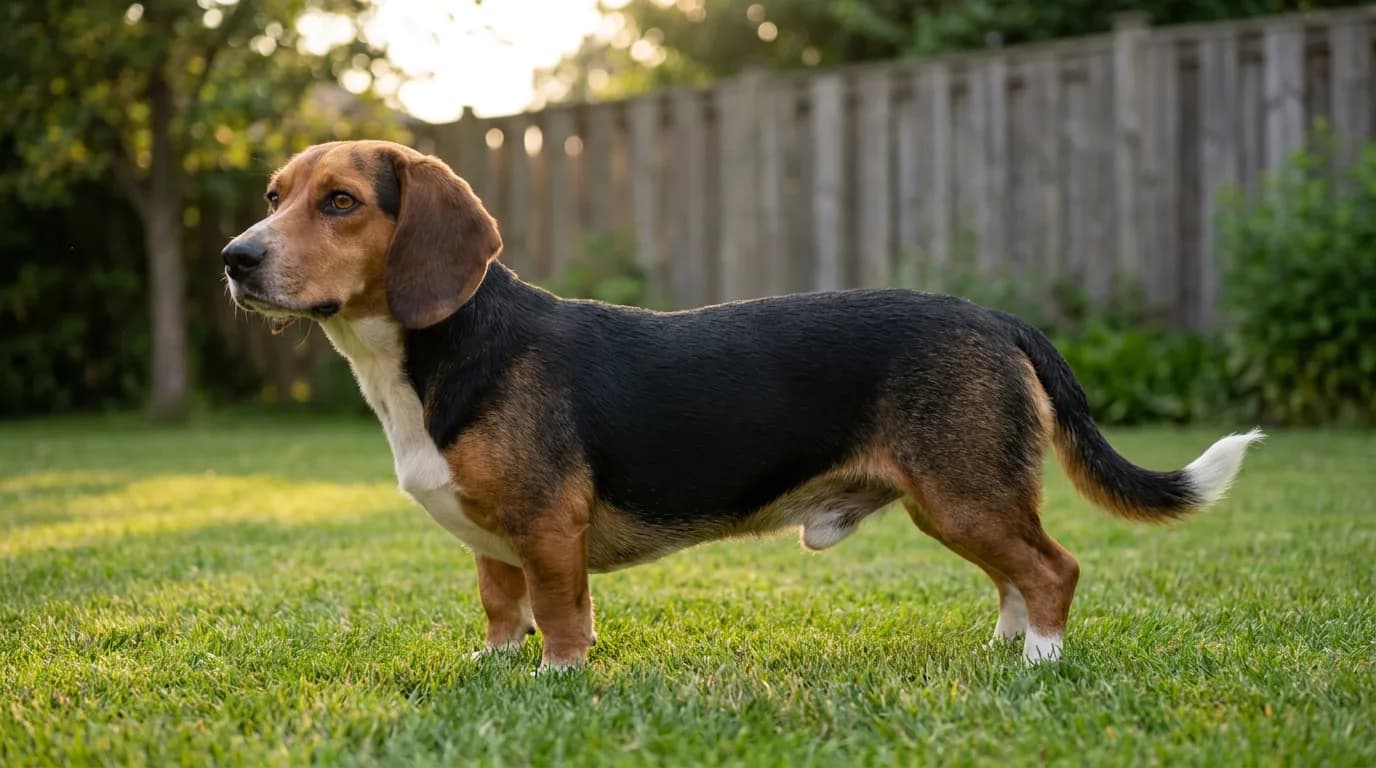
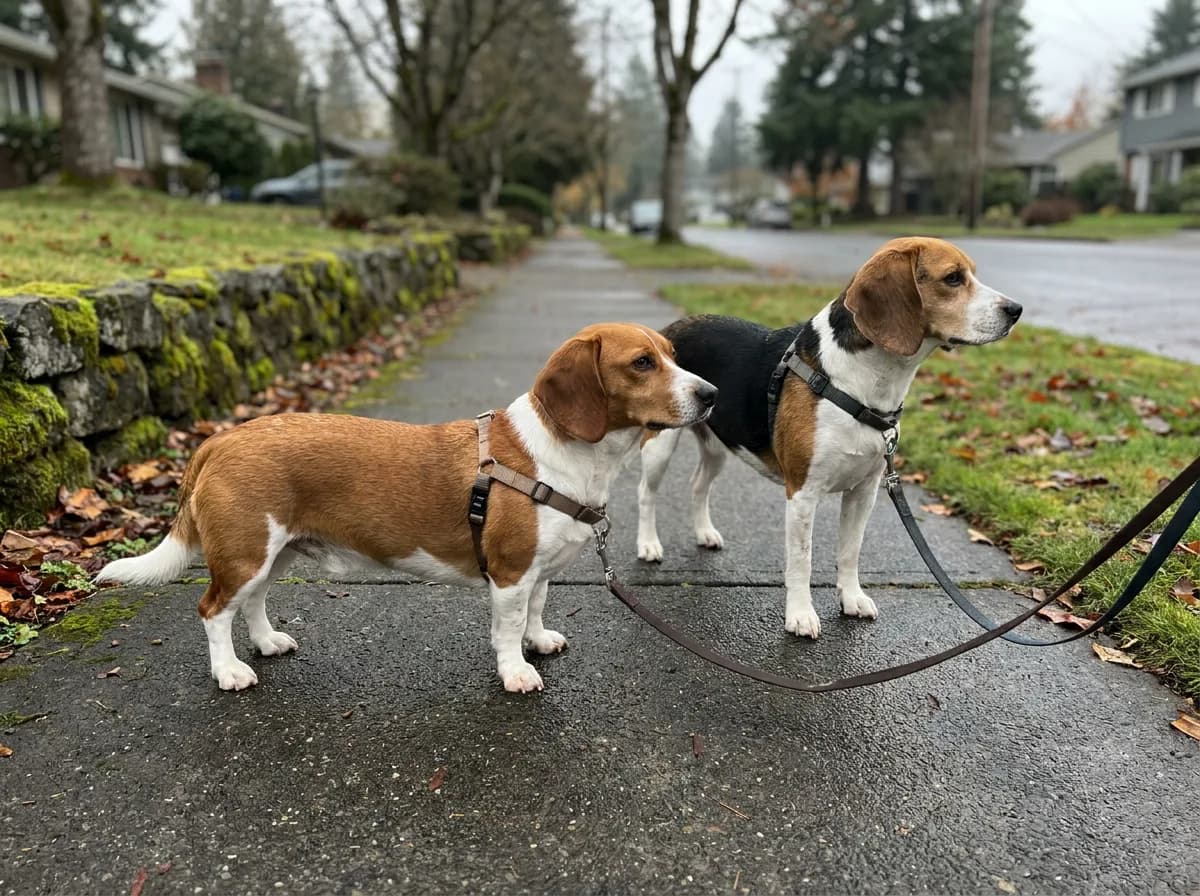
An adult tricolor Beagle Dachshund mix, or Doxle, with the long body, shortened legs, and Beagle-style head typical of the cross.
Petful is reader supported. As an affiliate of platforms like Amazon and Chewy, we may earn a commission when you buy through links on this page. There is no extra cost to you.
What is a Beagle Dachshund mix?
A Beagle Dachshund mix, usually called a Doxle, is a cross between a Beagle and a Dachshund: a long-bodied, nose-driven hound that most often weighs 16 to 30 pounds as an adult. It is not a recognized breed, and because both parent breeds carry the same genetic disc variant, back care is the one part of Doxle ownership you cannot skip.
- 1Names: Doxle is the common name; Beaschund and Beweenie are less common, and the AKC does not recognize the cross as a breed.
- 2Adult size: about 16 to 30 pounds and 9 to 13 inches at the shoulder with standard-size parents, less with a miniature Dachshund parent.
- 3Lifespan: about 12 to 15 years, estimated from the parents' AKC ranges.
- 4Temperament: friendly, food-driven, and vocal; a scent hound that follows its nose before it follows your recall cue.
- 5Health: a long back plus a disc variant inherited from both parents, so lift carefully and keep the dog lean.
The cross suits people who want a sociable, affectionate dog with a big voice and who will walk it on a leash every day. It is a harder fit if you need a quiet dog, work long days away from home, or keep rabbits or guinea pigs that run loose. Size, coat, and energy vary more than a single breed profile suggests, because a mix can take after either parent one trait at a time.
Most Doxles are first-generation crosses of a purebred Beagle and a purebred Dachshund. Some breeders pair two Doxles instead, and a shelter dog labeled "Beagle mix" or "Dachshund mix" may be a Doxle, sometimes with a third breed in the family tree. A shelter label is a visual guess, which is why the sections below lean on the parents' measurable traits rather than on the name.
Why is it called a Doxle?
A Dachshund Beagle mix is most often called a Doxle, a blend of "Doxie," the Dachshund's nickname, and the end of "Beagle." You will also see the cross called a Beaschund or Beweenie, and some breeders simply write Doxie Beagle. Every one of these names describes the same Beagle and Dachshund cross.
The names come from breeders and from designer-dog registries, which record crosses rather than breeds, not from a breed club. The American Kennel Club registers purebred dogs and does not recognize the Doxle as a breed, so no official standard fixes a Doxle's size, color, or coat. That is the practical meaning of "designer dog": the name tells you the parents, not what the adult will look like.
A Doxle is not shut out of organized dog sports, though. Mixed-breed dogs can enroll in AKC Canine Partners and compete in events such as Scent Work, rally, and agility, and Scent Work in particular suits a dog built around its nose.
What each parent breed brings
Every Doxle trait traces back to two very different hunting jobs. The Beagle was developed in England as a pack hound that tracked rabbits and hares by scent, so it tends to be sociable with other dogs and loud on a trail; our Beagle breed guide covers the parent breed in depth. The Dachshund, whose German name means "badger dog," was bred to dig into a den and hold its own underground, which explains its independence, its big bark, and its long, low body, as our Dachshund breed guide explains.
| Trait | Beagle | Dachshund |
|---|---|---|
| Original purpose | Hunting rabbits and hares in packs by scent | Digging into badger dens and working underground |
| AKC size classes | 13 inches and under, or over 13 to 15 inches | Standard, or miniature at 11 pounds and under at 12 months |
| AKC weight | Under 20 pounds (13-inch) or 20 to 30 pounds (15-inch) | 16 to 32 pounds (standard) or 11 pounds and under (miniature) |
| Coat varieties | Smooth, dense double coat | Smooth, wirehaired, or longhaired |
| AKC barking level, 1 to 5 | 4 | 5 |
| AKC good with young children, 1 to 5 | 5 | 3 |
| Signature health risks | Obesity, dental disease, ear infections, epilepsy, hypothyroidism, disc disease | Intervertebral disc disease, obesity, ear infections |
| AKC life expectancy | 10 to 15 years | 12 to 16 years |
Because a mix can inherit each trait from either side, two Doxle littermates can look and act like different dogs. If you adopted a dog labeled as a Beagle or Dachshund mix and want to know what it really is, a breed DNA test can estimate its ancestry. The Embark Breed & Health Dog DNA Test Kit reports breed ancestry and also screens for the CDDY disc variant explained in the health section below, so the report can inform a discussion with your veterinarian about ancestry and inherited risk. It cannot establish a pedigree, diagnose disc disease, or predict whether an individual dog will develop back problems.
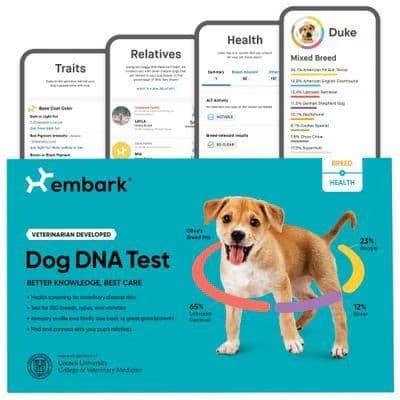
Petful may earn a commission when you click through to Chewy, at no extra cost to you.
How big does a Beagle Dachshund mix get?
A full-grown Beagle Dachshund mix usually has an adult weight of 16 to 30 pounds and a shoulder height of about 9 to 13 inches when both parents are standard-size. With a miniature Dachshund parent, an adult Doxle can finish in the low teens. The biggest influence is the parents themselves, because most first-generation puppies land somewhere between their mother's and father's adult sizes.
The table turns the parents' American Kennel Club size classes into a likely adult bracket for each common pairing. The brackets are Petful estimates, not measurements of Doxles: they assume a first-generation puppy finishes between its parents and narrow the parents' full ranges toward the middle, where most puppies from that pairing should land.
| Parent pairing | AKC classes behind it | Likely adult Doxle size bracket (weight) | Likely shoulder height |
|---|---|---|---|
| Standard Dachshund parent and 15-inch Beagle | Dachshund 16 to 32 lb; Beagle 20 to 30 lb, over 13 to 15 in | About 18 to 30 lb | About 9 to 13 in |
| Standard Dachshund parent and 13-inch Beagle | Dachshund 16 to 32 lb; Beagle under 20 lb, 13 in or less | About 15 to 25 lb | About 9 to 12 in |
| Miniature Dachshund parent and 13-inch Beagle | Dachshund 11 lb or less; Beagle under 20 lb | About 11 to 18 lb | About 7 to 11 in |
| Miniature Dachshund parent and 15-inch Beagle | Dachshund 11 lb or less; Beagle 20 to 30 lb | About 12 to 24 lb, the widest spread | About 8 to 13 in |
To read a puppy's likely size from its parents:
- Get real numbers. Ask for both parents' adult weights and heights, not just their breeds. A 13-inch and a 15-inch Beagle can differ by 10 pounds or more.
- Check the Dachshund's class. The AKC's miniature class is 11 pounds and under at 12 months, so a "mini" Dachshund that weighs 14 pounds is really a small standard.
- Expect legs to vary most. Part of the Dachshund's leg shortening comes from a second FGF4 gene copy on chromosome 18 that Beagles do not carry, so a Doxle's legs can land anywhere from Dachshund-low to nearly Beagle-tall.
- Weigh at 12 months. The AKC says small breeds usually finish growing by 6 to 8 months and medium breeds by about 12, so by its first birthday a Doxle of either size has its adult frame, though it keeps filling out with muscle after that.
Judge a grown Doxle by its body condition rather than by the chart: a 32-pound Doxle from small parents is more likely overweight than big-boned. When you buy gear, measure length and chest instead of going by weight. Measure from the base of the neck to the base of the tail for a crate or coat, and around the deepest part of the chest for a harness. For bedding, measure your dog stretched out asleep and choose a bed with room to spare; the FurHaven Velvet Waves Perfect Comfort Orthopedic Sofa Bed in large gives a long-bodied dog a supportive base to stretch out on and a rim to rest its chin, so compare its inside dimensions with your measurement before you order.
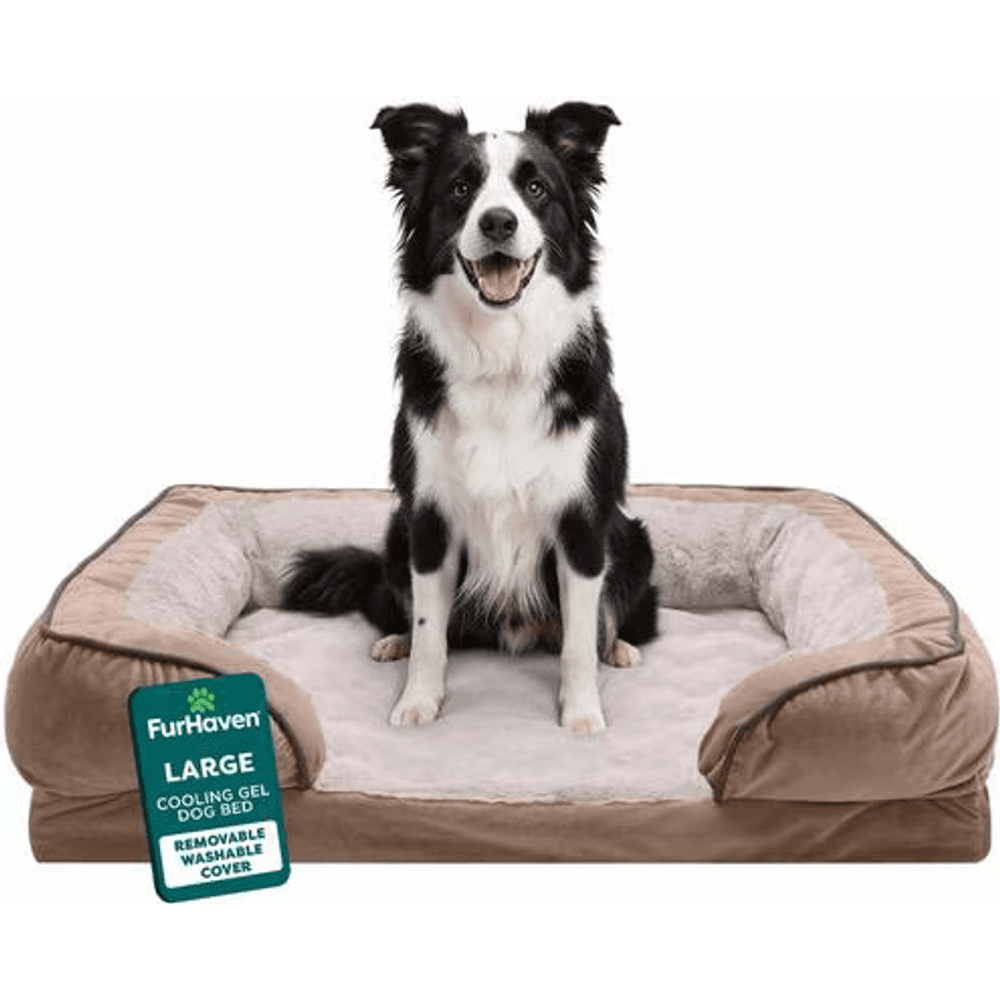
An orthopedic sofa bed with three bolstered sides for dogs who like to rest their head and joints against a cushion. The supportive foam base cradles hips and elbows, a comforting spot for an older or shaky dog to settle.
Petful may earn a commission when you click through to Chewy, at no extra cost to you.
Miniature Dachshund and Beagle mixes
A mini Doxle is a Beagle crossed with a miniature Dachshund, not a separate size with its own standard. In the AKC Dachshund standard, miniature is a weight class of 11 pounds or less at 12 months and older, so a true "mini" parent should weigh no more than that; our miniature Dachshund guide explains the class in detail. Because the Beagle side is almost always the heavier parent, most mini Doxles still finish bigger than their Dachshund parent.
The "mini" label is where buyers get misled. A breeder cannot promise that mini Dachshund Beagle mix puppies will stay small, and the widest-spread pairing in the size table is exactly this one when the Beagle parent is the 15-inch variety. A small Beagle parent adds its own uncertainty, especially one sold as a "pocket" or mini Beagle, which our pocket Beagle guide covers.
Small size does not lower the disc risk. The CDDY variant behind early disc degeneration is common in both parent breeds at every size, and a sofa is a longer drop for a 12-pound mini Doxle than for a 25-pound one, so the back routine later in this guide applies in full.
What does a Beagle Dachshund mix look like?
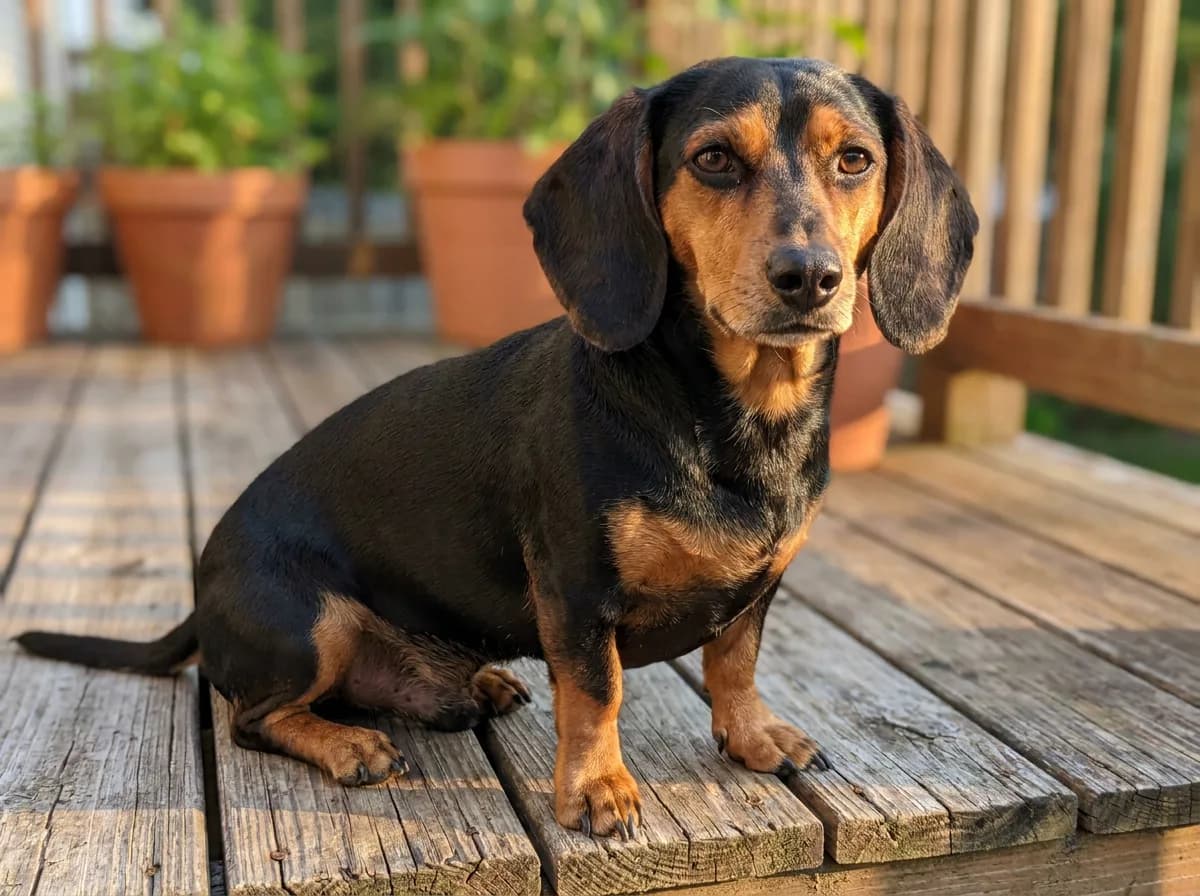
Most Doxles look like a Beagle stretched long and set lower to the ground: a Beagle-style head with long drop ears and brown eyes, a deep chest, a long body, and legs shorter than a Beagle's. The tail is usually carried up like a Beagle's, and the coat is most often a short, smooth coat in tricolor or black and tan. Photos of Doxles show how wide the range is, from dogs that pass for a long-legged Dachshund to dogs that look like a Beagle with an extra-long back.
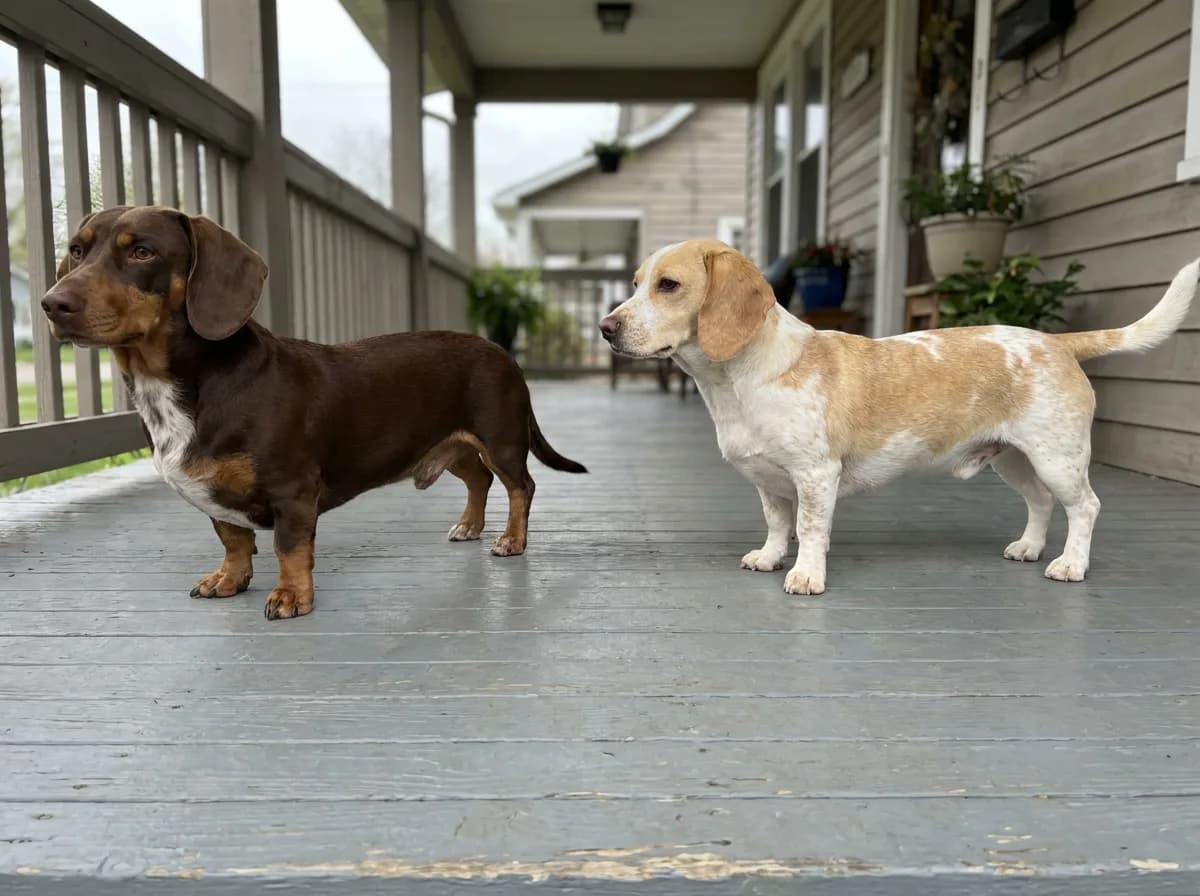
Two broad builds show up, sometimes in the same litter:
- Dachshund-type build: a long body, short legs, a chest that sits close to the ground, and often a longer, narrower muzzle.
- Beagle-type build: taller legs, a squarer outline, and the broad Beagle head, though the back is still longer than a purebred Beagle's.
- In-between build: a Beagle head on a lengthened body with moderately short legs.
Build tells you what the dog looks like, not how safe its back is. As the health section explains, the gene variant behind early disc disease comes from both parents, so a leggy, Beagle-type build does not mean a lower-risk spine.
Beagle Dachshund mix colors and patterns
Doxle colors come from both parents. Black and tan and the Beagle's tricolor coat of black, tan, and white are the looks most people picture, but a Doxle can show almost any Beagle or Dachshund color, often with white Beagle markings on the chest and tail tip. Dapple is the exception: it is a Dachshund-only pattern that shows up only when the Dachshund parent carries it.
- Black and tan: a standard color in both parent breeds, with tan points on the muzzle, eyebrows, chest, and legs.
- Tricolor: the classic Beagle coat of a black saddle, tan head, and white legs and tail tip.
- Lemon, red and white, or tan and white: Beagle colors that give a pale or ginger Doxle; lemon is a pale tan on white.
- Blue tick: Beagle ticking that makes the white areas look speckled gray.
- Red, cream, chocolate (brown), or wild boar: Dachshund colors that can produce a solid-looking Doxle with little or no white.
- Black, or black and white: a mostly black Doxle usually still shows some tan points, and a mostly white Doxle gets its white from Beagle markings or a piebald Dachshund parent.
- A first-generation Doxle from a Beagle cannot be a double dapple, because dapple is not a Beagle color, so a puppy inherits at most one copy. The risk appears when both parents carry dapple, such as two dapple Doxles or a dapple Doxle bred back to a dapple Dachshund. Double dapple puppies have a higher risk of eye defects, blindness, and deafness, and dapple can be nearly invisible on some coats. Before buying a dapple Doxle puppy, ask to see both parents and their color DNA results.
The numbers behind that warning come from merle genetics, since dapple is the Dachshund name for merle. In a study of 153 merle dogs, 25 percent of dogs with two merle copies had hearing loss in one or both ears, compared with about 4 percent of dogs with one copy, and the Royal Kennel Club will not register puppies from merle-to-merle matings. Our Dachshund colors and dapple guide explains how dapple, piebald, and brindle are inherited, and our Beagle colors guide covers tricolor, lemon, and blue tick coats.
Smooth, long-haired, and wirehaired coats
Most Beagle Dachshund mixes have a short, smooth coat. The Dachshund comes in three coat varieties, smooth, wirehaired, and longhaired, but coat genes do not blend evenly, so the Dachshund parent's coat predicts a first-generation Doxle's coat only partly:
- Smooth Dachshund parent: a smooth Doxle with a short, close-lying coat much like a Beagle's.
- Long-haired Dachshund parent: usually smooth-coated puppies, because long hair is recessive. A long-haired Doxle generally needs the gene from both sides, which most often happens when two Doxles that carry it are bred together.
- Wirehaired Dachshund parent: some first-generation puppies can have a wiry, bearded coat, because the furnishings gene behind wire coats is dominant and one copy can show.
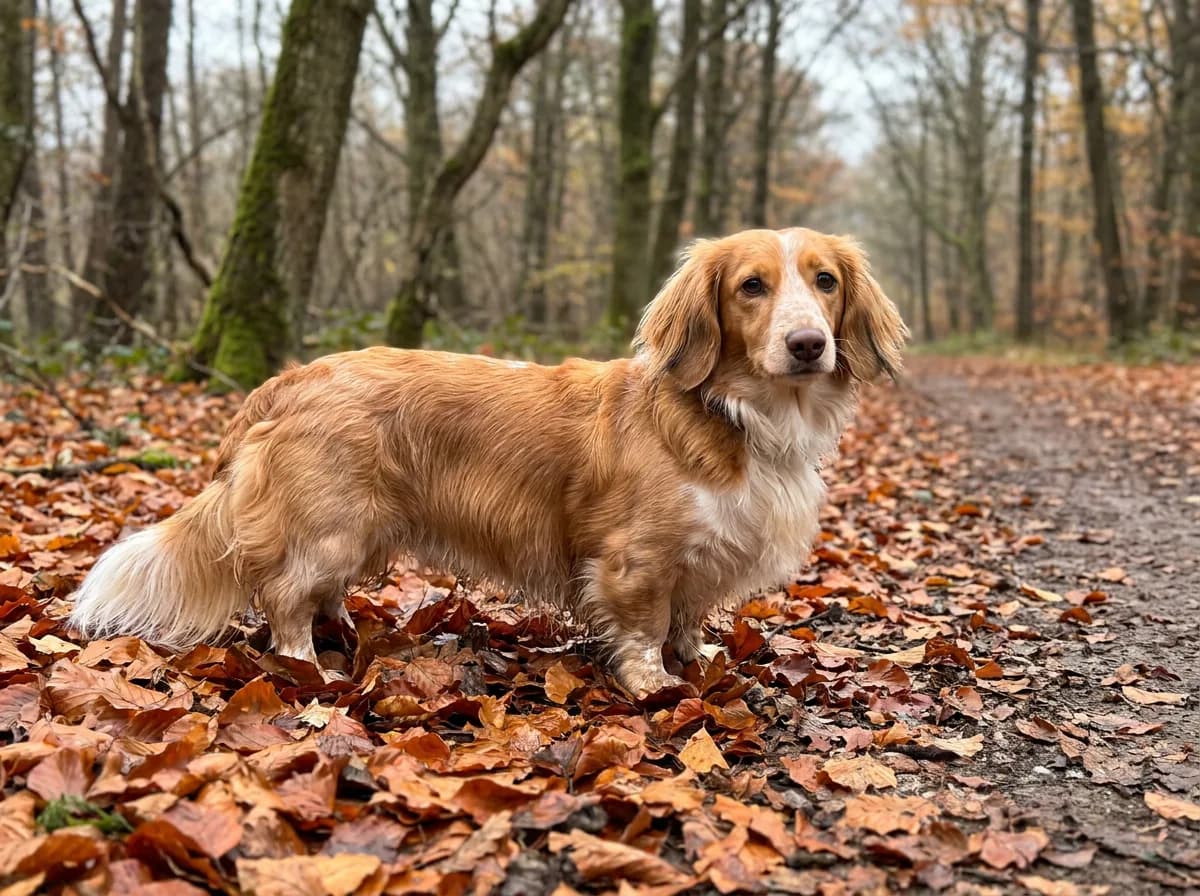
Shedding is moderate whichever coat a Doxle has. The AKC describes the Beagle's coat as a dense double coat that sheds moderately year-round and more heavily in spring, and it calls Dachshunds moderate shedders. Smooth Doxle hairs are short and stiff, so they weave into upholstery; a weekly rub with a rubber grooming mitt or hound glove removes most of them before they land.
A long-haired coat, with feathered ears and tail, needs brushing a few times a week to prevent mats behind the ears and under the legs. Wire coats need brushing once or twice a week plus plucking or hand-stripping several times a year, the same care the AKC describes for wirehaired Dachshunds. Our guide to whether Dachshunds shed goes deeper on each coat.
Beagle Dachshund mix temperament
The typical Beagle Dachshund mix temperament is friendly, curious, and food-driven, with a streak of independence from both hunting parents. Many Doxles are affectionate with their own people and sociable with visitors, but both parents were bred to follow a scent or dig after prey rather than wait for instructions. Expect a dog that listens well in the kitchen and much less well in the yard.
The AKC's breed trait ratings show where the two sides pull. On its 1 to 5 scales, the Beagle scores 5 for being good with young children and 5 with other dogs, while the Dachshund scores 3 and 4. The Dachshund scores higher for affection with family (5 versus 3) and for watchdog instinct (4 versus 2). A Doxle can land anywhere between those numbers, which is why meeting the individual dog matters more than the label.
Scent drive shapes most of daily life with a Doxle:
- Nose-first walks: the dog may stop, zigzag, and pull hard toward a trail.
- Selective hearing outdoors: a good smell usually beats your voice, which is why the AKC says Beagles should always be walked on a leash.
- Digging: the Dachshund was bred to dig into dens, and a bored Doxle will dig in the yard, in flower beds, and under fences.
- Food theft: a Beagle nose plus Dachshund persistence makes counters, trash cans, and handbags targets.
- Prey drive: squirrels, outdoor cats, and small pets can trigger a chase.
Because the pull toward a scent can be sudden and strong, a padded harness is a better match than a collar for daily walks, since it takes the load on the chest instead of the neck. The EliteField Padded Reflective No Pull Dog Harness is one option to compare; the linked listing is the small size, so check your Doxle's chest measurement against the maker's size chart before choosing.
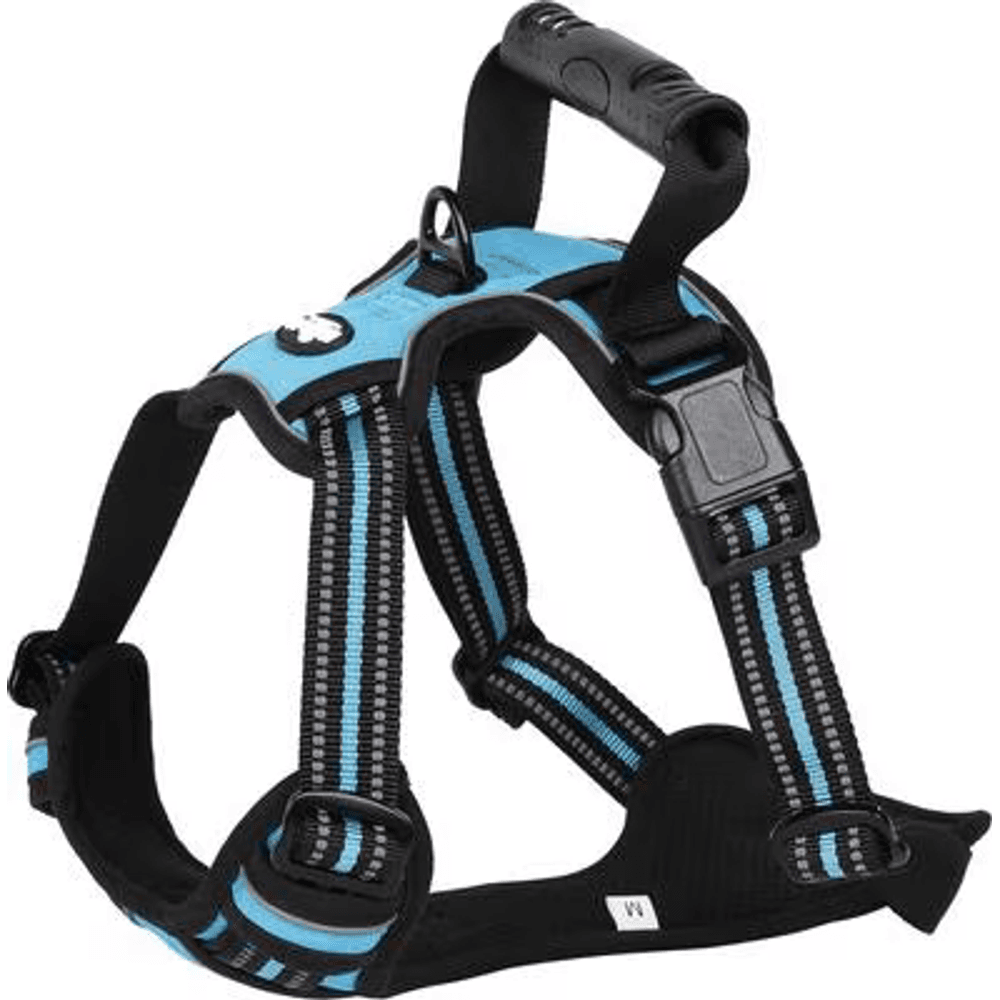
A padded, reflective no-pull harness that spreads leash pressure across the chest instead of the throat, the switch most vets recommend for a dog with a cough, a collapsing trachea, or any airway irritation so the leash never presses on
Petful may earn a commission when you click through to Chewy, at no extra cost to you.
Sex matters less than the individual. Neither a boy nor a girl Beagle is better: the clearest differences show up in intact dogs, since an unspayed female comes into heat about every six months and an intact male is more prone to roaming and urine marking. In a Doxle, socialization, training, and which parent the dog takes after shape behavior far more than whether it is male or female. Cuddling is similar: many Beagles like to cuddle at night, and a house-trained adult can share your bed if everyone sleeps well, while a puppy does better in a crate beside the bed. Many Doxles are happy lap dogs in the evening, which fits the Dachshund's affection rating, but a dog that sleeps on your bed needs pet steps or a ramp so it is not jumping down in the dark. Our Beagle breed guide covers whether boy or girl Beagles are better and how cuddly Beagles tend to be in the purebred parent.
Barking, baying, and howling
Expect a vocal dog. The AKC rates the Beagle 4 and the Dachshund 5 on its 1 to 5 barking scale, and the two voices are different. Beagles bay, a drawn-out hound howl used on a trail, while the Dachshund has what the AKC calls a big-dog bark, bred so a hunter above ground could find the dog underground. Many Doxles use both.
Common barking triggers include:
- Scents and wildlife seen or smelled through a window or fence.
- Doorbells, footsteps, and people passing the house, thanks to the Dachshund's watchdog streak.
- Boredom after a day without enough walking or sniffing.
- Being left alone, which can set off howling in a dog descended from pack hounds.
Management works better than suppression. Give a sniff walk before the hours you need quiet, block the window a dog patrols, reward quiet after one or two alert barks, and build alone time up gradually. Harsh corrections tend to backfire, and the AKC notes that both parent breeds respond poorly to harsh training.
If you are comparing Beagle crosses for noise, a Beaglier (a Beagle and Cavalier King Charles Spaniel cross) is likely the quieter choice, but no study has measured Beaglier barking and it is not a quiet dog. The AKC rates the Cavalier 3 for barking against the Beagle's 4 and the Dachshund's 5, and a Beaglier's Beagle half can still bay. Our guide to other Beagle mixes compares the Beaglier with other crosses.
Are Beagle Dachshund mixes good family dogs?
Yes: a Dachshund Beagle mix is a good family dog for most households that can supervise young children, handle a long back correctly, and live with a vocal, food-motivated hound. Doxles tend to be playful and affectionate, and the Beagle side brings top AKC scores for getting along with children and other dogs. The Dachshund side adds a watchdog streak and less patience with rough handling.
| Household | How a Doxle usually fits | What to plan |
|---|---|---|
| Young children | Usually good; playful and tolerant, but a long back is easy to hurt | Supervise play and teach children to cuddle on the floor instead of lifting the dog |
| Older children | Often an excellent match | Share feeding, leash, and training jobs |
| Cats | Often fine when raised together; outdoor cats may be chased | Slow introductions and a dog-free escape route for the cat |
| Small pets such as rabbits, guinea pigs, or hamsters | Risky, since both parents were bred to hunt small animals | Keep cages out of reach and never leave the dog alone with them |
| Other dogs | Usually good, since Beagles are pack dogs | Match play styles and avoid rough play with much bigger dogs |
| First-time owners | Workable with patience | Budget for a training class and start house-training on day one |
| Less active owners | Only with daily walks | Plan about an hour of walking and sniffing every day |
The biggest family risk is not temperament but handling. Children tend to scoop a small dog up under the front legs, which leaves a long back hanging unsupported. Teach kids to sit on the floor for cuddles and let adults do the lifting with the two-hand method in the back-care section below.
If you are weighing a purebred Beagle instead, the answer is similar: yes, a Beagle is a good house dog, and it should live indoors with its family rather than in the yard. The AKC says Beagles need at least an hour of exercise a day and are happiest with company, so the best fit is a home where someone is around much of the day and food and trash stay out of reach. Our Beagle breed guide covers whether Beagles are good house dogs in detail.
Beagle Dachshund mix health and lifespan
Most Beagle Dachshund mixes live about 12 to 15 years. That is an estimate, not a measured Doxle figure: the AKC gives the Beagle a life expectancy of 10 to 15 years and the Dachshund 12 to 16, and no study has tracked Doxle lifespan directly. The health problems most likely to complicate those years are shared by both parents, which is what sets this cross apart from many designer mixes.
The biggest shared risk is intervertebral disc disease (IVDD), and it does not depend on a Doxle inheriting short Dachshund legs. A 2017 study in PNAS identified an extra copy of the FGF4 gene on chromosome 12, now called the CDDY variant, that makes discs degenerate early; dogs with IVDD had roughly 50 times the odds of carrying it. A 2019 follow-up found two copies in all 29 Beagles and in 479 of 509 Dachshunds it genotyped, so the CDDY disc risk comes from both parent breeds.
The Dachshund's extra leg shortening comes partly from a second FGF4 copy on chromosome 18 that Beagles lack, and that variant had only a minor effect on disc disease in the same research. In mixed-breed dogs, carrying the chromosome 12 variant raised the odds of disc surgery about 18-fold, and one copy was enough, which matches the UC Davis Veterinary Genetics Laboratory description of the variant as dominant for disc changes. A CDDY DNA test result changes daily care like this:
- No copies: lower genetic risk, although discs can still fail for other reasons, so keep the basic back routine.
- One or two copies: expected in most Doxles. Treat the back routine below as non-negotiable, learn the warning signs, and price pet insurance before any back symptom appears.
- Breeding claims: because the variant is close to universal in both parent breeds, a breeder advertising "IVDD-free" Doxles should be able to show CDDY results for both parents.
Beyond the back, most Doxle health issues are everyday problems that run in one or both parents:
- Obesity: about 1 in 4 Beagles in a 2025 VetCompass study was diagnosed with obesity in a single year, the most common problem found, and extra weight loads a long spine.
- Dental disease: periodontal disease affected about 18 percent of the same Beagles.
- Ear infections: long drop ears trap moisture, and outer-ear infections affected about 11 percent of those Beagles; the AKC flags ear infections in Dachshunds too.
- Screened conditions: the AKC says responsible Beagle breeders screen for hip dysplasia, hypothyroidism, epilepsy, luxating patella, and eye disorders.
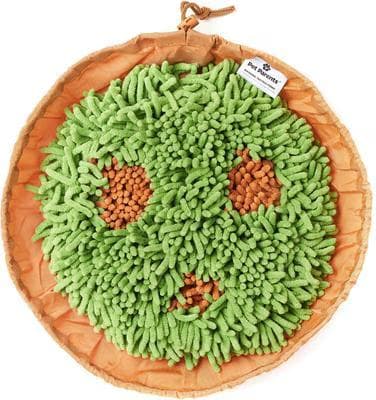
Weight control is the part you control most. Keep a Doxle at a body condition score of 4 to 5 on the WSAVA 9-point scale, where you can feel the ribs easily and see a waist from above. Feed measured meals, count training treats, and slow a fast eater down: the Pet Parents Forager Snuffle Mat & Slow Feeder Dog Bowl turns part of a meal into a nose game, which suits a scent hound better than a plain bowl.
Petful may earn a commission when you click through to Chewy, at no extra cost to you.
For breed-level depth, our Dachshund lifespan and back health guide covers disc disease in purebred Dachshunds, and our Beagle lifespan and health guide covers epilepsy, hypothyroidism, and how long Beagles live.
Protecting a Doxle's back
A back-safe routine uses ramps, a correct lift, and a lean body to cut down the everyday strain on a long spine. The AKC advises Dachshund owners to keep dogs from running up and down stairs or jumping on and off furniture, and this safe lifting technique and routine carry that advice over to the Doxle:
- Lift with two hands: support the chest with one hand and the hindquarters with the other, keeping the back level, and never lift by the front legs or the scruff alone.
- Add ramps or steps to the sofa, the bed, and the car, and teach the dog to use them before it needs them.
- Walk on a harness instead of a collar, so pulling toward a scent loads the chest rather than the neck, where discs can also rupture.
- Keep the dog lean, at a body condition score of 4 to 5 out of 9.
- Exercise every day; in the DachsLife survey of 2,031 Dachshunds, dogs exercised more than an hour a day had lower odds of disc disease, and dogs exercised under 30 minutes had higher odds.
- Put rugs or runners on slippery floors and gate off stairs for puppies and older dogs.
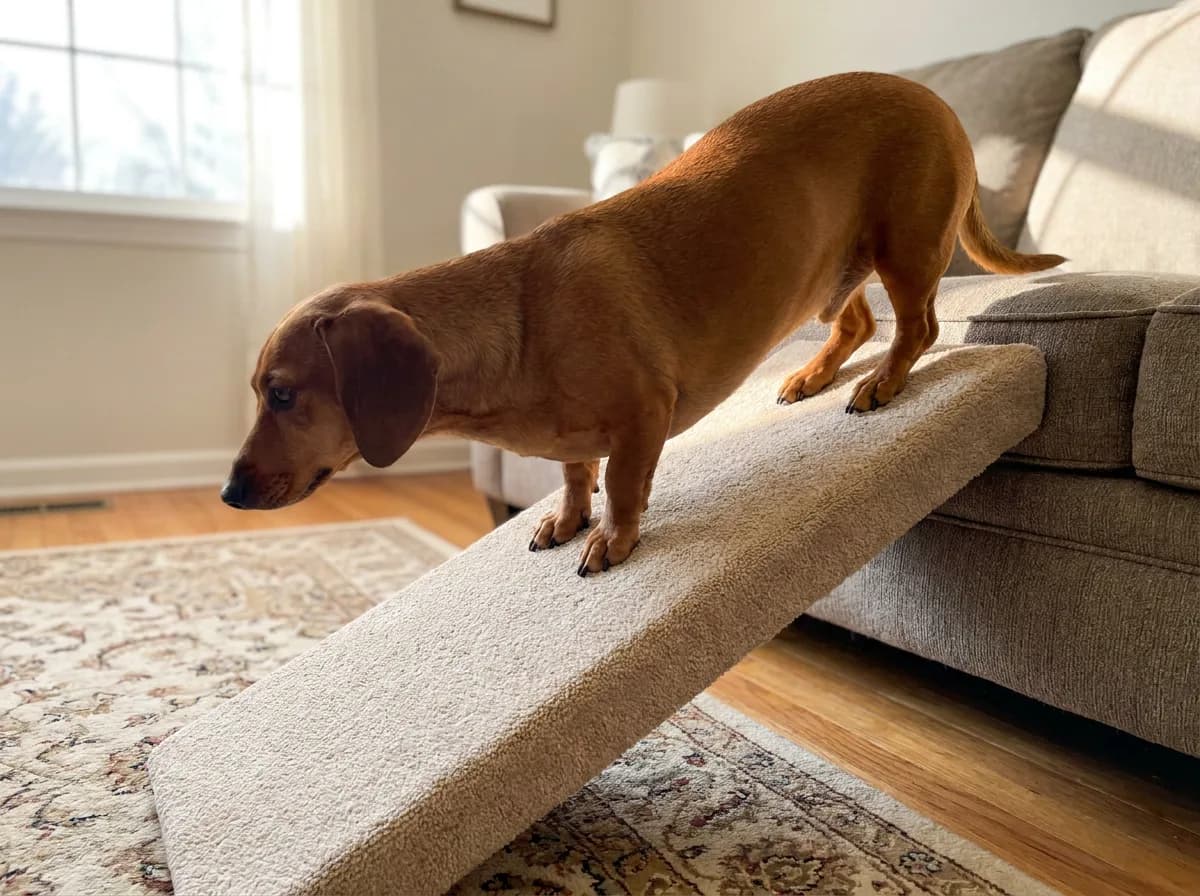
Two honest caveats apply. None of these steps has been proven in a trial to prevent disc disease, and the DachsLife survey even found that dogs kept off furniture had higher odds of IVDD; its authors suggest this may be reverse causality, since dogs with a past disc episode are the ones owners stop from jumping, and the same caution applies to its exercise findings. Ramps and a proper lift still make sense because they cut out hard landings at almost no cost, but genetics sets the baseline, so a careful owner can still face a disc episode.
Know what an episode looks like, because speed matters. The American College of Veterinary Surgeons describes disc rupture as a true surgical emergency, with outcomes that depend on how much nerve function remains when treatment starts.
- Call your veterinarian the same day if your Doxle cries when picked up, hunches its back, trembles, won't lower its head to eat or drink, or walks as if drunk on wobbly hind legs. Go to an emergency clinic immediately if it drags its hind legs, cannot stand, or loses bladder control.
Grooming a Beagle Dachshund mix
Doxle grooming and shedding needs are modest, and most of the routine is about ears, nails, and teeth rather than coat:
- Coat: brush a smooth coat weekly with a rubber mitt or hound glove, and a long or wire coat more often, as described in the coat section above.
- Ears: check and wipe the outer ears weekly, as the AKC advises for Beagles.
- Ear trouble: a sour smell, redness, or head shaking is a reason for a vet check rather than more cleaning.
- Nails: trim monthly, as the AKC advises for Dachshunds, because long nails change how a dog stands and walks.
- Teeth: brush several times a week or daily, since dental disease was the second most common diagnosis in the UK Beagle study.
- Baths: only when the dog is dirty; frequent bathing is not needed for either parent's coat.
Groom on the floor or on a low, non-slip surface rather than lifting a Doxle onto a high table, and keep sessions short with treats for holding still. Nail trims and ear checks go faster when a puppy learns to accept paw and ear handling early. For the weekly wipe, pre-moistened wipes such as Zymox Advanced Enzymatic Dog & Cat Ear Wipes are made for routine cleaning of the outer ear; they do not treat an ear infection. For the cleaning technique, see WebVet's step-by-step dog ear-cleaning guide.
How much exercise does a Beagle Dachshund mix need?
Most adult Doxles meet their exercise needs with about 60 minutes of exercise a day, split into two or three sessions. That sits between the parents: the AKC says Beagles need at least an hour a day and suggests two walks of moderate length for Dachshunds. In the DachsLife survey, Dachshunds that got more than an hour a day also had lower odds of disc disease, though that link may partly reflect owners resting dogs after a back problem.
A good way to split the hour:
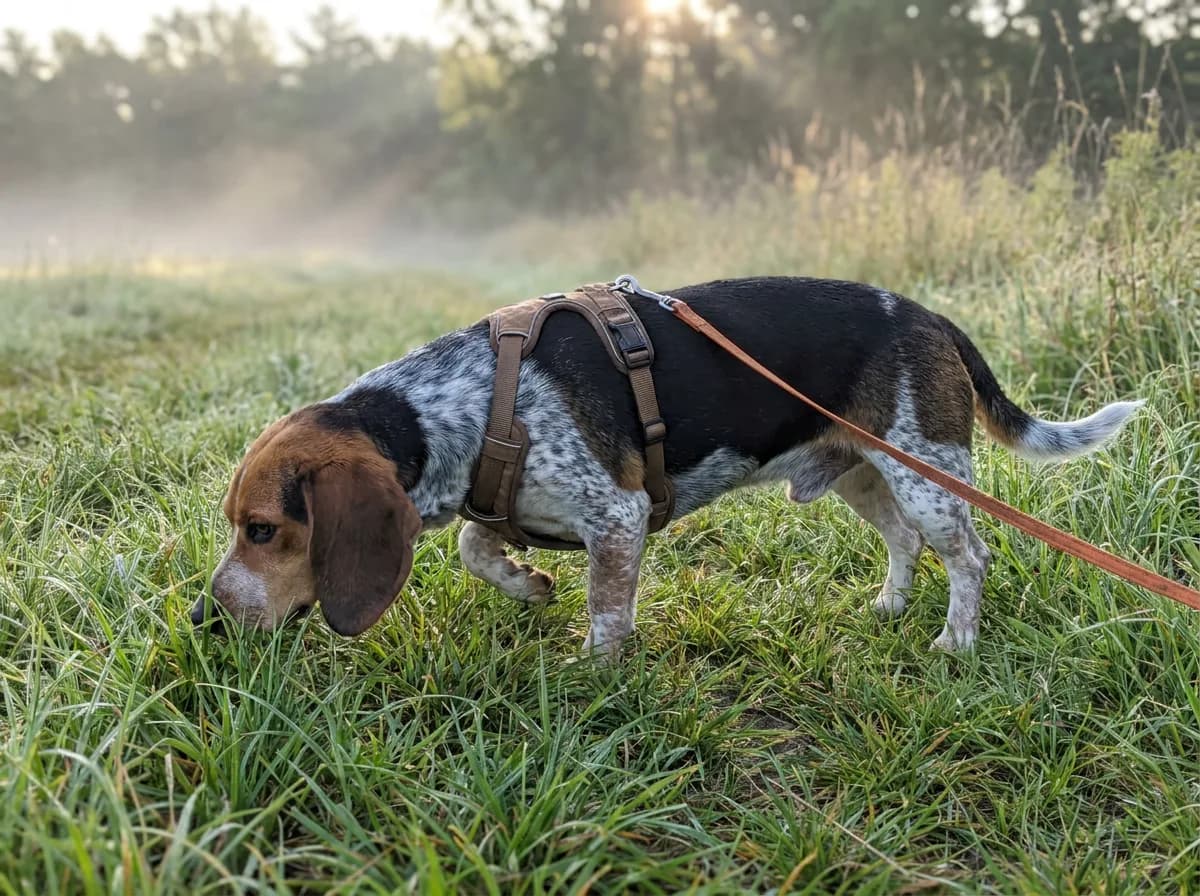
- Sniff walks: two walks of 20 to 30 minutes on a harness, at the dog's pace, with time to follow scents. For a scent hound, sniffing is the workout.
- Nose games: 10 minutes of hunting for hidden treats or part of a meal around the house or yard.
- Back-safe play: balls rolled along the ground, gentle tug, and fetch on flat grass rather than leaping catches.
- Short training games: recall and "find it" practice count toward the total.
Activities to limit:
- Repeated jumping, such as leaping for balls or flying discs.
- Stair races and jumping off furniture or out of the car.
- Long runs or hikes before the dog is full-grown at about 12 months.
- Rough wrestling with much bigger dogs.
- Off-leash time in unfenced areas, where a scent can carry a Doxle out of earshot in seconds.
Check the yard before you trust it. The AKC recommends a fence at least five feet tall that extends underground for escape-prone Beagles, and a Doxle adds the Dachshund's instinct to dig under whatever it cannot climb.
Sniffing does more than tire a dog out. In a 2019 study, pet dogs given two weeks of nosework games approached uncertain situations more optimistically than dogs given heelwork training. If your Doxle loves the game, AKC Scent Work is open to mixed breeds through the Canine Partners program.
Training a scent-driven Doxle
Training a Doxle works best with food, short sessions, and patience. The AKC notes that Beagles respond to treats and positive reinforcement rather than harsh methods, and that Dachshunds are intelligent but independent and often stubborn. Put together, that describes a dog that learns quickly and decides for itself when to use what it knows.
Skills worth practicing first:
- Name check-in: reward every glance back at you on a walk, because check-ins are the foundation of recall.
- Leave it: the most useful cue for a food thief; start with boring items and work up to dropped food.
- Recall on a long line: practice on a 15- to 30-foot line in a fenced area before trusting a recall anywhere open, and expect a fresh scent to win for months.
- Loose-leash walking: stop when the leash tightens and move forward when it slackens.
- Settle on a mat: rewarding calm is how you get a quiet evening with a busy hound.
Keep treats tiny and count them. Veterinary nutrition guidelines keep treats to about 10 percent of daily calories, and a food-driven Doxle can gain weight on its own training lessons. A small, soft reward such as Zuke's Mini Naturals Chicken Recipe Pet Treats can be broken into even smaller pieces, so one pouch covers many repetitions. House-training has its own quirks, covered in the FAQ below.
Beagle Dachshund mix price and puppy costs
No registry or published survey tracks what Doxle puppies sell for, so there is no reliable Doxle price. The useful anchors are adoption fees and all-breed cost data. Rescues that place Beagles, Dachshunds, and their mixes publish fees of about $150 to $500, and Rover's 2026 cost survey put breeder prices across all breeds at $675 to $4,400, with up to $1,100 more for a breeder puppy's vaccines and spay or neuter surgery.
| First-year costs | Typical range | Source and scope |
|---|---|---|
| Adoption fee | $150 to $500 at Beagle and Dachshund rescues; $50 to $500 across shelters and rescues | Rescue fee schedules and Rover 2026; usually includes spay or neuter, vaccines, and a microchip |
| Breeder puppy | No Doxle-specific data; $675 to $4,400 across all breeds | Rover 2026 survey; add up to $1,100 for vaccines and spay or neuter |
| Spay or neuter and microchip, if not included | $300 to $800 and $30 to $80 | Rover 2026 survey, all breeds |
| First-year care | $1,460 to $6,745 for a puppy | Rover 2026 annual range for puppies |
| Accident and illness insurance | About $836 a year | NAPHIA average premium for US dogs in 2025 |
| Disc surgery if IVDD strikes | $3,000 to $8,000 plus $1,000 to $3,000 for imaging | PetMD estimate written by a veterinarian (2024) |
Put together, a rescue Doxle puppy's first year runs roughly $1,600 to $7,200: a $150 to $500 adoption fee plus Rover's first-year care range for a puppy. For an adult rescue, Rover's adult range of $1,930 to $5,305 a year replaces the puppy figure. A breeder puppy adds its purchase price on top of the same care costs, plus spay or neuter surgery if the breeder has not done it.
If you buy a puppy, a fair price buys information, not a rare color. Ask the breeder for:
- Both parents' adult weights and heights, and a chance to meet at least the mother.
- Veterinary records for the puppy's first exam, vaccines, and deworming.
- DNA results for both parents, including CDDY and, for any dapple parent, a merle test.
- A written health agreement that says what happens if a back problem appears.
- A clear answer on whether both parents are dapple; a dapple-to-dapple litter is a reason to walk away.
Insurance is worth pricing early for this cross. Most policies exclude conditions that show signs before coverage starts, and one disc surgery can cost more than several years of premiums, so compare quotes while your Doxle is young and before any back problem shows up. When you compare, look at waiting periods and exclusions as well as the monthly price; Lemonade pet insurance is one insurer that quotes puppy plans online. For how the same costs look for a purebred Beagle, see our Beagle price guide.
Adopting a Doxle from a rescue
Adopting is the most direct way to find a Doxle, because Doxles in shelters and breed rescues are often listed simply as a Beagle mix or a Dachshund mix. Search both labels, and include Beagle and Dachshund breed rescues, since many place mixes. Little Paws Dachshund Rescue, for one, says its vetting is the same whether a dog is a purebred or a mixed Dachshund. Doxle puppies do come through rescues, but an adult dog has a known size, coat, and temperament, which removes most of the guesswork this cross is known for.
Fees vary by age. Dachshund Rescue of North America, for example, charges $350 for dogs under a year, $275 for dogs 1 to 7 years old, and $150 for dogs 8 and older, and Beagle rescues publish similar schedules. The fee usually covers spay or neuter, vaccines, a microchip, and a vet check, which would cost more to buy separately.
Questions to ask a rescue or foster:
- Has the dog shown back pain, limping, or episodes of weakness?
- How vocal is it at home, and when left alone?
- How does it act with cats, small pets, and children?
- Is it house-trained, and how does it handle a crate?
- Has it been DNA tested, and did the results include CDDY?
Behavior problems are the number one cause of relinquishment to shelters, according to the American Veterinary Society of Animal Behavior, and the Oregon Humane Society's Beagle guide describes the Beagle versions: baying that is nearly impossible to train out, escapes from poorly secured yards, raids on trash and counters, and destructiveness when a Beagle spends too much time alone. A Doxle inherits the same traits, so ask the foster how the dog handles each. Our Beagle breed guide looks at why Beagles end up in shelters.
Beagle Dachshund mixes with a third breed
A shelter dog labeled as a Beagle Dachshund mix may have a third breed somewhere in its family tree, and that breed can change the dog more than either named parent. The table uses each third breed's AKC size and trait ratings to show what it usually changes. A breed DNA test can identify evidence of a third breed, but the percentages remain statistical estimates rather than a pedigree.
| Third breed in the mix | What it changes in a Doxle mix | Size of that parent (AKC) | Energy and voice (AKC, 1 to 5) |
|---|---|---|---|
| Chihuahua | Shrinks the dog; may add a rounder head and upright ears | Not exceeding 6 lb | Energy 4; barking 5 |
| Jack Russell Terrier | Adds terrier speed, digging, and prey drive | 9 to 17 lb for the related Russell and Parson Russell Terriers | Energy 5; barking 3 to 4 |
| Corgi | Keeps the low build; may add herding instincts and heavier shedding | Up to 30 lb (Pembroke) | Energy 4; barking 4; shedding 4 |
| Pug | Can shorten the muzzle, which brings breathing and heat risks | 14 to 18 lb | Energy 3; barking 1 |
| Basset Hound | Heavier, lower, and slower, with a deep bay | 40 to 65 lb | Energy 2; barking 4 |
| German Shepherd, Rottweiler, Boxer, or Labrador | Adds size and height, putting a heavier frame on a long back | 50 to 135 lb, depending on breed | Energy 3 to 5; barking 1 to 3 |
| Pit bull-type terrier | Adds muscle, size, and a broad head | 40 to 70 lb (American Staffordshire Terrier) | Energy 3; barking 3 |
Clues that a dog labeled as a Doxle has a third breed in the mix:
- An adult weight above about 32 pounds, the top of the AKC range for either parent, points to a larger third breed.
- Upright ears point to a Chihuahua or a Corgi, since both Beagles and Dachshunds have drop ears.
- A tail curled over the hip or a very short muzzle suggests Pug ancestry.
- Herding habits such as circling people or nipping at heels point to a Corgi or a shepherd.
Several of these combinations have two-breed versions with their own profiles. Our guide to other Dachshund mixes covers the Jackshund (Jack Russell and Dachshund), the Dorgi (Corgi and Dachshund), and larger crosses such as the Dachshund with a Lab, German Shepherd, or pit bull. The Puggle guide covers the Pug and Beagle cross, and our Basset Hound vs Beagle comparison shows how those two hounds differ.
With any large third breed, remember that more weight on a long back means more load on the spine. A 40-pound dog with Dachshund proportions needs the back routine and the lean body condition even more than a small Doxle does.
Chihuahua, Beagle, and Dachshund mixes
A Chihuahua, Beagle, and Dachshund mix comes from a Chiweenie bred to a Beagle, a Doxle bred to a Chihuahua, or a Chiweagle bred to a Dachshund. The Chihuahua share pulls size down, since the AKC standard caps Chihuahuas at 6 pounds, so these dogs are usually smaller than a typical Doxle, though a Beagle grandparent can still add height and weight.
Expect a big personality in a small body. The AKC rates the Chihuahua 5 of 5 for barking, the same as the Dachshund, so this is rarely a quiet mix, and it rates the Chihuahua 1 of 5 for young children, so homes with toddlers need extra supervision. A small dog with a long back also needs ramps even more, because a sofa is a long drop for a 12-pound dog.
This dog is not the same as a Chiweagle, the two-breed Chihuahua and Beagle cross with no Dachshund in it. Budget about $50 to $500 to adopt a Chiweagle or $675 to $4,400 to buy one from a breeder. No registry or survey tracks Chiweagle prices either, so those are the all-breed ranges from Rover's 2026 survey. Our guide to Beagle mixes covers the Chihuahua and Beagle cross, also called the Cheagle, and how it compares. For the Chihuahua and Dachshund side on its own, see our Chiweenie guide.
Beagle Dachshund mix FAQ
Yes, if you can manage the noise. Size is not the problem; barking is, because both parents rate high on the AKC's barking scale and a bored Doxle will bark or bay through shared walls. Plan two daily sniff walks, give the dog a chew or a nose game while you work, and block window views of the hallway or street. A ground-floor unit or an elevator also spares a long back from daily stair climbs.
Not for a full workday without help. Beagles were bred to work in packs, and the AKC warns that a Beagle left alone for long periods tends to become destructive. Build alone time up gradually from a few minutes, and for an eight- to nine-hour day arrange a midday walk from a family member, neighbor, or dog walker. Howling, chewing at doors, or accidents that happen only when you are away are signs of separation distress that deserve help from your veterinarian or a trainer.
No. The American College of Allergy, Asthma and Immunology says no dog breed is truly hypoallergenic, because the proteins that cause allergy symptoms are found in dog dander and saliva as well as hair. A Doxle also sheds moderately year-round. If someone in your home has dog allergies, spend time with the specific dog before committing.
Start with the feeding guide on your dog food bag for your Doxle's ideal weight, not its current weight if it is heavy, and split the total into two measured meals. Recheck every two to four weeks with a body condition score: on the 9-point scale, 4 to 5 means you can feel the ribs easily and see a waist from above. Count treats and chews, and keep them to about 10 percent of daily calories.
It can be useful if you want an ancestry estimate and inherited-risk information to discuss with your veterinarian. A breed test estimates ancestry, including possible additional breeds, and a test with a health panel adds a CDDY result that shows whether your dog carries one or two copies of the disc variant. A positive result does not mean your dog will develop disc disease, and a negative result does not rule out all back problems. Follow sensible back-care habits regardless of the result, and ask your veterinarian what the finding means for your dog. Our Embark vs Wisdom Panel comparison explains how the two major tests differ.
Not especially; plan on several months of consistency. Scent hounds get distracted outdoors and can be stubborn indoors, so use crate training and a consistent schedule: take the puppy out after waking, meals, play, and naps, and allow at most as many hours between breaks as its age in months plus one, the AKC's rule of thumb. Reward outdoor potties right away, and clean indoor accidents with an enzymatic cleaner so the smell does not draw the dog back. Our puppy potty training guide has a full schedule.
Sources
- American Kennel Club breed pages for the Beagle and Dachshund: size classes, weights, life expectancy, trait ratings, and care.
- Brown EA and colleagues, FGF4 retrogene on CFA12 is responsible for chondrodystrophy and intervertebral disc disease in dogs, PNAS, 2017.
- Batcher K and colleagues, Phenotypic effects of FGF4 retrogenes on intervertebral disc disease in dogs, Genes, 2019.
- Packer RMA and colleagues, DachsLife 2015, Canine Genetics and Epidemiology, 2016.
- O'Neill DG and colleagues, Beagles kept as companion animals in the UK, VetCompass, 2025.
- Strain GM and colleagues, Prevalence of deafness in dogs heterozygous or homozygous for the merle allele, Journal of Veterinary Internal Medicine, 2009.
- American College of Veterinary Surgeons: intervertebral disc disease.
- NAPHIA State of the Industry data, 2026 report.

Sign up for expert-backed reviews and safety alerts all in one place.

Coreen Saito is a pet writer and longtime shelter volunteer with more than a decade in animal rescue. She covers cat behavior, breed care, and the small, ordinary science of sharing a life with companion animals, with a particular focus on honest takes about the products and decisions that actually matter. At home in Arizona, she's outranked by Mac (a dog with the loudest opinion in the house), Rebel (a cat who governs by quiet authority), and Meri (an orange tabby who runs the late shift and the laundry basket). She writes about all three, plus the rescues that keep coming through her life, at LifeWithMinty.com.
Sign up for expert-backed reviews and safety alerts all in one place.