Aussiedoodle Color Chart: Every Coat and Pattern
A complete Aussiedoodle color chart covering blue merle, red merle, tri-color, bi-color, phantom, sable and parti coats, the merle genetics inherited from the Australian Shepherd side, and how puppy coats fade with age.
Petful is reader supported. As an affiliate of platforms like Amazon and Chewy, we may earn a commission when you buy through links on this page. There is no extra cost to you.
No other doodle cross wears as many patterns as this one, which is exactly why an aussiedoodle color chart is the first thing most buyers go looking for. The Australian Shepherd side brings merle, tan points, and white trim. The Poodle side brings a deep pigment range plus a fading gene that quietly rewrites the coat over the dog's first two years. Stack those two inheritances and you get blue merle, red merle, tri-color, bi-color, phantom, sable, parti, and a full set of solids in one breed.
This guide names every coat and pattern you will actually meet in a litter, explains the genetics behind each one in plain language, and flags the single pairing no ethical program will make. It is written specifically for the Australian Shepherd crossed with Poodle, not recycled from another doodle, because the merle patterns that define this cross simply do not exist in a Labradoodle or a Goldendoodle.
Two ideas carry through everything below. First, coat color in this cross is not one gene but a short committee of them, each answering a different question: how dark the base pigment is, whether a pattern is layered on top, and how fast the coat lightens. Second, the puppy in the photo is often not the adult you bring home, because Poodle-derived fading acts on most of these coats. Hold those two facts and the whole palette stops looking random.
- 1Aussiedoodles come in solids (black, red, chocolate, golden, grey), patterns (blue merle, red merle, tri-color, bi-color, parti, phantom, sable, tuxedo), and combinations of the two
- 2Merle comes exclusively from the Australian Shepherd parent, and a single merle copy is what produces the marbled coat and the blue eyes that often go with it
- 3Breeding two merle dogs together produces double merle puppies with a high risk of deafness and vision defects, and no reputable breeder makes that pairing

Sign up for expert-backed reviews and safety alerts all in one place.
What Colors Do Aussiedoodles Come In?
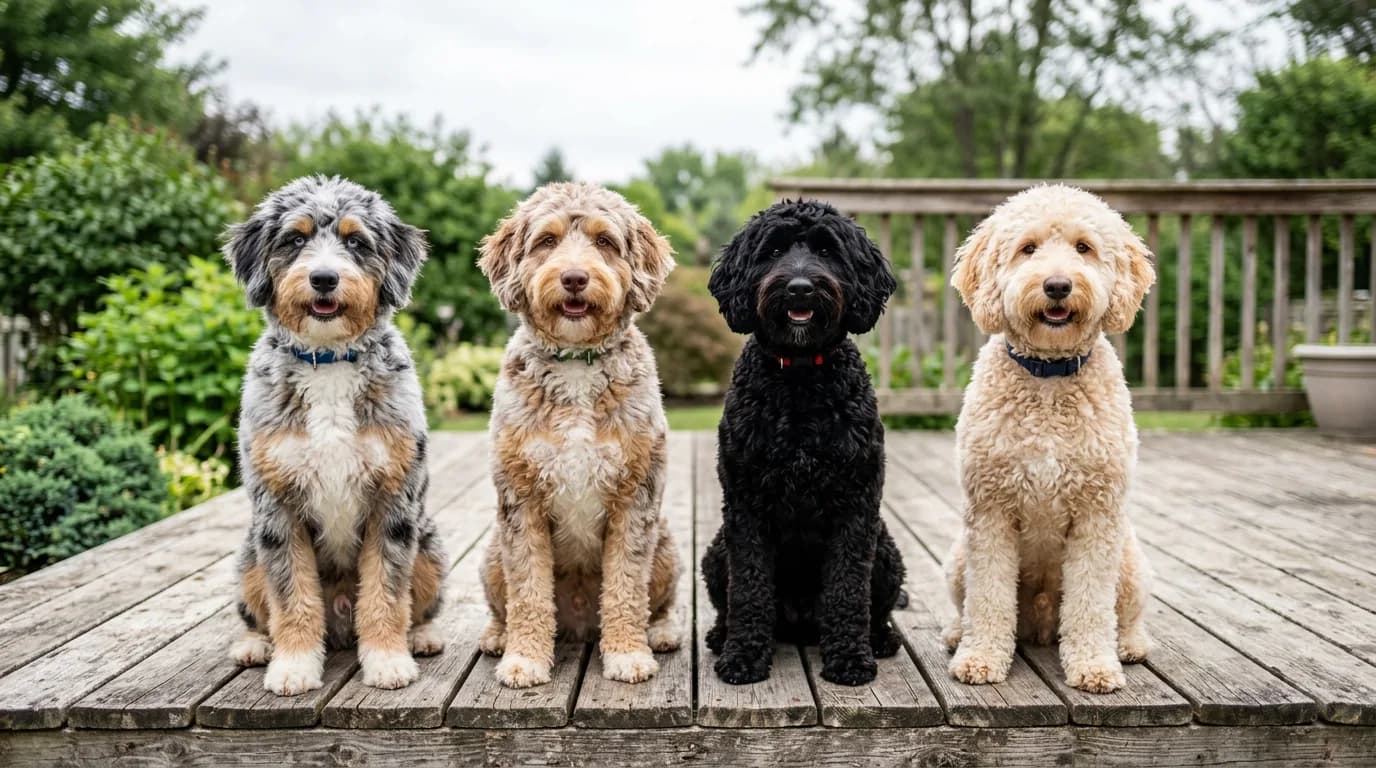
Aussiedoodles come in black, chocolate or brown, red, golden or apricot, cream, grey or silver, and blue, and any of those base colors can carry a pattern layered on top: merle, tri-color, bi-color, parti, phantom, sable, or tuxedo. There is no single governing standard for the cross, so the recognized coat colors are best understood as the Australian Shepherd's pattern set painted onto the Poodle's pigment range rather than as a fixed, closed list.
The practical way to read any Aussiedoodle is in two layers. Layer one is the base color, which is simply how much dark pigment (eumelanin) or red pigment (phaeomelanin) the dog carries and whether a brown or dilution gene has softened it. Layer two is the pattern, which decides how that pigment is arranged across the body. A "blue merle tri" is not one color, it is a black base plus the merle pattern plus tan points plus white trim, all named at once.
Here are the standard color patterns you will see described on litter announcements, grouped by what they actually mean:
- Solid coats: One even color from nose to tail, with no white beyond a small chest mark. Black, red, chocolate, and golden are the common solids.
- Bi-color coats: Two colors, most often a base color plus white trim on the chest, muzzle, feet, and tail tip. An Aussiedoodle black and white coat is the classic example.
- Tri-color coats: Three colors on one dog, meaning a base color plus copper or tan points plus white trim.
- Merle coats: A marbled, mottled pattern where patches of the base pigment are diluted. Blue merle and red merle are the two versions.
- Parti coats: At least half the dog is white, with large solid patches of a second color sitting on top.
- Phantom coats: A solid base with sharp tan or copper points in fixed places, and no white.
- Sable coats: Individual hairs tipped in black over a lighter base, so the dog looks darker as a puppy and lightens as the tipping wears off.
Two labels cause most of the confusion. Breeders sometimes call a heavily marked bi-color a "tuxedo" when the white sits neatly on the chest, throat, and paws like formal wear, and they sometimes call a lightly marked parti an "abstract" or "mismark." Both are the same white-spotting machinery expressed at different strengths, so judge the actual amount of white rather than the word.
Aussiedoodle Color Chart at a Glance
If you want one scannable reference before the section-by-section detail, this is it. The pattern reference table below pairs each coat with the gene driving it, which parent it comes from, and whether it typically holds or fades as the dog matures. Use this coat color comparison as your map, then read the sections that follow for the identification detail that photos alone never give you.
Petful may earn a commission when you click through to Chewy, at no extra cost to you.
| Coat or Pattern | What Drives It | Comes From | Holds or Fades |
|---|---|---|---|
| Black | Dominant dark pigment | Either parent | Often fades toward grey or silver |
| Chocolate or brown | Brown gene (B locus) | Either parent | Fades strongly toward cafe or silver-beige |
| Red or apricot | Red pigment (E locus) | Either parent | Usually softens with age |
| Golden or cream | Lightened red pigment | Either parent | Fades further toward cream |
| Grey, silver, blue | Progressive fading on a black base | Poodle side | Fading is the mechanism |
| Blue merle | Merle gene on a black base | Australian Shepherd only | Pattern holds, base may lighten |
| Red merle | Merle gene on a brown base | Australian Shepherd only | Pattern holds, base may lighten |
| Tri-color | Tan points plus white trim | Australian Shepherd side | Points can soften |
| Bi-color | Base color plus white trim | Australian Shepherd side | Contrast can soften |
| Parti | Piebald spotting (S locus) | Poodle side | White stays, patches may fade |
| Phantom | Tan points (A locus), no white | Either parent | Points can soften |
| Sable | Black-tipped hairs over a light base | Either parent | Fades noticeably as tips wear off |
A useful trick when the chart and the puppy disagree: check the nose and eye rims rather than the coat. Dogs built on black pigment keep a black nose no matter how far the coat fades, and dogs built on brown pigment keep a liver or rose-colored nose with lighter, amber-toned eyes. A faded adult that looks silver-beige is telling you it started chocolate if the nose is liver, and that it started black if the nose is black.
Eye color deserves its own note, because it is the second thing people search after the coat itself. Aussiedoodle blue eyes come almost entirely from the merle side of the family, and a blue eyed Aussiedoodle is usually a merle or a dog carrying heavy white trim around the face. Heterochromia, meaning one blue eye and one brown eye, is common in merles and is purely cosmetic on a single-merle dog. Blue eyes on their own are not a health problem. Blue eyes plus a mostly white coat plus two merle parents is an entirely different situation, covered below.
- Aussiedoodle is not a recognized purebred, so one program's "blue" is another's "silver" and one breeder's "merle tri" is another's "blue merle with points." Judge the coat in natural daylight, ask which parent carried which pattern, and treat the label as shorthand rather than as a guarantee.
How the Merle Gene Reaches Your Aussiedoodle
Search "Aussiedoodle merle" and you will get page after page of photo galleries and almost no explanation of where the pattern actually comes from. That is the part every ranking color guide skips, and it is the single most useful thing to understand before you look at a litter. Merle does not come from the Poodle. It arrives in this cross from the Australian Shepherd parent, where merle has been part of the breed's standard pattern set for as long as the breed has existed. If a litter has merle puppies, at least one parent is a merle Australian Shepherd or a merle Aussiedoodle carrying that inheritance forward.
The merle inheritance pattern is simple once you see the mechanism. Merle is a dominant modifier: a dog only needs one copy for the pattern to show. That single merle copy randomly dilutes patches of dark pigment across the coat, leaving the undiluted patches behind as the darker marbling you actually see. It is not a color of its own, it is a lightening effect applied to whatever base color the dog already carries.
Because merle acts only on dark pigment, three things follow that surprise most first-time buyers:
- Merle needs dark pigment to show. On a black base it produces blue merle. On a brown or liver base it produces red merle. On a red, golden, or cream dog there is little dark pigment to dilute, so the pattern can hide almost completely.
- A hidden merle is a real risk. A cream or red dog can carry merle without displaying it, which is called a cryptic or phantom merle. This is exactly why DNA testing both parents matters more than looking at them.
- Merle expression varies in strength. The gene comes in different lengths, and shorter versions produce faint, patchy marbling while longer versions produce the bold marbled coat people picture. Two full siblings can look very different.
- Merle does not create tan points or white trim. Those come from separate genes, which is why a "blue merle tri" needs three independent inheritances to line up in one puppy.
For the parent-breed picture, including how the pattern behaves across a full Australian Shepherd litter, our guide to the blue merle Australian Shepherd is the deeper reference, and the Australian Shepherd breed standard at the AKC documents which coats and patterns the parent breed formally recognizes. For the underlying science on how coat color loci behave in dogs generally, the UC Davis Veterinary Genetics Laboratory maintains a public reference on canine coat color genetics.
- A DNA color panel tells you whether each parent carries merle, brown, the fading gene, tan points, and piebald. Photos cannot tell you any of that, and a cryptic merle looks like an ordinary red or cream dog to the naked eye. A breeder who cannot produce panels on both parents cannot tell you what a litter can safely produce.
Blue Merle and Red Merle Aussiedoodles
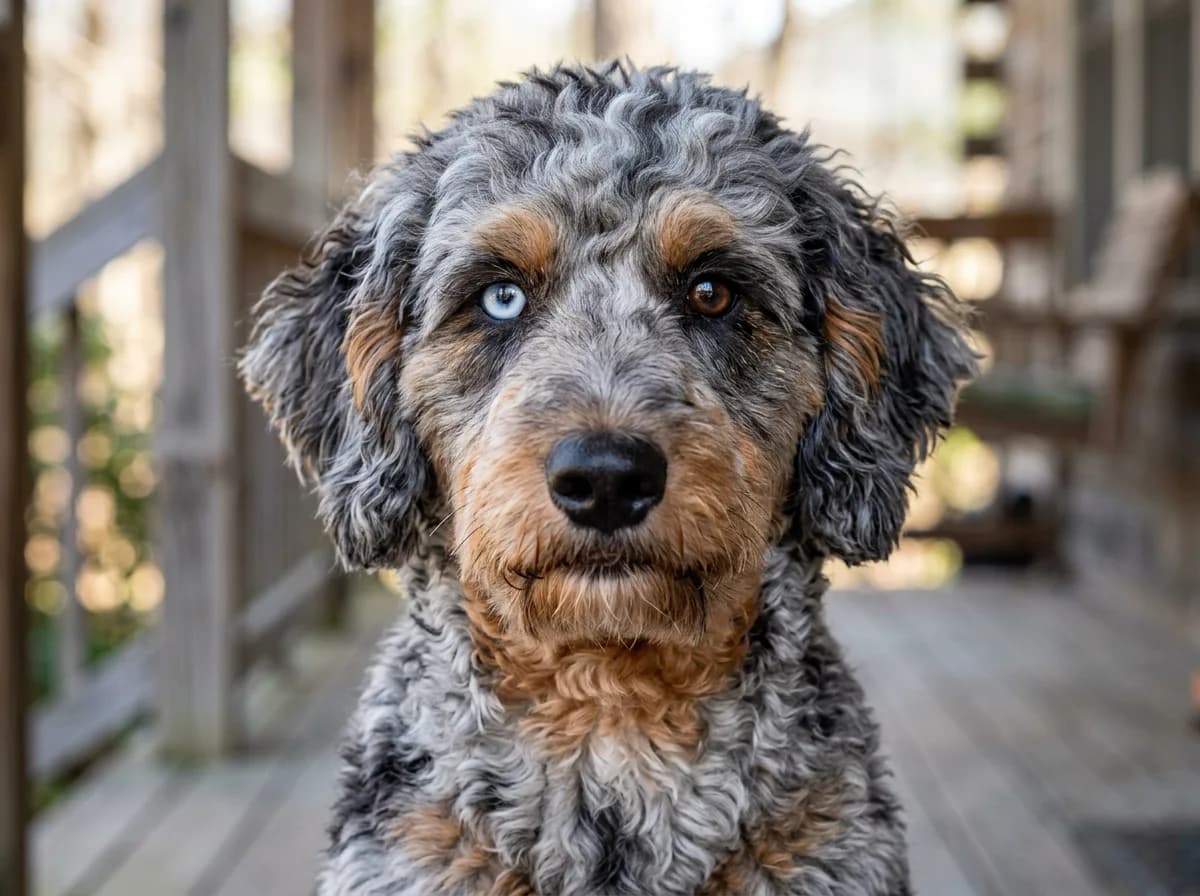
A merle Aussiedoodle is the signature look of this cross, and it splits cleanly into two versions depending on the base pigment underneath. Blue merle is merle on a black base: patches of grey and silver marbled through black, usually with white trim and often with copper points. Red merle is merle on a brown or liver base: patches of buff, cream, and pale copper marbled through a rich cinnamon or chocolate ground color, always with a liver nose rather than a black one.
Are red merle Aussiedoodles rare? Relatively, yes. Red merle needs the recessive brown gene from both parents on top of the merle inheritance, so a breeding that reliably produces red merle takes more planning than one producing blue merle. Blue merle needs only a black base plus merle, and black is dominant, so blue merle shows up far more often in real litters. Red merle is uncommon rather than genuinely scarce, and the premium some breeders attach to it reflects demand and planning effort more than true biological rarity.
Telling the two apart in person is easier than telling them apart in photos:
- Check the nose and eye rims first. Blue merle carries black pigment there. Red merle carries liver or rose pigment, and the eyes often read amber or light gold.
- Look at the darkest patches, not the light ones. On blue merle the undiluted patches are true black. On red merle they are brown, and in low light brown reads almost black.
- Watch for copper points. Both versions can carry tan or copper points above the eyes, on the cheeks, and on the legs, which is what turns a merle into a merle tri.
- Do not judge from a puppy photo alone. A blue merle Aussiedoodle puppy often shows far more contrast at eight weeks than the same dog does at two years.
That last point drives one of the most common searches in this category. A full grown merle Aussiedoodle frequently looks softer than its puppy pictures because the Poodle fading gene lightens the dark patches while leaving the marbled arrangement intact. The pattern does not disappear, but the contrast between the diluted and undiluted patches narrows. A full grown blue merle mini Aussiedoodle can read almost silver-grey overall while still being unmistakably merle up close.
Size labels get bolted onto merle constantly in listings, and they describe the dog's adult weight rather than anything about the coat. A mini blue merle Aussiedoodle carries exactly the same merle genetics as a standard one, just in a smaller frame. If you are searching a blue merle Aussiedoodle for sale and comparing programs, the pattern quality you are paying for should be judged on the parents' health testing and color panels, never on the size word in the ad.
- If a breeder cannot tell you which parent is merle and confirm in writing that the other parent tested clear of merle, walk away. That single question is the difference between a healthy single merle puppy and a double merle one, and no photograph can answer it for you.
Most of the pages ranking for these searches name coat patterns inside long photo galleries but never explain how the merle gene is actually inherited, which is why so many buyers reach a litter unable to read what they are looking at. Genetics matter here because they let you predict what a pairing can produce instead of reacting to whichever puppies happen to show up.
In genetic terms, merle is an incomplete dominant at the PMEL17 locus, also written as SILV. One copy produces the marbled coat you recognize as blue merle or red merle, and that single-copy dog carries no elevated risk from the pattern itself. Two copies produce a double merle, a dog stripped of far too much pigment and facing a high risk of deafness and blindness. Because a puppy inherits one copy from each parent, a merle bred to a non-merle dog cannot produce a double merle at all.
Petful may earn a commission when you click through to Chewy, at no extra cost to you.
- One merle copy: the standard blue merle or red merle coat, with no pattern-driven health risk.
- Two merle copies: a double merle, usually mostly white, with a high likelihood of deafness, vision defects, or both.
- Merle bred to non-merle: roughly half the litter comes out merle and none can be double merle, which is why this is the only merle pairing an ethical program makes.
- Merle hidden on a red or cream dog: still passes a full merle copy to the litter, which is exactly what DNA testing exists to catch.
Double Merle: The Pairing No Breeder Should Make
Double merle breeding is the one place where Aussiedoodle coat color stops being cosmetic and becomes a welfare issue. When two merle dogs are bred together, roughly a quarter of the resulting puppies inherit merle from both parents. Those puppies are double merles, and the pattern that looks striking in a single dose becomes destructive in a double dose. The pigment dilution runs so far that large areas of the coat lose color entirely, producing a mostly white dog, and the same pigment loss affects the developing inner ear and eye.
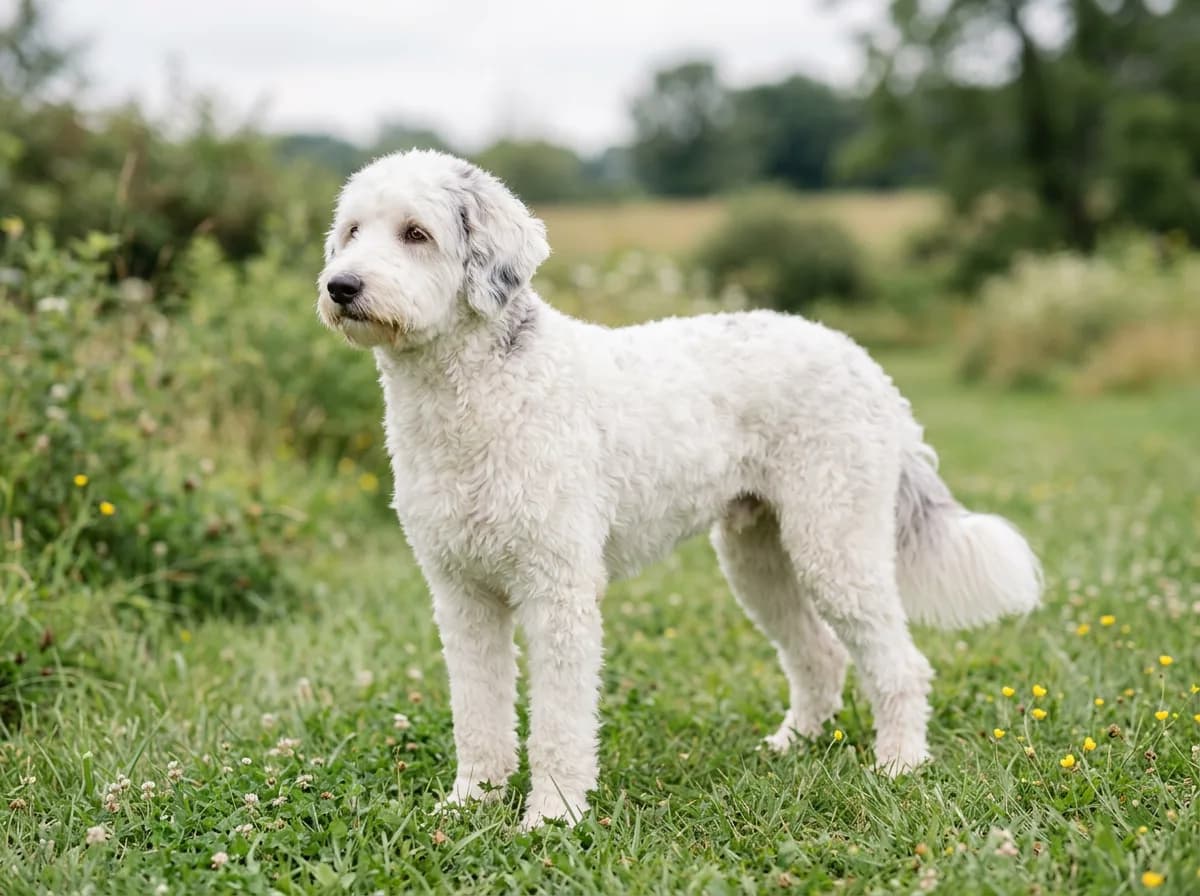
The consequences are well documented in every merle-carrying breed:
- Deafness and vision defects are the two headline risks. Double merles are frequently deaf in one or both ears and often have malformed eyes, including unusually small eyes, iris defects, and colobomas.
- The white coat is a warning sign, not a color. A predominantly white Aussiedoodle from two merle parents is displaying pigment loss, not a rare and desirable pattern.
- The risk is entirely avoidable. Pairing a merle with a non-merle dog produces merle puppies with no elevated risk, so there is no breeding reason to make the pairing at all.
- Marketing language is the tell. Terms like "rare white," "ghost merle," or "double dapple" applied to a litter are red flags worth a direct question about both parents' merle status.
To be explicit, because the ranking pages in this category are not: a merle to merle pairing is never acceptable, in this cross or any other. It is not a way to produce more merles, it is a way to produce deaf and visually impaired puppies alongside them. Ask the breeder directly which parent is merle, ask for the DNA result showing the other parent is clear, and treat any hesitation as an answer.
Health screening in this cross goes well beyond merle status, and the full picture (including the hip, eye, and drug-sensitivity testing that matters for Australian Shepherd crosses) belongs in one place. Our guide to Aussiedoodle health risks covers the screening panel, the conditions inherited from each parent breed, and the questions worth asking before you commit to a puppy. Aussiedoodle life expectancy and the lifespan of mini Aussiedoodle lines are covered there too, since neither is affected by coat color on a properly bred single merle dog.
Tri-Color, Bi-Color, and Parti Aussiedoodles
Once merle is understood, the white-and-points patterns are straightforward, and they are where a lot of the search volume in this category actually sits. A tri color Aussiedoodle carries three distinct colors: a base color, copper or tan points, and white trim. The classic version is black tri, meaning a black body with copper points above the eyes, on the cheeks, and on the legs, plus a white blaze on the face, a white chest, and white feet. Red tri is the same arrangement on a brown base.
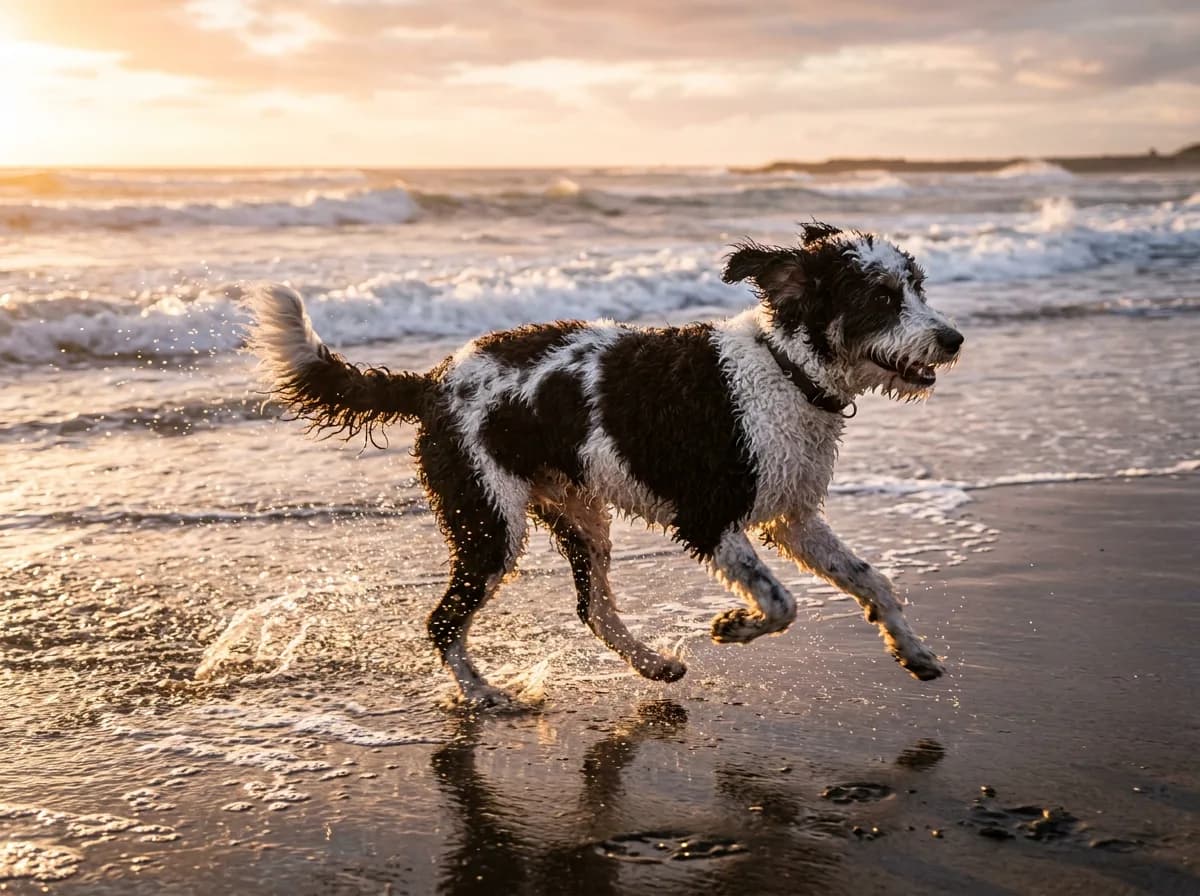
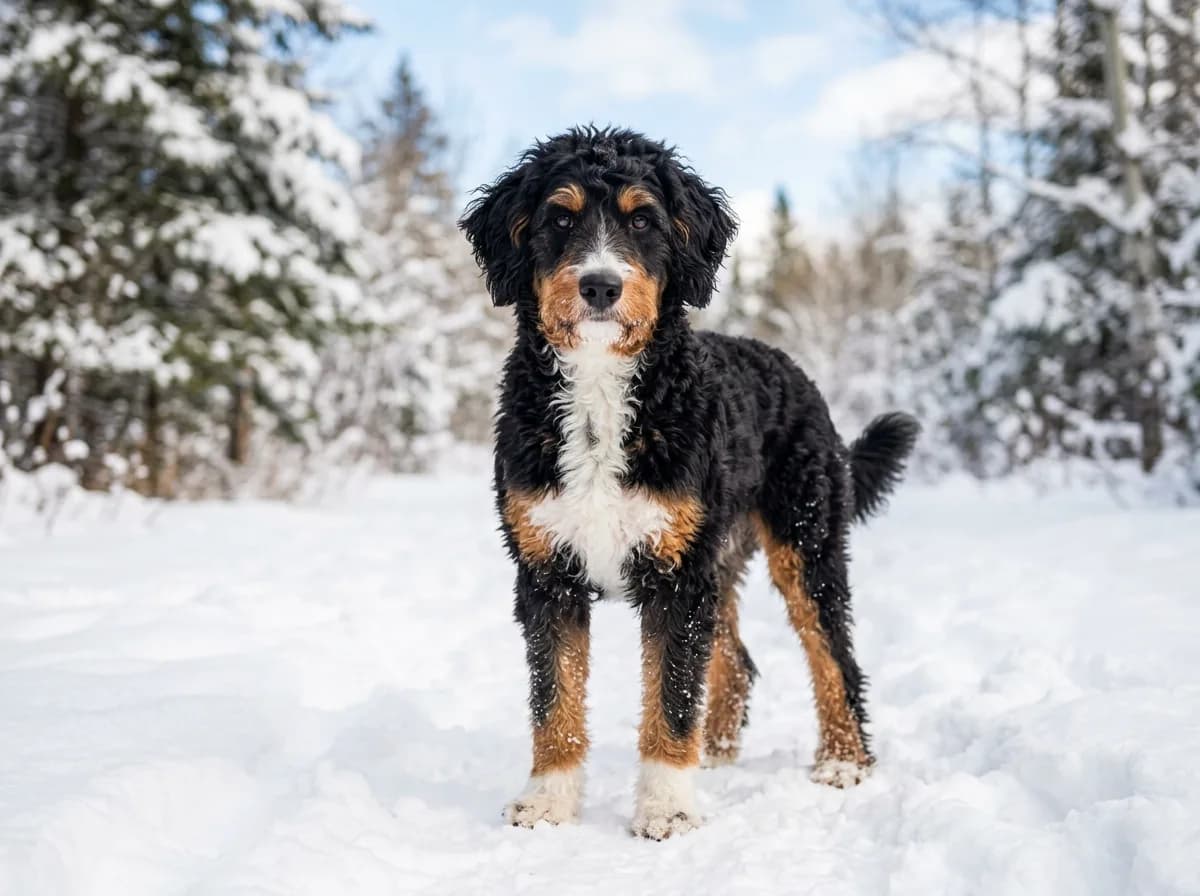
The Aussiedoodle tri color pattern is really two separate inheritances stacked. The copper points come from the agouti series, the same tan-point mechanism that gives a Rottweiler its markings. The white trim comes from the white spotting the Australian Shepherd side carries. Lose the points and you have a bi-color. Lose the white and you have a phantom. Keep both and you have a tri.
Here is how the white-marked patterns separate in practice:
- Bi-color: A base color plus white, with no tan points. An Aussiedoodle black and white coat is the most common version, and Aussiedoodle brown and white is the chocolate-based equivalent.
- Tuxedo: A bi-color where the white is confined to a neat chest bib, throat, and paws, so the dog looks formally dressed. It is the mildest expression of white spotting.
- Tri-color: Base color plus copper points plus white trim, all three visible at once.
- Parti: At least half the dog is white, with large solid patches of the base color. Parti comes from the Poodle side's piebald gene and is a much heavier white pattern than the Aussie-style trim.
- Merle tri: A merle coat that also carries copper points and white trim, which is the most visually complex coat this cross produces.
Parti deserves the sharpest distinction, because it is the pattern most often mislabeled. On a parti dog the white is the dominant field and the color sits on it in large blocks, often including a fully white face or a white saddle. On a tri or bi-color dog the color is the dominant field and the white is trim around the edges. If you are struggling to decide which one you are looking at, ask whether the dog is a white dog with patches or a colored dog with markings.
Size words attach to these patterns as often as they do to merle, and again they say nothing about the coat itself. A mini Aussiedoodle tri color and a standard tri carry identical pattern genetics, and a tri color mini Aussiedoodle simply reaches a smaller adult weight. A full grown Aussiedoodle black and white pattern tends to hold its contrast better than merle does, because white spotting does not fade the way pigment does, though the black itself may drift toward charcoal or grey with age.
- "Red merle tri," "black and white parti," and "chocolate phantom" all follow the same grammar. Identify the base pigment first, then stack the patterns named after it. Split every breeder label that way and the alphabet soup resolves into something you can actually verify against the dog in front of you.
White markings are the part of these patterns that ages worst. Tear staining, grass and mud all show first on a white blaze or chest, so a gentle conditioning dog shampoo used regularly does more for how a tri or parti coat looks than any amount of brushing.
Petful may earn a commission when you click through to Chewy, at no extra cost to you.
Phantom and Sable Aussiedoodle Coats
Phantom is the pattern people most often see and cannot name. A phantom Aussiedoodle is a solid-colored dog carrying a second color in fixed point locations and carrying no white at all: above each eye, on the cheeks and muzzle, across the chest, down the inside of the legs, and under the tail. Black and copper is the classic combination, but chocolate phantoms and red phantoms both occur. The distinguishing test is precision. Phantom points land in the same map on every dog, which is what separates them from a random splash of lighter hair.
Phantom and tri-color are close relatives and get confused constantly. They use the same tan-point gene. The only difference is white: add white trim to a phantom and it becomes a tri, remove the white from a tri and it becomes a phantom. That is the entire distinction, and it explains why a single litter can contain both.
Sable works differently and is the pattern most likely to fool you at eight weeks. On a sable coat each individual hair is dark at the tip and lighter toward the root, so the dog reads as a darker, smoky version of its true base color. As the dog matures and the tipped puppy hair is replaced, the dark overlay recedes and the underlying red, golden, or cream base emerges. A sable puppy that looks nearly black can mature into a warm golden adult with dark hair only along the spine and ears.
- Phantom points sit in fixed places. If the second color is not above the eyes and on the legs, it is not phantom.
- Phantom carries no white by definition. Any white trim reclassifies the dog as a tri.
- Sable is a hair-shaft effect, not a patch pattern. Part the coat and you will see each hair change color along its length.
- Sable fades more dramatically than any other pattern. Judge a sable puppy by the color at the root, not the color at the tip.
Solid Aussiedoodle Colors: Black, Red, Chocolate, and Golden
Solid coats make up a large share of every litter, and they carry the highest search demand of any group in this category. A black Aussiedoodle is the most common single color in the cross, because black pigment is dominant and both parent breeds carry it. A true solid black holds no white beyond a small chest mark, and a black mini Aussiedoodle carries identical color genetics to a standard one. Many blacks do not stay black, though, which is why a full grown black Aussiedoodle often reads charcoal, slate, or silver-grey by two years old.
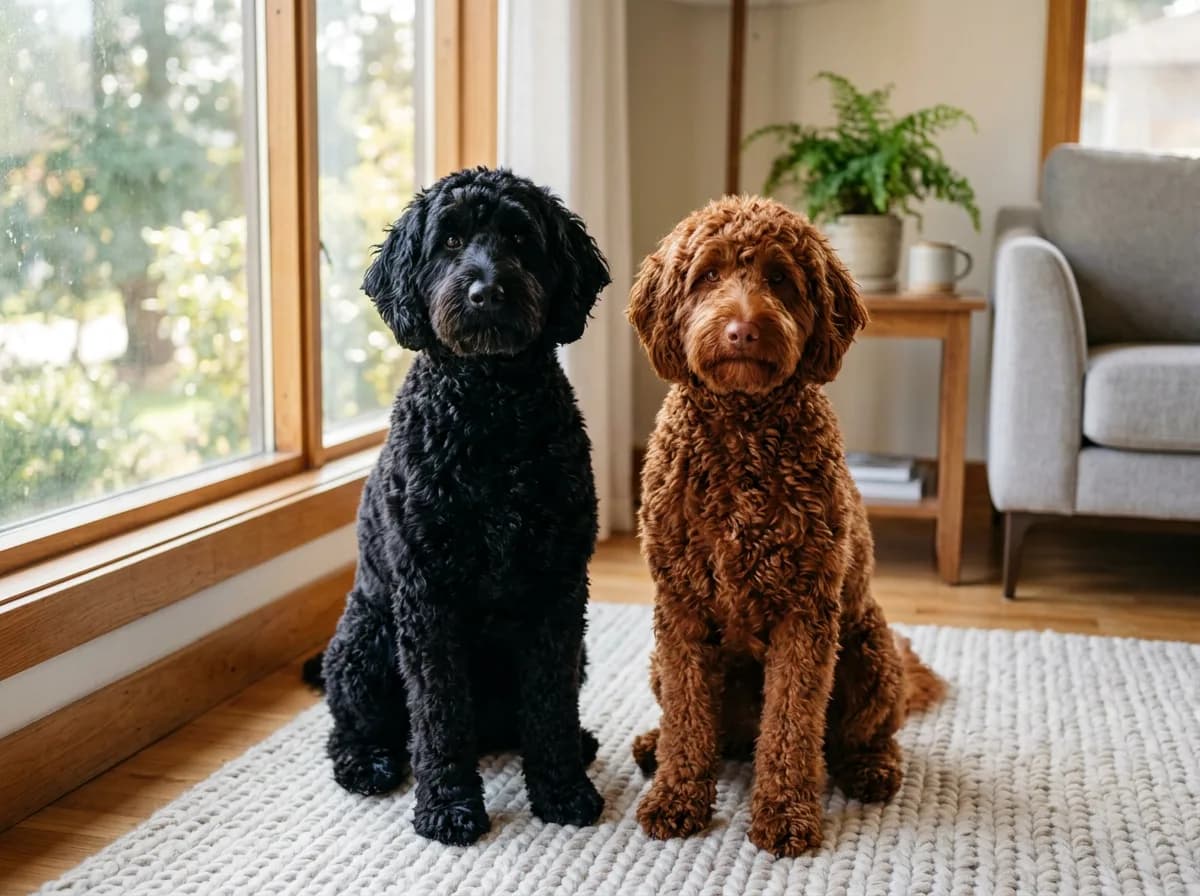
Here is the solid palette from darkest to lightest, with what actually drives each one:
- Black: Dominant dark pigment with no dilution or fading switched on. Common at birth, less common at maturity.
- Aussiedoodle grey, silver, and blue: Not birth colors at all. These are faded blacks, produced when the Poodle progressive fading gene lightens a black coat over 12 to 24 months. Blue is the coolest and darkest, silver the lightest.
- Chocolate and brown: The recessive brown gene converts black pigment to liver, so a chocolate Aussiedoodle and a brown Aussiedoodle are the same dog under two labels, both carrying a matching liver nose. A dark brown Aussiedoodle carries the deepest expression of it, while a brown Aussiedoodle puppy often lightens into cafe or silver-beige as an adult.
- Red: A saturated, setter-like tone built on red pigment. A red Aussiedoodle holds real depth of color when the fading gene is absent, and the Aussiedoodle red family shades down through rust and cinnamon.
- Golden and apricot: The same red pigment expressed at lower intensity, running from deep gold to soft apricot. A golden Aussiedoodle is among the most requested colors in the cross, and a mini golden Aussiedoodle is one of the most common listings you will see.
- Cream: The palest expression of red pigment, close to off-white but still carrying dark pigment on the nose, lips, and eye rims.
- On cream and white coats, tear staining shows first and worst. Tear stain wipes used a few times a week keep the muzzle from going rust coloured.
Two labels in that list overlap enough to be worth separating. Grey and silver are both cleared blacks and differ only in how far the clearing has gone, while blue describes a cooler, darker version of the same process. None of the three is a distinct gene, which is why a breeder can honestly call the same two-year-old dog blue, grey, or silver depending on the light. Brown and chocolate are likewise the same thing under two names, and the liver nose is the reliable confirmation in both cases.
How Aussiedoodle Coats Change With Age
This is the gap that no ranking competitor fills, and it is the reason so many owners feel misled by their puppy photos. Most Aussiedoodles inherit a coat fading gene from the Poodle side, a dominant progressive greying mechanism that gradually strips saturation from the coat over the dog's first two years. Breeders call the process clearing, and it is normal, painless, and unrelated to health or nutrition.
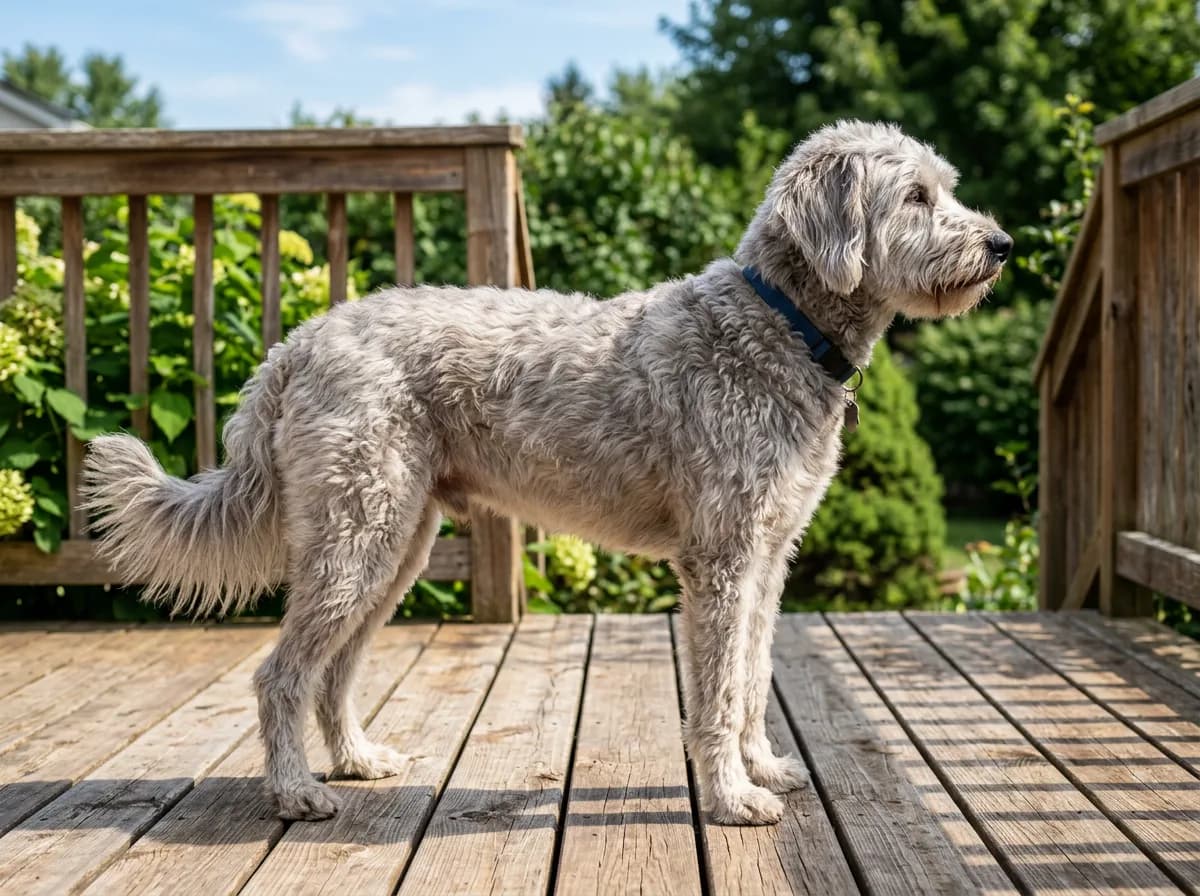
The pattern of change is predictable enough to plan around:
Petful may earn a commission when you click through to Chewy, at no extra cost to you.
- Fastest change happens between 8 weeks and 12 months. This is when a puppy coat clears most visibly, often lightening by several shades.
- The second year slows down. Change continues but at a much lower rate, and the adult coat color is usually locked by around 24 months.
- The puppy coat is physically replaced. The soft, dense puppy coat gives way to the adult texture between roughly 8 and 14 months, and the new coat frequently comes in lighter than the old one.
- Patterns soften but do not vanish. A merle stays merle and a tri stays tri, but the contrast between the light and dark areas narrows.
| Puppy Color | Common Adult Result | Typical Window |
|---|---|---|
| Solid black | Charcoal, slate, or silver-grey | 12 to 24 months |
| Chocolate or brown | Cafe, silver-beige, or parchment | 8 to 18 months |
| Red | Rust, cinnamon, or apricot | 6 to 18 months |
| Golden or apricot | Cream or pale gold | 6 to 12 months |
| Blue merle | Softer silver-and-grey marbling | 12 to 24 months |
| Red merle | Softer buff-and-cinnamon marbling | 12 to 24 months |
| Sable | Golden or red with dark spine and ears | 6 to 18 months |
Not every dog clears. A minority hold their birth color for life, and those are the dogs whose parents lack the fading gene entirely. If holding a specific shade matters to you, that is a testable question rather than a matter of luck: ask whether the parents have been DNA tested for progressive greying, and ask to see photos of both parents at eight weeks alongside photos of them as adults. A pairing that produced faded reds last time will do it again.
It is worth stating the mechanism in plain terms, because no ranking page explains how an Aussiedoodle puppy coat fades or clears into a different adult color. The fading gene does not repaint the dog. It progressively removes pigment from each new hair the follicle produces, so the puppy coat clears from the inside out, and the coat you see at two years is built from lighter hair than the one you photographed at eight weeks.
Knowing how puppy coats fade or clear into the adult color also tells you which shades are safe to fall in love with, because the adult coat color is the one you will live with longest. Dark, saturated coats carry the most pigment to lose, so they change the most. Pale coats have less to give up and tend to hold. Patterns built on white trim stay stable, since white cannot fade any further.
- Nose and eye-rim pigment never fades, so a liver nose still means a chocolate-based dog at six years old.
- White markings stay put, which makes a white blaze or chest bib the most reliable feature in any puppy photo.
- Merle marbling keeps its shape even as the contrast softens, so the pattern is safe to choose and the intensity is not.
- Tan and copper points often deepen rather than fade, and read more clearly on the adult than on the puppy.
The coat change that comes with maturity is also when most owners get caught out by matting, because the adult coat is denser than the puppy coat that preceded it. Stepping up to a slicker brush and working right down to the skin is the fix.
Which Aussiedoodle Colors Are Rarest?
The rarest coat color in this cross is a true red merle tri, because it needs three separate inheritances (the recessive brown gene from both parents, one copy of merle, and the tan-point plus white-trim combination) to land in a single puppy. Behind it sit the non-fading solids, meaning a red or chocolate that holds its saturation into adulthood, which requires parents that do not carry the fading gene at all.
Ranked from hardest to find down to routine, the picture looks like this:
- Red merle tri: The least common pattern in the cross, requiring brown, merle, tan points, and white spotting all at once.
- True non-fading red or chocolate: Genetically possible but uncommon, because the fading gene is widespread on the Poodle side.
- Phantom in a brown or red base: The point pattern is not rare, but a well-marked chocolate or red phantom is.
- Blue merle tri: Striking and in high demand, though far easier to produce than the red version.
- Parti: Uncommon in this cross compared with heavier-white doodle lines, since Aussie-style trim is more typical than piebald.
- Blue merle, black tri, and solid black: Common, and none the worse for it.
Rarity in this category is a supply story as much as a genetic one. Only a handful of programs deliberately chase red merle tri, because doing it consistently requires health-tested parents carrying the exact recessive combinations plus years of records on how their litters clear. That scarcity is real, but it is a cosmetic distinction and not a mark of quality. A common black tri from a program that DNA tests, screens hips and eyes, and socializes its litters is a better dog than a rare red merle from a breeder who cannot show you a color panel.
If you arrived asking what is the rarest Aussie coat color, the short answer holds for this cross as well as for the parent breed: red merle tri is the rarest coat color you will realistically find, and it is the least common pattern in any Aussiedoodle litter because it needs three separate inheritances to land in the same puppy. Everything else on the list above is uncommon rather than genuinely scarce.
- Scarcity in this category is a supply story, not a quality signal. A common black tri from a program that DNA tests both parents will outlive and out-behave a rare coat from a program that cannot show you a color panel.
Between baths, a pack of grooming wipes handles the muzzle, paws and rear without wetting the whole coat, which matters more on the lighter colours where every mark shows.
Does Coat Color Change With Aussiedoodle Size?
It does not. Color genetics and size genetics travel independently in this cross, so a toy Aussiedoodle, a miniature Aussiedoodle, and a standard Aussiedoodle can all carry identical coat patterns. Size comes from which Poodle variety sits behind the cross, not from pigment. What does change with size is how a pattern reads visually, since a bold merle covers more surface area on a big dog and can look busier on a small one. For adult weight ranges by size class, and for what a full grown mini Aussiedoodle or a full grown Aussiedoodle actually weighs, our Aussiedoodle size guide has the growth charts, and the mini Aussiedoodle guide covers the smaller end in detail.
How Coat Type Affects Grooming and Shedding
Coat texture matters more for daily life than coat color does, and the two are separate questions. Aussiedoodles come in curly, wavy, and straighter coats depending on how much Poodle texture each puppy inherits, and the tighter the curl, the darker a given color tends to read in person because curls trap shadow. Searchers type "do Aussiedoodle shed" and "are Aussiedoodles hypoallergenic" more often than almost any other coat question, and the honest answer depends far more on curl than on color.
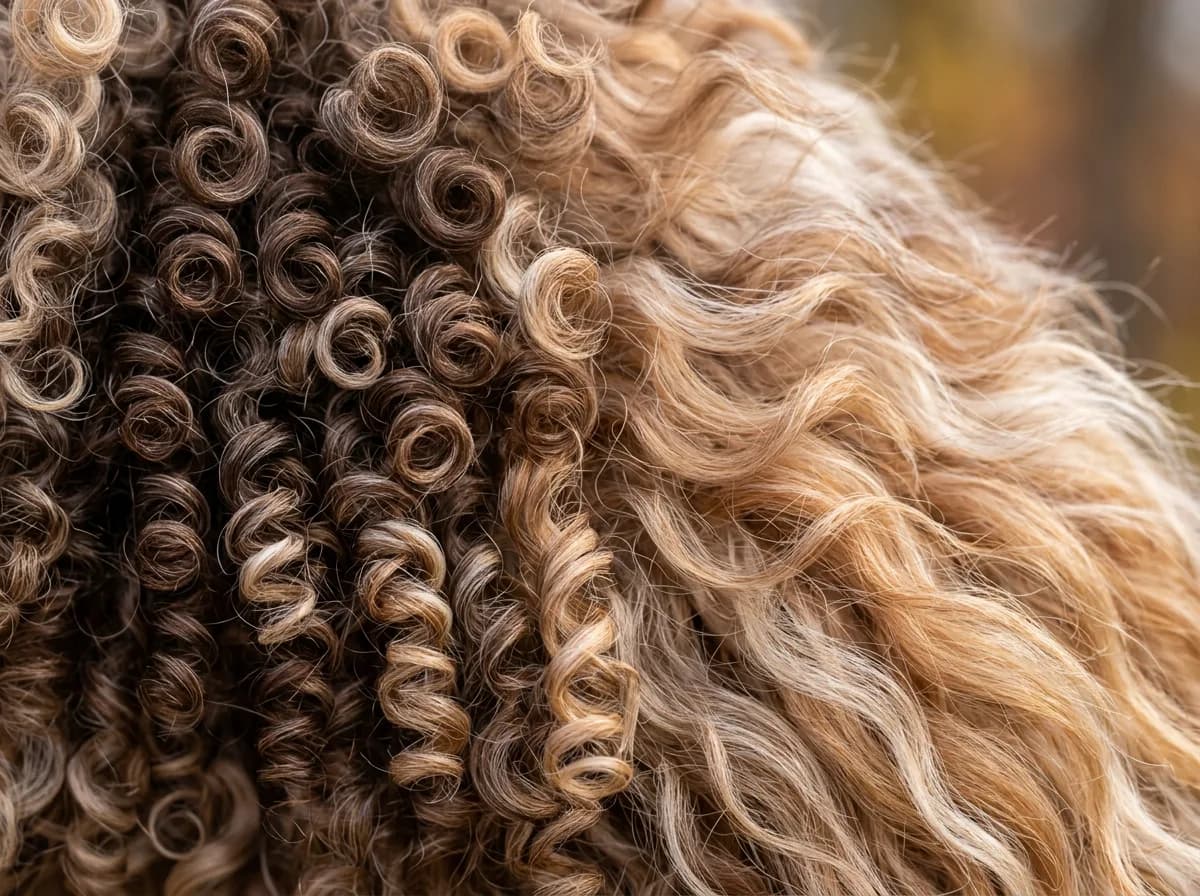
For curlier coats that tangle in the wash, a 2-in-1 shampoo and conditioner cuts down the post-bath detangling that causes most at-home matting.
Brushing cadence, clipper choice, matting prevention, and the realities of grooming an Aussiedoodle at home all belong to a dedicated grooming guide rather than to a color guide. Our full Aussiedoodle grooming walkthrough covers tools, haircut styles, mini Aussiedoodle grooming timing, and how often each coat type needs professional work.
- Straight or hair coat: sheds the most of the three, and the loose hair ends up on the floor and the sofa rather than in the coat.
- Wavy or fleece coat: the middle ground, dropping some hair and holding the rest in the wave, which is why weekly brushing usually keeps it under control.
- Curly or wool coat: sheds the least visibly but traps almost everything it loses, so it looks cleanest and mats fastest of the three.
Whatever the colour, a coat that traps shed hair needs it pulled out rather than left to felt, and a deshedding brush does that job faster than a slicker on the thicker Australian Shepherd style coats.
Does Coat Color Affect Temperament?
No. Coat color has no bearing on personality, trainability, or energy level in this cross. A blue merle is not calmer than a solid black, and a parti is not more stubborn than a tri. Personality comes from breeding, early socialization, and individual variation, and the herding drive both parent breeds contribute shows up regardless of what the dog looks like. For the honest picture on Aussiedoodle traits, mini Aussiedoodle personality, energy needs, barking, and when the breed settles, see our guide to Aussiedoodle temperament.
Do Rare Aussiedoodle Colors Cost More?
Usually, yes. Breeders price by demand, and merle, tri-color, and non-fading solids typically sit at the top of a price sheet while common blacks and creams sit lower. That premium is a modifier on the total rather than the thing driving it, since region, generation, health testing, and breeder reputation all move an Aussiedoodle cost more than pigment does. Treating color as the main line item is how buyers end up paying more for a less well-bred dog. For current ranges, including mini Aussiedoodle price bands and what the first year actually costs, see our breakdown of Aussiedoodle price.
Most people reach this question while already scrolling listings, so it is worth saying plainly where color belongs in that decision. Aussiedoodle breeders price a rare pattern the way any market prices scarcity, and mini Aussiedoodle breeders often stack a second premium on top for small adult size. Neither premium tells you anything about the dog's health, structure, or temperament, and our Aussiedoodle price guide breaks down what the rest of that number actually buys.
The same caution applies to the listings themselves. An Aussiedoodle puppy for sale advertised on color alone is being marketed on the one trait most likely to change over the next two years, and page after page of mini Aussiedoodles for sale will show you eight-week photos that no longer describe the adult dog. Ask what this exact pairing produced last time before you ask what the color costs.
- Ask what the color is called on the parents' DNA panel, not just in the ad, since blue, silver, and charcoal are all marketing words for the same faded black.
- Ask whether puppies inside the same litter are priced differently, and if so, exactly which trait is carrying the difference.
- Ask what happens if the coat clears to another shade, because no honest program guarantees an adult color.
- Ask for the health screening results before the color conversation starts, so a premium coat never stands in for a tested pairing.
- Choose the breeder, the health testing, and the temperament of the parents first, then take whichever coat that program happens to produce. A rare pattern from an untested pairing is the most expensive mistake a buyer can make in this category, and it is the one that shows up years later as a vet bill rather than a refund.
How Generation Changes the Coat You Get
Generation labels predict coat texture and, indirectly, how strongly the fading gene acts. An F1 Aussiedoodle is a first cross of Australian Shepherd and Poodle, so it carries one copy of each parent's inheritance and shows the widest variety of coats in a single litter. An F1b Aussiedoodle is bred back to a Poodle, which raises the odds of a curly, lower-shedding coat and also raises the odds of inheriting the fading gene, so F1b dogs tend to clear more. Because merle can only come from the Aussie side, backcrossing toward Poodle reduces the chance of merle in later generations. Our full Aussiedoodle breed guide explains what each generation label means for the Aussiedoodle breed overall.
Aussiedoodle Colors vs Other Doodle Crosses
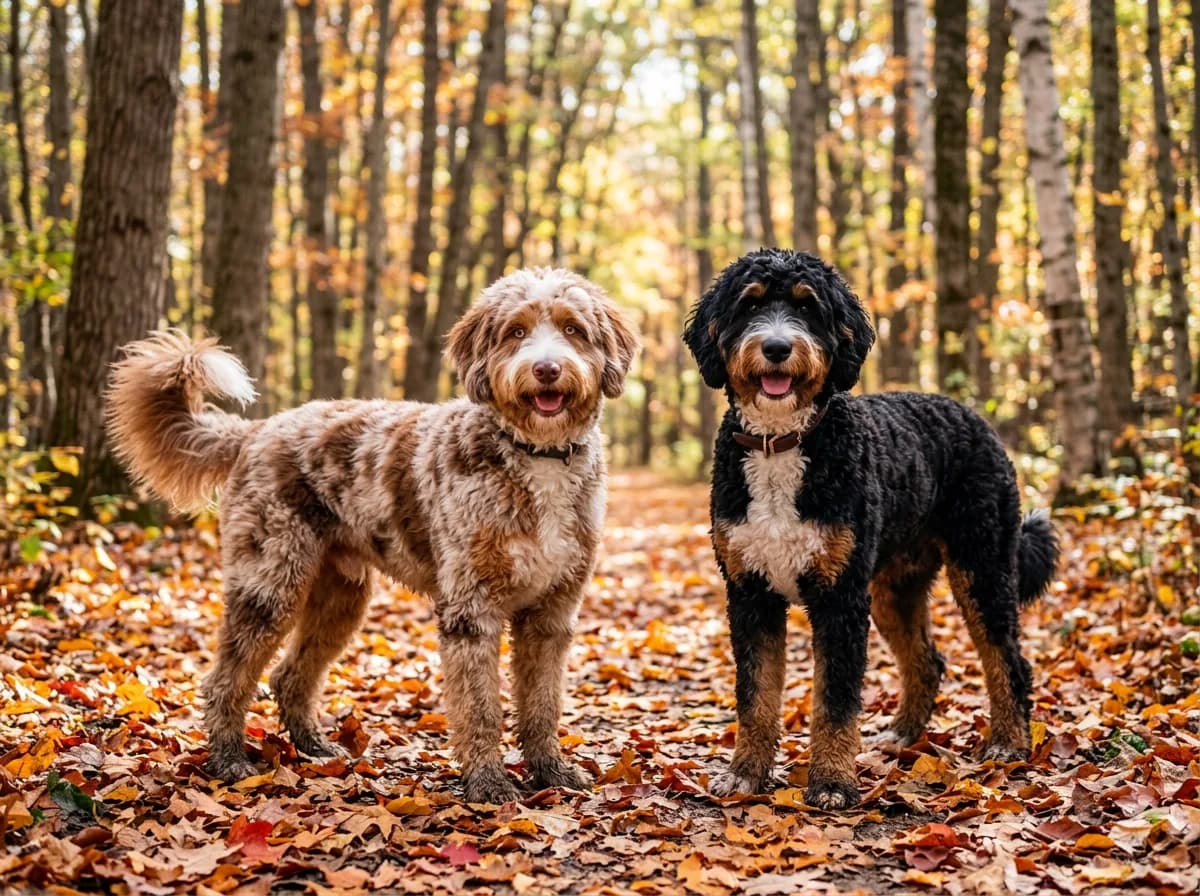
The color question separates this cross from its cousins more sharply than any other trait. In a bernedoodle vs aussiedoodle comparison, the Bernese side contributes a fixed tri-color of black, rust, and white rather than a pattern set, so an aussiedoodle vs bernedoodle look is mostly the difference between marbled variety and a consistent tri. Compare aussiedoodle vs goldendoodle and the gap is starker still, since Golden Retriever genetics supply only shades of gold and cream with no merle, no tan points, and no white trim at all. For the full coat picture on the closest tri-colored cousin, see our Bernedoodle coat colors guide. Petful’s guide to Bernedoodle colors has the full breakdown.
Choosing a Puppy by Color Without Getting Burned
Color is the easiest thing to shop for and the easiest thing to be misled about, so it pays to hold the pattern question and the breeder question separately. Reputable Aussiedoodle breeders and mini Aussiedoodle breeders will volunteer a color panel on both parents before you ask, and they will explain in plain terms what a given pairing can and cannot produce. A listing for an Aussiedoodle puppy for sale that names a rare color but says nothing about testing is telling you where that program's priorities sit.
Run this checklist against any litter before the color wins you over:
- Ask which parent carries merle and get the other parent's clear result in writing. This is non-negotiable on any merle litter.
- Ask for a full DNA color panel on both parents, covering merle, brown, the fading gene, tan points, and piebald.
- Ask to see both parents as puppies and as adults, which is the fastest read on how much this line clears.
- Ask what previous litters from this exact pairing looked like at two years old, not at eight weeks.
- Confirm the health screening separately from the color conversation, because a beautiful coat on an untested pairing is the worst trade in this category.
When you are browsing mini Aussiedoodles for sale and every listing shows an eight-week-old photo, remember that the photo is the least reliable piece of information in the ad. The parents' panels, the parents' adult coats, and the breeder's willingness to answer a direct merle question tell you far more about the dog you will actually live with in two years.
Finding an Aussiedoodle Breeder When You Want a Specific Color
Color is the reason most people start searching, so it is worth being straight about how it interacts with finding a dog. Searches for aussiedoodle breeders and mini aussiedoodle breeders spike around the rarer patterns, and listings for an aussiedoodle puppy for sale or for mini aussiedoodles for sale often lead with color precisely because it is the thing buyers respond to first. That is a marketing decision, not a quality signal, and treating it as one is how people end up with a beautifully marked dog from a program that tested nothing.
Use color as the last filter rather than the first. Health testing, temperament and how the breeder raises the litter all matter more to the next twelve years than whether a coat is blue merle or black tri. Our Aussiedoodle price guide covers what an ethical program actually spends, what a fair price looks like by size and generation, and the red flags worth walking away from.
- Ask which parent carries merle before you ask about color. A responsible breeder will never pair two merles.
- Ask to see health testing for both parents, not photographs of the puppies.
- Treat a guaranteed color on an unborn litter as a warning sign, because genetics does not work that way.
- Be wary of any listing that names a price premium for a color before it names a health test.
- Every rare-color premium in this article assumes the same health testing as any other puppy. If a breeder can tell you the exact shade of a puppy that has not been born yet but cannot tell you the parents MDR1 status, the color is the product and the dog is not.
Frequently Asked Questions
Most do. The Poodle side contributes a progressive fading gene that lightens the coat across the first two years, a process breeders call clearing. Black commonly settles into charcoal or silver-grey, chocolate lightens toward cafe or silver-beige, and red softens toward apricot. Change is fastest between 8 weeks and 12 months and usually finishes by about 24 months.
A phantom Aussiedoodle is a solid-colored dog carrying a second color in fixed point locations and no white at all. The points appear above each eye, on the cheeks and muzzle, across the chest, down the inside of the legs, and under the tail. Add white trim to a phantom and it is classified as a tri-color instead.
Yes, and it comes almost entirely from the merle side of the family. Single merle dogs frequently have one or both eyes in blue, and heterochromia, meaning one blue eye and one brown eye, is common and purely cosmetic. Heavy white facial markings can also produce a blue eye. Blue eyes alone are not a health concern on a properly bred single merle dog.
Merle is a marbling effect that dilutes random patches of dark pigment across the whole coat. Tri-color is a fixed arrangement of a base color plus copper points plus white trim. They are separate genes and a single dog can carry both, which breeders label a merle tri.
Not always. Black is the most common birth color in the cross, but many blacks carry the fading gene and drift toward charcoal, slate, or silver-grey by two years old. Ask whether either parent has tested positive for progressive greying, and check whether the puppy's hair is already paler at the root than at the tip.
Color itself is cosmetic, with one important exception. A dog with a single copy of the merle gene carries no elevated risk, but breeding two merle dogs together produces double merle puppies with a high chance of deafness and eye defects. That is a breeding decision rather than a property of the color, and responsible programs never make it.

Coreen Saito is a pet writer and longtime shelter volunteer with more than a decade in animal rescue. She covers cat behavior, breed care, and the small, ordinary science of sharing a life with companion animals, with a particular focus on honest takes about the products and decisions that actually matter. At home in Arizona, she's outranked by Mac (a dog with the loudest opinion in the house), Rebel (a cat who governs by quiet authority), and Meri (an orange tabby who runs the late shift and the laundry basket). She writes about all three, plus the rescues that keep coming through her life, at LifeWithMinty.com.
Sign up for expert-backed reviews and safety alerts all in one place.