Bernedoodle Colors: Tri-Color, Merle, Phantom, and More
Explore every common Bernedoodle color and pattern (tri-color, bi-color, sable, phantom, merle, and solids) with a real photo gallery, plus how color ties to coat type, grooming, and health.
Petful is reader supported. As an affiliate of platforms like Amazon and Chewy, we may earn a commission when you buy through links on this page. There is no extra cost to you.
Few designer dogs come in as many looks as this one, and that variety is exactly why so many families fall for the breed before they ever meet a puppy in person. Bernedoodle colors range from the classic black, white, and rust tri-color that people picture first, all the way to sable, phantom, merle, and rich solid coats, and no two litters look quite the same. Because a Bernedoodle is a cross between the Bernese Mountain Dog and the Poodle, a puppy can inherit the Bernese's bold tri-color markings, the Poodle's deep solids and patterns, or some surprising blend of both. This guide walks through every common Bernedoodle color and pattern with a real gallery of different dogs, explains how coat color ties into coat type and grooming, and answers the questions buyers ask most before they choose.
- 1Traditional tri-color (black, white, and rust) is the most iconic Bernedoodle look, but bi-color, sable, phantom, merle, and solid coats are all common
- 2Color is inherited independently of coat type, so a curly, wavy, or straight coat can appear in almost any color, and coat type drives grooming needs far more than color does
- 3Merle is the color most tied to health risk: never pair two merle parents, because merle-to-merle breeding can produce deaf or blind "double merle" puppies

Sign up for expert-backed reviews and safety alerts all in one place.
Why Bernedoodle Colors Vary So Much
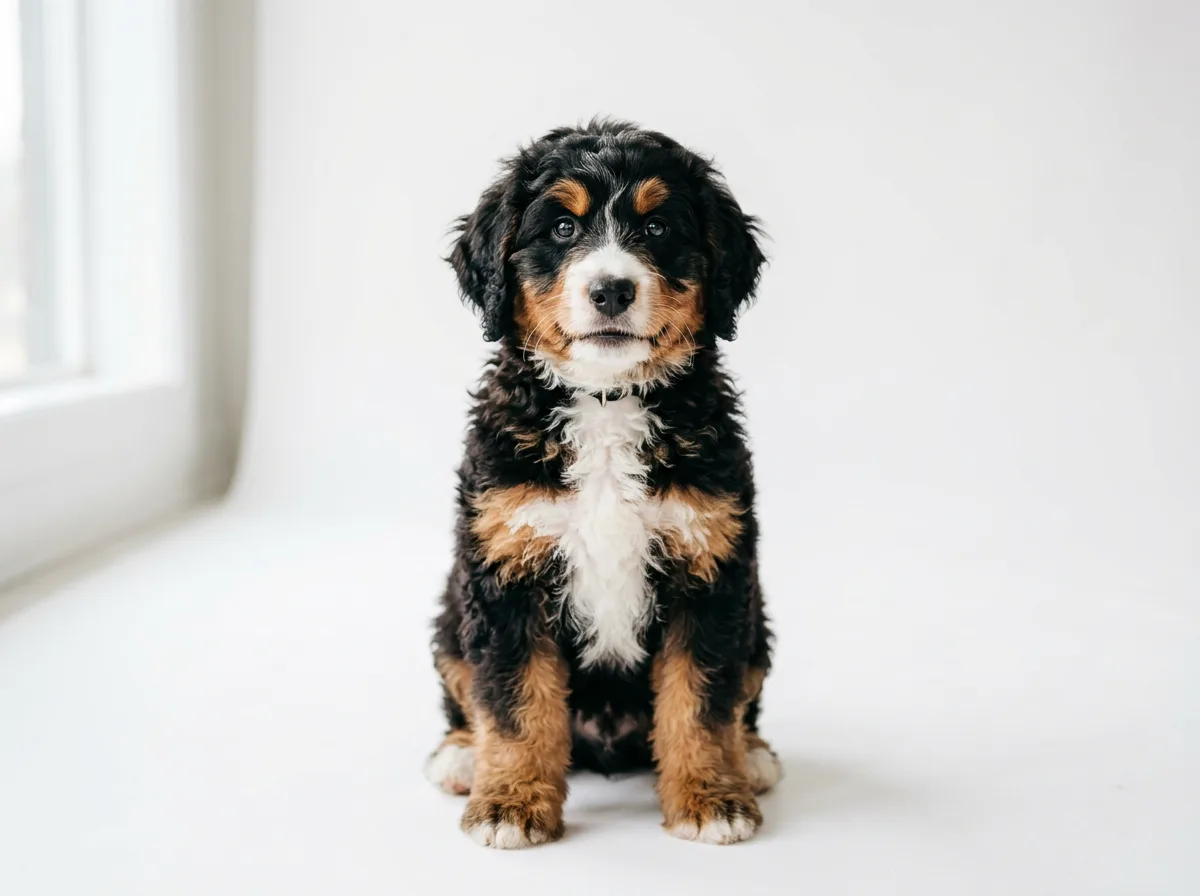
To understand the coat you might get, it helps to know where the color comes from. The Bernese Mountain Dog carries one signature look: a black base with white markings and rust or tan points, the tri-color pattern that made the breed famous on Swiss farms. The Poodle, by contrast, is bred in a huge span of solid shades (black, brown, apricot, cream, silver, and more) plus patterns like phantom and parti.
When you cross the two, the puppies pull from both parents' genetics. That is why a single Bernedoodle litter can hold a picture-perfect tri-color pup right next to a solid black sibling and a merle one. The generation of the cross matters too. An F1 Bernedoodle (Bernese parent crossed with Poodle parent) often leans toward the Bernese tri-color look, while later generations (F1b, F2, and beyond) fold in more Poodle color and pattern variety because there is more Poodle in the mix.
One thing to hold onto before we go color by color: coat color and coat type are two separate genetic stories. A gorgeous phantom coat tells you nothing about whether the dog will be curly, wavy, or straight. We will come back to that, because it changes everything about grooming.
How Generation Affects Bernedoodle Color
The generation of a Bernedoodle (how many crosses back the Poodle or Bernese sits) is one of the biggest predictors of what colors show up in a litter, and it is worth understanding before you start shopping. The label tells you the parentage, and the parentage skews the odds toward Bernese-style tri-color or Poodle-style solids and patterns.
An F1 Bernedoodle is a first cross: one purebred Bernese Mountain Dog parent and one purebred Poodle parent. Because half the genetics come straight from a tri-color Bernese, F1 litters produce the highest share of classic tri-color and bi-color puppies, and the coat tends to be wavier with a bit more shedding. An F1b Bernedoodle is an F1 bred back to a Poodle, so there is more Poodle in the mix. That pushes coats curlier and lower-shedding, and it opens the door to more Poodle-driven colors like solid apricot, cream, phantom, and merle. Later generations (F2, F2b, and multigen) can go almost any direction depending on the specific parents, which is why two multigen litters from different breeders can look nothing alike.
None of this is a guarantee. Genetics roll the dice every litter, and a single F1b puppy can still be a picture-perfect tri-color. But if a particular look matters to you, generation is the first filter, and the parents' own colors are the second. The table below shows the general tendencies breeders see.
Petful may earn a commission when you click through to Chewy, at no extra cost to you.
| Generation | Parentage | Coat Tendency | Common Colors |
|---|---|---|---|
| F1 | Bernese x Poodle | Wavy, sheds a little more | Tri-color and bi-color most common |
| F1b | F1 x Poodle | Curlier, lowest shedding | More solids, phantom, and merle appear |
| F2 | F1 x F1 | Highly variable | Wide mix of tri-color, solids, and patterns |
| Multigen | Multiple doodle generations | Bred toward a target coat | Any color, often chosen for consistency |
The Main Bernedoodle Colors and Patterns
Breeders and registries describe Bernedoodle coats using a mix of color words (black, white, brown) and pattern words (tri-color, bi-color, phantom, sable, merle). A single dog usually has both a color and a pattern, so a puppy might be described as a "black and white bi-color" or a "chocolate phantom." Here are the patterns you will actually see in listings and litters.
Traditional Tri-Color
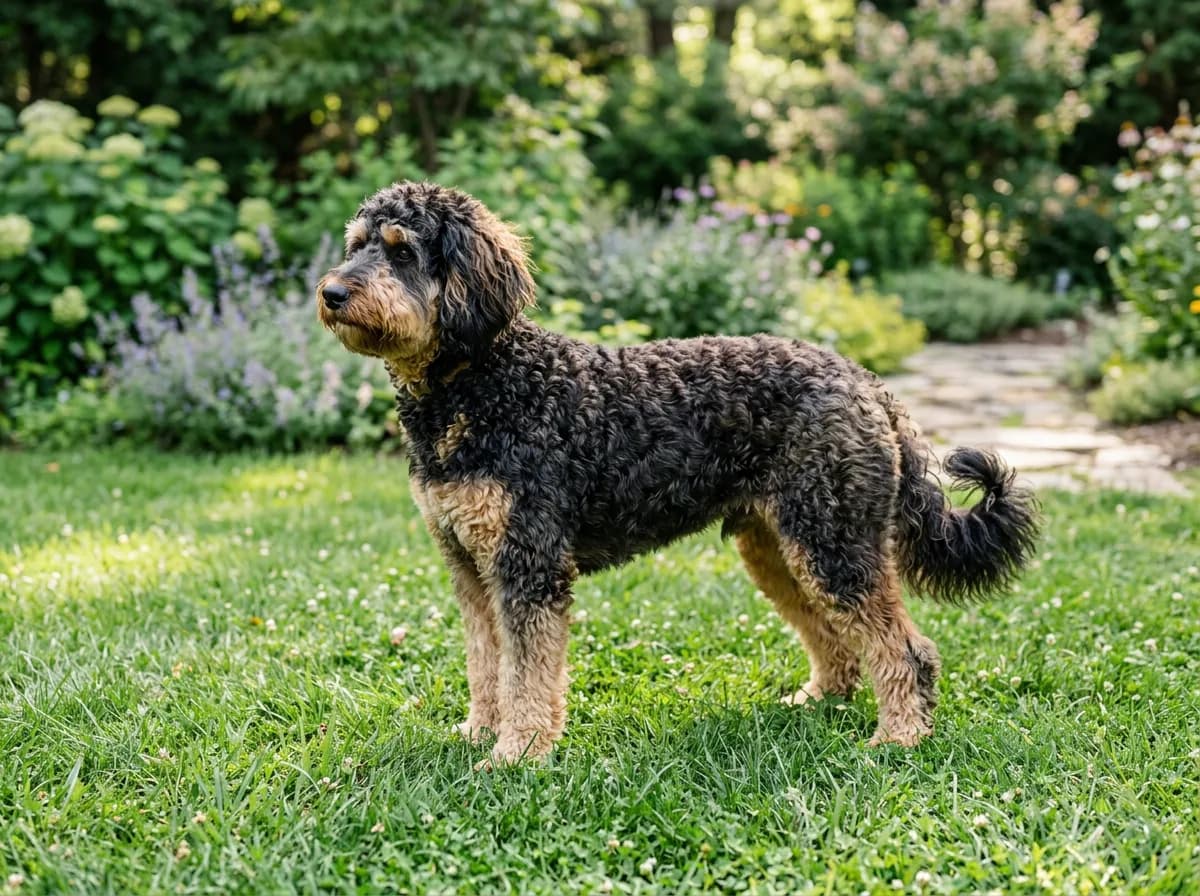
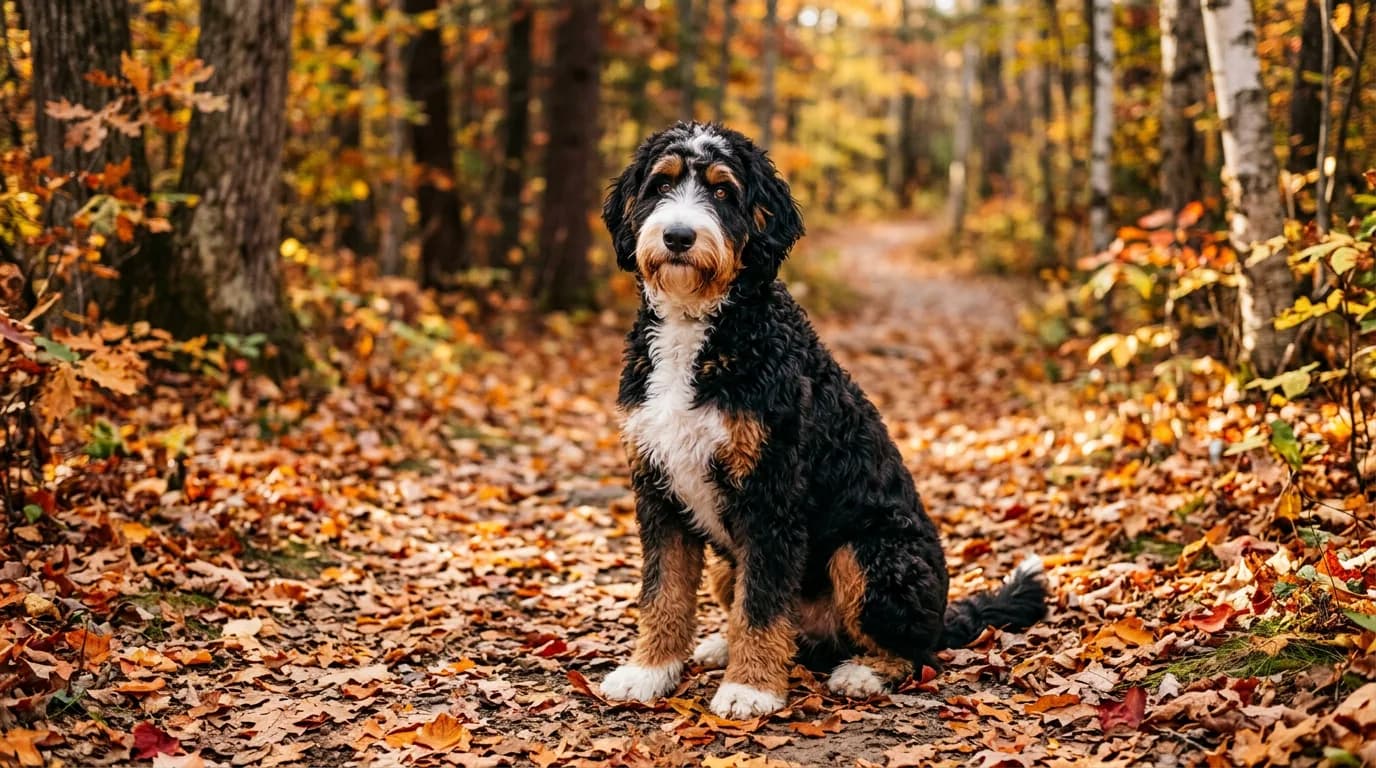
Tri-color is the coat most people mean when they picture a Bernedoodle. It layers three colors in a specific arrangement: a black base, white markings (typically a chest blaze, muzzle stripe, and paws), and rust or copper points above the eyes, on the cheeks, and on the legs. It is a direct nod to the Bernese Mountain Dog, and it is the look that drives a lot of the breed's popularity.
True, well-marked tri-colors are prized, and they can be harder to produce than a quick search suggests, because getting all three colors placed cleanly is not guaranteed even from two nicely marked parents. A tri-color puppy can also shift as it matures, with the rust deepening and the white sometimes shrinking a little as the adult coat comes in.
Bi-Color
Bi-color Bernedoodles wear just two colors, most often black and white, though you will also see brown and white or, less commonly, other pairings. Think of a bi-color as a tri-color that skipped the rust points: a black (or brown) dog with white markings on the chest, face, and feet. Black-and-white bi-colors sometimes get called "tuxedo" Bernedoodles when the white sits neatly on the chest and paws.
Bi-color is a clean, high-contrast look that stays striking as the dog ages, and it tends to hide the "puppy color change" surprises a bit more than tri-color does because there is no rust to deepen or fade.
Sable
Sable is one of the most fascinating patterns because it changes over time. A sable Bernedoodle is born looking one color, often a rich brown or dark tan, with black-tipped hairs that give the coat a shaded, layered appearance. As the dog matures and the coat grows out, those black tips can lighten or wear away, so a sable puppy frequently ends up several shades lighter than it started. Owners often say their sable "faded," when really the pattern was doing exactly what sable does.
Sable can appear on its own or combined with white markings, and because of the color shift, sable puppies are the ones where the adult coat is hardest to predict from the newborn photo.
Phantom
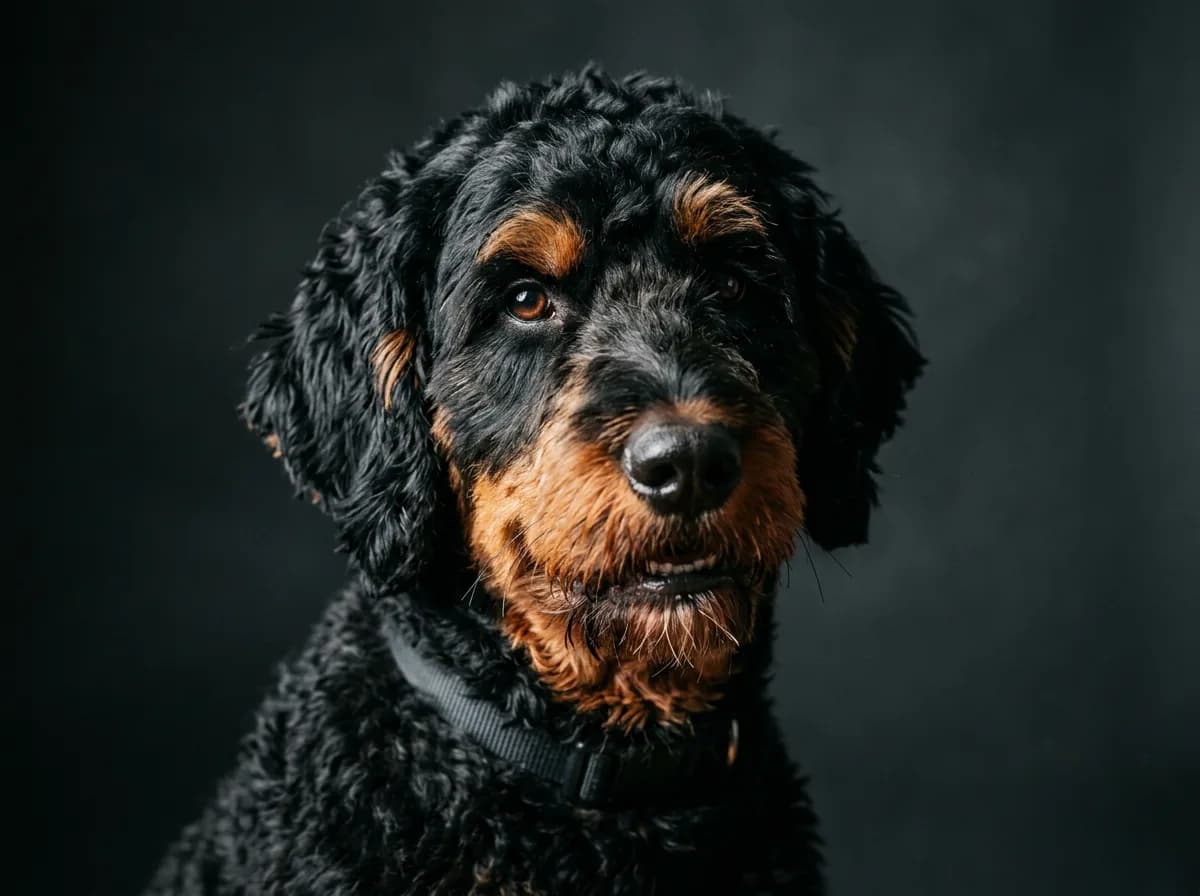
Phantom is the pattern Poodle owners know well, and it is essentially a two-tone marking in a fixed layout. A phantom Bernedoodle has a solid base color (black, chocolate, or another solid) with sharp tan or rust "points" in specific places: above the eyes, on the cheeks and muzzle, on the chest, and on the lower legs. The layout looks a lot like a Doberman or a Rottweiler's markings, which is why phantom dogs read as very defined and symmetrical.
The difference between phantom and tri-color trips people up. Phantom uses two colors (base plus points) with no white, while tri-color adds white markings on top of the black-and-rust arrangement. If a dog has clean tan eyebrows and legs but no white blaze, it is phantom, not tri-color.
Merle
Merle is the showstopper and the pattern that calls for the most caution. It creates a marbled or mottled coat, patches of diluted color scattered over a darker base, and it often comes with blue or partially blue eyes. Blue merle (gray marbling on black) and chocolate merle (lighter swirls on brown) are the versions you will see most.
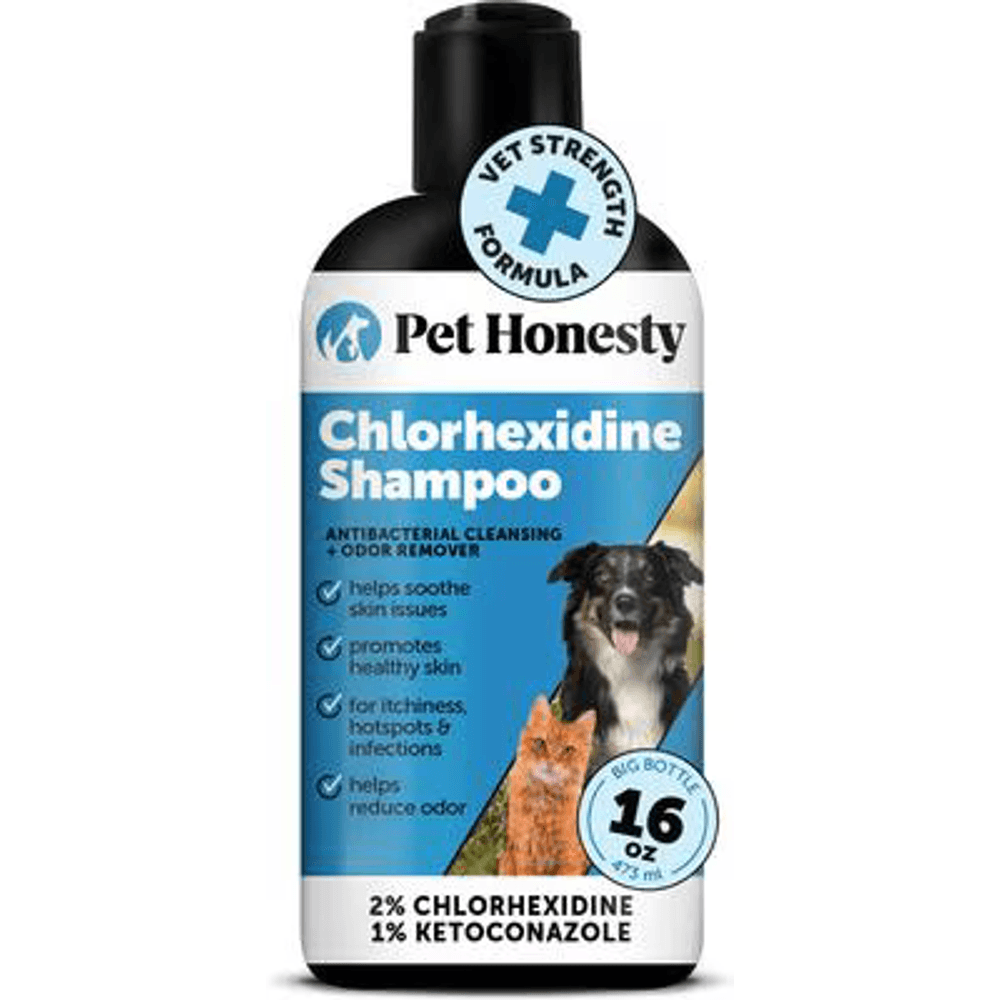
A vet-strength medicated shampoo with 2% chlorhexidine and 1% ketoconazole, the antifungal and antibacterial combination vets use to help clear ringworm and skin infections and to cut fungal spore shedding during treatment.
Petful may earn a commission when you click through to Chewy, at no extra cost to you.
Merle is beautiful, but it carries a real genetic warning. The merle gene is dominant, and a dog only needs one copy to show the pattern. When two merle dogs are bred together, some puppies inherit two copies, producing a "double merle." Double merle dogs are frequently born with serious deafness, blindness, or both, along with eye deformities. This is not a rumor or a scare tactic. It is well-documented canine coat-color genetics, and it is why a responsible breeder never pairs two merle parents. If a listing shows a merle litter, a trustworthy breeder can tell you which parent is merle and confirm the other parent is not.
Solid Colors
Not every Bernedoodle wears a pattern. Solid Bernedoodles come in one color across the whole coat, and they lean heavily on the Poodle side of the family. Common solids include:
- Solid black: the deepest, most uniform look, and one of the more common solids in early-generation crosses.
- Chocolate or brown: a warm solid that ranges from milk chocolate to deep espresso.
- Cream, apricot, or tan: softer solids that come straight from Poodle coloring.
- Silver and gray: often the result of a "fading" gene from the Poodle, where a dark puppy lightens with age.
A small patch of white on the chest is common on otherwise-solid dogs and does not disqualify the "solid" description in most breeders' listings. Purely solid coats can be easier to match over time because there is no multi-color placement to change as the dog grows.
Parti, Abstract, and Tuxedo
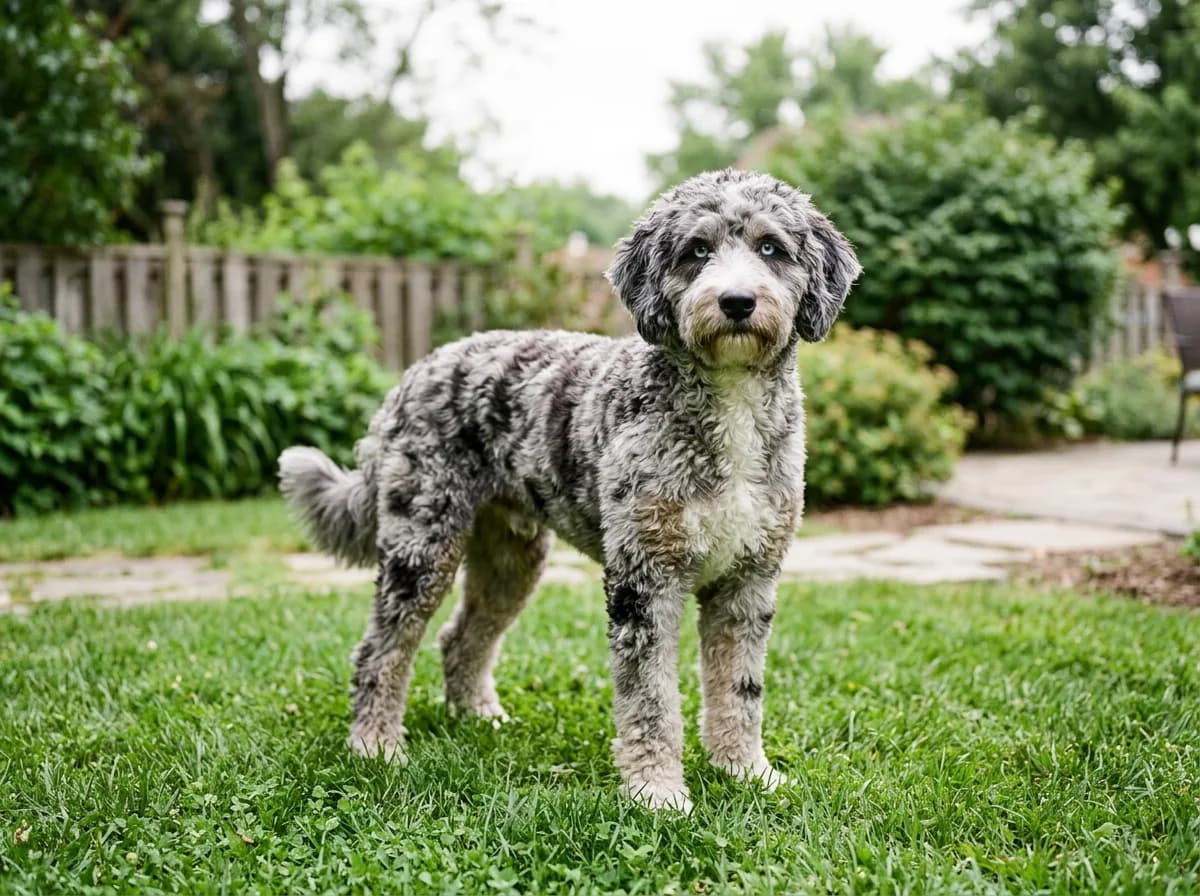
A few extra terms show up in Bernedoodle listings that describe how white is distributed rather than adding a new base color. A parti Bernedoodle is at least 50 percent white with large patches of a second color (black-and-white parti and brown-and-white parti are the usual versions), and it reads as a bold, patchy, high-white coat. An abstract or "chin" Bernedoodle is the opposite: mostly one color with only small splashes of white, often just a chin, chest, or toe. A tuxedo Bernedoodle sits in between, with white placed neatly on the chest and paws so the dog looks like it is wearing formalwear over a solid or tri body.
These are pattern descriptions, not separate colors, so you will often see them stacked with a color word, as in "chocolate parti" or "black tuxedo." They matter mostly for looks, though more white means more visible cleaning around those bright areas.
Do Bernedoodle Colors Change as They Grow?
Yes, and this is one of the most important things to understand before you pick a puppy by color. Many Bernedoodles do not keep the exact coat they are born with. Sable is the most dramatic example, lightening from a dark puppy into a much paler adult as the black-tipped hairs grow out. Poodle-derived fading genes can turn a solid black or dark brown puppy into a silver, blue, or cafe-au-lait adult over the first year or two. Even tri-color markings can shift, with rust points deepening and white areas sometimes shrinking slightly as the adult coat sets in.
What tends to stay stable is high-contrast bi-color and true, non-fading solids. If a locked-in adult color matters to you, ask the breeder two questions: what the parents looked like as adults, and how past puppies from the same pairing turned out grown up. A newborn photo is a starting point, not a promise.
Bernedoodle Color and Pattern Guide
Here is a quick-reference table that puts the common Bernedoodle colors and patterns side by side, including what each one looks like and the single most useful thing to know about it before you commit.

Petful may earn a commission when you click through to Chewy, at no extra cost to you.
| Color or Pattern | What It Looks Like | Rarity | Key Thing to Know |
|---|---|---|---|
| Traditional Tri-Color | Black base, white markings, rust points | Common but well-marked ones are prized | Markings can shift as the puppy matures |
| Bi-Color | Two colors, usually black and white | Common | High-contrast look that stays stable with age |
| Sable | Dark-tipped coat that lightens over time | Moderately common | Adult color is hard to predict from a puppy photo |
| Phantom | Solid base with fixed tan points, no white | Moderately common | Symmetrical points, often confused with tri-color |
| Merle | Marbled or mottled coat, often blue eyes | Less common | Never breed merle to merle (double-merle health risk) |
| Solid (black, chocolate, cream) | One uniform color coat-wide | Common | May fade or lighten with a Poodle fading gene |
What Is the Rarest Bernedoodle Color?
The rarest Bernedoodle colors are the unusual merle variations and the hardest-to-produce combinations, with merle (especially chocolate or "tri-merle" mixes) generally considered the rarest, followed by clean, richly marked tri-colors that hit every marking perfectly. There is no single official answer, because Bernedoodles are not standardized the way purebred show colors are, but breeders consistently point to a few coats that show up least often.
Merle sits at the top for most breeders. Because merle must be inherited from a merle parent, and because responsible breeders limit merle pairings for safety, merle litters are simply less common than solid or tri-color ones. Merle combined with other patterns, such as a merle-and-tan or a merle tri, is rarer still.
After merle, the genuinely rare category is the flawless traditional tri-color: a dog with perfectly placed white and rust markings and no muddying of the pattern. Plenty of dogs are "tri-color," but few are textbook. Unusual solids like true silver can also be scarce depending on the parent lines.
- Some sellers charge a premium for rare colors, especially merle. A higher price tag does not make a breeding safe. Ask for proof that both parents were health-tested and confirm that a merle puppy came from only one merle parent before you pay a rarity markup.
How Color Relates to Coat Type and Grooming
Here is the part that surprises most first-time buyers: the color you fall in love with tells you almost nothing about how much grooming the dog will need. Coat type does that, and coat type is a separate trait. A curly black Bernedoodle and a straight black Bernedoodle look similar in a photo, but they live very different grooming lives.
Bernedoodles generally fall into three coat types, and any of them can carry any of the colors above:
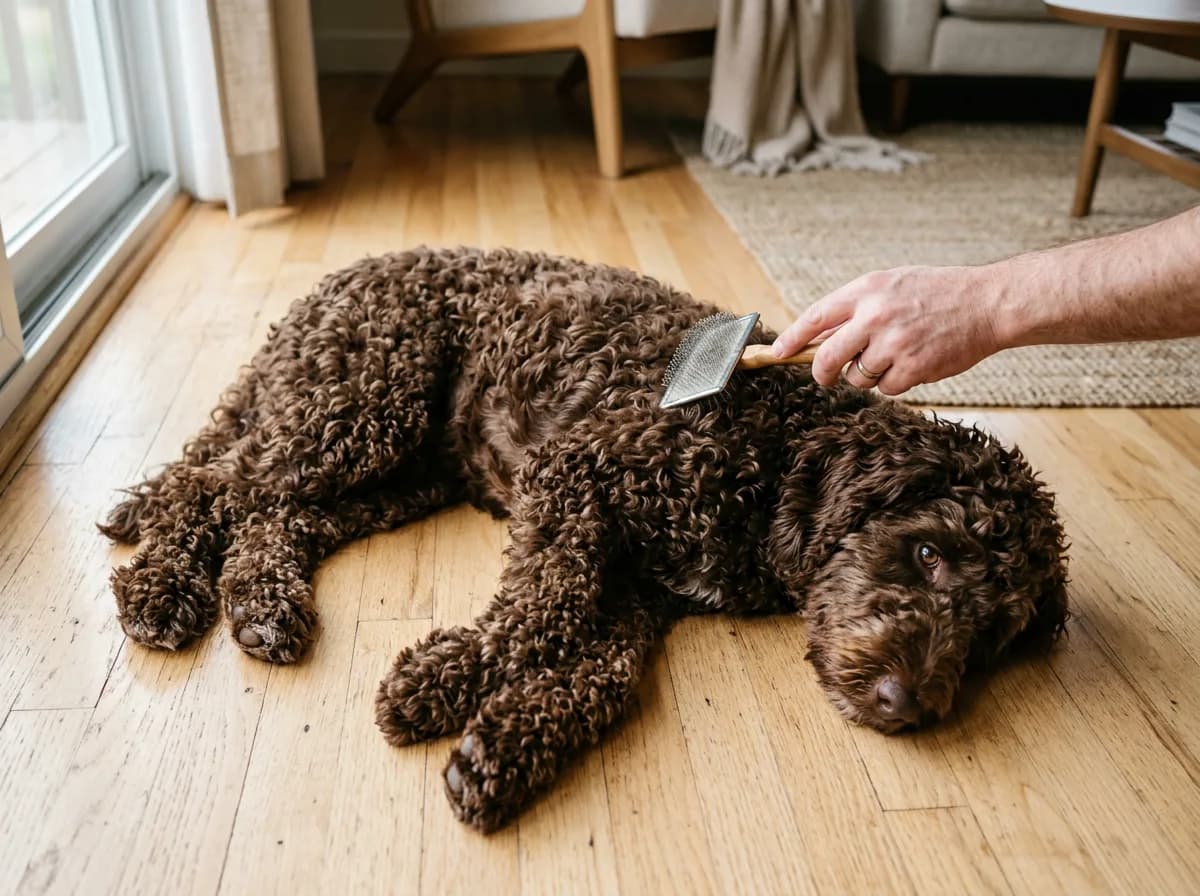
- Curly coat: the most Poodle-like, tightest curl, and typically the lowest-shedding and most allergy-friendly. It also mats the fastest and needs the most brushing.
- Wavy coat: the middle ground and the most common Bernedoodle coat. It is loose and soft, sheds minimally, and is a bit more forgiving to brush than a tight curl.
- Straight coat: the most Bernese-like, sometimes called an "improper" coat. It sheds more and is the least hypoallergenic, but it is the easiest to brush.
Color does interact with grooming in one honest, practical way: it changes what shows. Light cream and apricot coats show tear staining, mud, and food residue around the face and paws far more than a black coat does. Dark coats hide dirt but reveal dandruff and dryness. And any parti or heavily white dog will simply need the white areas cleaned more often to stay bright.
For coat-type-specific tools, bathing frequency, and a full brushing routine, see our companion Bernedoodle grooming guide, which breaks down the exact schedule by coat type. The short version: whatever color you choose, plan to brush several times a week and book a professional groom every six to eight weeks, because matting is a coat-type and length problem, not a color problem.
- If low shedding is your priority, ask the breeder about coat type, not just color. A wavy or curly coat is the low-shed choice. If you want the easiest brushing routine and do not mind shedding, a straight coat is simpler, though less allergy-friendly.
Does Bernedoodle Color Affect Health or Temperament?
For most colors, the honest answer is no. A black, tri-color, sable, or phantom Bernedoodle is not healthier or friendlier than any other, and color has no bearing on personality. Temperament comes from genetics, socialization, and training, not from coat shade, so choosing a puppy by color alone tells you nothing about whether it will be calm, goofy, or clingy.
Merle is the one real exception, and only in a specific way. The merle pattern itself is fine on a dog that inherited a single copy. The danger is entirely about breeding: two merle parents can produce double-merle puppies with a high risk of deafness and blindness. A single-merle Bernedoodle from a responsible pairing is as healthy as any other coat.
Beyond merle, general breed health is about the parents' testing, not their color. Reputable Bernedoodle breeders screen for hip and elbow dysplasia and eye conditions, and you can verify results through the Orthopedic Foundation for Animals. Coat-color genetics like merle are studied and testable through labs such as the UC Davis Veterinary Genetics Laboratory, so a serious breeder can show you a puppy's color genotype if you ask. If you want to confirm your own dog's genetic makeup and health markers, an at-home DNA test can identify coat-color genes (including merle status) and screen for inherited conditions.
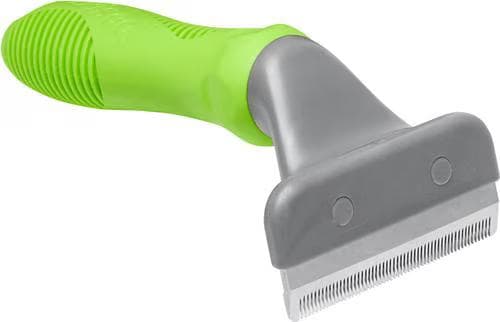
Petful may earn a commission when you click through to Chewy, at no extra cost to you.
Nose and Eye Color: The Other Half of the Look
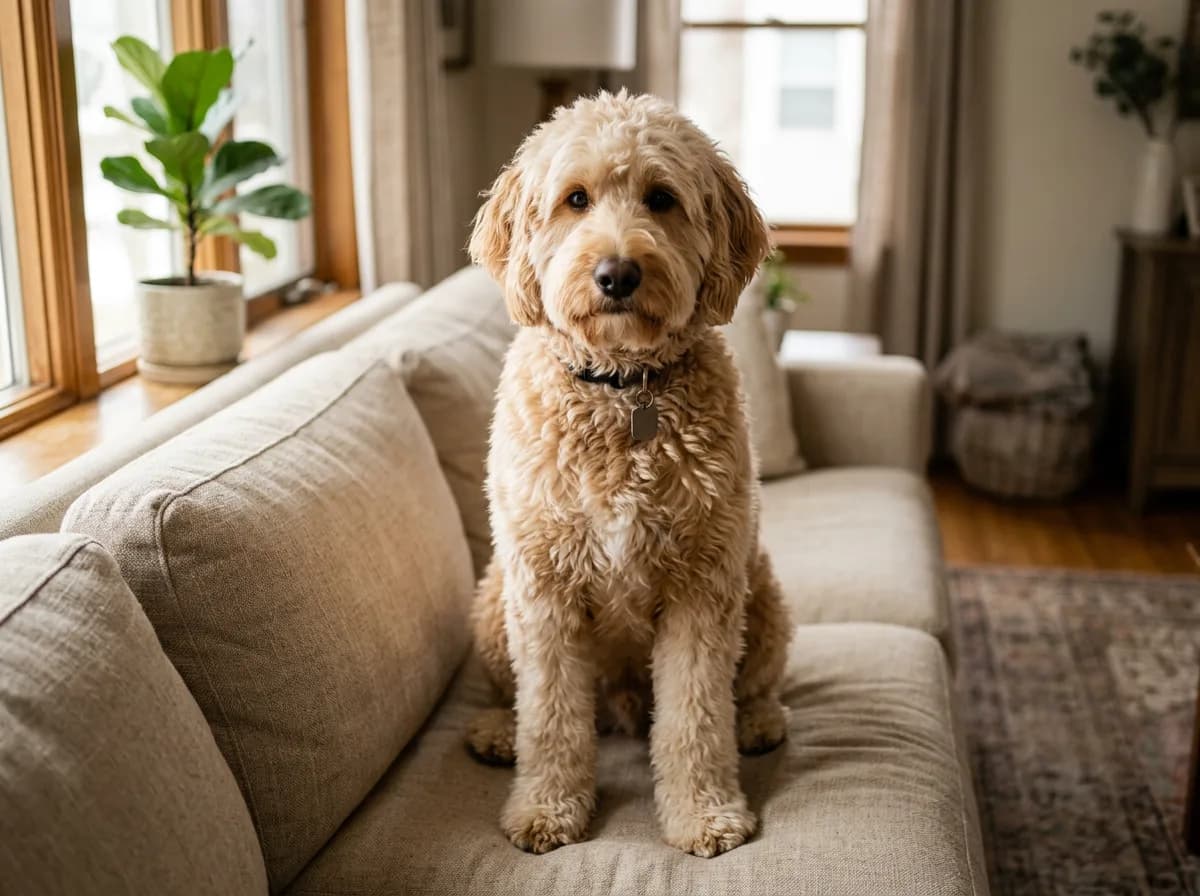
Coat color does not stop at the fur. It also influences nose, eye rim, and eye color, and those details are part of what gives each Bernedoodle its finished look. On black-based dogs (traditional tri-color, black phantom, solid black), the nose and eye rims are typically solid black, and the eyes are usually a warm brown.
Chocolate and other brown-based Bernedoodles are different. The same gene that turns the coat brown also lightens the nose to a liver or brown shade rather than black, and it often softens the eyes to amber or hazel. This is completely normal and healthy; a brown dog with a brown nose is doing exactly what its genetics dictate. Merle adds the most eye variety of all, since merle dogs frequently have blue eyes, partially blue eyes, or one blue and one brown eye (heterochromia). Blue eyes are also occasionally seen on non-merle dogs, though they are less common.
One practical note: a "winter nose" or "snow nose," where a black nose fades to pinkish in colder months, can occur in Bernedoodles and is cosmetic, not a health concern. If you ever notice a sudden nose color change paired with crusting, sores, or discomfort, that is worth a vet visit, but ordinary seasonal fading is nothing to worry about.
A Gallery of Bernedoodle Colors
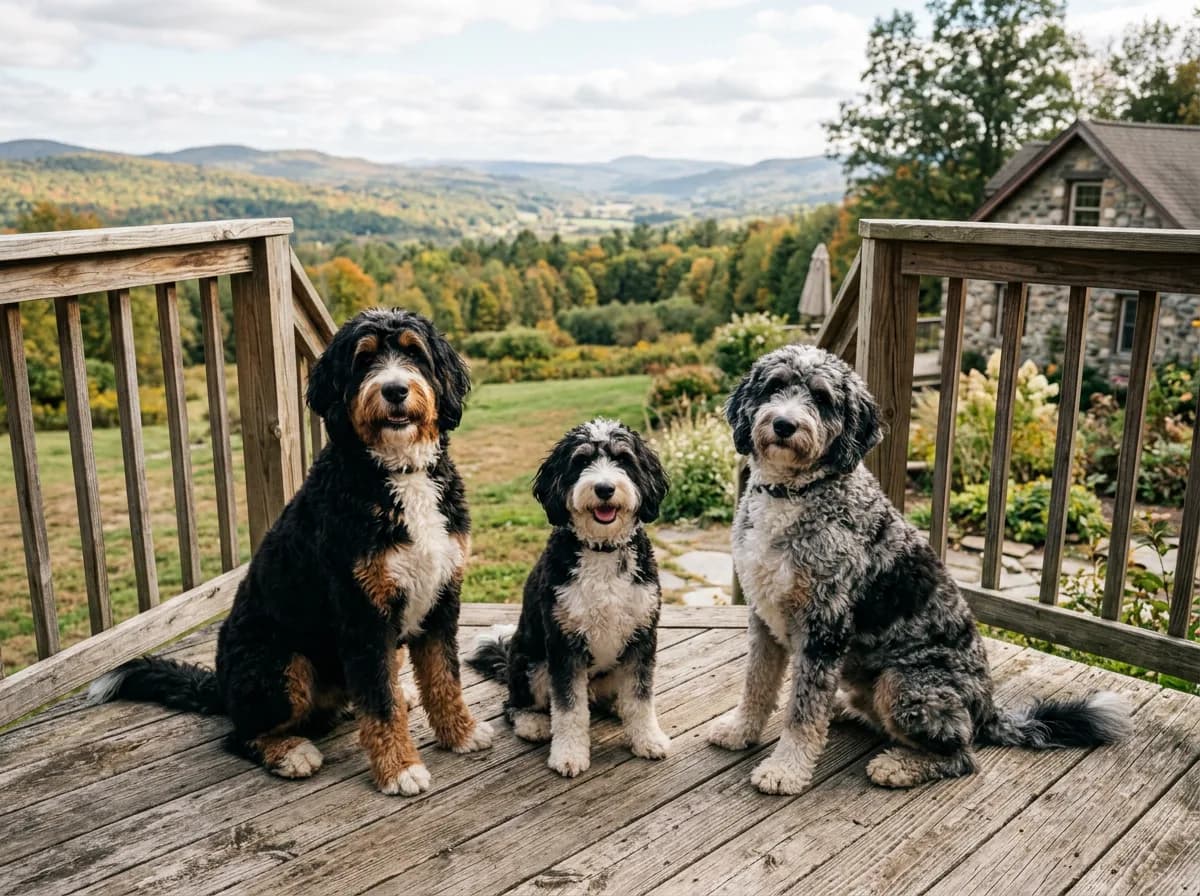
Because a color guide is only as useful as the pictures, here is a spread of different Bernedoodles showing how much the same breed can vary. Notice how coat type, size, and setting change the read of each color: a curly cream looks nothing like a straight tri-color, even though both are Bernedoodles.
When you scroll through breeder galleries, keep this in mind: puppy photos are a snapshot, not a forecast. Sable will lighten, some solids will fade, and tri-color markings can shift. Ask the breeder for photos of the parents and of past puppies as adults so you can see where a coat is likely to end up, not just where it starts. If you are cross-shopping other doodle-type breeds, our Cavapoo guide covers a similar range of coat colors in a smaller package.
Living With a Bernedoodle: Water, Sleep, and Training
Color is what draws people in, but the questions that follow are almost always about daily life with the dog. Here are the three that come up most, answered directly.
Do Bernedoodles Like Water?
Most Bernedoodles love water, and it is in their genes. The Poodle side descends from water retrievers (the breed was originally a duck-hunting dog), so a strong pull toward lakes, pools, sprinklers, and the beach is common. Plenty of Bernedoodles will wade in on their own the first time they see open water.
That said, "most" is not "all." The Bernese side is a mountain working breed with no particular water drive, so some Bernedoodles are cautious or indifferent about swimming, especially if they were never introduced to it as puppies. Early, positive, low-pressure exposure (shallow water, a calm day, a favorite toy) is the way to build confidence. Never toss a hesitant dog in, and remember that a heavy, wet doodle coat holds a lot of water, so rinse and dry thoroughly afterward to prevent matting and skin issues.
What Do Bernedoodles Like to Sleep On?
Bernedoodles tend to sleep best on a supportive, cushioned bed, and larger Bernedoodles specifically benefit from an orthopedic mattress that protects their joints. These are big, growing dogs (standards can reach 70 to 90 pounds), and like their Bernese parents they are prone to hip and elbow issues, so a firm, joint-supporting surface matters more than a thin pad.
Bernedoodles are also famously people-oriented and a little velcro, so many of them want to sleep near their humans, at the foot of the bed, in a crate in the bedroom, or on a dog bed placed in the room where the family spends the evening. A cool spot helps too, because that thick double-influenced coat runs warm; many Bernedoodles will abandon a plush bed for a cool tile floor in summer. The practical setup that satisfies both instincts is a supportive orthopedic bed placed close to where the family sleeps or relaxes.
How to Discipline a Bernedoodle?
The right way to "discipline" a Bernedoodle is through positive reinforcement, consistency, and redirection, never physical punishment or harsh corrections. These are sensitive, highly intelligent dogs that bruise emotionally under heavy-handed training and simply shut down or grow anxious. The goal is not to punish bad behavior after the fact but to teach and reward the behavior you want.
A few principles that work with this breed:
- Reward what you want, immediately. Bernedoodles are smart and food-motivated, so mark and treat good choices the second they happen.
- Be calm and consistent. Mixed rules confuse them. Everyone in the house should enforce the same boundaries the same way.
- Redirect, do not yell. If a puppy chews the wrong thing, swap in the right thing rather than scolding. Yelling erodes trust with a sensitive dog.
- Use time-outs, not pain. A brief, boring pause (a leash step-away or a moment in a calm space) teaches that the fun stops when the behavior starts.
- Exercise the brain. A bored Bernedoodle invents jobs. Puzzle toys, training games, and daily walks prevent most "misbehavior" before it starts.
Start early, keep sessions short and upbeat, and lean on socialization. A well-socialized, positively trained Bernedoodle is one of the easiest big dogs to live with.
Do Certain Bernedoodle Colors Cost More?
Color absolutely moves the price, but the driver is demand, not quality. A Bernedoodle in the United States typically runs somewhere in the range of $2,000 to $5,000, and within that spread the fashionable and hard-to-produce coats sit near the top while the plain, plentiful ones sit at the bottom. A rare-looking coat does not make a healthier or better dog. It simply costs more because more buyers are chasing the same look.
Three things push a coat toward the premium end: scarcity (merle and merle combinations), high demand (a crisp, well-marked traditional tri-color), and novelty (an unusual pattern like phantom in a rich chocolate). The most affordable coats are usually solid black and solid brown, mainly because they are the most common and read as the least "special" in a litter photo.
Keep the color premium in perspective, though. Size and generation usually swing the price far more than color does: a tiny or micro Bernedoodle, or a low-shedding F1b, will almost always cost more than a standard in a trendy shade. Do not let color alone stretch your budget, and never pay a "rare merle" markup without proof that only one parent is merle.
| Price Tier | Typical Colors | Why It Lands Here |
|---|---|---|
| Premium | Merle, merle tri, richly marked tri-color | Scarce to produce or in very high demand |
| Mid-range | Bi-color, sable, phantom, chocolate | Popular but easier to produce |
| Most affordable | Solid black, solid brown | Most common, lowest novelty |
The Genetics Behind Bernedoodle Coat Colors
Every Bernedoodle color traces back to a small set of gene "switches" that each parent passes on, which is why two similarly colored parents can still produce a surprising litter. You do not need a genetics degree to shop smart, but knowing the main switches helps you read a breeder's DNA results and predict how a puppy will look grown up.
- Black or red (E locus): decides whether the coat can make black pigment at all. A dog with two recessive copies comes out clear cream, apricot, or red no matter which other color genes it carries.
- Pattern (K and A loci): together control whether a dog reads as solid, sable, or tan-pointed. The tan-point version is what builds the phantom layout, and adding white markings on top of it is what turns phantom into traditional tri-color.
- Brown (B locus): flips a black-based dog to chocolate and, at the same time, lightens the nose to liver instead of black.
- Merle (M locus): adds the marbled pattern. Because a single copy is enough to show it, a merle dog always has at least one merle parent, and pairing two merles is the combination a responsible breeder avoids.
- Fading (the graying gene): explains why a jet-black or dark-brown puppy can lighten into silver, blue, or cafe-au-lait over its first year or two.
The practical payoff here is prediction. A color DNA panel run on the parents can show which coats a given pairing can and cannot produce, and it confirms a puppy's merle status before you commit to a deposit. If a specific adult color matters to you, ask the breeder whether both parents have been color-tested and what those results actually say.
Do Mini and Toy Bernedoodles Come in the Same Colors?
Yes. Size and coat color are inherited separately, so a mini or toy Bernedoodle can wear every color and pattern a standard can, including tri-color, phantom, sable, merle, and solids. The size simply comes from which Poodle was used, a Miniature or Toy Poodle instead of a Standard. Because that smaller cross folds in more Poodle genetics, mini and toy litters often lean a little more toward Poodle-style solids and phantoms than the largest standards do.
When people search mini Bernedoodle colors, the shades they ask about most are blue, grey, and black. Blue and grey are not separate pigments; they are diluted or fading forms of black, where a dark puppy gradually pales into a slate or silver adult over the first year or two. Solid black minis, by contrast, tend to hold their color. The rarity and safety rules do not change with size either: a mini merle still needs one non-merle parent, and a smaller price tag never makes a merle-to-merle pairing safe.
What Does a Tri-Color Bernedoodle Look Like Full Grown?
A full-grown tri-color Bernedoodle keeps the same three-part pattern it was born with, a black base, white markings on the chest, muzzle, and paws, and rust points above the eyes and on the legs, but the look settles and sharpens as the adult coat grows in. The rust usually deepens toward copper, the white areas can shrink slightly, and the coat lengthens into the fuller, softer texture the breed is known for.
Size, not color, is what varies most at maturity, and it depends entirely on the variety:
- Standard tri-color: roughly 50 to 90 pounds full grown, and often not fully filled out until close to two years old.
- Mini tri-color: roughly 25 to 49 pounds.
- Tiny or toy tri-color: roughly 10 to 24 pounds, usually done growing by about a year.
So a "tri-color Bernedoodle full grown" can be anything from a 15-pound lapdog to a 90-pound couch companion wearing nearly identical markings. Because a fuzzy puppy photo rarely predicts the adult, ask the breeder for pictures of grown dogs from the same pairing before you commit.
Yes. Coat color is inherited separately from size, so mini and toy Bernedoodles come in every color and pattern standards do, including tri-color, phantom, sable, merle, and solids. Blue, grey, and black are the shades buyers ask about most in minis, with blue and grey being diluted or fading forms of black.
A full-grown tri-color keeps its black base, white markings, and rust points, though the rust often deepens, the white can shrink slightly, and the coat lengthens. Adult size ranges from about 10 to 24 pounds for tiny, 25 to 49 for mini, and 50 to 90 pounds for standard, depending on the variety.
Merle is generally considered the rarest Bernedoodle color, especially chocolate merle and merle combined with other patterns, because merle must come from a merle parent and responsible breeders limit merle pairings for safety. Flawlessly marked traditional tri-colors and true silvers are also uncommon.
Most Bernedoodles love water thanks to their Poodle water-retriever ancestry, and many will wade or swim happily. Some are cautious, especially without early exposure, so introduce water gently and never force a hesitant dog.
Bernedoodles do best on a supportive, cushioned bed, and larger dogs benefit from an orthopedic mattress that protects their joints. Being very people-oriented, most also want to sleep near their family, and many seek out a cool spot in warm weather.
Use positive reinforcement, consistency, and redirection, never physical punishment. Bernedoodles are sensitive and intelligent, so reward good behavior immediately, keep house rules consistent, redirect unwanted behavior, and use brief time-outs instead of harsh corrections.
Choosing Your Bernedoodle Color With Confidence
At the end of the day, the "best" Bernedoodle color is the one you will love looking at for the next 12 to 15 years, paired with a coat type and a breeder that fit your life. Tri-color will always be the classic, bi-color stays crisp, sable and phantom bring depth, merle turns heads, and solids keep it simple. None of them makes the dog healthier or better behaved on its own.
Prioritize the things that actually shape your years together: a health-tested pairing, a coat type that matches your shedding and grooming tolerance, and a breeder who is transparent about genetics (especially with merle). Get those right, and whatever gorgeous color walks out of that litter, you will have picked well. For everything else about the breed, from size and temperament to lifespan and price, start with our full Bernedoodle breed guide.

Coreen Saito is a pet writer and longtime shelter volunteer with more than a decade in animal rescue. She covers cat behavior, breed care, and the small, ordinary science of sharing a life with companion animals, with a particular focus on honest takes about the products and decisions that actually matter. At home in Arizona, she's outranked by Mac (a dog with the loudest opinion in the house), Rebel (a cat who governs by quiet authority), and Meri (an orange tabby who runs the late shift and the laundry basket). She writes about all three, plus the rescues that keep coming through her life, at LifeWithMinty.com.
Sign up for expert-backed reviews and safety alerts all in one place.