Bernedoodle Grooming: A Complete Coat-Care Guide
Everything you need for Bernedoodle grooming: wavy, curly, and straight coat care, a realistic brushing and professional schedule, matting prevention, tools, bathing, costs, and the most popular cuts like the teddy bear.
Petful is reader supported. As an affiliate of platforms like Amazon and Chewy, we may earn a commission when you buy through links on this page. There is no extra cost to you.
Bernedoodle grooming is the single biggest ongoing commitment that comes with owning this Bernese Mountain Dog and Poodle cross, and it is the part most new owners underestimate. That soft, huggable coat does not stay tangle-free on its own. Depending on whether your dog inherited a wavy, curly, or straight coat, you are signing up for brushing several times a week, a bath every few weeks, and a full professional trim roughly every two months. Get into a rhythm early and it is genuinely easy. Fall behind and the coat packs into mats that are painful for the dog and expensive to fix. This guide walks through every coat type, the exact tools that work, a realistic at-home and professional schedule, matting prevention, and the popular cuts (including the famous teddy bear) so you know what you are doing before the tangles win.
- 1Brush most Bernedoodles 3 to 5 times a week, and daily if the coat is curly, all the way down to the skin
- 2Book a professional groom every 6 to 8 weeks for a bath, brush-out, and trim
- 3Matting forms first at friction points: behind the ears, in the armpits, under the collar or harness, and on the legs
- 4The teddy bear cut (rounded face, even 1 to 2 inch body) is the most requested Bernedoodle style
Whether you are still researching the breed on our Bernedoodle breed guide or already have a puppy chewing your shoelaces, the coat-care routine below is what keeps a Bernedoodle comfortable, clean, and looking like the teddy bear you fell for.

Sign up for expert-backed reviews and safety alerts all in one place.
Understanding Bernedoodle Coat Types
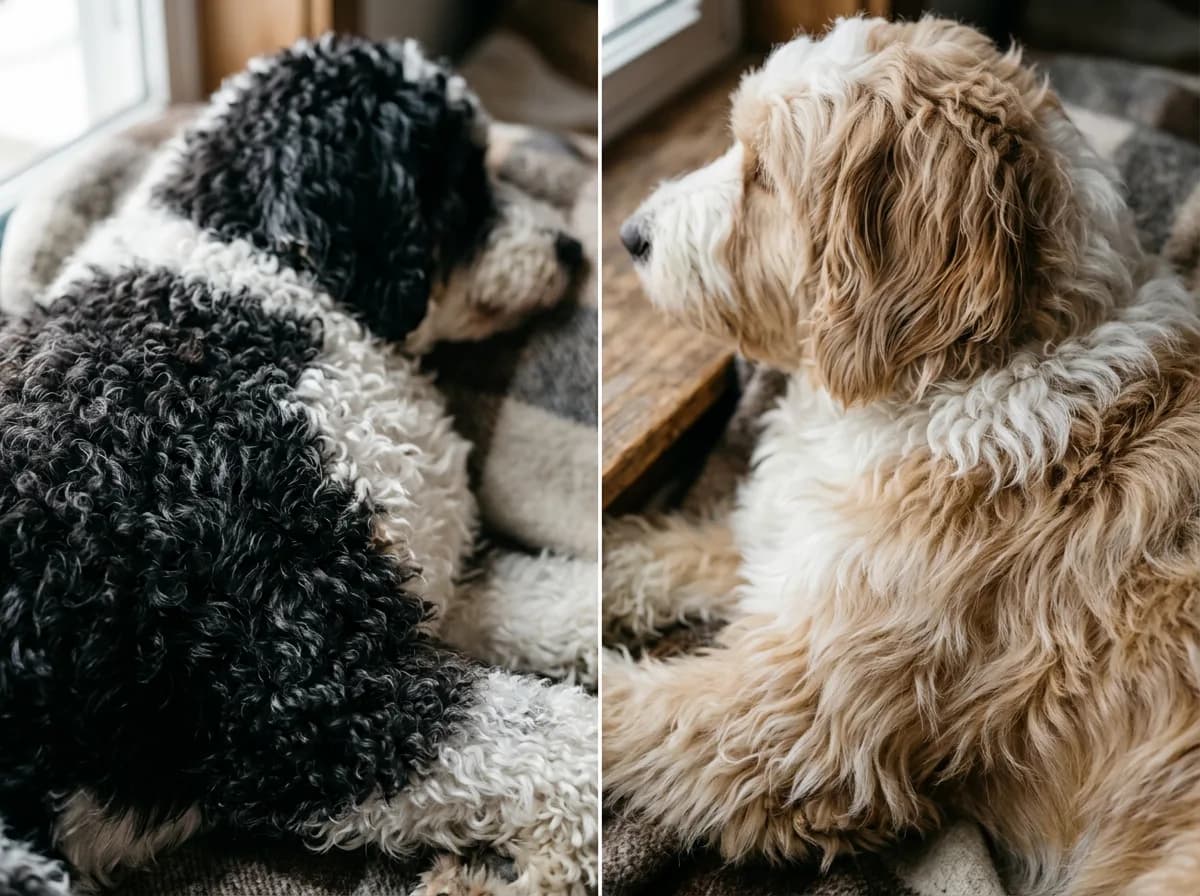
There is no single Bernedoodle coat. Because the breed crosses the double-coated Bernese Mountain Dog with the single-coated, curly Poodle, puppies land somewhere on a spectrum, and even littermates can differ. Your grooming routine depends almost entirely on which coat your dog got, so this is the first thing to identify.
Coat type is loosely tied to generation. An F1 Bernedoodle (Bernese crossed directly with Poodle) is the most variable and more likely to carry some Bernese-style straight hair. An F1b (an F1 bred back to a Poodle) leans curlier, lower-shedding, and more mat-prone. F2 and multigenerational dogs vary again. If you want the genetic detail, an at-home DNA panel can confirm the mix and even flag health markers worth watching.
Wavy (Fleece) Coat
The wavy or "fleece" coat is the classic Bernedoodle look: loose, S-shaped waves with a soft, cottony feel. It is the middle ground between the two parent breeds, usually low-shedding, and the coat most people picture when they imagine the breed. It mats less than a full curly coat but still needs brushing 3 to 4 times a week to stay open, especially as the adult coat comes in.
Curly (Wool) Coat
The curly or "wool" coat is the most Poodle-like: tight, dense curls that shed very little and are the most allergy-friendly of the three. That density is a double-edged sword. Curls trap loose hair and debris close to the skin, so a curly Bernedoodle mats faster than any other coat type and realistically needs daily brushing right down to the skin. This is the coat that most often ends up shaved short at the groomer because the owner could not keep up.

Petful may earn a commission when you click through to Chewy, at no extra cost to you.
Straight (Hair) Coat
The straight or "hair" coat is the least common and the most Bernese-like: flatter, sometimes with visible feathering on the legs and tail. Straight-coated Bernedoodles are the most likely to shed and the most likely to carry a genuine double coat (more on that below). The upside is that a straight coat mats the least, so brushing 2 to 3 times a week is often enough.
| Coat Type | Texture | Shedding | Matting Risk | Brushing Needs |
|---|---|---|---|---|
| Wavy (Fleece) | Loose S-shaped waves, soft | Low | Moderate | 3 to 4 times a week |
| Curly (Wool) | Tight, dense Poodle-like curls | Very low | High | Daily, to the skin |
| Straight (Hair) | Flat, Bernese-like, some feathering | Moderate to high | Low | 2 to 3 times a week |
Do Bernedoodles Have Two Coats?
Most Bernedoodles do not have two coats. The majority inherit the Poodle's single coat, which is why the breed is marketed as low-shedding and more allergy-friendly. However, straight-coated or higher-Bernese-percentage Bernedoodles can carry a double coat, meaning a softer insulating undercoat beneath the outer guard hairs. A double-coated Bernedoodle will shed noticeably more, blow its coat seasonally, and need de-shedding rather than pure de-matting. If your dog leaves tumbleweeds of fluff around the house, it likely has some double coat, and a de-shedding tool becomes part of your kit.
- Not sure which coat your dog has yet? Part the hair and press a finger to the skin. If you feel a soft, dense layer under the top coat, there is undercoat and probably some double coat. A single coat feels the same texture all the way down. Puppy coats also change, so recheck at around 8 to 12 months when the adult coat finishes coming in.
How Often Should Bernedoodles Be Groomed?
Bernedoodles should be brushed at home several times a week and professionally groomed every 6 to 8 weeks. That is the short answer, but the honest one depends on the coat. A curly Bernedoodle brushed less than daily will mat, full stop. A straight-coated dog can stretch to a couple of brush sessions a week. The professional interval is more consistent across coat types because the coat simply grows too long and too dense to manage past the two-month mark without a trim.
Think of it as two overlapping schedules. Home brushing keeps the coat from matting between salon visits. Professional grooming resets the coat length, deep-cleans the skin, and handles the fiddly work (feet, sanitary areas, nails, ears). Skip the home half and no groomer can save a fully matted coat except by shaving it to the skin.
- Puppies (8 to 16 weeks): short, positive brushing sessions daily to build tolerance, even before the coat needs it
- Adolescent coat change (6 to 12 months): the highest-risk window for sudden matting, so increase brushing as the adult coat comes in
- Adult, wavy or straight: brush 3 to 4 times a week, professional groom every 8 weeks
- Adult, curly: brush daily, professional groom every 6 weeks
- Between roughly 6 and 12 months, a Bernedoodle sheds its soft puppy coat and grows its denser adult coat. During this transition the two coat lengths tangle together and mats can form almost overnight, even in a dog that was easy to brush the month before. This is the number one time owners end up with a shave-down. Brush more, not less, through this phase.
Brushing Your Bernedoodle at Home
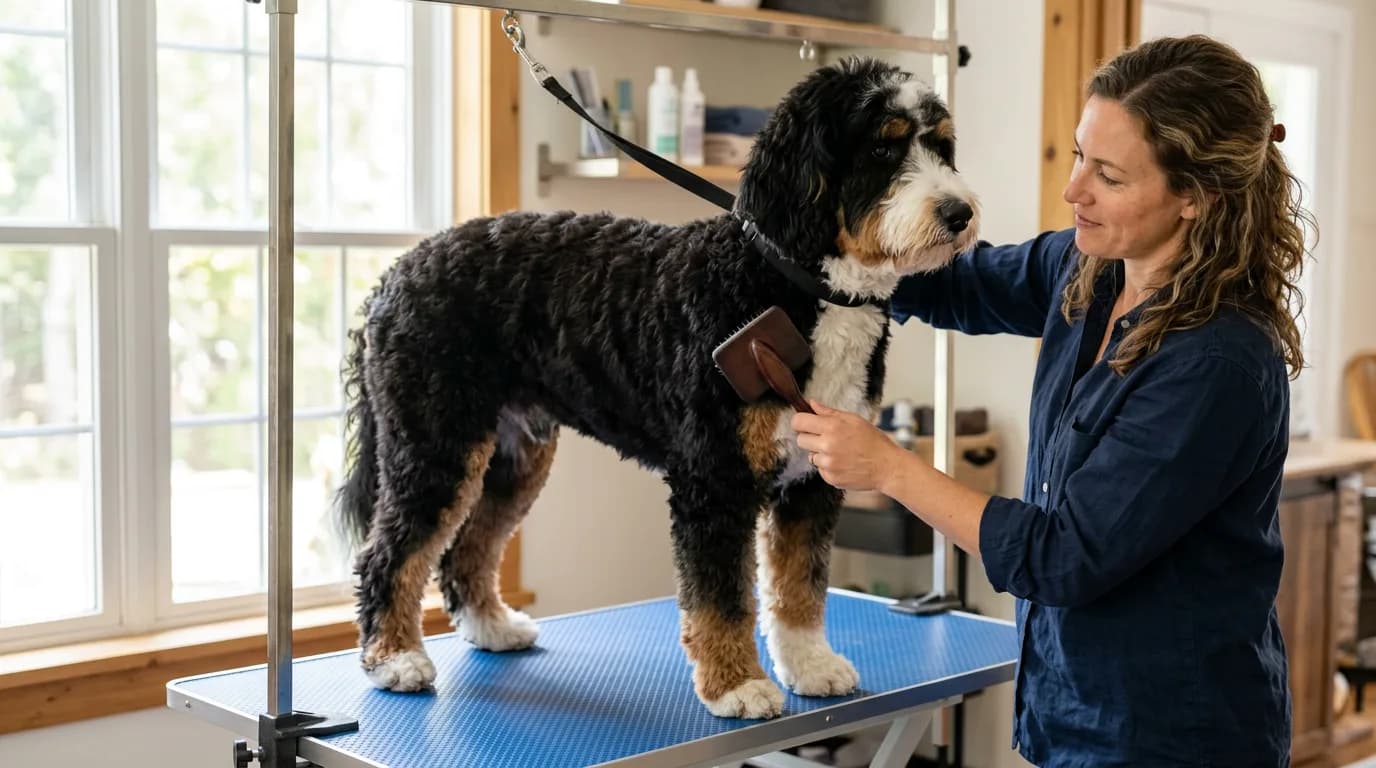
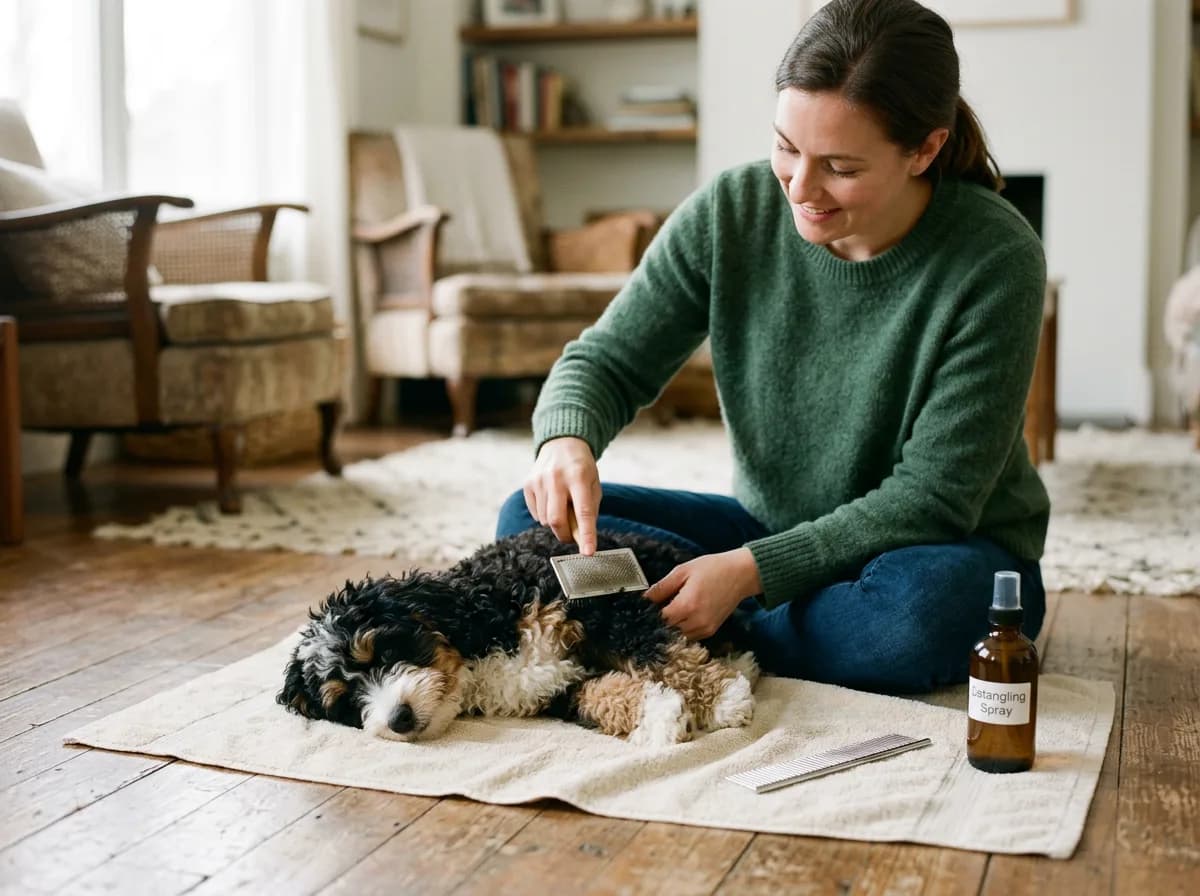
Brushing is the heart of Bernedoodle grooming, and the technique matters more than the time you put in. The mistake almost everyone makes is "top brushing," dragging a brush across the surface so the coat looks tidy while mats quietly form underneath, right against the skin. The fix is a method called line brushing.
Petful may earn a commission when you click through to Chewy, at no extra cost to you.
The Line-Brushing Method
Line brushing means working the coat in horizontal sections so every strand gets brushed from the skin outward, not just the top layer.
- Lay the dog on its side or have it stand calmly
- Start low, near the belly or the bottom of a leg
- Part the hair into a horizontal line and hold the coat above the part out of the way
- Brush the exposed section downward from the skin with a slicker brush until it is tangle-free
- Drop the next inch of coat down, make a new line, and repeat, working your way up the body
- Finish each area by running a metal comb through to the skin: if the comb glides, that section is clean; if it snags, you missed a mat
It sounds slow, and the first few times it is. Once the coat is well maintained, a full line-brush takes 15 to 20 minutes a few times a week.
The Tools That Actually Work
You do not need a salon's worth of equipment, but the right handful of tools makes the job far faster. A slicker brush and a good metal comb are the non-negotiables. Everything else solves a specific problem.
| Tool | What It Does | Best For |
|---|---|---|
| Slicker brush | Lifts the coat and removes loose hair and small tangles | Everyday line brushing |
| Metal greyhound comb | Reaches the skin to find hidden mats | The finish check after brushing |
| Dematting rake | Splits packed tangles without cutting the coat | Clearing small mats before they spread |
| Detangling spray | Adds slip so hair slides apart | Misting a dry coat before you brush |
| High-velocity dryer | Blows the coat dry down to the skin | Preventing mats after every bath |
- Dragging a brush through a dry mat hurts, and pain teaches your dog to dread grooming. Always mist a dry coat with a little detangling spray first, work mats loose with your fingers and a comb before you brush, and stop before your dog gets frustrated. A calm dog that tolerates grooming is worth more than a perfect coat on a stressed one.
Matting Prevention: Where and Why It Happens
Mats are not random. They form where hair moves against something and gets worked into a knot: friction points and anywhere moisture lingers. Once you know the hot spots, you can target them and prevent 90 percent of matting.
The usual culprits are behind and under the ears, in the armpits where the front legs meet the body, on the chest, under the collar or harness, around the sanitary area, and on the lower legs. Anything the dog wears (a collar, a harness, even a winter coat) creates constant friction, so those zones need extra attention.
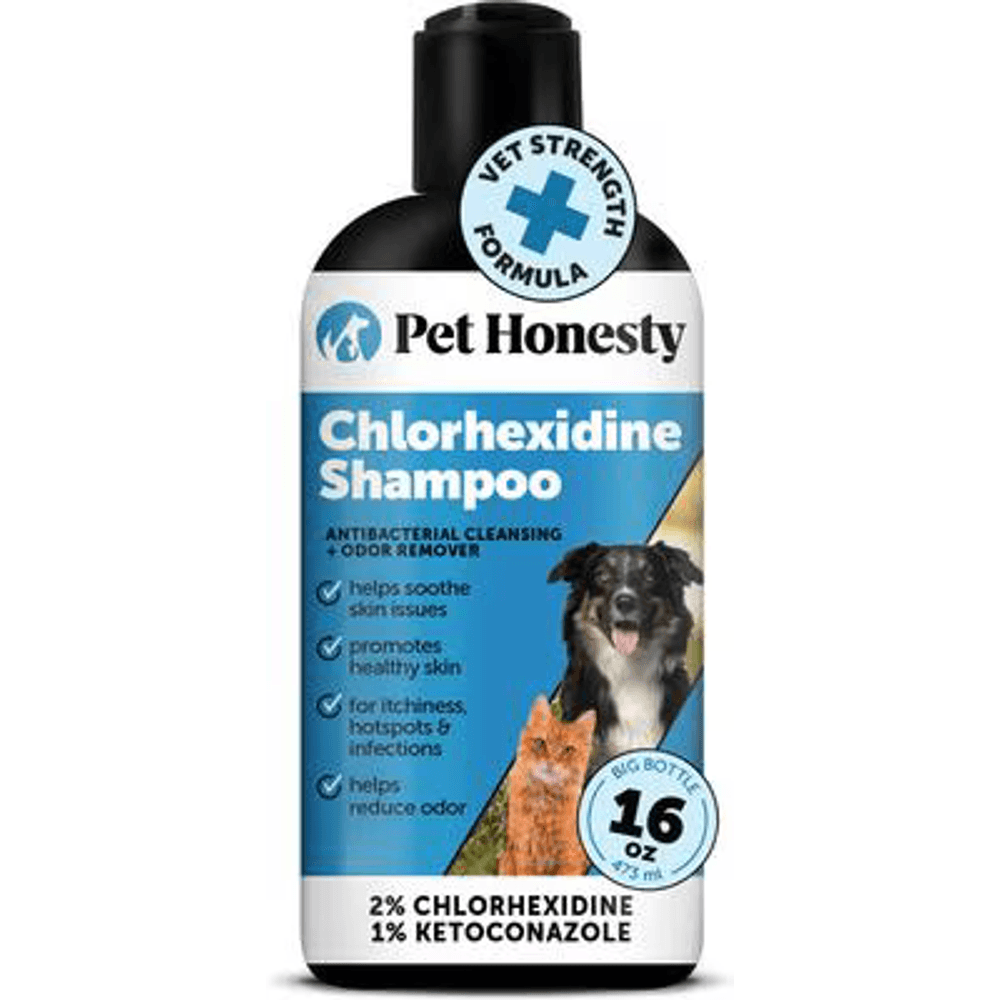
A vet-strength medicated shampoo with 2% chlorhexidine and 1% ketoconazole, the antifungal and antibacterial combination vets use to help clear ringworm and skin infections and to cut fungal spore shedding during treatment.
Petful may earn a commission when you click through to Chewy, at no extra cost to you.
- Check and brush the friction zones every day, even if you skip a full-body brush
- Take the collar or harness off at home so it is not grinding a mat in 24/7
- Dry the coat completely after baths, swimming, or rainy walks, because damp hair mats fast
- Never let a wet coat air-dry into curls if the dog is curly-coated, blow it dry instead
- Trim the hair shorter in chronic problem spots if you cannot keep up
If you do find a mat, work it apart with your fingers and a comb from the outer edge inward, or use a dematting rake for stubborn ones. Never bathe a matted dog before de-matting, because water tightens mats like a knot in a wet shoelace. And never cut a mat out with scissors blind, since the skin often tents up into the mat and it is dangerously easy to cut the dog.
Bathing Your Bernedoodle
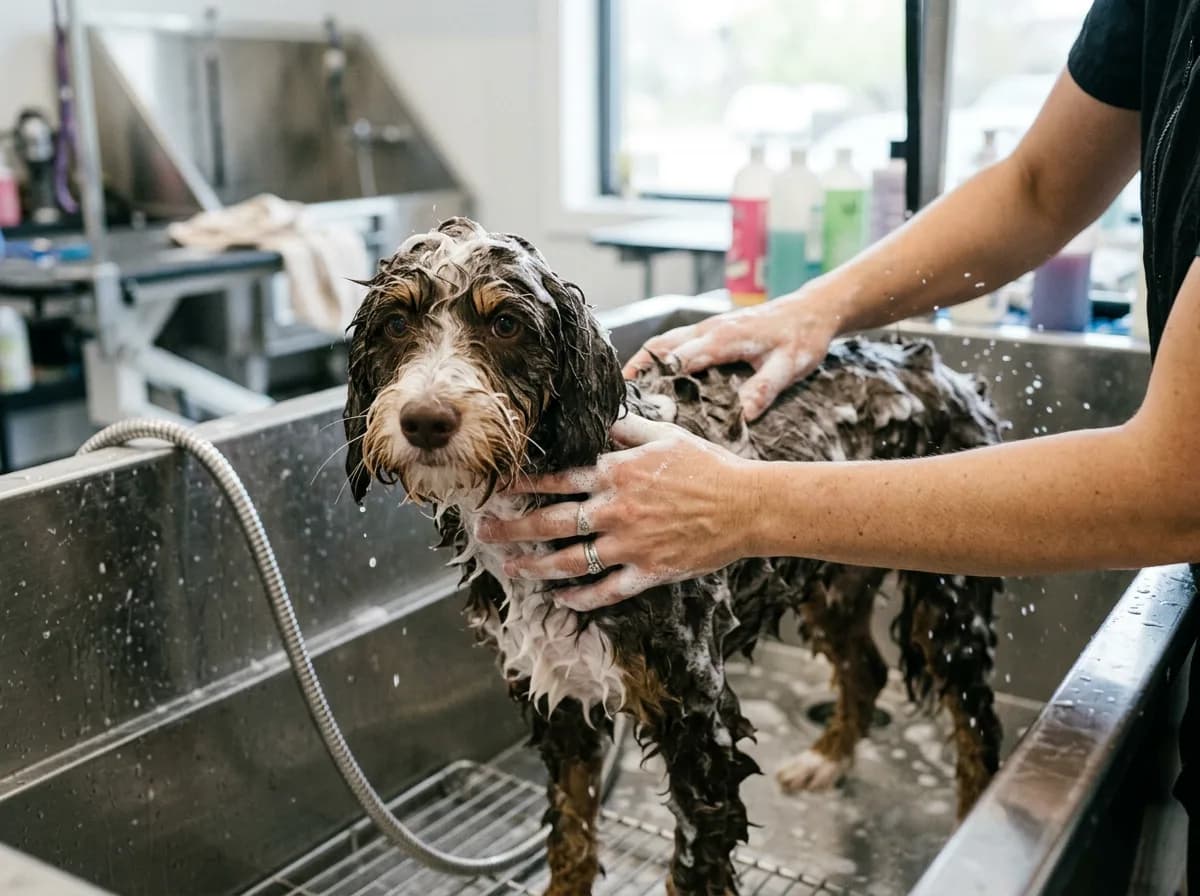
Most Bernedoodles need a bath every 3 to 6 weeks, or whenever they are genuinely dirty. Bathe more often than that and you strip the natural oils, leaving dry, itchy skin and, ironically, a coat that mats more. The critical rule for a doodle coat is sequence: always brush the coat completely mat-free before the bath, never after a mat has formed.
The bathing routine that keeps a doodle coat healthy:
- Brush and comb the entire coat to the skin first, clearing every tangle
- Wet the coat thoroughly with lukewarm water, which takes longer than you expect on a dense coat
- Use a gentle, dog-specific shampoo (never human shampoo, which is the wrong pH for canine skin) and work it down to the skin
- Rinse until the water runs completely clear, because leftover product irritates skin and attracts dirt
- Follow with a light conditioner or detangler to add slip
- Towel gently by squeezing, not rubbing, which itself creates tangles
- Blow the coat fully dry on a low-heat or high-velocity dryer while brushing, which is what sets the fluffy finish and prevents post-bath mats
That last step is what separates a fluffy Bernedoodle from a matted one. A curly or wavy coat left to air-dry will curl up tight around any loose hair and lock in mats. Drying while brushing (a technique groomers call fluff drying) is non-negotiable for the curlier coats.
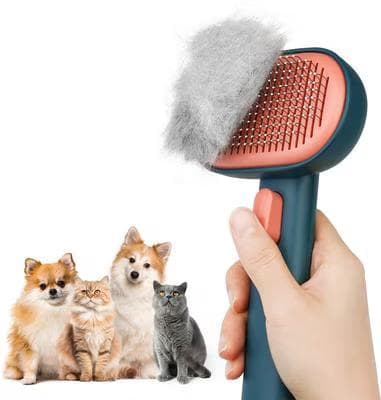
Petful may earn a commission when you click through to Chewy, at no extra cost to you.
- Bernedoodles have floppy, hairy ears that trap moisture and are prone to infection. After every bath, dry inside the ear flap, and check weekly for a bad smell, redness, or head-shaking. Many groomers pluck or trim the hair inside the ear canal to improve airflow. Ask your vet what is right for your dog, since routine ear plucking is not recommended for every dog.
Professional Grooming: Schedule and Cost
Even the most diligent home groomer needs a professional groom every 6 to 8 weeks. A groomer resets the coat to a manageable length, deep-cleans the skin, and handles the technical work that is hard to do well at home: a balanced haircut, tidy feet, clean sanitary areas, nail trims, and ear care.
What It Costs
Bernedoodle grooming is not cheap, largely because these dogs are big and their coats are labor-intensive. A full groom on a standard Bernedoodle commonly runs higher than a short-haired dog of the same size. Prices vary a lot by region and by the condition of the coat.
| Service | Typical Frequency | Average Cost (US) |
|---|---|---|
| Full groom (bath, brush, haircut) | Every 6 to 8 weeks | $75 to $150 |
| Bath and brush only | Every 4 to 6 weeks | $40 to $80 |
| De-matting add-on | As needed | $10 to $30 per 15 minutes |
| Nail trim | Every 4 to 6 weeks | $10 to $20 |
| Sanitary and face tidy | Every 2 to 3 weeks | $15 to $25 |
A mini or tiny Bernedoodle costs less to groom than a standard simply because there is less dog to work through, but the per-visit rhythm is the same.
Why Do Groomers Charge Extra for Doodles?
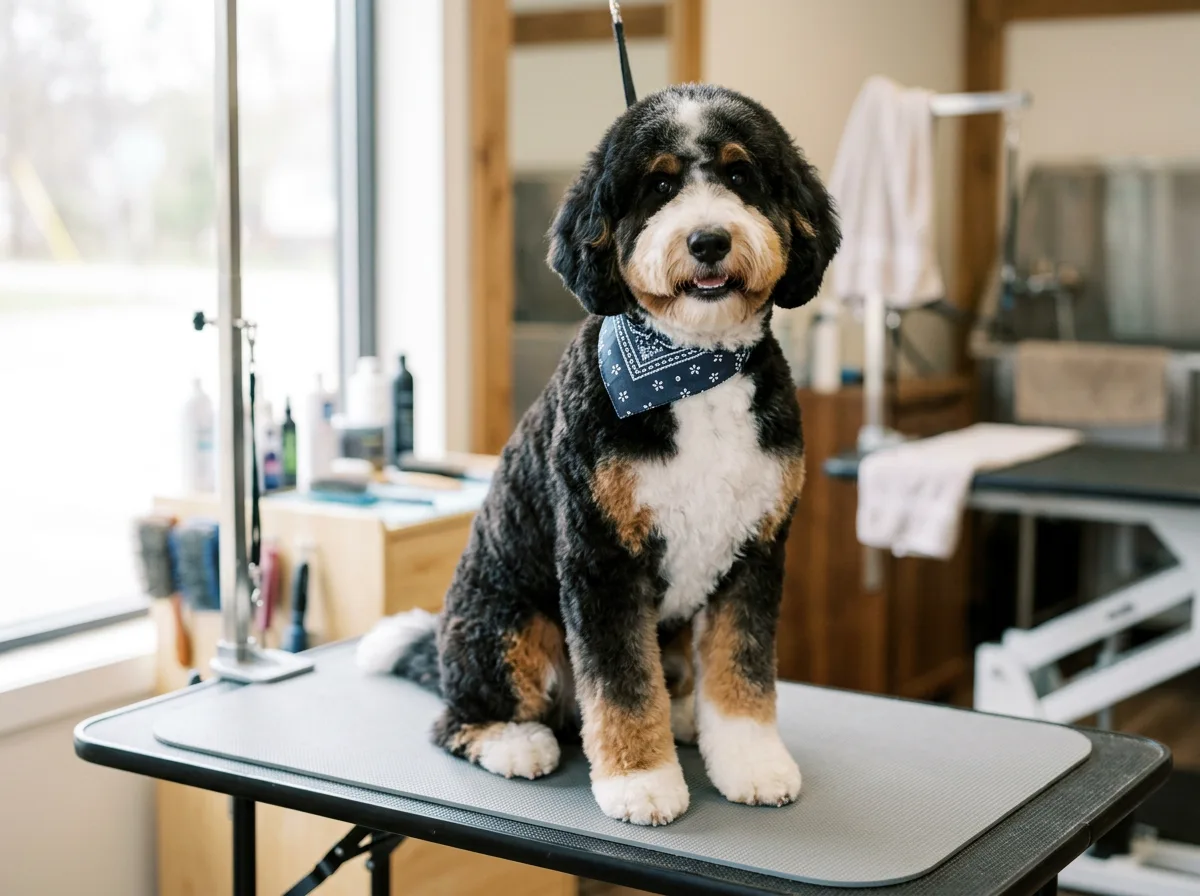
Groomers charge extra for doodles because their coats take far longer and carry more risk than a typical breed coat. A doodle groom is not one job, it is several: a thorough brush-out, a careful bath, a lengthy fluff-dry on a dense coat, and a hand-scissored haircut, all on a large, often wiggly dog. Curly doodle coats mat close to the skin, and de-matting is slow, physically demanding work that can stress both the dog and the groomer's hands and tools. Many salons now list a "doodle surcharge" or price doodles as a separate category for exactly this reason. If your dog arrives matted, expect the price to climb or the groomer to recommend a short shave-down, because working through heavy mats is both time-consuming and, past a certain point, painful for the dog.
- The cheapest way to lower your grooming bill is to keep the coat mat-free between visits. Groomers price de-matting by time, so a well-brushed dog gets the standard rate while a matted one racks up add-on charges or gets shaved. Booking on a standing schedule (say, every 6 weeks) also helps, since the coat never gets long enough to become a big job.
Popular Bernedoodle Haircuts and Cuts
Half the fun of a Bernedoodle is the styling. Because the coat grows continuously, you can choose a look, and the right cut can also make maintenance dramatically easier. Here are the most requested styles.
What Is the Best Haircut for a Bernedoodle?
The best haircut for a Bernedoodle is the teddy bear cut, which is why it is by far the most popular. It leaves the coat an even 1 to 2 inches all over the body with a rounded, plush face that gives that signature stuffed-animal look. It balances cuteness with practicality: long enough to look like a doodle, short enough to brush without a fight. If you want one style that works for most owners, this is it.
That said, "best" depends on your life. If you cannot commit to frequent brushing or your dog swims and hikes constantly, a shorter cut is genuinely the kinder, more practical choice. There is no single right answer, only the right cut for your dog's coat and your schedule.
Other Popular Styles
- Teddy bear cut: even 1 to 2 inch body with a rounded face, the breed classic
- Puppy cut: a short, uniform 1 inch or so all over, easy to maintain and great for active dogs
- Kennel or summer cut: very short (half an inch or less), the lowest-maintenance option and popular in hot climates
- Lamb cut: shorter body with slightly longer, fuller legs for a leggy silhouette
- Lion cut: full mane and shorter hindquarters, a novelty look rather than a practical one
Should You Cut a Bernedoodle's Hair?
Yes, you should cut a Bernedoodle's hair, and regularly. Unlike a shedding breed, a Bernedoodle's coat grows continuously and will not stop on its own, so without haircuts it grows long, mats, and traps dirt and debris. Trimming is not optional grooming vanity for this breed, it is basic coat maintenance. The only real choice is length, not whether to cut at all. A common myth says shaving a doodle "ruins" the coat: for a single-coated Bernedoodle that is not a health concern, though a shaved coat can grow back a slightly different texture. For a double-coated Bernedoodle, avoid shaving to the skin when possible, because the coat helps regulate temperature and can grow back patchy.
At-Home vs Professional Grooming
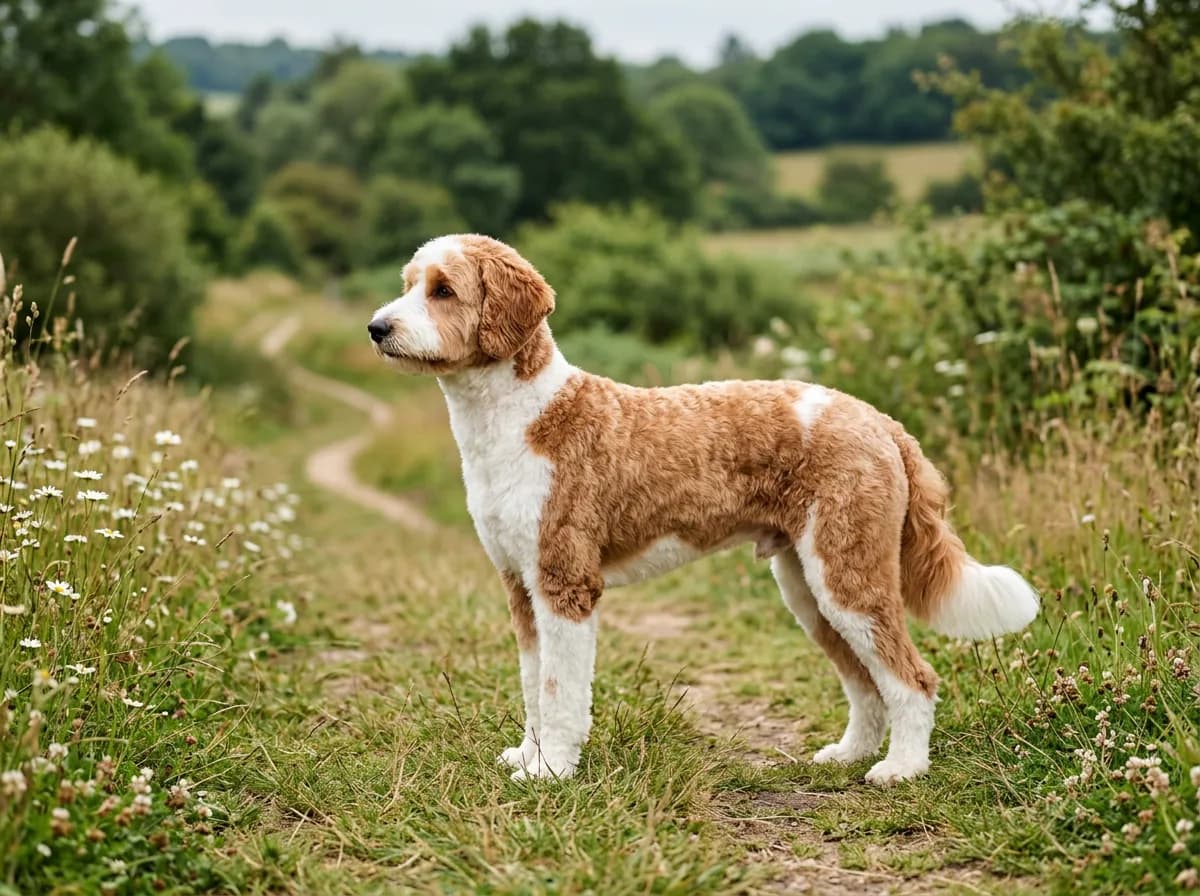
You do not have to choose one or the other. Most Bernedoodle owners do both: daily or near-daily maintenance brushing at home, plus a professional groom every 6 to 8 weeks for the bath, cut, and technical work. The question is really how much you take on yourself.
Home grooming saves money and builds a strong bond with your dog, and brushing at home is not optional in any case, because no salon interval is frequent enough to prevent matting alone. What most owners leave to the pros is the haircut itself. A balanced, hand-scissored doodle trim takes skill and the right blades, and a bad home haircut on a dense coat is very visible and hard to fix. Bathing and full drying a large, dense coat at home is also a genuine workout that many owners would rather outsource.
If you want to do more yourself, invest in a high-velocity dryer and learn to bathe and fluff-dry at home, then leave the scissoring to a groomer. If you want to go fully DIY, budget for good clippers and expect a learning curve. Either way, the home brushing routine is the part you cannot skip.
- Do at home, always: line brushing several times a week, friction-zone checks, ear drying
- Reasonable to do at home: bathing, fluff drying, nail trims, light face and feet tidying
- Best left to a professional: the full body haircut, heavy de-matting, and anal gland or deep ear work
Seasonal Grooming and Comfort
Grooming is not just about looks, it is about keeping your dog comfortable through the seasons. In summer, a shorter cut helps a dense-coated dog stay cool, though never shave a double-coated Bernedoodle to bare skin, since the coat also protects against sunburn and heat. In winter, a little more length provides insulation, and you may bathe less often to preserve skin oils in dry indoor air.
Do Bernedoodles Get Cold at Night?
Bernedoodles can get cold at night, especially puppies, single-coated dogs, and any Bernedoodle that has been clipped short. A full, long coat provides good insulation, but a freshly shaved or naturally single-coated dog has far less protection, and small or mini Bernedoodles lose body heat faster than standards. Signs a dog is cold include curling up tightly, shivering, seeking out blankets, or burrowing. The easy fixes: give a warm, draft-free bed away from cold floors, add a blanket the dog can nest in, and consider a light sweater for a short-clipped dog in a cold house or on winter walks. A healthy adult Bernedoodle in a heated home is usually fine, but do not assume the coat alone is enough right after a summer shave-down.
Is the Bernedoodle One of the Hardest Breeds to Groom?
The Bernedoodle is one of the higher-maintenance breeds to groom, but it is not usually named the single hardest. That title typically goes to corded or specialty-coated breeds like the Puli and Komondor, whose coats form permanent cords, and to breeds like the Afghan Hound and the standard Poodle, whose long, fine coats demand constant, skilled attention. Where the Bernedoodle lands is squarely in the "high effort" tier alongside other doodles: the continuously growing, mat-prone coat means there is no off-season and no low-maintenance version if you keep the coat long.
What makes doodle coats hard is the combination of factors. The coat never stops growing, it mats close to the skin, it requires both frequent home brushing and regular professional cuts, and the curlier coats are unforgiving of any lapse. A Labrador needs a brush and the occasional bath. A Bernedoodle needs a genuine routine. If you are also considering other designer breeds, know that a Cockapoo and a Cavapoo carry very similar Poodle-derived coats and nearly identical grooming demands, just on a smaller dog. The mix of colors in these coats, which you can explore in our guide to Bernedoodle colors, does not change the workload, but a lighter or particoat can show dirt sooner.
For breed-specific health and coat guidance, veterinary and breed authorities such as the American Kennel Club and university veterinary programs like Cornell University College of Veterinary Medicine publish reliable, current advice on skin, coat, and ear care that is worth checking alongside your own vet's recommendations.
Frequently Asked Questions
How Do You Groom a Bernedoodle's Face?
Groom a Bernedoodle's face by trimming the hair around the eyes first, then shaping the muzzle and cheeks to keep the soft, rounded "teddy bear" look most owners want. Hair that falls into the eyes traps moisture and is a common cause of tear staining and irritation, so keeping it short there is about comfort, not just appearance.
Use blunt-tipped (safety) scissors and always point them away from the eye, snipping the fringe between and above the eyes a little at a time. Comb the muzzle hair forward and even it out rather than cutting it flat, since that rounded scissoring is what gives the face its full, circular shape.
- Trim the eye-area hair every 2 to 3 weeks between full grooms; it grows back faster than the body coat.
- Wipe under the eyes daily with a damp cloth to lift staining before it sets, and keep the beard clean and dry after meals and drinks.
- If your dog squirms near the eyes, have a helper steady the head or leave the close work to a groomer.
Mini Bernedoodle Grooming: What's Different?
A Mini Bernedoodle needs the same coat care as a standard, just on a smaller body, so do not expect less grooming because the dog is little. Minis often carry more Poodle in their genetics (many are F1b), which usually means a curlier, denser coat that mats just as readily as a standard's wavy one.
The brushing routine, matting-prone spots, and haircut options are all the same. The main practical differences are that a smaller dog is easier to manage in a home bath or sink, and professional grooms often cost a bit less because there is less coat to work through. Tightly curled Mini coats can actually need brushing slightly more often to stay tangle-free.
- Do not stretch out grooming intervals just because a Mini or Toy Bernedoodle is small. A tight, curly coat on a 20-pound dog mats as fast as it does on a 70-pound one, and the smaller frame leaves less margin before mats start pulling at the skin.
Popular Mini styles mirror the standards: the teddy bear cut, puppy cut, and lamb cut all scale down well.
Grooming a Bernedoodle Puppy: When to Start and the Coat Change
Start grooming a Bernedoodle puppy at home the week you bring it home, and book a first professional "puppy groom" around 12 to 16 weeks, once core vaccinations are complete. Early, gentle sessions teach the puppy to accept brushing, bathing, nail trims, and the sound of clippers long before a full haircut is needed.
Keep the first home sessions short and positive: a minute or two of brushing, some handling of the paws and ears, and a reward for calm behavior. At this stage the goal is tolerance, not a perfect cut.
The bigger milestone is the coat change, when the soft puppy coat is replaced by the denser adult coat, usually between 8 and 12 months. During this window loose puppy hair tangles into the incoming coat and matting spikes, so brushing frequency needs to go up temporarily even though the dog can look the same on the surface.
- First groomer visit: 12 to 16 weeks, kept short and social.
- Coat change: expect heavier matting from roughly 8 to 12 months and brush more often to get through it.
Grooming the Tricky Spots: Feet, Ears, Sanitary Areas, and Tail
The feet, ears, sanitary area, and tail each need their own attention because they mat, trap debris, or affect hygiene in ways the main body coat does not. Handling them on a regular schedule keeps your Bernedoodle comfortable between full grooms.
- Feet: trim the hair between the paw pads and neaten the fur around the foot so it does not collect dirt or ice or cause slipping on smooth floors. Keep the nails short at the same time.
- Ears: keep the ear canal clean and dry, and trim excess hair around the opening for airflow. Ask your vet or groomer before plucking ear hair, since routine plucking is no longer universally recommended.
- Sanitary area: a short trim around the genitals and under the tail keeps waste from clinging and cuts down on odor.
- Tail: comb the plumed tail from the base outward to clear tangles, and many owners have the groomer shape it into a neat flag or rounded plume.
Give the feet, sanitary area, and tail a quick check and comb weekly, and clean the ears about every one to two weeks or whenever they look dirty.
Yes, with blunt-tipped scissors and a steady hand, but go slowly and leave the close work near the genitals to a groomer if your dog wriggles.
The teddy bear cut is the most popular and, for most owners, the best. It keeps the coat an even 1 to 2 inches with a rounded, plush face, balancing the classic doodle look with manageable upkeep. If you cannot brush often or your dog is very active, a shorter puppy or summer cut is more practical.
Brush at home 3 to 5 times a week (daily for curly coats) and book a professional groom every 6 to 8 weeks for a bath, brush-out, and trim. Home brushing prevents matting between salon visits, and no professional interval is frequent enough to skip it.
Corded breeds like the Puli and Komondor and long-coated breeds like the Afghan Hound and Poodle are usually named the hardest to groom. The Bernedoodle sits in the high-maintenance tier just below them, because its continuously growing, mat-prone coat needs both frequent brushing and regular professional cuts.
They can, especially puppies, single-coated dogs, and Bernedoodles clipped short, since a shaved or single coat offers little insulation and smaller dogs lose heat faster. Provide a warm, draft-free bed and a blanket, and use a light sweater for a short-clipped dog in a cold home or on winter walks.
Yes. A Bernedoodle's coat grows continuously and will mat and trap debris if left uncut, so regular haircuts are basic maintenance, not optional. The only real choice is the length. Avoid shaving a double-coated Bernedoodle to the skin, as the coat helps regulate temperature.
Most do not. The majority inherit the Poodle's single coat, which is why the breed is low-shedding. But straight-coated or higher-Bernese-percentage Bernedoodles can carry a double coat, meaning they shed more, blow their coat seasonally, and need de-shedding rather than pure de-matting.
Because doodle coats take much longer and carry more risk. A doodle groom includes a full brush-out, bath, lengthy fluff-dry on a dense coat, and a hand-scissored cut, often on a large dog, and curly coats mat close to the skin so de-matting is slow, demanding work. Many salons add a doodle surcharge for this reason.

Coreen Saito is a pet writer and longtime shelter volunteer with more than a decade in animal rescue. She covers cat behavior, breed care, and the small, ordinary science of sharing a life with companion animals, with a particular focus on honest takes about the products and decisions that actually matter. At home in Arizona, she's outranked by Mac (a dog with the loudest opinion in the house), Rebel (a cat who governs by quiet authority), and Meri (an orange tabby who runs the late shift and the laundry basket). She writes about all three, plus the rescues that keep coming through her life, at LifeWithMinty.com.
Sign up for expert-backed reviews and safety alerts all in one place.