Aussiedoodle Grooming: Coat, Cuts and Matting Guide
A complete Aussiedoodle grooming plan built around coat type. Learn how F1, F1b and F2 coats differ, how much this cross really sheds, the brushing cadence that prevents matting, which haircut to ask for, and what a groomer costs.
Petful is reader supported. As an affiliate of platforms like Amazon and Chewy, we may earn a commission when you buy through links on this page. There is no extra cost to you.
Aussiedoodle grooming is the part of this breed that nobody warns you about at the puppy visit. An Aussiedoodle is an Australian Shepherd crossed with a Poodle, and that pairing builds a coat that can go from soft and tidy to a solid pad of felt in about ten days if you leave it alone. The dog looks identical on day one and day nine. On day ten a comb will not go through it.
This guide is the practical version: what coat your dog actually inherited, how much it really sheds, how often to brush, which haircut to name at the groomer's counter, and what the whole routine costs per year. Everything below is specific to the Australian Shepherd and Poodle cross, because that coat behaves differently from a Labrador or Golden cross. If you are still getting to know the breed, our Aussiedoodle breed guide covers the full profile.
- 1Coat type, not breed name, sets the routine: brush a curly F1b every day and a straighter F1 every two to three days
- 2Matting starts at friction points (behind the ears, armpits, collar line, harness straps) long before you can see it on the surface
- 3Book a professional groom every six to eight weeks and expect $65 to $140 per visit, plus a de-matting surcharge if the coat is packed
- 4Low shedding is not no shedding: the Australian Shepherd undercoat still drops hair, the curl just holds onto it

Sign up for expert-backed reviews and safety alerts all in one place.
Aussiedoodle grooming: what the coat really needs
How should Aussiedoodles be groomed? Brush every other day at minimum, working down to the skin instead of across the surface, bathe every four to six weeks, and book a full clip every six to eight weeks. Most Aussiedoodles carry a wavy or curly coat that traps loose hair instead of dropping it, so anything you fail to brush out stays in the coat and knits itself into a mat. That single mechanic explains almost every grooming problem owners run into with this cross.
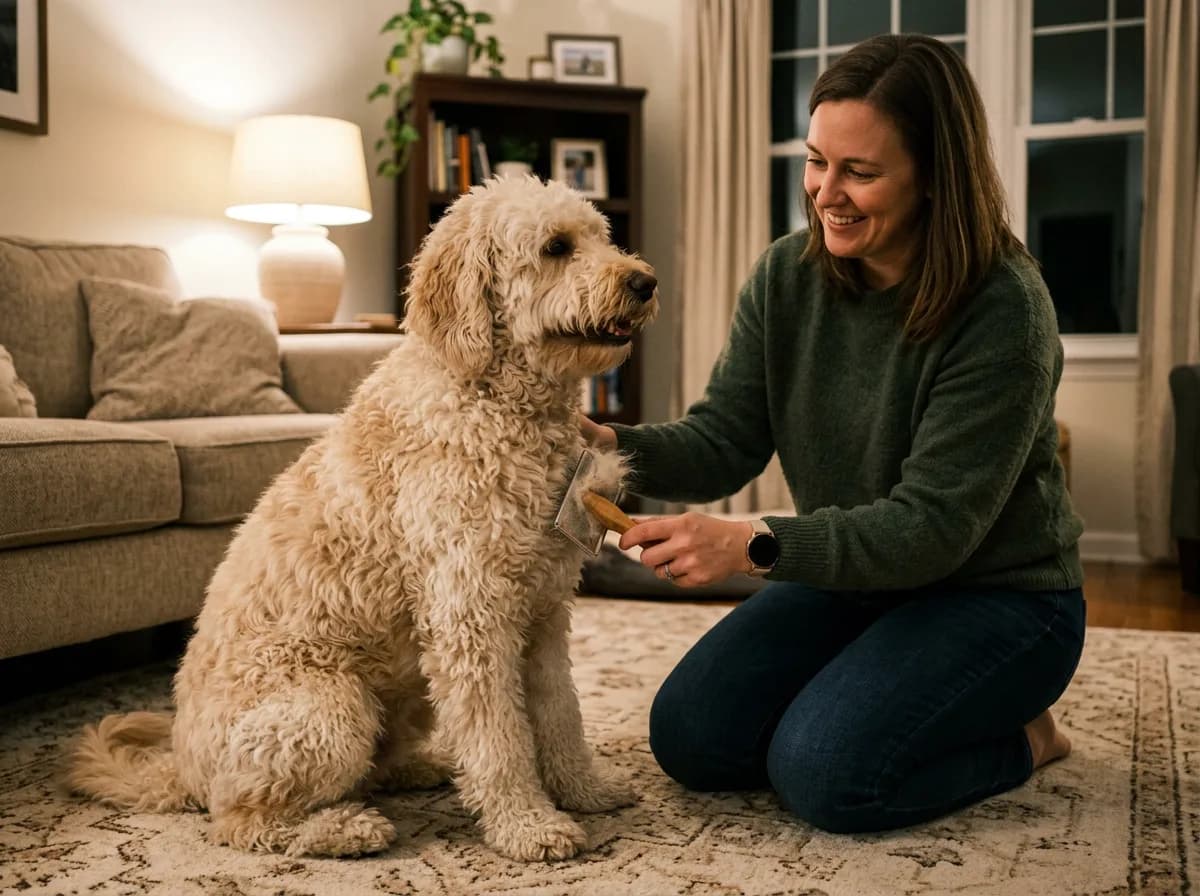
Grooming an Aussiedoodle is less about one big session and more about a rhythm you barely notice. The full week looks like this:
- A fast five-minute brush-through every other day, focused on the friction zones rather than the whole dog.
- One thorough head-to-tail line brushing session per week, with a comb check afterward.
- A bath every four to six weeks, always after brushing and never before.
- Weekly ear checks and a face tidy, because eye gunk and beard damp cause more problems than body coat does.
- A professional clip every six to eight weeks, or every eight to ten weeks if you keep the coat short.
Owners often go looking for an aussiedoodle grooming chart to pin to the fridge, and the honest version of that chart has only three rows, because everything scales off coat texture rather than age or season. The table below is that chart. Note that mini aussiedoodle grooming follows the exact same cadence as a standard, just with fewer minutes per session. There is no separate schedule for a smaller dog, and mini aussiedoodle grooming styles are the same styles a standard wears, cut proportionally shorter.
| Coat Texture | Brush | Full Groom |
|---|---|---|
| Curly (Poodle-dominant) | Daily | Every 6 weeks |
| Wavy (most common) | Every 2 days | Every 6–8 weeks |
| Straight or flat | Every 3 days | Every 8–10 weeks |
The aussiedoodle grooming styles you can realistically maintain depend on that first column. A curly coat left at two inches is a daily commitment whether you like it or not. The same dog at half an inch is a two-minute-a-day dog. Decide how much time you actually have before you decide what you want your dog to look like, because choosing the look first is how owners end up at a shave-down in month four.
Petful may earn a commission when you click through to Chewy, at no extra cost to you.
Aussiedoodle coat types across F1, F1b and F2 generations
This is where most grooming advice for this breed falls apart. Ranking pages describe three coat types in the abstract and stop, without telling you what any of it means for your calendar. The generation your dog came from is the single best predictor of coat texture, and coat texture sets brushing cadence by generation, safe clip length and mat risk all at once.
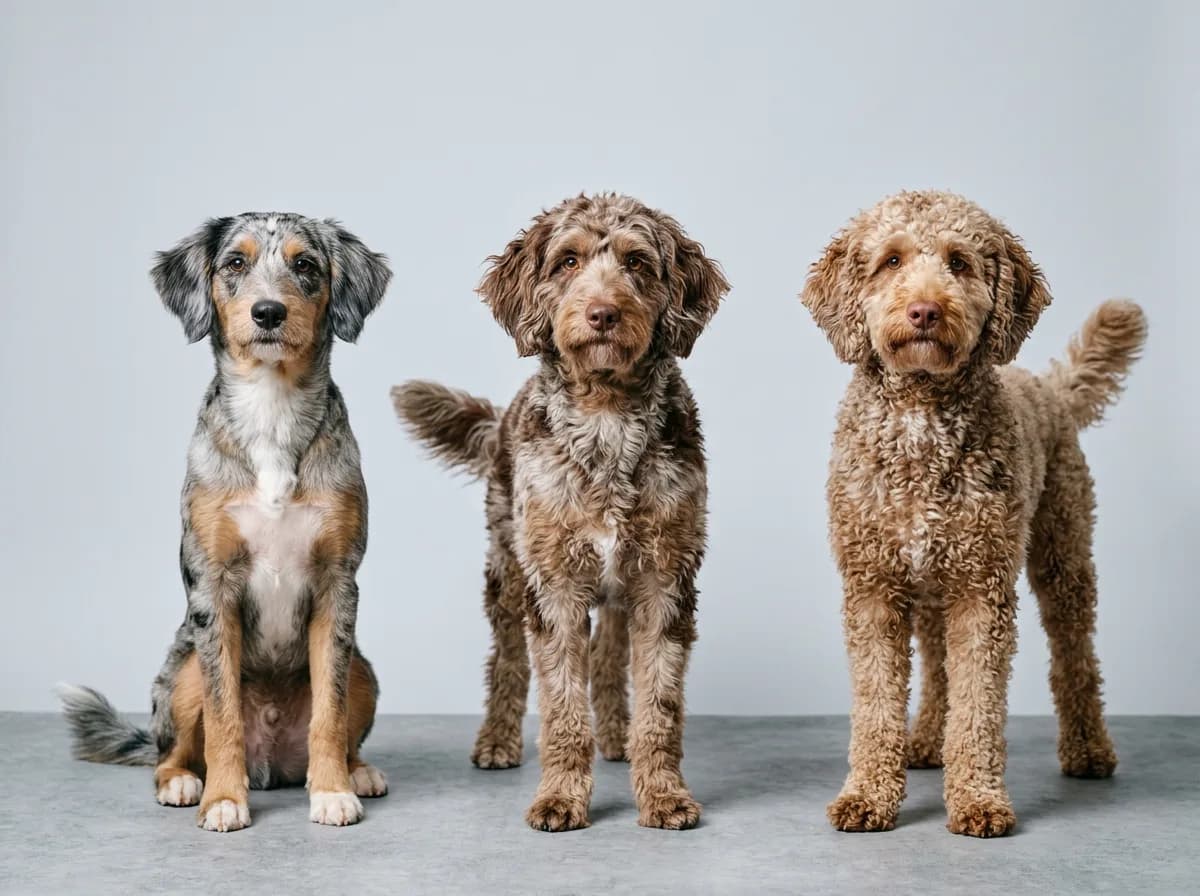
Here is what each generation actually produces:
- F1 Aussiedoodle: a first-cross Australian Shepherd to Poodle. The F1 generation is the most variable of the three. Littermates can range from a loose wave to a near-Aussie flat coat, and an f1 aussiedoodle is the most likely of any generation to inherit a real undercoat from the herding side.
- F1b Aussiedoodle: an F1 bred back to a Poodle, so roughly three-quarters Poodle. The F1b generation is reliably curlier, denser and lower-shedding. An f1b aussiedoodle is the easiest to predict and the fastest to mat, which is the trade nobody mentions.
- F2 Aussiedoodle: two F1s bred together. The F2 generation scrambles the deck again and can throw anything from tight curl to a straight coat aussiedoodle in the same litter.
The f1 vs f1b aussiedoodle question comes down to what you are optimizing for. If you want the lowest shedding and you are willing to brush daily, F1b wins. If you want a lower-maintenance coat and you can live with more hair on the sofa, an F1 with a flatter coat is genuinely easier to own.
A straight hair aussiedoodle surprises a lot of new owners who expected a doodle to look like a teddy bear. An aussiedoodle with straight hair is not a fault or a mixed-up pedigree. It is a normal F1 or F2 outcome where the Australian Shepherd coat genes won. An aussiedoodle straight coat sheds noticeably more than a curly one but mats far less, and an aussiedoodle flat coat is the closest thing this breed offers to a wash-and-wear dog.
So do aussiedoodles have hair or fur? Functionally, most have hair: it grows continuously, it needs cutting, and it does not shed out on a seasonal cycle the way true fur does. The straighter coats sit closer to fur and behave that way, which is exactly why they shed more and knot less.
| Generation | Brushing Cadence | Safe Clip Length | Mat Risk |
|---|---|---|---|
| F1 (straight to wavy) | Every 2–3 days | 1/2 to 1 1/2 inches | Low to moderate |
| F1 (wavy to curly) | Every 2 days | 1/2 to 1 inch | Moderate |
| F1b (curly) | Daily | 1/4 to 3/4 inch | High |
| F2 (variable) | Every 1–2 days by texture | 1/2 to 1 inch | Moderate to high |
Are aussiedoodles double coated? Some are, and this is the detail that decides your vacuum schedule. Do aussiedoodles have a double coat like the herding parent? It depends entirely on how much Australian Shepherd coat genetics came through, so F1 dogs are the most likely to carry one and F1b dogs the least. Owners asking do aussiedoodles have double coats are usually really asking about shedding, which the next section answers properly.
Most guides describe three coat textures in a few hundred words and stop there. Here is the framework they leave out: one rule that maps each generation to a specific brushing frequency, a safe clip length and a mat risk level, which is the fastest way to see how coat type differs across F1, F1b and F2 Aussiedoodles. An F1 wavy coat takes a line brush every third day and holds a one inch clip at moderate mat risk. The F1b generation is the curliest and the fastest to felt, so it wants a brush every single day and a half inch clip. An F2 lands anywhere between the two, so texture versus paperwork is the only thing worth planning around.
- F1 wavy coat: line brush every 2 to 3 days, comfortable at 1 inch (a #8 guard comb), moderate mat risk.
- F1 flat or straight coat: brush once or twice a week, safe at any length, low mat risk but the heaviest shedder of the three.
- F1b curly coat: brush daily without exceptions, keep it at half an inch to 1 inch (a #4 to #8 comb), high mat risk.
- F2 coat: unpredictable within a litter, so run a comb from skin to tip at eight weeks old and set the schedule off what you feel, not off the generation label.
Do Aussiedoodles shed? The hypoallergenic reality
Aussiedoodle shedding is the most oversold claim in this breed's marketing, and it is worth being blunt: low shedding is not no shedding. The Poodle side contributes a continuously growing, low-shed coat. The Australian Shepherd side contributes a genuine double coat with a soft undercoat that sheds seasonally. Your dog got some blend of the two, and no breeder can promise you which.
The Australian Shepherd undercoat is the piece that ranking pages skip. On a purebred Aussie, that undercoat releases twice a year in visible clumps, which our Australian Shepherd coat profile covers in detail. On an Aussiedoodle, the curl catches those shed hairs before they reach your floor. The hair still leaves the follicle. It simply stays in the coat, tangled around living hair, until you brush it out or it becomes a mat.
That is the honest answer to do aussiedoodle shed, and it reframes the whole routine: brushing an Aussiedoodle is not cosmetic, it is the shedding mechanism. You are the dog's shedding system.
- Every hair your Aussiedoodle sheds stays trapped in the coat until a brush removes it, which is why a dog that seems not to shed at all is often the dog that mats the fastest.
Where each dog lands on the aussiedoodle shedding level scale:
- Curly F1b coats: the lowest shedders. You will find almost no hair on furniture, and almost all of it in your brush.
- Wavy coats: light and steady shedding, mostly invisible until you skip a week of brushing.
- Straight or flat coats: the heaviest. These dogs can shed a lot, especially in spring and fall when the undercoat releases.
Does an aussiedoodle shed a lot compared to other dogs? Almost never. Even the flattest-coated Aussiedoodle sheds less than a purebred Australian Shepherd. Compared to other doodles, though, this cross runs slightly higher than a Poodle-heavy Labradoodle precisely because of that herding-breed undercoat.
Petful may earn a commission when you click through to Chewy, at no extra cost to you.
Size does not change the biology. Do mini aussiedoodles shed? Yes, at the same rate per square inch as a standard, so a mini aussiedoodle shed pattern just produces less total hair. Do toy aussiedoodles shed? Same answer again. Smaller dog, identical coat mechanics, less volume.
Now the allergy question. Are aussiedoodles hypoallergenic? No dog is. What people mean by aussiedoodle hypoallergenic is low-allergen, and allergies react to dander and to proteins in saliva rather than to hair itself. A low-shedding coat holds dander close to the skin instead of releasing it into the air, which genuinely helps many mild allergy sufferers without eliminating the trigger. The question reaches the search box a dozen different ways, and the answer is the same every time:
- Is a aussiedoodle hypoallergenic? Only in the low-allergen sense, and only reliably in a curly F1b coat. A flat-coated F1 is not.
- Aussiedoodle are they hypoallergenic enough for a diagnosed allergy? That is not something any breeder can promise in advance.
- Miniature aussiedoodle hypoallergenic and mini aussiedoodle hypoallergenic claims deserve exactly the same scrutiny as standard-size ones, because coat texture drives the result and body size does not.
If allergies are a genuine medical concern in your household rather than a mild annoyance, spend an hour with an adult dog of the same generation before you commit to a puppy. The AVMA pet owner resources are a solid starting point on coat and skin health.
It is worth naming the thing breeder pages and shop guides leave out. They repeat the hypoallergenic claim without connecting the Australian Shepherd parent double coat to real shedding outcomes, and that omission is exactly the frustration behind every doodle owner thread where somebody was promised a non-shedding dog and got a curly coat quietly holding a season of undercoat. The honest mechanics: the Poodle side decides how much hair reaches your floor, the Australian Shepherd side decides how much hair exists in the first place, and low-shedding marketing only ever describes the first half of that.
Brushing cadence, matting prevention and the tools that work
Matting is not a grooming failure, it is a physics problem. Shed hair stays trapped in curl, friction twists it, moisture tightens it, and within days you have felt. It always starts in the same places, in the same order, and it is always further along than it looks from the top of the coat.
The friction zones to check first, every single time:
- Behind and under the ears, where the ear leather rubs the neck.
- The armpits and the crease where the front legs meet the chest.
- Under the collar and along every harness strap line.
- The britches and the back of the rear legs.
- The tail base and anywhere a coat gets sat on.
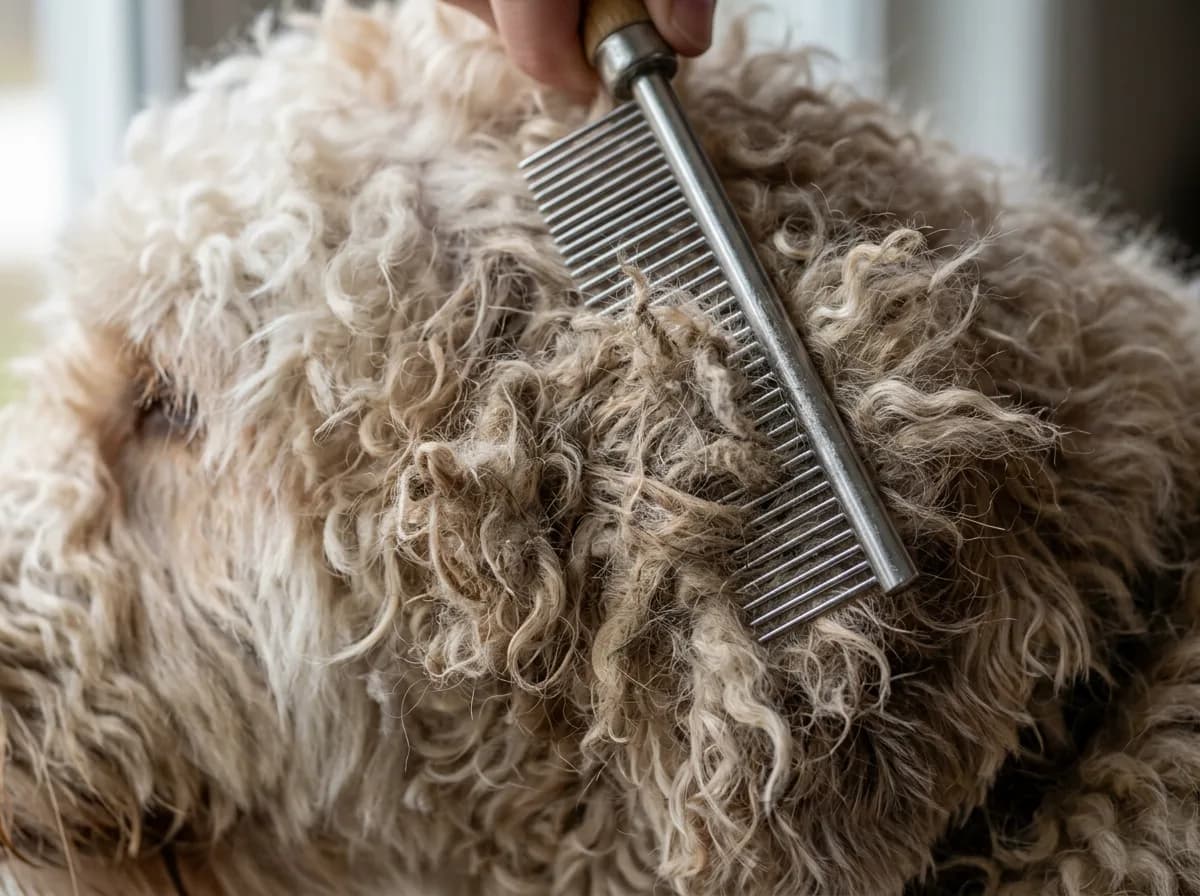
The technique that separates owners whose dogs never mat from owners who end up at a shave-down is line brushing. Part the coat in a horizontal line down to the skin, brush the exposed section outward from the skin, then move the part up an inch and repeat. It feels slow for the first week and then takes five minutes. Brushing across the top of the coat feels productive and does essentially nothing, because mats form at the base of the hair shaft where the brush never reaches.
- A slicker brush fluffs the surface and can hide a mat underneath. A metal comb is the honest test: if it does not glide from skin to tip anywhere on the body, that section is not finished.
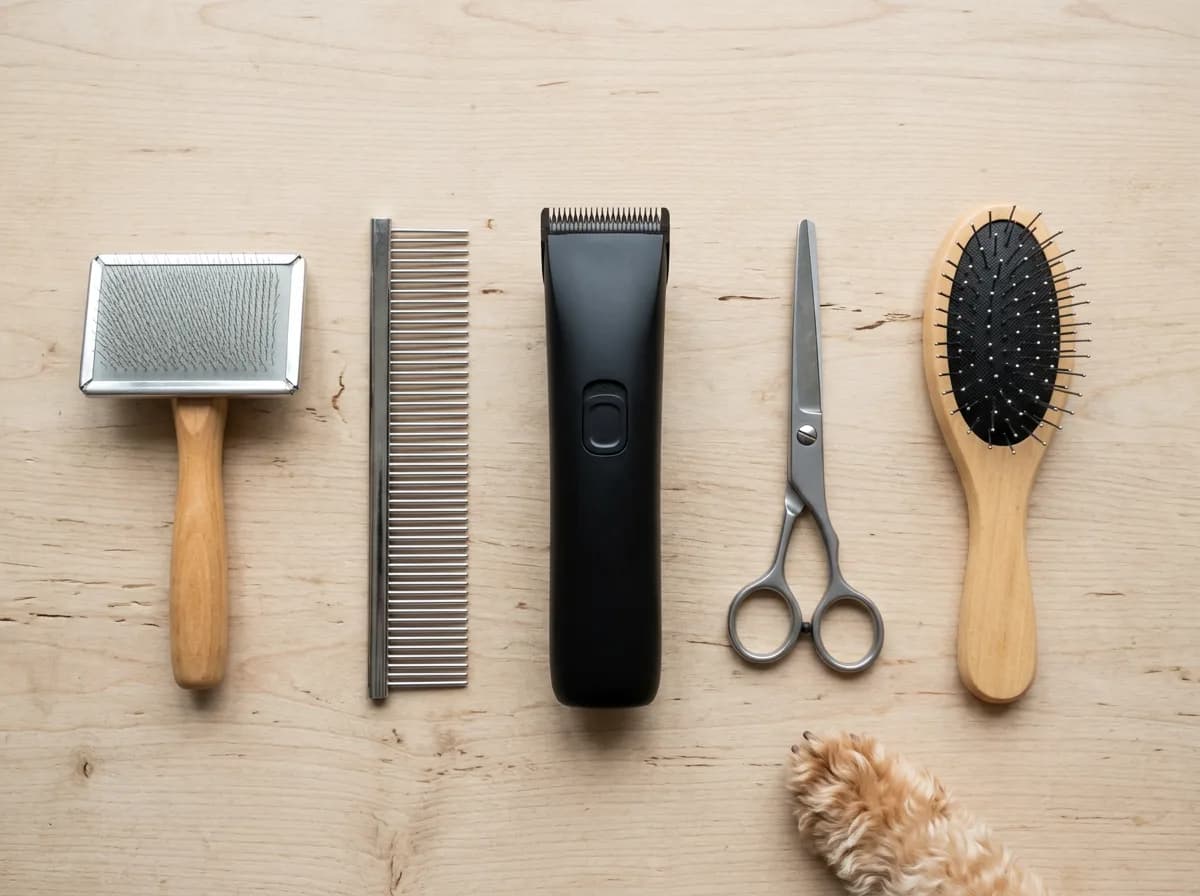
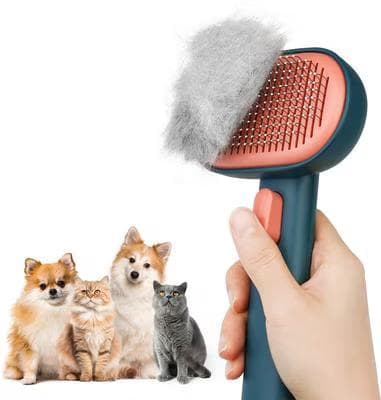
The best brush for aussiedoodle coats is a firm slicker with coated pins, and it is genuinely the only brush most owners need. The tool list is shorter than the internet suggests:
- A firm slicker brush for line brushing. Soft, flexible-pin slickers skim the surface and leave the base untouched.
- A stainless steel greyhound comb with wide and fine teeth, used as a verification tool rather than a brushing tool.
- A dematting rake or mat splitter for small knots, worked from the outer tip inward, never sawing at a mat sitting against skin.
- Blunt-tip curved scissors for face and paw work.
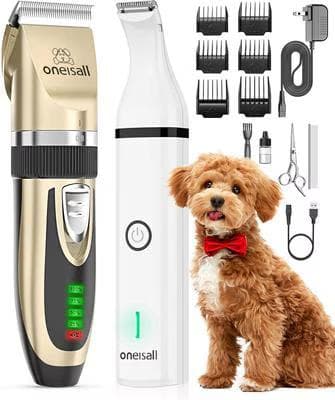
- Clippers with a real motor. The best clippers for aussiedoodle coats are two-speed units rated for dense coats, with a #10 blade for sanitary work and snap-on guard combs for body length.
Aussiedoodle face grooming deserves its own two minutes. This cross inherits Poodle beard growth on an Australian Shepherd head shape, so food and water collect in the muzzle hair and stay damp. Comb the beard daily, wipe it dry after meals, and keep the hair above the eyes trimmed short enough that your dog can actually see. Most eye staining on this breed is a wet-beard problem rather than a tear-duct problem.
Petful may earn a commission when you click through to Chewy, at no extra cost to you.
- Water shrinks and tightens existing knots into solid felt that no brush will open. Brush the coat completely first, then bathe, in that order and never the reverse.
So what is the brushing frequency and technique that actually prevents matting, rather than just tidying the surface? Every other day for a wavy coat and every single day for a curly one, using line brushing worked down to the skin, followed by a comb check through the same section before you move on. Fifteen minutes of that, three or four times a week, is the entire job. The comb is the test: if a greyhound comb passes cleanly from skin to tip through all five friction zones you are finished, and if it snags anywhere you have found tomorrow's mat while it is still just a tangle.
Bathing and drying an Aussiedoodle without creating mats
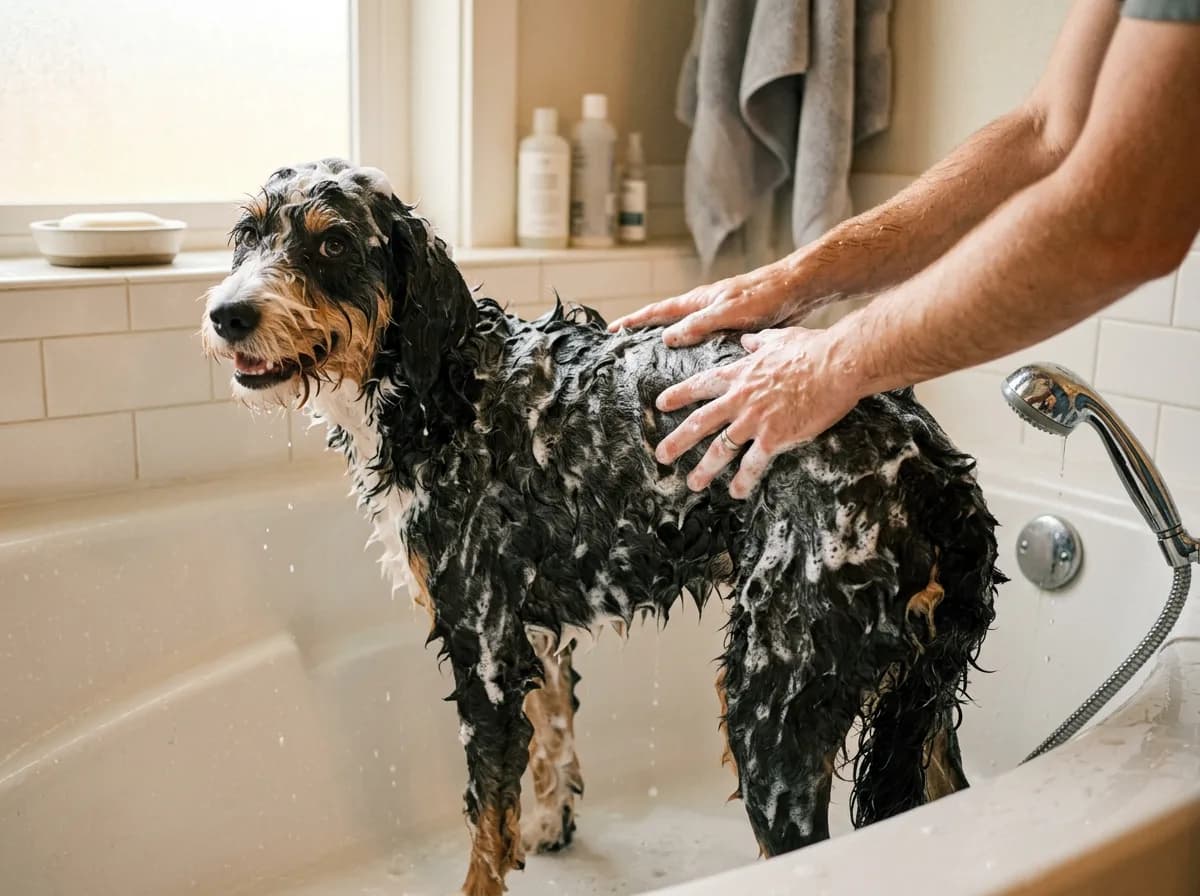
A bath is the fastest way to ruin a coat you have been maintaining well. Wet curl contracts, and any tangle that was loose going into the tub comes out of it three times tighter. The sequence matters more than the products.
The routine that works:
- Step 1, brush out first: Brush and comb the entire dog to completion. If the comb catches anywhere, deal with it before the water runs.
- Step 2, wet to the skin: Wet to the skin, not just the surface. A dense coat repels water, and shampoo sitting on top of dry hair does nothing.
- Step 3, wash and rinse twice over: Use a gentle dog shampoo, work it in with your fingers in straight lines rather than circles, and rinse twice as long as feels necessary. Residue is a mat starter.
- Step 4, squeeze rather than rub: Squeeze water out of the coat by hand rather than rubbing with a towel, which twists the hair.
- Step 5, fluff dry section by section: Fluff dry with a dryer in one hand and a slicker in the other, brushing the section you are drying. This is the step that keeps the coat straight instead of letting it curl into knots.
- For muddy paws and a dirty muzzle, deodorizing wipes beat a full bath, which is worth avoiding when a wet coat is what creates mats in the first place.
Air drying is the single most common cause of surprise mats in this breed. A coat left to dry on its own contracts unevenly, and a dog that went into the tub mat-free can come out of a nap with felt behind both ears. Every four to six weeks is the right bathing interval for most Aussiedoodles, and stretching to eight weeks is fine for a straight coat. Washing weekly strips coat oils and leaves dry, itchy skin that the dog then scratches into more tangles.
Compressed into one rule: a bathing and drying routine that does not create mats is brush out, wet to skin, rinse twice, squeeze rather than rub, then fluff dry section by section. Miss that last step and the coat contracts as it air dries, which is how a dog goes into the tub clean and comes out of a nap with felt behind both ears. Budget thirty to forty five minutes of drying for a standard and fifteen to twenty for a mini, and save the collar and harness lines for last, because damp hair sitting under a strap knots inside a day.
Aussiedoodle haircut styles: teddy bear, puppy cut and more
What is the best haircut for an Aussiedoodle? For most owners the answer is a teddy bear cut at one inch, because it keeps the soft doodle look while staying short enough to brush in a few minutes a day. If you want the lowest-maintenance option instead, an aussiedoodle puppy cut at half an inch all over is the honest winner. The best cut is the one that matches how much brushing you will actually do, not the one that photographs best.
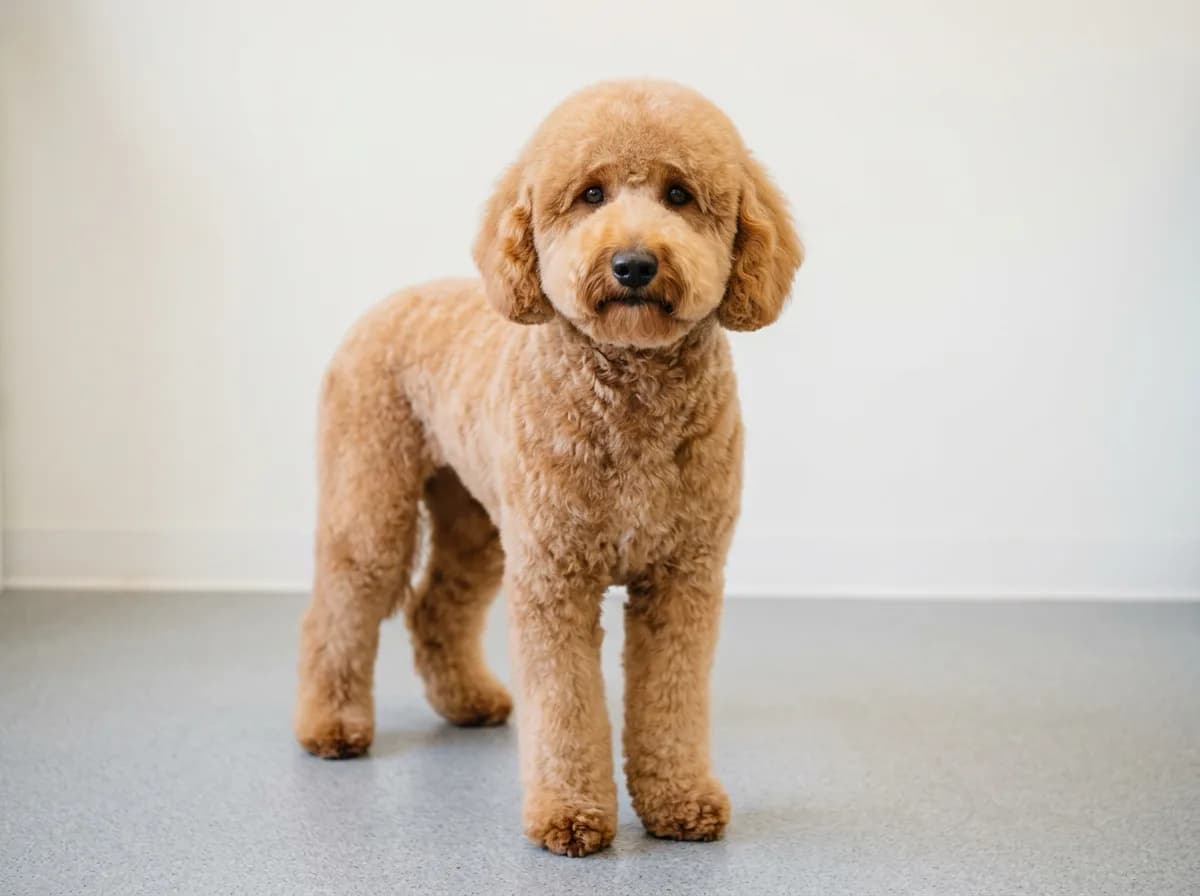
Owners searching aussiedoodle haircuts styles are usually after one of these six looks, and naming the style plus a guard length is all a groomer needs:
- Teddy bear cut: about one inch all over with a rounded face and muzzle. A teddy bear cut for aussiedoodle coats is the most requested style in every salon, and a teddy bear cut aussiedoodle groomed on a six-week schedule holds the shape well. Teddy bear aussiedoodles look soft because the length is left long, which is also why this cut mats the fastest.
- Puppy cut: half an inch, even everywhere, face included. Aussiedoodle puppy cuts are the lowest-effort option, and a puppy cut aussiedoodle can go eight to ten weeks between appointments. An aussiedoodle puppy haircut and a puppy cut are the same thing under two names, so aussiedoodle puppy haircuts get quoted at the same price.
- Aussiedoodle short haircut or kennel clip: quarter inch on the body with slightly longer legs. Practical for working dogs, swimmers and anyone who hikes.
- Aussiedoodle poodle cut: shorter body with a distinctly longer, shaped topknot and defined leg cuffs. An aussiedoodle with poodle cut styling leans into the Poodle parent instead of hiding it.
- Aussiedoodle mullet: short body, long feathering left on the britches and tail. Popular with owners who want the Australian Shepherd silhouette back.
- Aussiedoodle mohawk: a short body clip with a strip of longer hair left along the topline or just the crest. A styling choice rather than a maintenance one.
Do aussiedoodles need haircuts? Yes, and this is where the forum threads get heated. Because the Poodle side contributes continuously growing hair, the coat keeps growing whether you cut it or not. Skip the haircut long enough and you do not get a shaggier dog, you get a felted one.
Petful may earn a commission when you click through to Chewy, at no extra cost to you.
What actually happens when you skip the haircut:
- The coat passes the length your brush can penetrate, so line brushing stops reaching the skin.
- Trapped shed hair has nowhere to go and packs into a continuous layer against the body.
- Moisture and debris sit under that layer, which is how hot spots and skin infections start.
- The mats pull on skin every time the dog moves, which is genuinely painful.
- The only humane fix left is a full shave-down, which costs more and erases a year of coat.
- A teddy bear face needs the eye area kept clean or the look collapses. Tear stain wipes are the usual fix on lighter coats.
Aussiedoodle haircuts male and female dogs are cut identically on the body, and the only real difference is the sanitary trim, which is shaped differently front to back. Owners searching aussiedoodle haircuts female or aussiedoodle haircuts male are usually looking at the same photos of the same styles. Mini aussiedoodle haircuts follow the same rules with the same guard lengths, and the mini aussiedoodle teddy bear cut is by a wide margin the most requested style on smaller dogs. Mini aussiedoodle haircuts male and mini aussiedoodle haircuts female differ only in that sanitary shaping, exactly as they do on standards.
Looking at pictures of aussiedoodle haircuts is genuinely useful before an appointment, but bring the photo with you rather than describing it. Aussiedoodle haircuts before and after shots are the fastest way to communicate the finish you want, because "shorter" means something different to every groomer. The AKC grooming guidance library is a reliable reference for what standard clip terminology actually means before you walk in.
- Groomers interpret style names differently, so pair every request with a length. Teddy bear at one inch, puppy cut at half an inch, kennel clip at a quarter inch. Say the number and you get the finish you pictured.
These are the haircut styles and clip lengths to request by name, because a style name on its own leaves the finish up to whoever is holding the clippers. Teddy bear is one inch, which is a #8 guard comb on most kits. A puppy cut is half an inch, a #4 comb or a #3F blade. A kennel or short clip is a quarter inch, a #2 comb or a #5F blade. A summer body clip is half an inch with the belly and inner thighs taken to a quarter. Say the style, then say the number, and the dog you collect will match the one you pictured.
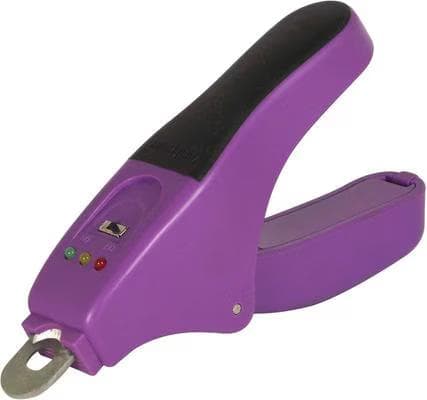
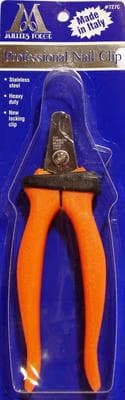
Nails get forgotten under all that leg feathering. Many owners find a rotary nail grinder easier than clippers on a wriggly doodle, because it takes the nail down gradually instead of demanding one confident cut.
Can you shave an Aussiedoodle? Summer cuts and how short is safe
How short can you cut an Aussiedoodle? A quarter of an inch is the shortest length that still protects the skin, and a #7 blade leaving roughly an eighth of an inch is the practical floor for a badly matted coat. Anything shorter than that exposes skin to sunburn and abrasion, and on a dog carrying real Australian Shepherd undercoat it can permanently change how the coat regrows.
A shaved aussiedoodle is sometimes the right call and sometimes a mistake, and the difference is the reason for the shave:
- A justified shave: the coat is pelted, a comb will not enter it anywhere, and brushing it out would take hours of pulling on skin. A mini aussiedoodle shaved for that reason is far kinder than the alternative.
- A comfort shave for heat: usually unnecessary. That coat insulates against heat as well as cold, and an aussiedoodle shaved down to the skin in July often ends up hotter and sunburned.
- A convenience shave: fine at a quarter inch, risky below it.
The aussiedoodle summer cut most groomers recommend is not a shave at all. It is a half-inch body clip with the belly and inner thighs taken shorter, which is where a dog actually dumps heat, plus a tidy on the feet and sanitary areas. You get the cooling benefit and keep the sun protection.
- Dogs carrying a true double coat can regrow patchy, cottony or dull hair after a close shave, sometimes taking a year or more to return to normal texture. It is not a guarantee, but it is a reason not to shave a flat-coated F1 for convenience.
Professional groomer versus grooming at home
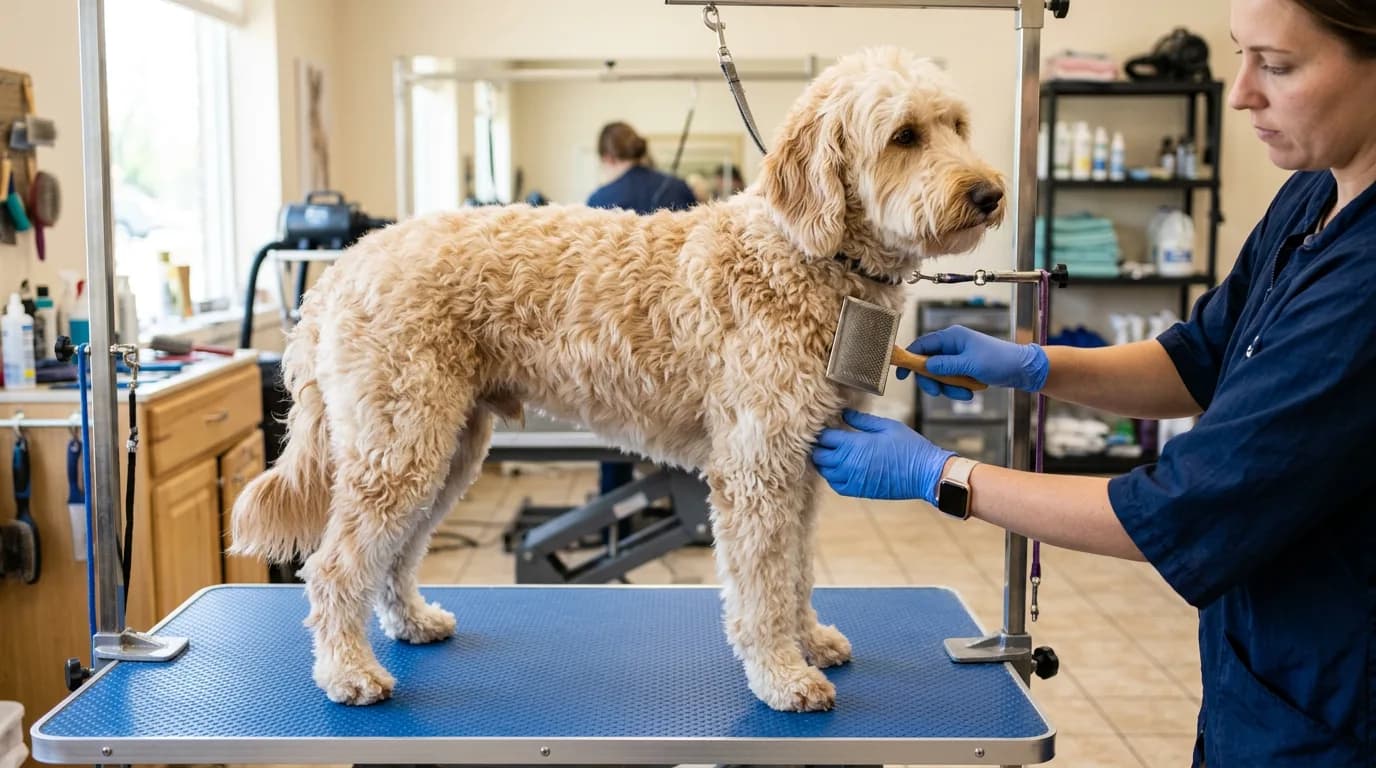
Do Aussiedoodles need professional grooming? Practically speaking, yes. You can absolutely handle the brushing, bathing and maintenance at home, and most owners should. But the clip itself is where home grooming goes wrong, because an even body length, a balanced round face and clean feet on a dense, curly, constantly moving dog is a genuine skill. Almost every owner who tries to skip the professional entirely ends up booking one anyway to fix the result.
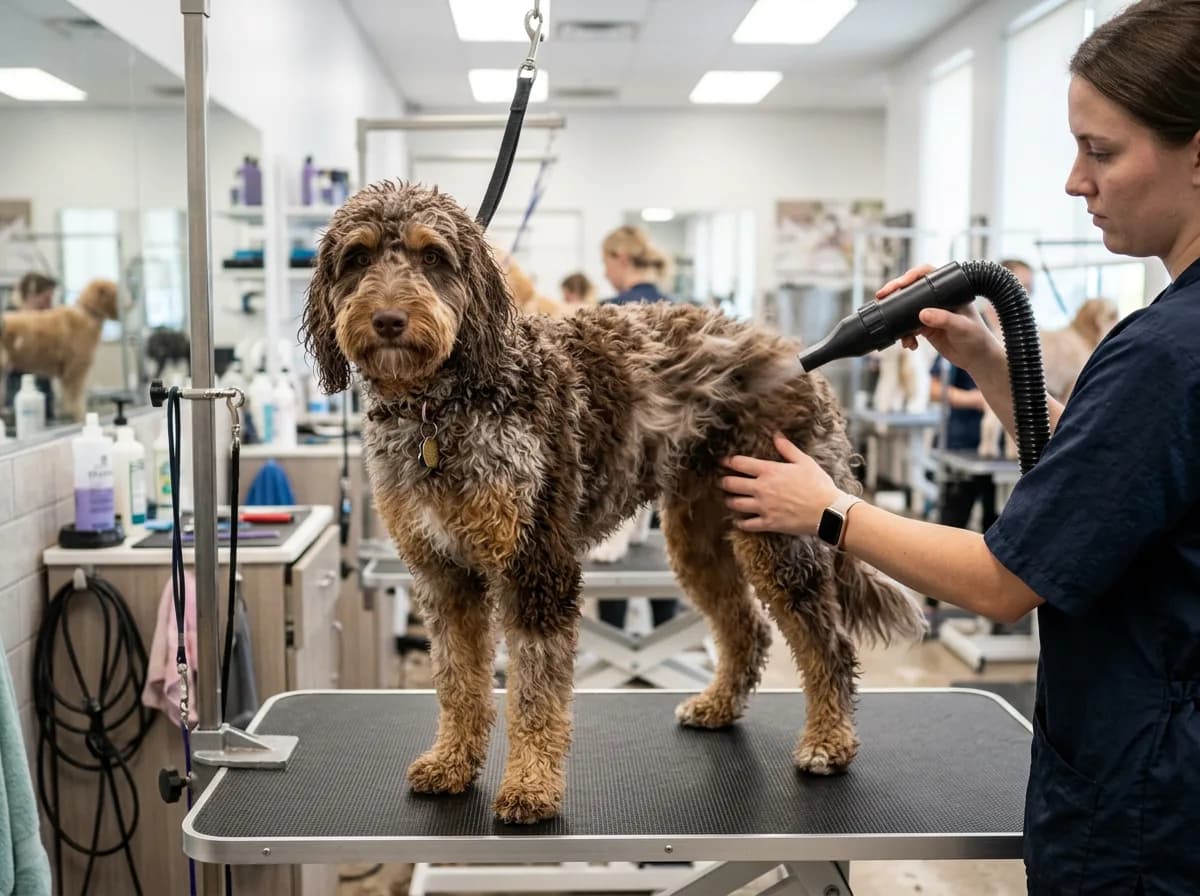
A sensible split of labor:
- You do: daily and weekly brushing, comb checks, bathing and fluff drying, beard and eye-area wiping, ear checks, nail maintenance between visits.
- A professional groomer does: the clip, the face shape, sanitary and paw pad work, blade-level de-matting, and a hard look at skin they see once every six weeks.
- If you cut nails yourself, buy clippers that come with styptic powder. Quicking a nail is not an emergency, but it is a lot calmer when the powder is already in the box.
Searching aussiedoodle grooming near me will turn up plenty of salons, and the questions worth asking before you book are specific: do they charge a doodle rate, do they have a matting policy in writing, do they use a forced-air dryer, and will they call you before switching to a shorter length than you asked for. That last one prevents most of the bad surprises.
If you plan to clip at home between visits, start with the body and leave the face and feet to a professional for the first year. The aussiedoodle grooming before and after difference on a home clip is almost entirely about the head. A tidy body with a shaggy, uneven face reads as an unfinished dog, while a well-shaped face makes even a mediocre body clip look deliberate.
How much does Aussiedoodle grooming cost?
Why do groomers charge extra for doodles? Because an Aussiedoodle takes two to three times the table time of a short-coated dog of the same size. The coat has to be fully brushed out before a blade touches it, dried with a forced-air dryer section by section, clipped, then scissor-finished on the face and feet. A shedding breed gets bathed, dried and sent home. That labor difference is the entire surcharge, and it is not a markup on the breed name.
The line items on a typical bill:
- Base groom, mini Aussiedoodle: $65 to $95 per visit.
- Base groom, standard Aussiedoodle: $85 to $140 per visit.
- De-matting surcharge: $15 to $50, usually billed in fifteen-minute increments once the brush-out passes a normal window.
- Full shave-down on a pelted coat: $20 to $40 above the base rate, because blade wear and handling time both go up.
- Nail grind, teeth or de-shedding add-ons: $10 to $25 each.
At a six to eight week cadence that is seven to nine visits a year. Running the middle of the range, expect roughly $600 to $850 annually for a mini and $750 to $1,100 for a standard, before add-ons. Cost per groom drops noticeably if you hand over a mat-free dog, because the de-matting surcharge is the one line you control completely.
At-home tooling changes the math. A firm slicker, a greyhound comb, a dematting rake, blunt-tip scissors and a two-speed clipper kit runs roughly $150 to $280 once. Amortized across three years that is about $50 to $95 a year, and it lets you stretch professional visits from six weeks to eight or nine. Owners who brush properly and book clips only typically land at the bottom of every range above.
- Base groom price is set by your dog's size and nothing you do changes it. The de-matting charge is set entirely by you. Hand over a dog a comb passes through and that line disappears from the bill.
Groomers charge extra for doodles because the labor is real, and most guides quote a single number instead of showing how the bill itemizes. Broken out, it runs like this: base groom of $65 to $95 for a mini versus $85 to $140 for a standard, a de-matting surcharge of $15 to $50 billed in fifteen minute blocks, and an amortized at-home tool kit of roughly $50 to $95 a year against a $150 to $280 one-time spend. Mini versus standard pricing sets the floor, and the matting surcharge is the only line on that grooming cost breakdown you control completely.
Put plainly, the realistic grooming cost per visit and per year for an Aussiedoodle is $65 to $140 per visit and $600 to $1,100 a year at a seven to nine visit cadence, plus $50 to $95 a year in amortized tools if you maintain the coat at home. Owners who brush properly land near the bottom of both ranges. Owners who bring in a pelted dog twice a year land above the top of them, because a shave-down plus a de-matting charge can add $70 to one appointment.
What grooming adds to the cost of owning an Aussiedoodle
Grooming is a recurring line most first-time buyers leave out of the budget entirely, and at $600 to $1,100 a year it is not a rounding error. It sits alongside food, preventives and insurance for the dog's whole life. Purchase price is its own conversation, and reputable aussiedoodle breeders price well above the bargain listings for reasons that show up later in coat and health. Our Aussiedoodle price guide breaks down purchase cost, what mini aussiedoodle breeders charge, and the real first-year and lifetime totals.
Does Aussiedoodle size change the grooming workload?
Aussiedoodle size changes the minutes, not the method. A standard has more square footage of coat to line brush and costs more per groom, but the technique, the cadence and the mat risk are identical to a smaller dog with the same texture. Where size does matter is handling: a 55-pound dog that dislikes the dryer is a different proposition from a 25-pound one. Our Aussiedoodle size guide covers full-grown height and weight by variety, including what a full grown mini aussiedoodle actually weighs.
Mini and toy Aussiedoodles: grooming a smaller coat
An aussiedoodle mini carries the same coat genetics as a standard, so nothing in this guide changes for a smaller dog except session length. The one practical difference is that a miniature aussiedoodle mats faster around the collar and harness, simply because the straps cover a larger share of the body. A toy aussiedoodle needs the same daily attention with even less margin for a skipped week. For size thresholds, temperament fit and what the smaller varieties are really like to live with, see our mini Aussiedoodle guide.
How coat color changes what you see between grooms
Color does not change the grooming routine, but it changes what you notice. A black aussiedoodle hides mats extremely well, so black dogs are the ones most likely to arrive at a groom pelted without the owner realizing. A blue merle aussiedoodle shows every fleck of debris and dulls visibly when the coat needs a bath, which is genuinely useful feedback. Merle also carries a serious breeding caveat: two merle parents should never be bred together, because double-merle puppies face a high risk of deafness and blindness. Our Aussiedoodle coat colors guide covers every pattern and the genetics behind them.
Grooming tolerance and Aussiedoodle temperament
The aussiedoodle traits that make this cross so trainable are the same ones that make grooming easy or miserable, depending on how you introduce it. These dogs are bright, handler-focused and often sensitive to restraint, so a dog that gets rushed on the table once tends to remember it. Short, frequent, boring sessions from puppyhood beat long corrective ones every time. Mini aussiedoodle personality runs a little more velcro and a little more reactive to being held still, which is worth knowing before the first appointment. Our Aussiedoodle temperament guide covers the behavior side properly.
Skin, ears and health problems grooming reveals
A thorough groom is the best routine health screen most dogs get, because your hands cover the whole body every week. Hot spots under mats, ear infections behind heavy ear feathering, lumps, ticks, and the early itch of atopic skin all show up on the grooming table first. Aussiedoodle health issues that grooming surfaces are worth acting on quickly rather than waiting for a scheduled visit. Coat quality also tracks general condition across a dog's aussiedoodle life expectancy, so a coat that suddenly goes dull or thin is a reason to call the vet. Our Aussiedoodle health issues guide covers the conditions this cross inherits from both parents.
If grooming keeps turning up greasy patches, a yeasty smell or red irritated skin, a medicated antifungal shampoo is the usual first step your vet will reach for, and it works far better on a coat that has already been brushed out to the skin.
Ears deserve their own routine on this cross, because a curly coat traps moisture in a pendulous ear canal. A gentle ear cleaner used after baths and swims prevents far more infections than treating them after the fact.
- Ear wipes handle the outer flap between proper cleanings and are the easiest habit to keep up on a dog that resents drops.
New to the breed? Start with the full Aussiedoodle guide
If you landed here while still deciding whether an aussiedoodle is the right dog, grooming is only one chapter and it is the one that most often gets underestimated. The breed's exercise needs, herding drive, trainability, family fit and honest downsides all belong in the same decision. Our complete Aussiedoodle breed guide covers the full profile including the pros and cons, so you can weigh the coat commitment against everything else this cross brings.
Frequently Asked Questions
Start the day you bring the puppy home, with two or three short sessions a week that last under five minutes each. The puppy coat barely mats, so these early sessions are about teaching the dog to lie still rather than removing tangles. That habit matters because the adult coat comes in between eight and twelve months, and matting spikes sharply during that transition.
No. Human clippers lack the torque to cut a dense doodle coat, so they stall, pull the hair and overheat against the skin. That combination teaches a dog to fear the clipper, which is far harder to undo than buying the right tool. Use a two-speed dog clipper rated for dense coats with snap-on guard combs.
Plan on two to three hours for a mini and three to four for a standard, assuming the coat arrives mat-free. A packed coat can add another hour of brush-out before any clipping starts, which is exactly what the de-matting surcharge pays for. Many salons now book doodles in a longer slot by default.
Yes, and often significantly. The soft puppy coat is replaced by a coarser, denser adult coat between eight and twelve months, and texture can shift from wavy toward curly during that window. Increase brushing frequency through the transition rather than after it, because the shed puppy coat tangles into the incoming adult coat.
Run a metal greyhound comb from skin to tip through the friction zones first: behind the ears, the armpits, the collar line and the back of the rear legs. If the comb catches anywhere, that is a mat forming, regardless of how the coat looks on the surface. Catching it at that stage takes seconds instead of a shave-down.

Coreen Saito is a pet writer and longtime shelter volunteer with more than a decade in animal rescue. She covers cat behavior, breed care, and the small, ordinary science of sharing a life with companion animals, with a particular focus on honest takes about the products and decisions that actually matter. At home in Arizona, she's outranked by Mac (a dog with the loudest opinion in the house), Rebel (a cat who governs by quiet authority), and Meri (an orange tabby who runs the late shift and the laundry basket). She writes about all three, plus the rescues that keep coming through her life, at LifeWithMinty.com.
Sign up for expert-backed reviews and safety alerts all in one place.