Ocicat: The Complete Guide to the Wild-Looking Cat With Zero Wild DNA
A complete guide to the Ocicat, the wild-looking spotted cat with zero wild DNA. Covers its accidental 1964 origin, all 12 colors, size, dog-like temperament, health, grooming, hypoallergenic truth, price, and how it differs from the Bengal.
Petful is reader supported. As an affiliate of platforms like Amazon and Chewy, we may earn a commission when you buy through links on this page. There is no extra cost to you.
The Ocicat is the only spotted housecat the Cat Fanciers' Association (CFA) describes as a "100% domestic hybrid" designed to emulate the wild cats of Central and South America, and according to TICA the entire breed traces back to a single accidental kitten born in 1964. If you searched "ocicat" and landed on coin charts, you are in the right place but the wrong universe: this article is about the cat breed named for the ocelot, not the cryptocurrency token that shares the spelling. The living, purring Ocicat is the one with thumbprint spots, a long muscular body, and a personality that acts more like a dog than a cat. That single line is the whole sell. You get the look of a miniature ocelot without a drop of ocelot, leopard cat, or serval in the gene pool, which is exactly what separates this breed from the Bengal and the Savannah. Below is the full profile: where the Ocicat came from, the dozen spotted colors it wears, how big it gets, why it is so trainable, what it costs, the honest truth about its "hypoallergenic" reputation, and how it stacks up against the wilder spotted breeds people keep confusing it with.
- 1The Ocicat is a 100% domestic spotted shorthair (Abyssinian x Siamese x American Shorthair) with no wild DNA, unlike the Bengal or Savannah
- 2It was created by accident in 1964 by Virginia Daly and named for its resemblance to the ocelot
- 3CFA recognizes twelve colors in eight classes, all showing the same thumbprint spotted-tabby pattern
- 4Temperament is famously dog-like: social, trainable, vocal, and devoted, which means it hates being left alone all day
- 5Lifespan is commonly 12 to 18 years, and prices typically run $800 to $1,500 from a reputable breeder

Sign up for expert-backed reviews and safety alerts all in one place.
The crypto vs. cat disambiguation, in one paragraph
Because a meme token borrowed the name, a search for "ocicat" now returns two completely unrelated things. To be clear: everything on this page is about the pedigreed cat breed. The Ocicat (the animal) is a recognized show breed registered with the CFA, TICA, and the Governing Council of the Cat Fancy (GCCF) in the UK. It has a breed standard, a spotted coat, and a heartbeat. If you came looking for price charts, market caps, or a wallet, this is not that. If you came looking for a friendly spotted cat that fetches like a retriever, read on.
Origin and history: the happy accident of 1964
The Ocicat exists because of a breeding experiment that did not go to plan. In 1964, Michigan breeder Virginia Daly set out to add Abyssinian-style ticked points to a Siamese. She crossed a ruddy Abyssinian with a seal point Siamese, and the first generation simply looked like Abyssinians. When she bred those offspring back to a Siamese, one kitten in the litter arrived ivory with golden spots. Daly's daughter looked at it and said it resembled an ocelot, so the family nicknamed him an "Ocicat." Per the CFA, that founding kitten was named Tonga, and a single newspaper photo of him caught the eye of geneticist Dr. Clyde Keeler, who had long wanted a domestic cat that mimicked the vanishing spotted wild cats. His encouragement turned a one-off accident into a deliberate breeding program.
To give the new breed more substance and bone, breeders added the American Shorthair, which also introduced the silver coloration. That makes three foundation breeds in the modern Ocicat: Abyssinian (the ticked agouti base that builds the spots), Siamese (body type and refinement), and American Shorthair (size, bone, and silver). The CFA accepted the Ocicat for registration in 1966 and granted it full championship status in 1987; TICA awarded championship recognition in August 1986. The breed you meet today is the polished result of that decades-long effort.
- Unlike the Bengal (developed from the Asian leopard cat) or the Savannah (developed from the African serval), the Ocicat was built entirely from three ordinary domestic breeds. Its wild look is pure selective breeding, so it carries the predictable temperament and care needs of a housecat, not a hybrid.
If you want to compare the Ocicat's tame ancestry against the genuinely wild-derived breeds, our profiles on the Bengal cat and the hybrid caracat show what "actual wild blood" looks like in a pedigree.
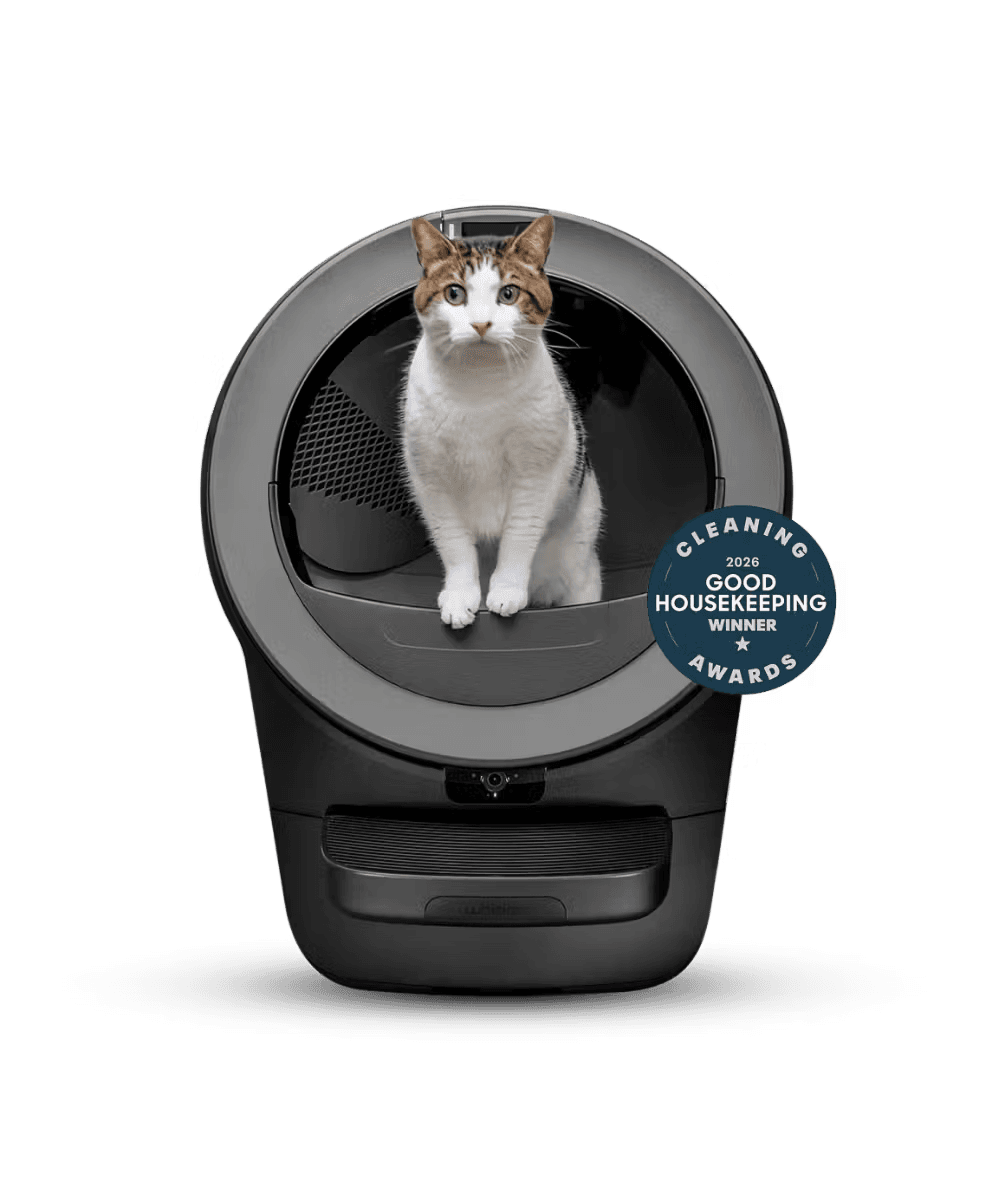
Never Scoop Again® with the Whisker Litter-Robot, the smart self-cleaning automatic litter box. Monitor visits and track weights for better overall care in the Whisker® app. Multi-cat friendly.
Petful may earn a commission when you click through to Whisker, at no extra cost to you.
The spotted coat: pattern and colors
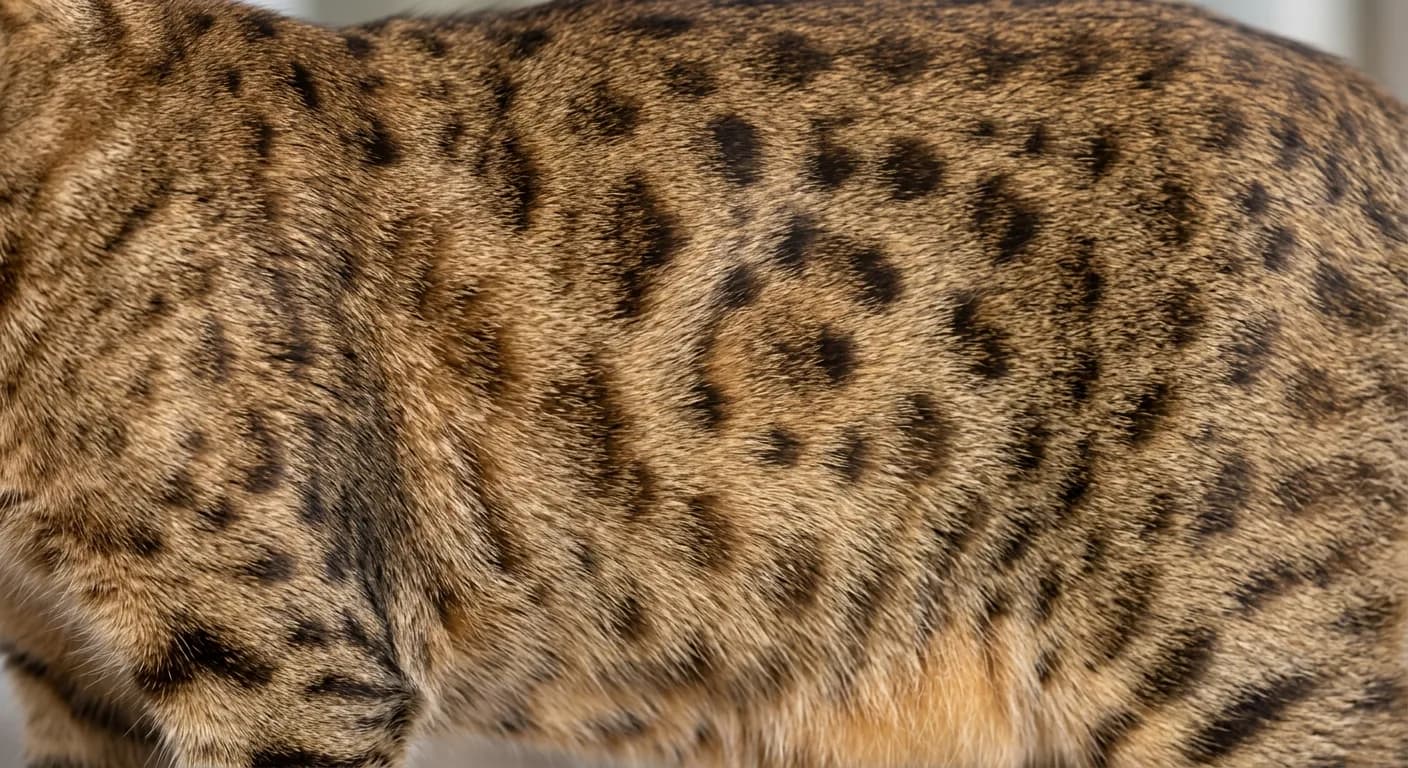
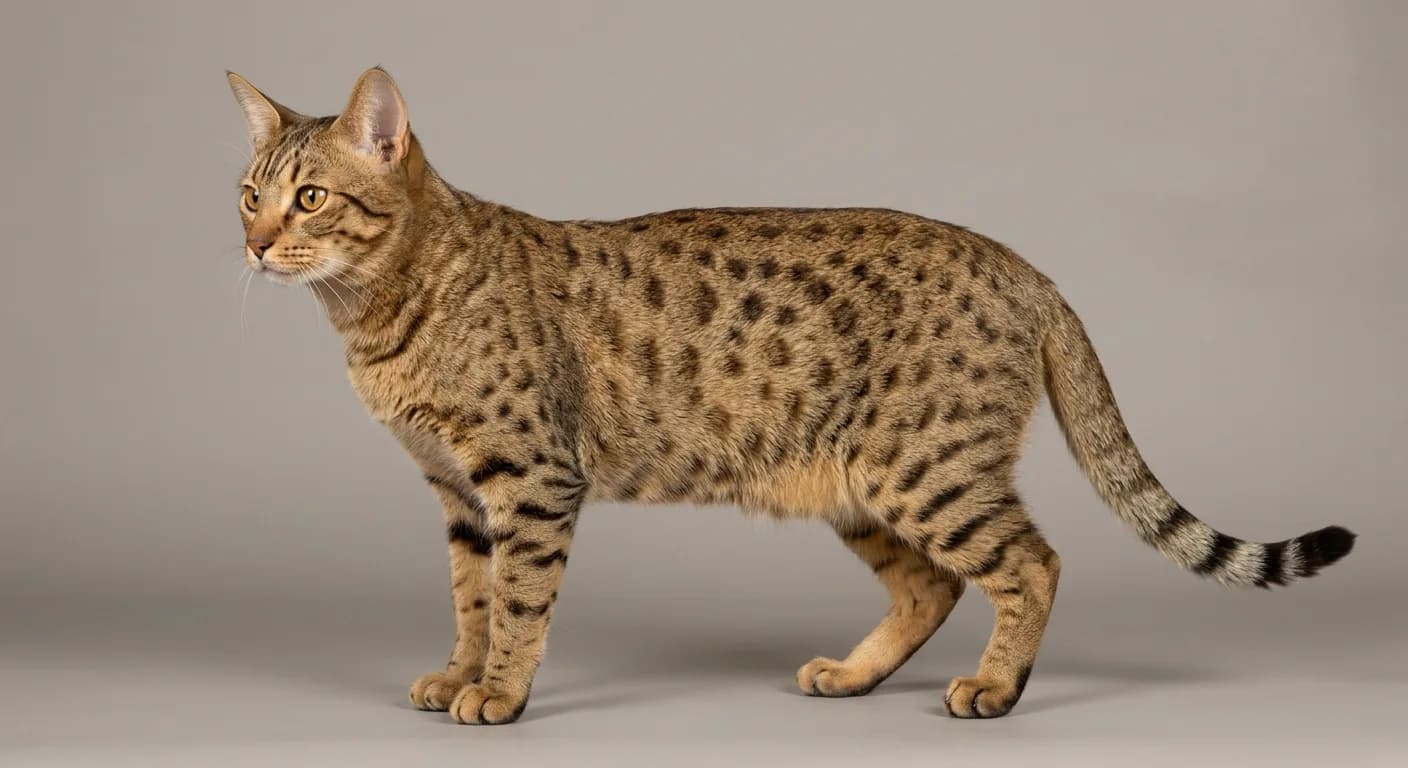
The Ocicat's signature is its spotting, and the spots are not random. The CFA standard calls for "thumb-print shaped" spots scattered across the body, with a distinctive arrangement on each side where "a spot encircled by other spots" forms a bull's-eye pattern. Every individual hair is agouti (banded with light and dark), the same ticking the breed inherited from its Abyssinian ancestor, which is what makes the ground color shimmer between the spots. The face carries the classic tabby "M" on the forehead, mascara lines around the eyes, and broken bands on the legs and tail. It is a spotted tabby in the truest sense, just one bred to look like a jungle cat.
How many Ocicat colors are there?
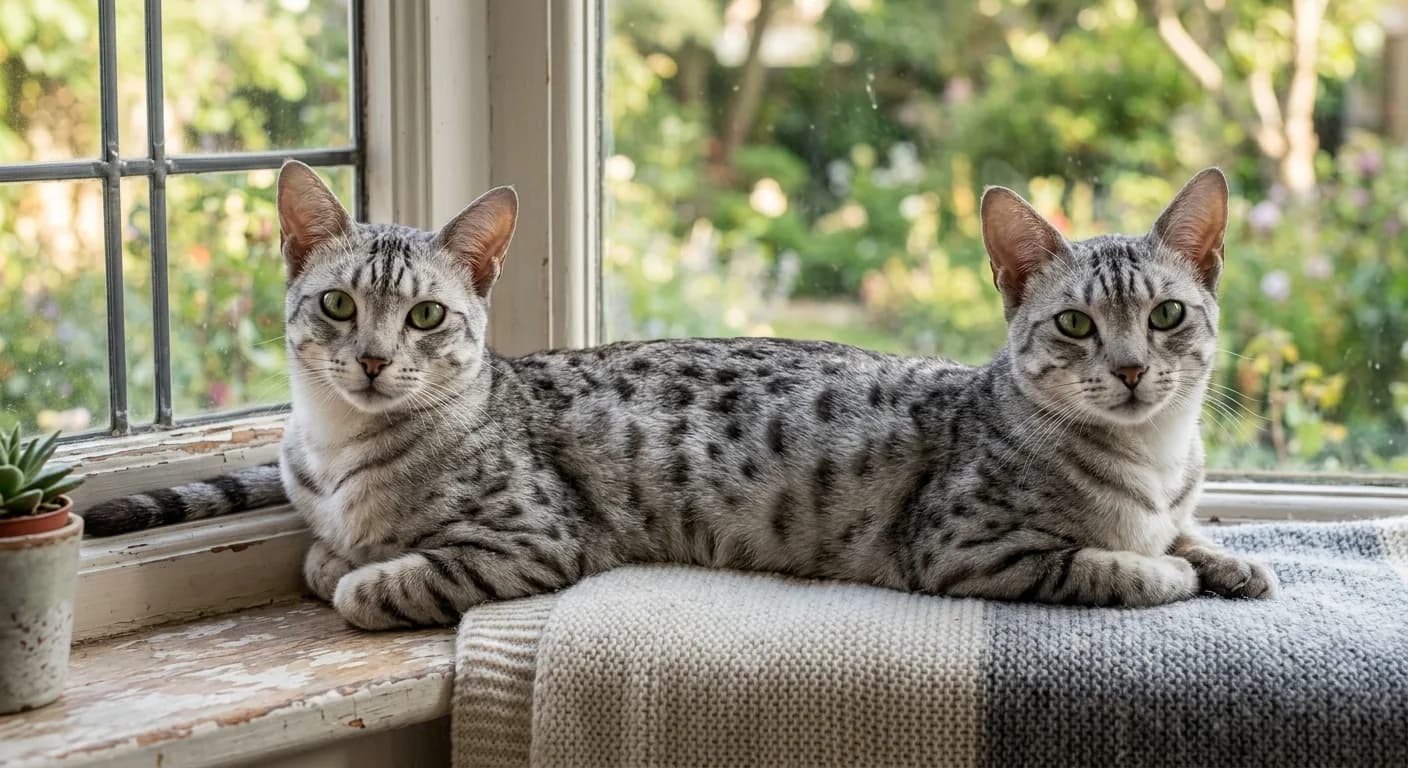
The CFA recognizes twelve Ocicat colors, organized into eight color classes and split into non-silver and silver groups. The non-silver colors are tawny, chocolate, cinnamon, blue, lavender, and fawn. Each of those has a silver counterpart: ebony silver, chocolate silver, cinnamon silver, blue silver, lavender silver, and fawn silver. (TICA describes the same dense brown-black color as "black" where the CFA uses "tawny" and "ebony silver," so you will see both naming conventions depending on the registry.) Here is the practical breakdown of what each looks like.
| Color | Spot Description | Group |
|---|---|---|
| Tawny | Rich dark brown to black spots on a warm bronze-agouti ground (the classic look) | Non-silver |
| Chocolate | Warm chocolate-brown spots on an ivory to cream ground | Non-silver |
| Cinnamon | Light reddish-brown spots on a pale warm ground | Non-silver |
| Blue | Cool slate-grey spots on a pale bluish-grey ground | Non-silver |
| Lavender | Soft frosty-grey spots with a pinkish cast on a pale ivory ground | Non-silver |
| Fawn | The palest warm dilute, light tan spots on a cream ground | Non-silver |
| Ebony Silver | Black spots on a sparkling silver-white ground | Silver |
| Chocolate Silver | Chocolate spots on a silver ground | Silver |
| Cinnamon Silver | Reddish-brown spots on a silver ground | Silver |
| Blue Silver | Slate spots on a cool silver ground | Silver |
| Lavender Silver | Frosty spots on a silver ground | Silver |
| Fawn Silver | The palest spots on a silver ground | Silver |
- The first word is the spot color and the second word tells you the ground. "Cinnamon" is the warmest, reddest brown of the dark series; add "silver" and the warm ground is swapped for a sparkling silver-white that makes the spots pop. Tawny is the most common and the most ocelot-like.
The eyes are their own feature. The CFA standard allows "all eye colors except blue," so Ocicats turn up with gold, copper, green, hazel, and amber eyes, but never blue. That is the opposite rule from a pointed breed like the Siamese, and it is a quick authenticity check: a true Ocicat does not have blue eyes.
Size and build: heavier than it looks
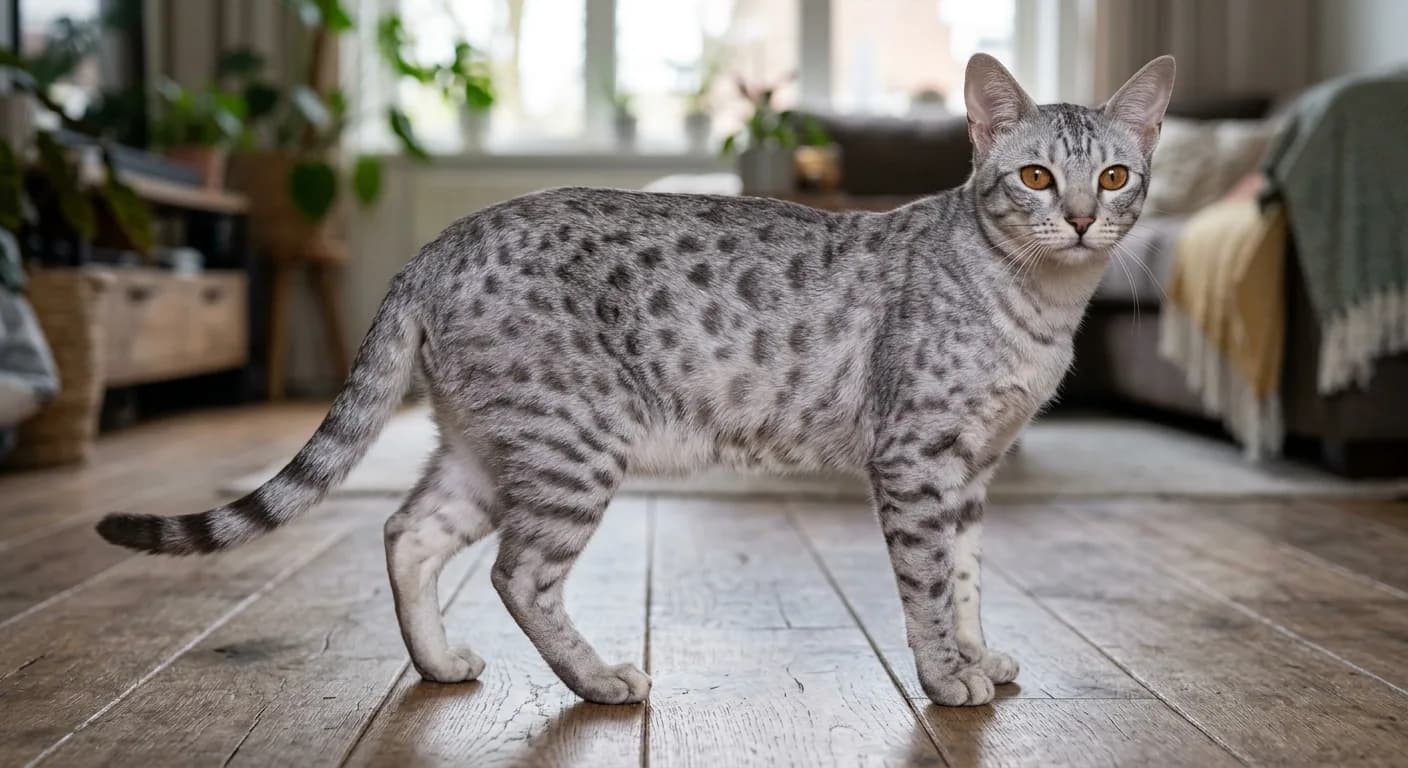
The Ocicat is a medium to large cat, and the standard makes a point of its athleticism. The CFA describes the breed as "so muscular that they feel heavy for their size," which is the single most common surprise for first-time owners: you pick up what looks like a lean, leggy cat and it weighs more than you expected. The long body, deep chest, and substantial bone (the American Shorthair contribution) all add up to real heft.
Per TICA's breed information, males typically weigh 10 to 12 pounds and females 8 to 10 pounds, while broader breed sources put the full range at roughly 6 to 15 pounds depending on sex and line. Height runs about 9 to 11 inches at the shoulder, and the body is notably long. The head is a modified wedge with a gentle curve, the ears are large and alert (sometimes tufted), and the eyes are large and almond-shaped, angled slightly toward the ears. Nothing about the Ocicat is delicate; it is built like a small, elegant athlete.
| Trait | Detail |
|---|---|
| Weight (male) | About 10 to 12 lb (TICA) |
| Weight (female) | About 8 to 10 lb (TICA) |
| Height | Roughly 9 to 11 in at the shoulder |
| Coat | Short, satiny, agouti spotted tabby |
| Recognized colors | 12 (CFA), in 8 color classes |
| Eye color | Any color except blue (CFA standard) |
| Lifespan | Commonly 12 to 18 years |
| Origin | United States, 1964 |
Temperament: a dog in a cat's coat
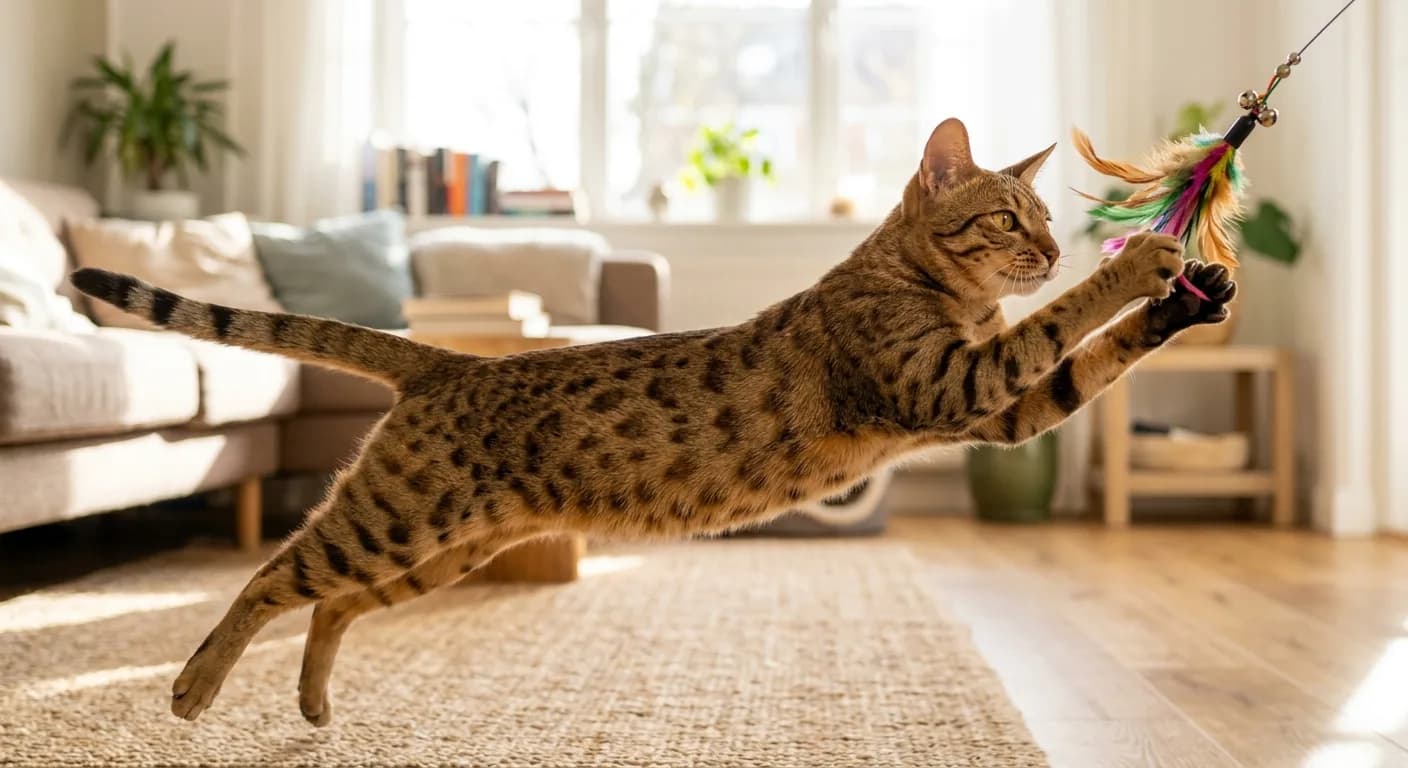
If the spots get people in the door, the personality is what keeps them. The Ocicat is the breed most often described as "dog-like," and it earns the label. The CFA calls it a natural extrovert that is "dedicated to their owners but neither clingy nor demanding." PetMD goes further and calls Ocicats "dogs in cats' fur." These cats greet you at the door, follow you room to room, ride on shoulders, walk on a harness and leash, learn their names, come when called, and play fetch for as long as you are willing to throw.
That intelligence is a double-edged sword. An Ocicat is highly trainable, which means it can learn to open cabinets, turn on faucets, and let itself into rooms you would rather keep closed. It is also very social and bonds hard with its people, so it does not do well isolated for long stretches. PetMD specifically flags that the breed is "prone to separation anxiety." An Ocicat left alone all day with nothing to do is a recipe for boredom behaviors. The flip side is that they thrive in busy households and usually get along beautifully with other cats and with dogs, so a second pet is often the kindest setup for a working owner.
They are also vocal. Ocicats are talkers, a trait inherited from the Siamese side, and they will hold a running conversation with you. Most owners find it endearing; light sleepers should know what they are signing up for. For a deeper look at the day-to-day quirks, energy level, and training tips, see our dedicated guide to the Ocicat personality.

63-inch multi-level cat tree with scratch posts, hammock, plush perches, and dangling toys. Vertical territory is non-negotiable for high-energy climbing breeds like the Bengal.
Petful may earn a commission when you click through to Chewy, at no extra cost to you.
- Because the Ocicat is so social and so smart, long days of solitude can lead to stress behaviors. Purina notes that an under-stimulated Ocicat can become demanding and develop problems such as inappropriate toileting and over-grooming. Plan on daily interactive play, puzzle feeders, and ideally a companion pet.
Health and lifespan
The Ocicat is generally a hardy, healthy breed, which makes sense given its broad three-breed foundation and large gene pool. The commonly cited lifespan is 12 to 18 years, and well-cared-for indoor Ocicats routinely reach the upper end of that range. As with any pedigreed cat, a few inherited conditions are worth knowing and screening for. According to PetMD and other veterinary sources, the conditions most associated with the breed include:
- Hypertrophic cardiomyopathy (HCM): the most common feline heart disease, a thickening of the heart muscle. It is not unique to Ocicats but is worth monitoring; responsible breeders screen breeding cats with cardiac ultrasound.
- Progressive retinal atrophy (PRA): an inherited eye disease that can cause night blindness, typically appearing around 1 to 2 years of age and progressing toward vision loss. A DNA test exists, so reputable breeders test parents.
- Renal and hepatic amyloidosis: an inherited tendency toward abnormal protein deposits in the kidneys (and sometimes liver) that can impair organ function over time. This trait is associated with the Abyssinian ancestry.
- Pyruvate kinase (PK) deficiency: an inherited red-blood-cell enzyme disorder that can cause anemia. A reliable DNA test is available, so it is now rare in well-screened lines.
- Periodontal (dental) disease: common across cats, so routine dental care matters.
The good news is that PRA and PK deficiency both have DNA tests, and HCM is screenable by ultrasound, so a breeder who tests their breeding stock dramatically lowers the odds. Ask any breeder which tests they run before you commit.
- No color or pattern protects an Ocicat from inherited disease. Always ask a breeder for documentation of PRA and PK DNA testing and HCM cardiac screening on the parents. A "rare" silver or chocolate kitten with no health testing is a worse choice than a tawny kitten from fully tested lines.
Grooming: about as easy as cats get
This is one of the lowest-maintenance coats in the cat world. The Ocicat wears a short, tight, satiny single coat with no undercoat to mat, so a weekly once-over is plenty. A rubber curry brush or grooming glove lifts loose hair, and TICA's breed notes mention a chamois polish to bring up the natural sheen, a nice touch before a show but optional for a pet. Beyond that, the standard cat-care basics apply: brush the teeth regularly to stay ahead of periodontal disease, trim the nails every couple of weeks, and check the large ears for wax or debris. Because the coat sheds modestly rather than heavily, an Ocicat is a relatively tidy cat to live with.

108-oz stainless steel pet fountain with quiet pump and water-level window. Bengals are notoriously water-obsessed; a flowing fountain encourages hydration and pulls them away from sinks and toilets.
Petful may earn a commission when you click through to Chewy, at no extra cost to you.
Is the Ocicat hypoallergenic? The honest answer
Here is the section most "exotic spotted cat" articles skip or fudge, so we will be straight about it. The honest answer is lower, not zero. No cat is truly hypoallergenic, the Ocicat included. Cat allergies are driven mainly by Fel d 1, a glycoprotein produced in a cat's saliva and skin (sebaceous) glands, not by hair itself, and every cat with skin and saliva makes some. The Ocicat is sometimes listed among the "better for allergy sufferers" breeds, and there is a plausible reason: its short, single coat with no dense undercoat means less hair, and therefore less Fel d 1-coated dander, gets distributed around your home compared with a long, double-coated breed. Some sources also suggest Ocicats may produce somewhat lower Fel d 1 levels.
But "less" is not "none." An Ocicat still sheds, still produces dander, and still makes the allergen in its saliva, so it can absolutely trigger a sensitive person. If someone in your home has cat allergies, do not buy a kitten on the strength of a "hypoallergenic" label. Spend real time with adult Ocicats first, and manage exposure with the usual tools (HEPA filtration, frequent washing of bedding, hand-washing after handling). The breed may be a friendlier option for mild allergies; it is not a guaranteed pass for serious ones.
- The trigger is Fel d 1, a protein in saliva and skin glands, not fur length. A short single coat like the Ocicat's can spread less allergen-laden dander, which is why it gets the "lower-allergen" reputation, but no breed is allergen-free. Test your own reaction with adult cats before committing.
Ocicat vs. Bengal: the spotted-cat showdown
These two get confused constantly because both are large, athletic, spotted cats. The defining difference is ancestry. The Bengal was developed by crossing domestic cats with the Asian leopard cat, a small wild species, so early-generation Bengals carry genuine recent wild DNA. The Ocicat has none. Everything wild about an Ocicat is cosmetic, achieved through selective breeding of three domestic breeds. That difference shows up in temperament and care: Bengals are famously high-octane and can be intense, while the Ocicat, though energetic, tends to be a touch more easygoing and people-pleasing. There is more on this in Petful’s guide to Bengal cat generations.
| Feature | Ocicat | Bengal |
|---|---|---|
| Wild ancestry | None (100% domestic) | Asian leopard cat in the foundation |
| Foundation breeds | Abyssinian, Siamese, American Shorthair | Domestic cats x Asian leopard cat |
| Coat pattern | Thumbprint spotted tabby (bullseye) | Spotted or marbled rosettes, often glittered |
| Typical temperament | Dog-like, social, trainable, vocal | Very active, demanding, highly playful |
| Eye color | Any except blue | Varies, often green or gold |
| Allergen profile | Lower, not hypoallergenic | Lower, not hypoallergenic |
The coats differ too. A Bengal's spots are often rosetted (two-toned, like a leopard's) and many carry a "glitter" sheen, while the Ocicat shows solid thumbprint spots over an agouti, ticked ground. If you are weighing the two, our deep dive on Bengal cat colors and patterns is the best way to see exactly how a rosette differs from an Ocicat thumbprint. And if the Abyssinian "ticked" look intrigues you, the Abyssinian cat profile shows the ground coat the Ocicat is built on, while the Egyptian Mau is the only natural (non-engineered) spotted breed for a third comparison.
Color-changing crystal litter that flags pH shifts in your cat's urine, an early warning sign of UTIs, kidney issues, and more.
Petful may earn a commission when you click through to Chewy, at no extra cost to you.
How much does an Ocicat cost?
Ocicats are a specialty breed, so expect specialty pricing. From a reputable breeder, a pet-quality Ocicat kitten typically runs $800 to $1,500, with show-quality cats, rare colors, or strong pedigrees pushing toward $2,000 and occasionally beyond. Adoption, when an Ocicat or Ocicat mix turns up in rescue, is far cheaper, generally in the $50 to $300 range, though purebred Ocicats are uncommon in shelters. Beyond the purchase price, budget for the ongoing cost of a long-lived cat: quality food, routine veterinary care, dental work, and pet insurance, which broad estimates put around $100 to $150 a month. For a full breakdown of upfront and lifetime costs, plus what drives the price up or down, see our detailed Ocicat price guide.
- A higher price from a tested breeder usually buys you health screening (PRA and PK DNA tests, HCM cardiac scans), early socialization, and registration papers. That is money well spent on a cat you will likely have for 15-plus years. Be wary of unusually cheap "purebred" kittens with no paperwork or testing.
Is an Ocicat right for you?
The Ocicat suits an owner who wants an interactive, almost canine companion and can give it attention. It is ideal for an active household, a family with other pets, or anyone who enjoys clicker-training, harness walks, and a cat that participates in daily life. It is a poor match for someone who wants an aloof, low-engagement cat or who is gone twelve hours a day with no second pet at home. If you can meet its social and mental needs, you get a strikingly beautiful, healthy, affectionate, and genuinely fun cat that will keep you entertained for well over a decade.
- 1Best for active, social homes that can offer daily play, training, and ideally a companion pet
- 2Not ideal if you are away long hours with no other pet, because Ocicats are prone to separation anxiety
- 3Low grooming, modest shedding, and a hardy constitution make day-to-day care easy
- 4Always buy from a breeder who DNA-tests for PRA and PK deficiency and screens for HCM
- 5Expect roughly $800 to $1,500 for a kitten and a 12 to 18 year commitment
Frequently asked questions about the Ocicat
A pet-quality Ocicat kitten from a reputable breeder typically costs $800 to $1,500, while show-quality cats, rare colors, or premium pedigrees can reach $2,000 or more. Adoption, when available, runs roughly $50 to $300, though purebred Ocicats rarely appear in shelters. Budget another $100 to $150 a month for food, vet care, and insurance over the cat's long life.
A $20,000 price tag generally belongs to an early-generation Savannah cat (an F1 serval hybrid), not an Ocicat. The Ocicat is far more affordable, typically $800 to $1,500, precisely because it is 100% domestic and has no costly wild-cat parent. Other high-dollar breeds at the extreme end include the Ashera and top-pedigree Bengals, but those prices reflect wild ancestry and rarity, not the Ocicat.
The main drawbacks are social and behavioral. Ocicats are demanding of attention, dislike being left alone, and are prone to separation anxiety, so a bored or isolated Ocicat may develop problem behaviors such as inappropriate toileting or over-grooming. They are also vocal and highly intelligent enough to open cabinets and doors. They need daily play, enrichment, and ideally a companion pet, which makes them a poor fit for owners who are away all day.
No. No cat is truly hypoallergenic, and the Ocicat is no exception. Allergies are triggered by the Fel d 1 protein in a cat's saliva and skin glands, not by fur, and every cat produces it. The Ocicat's short single coat may spread less allergen-coated dander than a long, double-coated breed, and some sources suggest it produces lower Fel d 1, so it is sometimes called a lower-allergen choice. But it still sheds and produces dander, so spend time with adult Ocicats before buying if anyone in your home has allergies.
The most expensive cat breeds are generally the Ashera and early-generation Savannah (both can run tens of thousands of dollars), followed by breeds like the Bengal and the Persian or Khao Manee depending on pedigree. The Ocicat is not among the most expensive cats; at roughly $800 to $1,500 it is moderately priced because it is fully domestic with no wild-cat parent driving the cost up.
Common irritants for most cats include a dirty litter box, loud or chaotic environments, being grabbed or restrained, sudden changes to routine, and strong scents. For the Ocicat specifically, the biggest stressor is boredom and being left alone for long periods, because the breed is unusually social and craves interaction. Under-stimulation, not a single annoyance, is what most often causes behavior problems in this breed.
No cat breed sells for $100 million; that figure comes up in the context of cats who inherited fortunes, not purchase prices. The most famous example is Blackie, a cat who reportedly inherited around $12 million, and other wealthy pets like Choupette (Karl Lagerfeld's cat) are sometimes cited. The Ocicat, by contrast, is a real and affordable breed costing $800 to $1,500, not a multimillion-dollar animal.
No. Despite looking like a miniature ocelot, the Ocicat has zero wild DNA. It was created entirely from three domestic breeds (Abyssinian, Siamese, and American Shorthair) through selective breeding. This is the key difference between the Ocicat and breeds like the Bengal (developed from the Asian leopard cat) or the Savannah (from the African serval), which do carry recent wild ancestry.
Ocicats commonly live 12 to 18 years, and healthy indoor cats from well-screened lines often reach the upper end of that range. Their broad three-breed genetic foundation makes them a generally hardy breed. Buying from a breeder who DNA-tests for PRA and PK deficiency and screens for hypertrophic cardiomyopathy, plus providing good preventive veterinary and dental care, gives an Ocicat the best shot at a long life.

Kristine Lacoste has been researching dog and cat breeds for nearly a decade and has observed the animals up close at dog shows in both the United States and the United Kingdom. She is the author of the book One Unforgettable Journey, which was named as a finalist for a Maxwell Award from the Dog Writers Association of America, and was host of a weekly pet news segment on the National K-9 Academy Radio Show. In addition, she was the New Orleans coordinator for Dogs on Deployment, a nonprofit that helps military members and their pets, for 3 years. Kristine has researched and written about pet behaviors and care for many years. She holds a bachelor’s degree in psychology, another bachelor’s degree in English and a Master of Business Administration degree.
Sign up for expert-backed reviews and safety alerts all in one place.