Abyssinian Cat: Personality, Size, Care and Breed Guide
The Abyssinian is an athletic, ticked-coat pedigreed cat often known for curiosity and activity. Learn about personality, size, care, enrichment, and household fit.
Petful is reader supported. As an affiliate of platforms like Amazon and Chewy, we may earn a commission when you buy through links on this page. There is no extra cost to you.
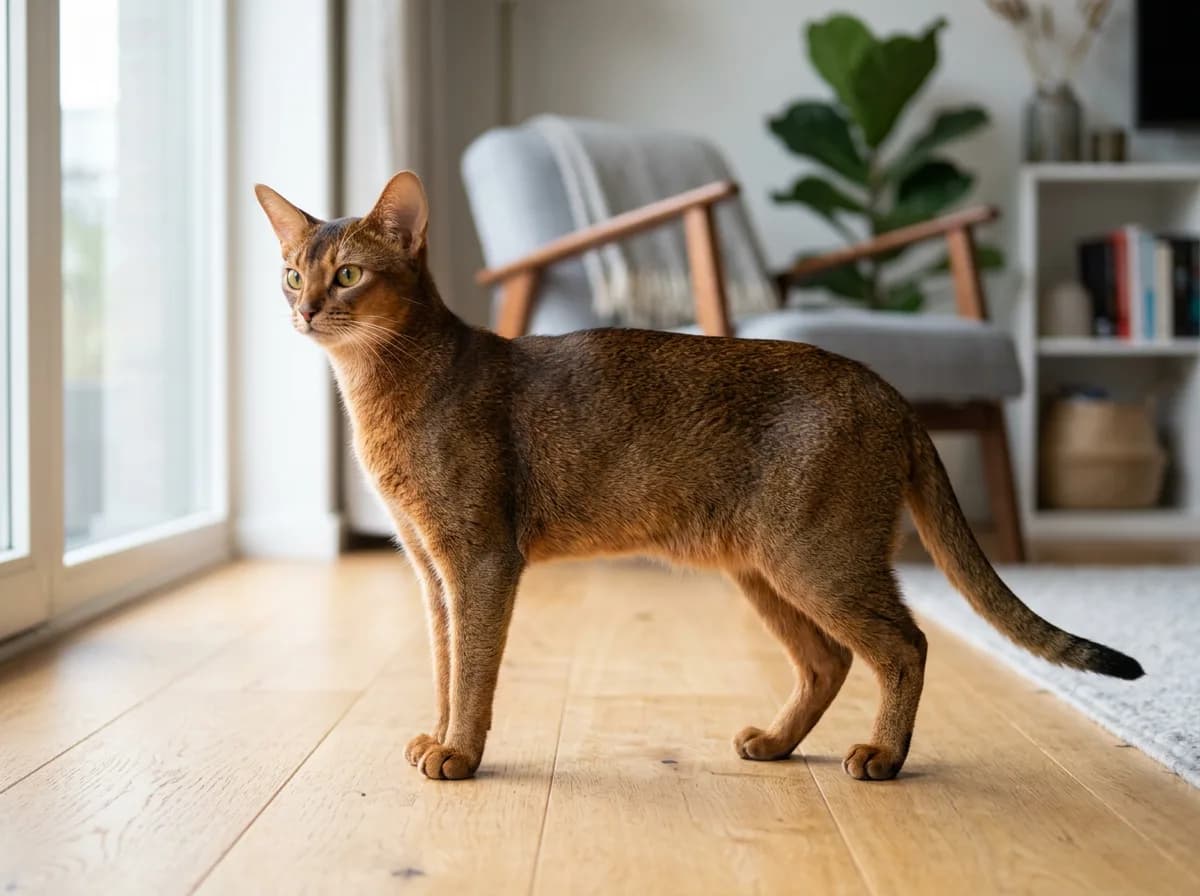
The Abyssinian cat is a lithe, athletic pedigreed breed known for a short ticked coat, alert expression, and intense interest in whatever its people are doing. Many Abyssinians are active, curious, and socially engaged, but the breed label cannot guarantee one cat's confidence, affection style, energy, or tolerance of a particular household.
This refreshed guide owns the practical questions about Abyssinian personality, size, activity, grooming, daily care, and household fit. Petful's dedicated guides cover Abyssinian cat colors, Abyssinian kittens, breeders, and adoption, Abyssinian cat price and lifetime cost, Abyssinian health and lifespan, and the Abyssinian vs Somali comparison.

Sign up for expert-backed reviews and safety alerts all in one place.
Abyssinian Cat at a glance
An Abyssinian is a registered breed, not a name for every slender brown cat with a banded coat. The Cat Fanciers' Association Abyssinian profile and the TICA Abyssinian profile describe a medium, fine-boned but muscular cat with a close-lying ticked coat and an alert, balanced appearance. Pedigree and registry records establish ancestry more reliably than appearance.
This breed snapshot is answer-first breed guidance: the breed's most important ownership trait is usually activity. An Abyssinian needs chances to climb, investigate, chase, learn, and participate in daily life. Individual cats can vary, so a good environment combines productive outlets, predictable routines, safe resting choices, and permission to disengage.

Petful may earn a commission when you click through to Chewy, at no extra cost to you.
- 1Answer-first breed guidance: the Abyssinian is a pedigreed, medium-sized athletic cat with a short ticked coat
- 2Many are curious, active, and socially engaged, but individual cats can vary
- 3Daily climbing, interactive play, social enrichment, and problem-solving matter more than a large floor plan
- 4Pedigree and registry records establish breed identity more reliably than color or body shape
| Reader decision | Practical answer |
|---|---|
| Identity | A standardized registered breed; verify ancestry with pedigree and registry records |
| Body | Medium, lithe, muscular, balanced, and built for agile movement |
| Coat | Short, close-lying, and ticked, with bands of color on individual hairs |
| Personality | Often curious, active, observant, and people-oriented, with meaningful individual variation |
| Activity | Daily climbing, hunting-style play, exploration, and short training sessions |
| Care | Measured feeding, weekly coat checks, dental and nail care, litter monitoring, safe transport, and preventive veterinary care |
What is an Abyssinian cat?
The Abyssinian is one of the established pedigreed cat breeds recognized by major registries. Its identity is documentary. A cat can resemble an Abyssinian without belonging to the registered breed population, and a documented Abyssinian can depart from the ideal described in a show standard.
The breed's history is often told through romantic stories about ancient Egypt. The more careful approach is to distinguish the modern breed's development from visual similarities to cats in old art. Registries describe the breed as having been developed through organized breeding, with early cats exhibited in Britain during the nineteenth century. Ancient-looking posture is not evidence of a direct unbroken lineage.
The official CFA breed standard PDF focuses on the whole cat rather than one striking feature:
- Balanced proportions and a modified wedge-shaped head.
- Expressive almond-shaped eyes and large alert ears.
- A lithe muscular body with fine-boned legs and oval compact paws.
- A tapering tail that remains proportionate to the body.
What to verify before you decide
- A warm ticked coat, large ears, almond-shaped eyes, or an athletic body may be consistent with the Abyssinian standard, but those traits cannot establish ancestry. Verify documentary records tied to the individual when breed identity matters. Population estimates are not guarantees about one cat's identity, behavior, size, health, or household fit.
Abyssinian personality and temperament
Abyssinian personality is commonly described as curious, intelligent, active, and involved. Many individuals prefer being near the center of household activity. They may follow a person from room to room, inspect an open cabinet, watch food preparation from a permitted perch, or investigate an object that changed position. This is a breed tendency, not a prediction of one cat's behavior.
Are Abyssinian cats friendly? Many are socially engaged, but personality and individual variation matter more than a universal friendly label. Some seek frequent touch or sleep beside a person. Others show attachment by staying nearby, initiating play, greeting at a doorway, or observing from a high perch. Let repeated voluntary choices define the individual cat's affection style.
Personality and temperament
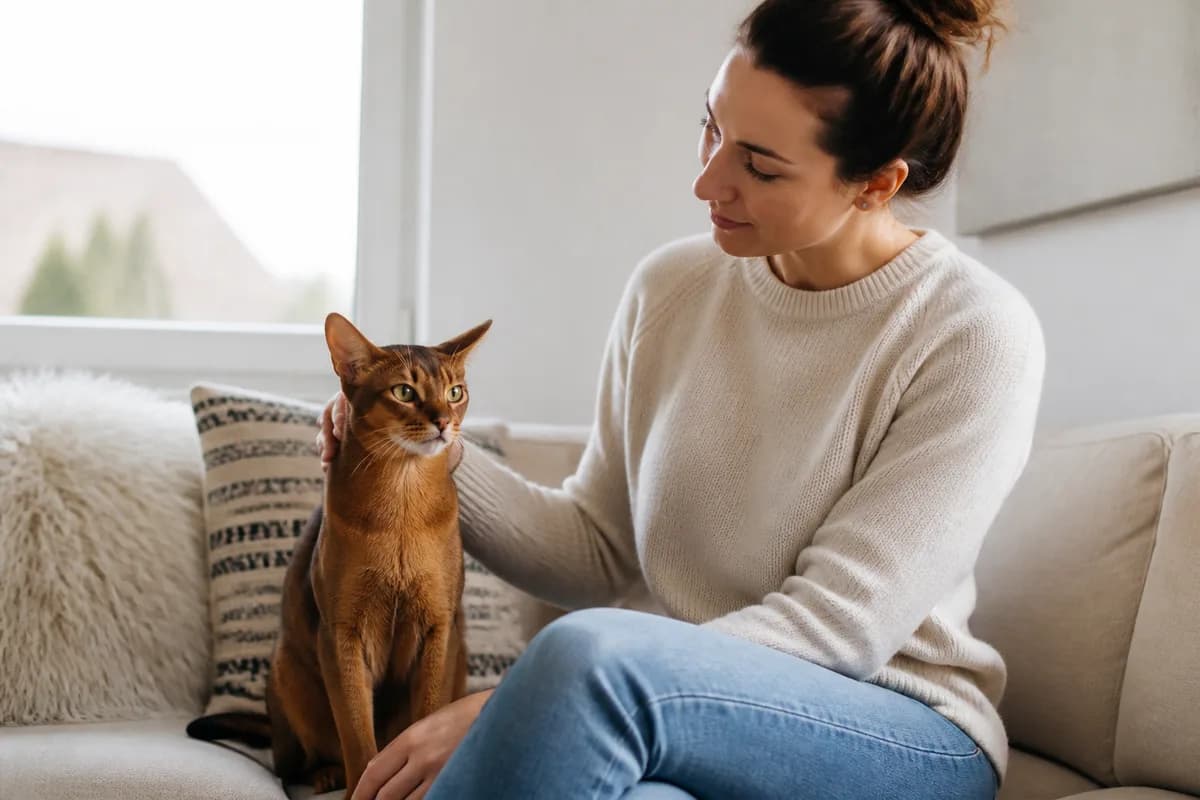
Watch behavior rather than relying on a breed stereotype. A relaxed cat has loose muscles, normal breathing, an easy face, and the ability to approach or leave. A cat that freezes, crouches, lashes the tail, flattens the ears, hides, or avoids contact needs more distance and a slower interaction.
A stable Yaheetech multi-level cat tree can give an active Abyssinian several legal observation heights in one footprint. Position it away from unstable furniture, assemble and anchor it according to directions, and keep launch and landing areas clear. The goal is safe choice, not forcing the cat to use a particular perch.
Abyssinian size, body and coat
An Abyssinian should look athletic rather than bulky or fragile. The body is medium in length, flexible, and muscular, with proportionate legs and a level back. Large ears and an alert expression can make the cat look delicate in a portrait, but the body should still have substance and controlled strength.
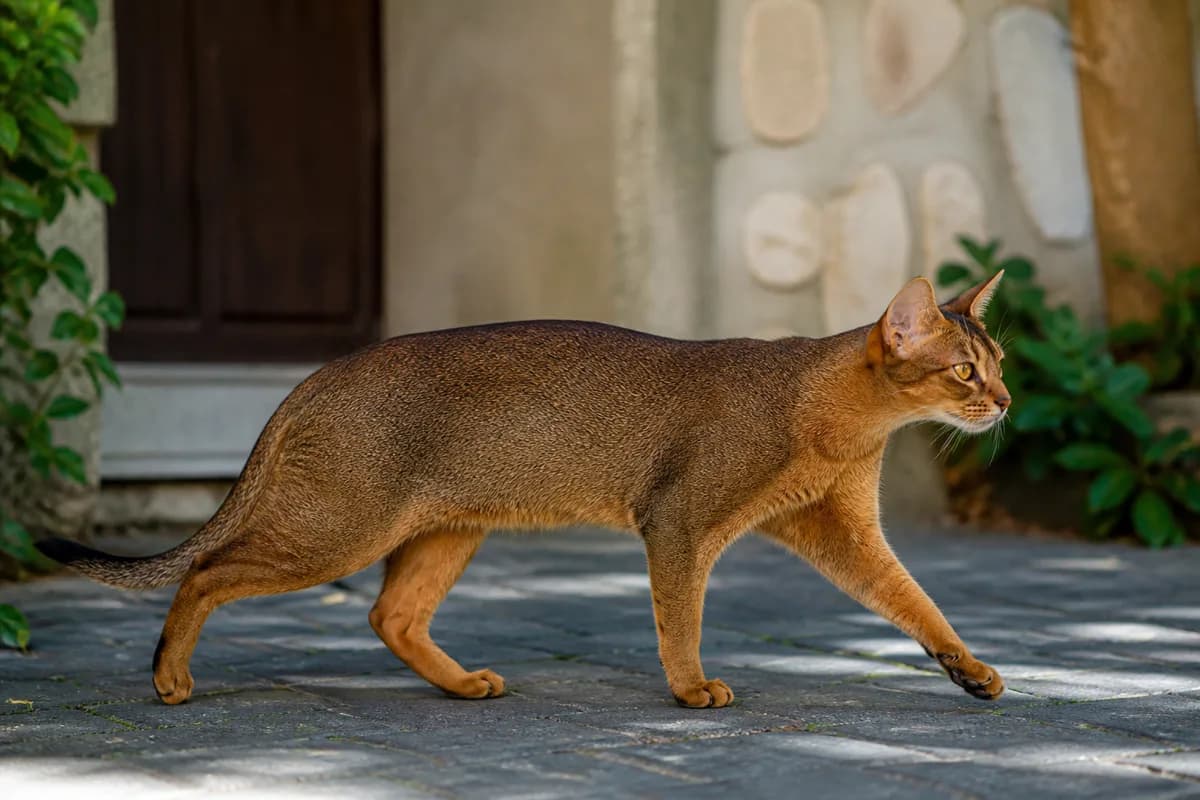
Abyssinian cat size varies by sex, lineage, age, and individual development. Weight alone cannot describe healthy condition. Feel for ribs beneath a light covering, look for a waist from above, and track changes over time. A veterinarian can interpret body-condition and muscle-condition scores in the context of the individual cat.
The coat is short, resilient, and close-lying. Ticking means that one hair has alternating bands of lighter and darker pigment. Seen across the body, those banded hairs create a warm, luminous effect rather than the clear stripes expected on many tabby coats. The face, tail, and legs may carry stronger accents, but the torso should not read as a conventionally striped tabby.
Petful's Abyssinian cat colors guide explains ruddy, sorrel, blue, and fawn, plus common confusion around gray, black, silver, and tabby language. Color can describe a documented Abyssinian accurately, but it cannot prove breed ancestry.

63-inch multi-level cat tree with scratch posts, hammock, plush perches, and dangling toys. Vertical territory is non-negotiable for high-energy climbing breeds like the Bengal.
Petful may earn a commission when you click through to Chewy, at no extra cost to you.
Activity, training and vertical space
An active Abyssinian benefits from a daily rhythm that uses climbing, chasing, searching, and thinking. Abyssinian exercise works best as several short, purposeful opportunities rather than forced continuous activity. A large home does not automatically provide enrichment, and a smaller home is not automatically unsuitable.
The practical depth an athletic breed needs comes from environmental setup: usable vertical space, more than one movement route, distributed resources, safe landing areas, interactive play, and the ability to choose between activity and rest. Give activity and environmental setup the practical depth expected for an athletic breed by mapping each feature to a daily behavior rather than counting square footage or products. This is the hub's activity decision path, while product-specific toy ideas remain supporting details.
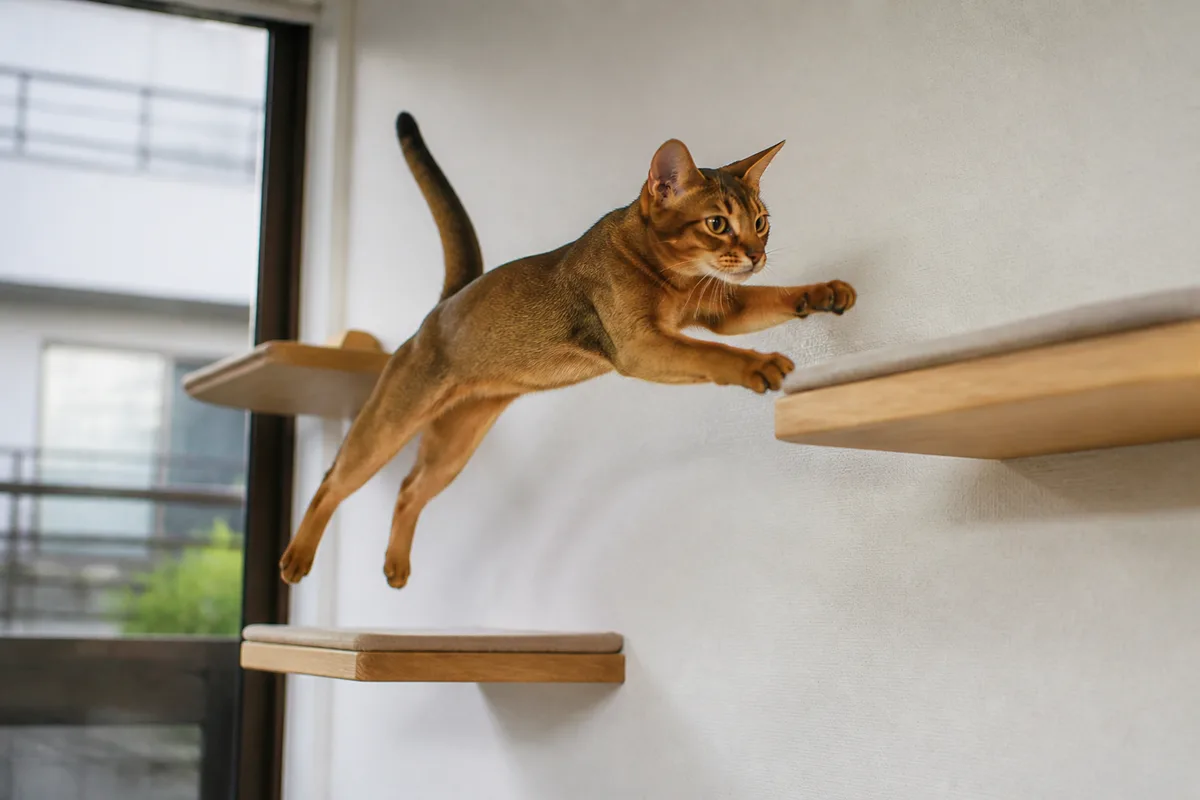
Build a practical activity plan:
- Offer at least two brief interactive play sessions at times the cat is naturally alert.
- Move toys like prey by hiding, pausing, changing direction, and ending with a catch.
- Create more than one climbing route so a resident pet cannot block every path.
- Use boxes, paper bags without handles, safe tunnels, and rotated objects for exploration.
- Teach useful behaviors such as going to a mat, entering a carrier, touching a target, and accepting brief handling.
- Put high-value resting locations where the cat can observe without being trapped.
A Frisco feather teaser wand can support supervised hunting-style play when the handler keeps feathers and string away from the cat between sessions. Let the cat stalk and catch instead of waving the toy continuously in the face. Retire damaged pieces immediately.
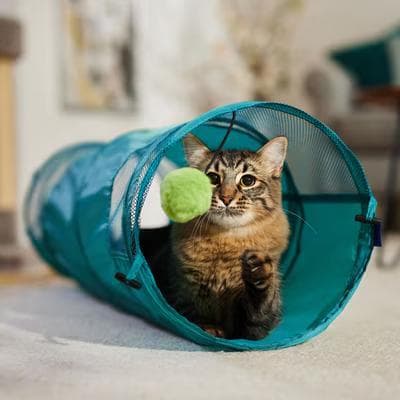
The Frisco foldable play tunnel can add hiding, ambush, and chase opportunities if it stays stable and intact. Check mesh, seams, and internal wire before each use, and place it away from stairs or doors. A cat that does not enjoy enclosed play should have open alternatives.
Social enrichment and training
WebVet's guide to interactive cat toys helps separate chase, puzzle, motion, and solo-play options. Rotation is usually more useful than putting every toy out at once. Keep the cat's favorite safe objects available while cycling a few others to restore novelty.
Training works best in small steps. Reward one achievable behavior, stop while the cat remains engaged, and avoid using hunger, fear, restraint, or punishment. A target stick or a simple hand target can guide the cat onto a scale, into a carrier, or away from a doorway without a struggle.

Feathered teaser wand with catnip-stuffed bird. Pairs perfectly with the no-bite training policy: redirect Bengal play drive into a 10-minute interactive session with the wand.
Petful may earn a commission when you click through to Chewy, at no extra cost to you.
Daily care and routine
Daily care should channel activity without allowing portions, litter changes, or subtle illness to disappear inside a busy schedule. Use a routine that is consistent enough to reveal changes but flexible enough to fit the individual cat.
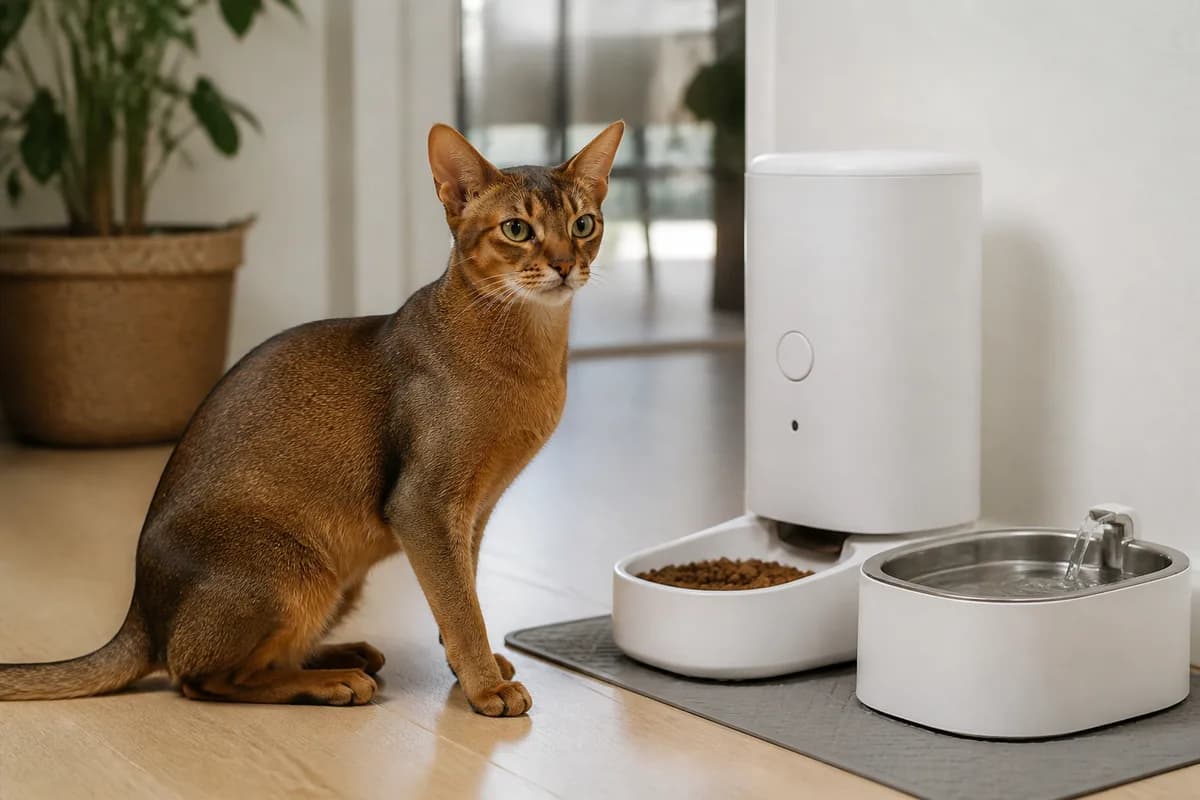
Measure food rather than filling a bowl by eye. Record what is offered, treats, puzzle-feeder food, and leftovers when weight or appetite is being monitored. An automatic feeder can distribute dry food on a schedule, but it cannot decide what amount is appropriate or confirm that the intended cat ate the meal. There is more on this in Petful’s guide to automatic cat feeder for multiple cats.
The Petlibro Granary WIFI automatic feeder can support timed measured dry-food portions when used within a veterinarian-informed feeding plan. Confirm each dispense, clean food-contact parts as directed, and keep a manual backup for power, network, or mechanical interruptions.
A second reference to the Petlibro automatic feeder matters most in a multi-cat home: supervise initial use and verify which cat eats. A camera or app event cannot prove intake if cats exchange bowls, steal food, or trigger a dispense without finishing it.
Water and litter monitoring
Separate water from food and litter when the home's layout allows. Offer clean bowls or a maintained fountain in more than one location, especially in a multi-level home. Monitor actual drinking and urine output rather than assuming a water device prevents urinary problems.
Litter-box observation is health information. Scoop frequently enough to notice a change in urine clump size, stool, frequency, straining, or blood. Provide enough accessible boxes in quiet locations, and keep at least one conventional option if a cat is learning an automated system.
Grooming and coat care
The close coat usually needs less combing than a long coat, but low grooming effort does not mean no care. A weekly hands-on check can remove loose hair and help a caregiver notice skin changes, parasites, tenderness, or a new lump.
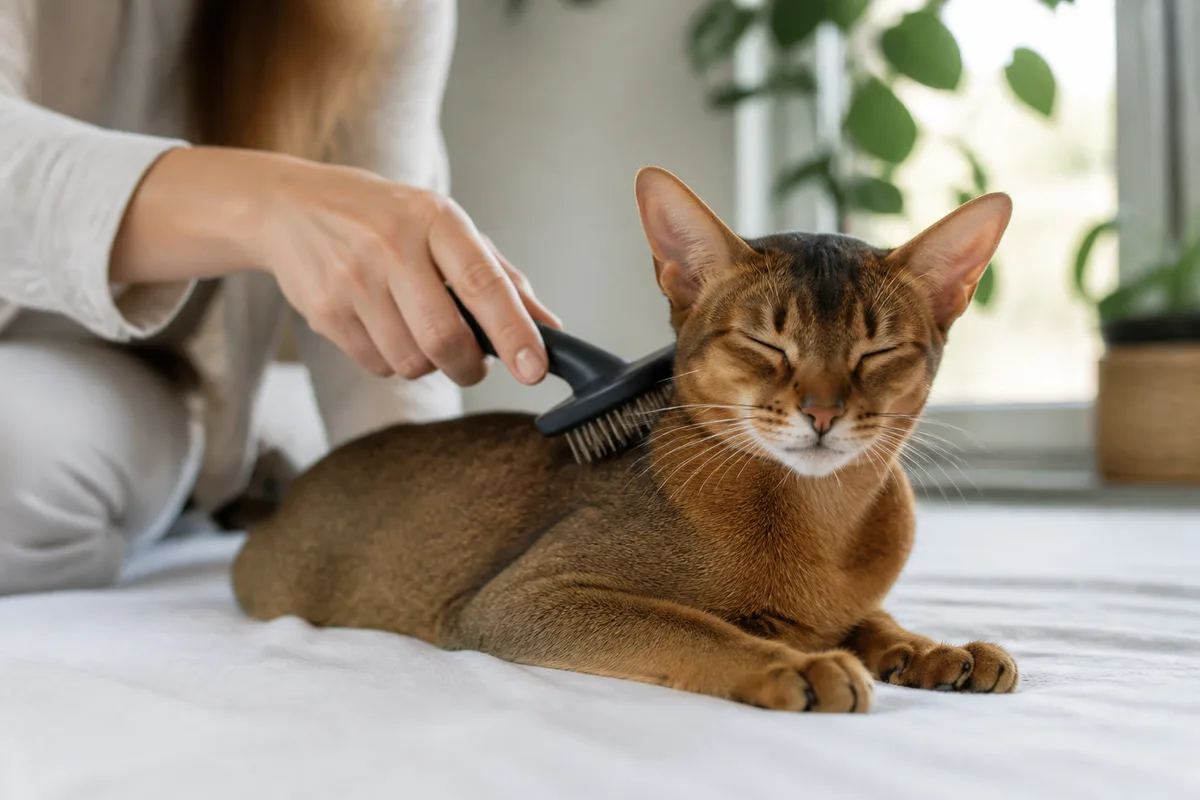
Use a soft grooming tool with light pressure. Begin with a few strokes in areas the cat already accepts, reward calm participation, and stop before discomfort escalates. More frequent brushing may help during seasonal shedding, but excessive force can irritate skin and damage coat.
Check nails, ears, eyes, teeth, and mouth as separate care tasks. Trim only the safe nail tip when the cat is comfortable and the caregiver can see the quick. Wipe only visible external ear debris with a veterinarian-approved approach; do not insert swabs into the ear canal. Persistent odor, discharge, redness, squinting, drooling, or appetite change needs veterinary guidance.
Dental care deserves a plan because normal eating does not rule out oral pain. Ask a veterinarian to demonstrate toothbrushing and recommend cat-safe products. Never use human toothpaste. Build acceptance through short steps such as touching the cheek, lifting the lip, and briefly contacting one tooth before expecting a full session.
Petful may earn a commission when you click through to Chewy, at no extra cost to you.
Family, children, cats and dogs
An Abyssinian may fit a household that enjoys an observant, interactive cat and can create predictable opportunities for activity. The same cat may struggle in a home where play is sporadic, vertical access is blocked, handling is forced, or other animals control every resource.
Children should learn to interact on the floor, use toys with adult supervision, and let the cat leave. An interested cat can participate without being carried. Adults remain responsible for reading body language, protecting rest, and preventing rough pursuit.
Family and pet fit
Introductions to cats and dogs should proceed through scent, distance, barriers, and controlled access. Provide separate feeding, water, litter, scratching, and resting resources. This family and pet fit assessment depends on the individual animals; a breed reputation for sociability cannot make an unsafe dog, resource conflict, or rushed introduction acceptable.
A second Yaheetech multi-level cat tree link is relevant here because vertical escape routes can reduce pressure during managed introductions. One tall object is not enough if another pet can block its entrance or landing area, so distribute protected routes across the home.
Use the Frisco teaser wand for parallel play only when each animal remains relaxed and can disengage. Do not use a moving toy to draw unfamiliar animals into close contact. Distance and successful short sessions matter more than speed.
Is this the right choice for your household?
The strongest fit test asks what the household can provide every day, not whether the breed looks appealing. This household-fit scorecard maps activity, attention, space and routine to real ownership decisions. Its clear decision labels and source-aware breed distinctions help the reader score each household fit factor as ready, needs a plan, or not currently workable.
- Activity: Two or more daily play or training opportunities plus safe independent exploration.
- Vertical space: Stable perches, more than one route, and protected observation or retreat areas.
- Social attention: Voluntary contact, predictable routines, and enough engagement without forced handling.
- Resource access: Distributed food, water, litter, scratching, and rest options that another pet cannot monopolize.
- Safety: Secured windows, protected doors, no unsupervised outdoor roaming, and safe toy storage.
- Care capacity: Measured feeding, coat and dental care, veterinary planning, transport practice, and an emergency budget.
- Household fit factors favor people who enjoy an athletic, observant companion and interactive play
- Short coat is usually straightforward to maintain
- Learns useful cooperative-care and household behaviors through rewards
- Uses vertical space well and can thrive without an enormous floor plan
- Activity and curiosity require daily outlets and home safety planning
- Individual behavior can vary around laps, holding, children, dogs, or other cats
- Short coat still sheds and dental, nail, and preventive care remain necessary
- Breed identity and responsible sourcing require documentary verification
A household with several “needs a plan” scores may still be a good future fit after changing the environment or routine. A “not currently workable” score for safe separation, veterinary access, or daily care deserves resolution before bringing a cat home.
Home safety for an active Abyssinian
Curiosity makes environmental safety part of routine care. An Abyssinian that climbs, jumps, opens a light cabinet, or follows people through doors is not being difficult. The behavior reveals which safeguards the home needs.
Start with windows and exterior doors. Confirm that screens are secure and designed to withstand contact. A standard insect screen may pop out under a cat's weight. Use a controlled entry routine, teach family members to check the cat's location, and create an interior pause point so the cat is not waiting directly at the exterior threshold.
Walk through the home at cat-eye and climbing height:
- Anchor tall furniture and secure unstable shelves.
- Store medication, cleaners, essential oils, string, thread, elastic, and small chewable objects behind reliable closures.
- Cover or organize cords, and unplug unsafe items when they cannot be supervised.
- Check washers, dryers, recliners, sofa beds, and other moving mechanisms before use.
- Identify toxic plants through a reliable veterinary or poison-control source and remove unsafe species.
- Keep breakable objects away from expected launch and landing paths.
- Use window, balcony, and outdoor enclosures only when their structure and maintenance are appropriate for containing a cat.
Unsupervised roaming exposes a cat to traffic, predators, toxins, fights, parasites, infectious disease, theft, and loss. Safe indoor enrichment, a properly built enclosure, or trained harness time can provide controlled sensory variety. Harness training should begin indoors through voluntary, rewarded steps. A harness does not make an unsecured location escape-proof.
The second Frisco foldable play tunnel reference belongs in the safety routine because active play equipment needs inspection. Check the tunnel before use, store it if another pet guards it, and retire it when wire, mesh, or seams become exposed.
A workable Abyssinian daily schedule
The best routine is one the household can repeat and observe. It does not need to fill every minute. It should alternate activity, meals, social contact, quiet choice, and rest while preserving enough consistency to make a change noticeable.
A sample day could look like this:
- Morning: Observe appetite and litter use, offer a short chase-and-catch play session, then provide a measured meal.
- Midday: Leave safe independent options such as a window view, puzzle opportunity, cardboard box, or secure climbing route. A caregiver can check water, temperature, and the cat's normal location.
- Evening: Use a second interactive session, one or two minutes of reward-based training, and another measured meal. Rotate one safe object rather than changing the entire environment.
- Night: Store string and feather toys, confirm doors and windows, scoop litter, and leave accessible water, litter, scratching, and rest choices.
Adapt timing to age, health, work schedule, and what the individual cat actually does. A kitten may need more frequent short activity and meals. An older cat may prefer lower jumps, warm rest, and gentler movement. A medical condition can change feeding, hydration, medication, or activity needs, so follow the treating veterinarian's plan.
Cooperative care and travel preparation
Care becomes easier when the cat learns that participation predicts small rewards and the option to pause. Practice touching one paw, looking briefly at the mouth, brushing one body area, stepping onto a scale, and entering a carrier as separate skills.
Break carrier training into observable steps: looking toward the carrier, approaching, placing the head inside, stepping in, staying briefly, allowing the door to move, and tolerating a short carry. Progress only when the cat remains comfortable at the current step. Keep the carrier open in a familiar room between trips when space and product design allow.
Track care without over-monitoring
Use a non-slip surface for grooming and nail care. Keep sessions short enough that the cat can succeed, and stop for escalating tension, escape attempts, vocal distress, or defensive behavior. Cooperative care improves routine handling, but urgent medical care should not be delayed because training is incomplete.
Track baseline observations in a simple log. Note monthly weight when advised, appetite patterns, litter output, activity, grooming, and any recurring medication. The value is not constant surveillance. It is having enough context to recognize a meaningful change and describe it clearly to a veterinarian.
Abyssinian colors, kittens, price and health in brief
Spoke summaries
These spoke summaries replace an unfocused all-in-one page with a better hub decision path. Replace the current all-in-one depth with a better hub decision path by answering the immediate breed question here, naming the evidence boundary, and directing detailed color, kitten, price, comparison, and health intent to its owner page. That keeps the pillar useful without repeating or competing with each focused guide.
Abyssinian colors in brief
Ruddy, sorrel, blue, and fawn are the four CFA-recognized Abyssinian colors. Each involves a specific ground color and darker ticking. A blue Abyssinian cat belongs in the same documented breed even though its coat looks cooler and more dilute. Registry terminology and documentary identity matter more than a seller's visual label. The dedicated Abyssinian cat colors and ticking guide explains the labels and why appearance alone cannot identify ancestry.
Abyssinian kittens in brief
Search results for an Abyssinian cat for sale do not verify a kitten, seller, pedigree, health record, or living environment. An Abyssinian cat adoption label may also describe visual resemblance when records are absent. Compare breeder, rescue, and adult-placement routes through the evidence each can provide rather than treating route labels as guarantees. Petful's Abyssinian kitten buying and adoption guide gives a records-first process for live contact, contracts, adoption evidence, deposits, pickup, and scam avoidance.
Abyssinian price in brief
An advertised figure is only one line in the decision. Compare included records, veterinary care, transport, deposits, contract terms, home setup, recurring care, and emergency capacity. The Abyssinian cat price guide separates purchase quotes from first-year and lifetime planning.
Abyssinian health in brief
Population-level Abyssinian cat lifespan information cannot predict one cat's outcome. Abyssinian cat health problems also cannot be diagnosed from a breed label. Ask a veterinarian about preventive care, lineage-specific records, current examination findings, and changes in appetite, weight, movement, breathing, elimination, or behavior. Screening results answer bounded questions and never guarantee an individual outcome. The Abyssinian health and lifespan guide owns the deeper clinical discussion.
Abyssinian vs Somali in brief
The Somali is closely related to the Abyssinian but has a longer coat and its own breed presentation. The Somali breed profile provides the established overview, while Petful's Abyssinian vs Somali guide compares the practical distinctions directly.
Abyssinian Cat FAQs
These answers resolve the captured follow-up questions while routing price, sourcing, color, comparison, and health depth to their dedicated pages.
Abyssinian cats can be expensive, and kittens from breeders can cost substantially more than cats adopted from shelters, but there is no single reliable national price. Location, availability, pedigree records, veterinary care, contract terms, transport, and other included services affect each quote. A high price does not prove health, quality, or responsible breeding, so compare current itemized quotes and budget for ongoing care as well as the initial cost.
Abyssinian cats can be good pets for active households that enjoy frequent interactive play, climbing setups, short training sessions, and regular social contact. They are often described as active and curious, but individual cats differ in confidence, affection, energy, and tolerance for children or other animals. Consider the specific cat's observed behavior and whether the household can provide safe activity, quiet rest, routine care, and veterinary support.
Coat color, large ears, a ticked pattern, or an athletic build can suggest that a cat resembles an Abyssinian, but appearance cannot confirm ancestry. Pedigree and registration records tied to the individual cat provide stronger evidence. Check names, dates, registration numbers, microchip details, and the issuing registry independently, especially when breed identity affects a purchase or adoption decision.

Kristine Lacoste has been researching dog and cat breeds for nearly a decade and has observed the animals up close at dog shows in both the United States and the United Kingdom. She is the author of the book One Unforgettable Journey, which was named as a finalist for a Maxwell Award from the Dog Writers Association of America, and was host of a weekly pet news segment on the National K-9 Academy Radio Show. In addition, she was the New Orleans coordinator for Dogs on Deployment, a nonprofit that helps military members and their pets, for 3 years. Kristine has researched and written about pet behaviors and care for many years. She holds a bachelor’s degree in psychology, another bachelor’s degree in English and a Master of Business Administration degree.
Sign up for expert-backed reviews and safety alerts all in one place.