Can Dogs Play With Catnip Toys?
The catnip is not the main problem. Learn why cat-toy size, strings and loose parts can endanger dogs, plus how to choose safer dog enrichment. Choose safer options for everyday play.

Veterinarian
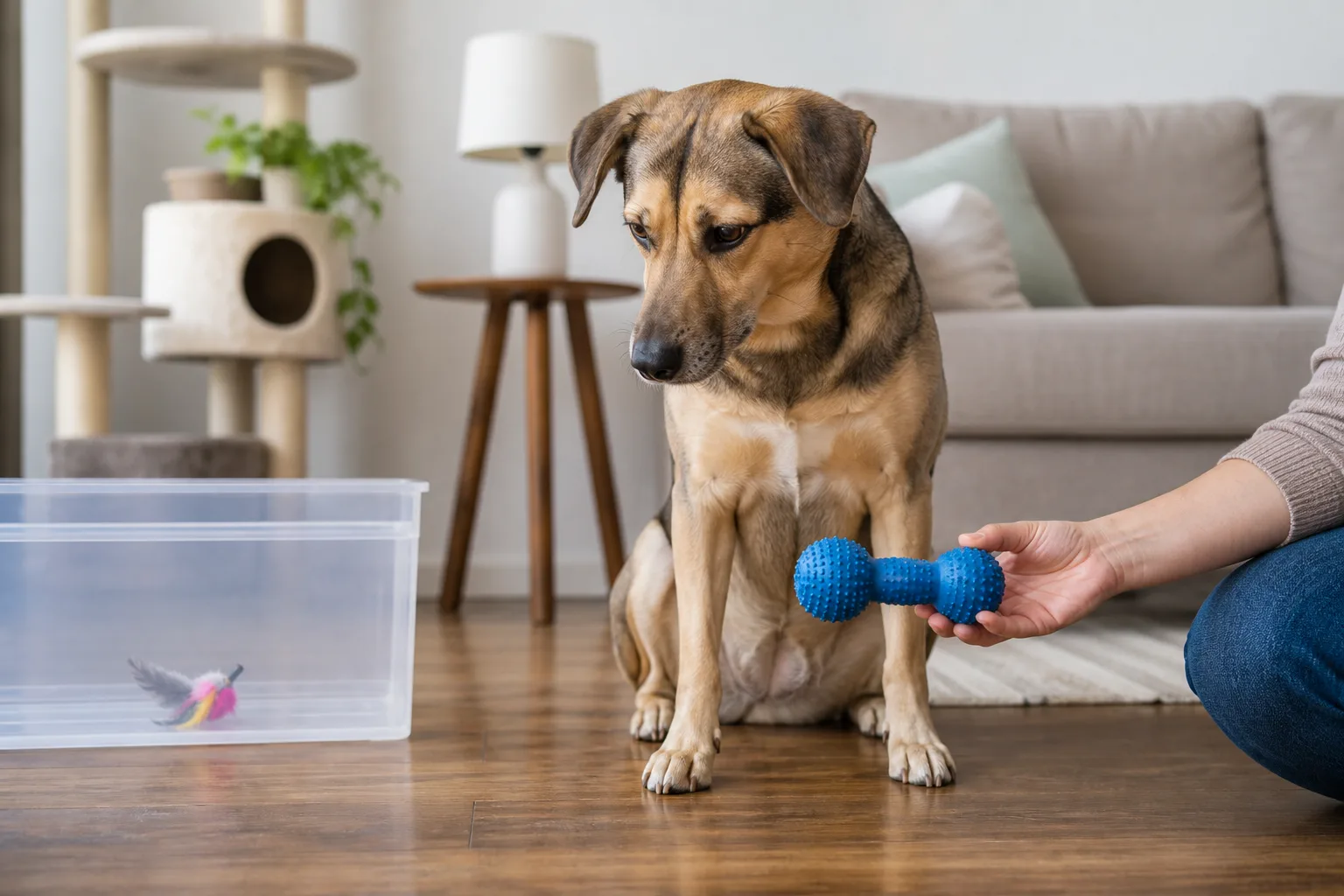
Dog-specific toys are the safer default when cat toys contain small or detachable parts.
Petful is reader supported. As an affiliate of platforms like Amazon and Chewy, we may earn a commission when you buy through links on this page. There is no extra cost to you.
Can dogs play with catnip toys? Generally, dogs should not play with catnip toys made for cats. The catnip herb is not the main concern. Small toy dimensions, loose seams, feathers, bells, strings and pieces that can be swallowed are the bigger risks. A sturdy, correctly sized dog toy is the safer default.
If a dog only sniffs an intact catnip toy, that is different from chewing it apart or swallowing its filling. Supervise any cross-species toy contact, take the toy away before damage starts and keep cat toys stored where the dog cannot raid them.

Sign up for expert-backed reviews and safety alerts all in one place.
The Short Answer
- 1Judge the whole toy, not just the catnip: size, construction and detachable pieces determine whether it is appropriate for a dog.
- 2Catnip guidance for cats does not establish a safe oral dose or useful effect for dogs.
- 3Use dog-sized enrichment, inspect it before every session and retire it as soon as fabric, rubber or stitching fails.
- 4If any toy, string or stuffing was swallowed, call a veterinarian promptly instead of waiting for symptoms.
- 5The evidence reviewed for this article supports two separate checks: the botanical exposure decision and the physical toy condition.
Use a two-part check before sharing any pet toy. First ask whether the contents have a reliable safety basis for this species. Then ask whether the physical object can survive this dog's mouth without becoming swallowable. Passing only one test is not enough. A harmless filling inside a tiny, weakly stitched shell can still send a dog to an emergency clinic.
Set the supervision plan before presenting an alternative: one adult watches, the session stays short and the toy is removed while it is still intact. This prevents “supervised” from meaning someone is merely in the same room.
For dogs that like to lick, carry and chew, a correctly sized large KONG Classic dog toy is one dog-specific alternative. Select the size from the maker's dog-weight guidance and supervise the first sessions because no toy is indestructible.
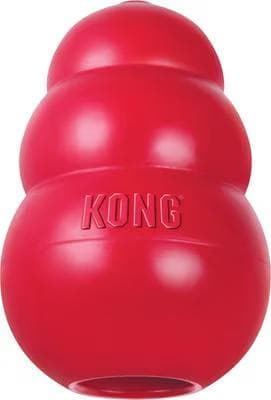
A large, dog-designed rubber toy for supervised licking and chewing.
Petful may earn a commission when you click through to Chewy, at no extra cost to you.
| What you see | What it means | Best next step |
|---|---|---|
| Tiny mouse, ball or plush | It may fit fully in the dog's mouth or be swallowed | Keep it for the cat and choose a dog-sized toy |
| Feathers, ribbon, yarn, bells or glued parts | Pieces can detach during chewing | Do not give it to the dog |
| Large toy with strong seams but labeled for cats | The label does not guarantee dog-safe construction | Use a dog toy matched to the dog's size and play style |
| Dog has swallowed any part | A foreign body can obstruct or injure the digestive tract | Call a veterinarian or emergency clinic now |
Does Catnip Affect Dogs?
Catnip, or Nepeta cataria, is best known for the scent response it produces in many cats. That familiar feline response does not mean the herb has been well studied as a recreational or calming ingredient for dogs. Current veterinary sources do not provide a dependable canine dose for pet owners to copy from cat products.
The ASPCA catnip plant entry notes that exposure can cause vomiting or diarrhea in cats. It does not prove that a dog can safely eat an unlimited amount, and it should not be used to calculate a canine dose. If your dog deliberately ate catnip, tell your veterinarian how much may be missing and whether any fabric, filling or other toy material was also consumed.
Describe the Exposure Precisely
When reporting an exposure, separate the herb from the package. A veterinarian needs to know whether the dog licked loose dried leaves, ate a filled plush, punctured a spray bottle or swallowed fabric. Bring the label or a photo if possible. Ingredients such as concentrated oils, preservatives or other botanicals may change the advice, and the amount missing is often more useful than the product's marketing name.
Watch for vomiting, diarrhea, drooling, unusual sleepiness, agitation or a change in appetite after deliberate ingestion, but do not wait for signs if part of the toy is missing. A dog can appear comfortable early in a foreign-body problem. Your veterinarian or an animal poison service can triage the ingredient question while the clinic evaluates the separate obstruction risk.
Avoid Improvised Herbal Products

Read every active and inactive ingredient instead of assuming all catnip-branded products are equivalent. Sprays, stuffed toys and loose herbs create different exposure questions, and concentrated preparations deserve more caution than a dog briefly smelling an intact plush.
Some products marketed as doggijuana use anise rather than catnip. “Natural” is not the same as tested or risk-free. The VCA guidance on complementary behavior products advises involving the veterinary team because evidence, quality and interactions vary. Do not add anise oil, drops or loose herbs to a toy without veterinary direction.
What is a dog's version of catnip?
What is a dog's version of catnip? There is no well-established canine equivalent with a reliable home dose or predictable effect. Some products called doggijuana use anise, but that marketing name does not make anise the same as catnip or prove it is useful for a dog. Discuss any deliberately administered herb, oil or calming product with the veterinary team.
Will catnip hurt dogs?
Will catnip hurt dogs, a dog or my dog? Current cat-focused sources do not establish a blanket safe canine dose. Catnip may not affect dogs like it affects cats, but “is catnip safe for dogs” and “can dogs eat catnip” are separate questions from toy safety. If exposure occurs, report the ingredient, amount and package. There is also no reliable answer for how long catnip lasts on dogs because a consistent canine response has not been established.
How to Choose a Safer Dog Toy
- Start with the individual dog, not a marketing superlative. Match the toy to body size, jaw strength and play pattern. A gentle retriever needs something different from a dog that methodically opens seams. The VCA enrichment and activity-toy guidance recommends a size that cannot be swallowed, durable construction and initial supervision. The large KONG Classic dog toy is one rubber option for dogs whose size and chewing style fit the manufacturer guidance.
- Measure risk in three dimensions. A toy that looks wide may flatten, fold or compress enough to slide behind the back teeth. Choose a shape that stays too large to swallow after the dog squeezes it, and reassess as rubber softens or fabric collapses with use. For multi-dog homes, size every shared toy for the largest dog with access.
- Match material to play style. Flexible rubber often suits licking and moderate chewing, while supervised tug toys suit dogs that release on cue. Plush can work for carriers that do not dissect seams. Hard objects that cannot flex at all may damage teeth, and soft objects that shred into strips can create digestive hazards. There is no universally safest material.
| Check | Pass | Retire or avoid |
|---|---|---|
| Size | Cannot fit fully behind the canine teeth | Can be swallowed or wedged in the mouth |
| Surface | No cracks, sharp edges or exposed core | Split rubber, hard shards or rough edges |
| Fabric | Tight intact seams | Loose thread, holes or accessible stuffing |
| Attachments | No detachable decorations | Feathers, bells, glued eyes, ribbon or elastic |
| Use | Dog is supervised and plays as intended | Dog is shredding, gulping or guarding pieces |
A dog that prefers tugging may be better served by a large KONG Wubba dog toy than by a feathered wand or tiny cat plush. Keep tug sessions interactive, end the game if seams open and put the toy away when play is finished.
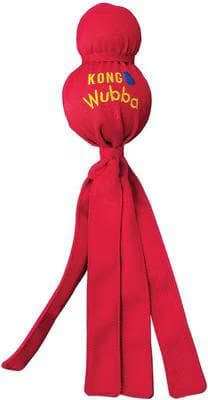
A large interactive dog toy for supervised fetching and tugging.
Petful may earn a commission when you click through to Chewy, at no extra cost to you.
Set a Clear Toy-Retirement Rule
Decide in advance what damage ends a toy's service. One exposed thread, a puncture that reaches the hollow center, a loose squeaker or a missing fragment should trigger immediate removal. Do not trim away obvious damage and return the toy, because the remaining structure may already be weakened. Photograph a new toy from several angles so later comparisons are easier.
Retirement rules should be stricter for dogs that swallow fabric or guard broken pieces. Those dogs may need simpler enrichment delivered through supervised training, scent work or food scattering rather than objects they can dismantle. Ask the veterinary team about individualized options when destructive chewing is frequent, sudden or paired with eating nonfood items.
Test the Toy in Short Sessions
A new toy earns trust gradually. Offer it for a short session in a quiet room, watch how the dog grips it and interrupt before arousal turns into frantic shredding. Check the floor and the dog's mouth when play ends. If the toy loses a piece, compare it with a product photo and contact a veterinarian when you cannot account for the missing material.
Recheck the product's dimensions against the dog's mouth, not only body weight. Broad heads, strong back teeth and a habit of compressing plush can change the practical fit. When uncertain between sizes, ask the manufacturer and choose the option that cannot pass behind the molars.

Supervise the first several sessions
Watch what the dog actually does. Carrying, rolling and licking create different wear than scissoring with the back teeth. Interrupt calmly before pieces come free. Check the toy again after play, then store it instead of leaving it available all day.
Inspection means bending and rotating the toy, not just glancing at the top. Feel along seams, pull gently on appendages, look inside openings and smell for trapped moisture. Squeakers that shift position, rope that thins in one spot and rubber that feels sticky or brittle are reasons to retire the item before a visible chunk breaks away.
For supervised plush-style play, large ZippyPaws Skinny Peltz stuffing-free toys remove loose stuffing from the design. Choose the large size only for supervised carriers or gentle plush players, and retire it at the first seam or squeaker damage.
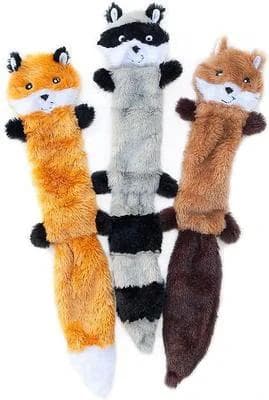
A large stuffing-free plush option for dogs who carry rather than destroy toys.
Petful may earn a commission when you click through to Chewy, at no extra cost to you.
Cleaning cannot restore damaged construction. Follow the product's washing directions, rinse away detergent and dry completely, then inspect again. Keep a small replacement rotation so discarding a worn favorite does not leave the dog without enrichment. Petful's guide to the best durable dog toys also explains why “indestructible” should be treated as a comparison term, not a guarantee.
Vary Enrichment Without Adding Fragile Parts
Dogs do not need cat toys to experience novelty. Rotate scent searches, short training games, supervised retrieving, food puzzles and appropriately sized tug sessions. Change one element at a time so you can see whether the dog remains thoughtful or shifts into frantic biting. Calm completion is a better goal than exhausting the dog.
For tug, keep the toy low and move it side to side instead of lifting the dog or twisting the neck. Build a reliable release cue, pause often and end the game if teeth contact hands, the dog begins swallowing fabric or arousal no longer drops during breaks. Store tug toys between interactive sessions. For interactive tug, the large KONG Wubba dog toy is one dog-specific option to assess under those same rules.
Use food puzzles for mental work
Start puzzles at an easy level and count every removable component before and after use. Frustration that becomes pawing, flipping or chewing means the setup is too difficult or the session has lasted too long. Calmly end the game, simplify the next attempt and use part of the dog's normal meal when extra calories would be a concern.
Count Calories and Components
Food toys change both the dog's activity and daily intake. Measure treats from the normal ration, adjust meals when necessary and avoid ingredients that conflict with allergies or a prescribed diet. Before each session, verify that every lid, insert and removable piece is present. Afterward, count them again before washing and storing the puzzle. The Outward Hound Lick N' Flip dog puzzle is one food-puzzle option for supervised problem-solving when its removable parts are counted.
Petful's dog puzzle guide has more low-cost enrichment ideas. If your dog enjoys taking things apart, try a controlled pull-apart dog toy activity rather than allowing access to fragile cat toys.
A puzzle can replace the novelty of raiding the cat's toy basket while giving the dog an appropriate job. The Outward Hound Lick N' Flip dog puzzle is designed for dog treats and supervised problem-solving. Use pieces the dog can safely eat and remove the puzzle if chewing replaces solving.
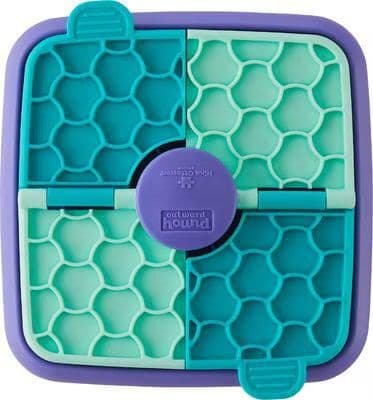
A dog-specific puzzle for supervised licking and treat-search games.
Petful may earn a commission when you click through to Chewy, at no extra cost to you.
Can small dogs play with catnip toys?
Can small dogs play with catnip toys? Small body size does not make a cat toy appropriate. A small dog can still crush seams, detach a bell or swallow a compressed plush. Apply sizing and chewing-style checks to the individual mouth and play pattern. The toy should remain too large to pass behind the molars, and every session needs supervision and an intact-toy inspection.
Choose dog-sized alternatives
Dog-sized alternatives should match the dog's mouth, jaw strength and activity without claiming any toy is indestructible. If someone asks whether dogs can play with cat toys, whether catnip toys for dogs exist or whether a dog catnip toy is needed, the practical answer is to choose dog-specific rubber, tug, plush or puzzle enrichment and retire it at the first structural failure.
Why Cat Toys Can Be Dangerous for Dogs
What happens if my dog plays with a catnip toy?
What happens if my dog plays with a catnip toy depends on two axes. The botanical exposure decision asks what herb or concentrate was present. The physical toy condition asks whether the shell stayed intact, tore open, lost a part or was swallowed. Dogs and catnip toys are not automatically safe together: seams, strings, bells, stuffing and swallowable size can create a small-part hazard even when the herb causes no obvious reaction.
Whether the search is “can dogs have catnip toys,” “are catnip toys safe for dogs” or “are catnip toys bad for dogs,” inspect the object rather than relying on its label. Can small dogs play with catnip toys? Only a dog-sized, dog-appropriate product should be considered, because a lightweight cat toy may compress or break apart in any dog's mouth.
The toy may be small enough to swallow
A cat toy can look large on the floor but disappear inside a medium or large dog's mouth. If it passes the throat, it can lodge in the stomach or intestine. The American College of Veterinary Surgeons identifies toys as common gastrointestinal foreign bodies and explains that obstruction or perforation may require urgent treatment.
Do not rely on the dog's age or previous luck. Puppies explore with their mouths, but experienced adult chewers can also gulp an object during excited play. A safe toy should be too large to swallow, yet comfortable to carry without forcing the jaw open.
Strings and ribbons create a special hazard
Yarn, ribbon, elastic cord and unraveling fabric can behave as linear foreign bodies. One end may become anchored while the intestine continues moving around it, increasing the risk of severe injury. Never pull a string that is protruding from a dog's mouth or rectum. Prevent access and contact a veterinarian if ingestion is possible.
Fillings and attachments can come loose
Cat toys often include feathers, bells, plastic eyes, crinkle film or aromatic filling. A determined dog can expose those pieces quickly. Even if catnip itself is not causing a reaction, the casing and contents can still become choking or digestive hazards.

- Call your veterinarian or an emergency clinic now. Do not induce vomiting unless a veterinary professional tells you to. Repeated vomiting, loss of appetite, abdominal pain, lethargy, dehydration, diarrhea, straining or inability to pass stool can signal an obstruction, but a dog may need assessment before every sign appears. This is the clear urgent-care boundary for string or obstruction risk: a missing or confirmed swallowed part warrants prompt veterinary contact even before every symptom appears.
Act according to the toy state
Use a state-based action framework. If the toy is intact and only sniffed, remove it and monitor. If the toy is torn but every part is present, discard it and choose a stronger dog-sized option. If any part is missing, call the veterinary team because ingestion is possible. After a confirmed swallow, seek prompt veterinary guidance and do not pull string or induce vomiting unless a professional directs you.
Petful's guide to foreign bodies in dogs explains the diagnostic and treatment process in more detail. The Merck Veterinary Manual also lists vomiting, appetite loss, abdominal pain, dehydration and shock among possible signs of gastrointestinal obstruction.
Manage Toys in a Dog-and-Cat Home
Create separate play zones and separate storage. Use a lidded bin or high cabinet for cat toys, especially wand toys and anything with ribbon. Bring those toys out for an interactive cat session, count the pieces afterward and put them away before the dog enters.
Dogs also need a place for their own toys. Rotate a few items instead of offering the whole collection. Rotation preserves novelty and makes inspection easier. Wash toys according to the manufacturer's directions and discard anything that no longer dries fully, smells unusual or has a hidden split. For a gentle plush carrier, large ZippyPaws Skinny Peltz stuffing-free toys can be included in a supervised rotation and retired at the first damage.
Keep Storage Predictable
Teach “leave it” and “drop it” with rewards before you need the cues in an emergency. Do not chase a dog who steals a cat toy because pursuit can turn the theft into a game or prompt gulping. Trade for a high-value treat, secure the object and adjust storage so the mistake cannot repeat.
Audit Shared-Pet Spaces
Check under sofas, beds and appliances during a weekly toy inventory. Cats often bat small objects into hidden spaces where dogs later find them. Replace damaged storage lids, collect loose wand attachments and move cat play to a room with a door when a barrier can be jumped or pushed aside.
Also review what happens when nobody is watching. A dog that climbs furniture, opens baskets or follows a cat through a pet door needs stronger physical separation, not repeated verbal reminders. Management should prevent access during sleep, deliveries and busy household transitions, when supervision predictably drops.
Make the household rule easy for every person to follow: cat toys come out only behind a closed door or barrier, and dog toys return to their own bin after a supervised session. Labeling bins helps children and visitors. A written toy count is useful for wand attachments, small balls and puzzle pieces that can disappear under furniture.
Why does my dog love cat toys?
Why does my dog love cat toys? Movement, scent, crinkle sounds, easy-to-carry size and access to the cat's special objects can all make them interesting. That interest does not prove a catnip effect or make the object safe. Meet the same needs with supervised dog-sized enrichment, rotate items for novelty and store feathers, ribbons and small plush toys behind a closed door.
Frequently Asked Questions
Is catnip poisonous to dogs? Current evidence does not supply a blanket yes-or-no rule or a safe canine dose. Available cat-focused guidance does not establish a blanket safe dose for dogs. Small incidental exposure to the herb is different from eating a filled toy. Call your veterinarian if your dog consumed catnip, especially if the amount is uncertain or toy material is missing. Do not use a cat product label to estimate a canine serving. Save the package, note when exposure occurred and check whether fabric, string or filling is missing. The veterinarian may address ingredient exposure and possible foreign-body ingestion as two separate problems.
A brief sniff of an intact toy is lower risk than chewing it, but supervision still matters. Put the toy away if the dog mouths it, becomes overexcited or can access strings, feathers or small parts. Keep the interaction brief and controlled, then return the toy to cat-only storage. Sniffing should not become carrying or chewing. Dogs that steal objects, guard toys or rapidly gulp items should not have access even for a supervised novelty check.
Usually not. Puppies explore by chewing and swallowing, and many cat toys are small or lightly constructed. Choose a puppy-sized dog toy that cannot be swallowed and supervise every session. The same caution applies to small adult dogs and powerful adolescent chewers. Recheck toy size as a puppy grows, because a once-appropriate item can become easy to crush or dismantle. Replace it when the shape, material or play style no longer fits.
If your dog ate string from a cat toy, call a veterinarian or emergency clinic promptly. Call a veterinarian or emergency clinic promptly. Do not pull visible string and do not induce vomiting unless a veterinary professional directs you. Linear foreign bodies can seriously injure the digestive tract. Tell the clinic the material, approximate length, time of ingestion and any symptoms. Bring an identical toy or product photo if available. Even when the dog seems normal, early veterinary assessment can be important because signs may not appear immediately.
You should not give a dog anise or doggijuana by improvising a dose. Do not improvise a dose or use concentrated oil. Evidence and product quality vary, so discuss any deliberately administered herb or complementary product with your veterinarian first. Share the exact ingredient list and concentration with the veterinary team, especially if the dog takes medication or has liver, kidney, digestive or neurologic disease. A product name does not establish purity, effectiveness or a species-appropriate amount.
Inspect dog toys before and after every play session, not only on a weekly schedule. Inspect before and after every play session. Retire a toy immediately if you see a split, loose thread, missing piece, exposed squeaker, sharp edge or size change that could make it swallowable. Build inspection into setup and cleanup so it is not forgotten. Compare toys with their new condition, count removable pieces and check beneath furniture for fragments. Store only items that are clean, dry, intact and still too large for the dog to swallow.
Sources
Veterinarian
At Petful®, founded by Pulitzer Prize–winning journalist and editor Dave Baker, we are on a mission to give our readers the best, most accurate information to help their pets live happier, healthier lives. Our team of expert writers includes veterinarians Dr. Debora Lichtenberg, VMD, and Dr. Pippa Elliott, BVMS, MRCVS, among others. Petful is also the leading independent source of U.S. pet food recall information on the web. Learn more about the amazing team behind Petful here: Meet the Team.
Sign up for expert-backed reviews and safety alerts all in one place.