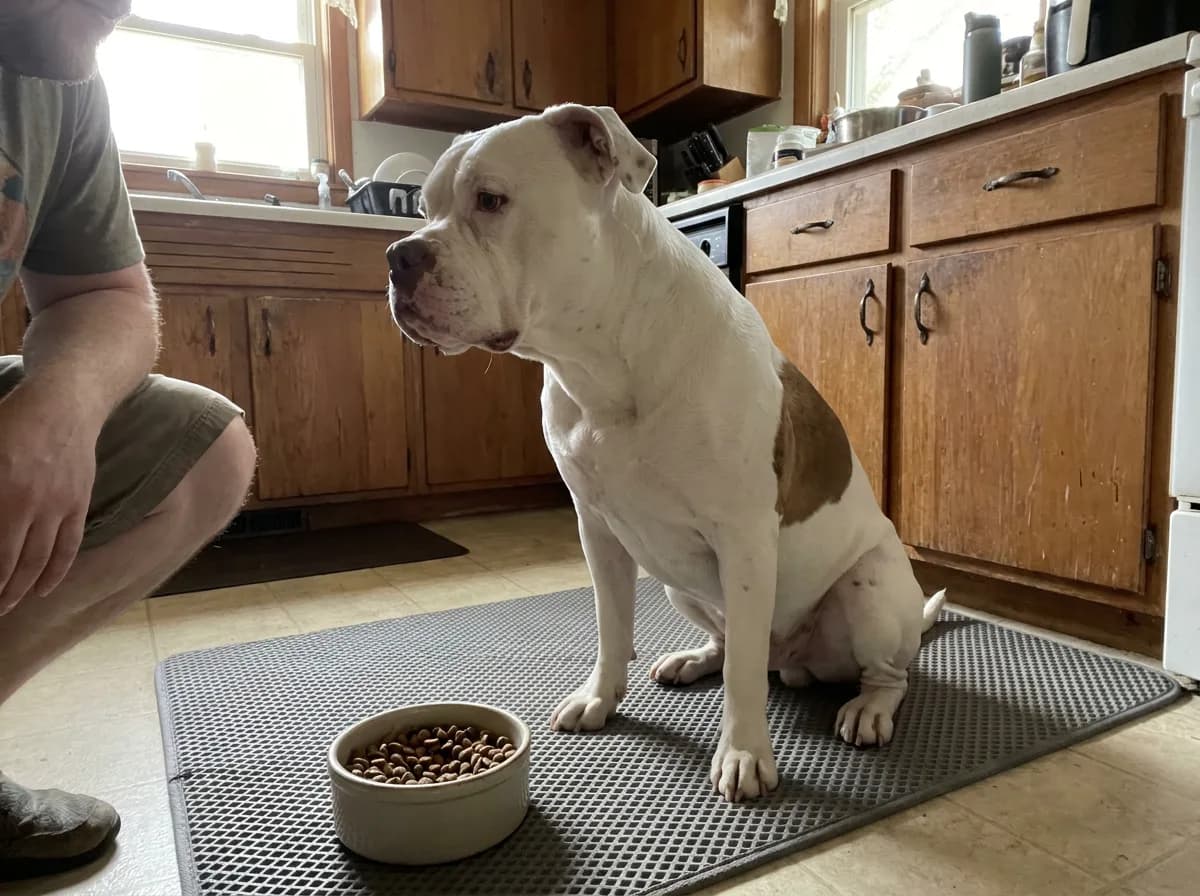
Sheepadoodle Temperament: Traits, Training, and Family Fit
A complete guide to Sheepadoodle temperament: core personality traits from both parent breeds, how herding heritage drives daily behavior, family and kid fit, training, exercise needs, and the behavior problems owners hit most.
Petful is reader supported. As an affiliate of platforms like Amazon and Chewy, we may earn a commission when you buy through links on this page. There is no extra cost to you.
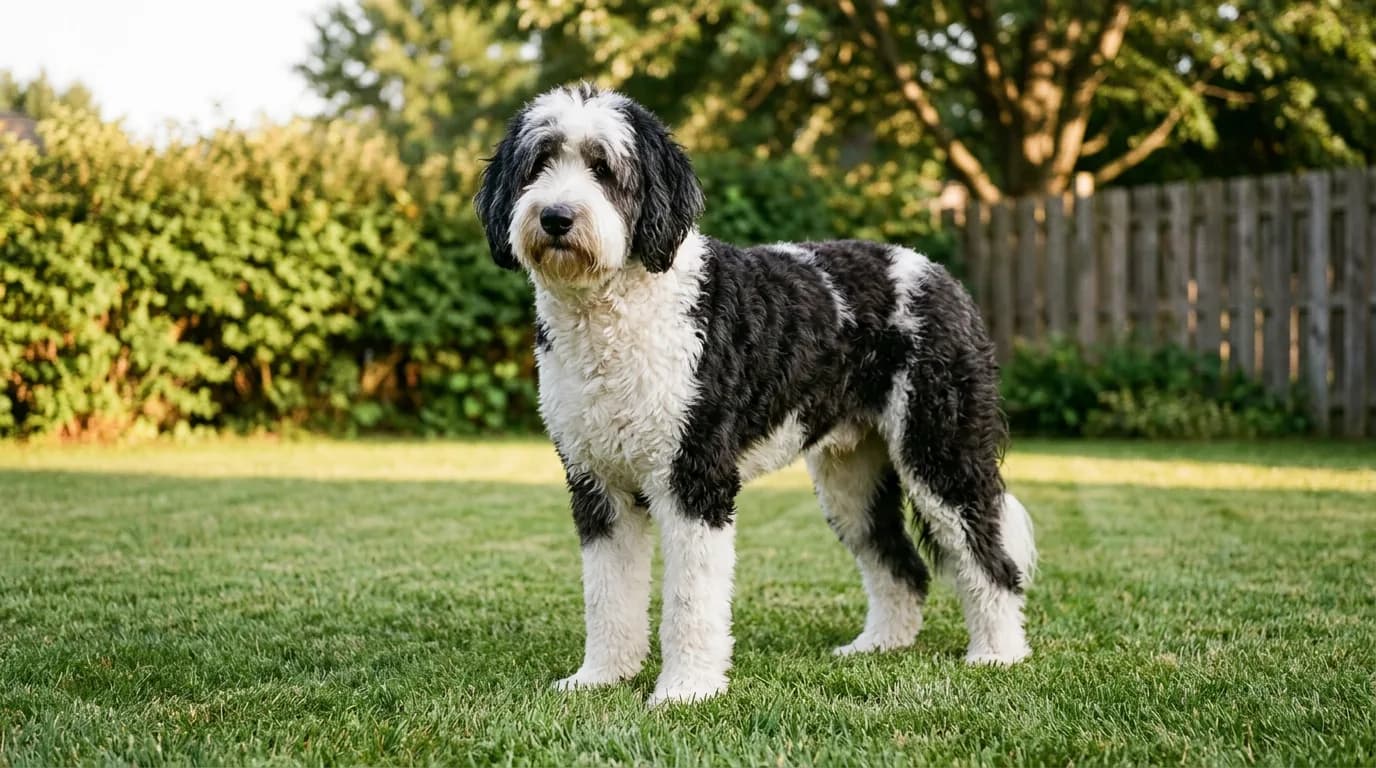
Sheepadoodle temperament is the reason most people fall for this cross and, occasionally, the reason they are unprepared for it. Cross an Old English Sheepdog with a Poodle and you get a dog with two jobs written into its DNA: watch the family and think for itself. The result is a goofy, affectionate, velcro-style companion that also wants to organize your household, follow you room to room, and be given something to do. Understanding sheepadoodle personality means understanding both parents, because the traits that make this dog a wonderful family companion are the same traits that create nipping, barking, and clinginess when they are left unchanneled.
This guide covers the core temperament traits, how herding heritage shows up in daily sheepadoodle behavior, whether they suit kids and other pets, what training actually works, how much exercise they truly need, and the behavior problems that show up most often in the first two years.
- 1Sheepadoodles are affectionate, people-focused, and highly trainable, with a strong instinct to stay near their household
- 2Herding heritage from the Old English Sheepdog side drives circling, ankle nipping, and watchfulness, not aggression
- 3Expect 60 to 90 minutes of daily physical exercise plus deliberate mental work, and more during adolescence
- 4They are excellent with respectful children and other dogs when socialization starts early
- 5Separation anxiety is the single most common complaint from owners, so alone-time training matters from week one

Sign up for expert-backed reviews and safety alerts all in one place.
Sheepadoodle Temperament: The Core Personality Traits
A Sheepadoodle is best described as a gentle giant with a working brain. The baseline personality is warm, silly, and emotionally attuned to people, with none of the aloofness you see in some guarding breeds. Most Sheepadoodles greet strangers happily, recover quickly from startling noises, and would rather lean on you than patrol the yard. That soft, sociable core comes from the Old English Sheepdog side of the herding heritage, while the Poodle contributes sensitivity, quick learning, and a low tolerance for boredom.
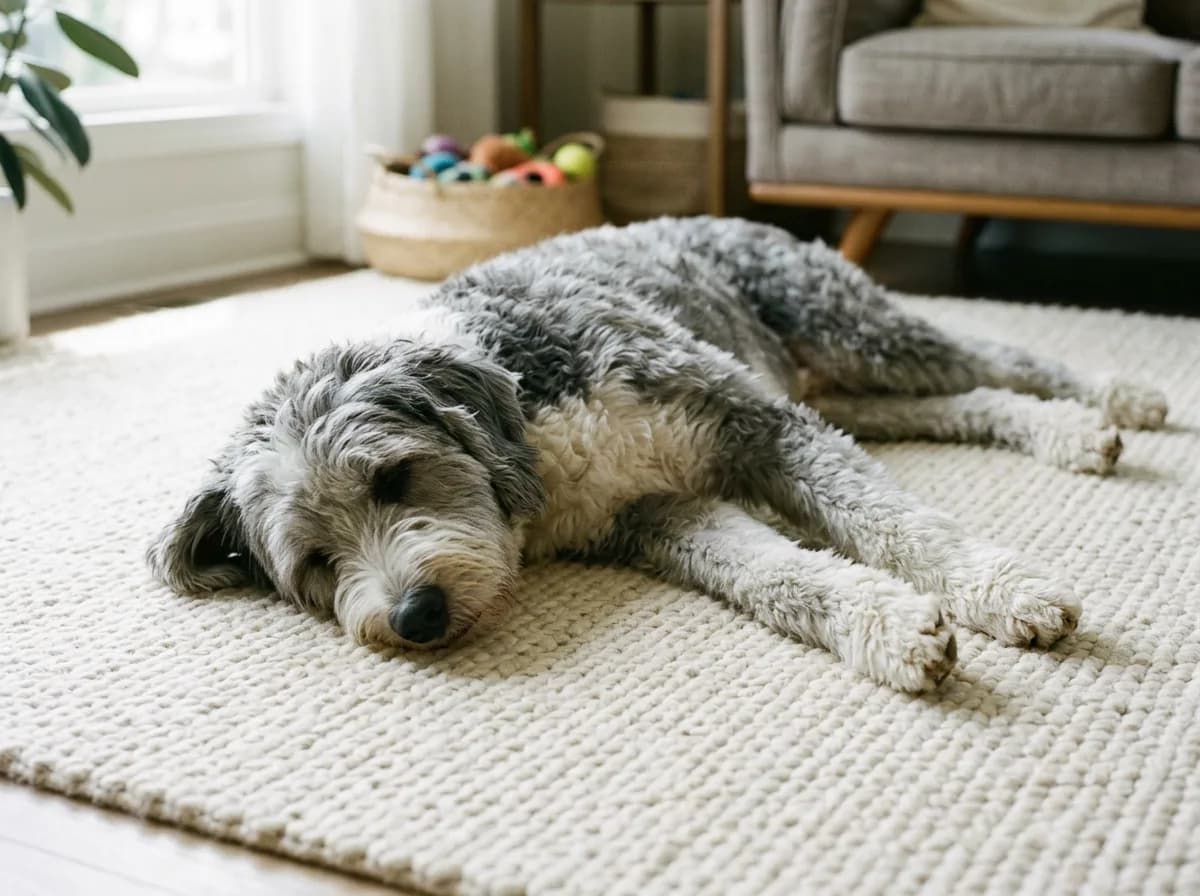
The traits that show up most consistently across owner reports and breeder observations:
- People-oriented to the point of shadowing. Sheepadoodles follow their person between rooms and settle where the family is, not in a separate den.
- Emotionally responsive. They read household tension quickly and often check in when someone is upset or unwell.
- Playful well past puppyhood. Silliness lasts into year three or four, which is charming in a 60 pound dog and occasionally inconvenient.
- Alert without being reactive. They notice arrivals and announce them, then settle once the situation is explained.
- Soft under correction. Harsh handling shuts a Sheepadoodle down rather than motivating it.
- Deeply routine-driven. Predictable feeding, walking, and rest schedules noticeably reduce anxious behavior.
- Meals are part of the routine, not separate from it. A slow feeder bowl stretches a two-minute meal into eight or ten, which blunts the demand behavior that tends to follow a fast eater looking for the next thing to do.
The sheepadoodle temperament reddit threads and doodle owner groups tell a consistent story: the dogs that struggle are almost never the ones with a bad disposition. They are the ones whose energy and herding drive were treated as decorative rather than real.
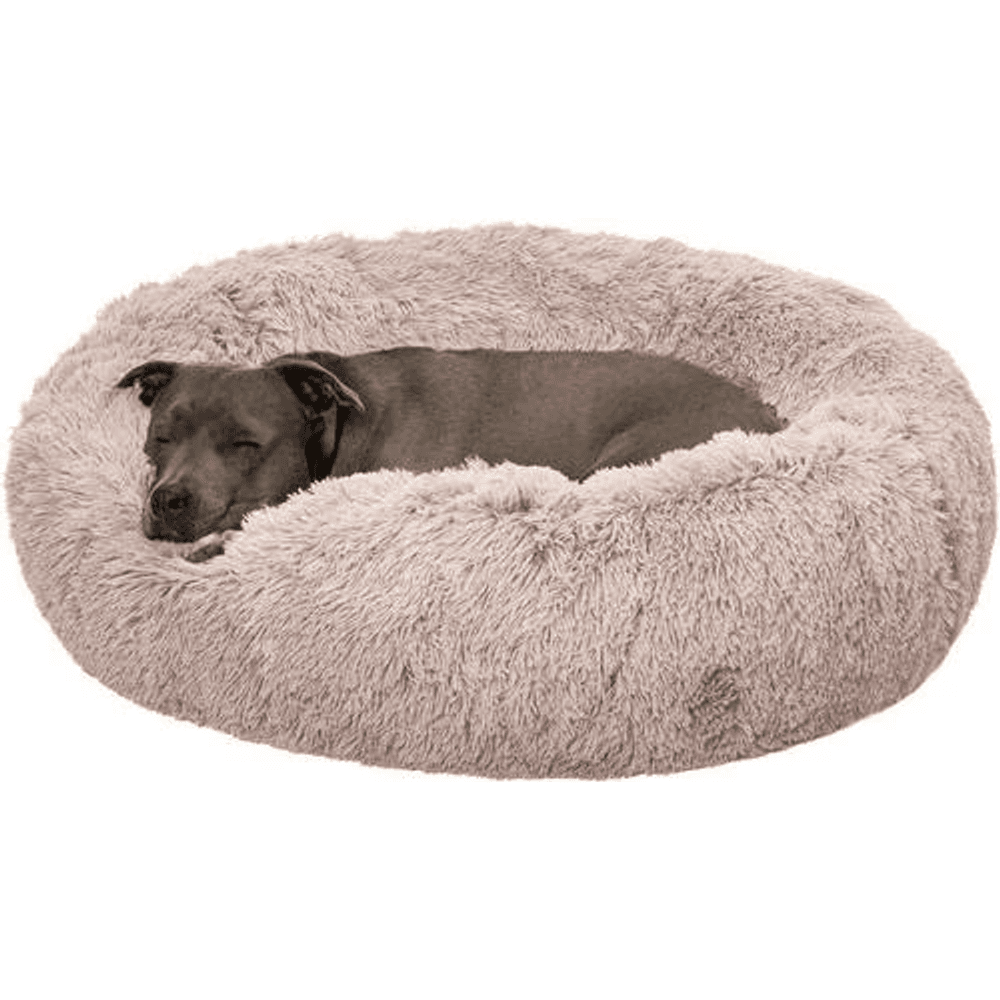
A plush, long-fur donut bolster bed with a raised rim that gives a recovering pet a secure, cushioned place to curl up during the crucial 10 to 14 days after surgery.
Petful may earn a commission when you click through to Chewy, at no extra cost to you.
| Trait | Typical rating | What it means day to day |
|---|---|---|
| Affection toward family | Very high | Seeks physical contact and follows the household room to room |
| Tolerance of children | High | Excellent with respectful kids; supervise around toddlers due to size |
| Friendliness to strangers | High | Greets visitors happily; poor guarding instinct |
| Trainability | Very high | Learns cues in few repetitions with reward-based methods |
| Sensitivity to correction | High | Shuts down under harsh handling rather than complying |
| Energy level | Moderate to high | 60 to 90 minutes of daily activity plus mental work |
| Herding and nipping drive | Moderate to high | Circles, blocks doorways, nips at running children |
| Barking tendency | Moderate | Alert, herding, and demand barking, each with a different fix |
| Tolerance of alone time | Low without training | Prone to separation anxiety in both parent lines |
| Mental stimulation need | Very high | Invents work when bored, usually herding the household |
- The Sheepadoodle is not a standardized breed. There is no closed studbook and no breed-club temperament standard the way there is for the Old English Sheepdog or the Poodle individually, so what you get is a temperament range rather than a fixed profile. Two puppies from the same litter can land in different places on that range. Meet the parents, watch how they behave with strangers, and choose the puppy whose disposition you actually saw rather than the one described in a listing.
Read every temperament description of this cross, including this one, as a range rather than a promise. The Sheepadoodle is not a standardized breed. There is no breed club setting a written standard, no registry policing the pairings, and no generations of selection pushing toward a consistent disposition. What you have is two established breeds combined recently, so the traits described here are what shows up most often, not what is guaranteed to show up in the individual puppy in front of you.
- Treat any listing that promises a calm or allergy-safe temperament as marketing. Neither can be guaranteed in a cross that has not been selected for it across generations.
- The spread is widest in first-generation litters, where two very different parent breeds meet with no intermediate generation smoothing the result.
- An adult dog removes the guesswork. A rescue or a placed adolescent shows you the temperament you are actually getting, which is a genuine argument for skipping the puppy stage.
- Judge the parents in person over any written description. How they behave with a stranger in their own home is the strongest predictor a buyer ever gets.
- Expect at least one trait on this page not to apply to your dog. That is normal for a non-standardized cross, not a sign that something went wrong.
How the Parent Split Changes What You Get
Generation matters more than most buyers realize. A first-generation cross pulls 50 percent from each side, so the outcome genuinely varies. Later generations shift the odds.
- F1 (Sheepdog x Poodle). The widest temperament spread. Some puppies lean heavily to the sheepdog parent and come out mellow, steady, and slower to mature. Others lean to the poodle parent and come out quicker, more sensitive, and more demanding of mental work.
- F1b (Poodle backcross). The F1b generation is bred back to a Poodle, which usually means more coat consistency and a sharper, more biddable dog with higher stimulation needs.
- F2 and multigenerational. Predictability improves somewhat, but temperament still varies more than in a purebred line.
If you want the calmest possible outcome, the sheepdog parent is the one to study. If you want the fastest learner, look hard at the poodle parent. In both cases, temperament in the parents is the strongest predictor you will ever have, and it beats generation labels on paper.
Generation matters, but not in the way the labels imply. An F1b generation puppy is usually sold as the predictable choice, and the backcross does tighten the coat, but the extra share from the poodle parent raises the mental workload rather than lowering it. Buyers who wanted a calmer dog and bought an F1b generation puppy for its coat often get a sharper one instead. What decides the outcome is which parent an individual puppy takes after, and the sheepdog parent is where the steadiness comes from.
- Meet both parents where you can. If only the dam is on site, ask for video of the sire working through cues at home rather than a portrait photo.
- Ask the breeder which puppies in the litter lean to the sheepdog parent and which lean to the poodle parent. Someone watching the litter daily can answer that; a broker cannot.
- Read an F1b generation listing as a coat claim, not a temperament claim. It predicts shedding far more reliably than it predicts calmness.
- In an F1 litter, expect siblings to genuinely differ. Picking the quietest puppy in a boisterous litter predicts adult temperament better than any generation label on paper.
- Ask what the sire does all day. A poodle parent from performance lines produces a very different dog than one from a quiet companion home, even at the same generation.
A generic temperament description tells you nothing useful without explaining which way the split fell, because poodle-leaning versus sheepdog-leaning changes the outcome in ordinary daily situations. Ask the breeder how each puppy handles four of them. A poodle-leaning dog usually recovers fast from a startle but escalates when bored, invents its own work, and takes a sharp word personally for hours. A sheepdog-leaning dog is slower to worry, slower to pick up a new cue, harder to talk out of a plan once it has one, and more likely to answer a missed walk with restless supervising than with mischief. Neither is the easier dog. They fail in different directions, and the parent you can watch tells you which failure you are signing up for.
- Recovery after a startle: ask how long each puppy takes to come back to a dropped pan. Seconds points to the poodle side, a minute or more to the sheepdog side.
- Reaction to a missed walk: cupboard raiding and counter surfing point poodle. Pacing, window checking and patrolling point sheepdog.
- Response to a firm voice: a poodle-leaning dog often shuts down and needs the session ended on an easy win, while a sheepdog-leaning dog shrugs it off and keeps working.
- Learning speed versus staying power: count the repetitions a new cue takes, then test it the next day. Fast to learn and fast to lose is the poodle pattern.
- Whatever the lean, plan your week around the more demanding version. A household that suits the sharper dog handles the steadier one comfortably, but not the reverse.
Herding Heritage: Why Your Sheepadoodle Herds, Watches, and Thinks
Half of this dog was bred to move livestock and keep a flock together in bad weather without a human giving instructions. That job does not disappear because the flock is now two children and a cat. Sheepadoodle herding behavior is one of the most misread parts of the breed, because owners often interpret perfectly normal instinct as either aggression or disobedience.

Here is the decoder that no ranking Sheepadoodle page currently offers, mapping the inherited job to what you actually see in your living room:
- Ankle nipping at running children. This is the classic heeler-style stop signal, not a bite. The herding instinct says a moving member of the group should be turned, and the nearest control point is the heel. Redirect to a tug toy carried in your pocket, and teach kids to stop running rather than to scream and accelerate.
- Circling behavior around the family group. A dog that loops around a group in the yard or the kitchen is gathering. Circling behavior spikes when the group spreads out, which is why it appears most at parties and playgrounds.
- Blocking doorways and stairs. Positioning at a chokepoint is flock control. It looks like stubbornness; it is management.
- Staring and low crouching. The fixed eye is how a herding dog applies pressure without contact.
- Barking when someone leaves the group. Announcing a separated member is part of the original job description.
- Following you to the bathroom. The flock does not split. Ever.
- Chokepoint blocking is solved faster with hardware than with training. A gate and playpen takes the doorway or stair landing out of play while you teach an alternative behavior, which matters most in homes with stairs or unsteady adults.
What connects a specific problem back to the job is the kind of herding the Old English Sheepdog was bred for. This was a drover's breed, moving stock along roads and lanes rather than gathering sheep at distance the way a Border Collie does. A drover works close, uses body weight instead of a long stare, and makes its own decisions when the handler is out of sight. That is why the complaints on this page are pushy rather than intense: leaning, shoulder bumps, blocked doorways, and a dog that inserts itself between two people who are moving apart. Read any single behavior against that original job and it stops looking like defiance and starts looking like unemployment.
- Leaning and shoulder bumps are contact herding. Stand your ground rather than stepping back, because moving is the reward the dog is working for.
- A dog that pushes between two people walking apart is closing a gap in the group. Cue it onto a mat before the group splits, not after.
- Distance work is unnatural in this line, which is why recall from 30 yards is far harder than a 10-foot heel. Build it on a long line and add ten feet at a time.
- Independent decision-making was part of the job description, so this dog keeps working a problem after you stop watching. Latch the gate, and assume the trash can is in scope.
- Watch the shoulder, not the mouth. In a close-working line the body block and the crouch come first, and the mouth is the last step rather than the first.
Two questions dominate every owner forum: are sheepadoodles smart, and is that actually a good thing to live with? Intelligence in dogs is usually split three ways, into instinctive intelligence (the inherited job), adaptive intelligence (solving a new problem without help), and working intelligence (learning what a person deliberately teaches). This cross does well on all three at once, which is unusual, and it is exactly why capable owners still feel outmatched. Sheepadoodle intelligence is not a trophy, it is a maintenance obligation. A dog that reads your routine, tests a latch, and works out which adult gives in fastest needs its brain booked before the day starts. Schedule the mental work the way you schedule the walk, or the dog will schedule something of its own. Petful’s separate guide to the so-called dumbest dog breeds explains why independent is not the same as dim.
- Book two 5-minute brain sessions daily (a scent search, a trick chain, a puzzle feeder) before you consider adding a third walk.
- Rotate puzzles instead of repeating them. Most dogs of this type solve a given food toy within 2 or 3 uses and then ignore it.
- Give the working drive an on and off switch: one 'find it' cue to start a job and one mat cue to end it.
- Expect a new cue in a handful of repetitions but several weeks of proofing before it holds around outdoor distractions.
- Childproof latches, gates, and trash cans by 6 months, when independent problem solving ramps up alongside adolescence.
Sheepadoodle Intelligence and Working Drive
Are sheepadoodles smart? Yes, and it is worth being specific about what kind of smart. Sheepadoodle intelligence combines Poodle problem-solving, which is fast and manipulative in the best sense, with sheepdog situational judgment, which is slower but better at reading a whole scene. Practically, that means your dog will learn a new cue in a handful of repetitions and will also learn, uninvited, how the treat cupboard latch works.
- A bored Sheepadoodle invents work, and the work it invents is usually herding your household. Ten minutes of scent games, a food puzzle at breakfast, or three short training sessions a day will do more for behavior than an extra mile of walking. Trick training, rally, agility, and treibball all suit this cross unusually well because they let the herding brain solve problems on cue.
A working brain with no work does not switch off, it reassigns itself. That is the mechanism behind most complaints about this cross, and it explains why the problem behaviors follow a pattern instead of being random. The Old English Sheepdog herding job was to monitor a group, control movement, and make decisions without being told. An under-employed Sheepadoodle applies those same three skills to your household, which is why the trouble tends to be organizational rather than destructive for its own sake.
- Monitoring becomes patrolling: a dog that checks the window at every noise and cannot settle while the family is spread across different rooms.
- Movement control becomes management of anything that moves, including the vacuum, the lawnmower, bicycles, and the child on the scooter.
- Independent decision-making becomes the opened cupboard, the unlatched gate, and the toy retrieved from a shelf you were sure was out of reach.
- Give the drive a real job instead of more distance. Scent games, a find-it search for a hidden toy, and short trick sessions tire this dog in a way another mile of walking does not.
- Herding-style outlets work best of all. Treibball, a flirt pole used with rules, and a formal herding introduction give the instinct somewhere legitimate to go.
Are Sheepadoodles Good Family Dogs?
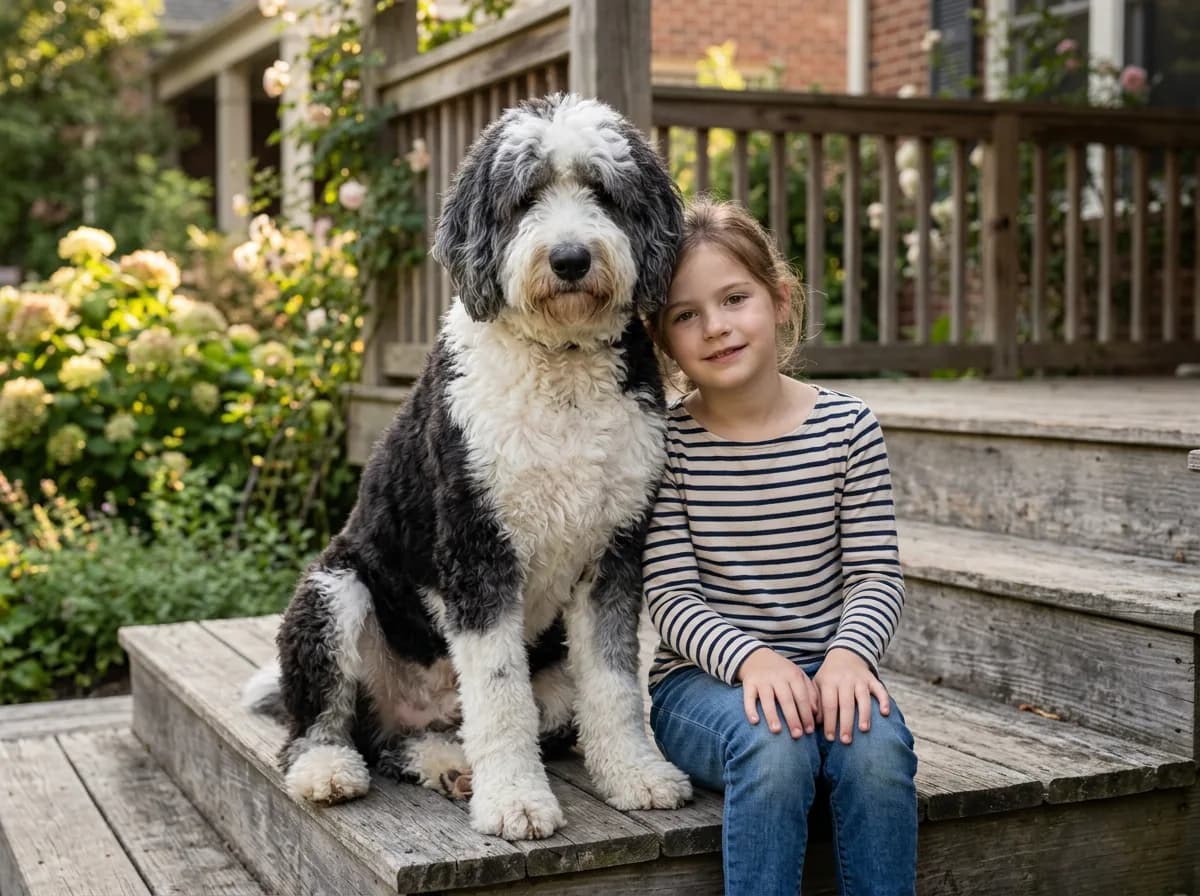
Are sheepadoodles good family dogs? For most households, yes, and the reasons are specific rather than generic. Sheepadoodles bond to the whole family rather than fixating on one person, they tolerate noise and chaos better than many sensitive breeds, and their default response to an unfamiliar situation is curiosity rather than defensiveness. Is a sheepadoodle a good dog for a first-time owner? It can be, provided that owner is honest about exercise and is willing to train through a long, physical adolescence.
What works well and what needs management:

Peanut butter soft chews with L-theanine, chamomile, and ashwagandha to ease hyperactivity and support calm, relaxed behavior.
Petful may earn a commission when you click through to Chewy, at no extra cost to you.
- Children over roughly six. Excellent fit. Older kids can help with training, which the dog enjoys and which builds a real relationship.
- Toddlers and preschoolers. Good with supervision, but the herding drive and the sheer body mass are the risks, not temperament. A 55 pound adolescent turning a running toddler is an accident waiting to happen.
- Teaching kids the rules. No running away from the dog, no hugging around the neck, no disturbing a sleeping dog. These three rules prevent most incidents.
- Elderly or unsteady household members. Manage door thresholds and stairs, where blocking behavior is most likely.
- Keep a traffic leash by the door in a house with small children. The short handle gives you close control at thresholds and on stairs, which is exactly where a 55 pound herding cross does its accidental damage.
Supervision with a herding cross means something more specific than being in the room. The moments that go wrong are predictable: a child running across open floor, a doorway or a stair landing, a sleeping dog approached from behind, and any point where excitement is already high. Family suitability comes down to whether the adults will interrupt those four situations every single time for the first two years. Do it consistently and this is an outstanding dog for children. Skip it and the dog's size makes the decision.
- Supervise actively for children under about six, meaning an adult within arm's reach and off their phone, not simply present in the same room.
- Call the dog out of the game before arousal peaks rather than after. A two-minute break with a chew resets a Sheepadoodle far faster than any correction.
- Give the dog a legal exit. A crate or a bed behind a gate that children are taught never to enter prevents most incidents before they can start.
- Set a rule for the front door. Arrivals are the highest-arousal moment in the house, so the dog goes behind a gate or onto a mat before anyone opens it.
- Give each child an age-appropriate job. A seven-year-old holding the treat pouch and marking a sit becomes a source of good things rather than a moving target.
Other Dogs, Cats, and Small Pets
Are sheepadoodles good with other dogs? Generally very good. Most are socially confident, play-motivated, and read canine body language well, which makes multi-dog households straightforward. The usual friction point is play style: a Sheepadoodle that has not been taught an off switch can be relentless with a smaller or older dog, so interrupt play every few minutes and let both dogs reset.
Cats are usually manageable if introduced during puppyhood, though the herding instinct means many Sheepadoodles will try to move the cat rather than chase it. Small pets such as rabbits and guinea pigs should stay physically separated. That is not a comment on aggression, only on the fact that a herding cross will attempt to control anything that scurries.
Are Sheepadoodles Good Guard Dogs?
Are sheepadoodles good guard dogs? Not really, and you should not buy one expecting protection. They are excellent watchdogs and poor guard dogs, which is a meaningful distinction:
- What they will do: bark at the doorbell, announce a car in the driveway, and alert you to anything unusual near the house.
- What they will not do: hold ground, show sustained defensive aggression, or deter a determined intruder.
- The likely outcome of an actual break-in: an enthusiastic greeting and possibly a stolen dog.
That sociability is a feature for a family dog and a limitation for a security dog. Choose accordingly.
Training a Sheepadoodle: What Works and What Backfires
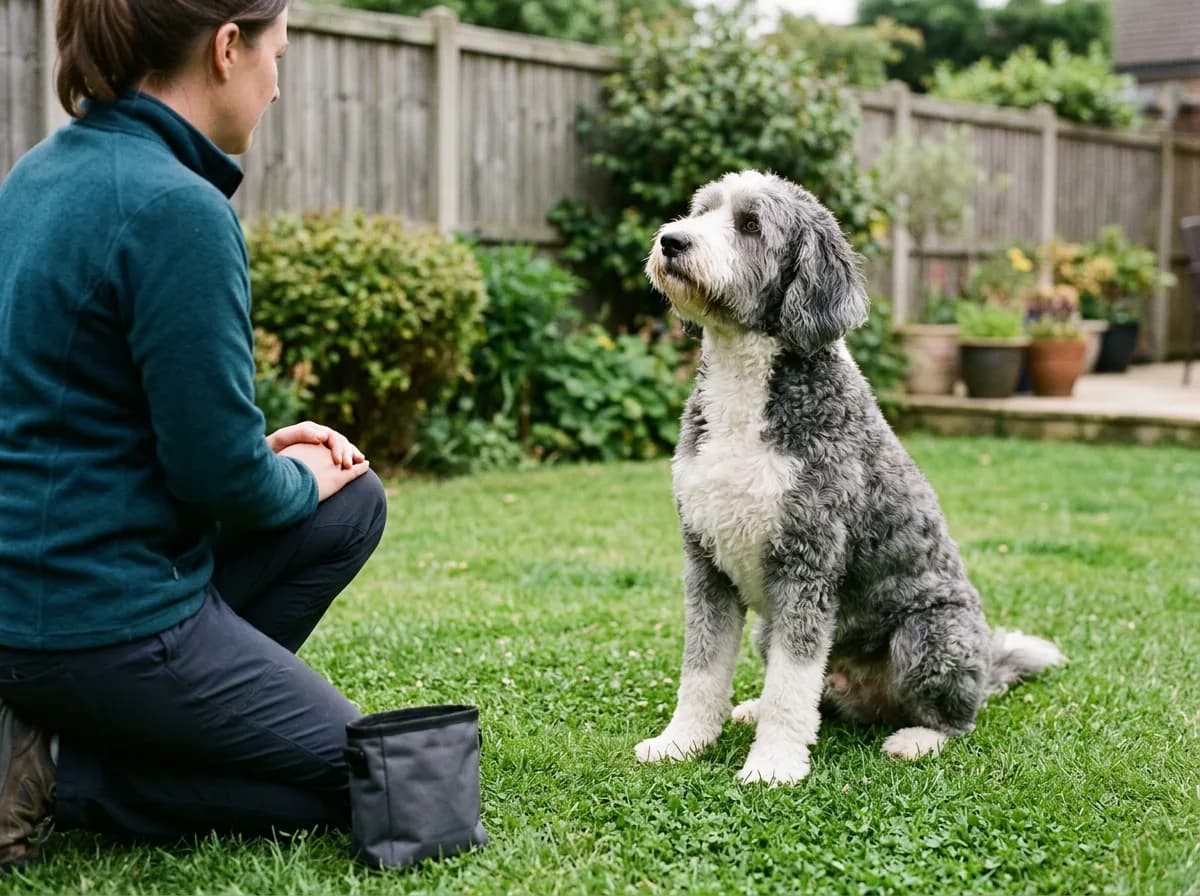
Training sheepadoodle puppies is genuinely enjoyable, because this cross wants to work with you and picks up cues fast. The catch is sensitivity. Positive reinforcement is not just the nicer option here, it is the effective one. Aversive corrections, raised voices, and leash pops tend to produce a shut-down dog that offers nothing and then rehearses the unwanted behavior again the moment pressure lifts.
What works:
- Short, frequent sessions. Three five-minute sessions daily beat one twenty-minute slog.
- Marker training. A clicker or a consistent verbal marker suits the speed at which this dog processes.
- Impulse-control cues first. "Leave it," a settle on a mat, and a reliable recall prevent more problems than any obedience polish.
- Naming the herding. Teaching an alternative behavior at the exact moment instinct fires works far better than suppressing it.
- Early, structured socialization. Deliberate socialization between 8 and 16 weeks, covering surfaces, sounds, people in hats, umbrellas, and calm adult dogs, has more effect on adult temperament than anything else you will do.
What backfires:

A vet-recommended probiotic supplement that helps dogs manage anxious behaviors and stay calm during stressful events like fireworks.
Petful may earn a commission when you click through to Chewy, at no extra cost to you.
- Repeating a cue the dog already knows, which teaches it that the first ask is optional.
- Punishing the herding nip, which usually escalates arousal rather than reducing it.
- Free-feeding, which throws away your best training currency.
- Skipping alone-time practice because the puppy is content following you around.
Two practical questions come before any obedience polish. Are sheepadoodles easy to potty train? Generally yes, and the crate is the tool that makes it easy, so plan housebreaking and crate work together in week one rather than as separate projects. The second question is whether to skip the work entirely. Listings for trained sheepadoodles for sale usually describe a started adolescent with crate manners, a recall, and some potty reliability, which can genuinely suit a busy household. Ask exactly what was trained, by whom, using what methods, and how much of it transfers to a family living room. A dog trained under pressure in a kennel often unravels in a noisy home, so confirm the methods were reward based before any money changes hands.
- Introduce the crate within the first 48 hours home: meals inside, door open, duration built in seconds before minutes.
- Expect potty reliability around 16 to 20 weeks, with a regression window to plan for between 6 and 9 months.
- Keep sessions to about 5 minutes, three times a day, and stop while the dog still wants another repetition.
- When evaluating a started dog, ask for unedited video of it working inside a home, not on a training field.
- Budget 2 to 4 weeks to transfer any pre-taught cues to your voice, your rewards, and your household routine.
Sheepadoodle Crate Training and Potty Training
Crate training a sheepadoodle takes patience precisely because this dog dislikes being separated from its group. Sheepadoodle crate training goes best when the crate is introduced as a good place rather than a containment tool: feed meals in it, leave the door open, and build duration in seconds before you build it in minutes. Place it where the family is, not in an isolated laundry room.
Are sheepadoodles easy to potty train? Mostly yes. Sheepadoodle potty training is usually faster than average because the dog is both clean-natured and attentive to your feedback. Potty training sheepadoodle puppies goes smoothest on a boring, mechanical schedule:
- Out first thing, after every nap, after every meal, and after every play session.
- One consistent door and one consistent outdoor spot.
- Reward outdoors within two seconds, not back inside.
- Expect reliability around 16 to 20 weeks, with occasional adolescent regression around 6 to 9 months.
- Never punish an indoor accident; it teaches the dog to hide from you, not to hold it.
- Listings for trained sheepadoodles for sale advertise a dog that already knows its cues, and some genuinely deliver. What they cannot transfer is the relationship, the household routine, or your family's handling consistency. A professionally started dog still needs weeks of the same work in your home to hold those behaviors, so budget the training time either way.
Housebreaking runs on the same reward-based logic as everything else with this cross: mark the moment the dog gets it right and pay immediately. The timeline is easier to plan by bladder capacity than by calendar. A puppy can generally hold roughly one hour per month of age while awake, which is why an eight-week-old needs an outing about every two hours while a five-month-old stretches considerably further. Nights consolidate before days do, simply because there is nothing to get distracted by.
- 8 to 10 weeks: outside every two hours while awake, plus one overnight trip. Carry the puppy to the door if it cannot reliably make it there yet.
- 10 to 16 weeks: stretch the daytime interval by half an hour at a time, and expect most puppies to start sleeping through the night.
- 16 to 20 weeks: reliability in the rooms the puppy has supervised access to. Expand that access one room at a time rather than all at once.
- 6 to 9 months: plan for adolescent regression and simply return to the earlier schedule for two weeks instead of treating it as defiance.
- Use a crate or a house line between outings rather than free roam. Every accident you never allow to happen is one the dog never learns to repeat.
How Much Exercise a Sheepadoodle Really Needs
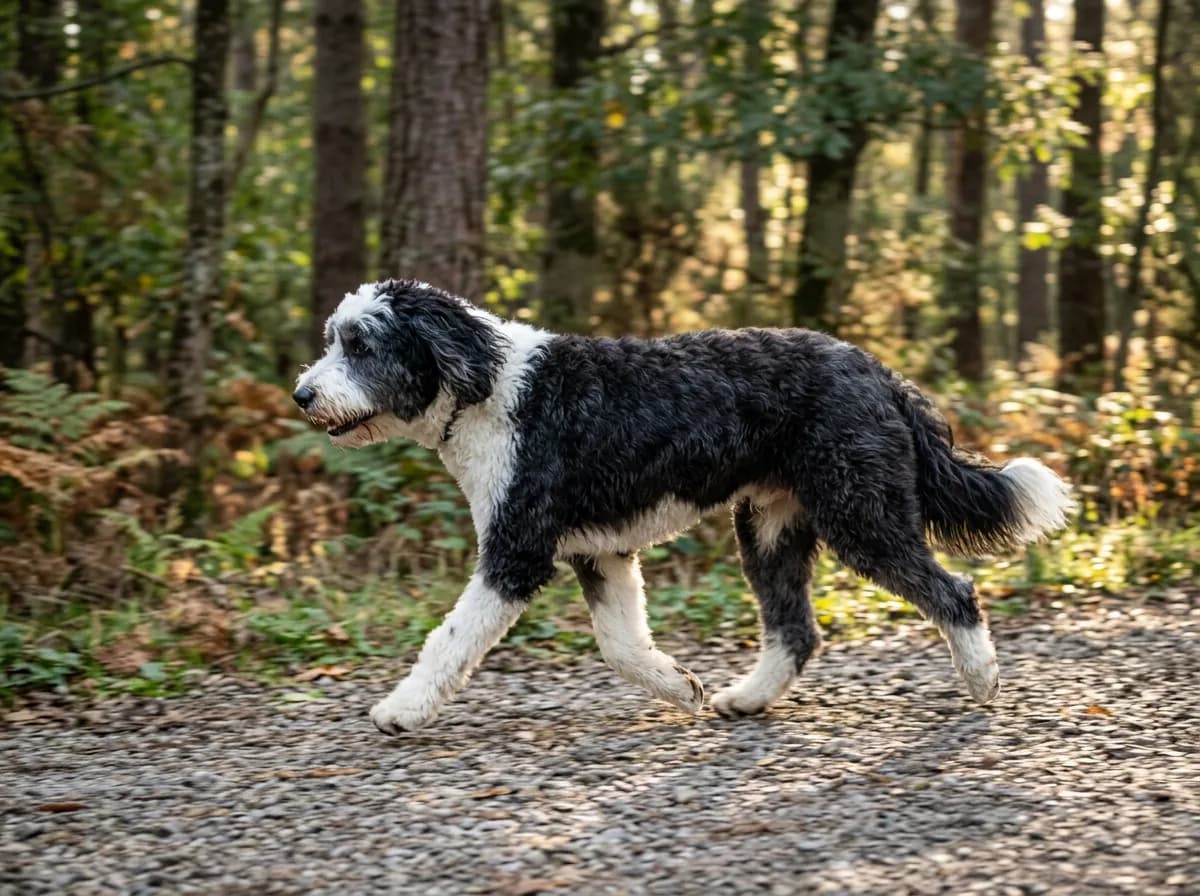
Are sheepadoodles high energy? Yes, more than most people expect from the fluffy teddy-bear photos. Sheepadoodle exercise needs sit at the upper end of the family-dog range because both parent breeds were built to work all day. A typical adult sheepadoodle energy level requires 60 to 90 minutes of real physical activity daily, split across at least two outings, plus separate mental work.
A realistic weekly rhythm by life stage:
- 8 to 16 weeks. Five minutes of structured exercise per month of age, twice daily, plus short sniff walks. Joints come first.
- 4 to 12 months. 45 to 60 minutes daily, low-impact, with jumping and long runs deferred until growth plates close.
- 1 to 6 years. 60 to 90 minutes daily, including at least one session that raises the heart rate properly.
- 7 years and up. Often still 45 to 60 minutes, with the intensity dialed down rather than the duration.
- Between 6 and 14 months the dog reaches close to full body weight months before impulse control catches up, so a front-clip no-pull harness is worth having for that window rather than after the pulling habit sets.
- Carry a collapsible bowl on anything over about 45 minutes. A dense doodle coat traps heat, and this cross will keep working well past the point where a shorter-coated dog would slow down and ask for a break.
Do sheepadoodles like to swim? Most do, and enthusiastically, thanks to the Poodle's water-retrieving background. Swimming is one of the best options for this cross because it burns real energy without loading growing or aging joints. Introduce water gradually with a shallow entry, and rinse and dry the coat thoroughly afterward, since a dense doodle coat holds moisture against the skin.
Sheepadoodle apartment living is workable but demanding. Size is not the deciding factor; output is. An apartment-dwelling Sheepadoodle needs the same 60 to 90 minutes, a hallway-friendly settle cue, and a plan for barking triggers in shared corridors. Owners who succeed in small spaces are usually the ones doing daily training games and scent work rather than relying on a yard.

A durable rubber dog toy that can be stuffed with treats and selected by the manufacturer's size guide; supervise use and retire it when damaged.
Petful may earn a commission when you click through to Chewy, at no extra cost to you.
- Sheepadoodles left alone in a yard do not exercise themselves. They patrol, they bark at the fence line, and they rehearse the herding behaviors you are trying to redirect. Structured activity with you is what actually meets the requirement, which is why owners with large yards often report more behavior problems, not fewer.
Common Sheepadoodle Behavior Problems
Almost every behavior complaint about this cross traces back to the same root: a herding dog with a working brain that is under-exercised, under-stimulated, or left alone more than it can handle. Reading body language early is what separates a manageable habit from an entrenched one.
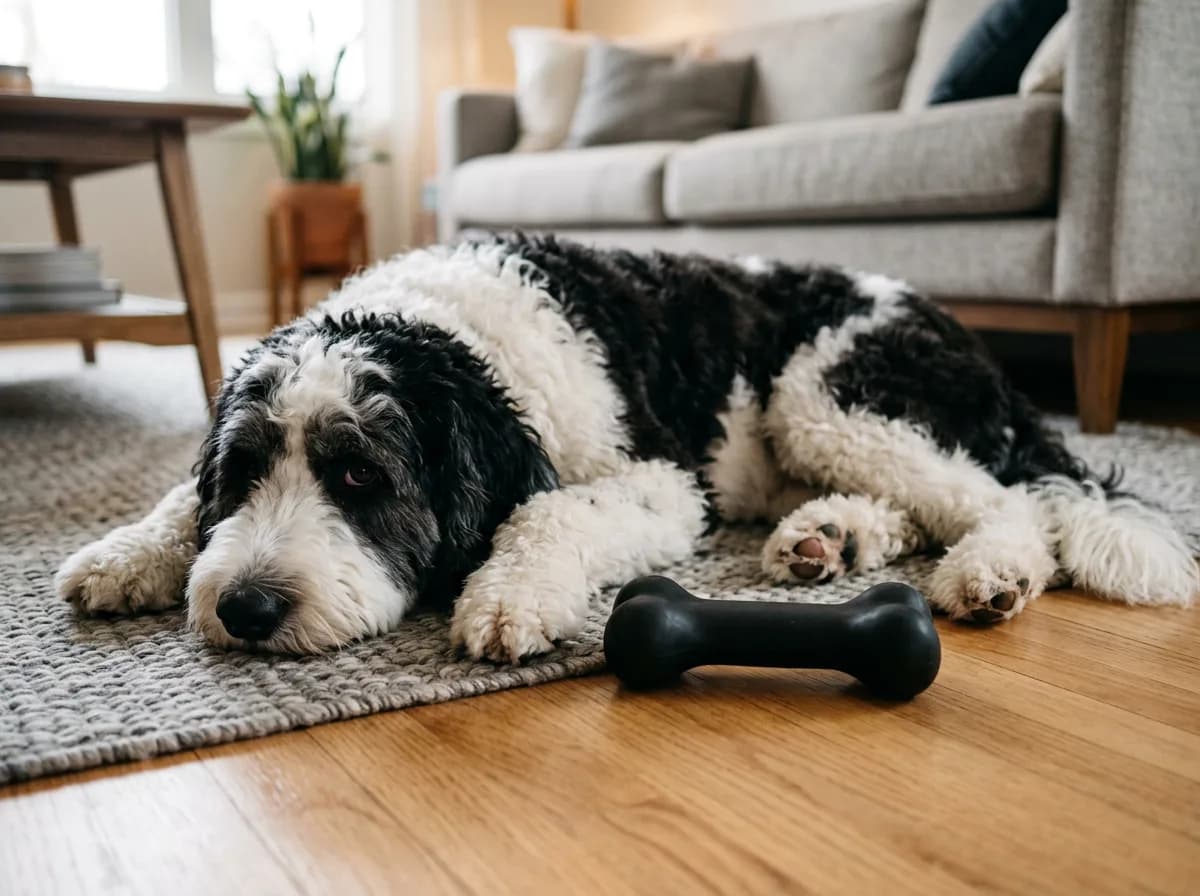
Almost every problem on this list is the Old English Sheepdog herding instinct doing its job in a house that has no sheep. Ankle nipping is a stop signal aimed at a running child. Circling behavior is a dog gathering a group that has spread out. Barking at a departing family member is an announcement. Prevention is not suppression: give the instinct a legal outlet before it picks its own, and most of these behaviors never establish themselves in the first place.
- Prevent ankle nipping by carrying a tug toy through the 4 to 10 month peak and putting it in the dog's mouth the instant the crouch appears, before contact happens.
- Prevent circling behavior at gatherings by setting the dog up on a mat with a chew at the edge of the room. A dog that cannot watch the group scatter has nothing to gather.
- Prevent demand barking by making the outburst genuinely boring, and by front-loading the day with mental work so the dog is not shopping for attention by mid-afternoon.
- Prevent doorway and stair blocking with a gate through adolescence, then teach a station cue on a mat placed a few feet back from the threshold.
- Prevent alone-time problems from day one, while the puppy is still easy. Ten minutes of practiced separation daily in the early months is worth more than any intervention after the fact.
One thing decides whether the common problems above ever take hold, and it has nothing to do with the dog. A herding cross reads the whole household as a system, so a rule that three people keep and one person breaks is not a rule at all. If one adult lets the dog block the kitchen doorway, or answers a demand bark with attention, that habit survives everyone else's training. Agree on the short list out loud before the puppy comes home, and keep it somewhere visible. It is also far cheaper to prevent a habit than to repair one: caught in its first two weeks, most of these behaviors need about a week of consistency, while an established version takes a month or more of daily work.
- Write the house rules down: furniture access, doorway blocking, jumping at greetings, and what the dog gets for barking. Four rules everyone keeps beat twenty that one person enforces.
- Give visitors and grandparents a script at the door: no touching until four feet are on the floor. Guests are the single biggest source of relapse.
- Track it for two weeks. A note on your phone each time the dog nips, circles, or barks at a departure shows the pattern (time of day, who was home, what came first) faster than memory does.
- Assume everything gets harder between 6 and 14 months, and build the routine before that window rather than during it.
- If a habit is already three months old, stop correcting it in the moment and change the setup instead: a gate, a mat, and a scheduled outlet before the trigger arrives.
Before troubleshooting anything, sort the complaint into the right bucket. Do sheepadoodles bark a lot? Less than most terriers, though more than the calm teddy-bear image suggests, and volume by itself tells you very little about cause. Is a sheepadoodle aggressive when it nips a heel, blocks a doorway, or barks at someone walking out? Almost never. Sheepadoodles are herding dogs applying pressure, and pressure reads as alarming to people who have only lived with retrievers. The difference is visible in body language: a herding dog stays loose, forward, and locked onto movement, while a truly aggressive dog goes stiff and still. Learn those warning signs first, because the fix for a lot of these problems depends entirely on which one you are looking at.
- Log two weeks of incidents with time of day, trigger, and who was home. Patterns surface faster than memory allows.
- Sort every bark into alert, herding, or demand before responding. The three categories need opposite handling.
- Treat stiffness and stillness as the threshold for calling a certified professional, not volume or mouthiness.
- Front-load the day. Demand barking and circling cluster in the late afternoon when the morning offered nothing to think about.
- Rule out pain first when habits change suddenly. New irritability in a previously easygoing adult is a vet question before it is a training question.
Barking
Do sheepadoodles bark a lot? Moderately, and almost always for a reason. Sheepadoodle barking is usually alert barking (someone at the door), herding barking (a family member walking away from the group), or demand barking (you stopped throwing the ball). The fix depends on the category, so identify which one you have before you try to solve it.
- Alert barking. Acknowledge, thank the dog, and cue a settle. Suppressing it entirely usually fails.
- Herding barking. Increase mental work and teach an incompatible behavior such as going to a mat when the family disperses.
- Demand barking. The only reliable answer is to stop rewarding it, which means being genuinely boring during the outburst.
Nipping and Herding Children
The ankle nipping described earlier peaks between 4 and 10 months. Carry a tug toy, redirect the mouth onto it the instant you see the crouch or the fixed stare, and reward. Do not grab the collar mid-chase, which raises arousal.
Separation Anxiety
Can sheepadoodles be left alone? Yes, but this is the cross's genuine weak point and the most common reason owners seek professional help. Separation anxiety is common in Sheepadoodles because both parent breeds were bred to stay with their people all day. Most adults handle 4 to 6 hours comfortably once they have been taught to, but that tolerance is trained, not automatic.
Warning signs to watch for, in order of escalation:
- Shadowing you intensely and reacting to shoe or key sounds.
- Whining or pacing during the first ten minutes after you leave.
- Refusing food or a stuffed toy while alone.
- Destructive chewing focused on doors, windows, and exit points.
- House soiling in an otherwise reliable adult dog.
Build tolerance in seconds and minutes, not hours: step out and come back before the dog gets worried, pair departures with a long-lasting chew, and drop the emotional intensity of both goodbyes and greetings.
- The most common mistake new Sheepadoodle owners make is spending the first two weeks at home with the puppy and never leaving its side. That teaches the dog that constant company is the normal state, and the first real workday then arrives as a shock. From day one, build short, boring, unremarkable departures into the routine even when you have nowhere to be.
Is the Sheepadoodle Aggressive?
Searches for sheepadoodle aggressive behavior are far more common than the reality warrants. True aggression is rare in this cross. What owners usually encounter is herding pressure, resource guarding, fear from insufficient socialization, or pain-related irritability. The body language tells you which: a herding dog is forward, loose, and focused on movement, while a fearful or guarding dog is stiff, still, whale-eyed, and lip-curling. If you see genuine stiffness and freezing, stop managing it yourself and bring in a certified behavior professional.
Body language is the part of temperament you can actually see, and it shifts long before a dog does anything you would call a problem. Sheepadoodles are expressive, but a heavy coat hides a great deal of it, so ears and hackles are less reliable here than in a short-coated breed. Watch the mouth, the eyes, and where the weight sits instead. The warning signs arrive in a sequence, and the earlier in that sequence you read them, the smaller your intervention has to be.
- Early warning signs: a mouth that closes after panting, a head turn away, lip licking, and a slow blink. The dog wants the situation to change, and that is your cue to create space.
- Middle warning signs: freezing, weight shifted forward over the front feet, whale eye where the white shows at the corner, and a low stiff tail. Stop what is happening rather than pushing through it.
- Late warning signs: a hard stare, a lifted lip, or a growl. Never punish a growl, because it is information, and a dog taught not to growl has simply had a warning removed from the sequence.
- Part the coat when you are unsure. Raised hackles and a tucked tail can be invisible under this much fur, so read the face and the body posture first.
- Photographs mislead. The teddy-bear head shot shows nothing about arousal, so judge a dog on video that includes movement, other dogs, and handling.
Coat, Shedding, and Grooming Basics
Coat care shapes daily life with this breed more than most owners anticipate, and it is a big enough topic to have its own home. Does a Sheepadoodle shed? Yes, lightly. Do sheepadoodles shed a lot compared with an Old English Sheepdog? No, but the coat mats aggressively if it is not brushed, and neglected mats cause skin pain that shows up as irritability. Are sheepadoodles hypoallergenic? No dog truly is, though many Poodle crosses are more tolerable for allergy sufferers. Do sheepadoodles drool? Far less than the Sheepdog side alone would suggest. Do sheepadoodles smell? Only when a damp coat is not dried properly. Full brushing schedules, clipper guidelines, and coat-type differences live in our Sheepadoodle grooming and shedding guide.
How Adult Size Shapes Temperament
Size changes how temperament lands in a real home. How big do sheepadoodles get? Standards commonly reach 60 to 80 pounds, which means an affectionate lean becomes a genuine shove and a herding turn becomes a physical event. A larger Sheepadoodle also takes longer to mature mentally, so the boisterous adolescent phase runs later. Weight-by-age growth curves, height ranges, and the standard versus mini versus micro breakdown are covered in the Sheepadoodle size chart, which is the right place to plan for adult sheepadoodle size before you commit.
Sheepadoodle vs Bernedoodle and Goldendoodle Temperament
Cross-doodle comparisons deserve a proper head-to-head rather than a paragraph here. The short version: sheepadoodle vs bernedoodle usually comes down to drive versus mass, since the Bernese side tends to be slower and steadier while the Sheepdog side is more active and more watchful. Sheepadoodle vs goldendoodle temperament is a question of biddability versus herding pressure, because the Golden side is more openly retriever-friendly and less inclined to manage the household. Which is calmer, whether one is better than a Goldendoodle, and which doodle ranks calmest overall are all answered with real data in our Sheepadoodle vs Bernedoodle comparison.
Do Mini Sheepadoodles Act Differently?
Yes, in ways that surprise people who assume smaller means calmer. Mini sheepadoodle temperament typically carries more Poodle influence because the cross uses a Miniature Poodle, which often means a quicker, more vocal, more sensitive dog rather than a scaled-down standard. A mini sheepadoodle still has the herding instinct, still needs mental work, and frequently needs more careful socialization around large dogs. Size-specific temperament, exercise, and household-fit guidance lives in the Mini Sheepadoodle guide.
What Is the Downside of a Sheepadoodle?
The honest downside of a Sheepadoodle is workload rather than personality. This is a large, coat-heavy, people-oriented dog that was bred from a working herder, and every one of those traits has a cost attached. The coat needs real time every week, the size makes ordinary logistics harder, the herding drive shows up around running children, and the attachment that makes the breed lovely also makes it poor at being left alone all day. None of that is a defect. It is simply the deal, and the households that struggle are the ones nobody warned.
- Coat care is the biggest single downside: budget real brushing time every week, not a burst before the groomer.
- Separation-related behavior is common in a breed this attached; build alone-time tolerance from the first week.
- Herding instinct around running children needs managing rather than punishing.
- Adult size changes housing, car, travel and veterinary costs in ways buyers rarely price in.
The honest downsides are exercise demand, alone-time intolerance, grooming cost, and a long adolescence. This is a 60 to 80 pound dog that needs 60 to 90 minutes of daily activity plus mental work, struggles with long workdays without deliberate training, requires professional grooming every 6 to 8 weeks, and stays boisterous into year two or three. There is also the health picture that comes with any cross of two breeds carrying inherited conditions, and the fact that temperament is less predictable than in a standardized breed. Veterinary criticism of doodle breeding practices, along with the specific conditions to screen for, is covered in our Sheepadoodle health issues guide.
Do Sheepadoodles Ever Calm Down?
Yes. Most Sheepadoodles begin to settle down noticeably between two and three years of age, with the sharpest change arriving around the two years mark. Before that, expect a genuinely long puppyhood: the physical body finishes growing well before the brain does, so a 70 pound one-year-old still behaves like an adolescent. What changes with maturity is the ability to switch off, not the underlying energy requirement.
Roughly what to expect by stage:
- 8 weeks to 6 months. High arousal, short attention, heavy nipping and mouthing.
- 6 to 14 months. The hardest window. Adolescence, testing of known cues, and peak destructive potential.
- 14 months to two years. Recall and impulse control stabilize; the dog starts to settle when you settle.
- Two to three years. The recognizable adult temperament arrives: still playful, far more able to switch off.
- Through the 6 to 14 month window, an interactive puzzle buys back more calm per minute than extra walking does, because arousal in this cross is mental as much as physical.
- Scatter-feeding part of the evening meal on a snuffle mat adds five to ten minutes of nose work at the hour most owners find hardest, and it costs nothing in extra walking time.
You can speed this up. Dogs that get consistent daily exercise, structured mental work, and an explicitly trained settle cue calm down considerably earlier than dogs left to burn energy on their own.
Do Sheepadoodles Like to Cuddle?
Yes, most Sheepadoodles like to cuddle, and they tend to want it more than their size makes convenient. The Old English Sheepdog side brings a heavy leaning, lie-on-your-feet kind of affection, while the Poodle side brings a dog that tracks you room to room. The result is a large animal that would genuinely like to be on the sofa with you. Individual dogs vary, and a few prefer to be near you rather than on you, but a Sheepadoodle that avoids contact entirely is unusual enough to be worth a look at what else is going on.
- Expect contact-seeking rather than lap-sitting once the dog is full grown, though plenty still try.
- Puppies that are handled daily settle into calmer adult affection than those left to self-soothe.
- A sudden drop in wanting contact is worth noting, since pain often shows up first as withdrawal.
- Give the dog a place to retreat to as well; constant availability is not the same as constant contact.
Very much. Sheepadoodles are among the more physically affectionate doodle crosses, and most will actively seek contact rather than merely tolerate it. The typical adult wants to lean against your legs, sleep touching a family member, and reposition itself onto the sofa the moment the rules relax. That affection is genuine, though it is worth remembering that it comes packaged with a dog that may weigh as much as a person.
A few practical notes on the cuddling:
- They rarely respect personal space. A Sheepadoodle that wants contact will sit on you rather than beside you.
- Contact-seeking can mask anxiety. Constant, frantic contact is different from a relaxed lean and can be an early sign of separation distress.
- Teach an off switch anyway. A trained "off" and a designated dog bed prevent the affection from becoming a management problem in a full-sized adult.
Choosing a Puppy with the Right Temperament
Because temperament varies so widely in this cross, sourcing matters more than it would for a standardized breed. A sheepadoodle for sale listing tells you nothing useful about disposition, and neither does a photograph. What predicts adult temperament is the parents' behavior in person, the breeder's socialization protocol, and full health testing on both sides. Ask to see the dam interacting with strangers, ask what enrichment the litter gets before eight weeks, and walk away from any breeder pairing two merle dogs together, since merle-to-merle breeding produces serious deafness and vision defects and is never acceptable. Detailed breeder vetting questions, red flags, and pricing for sheepadoodle puppies are in our Sheepadoodle puppies guide, and the full breed overview lives in our Sheepadoodle breed guide.
Watch how a seller talks about temperament, because the language itself is diagnostic. Listings routinely present it as a guarantee: calm, hypoallergenic, great with kids, written as though the traits were fixed at the factory. They are not. This is a non-standardized cross with no breed club, no written standard and nobody checking anyone's claims, so honest temperament information always arrives as a range rather than a promise. A breeder who says most of our puppies settle well but this litter is busier than the last one is giving you real information. A breeder who guarantees you a calm adult is either not watching the litter closely or is simply telling you what closes the sale.
- Ask for the range in words: what is the calmest puppy in this litter like, and what is the busiest one like? A breeder who cannot answer that has not been watching.
- Treat a written temperament guarantee as a sales document. A health guarantee has testable results behind it. A temperament one has nothing behind it at all.
- Ask what happened to the last litter. Owner updates at one and two years old are the closest thing to outcome data that exists for a cross with no registry.
- Discount adjectives that fit every dog of this type (goofy, loving, teddy bear) and weigh only what is specific to the puppy in front of you.
- Expect a real spread inside one litter. Siblings raised identically can differ here more than two purebred dogs from separate breeders.
Frequently Asked Questions
Sheepadoodles are affectionate, playful, people-focused, and highly trainable, with a strong instinct to stay physically close to their family. The Old English Sheepdog side contributes a gentle, watchful, herding-driven nature while the Poodle side adds sensitivity and fast learning. Expect a dog that is soft under correction, alert without being defensive, and happiest when it has a job and a predictable routine.
Yes, for most households. They bond to the whole family rather than one person, handle household noise well, and are typically excellent with respectful children over about six. The main things to manage are their size, which can knock over small children, and the herding instinct that produces ankle nipping at running kids. Early socialization and clear rules for the children resolve most of it.
They bark a moderate amount, and almost always with a purpose. Most Sheepadoodle barking falls into three categories: alert barking at arrivals, herding barking when a family member separates from the group, and demand barking for attention or play. Identify which type you are dealing with before trying to fix it, because the solutions are different for each.
Most adult Sheepadoodles handle four to six hours alone comfortably, but only if alone time was trained deliberately from puppyhood. This cross is prone to separation anxiety because both parent breeds were bred to stay with their people all day. Build tolerance gradually in seconds and minutes, pair departures with a long-lasting chew, and keep goodbyes and greetings low key.
Yes, unusually so, provided you use positive reinforcement. They learn new cues in very few repetitions and enjoy working with their handler. The one caution is sensitivity: harsh corrections, raised voices, and leash pops tend to shut a Sheepadoodle down rather than motivate it. Short, frequent sessions of about five minutes work far better than long ones.
A healthy adult needs 60 to 90 minutes of real physical activity daily, split across at least two outings, plus separate mental stimulation such as scent games, food puzzles, or short training sessions. Puppies need far less structured exercise while their joints develop. A yard does not count as exercise, since dogs left alone outside patrol and bark rather than genuinely working off energy.
True aggression is rare in this cross. What most owners interpret as aggression is herding pressure, resource guarding, fear from insufficient socialization, or discomfort from pain or matted skin. A herding dog is forward, loose, and focused on movement, while a fearful or guarding dog is stiff, still, and showing whale eye. If you see genuine stiffness and freezing, consult a certified behavior professional.
Most begin to settle noticeably between two and three years old, with the clearest shift around the two-year mark. The window from six to fourteen months is typically the hardest, since adolescence brings testing of known cues and peak destructive potential. Consistent daily exercise, structured mental work, and a trained settle cue all bring that calm forward considerably.
The Bottom Line
The Sheepadoodle temperament suits an active family that wants a dog genuinely involved in daily life rather than one that entertains itself. You get affection, intelligence, humor, and a dog that will meet you at the door for the next decade. In exchange, you owe it real exercise, deliberate mental work, patient reward-based training, and an honest plan for the hours it spends alone. Meet the parents, respect the herding instinct instead of fighting it, and this cross becomes one of the easiest large dogs to live with.

Coreen Saito is a pet writer and longtime shelter volunteer with more than a decade in animal rescue. She covers cat behavior, breed care, and the small, ordinary science of sharing a life with companion animals, with a particular focus on honest takes about the products and decisions that actually matter. At home in Arizona, she's outranked by Mac (a dog with the loudest opinion in the house), Rebel (a cat who governs by quiet authority), and Meri (an orange tabby who runs the late shift and the laundry basket). She writes about all three, plus the rescues that keep coming through her life, at LifeWithMinty.com.
Sign up for expert-backed reviews and safety alerts all in one place.