Sheepadoodle Grooming: Coat Types, Haircuts and Costs
Sheepadoodle grooming starts with knowing which of the three coat types your dog has. Here is the coat test, the brushing cadence each texture needs, the named haircuts worth asking for, and what a groomer really costs.
Petful is reader supported. As an affiliate of platforms like Amazon and Chewy, we may earn a commission when you buy through links on this page. There is no extra cost to you.
Sheepadoodle grooming is the single biggest ongoing commitment of owning this breed, and it is the one most new owners underestimate. Cross an Old English Sheepdog with a Poodle and you get a dog whose hair keeps growing instead of shedding out, which means every loose strand stays trapped in the coat until a brush or a comb removes it. Skip a week and you are not looking at a dusty dog. You are looking at mats.
The good news is that the workload is predictable once you know which of the three Sheepadoodle coat textures your dog actually has. This guide gives you a hands-on coat type test, a brushing schedule set from that result, the named haircuts worth asking a groomer for, and honest price bands so nobody is surprised at the counter.
- 1Sheepadoodles have curly, wavy or straight-flat coats, and the texture sets the entire grooming workload
- 2Curly coats need daily line brushing; wavy coats need four to five sessions a week; flat coats can get by on two or three
- 3The puppy coat change between roughly 7 and 14 months is when most owners lose the coat to matting
- 4Plan on a professional groom every 6 to 8 weeks at roughly $90 to $150 for a standard-size dog, more if the coat arrives matted
- 5A shave down is not a failure, it is the humane option when a coat has pelted

Sign up for expert-backed reviews and safety alerts all in one place.
Sheepadoodle Coat Types and the Coat Change
The Sheepadoodle coat is a genetic lottery between two very different parents. The Old English Sheepdog contributes a dense, profuse, shedding double coat. The Poodle contributes a single curly coat that sheds minimally but grows continuously. What a given puppy inherits determines whether you are brushing for five minutes or twenty-five.
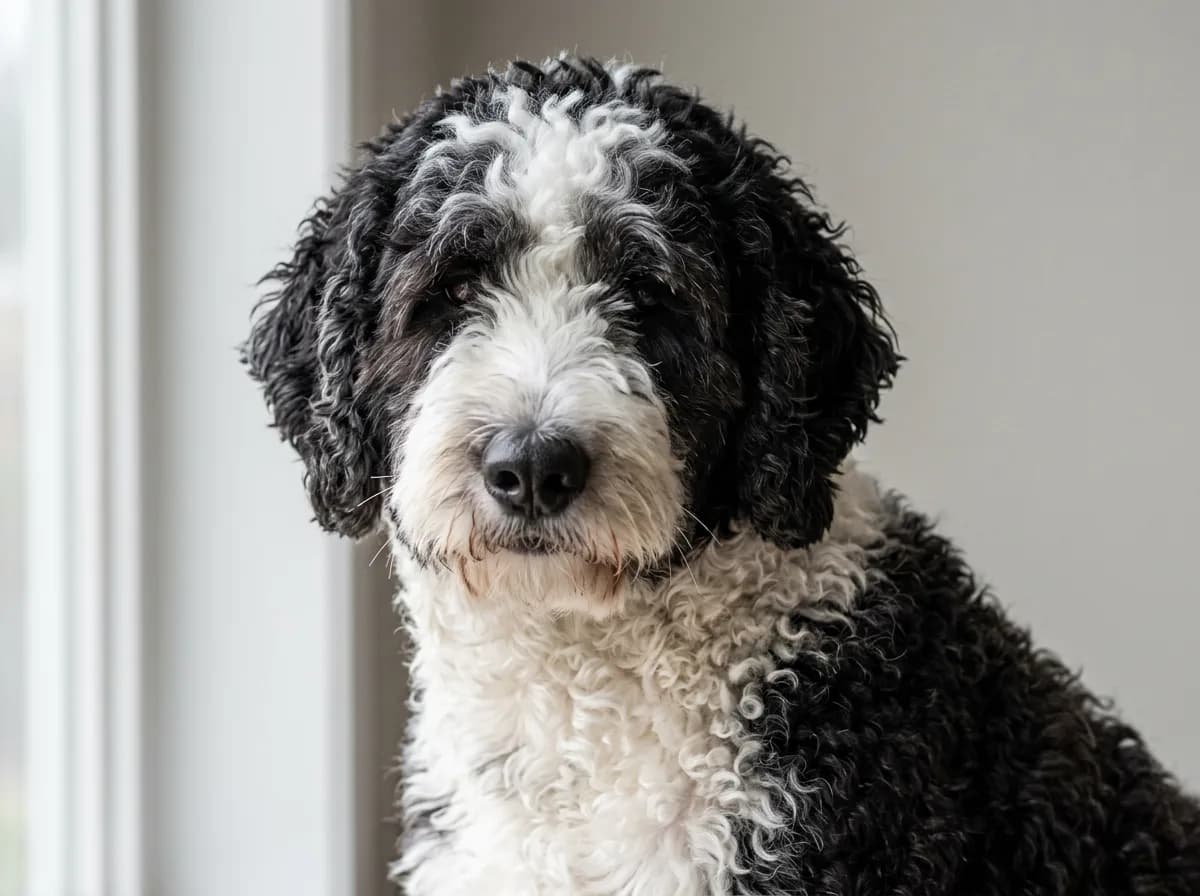
Sheepadoodle coats sort into three practical textures, and breeders and groomers use the same three names.
Do Sheepadoodles have a double coat? Most do not. The majority carry a single Poodle-style coat, and only the flatter, straight hair Sheepadoodles tend to have enough undercoat to behave like a true double coat the way a Sheepdog does. That single fact explains most of the variation owners run into. Sheepadoodle coats sort into curly, wavy and straight textures, each with its own brushing math, and a separate set of genes decides whether the face carries a beard or stays short like an unfurnished Sheepadoodle. Layered over all of it is the Sheepadoodle coat change, the adolescent window when the soft puppy hair is replaced. Work through the sections below in that order and you will know exactly which dog you have.
- Curly, wavy and straight are the three textures breeders and groomers both use, and the comb test below places a dog in about a minute.
- An F1 litter (one Poodle parent, one Old English Sheepdog parent) can produce all three textures in the same litter, so siblings are not a guide.
- Furnishings run on a different gene from curl, which is why a dog can be curly bodied and still unfurnished in the face.
- Only the flat and straight coats routinely carry enough undercoat to need a deshedding tool alongside a slicker.
- Plan for the coat change between roughly 7 and 14 months whatever texture your dog turns out to have.
The Coat Type Test
You do not need a DNA panel to place your dog. Do this coat type test on a clean, dry dog, working on the shoulder where the coat is most representative.
- Lift a section of Sheepadoodle hair about the width of two fingers and comb it straight out from the skin with a steel comb.
- Release it and watch what it does over the next few seconds.
- If it springs back into tight, defined ringlets that sit close to the body, you have a curly Sheepadoodle.
- If it relaxes into loose S-shaped waves that hold their shape but do not coil, you have a wavy coat.
- If it drops and lies flat against the body with only a slight bend, you have a straight or flat coat.
- Now run the same comb from the skin outward at the armpit. If it stops or snags before it clears the coat, matting has already started at the base and the texture question is secondary to a dematting session.
The Curly Sheepadoodle Coat
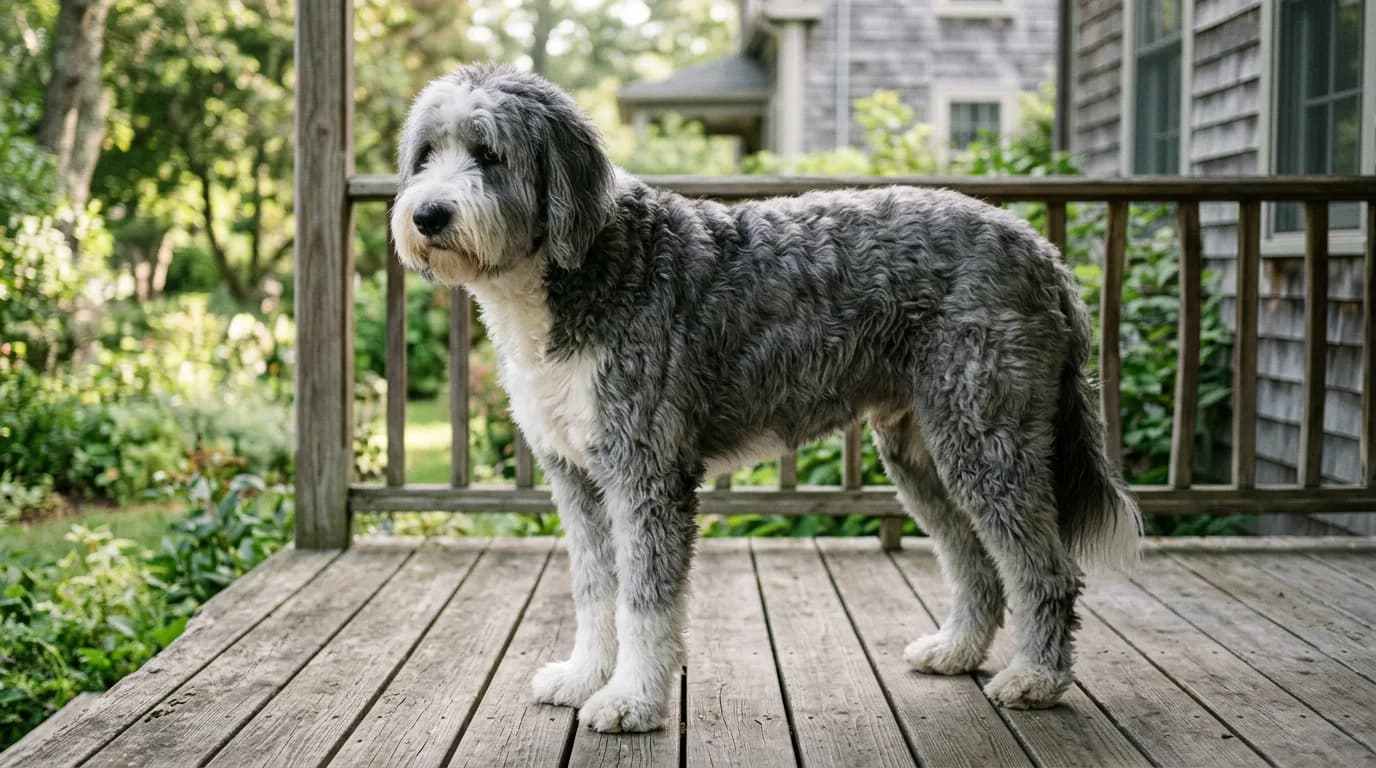
A curly Sheepadoodle looks the most Poodle-like, with tight ringlets that give the dog a plush, sculpted outline. It is the lowest-shedding of the three and the most allergy-friendly, but it is also the highest-maintenance coat in the breed by a wide margin. Curl grabs every loose hair and holds it, so the coat felts from the skin outward while the surface still looks perfect.
Curly coats also hide their own problems. A dog can look immaculate on top and carry a solid mat layer underneath, which is exactly the scenario that ends in a full clip at the salon.
The Wavy Sheepadoodle Coat
Wavy hair Sheepadoodles are the most common outcome, especially in F1 litters, and they land in the middle on every measure. The coat has visible body and movement, sheds a little more than a curly coat, and mats more slowly. It is the texture most owners can genuinely keep on top of at home with a realistic weekly routine.
The Straight Hair Sheepadoodle Coat
A straight hair Sheepadoodle carries more of the Old English Sheepdog side. The coat lies flatter, feels coarser at the tips, and often comes with a noticeably denser undercoat. These dogs shed the most of the three, drop hair seasonally, and need less frequent brushing but more thorough brushing when it happens, because the undercoat packs down rather than tangling on the surface.
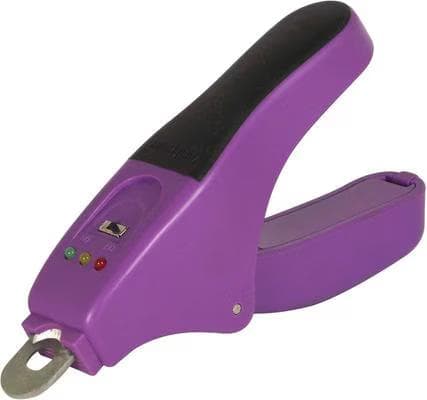
Petful may earn a commission when you click through to Chewy, at no extra cost to you.
- Coat texture is not always uniform across the body. It is common for a Sheepadoodle to be curly over the back and hips, wavy along the ribs, and nearly straight on the legs and ears. Test two or three areas and set your routine from the tightest curl you find, not the loosest.
Furnishings and the Unfurnished Sheepadoodle
Furnishings are the longer facial hair that produce the classic doodle beard, moustache and eyebrows. They come from a dominant gene inherited through the Poodle side, and they are what make a Sheepadoodle look like a shaggy teddy bear rather than a Sheepdog.
An unfurnished Sheepadoodle has inherited two copies of the improper coat variant and grows a short, smooth face with no beard or brows. It is a legitimate, healthy result of the cross, sometimes called an open-faced or flat-faced doodle. Unfurnished dogs are far easier to groom around the muzzle, but they typically shed more and are a poorer fit for allergy households.
The Sheepadoodle Coat Change
The Sheepadoodle coat change is the grooming event nobody warns first-time owners about, and it is where most coats are lost. Somewhere between roughly 7 and 14 months, the soft puppy coat is pushed out by the denser adult coat. The dead puppy hair does not fall to the floor. It stays woven into the incoming adult hair, and within two or three weeks a dog that never mats can be solid from the neck to the tail.
- The change usually starts at the friction points: behind the ears, in the armpits, at the collar line and around the harness.
- It can last two to four months from first shed to fully adult coat.
- Brushing frequency needs to roughly double for the whole window, regardless of coat texture.
- A shorter working length during the change, around one inch, makes the whole thing survivable.
- If you are only going to be diligent for one stretch of your dog's life, make it this one.
Do Sheepadoodles Shed? Coat, Allergies and What to Expect
Yes, but not the way a Labrador does. Every dog sheds hair, and a Sheepadoodle shed cycle is slow and low-volume compared with a shedding breed. The difference is where the hair goes. In a curly or wavy coat, released hairs are caught by their neighbours and stay in the coat, which is exactly why brushing is not optional and why the shedding question and the matting question are really the same question.
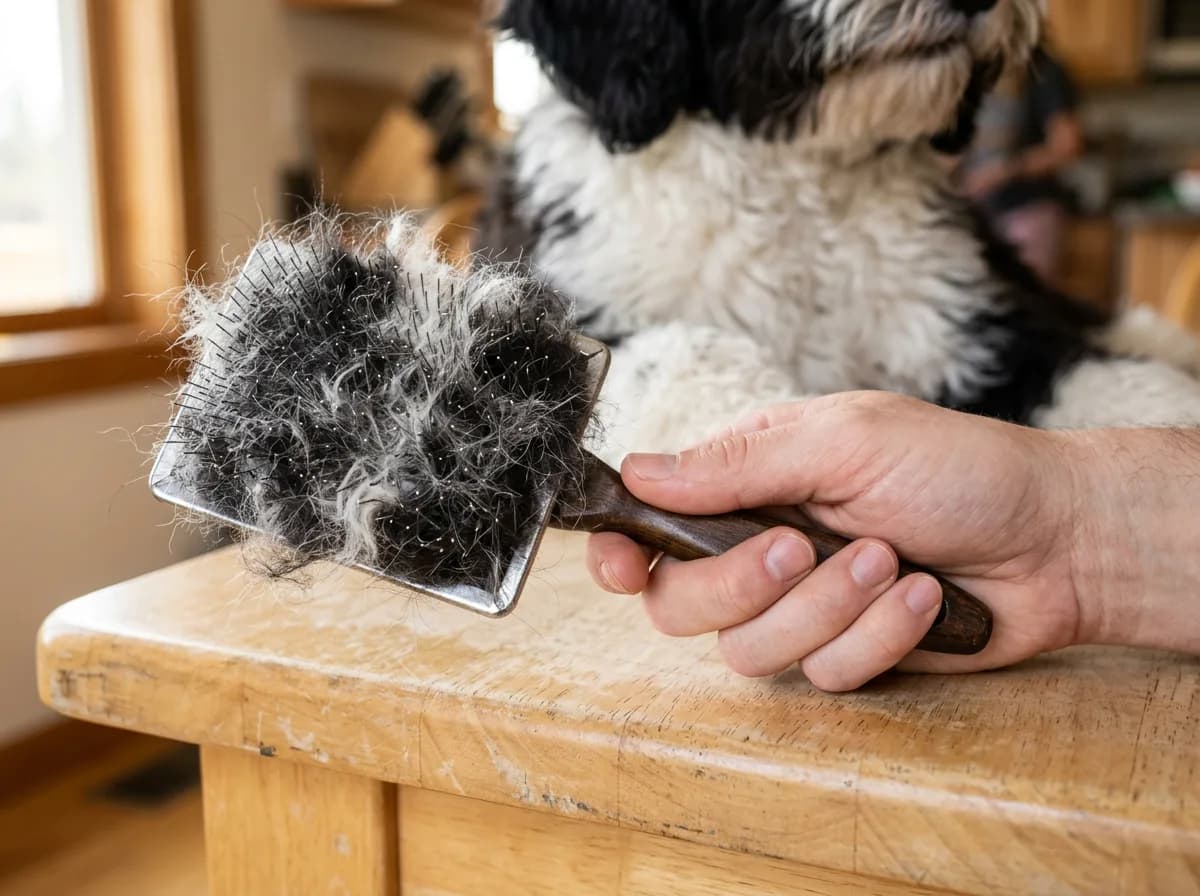
Two questions land here together, so take them together. Do Sheepadoodles shed a lot, and are Sheepadoodles hypoallergenic? The honest short answers are that they shed less than most dogs but never nothing, and that no dog is genuinely hypoallergenic whatever a puppy listing claims. Volume is only half the picture. Where the loose hair ends up matters more, and it is why owners of two Sheepadoodle littermates can describe completely different experiences on carpets, car seats and clothing. An allergy-sensitive household should treat the hypoallergenic question as a matter of degree rather than a yes or no, because the answer tracks the individual dog's coat type and generation far more closely than the breed label. The two sections below break both answers down.
- Expect the heaviest hair loss during the coat change between roughly 7 and 14 months, then a return to the baseline for that texture.
- Wash dog bedding weekly and vacuum high-traffic rooms two or three times a week, because allergen control is as much about the house as the coat.
- A bath every four to six weeks clears dander built up at the skin, which matters more to an allergic household than the haircut does.
- Keep one room, usually the allergic person's bedroom, dog free from day one rather than trying to reverse the habit later.
Do Sheepadoodles Shed a Lot?
Do Sheepadoodles shed a lot in practice? Ranked from lightest to heaviest, here is what owners actually report.
- Curly coats: minimal visible shedding, with almost no hair on furniture or clothing between grooms.
- Wavy coats: light shedding, occasional tumbleweeds during seasonal changes.
- Straight or flat coats with a real undercoat: moderate and seasonal, closest to the Old English Sheepdog parent.
- Unfurnished dogs of any texture: the heaviest shedders in the breed.
- Any coat during the puppy coat change: a temporary spike that looks alarming and then settles.
- Straight and flat coats push out a real undercoat during the change, and a deshedding brush clears that dead layer in far fewer passes than a slicker, which only lifts what has already worked its way to the surface.
Are Sheepadoodles Hypoallergenic?
No dog is truly hypoallergenic, and the Sheepadoodle hypoallergenic label sells more puppies than the science supports. The allergen most people react to is Can f 1, a protein in dander and saliva, not the hair itself. A low-shedding coat spreads less of that protein around your home, which is a genuine and meaningful reduction, but it is not elimination.
Owners ask this in a dozen phrasings: are Sheepadoodles hypoallergenic, is Sheepadoodle hypoallergenic, do Sheepadoodle dogs shed, and are F1 Sheepadoodles hypoallergenic. The honest answer is the same for all of them, and it depends far more on the individual dog's coat than on the breed name.
- A curly, fully furnished Sheepadoodle gives the best odds for an allergy-sensitive household.
- An F1 (first-generation) dog is the least predictable, because coat type varies widely within a single litter.
- F1b dogs, bred back to a Poodle, are the most reliably curly and the most allergy-friendly.
- An unfurnished dog is a poor choice for an allergic owner regardless of generation.
- Spend two unmedicated hours with the specific dog before committing, not with a sibling or a parent.
- A low-shedding coat does not mean a low-maintenance coat. The hair a Sheepadoodle does not drop on your floor is hair still sitting in the coat, and it has to be combed out by hand. Owners who choose the breed for cleanliness and then skip brushing end up paying a groomer to shave the result.
Brushing and Dematting: The Routine That Prevents Matting
Here is the short answer before the technique. Brush a Sheepadoodle with a slicker brush and finish with a steel comb, using line brushing to reach the skin, daily for curly coats, four to five times a week for wavy coats, and two to three times a week for flat coats, then book a professional groom every 6 to 8 weeks.
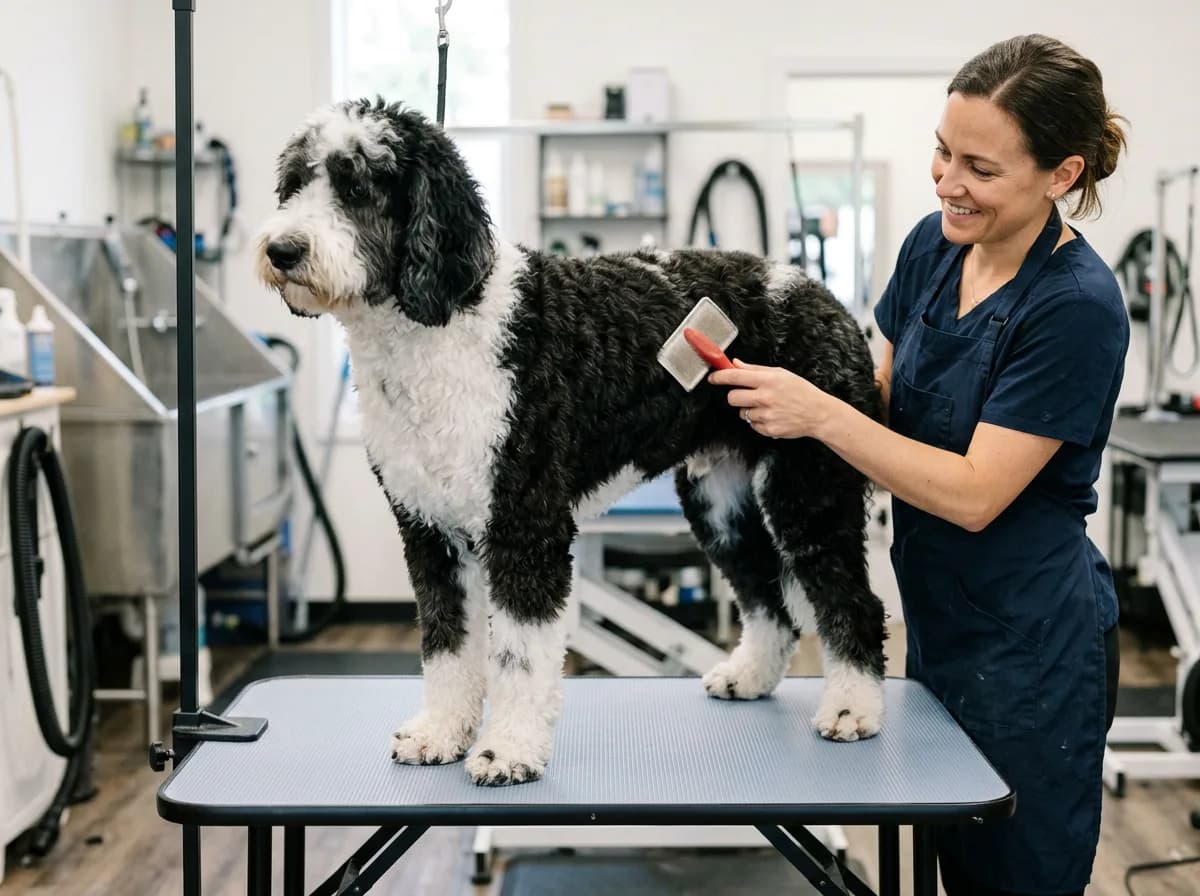
Do Sheepadoodles need to be groomed? They are one of the few breeds where the honest answer is that grooming is not cosmetic but a welfare requirement. Because the coat grows continuously and traps shed hair rather than releasing it, a Sheepadoodle left ungroomed will mat to the skin within a few months. Tight mats pull constantly, trap moisture, hide skin infections and restrict movement. Both a home routine and professional appointments are mandatory for this breed.
One thing worth settling before you go looking for Sheepadoodle grooming ideas: the cut you choose only works if the brushing routine underneath it is realistic. A shorter working length forgives missed days, a longer teddy bear shape does not, so decide how many minutes a week you will genuinely spend with a slicker and comb, then pick the style that survives that number. Every haircut later in this guide is described with its true upkeep alongside it for exactly that reason.
Brushing Frequency by Coat Type
This is the piece almost every ranking guide gets wrong by handing every Sheepadoodle the same rule. Set your brushing frequency from the coat type test result, not from the breed name.
| Coat Texture | Brushing Cadence | Session Length | Professional Groom |
|---|---|---|---|
| Curly | Daily | 15 to 25 minutes | Every 4 to 6 weeks |
| Wavy | 4 to 5 times per week | 10 to 15 minutes | Every 6 to 8 weeks |
| Straight or flat | 2 to 3 times per week | 10 to 15 minutes | Every 8 to 10 weeks |
| Any coat during the coat change | Daily | 20 to 30 minutes | Every 4 to 6 weeks |
Take the result of the coat type test and read your brushing frequency straight off it, because a curly dog and a flat-coated dog do not need the same week. Coat texture, not breed name, decides the cadence that keeps a dog mat free. Curly coats felt from the skin outward and need daily attention. Wavy coats forgive a missed day. Flat coats need fewer sessions but longer ones, because the work is undercoat rather than surface tangle. Set the schedule once and adjust only when the comb tells you to.
- Curly coat: line brush daily, or every second day at the absolute minimum, budgeting 20 to 25 minutes for a standard-size dog, because curl holds every shed hair against the skin.
- Wavy coat: four to five sessions a week at roughly 15 minutes each, with the six friction zones combed even on the days you skip a full brush out.
- Flat or straight coat: two to three sessions a week, but longer ones, since the job is clearing packed undercoat rather than lifting surface tangles.
- Re-run the comb check monthly at the armpit and behind the ears. If the comb catches in either place, your current cadence is running about one session a week short.
- Add an extra session after any bath, swim or muddy walk, because water and grit both tighten tangles that were loose an hour earlier.
How to Line Brush a Sheepadoodle
Surface brushing is the number one reason owners arrive at the salon convinced their dog is well maintained and leave with a shaved dog. A slicker glided over the top of the coat only touches the outer third. Line brushing is the technique that fixes it, and it is the single most valuable skill a Sheepadoodle owner can learn.
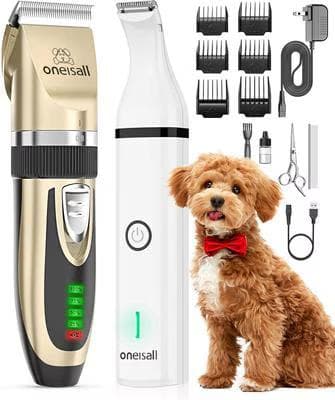
Petful may earn a commission when you click through to Chewy, at no extra cost to you.
- Lay the dog on its side or work it standing, starting at the paw or the lowest point of the area you are doing.
- Part the coat horizontally with your free hand so you can see a clean line of skin.
- Brush only the hair below that part line, from the skin outward, in short strokes with a slicker brush.
- Move the part up roughly half an inch and repeat, working in stripes up the body.
- Follow every brushed section immediately with a steel comb. If the comb passes from skin to tip without catching, that stripe is genuinely done.
- Finish with the high-friction zones last: behind the ears, under the collar, in the armpits, the groin, the tail base and the back of the hind legs.
Where Mats Form First
Matting is not random. It concentrates wherever hair rubs against hair, against skin or against gear, so a five-minute check of six places tells you whether you are winning.
- Behind and under the ear leather, the most common first site by a wide margin.
- The armpits, where the front legs meet the chest.
- Under a collar or harness, especially if the dog wears one all day.
- The groin and sanitary area.
- The back of the hind legs and the britches.
- The tail base and the underside of the tail.
Working Out a Mat Safely
A loose tangle and a tight mat are different problems. If you can slide a comb tooth underneath a mat and lift it off the skin, it is workable at home. If it lies flat against the skin and will not lift, it belongs to a groomer.
- Never bathe a matted dog. Water shrinks and tightens a mat into felt, and a wet mat is far harder to open than a dry one.
- Work dry, with a light detangling spray if the coat is brittle.
- Hold the base of the mat between your fingers so you are pulling against your own hand, not the dog's skin.
- Split the mat vertically into smaller sections with a dematting rake or the end tooth of a comb, then tease each section apart from the outside edge inward.
- Stop after a few minutes per mat. A dog that learns brushing hurts becomes a dog that will not stand for brushing.
- Never use scissors flat against the skin. Skin lifts into a mat and cuts are the most common home grooming injury in this breed.
- A slicker brush makes a coat look finished. A steel comb tells you whether it is. Before you call any session done, run the comb from skin to tip in six places: behind each ear, both armpits, the groin and the tail base. If the comb clears all six, you are genuinely mat free.
Your Sheepadoodle Grooming Schedule at a Glance
How should a Sheepadoodle be groomed? Work it as a layered routine rather than one big job: brush and comb to the skin on the cadence your coat texture demands, check ears and clear the eye area weekly, trim paw pads and nails every two to three weeks, bathe roughly monthly and always dry to the skin, and book a professional groom every 6 to 8 weeks. Consistency at the short intervals is what keeps the long intervals cheap.
- Daily to several times weekly: line brush, then comb the six friction zones.
- Weekly: check and clean ears, wipe the eye corners, inspect paw pads for packed hair and debris.
- Every 2 to 3 weeks: trim nails, tidy paw pad hair, refresh the sanitary trim if you are comfortable doing it.
- Every 4 to 6 weeks: bathe and fully blow dry, ideally the day before or after a full brush out.
- Every 6 to 8 weeks: professional groom, or a full at-home clip if you have the equipment and the skill.
- Twice a year: reassess working length against the season and your actual brushing habits, and shorten it if the last cycle got away from you.
- Weekly eye upkeep goes faster with tear stain wipes than a damp cloth, because the rust-colored residue on light furnishings is bound into the hair and needs a mild cleanser to lift rather than water alone.
Sheepadoodle Haircut Styles: Teddy Bear, Puppy Cut and More
What is the best haircut for a Sheepadoodle? For most owners it is a teddy bear cut kept at roughly one to two inches, because it preserves the soft, rounded look people buy the breed for while staying short enough to comb through in ten minutes. The genuinely best Sheepadoodle haircuts are the ones matched to how much brushing you will really do: the more honest you are about your time, the shorter the length should be, and a dog kept comfortably short beats a dog kept fashionably long and matted.
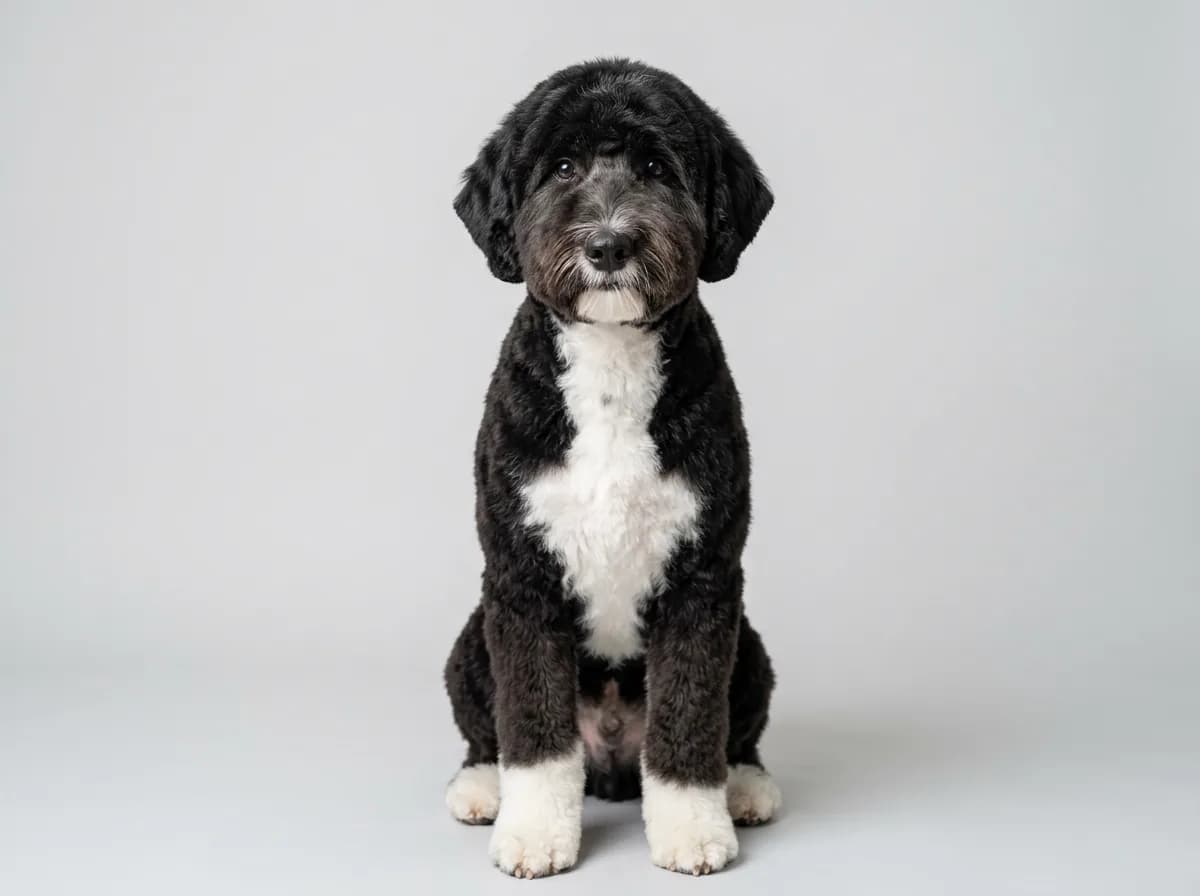
Sheepadoodle grooming styles come down to five named cuts plus the length you choose for each. Groomers group Sheepadoodle grooming cuts by silhouette, but length matters more than the name, so ask for the style and then give the groomer a number in inches. If you are collecting Sheepadoodle grooming ideas from photos, start with the length in each picture rather than the label, because "teddy bear" alone means different things in different salons.
Five named haircut styles cover almost everything a Sheepadoodle owner will be offered, and each one suits a different dog and a different owner. The teddy bear cut suits the owner who brushes most days. The puppy cut suits the household that cannot promise that. The summer cut suits hot climates and dogs that swim, hike or work outdoors. The lion cut suits owners who want a statement look and will maintain a mane. The kennel cut suits farm dogs, recovering coats and anyone who has decided short is simply easier.
- Match the style to the dog as well as the owner. A dog with a dense undercoat holds a scissored teddy bear shape far worse than a curly dog does, and collapses toward a puppy cut silhouette within about three weeks.
- Age matters. A dog going through the coat change should not be carrying two inches of teddy bear, whatever the photo on your phone looks like.
- Photograph the dog on groom day and again at week four. If the shape has gone by week four, the length was too long for your brushing habit rather than the style being wrong.
- A dog that swims or works in long grass is better served by a summer or kennel length regardless of which silhouette you prefer.
- Keep the same style for two consecutive appointments before switching, so you are judging the length rather than the label.
What Is a Teddy Bear Cut on a Sheepadoodle?
A Sheepadoodle teddy bear cut leaves the body at an even one to two inches and shapes the head into a soft, rounded silhouette, with the muzzle hair left full and scissored into a circle so the face reads as round rather than long. Ears are blended into the head shape, legs are left cylindrical and full to the paw, and the tail finishes in a rounded plume. It is the most requested doodle style in North America because it looks like the puppy the owner fell in love with.
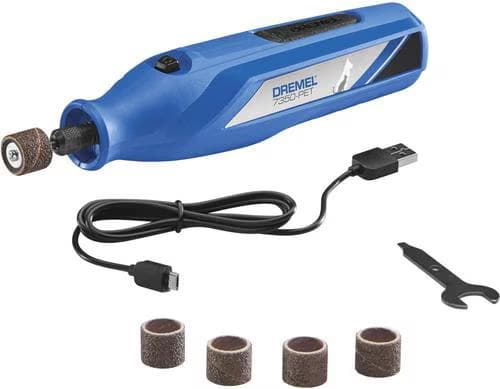
Petful may earn a commission when you click through to Chewy, at no extra cost to you.
- Best for: owners who want the classic doodle look and will brush most days. A teddy bear cut Sheepadoodle is a commitment to a brush, not just a haircut.
- Typical length: 1 to 2 inches on the body, face left longer and scissored.
- Upkeep: high. The rounded face needs eye-area maintenance every week or two.
- Watch for: the head shape falls apart fast between appointments, so book on a 6-week rhythm rather than 8.
The Sheepadoodle Puppy Cut
A Sheepadoodle puppy cut is one uniform length over the entire dog, body, legs, head and tail, usually clipped at half an inch to one inch. There is no sculpting and no separate head shape, which is exactly the point: it is fast for the groomer, cheap relative to a scissored style, and the easiest cut in the breed to maintain at home. A long puppy cut Sheepadoodle carries one and a half inches instead, which splits the difference if you want some fluff without the teddy bear workload. A puppy cut Sheepadoodle is also the safest choice for anyone who travels or works long hours.
- Best for: first-time doodle owners, busy households and any dog recovering from matting.
- Typical length: 0.5 to 1.5 inches all over.
- Upkeep: low to moderate, and forgiving if you miss a few days.
- Watch for: nothing much, which is why groomers quietly recommend it more than any other cut.
The Sheepadoodle Summer Cut
A Sheepadoodle summer cut takes the body down to roughly a quarter to half an inch while leaving the head, ears and tail longer for shape. It is a comfort cut for hot climates and for dogs who swim, hike or spend real time outdoors, and it dramatically reduces the amount of debris the coat can collect.
- Best for: hot and humid regions, water-loving dogs, and owners heading into a busy summer.
- Typical length: 0.25 to 0.5 inches on the body, head and ears left full.
- Upkeep: low, with easily the fastest drying time of any style.
- Watch for: sunburn on light-skinned or thinly coated dogs. Do not take a Sheepadoodle below a quarter inch for heat management, because the coat also insulates against heat and blocks UV.
The Sheepadoodle Lion Cut
A Sheepadoodle lion cut clips the body and hindquarters very short while leaving a full mane around the head, neck and chest, plus cuffs at the ankles and a pom on the tail. It is a novelty style rather than a practical one, and it is the least commonly requested cut in the breed.
- Best for: owners who want a statement look and are happy to maintain a distinct mane.
- Typical length: 0.25 inches on the body, 2 inches or more on the mane.
- Upkeep: moderate, and concentrated entirely in the mane.
- Watch for: the transition line between short and long grows out unevenly and needs a groomer to keep clean.
The Kennel Cut and Sheepadoodle Short Hair Options
A kennel cut is the shortest practical option, a single clipper length of about a quarter inch everywhere including the face. It is what a groomer will recommend when a coat has pelted, and it is a perfectly good long-term choice for a working farm dog or an owner who has decided that Sheepadoodle short hair suits their life better than the fluff.
There is no meaningful difference between Sheepadoodle haircuts female and Sheepadoodle haircuts male dogs beyond one detail: intact and neutered males often need a slightly more generous sanitary trim on the belly to keep urine out of the coat. Everything else is coat texture and owner preference.
- Groomers do not share a common dictionary for doodle styles. Bring a picture of the finished look you want and pair it with a specific blade or scissor length in inches. "Teddy bear at one and a half inches, face scissored round, ears blended" gets you a repeatable result. "Teddy bear, not too short" does not.
When Should a Sheepadoodle Get Its First Haircut?
When should a Sheepadoodle get its first haircut? Book it between 12 and 16 weeks, as soon as the vaccination series allows, and ask for a short puppy introduction rather than a full groom. The first visit should be about handling, clippers running nearby and standing still on the table, not about the finished shape. Keep the first two or three appointments brief even if that means booking twice in one month. The real cut can wait until around six months, once the adult coat starts coming in, and by then a puppy that has learned the salon is boring will sit for it.
- Confirm the salon vaccination policy when you book, since requirements differ between groomers.
- Ask specifically for a puppy introduction appointment, not a full groom, on the first visit.
- Handle paws, ears and muzzle at home daily from day one so the salon is not the first place anyone touches them.
Book the first appointment between 12 and 16 weeks of age, as soon as the puppy vaccination series allows it. A first Sheepadoodle puppy haircut is not really a haircut. It is a positive introduction: a bath, a full dry, a face and paw tidy, nails, and a few minutes of clipper noise against the body so the vibration stops being frightening. A very light all-over trim is plenty.
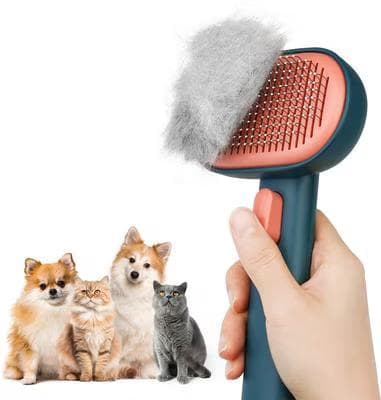
Petful may earn a commission when you click through to Chewy, at no extra cost to you.
- Aim for 12 to 16 weeks, and confirm the salon's vaccination policy before booking.
- Ask for a puppy introduction appointment specifically, not a full groom.
- Keep the first two or three visits short, even if that means a second appointment in the same month.
- Start the real cut around 6 months, once the adult coat is coming in.
- Handle paws, ears and muzzle at home daily from day one so the salon is not the first place anyone touches those areas.
- Start home handling with grooming gloves rather than pins. A puppy that has never felt a brush will usually accept a hand-shaped tool first and move up to a slicker within about two weeks.
- Pair every early paw, ear and muzzle session with a stuffed rubber chew toy, so the puppy's first association with being held still is food rather than restraint.
Shaving a Sheepadoodle: When It Is the Right Call
A shaved Sheepadoodle is the image every owner dreads, and the reaction it usually provokes is guilt. It should not. A shave down is not a punishment or a groomer's shortcut. It is the humane resolution to a coat that has already gone past the point where combing it out is fair to the dog.
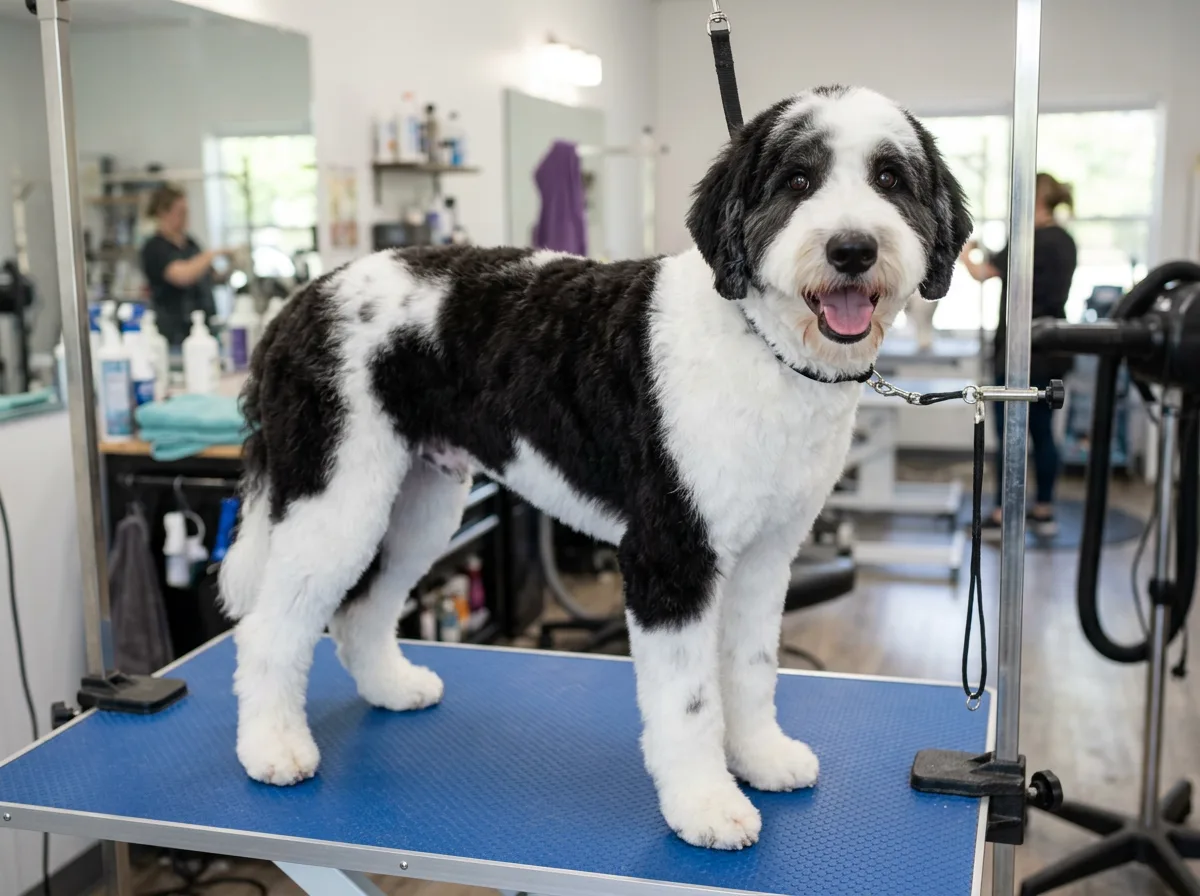
When a coat pelts, meaning the mats have joined into a continuous felted layer against the skin, dematting it would mean hours of sustained pulling on skin that is often already inflamed underneath. Groomers work to a humanity-over-vanity standard for exactly this reason, and a Sheepadoodle shaved down in that situation walks out lighter, cooler and out of pain.
Photos of a shaved Sheepadoodle circulate widely, and they are worth looking at honestly before you judge the decision. The result varies by coat texture more than by clipper length. A curly dog taken to a quarter inch reads as dense velvet and keeps a rounded outline. A wavy dog looks noticeably leaner, because much of its bulk was air held between the waves. A straight or flat coat with a heavy undercoat clips closest to the skin and shows the body shape most plainly of the three. None of that is damage. It is simply the dog that was under the coat, and the texture you started with is the best predictor of how startling the first photograph will be.
- Ask the groomer to photograph the skin before the pelt comes off, so you can see what the coat was hiding.
- Expect the dog to feel the cold for the first two to three weeks at lengths under half an inch, particularly in winter.
- Limit midday sun exposure for the first month on a pale-skinned dog, since a quarter-inch coat blocks very little UV.
- Re-run the comb test once regrowth reaches about half an inch, because the brushing schedule resets with the new length.
Signs the Coat Has Gone Past Brushing
- A comb will not pass from skin to tip anywhere along the back or sides.
- Mats have merged into sheets rather than sitting as separate lumps.
- The coat lifts away from the body as one piece when you press it.
- The skin underneath is pink, damp, flaky or smells sour.
- The dog flinches, snaps or tries to leave when you touch a specific area.
- You can no longer see skin when you part the coat.
What Happens After a Shave Down
An honest look at the result helps. A Sheepadoodle shaved down to a quarter inch usually looks startlingly small and often reveals a slightly patchy, uneven surface where the pelt was thickest. Skin that has been under a mat can be red or scurfy for a week or two and occasionally needs veterinary attention for a hot spot.
- Coat regrowth runs roughly half an inch to an inch per month.
- Expect three to five months before the dog looks like a doodle again.
- The returning coat texture can genuinely change, coming back softer or curlier than it was, especially if the shave happened during the coat change.
- A single mat-related shave does not permanently ruin a coat, despite the folklore.
- Use the regrowth window to build the brushing habit while the coat is short and forgiving.
- A Sheepadoodle coat insulates in both directions and shields skin from UV. Taking a healthy coat below about a quarter inch to keep a dog cool removes that protection and can leave light-skinned dogs sunburned. If heat is the problem, ask for a summer cut at a quarter to half an inch, keep the dog out of midday sun, and let the coat do its job.
Face, Ear and Paw Trimming Between Appointments
The three areas that decide whether a Sheepadoodle looks cared for at week five are the face, the ears and the paws. All three are safe for an owner to maintain with blunt-tipped scissors and a small trimmer, and all three are where problems start when they are ignored.
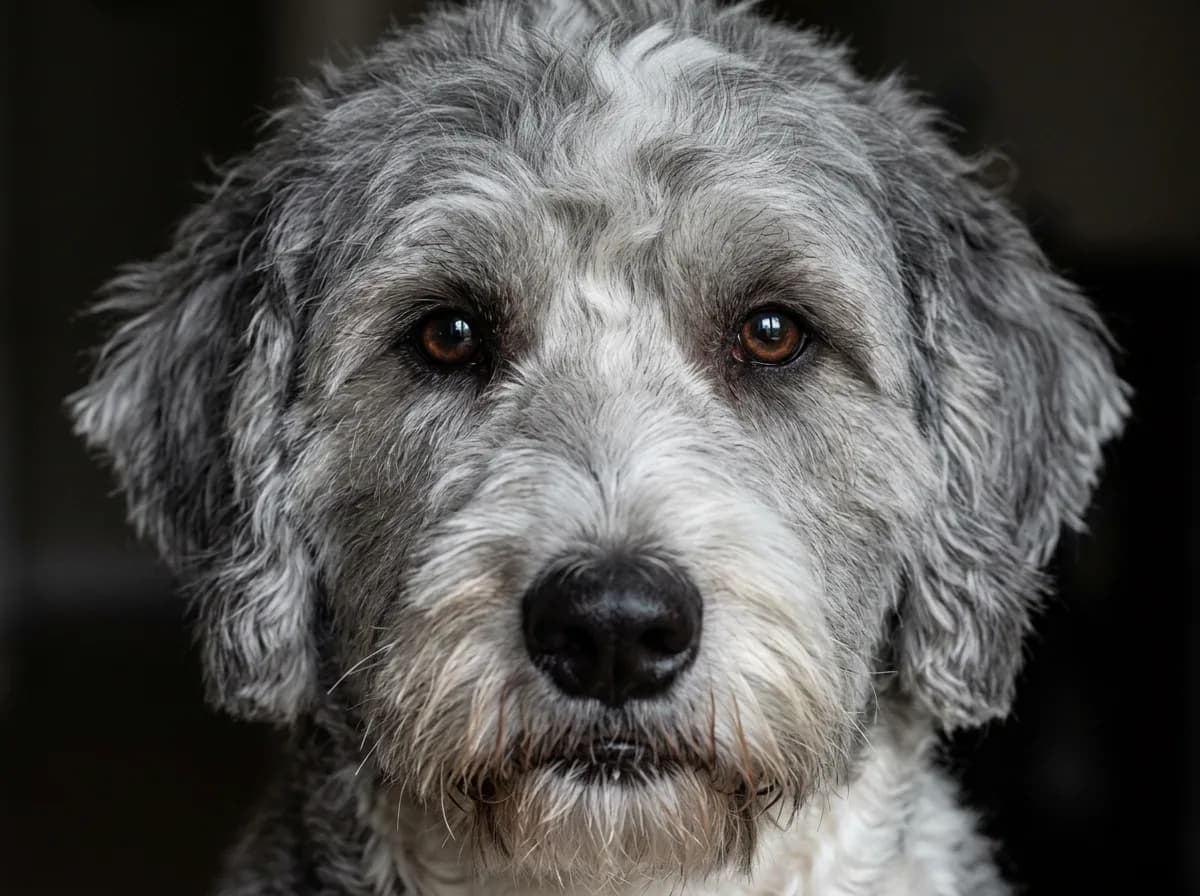
Between salon visits, Sheepadoodle grooming at home comes down to three small jobs done often rather than one large job done rarely. A face trim keeps hair out of the eyes, an ear check keeps moisture out of the canal, and a paw trim keeps grit and packed hair out from between the pads. None of the three takes long once a dog is used to being handled, and all three are what a groomer notices first when they have been skipped. Set a repeating reminder rather than waiting until something looks wrong, because a Sheepadoodle face tidied a little every couple of weeks never needs a rescue session, and paws checked weekly rarely turn into a mat you have to cut out.
- Face: aim for a clear triangle from the inner corner of each eye down the bridge of the nose, refreshed every one to two weeks.
- Ears: a weekly look inside the flap takes about 30 seconds and catches a yeast problem while it is still cheap to treat.
- Paws: level the pad hair every two to three weeks, and check between the toes after every long walk.
- Budget roughly 10 minutes a week for all three on schedule, against 40 minutes and an unhappy dog if you leave it two months.
- Work at waist height on a non-slip surface rather than on the floor, so you can see exactly where the blades are.
Sheepadoodle Face Trim
A Sheepadoodle face trim is mostly about the eyes. Sheepadoodle face grooming has a health purpose as much as a cosmetic one, because furnishings grow straight into the corner of the eye, wick tears down the muzzle and cause the staining and damp odor owners blame on diet. The goal is a clear triangle from the inner corner of each eye down the bridge of the nose.
- Use blunt-tipped safety scissors only, never a pointed pair, and never point the blade toward the eye.
- Rest the back of your scissor hand against the dog's head so the blade moves with the dog, not against it.
- Cut the hair growing over the eye and out of the inner corner, working from the nose upward.
- Comb the beard forward and trim the tips level rather than trying to shape it.
- Wipe the eye corners and beard daily with a damp cloth and dry them, because a wet beard is where mats and yeast both start.
- Leave the muzzle scissoring for a rounded teddy bear shape to the groomer. The eye clearance is the part that cannot wait.
Ears
Ear hair and the heavy Sheepadoodle ear leather are a combination that traps moisture, so ear care is a health job rather than a cosmetic one.
- Check inside the flap weekly for redness, a yeasty smell or brown discharge.
- Clean with a veterinary ear solution on a cotton pad, never a cotton bud pushed into the canal.
- Comb the hair behind and beneath the ear leather every time you brush, because this is where mats begin.
- Dry the ears thoroughly after every bath and every swim.
- Discuss plucking the hair in the ear canal with your vet or groomer rather than pulling it yourself. Opinions differ, it can irritate the canal, and it is not automatically the right answer for every dog.
Paws
- Trim the hair between the pads level with the pad surface using a small cordless trimmer or blunt scissors.
- Do not scoop hair out from between the toes, which leaves the skin exposed and sore.
- Round the hair over the top of the foot so the paw reads as a neat circle.
- Trim nails every two to three weeks, taking a small amount often rather than a lot rarely.
- Check between the toes for grass seeds, packed mud and small mats after every long walk.
- Wipe the paws down with grooming wipes after muddy or salted walks, which lifts grit out of the hair between the pads before it can felt into a mat.
The Sheepadoodle Grooming Tool Kit
Sheepadoodle grooming tools are one of the few areas where buying the cheap version genuinely costs more, because a poor brush skims the coat and leaves you convinced the job is done. You do not need a salon's worth of equipment, but you do need six things that work.
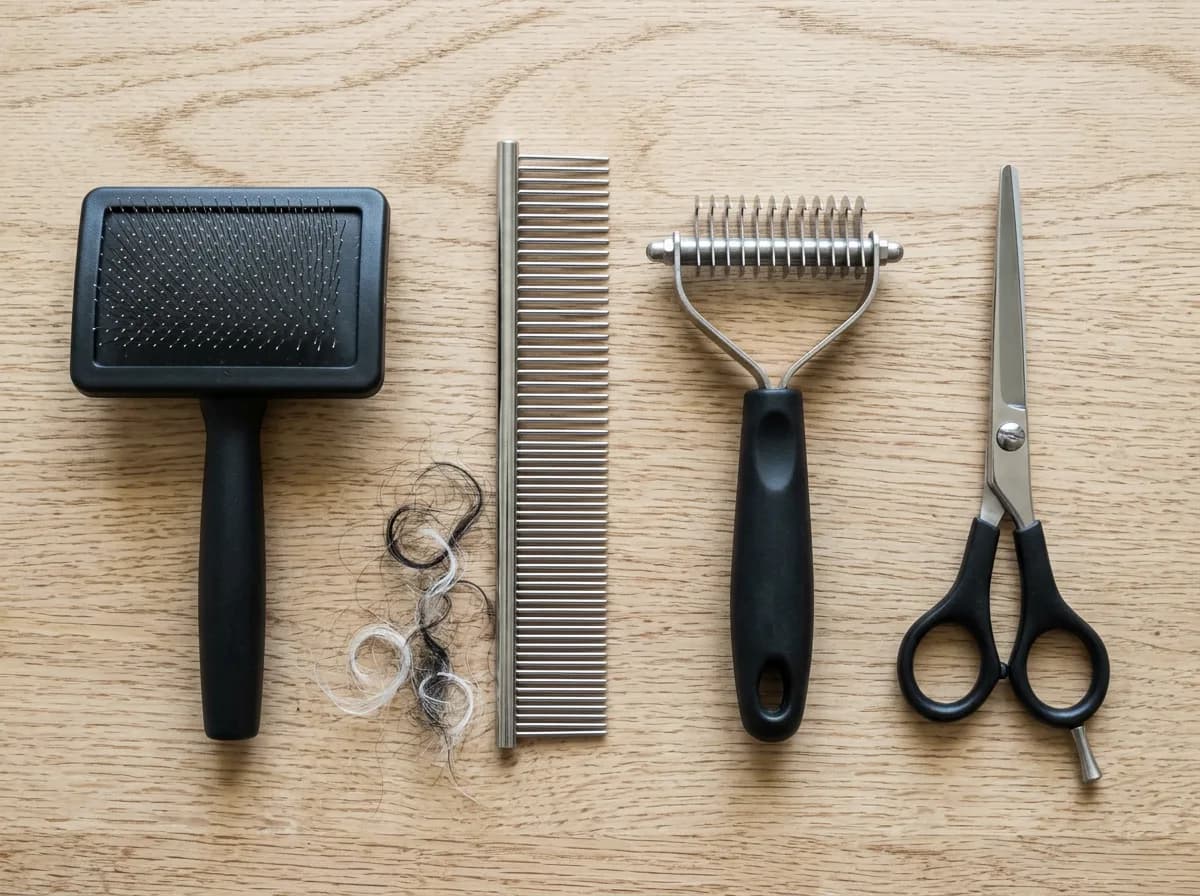
It helps to split Sheepadoodle grooming kit into two buckets. The first is the tools that do the work on a dry coat: a slicker, a steel comb, a dematting rake, blunt-tipped scissors, a small paw trimmer and a dryer. The second is the supplies you reach for on bath day, which cost less, get used up and are easy to forget until the dog is already wet. Buy the best brush and comb you can afford first, because those two decide whether a coat is genuinely maintained or only tidied on the surface, and treat everything after them as an upgrade you add over time. The two sections below cover each bucket and the buying mistakes that waste money.
- Six items cover almost every home session: slicker, steel comb, dematting rake, blunt-tipped scissors, paw trimmer, high-velocity dryer.
- Weigh the price of a good slicker and comb against a single dematting surcharge before deciding the cheap set is the economy.
- Size the slicker to the dog rather than to your hand, since an oversized pad cannot follow the curve of a leg or a muzzle.
- Replace a slicker once the pins splay outward, usually after a year or two of regular use, because bent pins skate over the coat.
- Keep bath-day supplies together in one box near the tub so nothing is missing once the dog is soaking wet.
The Best Brush for Sheepadoodle Coats
The best brush for Sheepadoodle coats is a firm, flexible-pin slicker brush sized to the dog, paired with a steel comb. Those two together do 90 percent of the work. A slicker with soft, wide-set pins bends over the surface of a dense doodle coat instead of reaching the skin, which is the most common equipment mistake owners make.
- Slicker brush: the primary tool for line brushing. Choose firm pins and a size you can control for 15 minutes without wrist fatigue.
- Steel greyhound-style comb: the referee. One coarse end and one fine end, used to verify every section you brush.
- Dematting rake: for splitting workable mats vertically before you tease them apart. Use it sparingly, because it cuts hair as it works.
- Blunt-tipped grooming scissors: eyes, beard tips, paw tidying and nothing else near skin.
- Cordless paw trimmer: a quiet, narrow-blade unit for pad hair and sanitary tidying.
- High-velocity dryer: the item owners skip and regret, because it blows water and loose undercoat out of the coat at once.
Sheepadoodle Grooming Supplies for Bath Day
Sheepadoodle grooming supplies beyond the brushes are short and cheap. A gentle dog shampoo, a conditioner or detangling rinse for curly coats, a leave-in detangling spray for daily brushing, a non-slip bath mat, a few absorbent microfibre towels, dog-safe ear cleaner and nail clippers or a grinder will cover a year of home grooming.
- Never use human shampoo, which sits at the wrong pH for canine skin.
- Conditioner is not optional on a curly coat, because slip is what lets a comb travel.
- Detangling spray goes on before brushing, lightly, not as a soak.
- Keep a dedicated towel set. Sheepadoodle coats hold an astonishing volume of water.
Bathing and Drying Without Creating Mats
Bathing is the step most likely to undo a week of good brushing, because water tightens every tangle already in the coat. Sequence matters more than product.
- Brush and comb the dog completely mat free before any water touches it, without exception.
- Bathe every four to six weeks, or sooner if the dog is genuinely dirty.
- Work shampoo through in the direction the coat grows rather than scrubbing in circles, which felts curl.
- Rinse for longer than feels necessary. Residue left at the skin causes itching and dulls the coat.
- Condition the whole coat on curly and wavy dogs, then rinse again.
- Dry to the skin with a high-velocity dryer while brushing at the same time. Air drying a Sheepadoodle is how a clean dog becomes a matted dog overnight.
- Comb the six friction zones once the dog is fully dry to confirm nothing tightened during the bath.
- An oatmeal and aloe shampoo is the safer default at a four to six week interval, because it rinses out cleanly and does not strip the coat oils that let a comb travel through curl.
Professional Groomer vs At Home: Cost and Cadence
Sheepadoodle grooming cost is driven by three things: the size of the dog, the condition of the coat when it arrives, and how much scissor work the style requires. A standard-size dog in good condition on a 6 to 8 week rhythm is a predictable line in the budget. The same dog arriving matted twice a year is not.
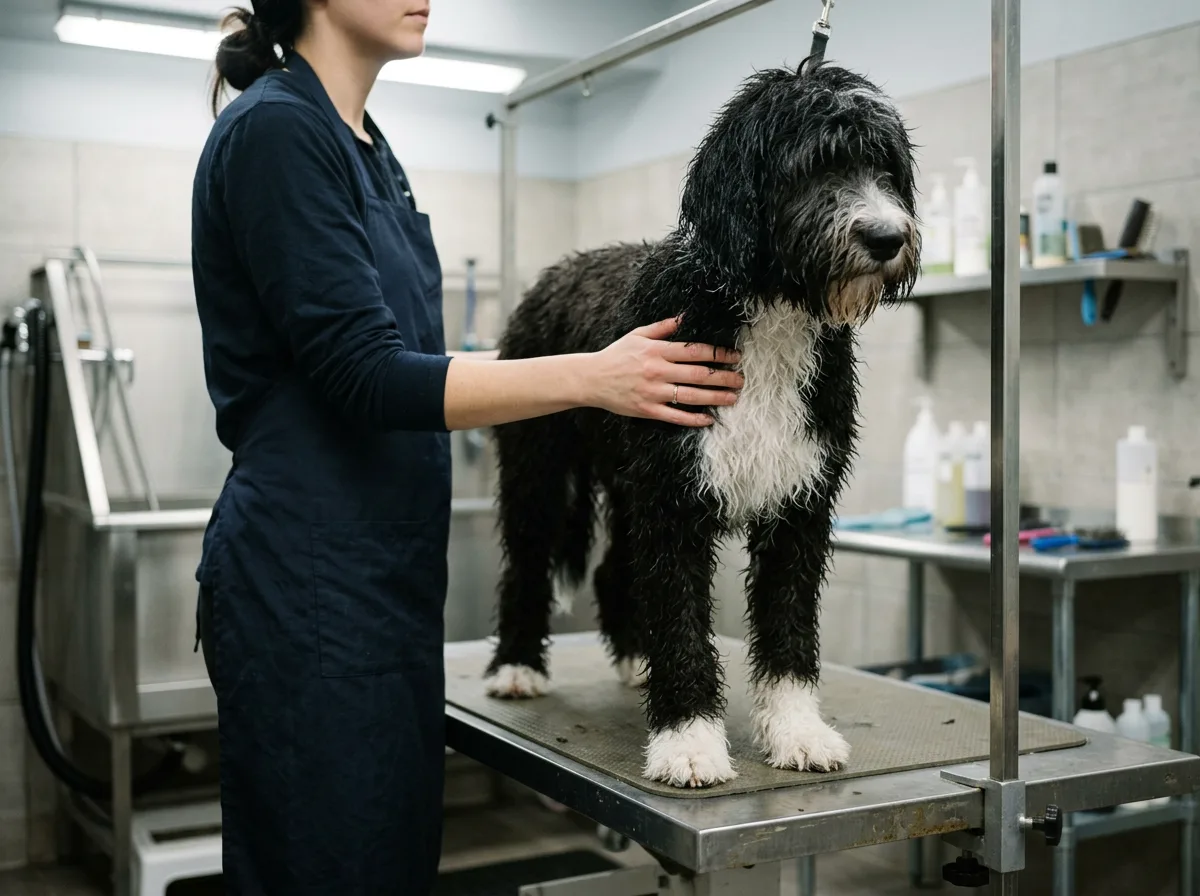
Groomers charge extra for doodles because they are selling time rather than a haircut, and a continuously growing coat needs a full brush out, a dry to the skin and hand scissoring before it looks like anything at all. What follows from that surprises most owners: salons usually quote doodles as a range and confirm the figure at drop-off, once someone has run a comb through the coat. That is not a bait and switch. It is the only honest way to price work whose length depends on the condition the dog arrives in. The variables below decide where inside that range you land, and most of them are settled at home between appointments rather than at the salon.
- Size sets the floor. A 70-pound dog carries roughly twice the coat area of a 35-pound one, and every stage (bath, dry, brush, scissor) doubles with it.
- Condition sets the surcharge. A dog that combs through cleanly is a standard groom, while mats behind the ears and under the harness are billed as dematting, usually by the quarter hour.
- Style adds scissor time. A hand-scissored teddy bear head takes far longer than a clipped kennel cut on the same dog, and that gap shows on every invoice.
- Behavior on the table counts. A dog that will not stand for a high-velocity dryer stretches a two-hour appointment, and some salons price that as a handling fee.
- Ask for the quote in two parts, the base groom and anything conditional, so you can see exactly what a five-minute comb check the night before would have saved you.
What a Groom Actually Costs
The price range below reflects typical full-service salon pricing in the United States, covering a bath, full dry, haircut, nails, ears and a sanitary trim. Rural salons sit at the low end and major metros at the high end, and mobile groomers usually add 25 to 50 percent on top.
| Service | Typical Price Range |
|---|---|
| Mini Sheepadoodle, standard full groom | $65 to $95 |
| Standard Sheepadoodle, standard full groom | $90 to $150 |
| Large Sheepadoodle over 80 lb, standard full groom | $120 to $200 |
| Bath, dry and brush out only | $45 to $80 |
| Dematting surcharge | $15 to $30 per additional 15 minutes |
| Full shave down of a pelted coat | $40 to $85 above the base price |
| Puppy introduction appointment | $35 to $60 |
Budgeting is simple once you fix the cadence. A standard Sheepadoodle groomed every 7 weeks at $120 comes to roughly $890 a year. Add two dematting sessions and you are past $1,000 for the same dog with a worse haircut.
Why Do Groomers Charge Extra for Doodles?
Because a doodle is priced by time, and a Sheepadoodle takes more of it than almost any other pet dog. A continuously growing coat has to be brushed out fully before the clipper touches it, blow dried to the skin, then hand scissored to shape, which is often two to three hours of labor against 45 minutes for a shorthaired dog of the same size. A dematting fee is added on top when the coat arrives tangled, because that work is slow, hard on the groomer's hands and hard on the dog. The surcharge is a time charge, not a breed tax.
- Groomers do not want to shave your dog and do not enjoy adding a dematting fee. Arrive with a coat a comb passes through and you pay the base price for the style you asked for. The brushing you do at home is, in a very literal sense, money.
What You Can Do at Home and What You Should Not
Knowing where the line sits between appointments prevents the injuries that send owners to an emergency vet on a Sunday.
| Task | At Home | Professional Groomer |
|---|---|---|
| Line brushing and combing | Yes, this is the core owner job | Included in every groom |
| Nail trimming | Yes, every 2 to 3 weeks | Yes, if you prefer |
| Eye area and beard tidying | Yes, blunt-tip scissors only | Yes, plus full face shaping |
| Paw pad hair | Yes, small trimmer | Yes |
| Bathing and drying | Yes, with a real dryer | Yes |
| Sanitary trim | Cautiously, with a trimmer not scissors | Yes |
| Full body clipper work | Only with training and proper clippers | Recommended |
| Dematting a pelted coat | No | Yes |
| Shave down | No | Yes |
| Ear canal hair plucking | No, discuss first | Discuss with your groomer and vet |
Searching sheepadoodle grooming near me is worth doing properly rather than by proximity alone. Ask whether the salon works on doodles regularly, what their matting policy is, whether they use a humanity-over-vanity standard, and whether they will send you home with the specific blade length they used so your next booking is repeatable. A groomer who explains their matting policy up front is telling you they are good at this.
The work you do between appointments is what keeps professional grooming at its baseline cost rather than its rescue price. A full-service groom every 6 to 8 weeks covers the bath, the dry, the haircut, nails and ears, and a standard dog held on a seven-week rhythm is a predictable annual figure. What an owner adds at home is not a cheaper version of that appointment. It is the maintenance that stops the appointment turning into a dematting session or a shave down.
- Book the next appointment before you leave the salon. A slipped booking is how a 7-week cycle quietly becomes an 11-week one.
- Do a five-minute comb check the week before every appointment and clear whatever you find, so the dog arrives in good condition rather than paying a time surcharge on the day.
- Keep face, paw and sanitary tidying at home on a two to three week rhythm. These are the areas that look neglected first and they are the safest for an owner to maintain.
- Leave clipper work over the body, full dematting and any scissor work near the eyes to the salon, whatever the video suggested.
- If money is the constraint, buy a shorter cut rather than a longer interval. Stretching 8 weeks to 12 costs more than the shorter clip would have.
Grooming a Mini Sheepadoodle
Mini Sheepadoodle grooming follows every principle on this page, because the coat genetics are identical. The differences are practical rather than technical: sessions are shorter, tools should be sized down, grooming prices sit at the bottom of the range, and the Miniature Poodle influence makes a tight curly coat somewhat more likely, which nudges most minis toward the daily end of the brushing schedule. A mini Sheepadoodle teddy bear cut is the most requested style in the smaller size, and it holds its shape slightly longer simply because there is less coat to collapse. For size, weight and mini-specific care detail, see our full mini Sheepadoodle guide.
Where Grooming Fits in the Bigger Sheepadoodle Picture
Coat care is the largest single commitment in this breed, but it is not the only one to weigh up. Exercise needs, separation sensitivity, the size the dog will actually reach and the health conditions it can inherit all belong in the same decision, and grooming workload is only one line in that list. Our Sheepadoodle breed guide covers the full set of drawbacks and trade-offs, including the temperament and lifestyle demands that catch owners out.
If you are still choosing, it is also worth reading up on how big the dog will get before you commit to a coat this size, since a full-grown standard takes noticeably longer to brush than the puppy in front of you. Our Sheepadoodle size chart sets those expectations, and the Sheepadoodle vs Bernedoodle comparison is the right place to look if grooming load is a deciding factor between two doodle crosses.
Get the routine right and this is a genuinely manageable breed. Test the coat, set the cadence from the result, learn to line brush, keep the length honest about your schedule, and book the groomer before the coat needs rescuing rather than after.
Brush at home daily for a curly coat, four to five times a week for a wavy coat, and two to three times a week for a flat coat, then book a professional groom every 6 to 8 weeks. During the puppy coat change, brush daily regardless of texture.
Usually not a true double coat. The Old English Sheepdog parent has one and the Poodle does not, so most Sheepadoodles inherit a single continuously growing coat. Straight or flat-coated dogs often carry enough undercoat density to behave like a partial double coat and shed seasonally.
No. Shedding is light in curly and wavy coats and moderate in flat, unfurnished coats. The catch is that shed hair stays trapped in the coat instead of falling out, so it has to be brushed and combed out or it becomes matting.
No dog is truly hypoallergenic. A curly, fully furnished Sheepadoodle spreads less dander around a home and suits many allergy-sensitive owners, but reactions vary by individual dog. Spend time with the specific dog before committing rather than relying on the breed label.
An even one to two inch body length with the head and muzzle scissored into a soft round shape and the ears blended in. It is the most requested doodle style and needs brushing most days plus a groom roughly every 6 weeks to hold its shape.
Between 12 and 16 weeks, once the vaccination series allows it. Book a short puppy introduction rather than a full groom, so the first visit is about handling, clippers running nearby and standing on the table rather than about the finished haircut. Keep the first two or three appointments brief even if that means booking twice in one month. The real cut can wait until around six months, when the adult coat starts coming in, and a puppy that has already learned the salon is boring will sit for it.
A firm-pin slicker brush for line brushing, always paired with a steel greyhound-style comb to verify the coat is clear to the skin. Soft, wide-set slicker pins skim the surface of a dense coat and leave mats forming underneath.
Roughly $65 to $95 for a mini, $90 to $150 for a standard and $120 to $200 for a large dog per full groom, with a dematting surcharge of about $15 to $30 per extra 15 minutes when the coat arrives tangled.
Not when the coat has pelted. Shaving is the humane choice over hours of painful dematting. Shaving a healthy coat purely to keep a dog cool is a poor idea, because the coat insulates against heat and protects skin from sunburn.
Three things decide whether Sheepadoodle grooming stays manageable, and none of them is a generic brushing rule. The first is cadence set from your dog's actual coat texture rather than from the breed name. The second is treating the coat change as a scheduled grooming event with its own plan rather than a phase to wait out. The third is understanding that the dematting surcharge groomers add is a time charge, so every mat you clear at home is money that stays in your pocket.
- Cadence: the coat type test result sets the schedule, and a curly dog and a flat-coated dog from the same litter can sit three sessions a week apart.
- Coat change: put it in the calendar rather than discovering it. Shorten the working length before it starts and book an extra salon visit inside the window.
- Dematting: the charge is usually billed as extra time, often in 15-minute increments or as a flat add-on, and two of them in a year is enough to take a roughly $890 grooming budget past $1,000.
- Condition on arrival is the one price variable an owner controls. Size and style are fixed once you have chosen the dog and the cut.
- If your cadence keeps slipping, shorten the coat rather than promising yourself more brushing. A shorter dog on an honest schedule stays mat free, and a longer dog on an aspirational one does not.

Coreen Saito is a pet writer and longtime shelter volunteer with more than a decade in animal rescue. She covers cat behavior, breed care, and the small, ordinary science of sharing a life with companion animals, with a particular focus on honest takes about the products and decisions that actually matter. At home in Arizona, she's outranked by Mac (a dog with the loudest opinion in the house), Rebel (a cat who governs by quiet authority), and Meri (an orange tabby who runs the late shift and the laundry basket). She writes about all three, plus the rescues that keep coming through her life, at LifeWithMinty.com.
Sign up for expert-backed reviews and safety alerts all in one place.