Mini Sheepadoodle: Full Grown Size, Cost, and Care
A full grown mini Sheepadoodle stands 16 to 20 inches and weighs 25 to 45 pounds. See measured adult size bands, how a micro really compares, the price premium over a standard, temperament, and whether one suits an apartment.
Petful is reader supported. As an affiliate of platforms like Amazon and Chewy, we may earn a commission when you buy through links on this page. There is no extra cost to you.
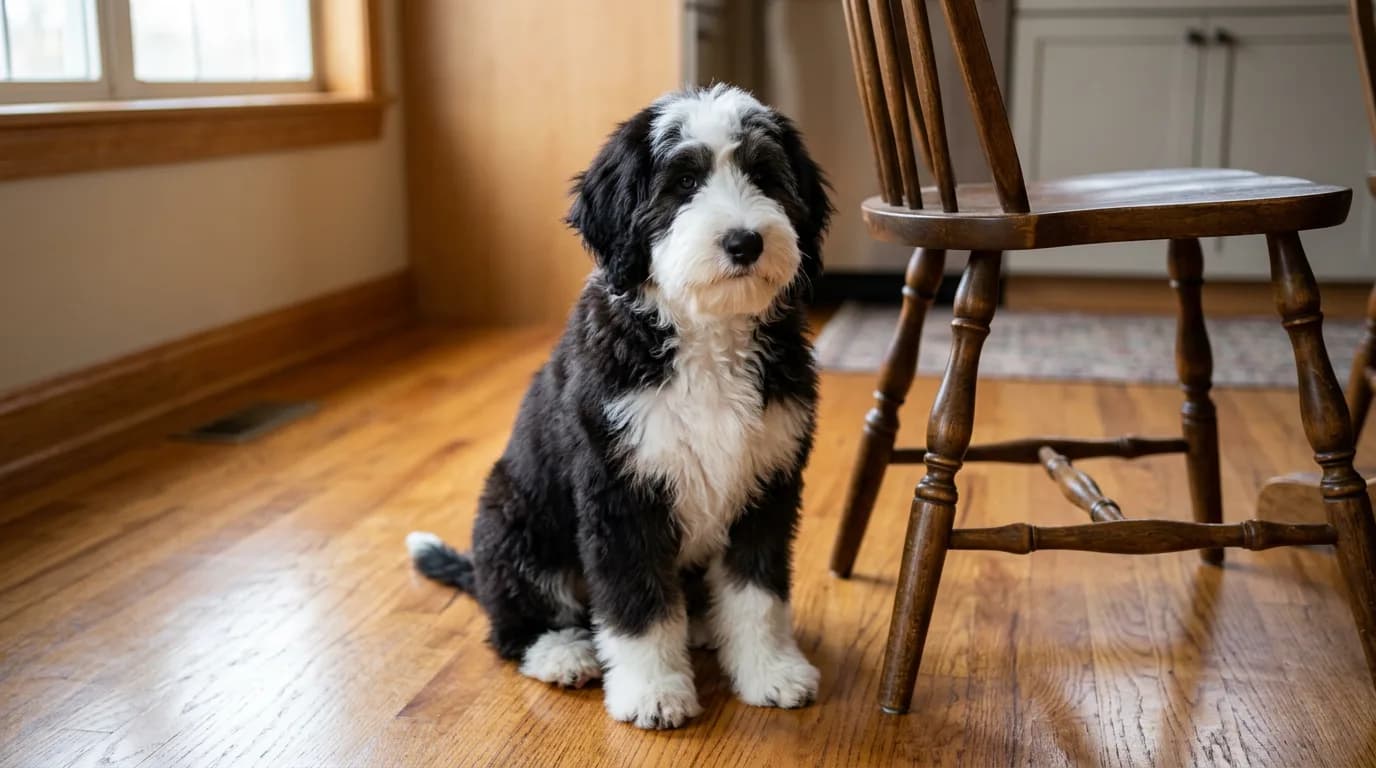
A full grown mini Sheepadoodle stands 16 to 20 inches at the shoulder and weighs 25 to 45 pounds, which puts it roughly halfway between a beagle and a border collie in bulk. It is an Old English Sheepdog crossed with a Miniature Poodle, or more often a standard Sheepadoodle bred back to a Miniature Poodle, and that single swap in the parent lineup is the only thing separating it from the standard version of the same cross.
That size difference is why people search for this dog specifically, and it is exactly where the ranking pages fall short. Almost every result is a breeder listing, so the numbers a buyer actually needs sit behind a wall of puppy photos. This guide publishes them plainly: measured adult height and weight, an honest comparison against the micro tier, what the size premium really costs, and whether the apartment claim survives contact with a real weekday schedule.
- 1A full grown mini Sheepadoodle stands 16 to 20 inches and weighs 25 to 45 pounds, reaching adult height at roughly 11 to 13 months.
- 2A mini is a size variant, not a separate breed, and no registry recognizes the Sheepadoodle at any size.
- 3Expect $2,500 to $4,500 from a health-testing breeder, which is $500 to $1,500 above what the same program charges for a standard.
- 4Plan on 45 to 60 minutes of daily exercise plus grooming every six to eight weeks, at any size.

Sign up for expert-backed reviews and safety alerts all in one place.
What is a Mini Sheepadoodle?
A mini Sheepadoodle is a deliberate cross between an Old English Sheepdog and a Miniature Poodle, producing a shaggy, low-shedding, people-focused dog in a body most owners can lift. Breeders and buyers write the name both ways, so a search for "sheepadoodle mini" returns the same animal as a search for the more common word order. Both spellings describe one cross at one size class.
Two parent breeds shape everything about this dog:
- Old English Sheepdog: a heavy-boned drover with a famously profuse coat, a slow-maturing brain, and a calm, clownish, deeply affectionate temperament. It contributes bulk, bounce, and the shaggy face.
- Miniature Poodle: a 10 to 15 inch, 10 to 15 pound working retriever in miniature. It contributes the size reduction, the tight curl that traps shed hair, and a very fast learning curve.
The most important thing to understand before you shop is that a mini is not a separate breed. It is a size variant of the same cross, produced by choosing a smaller Poodle parent rather than by any distinct bloodline or standard. The American Kennel Club registers both parent breeds but does not recognize the Sheepadoodle at any size, which means there is no official height or weight standard anywhere, and no registry policing what a breeder calls a mini.

Soft-sided travel safety carrier that keeps a stressed cat secure and well-ventilated on the way to the vet, with mesh panels for airflow and a seat-belt loop.
Petful may earn a commission when you click through to Chewy, at no extra cost to you.
| Trait | Mini Sheepadoodle |
|---|---|
| Parent breeds | Old English Sheepdog x Miniature Poodle |
| Full grown height | 16-20 in at the shoulder |
| Full grown weight | 25-45 lb |
| Lifespan | 12-15 years |
| Daily exercise | 45-60 minutes |
| Coat | Wavy to curly, low shedding, non-seasonal growth |
| Typical price | $2,500-$4,500 |
Because there is no standard, the label does real work in the marketplace and very little work biologically. One breeder's mini finishes at 28 pounds and another's finishes at 46, and both are advertised identically. The practical fix is to stop buying the label and start buying the recorded adult weights of the parents and grandparents, which is a question every serious program can answer in writing.
How big does a Mini Sheepadoodle get?
A mini Sheepadoodle gets to 16 to 20 inches tall at the shoulder and weighs 25 to 45 pounds full grown, with most adults settling near 35 pounds. That is the honest adult weight range, and the spread is wide because the Old English Sheepdog side is a 60 to 100 pound breed, so how much of that bulk carries through depends heavily on the specific pairing.
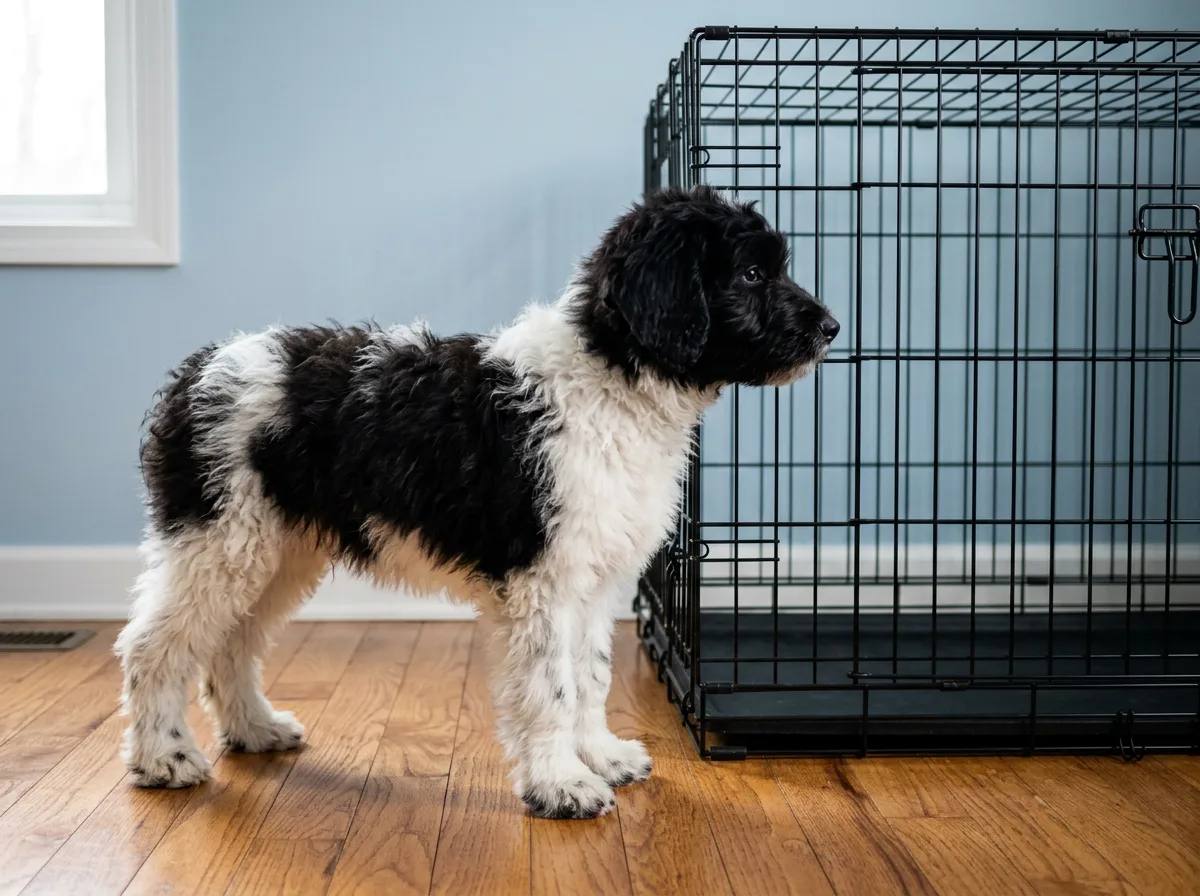
How large do mini Sheepadoodles get in practice? Most reach their adult shoulder height between 11 and 13 months, then keep adding chest, muscle, and coat density until roughly 16 months, so a dog that looks finished at ten months is usually still two to four pounds short of its final number. The mini Sheepadoodle weight your dog lands on is predicted far better by the recorded weights of both parents than by any breeder estimate, since a litter out of a 55 pound standard Sheepadoodle dam finishes very differently from a litter out of a 30 pound one.
| Size class | Shoulder height | Adult weight | Reaches adult height |
|---|---|---|---|
| Micro mini | 12-16 in | 15-25 lb | 10-12 months |
| Mini | 16-20 in | 25-45 lb | 11-13 months |
| Standard | 20-27 in | 55-85 lb | 14-18 months |
Since those figures sit in a table, here is the same mini Sheepadoodle size in plain text: 16 to 20 inches tall, 25 to 45 pounds, done growing upward around the first birthday and done filling out by about 16 months. Buyers ask about mini Sheepadoodle full grown size in a dozen different phrasings, but the answer does not change, and mini Sheepadoodle full grown weight is simply the upper two thirds of that band once the dog carries adult muscle.
Three practical bands sit inside that range:
- Small mini: 16 to 17 inches and 25 to 32 pounds, usually out of a smaller Miniature Poodle sire and a light standard dam.
- Typical mini: 17 to 19 inches and 32 to 40 pounds. This is what most breeders mean when they say mini.
- Large mini: 19 to 20 inches and 40 to 45 pounds, which shades into medium territory and is often sold as a mini anyway.
- For a mini Sheepadoodle, doubling the puppy's weight at 16 weeks gives a workable adult target, usually within about four pounds. It is rough, but it beats a breeder estimate given before the litter was weaned. Ask for weekly weights instead of a single guess.
Micro Mini Sheepadoodle vs Mini Sheepadoodle
A micro mini Sheepadoodle is the smallest marketed tier, typically 12 to 16 inches and 15 to 25 pounds, produced by breeding a mini back to a Toy or very small Miniature Poodle across two or more generations. A micro mini Sheepadoodle full grown is therefore roughly two thirds the height and half the weight of a typical mini, which is a genuine and visible size comparison rather than a marketing distinction alone.
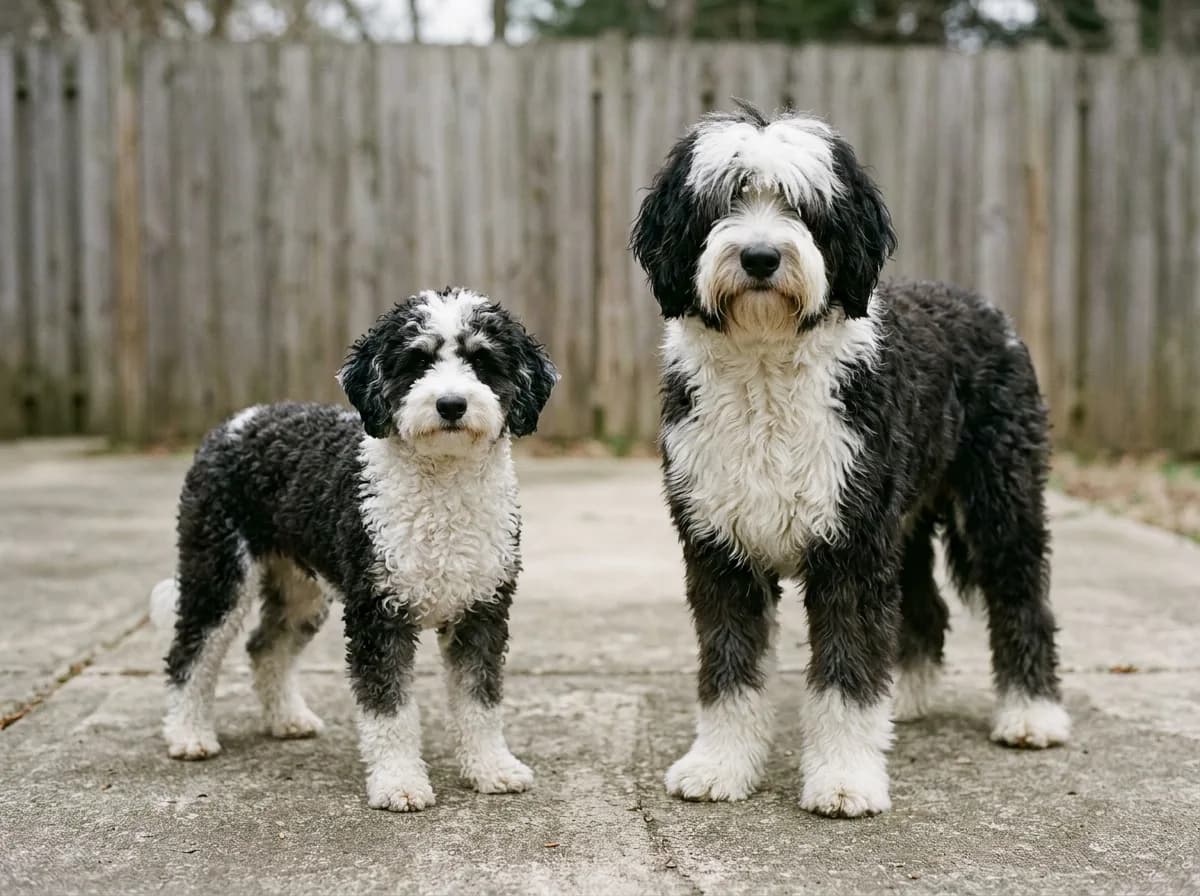
What the label does not carry is any guarantee. No kennel club defines micro, so the word means whatever the seller wants it to mean:
An airline-approved soft-sided carrier with patent safe buckles and mesh ventilation panels, sized for cats and small dogs.
Petful may earn a commission when you click through to Chewy, at no extra cost to you.
- No agreed threshold. One program calls a 22 pound adult a micro while another applies the same word to a 14 pound adult.
- Generation stacking. Reaching micro weights usually takes two or three rounds of breeding down, which narrows the gene pool being drawn from.
- Health load. Very small crosses carry higher rates of luxating patella, dental crowding, and tracheal issues than dogs in the mini band.
- Coat is unchanged. Shrinking the dog does not reduce the grooming schedule, and a smaller coat still mats on the same timeline.
- Price climbs as size drops. The micro tier reliably costs more than the mini tier from the same breeder.
- Nail work changes at this size. The quick sits closer to the tip on a 15 to 25 pound dog, so small-dog nail clippers give a sight line the full-size head blocks, and trims still land every three to four weeks. There is more on this in Petful’s guide to best dog nail clippers.
- Crowded teeth need daily contact, not a weekly pass. A finger toothbrush sits flat against the back molars in a narrow jaw where a long-handled brush cannot reach.
Listings for micro sheepadoodle for sale, micro mini sheepadoodle for sale, and micro mini sheepadoodle for sale near me generally come from programs specializing in the small end, and search results for micro mini sheepadoodle breeders skew heavily toward a handful of national kennels that ship. If you are shopping that tier, the questions that matter are what the smallest adult in the pedigree weighed, whether patella and eye clearances exist on both parents, and whether the breeder will state a weight range in the contract.
- No breed registry recognizes a micro Sheepadoodle, so the term carries no weight guarantee and no health standard. A puppy sold as a micro can finish at 28 pounds, well inside normal mini territory. Buy on the recorded adult weights of parents and grandparents, never on the word in the advertisement.
How much does a Mini Sheepadoodle cost?
A mini Sheepadoodle costs $2,500 to $4,500 from a breeder who health tests both parents, with $3,000 to $3,500 being the most common asking figure in 2026. Micro-marketed puppies run $3,500 to $6,000. The mini Sheepadoodle price also moves with coat color, coat predictability, region, and waitlist length, and a mini Sheepadoodle for sale under $500 is not a bargain, it is a warning.
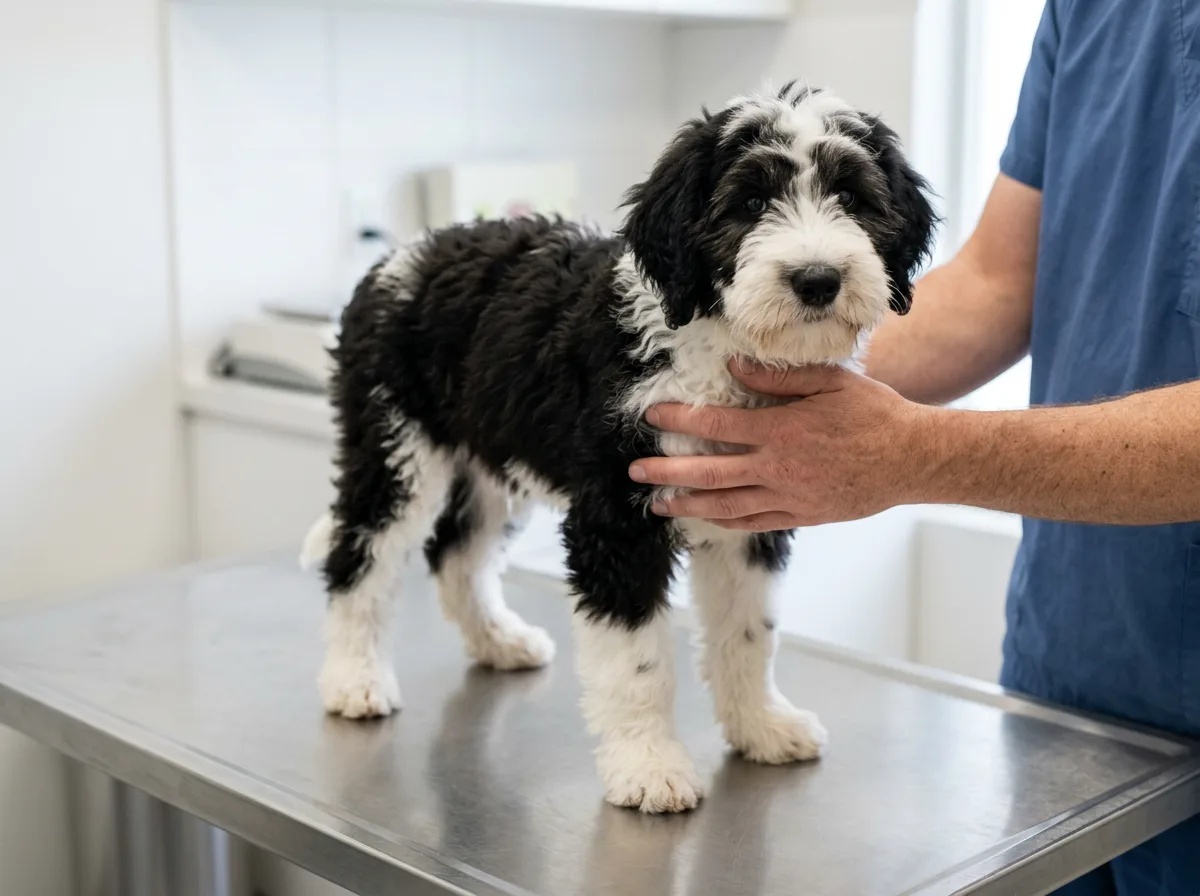
Here is the comparison no ranking page publishes: the smaller dog costs more to buy.
| Cost line | Mini Sheepadoodle | Standard Sheepadoodle |
|---|---|---|
| Purchase price | $2,500-$4,500 | $1,500-$3,000 |
| Monthly food | $35-$55 | $70-$110 |
| Professional groom (per visit) | $75-$95 | $110-$150 |
| First-year total | $4,500-$7,000 | $3,800-$6,200 |
| Annual cost after year one | $1,900-$3,000 | $2,600-$4,000 |
That gap is the price premium in one line: a mini typically costs $500 to $1,500 more than a standard from the same program, because mini litters are smaller, the pairings are harder to plan, and demand for compact doodles outruns supply. The trade is that lifetime running costs fall, since a 35 pound dog eats about half what a 70 pound dog eats and pays less for grooming, preventives, and weight-dosed medication across 12 to 15 years.
What actually moves the mini Sheepadoodle cost:

Peanut butter soft chews with L-theanine, chamomile, and ashwagandha to ease hyperactivity and support calm, relaxed behavior.
Petful may earn a commission when you click through to Chewy, at no extra cost to you.
- Size class. Smaller sells for more, and the micro tier carries the steepest markup.
- Health testing. Hip, elbow, eye, and cardiac clearances on both parents are built into the price and are the single line worth paying for.
- Generation. Backcrossed litters price higher because buyers pay for coat predictability.
- Color. Merle and tri-color puppies commonly price $500 to $1,000 above black and white littermates.
- Region and waitlist. Established metro programs with multi-year lists charge more than rural ones.
- Feeding cost. A 35 pound adult eats roughly half what a 70 pound standard does, so one bag of complete dry food lasts about twice as long at the same shelf price.
- Grooming spend is the line you control. Appointments run $75 to $95 every six to eight weeks, and a cordless clipper kit for feet, face, and sanitary trims stretches that interval by two to three weeks.
- Setup costs. Budget the first month as well as the deposit, and a 36 inch folding wire crate sized for a 45 pound adult is the one item you should not have to buy twice.
- A health-tested mini Sheepadoodle litter costs the breeder well over $500 per puppy before any profit. Listings far below market almost always mean no clearances, no vet records, a broker, or an outright scam. Never wire a deposit for a dog you have not seen on a live video call with its dam.
Work the premium out in both directions before you accept it. A mini priced $500 to $1,500 above a standard from the same program should buy something specific: smaller planned litters, a documented coat outcome, or clearances the standard litter did not have. If the breeder cannot say what the premium pays for, it is a size surcharge on a word. At the other end, a mini Sheepadoodle listed under $500 is not a cheaper version of the same dog. It is a different transaction, and usually a worse one.
- Ask any program for its standard-size price alongside its mini price. A premium you cannot compare inside one program tells you nothing, because region and waitlist move both numbers at once.
- Under $500 usually means one of four things: no clearances on the parents, a broker reselling a litter it never raised, a puppy being moved long distance by transport, or a deposit that will never produce a dog.
- Treat a request for payment by wire, gift card, or peer-to-peer app as disqualifying whatever the price says.
- The premium should be visible in paperwork. Hip, elbow, eye, and cardiac clearances are documents with dates and registry numbers, not a claim on a website.
- Get what the price includes in writing: microchip, first vaccinations, the health guarantee window, and a stated adult weight range. Two quotes that look $800 apart often differ by exactly those items.
Be clear about what the price premium a mini carries over a standard Sheepadoodle actually buys. That $500 to $1,500 gap is a demand surcharge rather than a quality upgrade: it delivers a smaller adult dog, not a healthier or better-tempered one. Health testing sits underneath both numbers and should never be offered as the reason the mini costs more. The premium is also front-loaded and unrecoverable. You pay it once, on day one, and it does nothing for you across the twelve to fifteen years that follow, which is worth weighing against the same money sitting in an emergency fund from the week the puppy comes home.
- The gap is paid once. Feeding a 35 pound dog instead of a 70 pound one pays you back slowly, across 12 to 15 years.
- Grooming does not shrink in proportion with the dog. Appointments still land every six to eight weeks at $75 to $95.
- Micro-marketed puppies sit higher again at $3,500 to $6,000, and the extra buys size, not screening.
- If a breeder cannot say what the premium pays for, put that money into the first-year emergency fund instead.
Mini Sheepadoodle temperament and apartment fit
Mini Sheepadoodle temperament is the Old English Sheepdog's affectionate, goofy, slightly bumbling nature wired to the Miniature Poodle's speed of learning. The result is a soft, sociable dog that wants to be in the room with you, learns household rules quickly, and does not have the sharp herding edge that drives some other doodle crosses. Most are gentle with children, unbothered by other dogs, and more likely to lean on a stranger than to guard against one.
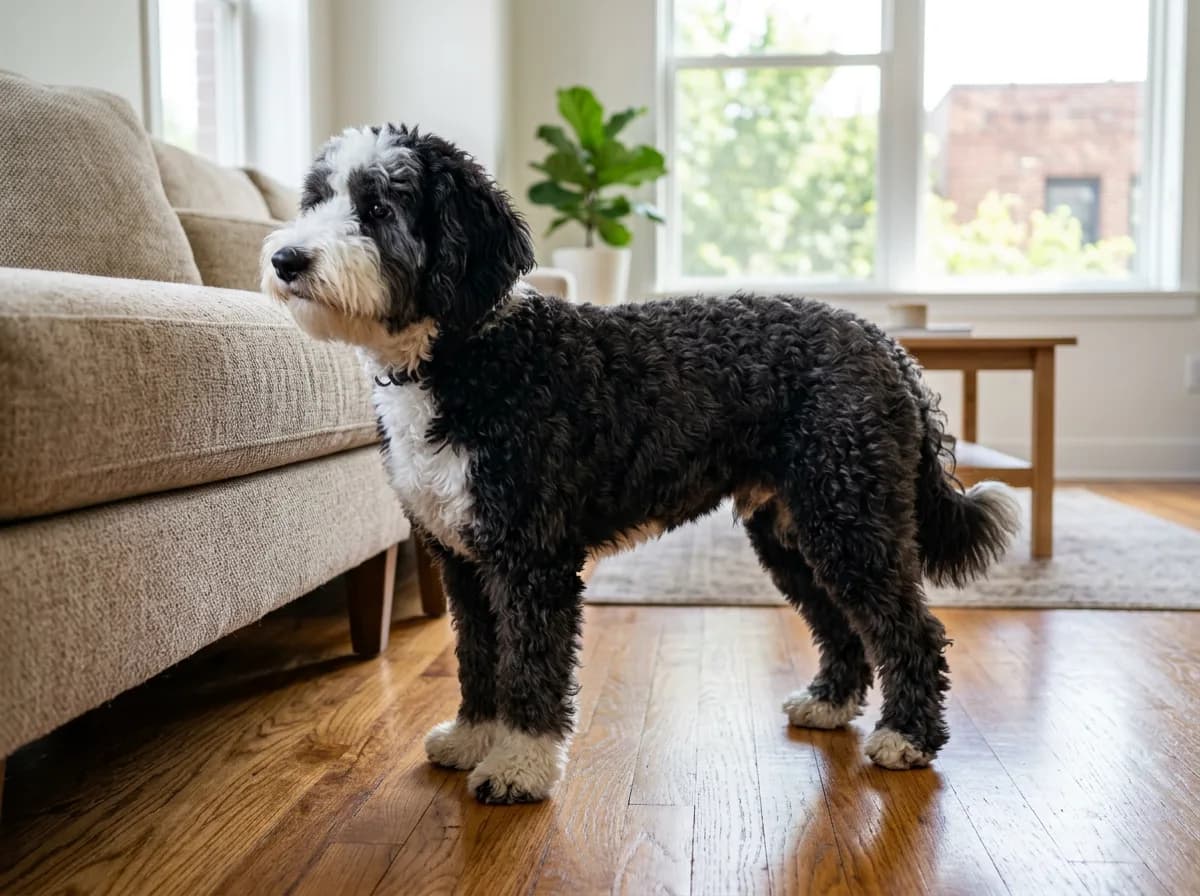
Consistent traits worth planning around:
- Velcro sociability. They follow you room to room and are prone to genuine separation distress in homes empty ten hours a day.
- Moderate, steady energy. Bouncy in bursts, then happy to sprawl. This is not a border collie in a small suit.
- Soft to correction. Harsh handling shuts them down. Reward-based training works dramatically better.
- Slow to mature. The Old English Sheepdog side stays puppyish until two or three years old.
- Low but real alert barking. Quieter than most herding crosses, though shared walls still argue for an early quiet cue.
Buyers also search mini Sheepadoodle hypoallergenic before they search anything else, so it is worth answering directly. No dog truly is hypoallergenic, because the allergens live in dander and saliva rather than in hair. What the Poodle coat does is trap shed hair instead of releasing it, which cuts airborne allergen circulation enough that many mild sufferers cope well. Spend an hour with an adult from the same breeding line before you commit, since reactions vary far more by individual than by generation label.
So does one actually suit apartment living? Usually yes, and the size genuinely helps, but the schedule decides it rather than the square footage. Work through this honestly:
- Can you deliver 45 to 60 minutes of daily exercise, split across at least two outings, in every season?
- Is there safe off-leash or long-line space within a short walk?
- Will the dog be alone more than six hours on a typical weekday?
- Can you add 10 minutes of scent work or puzzle feeding on days the walk gets cut short?
- Is grooming every six to eight weeks in the budget, given the coat grows continuously?
Four or five workable answers means apartment living will suit a mini Sheepadoodle well. Two or fewer means the dog will be under-served in any home, house or apartment, because the daily exercise floor and the company requirement do not scale down with the dog.
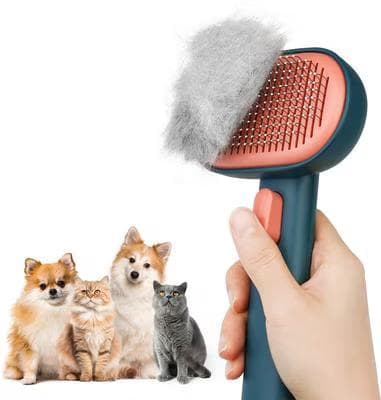
Petful may earn a commission when you click through to Chewy, at no extra cost to you.
- A 25-minute morning walk, a 20-minute evening walk or play session, one 10-minute training or sniffing game, and a longer weekend outing covers a mini Sheepadoodle comfortably. Two shorter outings beat one long one, because the dog resets between them.
To make that concrete, here is what apartment living with a mini Sheepadoodle looks like on a normal Tuesday. Energy level is moderate and bursty rather than relentless, so the daily exercise floor of 45 to 60 minutes is realistic, but it has to be split and it has to include something more interesting than a pavement loop. Temperament is the harder constraint. Alone-time tolerance, not square footage, decides whether this works, and no apartment layout compensates for a ten hour weekday.
- Morning: 25 to 30 minutes, with at least ten of it off pavement or on a long line so the dog gets to sniff and problem-solve rather than just march.
- Midday: a toilet break inside six hours. In an apartment every toilet trip is a full trip down and back, which is the part people underestimate about having no yard.
- Evening: 20 to 30 minutes on leash, then a short training session. Five minutes of shaping a new trick settles this temperament more effectively than a second lap of the block.
- Build alone time deliberately from week one with short absences you extend gradually. A dog that has never practiced being alone will not learn it at ten months old.
- Shared walls make the alert bark matter more than it would in a house. Teach a quiet cue early and manage window access, because hallway barking is a boredom problem before it is a temperament problem.
- The weather test is the honest one. If a cold, wet Tuesday reliably shrinks the walk to five minutes, that shortfall lands on a dog with no way to exercise itself indoors.
F1 vs F1b Mini Sheepadoodles
Generation labels tell you about the coat, not the size, and they are the second most misread thing in these listings after the word micro. An F1 mini Sheepadoodle is a first cross, one purebred Old English Sheepdog to one Miniature Poodle, so it is a straight 50-50 split. An F1b mini Sheepadoodle is an F1 bred back to a Miniature Poodle, landing at roughly 75 percent Poodle.
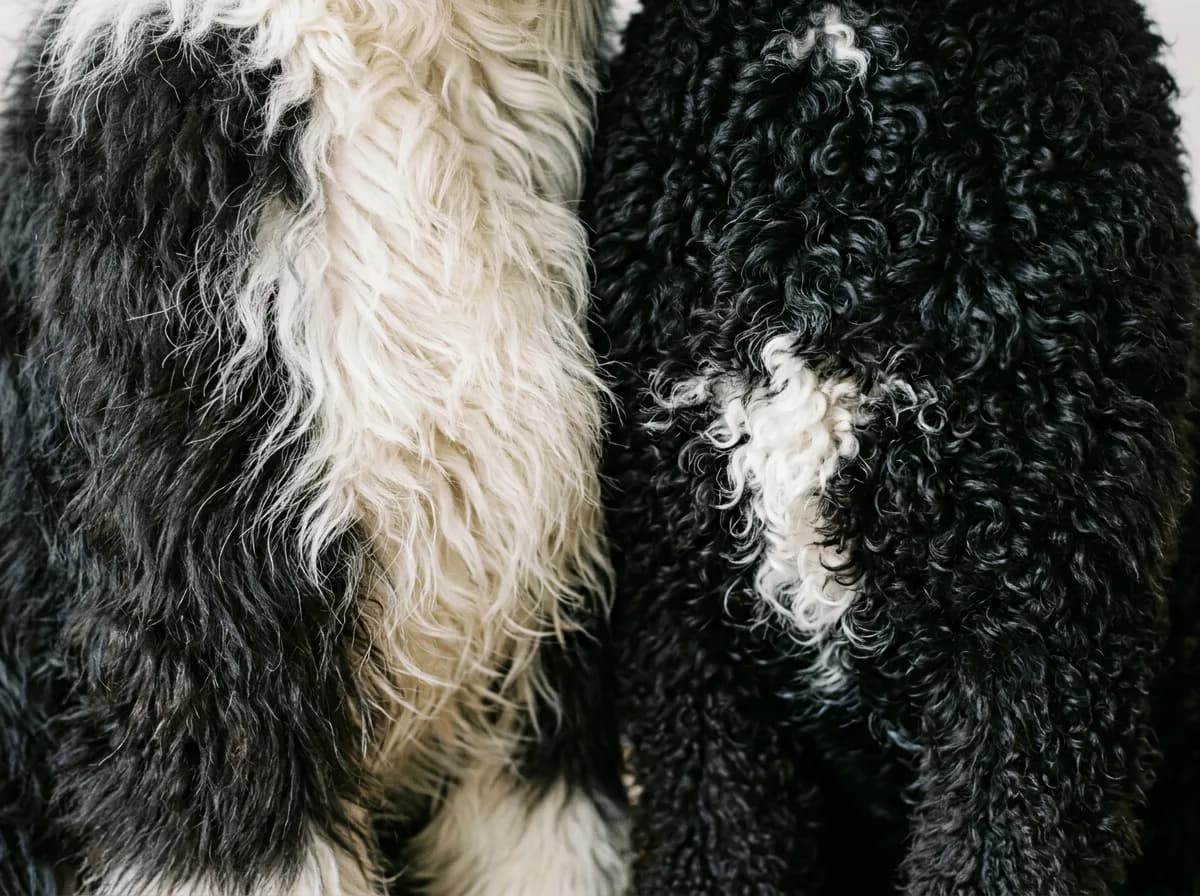
What changes between them:
- Coat texture. F1 litters vary from loose wave to full curl, and some F1 dogs shed lightly. The F1b generation produces the curliest and most consistently low-shedding coats.
- Allergy tolerance. Most allergy-sensitive buyers are steered toward the F1b generation for that reason, and listings for f1 mini sheepadoodle puppies for sale often price below their F1b littermates because of it.
- Grooming load. Curlier is not easier. F1b coats mat faster and usually need brushing every other day.
- Size predictability. A backcross to a small Poodle tends to pull adult weight downward, which is how many programs produce their micro tier.
- Appearance. F1 dogs more often keep the shaggy Old English Sheepdog face that buyers picture; F1b dogs read more Poodle.
- Tool choice. Every-other-day brushing on an F1b coat is only realistic with a self-cleaning slicker brush, since clearing a packed head by hand is what makes owners quit the schedule.
- Wash day. Curl mats tighter when it dries rough, so a 2-in-1 shampoo that conditions in the same pass cuts the brush-out that follows a bath.
One breeding practice deserves a flat answer rather than a preference. Merle patterning appears in some Sheepadoodle lines through the Poodle side, and merle-to-merle pairings are never acceptable, because roughly a quarter of that litter inherits two copies and is born at high risk of deafness, blindness, and eye malformation. Any breeder advertising a merle-to-merle litter has told you what their standards are, and the correct response is to walk away.
Mini Sheepadoodle lifespan and health span
The lifespan of a mini Sheepadoodle is 12 to 15 years, roughly one to three years longer than a standard, following the usual pattern that smaller dogs outlive larger ones. Health span matters as much as lifespan here, and the joints do most of the deciding. Hip dysplasia runs in the Old English Sheepdog line and is the single most valuable clearance to demand on both parents, since a smaller frame reduces load but does not remove the inherited risk.
The screening panel that matters at this size:
- Hips and elbows: OFA or PennHIP evaluation on both parents.
- Eyes: annual ophthalmologist exam covering progressive retinal atrophy from the Poodle side.
- Cardiac: particularly relevant on the Old English Sheepdog side.
- Thyroid and Addison's screening: both parent breeds carry documented endocrine risk.
Some buyers arrive asking why vets are cautious about doodle crosses generally, which is a fair question about screening standards, hybrid vigor claims, and breeding practice rather than about any one size. Our Sheepadoodle health issues guide works through the veterinary concerns and the specific tests that address them.
Mini Sheepadoodle downsides worth knowing
The downsides of a mini Sheepadoodle are concrete and worth naming before a deposit. Grooming is a permanent commitment rather than an occasional chore, since the coat grows continuously and needs brushing several times a week plus a professional appointment every six to eight weeks. They do not tolerate long solitude and can develop real separation distress. The purchase price runs above the larger standard, and because the mini has no size standard, the adult dog can finish well outside what you were promised.
The specific costs of choosing a mini:
- Matting is relentless. Skip two weeks of brushing and you are paying for a shave-down, not a trim.
- Alone-time ceiling. Six hours is the practical maximum for most adults without a mid-day break.
- Size uncertainty. Without a written weight range in the contract, a 30 pound expectation can arrive as a 45 pound reality.
- Slow maturity. Housetraining and impulse control take longer than the Poodle half suggests.
- Buyer's market problems. The small-doodle boom attracts brokers, so the shopping process itself takes real diligence.
- Adolescent pulling peaks around 8 to 14 months, and a no-pull harness keeps 40 pounds of unfinished manners off the dog's throat while the training catches up.
- Housetraining runs long in this cross, and washable pee pads beat disposables on cost by about month four if you are on an upper floor with no fast route outside.
- Six hours alone is the practical ceiling, and a snuffle mat that turns breakfast into a 15 minute foraging job takes the edge off the first hour after you leave.
Breed-wide behavioral drawbacks apply at every size and are not specific to the mini, so if you are weighing personality rather than dimensions, our Sheepadoodle temperament guide covers the full picture across all three size tiers.
So what is the downside of Sheepadoodles, in one answer? The workload, not the dog. Sheepadoodles are affectionate and easy to teach, and almost everything difficult about them is maintenance: a coat that grows continuously and mats if you skip two weeks, a professional appointment every six to eight weeks for the life of the dog, and a need for company that makes long empty weekdays genuinely unfair to them. Slow maturity is the other one people underestimate, since adolescence can stretch past two years. None of that is a temperament problem. It is a time and money problem, and it reads the same at every size in the cross.
- Treat grooming as a fixed monthly cost rather than an occasional one. It runs for 12 to 15 years with no off season.
- Adolescence runs long here. Housetraining and impulse control commonly take past the first birthday.
- Name the person responsible for brushing before the puppy arrives, and put it on a calendar. Unassigned jobs do not happen.
- Judge the fit against the worst week of your year rather than a quiet one, because that week is what the dog experiences.
Mini Sheepadoodle coat care and shedding
Shedding is the question buyers ask most after size, and the honest answer is that shedding depends on coat texture rather than on how small the dog is. A tight curl sheds least, a loose wave sheds a little, and neither reduces the brushing schedule. Clipping intervals, coat transition timing around ten months, and the specific mini Sheepadoodle grooming styles worth requesting are all covered in our Sheepadoodle grooming guide.
Mini Sheepadoodle growth timeline
This page publishes the adult numbers rather than the month-by-month curve. If your puppy is 14 weeks old and you want to project where it lands, you need a mini Sheepadoodle size chart with weight plotted by month for each size tier, plus the projection method that turns a 16-week weight into a defensible adult estimate. Growth in this cross is front-loaded, with the fastest gain between eight and 20 weeks, then a long tapering fill-out phase that catches new owners by surprise. Our Sheepadoodle size chart maps that timeline week by week for micro, mini, and standard.
Where to find a Mini Sheepadoodle puppy
Sourcing is its own project, and it is where most of the money and most of the risk sit. Searches for mini sheepadoodle puppies, mini sheepadoodle puppies for sale, mini sheepadoodle for sale, and mini sheepadoodle breeders return a mix of genuine programs, brokers reselling litters they never raised, and listing aggregators that verify nothing. Vetting them properly means checking clearances, visiting or video-calling with the dam present, reading the contract's weight and health guarantees, and understanding deposit terms. Our Sheepadoodle puppies guide covers breeder vetting, questions to ask, waitlists, and what a fair contract contains.
Sourcing is also where price and legitimacy blur together. No ranking page prices the mini premium against a standard from the same program, and almost none of them treats an under $500 listing as the red flag it plainly is. Do both jobs yourself. Ask for the standard Sheepadoodle price in the same message as the mini price, so the premium becomes a number you can look at rather than a feeling. Then treat cheap listings as a separate category: at 500 dollars nobody has paid for hip, eye, and cardiac clearances, so the question is not whether it is a bargain but what has been left out.
- Ask both prices in one email, from the same clearances and the same season, or the comparison tells you nothing.
- Aggregator sites do not raise the puppies and do not stand behind them, so the underlying kennel still has to be vetted directly.
- Reverse image search the listing photos. Reused litter shots across several sites are the fastest tell in this market.
- Insist on a live video call with the dam in the home before any money moves. A recorded clip proves nothing about today.
How the Mini fits into the Sheepadoodle family
The mini is one of three practical size tiers of a single cross, so everything that is true of the Sheepadoodle as a breed is true here in a smaller body. Breed history, the full temperament profile, standard-size specifics, and the rehoming routes people look for when they search mini sheepadoodle rescue all sit on the parent page rather than here. Our Sheepadoodle breed guide is the place to start if you are still deciding between the sizes, and it links out to every spoke in this cluster.
For the parent-breed standards behind the cross, the American Kennel Club's Old English Sheepdog profile and its Miniature Poodle profile are the primary sources for the size, coat, and temperament traits each side contributes.
Mini Sheepadoodle FAQ
A mini stands 16 to 20 inches and weighs 25 to 45 pounds, while a standard stands 20 to 27 inches and weighs 55 to 85 pounds. In practice the mini is about half the weight of a standard and reaches its adult height four to five months sooner. The two overlap slightly at the top of the mini band and the bottom of the standard band, which is why written weight ranges matter more than labels.
Generally yes. They are sociable, soft-natured, and quick to learn household rules, which forgives a lot of first-time handling. The two things that catch new owners out are the grooming schedule and the alone-time ceiling. Someone who can commit to brushing several times a week, a professional groom every six to eight weeks, and a home that is not empty ten hours a day will do well.
Most reach adult shoulder height between 11 and 13 months, then continue adding chest, muscle, and coat density until roughly 16 months. Growth plates typically close around 12 to 14 months, which is when repeated high-impact activity such as long pavement runs or agility jumping becomes appropriate.
No. A yard is convenient but it is not what the dog actually needs, which is 45 to 60 minutes of structured activity and human company. Plenty of minis live well in apartments with a reliable two-walk routine, while plenty of yard-owning households under-exercise theirs because nobody goes outside with the dog.

Coreen Saito is a pet writer and longtime shelter volunteer with more than a decade in animal rescue. She covers cat behavior, breed care, and the small, ordinary science of sharing a life with companion animals, with a particular focus on honest takes about the products and decisions that actually matter. At home in Arizona, she's outranked by Mac (a dog with the loudest opinion in the house), Rebel (a cat who governs by quiet authority), and Meri (an orange tabby who runs the late shift and the laundry basket). She writes about all three, plus the rescues that keep coming through her life, at LifeWithMinty.com.
Sign up for expert-backed reviews and safety alerts all in one place.