Bernedoodle Sizes: Tiny, Mini, and Standard (With Growth Chart)
How big do Bernedoodles get? Compare tiny, mini, and standard Bernedoodle sizes with real height and weight ranges, a growth chart by age, and proven ways to predict your puppy's adult size.
Petful is reader supported. As an affiliate of platforms like Amazon and Chewy, we may earn a commission when you buy through links on this page. There is no extra cost to you.
If you have started shopping for one of these teddy-bear crossbreeds, the first thing you learn is that bernedoodle size is not a single answer. The same breed name covers a lap-friendly 12-pound companion and a 90-pound couch-hogging giant, and everything in between. That range exists because a Bernedoodle is a Bernese Mountain Dog crossed with a Poodle, and Poodles come in three official varieties (toy, miniature, and standard). Whichever Poodle sits on the family tree sets the ceiling for how big the puppies grow. So before you fall for a fluffy face online, it pays to understand exactly which size category that puppy belongs to, what its adult height and weight will realistically be, and how quickly it will get there.
This guide breaks the breed into its three working size classes, gives you real adult height and weight ranges for each, walks you through a growth chart by age, explains what actually drives a Bernedoodle's final size, and shows you how to predict a puppy's grown-up dimensions before you commit. We wrote it for the person standing in front of a litter trying to picture what that eight-week-old will look like at two years old. For the wider picture on the crossbreed, see our full Bernedoodle breed guide, and if you are leaning small, our dedicated Mini Bernedoodle guide goes deeper on that variant.
- 1Bernedoodles come in three sizes driven by the Poodle parent: tiny (toy), mini (miniature), and standard.
- 2Tiny Bernedoodles typically mature around 10 to 24 pounds, minis around 25 to 49 pounds, and standards around 50 to 90 pounds or more.
- 3Smaller Bernedoodles reach adult size faster (roughly 9 to 12 months) while standards keep filling out until 18 to 24 months.

Sign up for expert-backed reviews and safety alerts all in one place.
Bernedoodle Size at a Glance

Most breeders and doodle registries sort Bernedoodles into three buckets, and the naming is not perfectly standardized across the industry. One breeder's "tiny" is another's "toy," and a "petite" or "micro mini" label usually just means a small mini bred down with extra toy Poodle influence. Do not get lost in the marketing words. The numbers underneath them are what matter, so anchor on adult height (measured at the shoulder, not the top of the head) and adult weight. Petful’s guide to teacup Maltipoos explains what the label really means and the health trade-offs.
Here is the quick reference before we dig into each category. Treat these as typical ranges rather than guarantees, because a crossbreed always carries more variation than a purebred with a closed stud book.
| Size Class | Height at Shoulder | Adult Weight | Full Size By |
|---|---|---|---|
| Tiny / Toy | 12–17 in | 10–24 lbs | 9–11 months |
| Mini / Miniature | 18–22 in | 25–49 lbs | 11–13 months |
| Standard | 23–29 in | 50–90+ lbs | 14–24 months |
A few things jump out of that table and they are worth saying plainly. First, the categories overlap at the edges. A big mini and a small standard can weigh almost the same, because both live near the 45 to 55 pound border. Second, standards have by far the widest weight window, since a standard Poodle crossed with a full-size Bernese can throw puppies anywhere from a trim 50 pounds to a towering 90-plus. Third, the smaller the dog, the sooner it finishes growing, which matters a lot when you are budgeting for food, planning crate purchases, or timing a spay or neuter with your veterinarian.
The Three Bernedoodle Sizes Explained
Tiny (Toy) Bernedoodle
A tiny Bernedoodle is the product of a toy Poodle crossed into the line, almost always through a miniature or petite parent rather than a full-size Bernese (you cannot safely breed a toy Poodle directly to a Bernese Mountain Dog, so tinies come from multigenerational breeding). Adults usually land between 10 and 24 pounds and stand roughly 12 to 17 inches at the shoulder. That puts them in true lap-dog territory: a tiny Bernedoodle can curl up on your knees, travel in an airline-approved carrier, and thrive in an apartment without a yard.
The trade-off is that "tiny" is the least predictable size class of all. Because it takes several generations of careful breeding to shrink a Bernese-descended dog down that far, a single litter can produce puppies that finish anywhere from 12 to 25 pounds. Two siblings can end up noticeably different sizes as adults. If a firm adult weight matters to you (for travel rules, for a landlord's weight cap, or simply for your own planning), ask the breeder for the weights of several dogs from previous litters of the same pairing, not just the sire and dam.
A grain-free kibble built around named whole-protein sources. Best for active adult dogs; the high fat content is more than many sedentary pets need.
Petful may earn a commission when you click through to Chewy, at no extra cost to you.
Tinies also carry the usual small-dog considerations. They can be more fragile around young children and rambunctious larger dogs, they lose body heat faster in cold weather despite that thick doodle coat, and they can be prone to dental crowding. None of that should scare you off, but it is the honest flip side of getting all that Bernedoodle personality in a pint-size package.
Mini (Miniature) Bernedoodle
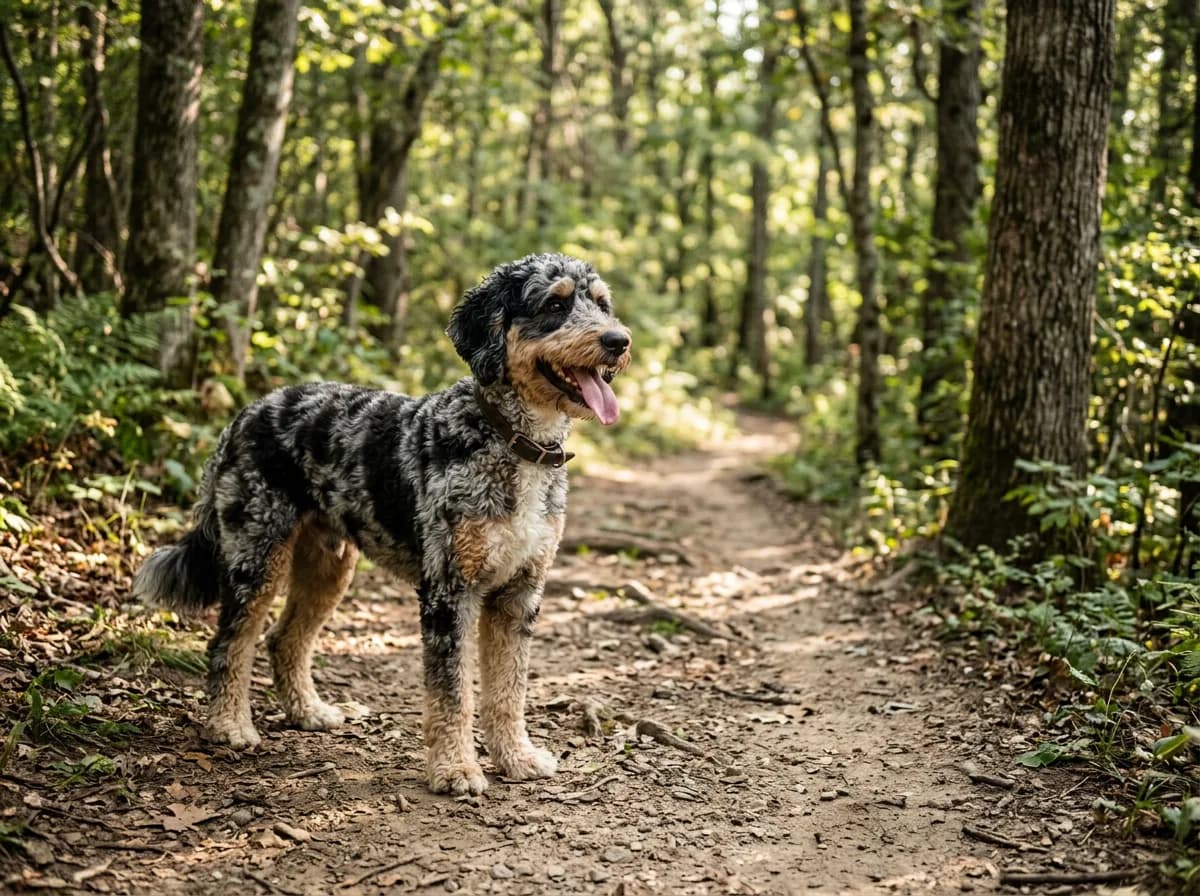
The mini is the breed's sweet spot for a lot of families, and it is the size that has driven most of the Bernedoodle's explosive popularity. A mini Bernedoodle comes from a miniature Poodle bred to a Bernese Mountain Dog (an F1 mini) or from smaller doodle parents in later generations. Adults typically weigh 25 to 49 pounds and stand about 18 to 22 inches at the shoulder. That is big enough to hike, jog, and roughhouse with kids, yet small enough to lift into a car, manage in a smaller home, and keep fed without a giant food budget.
Minis tend to be more size-predictable than tinies but less predictable than standards, again because of the generational math involved in crossing two very different-sized parents. An F1 mini (first-generation, one miniature Poodle parent and one Bernese parent) can surprise you on the larger side, because the Bernese genes push upward. If you specifically want a dog that will stay under 40 pounds, a multigenerational mini from two smaller doodle parents is a safer bet than a first-generation cross. Our Mini Bernedoodle guide covers this variant in detail, including how "mini" and "medium" get used interchangeably by different breeders.
Standard Bernedoodle
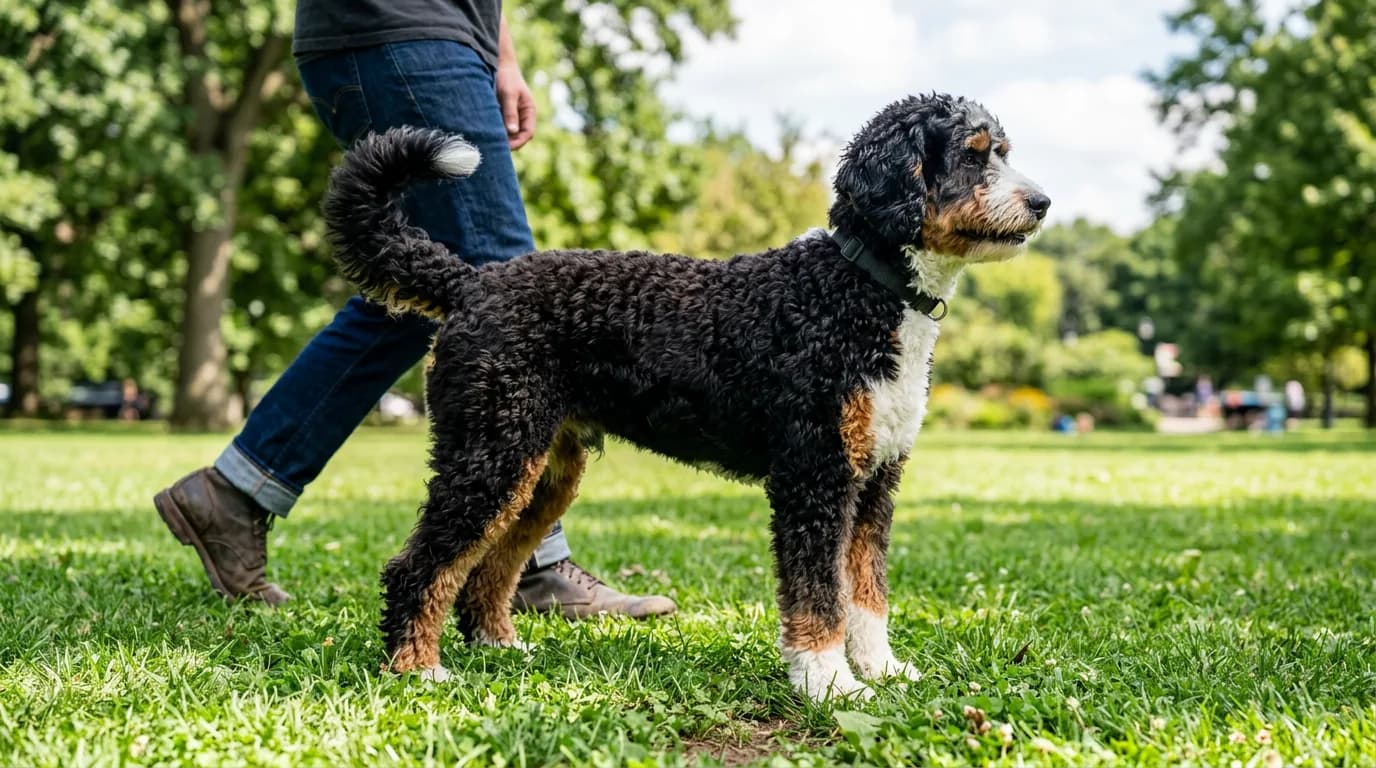
The standard is the original Bernedoodle and the closest in spirit to the Bernese Mountain Dog side of the family. It comes from a standard Poodle crossed with a Bernese, and it is a genuinely large dog. Adults commonly weigh 50 to 90 pounds, and some males from big lines push past 90 or even 100 pounds. Height runs about 23 to 29 inches at the shoulder. This is the Bernedoodle that looks like a walking teddy bear at the far end of the leash, the one strangers stop to photograph.
Standards need space, a bit more daily exercise than the smaller two, and a household prepared for a large-breed budget: bigger food bills, larger crates and beds, higher medication doses, and the joint-care attention that any big dog deserves. They also take the longest to grow up, both physically and mentally, which we cover in the growth section below. If you have room and you want maximum Bernedoodle, the standard delivers. If your life is more apartment-and-elevator than farmhouse-and-field, a mini or tiny is the more honest fit.
How Big Is a Fully Grown Bernedoodle?
A fully grown Bernedoodle can weigh anywhere from about 10 pounds to more than 90 pounds, depending entirely on which of the three size classes it belongs to. There is no single "adult Bernedoodle weight," and that is the most important thing to understand about the breed. A grown tiny Bernedoodle is roughly the size of a small spaniel or a large cat, a grown mini is in the cocker spaniel to border collie range, and a grown standard is in Labrador to Bernese Mountain Dog territory.
If you want the honest averages that most breeders quote, a fully grown standard Bernedoodle usually settles around 70 to 80 pounds, a mini around 30 to 40 pounds, and a tiny around 15 to 20 pounds. Females tend to finish slightly lighter and shorter than males within each size class, typically by 10 to 15 percent, though there is plenty of overlap.
Two grown Bernedoodles of the same size class can still differ because coat volume hides the real frame underneath. A freshly groomed 60-pound standard can look smaller than a fluffy 50-pound one. When you are judging an adult dog's true size, feel for the ribs and the shoulder rather than trusting the silhouette, because that famous doodle floof adds visual pounds it does not actually weigh.
The key point for a new owner: match the size class to your life before you fall for a face. A standard is not "a bigger version of the same dog." It is a large-breed commitment with large-breed costs and space needs, while a tiny is a genuine lap dog. Decide the size first, then choose the puppy.
- A dog's official height is taken at the withers, the ridge between the shoulder blades, never at the top of the head. When a breeder quotes a Bernedoodle's height, that shoulder measurement is what they mean, so a 25-inch standard is 25 inches at the shoulder and taller still at the crown of the head.
Bernedoodle Growth Chart by Age
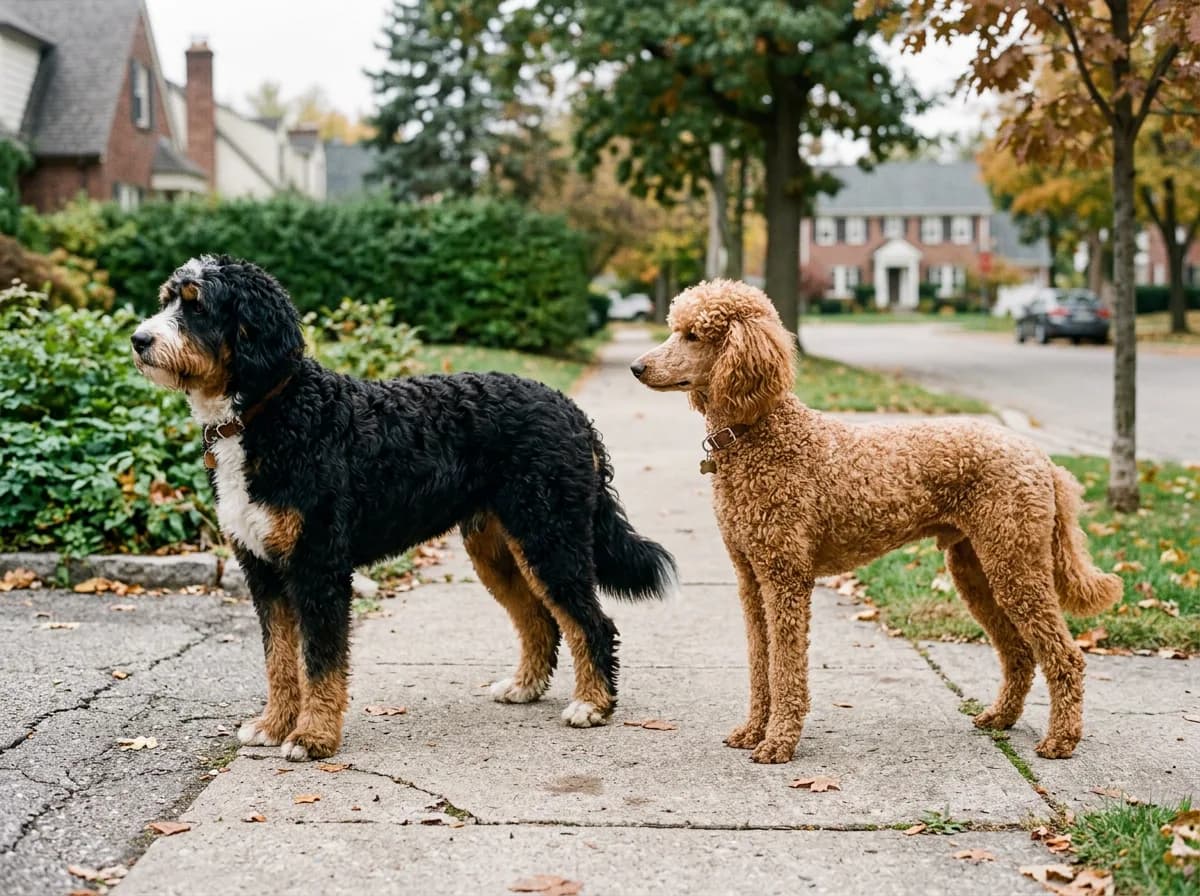
Growth charts are one of the most-searched pieces of Bernedoodle information, and for good reason: watching a puppy balloon month to month is both delightful and slightly alarming, and you want to know whether yours is on track. The chart below gives typical weights by age for each size class. Read it as a guide, not a gospel, because healthy puppies grow along their own curve, and a single weigh-in above or below these numbers is rarely a concern. What matters is a steady climb, not hitting an exact figure.
Remember the golden rule of growth: smaller dogs grow fast and finish early, larger dogs grow slower and finish late. A tiny Bernedoodle is near its adult weight before a standard has hit its adolescent lanky phase.
| Age | Tiny (lbs) | Mini (lbs) | Standard (lbs) |
|---|---|---|---|
| 8 weeks | 3–5 | 6–10 | 10–16 |
| 3 months | 6–9 | 12–18 | 22–30 |
| 4 months | 8–12 | 16–24 | 30–40 |
| 6 months | 11–17 | 22–34 | 42–58 |
| 8 months | 13–20 | 26–40 | 52–70 |
| 10 months | 14–22 | 28–44 | 58–78 |
| 12 months | 15–23 | 30–47 | 62–84 |
| 18 months | 15–24 | 30–49 | 66–90 |
Reading the tiny growth timeline
A tiny Bernedoodle does most of its growing in the first six months. By around four months it is often halfway to its adult weight, and by nine to eleven months it has essentially finished, with only minor filling out afterward. If your tiny is 12 pounds at six months, you can reasonably expect a grown weight in the high teens to low twenties. Tinies rarely surprise you late, so what you see at nine months is close to what you get for life.
Petful may earn a commission when you click through to Chewy, at no extra cost to you.
Reading the mini growth timeline
A mini Bernedoodle follows a middle path. It grows briskly through the first six months, then slows through months seven to eleven, and typically reaches adult weight somewhere between eleven and thirteen months. A useful shortcut: a mini's weight at four months is often close to half its adult weight. So a 20-pound four-month-old is trending toward roughly 40 pounds grown. Minis can still add a little chest and muscle into their second year, but the big changes are done by their first birthday.
Reading the standard growth timeline
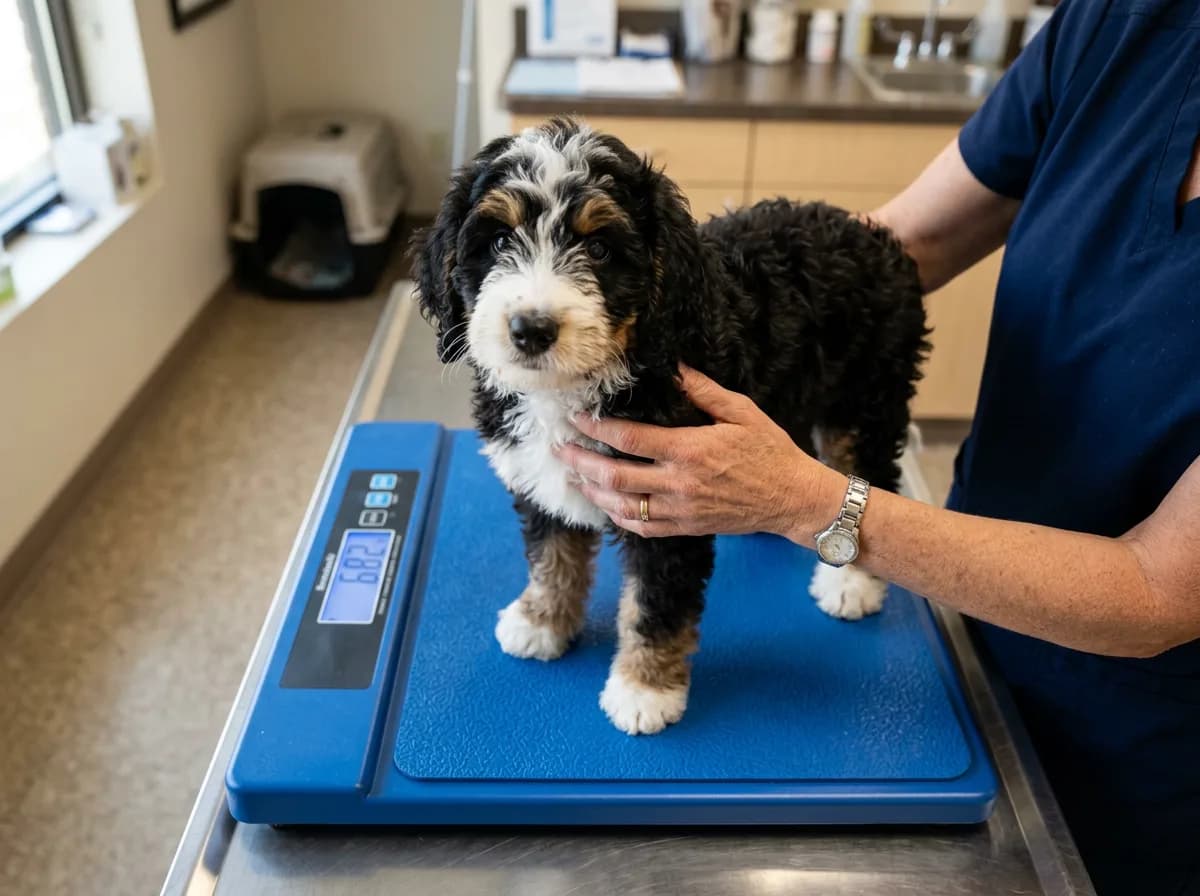
A standard Bernedoodle is a large-breed puppy, and large-breed puppies play a long game. Expect fast, almost startling growth through six months, a gangly adolescent stretch from six to twelve months where the dog looks all legs and no body, and then a slow filling-out of the chest, shoulders, and head that can continue until 18 to 24 months. A standard often reaches its adult height by around a year but does not carry its adult weight and muscle until well into its second year. Do not panic if your yearling standard looks lean and leggy. That is normal, and forcing weight on with overfeeding does a growing large-breed dog more harm than good.
When do Bernedoodles stop growing?
Tiny and mini Bernedoodles generally stop growing taller between 9 and 13 months, then spend a month or two adding a little final weight. Standard Bernedoodles usually finish gaining height around 12 to 14 months but keep broadening and filling out until 18 to 24 months. So the answer to "when will my Bernedoodle stop growing" depends on size: the smaller the dog, the sooner it is done. If you are ever unsure whether your puppy has finished growing, your veterinarian can assess the growth plates and body condition and give you a clear read.
- Large-breed standard Bernedoodle puppies benefit from a large-breed puppy formula that controls calcium and calorie density to protect developing joints. Feeding a fast-growing standard a rich small-breed food can push growth too quickly. Ask your veterinarian which growth food fits your specific size class.
What Determines a Bernedoodle's Size
If size were random, breeders could not advertise "mini" or "standard" litters with any confidence. It is not random. A Bernedoodle's adult size is set mostly by a few predictable factors, and understanding them lets you read a litter far more accurately than guessing from puppy cuteness.
The Poodle parent is the biggest lever

The single most important factor is which Poodle variety sits in the pedigree. Poodles come in three sizes (toy, miniature, and standard), and that choice sets the whole scale of the cross. A standard Poodle over a Bernese produces standard Bernedoodles. A miniature Poodle produces minis. Toy Poodle influence, layered in over generations, produces tinies. The Bernese Mountain Dog side is fairly consistent in size (a large breed), so the Poodle side is the dial that moves. When a breeder tells you a litter's size class, they are really telling you which Poodle line the puppies descend from.
Generation matters more than people expect
The generation label (F1, F1b, F2, and so on) affects both coat and size predictability. Here is what those codes mean and why they matter for size:
- F1 is a first-generation cross: one purebred Bernese parent and one purebred Poodle parent, so the puppy is 50 percent of each. F1 litters carry the most size variation because the two parent breeds differ so much.
- F1b is an F1 Bernedoodle bred back to a Poodle, making the puppy about 75 percent Poodle and 25 percent Bernese. F1b dogs lean toward the Poodle side in both coat (curlier, lower-shedding) and often size.
- F2 is two F1 Bernedoodles bred together. F2 litters can be the least predictable of all for size, because the genes reshuffle widely and puppies can favor either grandparent.
- F2b and multigen (F3 and beyond) come from selective breeding over several generations, which is how breeders lock in consistent size, coat, and temperament. Multigenerational tiny and mini lines are the most size-predictable because the breeder has been selecting for a target weight across generations.
| Generation | Poodle % | Coat Tendency | Shedding | Size Predictability |
|---|---|---|---|---|
| F1 | ~50% | Wavy | Low to moderate | Moderate |
| F1b | ~75% | Curlier | Lowest | Moderate |
| F2 | ~50% | Variable | Variable | Lowest |
| Multigen | 60–90% | Consistent curl | Low | Highest |
Genetics and normal litter variation
Even with the Poodle parent and generation locked in, individual puppies vary. Genetics is a lottery played with a stacked deck: the deck tells you the likely range, but each puppy still draws its own hand. That is why a responsible breeder quotes a range ("we expect these puppies to finish 30 to 45 pounds") rather than a single number. Within one litter, the biggest and smallest adult can differ by 10 pounds or more in the mini and standard classes. A puppy that was the runt at birth does not necessarily stay small, and the pushy fat one at the food bowl does not necessarily finish largest.
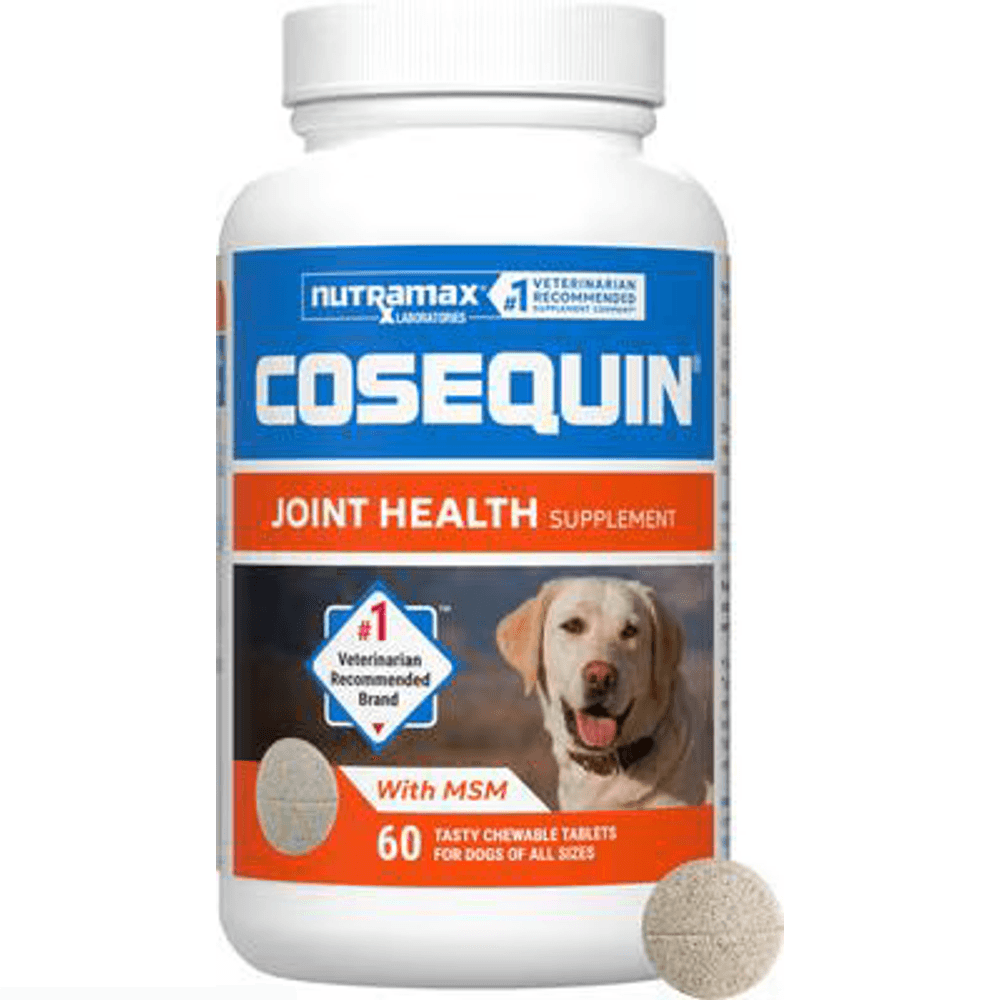
The number-one veterinarian-recommended joint supplement brand. Glucosamine, chondroitin, and MSM support cartilage and cushion the joints, easing the stiffness and hind-end weakness that can leave an older or arthritic dog trembling.
Petful may earn a commission when you click through to Chewy, at no extra cost to you.
Sex differences
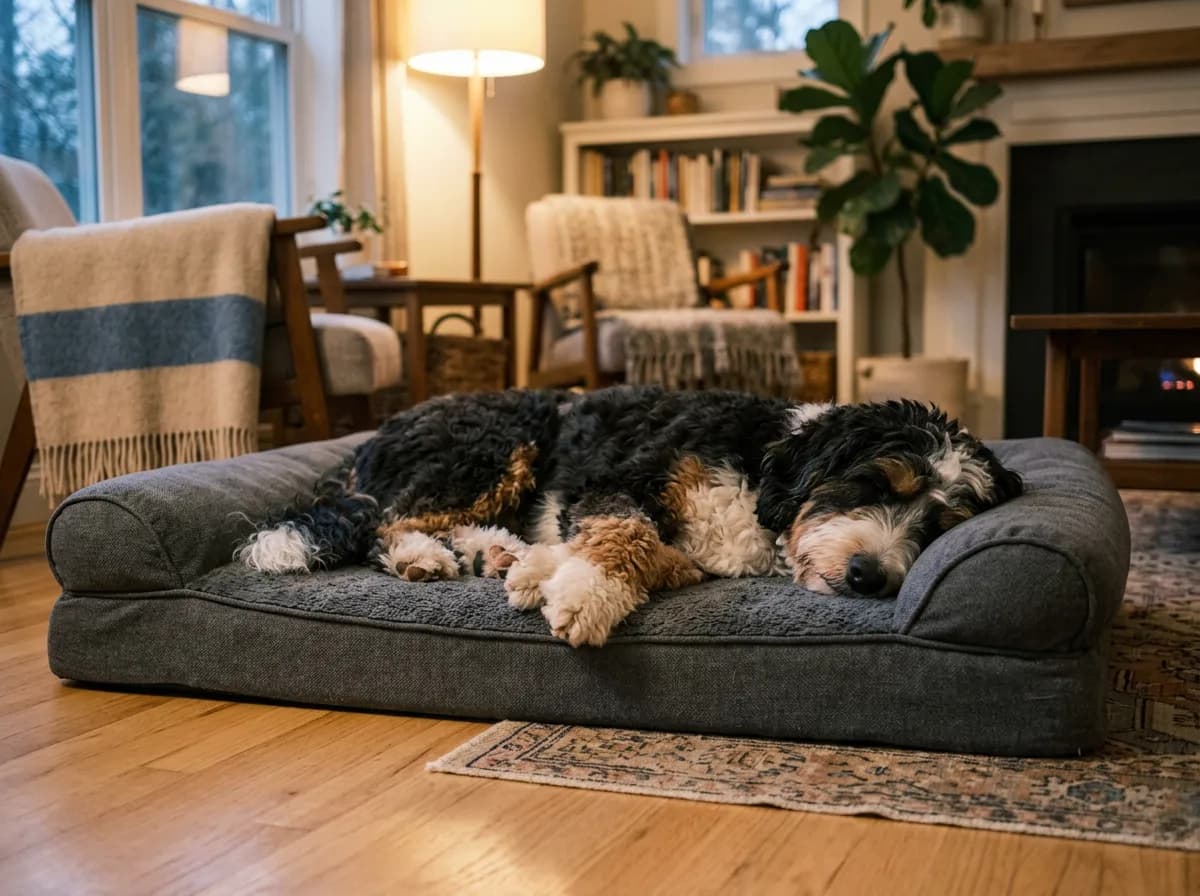
Across all three size classes, males generally finish a little taller and heavier than females, usually by around 10 to 15 percent. It is not a dramatic gap, and a large female from a big line can easily outweigh a small male from a petite line, but it is a real trend worth factoring in when you have a size preference. If you are choosing a standard and want the dog at the more manageable end of that big range, a female is a slightly safer bet, and vice versa.
How to Predict Your Bernedoodle Puppy's Adult Size
You cannot know a puppy's exact adult size in advance, but you can get remarkably close with a few methods. The more of these you stack together, the more confident your estimate. Here is how experienced puppy buyers and breeders read a young Bernedoodle.
1. Start with the parents and the litter history
The best predictor of any puppy's adult size is the size of its parents, and the second best is the adult size of previous puppies from the same pairing. Ask the breeder point-blank: how much do the sire and dam weigh, and how big did the last litter's puppies finish? A breeder who has done this pairing before can tell you the real-world outcome, which beats any formula. If the breeder cannot or will not share parent weights and past-litter results, treat that as a yellow flag about the operation.
2. Use the puppy-weight formulas
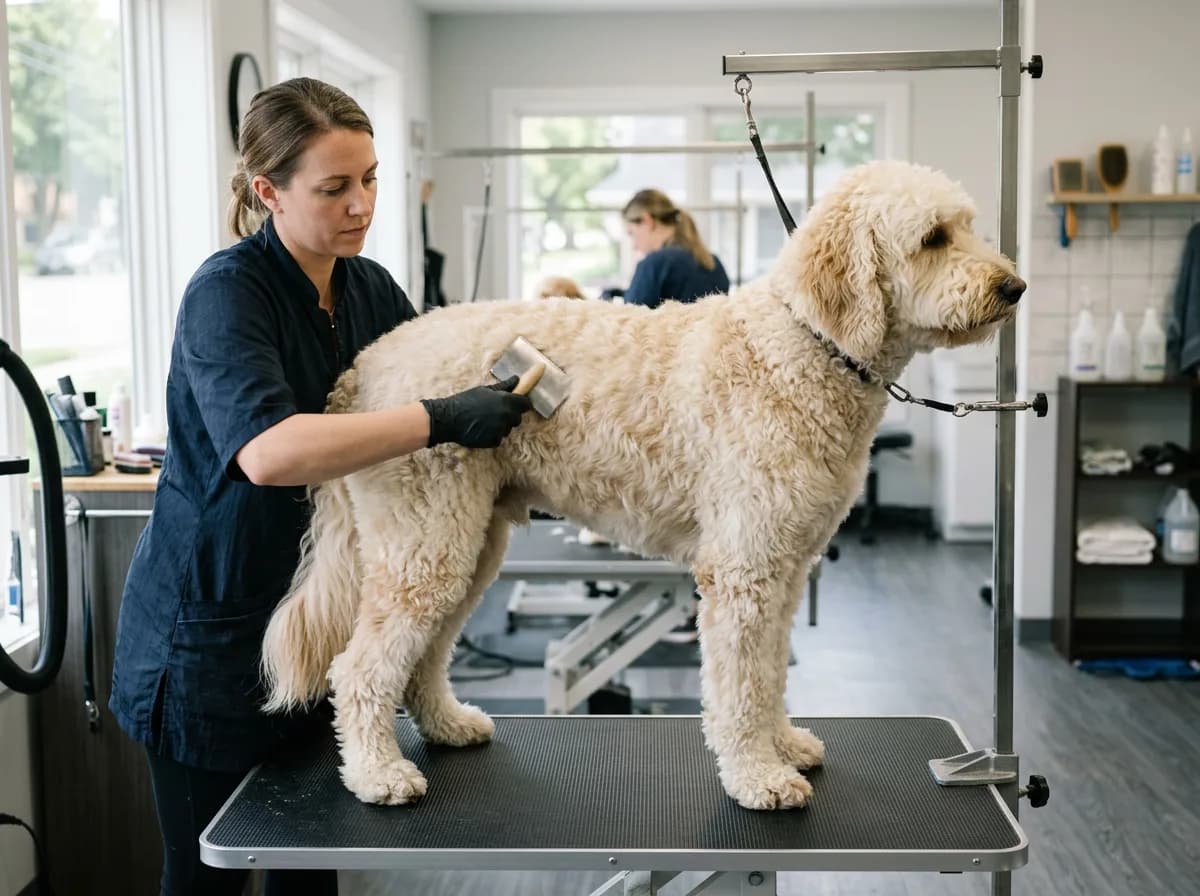
Weight-based formulas work because puppies grow along fairly consistent curves for their size class. These are estimates, not promises, but they are genuinely useful:
- Small dogs (tiny and small mini): adult weight is roughly the puppy's weight at 6 weeks multiplied by 4. Another version: weight at 12 weeks multiplied by 2.
- Medium dogs (mini): take the weight at 14 weeks, multiply by 2, and add half a pound.
- Large dogs (standard): a standard's weight at 6 months is often about two-thirds of its adult weight, so multiply the 6-month weight by about 1.5. Or double the weight at 16 to 20 weeks for a rough adult figure.
Run two or three of these where they apply and see whether they cluster around a similar number. If they do, you have a solid estimate. If they scatter widely, lean on the parent-and-litter data instead.
3. Look at paws, joints, and proportions
The old "big paws mean a big dog" rule of thumb has some truth to it. A puppy with paws and leg joints that look oversized for its body still has growing to do, while a puppy whose paws look proportionate is closer to done. Loose, wrinkly skin the puppy still has to "grow into" is another sign of more size to come. These are soft signals, not measurements, but they help you sanity-check a formula's answer.
4. Consider a DNA test
If you have a rescue or a mixed-history Bernedoodle and you genuinely do not know the parentage, a dog DNA test can estimate adult weight and confirm the breed makeup behind that doodle coat. It will not override good parent data on a puppy from a known breeder, but for an unknown-background dog it turns a guess into a data point, and it flags genetic health risks worth discussing with your veterinarian at the same time. For designer crosses like this one, a breed-and-health panel is the single most informative test you can run.
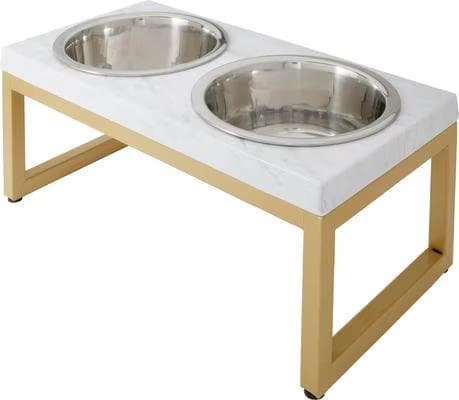
Raised stainless steel double bowl on a marble-look stand. Easier on the neck and joints and a clean, tip-resistant way to keep fresh water available all day.
Petful may earn a commission when you click through to Chewy, at no extra cost to you.
5. Give it time and re-check

Finally, the simplest method: weigh the puppy on the same scale every couple of weeks and plot the trend against the growth chart above. A puppy tracking along the "mini" column at four and six months is very likely a mini. Real data from your own dog beats every rule of thumb, and by six months you will have a confident read on where your Bernedoodle is heading.
How Big Is a 40 lb Bernedoodle?
A 40-pound Bernedoodle is a mini (miniature) Bernedoodle, sitting right in the meat of that size class or at the top end of it. In height, a 40-pound Bernedoodle typically stands about 18 to 22 inches at the shoulder. That is a medium dog: think roughly the size of a border collie or a springer spaniel, sturdy enough to hike and play hard, but still liftable and car-friendly.
Whether a 40-pound Bernedoodle is fully grown depends on its age. Because minis usually finish around 11 to 13 months, a dog that already weighs 40 pounds at, say, seven or eight months is likely to add a few more pounds and could finish closer to 45 to 50 pounds, nudging it toward the mini-to-standard border. A dog that reaches 40 pounds and holds there past its first birthday is a settled adult mini. If a firm 40-pound cap matters to you (for a travel rule, a housing limit, or your own lifting comfort), confirm the dog's age and check it against the growth chart before assuming that number is final.
It is also worth saying that a healthy 40-pound Bernedoodle should feel like 40 pounds of dog, not 35 pounds of dog under 5 pounds of coat. Run your hands over the ribs and waist. A grown mini at a good weight has a visible tuck at the waist and ribs you can feel with light pressure. If a groomer's scale surprises you either direction, that is useful information for your feeding plan, and your veterinarian can confirm an ideal body condition for that specific dog.
- At around 40 pounds and 18 to 22 inches tall, a mini Bernedoodle fits comfortably in apartments and smaller homes while still being robust enough for trail hikes, dog-park play, and active kids. It is the size many families find easiest to live with.
Bernedoodle vs. Goldendoodle: Which Is Calmer?
Because both are popular Poodle crosses of similar size, buyers constantly compare them, and the temperament question comes up as often as the size one. In general, the Bernedoodle is the calmer of the two. That mellowness comes from the Bernese Mountain Dog side, a famously gentle, easygoing, people-oriented breed that likes to lean on you and lounge nearby. Goldendoodles inherit the Golden Retriever's higher energy and stronger working drive, which tends to make them busier, bouncier, and more eager to fetch until your arm falls off.
That said, this is a tendency, not a law, and coat-deep generalizations fail plenty of individual dogs. A Bernedoodle from high-energy lines can be a whirlwind, and a Goldendoodle from calmer breeding can be a mellow couch companion. Generation and the Poodle percentage matter too, since more Poodle influence usually means more energy and more mental sharpness. If a calm home companion is your top priority, a Bernedoodle from parents you have personally seen being relaxed is a strong choice, but always weigh the individual dog and its specific parents over the breed-name stereotype. Our Bernedoodle temperament guide digs into personality traits in far more depth.
One more size-linked wrinkle: within Bernedoodles, the smaller sizes are not automatically calmer. Tiny and mini Bernedoodles can actually be more energetic and busier than easygoing standards, because the extra Poodle influence needed to shrink them down brings extra drive with it. So "smaller" does not reliably mean "lower energy." If calm is the goal, judge the parents' temperament rather than assuming the littlest puppy will be the mellowest.
What Is the Downside of a Bernedoodle?

No breed is all upside, and being honest about the drawbacks is part of choosing well. The main downsides of a Bernedoodle are cost, grooming demands, a stubborn streak, and the size-and-health considerations that come with the Bernese side. Here is the straight version.
- They are expensive to buy and to keep. Bernedoodles from reputable, health-testing breeders command high prices, and the larger standards carry large-breed running costs: more food, bigger gear, higher medication doses. For a full breakdown, see our Bernedoodle price guide.
- The coat is high-maintenance. That gorgeous low-shedding coat does not maintain itself. Bernedoodles need regular brushing to prevent painful matting and professional grooming every six to eight weeks. Skip it and the coat mats to the skin, which is uncomfortable and sometimes requires shaving down. Our grooming guide covers the routine in detail.
- They can be stubborn, especially young. The Bernese side can be independent and slow to mature, so Bernedoodles sometimes go through a willful adolescent phase. They are smart and trainable, but early, consistent, positive training matters. A standard can stay mentally puppyish well into its second year.
- Size unpredictability in early generations. As covered above, F1 and F2 litters can finish larger or smaller than expected, so the dog you planned for is not always the dog you get. Multigen lines reduce this, but it is a real consideration for buyers with a firm size limit.
- Health risks inherited from both parents. The Bernese Mountain Dog carries elevated risks for certain cancers and joint problems, and Poodles have their own hereditary conditions. Hybrid vigor helps, but it does not erase these risks, which is exactly why buying from a breeder who does orthopedic and genetic health testing matters so much. Our Bernedoodle health and lifespan guide covers what to screen for.
- They bond hard and can struggle when left alone. Bernedoodles are deeply people-oriented and can develop separation anxiety in homes where they are alone for long stretches. They do best with company, whether human or canine.
None of these are dealbreakers for a prepared owner, and most Bernedoodle families would tell you the upsides win easily. But go in with open eyes: budget for the grooming, screen the breeder's health testing, commit to early training, and accept that a crossbreed's exact size carries some uncertainty.
- A Bernedoodle's low-shedding coat traps loose hair instead of dropping it, so without regular brushing and professional grooming it mats down to the skin. Neglected mats pull painfully and can trap moisture against the skin. Budget for grooming every six to eight weeks plus at-home brushing, whatever the dog's size.
Caring for Your Bernedoodle by Size
Size does not just change how a Bernedoodle looks. It changes how you feed, house, exercise, and protect the dog's long-term health. Matching your care to the size class keeps your dog comfortable and heads off avoidable problems.
Feeding across the sizes
Feeding scales with the dog, and not only in portion size. A tiny Bernedoodle eats a modest amount and does well on a small-breed formula, but its tiny stomach and fast metabolism mean meals should be split across the day, especially in puppyhood, to avoid blood-sugar dips. A standard eats several times the volume and, as a puppy, needs a large-breed growth food that deliberately limits calcium and calorie density to keep those big joints developing at a safe, steady pace. Overfeeding a standard puppy to make it grow faster is one of the most common and most harmful mistakes new owners make. Whatever the size, feed to a lean body condition and let your veterinarian confirm the target.
Exercise and space
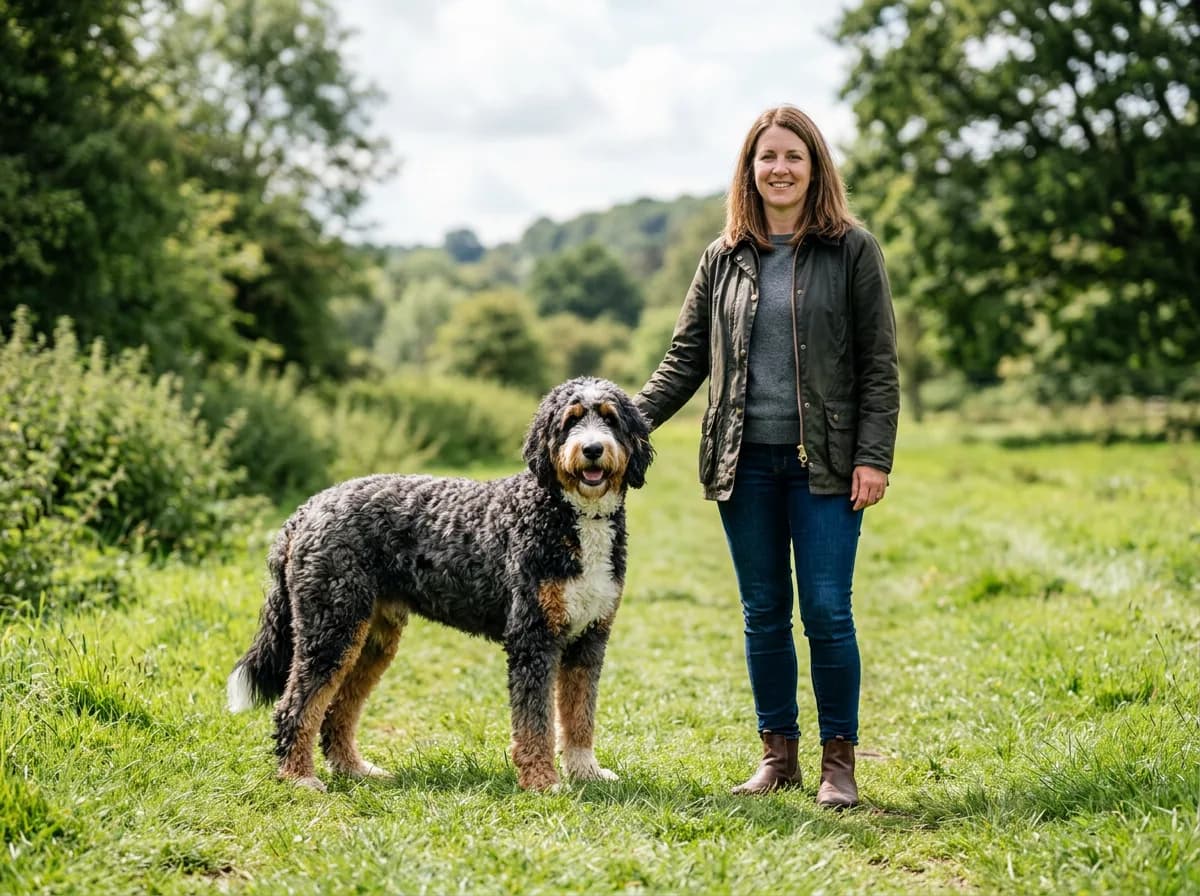
A tiny Bernedoodle can get much of its exercise indoors and in short walks, which is what makes it such a good apartment dog. A mini wants a solid daily walk plus some active play and is happiest with access to a yard or regular trips to open space. A standard needs the most: real daily exercise, room to stretch out at home, and mental work to keep that intelligent brain busy. Under-exercised standards get bored, and bored large dogs find their own entertainment, usually at the expense of your furniture.
Joint and orthopedic care
This is where size really bites. Larger Bernedoodles carry more weight on their joints and inherit the Bernese predisposition to hip and elbow issues, so orthopedic care is not optional for standards. Keep them lean, provide a supportive orthopedic bed to cushion the joints, avoid forced high-impact exercise during the growth phase, and talk to your veterinarian about joint support. Small Bernedoodles are not immune (patellar luxation, a slipping kneecap, is more of a small-dog concern), but the weight-bearing math is gentler on them. Reputable breeders screen breeding dogs through orthopedic evaluations, and you can ask to see those results before you buy.
Health screening scales with the stakes
Because standards live with more joint load and both parent breeds carry hereditary risks, health testing of the parents matters for every size, but the consequences of skipping it grow with the dog. Ask any breeder, tiny to standard, for proof of hip, elbow, eye, and genetic screening on the sire and dam. The Orthopedic Foundation for Animals maintains public health databases where many breeders register these results, and the American Kennel Club is a useful reference for the parent breeds' recommended screenings. For an independent overview of hip dysplasia and large-breed joint health, veterinary school resources such as the Cornell University College of Veterinary Medicine are reliable and jargon-free.
Choosing the Right Bernedoodle Size for Your Home
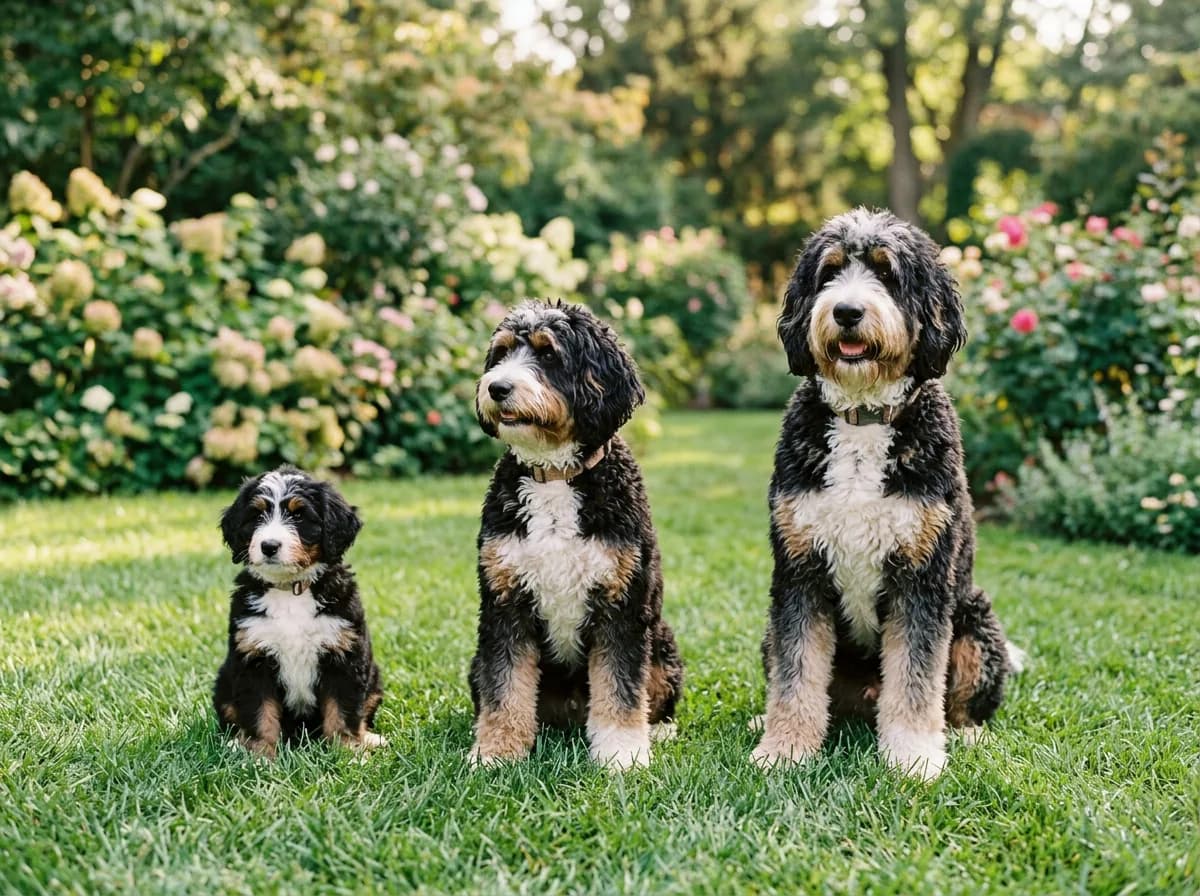
By now the practical decision should be coming into focus, so let us make it concrete. The right size is the one that fits your space, your budget, your activity level, and your tolerance for both grooming and a large dog's presence in a small room.
- Choose a tiny Bernedoodle if you live in an apartment or small home, want a true lap dog, travel and want a dog that can come along easily, or simply prefer a little dog with big personality. Accept the trade-off of higher size unpredictability and a bit more fragility.
- Choose a mini Bernedoodle if you want the breed's best all-rounder: big enough to hike and play, small enough to lift and house easily, and a manageable food and gear budget. This is the size most families land on, and for good reason.
- Choose a standard Bernedoodle if you have the space, want maximum teddy-bear presence, and are ready for a large-breed budget and the joint-care attention a big dog deserves. In return you get the calmest, most classic Bernedoodle.
Whichever way you lean, the size decision should come before the puppy-picking decision. It is far easier to fall in love with the right-size dog than to squeeze the wrong-size dog into your life. And if you are still weighing this crossbreed against its cousins, our guides to the Cavapoo and other Poodle mixes can help you compare designer breeds side by side before you commit.
A quick cost-by-size reality check
Budget is part of the size decision, and it scales with the dog. The table below is a rough orientation, not a quote, and prices vary widely by region, breeder reputation, and health testing. Use it to sanity-check that you are planning for the true lifetime cost of the size you choose, not just the sticker price of the puppy.
| Size Class | Typical Puppy Price | Est. First-Year Cost | Est. Annual Cost After |
|---|---|---|---|
| Tiny / Toy | $2,500–$5,000 | $2,000–$3,500 | $1,500–$2,500 |
| Mini / Miniature | $2,500–$5,000 | $2,200–$3,800 | $1,800–$2,800 |
| Standard | $2,000–$4,500 | $2,800–$4,800 | $2,400–$3,800 |
Notice that standards can cost a little less to buy but more to keep, because food, grooming volume, medication doses, and gear all scale up with body size. A tiny costs less to feed and medicate but often commands a premium purchase price because of the specialized breeding required to produce it. Whichever size you choose, plan for the running cost, not just the day-one price. Our Bernedoodle price guide breaks the numbers down in far more detail.
Bernedoodle Size FAQ
Here are the questions new owners ask most about how big these dogs get, answered quickly so you can plan with confidence.
Bernedoodle Size Comparison: How They Stack Up Against Other Dogs and People
A standard Bernedoodle sits in the same weight class as a Labrador Retriever or a slightly lighter Bernese Mountain Dog, and at 23 to 29 inches at the shoulder it reaches roughly knee height on an average adult standing on all fours. Up on its hind legs, a big standard can plant its paws on your chest or shoulders. Here is how the tiers compare to dogs most people already picture:
- Standard Bernedoodle: comparable to a Labrador or a lean Bernese Mountain Dog. A substantial dog that needs real floor space.
- Medium or mini Bernedoodle: close to a Cocker Spaniel or Springer Spaniel in bulk. Easy to lift, still sturdy.
- Tiny or toy Bernedoodle: on par with a Miniature Poodle or a larger Cavalier King Charles Spaniel. A true lap dog.
Against a same-weight Goldendoodle, a Bernedoodle usually carries heavier bone and a stockier, blockier frame thanks to its Bernese Mountain Dog parent, so it can feel bigger than the scale suggests. Use these reference points when a weight number alone does not tell you how a dog will fill your space.
- On its hind legs, a 70-pound standard Bernedoodle can reach the chest of an average adult, while a 15-pound tiny sits comfortably in your lap like a Cavalier.
Is There a Medium Bernedoodle?
Yes, but "medium" is an informal marketing label, not one of the three breeder-standard tiers. Bernedoodles are usually sorted into tiny, miniature, and standard, and "medium" or "mid-size" is the word many breeders reach for when a dog lands in the overlap between the top of the mini range and the bottom of the standard range, generally about 30 to 50 pounds and 18 to 22 inches tall. That in-between build is popular because it splits the difference: bigger and sturdier than a tiny lap dog, yet easier to manage in a small home than a 70-pound standard.
Because "medium" is not standardized, two breeders can attach it to noticeably different dogs. Pin down what a given breeder means before you commit:
- Ask for the breeder's projected adult weight range in pounds for the litter, not just the word on the listing.
- Confirm the poodle parent's size, since a mini-poodle cross and a standard-poodle cross produce very different "medium" dogs.
- Ask to see adult weights from previous litters of the same pairing if any exist.
A "medium" tag is useful shorthand, but the stated weight range is what actually tells you the size you will bring home.
What Do "Micro," "Toy," "Ultra," and "Munchkin" Bernedoodle Labels Mean?
These are breeder marketing terms for very small Bernedoodles, and none of them is an official, standardized size. They almost always describe a dog at or below the tiny end of the scale, but the weight behind each word shifts from breeder to breeder:
- Toy Bernedoodle: usually just another word for the tiny tier, generally around 10 to 24 pounds.
- Micro or micro mini Bernedoodle: marketed as smaller than a standard mini, often under about 25 pounds, typically reached by breeding back to a toy poodle over several generations.
- Ultra Bernedoodle: frequently not a size at all. Some breeders use "ultra" for coat or generation rather than weight, so always ask what they mean by it.
- Munchkin Bernedoodle: a novelty label for an especially short or small dog, with no consistent definition.
Because these words are unregulated, treat any of them as a question to ask, not a spec you can trust. Request the projected adult weight in pounds plus the weights of both parents. A reputable breeder can hand you a number; a label like "ultra micro" on its own tells you almost nothing about the grown dog.
- Extra-small labels sometimes carry a premium price and real health tradeoffs. Ask about the parents' health testing, not just how tiny the puppy will stay.
It depends on the size class. A fully grown tiny Bernedoodle is typically 10 to 24 pounds, a mini is 25 to 49 pounds, and a standard is 50 to 90 pounds or more. Averages most breeders quote are around 15 to 20 pounds for tinies, 30 to 40 for minis, and 70 to 80 for standards, with females finishing a little lighter than males.
A 40-pound Bernedoodle is a mini (miniature), standing about 18 to 22 inches at the shoulder. It is a medium dog, roughly border collie sized, and is fully grown if it is past about 12 months. A younger dog already at 40 pounds may add a few more pounds and finish near the mini-to-standard border.
Bernedoodles are generally the calmer of the two, thanks to the mellow, easygoing Bernese Mountain Dog side, while Goldendoodles inherit the Golden Retriever's higher energy. This is a tendency, not a guarantee, so always judge the individual dog and its parents over the breed stereotype.
The main downsides are high purchase and upkeep cost, demanding grooming (regular brushing plus professional grooming every six to eight weeks to prevent matting), a stubborn streak and slow maturity from the Bernese side, size unpredictability in early generations, and inherited health risks that make breeder health testing essential.
Tiny and mini Bernedoodles usually stop growing between 9 and 13 months, while standards reach adult height around 12 to 14 months but keep filling out until 18 to 24 months. The smaller the dog, the sooner it finishes.
You can get close by combining the parents' weights and past-litter results with puppy-weight formulas, paw-and-proportion cues, and, for unknown-background dogs, a DNA test. Weigh the puppy regularly and track it against a growth chart for the most reliable read by six months.
The Bottom Line on Bernedoodle Size
Bernedoodle size is really three answers wearing one breed name. Tiny Bernedoodles stay lap-dog small at 10 to 24 pounds, minis land in the versatile 25 to 49 pound range that suits most families, and standards grow into genuine 50 to 90-plus pound large dogs. The Poodle parent sets the scale, the generation sets how predictable that scale is, and normal genetic variation fills in the rest. Smaller dogs grow up fast and finish by around a year, while standards take up to two years to fully mature.
Decide the size class first, match it honestly to your home, budget, and activity level, and then choose the puppy. Ask the breeder for parent weights, past-litter outcomes, and proof of health testing, and use the growth chart and prediction methods here to check that the dog in front of you is heading where you expect. Do that, and whichever Bernedoodle size you bring home, you will know exactly what you are signing up for. For the complete picture on the breed, circle back to our full Bernedoodle guide.

Coreen Saito is a pet writer and longtime shelter volunteer with more than a decade in animal rescue. She covers cat behavior, breed care, and the small, ordinary science of sharing a life with companion animals, with a particular focus on honest takes about the products and decisions that actually matter. At home in Arizona, she's outranked by Mac (a dog with the loudest opinion in the house), Rebel (a cat who governs by quiet authority), and Meri (an orange tabby who runs the late shift and the laundry basket). She writes about all three, plus the rescues that keep coming through her life, at LifeWithMinty.com.
Sign up for expert-backed reviews and safety alerts all in one place.