Toy Poodle: Full-Grown Size, Temperament, and Cost
A full-grown Toy Poodle stands 10 inches or under and weighs about 4 to 6 pounds. See how it compares with a Miniature, how puppies grow, its temperament and honest cons, daily care, colors, and cost.
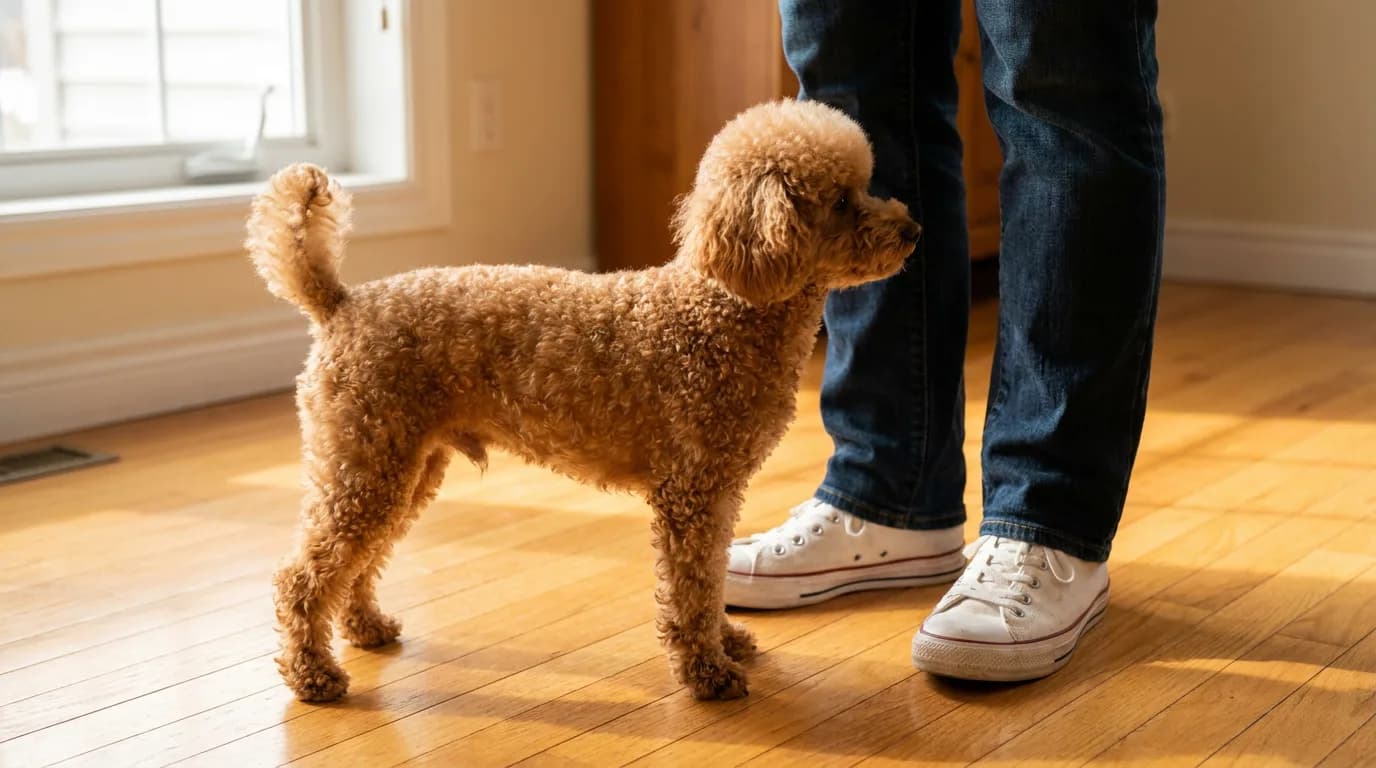
A full-grown Toy Poodle measures 10 inches or under at the withers and usually weighs 4 to 6 pounds.
Petful is reader supported. As an affiliate of platforms like Amazon and Chewy, we may earn a commission when you buy through links on this page. There is no extra cost to you.
A full-grown Toy Poodle stands 10 inches or less at the shoulder and usually weighs about 4 to 6 pounds, which makes it the smallest of the three Poodle sizes recognized by the American Kennel Club (AKC). It is a quick-learning, people-focused companion that tends to shadow its owner, bark at anything new, and need daily coat care.
The small size cuts both ways. A 5-pound dog fits apartment life and an airline cabin, but it can break a leg jumping off a sofa, needs frequent potty breaks, and copes poorly with long days alone. Before committing, check three things: both parents' adult height, how many hours the dog would be alone each day, and whether anyone at home is young enough to drop or trip over a dog this small.
- 1Height: 10 inches or under at the shoulder by AKC and UKC rules; UK and FCI standards allow up to 28 cm (about 11 inches)
- 2Typical adult weight: about 4 to 6 pounds (1.8 to 2.7 kg), though some breed guides list up to 9 pounds
- 3Group: the AKC shows Toys in the Toy Group, while Miniatures and Standards compete in the Non-Sporting Group
- 4Temperament: smart, affectionate, alert, and often vocal
- 5Lifespan: 10 to 18 years, according to the AKC
- 6Grooming: daily brushing or a short clip, plus a professional groom every 4 to 6 weeks

Sign up for expert-backed reviews and safety alerts all in one place.
What is a Toy Poodle?
A Toy Poodle is a purebred Poodle, the smallest of three size varieties that share one breed standard, not a separate breed or a mix. The AKC Poodle standard defines the Toy as 10 inches or under at the highest point of the shoulders, and the AKC breed profile lists a typical adult weight of 4 to 6 pounds. It is bright, affectionate, and alert, and its curly coat never stops growing, so it needs daily brushing or a short clip. There is only one Toy variety, defined by height alone.
For a small Poodle-type dog without papers, such as a rescue sold as a Toy, a DNA breed test like the Embark Breed & Health Dog DNA Test Kit can estimate Poodle ancestry and identify evidence of other breeds, without proving registered purebred status, and it screens for inherited disease variants worth sharing with your veterinarian. It cannot certify the variety: Embark groups Toys and Miniatures together as small Poodles, so adult height still decides.
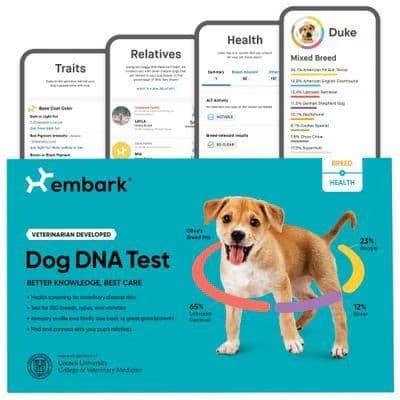
Petful may earn a commission when you click through to Chewy, at no extra cost to you.
What does a Toy Poodle look like?
A Toy Poodle looks like a Standard Poodle scaled down: squarely built, with a body length from breastbone to rump that roughly equals its height at the shoulder. In a standing profile you see a level back, a long neck carried proudly, and a tail set high. Beside a Miniature Poodle, a Toy shows the same outline in a smaller frame, so only height tells them apart.
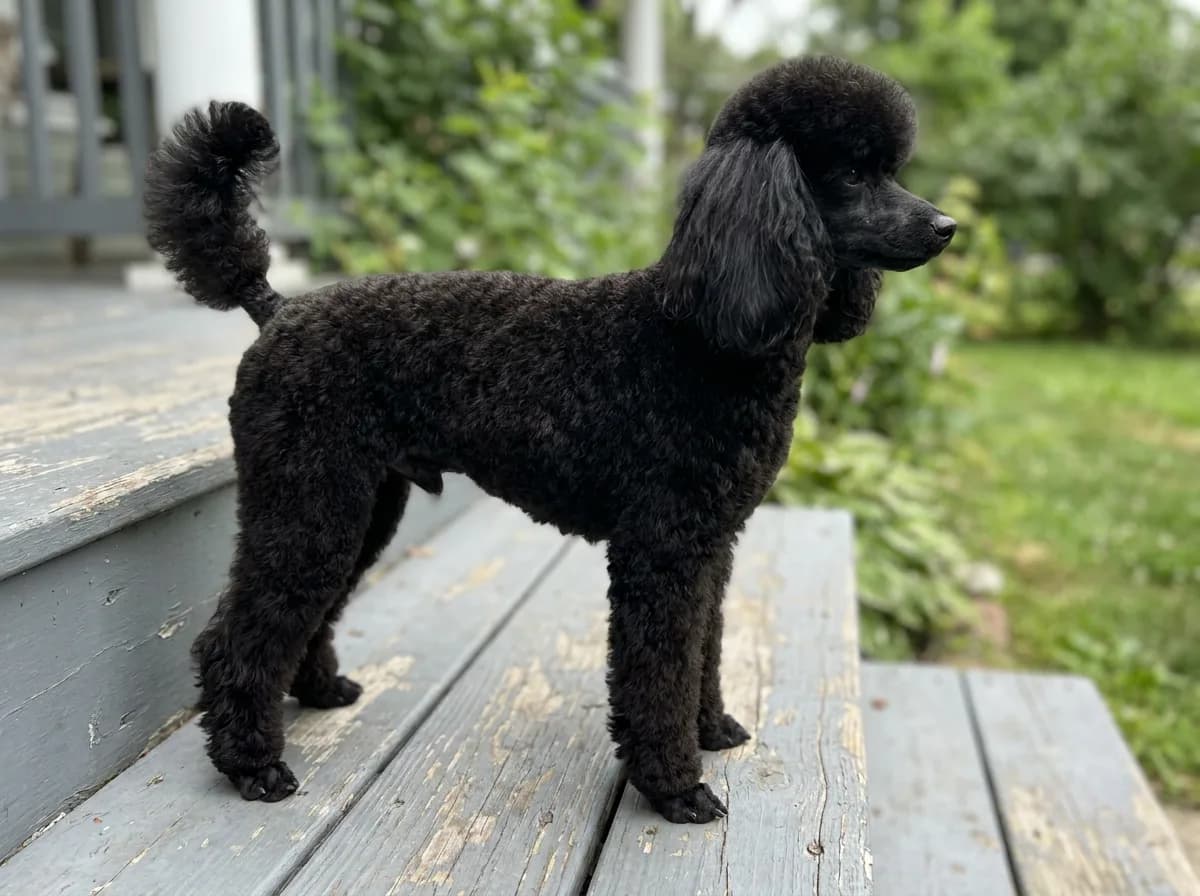
- Coat: dense, harsh-textured curls that keep growing, or, rarely, tight cords. Length is a grooming choice, so one dog can look long-haired and fluffy or short-haired and sleek.
- Face: a long, fine muzzle ending in a black or brown nose, with very dark oval eyes. A clean face is shaved in the traditional style; a teddy bear clip leaves the face hair full.
- Ears: long and heavily feathered, hanging close to the head. Poodle ears do not stand up, though a clipped ear can look shorter.
- Tail: straight and set high. The AKC standard calls for docking, but the FCI's 2024 standard no longer allows it and England's Animal Welfare Act 2006 bans cosmetic docking, so an undocked Toy with a long natural tail is normal in much of Europe.
- Feet: small, oval, and well arched.
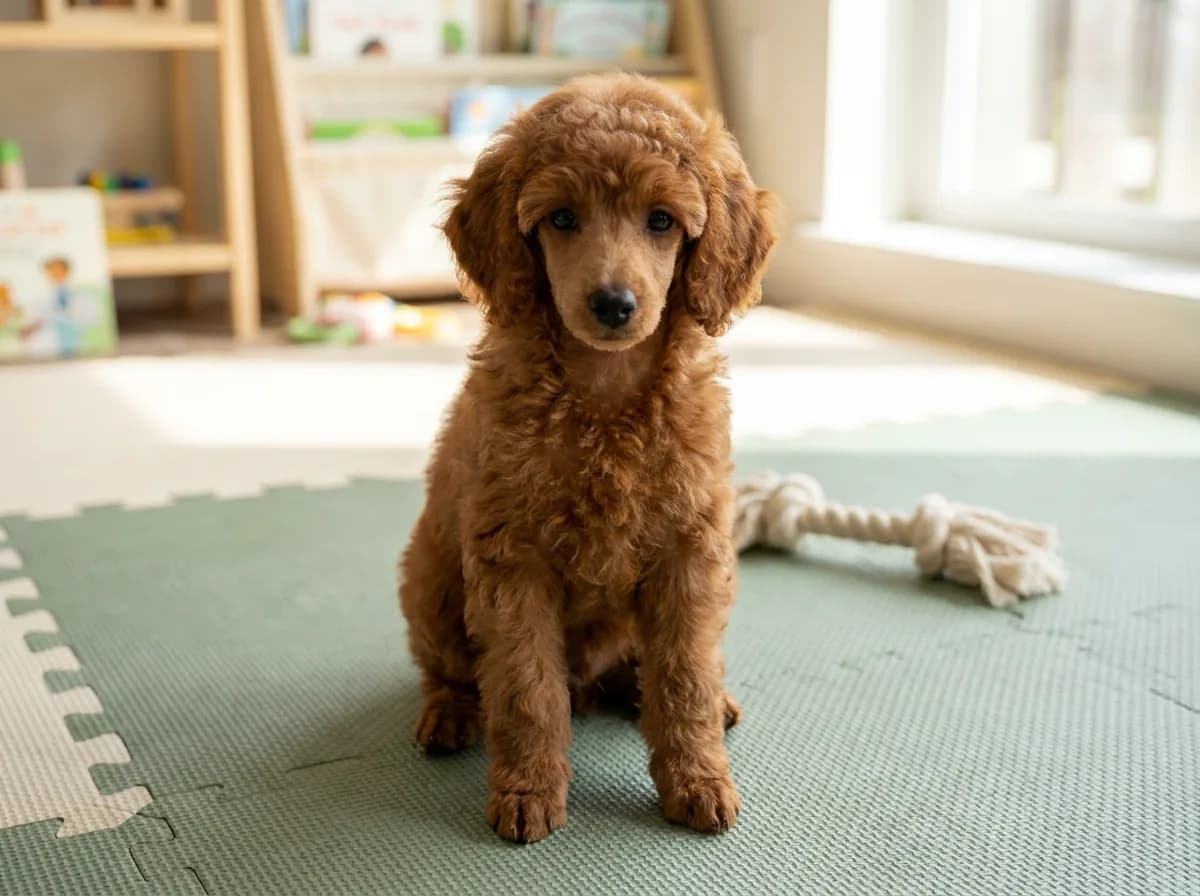
Puppies start with a softer, wavier coat, so fairly straight puppy hair is normal. An adult with a flat, straight coat and a smooth face is unusual for a purebred Poodle and worth asking the breeder about.
Where did the Toy Poodle come from?
Poodles began as water retrievers. The AKC traces the breed to Germany, while the FCI lists France as its country of origin and notes its descent from the Barbet. That split explains the French toy poodle label: the Poodle is France's national dog, but no separate French breed exists. Toys were bred down from larger Poodles as companions, which is still the use the FCI lists for the breed. Our Poodle breed guide covers the full history of all three sizes.
How big is a full-grown Toy Poodle?
By AKC and UKC rules, a full-grown Toy Poodle measures 10 inches or under at the withers, and the typical adult weight range is 4 to 6 pounds (1.8 to 2.7 kg). Next to an adult human, a 10-inch Toy's back reaches roughly mid-shin. Toys near the height limit or with heavier bone often weigh more, which is why some breed guides list 6 to 9 pounds.
| Source | Registry height limits for a Toy | Published weight ranges |
|---|---|---|
| AKC breed standard (US) | 10 inches or under at the highest point of the shoulders | None in the standard; the AKC breed profile lists 4 to 6 lb |
| UKC standard (US) | 10 inches or under at the withers | None in the standard |
| Royal Kennel Club (UK) | Under 28 cm (11 inches) | None in the standard |
| FCI standard 172 (Europe and other member countries) | Over 24 cm up to 28 cm (about 9.5 to 11 inches), ideal 25 cm; under 23 cm disqualified | None in the standard |
| Chewy, PetMD, and Pets Best breed guides | Not a registry | 4 to 6 lb |
| Pedigree and The Spruce Pets breed guides | Not a registry | 6 to 9 lb |
| ASPCA Pet Insurance breed guide | Not a registry | 6 to 10 lb |
Why do published weight ranges differ? No registry sets a weight for the Toy; the UKC Poodle standard, like the others, gives heights only. The 4 to 6 pound figure describes a typical fine-boned Toy, while heavier ranges fit dogs near the limit or with sturdier builds. Registries also disagree on height: the Royal Kennel Club accepts Toys under 28 cm (11 inches), and the FCI standard sets 24 to 28 cm, so a European Toy can be taller than an American one.
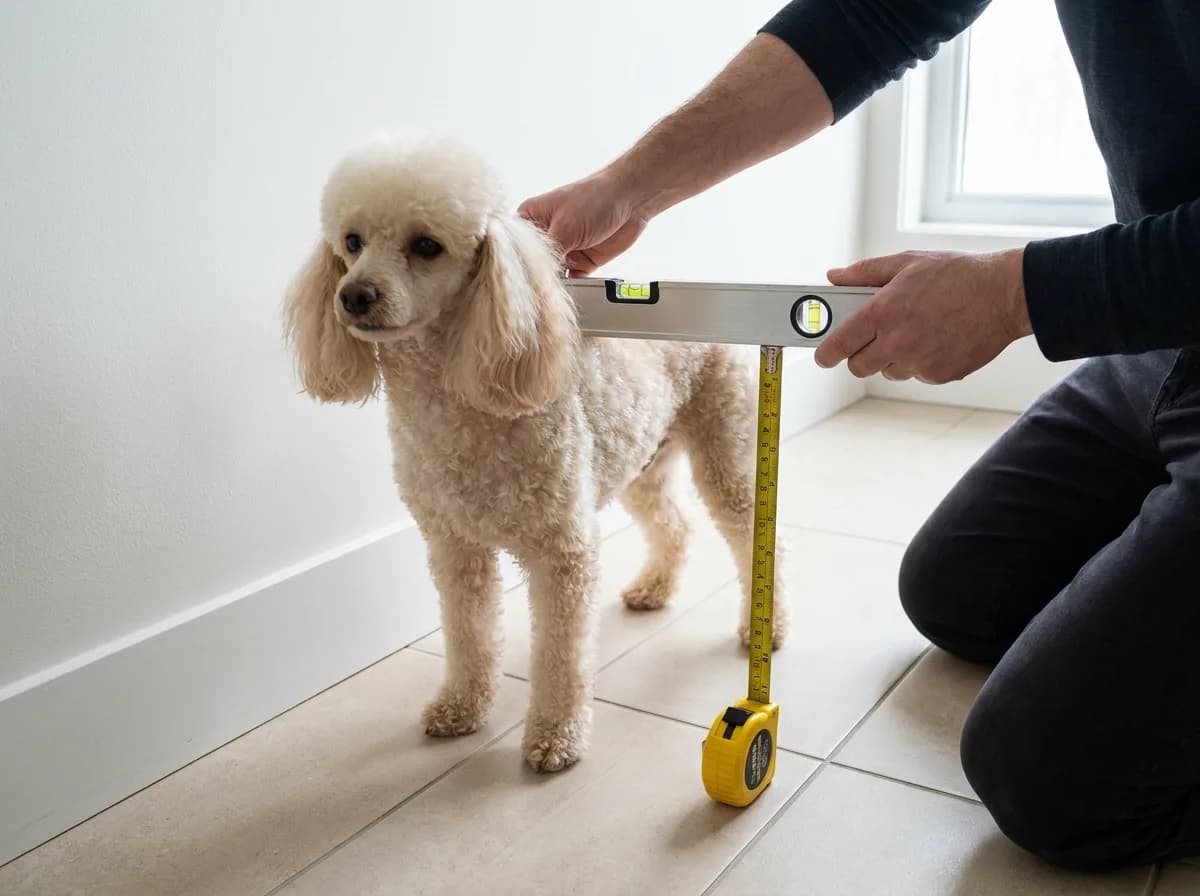
How to measure height at the withers:
- Stand your dog square on a hard, level floor, head up and weight on all four feet.
- Find the withers, the highest point of the shoulder blades behind the neck, and part the coat so you measure bone, not hair.
- Rest a level or a flat book across the withers, parallel to the floor.
- Measure from the floor to the underside of the level three times and use the middle reading.
- Recheck after about 8 months. Over 10 inches means Miniature-sized under AKC and UKC rules.
Teddy bear and tiny toy are labels, not sizes. A full-grown teddy bear Toy Poodle is a Toy in a rounded teddy bear cut, and a teddy bear miniature toy poodle listing could describe either variety until someone measures the dog. The smallest healthy Toys weigh around 4 pounds. Tiny toy puppies are often just young, so judge them by the parents' adult height.
A healthy weight for a Toy Poodle is one where you can feel the ribs easily under a thin layer of fat and see a waist from above, as on the body condition charts in the WSAVA nutrition guidelines. One extra pound on a 5-pound Toy is 20 percent of its body weight, so weigh monthly on a kitchen or baby scale.
When do Toy Poodles stop growing?
Most Toy Poodles reach adult height by about 6 to 8 months, the range Dr. Jerry Klein, the AKC's chief veterinarian, gives for small breeds, and then keep filling out until about 12 months. The WALTHAM puppy growth charts, built from the weights of 50,000 healthy young dogs seen at US veterinary clinics, show dogs expected to weigh under 6.5 kg (about 14 pounds) still gaining slowly near their first birthday.
| Age (months of age) | Growth: share of adult weight | Expected weight range for a 4 to 6 lb adult | Metric |
|---|---|---|---|
| 8 weeks (2 months) | About 30% (estimate; the charts start at 12 weeks) | About 1.2 to 1.8 lb | 0.5 to 0.8 kg |
| 12 weeks (3 months) | About 40 to 45% | About 1.6 to 2.7 lb | 0.7 to 1.2 kg |
| 16 weeks (4 months) | About 55% | About 2.2 to 3.3 lb | 1.0 to 1.5 kg |
| 20 weeks (about 4.5 months) | About 65% | About 2.6 to 3.9 lb | 1.2 to 1.8 kg |
| 26 weeks (6 months) | About 75% | About 3.0 to 4.6 lb | 1.4 to 2.1 kg |
| 35 weeks (8 months) | About 88% | About 3.5 to 5.3 lb | 1.6 to 2.4 kg |
| 40 weeks (9 months) | About 92% | About 3.7 to 5.5 lb | 1.7 to 2.5 kg |
| 52 weeks (12 months) | About 98 to 100% | About 4 to 6 lb | 1.8 to 2.7 kg |
The percentages come from the shape of WALTHAM's curves for dogs under 6.5 kg, applied to the AKC's 4 to 6 pound range. The 8-week row is an estimate because the curves start at 12 weeks. A puppy that stays in roughly the same place on the chart is growing normally, and WALTHAM flags one that crosses two centile lines, or stalls before adulthood, for a veterinary check.
For a rough adult estimate, multiply a 12-week weight by about 2.3 or a 6-month weight by about 1.3. A 2-pound 12-week-old projects to about 4.5 pounds as an adult. A 5-pound 6-month-old projects to about 6.5 pounds, heavier than most Toys, which is a cue to measure height at maturity rather than assume.
Toy Poodle vs. Miniature Poodle
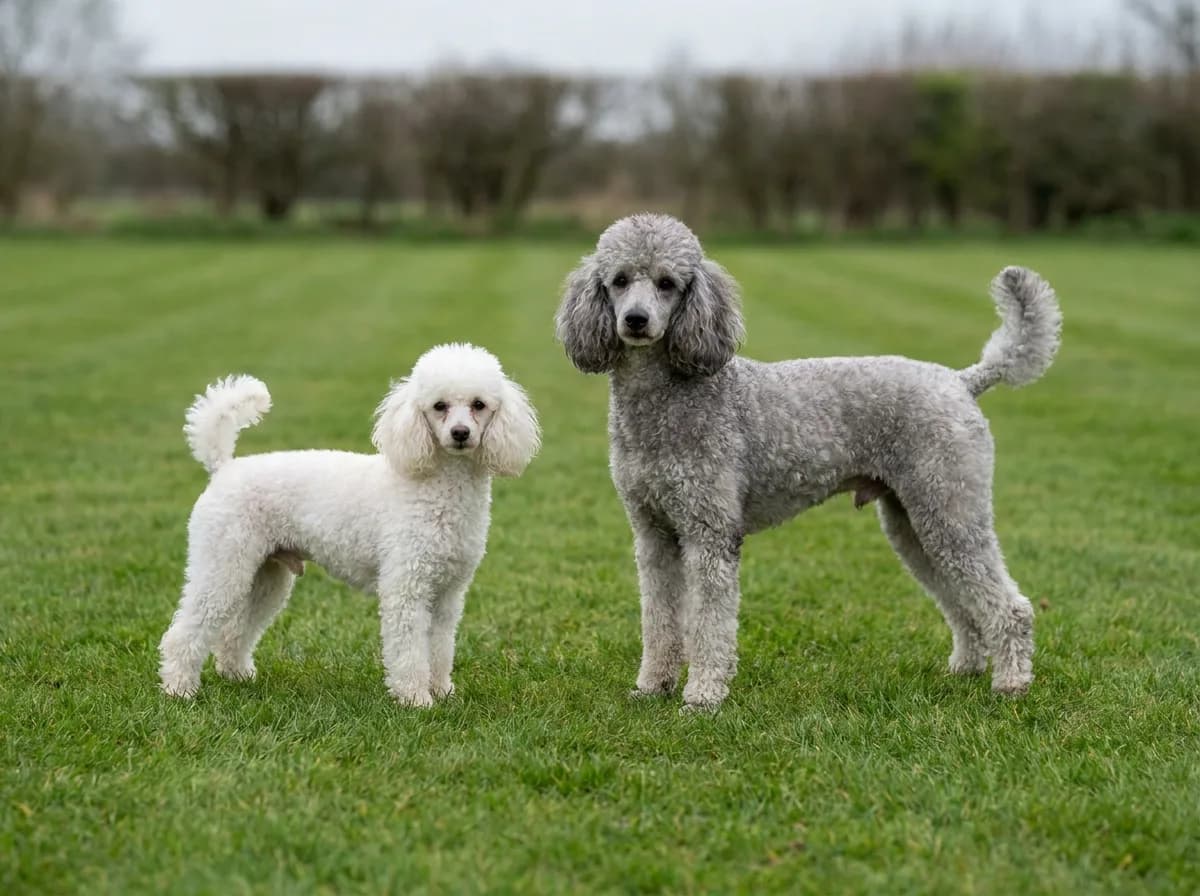
The Toy is the smaller of the two: 10 inches or under and about 4 to 6 pounds, while a Miniature stands over 10 up to 15 inches and weighs about 10 to 15 pounds, according to the AKC. Both share one standard, one temperament, and the same coat; the differences come from size. Mini toy poodle is not a registry size, just a label for a large Toy or a small Miniature.
| Trait | Toy Poodle | Miniature Poodle |
|---|---|---|
| Height at the shoulder | 10 inches or under | Over 10 up to 15 inches |
| Typical adult weight | 4 to 6 lb | 10 to 15 lb |
| AKC group | Toy Group | Non-Sporting Group |
| Sturdiness | Fine-boned; falls and rough play can break bones | Sturdier; better with gentle school-age children |
| Daily exercise | Short walks plus indoor play | Longer walks, hikes, and dog sports |
| Cabin travel | Usually fits an under-seat carrier | Smaller ones may fit; many exceed carrier limits |
| Suits | Adults, seniors, and calm homes | Active households with older children |
Which size fits your home?
- Choose a Toy if you want the most portable Poodle, live in a small space, and have no toddlers or rough large dogs at home.
- Choose a Miniature if you have school-age children or a bigger dog, or want a partner for longer hikes; at two to three times a Toy's weight, it is far sturdier.
- Skip dogs sold as teacups: the label is not a size, and the smallest puppies carry the highest risk of low blood sugar and injury.
When a Toy stands beside a Miniature Poodle, the height difference can be as little as an inch (a large Toy next to a small Miniature) or as much as 5 or 6 inches. In young puppies it is much harder to see, which is where the checks below help.
Size also shapes travel. Most adult Toys fit a soft carrier such as the Sherpa Original Deluxe Airline-Approved Dog & Cat Carrier Bag, handy for cabin flights and crowded vet waiting rooms. Size the carrier by measuring your dog standing and lying down, then check your airline's under-seat limits.
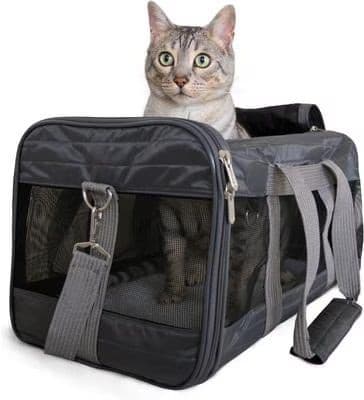
An airline-approved soft-sided carrier with mesh ventilation windows, a top-rated travel pick for cats and small dogs.
Petful may earn a commission when you click through to Chewy, at no extra cost to you.
Is my puppy a Toy or a Miniature Poodle?
Nothing on a puppy's paperwork settles this; adult height does. Three checks narrow it down before maturity:
- Both parents' measured heights: ask for each parent's height at the withers, not just the word Toy on a registration. If either parent is over 10 inches, a Miniature-sized puppy is possible.
- Puppy weight checks: compare regular weigh-ins with the growth table above. A puppy well above about 2.7 pounds at 12 weeks or 4.6 pounds at 6 months is tracking larger than a typical Toy.
- Withers height at maturity: measure at 8 to 12 months. Over 10 inches makes the dog a Miniature under AKC and UKC rules, whatever the listing said.
If your dog lands in Miniature territory, our guide to Miniature Poodle size and temperament covers what changes.
How the Toy compares with the Standard Poodle
A Standard Poodle is over 15 inches at the shoulder, and the AKC lists 60 to 70 pounds for males and 40 to 50 pounds for females, roughly 10 times a Toy's weight. The standard and temperament are shared, but a Standard is sturdy enough for rough play, running, and swimming, and it needs far more exercise and food. The Poodle breed guide compares all three sizes side by side.
What about teacup Toy Poodles?
- Teacup is not an official size in any Poodle standard. The teacup label usually means a dog bred or selected to stay well under the typical Toy weight, and extremely small puppies have less reserve against low blood sugar and injury.
Listings for teacup, micro, or tiny teacup Toy Poodles describe dogs marketed as smaller than a typical Toy. No registry recognizes them, and Chewy's breed guide advises against breeders who advertise teacups. A healthy Toy at the low end of the range, around 4 pounds, is already small; paying more for a smaller promise buys risk, not a different variety. For teacup sizes, red flags, and costs, see our teacup poodle guide.
Toy Poodle temperament and personality
A Toy Poodle is smart, affectionate, and alert, with more energy than its size suggests. The AKC describes the Toy as intelligent, agile, and self-confident. Its breed ratings, on a 1 to 5 scale:
- Affectionate with family: 5
- Trainability: 5
- Playfulness: 5
- Energy level: 4
- Barking level: 4
- Good with other dogs: 3
Those ratings describe the breed, not every dog. Pedigree's breed guide notes that the sensitivity that helps Toys read their owners can also make some skittish, snappy, or territorial with strangers. Early, gentle socialization with calm people, other dogs, and household noises usually produces a confident adult.
Toy Poodles are not an aggressive breed, but a frightened or hurt Toy may nip, especially when grabbed or handled roughly. Many are happy lap dogs that still want real activity: fetch down a hallway, training games, and a daily walk.
Are Toy Poodles clingy?
Yes, many Toy Poodles are clingy. They were bred as companions, and a Toy that follows you from room to room, settles on your lap, and greets you at the door is showing normal attachment. Clinginess becomes a problem only when the dog cannot cope with being apart.

Separation anxiety looks different from ordinary attachment. According to the ASPCA, dogs with separation anxiety show signs like these only when left alone:
- urinating or defecating indoors despite being housetrained
- persistent barking or howling
- chewing or digging at doors and windows
- escape attempts
- pacing
An alone-time training plan builds independence before you need it:
- Reward your dog for resting on its bed while you move around the room.
- Step out of sight for a few seconds, return calmly, and repeat until it stays relaxed.
- Stretch absences gradually, varying their length, and hand over a food puzzle or chew as you leave.
- Keep departures and returns low-key.
- If distress persists, ask your veterinarian or a certified behavior consultant for help early.
Can Toy Poodles be left alone?
Yes, for a few hours at a time once trained. The RSPCA advises leaving any dog for no longer than four hours so it has chances to exercise, toilet, and spend time with people, a limit that suits a Toy's small bladder. Puppies need breaks sooner: the AKC's rule of thumb is about one hour per month of age plus one, and toy breeds may need to go even more often.
- 4 hours or less: fine for most trained adult Toys with water, a bed, and a toy.
- 6 hours: possible for some adults with a potty area, but plan a visit when you can.
- 8 hours or more: too long for most Toys; arrange a dog walker, a neighbor, or daycare for a midday break.
If your Toy panics whenever it is left, showing the signs listed above, simply adding hours alone will not fix the problem. That is separation anxiety, and it needs a gradual plan, sometimes with your veterinarian's help.
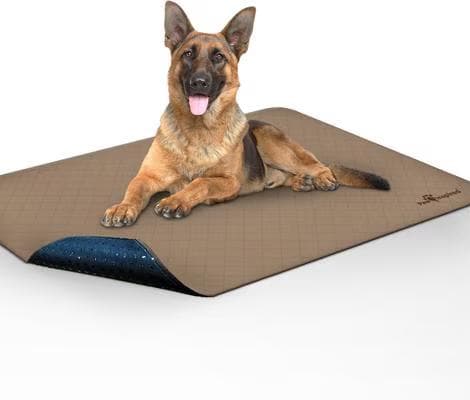
For time alone during the day, keep a Toy in a small safe room or pen rather than the whole house, so furniture jumps and chewing hazards are out of reach. Add water, a bed, and a washable potty spot such as Paw Inspired Washable Dog Pee Pads for days when a break cannot be arranged. A food puzzle like the Outward Hound Nina Ottosson Lickin' Layers puzzle feeder gives the first minutes alone a job to do.
Petful may earn a commission when you click through to Chewy, at no extra cost to you.
Do Toy Poodles bark a lot?
Yes, more than many breeds. The AKC rates the Toy Poodle's barking level 4 out of 5, and Toys are alert watchdogs that announce visitors, knocks, and outside noises. Barking can be trained down, but it rarely disappears in a dog bred to notice everything.
Common barking triggers:
- the doorbell, knocks, and people passing a window
- unfamiliar people or dogs
- boredom or too little exercise
- attention seeking, including whining or crying for company
- being left alone, when barking is part of separation distress
To cut barking, block the trigger where you can with window film or white noise. Teach a quiet cue by rewarding the pause after two or three barks, and never reward demand barking with attention. Daily exercise and food puzzles reduce boredom barking, while barking only when alone points to separation distress rather than a training gap.
At what age does a Toy Poodle calm down?
Most Toy Poodles settle noticeably between about 18 months and 2 years. Adolescence in dogs usually starts around 6 months and ends around 18 months, though it can run to 2 years, according to Cornell University's Riney Canine Health Center. Adolescent energy peaks in that window, along with ignored recalls, tantrums over denied treats, and barking with no clear cause.
A calmer adult Toy Poodle still loves play; the AKC rates the breed's energy 4 out of 5. What changes is the ability to settle indoors. Settling comes sooner with:
- two or three short walks or play sessions a day
- brain work such as scent games and trick training (Cornell notes that even five minutes of training a day helps)
- a predictable rest routine, with a crate or pen for naps
- rewards for calm behavior, not only attention for excitement
How smart is a Toy Poodle?
Very. Psychologist Stanley Coren's ranking of working and obedience intelligence places the Poodle second only to the Border Collie, and his list treats all three sizes as one breed. The AKC rates the Toy 5 out of 5 for both trainability and mental stimulation needs, which cuts both ways: a bored Toy invents its own games, often barking or chewing. The Poodle breed guide covers Poodle intelligence and training in depth.
What are the cons of a Toy Poodle?
The biggest cons come from size and coat. A Toy Poodle is fragile, slow to housebreak, vocal, and costly to keep groomed, and it needs company most of the day. None of these rule the breed out, but each needs a plan:
- Injury risk from falls or jumps: a jump from a sofa or a slip from someone's arms can break a leg; a Poodle Club of America Toy representative told Chewy that a single drop or trip can do it. The AKC also notes that luxating kneecaps and Legg-Calve-Perthes disease are more likely in Toys and Miniatures than in Standards.
- Housebreaking a small bladder: Toys need more frequent potty breaks and often take longer to housetrain.
- Barking: alert barking comes with the breed.
- Grooming time and cost: daily brushing plus a professional groom every 4 to 6 weeks.
- Needs company: long days alone raise the risk of separation anxiety.
- Dental disease: crowded teeth in a tiny jaw make daily tooth brushing a must.
- Cold sensitivity in a small body: a Toy loses heat quickly, especially in a short clip.
- Safety around toddlers or large dogs: a grabbing toddler or a playful big dog can injure a 5-pound dog in seconds.
- Outdoor hazards: birds of prey and wildlife can threaten a dog this small, so supervise it outdoors.
- Low-shedding coat that suits many, but not all, allergy sufferers
- Quick to learn, rated 5 of 5 for trainability by the AKC
- Portable enough to fly in an under-seat carrier
- Long-lived, with a 10 to 18 year life expectancy
- Affectionate, playful companion that suits apartments
- Fragile legs that can fracture in falls or rough play
- Alert barker that announces every visitor
- Slow to housebreak because of a small bladder
- Daily brushing plus a groom every 4 to 6 weeks
- Needs company and can develop separation anxiety
- Prone to dental disease and chills in cold weather
Caring for a Toy Poodle
Daily care for a Toy Poodle takes less space and food than a bigger dog needs, but more attention to the coat, to safety, and to meal timing.
Grooming a Toy Poodle at home
Grooming is the biggest daily job with a Toy Poodle. The curly coat grows continuously and sheds little, so loose hair stays trapped in the curls and knots into mats within days if brushing lapses. The AKC's advice is to brush a full coat down to the skin every day or keep the dog in a shorter trim, and to book a professional groom every 4 to 6 weeks.
A workable home routine:
- Daily brushing to prevent mats: line-brush in sections from the skin out with a slicker brush, then check with a metal comb. Mats start behind the ears, in the armpits, and under the harness.
- Bath every 2 to 4 weeks: use a dog shampoo and conditioner, and dry the coat fully, because damp curls mat fast.
- Ears: Poodles grow hair inside the ear canal. The Poodle Club of America suggests gently pulling out long canal hairs, while some veterinarians prefer trimming only around the opening, so ask your groomer or veterinarian which suits your dog, never push scissors into the canal, and clean the ears as your veterinarian advises.
- Eyes: wipe tear stains daily with a soft, damp cloth; light coats show them most.
- Nails: trim every few weeks, or whenever you hear clicking on the floor.
- Clip: between professional grooms, tidy the feet, face, and sanitary areas at home with quiet clippers.
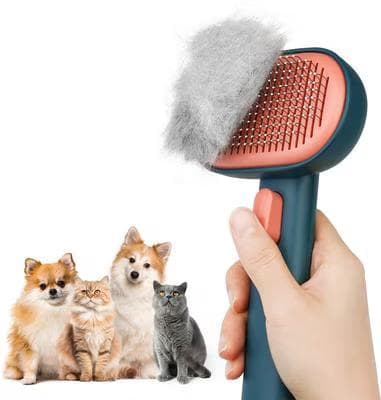
A self-cleaning slicker such as the aumuca Self Cleaning Slicker Brush speeds up the daily pass because it releases collected hair in one step. Brush gently, since a slicker dragged hard over one spot can scrape thin skin. If mats get ahead of you, a groomer will usually shave the coat short and start over, which is kinder than hours of dematting.
Petful may earn a commission when you click through to Chewy, at no extra cost to you.
Daily tooth brushing matters more for a Toy than for most dogs. Toy Poodles have the same 42 adult teeth as a large dog, crowded into a tiny jaw, and small breeds, Poodles included, often keep baby teeth that should have fallen out. VCA Animal Hospitals notes that retained teeth crowd the adult ones and invite dental disease. Use a dog toothpaste with a small brush such as the Virbac C.E.T. Dual-Ended Dog & Cat Toothbrush, and choose chews that carry the Veterinary Oral Health Council seal.
Expect extra mats during the coat change, when the soft puppy coat gives way to the denser adult coat, often starting around 9 to 12 months, groomers report. A well-kept Toy should not smell much. When one does, check the ears, teeth, a damp or matted coat, the skin, and the anal glands, since fixing the source fixes the odor. The Poodle breed guide covers Poodle odor in more depth.
Do Toy Poodles shed, and are they hypoallergenic?
Toy Poodles shed very little; the AKC rates the Toy's shedding 1 out of 5, and dead hairs mostly stay in the coat until brushing removes them. That makes the breed a common choice for people with allergies, but no dog is fully hypoallergenic, because allergens come from dander and saliva as well as hair. Spend time with Toy Poodles before committing if anyone at home has allergies. The Poodle breed guide covers Poodle shedding and allergies in detail.
Which haircut suits a Toy Poodle?
For most pet Toys, a short, even clip is easiest. A puppy cut leaves the coat one length all over, and a teddy bear cut adds a full, rounded face. Show dogs wear the continental or English saddle clip, while a lamb or sporting clip keeps the body short with slightly fuller legs. The shorter the cut, the less daily brushing it needs. See our guide to Poodle haircuts for pictures of each cut and how often to book one.
Daily exercise, rest, and gear
Plan on about 30 to 60 minutes of activity a day, split into short walks and play; Chewy's breed guide suggests about an hour for most Toys. Two or three short walks, fetch down a hallway, and a few minutes of trick training cover it for most adults, while puppies need shorter sessions and more naps.
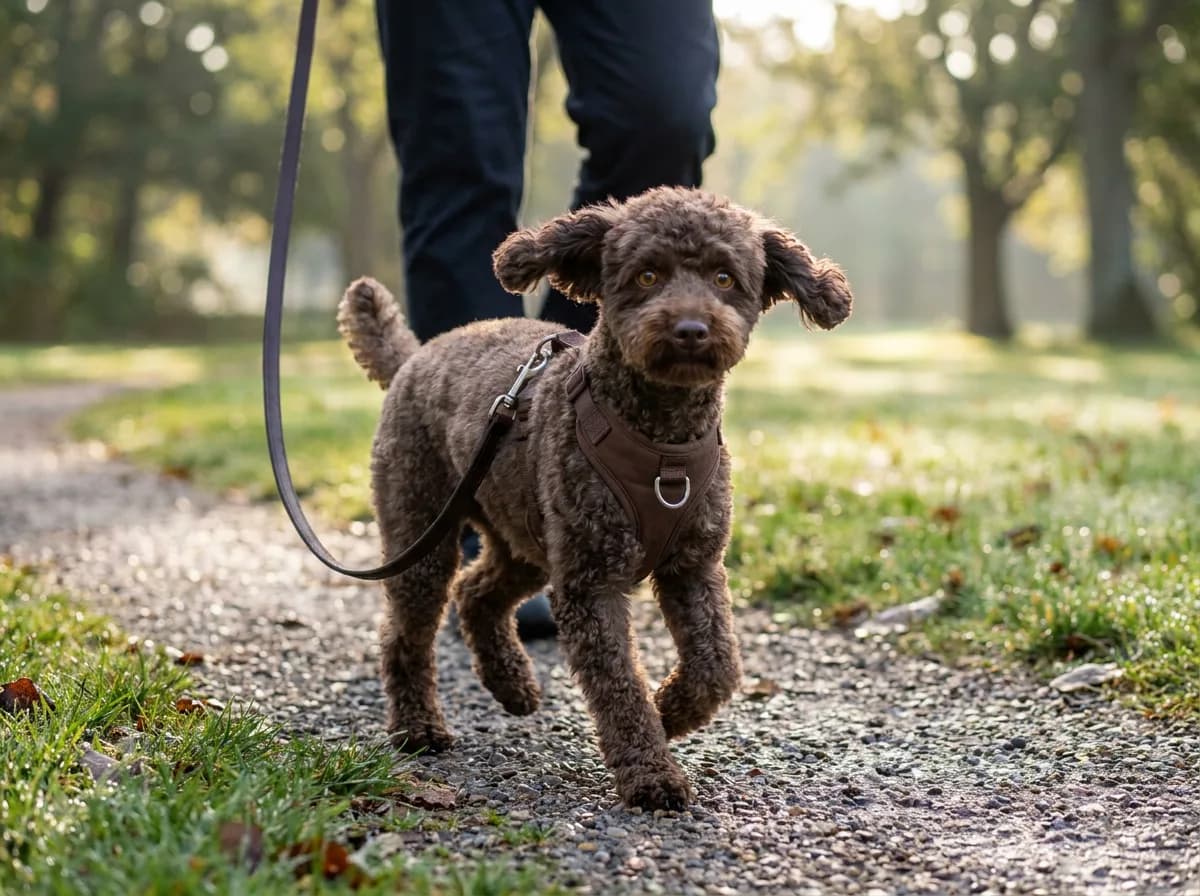
- Small breeds, Poodles among them, are prone to tracheal collapse, and a leash clipped to a neck collar puts pressure on the windpipe every time the dog pulls. Clip the leash to a padded harness and keep the collar for ID tags.
Measure the chest behind the front legs, under the coat, before buying a harness; many adult Toys need an extra-small, and a step-in or vest style suits a small frame. The American College of Veterinary Surgeons lists Poodles among the breeds most often affected by tracheal collapse, and a honking cough needs a vet visit. Keep a lightweight collar for ID tags, with room for two fingers underneath.
Rest and handling are part of daily care, too. Give your Toy a small bed at floor level, add pet steps or a ramp to any sofa or bed it uses, and gate stairs until it is steady on them. Lift it with one hand under the chest and one under the hindquarters, and set it down rather than letting it jump from your arms. For travel and vet visits, a carrier keeps it safe from bigger dogs and crowds.
Feeding a Toy Poodle
Feed a complete and balanced food in small, measured meals. For a puppy, look for an AAFCO nutritional adequacy statement for growth or all life stages, then switch to adult maintenance after the first birthday. Dry, wet, and fresh foods all work if they are complete and balanced, but homemade food needs a recipe from a board-certified veterinary nutritionist. Small-bite kibble suits a Toy's mouth, and Royal Canin makes Poodle-specific formulas, yet there is no single best dog food for a Toy Poodle, only one your dog thrives on at a healthy weight.
| Age | Typical weight | Meals per day | Approximate daily calories |
|---|---|---|---|
| 8 to 12 weeks | 1.2 to 2.7 lb | 4 | 130 to 245 kcal |
| 3 to 4 months | 1.6 to 3.3 lb | 3 to 4 | 165 to 285 kcal |
| 4 to 6 months | 2.2 to 4.6 lb | 3 | 140 to 245 kcal |
| 6 to 12 months | 3 to 6 lb | 3 | 175 to 300 kcal |
| Adult, spayed or neutered | 4 to 6 lb | 2 | 175 to 235 kcal |
| Adult, intact | 4 to 6 lb | 2 | 195 to 265 kcal |
| Adult, less active or senior | 4 to 6 lb | 2 | 130 to 210 kcal |
The calorie column uses the resting energy formula the Pet Nutrition Alliance publishes for veterinary teams: 70 times body weight in kilograms raised to the 0.75 power, multiplied by a life-stage factor.
- 3 for puppies under about 4 months
- 2 from 4 months to adulthood
- 1.6 for spayed or neutered adults and 1.8 for intact adults
- 1.2 to 1.4 for less active or overweight-prone adults
The Alliance cautions that individual dogs can vary by as much as 50 percent from these estimates, so treat the numbers as a starting point and adjust by body condition every few weeks. Keep treats under 10 percent of daily calories.
Small, frequent meals matter most in the first months. Toy-breed puppies are prone to hypoglycemia, or low blood sugar, because they burn energy fast and store little of it. Weakness, trembling, wobbliness, or unusual sleepiness in a young puppy needs a veterinarian right away.
Training and housebreaking a Toy Poodle
Toy Poodles learn fast and respond best to short, upbeat sessions with food rewards. Keep sessions to about five minutes, a few times a day, and teach the basics early: sit, come, wait at doors, and settle on a mat. Let a Toy walk on its own four feet and meet people and dogs calmly, because a dog carried everywhere misses the practice that builds confidence.
Housebreaking a small bladder takes a tighter schedule than it does with a bigger dog. By the AKC's rule of thumb, a puppy can hold its bladder for about its age in months plus one hour, and the AKC suggests hourly trips for toy breeds when you can manage them. Take your puppy out:
- right after waking, eating, playing, and chewing
- about every hour while it is awake in the early weeks
- last thing at night and as soon as it wakes in the morning
Reward the puppy outdoors the moment it finishes, and clean accidents with an enzymatic cleaner so the smell does not draw it back. An indoor potty spot helps in bad weather and on long days. Most toy puppies need several months of consistency, and setbacks during adolescence are normal.
A crate helps with both housebreaking and safe naps. For a young puppy, choose one just big enough to stand, turn around, and lie down in, so it will not soil one end. For an adult Toy, a small kennel such as the Petmate Two Door Top Load Dog & Cat Kennel, rated for pets up to 15 pounds, also works for car trips, and its top door lets you lift the dog out instead of pulling it through the front.
Toy Poodle Colors
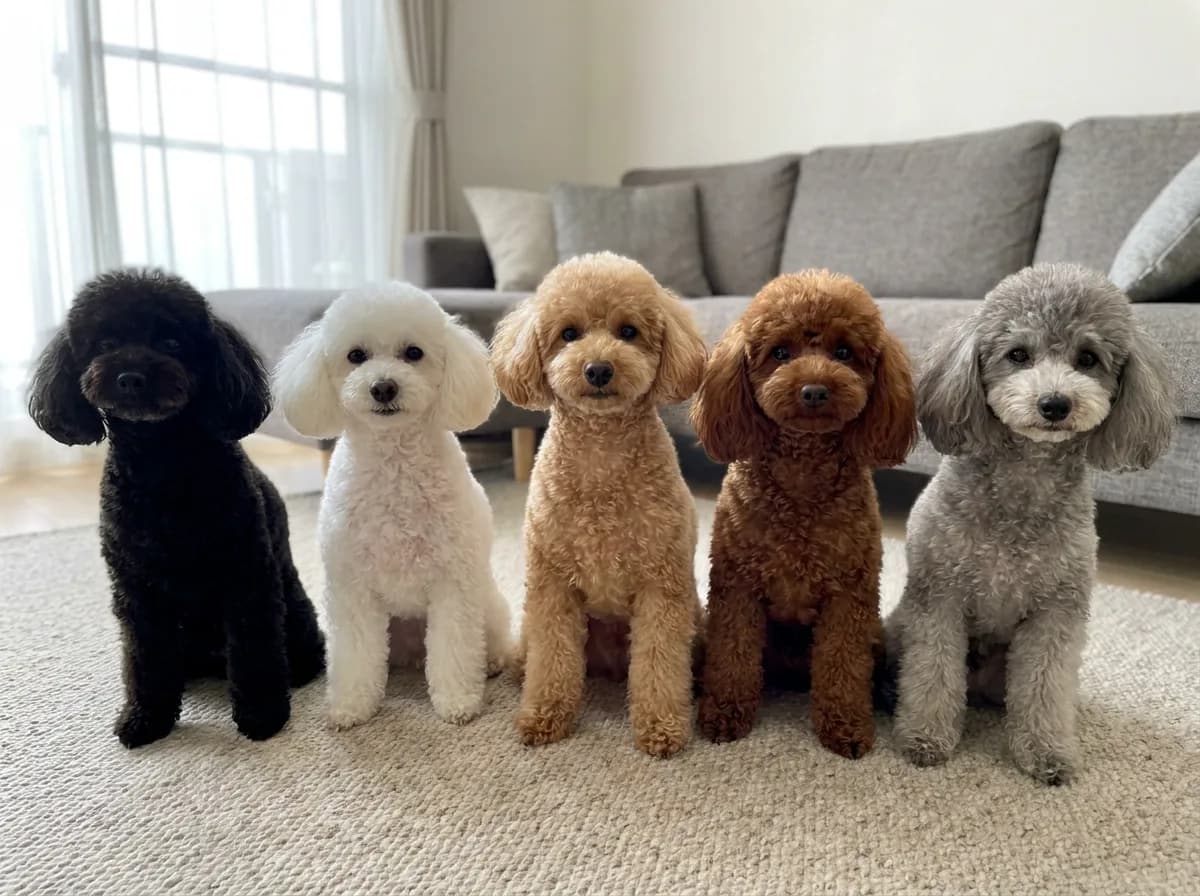
Toy Poodles come in every Poodle color. The AKC registers Toys in 11 solid standard colors plus 16 two-color combinations recorded as alternate colors, but only solid-colored dogs can compete in AKC conformation. Many colors also shift with age as the coat clears. For every Poodle color and pattern in detail, see our Poodle colors guide.
Common and rare Toy Poodle colors
Every AKC standard color appears in Toys, as the table below shows. Two-color Toys such as parti (at least half white) and phantom (black and tan or black and apricot) can be registered as alternate colors but cannot compete in AKC shows; the UKC shows them separately as Multi-Colored Poodles. No registry publishes how many Toys are born in each color, so treat any breeder's rare label with caution.
| Color | AKC status for Toys | How it can change with age |
|---|---|---|
| Black | Standard solid | Stays black unless the dog carries graying genes, which clear it to blue or silver |
| White | Standard solid | Stays white; tear stains show, and a brown nose is a show fault |
| Cream | Standard solid | Darker hair on the ears and neck lightens as the coat clears |
| Apricot | Standard solid | Can lighten as the coat clears |
| Red | Standard solid | Can lighten toward apricot as the coat clears |
| Silver | Standard solid | Born black; the face shows silver by about 6 weeks and the body keeps clearing |
| Blue | Standard solid | Born black; may not start clearing until about 2 years |
| Gray | Standard solid | Lightens from a darker puppy shade |
| Brown (often called chocolate) | Standard solid | May clear toward cafe au lait if the dog carries graying genes |
| Cafe au lait | Standard solid | Born darker brown; may not start clearing until after 1 year |
| Silver beige | Standard solid | Born brown; the lighter face shows by about 6 weeks |
| Parti, such as black and white or red and white | Alternate color: registrable, not shown in AKC conformation | Colored patches can clear; small dark ticking can appear on the white |
| Phantom, such as black and tan; tri color when combined with parti | Alternate color: registrable, not shown in AKC conformation | Tan points can fade toward silver |
| Sable and brindle | Not on the AKC Toy color list; shown in UKC Multi-Colored classes | Sables lighten considerably; brindles often clear toward blue or silver by about 1 year |
| Merle, including blue merle and red merle | Not a traditional Poodle color; disqualified by the UKC | Signals crossbreeding somewhere in the pedigree |
| Albino | Not on the AKC Toy color list; disqualified by the UKC | Pink nose, pink eye rims, and blue eyes |
What is the rarest Toy Poodle color? No one can say with data. Colors that need two copies of a recessive gene, such as brown, the red-to-white range, and parti, can skip generations and turn up less often from solid-colored parents, and some breeders price patterns and unusual shades higher. Merle and albino are not rare Poodle colors at all: the United Poodle Association says merle entered the breed through crossbreeding, and breeding two merles risks deaf or blind double-merle puppies.
Informal names cause much of the confusion:
- Ginger, caramel, and orange usually describe shades of red or apricot.
- Blonde and beige usually mean cream or light apricot; silver beige is a separate brown-based color.
- Tan usually refers to phantom points on a black or brown dog.
- A white chin or chest on a black Toy is recorded by the AKC as white markings, and a tuxedo look adds white down the chest and legs; the UKC calls a mostly solid dog with some white an abstract.
- Blue eyes fall outside the standards, which call for dark eyes (dark amber in brown dogs), and usually point to merle or albinism.
Does color change a Toy Poodle's price?
Color can change the asking price, not the dog's quality. Coat color has no bearing on health or temperament, so a black or white Toy should not cost more because of its coat. Some breeders do charge premiums for red, parti, phantom, or colors they market as rare, and a premium for merle is a red flag rather than a bonus. Parent health testing, early socialization, and a written health guarantee are better places to spend. Our guide to what a Poodle costs breaks down prices by size.
Toy Poodle health and lifespan
The average lifespan of a Toy Poodle is long for a dog. The AKC lists a life expectancy of 10 to 18 years, and Toys in a 2004 UK Kennel Club owner survey died at a median age of 14 years 8 months (a small sample of 20 dogs), close to the 14.7-year life expectancy that Japanese pet insurance data gave Toy Poodles. For how Toys compare with Miniatures and Standards, and what shortens a Poodle's life, see how long Poodles live.
Common health problems in Toy Poodles include:
- Patellar luxation (slipping kneecaps) and Legg-Calve-Perthes disease of the hip, both more likely in Toys and Miniatures than in Standards, per the AKC
- Progressive retinal atrophy (PRA), an inherited cause of blindness with a DNA test for the prcd form
- Periodontal disease, driven partly by crowded teeth
- Tracheal collapse, which causes a honking cough
- Epilepsy and von Willebrand's disease, a bleeding disorder, seen occasionally in the breed
Before buying a puppy, ask for the parents' results on the three tests the Poodle Club of America lists for Toys: a PRA-prcd DNA test, a yearly eye exam by a board-certified veterinary ophthalmologist, and a patellar luxation evaluation.
How much does a Toy Poodle cost?
A Toy Poodle puppy from a breeder typically costs about $1,200 to $3,000, and some guides start at $1,000:
- Chewy's breed guide: $1,000 to $3,000 or more
- PetMD: $1,200 to $3,000 from a breeder
Lineage, location, and color can push the price higher, while adopting from a rescue usually costs far less, with fees set by each group. Over a lifetime the purchase price is the smaller number. The recurring costs to plan for:
- Grooming: Spot Pet Insurance puts Poodle grooming at about $55 to $160 a session, and a Toy groomed every 4 to 6 weeks needs 9 to 13 visits a year.
- Pet insurance: the average US accident-and-illness premium for a dog was $836 a year in 2025, according to NAPHIA, the North American Pet Health Insurance Association.
- Dental and routine vet care: yearly checkups, preventives, and periodic dental cleanings, which a Toy's crowded teeth make more likely.
For price by size, yearly grooming and vet costs, and how to spot a fair price, see our guide to what a Poodle costs.
Is a Toy Poodle a good dog for you?
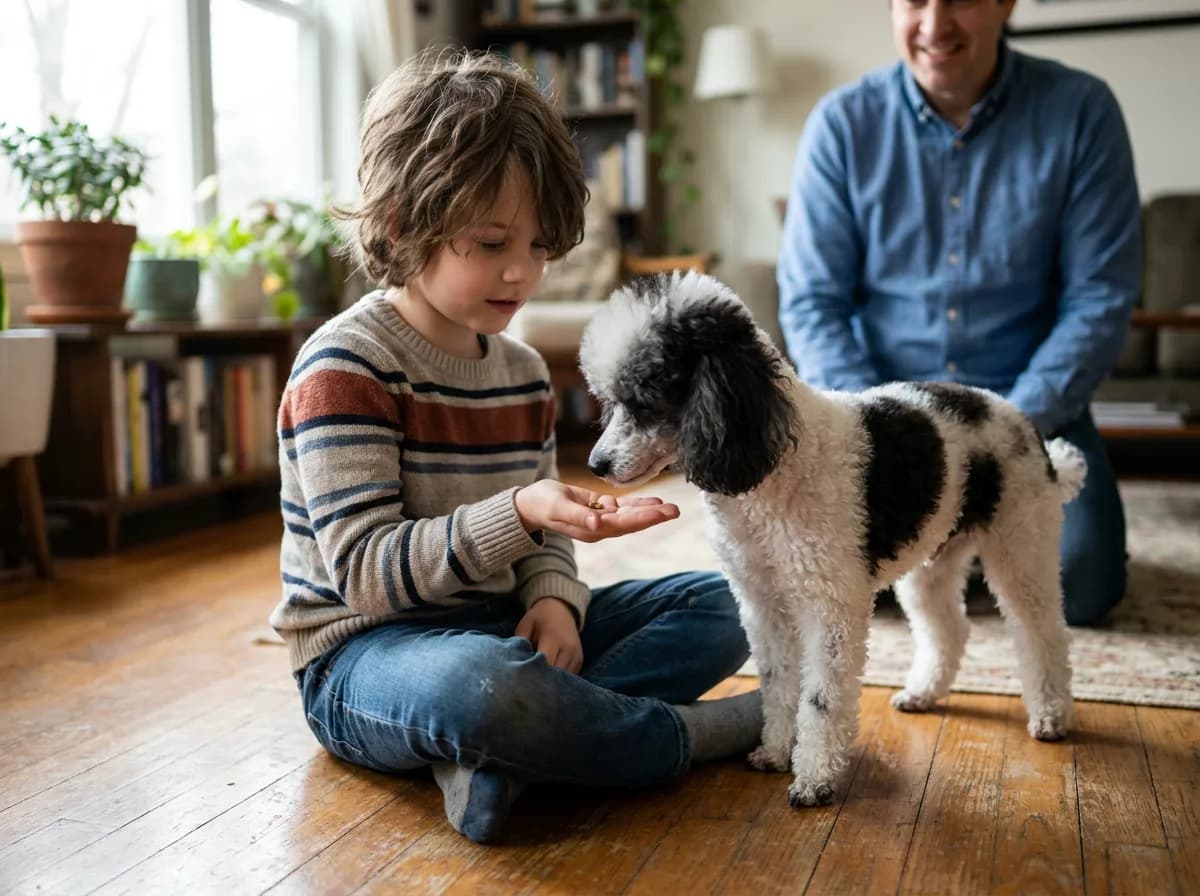
A Toy Poodle is a good dog for adults, seniors, and families with older, gentle children who are home most of the day and will keep up with grooming. It is a poor fit for homes with toddlers, rough large dogs, or long daily absences. The AKC rates the breed highly for patience with young children; the risk is physical, because a toddler can drop or fall on a 5-pound dog.
| Check | Good fit if | Think twice if |
|---|---|---|
| Young children at home | Children are school-age and sit on the floor to hold the dog | Toddlers who grab, carry, or fall on pets |
| Hours alone each day | Someone is home most days or can arrange a midday visit | The dog would be alone 8 or more hours most days |
| Stairs and furniture | You can add pet steps and gate stairs | The dog must jump from high beds or sofas |
| Other pets | Cats or small, gentle dogs | Large, boisterous dogs |
| Grooming budget | You can brush daily and book a groom every 4 to 6 weeks | You want a wash-and-go coat |
| Barking tolerance | You can teach a quiet cue and live with alert barking | Thin walls and strict neighbors |
| Activity | Short walks and daily training games suit you | You want a partner for long runs or hikes |
With a cat, introduce the pets slowly and under supervision, and give each a retreat the other cannot reach; many cats outweigh a Toy, so rough play can hurt either one. As a pet for older owners, a Toy's size is a plus, but a small dog underfoot can also be a tripping hazard, so a bright harness or a bell on the collar helps.
Should you choose a male or female Toy Poodle?
Neither a boy nor a girl Toy Poodle is better: the individual dog's temperament matters more than its sex, and at this size the AKC lists the same 10-inch limit and 4 to 6 pound weight for males and females. The practical differences are hormonal: intact males are more likely to mark indoors, and intact females come into heat. Spaying ends heat cycles and neutering often reduces marking; your veterinarian can advise on timing. The Poodle breed guide covers boy-versus-girl tradeoffs across all three sizes.
Considering a Toy Poodle mix?
Toy Poodles are one parent of many popular small crosses, including the Maltipoo, Cavapoo, Yorkipoo, and Shih-Poo. Many of these crosses can come from either a Toy or a Miniature Poodle parent, and a mix's adult size depends on both parents, so it can land well outside the Toy range. Coat type and shedding also vary more than in a purebred Toy. Compare crosses, sizes, and coat types in our Poodle mixes guide.
Toy Poodle FAQ
Yes. Under the Americans with Disabilities Act, a dog of any breed or size can be a service dog if it is individually trained to do work or perform tasks for a person with a disability. Toy Poodles suit psychiatric service tasks, such as interrupting anxiety episodes, and some medical alert work, but they are too small for mobility support such as bracing or pulling a wheelchair. A therapy dog is different: it visits hospitals or schools with its owner and has no public access rights under the ADA.
Usually. A 4 to 6 pound Toy fits comfortably in a soft-sided under-seat carrier, which is how small dogs fly in the cabin on US airlines. Each airline pet policy sets its own carrier size, fee, and limit on pets per flight; JetBlue, for example, caps carriers at 17 by 12.5 by 8.5 inches. Measure your dog standing and lying down, make sure it can turn around, and book the pet reservation early.
It can if the big dog is gentle and you manage the setup. Allow only supervised play with larger dogs, interrupt wrestling and chasing before it escalates, feed the dogs apart, and give the Toy a separate resting space, such as a gated room or pen the larger dog cannot enter. Do not leave them loose together unsupervised until the big dog has proven reliably calm.
Often, yes. A small body loses heat quickly, and a short clip in winter removes most of the coat's insulation, so a snug sweater or insulated coat helps on cold walks. Limit time in cold wind and wet weather, dry the coat after walks, and head inside if your dog shivers, lifts its paws, or slows down.

Coreen Saito is a pet writer and longtime shelter volunteer with more than a decade in animal rescue. She covers cat behavior, breed care, and the small, ordinary science of sharing a life with companion animals, with a particular focus on honest takes about the products and decisions that actually matter. At home in Arizona, she's outranked by Mac (a dog with the loudest opinion in the house), Rebel (a cat who governs by quiet authority), and Meri (an orange tabby who runs the late shift and the laundry basket). She writes about all three, plus the rescues that keep coming through her life, at LifeWithMinty.com.
Sign up for expert-backed reviews and safety alerts all in one place.