Tuxedo Cat: Genetics, Characteristics, Lifespan, and Famous Tuxies
A tuxedo cat is a black-and-white coat pattern, not a breed. Here is the white-spotting genetics behind the markings, why tuxedos split 50/50 male and female, the breeds that wear the look, lifespan, costs, and the famous tuxedo cats of history.
Petful is reader supported. As an affiliate of platforms like Amazon and Chewy, we may earn a commission when you buy through links on this page. There is no extra cost to you.
A tuxedo cat is one of the most recognizable cats on Earth, yet the Cat Fanciers' Association (CFA) recognizes the bicolor pattern that creates it in at least 15 different breeds, which is the first clue that "tuxedo" describes a coat, not a kind of cat. The classic black-and-white markings (a dark coat with a white chest, belly, paws, and often a white chin) look so much like formal black-tie evening wear that the look earned its name decades ago. President Bill Clinton's cat Socks, who lived in the White House from 1993 to 2001, may be the most famous example, but tuxedo cats turn up in shelters, barns, and pedigreed catteries all over the world. Below, drawing on feline geneticists and the CFA breed standards, we explain exactly what a tuxedo cat is, the white-spotting gene behind the pattern, why these cats are split roughly 50/50 male and female (unlike calicos), and the real and fictional tuxies who made the look famous.
- 1A tuxedo cat is a black-and-white (bicolor) coat pattern, not a breed
- 2The pattern comes from the KIT-related white-spotting (piebald) gene and is graded low to high, with tuxedo sitting at the low-to-mid end
- 3Unlike calico and tortoiseshell, the white-spotting gene is NOT sex-linked, so tuxedo cats are roughly 50/50 male and female
- 4Tuxedos are common, not rare, and the pattern does not affect lifespan, which runs about 12-16 years for healthy indoor cats

Sign up for expert-backed reviews and safety alerts all in one place.
What Is a Tuxedo Cat?
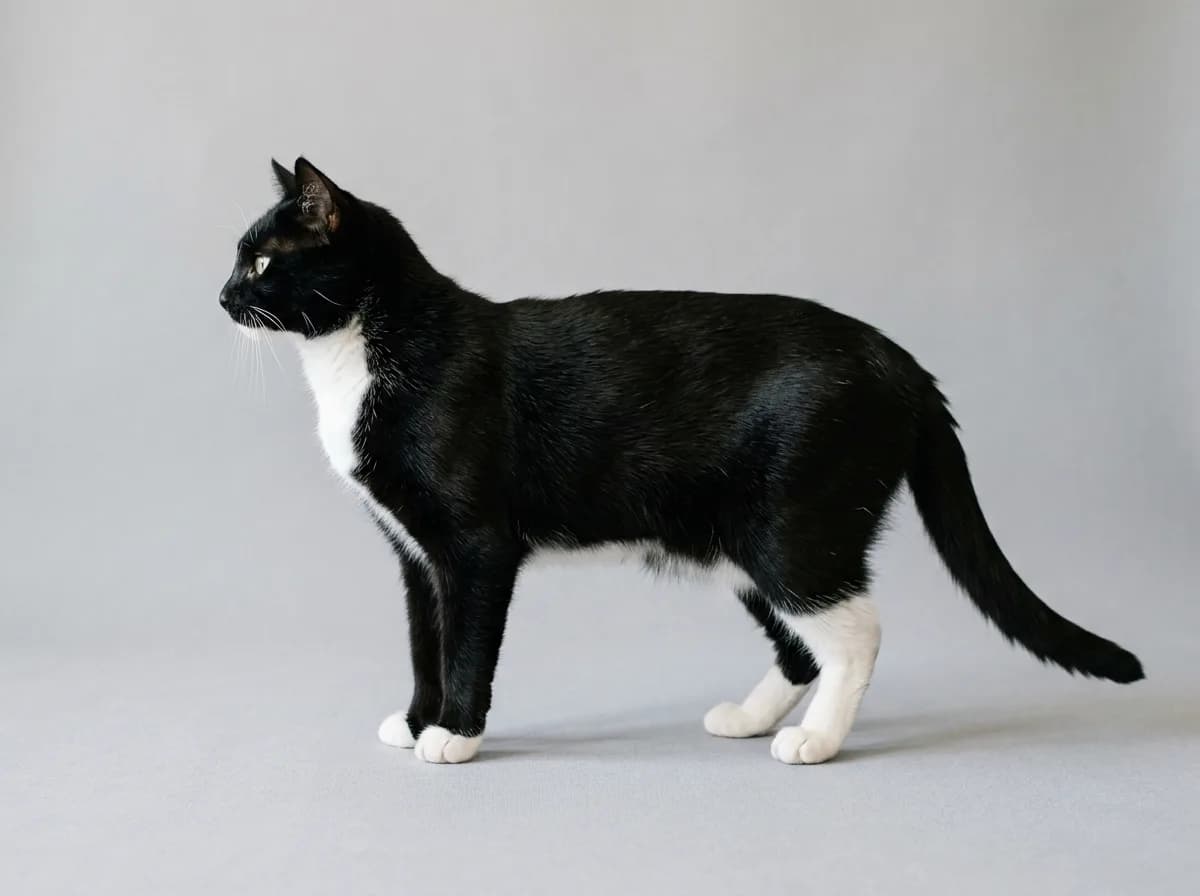
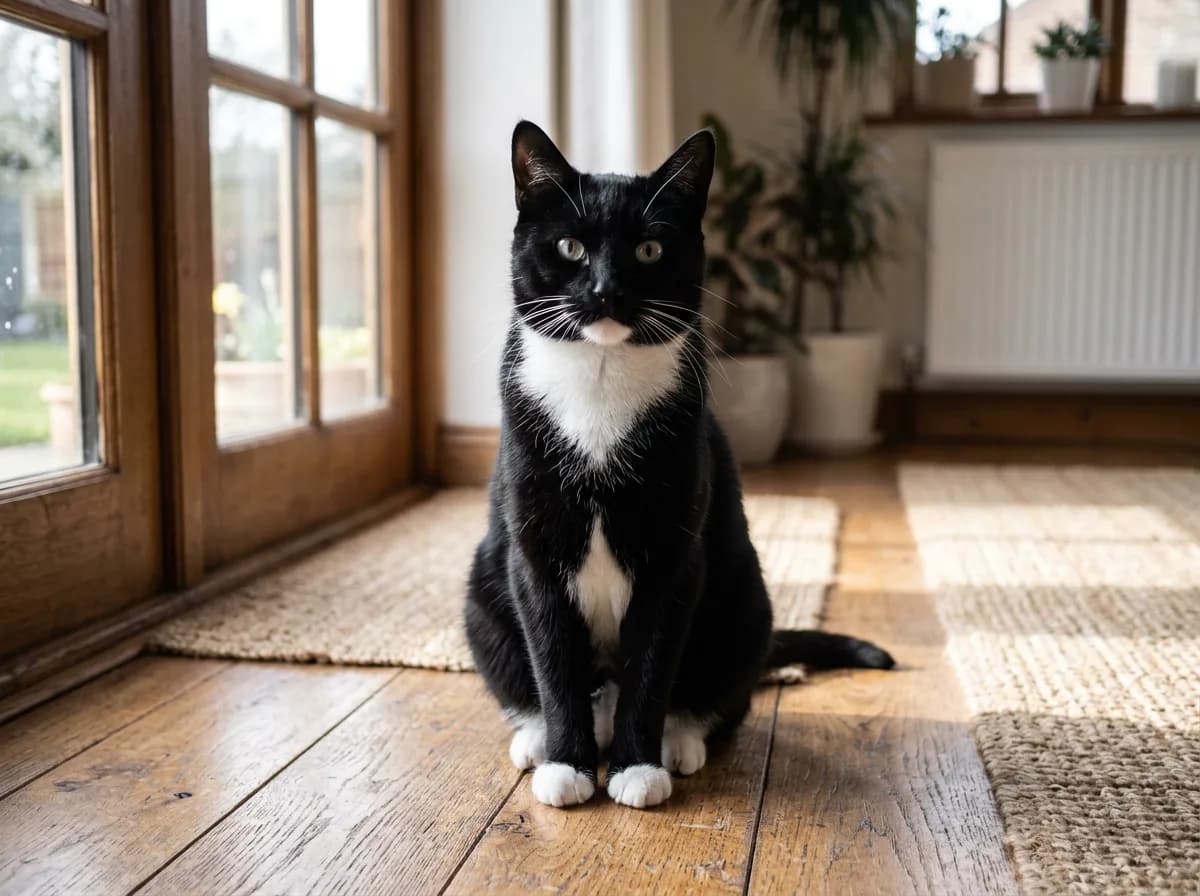
A tuxedo cat is a cat with a bicolor coat: a dark base color, classically black, broken up by white on the chest, belly, paws, and frequently the chin and muzzle. The contrast of a black "jacket" over a white "shirt front," finished with white "spats" on the feet, mimics a man's formal tuxedo, which is where the name comes from. People also call these cats tuxies, and you will see them nicknamed "Felix cats" after the cartoon and "Jellicle cats" after the felines in T.S. Eliot's poetry and the musical Cats. Geneticists describe the underlying coat as piebald, the same word used for black-and-white horses and other animals with patchy white.
The most important thing to understand up front is that a tuxedo cat is not a single breed. It is a black and white cat pattern that can appear on a purebred Maine Coon, a pedigreed British Shorthair, or the mixed-breed cat that wandered into your yard. The "tuxedo" only describes how the black and white are arranged, not the cat's ancestry, size, or personality.
- A "true" tuxedo is mostly black with white limited to the chest, belly, paws, and often the chin. If a cat is mostly white with a few dark patches, that is a different grade of the same white-spotting pattern (closer to harlequin or van), not a tuxedo.
Tuxedo Is a Type of Black and White Cat
Every tuxedo cat is a black and white cat, but not every black and white cat is a tuxedo. The "tuxedo" label is reserved for the specific arrangement where the dark color covers most of the back, head, and tail like a coat, and the white sits on the underside and feet like a dress shirt and spats. A cat that is half black and half white in random blotches, or mostly white with a black cap, falls elsewhere on the white-spotting scale we explain below.
Are Tuxedo Cats a Breed?
No. A tuxedo cat is not a breed. It is a coat pattern that shows up across many different cat breeds and in countless mixed-breed domestic cats. There is no "tuxedo breed" you can adopt or register, because the black-and-white markings are produced by a single white-spotting gene that can land on a cat of almost any breed or ancestry.
This is the single most common misconception about these cats. When someone asks "what breed is my tuxedo cat," the honest answer is that the pattern alone cannot tell you. Your tuxedo could be a domestic shorthair (the catch-all term for a mixed-breed short-coated cat), a domestic longhair, or a purebred from a recognized breed that happens to allow bicolor coats. To know the breed, you would need pedigree papers or a feline DNA test, not the coat.
- Coat pattern never determines breed. If you want to know your tuxedo cat's ancestry, a feline DNA test (around 45 to 130 US dollars) is the only reliable route. Pedigree paperwork from a registered breeder is the other.
Tuxedo Cat Characteristics
The defining tuxedo cat characteristics all come down to where the white sits against the dark coat. Beyond the markings, tuxedo cats vary enormously in size, eye color, and coat length, because those traits track the cat's breed and individual genetics rather than the bicolor pattern itself. Here is what actually distinguishes a tuxedo.
Classic Markings, Mittens, and Masks
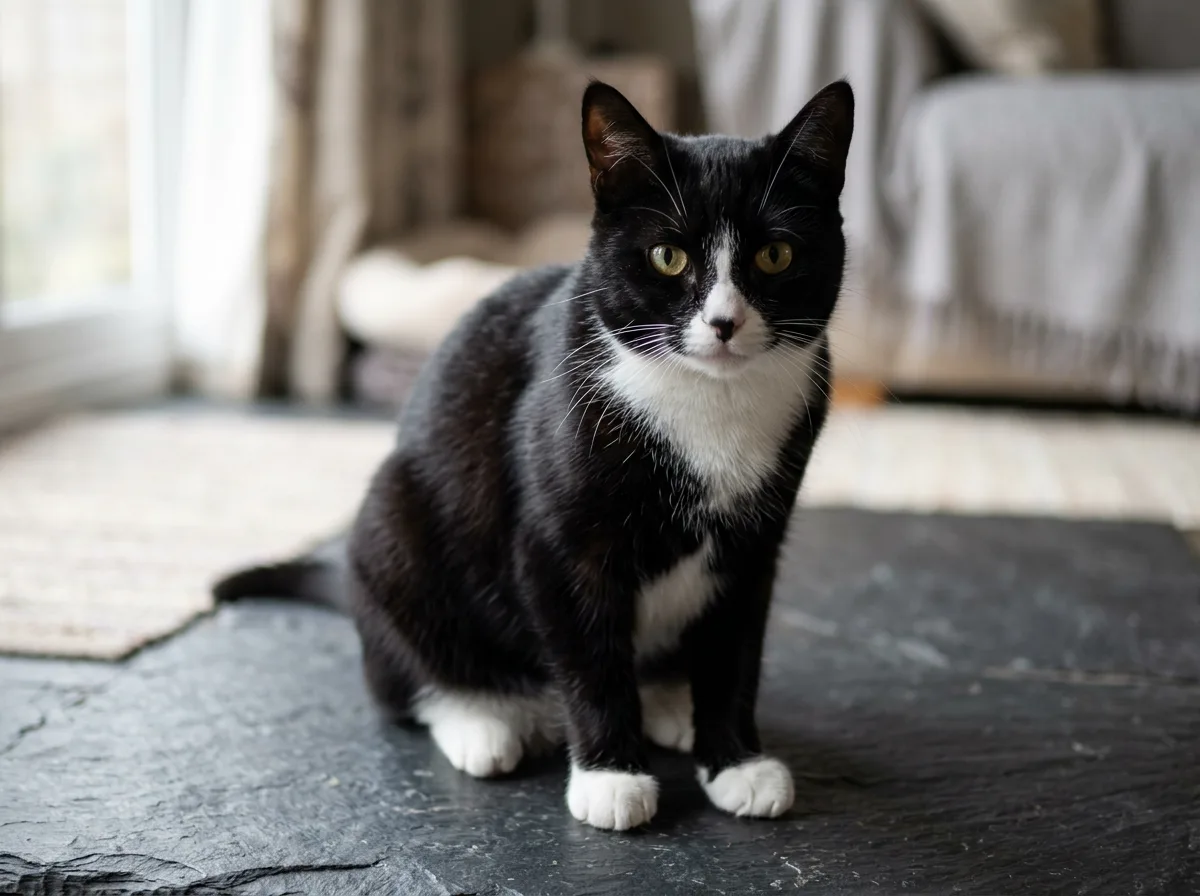
The textbook tuxedo has a solid dark back, head, and tail with a white chest and bib, a white belly, and white feet. The white paws are sometimes called "mittens" or "boots," and a cat with especially neat white feet may be described as having "tuxedo mittens." Many tuxedos also carry white on the chin and muzzle, which can read as a tidy little goatee or a white mustache, and some have a white blaze or facial mask that gives them an asymmetrical, expressive face. No two tuxedos are marked exactly alike, because the white forms through a partly random developmental process (more on that in the genetics section).

Never Scoop Again® with the Whisker Litter-Robot, the smart self-cleaning automatic litter box. Monitor visits and track weights for better overall care in the Whisker® app. Multi-cat friendly.
Petful may earn a commission when you click through to Whisker, at no extra cost to you.
Eye Color
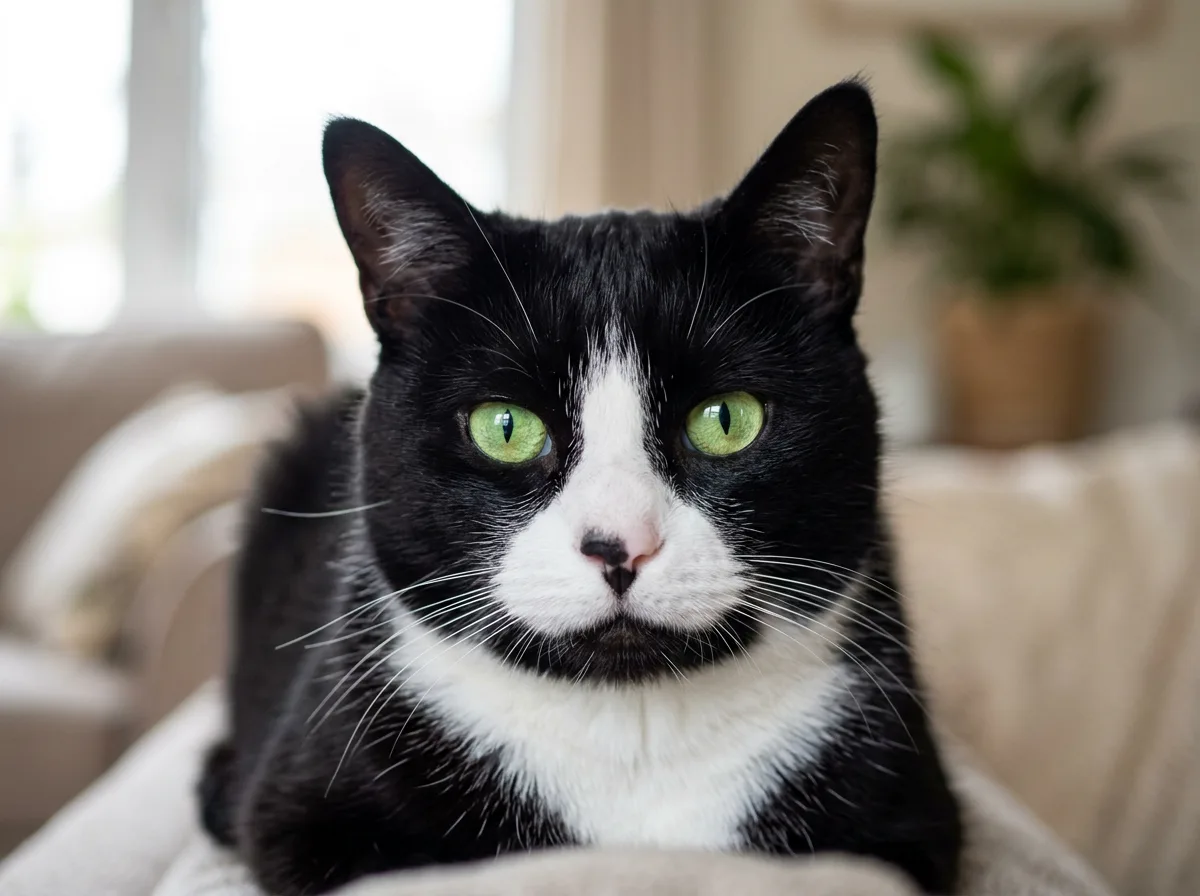
Tuxedo cats can have any eye color. Gold, copper, green, and yellow are the most common, and some tuxedos have striking blue or odd-colored (heterochromatic) eyes depending on their breed and other coat genes. Eye color is not tied to the tuxedo pattern, so you cannot predict it from the markings alone.
Size and Weight by Breed
Because "tuxedo" is a pattern and not a breed, size ranges all over the map. A tuxedo domestic shorthair typically weighs 8 to 12 pounds. A tuxedo Maine Coon, one of the largest domestic breeds, can reach 12 to 18 pounds or more, while a tuxedo Munchkin or Singapura sits at the small end near 5 to 9 pounds. Always size your expectations to the breed, not the coat.
Male vs Female Tuxedo Cats
Tuxedo cats are split roughly evenly between males and females. There is no strong sex bias the way there is with calico and tortoiseshell cats, and the reason is genetic: the white-spotting gene that creates the tuxedo pattern is not carried on the sex chromosomes. A female tuxedo cat is exactly as likely as a male, and neither sex is "rarer" or worth more because of the pattern. We unpack the genetics, and the calico contrast, next.
The Genetics Behind the Tuxedo Pattern
This is where most articles stop short, and where the real answer lives. The tuxedo pattern is created by the white-spotting gene, a piebald-spotting mutation in the KIT gene family. KIT codes for a receptor that helps direct pigment-producing cells, and a feline endogenous retrovirus inserted into the KIT gene is what triggers the white-spotting pattern in domestic cats (described in the journal G3: Genes, Genomes, Genetics). It is the same gene family responsible for the white in a calico or a bicolor Maine Coon.
Why the White Lands Where It Does
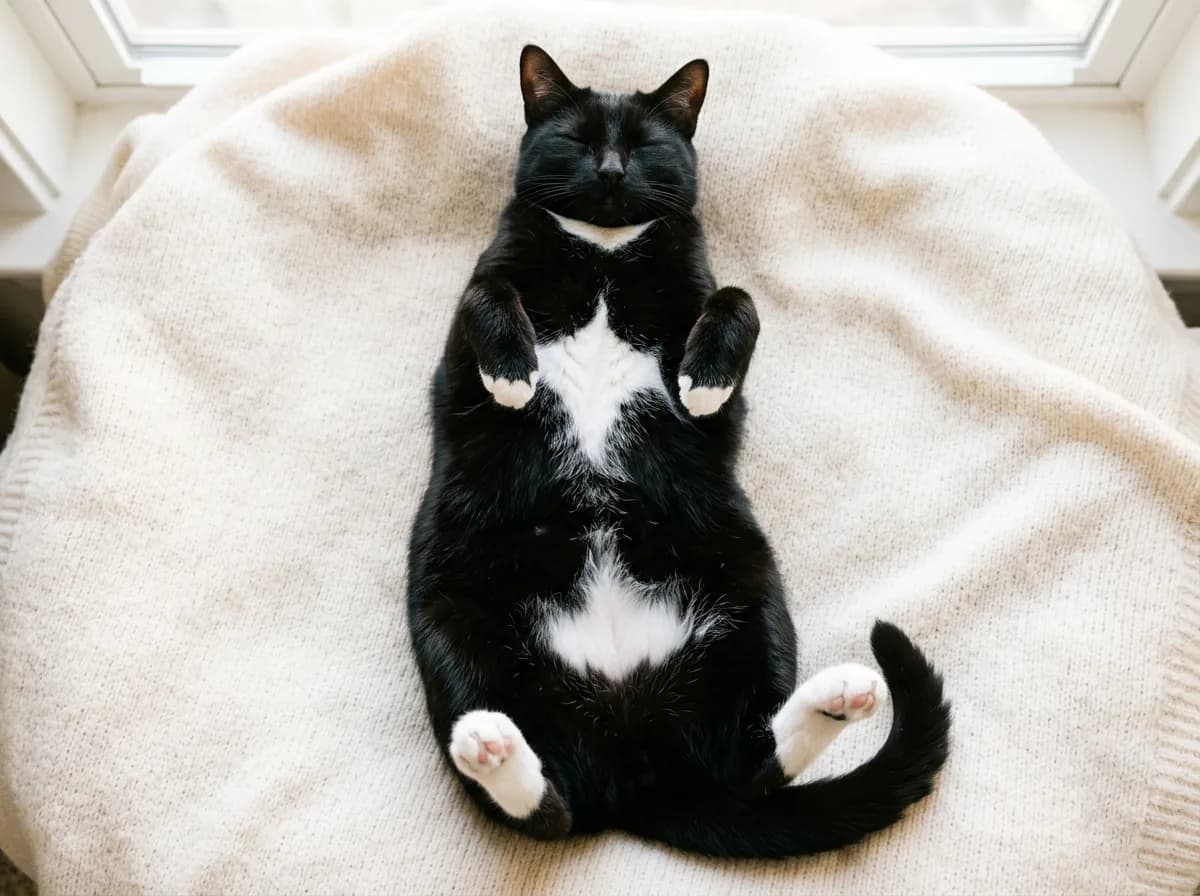
During development, pigment cells called melanoblasts start near the embryo's back and migrate down and around to cover the whole body before the skin forms. A 2016 study from the University of Bath and the University of Edinburgh, published in Nature Communications, overturned the old textbook idea that these cells simply move too slowly. It showed the pigment cells move and multiply at random, and that a faulty white-spotting gene reduces the rate at which they divide, so too few cells are produced to cover the whole embryo before the skin forms. The areas they fail to reach (typically the belly, chest, and paws, which are farthest from the starting point) end up with no pigment, so they grow white fur. That is exactly why a tuxedo's white shows up on the underside and feet: those regions are the last to be covered, so they are the first to be left white. It also explains why no two tuxedos are marked identically.
The White-Spotting Grade Scale
Cat geneticists describe white spotting on a low-to-high scale (often numbered roughly 1 to 10, where higher means more white). Tuxedo sits at the low-to-mid end of that scale: enough white to mark the chest, belly, and paws, but not so much that the cat reads as mostly white. As the grade climbs, the same gene produces progressively more white coats. The table below maps the common bicolor "grades" so you can place your own cat.
| Grade / Name | Approximate White | What It Looks Like |
|---|---|---|
| Low grade (locket / mitted) | A few percent | A small white chest spot or white toes on an otherwise solid cat |
| Tuxedo | Roughly 10 to 40 percent | White chest, belly, and paws, with color over the back and head (the formal black-tie look) |
| Bicolor (standard) | About 50 percent | Color and white in larger, balanced areas, often a colored "cap" and "saddle" |
| Harlequin | Mostly white | A predominantly white cat with a few scattered patches of color |
| Van | Almost all white | Color limited to the head and tail only, with a nearly all-white body |
- These are all the SAME white-spotting gene at different strengths. A tuxedo is low-to-mid white. A van (named for the Turkish Van) is the high extreme, with color only on the head and tail. Harlequin sits between bicolor and van. Knowing the scale is the fastest way to tell a tuxedo from its mostly-white cousins.
Why Tuxedo Is NOT Sex-Linked (the Calico Contrast)
Here is the genetic point no competitor explains clearly. Calico and tortoiseshell cats are nearly always female because their orange and black coloring is controlled by the orange gene, which sits on the X chromosome. A female (XX) can show both orange and black at once through random X-inactivation; a male (XY) usually has only one X, so he typically shows only one of those colors. That is why roughly 99.9 percent of calicos and torties are female (male calicos occur about 1 in 3,000, the commonly cited University of Missouri figure).
The tuxedo pattern is different. White spotting is controlled by the KIT-family gene, which is not on a sex chromosome. It affects males and females equally. So while the orange in a calico is sex-linked, the white in a tuxedo is not. The practical result: tuxedo cats are roughly 50/50 male and female, and a male tuxedo is in no way unusual. If you ever see a black-and-white-and-orange tuxedo (a tuxedo with tortie or orange patches), the orange part of that cat is still sex-linked, but the white tuxedo pattern over it is not.
- "Tuxedo cats are mostly male" is false. People confuse tuxedos with calicos because both involve white spotting, but only the orange/tortoiseshell colors are sex-linked. Tuxedo cats split evenly between the sexes.
Breeds That Can Have the Tuxedo Pattern
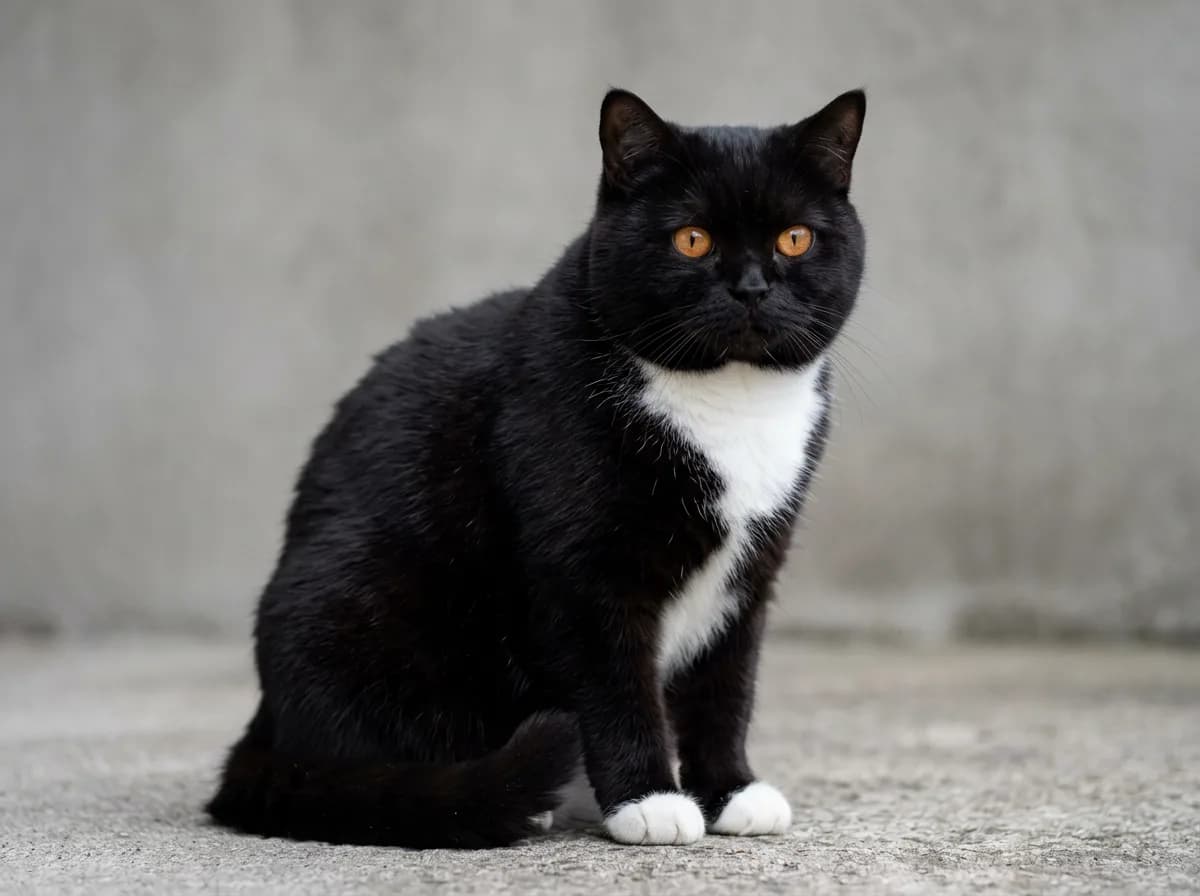
Many recognized breeds carry the bicolor white-spotting pattern, and the CFA permits bicolor (including tuxedo-style) coats in roughly 15 breeds. Add in the millions of mixed-breed domestic shorthairs and longhairs that wear it, and the tuxedo is one of the most widespread looks in catdom. The breeds below are among those whose standards allow the pattern.
| Breed | Coat Length | Notable Trait |
|---|---|---|
| American Shorthair | Short | Sturdy, easygoing all-American cat |
| British Shorthair | Short | Dense plush coat, calm "teddy bear" temperament |
| Maine Coon | Long | One of the largest breeds, tufted ears and ruff |
| Persian | Long | Flat-faced, very long coat, quiet nature |
| Exotic Shorthair | Short | The short-coated Persian, same face, less grooming |
| Norwegian Forest Cat | Long | Rugged double coat built for cold |
| Devon Rex | Short (curly) | Wavy coat, big ears, playful |
| Cornish Rex | Short (curly) | Fine rippled coat, athletic |
| Sphynx | Hairless | Pattern shows on the skin pigment |
| Scottish Fold | Short or long | Folded ears, round face |
| Munchkin | Short or long | Short legs, otherwise typical cat |
| Oriental | Short | Sleek and vocal, Siamese relative |
| American Curl | Short or long | Backward-curling ears |
| LaPerm | Curly | Soft curly rexed coat |
| Peterbald | Hairless to fine | Russian hairless breed |
Remember that a purebred tuxedo is purebred because of its breed, never because of the pattern. A tuxedo British Shorthair is a registered British Shorthair that happens to be bicolor. If you are drawn to a specific build or temperament, research the breed's care needs, since those vary far more than the coat color. Petful's full British Shorthair breed profile and Persian cat profile are good places to compare. Several Persian cat colors include bicolor divisions, and the breed's color hub explains how registries sort them.
Maine Coon Tuxedo Cats
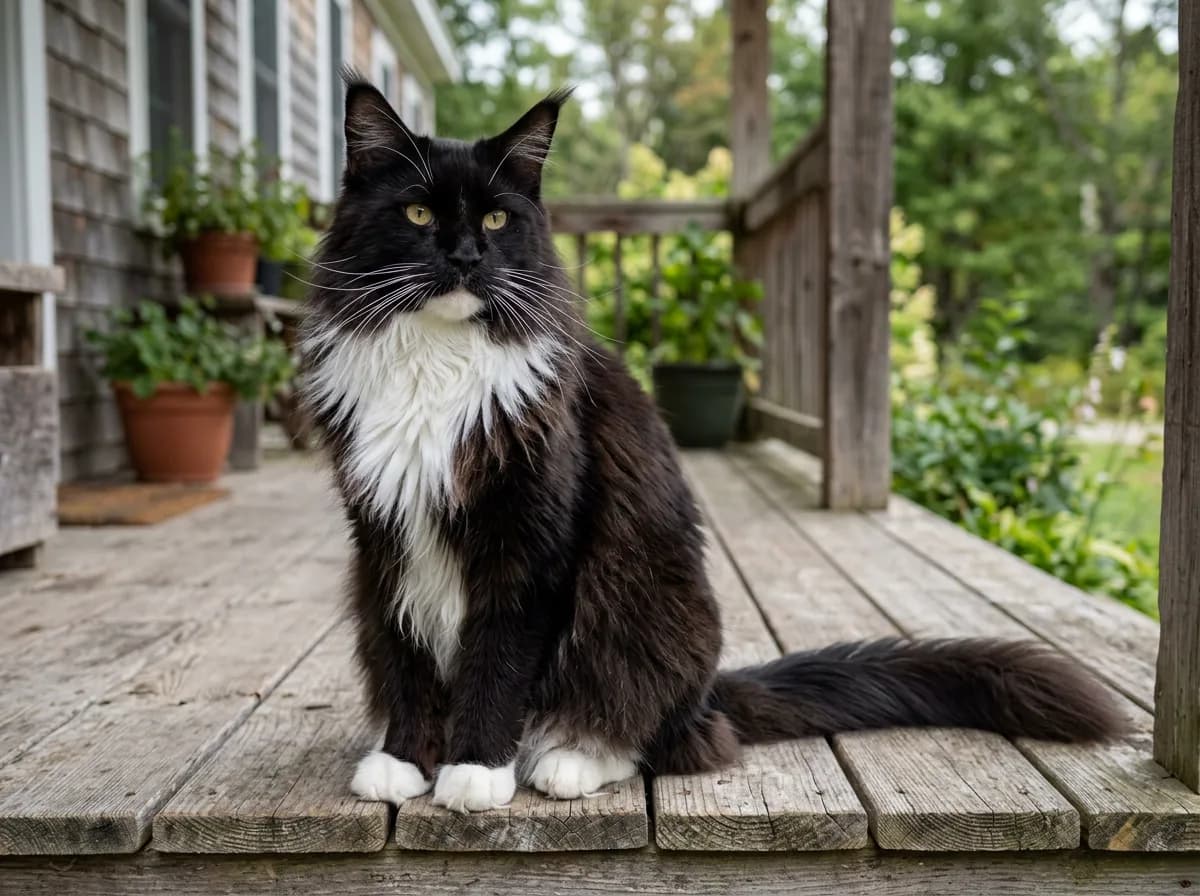
A tuxedo Maine Coon is simply a black-and-white (bicolor) Maine Coon, a combination the CFA recognizes within the breed. These are large, long-coated cats with the classic tuxedo markings scaled up to a much bigger frame, and they remain Maine Coons in every other respect: the same gentle "gentle giant" reputation, the same tufted ears and bushy tail, the same grooming needs. To go deeper on the breed itself, see Petful's Maine Coon breed profile, and the dedicated black Maine Coon guide covers the eumelanin (black) genetics that the dark half of a tuxedo Maine Coon shares.
Tuxedo Cat Colors and Markings
Although "tuxedo" classically means black and white, the same white-spotting pattern can sit over other base colors, which is why you will see grey, orange, and tabby tuxedos. The white part is always created by the same gene; only the dark base color changes. Here are the common variants, each of which is well represented in tuxedo photo galleries.

63-inch multi-level cat tree with scratch posts, hammock, plush perches, and dangling toys. Vertical territory is non-negotiable for high-energy climbing breeds like the Bengal.
Petful may earn a commission when you click through to Chewy, at no extra cost to you.
Grey (Blue) Tuxedo Cats
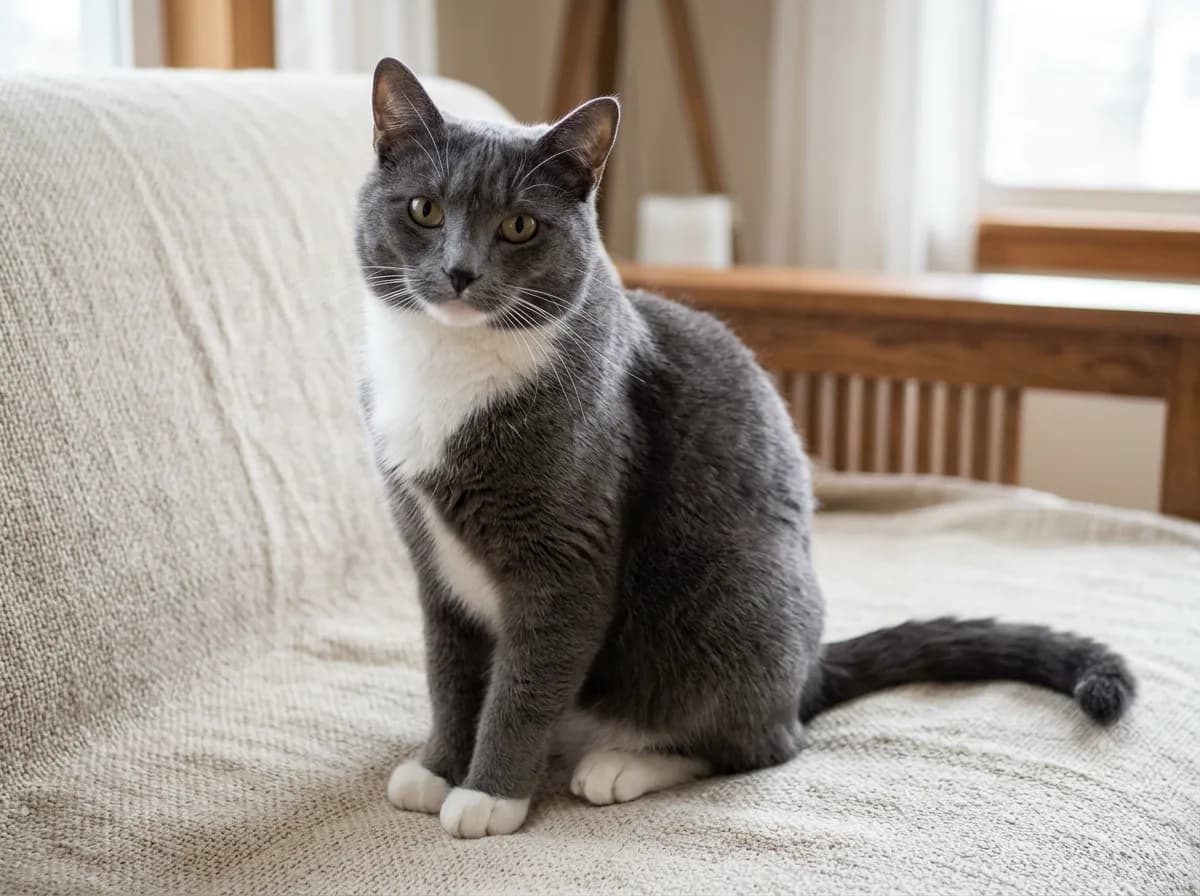
A grey tuxedo cat, more precisely called a blue tuxedo, has soft blue-grey fur where a classic tuxedo would be black. The grey comes from the dilution gene (MLPH, recessive), which softens black pigment to blue-grey. The white markings sit on top exactly as they do in a black tuxedo, so you get a slate-and-white version of the same formal look.
Long-Haired Tuxedo Cats
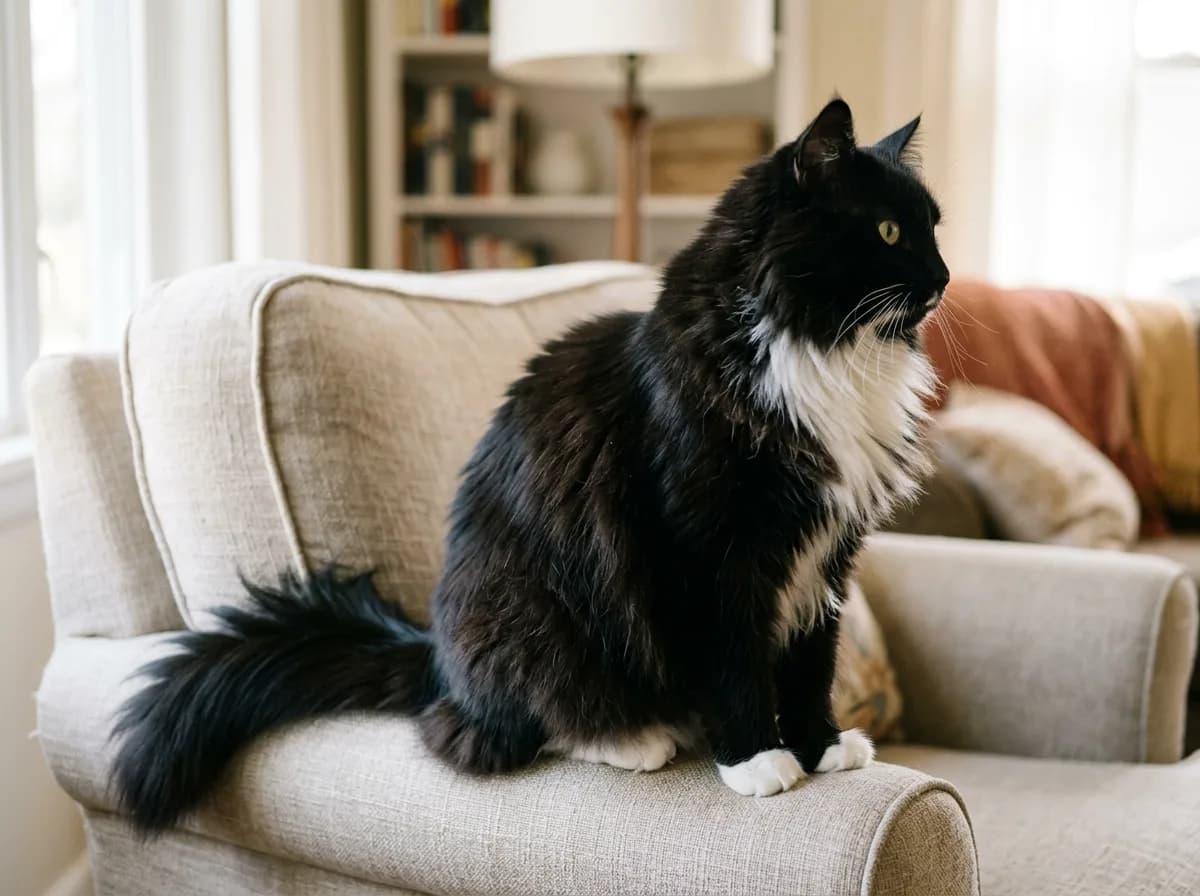
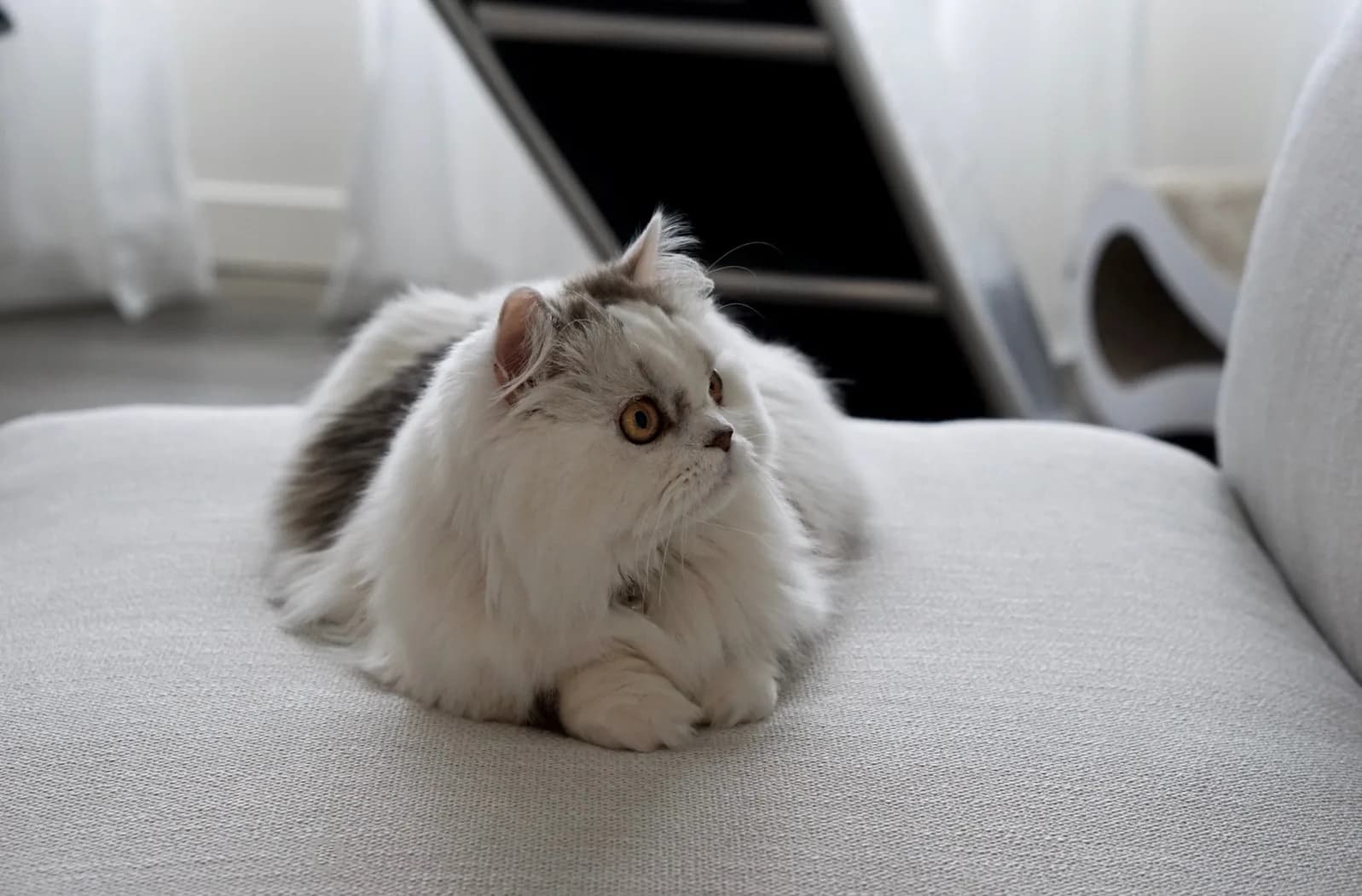
A long-haired tuxedo cat is not a specific breed. It is simply a tuxedo whose coat genetics make the fur long, which can happen in mixed-breed domestic longhairs or in long-coated breeds like the Maine Coon, Persian, and Norwegian Forest Cat. The dramatic black-and-white contrast plus a flowing coat makes long-haired tuxedos especially photogenic, but it also means more grooming (covered below).
Tuxedo Kitten Coats
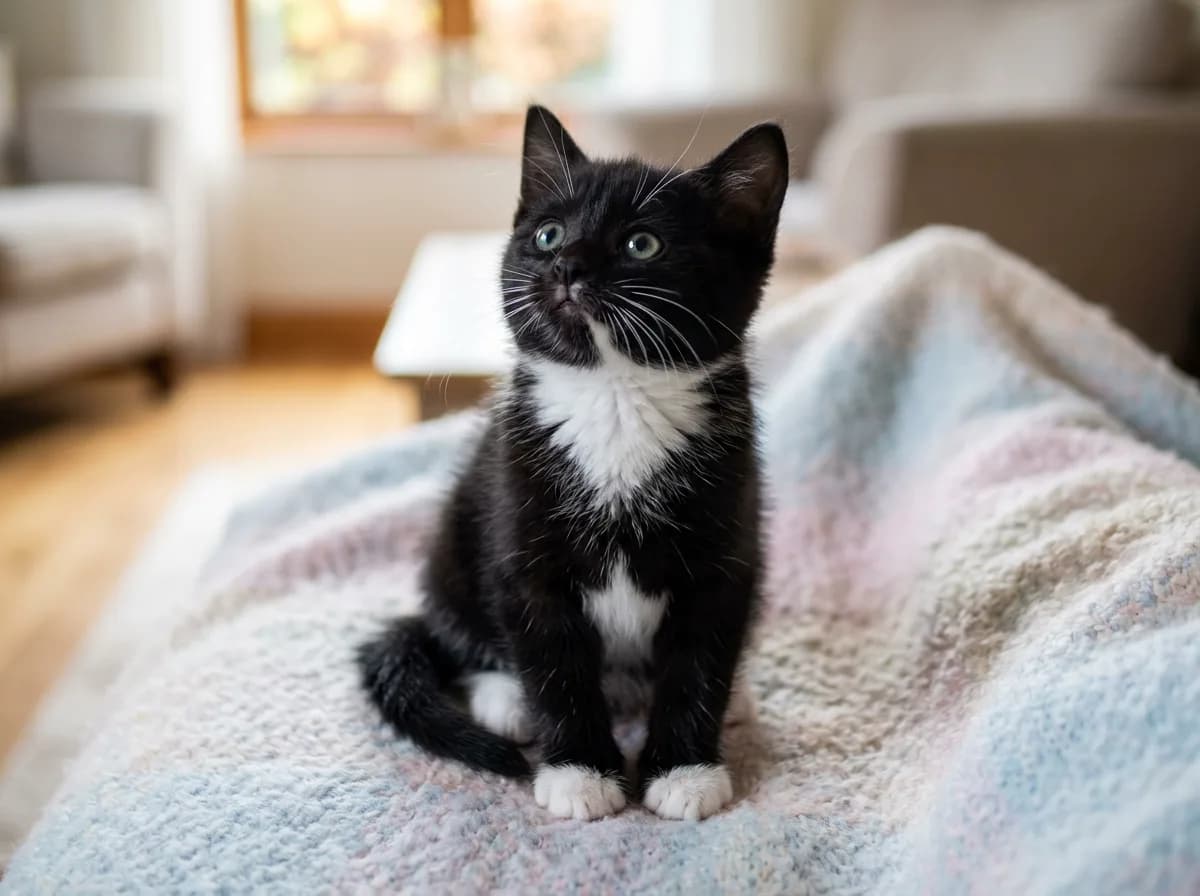
A tuxedo kitten is born with its white markings already in place, because the white-spotting pattern is set during development in the womb. Unlike some coat shading that fills in over weeks, the tuxedo's white chest and paws are visible from day one and stay stable as the kitten grows. Kitten eyes start out blue at birth and shift to their adult color around 6 to 7 weeks, but the tuxedo markings themselves do not move. For more on the variants and how they form, our companion guide to tuxedo cat colors and markings goes deeper.
Tuxedo Cat Personality and Temperament
Owners love to swap stories about bold, clownish, chatty "tuxie-tude," and many describe tuxedo cats as affectionate, smart, and full of character. It makes for great anecdotes, but it is important to be clear: there is no scientific basis for a tuxedo-specific personality. Because tuxedo cats span dozens of breeds and countless mixed-breed cats, their temperament tracks the individual cat, its breed, and how it was socialized, not the bicolor coat.
The only relevant data is a 2016 owner-survey study from UC Davis (Stelow, Bain, and Kass; published in the Journal of Applied Animal Welfare Science), which analyzed 1,274 responses. It found a modest, owner-reported difference in handling-related behavior for certain coat groups, including black-and-white cats, but the authors stressed individual variation dominated and the effect was small and self-reported. Treat any "tuxedo cats are extra friendly or extra vocal" claim as anecdotal. For the full breakdown, see our dedicated tuxedo cat personality guide.
- If temperament matters to you, choose by breed reputation and (for an adult) by meeting the actual cat, not by the tuxedo pattern. A shy tuxedo and a boisterous tuxedo are both completely normal.
Tuxedo Cat Lifespan and Health
The tuxedo pattern has no effect on lifespan or health. A healthy indoor cat typically lives 12 to 16 years, and many reach 18 to 20, regardless of coat color. Outdoor cats average shorter lives because of traffic, predators, and disease, so keeping a tuxedo indoors (or in a safe enclosed catio) is the single biggest lifespan lever you control.
Any breed-specific health risks belong to the underlying breed, not the bicolor coat. A tuxedo Maine Coon shares the breed's screened risks (such as hypertrophic cardiomyopathy and hip dysplasia); a tuxedo Persian shares the Persian's brachycephalic-face and kidney considerations; a mixed-breed tuxedo generally enjoys the broad genetic diversity of a moggy. The smartest health plan is to learn your cat's breed (or assume general domestic-cat care for a mix) and follow that, plus the universal basics: annual or twice-yearly vet visits, core vaccines, parasite prevention, dental care, and a body-condition-appropriate diet.
- Obesity is the most common preventable health problem in pet cats and it shortens lifespan. The formal-wear coat hides weight gain well, so weigh your cat and check body condition rather than eyeballing the silhouette.
Caring for a Tuxedo Cat
Caring for a tuxedo cat is the same as caring for any cat of its breed and coat length. The tuxedo pattern itself never changes grooming, exercise, or diet needs. Match the care to the coat type and the breed.
Grooming and Shedding by Coat Length
A short-haired tuxedo (most domestic shorthairs, American Shorthairs, British Shorthairs) needs only a weekly brush to manage shedding and loose hair. A long-haired tuxedo (Maine Coon, Persian, Norwegian Forest Cat, or a longhair mix) needs combing several times a week, and often daily during heavy shed seasons, to prevent mats behind the ears, under the legs, and along the belly, which is exactly where the white fur often sits. The high black-and-white contrast makes shed hair very visible on furniture, so a regular routine pays off. Hairless tuxedo-patterned breeds like the Sphynx need skin care (regular bathing) rather than brushing.

108-oz stainless steel pet fountain with quiet pump and water-level window. Bengals are notoriously water-obsessed; a flowing fountain encourages hydration and pulls them away from sinks and toilets.
Petful may earn a commission when you click through to Chewy, at no extra cost to you.
Exercise and Enrichment
All cats need daily play and mental stimulation. Plan on two short interactive play sessions a day with a wand toy or chaser, plus climbing space (a cat tree), scratching posts, and food puzzles. Indoor tuxedos especially benefit from vertical territory and window perches. Enrichment prevents boredom-driven problems like overgrooming and furniture scratching.
Diet and Nutrition
Feed a complete, balanced cat food appropriate to life stage (kitten, adult, senior). Cats are obligate carnivores, so prioritize quality animal protein, provide constant fresh water (or a fountain to encourage drinking), and measure portions to maintain a healthy body condition rather than free-feeding to obesity. Your vet can set a target weight and daily calorie range for your specific cat.
How Much Does a Tuxedo Cat Cost?
A tuxedo cat costs the same as any cat of its background, because the pattern adds zero premium. From a shelter or rescue, adoption fees typically run 50 to 200 US dollars, and that usually includes spay/neuter, initial vaccines, and a microchip, which is an excellent value. A purebred tuxedo (a registered breed that happens to be bicolor) follows that breed's pricing, roughly 800 to 2,500 US dollars for most pedigreed kittens from a reputable breeder, with some high-demand breeds costing more.
Be skeptical of any listing that prices a cat higher because it is a tuxedo, or that markets a male tuxedo as "rare." Neither is true. The cheapest and most rewarding way to get a tuxedo is almost always a shelter, where black-and-white cats are common and frequently overlooked.
- Shelters report that black and black-and-white cats are adopted more slowly than colorful cats, a bias sometimes called "black cat syndrome." That means tuxedos are both common and easy to find at adoption events, often at the standard fee.
Famous Tuxedo Cats
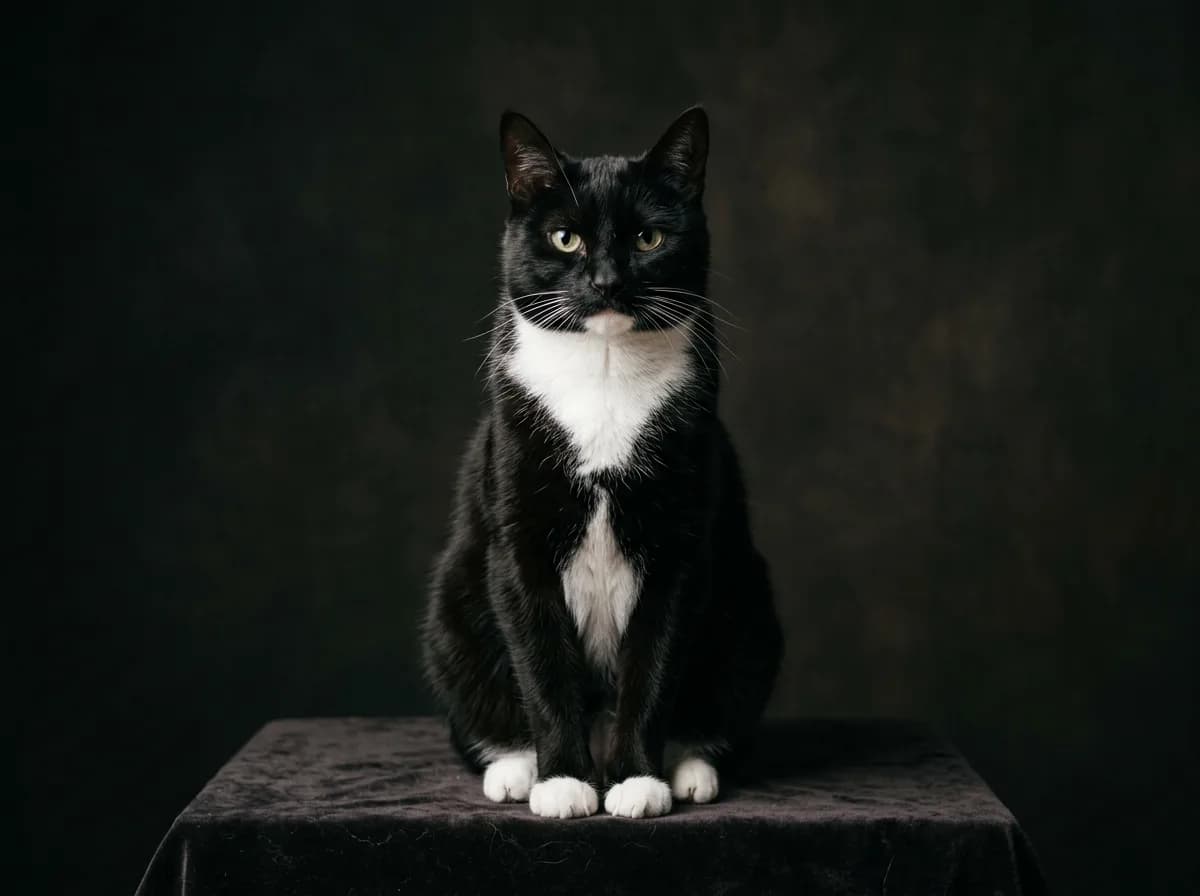
Tuxedo cats have a long history of stealing the spotlight, both real and fictional. Each real cat below is documented in reputable sources.
Real Tuxedo Cats
Socks Clinton was the First Cat of the United States during Bill Clinton's presidency (1993 to 2001). Adopted as a stray in Little Rock, Arkansas, the black-and-white Socks became a media celebrity, even fronting the children's version of the White House website. He died in 2009.
Simon of HMS Amethyst is the only cat ever awarded the PDSA Dickin Medal, often called the animal Victoria Cross. The black-and-white ship's cat served aboard the Royal Navy frigate HMS Amethyst and, despite being wounded by shell fire during the 1949 Yangtze Incident, kept killing rats and boosting crew morale. He died later that year.
Tuxedo Stan ran for mayor of Halifax, Nova Scotia, in 2012 to raise awareness of feral-cat overpopulation. His campaign, backed by the tongue-in-cheek Tuxedo Party, drew international coverage and endorsements from Ellen DeGeneres and Anderson Cooper, and helped spur municipal funding for a spay/neuter clinic. He died of cancer in 2013.

Color-changing crystal litter that flags pH shifts in your cat's urine, an early warning sign of UTIs, kidney issues, and more.
Petful may earn a commission when you click through to Chewy, at no extra cost to you.
Fictional Tuxedo Cats
The tuxedo look is so iconic that cartoonists reach for it constantly. Felix the Cat, one of the earliest animation stars, is a tuxedo. So is Sylvester from Looney Tunes (the one forever chasing Tweety) and Tom from Tom and Jerry, both black-and-white tuxies. Mr. Mistoffelees, the magical "original conjuring cat" from T.S. Eliot's Old Possum's Book of Practical Cats and Andrew Lloyd Webber's musical Cats, is portrayed as a black-and-white tuxedo on stage. Simon's Cat and the Cat in the Hat round out a long bench of beloved bicolor characters.
Tuxedo Cat Facts
A few extra facts round out the picture and clear up the most common myths.
- Tuxedos are common, not rare. Bicolor coats are among the most frequent patterns in domestic cats, so a tuxedo is one of the easiest looks to find in any shelter.
- No two tuxedos are identical. Because the white forms through a partly random developmental process, every tuxedo's markings are unique, like a fingerprint.
- Some tuxedos go "salt and pepper" with age. A few black cats, tuxedos included, can develop scattered white hairs or small white patches over the years from feline vitiligo, a harmless loss of pigment.
- The "ancient Egypt" claim needs a caveat. It is sometimes said that most cats depicted in ancient Egyptian art were tuxedos. Egyptians clearly revered cats, but the specific "70 percent were tuxedos" figure circulates widely online without a solid primary source, so treat it as folklore rather than fact.
- The pattern crosses every coat length and many breeds, which is why "what breed is my tuxedo" has no single answer.
Where to Adopt a Tuxedo Cat or Kitten
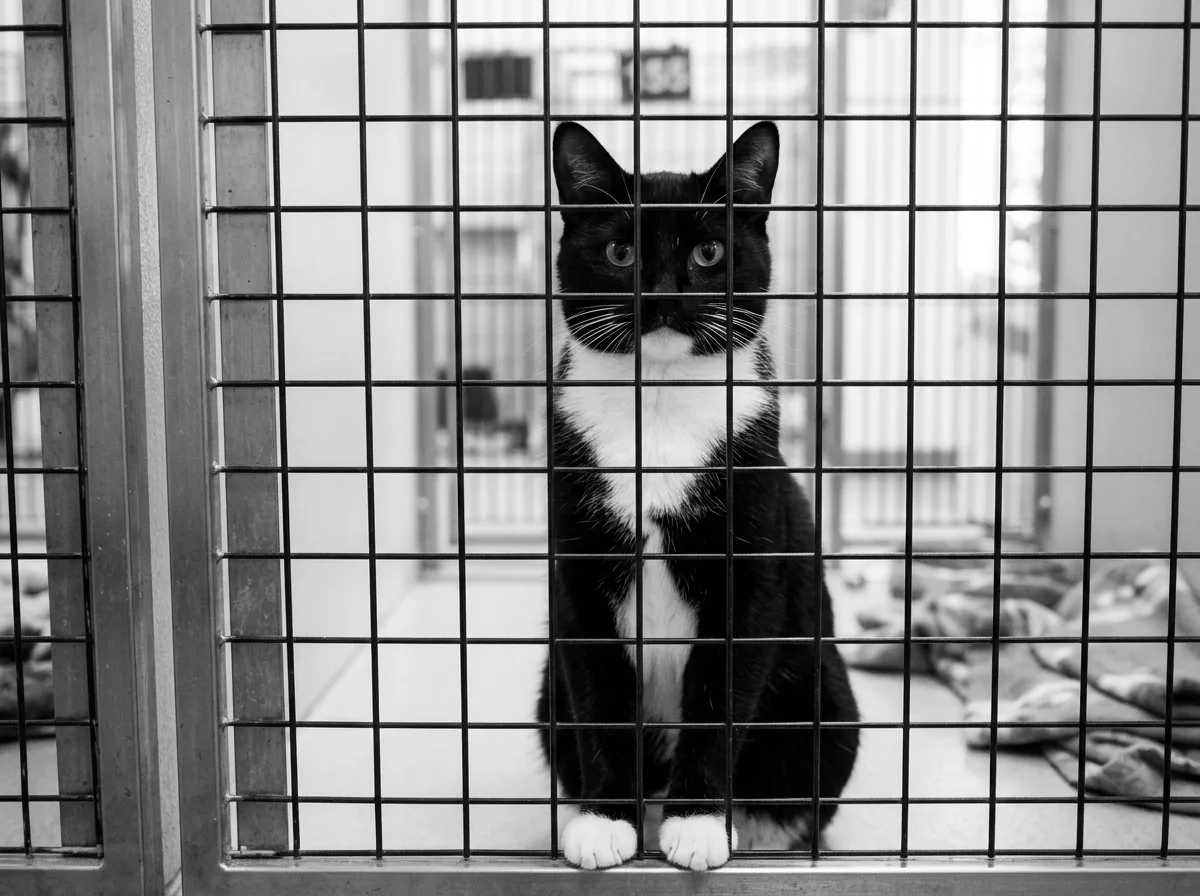
Because tuxedos are so common, adoption is the easiest and most affordable route. Start with your local animal shelter or municipal pound, where black-and-white cats are almost always available and often overlooked. Breed-specific rescues are the place to look if you want a particular breed (a Maine Coon rescue, a Persian rescue) that happens to be tuxedo. Reputable breeders are the route for a pedigreed kitten, but expect to pay the breed's price, not a "tuxedo" surcharge.
When you adopt a tuxedo kitten or cat, ask the shelter or breeder a few key questions: the cat's known age and health history, whether it is already spayed or neutered, its vaccine and deworming status, how it behaves with people and other animals, and any litter-box or behavior notes. For a kitten, confirm it is at least 8 to 12 weeks old and weaned before going home. A good source will welcome these questions.
- Since the tuxedo pattern is so widespread, you almost never need a breeder to get one. Shelters are full of wonderful black-and-white cats and kittens at the standard adoption fee, and you will be giving a frequently-overlooked cat a home.
Frequently Asked Questions
Their striking black-and-white "formal wear" markings, often with white mittens, a bib, and a little goatee, make them instantly recognizable, and each cat's pattern is unique because the white forms through a partly random developmental process. The look has made tuxedos icons in real life (Socks Clinton, Simon the Dickin Medal cat) and fiction (Felix, Sylvester). They are not special genetically beyond the white-spotting gene shared by many bicolor cats.
No. A tuxedo cat is a coat pattern, not a breed. The black-and-white markings come from a white-spotting gene that can appear on many different breeds and on mixed-breed domestic cats, so the pattern alone never tells you a cat's breed.
No, tuxedo cats are common. Bicolor coats are among the most frequent patterns in domestic cats, and shelters usually have several black-and-white cats available at any time.
The pattern does not affect lifespan. A healthy indoor cat typically lives 12 to 16 years, and many reach 18 to 20. Lifespan depends on the cat's breed, diet, vet care, and whether it lives indoors, not on its coat.
No. Tuxedo cats are split roughly 50/50 male and female because the white-spotting gene that creates the pattern is not sex-linked. This is different from calico and tortoiseshell cats, whose sex-linked orange coloring makes them nearly always female.
A shelter or rescue adoption typically costs 50 to 200 US dollars, usually including spay/neuter, vaccines, and a microchip. A purebred cat that happens to be tuxedo follows its breed's price, roughly 800 to 2,500 US dollars for most pedigreed kittens. The pattern itself adds no premium.
The tuxedo pattern cannot identify a breed by itself. Most tuxedos are mixed-breed domestic shorthairs or longhairs. To know the breed for sure you need pedigree papers from a breeder or a feline DNA test.
Yes. While classic tuxedos are black and white, the same white-spotting pattern can sit over a grey (blue) base, an orange/red base, or a tabby base. A grey tuxedo is just a black tuxedo with the dilution gene softening the dark fur to blue-grey.
There is no scientific evidence that tuxedo cats are smarter. Intelligence varies by individual and breed, and because tuxedos span many breeds, the pattern says nothing about brains. Claims of extra-clever "tuxies" are anecdotal.
During development, pigment cells migrate from the back to cover the whole body, but they multiply at random and too few divide fast enough to reach the farthest areas (belly, chest, and paws) before the skin forms. Those uncovered areas grow white fur, which is why the white lands on the underside and feet.
Names that play on the formal-wear look are popular: Tux, Tuxie, Pengu or Penguin, Oreo, Domino, Mittens, Socks, Sox, Bowtie, Alfred, Jeeves, Bond, Charlie Chaplin, Bandit, Chess, Magpie, Felix, Sylvester, and Mistoffelees.
No reliable evidence supports a tuxedo-specific personality. Temperament tracks the individual cat, its breed, and socialization, not the coat. A 2016 UC Davis owner survey found only a small, self-reported difference in handling behavior for some coat groups, with individual variation dominating.
No. A long-haired tuxedo is simply a tuxedo with the genes for a long coat, which can occur in mixed-breed longhairs or in long-coated breeds like the Maine Coon, Persian, and Norwegian Forest Cat. The long coat does not make it a distinct breed.
No. Tuxedo cats can have any eye color, including gold, copper, yellow, green, and sometimes blue. Eye color depends on the cat's other genetics and breed, not on the tuxedo pattern.

Coreen Saito is a pet writer and longtime shelter volunteer with more than a decade in animal rescue. She covers cat behavior, breed care, and the small, ordinary science of sharing a life with companion animals, with a particular focus on honest takes about the products and decisions that actually matter. At home in Arizona, she's outranked by Mac (a dog with the loudest opinion in the house), Rebel (a cat who governs by quiet authority), and Meri (an orange tabby who runs the late shift and the laundry basket). She writes about all three, plus the rescues that keep coming through her life, at LifeWithMinty.com.
Sign up for expert-backed reviews and safety alerts all in one place.