Maine Coon Tuxedo Cat: Pattern, Size, Price and Pictures
A maine coon tuxedo cat is a purebred Maine Coon in a black-and-white bicolor coat, not a rare breed. Learn the white-spotting genetics, true size, honest pricing, an identification checklist, and care tips for this gentle giant.
Petful is reader supported. As an affiliate of platforms like Amazon and Chewy, we may earn a commission when you buy through links on this page. There is no extra cost to you.
A maine coon tuxedo cat is simply a purebred Maine Coon wearing the classic black-and-white bicolor coat, and the Cat Fanciers' Association (CFA) recognizes bicolor among the 80-plus color and pattern combinations allowed in the breed. In other words, "tuxedo" is not a separate breed, a rare mutation, or a price upgrade. It is a coat pattern that can appear on the largest domesticated cat in the world, the same shaggy giant that males of which routinely reach 18 to 22 pounds. The tuxedo look (dark coat, white chest, white paws, often a white chin) comes from the ordinary white-spotting gene, the exact gene that paints white onto millions of everyday house cats. Pair that common pattern with a true Maine Coon's frame, ruff, ear tufts, and three-to-five-year growth curve, and you get a cat that turns heads at the door and lives a normal feline lifespan of 12 to 16 years.
- 1A maine coon tuxedo cat is a purebred Maine Coon with a black-and-white bicolor coat, not a separate breed.
- 2The tuxedo look comes from the common white-spotting (piebald) gene, which is NOT sex-linked, so tuxedo Maine Coons are roughly 50/50 male and female.
- 3The pattern is common and adds no legitimate price premium. A realistic purebred Maine Coon kitten runs roughly $800 to $2,500, not the $3,500-plus some breeder sites quote.
- 4Only registry papers and Maine Coon traits (size, ear tufts, lynx tips, ruff, plumed tail, slow growth) prove a tuxedo cat is actually a Maine Coon, not a long-haired domestic look-alike.

Sign up for expert-backed reviews and safety alerts all in one place.
What Is a Maine Coon Tuxedo Cat?
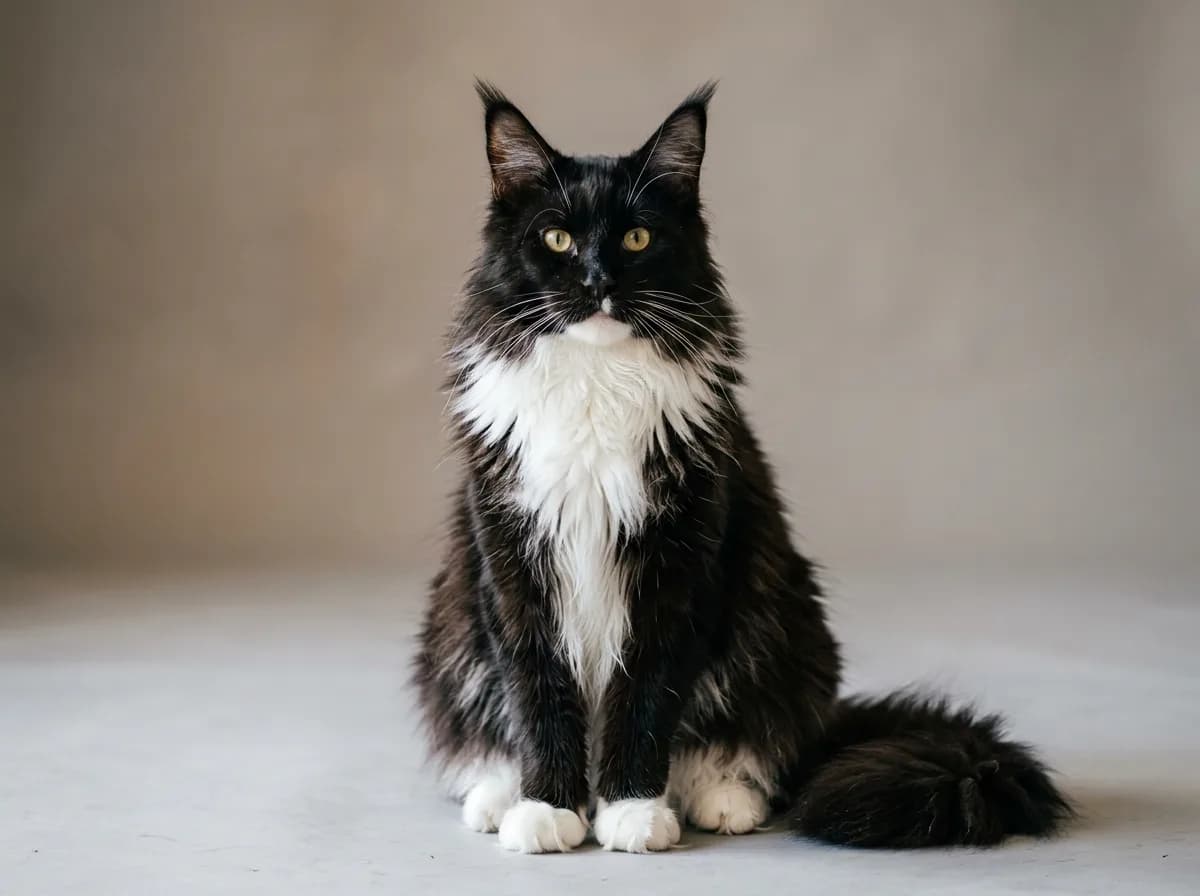
A Maine Coon tuxedo cat is a Maine Coon (a recognized natural breed) that happens to carry the tuxedo coat pattern: a mostly black body with crisp white on the chest, belly, paws, and frequently the chin or muzzle, so the cat looks like it is dressed for a formal black-tie event. The breed gives you the body; the pattern gives you the look. Neither one changes the other.
This distinction matters because the internet is full of breeder pages that present "Tuxedo Maine Coon" as if it were a special variety you pay extra for. It is not. The Cat Fanciers' Association and The International Cat Association (TICA) both register Maine Coons in bicolor, and a black-and-white bicolor that fits the tuxedo description is recognized like any other accepted color. The CFA breed standard is famously open: Maine Coons appear in more than 80 color and pattern combinations built from base colors (black, blue, red, cream, white) crossed with patterns like tabby, smoke, silver, solid, and bicolor.
So when someone says "tuxedo Maine Coon," they mean a normal Maine Coon whose white spotting happens to land in the tuxedo arrangement. The cat is judged on Maine Coon type (head shape, ear set, ruff, body length, tail), not on the cleverness of its markings.
- "Maine Coon" tells you the breed (the body, the type, the genetics behind the size). "Tuxedo" tells you only where the white sits. A tuxedo cat from the shelter with no Maine Coon ancestry is still a tuxedo cat. A Maine Coon with tuxedo markings is still 100 percent Maine Coon.
A quick history of the breed behind the pattern
The Maine Coon is one of North America's oldest natural breeds, a working barn-and-ship cat that developed in the harsh New England climate. The breed was a fixture at early American cat shows in the late 1800s, including documentation around the 1860s and a notable showing in the 1890s. None of that history is tuxedo-specific. Bicolor and black-and-white cats simply existed alongside the tabbies and solids the whole time, because white spotting is one of the most common coat traits in domestic cats. The "tuxedo Maine Coon" is not a new designer creation; it is a longtime member of a very old breed.
Tuxedo vs Black and White Maine Coon: What's the Difference?
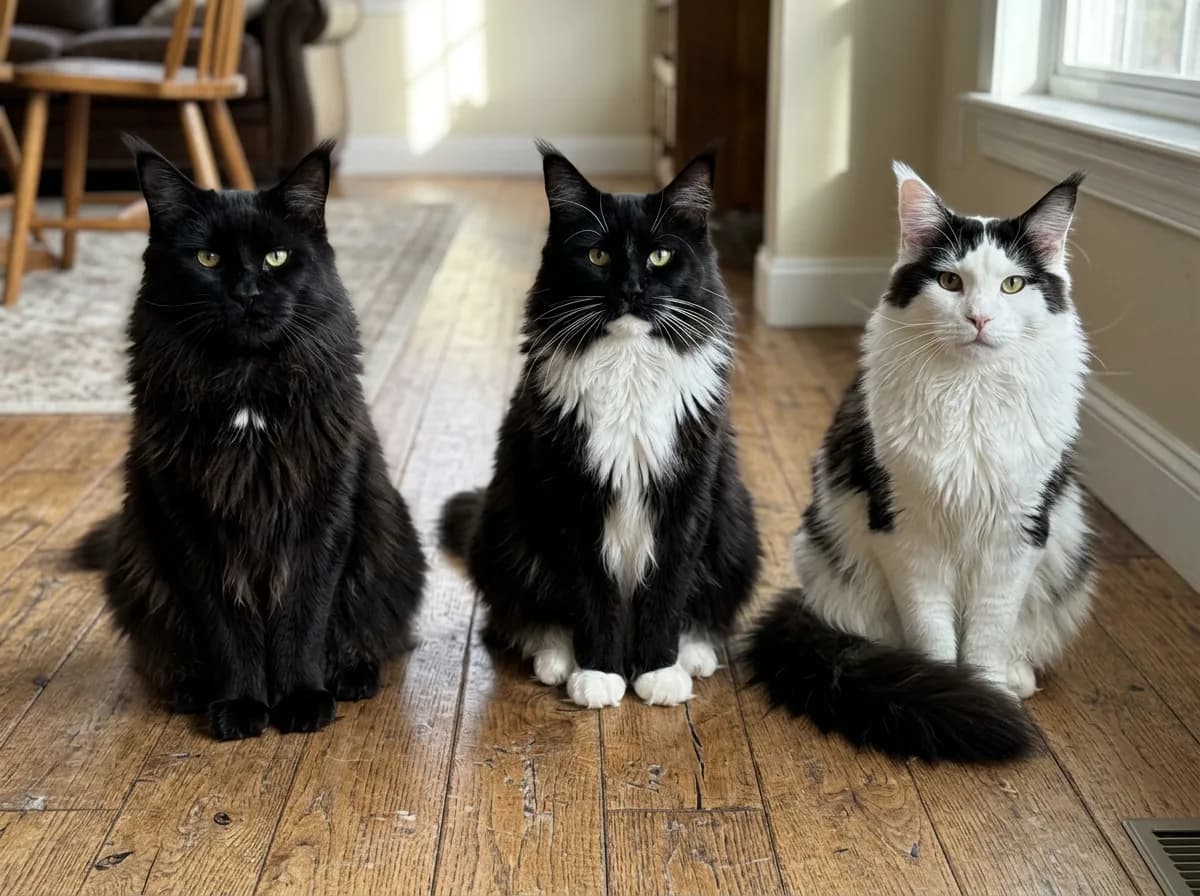
People search "black and white maine coon" and "tuxedo maine coon" as if they were two different cats. Mostly, they overlap. Every tuxedo Maine Coon is a black and white Maine Coon. But not every black and white Maine Coon is a tuxedo.
Here is the clean way to think about it:
- Black and white Maine Coon is the broad category: any Maine Coon whose coat combines black and white in any proportion. This includes tuxedos, but also higher-white "magpie"/harlequin cats, mostly-white "van" cats with color only on the head and tail, and lower-white cats with just a locket on the chest.
- Tuxedo is one specific arrangement within that category: a predominantly black cat with white limited to the chest, belly, paws, and often the chin. The color covers the back and head like a jacket; the white shows on the underside like a dress shirt.
In genetics terms, both come from the same white-spotting gene. The difference is only the grade (how much white). A tuxedo is a low-to-mid grade of white spotting. A van or harlequin is a high grade. So "black and white Maine Coon" is the family, and "tuxedo" is one member of it.
- If you want a Maine Coon with a dark coat and a white shirt-and-spats look, search "tuxedo." If you are open to any black-and-white split, search "black and white" or "bicolor." Breeders and rescues tag litters differently, so using both terms finds more cats.
The Genetics: How the White Spotting Gene Creates the Tuxedo Pattern
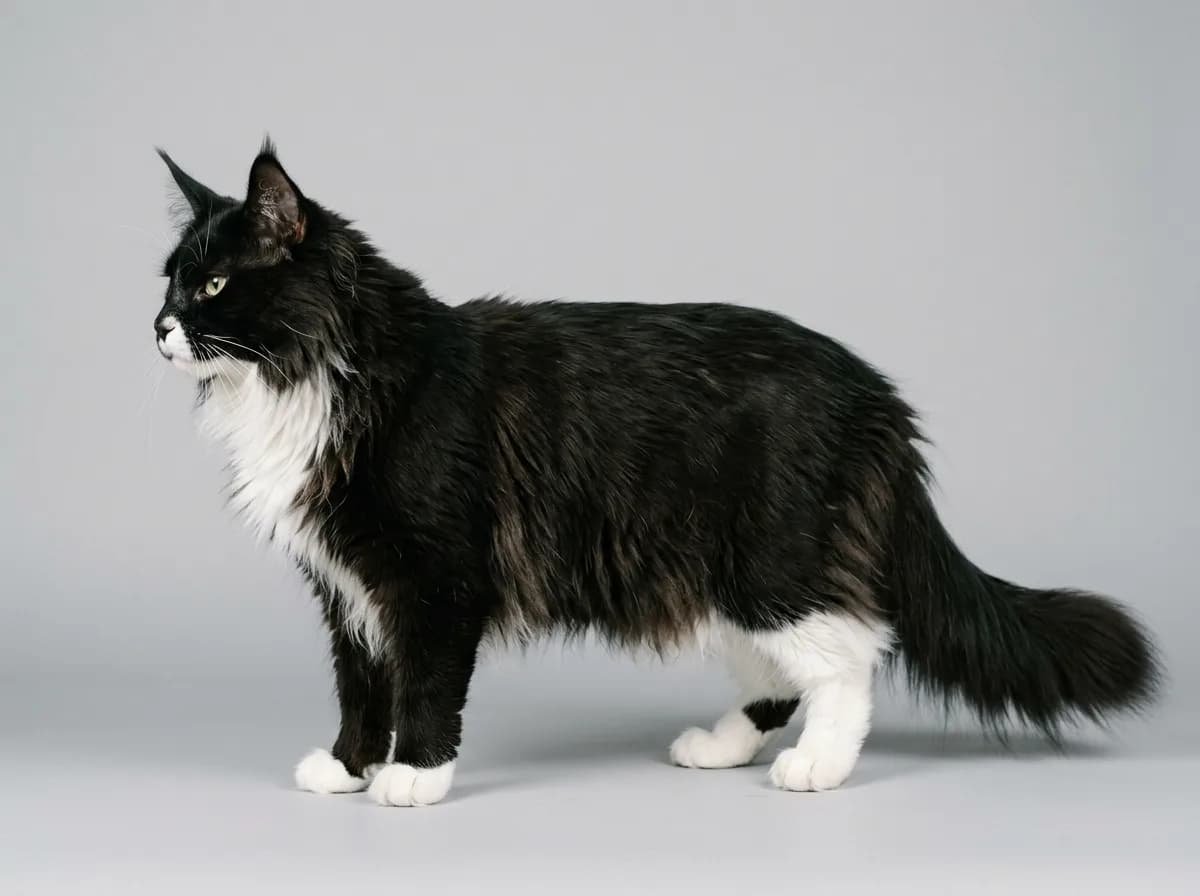
The tuxedo pattern is caused by the white-spotting gene, part of the KIT gene family (also called piebald spotting). This is the same gene family responsible for the white in a calico cat. It works by interrupting where pigment ends up, not by adding a new color.
Here is what actually happens. In the embryo, pigment-producing cells (melanocytes) start near the back and spine and migrate outward across the developing skin. A 2016 study from researchers at the University of Bath and the University of Edinburgh showed that this spread is essentially a random process of cell division and tissue expansion, not a precise blueprint. The pigment cells multiply and crawl, and if they cannot cover the whole embryo before the skin finishes forming, the uncovered areas (typically the belly, chest, and paws, which are farthest from the starting point) stay white. That is why tuxedo white shows up on the underside and feet: those spots are simply the last places the pigment would have reached.
Grade the amount of white from low to high and you get the whole bicolor spectrum:

Never Scoop Again® with the Whisker Litter-Robot, the smart self-cleaning automatic litter box. Monitor visits and track weights for better overall care in the Whisker® app. Multi-cat friendly.
Petful may earn a commission when you click through to Whisker, at no extra cost to you.
- Very low: a single white locket or a few white toes on an otherwise black cat.
- Low to mid (tuxedo): white chest, white belly, white paws, often a white chin, color over the back and head.
- Mid to high (mitted/bicolor): more white climbing up the legs and face.
- High (harlequin): mostly white with a few isolated color patches.
- Highest (van): color limited to the head and tail, the rest white.
- White patches are not pigment that was removed. They are areas the pigment cells never reached during development. The dark areas are where the cells arrived in time; the white areas are where they ran out of room. It is a race against the clock inside the embryo, and the result is largely random.
Why this gene is the opposite of the calico story
This is the single most important genetics point on the page, and it is where most casual readers get it wrong. The white-spotting gene is NOT sex-linked. It affects male and female cats equally. That is completely different from the orange/tortoiseshell/calico colors, which ride on the X chromosome and produce the famous "almost always female" rule.
So while roughly 99.9 percent of tortoiseshell and calico cats are female, tuxedo cats (Maine Coon or otherwise) are roughly 50/50 male and female. If anyone tells you a tuxedo Maine Coon is rare or special because of its sex, they are confusing the tuxedo pattern with the calico color story. The two are unrelated genetically.
- The "nearly all female" rule applies only to orange, tortoiseshell, and calico cats, because the orange gene is on the X chromosome. The tuxedo (white-spotting) gene is not sex-linked. A tuxedo Maine Coon is just as likely to be male as female.
What the Tuxedo Pattern Looks Like on a Longhair Giant
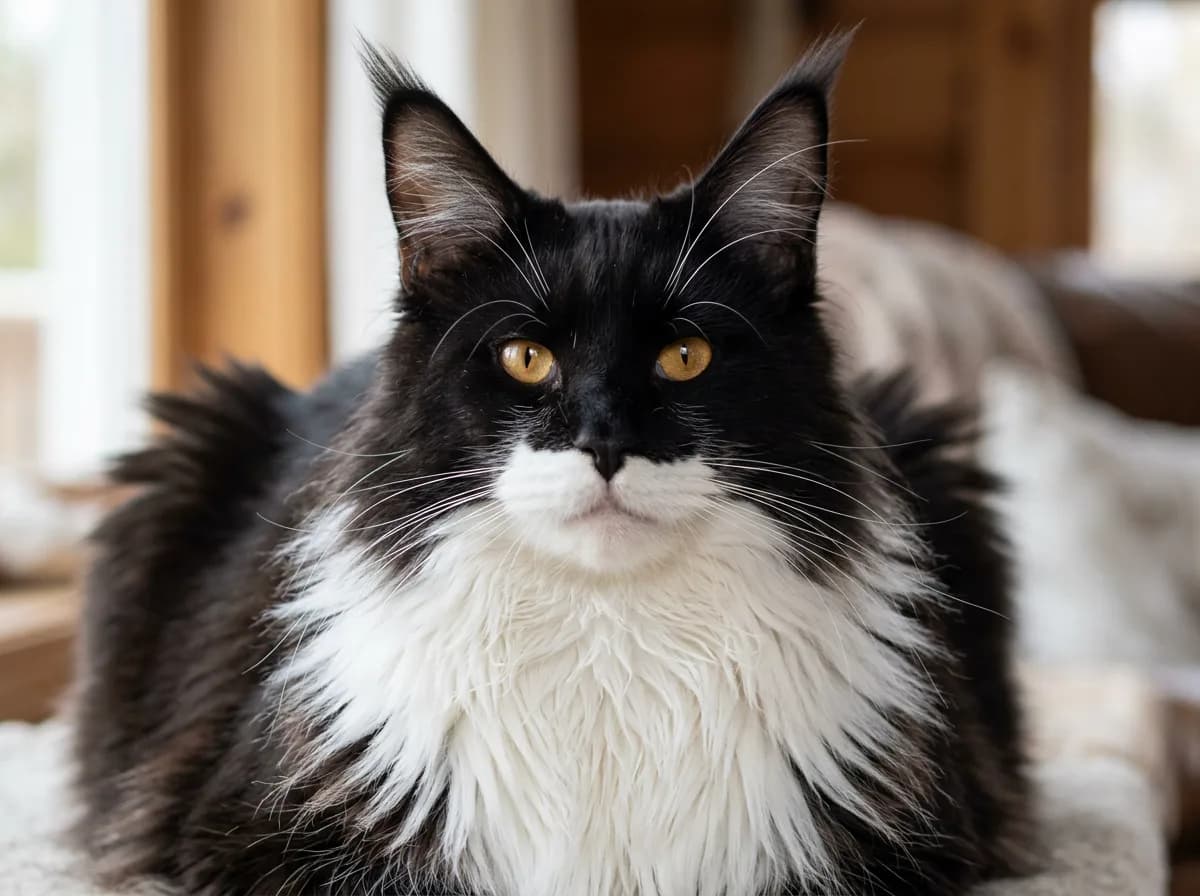
A tuxedo cat with short fur shows crisp, clean borders between black and white. On a Maine Coon, the long, shaggy, water-resistant coat changes how the same pattern reads.
A Maine Coon's fur is uneven by design: shorter on the shoulders, longer on the belly, stomach, and britches (the trousers of fur on the hind legs), with a pronounced neck ruff. When the white-spotting pattern lands on that coat, several things happen:
- The ruff often reads as a bigger, fluffier white bib than you would see on a domestic shorthair tuxedo, because the long ruff fur exaggerates the white chest.
- Edges look softer. Long fur blurs the boundary between the black jacket and the white shirt, so the "lines" of a longhair tuxedo are feathered rather than sharp.
- White paws look like spats because the toe and foot fur is long, giving the classic "wearing white socks" look an extra-fluffy finish.
- The plumed tail is usually solid black on a classic tuxedo, a dramatic dark banner trailing behind a white-chested cat.
Because the kitten coat is fluffier and less defined than the adult coat, the apparent markings can shift as the cat matures. A kitten that looks almost evenly split can grow into a cat that reads more black-dominant once the adult ruff and guard hairs come in. The underlying genetics do not change; the way the long coat displays them does.
Size and Coat Expectations
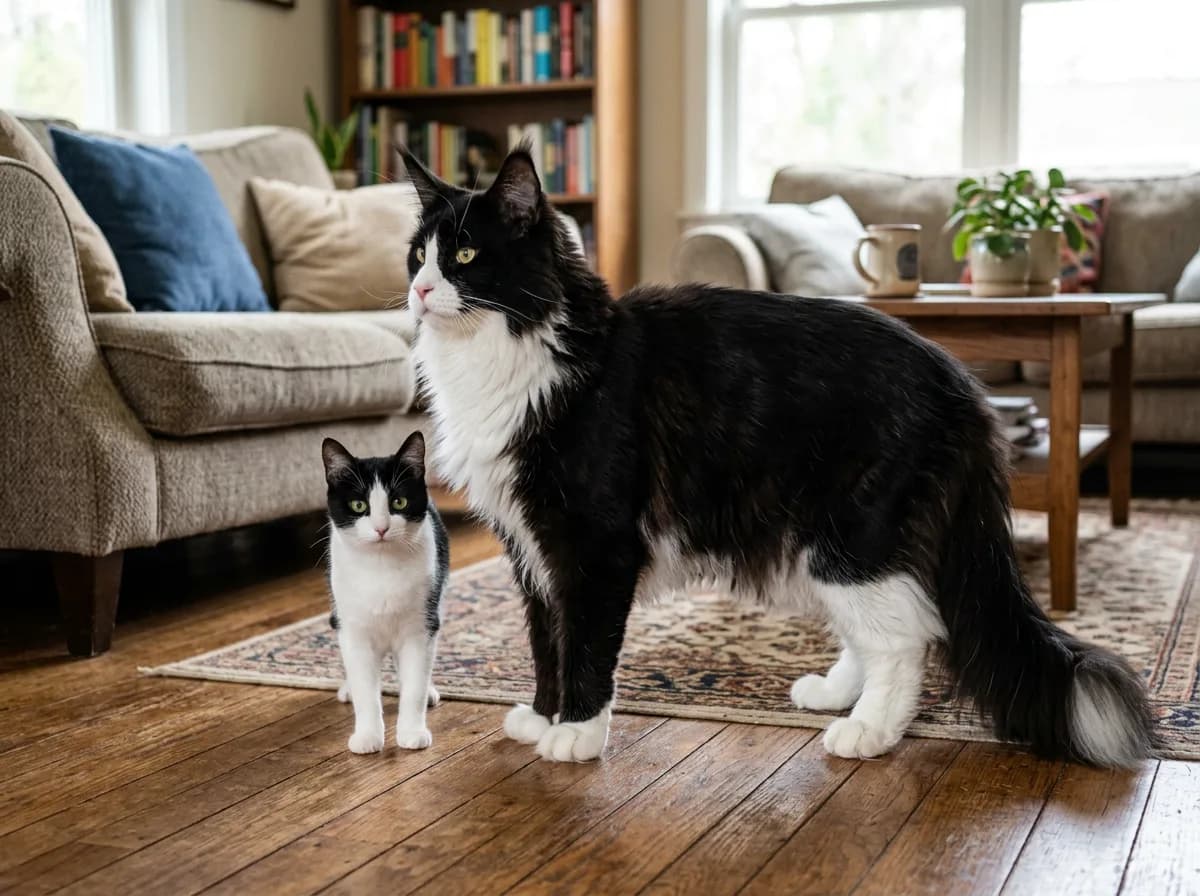
This is where a real Maine Coon separates itself from a long-haired tuxedo look-alike, and it is the part most breeder blogs skip. Coat color tells you nothing about size. Breed does.
A tuxedo Maine Coon should grow to true Maine Coon proportions:
- Males: typically 18 to 22 pounds, with some individuals larger.
- Females: typically 12 to 15 pounds.
- Body: long, rectangular, muscular, with a broad chest and substantial bone. The breed standard prizes a balanced, well-proportioned cat where nothing is exaggerated for the sake of size.
- Tail: long and heavily plumed, ideally as long as the body.
- Ears: large, wide at the base, set high, with lynx-like tufts at the tips and tufts of fur ("ear furnishings") inside.
- Coat: smooth and shaggy, water-resistant, longer on the belly and britches, with a pronounced ruff.
| Age | Approx. Weight (Male) | Approx. Weight (Female) | What to Expect |
|---|---|---|---|
| 3 months | 3-5.5 lb | 3-5 lb | Fluffy kitten coat, ear tufts just starting |
| 6 months | 7-10 lb | 6-8 lb | Body lengthening, ruff developing |
| 1 year | 12-15 lb | 9-12 lb | Looks like a cat, still filling out |
| 2 years | 15-18 lb | 11-14 lb | Coat and ruff thickening |
| 3-5 years | 18-22+ lb | 12-15 lb | Full mature size, complete ruff and britches |
The slow growth is a defining breed trait. Maine Coons do not reach full size until 3 to 5 years of age, far longer than the average cat's 1 to 2 years. A tuxedo Maine Coon that is "small" at one year is not necessarily a fake; it may simply be early on a long growth curve. By contrast, a tuxedo cat that finishes growing at 9 to 10 pounds by 18 months and never develops a ruff or ear tufts is most likely a domestic longhair, not a Maine Coon.
- Plenty of large, fluffy black-and-white cats are domestic longhairs, not Maine Coons. Size alone is suggestive, not proof. Pair the size with the head shape, ear tufts, ruff, and (ideally) registration papers before you call a cat a Maine Coon.
Tuxedo Maine Coon Color Variations
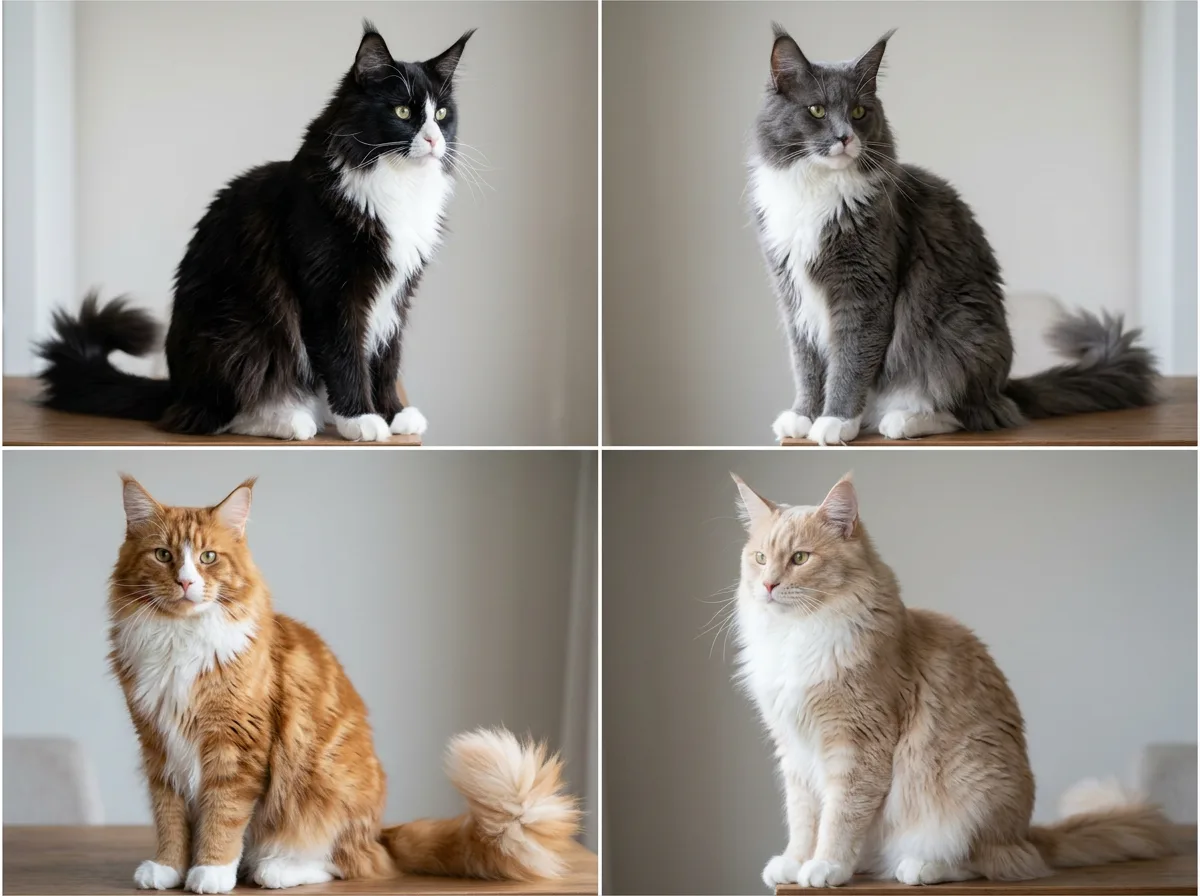
The classic tuxedo is black and white. But "tuxedo" really describes the white arrangement, and the dark color underneath can be any of the breed's recognized base colors. That means several tuxedo variations are possible:
- Black tuxedo (classic): the standard black jacket with white shirt and paws. The most common and most recognizable.
- Blue (gray) tuxedo: the dilute version of black. The MLPH (melanophilin) dilution gene, recessive and needing two copies, softens black to a smoky blue-gray, paired with white.
- Red (orange) tuxedo: a red or orange Maine Coon with the tuxedo white pattern. Because orange is sex-linked, solid red males are more common than red females, but the white spotting itself is still not sex-linked.
- Cream tuxedo: the dilute of red, a soft buttery cream with white.
- Tortie tuxedo: a tortoiseshell base (brindled orange and black) with white in the tuxedo arrangement. These are almost always female because the tortie color is sex-linked, even though the white is not.
- Smoke tuxedo: a cat whose hairs are white at the root and dark at the tip, giving a shimmering "smoke" effect over the dark areas, with the white tuxedo pattern on top.
Note the interaction: the tuxedo (white) pattern is never sex-linked, but the underlying color can be. A red or tortie tuxedo follows the orange gene's sex rules for the color, while the white placement follows the non-sex-linked white-spotting gene. They are two separate genetic systems sharing one cat.
For a deeper tour of every accepted shade in the breed, Petful's Maine Coon colors guide breaks down how each base color and pattern is described and recognized.
Are Tuxedo Maine Coons Rare?
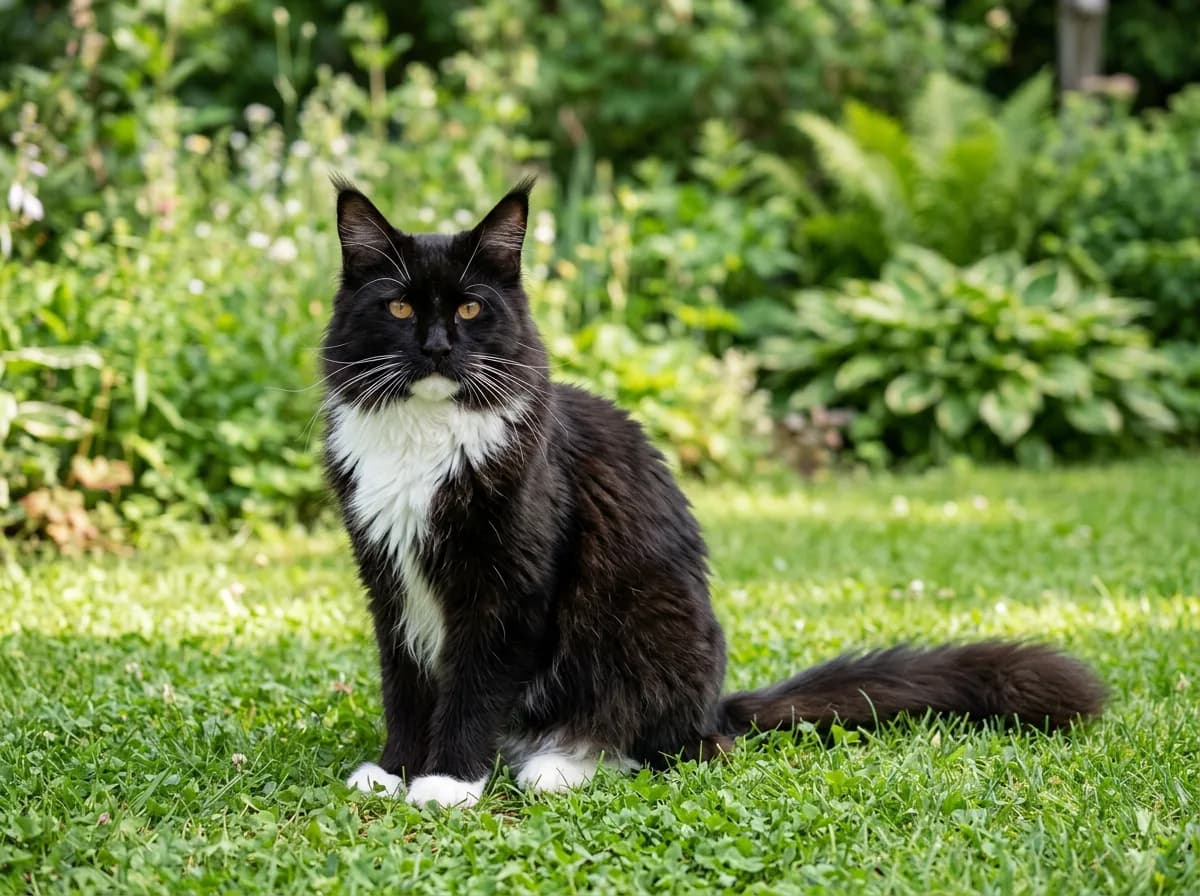
No. This is the most over-hyped claim in the entire Maine Coon market, and it is worth being blunt about.
The tuxedo pattern is common. Bicolor coats are among the most frequent in all domestic cats, because the white-spotting gene is widespread. A black-and-white Maine Coon is a perfectly ordinary, well-loved expression of the breed, not a unicorn.
What IS relatively less common are some of the variations:
- Solid white-free black (no white at all) is its own thing, covered on Petful's black Maine Coon page.
- High-grade bicolors (van and harlequin) are seen less often than the standard tuxedo.
- Silver, smoke, and certain red variations can be harder to find from breeders, which is partly why those colors get marked up.
But a plain black-and-white tuxedo Maine Coon? Common. Any seller charging a "rare tuxedo" premium is selling you a story. The breed itself commands a price because Maine Coons are expensive to breed responsibly. The tuxedo pattern adds nothing to that.
- If a breeder advertises a tuxedo Maine Coon as rare or charges extra specifically for the tuxedo pattern, treat it as a warning sign. The pattern is common and not sex-linked. A trustworthy breeder prices on health testing, lineage, and breed type, not on a coat color that costs them nothing.
Personality and Temperament: Does the Pattern Matter?
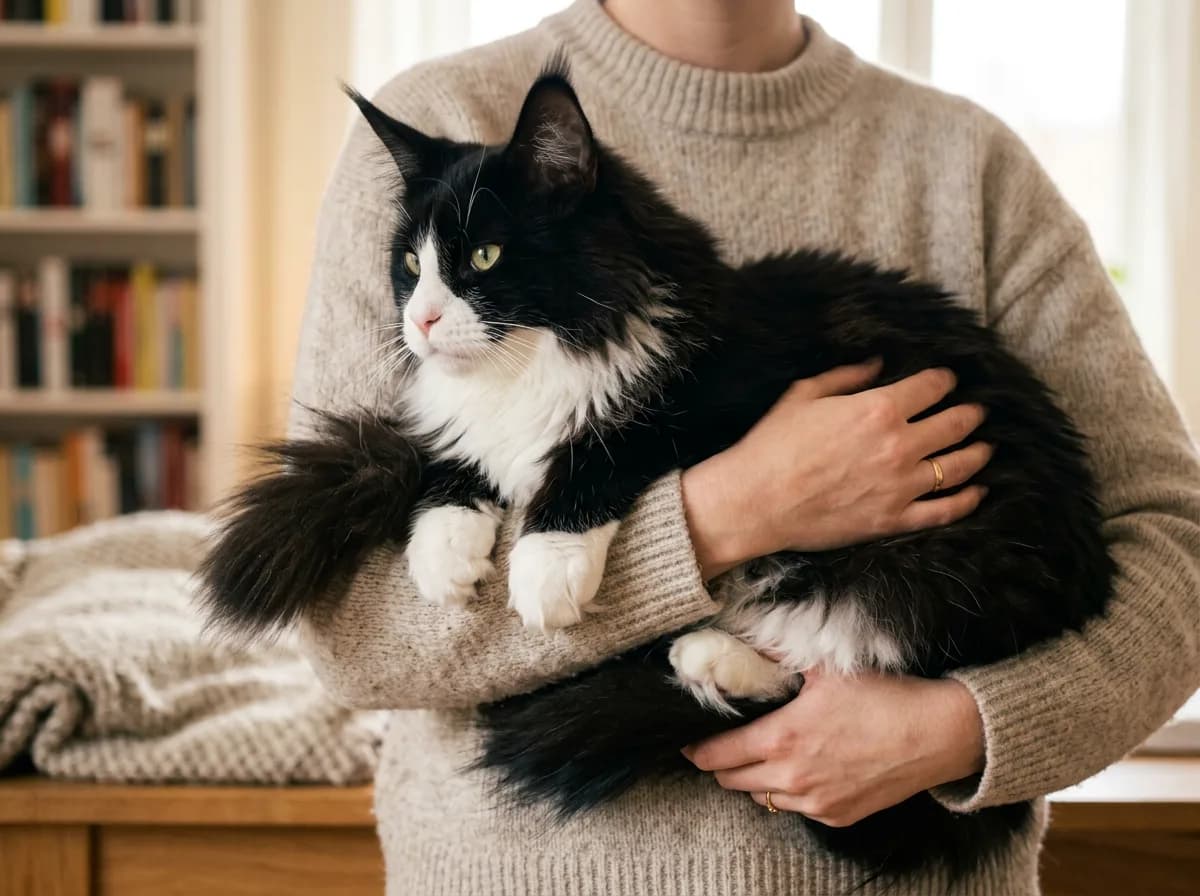
There is no scientific basis for a "tuxedo personality." Coat pattern does not determine temperament. A tuxedo Maine Coon acts like a Maine Coon, because the breed (and the individual cat's upbringing) drives behavior, not the white on its chest.
And Maine Coons have a wonderful, well-earned reputation:
- Gentle giants. Despite the size, they are typically mellow, friendly, and patient, often good with children and other pets.
- Dog-like. Many Maine Coons follow their people from room to room, learn to fetch, and tolerate leash training.
- Chatty. The breed is known for chirps and trills rather than constant loud meowing.
- People-oriented. They tend to want to be near you (often on you), which is why they frequently top "clingy cat" and "affectionate breed" lists.
- Playfully smart. Puzzle feeders, water games, and interactive toys keep that big brain busy.
The only relevant data point on pattern and behavior is a 2016 owner survey from UC Davis (Stelow, Bain, and Kass; 1,274 analyzed responses), which found owner-reported, modest differences in handling-related behaviors for certain coat groups, including black-and-white and gray-and-white cats. It was self-reported, the effect was small, and individual variation dominated. Treat any "tuxedo cats are sassy/extra-affectionate" claim as anecdote, not science. With a Maine Coon, breed temperament swamps any pattern effect.

63-inch multi-level cat tree with scratch posts, hammock, plush perches, and dangling toys. Vertical territory is non-negotiable for high-energy climbing breeds like the Bengal.
Petful may earn a commission when you click through to Chewy, at no extra cost to you.
- Breed tendencies, early socialization, individual genetics, and your home environment shape a cat's temperament far more than coat color. A well-socialized tuxedo Maine Coon kitten is set up to be the friendly, dog-like companion the breed is famous for.
Maine Coon Tuxedo Cat Price: What You Should Actually Pay
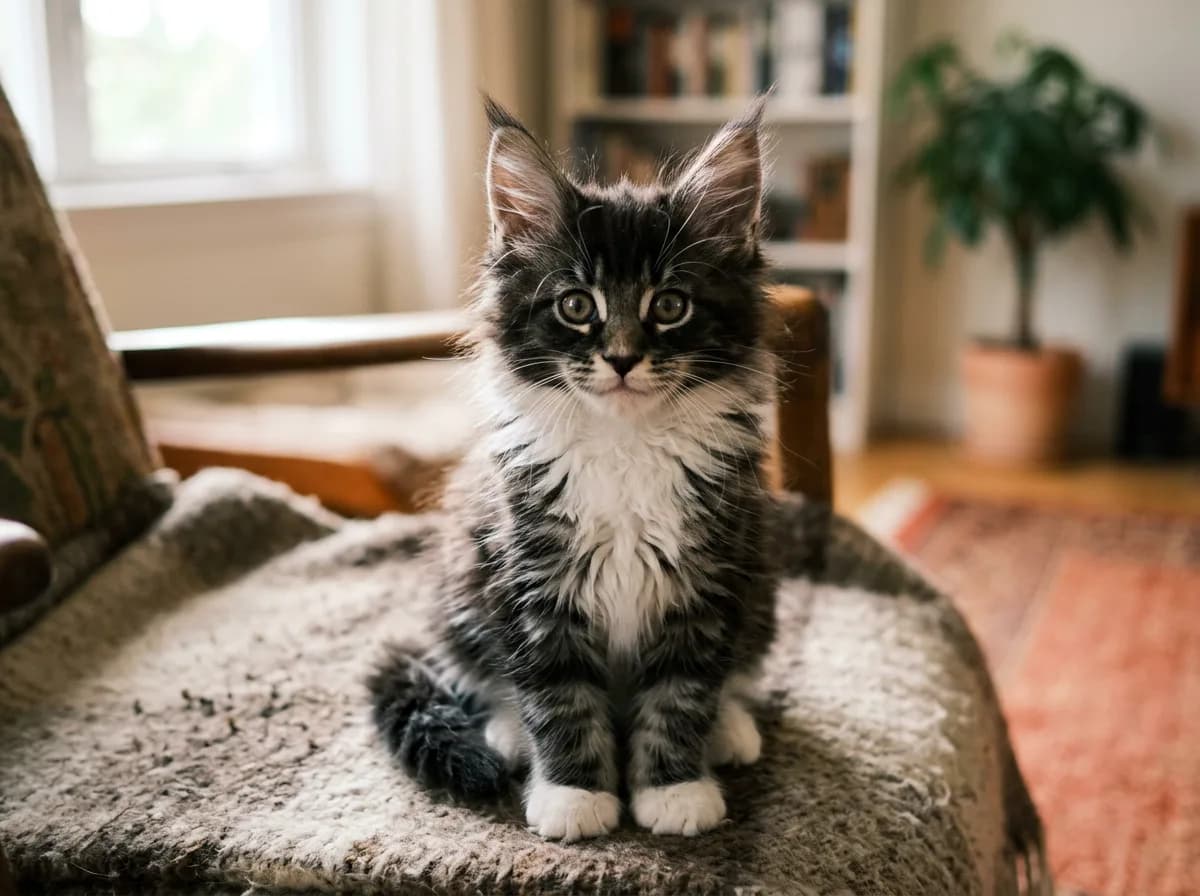
Here is the honest version, because most pages serving this query are breeder marketing.
A purebred Maine Coon kitten from a responsible, health-testing breeder typically runs roughly $800 to $2,500 in the United States, with show- or breeding-rights kittens going higher. The tuxedo pattern itself adds no premium: it is common, not sex-linked, and costs the breeder nothing extra to produce.
You will see breeder pages quote much higher ranges (one competitor cites $3,500 to $6,500; another lists $1,200 to $4,000-plus). Those numbers are real for some premium catteries and rare-color lines, but they are not the floor, and a high price does not guarantee a healthy, well-bred cat. What you are actually paying for in a legitimately priced Maine Coon is:
- Genetic health testing of the parents (HCM, SMA, PKD, hip screening).
- Registered lineage with CFA or TICA.
- Vaccinations, deworming, and a vet check before the kitten goes home.
- Early socialization in the breeder's home.
| Cost Factor | Legitimate Reason to Pay | Marketing Inflation to Question |
|---|---|---|
| Health testing (HCM, SMA, PKD, hips) | Yes, this protects you from heartbreak | No |
| CFA/TICA registration and pedigree | Yes, this is proof of breed | No |
| Vaccines, deworming, vet check | Yes, standard responsible care | No |
| "Rare tuxedo pattern" surcharge | No, tuxedo is common and not sex-linked | Yes |
| "European/giant lines" upcharge | Sometimes, ask for proof and testing | Often |
| Color rarity (silver, smoke, specific reds) | Sometimes genuinely scarcer | Often overstated |
A tuxedo Maine Coon kitten priced under a few hundred dollars from an unknown source is a red flag for a backyard breeder, a kitten mill, or a non-purebred look-alike. The safest middle path: a tuxedo Maine Coon from a rescue or breed-specific rescue, which is far cheaper and gives an adult cat a home (more on that below).
For the broader breed background that justifies the breed's pricing, see Petful's Maine Coon breed profile.
Is My Tuxedo Cat a Maine Coon? Identification Checklist
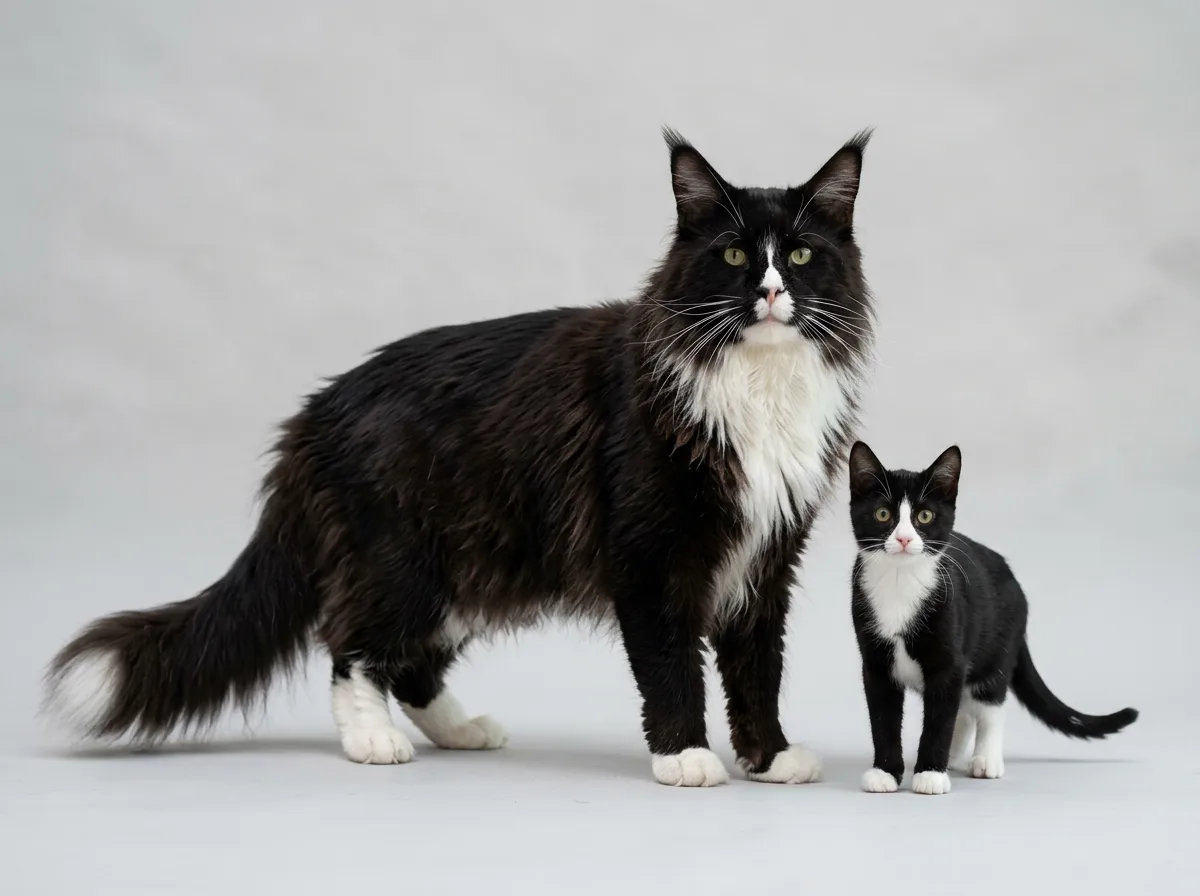
This is the question the whole internet is asking and almost nobody answers well: "I have a big fluffy black-and-white cat. Is it part Maine Coon?" Plenty of large, long-haired tuxedo domestic cats look the part without a drop of Maine Coon in them. Here is an honest checklist.
- The only way to KNOW a cat is a purebred Maine Coon is registration papers from CFA or TICA tracing its pedigree, or a DNA breed test. The traits below stack the odds, but a rescue or "found" cat without papers is a Maine Coon-TYPE cat, not a confirmed purebred. That is fine. It just means "looks like" is not "is."
Score the traits below. The more a cat hits, the more likely there is real Maine Coon influence.
- Size, but slow. Maine Coons are large AND finish growing at 3 to 5 years. A cat that is still gaining frame at age 3 fits. A cat that maxed out at 10 pounds by 18 months does not.
- Ear tufts and lynx tips. Tall ears set high, with tufts of fur sprouting from the tips (lynx tips) and inside the ears (furnishings). This is one of the strongest single tells.
- Neck ruff. A pronounced lion-like mane of fur around the neck and chest, heaviest in cooler months.
- Plumed, body-length tail. Long and heavily furred, ideally as long as the body, carried like a banner.
- Rectangular body. Long, rectangular, muscular, with a broad chest, not a cobby or compact build.
- Big paws (sometimes tufted). Large, round feet with tufts of fur between the toes. (Note: extra toes are polydactyly, a separate single-gene trait, not a Maine Coon-only feature.)
- Square, gently wedge-shaped muzzle. A distinct, blocky muzzle, not a short flat face and not a fine triangular one.
- Shaggy, uneven, water-resistant coat. Shorter on the shoulders, longer on the belly and britches. A coat that is uniform-length all over is less Maine Coon-like.
| Trait | Tuxedo Maine Coon | Regular Long-Haired Tuxedo Cat |
|---|---|---|
| Adult size | Large, males 18-22 lb | Variable, usually 8-12 lb |
| Growth to full size | Slow, 3-5 years | Typical, 1-2 years |
| Ear tufts and lynx tips | Pronounced | Usually minimal or absent |
| Neck ruff | Heavy, lion-like | Light or none |
| Tail | Long, plumed, body-length | Often shorter, less plumed |
| Body shape | Long, rectangular, muscular | Often rounder or smaller |
| Coat texture | Shaggy, uneven, water-resistant | Often even-length |
| Proof of breed | CFA/TICA papers or DNA test | None needed; it is what it is |
The "M" marking, by the way, is a tabby feature, not a Maine Coon-specific one. A solid black tuxedo will not show an M; a tabby-and-white (patched) Maine Coon might, but so will any tabby cat of any breed. Do not use the M as a Maine Coon test.
Maine Coon Tuxedo Mix Cats
A maine coon tuxedo mix is a cat with some Maine Coon ancestry crossed with another breed or a domestic cat, wearing the tuxedo pattern. These cats are common in rescues and shelters, and many are wonderful pets.
What to expect from a mix:

108-oz stainless steel pet fountain with quiet pump and water-level window. Bengals are notoriously water-obsessed; a flowing fountain encourages hydration and pulls them away from sinks and toilets.
Petful may earn a commission when you click through to Chewy, at no extra cost to you.
- Often large and fluffy, but usually not as consistently giant as a purebred.
- Some Maine Coon traits, like ear tufts or a ruff, but not always the full set.
- A faster, more typical growth curve than a purebred (a strong purebred tell is the very slow 3-to-5-year growth).
- No registration papers and no guarantee of breed-specific health screening, which matters because Maine Coons carry breed-linked conditions a mix may or may not inherit.
A mix is not lesser. It just is not a purebred, and you should not pay purebred prices for one. If a "tuxedo Maine Coon" listing has no pedigree and the seller cannot produce parents' health testing or registration, you are most likely looking at a mix or a domestic longhair, regardless of how the cat is advertised. A DNA breed test can settle it if you genuinely want to know.
Show Standards and Registry Recognition
Both major North American registries recognize bicolor (and therefore tuxedo) Maine Coons:
- CFA (Cat Fanciers' Association): recognizes the breed in a wide spread of colors and patterns including bicolor. The standard judges type, not pattern preference, so a black-and-white bicolor Maine Coon competes on the same body-and-coat criteria as a brown tabby.
- TICA (The International Cat Association): likewise registers Maine Coons in bicolor and other patterns.
A few practical notes for show hopefuls:
- A tuxedo (bicolor) Maine Coon can absolutely be shown and titled in the appropriate color class.
- The breed standard does set out some white-placement preferences for bicolors (for example, judges look for clean white on the bib, belly, and paws in certain bicolor classes). A pet-quality tuxedo with "off" white placement is still a purebred Maine Coon; it just may not be competitive in the show ring.
- Certain color combinations (like chocolate, lavender, or the pointed Himalayan pattern) are NOT accepted in the Maine Coon, because they indicate hybridization outside the breed. A standard black-and-white tuxedo is not affected by this; it is a fully accepted bicolor.
If you are comparing Maine Coon bicolors with other classic bicolor breeds, Petful covers the British Shorthair and the mitted/bicolor Ragdoll as well.
Grooming and Care for a Black and White Longhair Coat
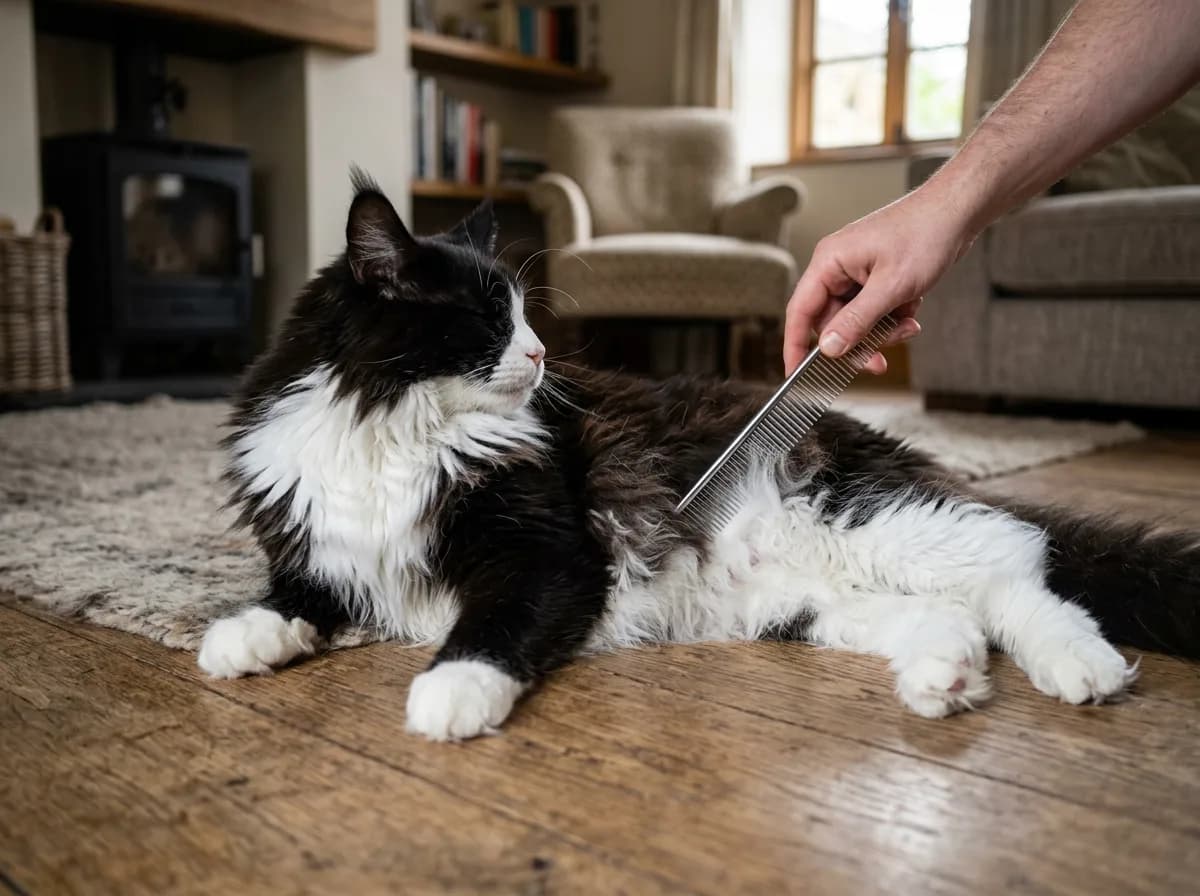
A tuxedo Maine Coon needs the same grooming as any Maine Coon. The white areas just show dirt and tear-staining a little more obviously, so they reward a bit of extra attention.
Coat care:
- Brush 2 to 3 times a week, more during seasonal shedding (spring and fall). The long belly and britches fur mats fastest, so work those zones, plus behind the ears and the armpits.
- Use a metal comb plus a slicker brush. A comb catches the undercoat tangles a slicker can skim over.
- Bathe occasionally. Maine Coons have water-resistant coats and many tolerate (even enjoy) water. A bath every few months keeps the white bib and paws bright; whitening shampoos formulated for cats can help, but skip anything not made for cats.
Everyday care for the breed:
- Trim nails every couple of weeks and provide sturdy, tall scratching posts (a big cat needs a big post).
- Dental care: brush teeth or use vet-approved dental treats; the breed is prone to gum issues like any cat.
- Watch the weight. A Maine Coon is naturally big; obesity on top of that frame stresses the joints, which matters given the breed's hip-dysplasia risk.
| Task | Frequency | Why It Matters |
|---|---|---|
| Full brush-out (comb + slicker) | 2-3x per week | Prevents painful mats in long belly/britches fur |
| De-shed session | Daily during spring/fall | Manages heavy seasonal coat blow |
| Bath | Every 2-3 months (as needed) | Keeps white bib and paws clean, manages oils |
| Nail trim | Every 2 weeks | Protects furniture and the cat's paws |
| Tooth brushing | Several times a week | Reduces dental disease risk |
| Ear and eye check | Weekly | Catches tear-staining and wax early |
- Tuxedo cats wear their white like a clean shirt, which means tear stains under the eyes and litter dust on white paws are more visible than on a solid cat. A weekly wipe with a damp cloth and a cat-safe eye wipe keeps the formalwear looking sharp.
Health: The Pattern Is Cosmetic, the Breed Risks Are Not
This is critical and almost no competitor covers it: the tuxedo pattern is purely cosmetic and carries no health linkage. Unlike some white-coat genetics that can be tied to deafness in heavily white cats, the standard tuxedo (a mostly-dark cat with limited white) is not associated with the pigment-related deafness seen in dominant-white cats. A tuxedo Maine Coon is not at higher health risk because of its markings.
What DOES matter is the breed. Maine Coons, of any color, carry several inherited conditions you should understand and screen for:
- Hypertrophic cardiomyopathy (HCM): the most significant Maine Coon health concern, a thickening of the heart muscle. It is common enough in the breed that responsible breeders screen with cardiac ultrasound and DNA testing for the known Maine Coon mutation. Ask any breeder for HCM testing results on the parents.
- Spinal muscular atrophy (SMA): an inherited, recessive neuromuscular condition specific to the breed. A DNA test exists; affected kittens (those inheriting the gene from both parents) show signs within a few months. SMA is not painful or fatal, but it affects mobility, and affected cats can live relatively normal lives with care, per research from the University of Pennsylvania School of Veterinary Medicine.
- Hip dysplasia: the breed's large frame predisposes it to hip-joint issues. Keep your cat lean and ask breeders about hip screening of their lines.
- Polycystic kidney disease (PKD): less classically associated with Maine Coons than with Persians, but worth testing in any pedigreed cat.
- The single best predictor of a healthy Maine Coon is documented parental health testing (HCM, SMA, and ideally hips and PKD), not how striking the tuxedo markings are. A gorgeous coat over untested parents is a gamble. If a breeder cannot show you test results, walk away.
None of this is meant to scare you off the breed. Plenty of Maine Coons live full, healthy 12-to-16-year lives. The point is that the responsible questions are about the breed's genetics, never about the tuxedo color, which is medically irrelevant. If you ever notice exercise intolerance, labored breathing, fainting, or sudden hind-limb weakness, see a veterinarian promptly; those can be signs of the cardiac or neuromuscular conditions above.
Where to Find a Tuxedo Maine Coon: Breeders, Rescues and Adoption
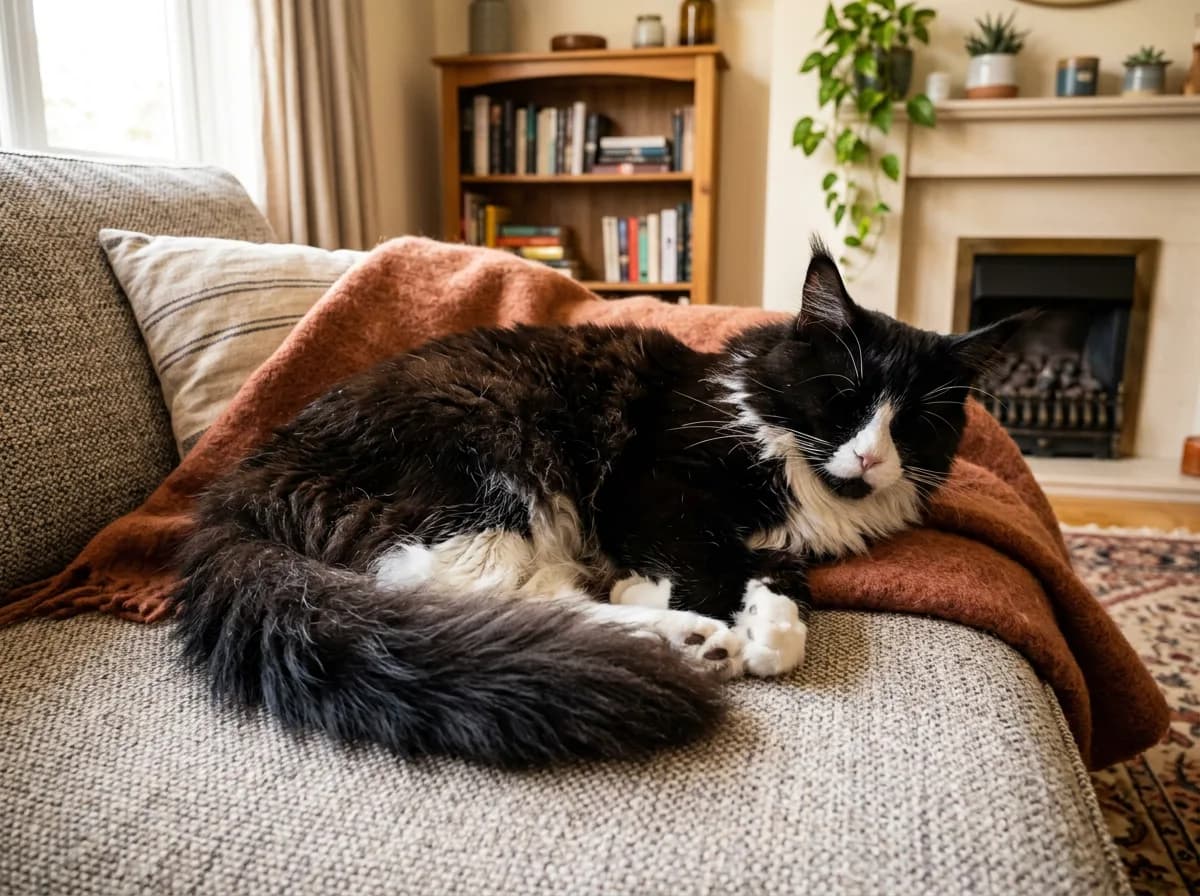
Every breeder blog on this topic funnels you straight to buying a kitten from a cattery. There is a better, often overlooked first step: adoption.
Adoption and rescue (start here):
- Breed-specific rescues. Maine Coon and "Maine Coon-type" rescues exist in many regions and frequently have tuxedo and black-and-white cats, including purebreds surrendered by breeders or owners.
- Shelters and general rescues. Large fluffy tuxedo cats turn up constantly. Many are Maine Coon mixes (often just as wonderful, and far cheaper).
- Petfinder and Adopt-a-Pet. Searchable by breed type, size, and coat, which is useful for finding a Maine Coon-type tuxedo.
Adoption typically costs a fraction of a breeder price (often a modest fee that includes vaccinations and spay/neuter), and it gives a home to a cat that needs one. The demand is real: "Maine coon tuxedo cat adoption" is a recurring search, which tells you plenty of people want exactly this.
If you choose a breeder:
- Insist on CFA or TICA registration and a written pedigree.
- Demand parental health testing (HCM, SMA; ideally PKD and hips).
- Expect the kitten to come vaccinated, dewormed, vet-checked, and to stay with the breeder until at least 12 to 14 weeks.
- Be wary of any "rare tuxedo" surcharge, suspiciously low prices, or a breeder who will not let you meet the parents or see where the kittens are raised.
- Whether you adopt or buy, the purchase price is the smallest part of owning a giant longhair cat. Budget for food (a big cat eats more), grooming tools, quality litter, and the routine and emergency veterinary care any 12-to-16-year companion will need. The cat's coat color has zero bearing on any of these costs.
Frequently Asked Questions
Yes. A tuxedo Maine Coon is a purebred Maine Coon with the black-and-white bicolor coat pattern. Both the CFA and TICA recognize bicolor in the breed, so a tuxedo (dark coat with white chest, belly, and paws) is a fully accepted Maine Coon coat. The tuxedo look is just a coat pattern, not a separate breed or variety.
They are not rare. The tuxedo pattern comes from the common white-spotting (piebald) gene, and bicolor coats are among the most frequent in all domestic cats. Anyone charging a "rare tuxedo" premium is using marketing, not genetics. Some color variations (silver, smoke, certain reds, or high-white van and harlequin patterns) are less common, but a standard black-and-white tuxedo is ordinary.
Maine Coons are frequently named among the most affectionate, people-following ("clingy") breeds, along with Ragdolls, Siamese, and Sphynx cats. A tuxedo Maine Coon's tendency to shadow its owner comes from the breed's dog-like, people-oriented temperament, not from its coat color. Clinginess varies by individual cat and by how it was socialized.
A high-quality, protein-rich cat food formulated for the cat's life stage, fed in portions that keep a big cat lean. Because Maine Coons are large and prone to joint issues and heart disease, avoid overfeeding; obesity worsens both. Some owners choose large-breed or Maine Coon-specific formulas with bigger kibble, and many include wet food for hydration. Ask your veterinarian for a recommendation tailored to your cat's age and health.
A purebred Maine Coon kitten from a responsible breeder typically runs roughly $800 to $2,500 in the US, with show- or breeding-rights cats costing more. The tuxedo pattern itself adds no premium because it is common and not sex-linked. Some catteries quote $3,500 or higher, but that is not the floor and a high price does not guarantee health. Adoption from a rescue costs far less.
Look for the breed's traits: large size that keeps growing until 3 to 5 years, tall ears with lynx tips and inner tufts, a heavy neck ruff, a long plumed tail, a rectangular muscular body, big (sometimes tufted) paws, and a shaggy, uneven, water-resistant coat. The more boxes a cat ticks, the more likely there is Maine Coon ancestry. The only definitive proof is CFA/TICA registration papers or a DNA breed test.
No. There is no scientific basis for a tuxedo-specific personality. A tuxedo Maine Coon behaves like a Maine Coon: gentle, friendly, dog-like, chatty, and people-oriented. Temperament is shaped by breed, individual genetics, and socialization, not by coat color. A 2016 UC Davis owner survey found only modest, owner-reported behavior differences for some coat groups, with individual variation dominating.
The same size as any Maine Coon, because coat color does not affect size. Males typically reach 18 to 22 pounds and females 12 to 15 pounds, with a long, rectangular, muscular body and a plumed tail nearly as long as the body. They grow slowly, reaching full size at 3 to 5 years rather than the 1 to 2 years typical of most cats.
They can be. A tuxedo Maine Coon with CFA or TICA registration and a documented pedigree is purebred. A large black-and-white cat without papers is a Maine Coon-type or mixed cat, not a confirmed purebred, no matter how it is advertised. Purebred status comes from verifiable lineage, not from the tuxedo pattern, which appears on many breeds and on countless random-bred cats.
Yes. The classic tuxedo is black and white, but the dark color can be any recognized base color. You can find blue (gray), red, cream, tortie, and smoke tuxedo Maine Coons, each with the white chest, belly, and paws of the tuxedo arrangement. The white-spotting pattern is never sex-linked, although some underlying colors (like red and tortie) follow the sex-linked orange-gene rules.
The white-spotting pattern is set before birth and the major markings are stable, but the way a long, shaggy adult coat displays them can shift. A fluffy kitten coat may look more evenly split, then read more black-dominant as the adult ruff and guard hairs come in. The genetics do not change; the long coat just presents them differently over the first few years.
Yes. Bicolor (including tuxedo) is a recognized pattern in the Maine Coon, so a tuxedo can be shown and titled in the appropriate color class under CFA and TICA. Judges evaluate Maine Coon type (head, ears, body, coat) and some bicolor white-placement preferences, but the tuxedo pattern itself is fully accepted. Only non-breed colors like chocolate, lavender, or the pointed Himalayan pattern are disqualified.

Coreen Saito is a pet writer and longtime shelter volunteer with more than a decade in animal rescue. She covers cat behavior, breed care, and the small, ordinary science of sharing a life with companion animals, with a particular focus on honest takes about the products and decisions that actually matter. At home in Arizona, she's outranked by Mac (a dog with the loudest opinion in the house), Rebel (a cat who governs by quiet authority), and Meri (an orange tabby who runs the late shift and the laundry basket). She writes about all three, plus the rescues that keep coming through her life, at LifeWithMinty.com.
Sign up for expert-backed reviews and safety alerts all in one place.