Maine Coon Colors: All 75+ Coat Colors and Patterns Explained
The CFA, TICA, and GCCF recognize 75+ maine coon colors, from solid black to silver tabby, black smoke, tortoiseshell, and calico. Learn every accepted color, the genetics behind them, and which are disqualifying, like colorpoint and chocolate.
Petful is reader supported. As an affiliate of platforms like Amazon and Chewy, we may earn a commission when you buy through links on this page. There is no extra cost to you.
The Cat Fanciers' Association (CFA) formally recognizes more than 75 maine coon colors and pattern combinations, making this breed one of the most visually diverse in the entire cat world. From jet-black solids and copper-eyed blue-grays to tortoiseshell patchwork and glittering silver tabbies, the Maine Coon's palette spans nearly every shade the feline gene pool can produce. Only four color classes are completely off the table: colorpoint, chocolate, lilac, and cinnamon (plus their derivative fawn). Every other combination is fair game. Petful’s guide to Munchkin cat colors has the full breakdown.
- 1The CFA, TICA, and GCCF collectively recognize 75+ Maine Coon color and pattern combinations.
- 2Solid, tabby (classic, mackerel, ticked), tortoiseshell, calico, bicolor, smoke, and silver are all accepted.
- 3Colorpoint, chocolate, lilac, cinnamon, and fawn are disqualifying in all major registries.
- 4Blue eyes appear only in white Maine Coons; all other eye colors are green, gold, or copper.
- 5Coat color carries no official price premium: a "rare" color does not raise the CFA/TICA breed-standard price.

Sign up for expert-backed reviews and safety alerts all in one place.
How Many Maine Coon Colors Are There?
The short answer is more than 75 recognized color and pattern combinations, though the exact count shifts slightly depending on which registry you consult. The CFA's breed standard lists approximately 75 distinct entries when you map every solid color against every pattern class; the TICA standard uses broader category descriptors that roll up to a similar count; the GCCF in the United Kingdom runs a comparable register.
The reason the count climbs so high is that "color" and "pattern" are multiplied together. Start with five recognized solid base colors (black, blue, red, cream, white), add tabby variations (classic, mackerel, ticked), overlay smoke or silver modifier genes, mix in the tortoiseshell/calico axis (which applies only to females), and add bicolor white spotting at the end. Each valid combination of those layers becomes a distinct registration category.
What you will never find in a CFA-, TICA-, or GCCF-registered Maine Coon: colorpoint (the Siamese-style pointed pattern), chocolate, lilac, cinnamon, or fawn. These colors are either genetically incompatible with the breed's foundation stock or were excluded from the standard when registries formalized the breed in the 1970s. A breeder advertising a "chocolate Maine Coon" is selling a cat with disputed or mixed lineage.
Color-changing crystal litter that flags pH shifts in your cat's urine, an early warning sign of UTIs, kidney issues, and more.
Petful may earn a commission when you click through to Chewy, at no extra cost to you.
Solid Maine Coon Colors (Black, Blue, Red, Cream, White)
Solid (or "self") Maine Coons carry one base color evenly across every hair, from root to tip, with no tabby ghost markings, tipping, or white spotting. There are five recognized solids.
Black
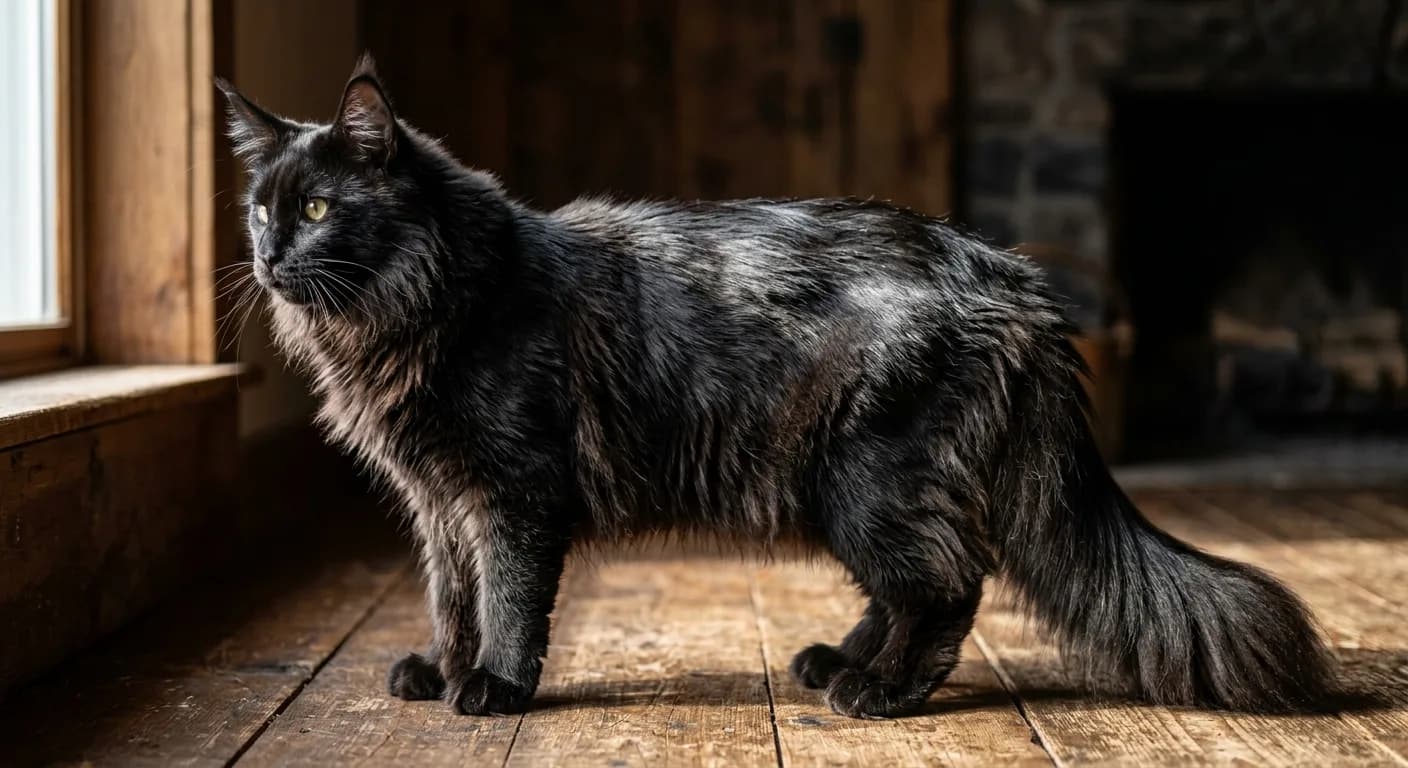
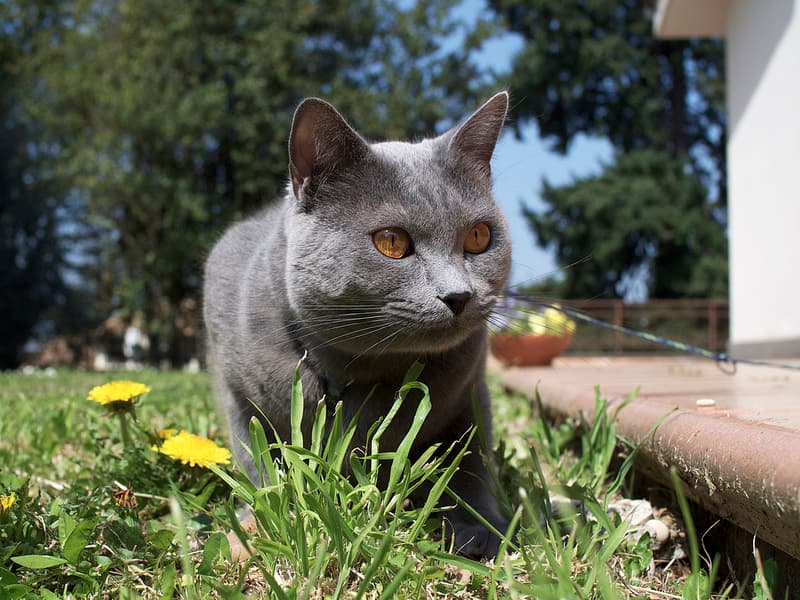
The black Maine Coon is dense, raven, and lustrous from root to tip, with no rust-tinge, shadowing, or tabby ghost pattern visible in natural light. Even black is genetically a form of eumelanin (the same pigment molecule), so a very young black kitten may show faint ghost stripes that typically disappear by adulthood. Eyes are green, gold, or copper. Unlike the British Shorthair, the Maine Coon standard sets no coat-linked eye-color requirement, so any of those eye colors is acceptable on a solid black.
Blue
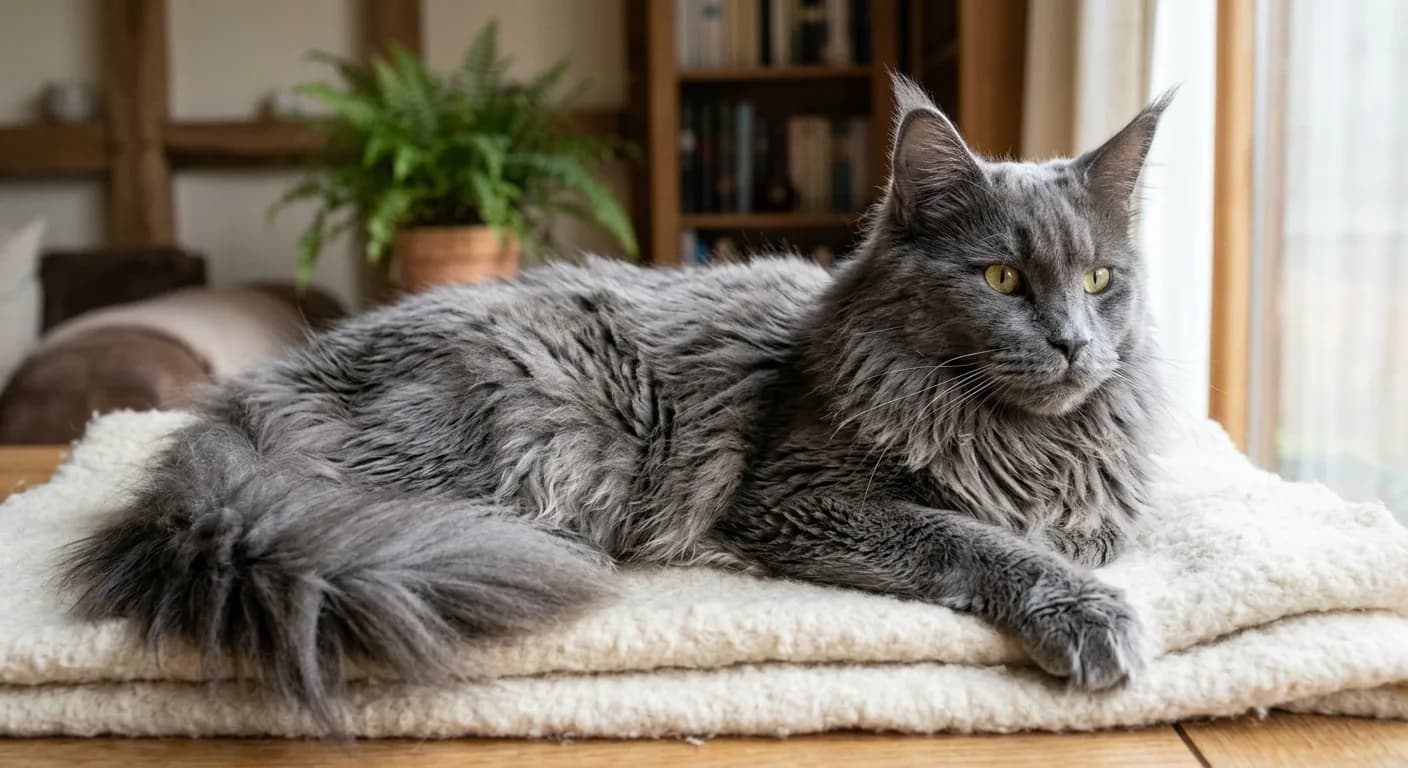
Blue is the dilute form of black. The dilution gene (dd genotype) spreads the melanin granules farther apart, producing a cool blue-gray across the entire coat. Blue is one of the most popular solid colors in the breed and pairs with copper or gold eyes for a striking contrast. Compared with the British Shorthair's iconic "British Blue," the Maine Coon version looks shaggy and wild rather than plush, owing to the longer, layered coat.
Red (Orange)
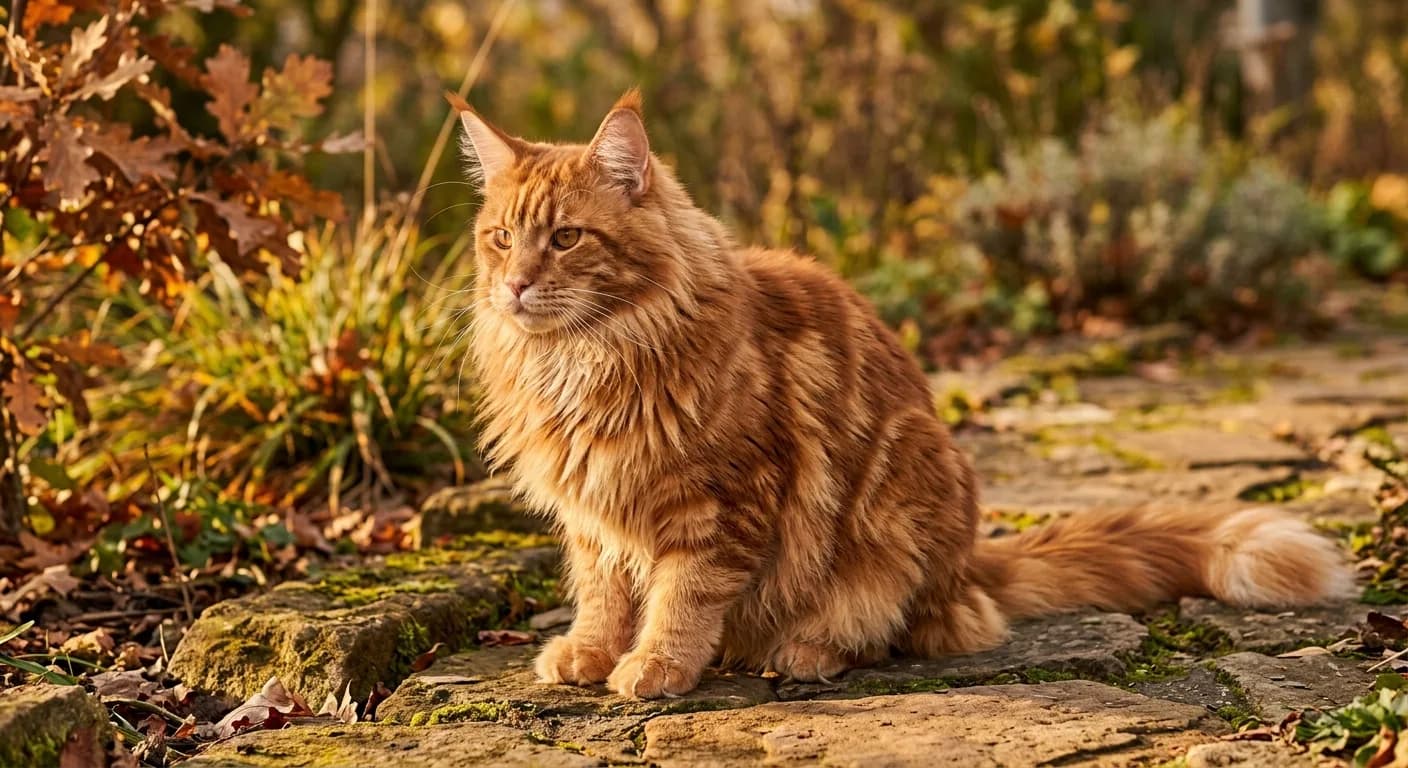
Red (which breeders and registries call "red," not orange) is driven by the X-linked orange gene. Because the gene sits on the X chromosome, solid-red males (XoY) are more common than solid-red females (XoXo requires two copies). Red Maine Coons have deep, rich brick-to-copper coat color. Almost every red cat shows some residual tabby marking on the face even when the body registers as "self"; this is a quirk of the red pigment (phaeomelanin) and does not disqualify the cat.

Never Scoop Again® with the Whisker Litter-Robot, the smart self-cleaning automatic litter box. Monitor visits and track weights for better overall care in the Whisker® app. Multi-cat friendly.
Petful may earn a commission when you click through to Whisker, at no extra cost to you.
Cream
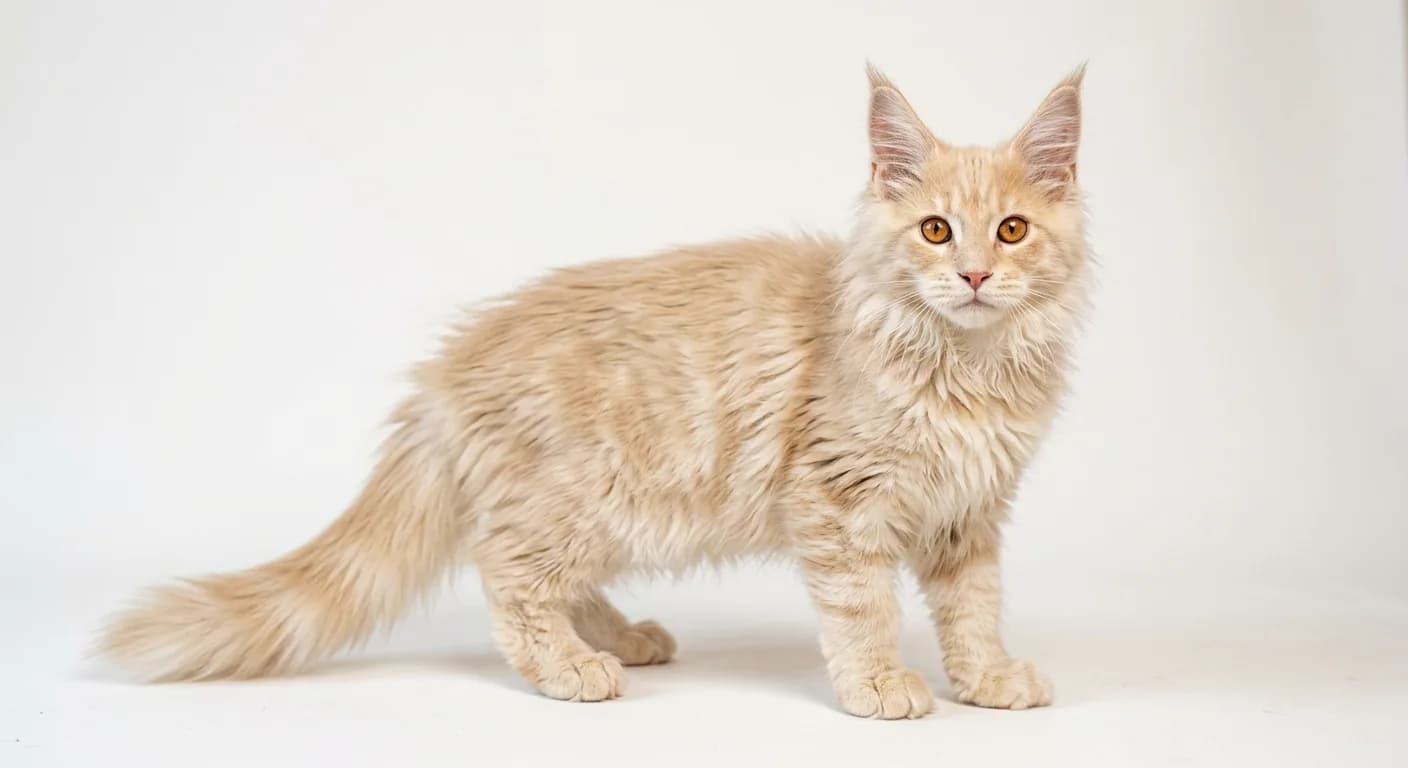
Cream is the dilute of red, produced by combining the orange gene with the dilution gene. The result is a warm, pale buff to light apricot color, softer than red but clearly different from white. Cream solids, like reds, often show faint tabby ghost striping on the face.
White
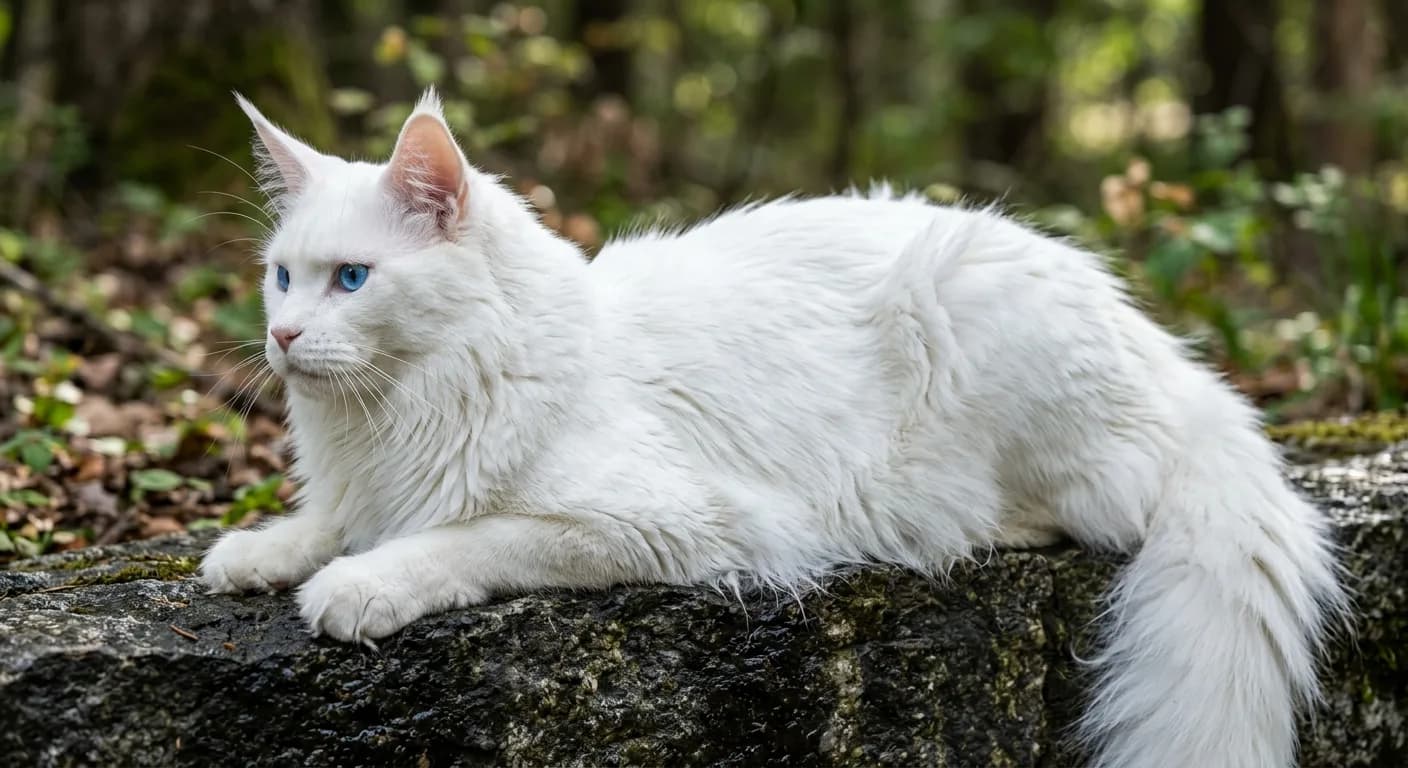
White Maine Coons are genetically masked rather than truly colorless. The dominant white gene (W) suppresses all color expression, so any underlying color or pattern is hidden. According to TICA guidelines, white cats may carry blue, green, gold, copper, or odd (one blue, one other color) eyes. Blue or odd-eyed whites have an increased risk of congenital deafness in the blue-eye side, a correlation seen across all white-coated cat breeds, not just Maine Coons. For more, see Petful’s guide to is my cat deaf.
- Research cited by the Cornell Feline Health Center shows that blue-eyed white cats have a substantially higher risk of congenital sensorineural deafness, linked to the same pigmentation pathway that produces the white coat and blue eyes. An odd-eyed white cat is often deaf only on the blue-eye side. Have white kittens BAER-tested before placement.
Maine Coon Tabby Patterns (Classic, Mackerel, Ticked)
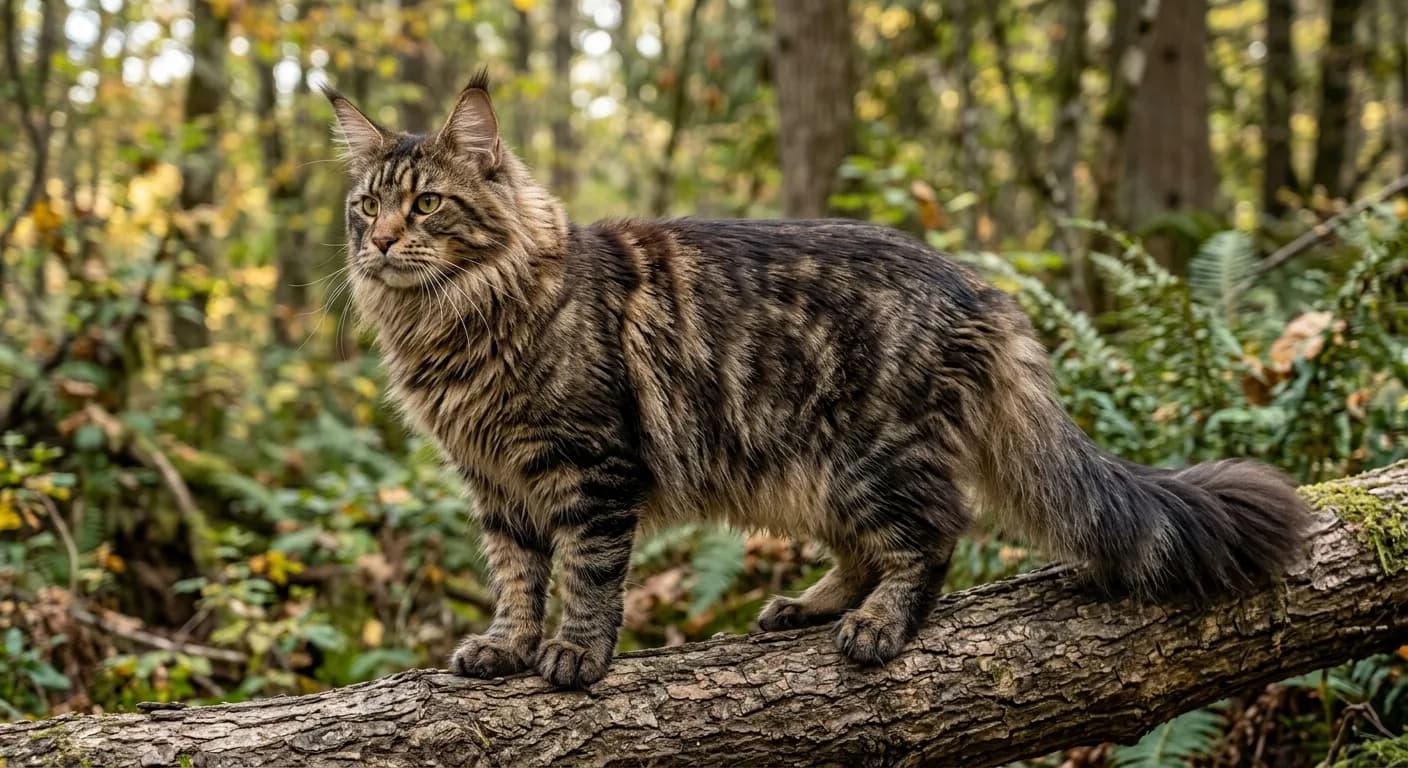
Tabby is not a color: it is a pattern overlaid on a base color. The Maine Coon's tabby variants are classic, mackerel, and ticked. Every tabby shares the "M" marking on the forehead.
Classic (Blotched) Tabby
The classic tabby is the most visually dramatic. Wide, flowing swirls and blotches replace the narrow stripes: a bold "bull-eye" or oyster-shell spiral sits on each flank, butterfly shoulder markings appear on the back, and an unbroken "necklace" ring circles the chest. The brown classic tabby (black pigment on an agouti ground) is often considered the "quintessential" Maine Coon look, featured in most breed photography.
Mackerel Tabby
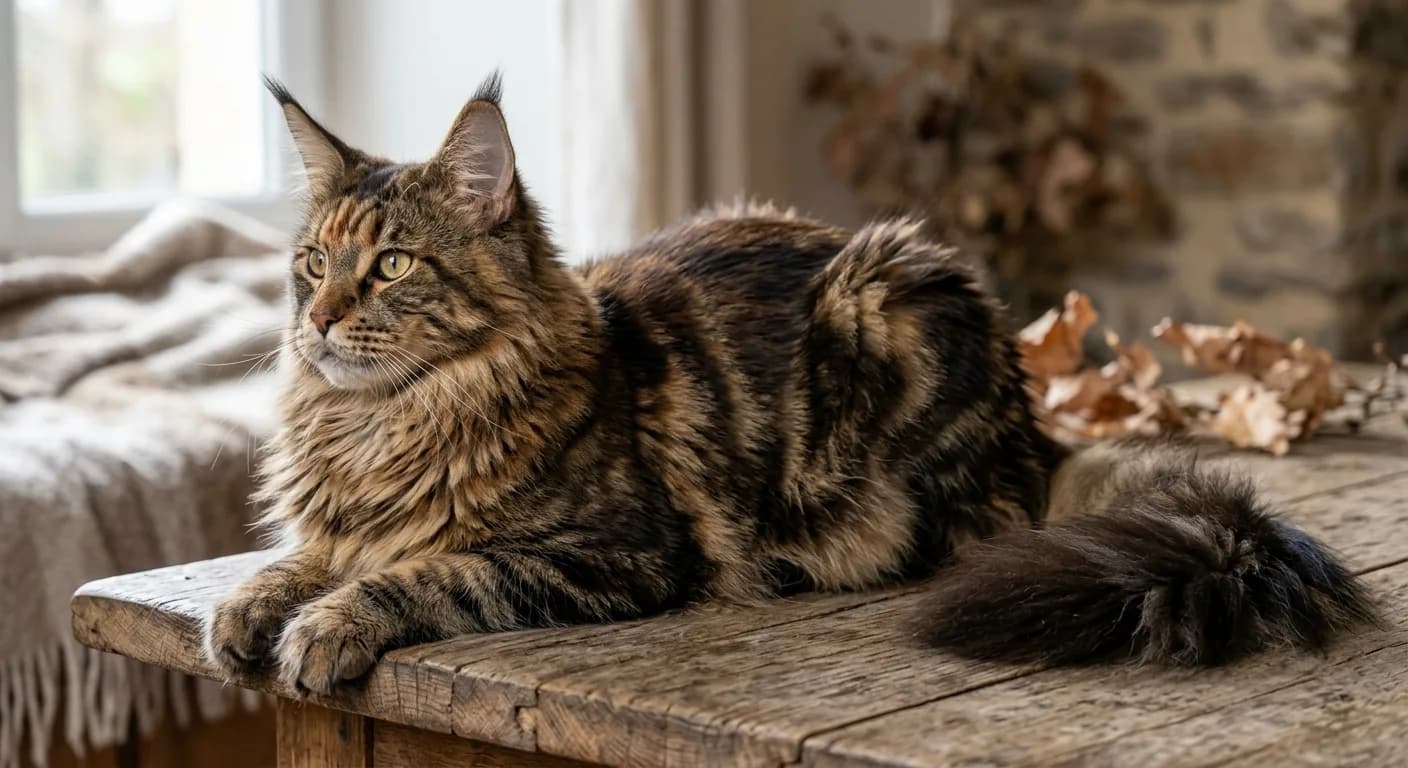
The mackerel (fishbone) tabby shows narrow, parallel vertical stripes running from the spine down the sides, ideally continuous and unbroken like the bones of a fish. It is the ancestral tabby pattern and remains common across all domestic cats. In a brown mackerel tabby Maine Coon, the contrast between the dark-brown stripes and the warm tan ground is crisp and high-contrast.
Ticked Tabby
The ticked tabby has no obvious body stripes or swirls. Each individual hair is banded with alternating light and dark rings (agouti banding), giving the coat a salt-and-pepper or sand-like shimmer. A ticked tabby Maine Coon still has the classic tabby "M" on the forehead and may show faint leg striping, but the body looks almost stripeless from a distance. This is distinct from the Abyssinian-type "ticked-only" coat that some registries exclude from the standard.
- On a mackerel tabby, the side markings are narrow parallel stripes: think fishbones. On a classic tabby, the sides show wide whorled blotches: think thumbprint spiral. The belly always has a double row of "vest button" spots on both patterns. If you see a bold bull-eye circle on the flank, you are looking at classic.
For a deeper dive into how the agouti gene creates tabby patterning across all cat breeds, see our guide to tabby cats and what makes a tabby.
Smoke and Shaded Maine Coons
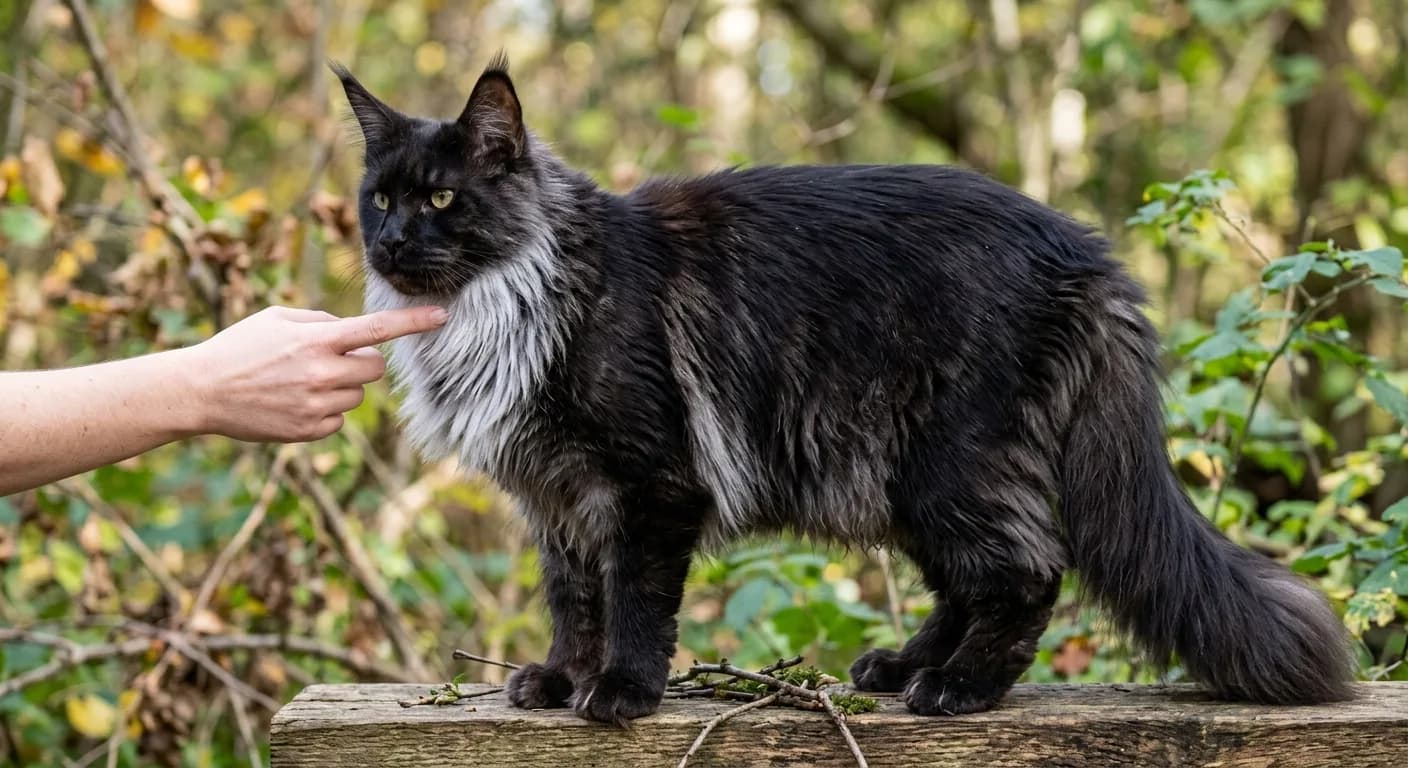
Smoke and shaded are not separate base colors: they are the same undercoat-coloration modifier applied at different intensities.
Smoke
In a smoke Maine Coon, each hair has a white or pale silver undercoat (the "silver" or "inhibitor" gene suppresses eumelanin in the lower hair shaft) with deeply colored tips. At rest, the cat looks like a solid; when the fur is parted or the cat moves, the pale undercoat flashes through like smoke. The most dramatic version is black smoke: a near-black surface that opens to a white base. Blue smoke, red smoke, and cream smoke are also accepted.
A black smoke Maine Coon is sometimes confused with a pure black cat at first glance. The tell is the white ruff and the pale inner-ear tufts, which tend to show the lighter undercoat most clearly.
Shaded and Chinchilla
In shaded cats, only the top quarter to third of each hair is pigmented; in chinchilla (the most extreme version), only the very tips are colored. The result is a nearly white cat with a subtle dusting of color on the tips. Shaded silver and chinchilla silver are the recognized variants in the breed standard.
Tortoiseshell, Calico, and Torbie Maine Coons
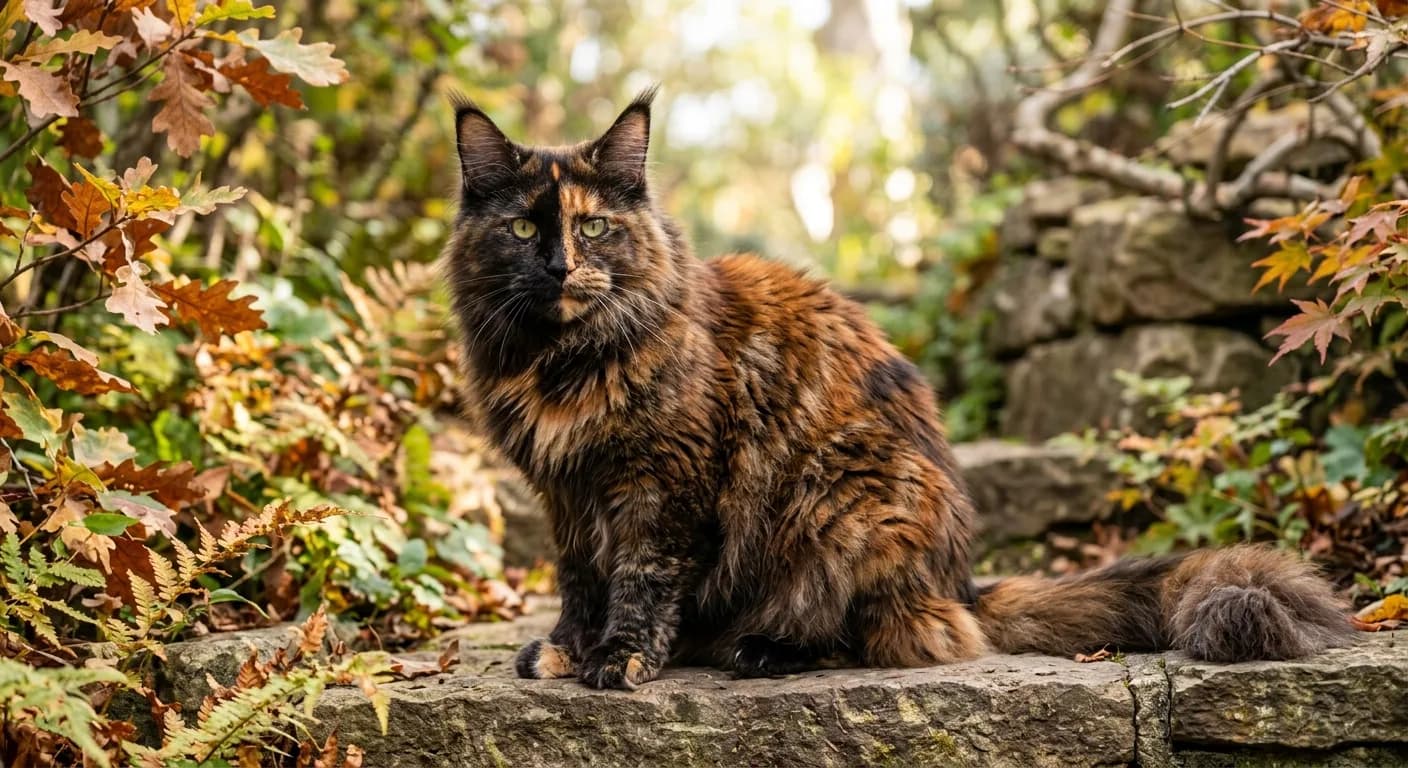
These three terms are frequently confused. They share the same genetic root (the orange/black mosaic on the X chromosome) but differ in the presence or absence of white spotting.
Tortoiseshell
A tortoiseshell (tortie) Maine Coon carries intermingled patches or a brindled mix of black (or blue) and red (or cream). There is no white in a true tortie. Because the orange gene is X-linked, tortoiseshell cats are almost always female (XX, with one X expressing orange and one expressing black). Male torties exist but are typically XXY (Klinefelter) and are almost always sterile.

63-inch multi-level cat tree with scratch posts, hammock, plush perches, and dangling toys. Vertical territory is non-negotiable for high-energy climbing breeds like the Bengal.
Petful may earn a commission when you click through to Chewy, at no extra cost to you.
Calico
A calico is a tortoiseshell with white spotting added by a separate gene (the piebald/white-spotting locus). Classic calico is white with distinct patches of black and red; dilute calico replaces black with blue and red with cream. Calico is also nearly exclusively female for the same genetic reason.
Torbie
A torbie (tortoiseshell + tabby) carries tabby pattern within the red and/or black patches. So where a tortie shows solid-colored brindled patches, a torbie shows striped or swirled patches. The CFA registers torbies under "patched tabby" entries. They are arguably the most visually complex Maine Coon color pattern.
- The gene that switches on orange pigment (O) sits on the X chromosome. A female (XX) can carry one X for orange and one for non-orange, producing a mosaic of both: tortoiseshell or calico. A male (XY) has only one X, so he is either orange or non-orange, never both, unless he has an extra X chromosome (XXY). That chromosomal anomaly is rare and nearly always causes sterility.
For a comparison of how color genetics work in another deeply color-diverse breed, see our overview of Persian cat colors.
Bicolor and Two-Tone Maine Coons
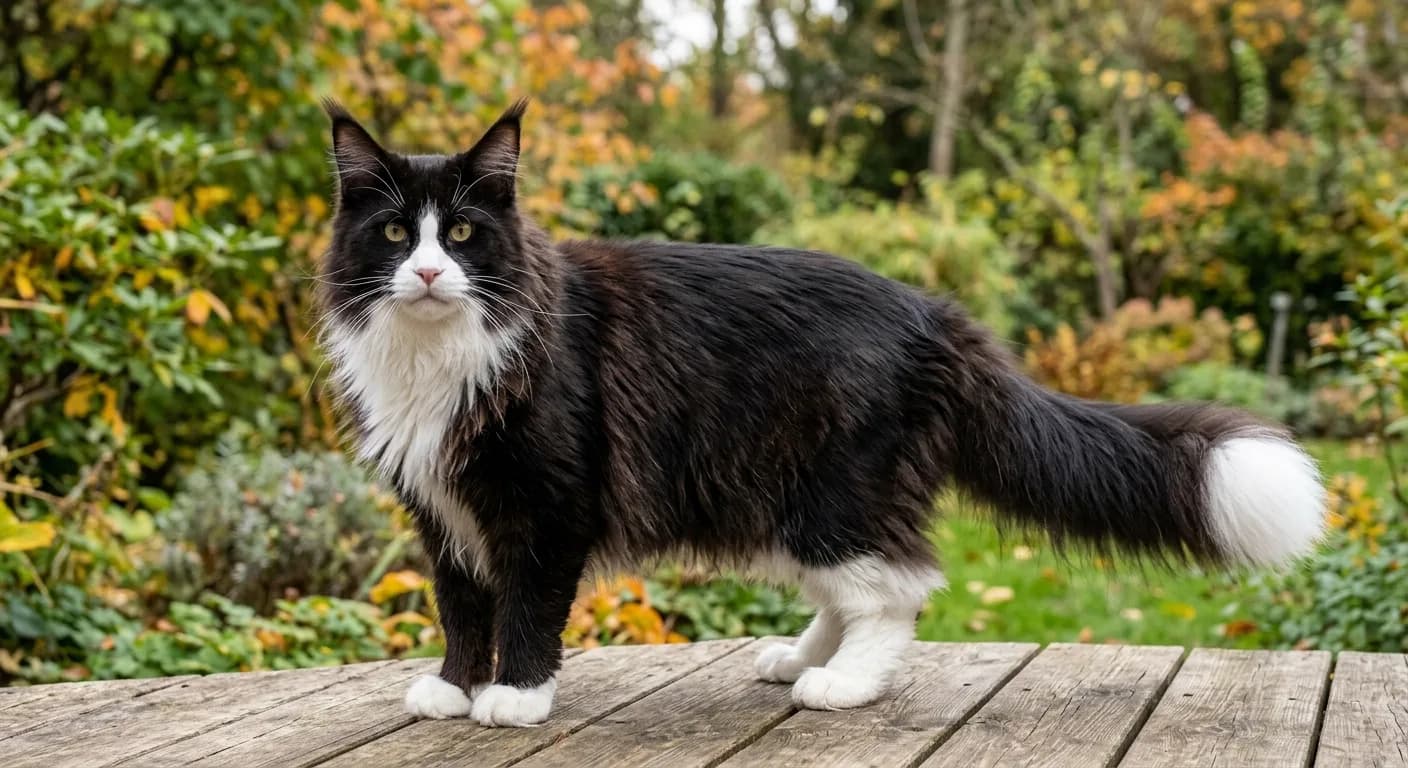
Bicolor Maine Coons carry white spotting (the S/s piebald locus) combined with any recognized color or pattern above. The white patches appear because the spotting gene prevents pigment cells from reaching parts of the skin during fetal development.
Van Pattern
At the extreme end of white spotting, a "van" pattern Maine Coon is mostly white with color confined to the head and tail. Van is rarer than standard bicolor but accepted in the breed standard.
Tuxedo
The popular "tuxedo" pattern (black and white with white limited to the chest, paws, and belly) is simply a bicolor Maine Coon with limited white expression. Tuxedo is not a formal CFA color category; it is a colloquial description of where the white falls.
Silver Maine Coons
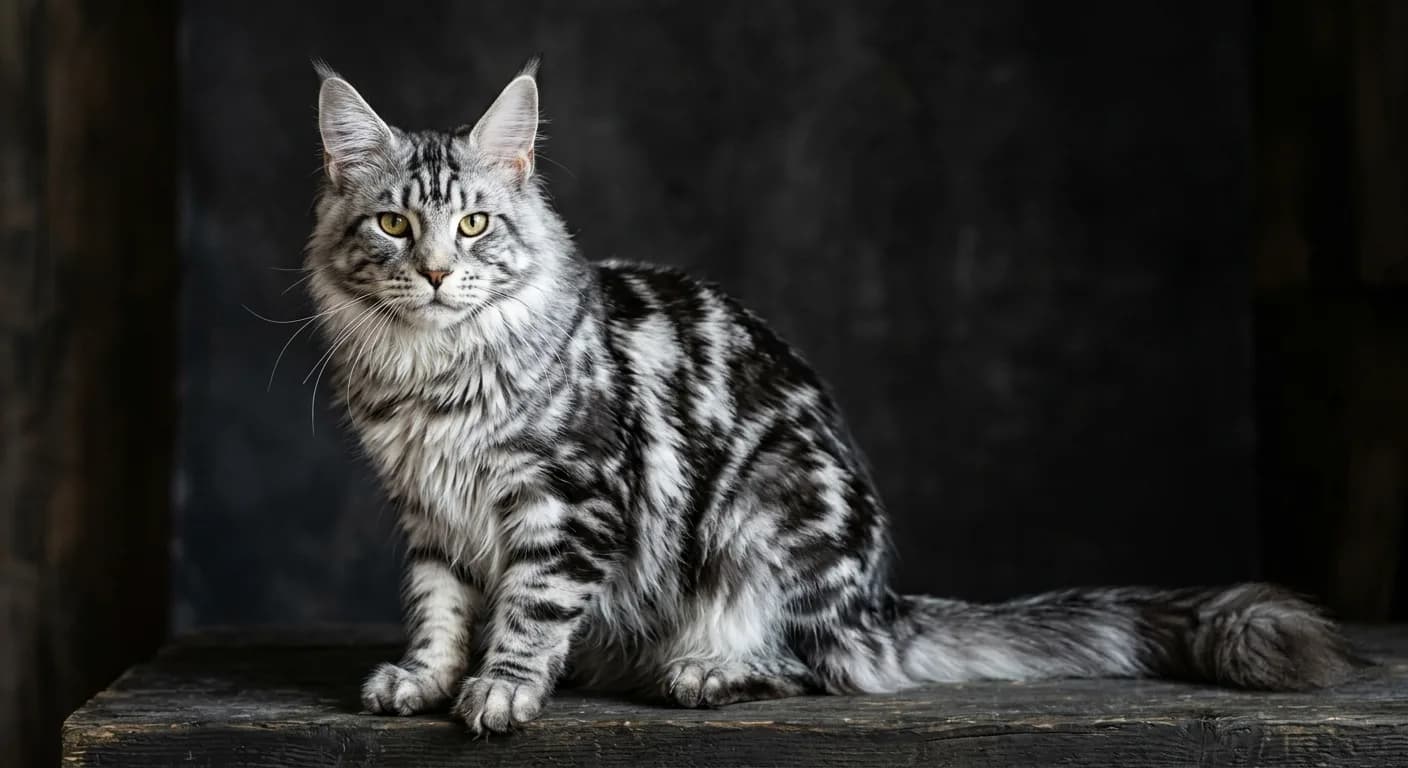
Silver deserves its own section because it is caused by a specific modifier gene (the "inhibitor" gene, symbol I) rather than a base color. The inhibitor gene blocks eumelanin production in the lower portion of each hair, producing a bright white or silver undercoat. It can work on top of any tabby pattern, creating "silver tabby," or on top of solid colors, creating "smoke."
A silver classic tabby Maine Coon shows jet-black tabby markings on a pure white ground: the contrast is higher than in any brown tabby. Silver tabbies most often have green or gold eyes, but unlike the British Shorthair standard (where silver and golden cats must be green-eyed), the Maine Coon standard does not tie eye color to coat color: green, gold, and copper are all acceptable on any non-white Maine Coon.
A silver shaded or chinchilla Maine Coon, as described above, takes the inhibitor gene to its furthest expression: the cat appears almost white with just a faint dusting of color on the hair tips, giving it an almost ethereal, sparkling look.

108-oz stainless steel pet fountain with quiet pump and water-level window. Bengals are notoriously water-obsessed; a flowing fountain encourages hydration and pulls them away from sinks and toilets.
Petful may earn a commission when you click through to Chewy, at no extra cost to you.
- Blow gently into the coat near the spine. A silver tabby will show darker tabby marking on the hair tips even in the parted fur; the undercoat will be pure white but the tips clearly patterned. A true white cat will be uniformly pale all the way to the root.
The Rarest Maine Coon Colors
"Rarest" in cat breeding refers to colors that require specific multi-gene combinations that are statistically unlikely, not to arbitrary marketing labels.
The genuinely rare combinations in Maine Coons include:
Solid white. White requires the dominant W allele, which is unrelated to the base color. Because W is unlinked to other desirable show traits, intentionally breeding for white while maintaining correct type is challenging.
Chinchilla silver. Requires the inhibitor gene plus modifier genes that push tipping to less than 10% of each hair shaft. The combination produces a cat that is effectively white with a gossamer shimmer of color. Precise, controlled breeding over generations is needed.
Shaded golden. The "golden" color results from the inhibitor gene acting on a tabby base, but the wide-band modifier gene prevents the full silver effect, leaving a warm golden-apricot undercoat instead of white silver. Golden Maine Coons are produced in much smaller numbers than silver.
Odd-eyed white. Requires white masking plus the condition for differential iris pigmentation. Striking and uncommon.
What is NOT rare in any objective sense: any color with "rare" in a breeder's marketing copy. A "rare silver" or "rare black smoke" is not statistically unusual; it is common marketing language.
- No CFA, TICA, or GCCF standard assigns a price premium to any Maine Coon coat color. A responsible breeder prices kittens on health testing, pedigree quality, and structural conformation, not pigmentation. Pet-quality Maine Coons from health-tested lines typically cost $1,000-2,500 regardless of color; show-quality animals run $2,500-4,000+. If a breeder is charging $5,000 for a "rare blue smoke" with no mention of HCM screening, cardiac echo results, or DNA panel results, that is a red flag, not a color premium.
Most Popular Maine Coon Colors
Popularity varies by country and generation of breeders, but the consistently most-sought colors in the United States and Europe are:
| Color / Pattern | Appearance | Eye Color | Notes |
|---|---|---|---|
| Brown Classic Tabby | Bold swirl/bull-eye on warm brown ground | Green, gold, or copper | The "signature" Maine Coon look; most recognizable |
| Brown Mackerel Tabby | Narrow parallel stripes on warm brown | Green, gold, or copper | Common; ancestral tabby pattern |
| Blue | Even cool blue-gray, no pattern | Copper or gold | Second most popular solid; dignified and calm-looking |
| Black | Jet black, no markings | Green, gold, or copper | High-contrast; especially dramatic in semi-long coat |
| Black Smoke | Appears black at rest; silver undercoat flashes on movement | Green, gold, or copper | Popular in shows for "wow" factor |
| Silver Classic Tabby | Jet-black markings on pure white/silver ground | Green, gold, or copper | Show ring favorite; striking high-contrast |
| Red / Red Tabby | Deep brick-copper; nearly always shows tabby ghost | Green, gold, or copper | Popular with owners who want an "orange" cat |
| Blue Cream | Blue and cream mosaic (dilute tortoiseshell) | Copper or gold | Elegant; female-only |
| White | Pure white; can be odd-eyed | Blue, green, gold, copper, odd | Less common; deafness testing recommended |
The brown classic tabby is overwhelmingly the most iconic Maine Coon color, appearing in the majority of breed photographs, show catalogs, and registry feature material. If someone pictures "a Maine Coon," they are almost certainly picturing a brown classic tabby.
Maine Coon Color Genetics Explained Simply
You do not need a genetics degree to understand why Maine Coons come in so many colors, but a few key concepts unlock the whole system.
Eumelanin and phaeomelanin. All cat coat color comes from two pigments: eumelanin (black/brown) and phaeomelanin (red/orange). Every color variation is the result of genes that modify the intensity, distribution, or presence of these two pigments.
The agouti/tabby axis. The agouti gene (A) controls whether eumelanin distributes evenly along each hair shaft (producing a tabby pattern through banding) or accumulates at the tip (tending toward non-agouti/solid). The Tabby (Mc) gene controls which tabby pattern appears. Solid-color cats are homozygous non-agouti (aa) and suppress the tabby banding in eumelanin-pigmented areas.
The dilution gene. The dilution gene (d) in homozygous form (dd) spreads melanin granules farther apart, diluting black to blue and red to cream. All "dilute" colors require two copies of the recessive d allele.
The orange/sex-linked gene. The O (orange) gene on the X chromosome replaces eumelanin with phaeomelanin. Males (XY) can only be orange or non-orange; females (XX) can be heterozygous, producing the orange-plus-black mosaic of tortoiseshell.
The inhibitor (silver) gene. The dominant I allele blocks eumelanin from depositing in the lower hair shaft, producing a pale or white undercoat. Applied to a tabby, it creates silver tabby. Applied to a solid, it creates smoke.
The white-spotting gene. The piebald S locus controls white spotting from a small locket (S/s heterozygous) to near-total white coverage (S/S homozygous or near-van). The dominant W gene produces a completely white cat unrelated to the piebald system.
What is missing from Maine Coons. Chocolate and cinnamon require specific alleles at the B (brown) locus (b and b-l, respectively). Colorpoint requires the cs allele at the C (color/albinism) locus, which restricts pigment to the cooler extremities. These alleles were either absent from the Maine Coon foundation population or excluded by registry policy. Lilac and fawn are the dilute forms of chocolate and cinnamon, so they are absent for the same reason.
- If a breeder offers "colorpoint Maine Coons" or "mink Maine Coons," the cat either carries genes from outcrossed breeds or is not a purebred Maine Coon by CFA, TICA, or GCCF standards. A legitimate Maine Coon will never have the darker-points-and-pale-body look of a Siamese or Ragdoll. A true Maine Coon's color is the same or similar in intensity from head to tail.
For a comparison of how registry standards shape color diversity in another long-coated breed, see the Maine Coon breed profile for the full standard overview. The Norwegian Forest Cat and Siberian are the two breeds most frequently confused with the Maine Coon, and both carry similarly broad color palettes in their own standards. Petful’s separate guide to Norwegian Forest Cat vs Maine Coon compares the two breeds side by side.
Frequently Asked Questions About Maine Coon Colors
Genuinely rare combinations include solid white (requires the unlinked dominant W gene), chinchilla silver (requires inhibitor plus multiple modifier genes restricting tipping to under 10% of the hair), and shaded golden. Male tortoiseshells and calicos are extremely rare and are almost always sterile.
The CFA, TICA, and GCCF collectively recognize over 75 color and pattern combinations spanning solids (black, blue, red, cream, white), tabbies (classic, mackerel, ticked) in those same base colors, tortoiseshell and calico, bicolor, smoke (black, blue, red, cream), shaded and chinchilla silver, and the patched-tabby (torbie) classes.
Maine Coons come in solid (self), classic tabby, mackerel tabby, ticked tabby, smoke, shaded, chinchilla, tortoiseshell, calico, torbie (patched tabby), and bicolor (including van). Patterns can combine with any recognized base color for dozens of combinations.
A tortie (tortoiseshell) is an intermingled or patched mix of black and red with no white. A calico adds white spotting to the tortoiseshell combination, creating distinct patches of black, red, and white. A torbie is a tortoiseshell that also carries tabby patterning within its colored patches, so the red and black areas show stripes or swirls rather than solid color.
No recognized breed standard assigns a price premium to any Maine Coon color. Pet-quality Maine Coons typically cost $1,000-2,500 regardless of coat color; show-quality animals from health-tested lines run $2,500-4,000 or more. Breeders who charge extra for "rare" colors are using marketing language, not breed-standard pricing.
The brown classic tabby is the most recognizable and widely photographed Maine Coon color, and it appears most frequently in breed catalogs and show literature. Blue solid and black smoke are also consistently popular, particularly in the show ring.
A smoke Maine Coon has the inhibitor (silver) gene, which blocks eumelanin pigment from depositing in the lower portion of each hair, leaving a white or pale silver undercoat under deeply colored tips. At rest the cat appears solid; when the fur moves or is parted, the pale undercoat flashes through like smoke.
A silver Maine Coon carries the dominant inhibitor gene (I), which creates a white or pale silver undercoat. On a tabby base this produces silver tabby (dark markings on a white ground); at lower tipping levels it produces shaded or chinchilla silver. Silver Maine Coon tabbies most often have green or gold eyes, though the Maine Coon standard does not tie eye color to coat color.
Yes, to a degree. Black kittens often show faint ghost tabby markings that fade by one year of age. Smoke kittens can look misleadingly dark or light at birth before the full undercoat develops. Tabby contrast tends to sharpen as the adult coat fills in, typically by 12-18 months, and the full depth of color in a smoke or silver is not visible until the mature coat comes in.
No. Colorpoint is a disqualifying pattern in all major registries (CFA, TICA, GCCF) for Maine Coons. The cs allele required for point restriction was not present in the breed's foundation stock and is excluded by standard. A Maine Coon with point coloring is either a mixed-breed cat or one that does not meet breed-standard requirements.
The CFA recognizes Maine Coons in solid (black, blue, red, cream, white), tabby (classic, mackerel, ticked), tortoiseshell, calico, dilute calico, bicolor (with any recognized color), smoke (black, blue, red, cream), shaded and chinchilla silver, and patched tabby (torbie). There are over 75 individual registry entries when all base-color and pattern combinations are mapped.
Colorpoint (Siamese-style point restriction), chocolate, lilac, cinnamon, and fawn are disqualifying colors in the CFA, TICA, and GCCF Maine Coon standards. Any Maine Coon carrying these colors either has mixed ancestry or does not qualify for registration as a purebred Maine Coon under those registries.
Coat color does not determine personality or typical health outcomes in Maine Coons. The breed as a whole is described as dog-like, social, playful, and intelligent regardless of color. The one health exception is white coat color: white cats with blue eyes have a documented higher risk of congenital sensorineural deafness, a pigmentation-pathway association confirmed across all domestic cat breeds by Cornell Feline Health Center research, not limited to Maine Coons.
A black smoke Maine Coon appears jet black at rest because the deeply pigmented black tips cover nearly the entire visible hair shaft. When the cat moves, rolls, or has its fur parted, a bright white or silver undercoat is revealed, giving the dramatic "smoke" effect. Show-quality black smokes often display a pale silver ruff and inner-ear furnishings that hint at the contrast beneath the surface.
Closing Thoughts
With more than 75 recognized color and pattern combinations, the Maine Coon is effectively a single breed wearing dozens of coats. Whether you are drawn to the bold geometry of a classic tabby, the ghostly flicker of a black smoke, the warmth of a red torbie, or the near-translucent shimmer of a chinchilla silver, the CFA, TICA, and GCCF standards have a name and a registration category for it. No color ranks above another in the breed standard, and no color earns a price premium from a reputable, health-focused breeder.
The two most important choices when selecting a Maine Coon have nothing to do with color: they are the health-testing record (HCM cardiac echo plus MyBPC3 DNA, SMA, and PKD panels) and the temperament of the kitten's parents. A fully health-tested brown mackerel tabby kitten is worth more than an untested "rare" chinchilla silver, every time.
For more on living with this breed, see the complete Maine Coon breed guide. If you are comparing look-alike breeds, the Norwegian Forest Cat and Siberian share the semi-long coat and large body type but have distinct breed standards and color rules of their own. There is more on this in Petful’s guide to Norwegian Forest Cat colors.
Whatever color yours is, a Maine Coon is a real investment, so a free MyPetID profile is worth setting up early to keep your cat's microchip number, vaccination records, and proof of ownership in one place, with a QR tag to help a lost cat get home fast.
Set up a free MyPetID profileSee our individual color guides: the black Maine Coon, the white Maine Coon, and the orange Maine Coon.

Coreen Saito is a pet writer and longtime shelter volunteer with more than a decade in animal rescue. She covers cat behavior, breed care, and the small, ordinary science of sharing a life with companion animals, with a particular focus on honest takes about the products and decisions that actually matter. At home in Arizona, she's outranked by Mac (a dog with the loudest opinion in the house), Rebel (a cat who governs by quiet authority), and Meri (an orange tabby who runs the late shift and the laundry basket). She writes about all three, plus the rescues that keep coming through her life, at LifeWithMinty.com.
Sign up for expert-backed reviews and safety alerts all in one place.