Orange Maine Coon: Complete Guide to the Ginger Giant
Orange Maine Coons dazzle with their ginger-red coats and gentle-giant temperament. Discover the sex-linked genetics behind the color, the three tabby patterns, why females are harder to find, and expert grooming tips for the iconic flowing mane.
Petful is reader supported. As an affiliate of platforms like Amazon and Chewy, we may earn a commission when you buy through links on this page. There is no extra cost to you.
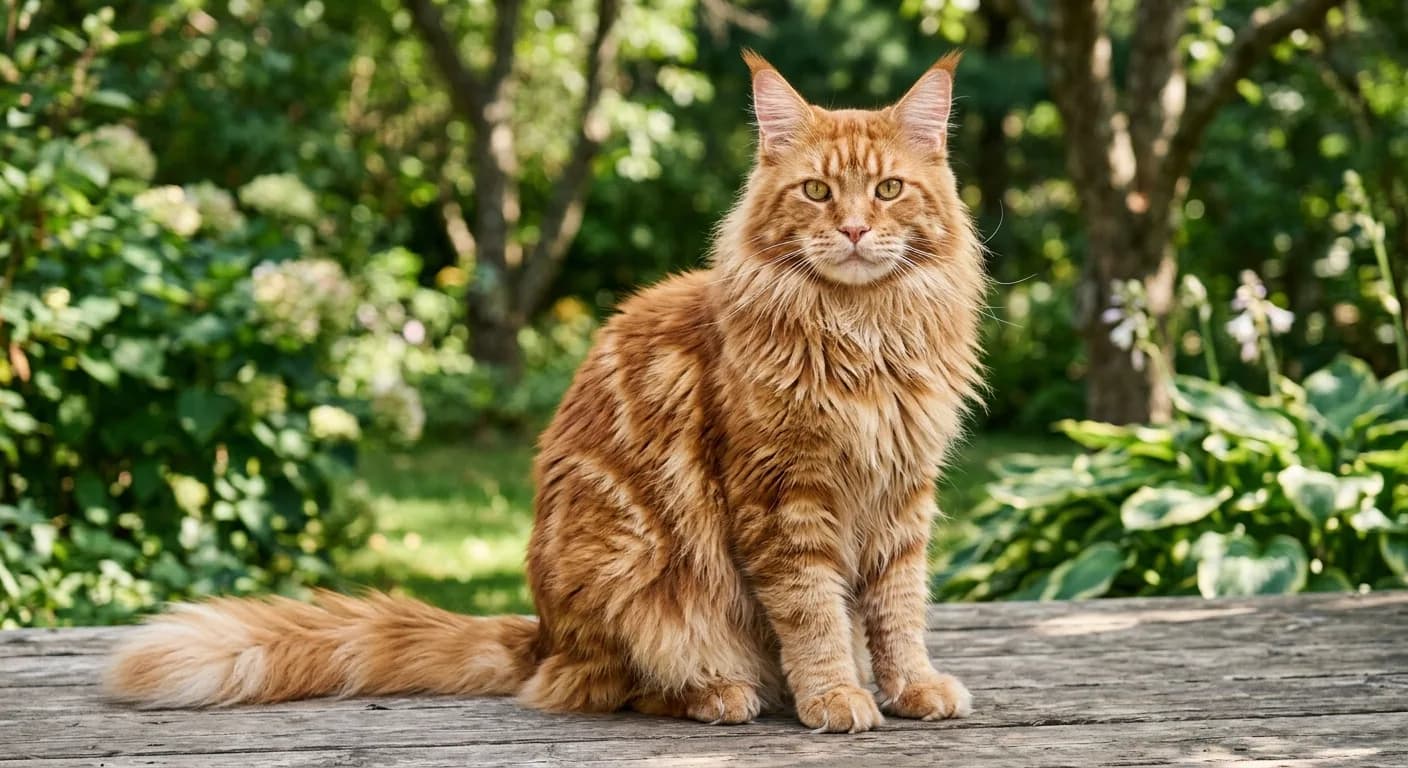
The orange Maine Coon is one of the most instantly recognizable cats on the planet, and for good reason. Towering over most house cats at up to 25 pounds, draped in a flowing red-gold mane, and wired with the personality of a golden retriever, the orange Maine Coon combines maximum presence with genuinely warm-hearted temperament. Whether you are researching the genetics behind that striking coat, wondering why orange Maine Coons are almost always male, or deciding whether this flame-colored giant belongs in your home, this guide covers everything the top sources do not.
- 1Officially called "Red" not orange in CFA and TICA breed standards
- 2About 80% of orange Maine Coons are male because the O gene is carried on the X chromosome
- 3Three tabby patterns exist: classic (swirled), mackerel (striped), and ticked (agouti)
- 4Orange is not rare in males but orange females are noticeably less common
- 5Personality is shaped by breeding and socialization, not coat color
For the full Maine Coon breed profile including size charts, history, and health deep-dives, visit Petful's Maine Coon cat breed guide.

Sign up for expert-backed reviews and safety alerts all in one place.
What "Orange" Actually Means in Breed Standards
If you walk into a cat show and ask a judge about the "orange" Maine Coon in the ring, you will get a polite correction. The Cat Fanciers' Association (CFA) and The International Cat Association (TICA) both use the official term "Red." The breed standard calls for "deep, rich, clear, brilliant red, without shading, markings, or ticking" on the coat, with brick-red nose leather and brick-red paw pads.
In everyday language, owners and breeders use "orange," "ginger," and "red" interchangeably. All three describe the same genetic color. The disconnect between the vivid orange most people see and the formal designation "red" comes from how the gene expresses itself through the Maine Coon's dense double coat, which diffuses the hue toward warm amber and deep copper.
- The CFA and TICA both register this color as "Red," not orange. You will see "red tabby," "red smoke," and "red silver tabby" on pedigrees. When a breeder says "red" they mean the same cat you are picturing when you hear "orange."
The Genetics Behind the Orange Color
The O Gene and the X Chromosome
The orange color in cats, including Maine Coons, is controlled by the O (orange) gene. This gene is sex-linked, meaning it is located on the X chromosome rather than one of the autosomes.
Here is how the math works:
Male cats carry one X chromosome and one Y chromosome (XY). If that single X carries the O allele, the cat will be orange. Males need only one copy of the gene to express the color fully.
Female cats carry two X chromosomes (XX). To be orange, a female must inherit the O allele on both X chromosomes. If she carries O on one X and a non-orange allele on the other, she becomes a tortoiseshell or calico instead of a solid orange cat.
This is precisely why roughly 80% of all orange cats, across all breeds, are male. A female orange Maine Coon requires the right genetic hand from both parents, making her considerably less common.
- An orange female Maine Coon is produced when both her sire (father) is orange and her dam (mother) either carries or expresses the O gene. This narrows the pool significantly, which is why female orange kittens in a litter are often claimed first by buyers who specifically want them.
The Agouti Gene and Tabby Expression
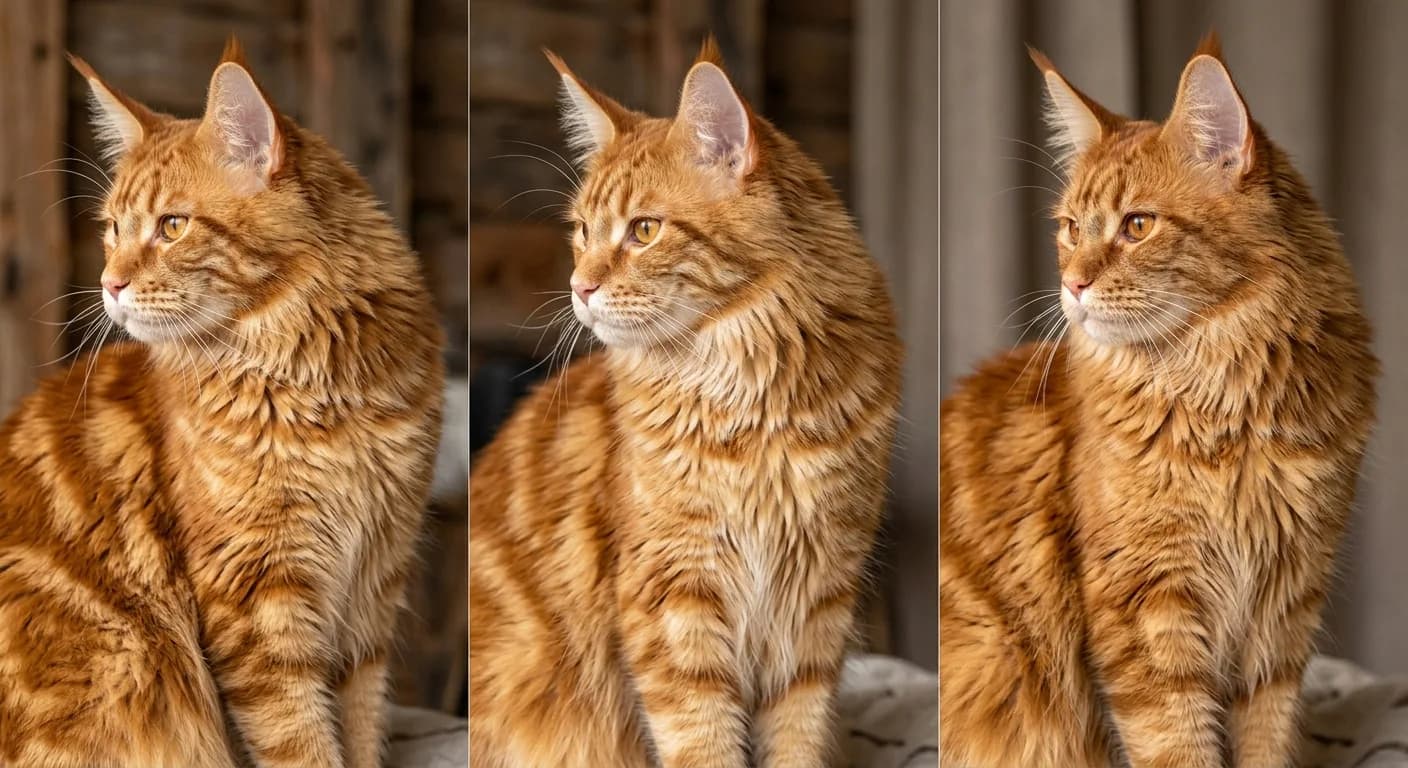
Nearly every orange Maine Coon you will ever see displays tabby patterning. This is because a second gene, the agouti gene (A), controls whether banding appears on individual hairs. The agouti gene interacts with the O gene so that solid (non-tabby) orange cats are extremely rare. Even Maine Coons registered as "solid red" often show faint ghost tabby markings, particularly in kittens whose patterns lighten as they mature.
Never Scoop Again® with the Whisker Litter-Robot, the smart self-cleaning automatic litter box. Monitor visits and track weights for better overall care in the Whisker® app. Multi-cat friendly.
Petful may earn a commission when you click through to Whisker, at no extra cost to you.
What you are looking at when you see an orange Maine Coon is almost always a red tabby, a red smoke, or a red silver tabby, depending on additional modifier genes.
Orange Maine Coon Color Shades and Patterns
Not all orange Maine Coons look the same. The O gene creates a spectrum from deep brick-red to pale peachy cream, and three distinct tabby patterns add further visual variation.
| Pattern / Shade | Visual Appearance | Rarity Among Orange MCs |
|---|---|---|
| Red Classic Tabby | Bold concentric swirls on the sides, a distinct "bullseye" on the flank, dark stripes from head to tail spine | Most common |
| Red Mackerel Tabby | Narrow parallel stripes running vertically down the flanks, no swirls, resembles a fish skeleton | Very common |
| Red Ticked Tabby | No visible body stripes, each individual hair banded in alternating light and dark, gives a shimmering sandy-red look | Less common, striking up close |
| Red Smoke | Dense red over a white undercoat visible when the fur parts; appears nearly solid at rest | Uncommon |
| Red Silver Tabby | Tabby markings over a silver-white undercoat; produces a pale peachy-orange or "light orange" appearance | Uncommon |
| Cream | Diluted orange produced by the dilution gene (d); a soft warm beige-ivory | Separate recognized color |
Classic Tabby
Classic (or "blotched") tabbies display broad, swirling marbled patterns on the sides. In orange Maine Coons, these swirls are a rich amber against a slightly lighter copper base. The chest typically shows a broken "necklace" of darker rings, and the legs are distinctly barred.
Mackerel Tabby
Mackerel tabbies carry narrow vertical stripes running from spine to belly, with no swirling. This is the pattern most people associate with a classic "tiger cat" look. On an orange Maine Coon, the contrast between the darker orange stripes and the lighter base creates a vivid flame effect, particularly visible on the long flowing coat.
Ticked Tabby
The ticked or agouti tabby has no distinct body stripes. Instead, each hair is banded in alternating light and dark segments, giving the coat an even shimmering texture. Face, legs, and tail still show faint barring, but the body reads as almost solid from a distance. Among orange Maine Coons, the ticked pattern is the most subtle and can appear closest to a solid red.
Light Orange and Cream: What Causes Pale Shades
Breeders are sometimes asked about "light orange" Maine Coons. These cats are typically one of two things: a red silver tabby (where a separate inhibitor gene lightens the undercoat, pushing the overall appearance toward peach or strawberry blond), or a cream, which is the diluted form of orange created by the dilution gene. Cream is recognized as its own color class in breed standards, not a variant of red.
- Crouch down to eye level with the cat and look along the flank. Classic tabbies show distinct swirling bullseyes; mackerel tabbies show vertical bars; ticked tabbies read as nearly solid. Up close on a ticked cat, you can see the individual hair banding with a loupe or strong light.
Are Orange Maine Coons Rare?
The short answer: no, but it depends on what you are looking for.
Male orange Maine Coons are one of the more common color presentations in the breed. If you search reputable Maine Coon breeder websites, you will find orange males in most litters. The genetics make this predictable: a male only needs the O gene on his single X chromosome.
Female orange Maine Coons are less common but not exotic. They require the right gene combination from both parents, so they appear less frequently in litters and tend to be reserved quickly. An orange female from a quality health-tested program may require a waitlist of six months to a year.
Where true scarcity enters the picture is quality, not color. Orange Maine Coons from programs that perform HCM cardiac screening, hip dysplasia evaluations, and DNA panel testing for polycystic kidney disease are genuinely hard to find regardless of color. A well-built orange male with a show-quality mane and documented health testing is not "rare" in the genetic sense but is absolutely not easy to source quickly.
- For context, the genuinely rare Maine Coon colors are the dilutes and recessives: gold/chinchilla, shaded, and particularly the various smoke colorways. Solid white (masking all underlying color) and true lilac (a double-dilute blue) are rarer than orange in most breeding programs.
Orange Maine Coon Personality: Myths vs. Reality
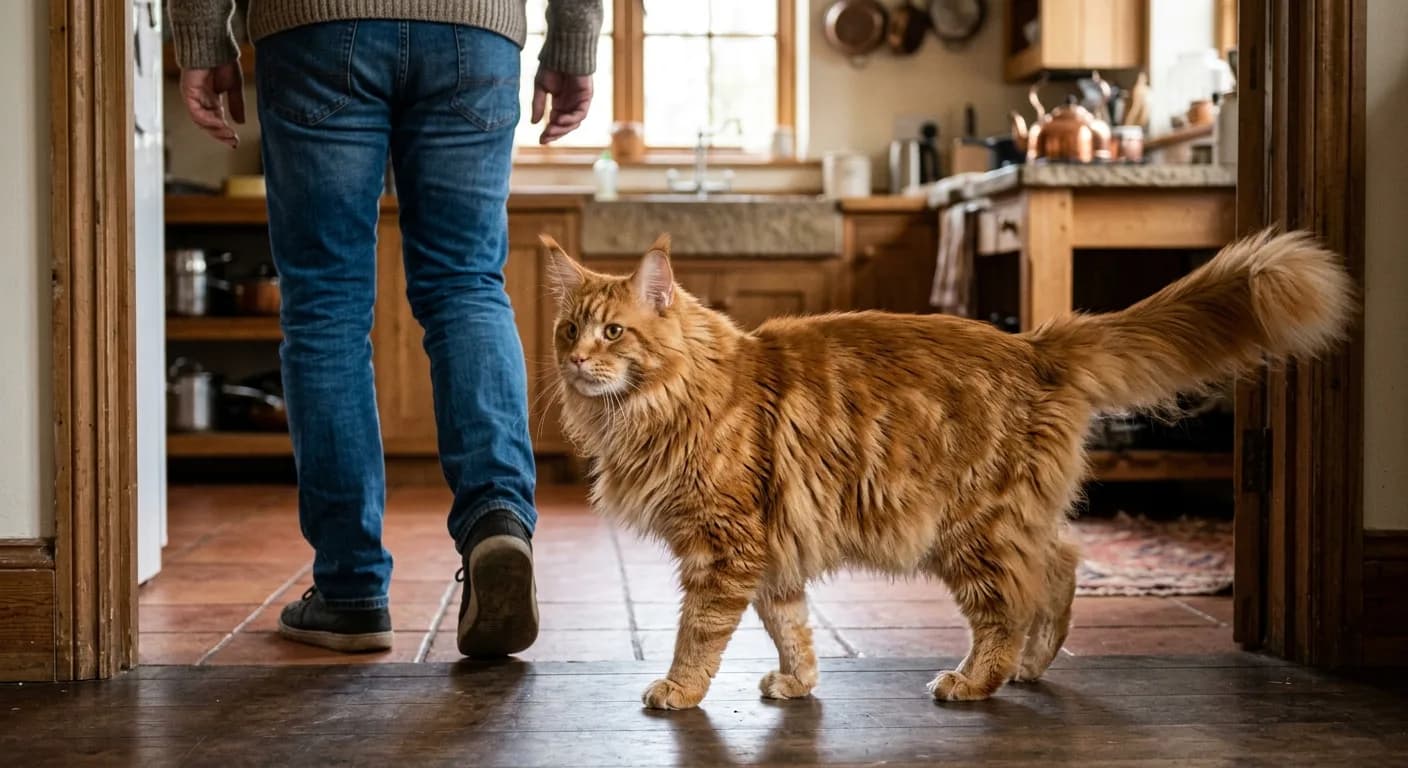
The internet loves the idea that orange cats have a distinct personality. Reddit's r/OneOrangeBraincell entire premise is that orange cats share a single communal brain cell of endearing clumsiness. Maine Coon owners on TikTok, Instagram, and YouTube consistently describe their orange cats as louder, sillier, and more attention-seeking than cats of other colors.
The science is clear on this: no peer-reviewed research links coat color to temperament in cats. The O gene operates on a completely different chromosome from the genes that influence behavior and neurological development. An orange Maine Coon is not friendlier because it is orange.
What IS true is that Maine Coons as a breed, orange or otherwise, are bred for exceptional sociability, low anxiety, and high tolerance for handling. When you consistently see orange Maine Coons behaving in warm, goofy, people-oriented ways, you are seeing the breed's selective traits, not a color effect.
That said, here are the genuine personality traits you can expect from any well-bred Maine Coon, regardless of color:
Dog-like loyalty. Maine Coons routinely follow their owners from room to room, wait by the door when they leave, and greet them on return. This trait is consistent across colors and is a hallmark of the breed.
Chirping and trilling vocalization. Maine Coons do not typically produce traditional "meow" sounds. They communicate with chirps, trills, chatters, and high-pitched chirring. Orange Maine Coon owners often describe their cats as particularly vocal, but this varies far more by individual than by color.
Water fascination. Many Maine Coons are attracted to running water, will paw at their water bowl, and some will voluntarily join their owners at the bathroom sink. This is a breed trait with no documented connection to color.
High intelligence and trainability. Maine Coons learn their names quickly, respond to recall commands, and can be taught leash walking with a harness. Some owners train their cats to perform fetch, high-fives, and door-ringing for attention.
Gentle tolerance. The breed's reputation for patience with children, dogs, and other cats is well-established. They are not typically aggressive and tend to retreat rather than scratch when overwhelmed.
- The claim that orange cats are less intelligent or "dumb" is pure internet humor with no scientific basis. Maine Coons are among the most cognitively engaged domestic cats, regardless of coat color. Do not conflate the orange cat meme with reality when evaluating a kitten.
Size: How Big Do Orange Maine Coons Get?
Orange Maine Coon males are typically among the largest cats you will encounter outside of wild species, a topic covered in depth in our Maine Coon size guide. Adult males weigh 15 to 25 pounds and stand 10 to 16 inches at the shoulder, with body length commonly exceeding 40 inches from nose tip to tail tip. Females are smaller but still substantial at 8 to 14 pounds.

63-inch multi-level cat tree with scratch posts, hammock, plush perches, and dangling toys. Vertical territory is non-negotiable for high-energy climbing breeds like the Bengal.
Petful may earn a commission when you click through to Chewy, at no extra cost to you.
The critical caveat: Maine Coons do not reach full size until they are 3 to 5 years old. A one-year-old orange Maine Coon is still a kitten in body development terms. Many owners are surprised to find their already-large one-year-old continues filling out for another two to three years. The distinctive lion-like ruff around the neck, wide chest, and barrel-chested silhouette all continue developing through year four.
| Trait | Males | Females |
|---|---|---|
| Weight (adult) | 15-25 lb | 8-14 lb |
| Height at shoulder | 10-16 in | 10-14 in |
| Full maturity | 3-5 years | 3-4 years |
| Coat length | Medium to long | Medium to long |
| Official color name | Red | Red |
| Eye colors | Green, gold, copper; blue in white-gene cats | Same |
| Nose leather | Brick-red | Brick-red |
| Paw pads | Brick-red | Brick-red |
| Typical lifespan | 12-15 years | 12-15 years |
Eye Color in Orange Maine Coons
Orange Maine Coons do not have a fixed eye color. The most common eye colors in this color class are:
Gold and copper. Deep amber to rich copper eyes are the most frequently seen eye color in red tabbies and are considered particularly striking against the warm coat.
Green. Clear green eyes appear in some red tabbies and are equally accepted in breed standards.
Blue. Blue eyes in an orange Maine Coon typically indicate the presence of a white spotting gene or the dominant white gene modifying the base red coat. A fully orange cat without white markings very rarely carries blue eyes. Orange cats with white patches (red and white) can have blue or odd eyes. There is more on this in Petful’s guide to white Maine Coon.
- All Maine Coon kittens are born with blue eyes. The permanent adult eye color does not set until approximately 3 to 4 months of age. Do not select a kitten expecting a specific eye color until after this transition period.
Coat Care and Grooming for Orange Maine Coons
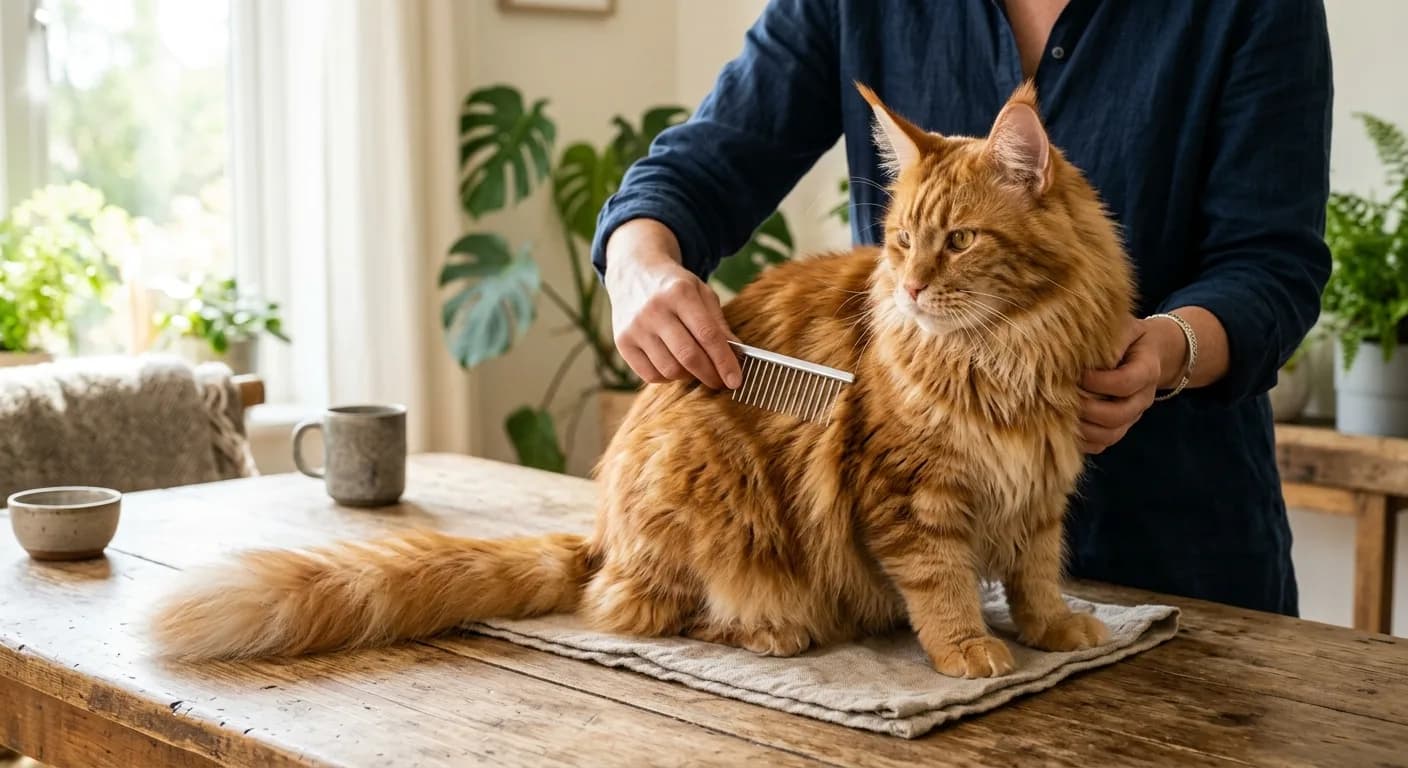
The Maine Coon coat is a dense, semi-long double coat with a slightly oily water-resistant texture. On orange individuals, the coat has a particularly silky quality in the ruff (chest mane), britches (rear leg feathering), and tail plume. This is gorgeous but requires consistent maintenance.
Weekly Brushing Routine
Brush your orange Maine Coon at minimum twice per week, ideally three to four times. Use a stainless steel wide-tooth comb to work through the undercoat and a slicker brush to smooth the topcoat. Always work with the direction of hair growth to avoid pulling.
Pay particular attention to:
The armpits and groin. These areas mat most quickly because friction from movement creates tangles. Check and comb these areas at every grooming session.
Behind the ears. The soft fur behind the ear base is prone to matting, particularly in cats that scratch their ears frequently or sleep on the same side consistently.
The ruff and chest. The lion-like mane is deep and can conceal mats at the skin level. Part the ruff and run the comb from the skin outward, not just over the surface.
The tail plume. The tail feathers can hold debris and develop tangles where the plume flares widest. Comb from base to tip with a wide-tooth comb.

108-oz stainless steel pet fountain with quiet pump and water-level window. Bengals are notoriously water-obsessed; a flowing fountain encourages hydration and pulls them away from sinks and toilets.
Petful may earn a commission when you click through to Chewy, at no extra cost to you.
- The single best grooming investment is early habituation. Introduce combing and handling during the first week your kitten is home. A Maine Coon that associates grooming with calm handling becomes cooperative for life. Starting with an adult rescue that has never been groomed is significantly more challenging.
Shedding and Seasonal Coat Changes
Maine Coons shed year-round with two heavier seasonal blows in spring and fall. During these periods, daily brushing prevents mats from forming in the loosened undercoat. Orange Maine Coons are particularly visible shedders because their red-orange hair shows up on dark fabrics. A HEPA vacuum and a lint roller kept near seating areas are practical necessities.
Bathing
Most Maine Coons tolerate bathing better than other long-haired breeds, partly because of their water-curious temperament. Bathing every six to eight weeks reduces dander, removes loose undercoat, and keeps the ruff from developing a greasy texture. Use a cat-safe diluted shampoo, rinse thoroughly to prevent skin irritation, and use a low-heat dryer or allow drying in a warm room away from drafts.
Nail and Ear Care
Trim nails every two to three weeks. Check ears weekly for wax buildup or dark debris that might indicate ear mites. Gently wipe visible wax with a cotton ball and cat-safe ear cleaner. Do not insert anything into the ear canal.
- If you find a mat that is tight to the skin and larger than a quarter, do not pull it. Skin tears easily in mats held close to the body. A professional groomer or veterinary technician can safely remove severe mats with blunt-tipped scissors or a mat-splitter tool. This is especially common in senior or rescued orange Maine Coons with a history of neglected coat care.
Health Considerations for Orange Maine Coons
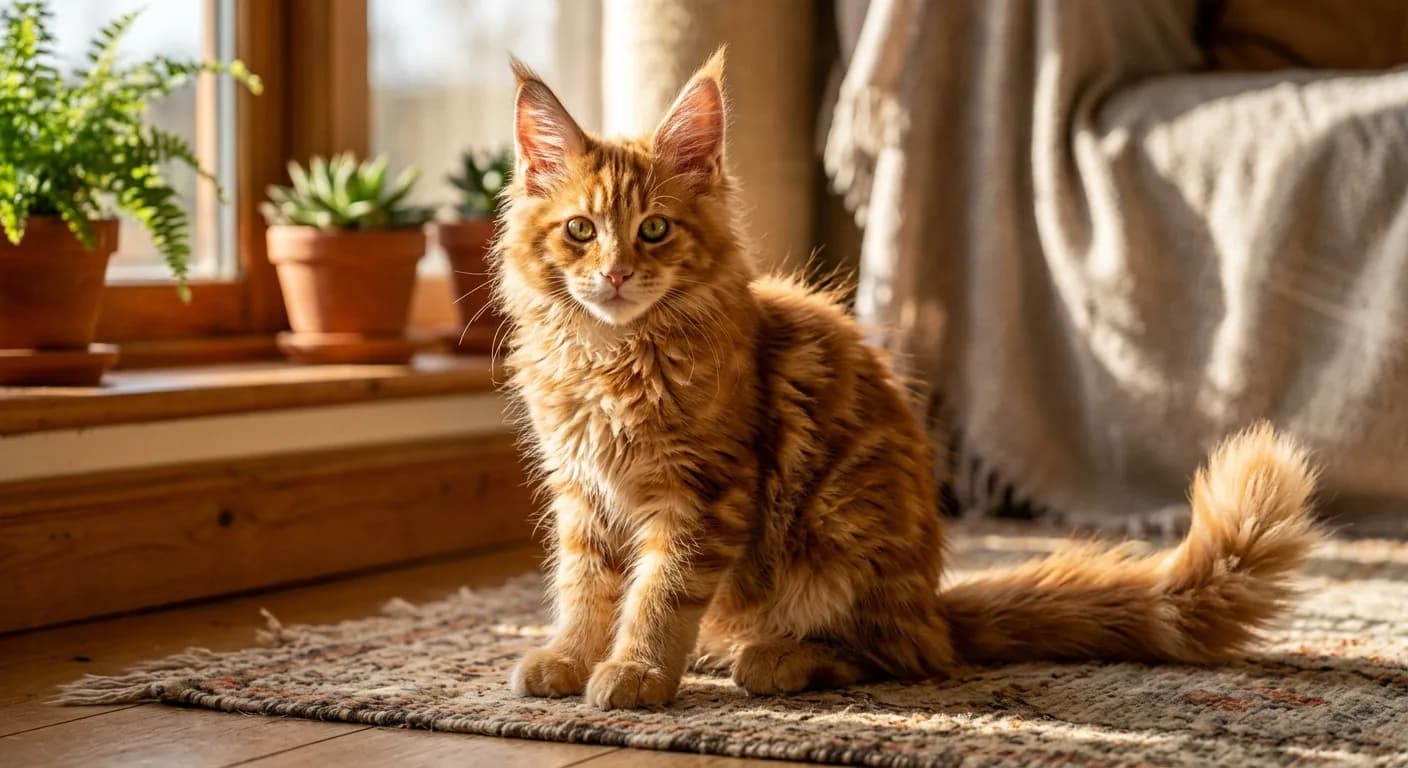
The orange coat color itself carries no known health liabilities. Health concerns in Maine Coons are breed-specific, not color-specific.
The three conditions all prospective Maine Coon owners should understand:
Hypertrophic Cardiomyopathy (HCM). The most common inherited heart disease in cats overall, and Maine Coons have a known genetic predisposition through a mutation in the MYBPC3 gene. Reputable breeders screen parent cats annually with cardiac ultrasound and offer a DNA test for the known Maine Coon-associated MYBPC3 mutation. Ask for documentation before committing to a kitten.
Hip Dysplasia. Large-breed cats are more vulnerable to hip dysplasia than small breeds. Maine Coons rank among the most affected breeds. Symptoms appear as reduced activity, difficulty jumping, or an unusual gait. Pedigree programs with OFA hip evaluations on breeding cats reduce risk.
Spinal Muscular Atrophy (SMA). An inherited neuromuscular condition causing progressive muscle weakness in the hind limbs. Affected kittens typically show signs between 3 and 4 months. DNA testing can identify carriers and affected individuals. Ethical breeders test and do not breed carrier-to-carrier pairs.
Asking to see HCM echo reports, hip evaluation results, and SMA DNA panel results from both parents is not an unusual request from a reputable breeder. It is the standard of care.
Finding an Orange Maine Coon Kitten
Purebred orange Maine Coon kittens from health-tested programs are priced like any standard Maine Coon color, roughly $1,000 to $2,500 from a health-testing breeder, since orange carries no color premium. Prices far below $800 from a "Maine Coon" listing should raise immediate questions about health testing, registration, and whether the cat is genuinely purebred.
Orange is a popular color, and kittens from established programs are frequently reserved before a public listing goes up. Joining a breeder waitlist six to twelve months before you want a kitten is realistic for most buyers seeking a specific sex and color combination.
- Before committing: confirm TICA or CFA registration, ask for cardiac echo dates on both parents, request the SMA DNA panel, and ask to see photos or visit the breeding environment. Reputable breeders will welcome questions and provide references from prior buyers.
For adoption, contact Maine Coon-specific rescue organizations. Orange Maine Coon mixes sometimes appear in general shelters labeled as "domestic longhair" cats. A Maine Coon rescue can help verify whether a cat is purebred or a mix.
Orange Maine Coon vs. Orange Maine Coon Mix
If you see an orange longhaired cat in a shelter described as a "Maine Coon mix," the visual characteristics to look for include: large rectangular body frame, square muzzle with high cheekbones, wide-set tufted ears with significant ear furnishings (the fur inside the ear), tufted paw pads (polydactyl toes are particularly common in Maine Coons), and a dense multi-layered tail that holds its shape when lifted.
A cat lacking most of these structural traits alongside the orange coat is likely a domestic longhair with minimal or no Maine Coon ancestry, regardless of what the listing says.
Orange Maine Coon shorthairs do not exist as a breed variation. The Maine Coon breed standard requires a medium to long coat. A shorthaired orange cat with Maine Coon-like features is either a domestic shorthair mix or a different breed entirely.
Frequently Asked Questions
Male orange Maine Coons are not rare; they are among the more common color expressions in the breed because males need only one X chromosome carrying the orange gene. Female orange Maine Coons are less common but not exotic, requiring the gene from both parents. What is genuinely hard to find is a high-quality, health-tested orange Maine Coon from a responsible program, due to demand rather than color scarcity.
The orange (O) gene is located on the X chromosome. Male cats have one X and one Y chromosome, so if their single X carries the orange gene they express the color fully. Female cats have two X chromosomes and must inherit the orange gene on both to be orange rather than tortoiseshell or calico. This sex-linked inheritance means roughly 80% of all orange cats, including Maine Coons, are male.
Among officially recognized colors, true gold/chinchilla, solid white, and lilac (a double dilute of blue) are generally rarer than orange in most breeding programs. The rarest combinations involve the interaction of multiple recessive genes such as dilution, inhibitor, and white-spotting all appearing together.
No scientific evidence links coat color to temperament in cats. The friendly, dog-like, vocal, and playful personality associated with orange Maine Coons is a Maine Coon breed trait present across all color classes. It is reinforced by selective breeding for temperament, not by the orange pigment gene.
Orange Maine Coons come in three primary tabby patterns: classic tabby (bold swirling bullseye on the flank), mackerel tabby (narrow parallel vertical stripes), and ticked tabby (no body stripes, each hair is banded in alternating light and dark). Many also carry white markings on the chest, chin, or paws. Red smoke and red silver tabby are additional recognized variants.
Yes, but only when a white-spotting or dominant white gene is also present. A fully orange Maine Coon with no white markings very rarely has blue adult eyes. Kittens of all colors are born with blue eyes that transition to their permanent adult color by 3 to 4 months of age.
Purebred orange Maine Coon kittens from health-tested programs in the United States typically cost $1,000 to $2,500 as of 2026, the same as other colors since orange carries no price premium. Price is driven by health testing documentation, pedigree quality, and breeder reputation rather than color. Maine Coon mixes from rescue organizations carry adoption fees of $50 to $300.
Maine Coons benefit from high-protein diets with real meat listed as the first ingredient. Due to their large size and slow maturation, high-quality kibble or wet food with appropriate caloric density supports growth through age 3 to 5. Avoid fillers, artificial preservatives, and corn-heavy formulas. Consult your veterinarian for age and weight-appropriate portion guidance.
This is a personal and situational decision. Maine Coons are large enough to defend themselves from some threats but are still vulnerable to cars, predators, disease, and theft due to their value. Many owners provide supervised outdoor access via a secure catio or harness and leash walks, which satisfies the breed's high curiosity and activity needs without free-roaming risk.
Maine Coons are social cats and can experience boredom or mild separation anxiety if left alone for extended periods daily. For owners with standard work schedules, providing enrichment in the form of puzzle feeders, window perches, vertical climbing structures, and ideally a feline companion mitigates loneliness. Most well-adjusted Maine Coons tolerate an 8-hour workday with proper environmental enrichment.
Summary: Is the Orange Maine Coon Right for You?
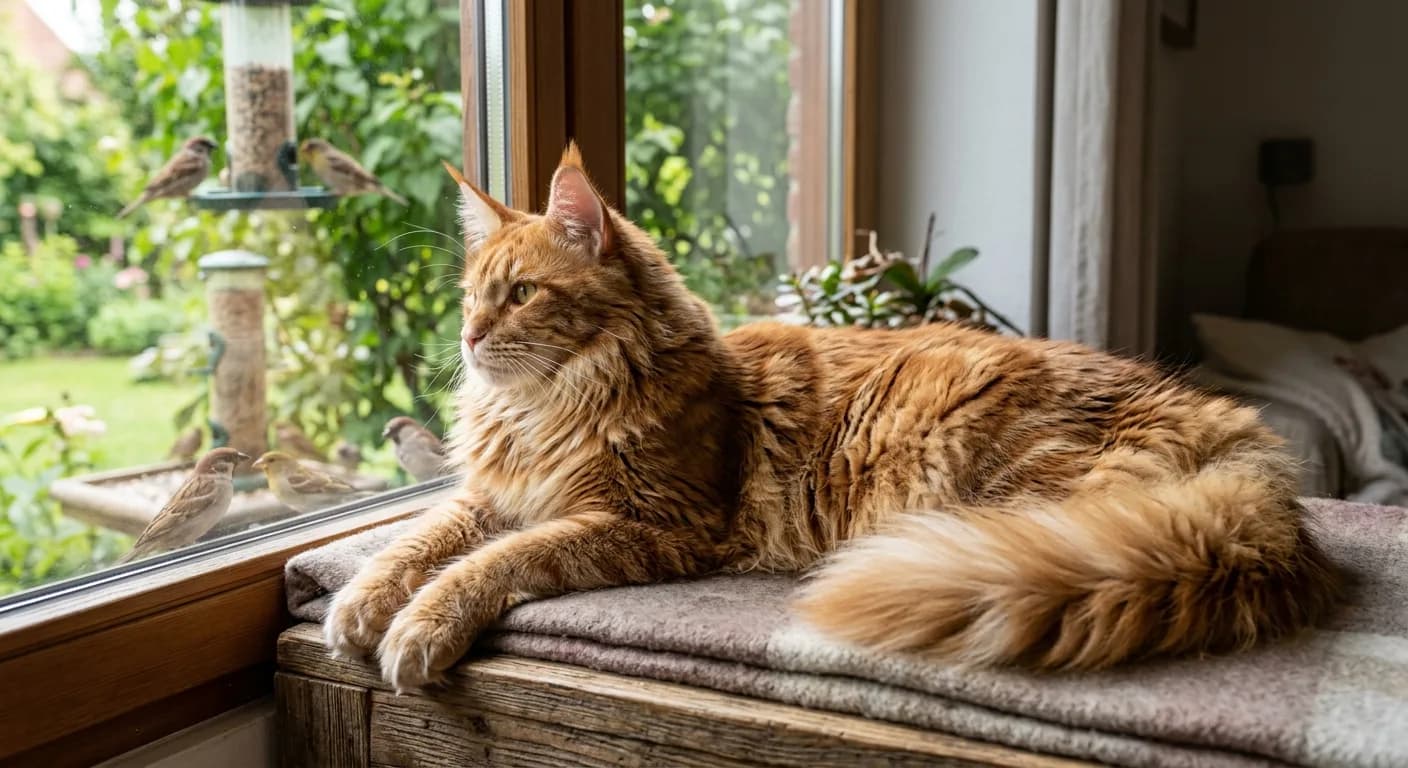
The orange Maine Coon is a visually commanding, intellectually engaged, and deeply people-oriented cat that will occupy a substantial physical and emotional space in your home. The flame-colored coat requires consistent grooming commitment. The breed's size means higher food costs, larger litter boxes, sturdier furniture, and taller cat trees than most cats require; our Maine Coon cost guide breaks down the full lifetime budget.
In return, you get a cat that communicates with you in chirps and trills, follows you from room to room, learns its name within days, tolerates handling with patience, and grows into a genuinely impressive animal over its five-year development arc.
Color does not determine temperament. But if you want a Maine Coon, and the orange coat calls to you, the genetics and the personality will deliver on the visual promise. See the full Maine Coon cat breed guide for health screening protocols, kitten socialization tips, and the complete color range recognized in breed standards.

Coreen Saito is a pet writer and longtime shelter volunteer with more than a decade in animal rescue. She covers cat behavior, breed care, and the small, ordinary science of sharing a life with companion animals, with a particular focus on honest takes about the products and decisions that actually matter. At home in Arizona, she's outranked by Mac (a dog with the loudest opinion in the house), Rebel (a cat who governs by quiet authority), and Meri (an orange tabby who runs the late shift and the laundry basket). She writes about all three, plus the rescues that keep coming through her life, at LifeWithMinty.com.
Sign up for expert-backed reviews and safety alerts all in one place.