White Maine Coon: Rarity, Blue Eyes, and the Deafness Gene Explained
White Maine Coons carry a dominant W gene that masks their true color. Learn the genetics, blue-eye deafness risk, real breeder prices ($1,000-2,500 pet quality), grooming demands, and how to tell them from Turkish Angoras and Norwegian Forest Cats.
Petful is reader supported. As an affiliate of platforms like Amazon and Chewy, we may earn a commission when you buy through links on this page. There is no extra cost to you.
The white maine coon is one of the most searched color variants of the breed, and for good reason: the CFA recognizes solid white as a separate Maine Coon color class, and those ice-blue eyes carry a documented link to congenital deafness that every prospective owner deserves to understand before falling in love with a photo. What looks like a rare snow-white giant is, in genetic terms, a cat wearing a mask. A dominant "white" gene (W) is suppressing whatever underlying color and pattern that cat truly carries, and that same gene is tied to cochlear degeneration in a portion of cats who inherit it. This article covers the genetics, the eye colors, the deafness science, the realistic price, and everything you need to care for this striking animal.
- 1Solid white Maine Coons carry the dominant W (epistatic white) gene, which masks any underlying color. It is NOT albinism.
- 2Blue-eyed and odd-eyed white Maine Coons have a statistically higher risk of congenital deafness (unilateral or bilateral) due to W-gene cochlear degeneration.
- 3Gold, green, and copper eyes are also possible and carry a much lower deafness risk.
- 4White is an accepted CFA/TICA color class, not a "rare" variant commanding an official price premium.
- 5Coat care is intensive: white fur shows every speck of debris and requires regular brushing to prevent mats.

Sign up for expert-backed reviews and safety alerts all in one place.
What Is a White Maine Coon?
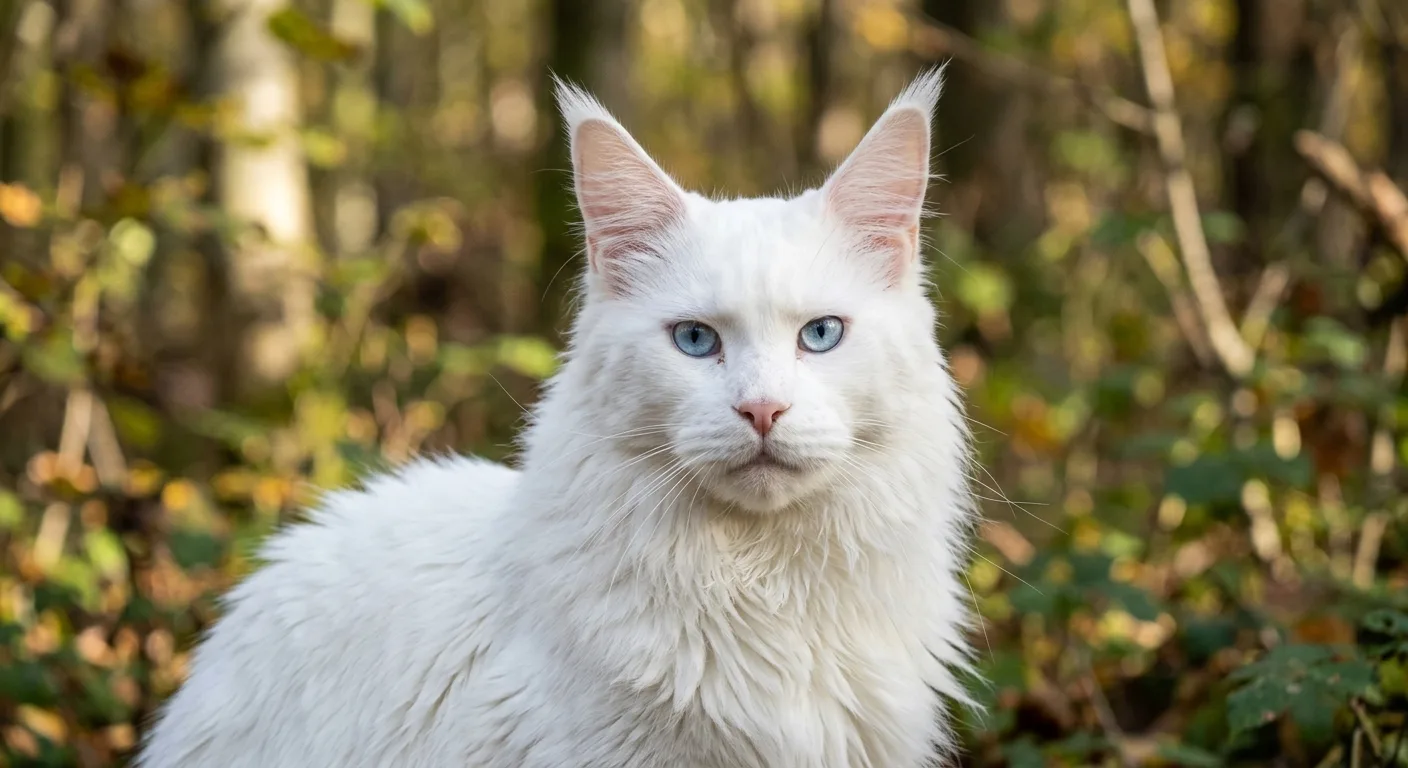
A white Maine Coon is a Maine Coon cat whose entire coat presents as solid white. The CFA and TICA both recognize solid white as a distinct color class within the breed standard, requiring a pure, glistening white coat with no other color anywhere. Eye color may be blue, gold, green, or one of each (odd-eyed). The nose leather and paw pads are pink.
Structurally, a white Maine Coon is every inch the classic breed: a large, long, rectangular, muscular body; a lion-like neck ruff; large high-set ears with prominent lynx-tip tufts; tufted paws; a long heavily plumed tail; high cheekbones; and a distinctively squarish muzzle. The white coat simply makes all of that architecture visible against a single luminous background.
What a white Maine Coon is NOT: an albino cat. Albinism is caused by a completely different genetic pathway (the C locus) that eliminates melanin production entirely. Albino cats have pink or very pale blue eyes and pink skin visible through thin, colorless fur. A white Maine Coon's whiteness comes from the dominant W gene suppressing normal melanin expression. The underlying pigment genetics are still present in the cat's DNA; they are simply switched off at the surface.
How Rare Is a White Maine Coon?
White is not the most common Maine Coon color (tabbies dominate), but calling it "rare" is a marketing exaggeration that reputable breeders push back on. Solid white cats appear in the breed at a lower frequency than tabby or bicolor patterns, because two genes must align: first, the cat must carry or inherit the dominant W allele, and second, responsible breeders often avoid pairing two W-gene cats due to heightened deafness risk in offspring.
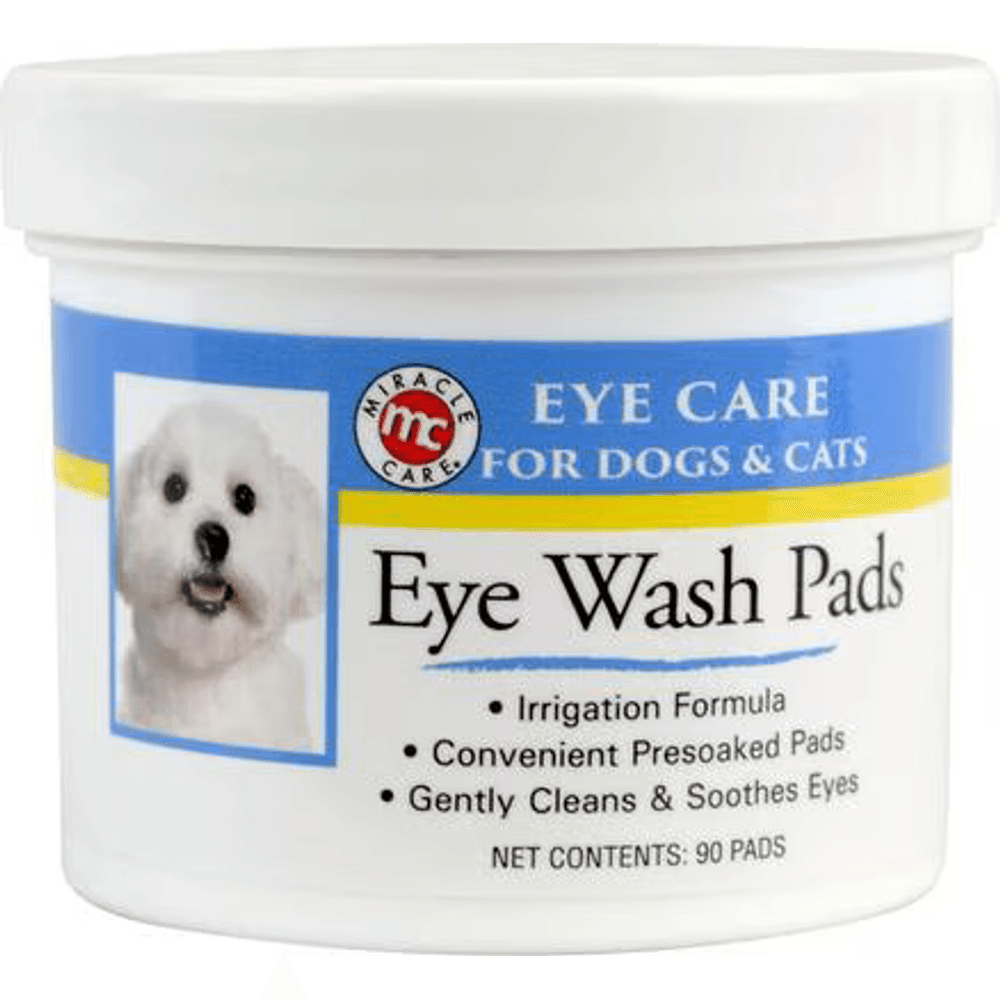
Presoaked sterile pads that gently wipe away everyday debris, discharge, and tear stains from around a dog's or cat's eyes as part of routine grooming. An easy way to keep the eye area clean and comfortable between baths.
Petful may earn a commission when you click through to Chewy, at no extra cost to you.
From a registry standpoint the CFA and TICA both accept solid white without restriction. Dedicated white Maine Coon breeding programs exist, meaning supply is available from ethical sources if you know where to look. The "rare" framing is most commonly deployed by cattery websites to justify inflated prices. As discussed in the price section below, the breed standard assigns no official color premium.
- Solid white Maine Coons are less frequently produced than tabbies or bicolors, but they are not rare in the way a chocolate or cinnamon would be (colors that are disqualifying in Maine Coons). A realistic wait with a reputable breeder is 6-18 months, similar to other specialty color requests.
The Genetics Behind the White Coat
Understanding why a Maine Coon is white requires a quick look at three separate genetic mechanisms. The confusion between them is one of the most common misconceptions in cat color genetics, and it matters because the mechanism determines everything about health risk.
Epistatic White (Dominant W Gene)
This is the mechanism at work in most white Maine Coons. A single copy of the dominant W allele at the KIT gene locus causes white masking of the entire coat. The cat still carries a complete underlying color genotype (it might be a smoke tabby, a solid black, a tortoiseshell) but the W gene prevents the pigment from expressing in the fur. The cat is, in the parlance of geneticists, a "masked" color.
The reason this matters clinically is that the W gene is also associated with cochlear degeneration (see the deafness section below). The same pathway that suppresses melanocyte migration into the skin and fur also, in some cats, impairs the development of melanocyte-derived cells in the inner ear that are required for normal hearing.
White Spotting (Piebald S Gene)
A separate white spotting gene (S) produces cats with white patches over a colored base. This is not the same as solid white. A bicolor Maine Coon (white plus another color) is a W-absent, S-present cat. White spotting is not associated with the same degree of deafness risk as the W gene.
Albinism (C Locus)
Albinism disables the enzyme tyrosinase, eliminating melanin everywhere. True albino cats have pink or extremely pale blue irises and visible pink skin. Albinism is extremely rare in domestic cats and has not been reliably documented in the Maine Coon breed. A white Maine Coon is not albino.

Never Scoop Again® with the Whisker Litter-Robot, the smart self-cleaning automatic litter box. Monitor visits and track weights for better overall care in the Whisker® app. Multi-cat friendly.
Petful may earn a commission when you click through to Whisker, at no extra cost to you.
- True albino cats have pink eyes due to visible blood vessels behind a colorless iris. A white Maine Coon with blue or gold eyes is not albino. The distinction is not cosmetic: confusing the two can lead to inappropriate health assumptions and bad breeding decisions.
| Mechanism | Gene | Coat Outcome | Deafness Link | Eye Color |
|---|---|---|---|---|
| Epistatic White | Dominant W (KIT locus) | Entire coat white; underlying color masked | Yes, via cochlear degeneration | Blue, gold, green, or odd-eyed |
| White Spotting | S (KITLG region) | White patches over colored base | Low (linked to white area near ear) | Standard for coat color |
| Albinism | C locus recessive | Full white, pink/red eyes | None documented in Maine Coons | Pink or very pale blue |
| Dilution (unrelated) | d locus recessive | Lightens base color (not true white) | None | Standard for coat color |
Eye Colors: Blue, Gold, Green, and Odd-Eyed
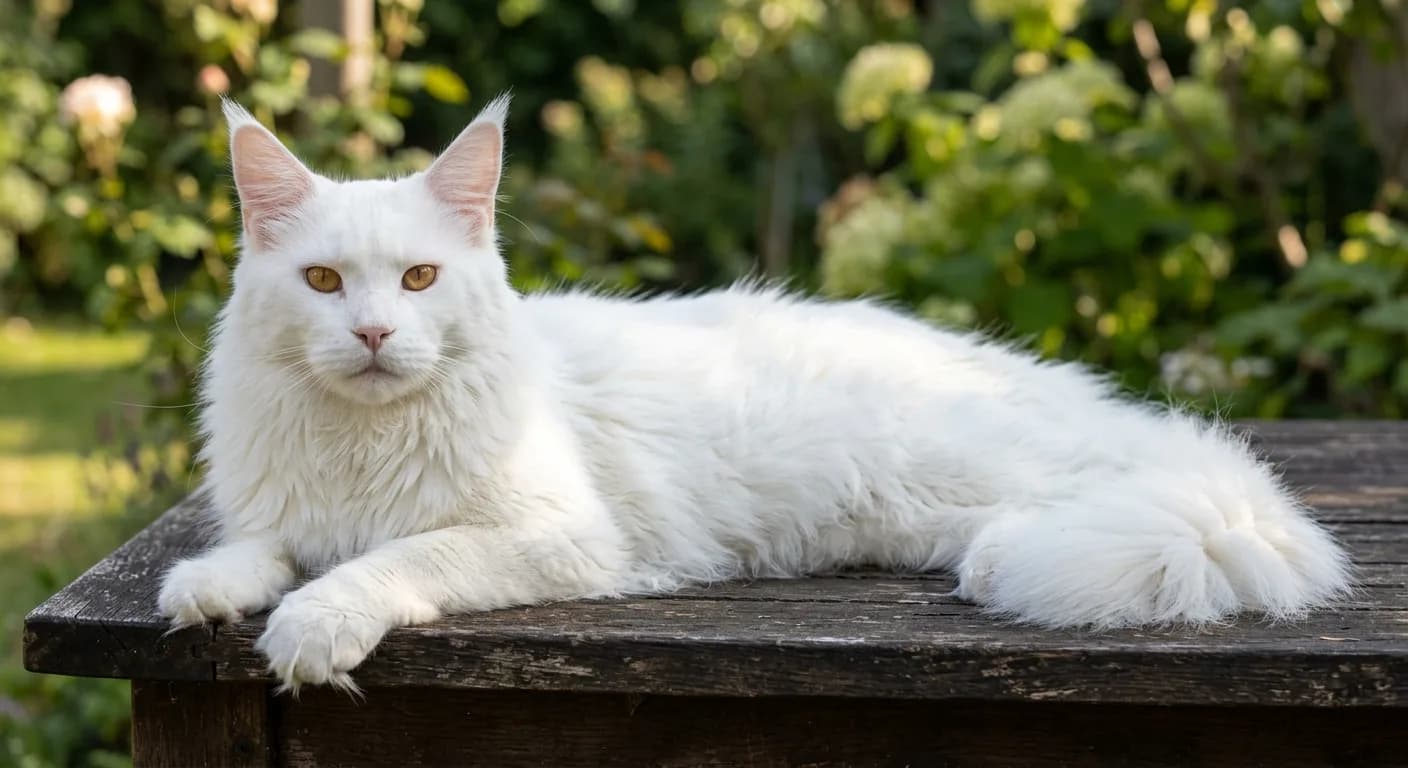
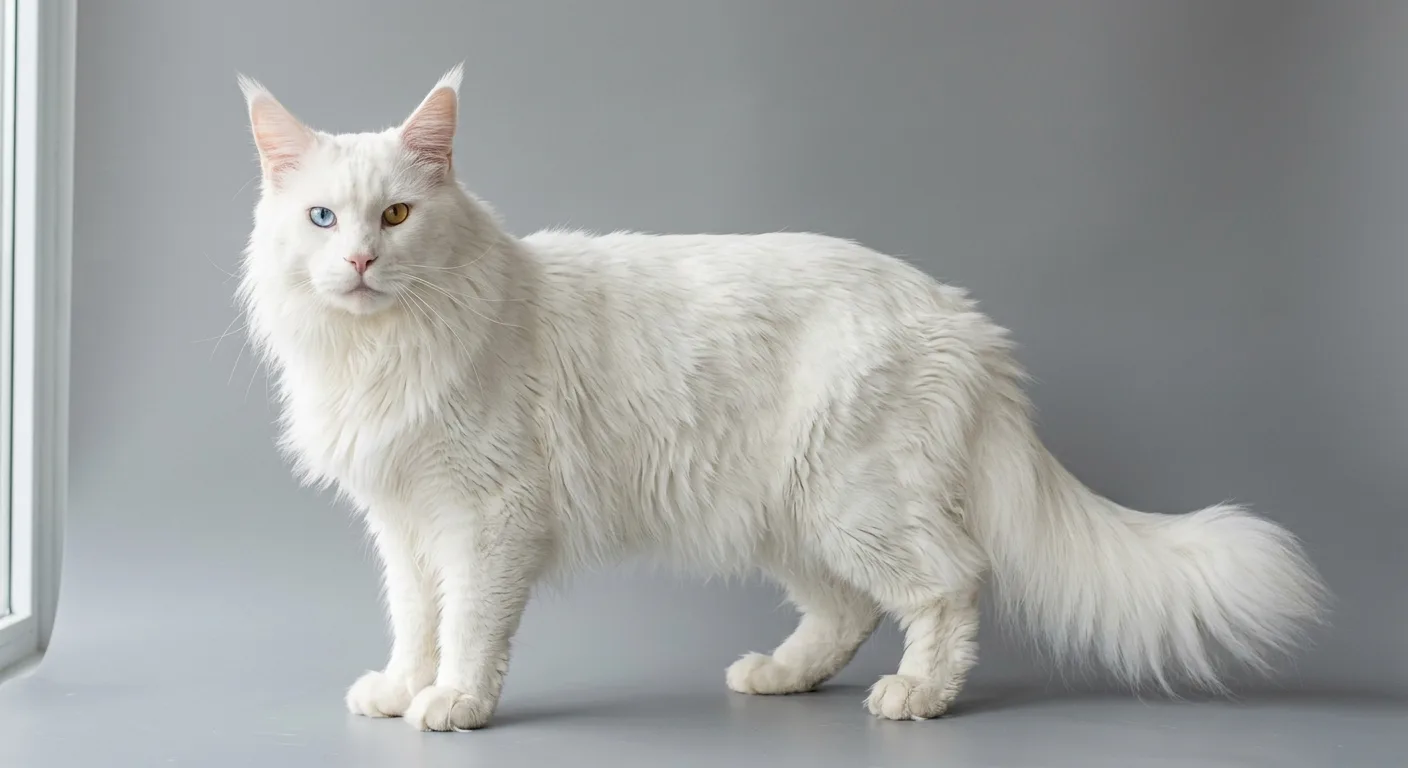
One of the most visually striking aspects of white Maine Coons is the range of eye colors they can carry. The CFA breed standard permits blue, gold, or odd-eyed (one of each) in solid white Maine Coons. Green is also observed and accepted in practice, though gold and copper are the default non-blue options in the breed.
Blue Eyes
Blue eyes in a white cat are the most eye-catching and the most genetically significant. The blue color in this context is not the "Siamese blue" (which is temperature-sensitive, a different mechanism) but rather a structural color caused by light scattering in a largely unpigmented iris. In W-gene white cats, blue eyes correlate with an increased likelihood that the W gene has disrupted melanocyte migration to both the cochlea and the iris on the same side. Studies published in the veterinary literature have repeatedly confirmed that blue-eyed white cats across multiple breeds have higher rates of congenital deafness than odd-eyed or non-blue-eyed white cats.
Gold and Copper Eyes
Gold and copper-eyed white Maine Coons still carry the W gene, but the presence of pigment in the iris suggests that melanocyte migration succeeded in the eye on that side. This does not guarantee hearing on the corresponding side, but population-level data consistently shows lower deafness prevalence in gold/copper-eyed white cats compared to blue-eyed white cats.
Odd-Eyed (Heterochromia)
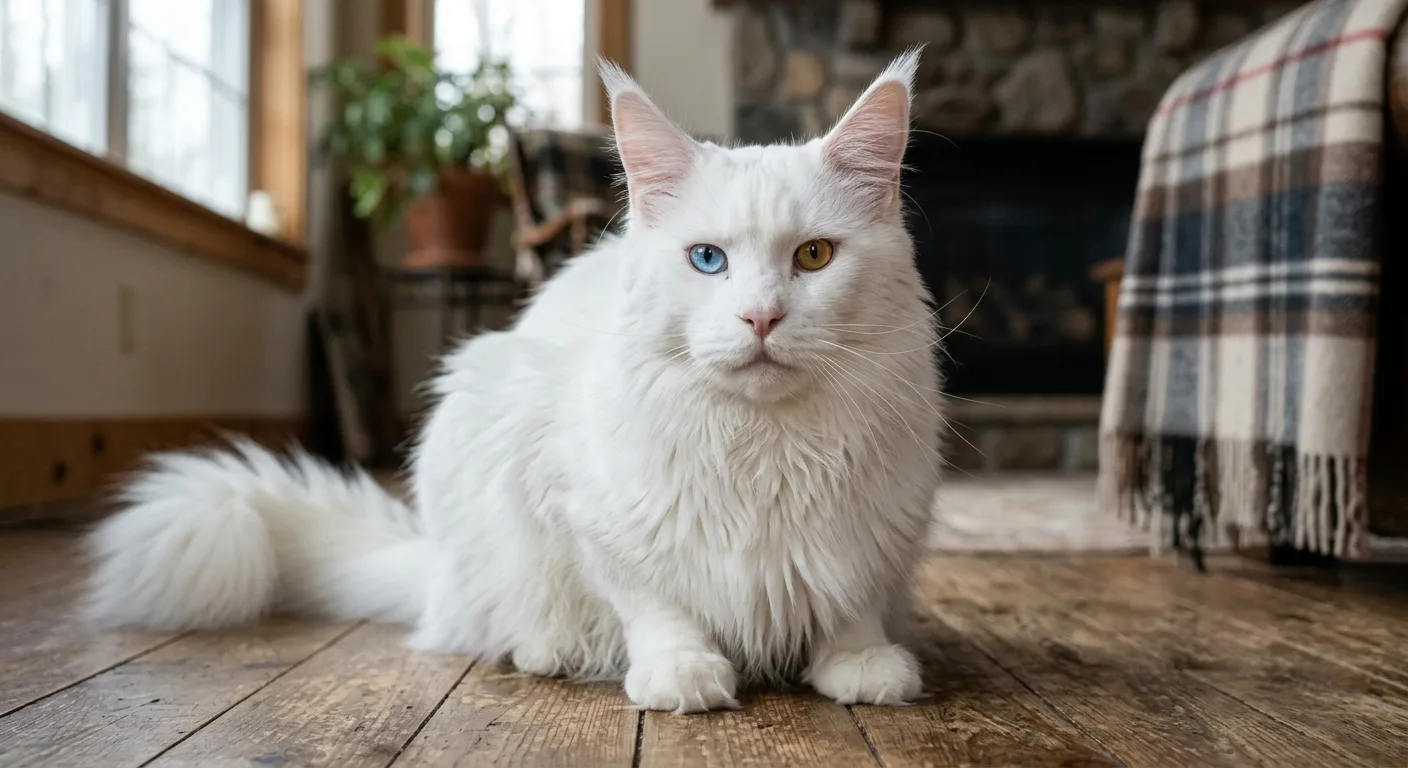
An odd-eyed white Maine Coon has one blue eye and one gold or green eye. This is caused by unequal melanocyte presence in the two irises. Veterinary audiologist research (particularly the landmark work of Dr. George Strain at Louisiana State University) found that odd-eyed white cats tend to be deaf on the side of the blue eye more often than the gold-eyed side. Bilateral deafness is less common in odd-eyed cats than in blue-eyed cats.
White Maine Coons and Deafness: What the Research Shows
This is the topic cattery blogs frequently either bury or sensationalize. Here is a calm, research-grounded summary.
The Science
The most comprehensive dataset on congenital deafness in white cats was compiled by Dr. George M. Strain (Board Certified Veterinary Neurologist, Louisiana State University School of Veterinary Medicine), whose research and review papers published in The Veterinary Journal and related outlets consistently document the following pattern:
- Approximately 17-22% of white cats with non-blue eyes are deaf (unilateral or bilateral) across studies.
- Approximately 40% of odd-eyed white cats are deaf in at least one ear.
- Approximately 65-85% of blue-eyed white cats show some degree of deafness in studies using the Brainstem Auditory Evoked Response (BAER) test.
These figures span all white cat breeds, not Maine Coons alone, but the W-gene mechanism is the same. The deafness is congenital, present from birth, and caused by degeneration of the stria vascularis in the cochlea (the same structure that melanocyte-derived cells populate during embryonic development). The deafness is permanent and sensorineural (not treatable with medication or correctable surgically).
What This Means for Maine Coon Buyers
A reputable Maine Coon breeder who produces white kittens should BAER-test all white kittens before placement. The BAER test is the only reliable way to determine hearing status in each ear independently. A kitten can pass a simple hand-clap test and still be unilaterally deaf because the hearing ear compensates.
Unilateral deafness (one ear only) is the most common outcome. Cats with unilateral deafness live full, healthy, normal lives with no special accommodations. They cannot localize sound as precisely as a bilaterally hearing cat, which means indoor-only living is strongly recommended to reduce injury risk from approaching vehicles or predators they cannot detect directionally.
Bilaterally deaf cats require more deliberate owner management: vibration-based communication cues, visual signals, tactile waking (gentle touch rather than calling), and careful door discipline to prevent outdoor access.
- Before purchasing a white Maine Coon kitten, ask the breeder for individual BAER (Brainstem Auditory Evoked Response) test results for both ears. A responsible breeder tests every white kitten in a litter. Refusing or being unable to provide this documentation is a significant red flag.
Does Deafness Change the Temperament?
No. Deaf and hearing Maine Coons share the same breed temperament. Some owners of deaf Maine Coons report that their cats compensate with heightened visual attention and tactile sensitivity, making them especially responsive to owners who learn their cat's preferred communication style.
White Maine Coon Temperament and Personality
Coat color does not alter temperament in cats, and white Maine Coons are no exception. They carry the full Maine Coon personality profile that has made the breed one of America's most popular: sociable, playful, moderately vocal (trilling and chirping rather than loud yowling), intelligent enough to learn tricks and play fetch, and affectionate without being clingy.
Maine Coons are often described as "dog-like" in their tendency to follow owners from room to room, greet visitors at the door, and engage in sustained interactive play well into adulthood. They are generally excellent with children and with other pets, including dogs, when introduced properly. The CFA breed standard describes the Maine Coon as having a "gentle giant" personality to match its outsized body.
One practical note for white Maine Coon owners: if your cat has any degree of hearing impairment, the sociable Maine Coon personality does not disappear. The adaptation is in your communication toolkit, not in the cat's desire to connect. Many owners find that a partially hearing or deaf Maine Coon becomes exceptionally tuned in to visual and tactile cues precisely because that is the available channel.
- Maine Coons were bred as working farm cats in 19th-century New England and retained a highly social, interactive temperament. Multiple TICA and CFA breeder profiles describe the breed as enjoying water, playing fetch, and learning their name, all of which hold true in white Maine Coons.
Size and Physical Characteristics
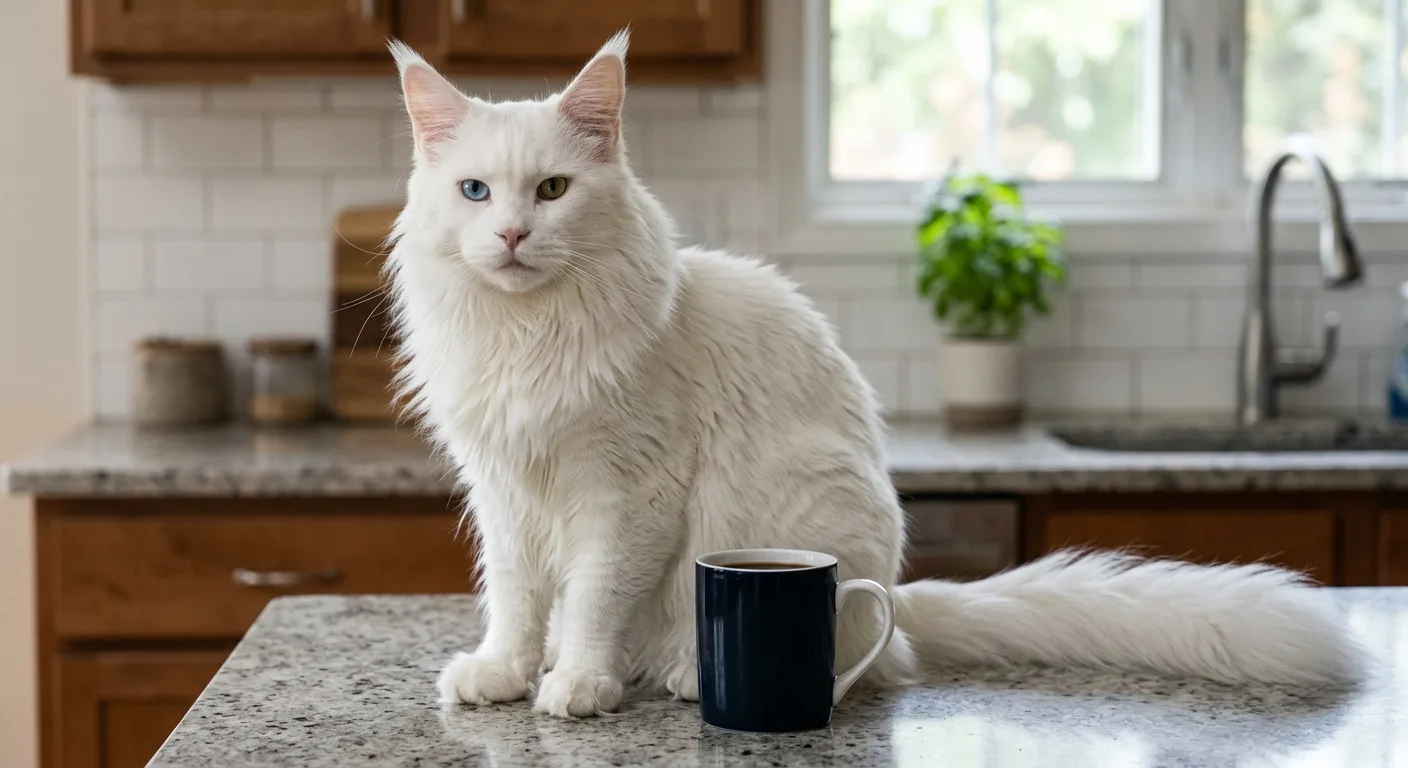
The white coat can make a Maine Coon look even larger than it is because the long, pale fur has no strong visual contrast to break up the silhouette. The actual size is breed-standard:

63-inch multi-level cat tree with scratch posts, hammock, plush perches, and dangling toys. Vertical territory is non-negotiable for high-energy climbing breeds like the Bengal.
Petful may earn a commission when you click through to Chewy, at no extra cost to you.
- Males: 15-25 lb, occasionally heavier in large lines
- Females: 8-14 lb
- Length (nose to tail base): up to 38-40 inches in some males
- Height: 10-16 inches at shoulder
- Full maturity: not reached until 3-5 years of age
The coat itself is a double coat: a shorter, dense undercoat and a longer, silky, water-resistant topcoat. On a white Maine Coon, the fur luminosity in natural light can appear almost silver or cream-tinted, particularly around the thick neck ruff and the heavily plumed tail. The ears carry the lynx-tip tufts that are a hallmark of the breed, and the tufted paws are large enough that owners frequently compare them to snowshoes.
For owners comparing breeds, the Norwegian Forest Cat is the Maine Coon's most frequent look-alike and also comes in white. The key distinctions are the Maine Coon's squarish muzzle (versus the Norwegian Forest Cat's more triangular face), the Maine Coon's slightly heavier bone structure, and the fact that the Norwegian Forest Cat's coat is slightly coarser and more weatherproof in texture. The Siberian is another large semi-longhaired breed sometimes mistaken for a Maine Coon, but the Siberian is a compact, barrel-chested breed rather than the long-rectangular Maine Coon body type.
White Maine Coon Kittens
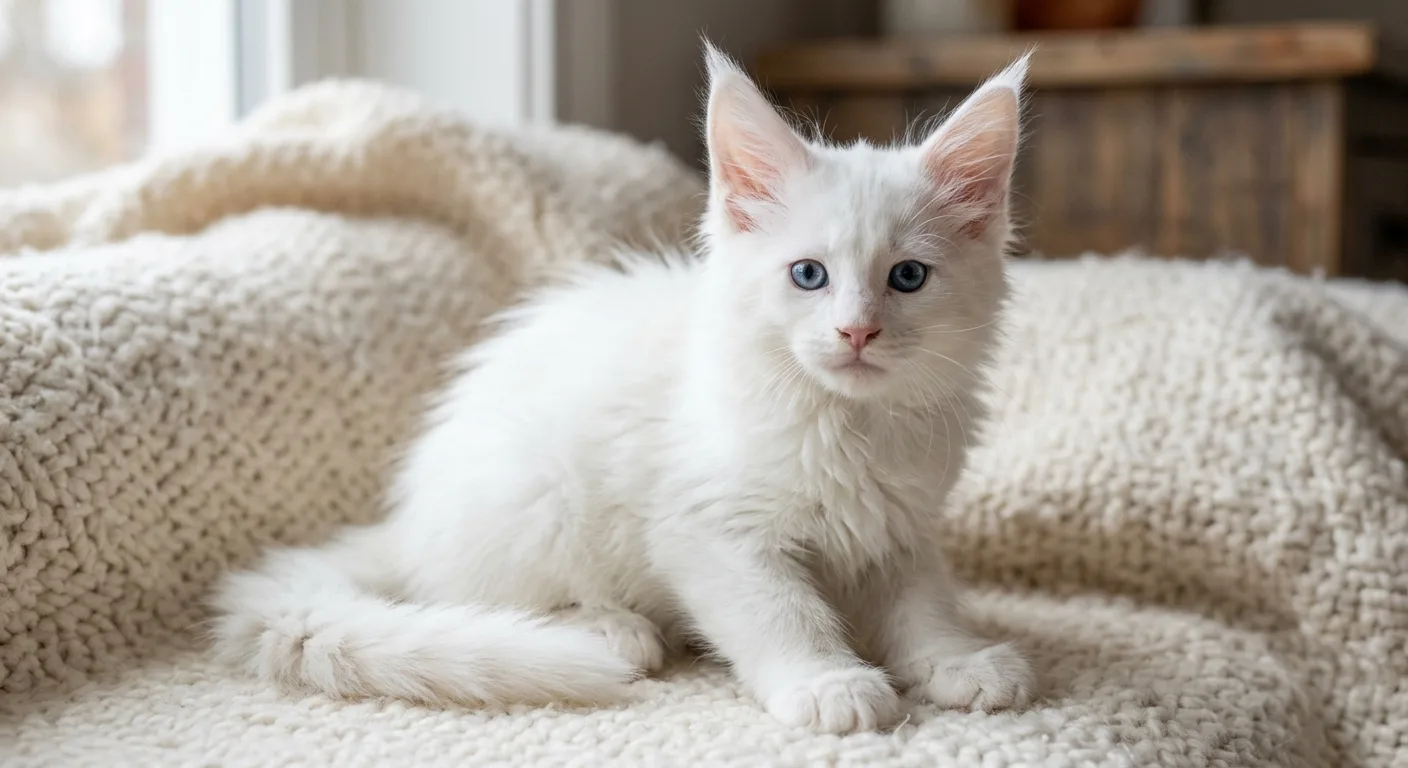
White Maine Coon kittens are born fully white (or nearly so) when the W gene is present, which makes early visual identification fairly straightforward. Some white kittens are born with a faint colored "cap" of fur on the top of the head; this often fades to pure white within the first few weeks to months and is not an indication of future pattern. Breeders sometimes use this temporary cap to infer the underlying masked color.
Kitten development milestones are the same as for all Maine Coons: eyes typically open at 10-14 days, socialization is critical from weeks 3-9, and Maine Coon kittens tend to be notably more playful and active than many other breeds through their first year. Because the breed matures slowly (full adult size at 3-5 years), a white Maine Coon "kitten" may still look like a kitten at 12-18 months despite approaching adult weight.
BAER testing is typically performed at 5-6 weeks of age in kittens, before placement. If you are purchasing a white Maine Coon kitten and the litter has not yet reached testing age, request that the breeder holds placement until results are available, or confirm in writing that testing will occur before the kitten ships.
Care, Grooming, and Coat Maintenance
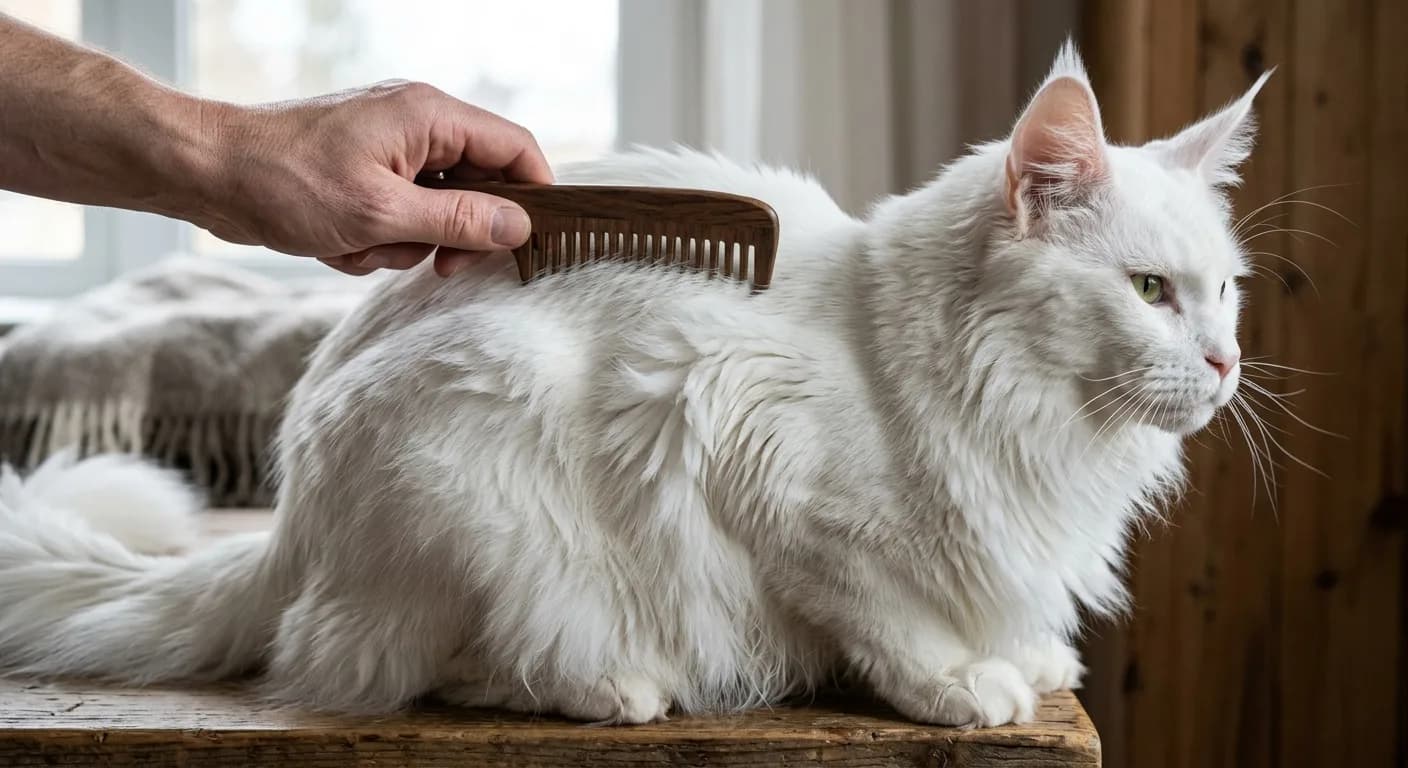
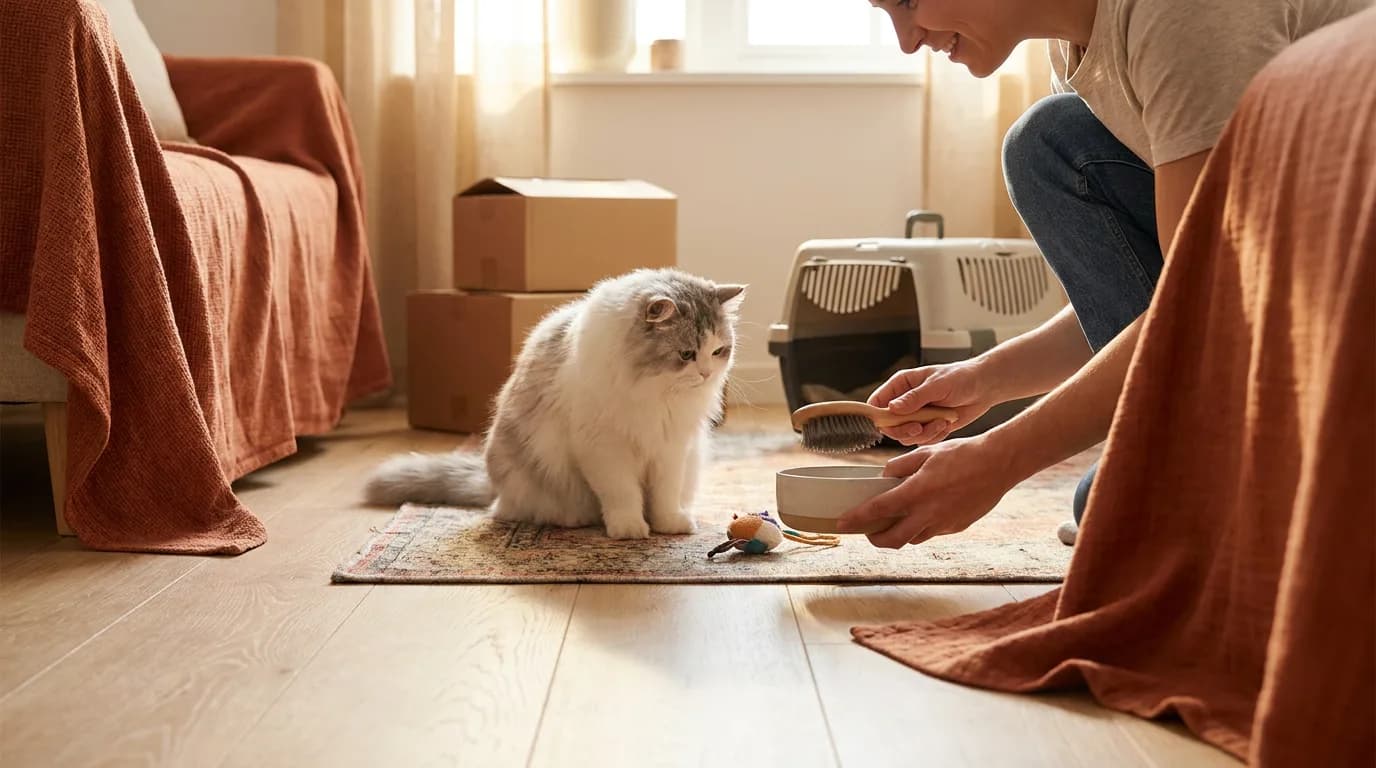
The white coat is the most demanding aspect of Maine Coon ownership in this color. Dirt, litter dust, food residue, and environmental debris are all highly visible on pure white fur. Beyond the aesthetic consideration, white Maine Coons are prone to the same matting and tangles as any long-coated Maine Coon, particularly in the undercoat at the armpits, behind the ears, and at the base of the tail.
Brushing Schedule
A minimum of three to four brushing sessions per week is required to prevent mat formation; daily brushing is ideal during seasonal shedding periods (spring and fall). The tools that work best for Maine Coon coats are:
- A wide-toothed metal comb (to work through the undercoat without breaking topcoat hairs)
- A slicker brush (for the topcoat and removing loose fur)
- A mat splitter or dematting comb (for established mats, always working from the tip inward toward the skin, never pulling from the skin outward)
Never bathe a Maine Coon with a mat: water tightens mats significantly and makes removal far more difficult. Address any mats before bathing.
- Before each brushing session, run a fine-toothed comb through the armpit, groin, and base-of-tail areas first. These are the highest-mat-risk zones. If the comb passes cleanly, proceed with the full brush. If it catches, work the snag out gently with fingers and a wide-toothed comb before using the slicker brush.
Bathing
Maine Coons are unusual among domestic cats in their relatively high tolerance for water, likely a survival adaptation from their New England farm-cat origins. Most Maine Coon owners can establish a monthly or every-six-weeks bathing routine using a gentle, cat-formulated shampoo. For white Maine Coons specifically, a whitening or brightening shampoo formulated for cats (not human or dog products) can help counteract the yellowing that some white coats develop, particularly around the chin and paws where the cat self-grooms most intensively.
Eye and Ear Care
White cats with pink-pigmented skin around the eyes sometimes show more visible tear staining than darker-coated cats. Daily or every-other-day gentle cleaning of the inner corner of the eye with a damp cotton pad prevents staining from accumulating. Ear care is standard for the breed: check ears weekly for debris or dark wax and clean gently as needed.

108-oz stainless steel pet fountain with quiet pump and water-level window. Bengals are notoriously water-obsessed; a flowing fountain encourages hydration and pulls them away from sinks and toilets.
Petful may earn a commission when you click through to Chewy, at no extra cost to you.
Health Considerations
White Maine Coons share all the health considerations of the breed at large, with the addition of the deafness risk tied to the W gene.
Breed-Standard Health Screenings
Responsible Maine Coon breeders screen for:
- Hypertrophic Cardiomyopathy (HCM): The most significant health concern in the breed. The MyBPC3 mutation associated with Maine Coon HCM is DNA-testable. Breeders should provide documentation of DNA-negative or cardiac-echo-clear status in breeding cats. Echocardiographic screening (annual or every two years) is recommended for breeding cats even in DNA-negative lines because additional HCM mutations exist beyond MyBPC3.
- Hip Dysplasia: More common in Maine Coons than in many other breeds due to their size. Reputable breeders may submit breeding cats for OFA (Orthopedic Foundation for Animals) hip evaluation.
- Spinal Muscular Atrophy (SMA): A DNA-testable recessive mutation that causes progressive muscle weakness. Breeders should DNA-test; carriers can still be bred to non-carriers safely.
- Polycystic Kidney Disease (PKD): DNA-testable; less common in Maine Coons than in Persians, but documented.
Additional Consideration: BAER Testing
As covered above, every white kitten from a white-coated parent should be BAER-tested. This is specific to white Maine Coons and does not apply to other color variants.
- HCM can develop in a DNA-negative Maine Coon because the tested MyBPC3 mutation is not the only mutation that causes the disease. A "DNA clear" certificate alone is not a cardiac clearance. Ask specifically whether the breeding cats have had recent echocardiograms (ideally within the past 1-2 years) from a board-certified cardiologist.
For a full picture of the breed's health profile, the Maine Coon breed guide at Petful covers each health condition in depth alongside care, history, and adoption considerations.
How Much Does a White Maine Coon Cost?
The white coat, despite its dramatic appearance and the "rarity" marketing that surrounds it, does not carry an official price premium in the Maine Coon breed. The CFA and TICA breed standards assign no color hierarchy. White is not more or less show-worthy than a classic tabby of equal conformation. Prices for white Maine Coon kittens from reputable breeders fall within the standard breed price range:
- Pet-quality kitten from a registered cattery: $1,000-2,500
- Show or breeding-quality kitten: $2,500-4,000
- Top show lines with exceptional pedigrees: $4,000-6,500+
- Shelter or rescue adoption: $100-400 (white Maine Coons appear in rescue occasionally, most often as adult cats)
- If a breeder is charging $5,000+ for a pet-quality white kitten specifically because of the coat color, that is a marketing tactic not supported by any registry standard. It may also signal that the breeder is prioritizing white-to-white pairings to maximize white kitten output, which increases the proportion of kittens at elevated deafness risk. Reputable breeders price white kittens on conformation and pedigree quality, the same criteria applied to every other color.
Price comparisons across large breeds are useful context: the Maine Coon breed guide and the Ragdoll breed profile both document price ranges for large, heavily-pedigreed breeds, confirming that four-figure asking prices are the norm at reputable catteries, not a white-coat surcharge.
White Maine Coon vs. Look-Alike Breeds
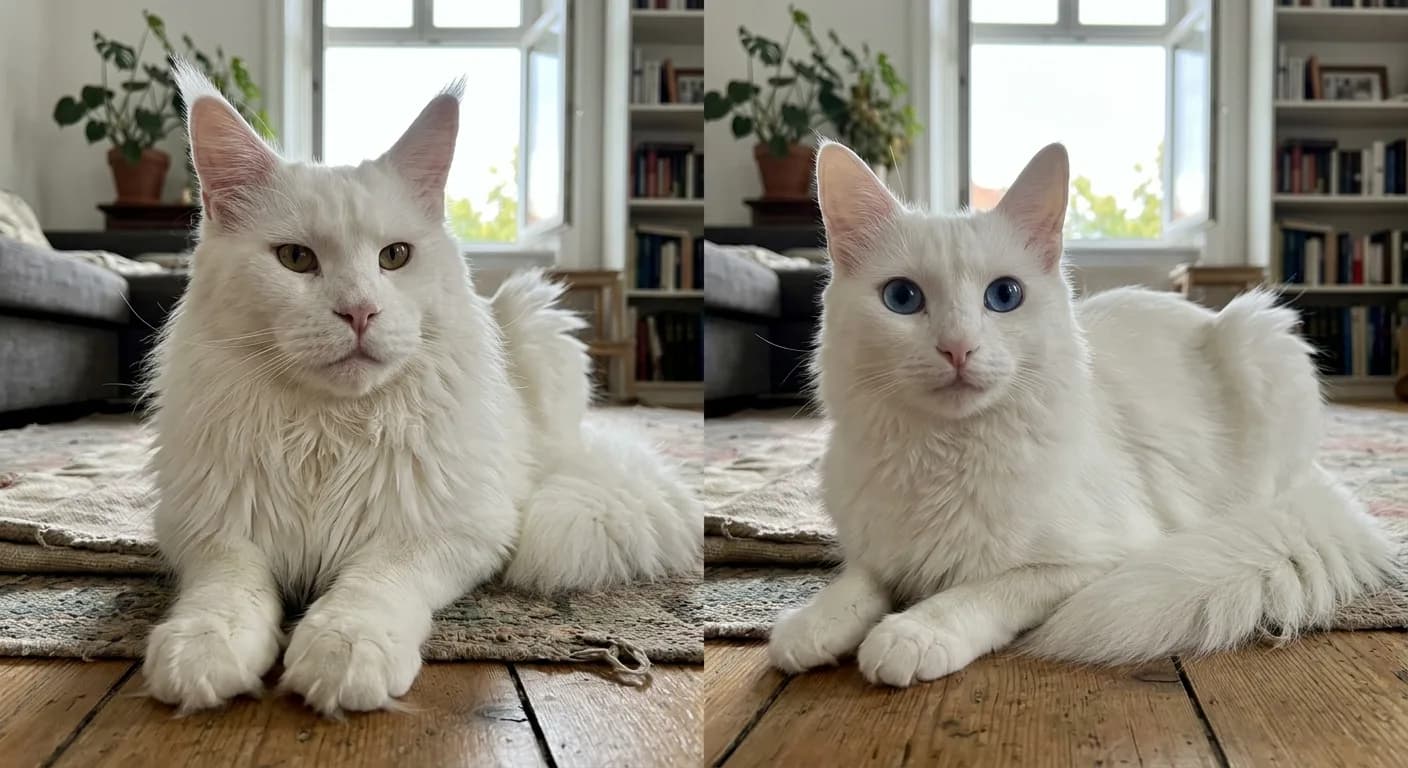
White coats appear across several large semi-longhaired breeds, and photographs can make identification difficult even for experienced cat people. Two breeds are most commonly mistaken for the white Maine Coon.
Norwegian Forest Cat
The Norwegian Forest Cat also produces white-coated individuals. The face shape is the clearest distinguishing feature: Norwegian Forest Cats have a triangular face with a straight nose profile, whereas Maine Coons have a squarish muzzle with a gentle concave curve visible in profile. Norwegian Forest Cats also tend to have a slightly more angular body shape compared to the Maine Coon's broad, heavy-boned rectangle. Ear tufts are present in both, though Maine Coon lynx tips tend to be more pronounced and grow from the ear tip specifically rather than from inside the ear only. See the Norwegian Forest Cat profile for a full visual breakdown.
Turkish Angora
The Turkish Angora is frequently pictured in pure white and was historically so associated with white coats that "white Angora" became nearly synonymous with "white cat" in Victorian-era cat fancy literature. However, Angoras are a much finer-boned, wedge-headed breed with a silky single coat (no dense undercoat) and a considerably lighter body weight (6-12 lb for females, 7-14 lb for males). Placed beside a white Maine Coon, the size difference is immediately apparent.
Siberian
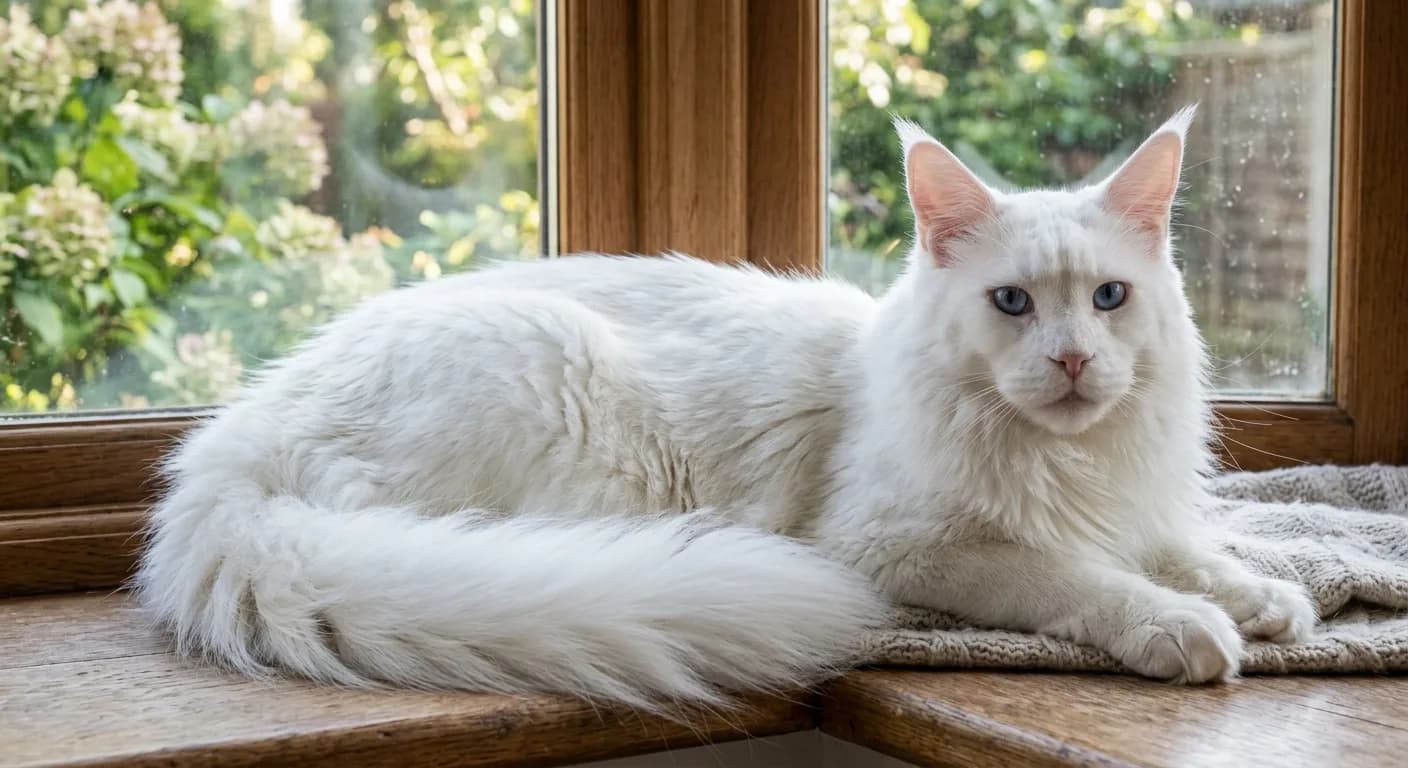
The Siberian in white or near-white colorings is occasionally mistaken for a Maine Coon. The Siberian is barrel-chested and compact rather than long and rectangular, with a rounder face and a coat that is often described as having a more matte texture due to its triple-layer structure. The Siberian breed guide outlines the physical distinctions in detail.
The Persian cat colors guide is a useful reference for understanding how white is handled across registries in another heavily-studied breed, particularly the albinism vs. W-gene distinction, which is the same across all breeds.
Frequently Asked Questions
White Maine Coons are less common than tabbies or bicolors but are not genuinely rare. The CFA and TICA both accept white as a standard color class, and dedicated breeding programs produce them. The "rare" label is marketing, not a registry designation.
White Maine Coons can have blue, gold, green, or odd-eyed (one blue, one gold or green) eyes. Blue and odd-eyed are most visually striking but also most associated with deafness risk. Gold and green eyes indicate more pigment in the iris and typically lower deafness prevalence.
Some are, not all. Blue-eyed white Maine Coons have the highest risk: studies by Dr. George Strain at LSU have found deafness in approximately 65-85% of blue-eyed white cats tested by BAER in various populations. Odd-eyed cats show deafness on the blue-eyed side more often than the gold side. Gold or green-eyed white Maine Coons still carry the W gene but show lower deafness rates. Ask any breeder for individual BAER test results.
$1,000-2,500 for a pet-quality kitten from a reputable registered cattery, $2,500-4,000 for show or breeding quality, and up to $4,000-6,500+ for top show lines. Coat color adds no official premium; price should reflect pedigree and conformation, not coat color. Rescue/shelter adoption is $100-400.
The Norwegian Forest Cat is the most common mistaken identity, particularly in white. Both are large, tufted, and semi-longhaired, but Maine Coons have a squarish muzzle and heavier bone structure versus the Norwegian Forest Cat's triangular face and finer frame. The Turkish Angora is also frequently confused with a white Maine Coon in photographs, though it is much lighter and finer-boned.
White Maine Coons share the breed lifespan of 12-15 years, with 13-14 years being a typical outcome and well-cared-for cats sometimes reaching the high teens. Coat color has no documented effect on longevity.
Males typically weigh 15-25 lb and females 8-14 lb, consistent with the breed standard. Full adult size is not reached until 3-5 years of age.
All Maine Coon health concerns apply: hypertrophic cardiomyopathy (HCM, the primary concern), hip dysplasia, spinal muscular atrophy (SMA), and polycystic kidney disease (PKD). White Maine Coons additionally face congenital deafness risk linked to the W gene, most prevalent in blue-eyed and odd-eyed cats.
Identical to the breed standard: sociable, playful, intelligent, moderately vocal (trilling and chirping), affectionate without being clingy, and generally tolerant of children and other pets. Coat color does not alter Maine Coon temperament.
They carry a masked color. The dominant W gene at the KIT locus suppresses expression of the underlying coat color and pattern in the fur. The cat is genetically, for example, a black smoke tabby but presents as pure white because W is epistatic (overrides all other color expression). This is distinct from albinism.
Brush three to four times per week minimum (daily during seasonal shedding), using a wide-toothed metal comb followed by a slicker brush. Check armpits, groin, and tail base first for mats. Bathe every four to six weeks with a cat-formulated whitening shampoo to prevent yellowing around the chin and paws. Address mats before bathing, not after.
Yes. Maine Coons are a heavy-shedding breed year-round, with peak shedding in spring and fall. The white coat makes shed fur extremely visible on dark furniture and clothing. Regular brushing and a diet high in omega-3 fatty acids support coat health and reduce loose fur volume.
- Many white Maine Coons are genetically tabbies underneath. The W gene masks the pattern completely, so a cat that looks pure white may carry a hidden tabby pattern (agouti, mackerel, or classic) at the genetic level.
A white Maine Coon is a real investment, so a free MyPetID profile is worth setting up early to keep your cat's microchip number, vaccination records, and proof of ownership in one place, with a QR tag to help a lost cat get home fast.
Set up a free MyPetID profileMore Maine Coon reading: the full Maine Coon colors guide and the black Maine Coon.

Coreen Saito is a pet writer and longtime shelter volunteer with more than a decade in animal rescue. She covers cat behavior, breed care, and the small, ordinary science of sharing a life with companion animals, with a particular focus on honest takes about the products and decisions that actually matter. At home in Arizona, she's outranked by Mac (a dog with the loudest opinion in the house), Rebel (a cat who governs by quiet authority), and Meri (an orange tabby who runs the late shift and the laundry basket). She writes about all three, plus the rescues that keep coming through her life, at LifeWithMinty.com.
Sign up for expert-backed reviews and safety alerts all in one place.