Silver Lab: The Dilute Gene Controversy Explained
A silver lab is a diluted chocolate Labrador at the center of a genetics fight. Here is the truth about the dilute gene, the AKC stance, health risks, and why the price runs so high, without the rare-color hype.

Petful is reader supported. As an affiliate of platforms like Amazon and Chewy, we may earn a commission when you buy through links on this page. There is no extra cost to you.
The silver lab is one of the most argued-about dogs in America. To some owners it is a stunning, one-of-a-kind Labrador with a shimmering steel-gray coat. To the breed's own governing clubs it is a marketing story wrapped around a genetics question that has never been fully settled. If you are trying to decide whether one of these dogs belongs in your home, you deserve the real picture: where the color comes from, what the American Kennel Club (AKC) actually will and will not do, the health issue that is specific to dilute coats, and why the price tag runs so high.
This guide walks through the coat genetics in plain language, lays out the AKC and Labrador Retriever Club positions without spin, and separates the health facts from the internet noise. By the end you will know exactly what you are looking at when a breeder shows you a "rare silver Labrador puppy."

Petful may earn a commission when you click through to Chewy, at no extra cost to you.
- 1A silver lab is a chocolate Labrador whose coat is lightened by a dilution gene (the "d" allele)
- 2The AKC registers silvers, but only as "chocolate," and never as a separate color
- 3The dilute coat carries one real health risk, color dilution alopecia, that most breed critics point to

Sign up for expert-backed reviews and safety alerts all in one place.
What is a silver lab, exactly?

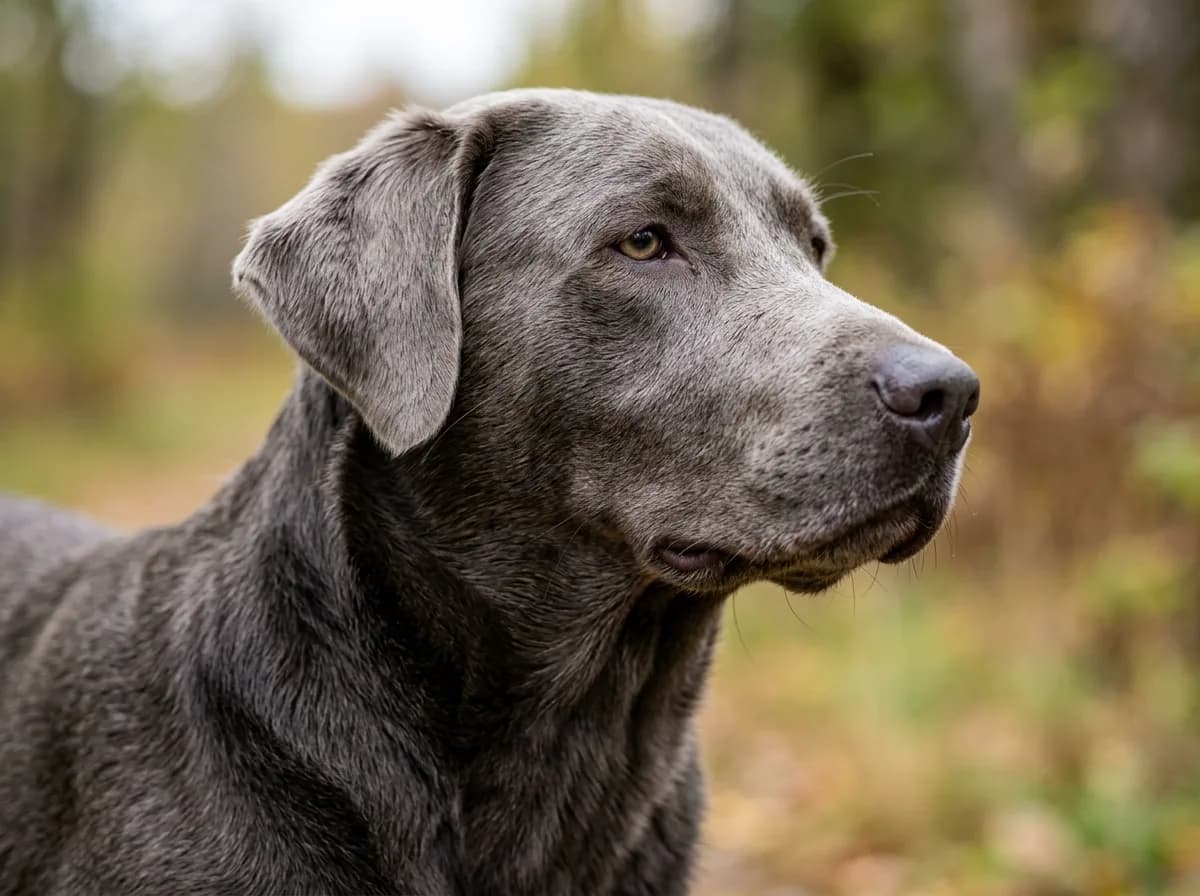
A silver lab is a Labrador Retriever whose coat has been genetically diluted from chocolate to a soft, pewter-gray shade. The dog is, at the pigment level, a chocolate Labrador. A separate gene acts on that chocolate pigment and lightens it, the way a dimmer switch lowers a light without changing the bulb.
Labradors come in three coat colors the breed standard recognizes: black, yellow, and chocolate. Silver is not a fourth color. It is chocolate that has been diluted. When you also apply that same dilution gene to a black Labrador you get a "charcoal" lab, and to a yellow Labrador you get a "champagne" lab. Silver, charcoal, and champagne are all the same underlying phenomenon: a standard Labrador color turned down by the dilution gene.
That single fact is the root of the entire controversy. Because the color is produced by a gene, the argument is really about one question: has that gene always existed quietly inside purebred Labradors, or did it enter the breed from somewhere else?
The coat genetics: how dilution actually works
Coat color in dogs is built from two pigments: eumelanin (black and brown tones) and phaeomelanin (red and yellow tones). A Labrador's base color is set at what geneticists call the B locus. Two chocolate ("b") copies give you a chocolate coat instead of black.
Dilution is controlled at a different spot, the D locus, by a gene called MLPH (melanophilin). The normal, full-color version is written "D." The dilute version is written "d." The dilution gene is recessive, which means a dog only shows a diluted coat when it inherits two copies, one from each parent (a "dd" dog). A dog with one "D" and one "d" looks completely normal but is a silent carrier that can pass dilution to its puppies.
So a silver lab is genetically a chocolate Labrador (bb at the B locus) that also happens to be dd at the D locus. The chocolate pigment is present; the dilution gene lightens it to gray.

Petful may earn a commission when you click through to Chewy, at no extra cost to you.
- A silver lab is a "bb dd" Labrador: chocolate at its base, then diluted. Charcoal labs are black-based and diluted, champagne labs are yellow-based and diluted. All three are the same dilution gene acting on a different starting color.
Here is where geneticists and breed clubs disagree. The dilution gene is common and well documented in other breeds such as the Weimaraner, where every dog is dd, which is why the entire breed is silver-gray. Critics of silver labs argue that the "d" allele was never native to the Labrador and must have been introduced by crossing a Labrador with a dilute breed at some point in the mid-twentieth century, when silver labs first appeared in the United States around the 1950s. Defenders argue the gene could have existed at very low frequency in the Labrador population all along and simply went unnoticed until modern DNA testing could reveal it. As of today there is no published peer-reviewed study that definitively proves either origin. That uncertainty is the honest center of the debate, and any breeder who tells you it is "settled science" in either direction is overstating the evidence.
The controversy: what the breed clubs actually say

This is where the silver lab stops being a genetics lesson and becomes a fight.
The Labrador Retriever Club position
The Labrador Retriever Club, Inc. (the AKC parent club for the breed) has taken a firm public stance. In a statement authored by its Genetics Committee chair, the club states that a silver Labrador "is not a purebred Labrador retriever" and argues that the public is being misled about the dogs' authenticity and desirability. The club's reasoning rests on the claim that the dilute "d" allele has never been documented in a verified purebred Labrador line, and that the breed standard recognizes only black, yellow, and chocolate. You can read the club's own statement on its website at thelabradorclub.com.
Petful may earn a commission when you click through to Chewy, at no extra cost to you.
The AKC position
The AKC, importantly, does not refuse to register these dogs. It registers a silver lab, but it records the dog's color as "chocolate," because silver is not a recognized color name in the breed standard. So a silver lab can hold AKC papers, compete in AKC performance events like obedience and agility, and be bred under AKC registration. What it cannot do is be shown in the conformation ring and win, because a judge evaluating to the written standard will fault a coat that is clearly outside the recognized chocolate, black, or yellow. In short: registerable, yes; recognized as a distinct color, no.
Why breeders take sides so strongly
The heat behind the debate is partly about genetics and partly about money and reputation. Reputable Labrador breeders who show and title their dogs worry that "rare silver" marketing turns a coat-color question into a premium price, encouraging breeders to prioritize an unusual color over the health testing, temperament, and structure that define a good Labrador. Silver-lab breeders counter that they health-test and produce sound, typey dogs that happen to carry a diluted coat. Both things can be true at once: a color can be controversial and an individual breeder can still be responsible. The color on its own tells you nothing about whether a specific litter was bred well.

Petful may earn a commission when you click through to Chewy, at no extra cost to you.
- A "rare" coat says nothing about hips, elbows, eyes, or genetic disease clearances. Judge any silver-lab breeder on the same evidence you would demand from a black-lab breeder: OFA or PennHIP hip and elbow results, current eye exams, and DNA panels, not on the coat.
Are silver labs just Weimaraners?

No. A silver lab is not a Weimaraner, and it is not simply a Weimaraner in disguise. A Weimaraner is a separate, distinct breed with its own body type, head shape, tail, temperament, and lineage. Every Weimaraner is dd, which is why the whole breed is gray, and that shared dilution is exactly why some critics suspect a historical cross somewhere in the silver lab's past. But a modern silver lab that is AKC-registered descends from Labrador lines and looks and behaves like a Labrador, not like a Weimaraner. The "they're just Weimaraners" line is a shorthand for the crossbreeding origin theory, not a literal claim that the dog in front of you is a purebred Weimaraner.
Silver lab health: what is real and what is myth

Because the coat color is unusual, the internet is full of claims that silver labs are "sickly" or "cancer-prone." Most of those claims are not supported by evidence. But there is one genuine, dilution-linked condition worth understanding.
Color dilution alopecia (CDA)
The one health issue specifically tied to the dilute coat is color dilution alopecia. CDA is a hereditary skin condition seen in dogs with diluted coats across many breeds, in which the abnormal clumping of pigment in the hair shaft leads to hair breakage, gradual thinning or patchy hair loss, and sometimes flaky, itchy skin, usually starting in the first year or two of life. It is not universal in dilute dogs, it is not painful in the way a disease is, and it is managed rather than cured, typically with medicated shampoos, skin support, and treating any secondary infections. Merck's veterinary reference describes color dilution alopecia as a recognized condition of dilute-coated dogs; you can read the veterinary overview at merckvetmanual.com. Not every silver lab develops CDA, but it is the legitimate health footnote behind a coat that is genetically diluted.

Petful may earn a commission when you click through to Chewy, at no extra cost to you.
The rest of the health picture
Beyond CDA, a silver lab faces the same health considerations as any Labrador, because underneath the coat it is a Labrador. That means the breed's well-known predispositions apply: hip and elbow dysplasia, exercise-induced collapse (EIC), progressive retinal atrophy (PRA) and other eye conditions, and a strong tendency toward obesity if the dog is overfed and under-exercised. None of these are caused by the silver color. They are Labrador issues, and they are exactly why the health clearances on the parents matter far more than the coat.
- Ask any silver-lab breeder for: OFA or PennHIP hip scores and OFA elbow scores on both parents, a current CAER (eye) exam, and DNA results for EIC and PRA. A breeder who leads with "rare color" but goes quiet on clearances is telling you where their priorities sit.
With good breeding, sound weight management, and routine veterinary care, a silver lab shares the Labrador's typical lifespan of roughly 11 to 13 years. The color does not shorten it.
Temperament: is a silver lab a "real" Labrador in personality?
Yes. Temperament in Labradors is not linked to coat color, and a silver lab is a Labrador in every behavioral sense. Expect a friendly, outgoing, people-focused dog that is highly trainable, food-motivated, and built for work and activity. These are high-energy retrievers that need real daily exercise (think 60 to 90 minutes of active movement, not a stroll) and plenty of mental engagement, or they will invent their own entertainment, usually at the expense of your furniture. They tend to be excellent with children and other dogs, they mature slowly and stay puppy-brained well past their first birthday, and they thrive on being included in family life rather than left alone in a yard.
| Trait | Detail | What it means for you |
|---|---|---|
| Coat color | Diluted chocolate (steel gray) | Registered as "chocolate" by the AKC, not shown in conformation |
| Temperament | Friendly, high-energy, trainable | Same classic Labrador personality; needs daily exercise |
| Typical lifespan | 11 to 13 years | Same as any well-bred Labrador; color does not affect it |
| Standout health note | Color dilution alopecia risk | Dilution-linked coat condition; ask about skin history in the line |
| Typical price | Higher than a standard Lab | "Rare color" premium, not a quality premium |
How much does a silver lab cost, and why so much?
Silver labs are consistently priced above standard-colored Labradors. Where a well-bred black, yellow, or chocolate Labrador puppy from a health-testing breeder often runs in the range of roughly 800 to 1,500 dollars, silver labs are frequently advertised from about 1,000 to well over 2,500 dollars, and sometimes higher, marketed on the strength of the "rare" color.
Here is the part worth internalizing: that premium is a scarcity-and-novelty premium, not a quality premium. A higher price for silver does not buy you better hips, cleaner eyes, or a sounder temperament. Those come from health testing and breeding decisions, which cost the same to do well regardless of coat color. If you are paying extra, you should be paying for demonstrable clearances and a well-run program, and the color should be incidental. Paying a premium purely for gray fur, from a breeder who cannot produce clearances, is the exact pattern the breed clubs warn about.
- Wanting one is completely fair. Just buy the dog the same careful way you would buy any Labrador: verified parental health clearances, a breeder who welcomes questions and lets you meet the dam, a written health guarantee, and a contract. Let the coat be the tie-breaker, never the reason.
Should you get a silver lab? A straight answer
If you love the look and you buy from a genuinely responsible breeder who health-tests, a silver lab will give you everything a Labrador gives: an affectionate, trainable, endlessly enthusiastic family dog, in an unusual color. What you are giving up is the ability to show the dog in AKC conformation and the blessing of the breed's parent club, and what you are taking on is a slightly higher chance of a dilution-linked coat condition and a higher purchase price. For most pet homes that trade is entirely reasonable, as long as you refuse to let the rare-color pitch substitute for real health evidence.
If coat-color debates and the ability to show your dog matter to you, or if a breeder's whole sales story is "rare silver" with nothing behind it, walk away and buy a beautifully bred chocolate, black, or yellow Labrador instead. You lose nothing but the gray.
For a deeper look at how coat-color controversy plays out in another breed, and how "rare color" marketing tends to work, see our guide to Rhodesian Ridgeback colors, where non-standard colors raise many of the same questions silver labs do.
Related on Petful
- Labrador Colors: The Complete Guide
- The Fox Red Lab: A Complete Color Guide
- Chocolate Lab: The Complete Owner's Guide
- Merle Dog Guide: Genetics, Breeds, and Health
- Doberman Colors: Every Coat, Rarity, and Genetics
It depends who you ask. The AKC will register a silver lab (recorded as "chocolate"), which treats it as a Labrador, but the Labrador Retriever Club's parent-club position is that a silver Labrador is not a purebred because the dilution gene has not been documented in verified purebred lines. Genetically, a silver lab is a chocolate Labrador carrying two copies of the dilution gene; whether that gene was always native to the breed or entered through a historical cross has never been definitively proven.
They are uncommon but far from unavailable. Silver requires a chocolate-based dog that also inherits two copies of the recessive dilution gene, so the color shows up only when both parents carry it, which keeps numbers low relative to standard blacks, yellows, and chocolates. A growing number of breeders now specialize in the color, so "rare" is used as much as a marketing term as a literal one.
Reputable show and performance breeders object on two grounds. First, genetics: the breed's parent club argues the dilution gene is not native to purebred Labradors and may signal a historical crossbreeding, so they consider silver outside the breed. Second, priorities: they worry "rare silver" marketing pushes a premium color ahead of the health testing, temperament, and structure that make a good Labrador. Their concern is less about the individual dog and more about breeding for a color over quality.
No. A Weimaraner is a separate breed with its own body type, head, and lineage, and every Weimaraner carries the dilution gene, which is why the whole breed is gray. The "they're just Weimaraners" claim is shorthand for the theory that silver entered Labradors through a historical cross with a dilute breed. A modern AKC-registered silver lab descends from Labrador lines and looks and behaves like a Labrador, not a Weimaraner.
The case against them: the breed's parent club does not recognize the color and considers the dogs not purebred, they cannot win in AKC conformation, they carry a dilution-linked risk of color dilution alopecia, and they usually cost more purely for the color. The counter-case is that they are still Labradors in temperament and, from a health-testing breeder, can be sound family dogs. "No" makes sense if showing, parent-club recognition, or avoiding the CDA risk matter to you; otherwise it is a personal call.
Silver labs typically cost more than standard-colored Labradors. Where a well-bred standard Lab often runs roughly 800 to 1,500 dollars, silver labs are frequently advertised from about 1,000 to over 2,500 dollars, sometimes higher, on the strength of the "rare" color. That premium reflects scarcity and novelty, not better health or temperament, so insist that any higher price be backed by verified parental health clearances rather than the coat color alone.

Coreen Saito is a pet writer and longtime shelter volunteer with more than a decade in animal rescue. She covers cat behavior, breed care, and the small, ordinary science of sharing a life with companion animals, with a particular focus on honest takes about the products and decisions that actually matter. At home in Arizona, she's outranked by Mac (a dog with the loudest opinion in the house), Rebel (a cat who governs by quiet authority), and Meri (an orange tabby who runs the late shift and the laundry basket). She writes about all three, plus the rescues that keep coming through her life, at LifeWithMinty.com.
Sign up for expert-backed reviews and safety alerts all in one place.