The Fox Red Lab: A Complete Color Guide
A fox red lab is not a separate breed but a purebred Labrador at the deepest end of the yellow spectrum. We break down the coat genetics, show vs field lines, whether the red fades with age, rarity, and what a fox red really costs.

Petful is reader supported. As an affiliate of platforms like Amazon and Chewy, we may earn a commission when you buy through links on this page. There is no extra cost to you.
The fox red lab is one of the most striking dogs you will ever see at the park: a Labrador Retriever wearing a deep, warm, russet-copper coat that looks more like an Irish Setter or a wild fox than the buttery yellow most people picture. That color turns heads, and it also raises a lot of questions. Is a fox red lab a separate breed? Is it purebred? Is the shade rare, will it fade, and why do some breeders charge a premium for it? This guide answers all of that, grounded in the actual coat-color genetics of the Labrador Retriever rather than marketing copy.
The short version, which we will unpack in detail below: a fox red lab is not a new breed, not a rare exotic, and not a mixed dog. It is a Labrador Retriever whose yellow coat sits at the darkest end of the yellow range. Every fox red lab is, genetically, a yellow Labrador. The fox red simply describes how deep and saturated that yellow runs.
- 1A fox red lab is a purebred Labrador Retriever, not a separate breed
- 2Genetically it is a yellow Lab at the darkest, most saturated end of the yellow spectrum
- 3The Labrador breed standard recognizes only three colors (black, yellow, chocolate); fox red is registered as yellow
- 4The deep red shade often fades and lightens with age, especially at the ears and face
- 5Fox red pups typically cost more because the color is uncommon and demand outstrips supply, not because they are worth more as pets

Sign up for expert-backed reviews and safety alerts all in one place.
What Is a Fox Red Lab, Exactly?

A fox red lab is a Labrador Retriever with a coat that runs from a dark honey through rich copper to a deep, almost mahogany red. You will also hear the same dog called a "red fox lab," a "red Labrador," or a "ruby Lab." They are all the same animal described from different angles: fox red and red fox are just word-order variants of the identical color.
Here is the part that surprises most people. To a geneticist, and to every major kennel club, there is no such thing as a "red" Labrador as a distinct color category. The Labrador Retriever comes in exactly three recognized coat colors: black, yellow, and chocolate. Fox red is not a fourth color. It is a shade of yellow, the deepest one, and it is registered on kennel-club paperwork as yellow.
That is why a fox red lab from a well-bred litter can have littermates that look pale cream. Under the coat, they carry the same yellow genetics. One puppy simply expresses far more red pigment than the other.

Petful may earn a commission when you click through to Chewy, at no extra cost to you.
- A fox red lab is a purebred Labrador Retriever registered as "yellow." There is no separate red Labrador breed, no red-only bloodline that is genetically distinct, and no exotic crossbreeding behind the color. The dog is a Lab through and through; only the intensity of the yellow pigment sets it apart.
Fox Red vs. Yellow: One Coat Color on a Sliding Scale
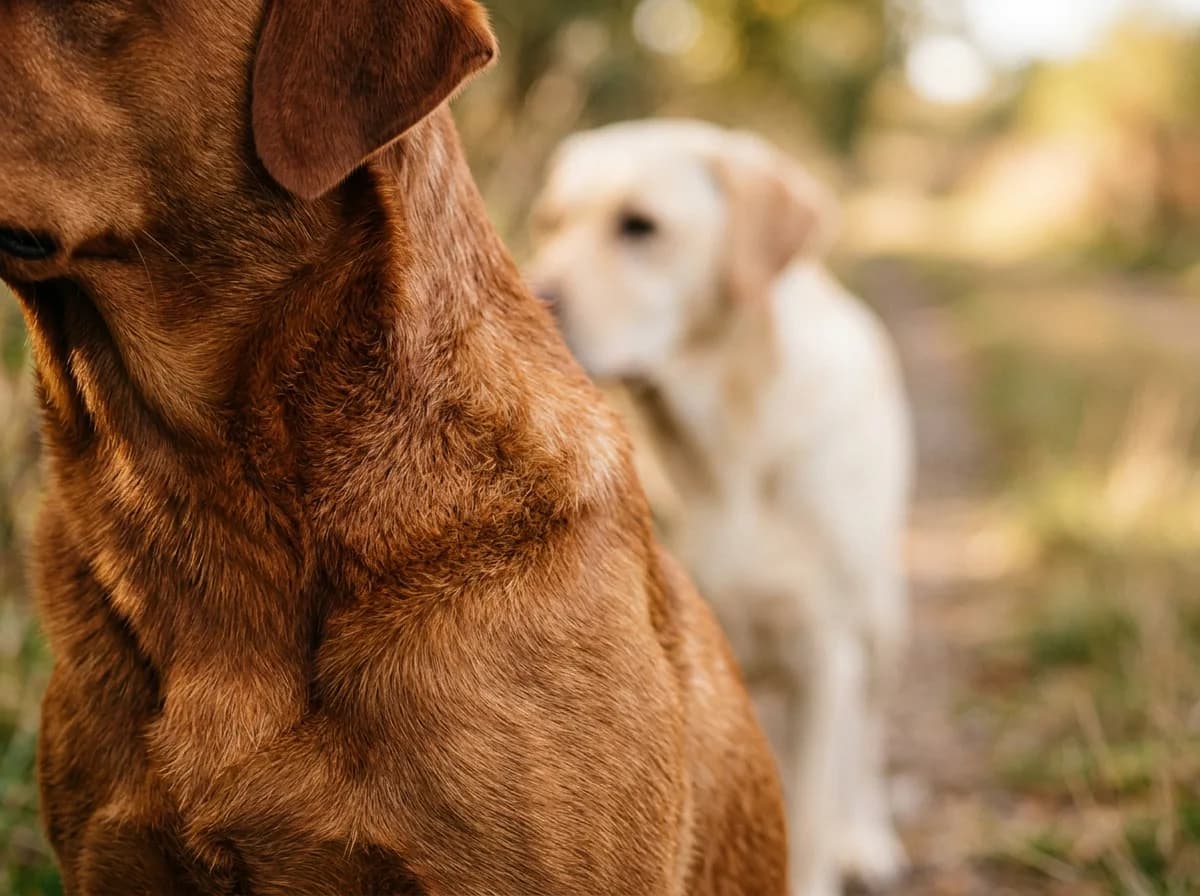
It helps to think of the "yellow" in a yellow Lab not as a single color but as a spectrum. At one end sits the pale, almost-white cream you see on many show-line English Labs. At the other end sits the deep russet of the fox red lab. In between lies every shade of gold and honey.
All of these dogs are "yellow" Labradors. What moves a dog along that scale from cream toward fox red is the amount and richness of the red-based pigment their coat produces. A fox red lab is simply a yellow Lab expressing that pigment at full volume.
Because it is all one color category, you cannot always tell at eight weeks old exactly how red a puppy will finish. Fox red puppies are often born a lighter shade and darken over their first months, and the ears frequently stay the deepest, most saturated part of the coat into adulthood. That ear color is a classic tell: even on a Lab whose body has lightened, the ears often hold the original rich red.
Where the Red Comes From Historically
Deep red-yellow Labs are not a modern invention. Early Labrador Retrievers from the breed's founding kennels in the late 1800s and early 1900s included dark, foxy-yellow dogs. As the breed's popularity exploded in the twentieth century and lighter, paler yellows became fashionable in the show ring, the darker reds fell out of favor and became scarce.
The color never disappeared, though. It survived largely in working and field lines, where breeders cared about a dog's nose, drive, and retrieving ability far more than the fashionable pale coat. That history is a big reason many fox red labs today trace back to field-bred stock, a point that matters when we compare show and field lines below.
The Genetics of Coat Color in Labradors

To really understand the fox red lab, you have to look at the two genes that decide a Labrador's coat color. Coat color in dogs is complex, but for Labs the picture is unusually clean, which is part of why the breed is a classic teaching example in canine genetics.
Two pigment types are at play across all mammals: eumelanin, which produces black and brown, and phaeomelanin, which produces red and yellow. Which pigment shows up, and where, is controlled by genes. For Labradors, two genes do most of the work: the B locus and the E locus.
Petful may earn a commission when you click through to Chewy, at no extra cost to you.
The B Locus: Black or Chocolate
The B gene decides whether a dog's eumelanin (its black-brown pigment) is black or brown. A dog with at least one dominant B allele makes black pigment. A dog with two recessive b alleles makes brown pigment, which is what we call chocolate in a Lab. This is why chocolate Labs exist: they are, at the B locus, bb.
The E Locus: The Switch That Creates Yellow
The E gene is where the yellow (and therefore the fox red) magic happens. The E locus controls whether the dog can actually deposit its black or brown pigment into the coat at all.
A dog with at least one dominant E allele shows its B-locus color in the coat: black or chocolate. A dog with two recessive e alleles (ee) cannot deposit eumelanin into its fur. Instead, the coat shows only phaeomelanin, the red-yellow pigment. That ee dog is a yellow Labrador, no matter what its B locus says.
So every yellow Lab, and therefore every fox red lab, is ee at the E locus. The fox red is a yellow Lab whose phaeomelanin is expressed richly and darkly rather than palely.
| Genotype | Coat result | Notes |
|---|---|---|
| EE or Ee, B_ | Black Lab | Eumelanin deposited as black |
| EE or Ee, bb | Chocolate Lab | Eumelanin deposited as brown |
| ee, any B | Yellow Lab (cream to fox red) | Eumelanin blocked; only red-yellow pigment shows |
| ee, deep pigment modifiers | Fox red lab | Yellow Lab at the darkest, most saturated end |
Why Depth of Red Varies So Much
If every yellow Lab is ee, why is one cream and another fox red? The answer is modifier genes: additional, less-well-mapped genetic factors that dial the intensity of the phaeomelanin up or down. A cream Lab and a fox red lab share the same ee foundation but carry different intensity modifiers. Selectively breeding two deeply pigmented fox red dogs together tends to concentrate those modifiers, which is how dedicated breeders produce litters of consistently deep-red puppies.

A durable rubber dog toy that can be stuffed with treats and selected by the manufacturer's size guide; supervise use and retire it when damaged.
Petful may earn a commission when you click through to Chewy, at no extra cost to you.
- When you meet an adult yellow Lab and wonder how red it started out, look at the ears. Ear leather often holds the deepest, most saturated pigment on the whole dog, so even a Lab that has lightened elsewhere frequently keeps foxy-red ears. On puppies, richly colored ears are one of the better early hints that a pup will finish darker rather than pale.
Show Lines vs. Field Lines: Where Fox Reds Come From
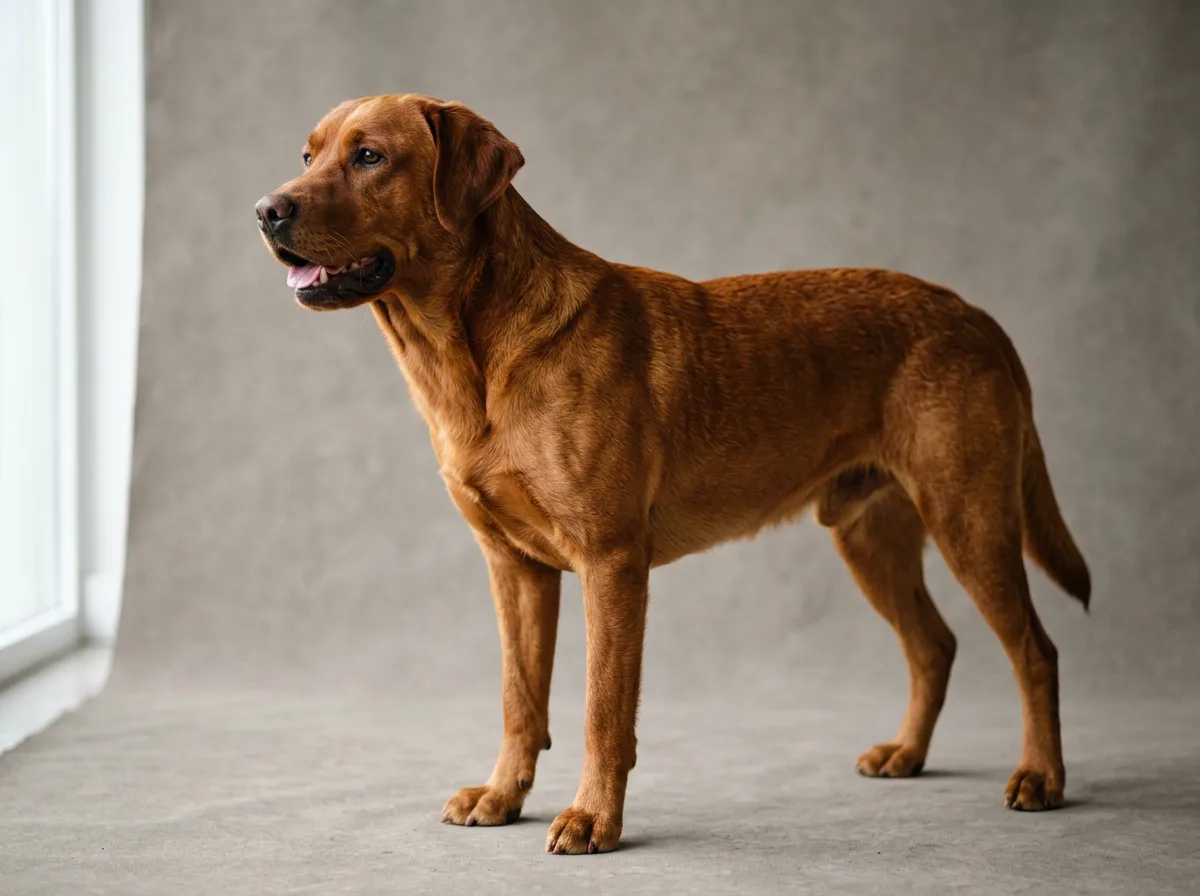
Labrador Retrievers split, roughly, into two working templates: show lines (often called English or bench Labs) and field lines (often called American or working Labs). Understanding this split explains a lot about where fox red labs come from and what a given fox red pup is likely to be like.
Show or English Labs are bred toward the conformation ring. They tend to be stockier and heavier, with a broad head, a thick "otter" tail, a blockier build, and a generally calmer, more laid-back temperament. Historically the show ring favored pale, even yellow coats, so the deepest reds were selected away from bench lines for decades.
Field or American Labs are bred for the job the breed was created to do: retrieving, hunting, and field trials. They tend to be leaner, taller, and more athletic, with a narrower head and dramatically higher energy and drive. Because field breeders prized ability over coat fashion, they held on to the dark, foxy reds that the show world set aside. That is why a large share of today's fox red labs trace back to field and working lines.
This is a generalization, not a law. There are calm field-line dogs and red-coated show-line dogs. But if you are meeting a fox red lab, it is worth asking the breeder about the line, because a high-drive field-bred red and a mellow bench-bred red can be very different dogs to live with even though they share a coat color.
- 1Show or English Labs are stockier, calmer, and were bred toward pale coats
- 2Field or American Labs are leaner, higher-drive, and kept the deep reds alive
- 3Many fox red labs descend from field and working lines
- 4Coat color does not dictate temperament; the line and the individual dog do
- 5Always ask a breeder about the line, not just the color
Do Fox Red Labs Fade? What to Expect Over Time

Yes, fox red labs very commonly lighten with age, and prospective owners should expect it rather than be surprised by it. A puppy that looks like a deep red ember can mature into a warm honey-gold adult. This is normal and is not a defect or a sign of poor breeding.
A few patterns are worth knowing. The body coat tends to lighten most, while the ears frequently hold their deeper color the longest. Sun exposure and coat blowing (the seasonal shed) can shift how red a dog looks month to month. And as with all Labs, gray hairs come in with age, especially around the muzzle, which softens the overall red as a dog becomes a senior.
If a consistently deep coat matters a great deal to you, ask a breeder to show you the adult parents and grandparents, not just the puppies. Adult relatives are a far better predictor of a pup's finished color than the puppy itself, because they show you where that bloodline actually lands once the coat matures.

Petful may earn a commission when you click through to Chewy, at no extra cost to you.
- It is tempting to pick the reddest pup in the litter, but puppy coat color shifts, and the deepest-red baby may finish lighter than a littermate. More importantly, coat shade tells you nothing about health, temperament, or whether the breeder health-tests. Prioritize a health-tested litter with sound, well-socialized parents over the single reddest puppy. Color fades; a good temperament and clear health clearances last the dog's life.
Are Fox Red Labs Purebred and Legitimate?

This comes up constantly, so let us be direct. A fox red lab, from a reputable breeder of purebred Labradors, is 100 percent a purebred Labrador Retriever. There is no crossbreeding, no other breed, and no genetic trickery behind the color. The dog is registered with kennel clubs as a yellow Labrador.
The confusion usually comes from three places. First, some sellers market "rare red Labs" as if they were an exotic or separate breed to justify a higher price, which is not accurate: fox red is a shade of yellow, not a rarity you are buying into. Second, because deep-red pups look so different from the familiar cream, people assume something unusual must be in the mix. Third, a small number of unscrupulous sellers do cross Labs with other red-coated breeds and pass the result off as a "fox red lab," which is exactly why buying from a responsible, transparent breeder matters.
A legitimate fox red lab, then, is real, purebred, and eligible for registration as a yellow Lab. The color is not itself a red flag. The seller's honesty and health testing are what you actually need to vet.
How to Buy a Fox Red Lab Responsibly
Because the color commands a premium, fox red labs attract some sellers who care more about the price tag than the dogs. Protect yourself and the puppy by insisting on the fundamentals that apply to any Labrador, red or not:

Petful may earn a commission when you click through to Chewy, at no extra cost to you.
- Ask for health clearances on both parents: hips and elbows evaluated for dysplasia, eyes cleared annually, and DNA testing for breed conditions such as exercise-induced collapse (EIC) and progressive retinal atrophy (PRA).
- Meet the mother, and ideally other adult relatives, in person to see temperament and adult coat color.
- Confirm registration papers list the dog as a purebred Labrador Retriever (color: yellow), not a made-up "red Lab" designation.
- Be skeptical of any seller pushing "rare" as the main selling point, offering multiple exotic "colors," or refusing to show health testing.
- Expect a contract, a health guarantee, and a breeder who asks you as many questions as you ask them.
Fox Red Lab Temperament, Size, and Care

Here is the reassuring part: a fox red lab is, in personality and needs, simply a Labrador Retriever. The coat color changes nothing about the dog inside. Labs are famously friendly, outgoing, people-oriented, food-motivated, and eager to please, which is a big part of why the breed is consistently among the most popular in the United States.
Size. Fox red labs match the standard Labrador range. Males typically stand about 22.5 to 24.5 inches at the shoulder and weigh roughly 65 to 80 pounds; females run about 21.5 to 23.5 inches and roughly 55 to 70 pounds. Field-line reds may look leaner and racier than the blockier bench build, but they are the same breed on the size chart.
Energy and exercise. Labs are active sporting dogs that need real daily exercise and mental work to stay happy and out of trouble. Field-bred fox reds in particular can be high-drive and need a serious outlet: long walks, swimming, fetch, scent games, or dog sports. An under-exercised Lab is a Lab that finds its own entertainment, usually your furniture.
Coat and grooming. The Labrador double coat is short but sheds, and it sheds heavily during seasonal coat blows. Weekly brushing (more during a blow), occasional baths, and routine nail and ear care cover it. The red coat needs no special grooming; it is the same coat as any yellow Lab.
Diet and weight. Labs are enthusiastic eaters and prone to obesity, which stresses their joints and shortens their lives. Measured meals, limited treats, and a body-condition check you do by feel, not by the bowl, keep a fox red lab lean and sound. If you want to go deeper on building an active dog's routine and picking gear, our broader dog breeds hub collects breed-by-breed guides.
Health and Lifespan of the Fox Red Lab
A fox red lab has the same health profile and life expectancy as any Labrador; the color carries no known health penalty or bonus of its own. The breed's well-documented predispositions apply equally to a cream Lab and a fox red one.
The conditions responsible Lab breeders screen for include hip and elbow dysplasia, hereditary eye conditions such as progressive retinal atrophy, and exercise-induced collapse (EIC). Labs are also, as a breed, notably prone to obesity, and excess weight is one of the biggest levers an owner controls over a dog's long-term joint health and lifespan. Keeping a Lab lean is not cosmetic; it is one of the most protective things you can do.
On lifespan, the Labrador Retriever typically lives about 11 to 13 years. Research on Labrador longevity has found that leaner dogs kept at a healthy body condition tend to live meaningfully longer than overweight ones, another reason weight management is central to caring for the breed. A fox red lab kept lean, well-exercised, and up to date on veterinary care sits squarely in that normal Labrador lifespan range.
- No credible evidence links the fox red shade itself to any extra health risk. A fox red lab is prone to the same conditions as any Lab (hip and elbow dysplasia, certain eye disorders, EIC, and obesity) and benefits from the same protections: health-tested parents, lean body condition, regular exercise, and routine veterinary care. Discuss any breed-specific screening with your own veterinarian.
How Rare and How Expensive Are Fox Red Labs?
Fox red is genuinely less common than black, standard yellow, or chocolate, so in that everyday sense it is uncommon. But "rare" is doing a lot of marketing work in the phrase "rare red Lab." The color is not a distinct, hard-to-produce genetic event; it is simply the deep end of a spectrum that many breeders have not selected for. Where breeders do focus on it, they produce whole litters of fox red pups reliably.
That uncommonness, combined with strong demand from buyers who love the look, is why fox red labs often carry a higher price than a standard yellow from the same breeder. You are paying for scarcity and demand, not for a better or healthier dog. A fox red lab and a cream lab from the same health-tested, well-run program are equally sound; the price gap reflects the market, not the merit.
We will handle the specific "rarest color" and "most expensive color" questions directly in the FAQ below, because they are among the most-searched questions about Lab colors and deserve straight answers.
For a sense of how coat-color variation and pricing play out in another breed, our guide to Rhodesian Ridgeback colors walks through the same "one breed, a spectrum of shades" idea from a different angle.
Is a Fox Red Lab Right for You?
A fox red lab is a wonderful dog for the right home, and the right home is really just a good home for any Labrador with clear eyes about energy needs. If you want an affectionate, trainable, people-loving companion and you can commit to daily exercise, mental stimulation, weight management, and regular shedding, a Lab of any color will thrive with you. The fox red coat is a lovely bonus, not a different commitment.
Go in understanding three things and you will not be disappointed: the deep red often lightens with age, the color says nothing about the dog's temperament or health, and a responsible breeder and lean, active lifestyle matter infinitely more than the exact shade of the coat. Choose the dog and the breeder first; enjoy the gorgeous russet color as the icing.
Related on Petful
- Labrador Colors: The Complete Guide
- Silver Lab: The Dilute Gene Controversy Explained
- Chocolate Lab: The Complete Owner's Guide
- Golden Retriever Colors: A Complete Shade Guide
- Merle Dog Guide: Genetics, Breeds, and Health
Fox red is less common than black, standard yellow, or chocolate, so in everyday terms it is uncommon. But it is not a distinct, hard-to-produce genetic event; it is simply the darkest end of the yellow spectrum. Breeders who select for it can produce whole litters of fox red puppies reliably, so it is uncommon by choice and fashion, not truly rare.
Fox red labs typically cost more than a standard yellow from the same breeder because the color is uncommon and in high demand. You are paying for scarcity and demand rather than a healthier or better dog. Prices vary widely by region, bloodline, and health testing, so focus on what the price includes (health clearances, guarantees, socialization) rather than the color premium alone.
Yes. A red fox Lab (the same dog as a fox red lab) from a reputable breeder of purebred Labradors is a 100 percent purebred Labrador Retriever, registered with kennel clubs as a yellow Lab. There is no crossbreeding behind the color; it is simply a deeply pigmented yellow coat.
Yes, they are legitimate purebred Labradors, not a scam or a made-up designer breed. The color itself is real and recognized as a shade of yellow. The thing to vet is the seller: avoid anyone marketing the dog as an exotic separate breed or crossing Labs with other red breeds, and insist on health testing and registration papers listing a purebred Labrador Retriever.
Among the three recognized Labrador colors (black, yellow, chocolate), chocolate is generally the least common, and within yellow, the deep fox red shade is the least common. Beyond the standard three, dilute shades such as "silver" are marketed as rare, but the silver coloration is controversial and not accepted as a standard Labrador color by major kennel clubs.
Yes. A fox red lab is a purebred Labrador Retriever. Fox red is not a separate breed or a fourth color; it is the darkest shade of yellow and is registered on kennel-club paperwork as yellow. A fox red pup from a responsible purebred Lab breeder is fully purebred.
A fox red lab has the same life expectancy as any Labrador, typically about 11 to 13 years. Coat color has no known effect on lifespan. Keeping the dog at a lean, healthy body condition is one of the biggest factors in a longer, healthier life, since research on Labradors links leaner body condition to longer lifespan.
Price depends more on the breeder, bloodline, and health testing than on color, but uncommon shades tend to command a premium. Fox red yellows and marketed "silver" dilutes are often priced highest because of scarcity and demand. Remember that a color premium reflects the market, not a healthier or better dog; a health-tested Lab of any color is the better value.
The Bottom Line on Fox Red Labs
A fox red lab is a purebred Labrador Retriever wearing the deepest, richest shade of yellow the breed produces. It is not a separate breed, not a rare exotic, and not a mixed dog. Its color comes from the same ee genetics that make every yellow Lab yellow, dialed up by intensity modifiers that concentrate the red pigment. That deep coat often lightens with age, tends to trace back to field and working lines, and carries a price premium driven by demand rather than merit.
Choose a fox red lab the way you would choose any Labrador: for a health-tested litter, sound parents, and a breeder who is honest about the color's fashionable-but-purely-cosmetic appeal. Do that, and you get all the affection, trainability, and companionship that make Labs America's favorite dog, in an unforgettable russet coat.

Coreen Saito is a pet writer and longtime shelter volunteer with more than a decade in animal rescue. She covers cat behavior, breed care, and the small, ordinary science of sharing a life with companion animals, with a particular focus on honest takes about the products and decisions that actually matter. At home in Arizona, she's outranked by Mac (a dog with the loudest opinion in the house), Rebel (a cat who governs by quiet authority), and Meri (an orange tabby who runs the late shift and the laundry basket). She writes about all three, plus the rescues that keep coming through her life, at LifeWithMinty.com.
Sign up for expert-backed reviews and safety alerts all in one place.