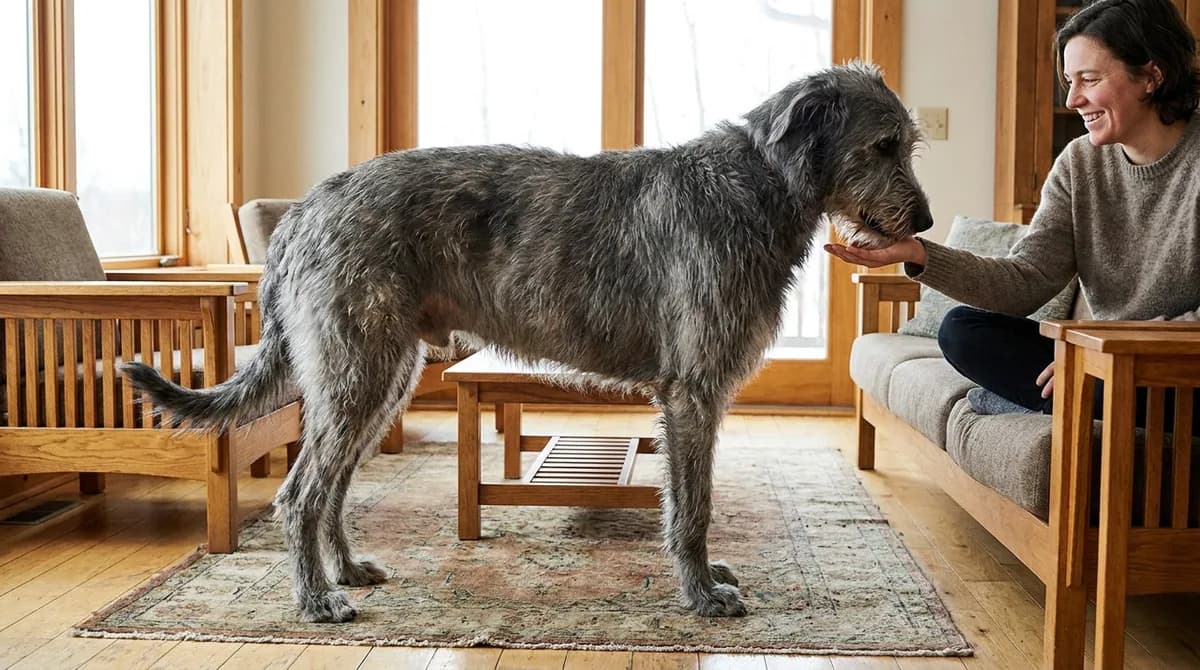
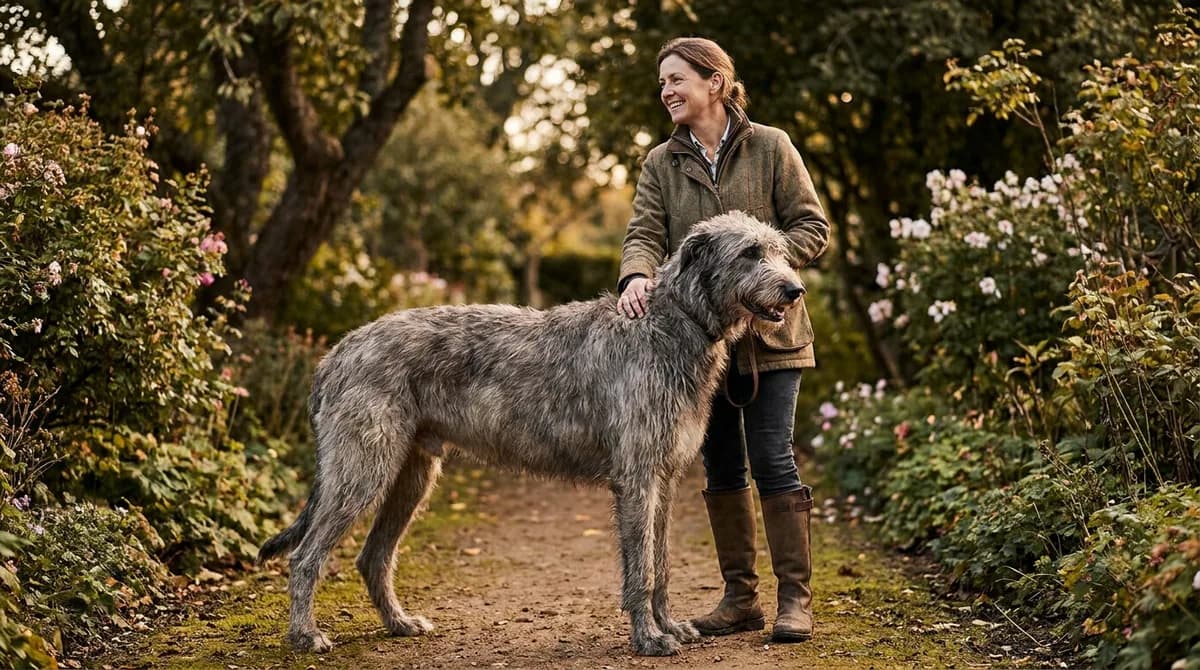
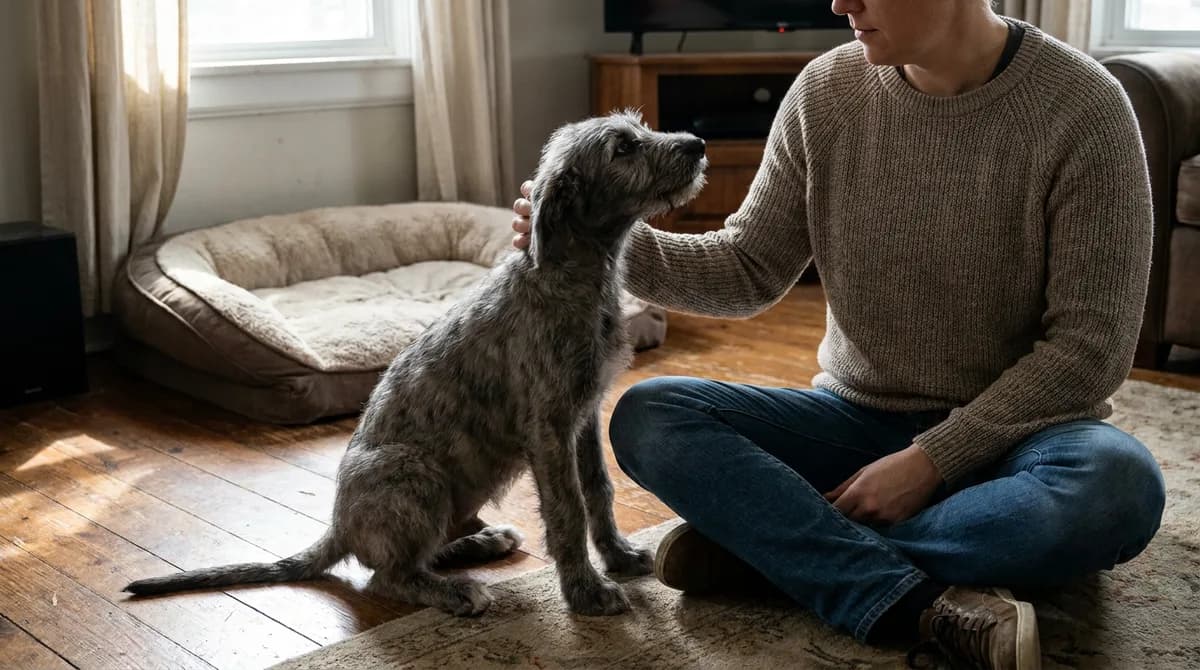
Irish Wolfhound vs Great Dane: Size, Care, and Best Fit
Irish Wolfhounds and Great Danes are both giant dogs, but height does not tell the whole story. Compare their measurements, coats, daily care, health evidence, and practical fit for your household.
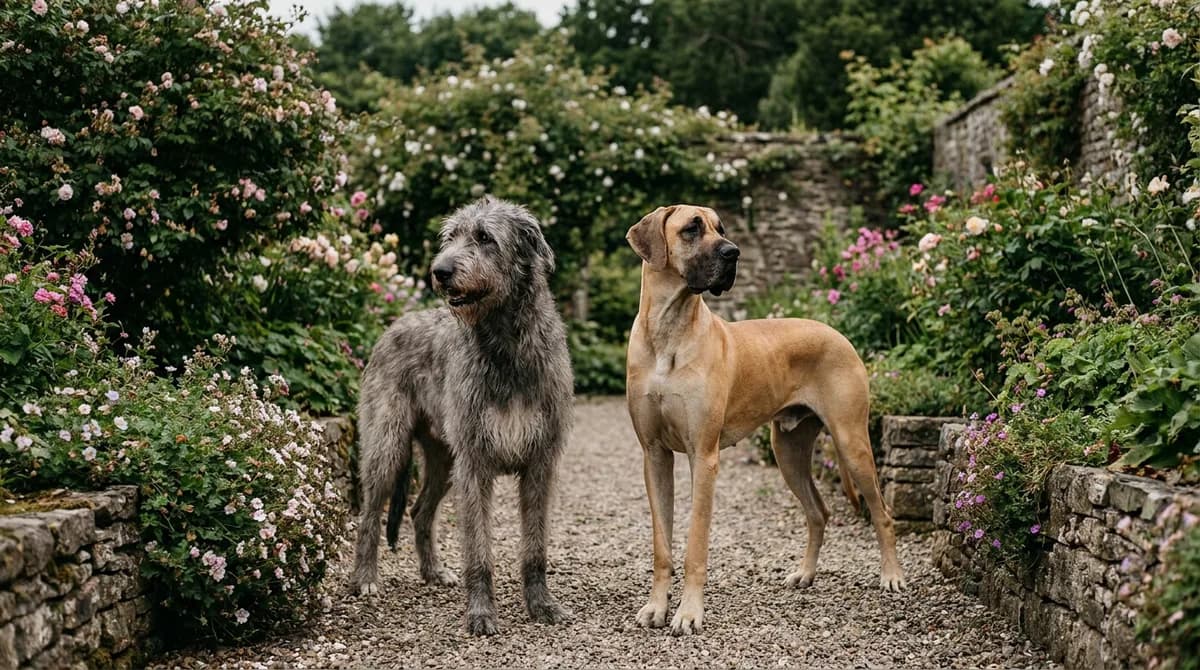
Individual dogs illustrate different builds without establishing a universal size ranking.
Petful is reader supported. As an affiliate of platforms like Amazon and Chewy, we may earn a commission when you buy through links on this page. There is no extra cost to you.
An Irish Wolfhound vs Great Dane comparison starts with two different questions: which is taller, and which is heavier? Irish Wolfhound standard minimums emphasize remarkable height, while the Great Dane's published weight ranges show how substantial that breed can be. Neither set of figures tells you which individual dog will suit your home.
Coat care, safe handling, other pets, and your daily routine make the more useful comparison.

Sign up for expert-backed reviews and safety alerts all in one place.
Irish Wolfhound and Great Dane differences at a glance
Both breeds require planning for a giant dog, but their size figures need careful labels. The IWCA breed standard gives Irish Wolfhound minimums for dogs over 18 months. The American Kennel Club's Great Dane profile supplies reference ranges. These describe different kinds of information and should not be presented as matching population averages.
| Measure or task | Irish Wolfhound | Great Dane |
|---|---|---|
| Male shoulder height | IWCA standard minimum: 32 inches over 18 months | AKC profile range: 30–32 inches |
| Female shoulder height | IWCA standard minimum: 30 inches over 18 months | AKC profile range: 28–30 inches |
| Male body weight | IWCA standard minimum: 120 pounds over 18 months | AKC profile range: 140–175 pounds |
| Female body weight | IWCA standard minimum: 105 pounds over 18 months | AKC profile range: 110–140 pounds |
| Coat | Rough, wiry coat needing brushing and combing | Short coat needing regular maintenance |
| Everyday planning | Secure exercise space, suitable transport, and room to rest | Secure exercise space, suitable transport, and room to rest |
Read the measurements alongside the IWCA breed standard and AKC Great Dane profile. For a prospective owner, the important next step is meeting adult dogs and checking the space and support you can provide. A difference on paper may matter less than whether you can safely handle the particular dog.

Compare this six-foot leash with dual padded handles for supervised walks with either breed. It is a walking lead, not a vehicle restraint.
Petful may earn a commission when you click through to Chewy, at no extra cost to you.
Which is taller, and which is heavier?
How tall is an Irish Wolfhound compared to a Great Dane? The Wolfhound standard minimums are 32 inches for males and 30 inches for females, compared with AKC's Great Dane reference ranges of 30–32 inches for males and 28–30 inches for females. This supports a height comparison, but it does not mean every Wolfhound is taller than every Dane.
Shoulder height measures the distance from the ground to the withers. Body weight measures mass. A tall, long-legged dog and a heavier dog can create different handling challenges, so “bigger” needs a definition. The Wolfhound's minimum weights are not average weights or maximums, and the Great Dane's published ranges are not limits for every individual.
- Compare male and female measurements separately.
- Distinguish standard minimums from reference ranges and measured averages.
- Measure the dog you are fitting for a bed, gate, harness, or vehicle.
- Keep an individual record separate from a breed standard.
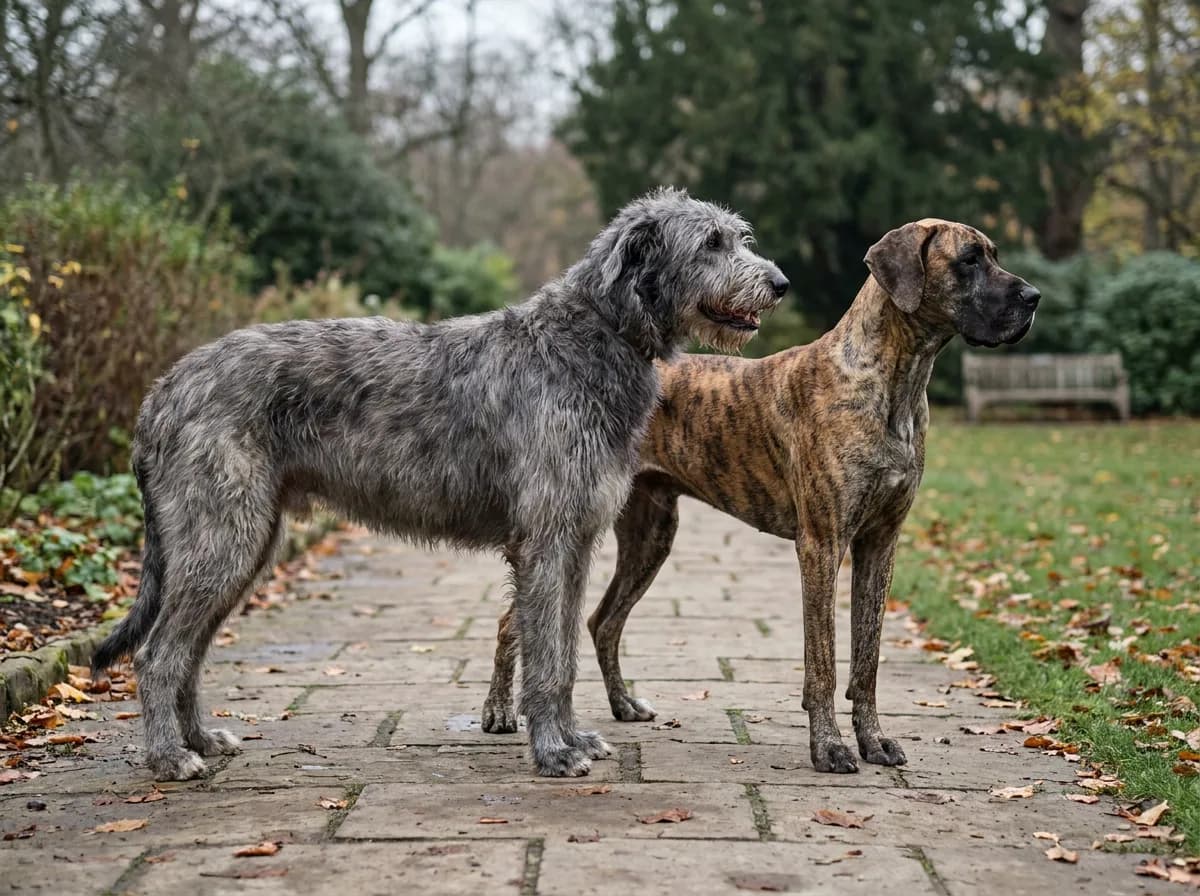
An Irish Wolfhound next to a Great Dane can help you appreciate their different outlines. A photograph cannot establish breed-level size: sex, age, posture, and camera distance affect the comparison. Individual overlap matters more when choosing between two actual dogs than a claim that one breed always wins on height.

Consider this slicker brush for suitable areas of an Irish Wolfhound's rough coat. Choose a separate grooming approach for a Great Dane's short coat.
Petful may earn a commission when you click through to Chewy, at no extra cost to you.
Our Irish Wolfhound size guide explains the Wolfhound measurements and how to use them. For either breed, arrange equipment around the adult dog you expect to accommodate rather than treating a published number as a guaranteed final size.
Check more than the floor area of a bed or crate. Look at the entrance, the space to turn, and whether the dog can rest naturally. For collars and harnesses, follow the particular manufacturer's fitting instructions. Neither a breed name nor a body-weight estimate can replace those checks.
Temperament, training, and other pets
Individual temperament deserves more attention than a chart assigning one breed a higher friendliness score. Meet adult dogs, ask about their ordinary routines, and discuss what the breeder or rescue has observed. A calm greeting does not answer every question about behavior at home, around visitors, or with unfamiliar animals.
The IWCA describes Wolfhounds as companion dogs, not dogs intended for guarding or patrol work. That background helps explain the breed's appeal, but it does not guarantee a particular puppy's behavior. Likewise, a Great Dane's size should not be treated as proof of protective behavior or easy control.
For children and cats, ask specific questions instead of accepting “family friendly”:
- Has the dog lived with children of similar ages, and under what supervision?
- Has it encountered cats indoors, outdoors, or both?
- How does it respond when other dogs approach food, toys, or resting places?
- What signs show that it needs more space or a break?
Prey drive and chase responses need practical management, especially when smaller animals are involved. Do not use an off-leash encounter as a compatibility test. Arrange supported introductions and secure boundaries, and keep children from climbing on, crowding, or disturbing either dog while it rests.
Early training and handling matter because an enthusiastic giant dog can be difficult to manage even without aggressive intent. WebVet's dog training schedule can help organize short, repeatable practice. Teach everyday skills such as walking calmly, waiting at doors, and settling in a designated space. For more breed-specific background, our Irish Wolfhound temperament guide covers companionship, training, and household decisions. A first-time owner should assess available coaching and safe physical handling rather than assuming that either giant breed will be easy solely because it is affectionate.
The Pet Parents Forager Snuffle Mat & Slow Feeder offers a supervised food-search activity using part of the dog's planned allowance. Give dogs separate space during food activities when needed, and remove the mat if the dog chews the fabric. Enrichment supports a routine; it does not prove pet compatibility.
Coat, shedding, and grooming
The clearest visible care difference is the Wolfhound's wiry coat versus the Great Dane's short coat. A Wolfhound owner needs to become comfortable brushing and combing a rough coat. A Dane's shorter hair changes the tools and tasks, but does not eliminate shedding, skin checks, nail care, or household cleaning.
The IWCA's breed FAQ describes year-round shedding and regular brushing and combing. Ask a breeder or groomer to demonstrate suitable technique, including how to check for tangles gently. A rough appearance should not be mistaken for a coat that needs no attention.
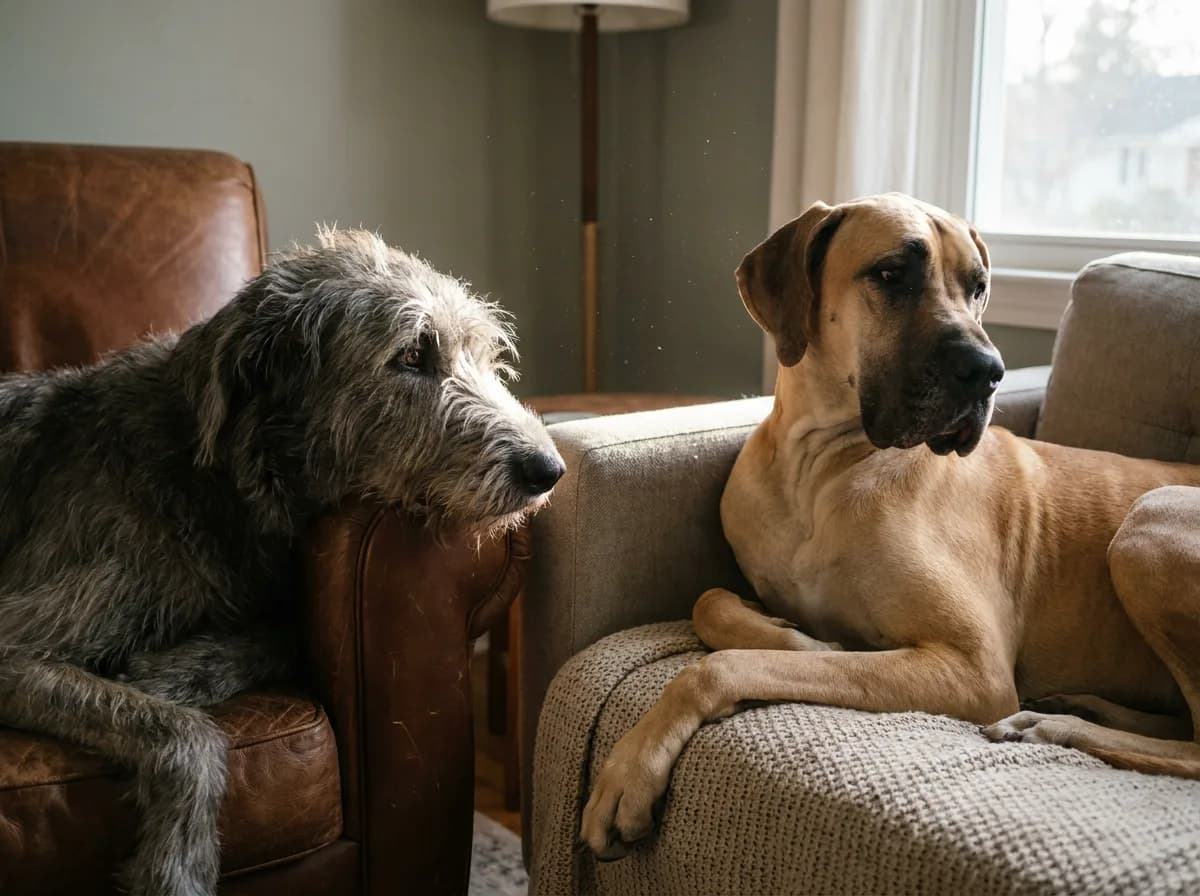
The aumuca Self Cleaning Slicker Brush is an option to assess for suitable areas of a Wolfhound's coat. Use it gently and ask for help if the coat pulls or the dog is uncomfortable. Do not assume that the same tool is appropriate for a Great Dane simply because both dogs are large.
Compare the routine you are willing to maintain:
- Time for coat care and gradual grooming practice.
- Cleaning hair from bedding, floors, clothing, and the vehicle.
- Washing and drying a giant dog's resting covers.
- Access to help with nails, bathing, or difficult grooming tasks.
If your preference is specifically for a short coat, the Dane meets that preference more directly. If you enjoy a rough-coated dog and can maintain it, the Wolfhound may fit well. Neither choice removes the need to teach relaxed handling or inspect the dog's skin and feet.
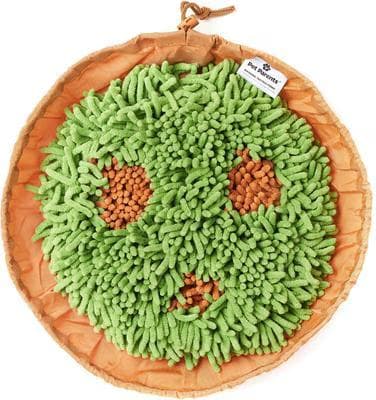
Offer supervised food-search enrichment with this snuffle mat, using part of the planned food allowance and separate space when needed.
Petful may earn a commission when you click through to Chewy, at no extra cost to you.
Health, lifespan, and veterinary planning
Health risks deserve a separate conversation for each breed. The Irish Wolfhound Foundation's general health guidance discusses relevant screening and health concerns. For Great Danes, the AKC's national-club testing recommendations list hip, cardiac, eye, and thyroid evaluations, reflecting guidance from the Great Dane Club of America.
Ask for actual results, not just a statement that the parents were tested. Parent screening helps inform decisions, but it cannot guarantee an individual puppy's future health. Your veterinarian should also assess the dog you bring home and help plan routine care and any appropriate follow-up.
Compare lifespan evidence carefully
The lifespan evidence also needs labels. The Irish Wolfhound Foundation's October 2020 Life Cycle update reported historical cohort means of 7.41 years and 7.58 years in its two studies. The AKC Great Dane profile publishes a 7–10-year reference range. Those are not equivalent statistics from matched study populations.
A mean versus median comparison needs care: a mean is the arithmetic average, while a median is the middle observation. Neither is the same as a general reference range. These sources do not establish a precise lifespan advantage for one breed over the other, and none predicts an individual dog's lifetime. Our Irish Wolfhound lifespan guide explains the Wolfhound evidence in more detail.
Both breeds warrant discussion of serious giant-dog health concerns, including gastric dilatation-volvulus, or GDV. Ask your veterinarian how to recognize an emergency and where to go outside regular hours. Suspected GDV requires urgent veterinary care; a breed comparison cannot diagnose it or replace that plan.
- Request local estimates for routine examinations and recommended screening.
- Plan how you would transport a large dog that cannot walk normally.
- Keep access to emergency funds and the clinic's contact details.
- Review insurance terms separately from routine-care costs.
WebVet's vet-visit cost guide helps frame budget questions without assuming one national price. If requesting Lemonade insurance quotes, compare eligibility, waiting periods, exclusions, and reimbursement arrangements for each dog. Do not infer that one breed will always have a lower premium.

Compare coverage choices for your pet, then request a quote directly on Lemonade.
- Check a price for your pet
- Review available coverage choices
- See the terms before you decide
Eligibility, waiting periods, limits and exclusions apply.
Petful may earn a commission when you click through to Lemonade, at no extra cost to you.
Compare the records themselves as well as the list of tests. Note which dog each result identifies, when the evaluation occurred, and what follow-up was advised. Screening describes an assessment at a particular time; it is not a diagnosis of every possible condition or lifetime clearance. If a breeder or rescue cannot supply a record, ask your veterinarian how that missing information affects the next steps rather than recording it as a normal result.
Exercise, space, and transport
For two giant dogs living together, plan separate resting and feeding spaces as well as room for both to move. Their shared size does not establish compatibility.
Exercise needs should be matched to the individual dog's age, health, and development. Both breeds need an appropriate daily routine and opportunities to move, but a giant puppy should not be expected to keep up with every activity its owner enjoys. Discuss growing-dog exercise with the breeder and veterinarian rather than imposing a universal duration.
At home, measure the sleeping footprint as carefully as the dog's standing height. A bed should allow comfortable resting, and people should be able to move through the room without repeatedly stepping over the dog. Nonslip routes and accessible resting places can make daily movement easier to manage.
Check the household layout
Walk through the practical setup before bringing either dog home:
- Check doorways, narrow corridors, and the route from the resting area to the yard.
- Decide how you will separate the dog from visitors or other animals when needed.
- Confirm that anyone providing walks or overnight care can manage a giant dog.
- Plan for cleaning, washing bedding, and storing food without blocking access routes.
- Identify an alternative caregiver and transport arrangement if your usual helper is unavailable.
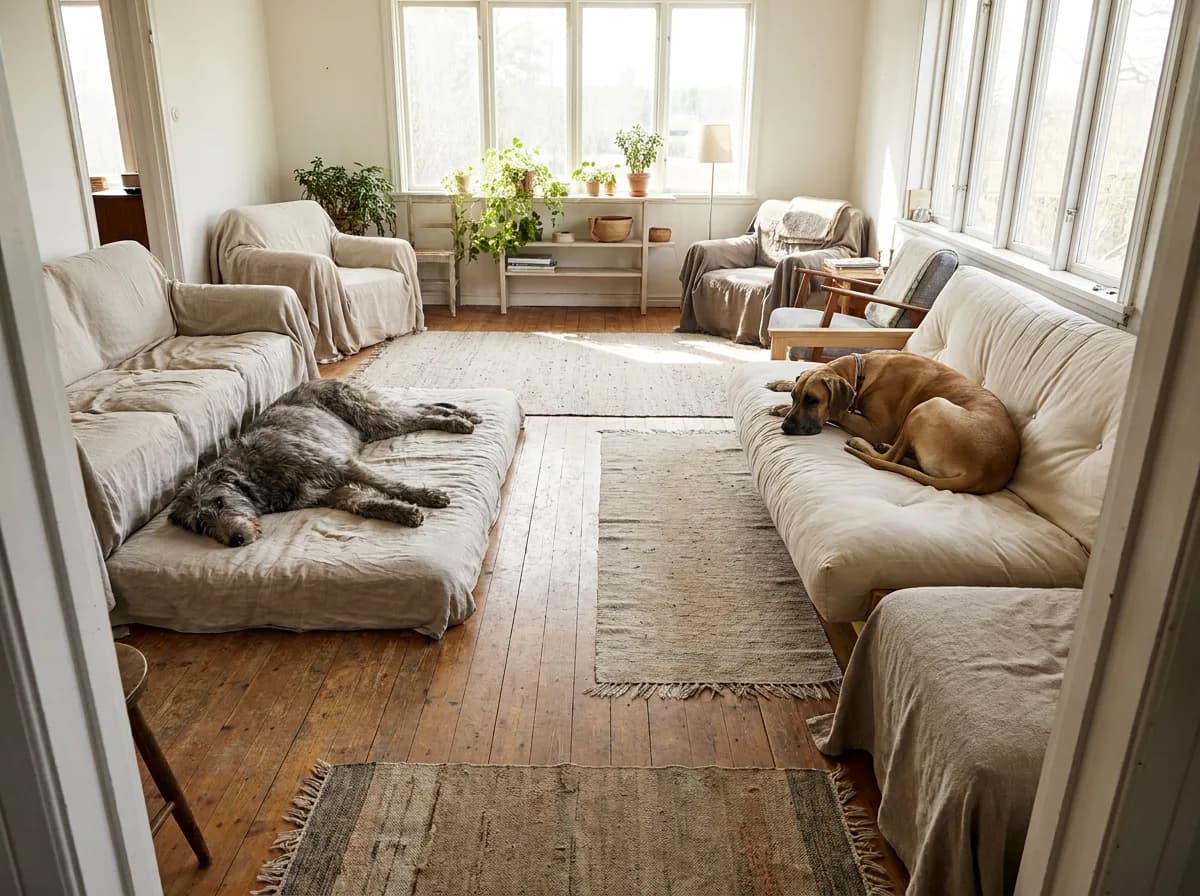
Check vehicle access before making a commitment. Look at the door opening, usable interior space, restraint options, and how the dog will enter and exit. Also consider who could help if the dog were injured or became less mobile. Being able to transport a puppy does not prove the same setup will serve an adult.
For supervised walks, the Frisco Traffic Leash with Dual Padded Handles is one fixed-length option to compare. It is not a vehicle restraint. Fit walking equipment to the dog and practice calm handling before relying on a close grip in a difficult situation.
A yard is useful only if its boundaries and gates are secure and someone provides the dog's daily care and companionship. Review the whole routine: walks, training, rest, time alone, and access to help. Neither breed's height tells you whether that routine will work.
Which breed fits your household?
Should you get a Great Dane or Irish Wolfhound? Choose the dog whose observed behavior and care needs fit your household, with coat preference as one clear breed-level difference. A Great Dane may suit someone specifically seeking a short coat; a Wolfhound may suit someone comfortable maintaining a rough coat. Both require realistic plans for giant-dog handling, transport, and care.
| Your priority | Question to answer before choosing |
|---|---|
| Grooming preferences | Will you maintain a rough coat, or do you specifically prefer a short coat? |
| Physical handling | Can every responsible caregiver manage this individual dog safely? |
| Children and other pets | What history, supervision, and introductions will the household need? |
| Daily routine | Who provides exercise, companionship, training, and rest opportunities? |
| Home and vehicle | Does the adult dog fit the resting area, access routes, and transport setup? |
| Health planning | Are records available, local care accessible, and unexpected costs manageable? |
Meet more than one adult of each breed if possible. Ask owners to describe an ordinary day, including the inconvenient parts. Then compare those accounts with your own constraints instead of relying on an exceptional show dog, a viral video, or a single friendly encounter.
If a crucial requirement remains unresolved, identify the missing information before choosing. That might be an adult rescue dog's cat history, a workable vehicle arrangement, or access to a trainer. A breed label cannot solve a practical problem that the household has not planned for.
Irish Wolfhound purchase and ownership costs
Irish Wolfhound price depends on the specific breeder or rescue arrangement, and the purchase payment is only one part of ownership. Food, equipment, transport, training, and veterinary care need their own budget. Our Irish Wolfhound price guide separates documented breeder quotes from ongoing expenses. Use actual Great Dane quotes for comparison rather than treating Wolfhound examples as a price estimate for both breeds.
Considering an Irish Wolfhound and Great Dane mix?
An Irish Wolfhound mix with Great Dane ancestry does not guarantee a halfway result in height, weight, coat, or behavior. Ask what supports the ancestry claim and assess the individual dog's records and observed traits. Our Irish Wolfhound mix guide covers the Great Dane cross alongside other named mixes and explains how documented parentage differs from a visual guess or an ancestry estimate.
Irish wolfhound guide
Irish Wolfhounds are kept as companions; their size and care demands do not mean they have disappeared from family homes. Their historical wolf-hunting role explains the breed's name, but it does not predict an individual dog's ability to confront a wolf or provide a reason to test it. Our Irish Wolfhound breed guide explains the history, availability, and practical realities of living with the breed.
Irish Wolfhound and Great Dane questions
“Heartbreak breed” is an informal nickname reflecting owners' concern about a relatively short lifespan and the grief of losing a much-loved dog. It is not a medical diagnosis or a prediction for an individual Great Dane.
No. An individual record describes one exceptional dog. Breed-level measurements describe standards, reference ranges, or a measured population. Record measurements cannot establish that every member of one breed is taller than every member of another.
They can, but individual compatibility matters more than their shared giant size. Use supervised introductions, separate resting spaces, and careful management around food and valued items. Obtain help if either dog shows persistent discomfort or conflict.

Coreen Saito is a pet writer and longtime shelter volunteer with more than a decade in animal rescue. She covers cat behavior, breed care, and the small, ordinary science of sharing a life with companion animals, with a particular focus on honest takes about the products and decisions that actually matter. At home in Arizona, she's outranked by Mac (a dog with the loudest opinion in the house), Rebel (a cat who governs by quiet authority), and Meri (an orange tabby who runs the late shift and the laundry basket). She writes about all three, plus the rescues that keep coming through her life, at LifeWithMinty.com.
Sign up for expert-backed reviews and safety alerts all in one place.