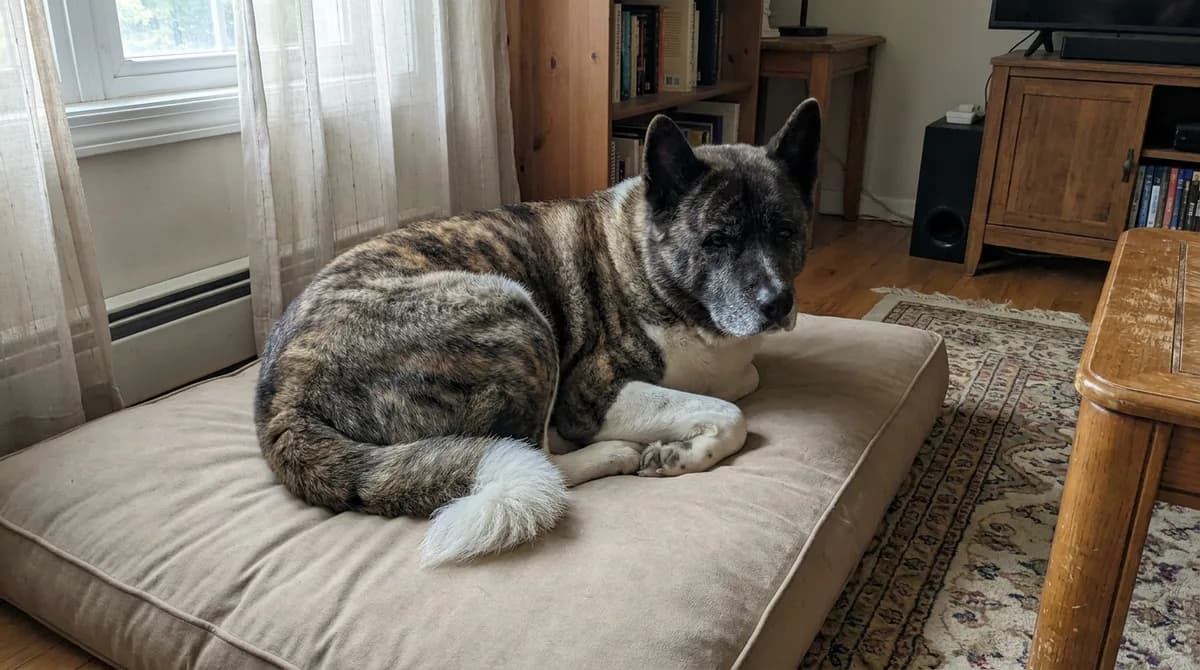
Akita Temperament: Family Fit, Other Dogs and Training
Akitas can combine family affection with independence and reserve. Learn how to plan for visitors, children, other animals, daily care, and humane training while assessing the individual dog.
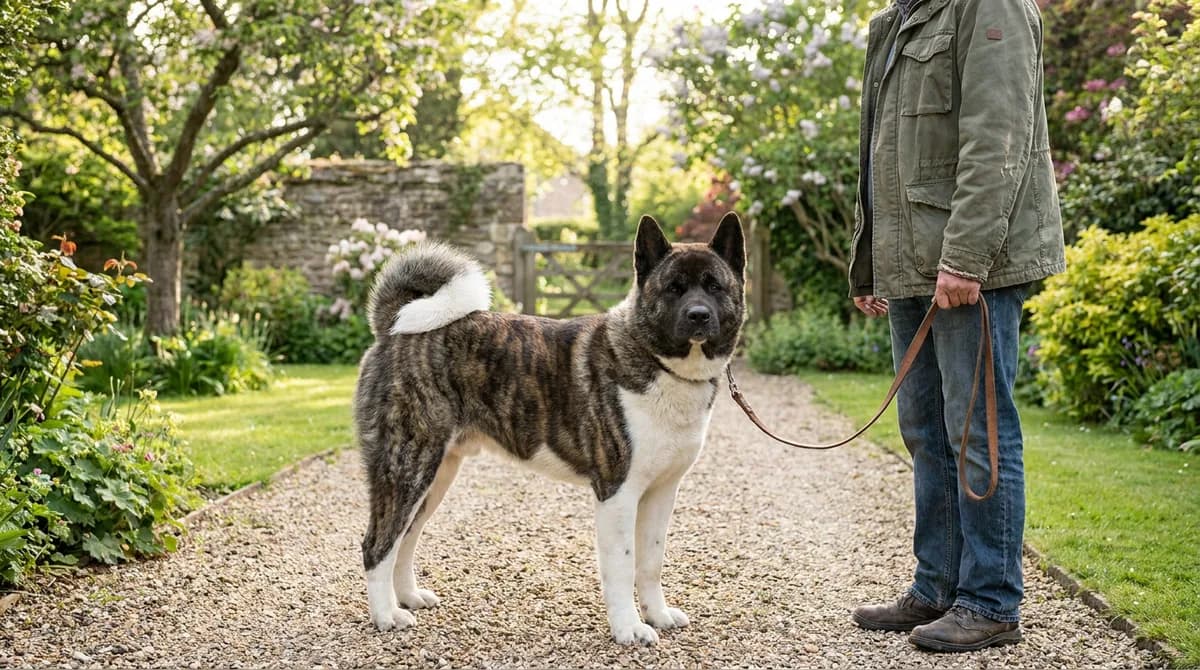
A relaxed adult Akita beside an adult handler without an aggressive pose.
Petful is reader supported. As an affiliate of platforms like Amazon and Chewy, we may earn a commission when you buy through links on this page. There is no extra cost to you.
Akita temperament is often described through loyalty, independence, and reserve. Those words become useful only when you connect them to ordinary life: opening the door for a visitor, walking past another dog, brushing a thick coat, or giving a resting dog space.
An Akita can be an affectionate companion without enjoying every stranger or animal. Good ownership means learning the individual dog's responses, teaching useful skills, and arranging the household so that comfort and safety do not depend on perfect obedience.

Sign up for expert-backed reviews and safety alerts all in one place.
What is the Akita temperament like?
Aggression context matters: distinguish the circumstances, the dog's response, and what management prevents another difficult encounter.
The AKC Akita standard describes an alert, dignified dog and recognizes possible intolerance of other dogs, particularly same-sex dogs. These are reasons to ask careful questions and plan management. They are not a prediction of everything an individual Akita will do.
Akita Inu temperament can include strong family attachment alongside an independent approach to unfamiliar situations. A dog may be relaxed with familiar people yet need distance from visitors. It may learn a household routine readily but find an exciting outdoor environment much harder. Describing both situations is more informative than calling the dog simply “good” or “stubborn.”
Are Akitas good dogs, aggressive dogs, or dangerous dogs?
“Are Akitas good dogs?” and “Are Akita dogs aggressive?” are not opposite questions with a single breed-wide answer. A dog can be a valued family companion and still need careful management around certain triggers. The useful assessment considers what the dog does, when it happens, how easily distance can be created, and whether the household can meet those needs.
The same applies to American Akitas. A breed label does not establish that an individual is safe in every setting, and it does not establish that every member of the breed is dangerous. The Akita's physical size makes it especially important to take pulling, chasing, guarding, and handling discomfort seriously before they become harder to manage.
Ask for examples rather than reassuring adjectives:
- What happens when an unfamiliar adult enters the house?
- How does the dog respond to another dog across the street?
- Can the dog rest undisturbed while people move nearby?
- What handling does the dog accept comfortably, and what currently needs help?
Why are Akitas sometimes a restricted breed?
A housing provider, insurer, boarding business, or other organization may apply breed or size restrictions. The exact policy matters more than a general statement about Akita behavior. Check the rules that apply to your home and services before committing to a dog, and obtain clarification directly from the responsible provider.
A restriction is not an individual behavior assessment. Equally, finding a provider without a restriction does not prove that your arrangements are suitable. You still need realistic handling, visitor, and pet-management plans.
Akita breed overview
Temperament belongs within the wider ownership picture. The Akita is a substantial dog with a coat, activity needs, and physical presence that affect daily care. Our Akita breed overview covers that broader context. Use it alongside the behavior history of the actual dog so that an appealing personality description does not hide practical requirements your household cannot meet.
A Frisco Traffic Leash with Dual Padded Handles is one fixed-length option for supervised walking practice. Check the hardware, fit with the dog's walking equipment, and your own grip. A lead supports management; it does not teach the dog by itself.

Practice calm walking with this fixed-length lead. Check hardware, equipment fit, and comfortable handling before choosing it for your Akita.
Petful may earn a commission when you click through to Chewy, at no extra cost to you.
American and Japanese Akita differences
American Akita and Japanese Akitainu standards describe distinct physical characteristics, but those differences do not establish that one type is consistently more sociable or easier to manage. Our American Akita vs Japanese Akita comparison explains their identities and standards. For household fit, still request the actual dog's behavior history, parent information where available, and observed responses in relevant situations.
Loyalty, affection and personal space
Give the dog space and reward calm behavior without making physical contact compulsory.
Why are Akitas not cuddly? Some enjoy close contact, while others show attachment by following a familiar person, resting nearby, or choosing to share a room. A preference for proximity without hugging does not mean the dog lacks affection. Let the individual determine how much touch is welcome.
Invite contact rather than surrounding the dog with it. Offer a brief interaction and pause. If the dog moves closer or clearly seeks more contact, you can respond. If it turns away, leaves, or becomes tense, give the dog space. There is no benefit in testing how much unwanted handling a loyal dog will endure.
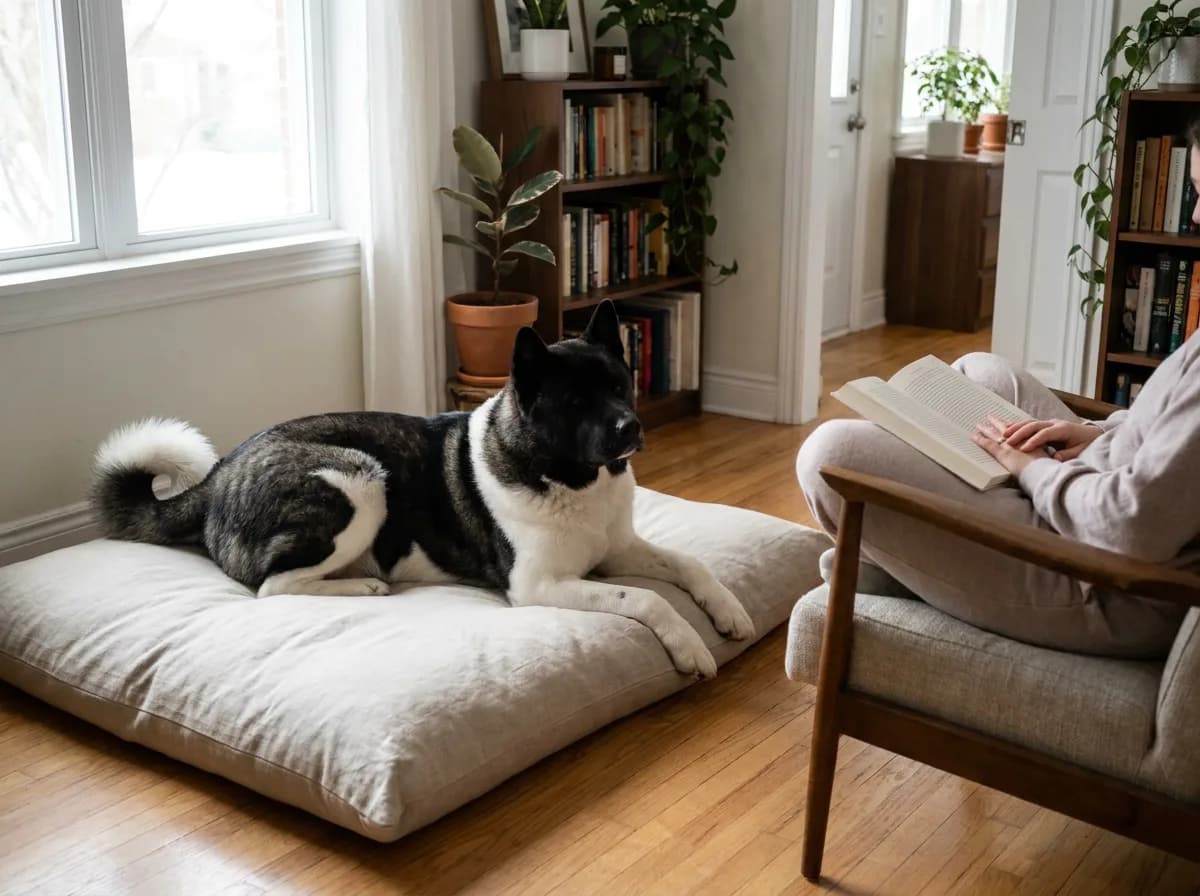
Rest should be available without negotiation
Set up a resting place where household traffic does not continually interrupt the dog. Teach children and visitors that the resting area is not an invitation to pet. If other animals share the home, separate resting areas can reduce the need for any animal to defend its space.
Call the dog away from a comfortable place when you need it to move, using a familiar cue and reward. Avoid reaching over a sleeping dog or physically dragging it from furniture. If moving away from a resting place repeatedly causes tension, change access and obtain help rather than turning the same interaction into a daily contest.
Affection also varies with the situation. A dog that seeks attention in the evening may prefer to be left alone after a busy outing. Look at the current response instead of insisting on yesterday's interaction. The aim is a relationship in which the dog can approach and retreat without its choices being treated as disobedience.
Notice changes from the dog's usual behavior
A sudden behavior change matters, especially when a previously comfortable dog starts avoiding touch, snapping during handling, or withdrawing from normal contact. Pain or another health problem can contribute, and a temperament label cannot explain the cause.
Arrange veterinary assessment when behavior changes unexpectedly. Tell the veterinarian which activity or touch appears difficult, when the change began, and whether movement, appetite, sleep, or other routines have changed. Do not provoke the response again to prove it exists. A description of ordinary observations is more useful than a staged confrontation.
Our Akita lifespan and health guide provides broader care context. A dog's age may change the support it needs, but being older does not make new discomfort something to ignore.
Barking, exercise and a predictable routine
A routine helps you distinguish ordinary needs from a situation the dog finds difficult. Include opportunities to walk and sniff, brief learning sessions, suitable enrichment, and uninterrupted rest. Adapt activity to the dog's age, condition, weather, and response rather than assuming that every Akita needs an identical exercise quota.
Watch what happens before barking. A dog responding to movement outside a window needs a different arrangement from one waiting at the door for its walk. Record the time, location, nearby activity, and what helped the dog settle. This gives you something concrete to change instead of treating every bark as the same problem.

Offer a supervised food-search activity with this snuffle mat. Use part of the daily food allowance and remove it if your dog chews the fabric.
Petful may earn a commission when you click through to Chewy, at no extra cost to you.
A supervised food-search activity can be one part of the day. Introduce a Pet Parents Forager Snuffle Mat with a portion of the dog's usual food, let the dog investigate individually, and remove the mat if chewing replaces searching. It complements walks and training rather than replacing them.
Make the routine practical
A practical routine might include the following opportunities, adjusted to the individual:
- A manageable outing with time to sniff rather than a constant demand to walk at heel.
- A short practice session during an ordinary transition, such as putting on walking equipment.
- A quiet activity when the household is occupied.
- A protected resting period after activity.
- Another chance to go outside and a calm transition toward bedtime.
WebVet's dog training schedule can help organize practice around everyday life. Keep the schedule flexible enough to respond to the dog: poor weather, illness, an unusually busy household, or a difficult outing may change what is appropriate that day.
Predictability also matters when you leave. Plan departures so that the dog has a suitable resting area and its ordinary needs have been addressed. Do not assume that more exercise resolves every difficulty with being alone. If departure repeatedly leads to distress or destructive behavior, record what occurs and seek individual help rather than extending absences to make the dog “get used to it.”
Intelligence, independence and reward-based training
Where do Akitas rank in intelligence? A ranking does not tell you how well a particular Akita will respond in your kitchen, at the veterinary clinic, or near another dog. Learning a cue, valuing the available reward, and responding despite a distraction are different skills. Independence is not proof that a dog cannot learn, and slow progress in one setting is not a reason to force compliance.
Useful Akita training tips begin with observable behavior. Decide what you want the dog to do, make that behavior achievable, and reward it promptly. “Be less stubborn” is not a teachable action. Looking toward you, keeping four paws on the floor, stepping onto a resting mat, and walking beside you for a few steps are actions you can recognize and reinforce.
Replace confrontation with achievable practice
The AVSAB humane dog training position statement recommends reward-based training. Physical-dominance advice, including scruff shaking, forced submission, and confrontational handling, is not an appropriate response to an Akita's independence.
If the dog turns away or cannot follow a familiar cue, first look at the task. The environment may be too distracting, the reward may not be useful in that situation, or the dog may be uncomfortable. Reduce the difficulty instead of repeating the cue more forcefully. A calm response in a quiet room should be established before expecting the same response beside a busy entrance.
- 1Use reward-based training to teach specific, observable actions.
- 2Avoid aversive methods and physical-dominance exercises.
- 3Build skills through gradual practice at a difficulty the dog can manage.
- 4Increase distance or simplify the task when the dog cannot participate comfortably.
Teach calm movement before adding distractions
Start loose-lead practice where there is room to move away from distractions. Reward a glance toward you or a few steps without lead tension. If another dog appears too close, create distance rather than requiring your Akita to sit and endure an encounter it cannot handle comfortably.
Build a useful turn-away cue in easy situations. Say the cue, move in the new direction, and reward the dog for following. Practice before you need it on a narrow path. A practiced change of direction gives you an ordinary response when a route becomes too crowded.
Practice pauses at gates and vehicle doors separately from leash walking. Begin with the door closed, reward waiting in a comfortable position, and open it only as far as the dog can manage without rushing. If the dog moves forward, calmly reset the arrangement rather than using the door or lead to punish it. Keep the dog suitably secured throughout practice. The purpose is to make departures more orderly, not to test whether the dog can resist an unexpected opportunity to escape.
Practice recall in a secure space
For recall, use a secure space and a reward that matters to the dog. Call when success is likely, reward arrival, and avoid making every return predict the immediate end of an enjoyable activity. Maintain suitable restraint outside secure areas. A successful recall with no distractions is not evidence that the dog will ignore wildlife or an unfamiliar animal.
Choose rewards and use them clearly
Food rewards should fit within the dog's overall diet. WebVet's guide to training treats and daily portions explains how to account for them. Small rewards can make repeated practice practical without turning every session into an extra meal.
Watch whether the dog is actually interested in the reward. Praise, food, an opportunity to sniff, or access to a familiar activity may be useful in different circumstances. If the dog refuses a normally valued reward while staring at a distraction, making the reward bigger is not the only option. More distance or a quieter setting may be the necessary change.
Coordinate the household's cues and expectations:
- Choose one clear cue for each action rather than several competing phrases.
- Agree on where the dog rests during meals and visitor arrivals.
- Reward the behavior you want before a problem develops.
- Tell helpers what the dog can already do and which situations still need management.
A training record can stay simple. Note the skill, the setting, what went well, and the next small step. “Returned when called in the enclosed garden” is useful. “Recall mastered” hides the limits of that success. Progress should describe what the dog can do comfortably, not what you hope it will tolerate next time.
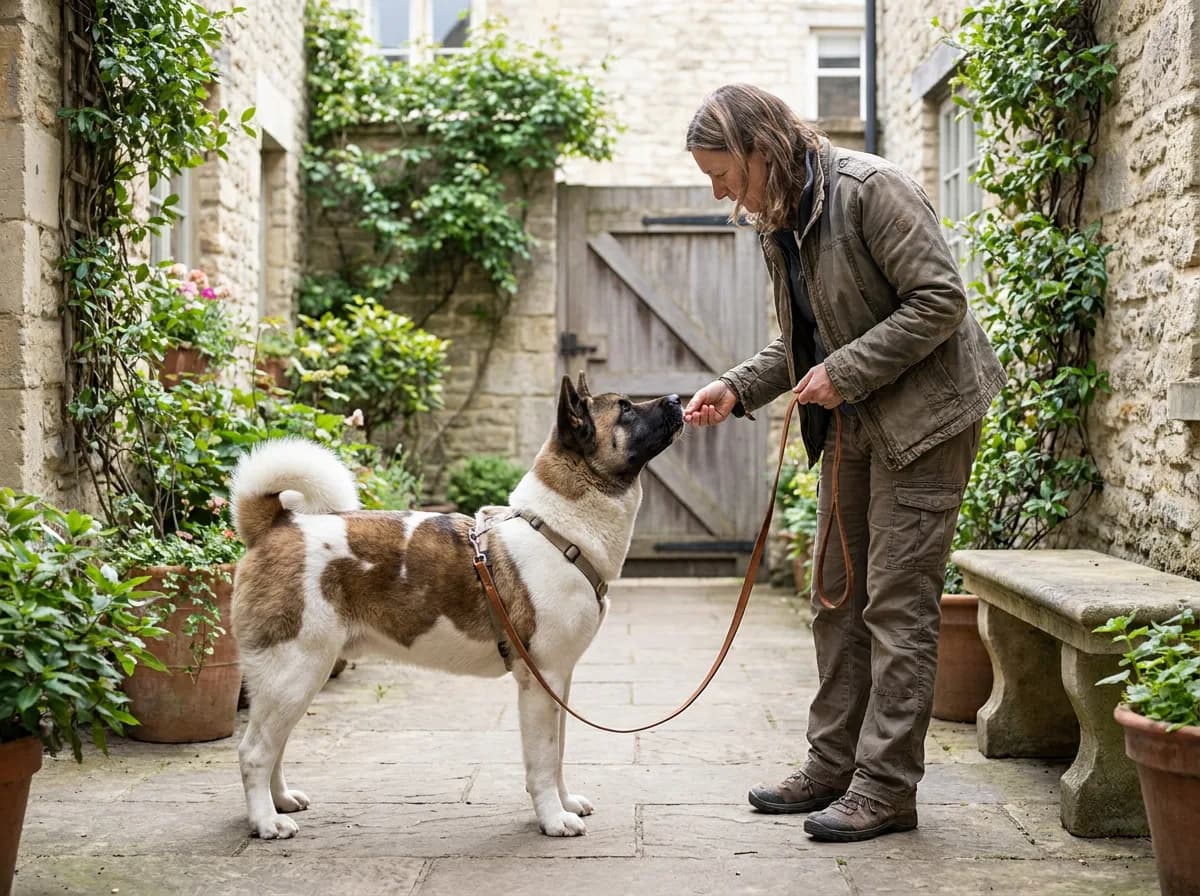
Make grooming and handling voluntary
Handling is a training task in its own right. Brushing, looking at teeth, touching paws, and putting on equipment involve close contact. Start at a point where the dog can remain comfortable. A dog that accepts shoulder touching may not yet accept a lifted paw or a brush moving through a tangle.
Offer brief contact, pause, and notice whether the dog remains engaged or moves away. Reward calm behavior without holding the dog in place to finish an arbitrary amount of work. Turning away, pulling a limb back, becoming still or tense, or trying to leave are reasons to stop and reassess the step.
| Task | Comfortable starting point | How to reward calm behavior | Signs of discomfort or a reason to pause |
|---|---|---|---|
| Mouth care | Brief touch near the cheek if welcomed | Reward and release before asking for more | Turning away, tension, resistance, or apparent pain |
| Paw care | Calm contact near the shoulder or leg before touching the paw | Reward a short comfortable step | Pulling away, stiffening, or trying to leave |
| Coat care | One gentle brush stroke in an area the dog accepts | Pause and reward participation | Flinching, guarding an area, or discomfort at a tangle |
| Walking equipment | Allow investigation before placing equipment | Reward voluntary approach and stillness | Avoidance, freezing, or resistance to contact |
| Veterinary handling preparation | Practice familiar easy steps at home | Keep practice brief and predictable | New discomfort, escalating concern, or handling beyond your ability |
The table is a starting framework, not permission to continue through resistance. If routine care cannot be completed comfortably, ask your veterinarian and an appropriate reward-based professional to help plan it. Needed treatment should not be delayed while you try to solve every handling problem alone.
A Jasper 360 Dog Finger Toothbrush may suit a dog already comfortable with gentle mouth handling. Ask your veterinarian about appropriate dental care and dog toothpaste. A finger brush is not an appropriate tool for pushing past resistance or putting your hand into the mouth of a dog that may bite.
Recognize when the task needs individual support
Seek help when the dog's responses are escalating, you cannot create enough distance, or ordinary care is becoming unsafe. Describe the actual sequence rather than assigning a motive: where the dog was, what approached, what the dog did, and how the incident ended. Include any recent health or household changes.
A useful professional plan should explain what to prevent now, which skills to teach, and how to judge progress. Ask how the professional handles a dog that is uncomfortable or cannot follow a cue. Avoid promises to establish dominance, guarantee protection, or solve a complex history in one confrontation.
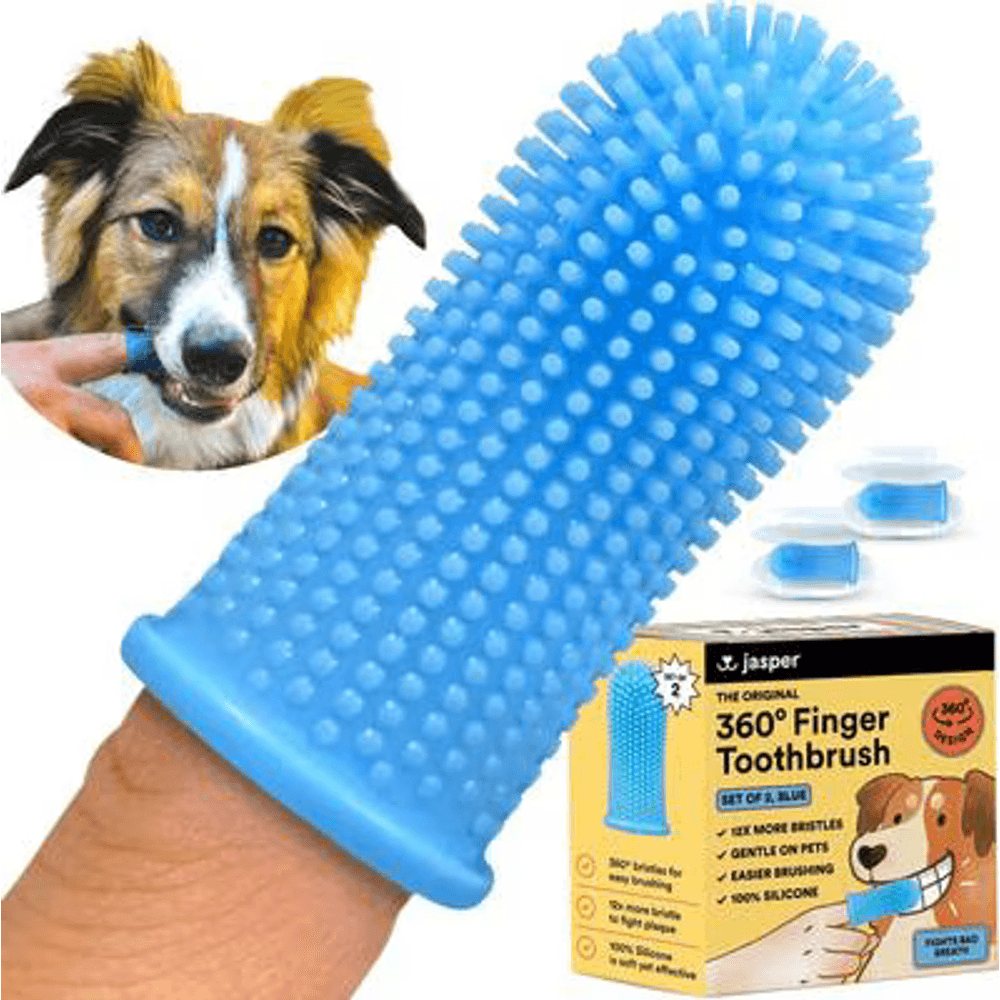
Consider this finger toothbrush for an Akita comfortable with mouth handling. Introduce brushing gradually and ask your veterinarian about suitable care.
Petful may earn a commission when you click through to Chewy, at no extra cost to you.
Akitas with children and family members
An Akita's attachment to its family does not make every child interaction comfortable. Children move unpredictably, may approach a sleeping dog, and can miss signs that an animal wants distance. Adults need to manage those situations rather than relying on the dog to be endlessly tolerant.
Supervision means an adult is available to notice and interrupt an unsuitable interaction. If you are cooking, answering the door, or occupied with another child, secure separation may be the more realistic choice. A dog resting comfortably behind a boundary is not missing a necessary bonding opportunity.
Teach rules a child can actually follow
Keep the rules concrete and age appropriate. “Be nice” is too vague to guide a child who thinks hugging is kindness. Show the child what to do instead, and arrange the space so that following the rules is possible.
- Leave the dog alone while it sleeps, eats, or uses its resting place.
- Keep faces away from the dog's face and avoid climbing, hugging, or pulling.
- Ask an adult before approaching, feeding, or playing with the dog.
- Call an adult if the dog takes a toy or another item rather than trying to retrieve it.
- Let the dog walk away without following it into a corner or resting area.
An adult can help a child participate through a simple, familiar activity when appropriate. The child might place a food reward where the adult directs or watch a brief training session from a comfortable distance. Participation should fit the child's abilities and the dog's current comfort, not a goal of making the child control the dog.
Plan for visiting children as well as your own
A dog accustomed to the children in its household has not necessarily had the same experience with their friends. A playdate can add noise, running, unfamiliar voices, and doors opening repeatedly. Decide where the dog will rest before the visit begins.
Explain the arrangement to the visiting adult and children without inviting them to test it. A closed door or suitable secure separation should protect the dog's area from accidental access. The plan should continue to work when the children become excited, not depend on everyone remembering a complicated set of instructions.
If a child is frightened of the dog, do not require a greeting to prove the Akita is friendly. Likewise, do not hold the dog still so a hesitant child can pet it. Comfortable distance and an ordinary activity elsewhere in the home may be the best outcome for that visit.
Make care possible for every regular adult
An Akita may respond differently to different caregivers because their handling and history differ. Give a new helper clear instructions about familiar cues, walking routes, resting areas, and known difficulties. Introduce routines while the regular caregiver is available to explain them.
Consider physical ability as well as affection for dogs. A person who can comfortably feed the Akita may not be able to manage it on a busy walk. Divide responsibilities honestly. Do not assume an older child can take over walking because the dog usually behaves well with an adult.
Family changes also affect the arrangement. A new baby, a relative moving in, or a caregiver recovering from illness can alter noise, access, and available attention. Prepare the separate spaces and backup care early. If the dog's behavior changes during that transition, address the specific difficulty instead of expecting loyalty to make adjustment automatic.
Is an Akita right for your household?
The downsides of owning an Akita are practical commitments: managing a large dog, allowing for possible conflict with other animals, arranging visitors carefully, maintaining grooming and training routines, and finding suitable care when you are away. None of those challenges means every Akita behaves the same way. They mean the household needs a plan that does not depend on unusually easy behavior.
Consider the ordinary week rather than the ideal weekend. Who opens the door when deliveries arrive? Who walks the dog when your usual handler is ill? Where can a visitor sit while the dog rests separately? If the answer repeatedly relies on someone physically overpowering the dog, the arrangement needs to change.
Include the cost of support
Budget for the care your individual dog needs, including veterinary attention, appropriate training help, suitable equipment, and a workable boarding or pet-care arrangement. The cheapest service is not useful if it cannot safely accommodate the dog.
A personalized Lemonade pet insurance quote can be one part of planning for eligible veterinary expenses. Review exclusions, waiting periods, deductibles, and reimbursement terms. Do not assume a policy covers training or behavior services without checking its actual terms.
Choose an adult with a documented history
Adult adoption can make some decisions more concrete because the dog already has a size and a history. It does not remove uncertainty. Ask the rescue or previous caregiver what was directly observed, what came from an earlier owner, and what remains unknown.

Compare coverage choices for your pet, then request a quote directly on Lemonade.
- Check a price for your pet
- Review available coverage choices
- See the terms before you decide
Eligibility, waiting periods, limits and exclusions apply.
Petful may earn a commission when you click through to Lemonade, at no extra cost to you.
“Good with dogs” needs context. Find out whether that means living with one familiar dog, walking calmly past dogs at a distance, or enjoying unfamiliar dogs in a shared space. Those are different experiences. Similarly, ask which children the dog has lived with, their ages, and what supervision was required.
- 1Request a documented behavior history and distinguish observations from unknowns.
- 2Confirm that regular caregivers have the adult handling capacity the dog needs.
- 3Arrange secure separation for visitors, resting, and other animals when necessary.
- 4Identify veterinary and reward-based training support before a difficult situation becomes urgent.
Ask about events that affect your decision:
- Any bite or near-bite history, including the circumstances and who was involved.
- Responses to unfamiliar people, children, dogs, cats, and wildlife.
- Comfortable and uncomfortable grooming or veterinary procedures.
- Behavior when left alone and the arrangement used.
- Medications, veterinary findings, or professional behavior support already in place.
A single meeting is not a complete temperament test. A dog may behave differently as it settles into a new home. Make the first days manageable: a quiet arrival, clear resting space, a predictable route outdoors, and introductions that can be delayed rather than compressed into one busy afternoon.
Akita size and measurements
The size of an Akita affects which management plans are realistic. Gates, transport, walking equipment, and assistance during illness must suit the adult dog, not the puppy you first met. Our Akita size and measurement guide explains adult dimensions and measurement. Assess the regular handler's balance, strength, and confidence alongside equipment fit rather than assuming a product solves a physical mismatch.
Clarify the adoption arrangement
Ask what support remains available after placement. Who should you contact if the dog struggles with an introduction, handling task, or being left alone? Discuss any trial or return terms directly with the organization before bringing the dog home. Knowing the arrangement helps you respond promptly if the placement reveals needs the household cannot safely meet.
A foster caregiver may be able to describe the dog's routine in more detail than a brief shelter meeting allows. Ask which parts of that routine you can preserve initially, including rest, walks, feeding, and contact with other animals. Familiar arrangements can make the transition easier to organize without guaranteeing a particular outcome.
Be candid about limitations. Describe your other pets, visiting children, housing, regular absences, and who will provide care. Withholding a difficulty to obtain approval can undermine the match. An organization needs accurate information to help choose a dog whose known needs are compatible with the household.
Match expectations before making the commitment
An Akita may be a poor match if your household expects every dog to enjoy crowded events, unrestricted play with unfamiliar dogs, or frequent close contact from visitors. That mismatch should be acknowledged before adoption, rather than blamed on the dog afterward.
Agree on responsibilities among the people who will provide care. A clear routine is difficult to maintain if one person allows doorway rushing while another tries to teach calm exits, or if visitors are invited to touch a dog that someone else is trying to give space. Shared expectations should be practical enough for every caregiver to follow.
Guarding behavior and visitors
An Akita guard dog reputation can create misleading expectations. Being alert to unfamiliar activity does not mean the dog will distinguish a genuine threat from an ordinary visitor in the way a person would. Do not encourage suspicion or rehearse confrontations to make a pet more protective.
An Akita attack dog label, stories about Akita attacks, or videos framed as a Japanese Akita attack do not provide a useful household plan. Focus on preventing unsafe encounters and teaching manageable alternatives. The relevant question is what the dog does when someone arrives and how you can keep that situation controlled.
Prepare before opening the door
Arrange visitor separation before the arrival, not after the dog is already at the doorway. Choose a comfortable area with a secure boundary and a route that lets the visitor enter without passing through the dog's space. A baby gate is only useful if it actually contains that individual dog.
Tell the visitor what to expect. They should not reach over a barrier, stare at the dog, or try to win it over by approaching repeatedly. Some visits can take place entirely with the dog resting separately. Greeting every guest is not a requirement for successful pet ownership.
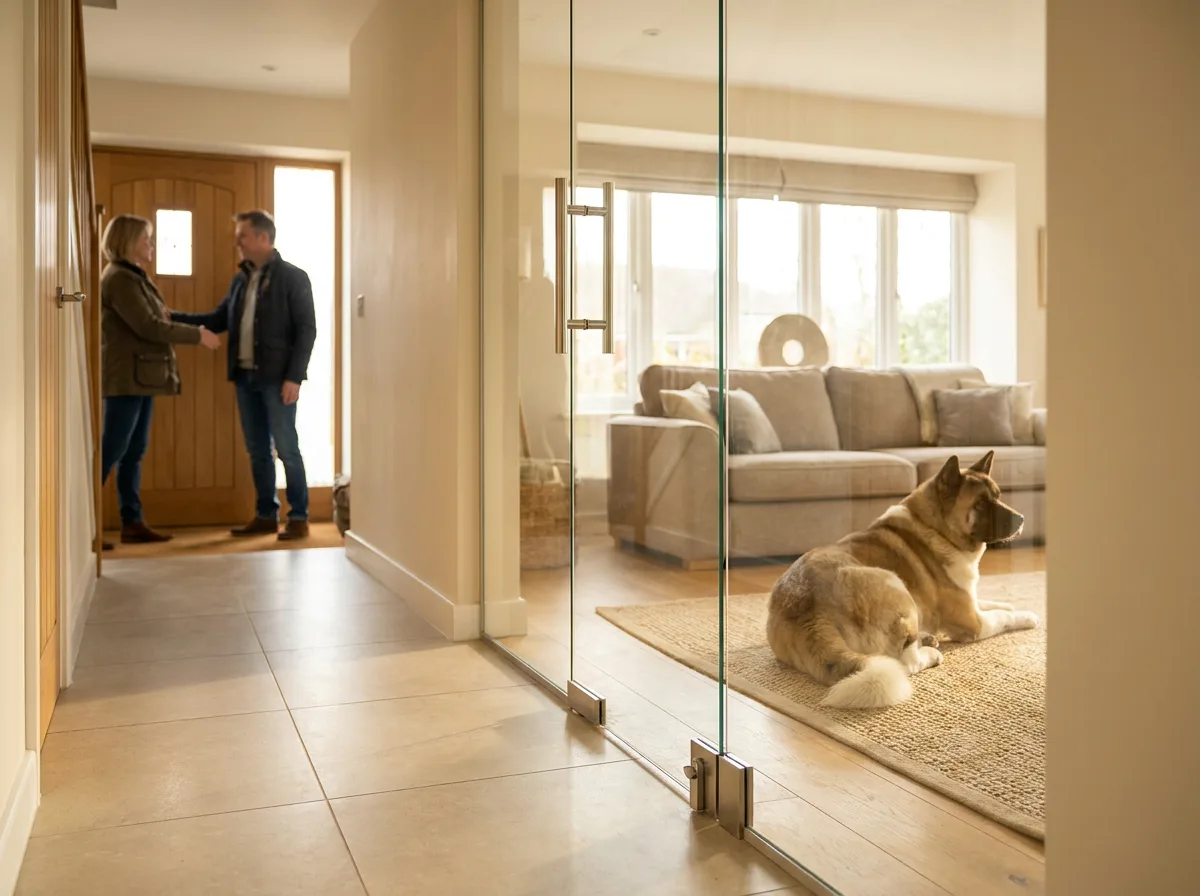
Turn an observation into a next step
Watch the whole situation rather than a single signal. Increased distance may help a dog that is staring, stiffening, withdrawing, or unable to disengage. Do not interpret a tail movement alone as permission to approach. When you are unsure, keep the encounter easier and seek guidance.
| Situation or behavior trigger | What to notice | Immediate management | Next useful step |
|---|---|---|---|
| Visitor arrival | Door rushing, tension, withdrawal, or difficulty disengaging | Arrange secure separation before opening the door | Practice a familiar resting routine without a visitor first |
| Another dog appears | Staring, pulling, stiffening, or inability to turn away | Increase to a comfortable distance and change direction | Build rewarded attention in easier settings |
| Handling discomfort | Turning away, flinching, pulling back, or resistance | Stop the handling step and avoid forced contact | Consider veterinary assessment and professional help |
| Resting dog is approached | Tension or avoidance when disturbed | Leave the dog undisturbed and protect its resting area | Teach household members to call rather than physically move the dog |
| Sudden behavior change | A new response in a previously comfortable situation | Prevent repeated triggering and note what changed | Arrange veterinary assessment and appropriate professional help |
If the dog can comfortably remain at a distance, reward calm behavior without making interaction the next compulsory step. Progress may mean a quiet visit behind a boundary, not eventually removing every boundary. Choose goals that meet the household's needs while respecting the dog's response.
Rehearse the household routine without a visitor
Teach the route to the resting area during ordinary, quiet moments. Give the dog a familiar cue, reward arriving there, and practice brief comfortable stays while household members move around. Add difficulty gradually. A doorbell, an opening door, and a stranger entering are separate challenges, not one simple exercise.
Keep practical details consistent. Place walking equipment where you can reach it, check the separation before opening the entrance, and make sure children cannot accidentally release the dog. If the home cannot provide a secure arrangement, visitor management needs professional input rather than improvisation.
Unexpected arrivals deserve the same preparation. A delivery, repair appointment, or visiting child may leave less time to explain the routine. Use the secure arrangement first and discuss introductions only once the situation is stable. Do not ask a worker or guest to take part in training they did not agree to perform.
Other dogs, cats and prey drive
Are Akitas aggressive? Some individuals show aggression in particular situations, and the breed standard specifically acknowledges possible intolerance of other dogs, especially same-sex dogs. That warrants careful assessment. It does not tell you that every encounter will end badly or that every Akita can learn to enjoy unrestricted contact.
Prey drive also matters when considering cats, wildlife, and smaller animals. Calm behavior toward one familiar animal does not establish a reliable response to a different animal running nearby. Keep opportunities for chasing from becoming an experiment in whether the dog will stop.
Introductions should leave room to retreat
When a professional or knowledgeable caregiver considers an introduction appropriate, begin with enough space that each dog can move with its own handler. A parallel outing may offer more control than bringing two dogs together in a narrow doorway. The distance should reflect the dogs' responses rather than a fixed rule.
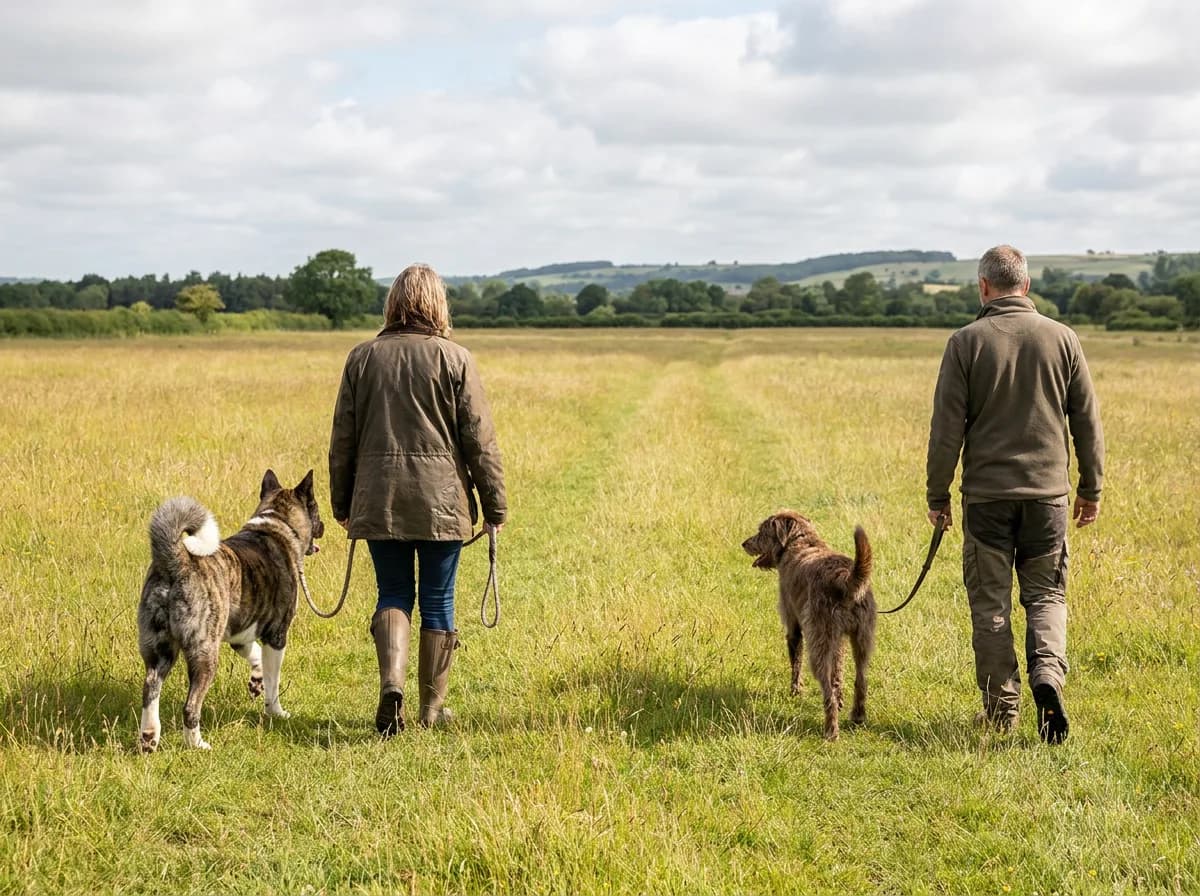
Observe whether both dogs can disengage, move normally, and respond to their handlers. If either becomes fixated, tense, or overwhelmed, create more space or end the session. A quiet parallel walk does not automatically justify immediate off-lead play or shared access to food and resting places.
For a household introduction, plan the separate spaces first:
- Feed separately when needed and remove competition over food during introductions.
- Provide resting areas where each animal can remain undisturbed.
- Control access through narrow doorways and other crowded spaces.
- Keep a realistic option for continued separation if the animals are not compatible.
Prevent conflict instead of testing toughness
Akita dogs fighting is a welfare and safety problem, not a demonstration of character. Videos labeled American Akita fighting or Japanese Akita fighting do not show the full history or establish how your dog will behave. Do not allow a confrontation to continue so that dogs can supposedly settle their status.
If there has been a fight or a serious near miss, stop repeating the arrangement that allowed it. Use secure separation and seek individual professional advice. Assess any possible injuries with a veterinarian. Do not put yourself between fighting dogs or grab at their mouths in an attempt to prove control.
For cats, ask what “cat friendly” actually means. Has the dog shared living space with a cat, or merely seen one behind a barrier? Was chasing observed? Could the cat move freely without pursuit? Give the cat routes and resting places that do not require passing close to the dog, and maintain separation whenever you cannot supervise an appropriate introduction.
Socialization has a purpose and limits
The aim is to help the dog experience ordinary surroundings at a manageable level, not to maximize the number of close encounters. Watching another dog from a comfortable distance can be useful practice. Being surrounded by unfamiliar dogs is not automatically beneficial simply because it involves exposure.
Continue management even when training is progressing. The dog may cope differently when tired, uncomfortable, crowded, or surprised. Good experiences do not create a guarantee, but they can help you identify the conditions in which the dog is most comfortable and responsive.
Akita mixes and ancestry
A shepherd and Akita mix may inherit traits associated with either parent, but the label does not provide a dependable temperament formula. Appearance cannot tell you how that dog will respond to visitors or other pets. Our Akita mixes and ancestry guide explains the limits of cross labels. For a mixed dog, use the same individual history, observation, and household-fit questions rather than assuming the other parent makes management easier.
Behavior changes that need professional help
Behavior history gives you a baseline. A new reluctance to climb into the car, discomfort when a particular area is touched, unusual withdrawal, or a change in reactions to familiar people deserves attention. These observations do not identify a diagnosis, but they can help a veterinarian decide what to assess.
Do not assume every change is “just an Akita being an Akita.” Equally, avoid diagnosing a medical condition from a single behavior or an online checklist. Describe what has changed and allow the clinical assessment to guide the next step.
Bring useful observations to the appointment
Record everyday events without provoking the dog. Note the setting, the action immediately before the response, what the dog did, and how long it took to return to its usual routine. Include any changes in movement, eating, sleeping, medication, or the household.
- Say “pulled away when the left paw was touched” rather than “became dominant.”
- Say “barked when the visitor entered the hallway” rather than “hates people.”
- Explain what was different from the dog's usual response.
- Tell the veterinarian if an examination or transport may be difficult so the visit can be planned.
Medical assessment and training support can serve different parts of the same problem. The veterinarian can assess potential health contributors; a suitable behavior professional can help arrange management and teach achievable skills. Improvement in one setting does not mean every precaution should immediately disappear.
If an incident involved a bite or a serious attempt to bite, prevent a repeat encounter and seek individualized advice. Keep children and other vulnerable people away from the triggering situation. Do not recreate the incident for a video or ask another person to test whether the dog does it again. The next useful step is a supported plan, not more evidence collected through confrontation.
Akita temperament questions
In everyday practice, give the dog space and reward calm behavior. The answers below explain what that approach can and cannot establish about an individual Akita.
An Akita may show a guarding tendency, but there is no protection guarantee. A pet's response to an unfamiliar or frightening event cannot be promised from breed alone. Choose a companion whose needs you can meet, and prioritize calm management rather than encouraging confrontation or expecting the dog to make human safety decisions.
Barking varies with individual triggers, surroundings, and routine. Identify barking triggers by noting what happens immediately before the sound and what helps the dog settle. Changes in barking deserve attention, especially when accompanied by other changes in behavior or health. A reputation for being quiet is not a guarantee that an individual dog will rarely vocalize.
Owner-directed behavior has context; it should not be explained as a dog suddenly betraying its family. A pain or fear assessment, handling history, and the circumstances of an incident can all matter. Prevent another triggering encounter and obtain veterinary and qualified behavior support rather than confronting the dog to test trust.
An adult dog can learn through gradual reward-based practice, with individual support matched to its history and current abilities. Start with achievable skills and measure progress in specific situations. New learning can improve daily life without promising that the dog will become comfortable with every person, animal, or type of handling.

Coreen Saito is a pet writer and longtime shelter volunteer with more than a decade in animal rescue. She covers cat behavior, breed care, and the small, ordinary science of sharing a life with companion animals, with a particular focus on honest takes about the products and decisions that actually matter. At home in Arizona, she's outranked by Mac (a dog with the loudest opinion in the house), Rebel (a cat who governs by quiet authority), and Meri (an orange tabby who runs the late shift and the laundry basket). She writes about all three, plus the rescues that keep coming through her life, at LifeWithMinty.com.
Sign up for expert-backed reviews and safety alerts all in one place.