Snowshoe Cat: The Complete Breed Guide to a Rare American Original
Everything about the snowshoe cat: its 1960s Philadelphia origin, signature white boots and inverted white V, dog-like temperament, colors, size, grooming, health, lifespan, and how rare and pricey one really is.
Petful is reader supported. As an affiliate of platforms like Amazon and Chewy, we may earn a commission when you buy through links on this page. There is no extra cost to you.
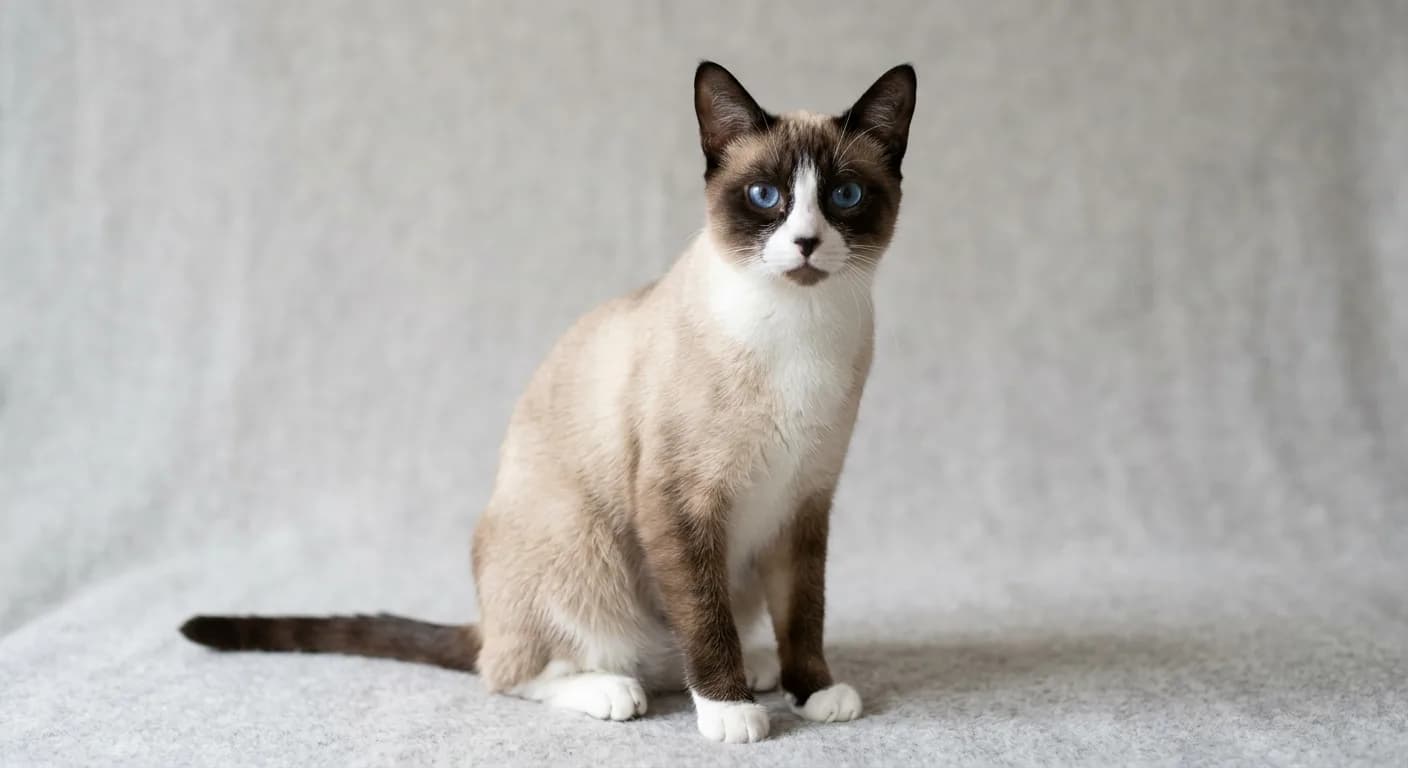
The International Cat Association (TICA) traces the snowshoe cat back to the early 1960s, when a Philadelphia breeder named Dorothy Hinds-Daugherty noticed three Siamese kittens born with four crisp white feet and decided that look deserved a breed of its own. More than sixty years later the snowshoe is still genuinely rare, and the reason you stop in your tracks when you meet one is the combination of three signatures arriving on a single cat at once: Siamese-style dark points on the ears, mask, legs, and tail, four white "snowshoe" boots on the paws, and an inverted white V splashed down the muzzle, all lit up by a pair of vivid blue eyes. This guide is the full profile: where the breed came from, what it looks like, how it behaves (think dog-like, talkative, and allergic to being alone), the colors and patterns, size, grooming, health and lifespan, how kittens develop from white to fully marked, and clear answers to every question buyers ask before they bring one home.
- 1The snowshoe is a rare American breed created in the 1960s by crossing a Siamese with an American Shorthair
- 2Its three signatures are pointed coloring, white "snowshoe" boots, and an inverted white V on the face, all with blue eyes
- 3Temperament is affectionate, dog-like, and vocal (but softer-voiced than a Siamese); these cats hate being left alone
- 4TICA gave the breed championship status in 1994 and the UK's GCCF granted full status in 2013, while the CFA still does not
- 5Snowshoe kittens are born pure white and develop their points and markings over the first weeks, reaching full color by about 2 years

Sign up for expert-backed reviews and safety alerts all in one place.
Snowshoe cat at a glance
Before the deep dive, here is the quick-reference card. Treat the numbers as typical ranges from the breed registries and major pet-health sources rather than guarantees, since an individual cat can sit outside any range.
| Trait | Detail |
|---|---|
| Origin | United States (Philadelphia), early 1960s |
| Parent breeds | Siamese x American Shorthair |
| Weight | Females about 7-10 lb, males about 9-12 lb (TICA) |
| Size | Medium to medium-large, muscular, rectangular build |
| Coat | Short, single coat with little to no undercoat |
| Colors | Pointed: seal, blue, chocolate, lilac, and more, always with white |
| Eyes | Always blue |
| Lifespan | Commonly 14-19 years |
| Temperament | Affectionate, social, dog-like, vocal but soft-voiced |
| Shedding | Low to moderate |
| Recognition | TICA (1994), ACFA (1982), GCCF (2013); not CFA championship |
- The breed is named for the white feet. Dorothy Hinds-Daugherty thought the white paws looked like the cat was wearing little snowshoes, and the name stuck. The white boots, not the points, are the trait the breed is built around.
Origin and history: a happy accident in 1960s Philadelphia
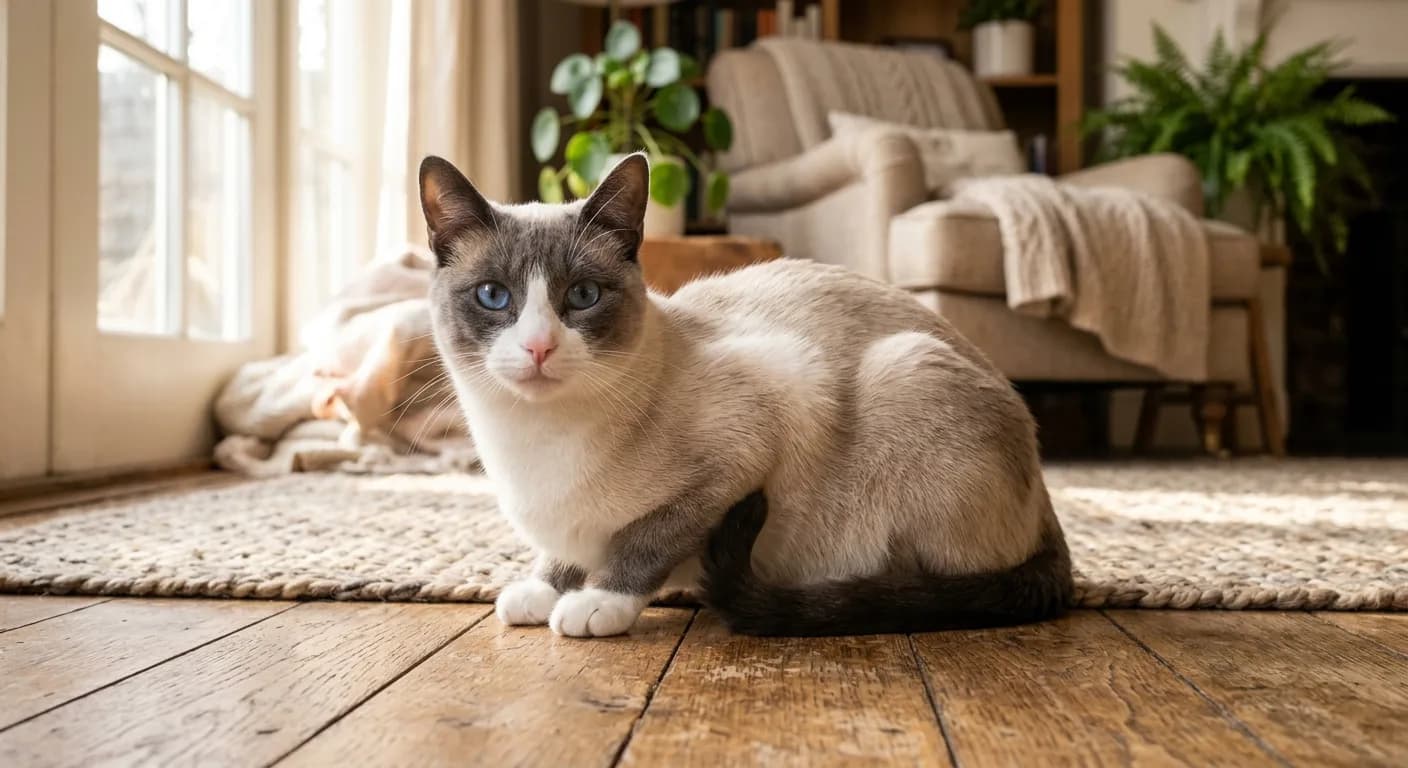
The snowshoe is one of the few cat breeds whose origin story is precisely documented. According to TICA, in the early 1960s a Siamese breeder in Philadelphia, Dorothy Hinds-Daugherty, found three kittens in a litter of Siamese that each had four white feet. Charmed by the contrast of dark points and white paws, she set out to fix that look as a repeatable breed. To do it she crossed her white-footed Siamese with an American Shorthair carrying tuxedo (black-and-white) markings, and over several generations she developed the breed's hallmark white feet plus the now-famous inverted white V on the face.
Progress was slow and nearly stalled. Interest in the breed dropped through the late 1960s and 1970s, and by 1977 there was reportedly only a single active breeder keeping the line alive. A second wave of breeders revived it in the 1980s, and by 1989 there were close to thirty documented snowshoe breeders. That fragile, stop-and-start history is a big part of why the snowshoe remains uncommon today. The breed standard is also demanding: getting the white boots and the facial V to land symmetrically is genetically unpredictable, so even careful pairings produce only a handful of "show-perfect" kittens. Rarity plus difficulty is the whole story.
How the registries recognize the snowshoe
Breed recognition for the snowshoe is split, and that split matters when you read a pedigree or a breeder's claims. The American Cat Fanciers Association (ACFA) recognized the snowshoe in 1982. The International Cat Association (TICA) accepted it as a championship breed in 1994. In the United Kingdom, the Governing Council of the Cat Fancy (GCCF) advanced the snowshoe to full breed status in 2013. The notable holdout among the big North American registries is the Cat Fanciers' Association (CFA), which does not grant the snowshoe championship recognition. So a "registered snowshoe" is almost always papered through TICA, ACFA, or the GCCF, not the CFA, and that is normal for the breed rather than a red flag.
Never Scoop Again® with the Whisker Litter-Robot, the smart self-cleaning automatic litter box. Monitor visits and track weights for better overall care in the Whisker® app. Multi-cat friendly.
Petful may earn a commission when you click through to Whisker, at no extra cost to you.
- A legitimate pedigreed snowshoe is typically registered with TICA, ACFA, or the GCCF. If a seller claims "CFA champion snowshoe," ask questions, because the CFA does not currently grant the breed championship status. No papers at all does not mean the cat is not snowshoe-like, only that it is not a registered, pedigreed member of the breed.
What a snowshoe cat looks like
The snowshoe is a study in contrast. Picture the elegant, color-pointed silhouette of its Siamese parent, then add the sturdier body of the American Shorthair and stamp on the white feet and facial V, and you have the breed in one sentence. Here is how the pieces break down.
The three signatures: points, boots, and the V
The pointed coat is the Siamese inheritance. The body stays pale while the ears, mask (face), legs, and tail carry a darker color, because the snowshoe shares the same temperature-sensitive colorpoint gene as the Siamese: the pigment-producing enzyme works best in the cooler extremities, so the points darken and the warm body stays light. Layered on top are the two traits that make a snowshoe a snowshoe rather than just a Siamese. First, the white boots: ideally four feet dipped in white, the front paws like mittens and the back legs like taller boots. Second, the inverted white V, a wedge of white that runs from between the eyes down over the muzzle. Getting both to appear cleanly and symmetrically is the breeder's holy grail and the reason perfectly marked snowshoes are scarce.
Body, head, and coat
Snowshoes are medium to medium-large cats with a deceptively solid, muscular body. ASPCA Pet Insurance describes them as medium-sized, athletic cats with a solid build, and major profiles place most snowshoes in a rectangular, well-balanced frame rather than the extreme tubular look of a modern show Siamese. The head is a modified wedge, slightly rounded, sometimes described as having an "applehead" softness compared with the sharp triangle of a Siamese. The coat is short, single-layered, and smooth, with little to no undercoat, which is part of why grooming is so easy. The GCCF notes the snowshoe coat is a single layer with no evidence of an undercoat and is usually smooth to the touch.
Eyes: always blue
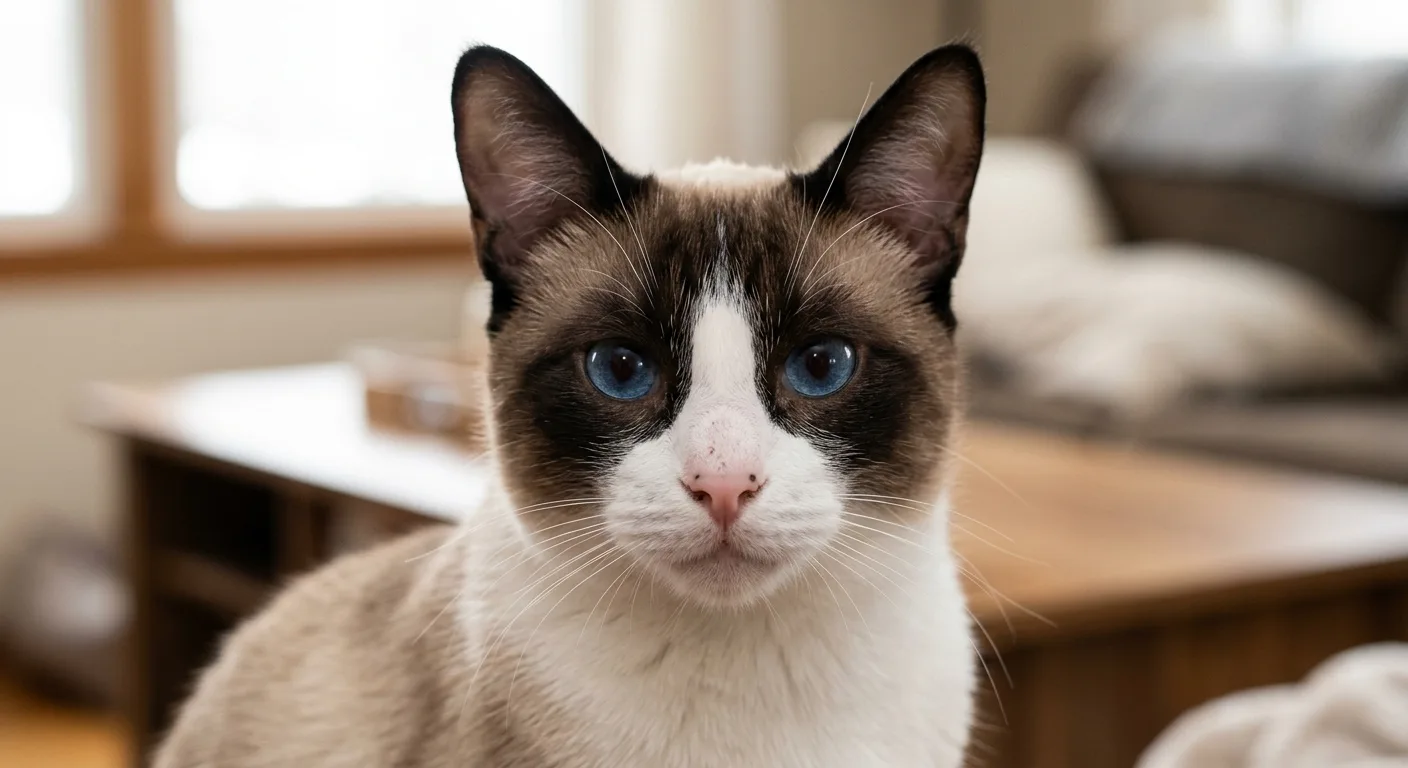
One trait is non-negotiable: the eyes are blue, ranging from a sparkling deep blue to a softer blue-grey. TICA describes snowshoe eyes as blue, and a rich blue is prized. If a cat marketed as a snowshoe has green, gold, or copper eyes, that is a strong sign it is a snowshoe-type mixed cat rather than a pedigreed, traditionally pointed snowshoe. For the deeper Siamese connection behind those blue eyes and pointed genes, see our guide to the snowshoe and its Siamese ancestry.
Snowshoe cat colors and patterns
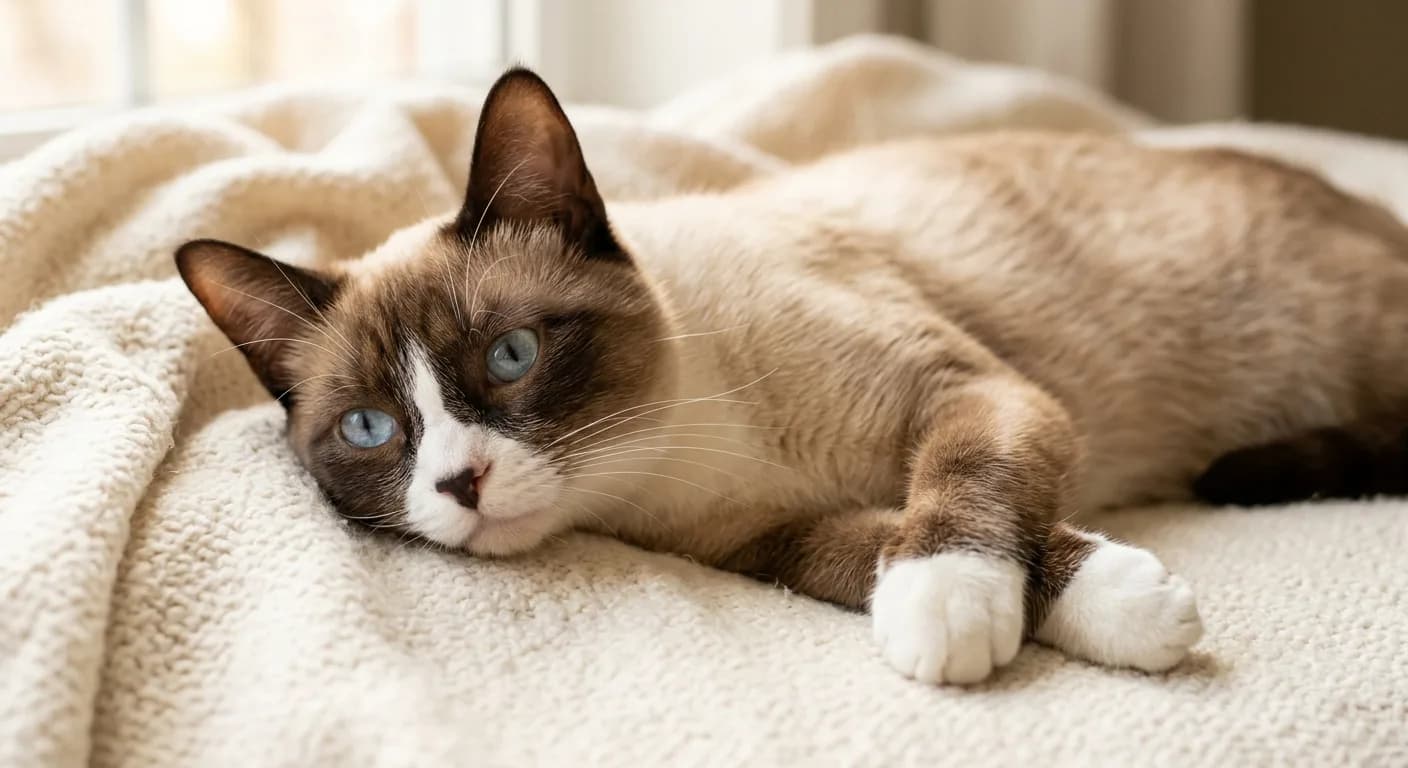
Because the snowshoe carries the same colorpoint genetics as the Siamese, its palette is built on point colors, always combined with white. The two you will see most often by far are seal point (dark cool brown points over a cream body) and blue point (soft slate-grey points over a bluish-white body). Beyond those, the breed also appears in chocolate, lilac, and, in some registries and breeding lines, the warmer red (flame) and cream points, plus lynx (tabby) point variations that add striping to the points. Every one of these always pairs with the white boots and, ideally, the facial V.
A quick caution on terminology: snowshoe color rules vary by registry, and some associations recognize a tighter set of colors than others. The constant across all of them is that the cat is pointed and has white feet. For the full visual breakdown of every shade and how rare each one is, see our dedicated guide to snowshoe cat colors. Because the breed descends from the Siamese, the parent breed's own palette is a useful reference too, which you can explore in our guide to Siamese cat colors.
- Seal and blue points dominate the snowshoe just as they do the Siamese, because both colors are genetically "easy." Chocolate and lilac are rarer because they ride on recessive genes. The white boots and V are layered on top of whatever point color the cat carries.
Snowshoe cat personality and temperament
If the looks get people in the door, the personality is what makes snowshoe owners obsessive. This is an affectionate, intensely people-oriented cat that bonds hard, usually choosing one favorite human while still being warm with the whole household. TICA describes the breed as uncannily intelligent, amusing, and loyal, and the GCCF flatly calls a well-socialized snowshoe an ideal all-round cat that readily accepts other cats, dogs, and children.
Dog-like, trainable, and busy
Snowshoes act a lot more like dogs than the aloof-cat stereotype. They tend to follow their person from room to room, greet visitors, come when called, and many can be taught to fetch or walk on a harness. They are smart and need engagement, so puzzle feeders, climbing space, and interactive play keep that clever brain from inventing its own (often mischievous) entertainment. For a fuller dive into quirks, energy level, and what daily life with one is actually like, see our deep dive on snowshoe cat personality.
Vocal, but softer than a Siamese
Snowshoes inherited the Siamese love of conversation, but the volume is dialed back. They are chatty and will "talk" to you throughout the day, yet their voice is generally softer, more melodic, and less piercing than the famously loud Siamese yowl. Owners often describe it as commentary rather than complaint. If you adore the Siamese personality but want it a notch quieter, the snowshoe is frequently the answer; you can compare the two temperaments directly in our guide to Siamese cat personality.
The water thing, and the need for company
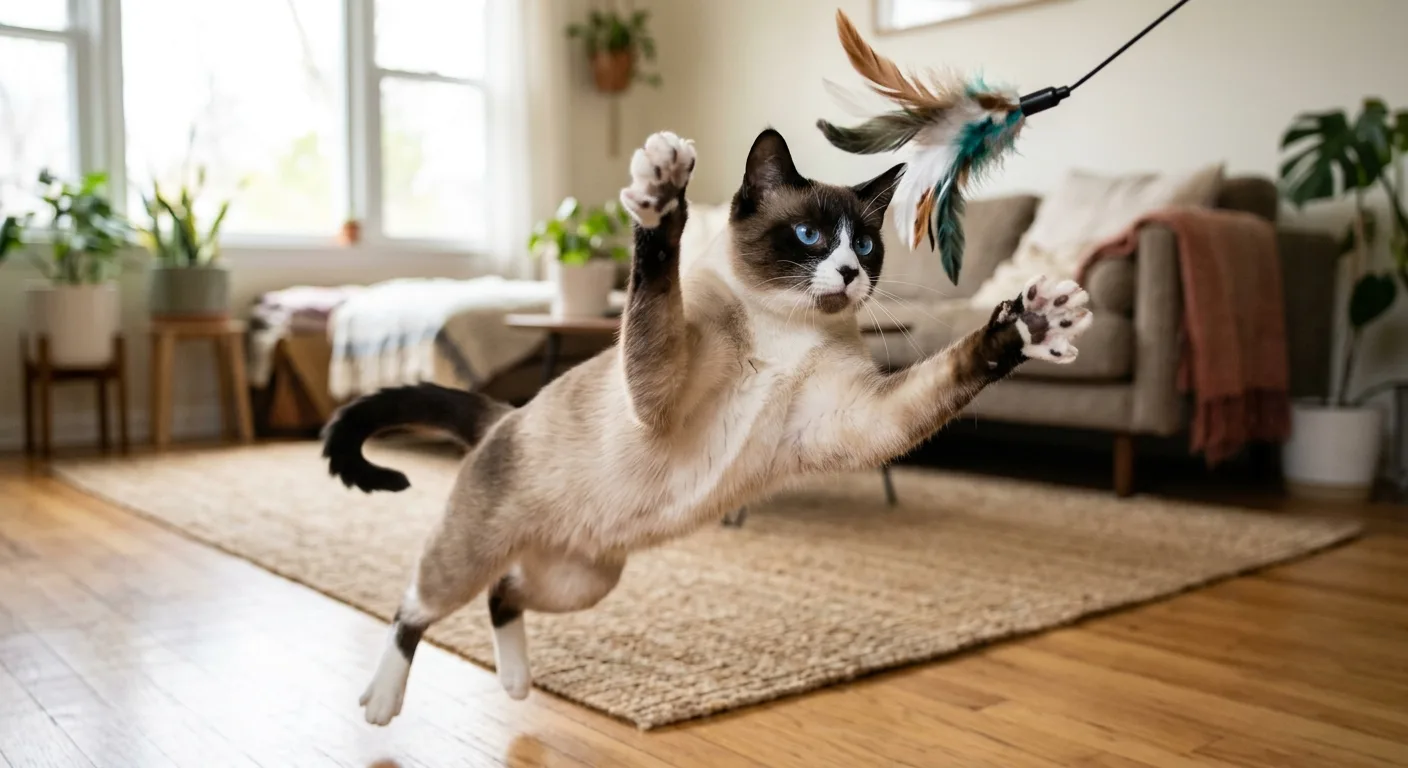
Two more snowshoe traits surprise new owners. First, a lot of them love water: dripping faucets, the shower edge, a hand splashing in a bowl. It is a common (though not universal) quirk in the breed. Second, and more important, snowshoes do not do well alone. Because they are so bonded and social, a snowshoe left by itself for long stretches every day can become stressed, anxious, or destructive. They are best matched with a home where someone is around much of the day, or where a second pet provides company.

63-inch multi-level cat tree with scratch posts, hammock, plush perches, and dangling toys. Vertical territory is non-negotiable for high-energy climbing breeds like the Bengal.
Petful may earn a commission when you click through to Chewy, at no extra cost to you.
- Snowshoes are highly social and can develop anxiety or separation-related behavior problems if isolated for long hours daily. If your household is empty most of the day, plan for a feline or canine companion, plenty of enrichment, and dependable midday company before choosing this breed.
Snowshoe cat size and growth
Snowshoes are a solid medium-sized breed, heavier in the hand than they look thanks to that muscular American Shorthair build. Per TICA, females typically weigh about 7 to 10 pounds and males about 9 to 12 pounds, and ASPCA Pet Insurance puts the breed broadly at 7 to 12 pounds. They are slow to finish: like many pointed breeds, a snowshoe keeps filling out and deepening in color past the kitten stage, often not reaching full adult size and final coat color until close to 2 years old.
| Measure | Female | Male |
|---|---|---|
| Typical weight | About 7-10 lb | About 9-12 lb |
| Build | Medium, muscular, rectangular | Medium-large, muscular, rectangular |
| Full size reached | Around 18-24 months | Around 18-24 months |
Grooming and care
Good news for low-maintenance households: the snowshoe is one of the easier purebreds to keep looking sharp. The short, single coat with little undercoat means shedding is low to moderate and grooming is minimal. A weekly once-over with a brush or grooming glove removes loose hair and keeps the coat glossy; during light seasonal shedding you can bump that up. Beyond the coat, follow the standard cat-care basics that breed-care guides recommend: keep the nails trimmed, check and gently clean the ears, and brush the teeth regularly, since dental disease is a documented snowshoe concern (more on that below).
Because snowshoes are so smart and so social, "care" for this breed is at least as much mental as physical. Daily interactive play, vertical space to climb, and food puzzles are not luxuries; they are how you prevent a bored, attention-starved snowshoe from redecorating your home. Feed a complete, life-stage-appropriate diet and keep an eye on the scale, as a muscular cat can quietly tip into overweight if play drops off.
- Coat care is genuinely easy: a weekly brush, nails every few weeks, ears checked, teeth brushed. The bigger daily job is enrichment. A snowshoe that gets play and company is a calm snowshoe; one that gets neither will find its own (louder) hobbies.
Snowshoe cat health and lifespan
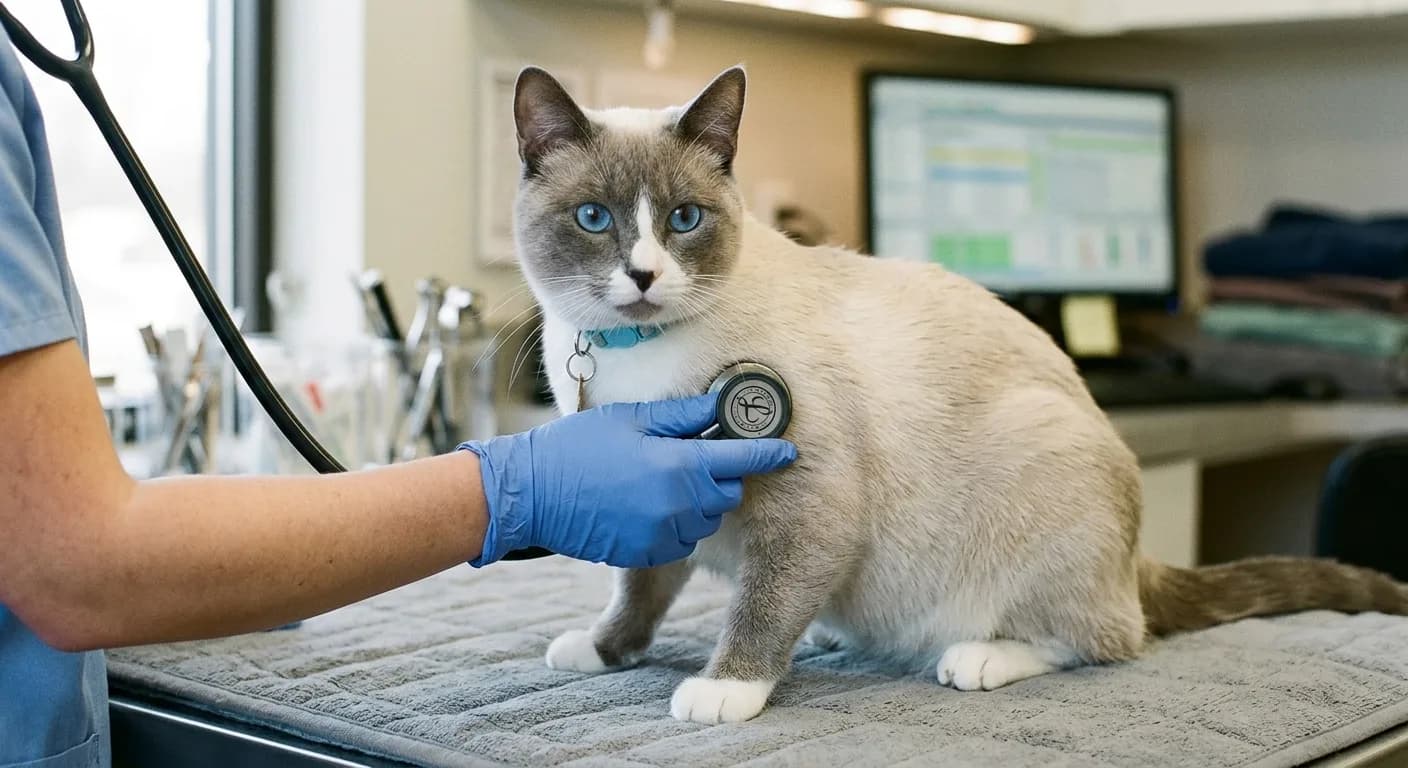
Snowshoes are generally healthy, sturdy cats, and a well-bred one from a responsible breeder can be a long-lived companion. Most US breed-health sources put the typical snowshoe lifespan at roughly 14 to 19 years, with some individuals reaching their early twenties; the UK's GCCF gives a more conservative average of about 9 to 15 years. As with any cat, the real levers on lifespan are indoor living, a good diet, healthy weight, dental care, and regular veterinary checkups.
Because the breed descends from the Siamese and the American Shorthair, it can inherit a handful of conditions associated with those lines. The ones most worth knowing about:

108-oz stainless steel pet fountain with quiet pump and water-level window. Bengals are notoriously water-obsessed; a flowing fountain encourages hydration and pulls them away from sinks and toilets.
Petful may earn a commission when you click through to Chewy, at no extra cost to you.
- Hypertrophic cardiomyopathy (HCM): the most common heart disease in cats overall, in which the heart muscle thickens. A breed-specific genetic test has not been developed for snowshoes, so periodic cardiac screening by a veterinarian is the practical safeguard.
- Polycystic kidney disease (PKD / AD-PKD): an inherited condition seen in some Siamese-related lines in which fluid-filled cysts form in the kidneys. Reputable breeders screen breeding cats.
- Periodontal (dental) disease: snowshoes, like many cats, are prone to gum and tooth disease, which is why routine dental care and brushing matter.
- Crossed eyes and a kinked tail: harmless cosmetic throwbacks to the Siamese ancestry that show up occasionally. Vet sources note these do not cause pain or shorten lifespan, though crossed eyes can slightly affect peripheral vision.
- The single biggest health decision you make happens before you bring the cat home. Choose a breeder who screens breeding cats for HCM and PKD and is transparent about results, or, if you adopt a snowshoe-type cat, budget for a thorough vet workup. No coat color or marking pattern makes a cat immune to these inherited risks.
From white kitten to fully marked adult
One of the most charming facts about the snowshoe is that the kittens are born almost pure white. This traces straight back to the colorpoint gene: in the uniformly warm environment of the womb the pigment enzyme never switches on, so newborns arrive white all over with no points and no markings. TICA describes snowshoe kittens as born totally white, with the point coloring beginning to develop within a few weeks as the tail, legs, head, and ears gradually darken.
The white boots and the facial V emerge on their own timeline as the points come in, and because the breed matures slowly the full, settled pattern is not visible until the cat is well into its second year. That slow reveal is exactly why responsible breeders rarely promise a "show-quality" kitten at eight weeks: you genuinely cannot see the final markings yet. It is also a useful tell for buyers, because a very young "snowshoe" already showing dark, fully developed points and crisp markings is unusual and worth a second look.
- Snowshoe kittens are white at birth because the colorpoint pigment only develops in cooler body zones, and the womb is warm. Points and the white V appear over the first weeks and keep deepening, reaching final color around 2 years. A photo of a pale kitten is not the cat you will have at maturity.
How rare is the snowshoe, and what does one cost?
The snowshoe is widely described as a rare breed, and that label is earned on two fronts. First, the population is small: the breed nearly died out in the 1970s and has always had a limited pool of dedicated breeders. Second, the standard is hard to hit, because the white boots and symmetrical facial V are genetically unpredictable, so each litter yields only a few cats with textbook markings. Together that keeps both supply and "perfect" examples scarce.
On price, a pedigreed snowshoe from a reputable breeder generally runs higher than a random-bred cat, with show-or-breeding-quality kittens commanding the most because of their markings and lineage. Prices vary widely by region, breeder, and quality, so rather than fixate on a single number, read our detailed snowshoe cat price breakdown for current ranges and what drives them. Adoption is also a real option: snowshoe-type cats and snowshoe mixes do turn up in shelters and rescues, usually at a fraction of breeder pricing, and many have the full personality even without the papers.

Color-changing crystal litter that flags pH shifts in your cat's urine, an early warning sign of UTIs, kidney issues, and more.
Petful may earn a commission when you click through to Chewy, at no extra cost to you.
Snowshoe versus the look-alikes
Snowshoes get confused with several other blue-eyed, pointed, or white-marked breeds. Here is how to tell them apart at a glance, which also doubles as a guide to whether the snowshoe is the right pick for you.
| Breed | Coat length | Key tell vs the snowshoe |
|---|---|---|
| Snowshoe | Short | Pointed, white boots, inverted white V, blue eyes, muscular medium body |
| Siamese | Short | Pointed and blue-eyed but no white boots or V, finer and more angular, louder voice |
| Ragdoll | Long | Larger and long-haired; mitted Ragdolls have white feet but a plush coat and softer build |
| Birman | Long (semi) | Long silky coat with white "gloves," but a different head and no inverted facial V |
The closest relationship is with the Siamese, which is the snowshoe's direct ancestor; the white feet and facial V are the quickest way to separate the two. If you are torn between the elegant points of a Siamese and the playful Siamese-adjacent breeds, our comparisons of the full Siamese breed profile and the gentler Tonkinese, a Siamese-Burmese cross, are good next reads. People drawn to the warm orange points sometimes also look at the flame point Siamese and the tabby-striped lynx point Siamese, both of which share genetics with the snowshoe's own red and lynx variations.
- Two questions settle most "is it a snowshoe?" debates. Does it have white feet? And does a white V run down the face between blue eyes? Pointed coat plus white boots plus the V plus blue eyes points to snowshoe; pointed coat with colored feet and no V points to Siamese.
Is a snowshoe cat right for you?
A snowshoe is an outstanding fit for a household that wants an interactive, affectionate, dog-like companion and can give it daily attention and company. It rewards you with loyalty, conversation, easy grooming, and a striking look. It is a poor fit if the cat would be home alone for long hours every day, or if you want a quiet, independent, low-interaction pet. If the snowshoe's people-first temperament appeals but you are still breed-shopping, our wider Siamese cat mixes guide walks through other pointed, sociable options worth weighing.
- 1Choose a snowshoe if you want an affectionate, trainable, talkative cat and someone is home much of the day
- 2The white boots plus the inverted white V plus blue eyes are the trio that separates a snowshoe from a plain Siamese
- 3Grooming is minimal, but enrichment and companionship are non-negotiable
- 4Buy from a TICA, ACFA, or GCCF breeder who health-screens, or adopt a snowshoe-type cat with a vet workup
- 5Expect a white kitten that slowly reveals its points and markings, reaching full color near age 2
Frequently asked questions about the snowshoe cat
Two reasons. The breed nearly died out in the 1970s (down to a single breeder by 1977) and has always had a small pool of dedicated breeders, so the population is limited. On top of that, the signature white boots and the symmetrical inverted white V on the face are genetically unpredictable, so even careful pairings produce only a few kittens with textbook markings. Small numbers plus hard-to-hit markings keep the snowshoe scarce.
A pedigreed snowshoe from a reputable breeder generally costs more than a random-bred cat, and show or breeding quality kittens with the best markings and lineage command the most. Prices swing widely by region, breeder, and quality, so see our snowshoe cat price guide for current ranges. Adopting a snowshoe-type cat or mix from a shelter or rescue is usually far cheaper and is a great option.
The snowshoe is unique for stacking three rare traits on one cat: Siamese-style pointed coloring, four white "snowshoe" boots, and an inverted white V down the face, all with blue eyes. Personality-wise they are uncannily dog-like, following their person around, greeting guests, learning tricks, often loving water, and "talking" in a voice that is softer and more melodic than a Siamese.
Snowshoes are generally healthy but can inherit conditions from their Siamese and American Shorthair ancestry. The main ones are hypertrophic cardiomyopathy (HCM), polycystic kidney disease (PKD), and periodontal (dental) disease. Some also show harmless Siamese throwbacks like crossed eyes or a kinked tail, which do not cause pain or shorten life. Buying from a breeder who screens for HCM and PKD lowers the risk.
Most US breed-health sources put the snowshoe's typical lifespan at about 14 to 19 years, with some cats reaching their early twenties. The UK's GCCF gives a more conservative average of around 9 to 15 years. Indoor living, a good diet, healthy weight, dental care, and regular vet checkups are what push a snowshoe toward the high end of the range.
No. No cat is truly hypoallergenic, and the snowshoe is not an exception. Cat allergies are driven mainly by the Fel d 1 protein in saliva and skin, not by hair length, so even this short, single-coated, low-shedding breed produces allergens. Low shedding may mean slightly less hair-borne dander around the home, but sensitive people can still react.
The snowshoe descends from the Siamese and shares its pointed coat and blue eyes, but it adds two things the Siamese does not have: white feet (the "snowshoes") and an inverted white V on the face. The snowshoe also has a sturdier, more muscular body, a rounder head, and a softer, quieter voice than the famously loud and angular Siamese.
Yes, by several. The American Cat Fanciers Association (ACFA) recognized the snowshoe in 1982, The International Cat Association (TICA) gave it championship status in 1994, and the UK's Governing Council of the Cat Fancy (GCCF) granted full status in 2013. The major exception is the Cat Fanciers' Association (CFA), which does not currently grant the snowshoe championship recognition.
Rarity rankings vary, but breeds frequently named among the rarest include the Sokoke, the Kurilian Bobtail, and the LaPerm, with others like the American Wirehair and the Norwegian Forest Cat's relatives sometimes cited. The snowshoe itself is widely considered a rare breed for the same reasons covered above: a small breeder pool and hard-to-reproduce markings.
Yes. Snowshoe kittens are born almost pure white because the colorpoint pigment only develops in the cooler parts of the body and the womb is uniformly warm. The points and the white V begin to appear within the first few weeks as the ears, mask, legs, and tail darken, and the full pattern keeps deepening until the cat is around 2 years old.

Coreen Saito is a pet writer and longtime shelter volunteer with more than a decade in animal rescue. She covers cat behavior, breed care, and the small, ordinary science of sharing a life with companion animals, with a particular focus on honest takes about the products and decisions that actually matter. At home in Arizona, she's outranked by Mac (a dog with the loudest opinion in the house), Rebel (a cat who governs by quiet authority), and Meri (an orange tabby who runs the late shift and the laundry basket). She writes about all three, plus the rescues that keep coming through her life, at LifeWithMinty.com.
Sign up for expert-backed reviews and safety alerts all in one place.