Flame Point Siamese: The Red Point Cat Color Explained
A flame point Siamese, or red point, has a creamy white body with reddish-orange points and deep blue eyes. This guide covers how the color develops, the sex-linked genetics behind the male skew, how it differs from cream and lynx points, and care.
Petful is reader supported. As an affiliate of platforms like Amazon and Chewy, we may earn a commission when you buy through links on this page. There is no extra cost to you.
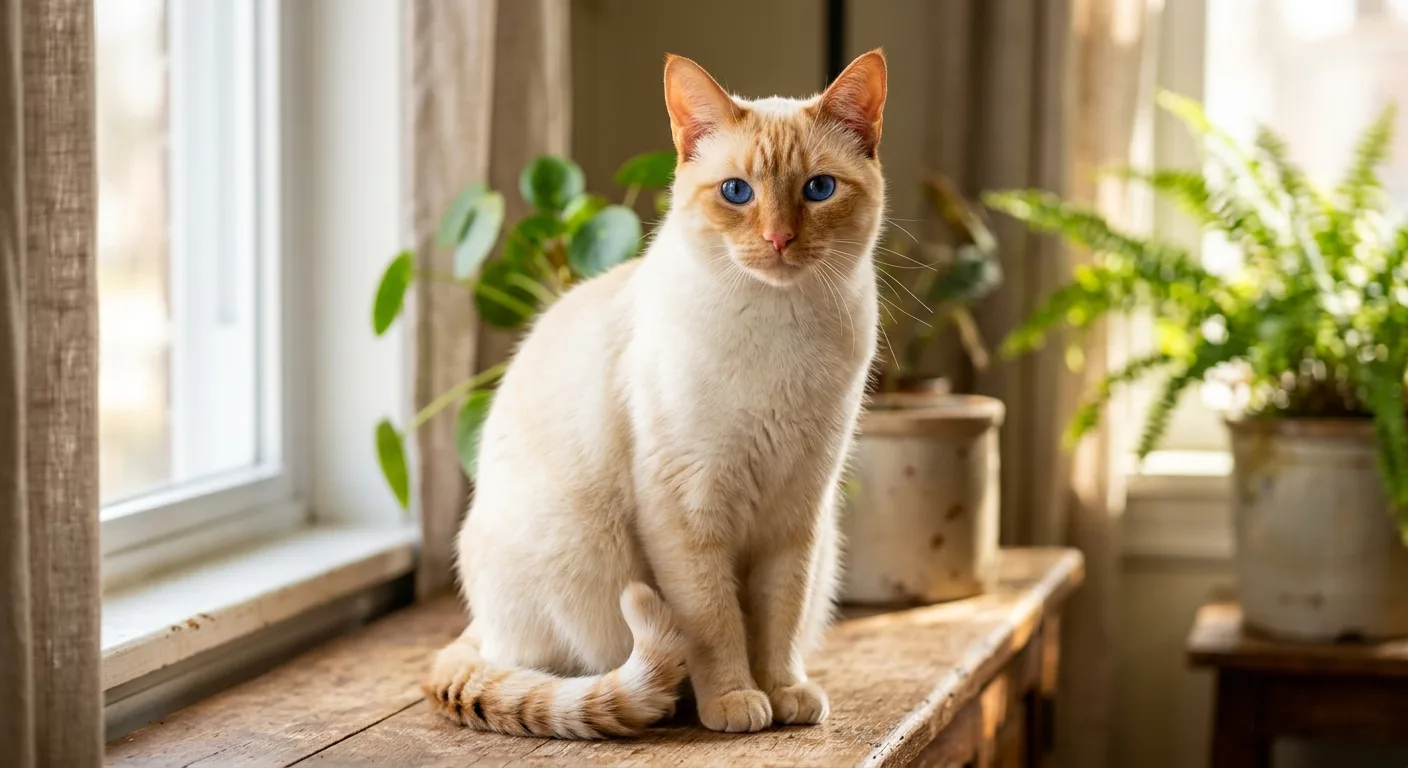
The flame point Siamese, also known as the red point Siamese, is one of the most eye-catching color variations in the breed: a creamy white body set off by warm reddish-orange or apricot points on the ears, face mask, legs, and tail, finished with the deep blue eyes the Siamese is famous for. Unlike the classic seal or chocolate points, the flame point gets its fiery color from the sex-linked orange gene, which is also why the great majority of these cats are male. If you have fallen for that soft cream-and-tangerine look, this guide walks through exactly what a flame point Siamese is, how the color develops, the genetics behind the male skew, how to tell it apart from look-alike colors, and what to expect from its personality, price, and care. For the full breed background, see our Siamese cat breed profile, or browse every variation in our guide to Siamese cat colors.
- 1Flame point Siamese (red point) have a creamy white body with reddish-orange or apricot points
- 2Points develop gradually with age and often show faint tabby striping
- 3The color comes from the sex-linked orange gene, so most flame points are male
- 4Deep blue almond-shaped eyes and a pink nose and paw pads are signatures
- 5They carry the classic Siamese personality: vocal, social, and affectionate

Sign up for expert-backed reviews and safety alerts all in one place.
What Is a Flame Point Siamese?
A flame point Siamese is a Siamese (or Siamese-type) cat whose point coloration is a warm reddish-orange rather than the dark brown of a seal point or the gray-blue of a blue point. The body is a pale creamy white, and the color concentrates at the cooler extremities of the cat: the ears, the face mask around the eyes and nose, the lower legs and paws, and the tail. Because that orange-red pigment reads as "flame," the variety picked up the descriptive name, though many registries and breeders formally call it the red point.

Presoaked sterile pads that gently wipe away everyday debris, discharge, and tear stains from around a dog's or cat's eyes as part of routine grooming. An easy way to keep the eye area clean and comfortable between baths.
Petful may earn a commission when you click through to Chewy, at no extra cost to you.
The flame point look comes from combining the Siamese pointed pattern (a temperature-sensitive form of partial albinism) with the orange coloring gene. The pointed pattern is why a Siamese is pale on its warm core and darker on its cool points. The orange gene swaps what would have been a dark point for a red one. The result is a cat that keeps every classic Siamese hallmark, the sleek short coat, the wedge-shaped head, the long lithe body, and the vivid blue eyes, but trades the dramatic dark contrast for something softer and warmer.
Flame points are considered an uncommon and desirable color. They show up in both the modern wedge-head Siamese and the rounder traditional or "applehead" Siamese, as well as in related and derived breeds such as the Colorpoint Shorthair, where red and cream points were deliberately developed.

Never Scoop Again® with the Whisker Litter-Robot, the smart self-cleaning automatic litter box. Monitor visits and track weights for better overall care in the Whisker® app. Multi-cat friendly.
Petful may earn a commission when you click through to Whisker, at no extra cost to you.
Flame Point Siamese Appearance
The single most important thing to understand about flame point appearance is that the color develops with age. Like all pointed cats, flame point Siamese kittens are born almost pure white, because the womb is warm enough to suppress pigment everywhere. Over the first weeks and months of life, the cooler points slowly deepen, and a flame point's full reddish-orange color may not settle until the cat is a year or more old. A pale, barely-tinged kitten can mature into a cat with rich apricot ears and tail.
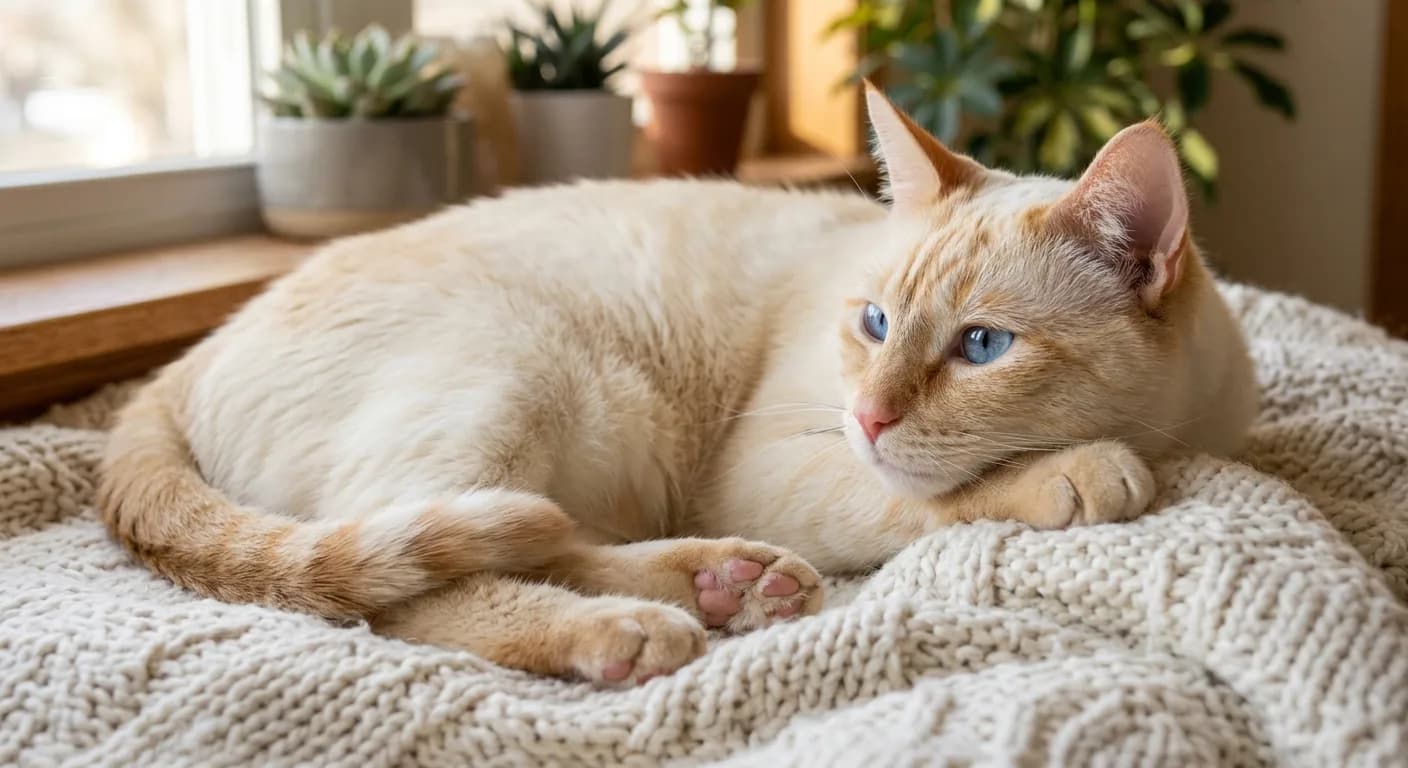
Faint tabby striping is extremely common in flame points, more so than in most other Siamese colors. This happens because the orange gene does not fully mask the underlying tabby pattern, so many red points show soft "ghost" striping or ringing on the mask, ears, legs, and tail even when the cat is not formally a lynx (tabby) point. This is normal and does not mean the cat is mixed or mismarked.
Other physical signatures include a pink nose leather and pink paw pads (rather than the dark nose of a seal point), and the breed-standard deep blue, almond-shaped eyes. The coat itself is short, fine, and close-lying, with no undercoat to speak of, which is part of why the points look so crisp against the cream body.
- Flame point Siamese kittens look nearly white at birth and "color up" gradually as the cooler points develop pigment. A kitten's adult depth of color can be hard to judge early, so the rich reddish-orange you see in photos of adult cats is something the kitten grows into over its first year.
The Genetics: Why Flame Points Are Usually Male
The reason flame point Siamese are overwhelmingly male comes down to one detail: the gene for orange (red) coloring sits on the X chromosome. It is sex-linked.
Male cats have one X chromosome and one Y chromosome (XY). A male needs only a single copy of the orange gene, on his lone X, to be a red (flame) point. Because there is just one X to "switch on" the color, flame point males are relatively straightforward to produce, and the orange shows up cleanly across the points.
Female cats have two X chromosomes (XX). For a female to be a solid flame point, she must inherit the orange gene on both of her X chromosomes, one from each parent. That requires both the father to be a red point and the mother to carry red, which is a much less frequent pairing. A female who inherits orange on only one X chromosome does not become a flame point; instead she typically becomes a tortie point or cream-and-red mixed point, because the two X chromosomes express different colors in patches. This is the same X-linked mechanism that makes the vast majority of orange tabbies and calico/tortoiseshell cats skew strongly by sex.
The practical upshot for buyers: most flame point Siamese you encounter will be male, female flame points exist but are notably rarer, and a "red" female is more often a tortie point than a true even flame point.
- If a breeder offers a true, evenly colored flame point, expect a male far more often than not. A female advertised as red is worth a closer look. She may genuinely be a rare flame point, or she may be a tortie point, which is a related but visually distinct color.
Flame Point vs Cream Point vs Red Lynx Point
Flame point is easy to confuse with a couple of close relatives, because they all sit in the warm, reddish end of the Siamese color range. The differences come down to depth of color and the presence of tabby striping.
A cream point is essentially a diluted, paler version of the flame point. Where flame point shows a saturated reddish-orange, cream point shows a soft buff or pale apricot, the result of the dilution gene lightening the same red pigment. A red lynx point (also called flame lynx point) is a flame point that also carries the tabby pattern gene, so it shows distinct, defined tabby striping on the points, banded legs, a ringed tail, and an "M" marking on the forehead, rather than the faint ghost striping of a plain flame point.

63-inch multi-level cat tree with scratch posts, hammock, plush perches, and dangling toys. Vertical territory is non-negotiable for high-energy climbing breeds like the Bengal.
Petful may earn a commission when you click through to Chewy, at no extra cost to you.
The table below lays the three side by side so you can tell them apart at a glance.
| Variety | Point Color | Striping | Notes |
|---|---|---|---|
| Flame Point (Red Point) | Reddish-orange to apricot | Faint ghost striping common, not defined | The standard red Siamese point; pink nose and pads |
| Cream Point | Pale buff or soft apricot | Minimal | A diluted, lighter version of flame point caused by the dilution gene |
| Red Lynx Point | Reddish-orange | Distinct, defined tabby striping | A flame point carrying the tabby gene; banded legs, ringed tail, forehead "M" |
If a defined tabby pattern is what appeals to you, the lynx point Siamese is the variety to read up on next, since the flame and red lynx points are closely related and often produced in the same litters.
Flame Point Siamese Personality and Temperament
Color has no bearing on personality, so a flame point Siamese behaves like any other Siamese, and that means a big personality in a sleek package. Siamese are famously vocal. They "talk" to their people with a loud, distinctive, sometimes raspy voice, and they expect a reply. If you want a quiet, aloof cat that keeps to itself, this is not the breed for you.
They are also intensely social and people-oriented. A flame point Siamese tends to bond hard with its humans, follow them from room to room, supervise every household task, and insist on being involved. Many dislike being left alone for long stretches and do best with company, whether that is an attentive owner who is home often or a second pet for companionship.
On top of that, Siamese are highly intelligent and active. They learn quickly, enjoy puzzle feeders and interactive play, and can be taught tricks or to walk on a harness. That cleverness needs an outlet. A bored Siamese will invent its own entertainment, often noisily. Give a flame point plenty of enrichment, vertical space to climb, and daily interaction, and you get an affectionate, engaging, almost dog-like companion.

108-oz stainless steel pet fountain with quiet pump and water-level window. Bengals are notoriously water-obsessed; a flowing fountain encourages hydration and pulls them away from sinks and toilets.
Petful may earn a commission when you click through to Chewy, at no extra cost to you.
Flame Point Siamese Price
Because flame point is an uncommon and in-demand color, it usually carries a premium over the classic seal point. Where a pet-quality seal point Siamese from a reputable breeder might start around the lower end of the breed's range, a flame point of comparable quality often costs noticeably more, frequently several hundred dollars above a standard point from the same litter or breeder, with rarer female flame points commanding the steepest prices of all.
Exactly how much you pay depends on the same factors that drive any purebred cat's cost: quality tier (pet versus show), the breeder's registration and health testing, bloodline and titles, and your region. Adoption through a Siamese-specific rescue remains the most affordable route if a particular color is not a strict requirement, though flame points are less commonly surrendered than the more numerous seal and blue points.
For the full breakdown of what Siamese cats cost across every tier and color, including how the rare-color premium stacks up against show-quality pricing, see our detailed guide to Siamese cat price.
Health and Care
A flame point Siamese needs the same care as any Siamese, and on the grooming front that care is refreshingly low. The short, fine, single coat sheds modestly and almost maintains itself. A weekly once-over with a soft brush or grooming glove removes loose hair and keeps the coat glossy, supplemented by routine nail trims, dental care, and the occasional ear check. There is no undercoat to mat and no heavy seasonal blow-out to manage.
One care note specific to pale, lightly pigmented cats: the cream body and pink nose offer little natural sun protection, so an indoor or supervised lifestyle helps avoid sunburn on the ears and nose, especially in sunny climates.
On health, flame points are not more or less robust than other Siamese, but the breed as a line does carry a handful of inherited predispositions worth knowing. These can include progressive retinal atrophy (PRA) and other eye conditions, dental disease, certain heart and respiratory issues, and amyloidosis affecting the liver or kidneys. None of this is cause for alarm, but it is the reason to buy from a breeder who health-tests their breeding cats and to keep up with regular veterinary wellness exams. As a clinically active YMYL topic, any specific symptom or diagnosis should be discussed with your own veterinarian.
- A flame point's cream coat and pink nose provide little protection against UV exposure. In bright, sunny environments, limit unsupervised outdoor time to reduce the risk of sunburn and skin damage on the ears and nose.
Frequently Asked Questions
A flame point Siamese, also called a red point Siamese, is a Siamese cat with a creamy white body and warm reddish-orange or apricot points on the ears, face, legs, and tail, plus deep blue eyes. The red coloring comes from the sex-linked orange gene rather than the dark pigment of a seal or chocolate point.
Yes, flame point is considered an uncommon and sought-after Siamese color, less numerous than the classic seal, chocolate, blue, and lilac points. Female flame points are rarer still because of the sex-linked genetics, which is part of why the color often carries a price premium.
Flame point Siamese typically cost more than standard seal points because the color is uncommon and in demand, often several hundred dollars above a comparable point from the same breeder. Final price depends on quality tier, breeder registration and health testing, bloodline, and region. See our Siamese cat price guide for full ranges.
No, but they are usually male. The orange gene responsible for the red color is carried on the X chromosome, and males need only one copy to be a flame point, so they are far more common. Female flame points exist but are rare, since a female must inherit the orange gene on both X chromosomes.
Yes. Like all true Siamese, flame point Siamese have the breed's signature deep blue, almond-shaped eyes. The blue eye color is tied to the pointed (partial albino) pattern itself, so it appears across every Siamese point color, including the red-orange flame point.
A flame point is one of the rarer, more sought-after Siamese colors. Keep its pedigree and rare-color papers, microchip, and vet records in one free digital profile with MyPetID so nothing gets lost.
Create a free pet record
Coreen Saito is a pet writer and longtime shelter volunteer with more than a decade in animal rescue. She covers cat behavior, breed care, and the small, ordinary science of sharing a life with companion animals, with a particular focus on honest takes about the products and decisions that actually matter. At home in Arizona, she's outranked by Mac (a dog with the loudest opinion in the house), Rebel (a cat who governs by quiet authority), and Meri (an orange tabby who runs the late shift and the laundry basket). She writes about all three, plus the rescues that keep coming through her life, at LifeWithMinty.com.
Sign up for expert-backed reviews and safety alerts all in one place.