Oriental Shorthair: The Complete Big-Eared Breed Guide
Meet the Oriental Shorthair, essentially a Siamese in 600+ non-pointed colors. This complete guide covers the giant ears, the famous "honk," temperament, grooming, honest health, hypoallergenic facts, and what a kitten costs.
Petful is reader supported. As an affiliate of platforms like Amazon and Chewy, we may earn a commission when you buy through links on this page. There is no extra cost to you.
The Oriental Shorthair is, in the words of the Cat Fanciers' Association (CFA), "a study in elegant design that clearly reveals its Siamese roots," wrapped in more than 600 possible color and pattern combinations. Picture a Siamese in every color except the pointed one: the same long, tubular body, the same flat-profiled wedge of a head, the same loud and loving personality, but dressed in solid ebony, blue, chocolate, red, tabby, tortoiseshell, or smoke instead of the classic seal points. Recognized by CFA as the "Oriental" and by The International Cat Association (TICA) as the Oriental Shorthair, this is one of the most colorful, most talkative, and most people-obsessed cats you can bring home, and those enormous, satellite-dish ears make it instantly unmistakable.
- 1The Oriental Shorthair is essentially a Siamese in non-pointed colors and belongs to the same Siamese Breed Group
- 2It comes in 600+ color and pattern combinations, the widest palette of any cat breed
- 3Expect a loud, raspy, "honking" voice and a velcro, dog-like personality that hates being left alone
- 4The fine, undercoat-free coat is low-shedding and low-grooming, but no cat is truly hypoallergenic
- 5Generally long-lived at 12-15 years, with breeder screening for HCM and PRA being the key to a healthy kitten

Sign up for expert-backed reviews and safety alerts all in one place.
What Is an Oriental Shorthair?
The simplest, most accurate way to describe an Oriental Shorthair is this: it is a Siamese in non-pointed colors. TICA places the breed inside the "Siamese Breed Group," which it shares with the Siamese, the Balinese, and the Oriental Longhair. Every cat in that group has the same long, slim, tubular body, the same wedge-shaped head, the same giant ears, and the same vocal, attention-loving temperament. What separates them is mostly coat: the Siamese is colorpointed, the Balinese and Oriental Longhair carry longer hair, and the Oriental Shorthair takes that elegant Siamese type and pours it into hundreds of solid and patterned, non-pointed colors.
Registry naming can be confusing, so here is the clean version. CFA registers the breed simply as the "Oriental," a single breed that covers both the short and the long coat. TICA recognizes the "Oriental Shorthair" as its own breed within the Siamese Breed Group. Either way, the animal in front of you is the same striking, big-eared cat, and breeders, vets, and cat people use "Oriental Shorthair" as the everyday name.
If you have ever loved the look and personality of a Siamese but wished it came in jet black, silver tabby, or calico, the Oriental Shorthair is the cat that answers that wish. To go deeper on the closely related parent breed, see our full Siamese cat breed profile.
- The Oriental Shorthair, Siamese, Balinese, and Oriental Longhair are one extended family. They share body, head, ears, voice, and temperament. The differences come down to color and coat length, not personality.
Origin and History: From Siam to a Rainbow of Colors
The Oriental Shorthair's deep roots reach back to Thailand (historically Siam), the ancestral home of the Siamese. The modern breed, however, was built in the West. Beginning roughly in the 1950s and continuing through the 1970s, breeders in Britain and then the United States set out to take the elegant Siamese body and head and free it from the colorpoint pattern, so it could appear in a full spectrum of solid and patterned colors.
To do that, they crossed Siamese cats with other shorthaired breeds, including the British Shorthair, the Russian Blue, the Abyssinian, and domestic shorthairs, then bred the offspring back toward the Siamese type. The result kept the slinky, refined Siamese silhouette while introducing the genes for solid colors, tabby, tortoiseshell, and more. Early English cats appeared in solids like chestnut (chocolate), lavender, and white, and American breeders pushed the color range wider through the 1960s and 1970s. CFA granted the Oriental Shorthair championship status in the late 1970s, and the longhaired version followed in the late 1980s.
The Abyssinian's role in that early development is one reason you will sometimes hear Orientals described as having a lively, busy, "into everything" energy that never really switches off.
The Signature Look: Giant Ears, a Wedge Head, and a Whippy Tail
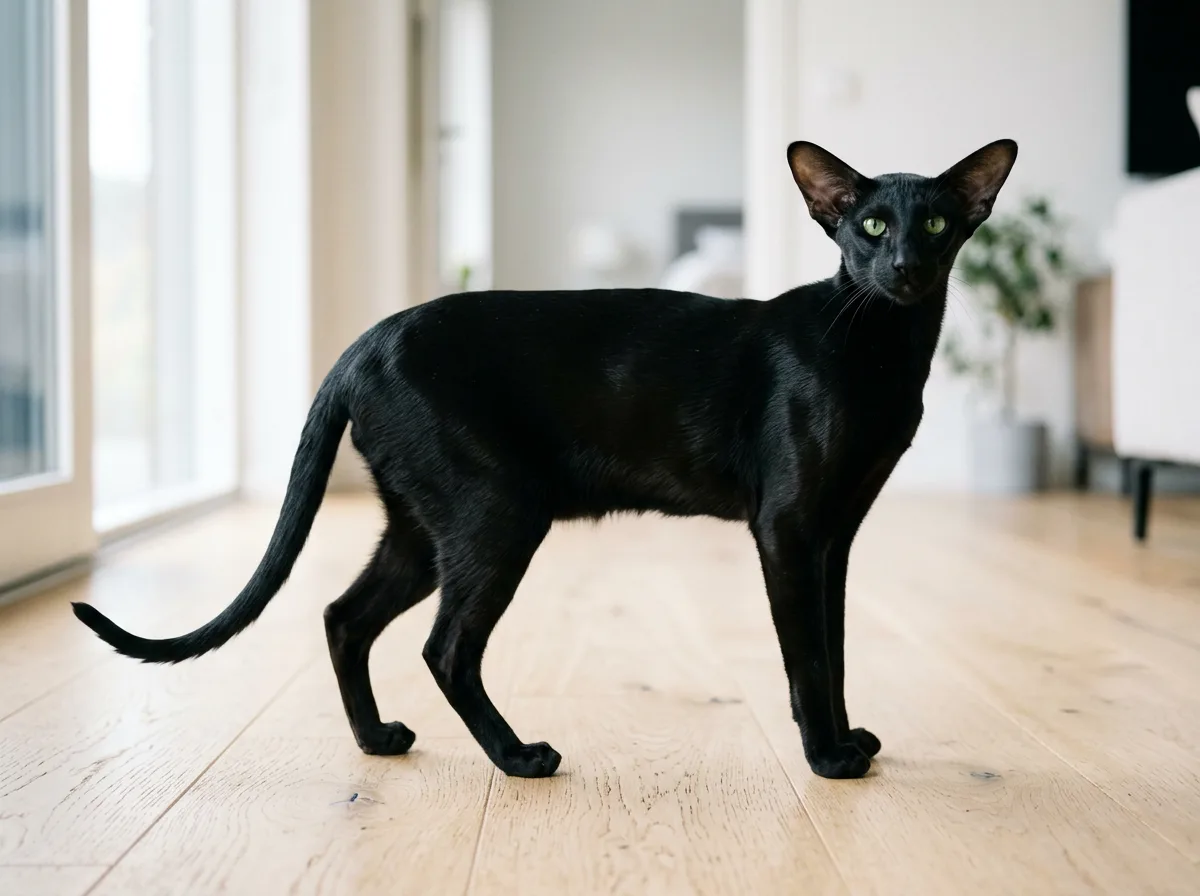
If the personality is the soul of the Oriental Shorthair, the ears are the headline. This is the cat the internet calls "the cat with giant ears," and the description is earned. CFA's breed standard calls for ears that are "strikingly large, pointed, wide at the base, continuing the straight lines of the wedge." Set on a long, flat-profiled, wedge-shaped head, those broad-based ears give the Oriental its alert, almost elfin, unmistakable face.
Never Scoop Again® with the Whisker Litter-Robot, the smart self-cleaning automatic litter box. Monitor visits and track weights for better overall care in the Whisker® app. Multi-cat friendly.
Petful may earn a commission when you click through to Whisker, at no extra cost to you.
The rest of the cat matches that drama. The body is long, slim, and tubular, elegant on first glance but surprisingly muscular and athletic under the hand. Breeders describe the ideal as a hard, svelte cat, not a bony or fragile one, which is an important distinction for owners: the Oriental Shorthair is heavier and stronger than it looks. The tail is long, thin, and whippy, tapering to a fine point and seeming, as CFA puts it, to "go on forever." The eyes are almond-shaped and slightly slanted, usually a vivid green. Blue eyes appear only in the rare pointed individuals (which are, by definition, Siamese), and white Orientals may have green, blue, or odd-colored eyes.
The coat completes the picture: short, fine, glossy, and satin-like, lying close to the body with no undercoat at all. That single anatomical fact, the missing undercoat, drives much of what makes this breed easy to live with, from low shedding to minimal grooming.
- An Oriental Shorthair is lean and elegant but genuinely muscular, and it weighs more than it appears. Feel the body, do not just eyeball it, when judging weight, and follow your vet's body-condition guidance rather than under-feeding a cat that "looks" chunky.
The 600+ Colors: The Most Colorful Cat Breed
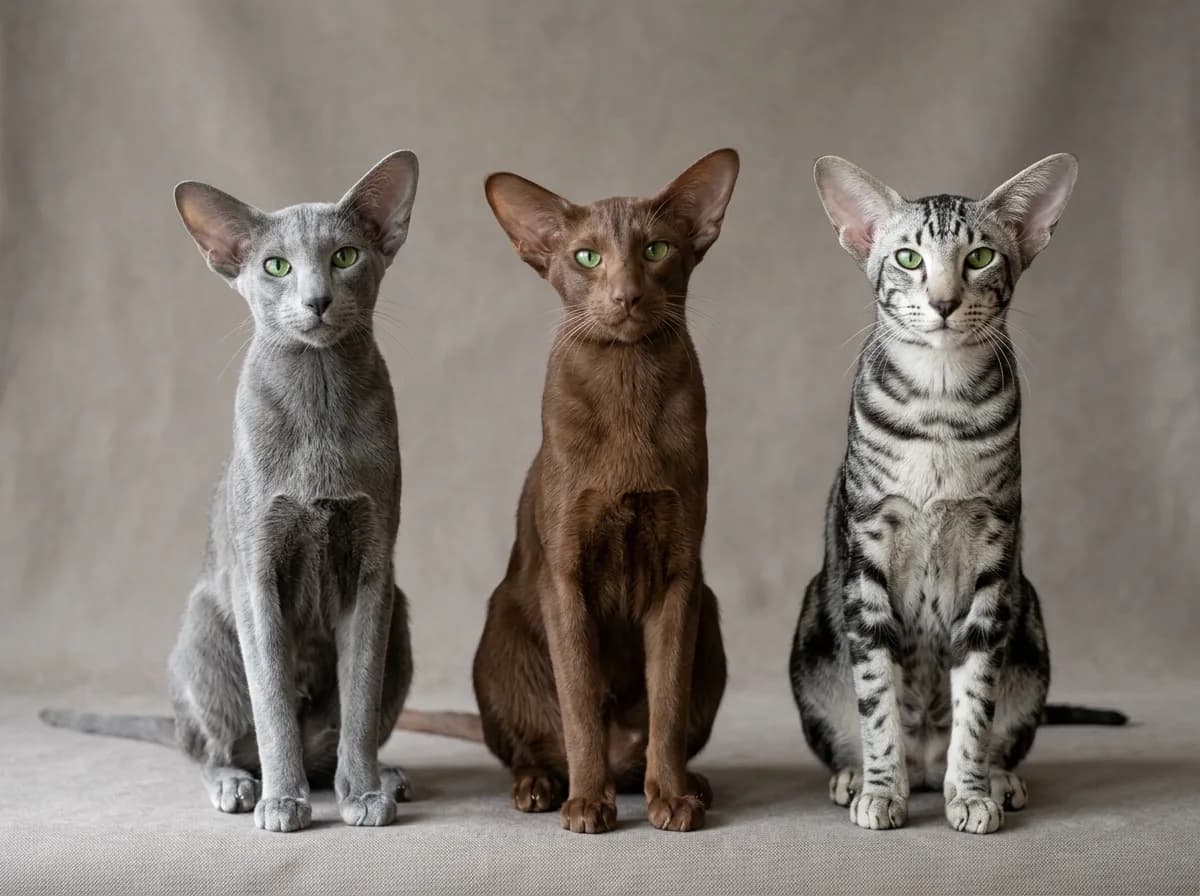
Color is the Oriental Shorthair's superpower. CFA describes the breed as having "over 600 possible color, pattern, and coat length combinations," and TICA simply calls it "hundreds." No other cat breed offers a palette this wide, which is why fanciers nicknamed it the "Rainbow Cat."
The colors fall into a few broad families. Solids include ebony (black), blue, chocolate, lavender (lilac), cinnamon, fawn, red, cream, and white. On top of those come tabby in every pattern (classic, mackerel, spotted, and ticked), tortoiseshell and torbie (tortie-tabby), smoke, silver and shaded varieties, and bicolor, which is any of those colors combined with white. The unifying rule is that these are all non-pointed colors. The moment a cat carries the colorpoint pattern (a pale body with darker points on the face, ears, legs, and tail), it is classified as a Siamese, not an Oriental Shorthair.
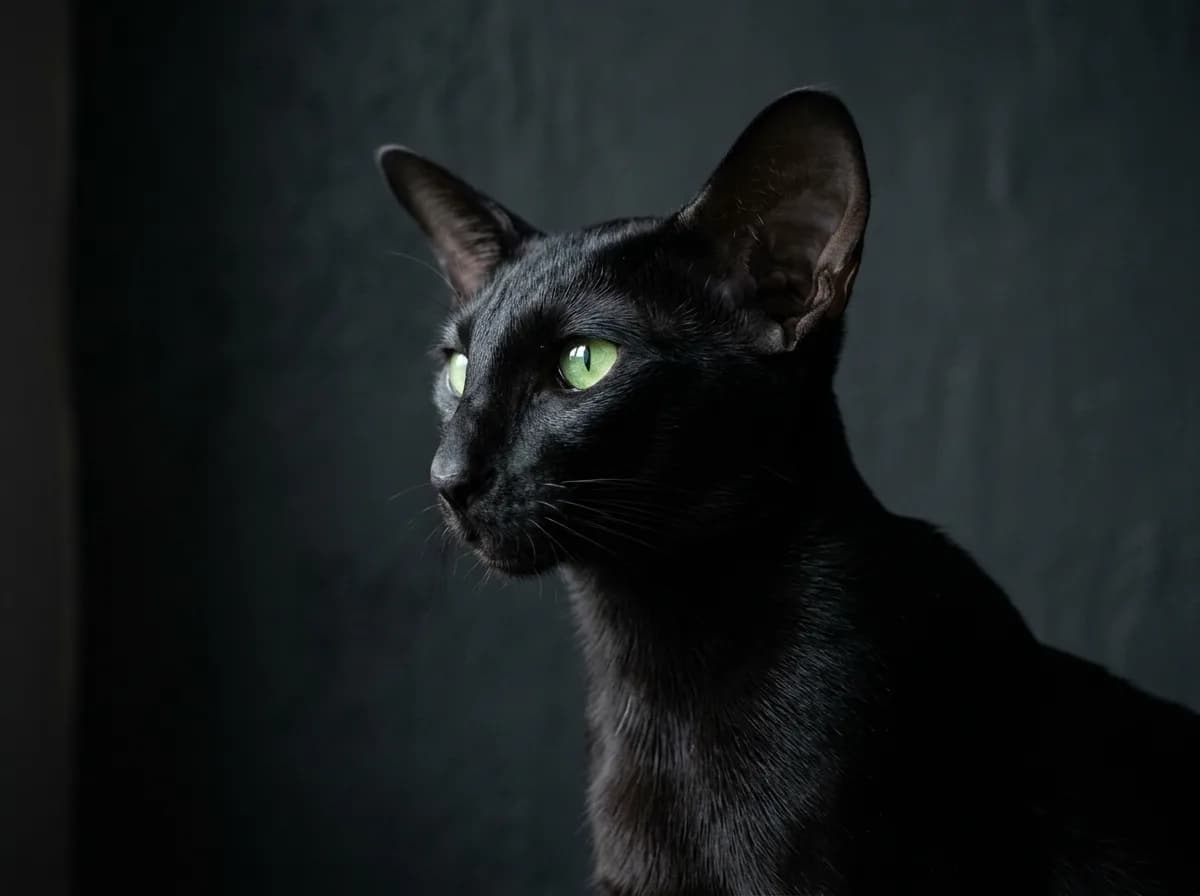
The most iconic and most-searched look is the solid black "ebony" Oriental: a sleek, panther-like cat with brilliant green eyes. But part of the joy of the breed is that almost any color you can imagine in a cat, the Oriental Shorthair comes in. Importantly, color does not affect health or personality, though rarer colors can nudge up a kitten's price. For the full gallery and what each shade looks like, see our deep dive on Siamese cat colors, which explains the pointed-versus-non-pointed contrast that defines this whole family.
- If an Oriental-looking cat has the classic colorpoint pattern and blue eyes, it is registered as a Siamese, not an Oriental Shorthair. Breed a Siamese to an Oriental and a single litter can contain both.
Quick Facts at a Glance
Before the deep dive into temperament, care, and health, here is the breed in one scannable snapshot.
| Trait | Details |
|---|---|
| Origin | Developed in Britain and the U.S. (1950s-1970s) from the Siamese; ancestral roots in Thailand |
| Breed group | Siamese Breed Group (with Siamese, Balinese, Oriental Longhair) |
| Size | Medium, but looks larger due to length |
| Weight | About 5-12 lb (males ~8-12 lb, females ~5-8 lb) |
| Lifespan | 12-15 years on average, often 15+ |
| Coat | Short, fine, glossy, no undercoat; low shedding |
| Colors | 600+ color and pattern combinations (non-pointed) |
| Eye color | Usually green (blue only in rare pointed cats) |
| Temperament | Vocal, social, velcro, dog-like, highly intelligent |
| Grooming | Very low (weekly brush or grooming mitt) |
| Price | $75-200 adoption; $600-1,500 pet quality; $1,500-3,000 show quality |
Temperament: The Famous "Honk" and a Velcro Personality
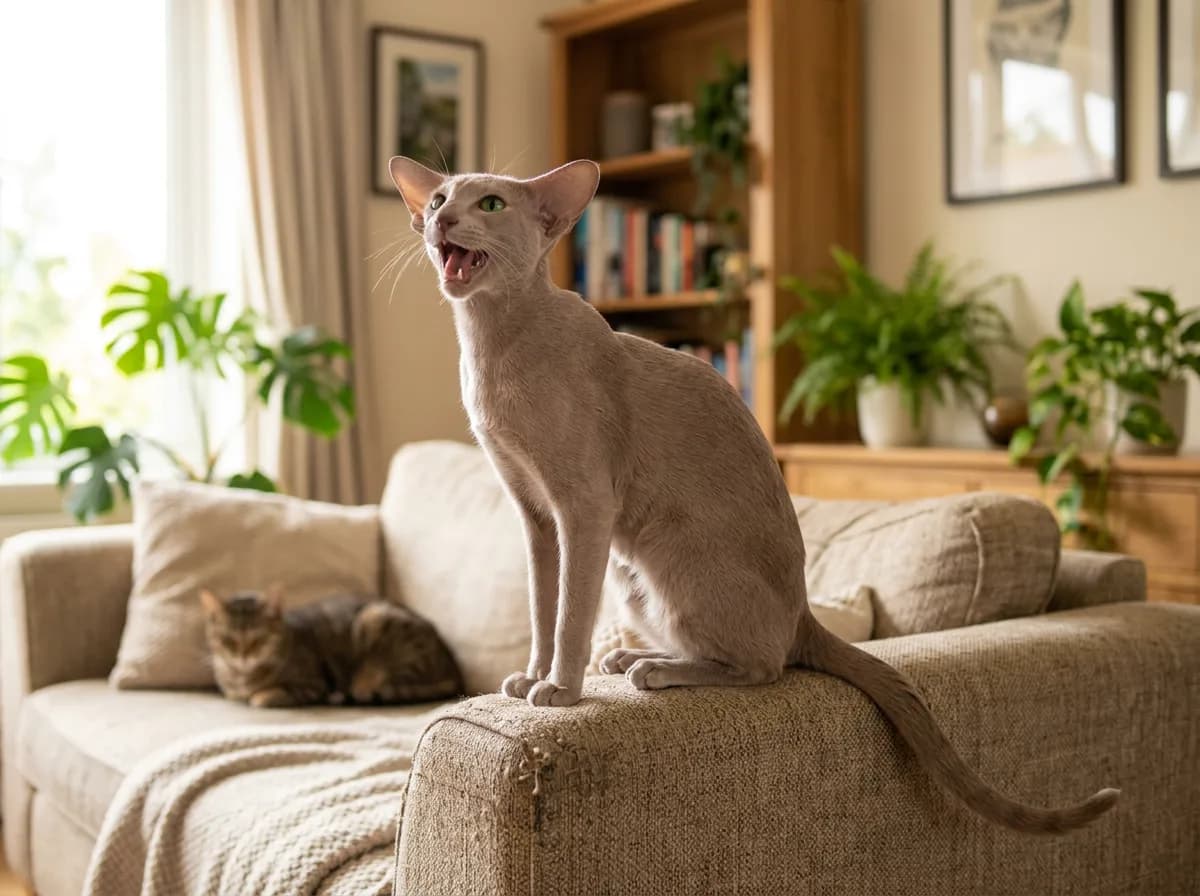
Ask anyone who lives with an Oriental Shorthair what defines the breed and they will mention the voice before anything else. Orientals are intensely vocal, and their voice is unusual: loud, raspy, and distinctive, so much so that owners and breed clubs commonly describe it as a "honk." These cats do not meow politely in the background. They talk to you, constantly, with opinions about your arrival, your departure, their dinner, and the bird outside the window.
That chatter comes straight from the Siamese side of the family, and it pairs with a personality that is just as intense. The Oriental Shorthair is a "velcro" cat: it follows you from room to room, rides on shoulders, supervises your every task, and inserts itself into whatever you are doing. People describe the breed as dog-like for good reason. Orientals bond hard with their humans, crave constant interaction, and are happiest when they are involved in family life rather than watching from a distance.
They are also brilliant. Orientals are highly intelligent, athletic, and playful well into old age, the kind of cat that learns to open cabinets, walk on a leash, fetch toys, and perform tricks for attention. TICA and breed knowledge-graph descriptors paint a consistent picture: inquisitive, sociable, devoted, intelligent, friendly, and emotional. That last word matters. This is a sensitive breed that bonds deeply and feels it when that bond is interrupted.
The flip side of all that devotion is that Orientals genuinely do not like being left alone for long stretches. They can become lonely, bored, and stressed without company, which is why experienced owners and rescues so often recommend adopting them in pairs or keeping them in a home where someone is around much of the day. A second cat, a dog, or a present, interactive human keeps an Oriental Shorthair thriving. The personality parallels with the parent breed are strong, and our Siamese cat personality guide goes deeper on the talkative, social temperament both breeds share.
- Oriental Shorthairs form intense attachments and can become stressed, vocal, or destructive when left alone all day. If you work long hours away from home, plan to provide a companion animal or reconsider whether this breed fits your lifestyle.
Why Do Oriental Shorthairs Honk?
The "honk" is simply the Oriental's natural voice, inherited from the Siamese line. Where many cats produce a soft, high meow, Siamese-group cats tend toward a louder, lower, raspier sound, and in some Orientals it really does land somewhere between a meow and a goose-like honk. There is nothing wrong with a honking Oriental. It is a chatty, communicative breed using the voice it was born with, and it usually means the cat wants your attention, your company, or your dinner.
Size: How Big Do Oriental Shorthairs Get?
The Oriental Shorthair is officially a medium-sized cat, but it reads as larger because it is so long and lean. Most weigh between about 5 and 12 pounds, with males typically landing around 8 to 12 pounds and females around 5 to 8 pounds. Stretched out, an adult can measure well over a foot of body plus that long whippy tail, which is why a healthy Oriental can look bigger in photos than the scale suggests.
The key ownership takeaway repeats here: lean does not mean lightweight. Because the body is so slim, even a small amount of excess weight shows up quickly as a rounded belly, and the dense muscle means a healthy Oriental weighs more than its delicate frame implies. Feed to body condition, monitor weight with your vet, and resist the urge to overfeed a cat that simply looks slender by design.
Grooming: Low Maintenance by Design
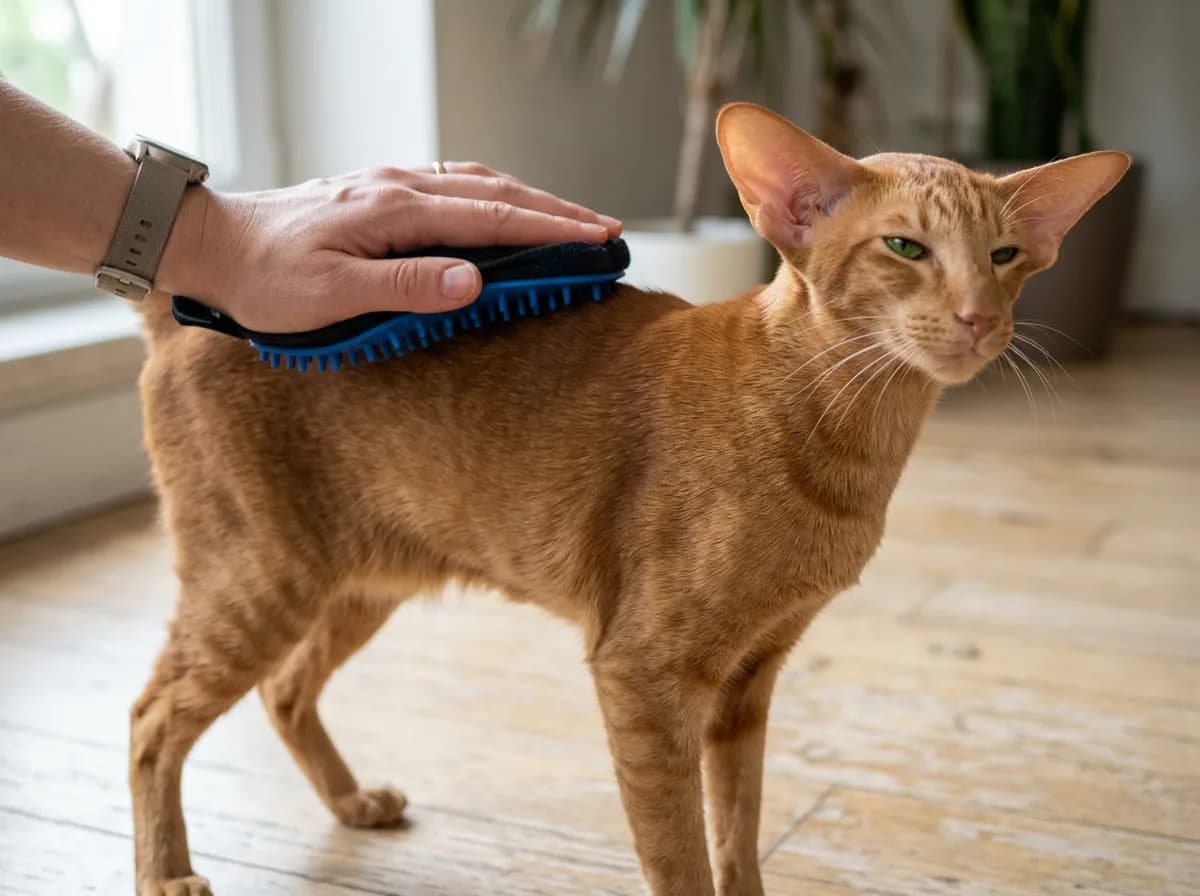
Here is where the missing undercoat pays off. The Oriental Shorthair's fine, short, close-lying coat needs very little: a weekly once-over with a soft brush or a rubber grooming mitt is plenty to remove loose hair and keep the coat glossy. Shedding is low, matting is essentially a non-issue, and the breed is about as wash-and-wear as a cat gets.
That does not mean zero care. Those famous big ears can accumulate wax and debris, so check and gently clean them weekly. The breed is also prone to dental disease, so regular tooth brushing and routine dental checks are genuinely important rather than optional. Add nail trims and the standard wellness routine, and an Oriental Shorthair is a strikingly low-effort cat to keep looking and feeling its best.

63-inch multi-level cat tree with scratch posts, hammock, plush perches, and dangling toys. Vertical territory is non-negotiable for high-energy climbing breeds like the Bengal.
Petful may earn a commission when you click through to Chewy, at no extra cost to you.
- Oriental Shorthairs are prone to dental disease. Brush their teeth several times a week with a cat-safe toothpaste and keep up with professional dental checkups. It is the single most overlooked part of caring for this otherwise low-maintenance breed.
Oriental Shorthair vs. Siamese: What's the Difference?
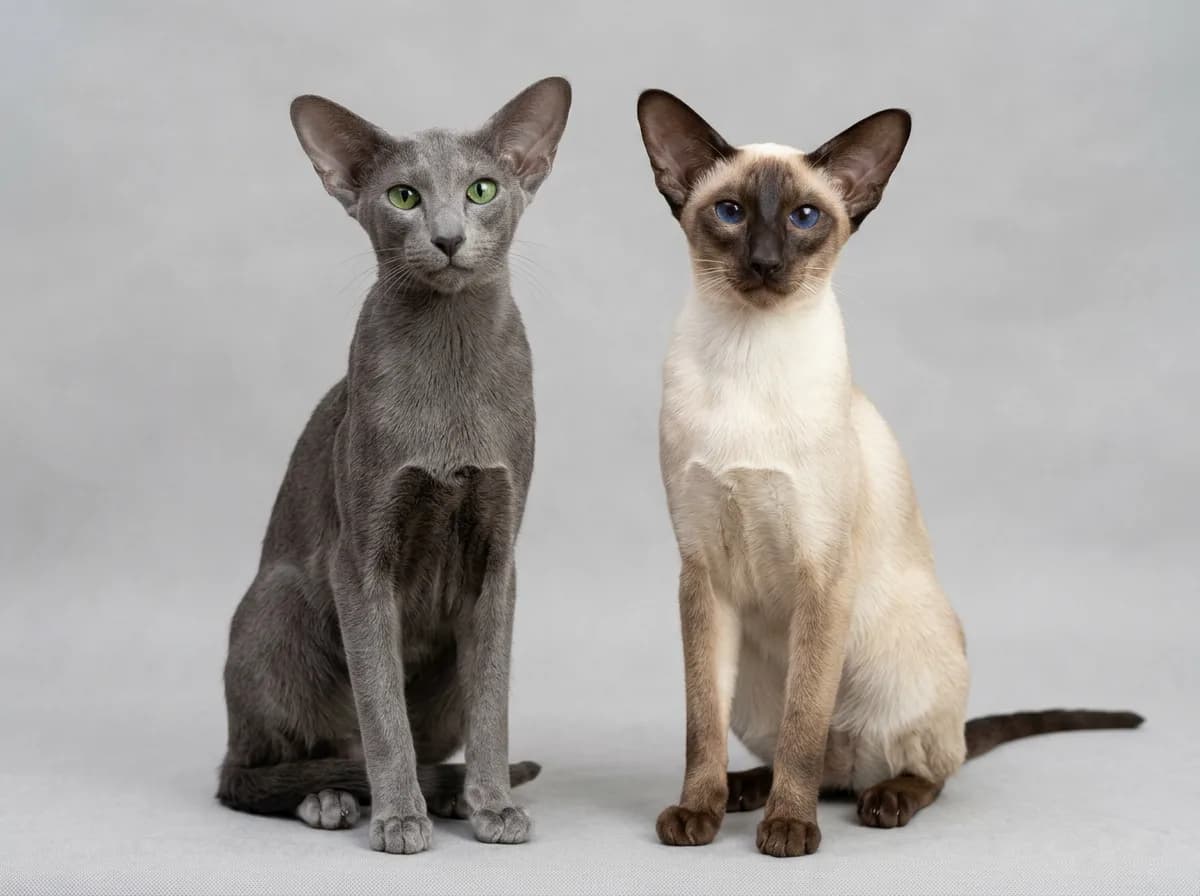
This is the question that defines the breed, so it deserves a clear answer: the Oriental Shorthair and the Siamese are the same breed group, with the same body, the same wedge head, the same giant ears, the same voice, and the same temperament. The single real difference is color.
The Siamese is colorpointed, meaning a pale body with darker "points" on the face, ears, legs, and tail, and it always has blue eyes. The Oriental Shorthair wears the full 600-plus palette of solid and patterned non-pointed colors and usually has green eyes. That is genuinely the whole story. The two are so closely related that if you breed a Siamese to an Oriental Shorthair, a single litter can produce both pointed and non-pointed kittens.
So when you are choosing between them, you are not choosing between two personalities. You are choosing between two color schemes on the same wonderful, talkative, velcro cat. Prefer the classic pointed look with blue eyes? That is the Siamese. Want black, silver, tabby, calico, or any of hundreds of other colors with green eyes? That is the Oriental Shorthair.
| Feature | Oriental Shorthair | Siamese |
|---|---|---|
| Body and head | Long, tubular, wedge head | Long, tubular, wedge head (identical) |
| Ears | Very large, broad-based | Very large, broad-based (identical) |
| Coat color | 600+ non-pointed colors | Colorpoint pattern only |
| Eye color | Usually green | Always blue |
| Voice | Loud, raspy "honk" | Loud, raspy "honk" (identical) |
| Temperament | Vocal, social, velcro | Vocal, social, velcro (identical) |
The Oriental Longhair: The Semi-Longhaired Cousin
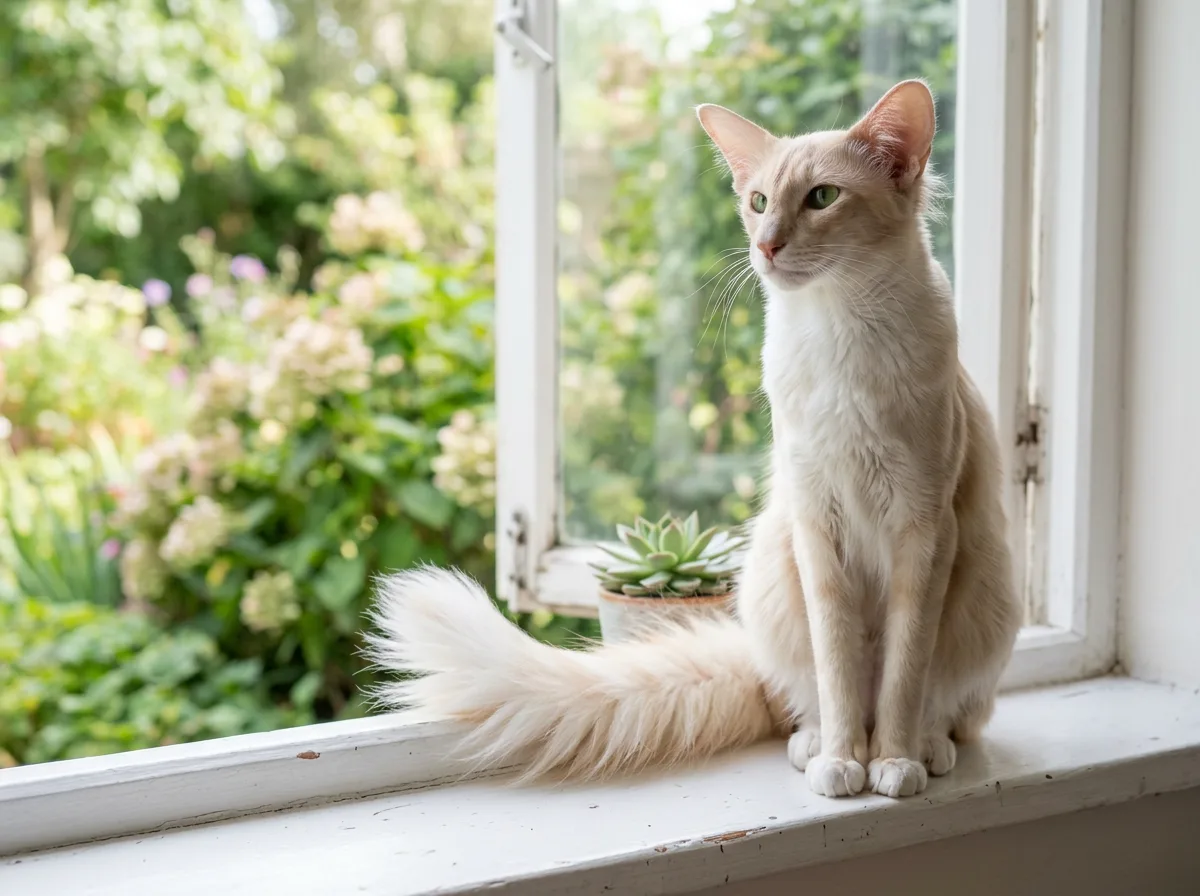
The Oriental does not only come in short hair. The Oriental Longhair is the semi-longhaired version of the same breed, sharing the identical body, head, ears, and personality, but wearing a soft, medium-length coat and a beautiful feathery plume of a tail instead of the sleek shorthair finish. Because there is no heavy undercoat even on the longhair, grooming stays manageable, though a longhair benefits from a slightly more frequent brush to keep the coat and tail plume tidy. If you love everything about the Oriental Shorthair but want a wisp of extra floof, the Oriental Longhair is your cat. For a sense of the Siamese group's longhair branch, our Balinese cat profile covers the closely related longhaired sibling.
Health: An Honest Look at the Oriental Shorthair
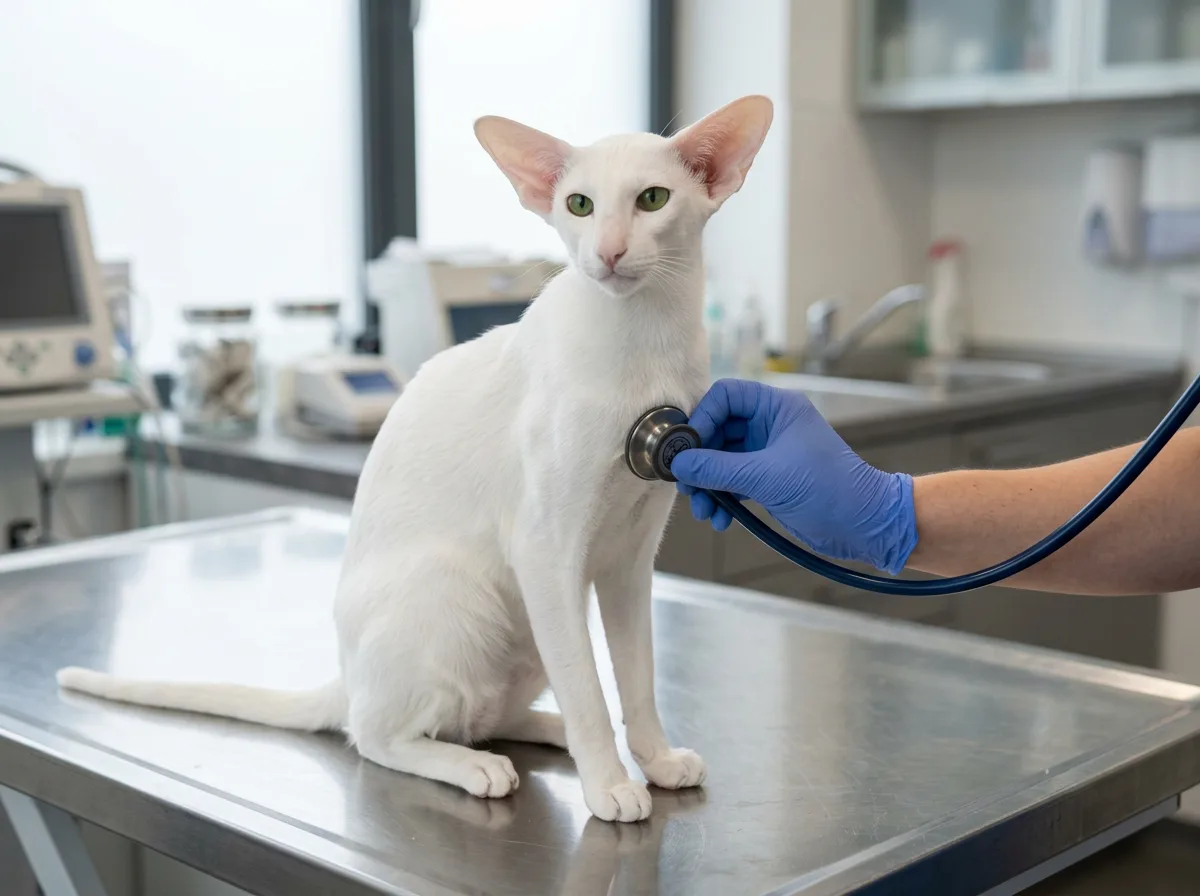
Oriental Shorthairs are generally healthy and long-lived, but honesty matters with a Siamese-derived breed, because they share a handful of inherited conditions that responsible breeders screen for. None of this should scare you off. The point is informed ownership and choosing a breeder who tests their lines.
The conditions worth knowing:

108-oz stainless steel pet fountain with quiet pump and water-level window. Bengals are notoriously water-obsessed; a flowing fountain encourages hydration and pulls them away from sinks and toilets.
Petful may earn a commission when you click through to Chewy, at no extra cost to you.
- Hypertrophic cardiomyopathy (HCM) and dilated cardiomyopathy (DCM). HCM is the most common feline heart disease, a thickening of the heart muscle, and it appears in this breed group. Some Oriental lines have also been associated with DCM. Reputable breeders screen breeding cats for heart disease.
- Progressive retinal atrophy (PRA). This inherited eye disease causes the retina to degenerate over time and can lead to blindness. A DNA test exists, and responsible breeders test for it.
- Amyloidosis. A notable hereditary concern in the Siamese and Oriental group, amyloidosis is the buildup of abnormal protein deposits in organs, most often the liver or kidneys, which can impair organ function. TICA notes there is no current diagnostic screening test for it, which makes choosing health-focused lines all the more important.
- Dental disease. As covered in grooming, this breed is prone to dental problems, so at-home and professional dental care genuinely matter.
- Mild respiratory or GI sensitivities. Some Orientals have a sensitive stomach or mild respiratory tendencies, and the breed group can be sensitive to anesthesia, which is worth flagging to your vet before any procedure.
The reassuring context: most Oriental Shorthairs live long, healthy lives, and the best insurance is a kitten from a breeder who screens for HCM and PRA, plus attentive routine veterinary care across the cat's life. With good care and a sound genetic start, many Orientals reach their mid-teens and beyond.
- The most important health decision you make happens before you bring the kitten home. Ask any Oriental Shorthair breeder for documented HCM and PRA screening on the parent cats. A responsible breeder will share results willingly; one who dodges the question is a red flag.
Is the Oriental Shorthair Hypoallergenic?
Short answer: no cat is truly hypoallergenic, and that includes the Oriental Shorthair, but it is a reduced-allergen, low-shedding breed that some allergy sufferers tolerate better than a heavy-coated cat.
Here is the science people often get wrong. Cat allergies are not caused by hair. They are driven by a protein called Fel d 1, which is produced in a cat's saliva and skin glands and spread across the coat during grooming, then shed into your home on dander and loose hair. Because Fel d 1, not fur, is the trigger, no coat type can make a cat allergen-free, and Orientals still produce Fel d 1 like any other cat.
So why the hypoallergenic reputation? It comes down to the coat. The Oriental's fine, short, undercoat-free coat sheds little, which means it tends to spread less dander around your home than a thick double coat does. Less loose, allergen-coated hair floating around can translate into fewer symptoms for some people. That is a meaningful difference for mildly allergic households, but it is reduced-allergen, not allergen-free, and there is no strong evidence that Orientals produce less Fel d 1 than other cats. The difference is in coat and shedding, not in the protein itself.
If you have allergies and are drawn to this breed, the honest advice is to spend real time with an adult Oriental Shorthair before committing, manage your environment with grooming and air filtration, and keep the bedroom a cat-free zone. For another breed that carries a similar hypoallergenic reputation and the same reality check, see our Sphynx cat breed profile.
- Marketing often labels the Oriental Shorthair hypoallergenic, but every cat produces the Fel d 1 protein that triggers allergies. If you are allergic, test your own reaction by spending time with an adult Oriental before you adopt. Do not assume the short coat will protect you.
Care and Diet
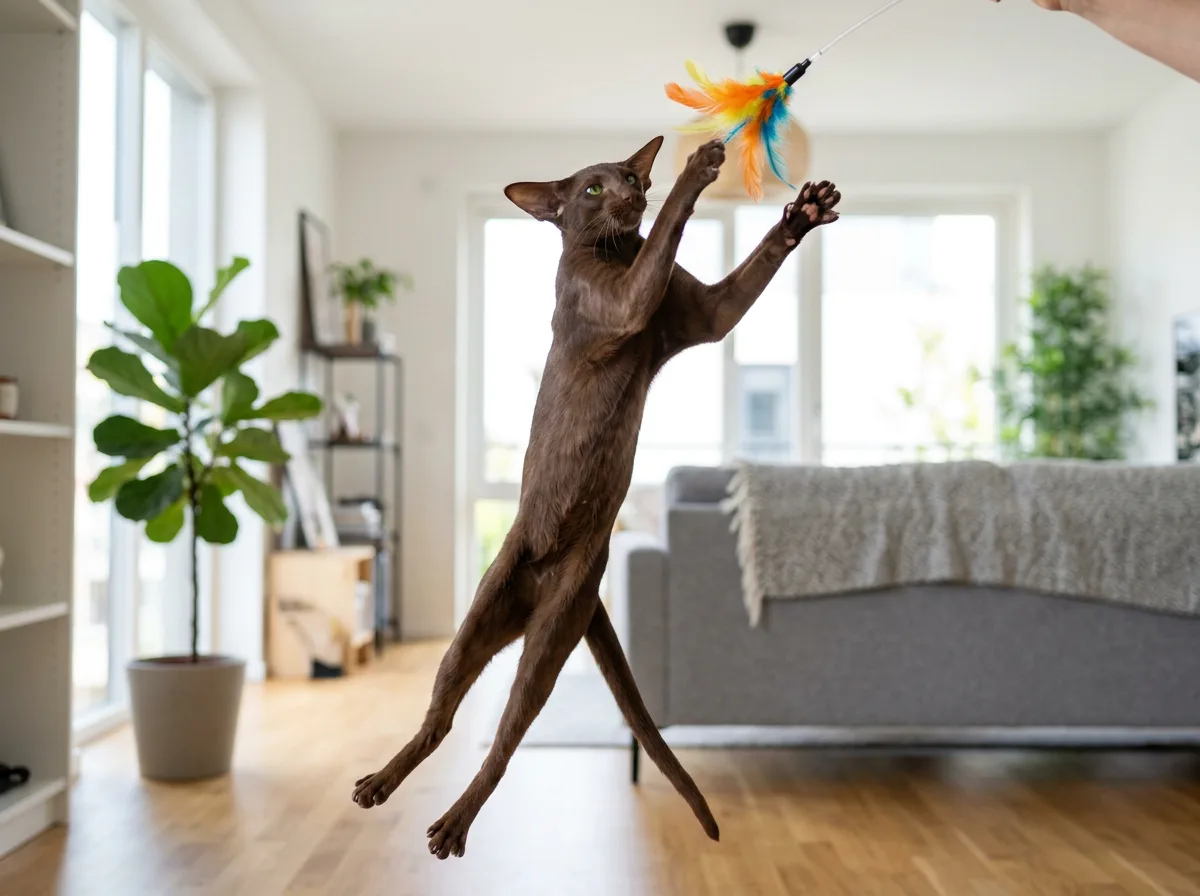
Caring for an Oriental Shorthair is mostly about feeding a body that is busier and hungrier than it looks and keeping a bright mind engaged. Feed a complete, high-quality cat food appropriate to the cat's life stage, and portion to body condition rather than to the cat's slim silhouette. Fresh water, a clean litter box, and consistent routine round out the basics.
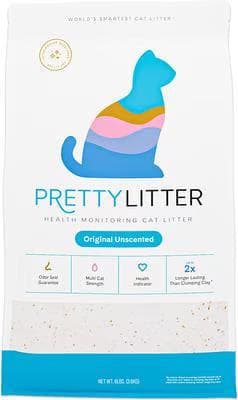
Color-changing crystal litter that flags pH shifts in your cat's urine, an early warning sign of UTIs, kidney issues, and more.
Petful may earn a commission when you click through to Chewy, at no extra cost to you.
Mental and physical enrichment is not optional for this breed. Orientals are athletic, intelligent, and easily bored, so provide climbing trees, puzzle feeders, interactive wand play, and rotating toys, and consider clicker training or leash walks, both of which many Orientals take to readily. Above all, give them your time and company. An Oriental Shorthair that is engaged, exercised, and included in family life is a healthy, happy, well-behaved cat.
Finding a Kitten and What It Costs
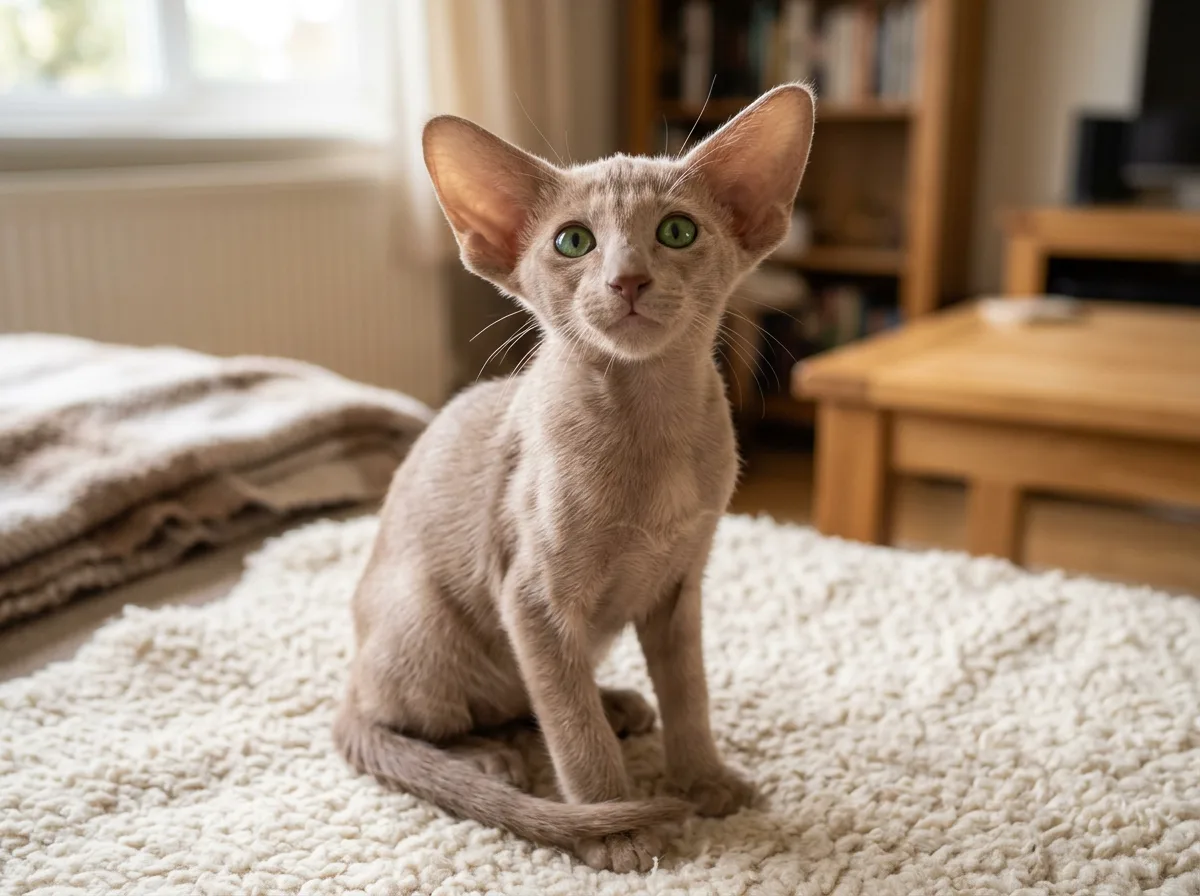
Oriental Shorthair pricing spans a wide range depending on how and where you get your cat. Adoption or rescue typically runs about $75 to $200. A pet-quality kitten from a reputable breeder generally falls between roughly $600 and $1,500, while show or breeding-quality kittens from proven, health-screened lines run from about $1,500 to $3,000. Real-world listings sit inside those bands: one current breeder listing showed kittens at $850 to $1,100, squarely in the pet-quality range.
What moves the price? Lineage and show quality, documented health testing (especially HCM and PRA screening), color rarity, and your location all play a role. The cheapest responsible route is adoption through an Oriental or Siamese breed rescue, while the priciest cats come from established show lines.
Wherever you buy, vet the source. Ask for HCM and PRA test results on the parents, expect a clean, social cattery environment, and walk away from anyone who cannot answer health questions. Because this is a social breed that hates being alone, many breeders and rescues will encourage you to take two, or to ensure your home already has another companion animal. For a parallel look at how breed pricing tiers work, our Siamese cat price guide breaks down the same adoption-versus-breeder math for the closely related parent breed.
- Because Oriental Shorthairs are so socially dependent, rescues frequently adopt them out in bonded pairs and breeders often recommend two. Two Orientals keep each other company while you are out, which can prevent the loneliness and stress a single Oriental may feel in an empty home.
Is the Oriental Shorthair Right for You?
The Oriental Shorthair is a near-perfect cat for the right home and a frustrating mismatch for the wrong one. It is ideal for people who want a cat that acts like a chatty, devoted shadow: someone home often, an interactive household, a family that wants a cat involved in daily life, and ideally a home with a second pet for company. Active, playful, trainable, and endlessly affectionate, an Oriental rewards attention with a depth of bond most cats never offer.
It is a poor fit for someone who wants a quiet, independent, low-interaction cat, or for a household where the cat would be alone all day every day. The voice is loud and frequent, the need for company is real, and the emotional sensitivity means this breed feels neglect. If you want a cat you can largely leave to its own devices, this is not your breed. But if you want a colorful, talkative, dog-like companion that will follow you everywhere and tell you all about its day, few cats do it better.
Adoption or rescue typically runs $75 to $200, a pet-quality kitten from a reputable breeder runs about $600 to $1,500, and show or breeding-quality kittens from health-screened lines run roughly $1,500 to $3,000. Price depends on lineage, HCM and PRA health testing, color rarity, and location.
The main downsides are that they are very loud and vocal, they demand a lot of attention, and they genuinely dislike being left alone, so they can become lonely or stressed in an empty house. They are also prone to dental disease and a few inherited health conditions, and they need a companion or a present owner to thrive.
The loud, raspy, honking voice is inherited from their Siamese ancestry. Siamese-group cats naturally produce a lower, raspier sound than most cats, and in some Orientals it lands between a meow and a honk. It usually means the cat wants attention, company, or food. There is nothing wrong with a honking Oriental; it is simply the breed's natural voice.
They are the same breed group with the same body, head, ears, voice, and temperament. The only real difference is color: the Siamese is colorpointed with a pale body, darker points, and blue eyes, while the Oriental Shorthair comes in 600-plus non-pointed solid and patterned colors and usually has green eyes. Breeding the two can produce both in one litter.
More than any other cat. CFA cites over 600 color and pattern combinations, including solids (ebony, blue, chocolate, lavender, cinnamon, fawn, red, cream, white), all tabby patterns, tortoiseshell, smoke, silver, and bicolor. They are non-pointed by definition; a pointed version is a Siamese. Solid black ebony is the most iconic look.
No cat is truly hypoallergenic, and that includes the Oriental Shorthair. Cat allergies come from the Fel d 1 protein in saliva and skin, not from hair, and Orientals produce it like any cat. However, their fine, short, undercoat-free, low-shedding coat spreads less dander, so some allergy sufferers tolerate them better. Spend time with an adult before committing.
Oriental Shorthairs live about 12 to 15 years on average, and many reach 15 or beyond with good care. Longevity is supported by buying from a breeder who screens for HCM and PRA, feeding to a healthy weight, keeping up with dental care, and providing routine veterinary checkups, including cardiac monitoring.
Their grooming is very low maintenance thanks to a short, undercoat-free coat, but their emotional needs are high. They are intensely social and do not like being left alone, so they do best with a companion animal or an owner who is home often. In that sense they are high maintenance for attention, not for grooming.
They are a medium-sized cat that looks larger because of their length. Most weigh 5 to 12 pounds, with males around 8 to 12 pounds and females around 5 to 8 pounds. They are lean but muscular and heavier than they look, so feed to body condition rather than under-feeding a naturally slim cat.
Yes. They are affectionate, playful, intelligent, and people-oriented, which makes them excellent family cats for interactive homes. Their social, dog-like nature means they often do well with respectful children and with cat-friendly dogs, and they generally appreciate having another pet for company when their humans are away.
The Oriental Shorthair is the breed most associated with honking, along with its close relative the Siamese. Both belong to the Siamese Breed Group and share the same loud, raspy, distinctive voice that can sound like a honk.
They are less common than mainstream breeds like the domestic shorthair, but they are well established and available through breeders and breed-specific rescues. Certain colors are rarer than others, which can raise a kitten's price, but the breed itself is not difficult to find through reputable sources.

Coreen Saito is a pet writer and longtime shelter volunteer with more than a decade in animal rescue. She covers cat behavior, breed care, and the small, ordinary science of sharing a life with companion animals, with a particular focus on honest takes about the products and decisions that actually matter. At home in Arizona, she's outranked by Mac (a dog with the loudest opinion in the house), Rebel (a cat who governs by quiet authority), and Meri (an orange tabby who runs the late shift and the laundry basket). She writes about all three, plus the rescues that keep coming through her life, at LifeWithMinty.com.
Sign up for expert-backed reviews and safety alerts all in one place.