Giant Schnauzer Puppies: Price and Responsible Sourcing
A Giant Schnauzer puppy should be chosen for health, temperament, and household fit rather than urgency or price alone. Compare sourcing routes and first-year costs.

Petful is reader supported. As an affiliate of platforms like Amazon and Chewy, we may earn a commission when you buy through links on this page. There is no extra cost to you.
Finding Giant Schnauzer puppies should begin with health evidence, stable temperament, and a realistic plan for the adult dog, not with the fastest available litter. A high price, registry listing, rare-color claim, polished website, or transport offer does not prove responsible breeding.
This guide explains where to look, how to verify a seller and both parents, what a CHIC number means, how to compare quotes, what belongs in a first-year budget, and how to prepare for a puppy who will soon become a strong working adolescent.
Searches for Schnauzer puppies for sale and Schnauzer puppy breeders mix responsible sources, rescues, copied listings, and scams. Treat the result page as a lead list only, then apply the same identity, health, contract, and environment checks to every source.

Sign up for expert-backed reviews and safety alerts all in one place.
Where to look for a Giant Schnauzer puppy
- 1Verify the seller and both parent identities before sending money.
- 2Compare current parent-club health-testing expectations with public results.
- 3Treat price as one budget line, not a quality score.
- 4Require a written contract with disclosure, support, and return terms.
- 5Consider breed rescue and carefully assessed adult placements as responsible routes.
- 6Verify the OFA and CHIC records, CHIC number, sales contract, and puppy socialization plan before committing.
Responsible options include a breeder who documents the litter, rescue adoption through a breed organization, a shelter, or an adult rehome with transparent history. Each route offers different evidence. A breeder can provide parent and early-development records; a rescue may know more about adult behavior; a shelter may have limited history but can still document current medical and behavior observations.
If the household is not certain the largest Schnauzer is the right fit, pause the search and use the Giant, Standard, and Miniature comparison before evaluating a litter.
The three types of Schnauzers are distinct breeds, and a Standard Schnauzer is not simply a smaller version of a Giant. Confirm that the Giant's adult workload and handling consequences are the intended fit before choosing a source.
| Route | Useful evidence | Uncertainty to plan for |
|---|---|---|
| Responsible breeder | Parent identities and screening, litter records, contract, early socialization | Adult outcome is never guaranteed |
| Breed rescue | Foster observations, current veterinary record, adult size and behavior | Early history may be incomplete |
| Shelter | Current exam, intake information, observed behavior | Breed label and past history may be uncertain |
| Private adult rehome | Direct routine and behavior history, current records | Verify identity, ownership, and reason for placement |

Start with the adult dog you can live with
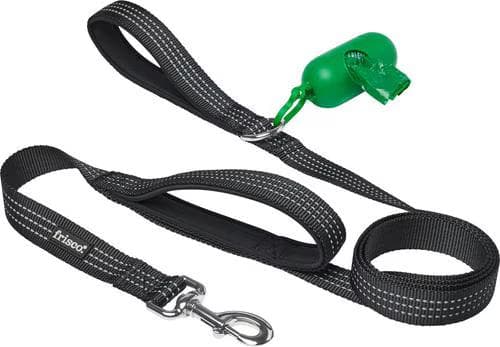
Introduce a durable traffic-handle leash as ordinary equipment through reward-based handling, then inspect the hardware and fit as the puppy grows. A shorter secondary handle is useful only when the caregiver can use it without yanking or wrapping the leash around a hand.
Petful may earn a commission when you click through to Lemonade, at no extra cost to you.
A puppy's soft coat and small body can hide the decision that matters: whether the household can safely and happily live with a 55 to 95 pound working guardian. Meet stable adult relatives whenever possible, and use the types of Schnauzers comparison if a Standard Schnauzer may fit better.
Describe your visitors, children, pets, work schedule, housing, activity, grooming tolerance, and training experience honestly. A responsible source should help identify a mismatch rather than promise that every puppy can fit every home.
- At least one parent or close adult relative can be observed when practical.
- Temperament questions include recovery, handling, strangers, and other animals.
- The household has read the full Giant Schnauzer guide.
- Adult size and handling are planned before the puppy comes home.
A seller who treats guarding, fear, or uncontrolled intensity as proof of quality is not offering a sound family-placement assessment.
Breeder, rescue, and adult placement questions
The source should be willing to discuss strengths, limitations, known health, and support. Answers should connect to documents and observed behavior rather than rely on reputation alone.
Ask how puppies are raised, matched, examined, socialized, and supported after placement. For adults, ask about house training, alone time, handling, visitors, dog and cat history, guarding, bite history, medications, and why the placement is changing.
- You can see where the dogs live through an in-person visit or verified live video.
- The source asks detailed questions about your household.
- No puppy leaves before an appropriate age or without veterinary records.
- The dog can be returned to the source if the placement fails.
Do not accept a vague assurance that every dog is perfect with children, dogs, or cats. Responsible placement acknowledges individual variation.
Verify health testing, not just claims
A general wellness exam on the parents is not the same as breed-specific screening. Compare the current Giant Schnauzer Club of America recommendations with public results for the actual sire and dam. Confirm registered names and identifiers; similar kennel names or cropped screenshots are not enough. A CHIC number shows that required tests were completed and results made public under the program. It is not a clean bill of health and does not mean every result was normal. Read the results themselves, their dates, and whether the dog was old enough for the test.
The Giant Schnauzer health and lifespan guide owns the deeper Giant Schnauzer lifespan discussion and explains what screening can and cannot predict. Use it after verifying the actual sire and dam, not as a substitute for their records.
Record each parent's OFA listing and CHIC number. A CHIC record documents completed public testing; it does not guarantee normal results, a fixed Giant Schnauzer lifespan, or freedom from Giant Schnauzer health problems.
Petful may earn a commission when you click through to Chewy, at no extra cost to you.

The five-document verification rule
Before a deposit, ask for five categories of evidence: parent identity, public health results, puppy veterinary record, written sales contract, and the source's lifetime return policy. Each document answers a different risk.
Keep the sales contract with the health record, and ask how puppy socialization will continue without forced greetings.
Open public databases yourself and match the names to the contract. Read the entire agreement for health disclosures, spay or neuter conditions, registration limits, transportation, refund language, and what happens if you cannot keep the dog.
- Both parents are named rather than described only by call names.
- Required results are public and interpretable.
- The puppy record identifies dates, products, and the examining clinic.
- The return clause does not depend on finding a replacement buyer.
No paperwork can guarantee a disease-free dog, but refusal to provide checkable evidence is a reason to stop the transaction.
What DNA testing can and cannot do
DNA panels can identify certain variants, confirm parentage, or add information when a validated test exists. They do not replace examinations and imaging for hips, eyes, thyroid, heart, or other traits assessed through phenotype.
Ask why each test was chosen, what the result means for the planned mating, and which recommended screens still require a specialist or age-based evaluation. Avoid treating a long panel as proof that every important condition was addressed.
- The test is relevant to this breed and the specific question.
- The laboratory and result can be verified.
- Carrier status is interpreted in the context of the mate.
- Phenotype-based parent-club screens are not omitted.
Health testing informs breeding decisions; it does not predict the exact lifespan or future diagnoses of one puppy.
How to verify a seller before paying
Fraud prevention is separate from breeder-quality evaluation. A scammer may copy real dogs, records, names, and photos. Confirm that the person receiving money is the person you verified and that the puppy shown live matches the one in the agreement.
Use this seller-verification process before payment: results for Schnauzer puppies for sale and Schnauzer puppy breeders are leads, not proof. Check identities, public health records, the written contract, living conditions, and return support yourself.
- Walk away from gift-card or cryptocurrency demands, identity mismatches, copied photos, refusal of live video, impossible shipping promises, pressure to pay immediately, or new fees that appear after a deposit. A legitimate opportunity can withstand basic verification.
Identity and live-video checks
Search the phone number, email, kennel name, and distinctive wording. Reverse-image search advertised photos when possible. Then request a live video call that shows the puppy, dam, environment, and a simple real-time action you choose.
Verify the payment recipient against the written contract and independently located contact information. If a club or marketplace listing is involved, navigate to it yourself instead of trusting a link sent in a message.
Petful may earn a commission when you click through to Chewy, at no extra cost to you.
- Names and locations remain consistent across records.
- The seller can show the puppy moving and interacting in real time.
- A veterinarian or reference is contacted through independently found details.
- Payment method offers a traceable record and follows the contract.
A marketplace badge or social-media history reduces neither the need to verify identity nor the need to evaluate breeding practices.
Giant Schnauzer puppy price and first-year budget
There is no single responsible price that applies across regions, litters, and time, and price is not a quality score. Ask several responsible sources what the quoted amount includes, then compare evidence and contract terms. A higher price can reflect real costs, marketing, scarcity, or all three; a lower price can be an opportunity, a rescue fee, or a warning. The number cannot be interpreted alone.
| Category | What to obtain locally | Why it varies |
|---|---|---|
| Acquisition | Written breeder, rescue, shelter, or rehome quote | Region, age, source, included care |
| Veterinary | Exam, vaccines, parasite plan, preventives, emergency reserve | Local fees and individual needs |
| Training | Puppy class, adolescent class, private support if needed | Instructor, format, and behavior |
| Grooming | Tools, introductory appointments, regular coat work | Clip, hand stripping, coat, region |
| Equipment | Gates, crate or rest area, leash, bed, vehicle restraint | Adult dimensions and household |
| Food | Complete diet, measured treats, transition food | Calories, format, brand, growth stage |
Use written local quotes instead of copying an online national average. Budget beyond purchase for recurring grooming and training, plus a contingency fund.
When setting the first-year budget in advance, compare a puppy insurance option with household savings and other financing choices.
Read the actual policy's waiting periods, limits, reimbursement terms, and exclusions before deciding. Keep separate savings for costs the policy does not cover. If comparing coverage, Lemonade pet insurance is one provider to review against current breed, state, exclusion, waiting-period, and reimbursement terms.
Compare total terms, not headline price
Two identical purchase prices can represent very different placements. One may include documented screening, veterinary care, early development, a clear contract, and long-term support; another may include little beyond the puppy.
Create a one-page comparison with parent records, contract, included veterinary services, registration terms, transport, return support, and expected first-year costs. Leave color and delivery speed off the first pass.
- Every included service is written rather than implied.
- Refund and replacement language is understood before signing.
- Transport does not replace meeting the source and evaluating the environment.
- The remaining budget still covers training, grooming, and veterinary care.
Do not stretch the budget so far for acquisition that ordinary care becomes unaffordable. The puppy's welfare depends on the years after payment.
The first weeks at home
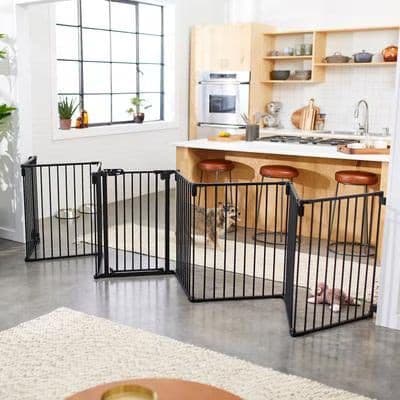
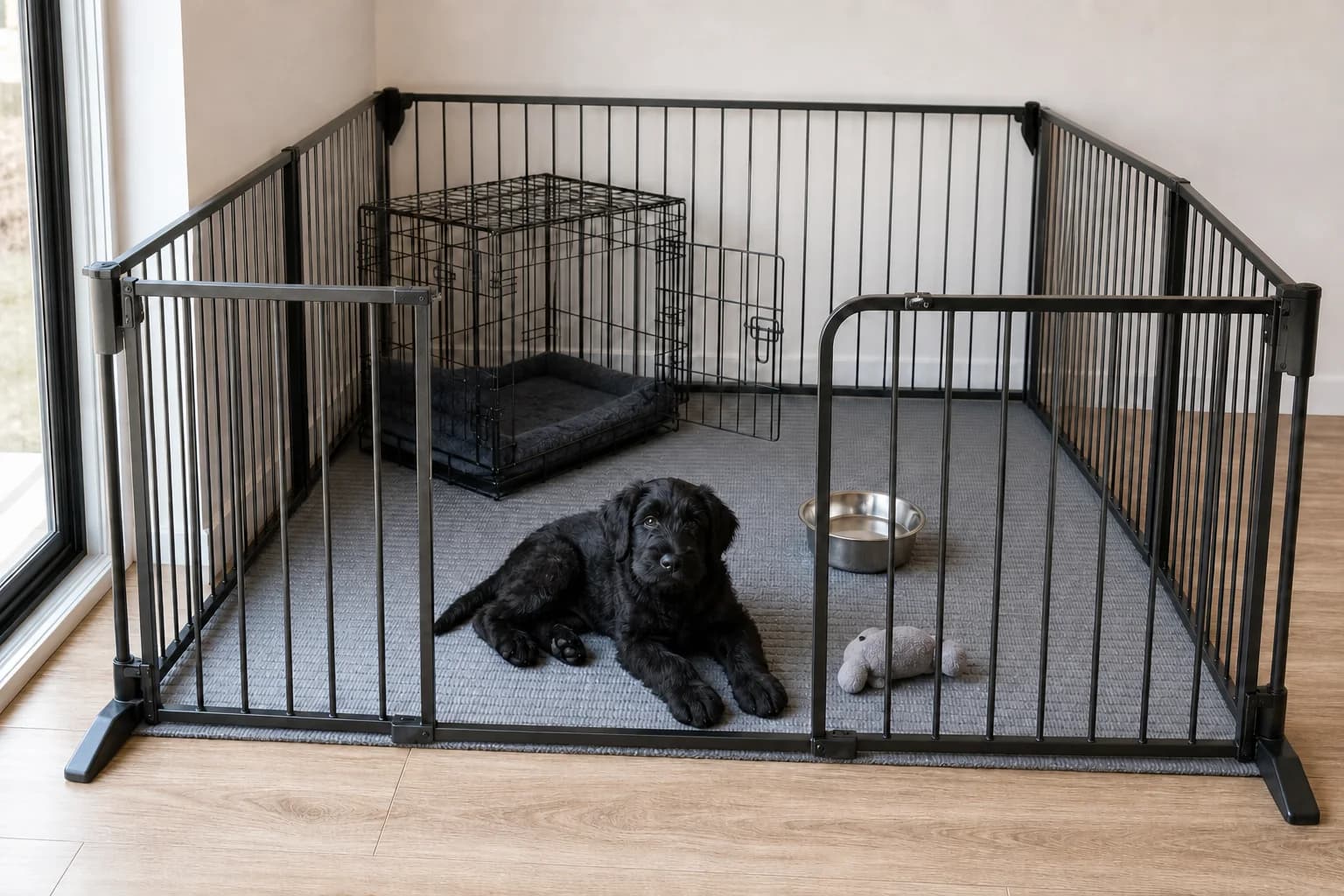
Keep the early environment small, predictable, and well supervised. A sturdy gate or configurable puppy pen can protect rest and prevent unsafe rehearsal, but it should be sized and secured for a rapidly growing working puppy.
Use the Giant Schnauzer size guide before buying adult equipment; a big Giant Schnauzer needs measured clearance, not a seller estimate.
A big Giant Schnauzer will quickly outgrow a puppy-only setup. Use the Giant Schnauzer size and weight guide to measure adult clearance, transport, and equipment before buying the largest versions of gates, crates, or beds.
A development-first arrival plan
The first days are for sleep, toileting, gentle handling, food stability, and learning that people are predictable. A parade of visitors and errands can overwhelm a puppy who has just left the litter.
Keep the previous food initially, schedule the veterinary visit, establish toilet and rest routines, and introduce household spaces gradually. Use short absences and calm returns to build independence without flooding.
- The puppy has a quiet protected sleep area.

Petful may earn a commission when you click through to Chewy, at no extra cost to you.
- Toileting opportunities follow sleep, meals, play, and transitions.
- Interactions stop before biting and arousal escalate.
- Household members use the same cues and management rules.
Persistent vomiting or diarrhea, lethargy, breathing change, refusal to eat, pain, or rapid deterioration needs prompt veterinary advice rather than an adjustment period assumption.
Final puppy-selection checks
Once a source passes identity, health-record, contract, and scam checks, the remaining work is to match a puppy or adult thoughtfully and preserve a useful development record.
Let temperament matching outrank photo choice
A single puppy test cannot predict an adult, but repeated breeder observations across sleep, novelty, frustration, recovery, handling, play, and litter interactions provide more context than a posed photo.
Give the source a truthful household profile and ask why the recommended puppy fits. Request examples of behavior over time and ask what support would be needed if the placement develops differently.
- The source has observed the litter daily.
- Matching considers visitors, pets, children, work, and experience.
- One bold or quiet moment is not treated as destiny.
- The buyer can decline a mismatch without pressure.
Avoid guarantees that the largest, first-to-greet, or most dominant-labeled puppy will become the best guardian or family dog.
Keep a socialization and health log
A simple record can show whether exposure is producing calm recovery or accumulating stress. It also helps the veterinarian and trainer connect behavior with sleep, digestion, pain, medication, or environmental change.
Record location, stimulus, distance, body language, recovery, food response, toileting, sleep, and any physical symptom. Keep entries short enough that the habit lasts.
- Exposure includes handling, surfaces, sound, transport, and rest.
- The puppy can opt out and recover.
- Vaccination and disease-risk advice is followed.
- Patterns are reviewed before difficulty increases.
Socialization is not a race to collect contacts. Repeated fear, shutdown, aggression, or physical illness calls for a smaller plan and professional help.
Protect the handoff and first month
A responsible transaction does not end when payment clears. The transfer should preserve identity, medical information, support, and a calm path into the new home.
Reconcile the puppy at pickup
Names, microchip numbers, sex, color description, date of birth, vaccine and deworming records, and the contract should all describe the same puppy. A rushed parking-lot handoff makes discrepancies harder to resolve.
Read the signed documents before travel, scan the microchip when possible, compare the puppy with the agreement, and obtain the source's current phone, veterinary, feeding, and return instructions.
- The person transferring the puppy matches the verified source.
- Original records and copies agree.
- Medication and next due dates are explicit.
- The return clause remains available after pickup.
Do not accept a surprise substitute, unexplained identity change, visibly ill puppy, or new payment demand merely because travel and emotion make walking away difficult.
Time insurance and veterinary decisions
Coverage commonly has exclusions, waiting periods, reimbursement rules, and documentation requirements. Buying a policy after signs begin may leave the condition outside coverage, while insurance never replaces an emergency reserve.
Compare sample policies before pickup, ask how congenital and hereditary conditions are handled, preserve the enrollment date, and schedule the first independent veterinary examination within the contract window.
- The policy holder understands deductible and reimbursement terms.
- Waiting periods fit the planned pickup date.
- Preexisting-condition language has been read.
- A claim can be funded before reimbursement arrives.
No policy proves that a source is responsible or a puppy is healthy. Parent screening, examination, contract rights, and ongoing care remain separate decisions.
Training and socialization in the first year
Puppy socialization should create calm, safe familiarity, not maximum contact. Reward observation, recovery, handling, surfaces, sounds, transport, and polite neutrality. Avoid dog-park chaos and forced greetings.
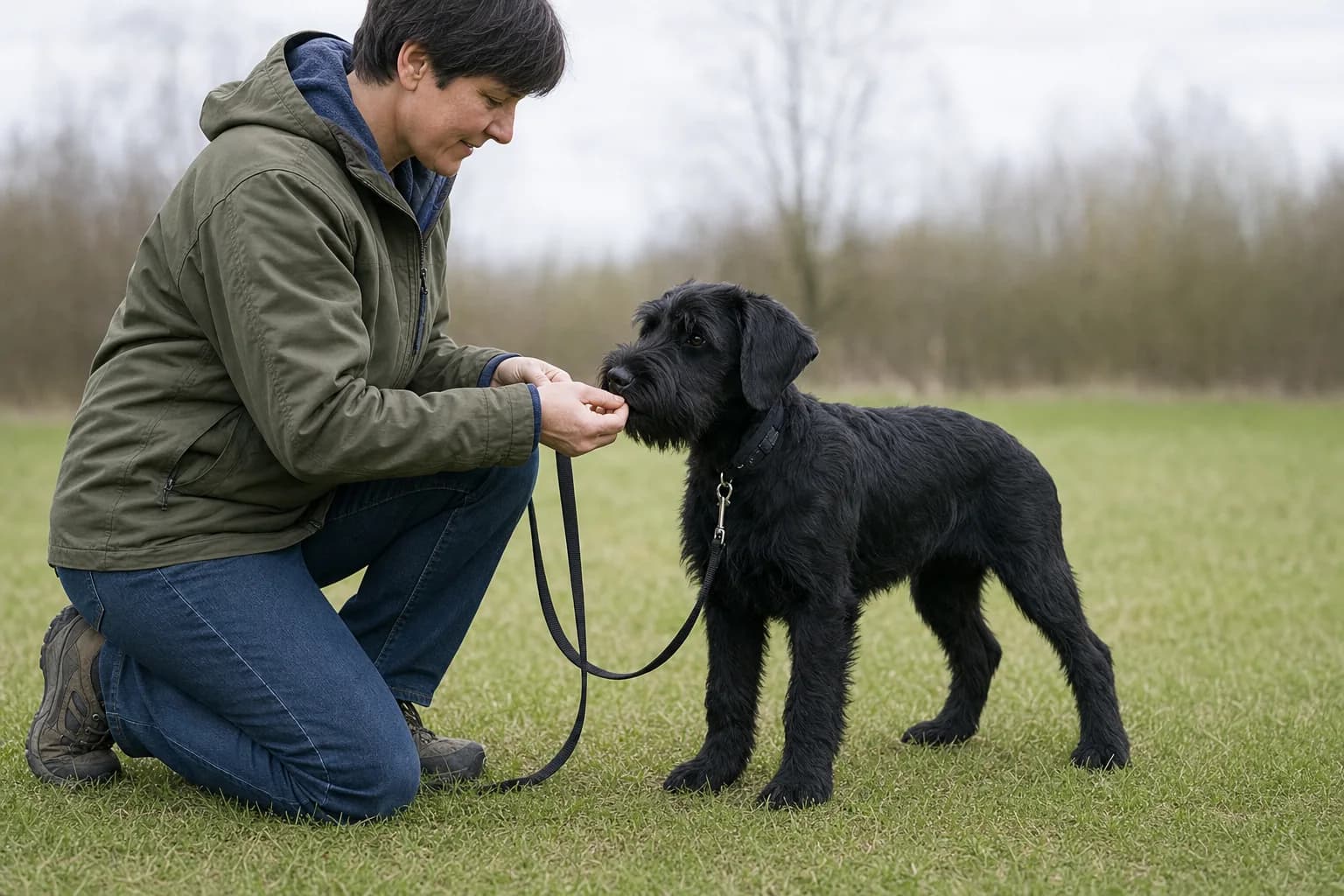
Teach foundations before adolescent power arrives:
- Name response, recall, hand target, drop, leave it, and place.
- Loose-leash movement and check-ins around mild distractions.
- Calm door, gate, vehicle, grooming, and veterinary routines.
- Comfortable muzzle conditioning as ordinary emergency preparation.
- Rest after activity and brief age-appropriate alone-time practice.
Recheck the size and health plans as the puppy matures; the measurements, handling strategy, and veterinary priorities should change with the individual dog rather than a generic age chart.
Use part of the measured meal in training, and consider a supervised food puzzle only when the construction and difficulty suit the puppy. Remove it if chewing or frustration makes use unsafe.
Giant Schnauzer puppy FAQs
How much should I pay for a Giant Schnauzer? There is no single quality price. Obtain current written quotes from responsible sources in your region, compare what each includes, verify both parents and the contract, and preserve enough budget for veterinary care, training, grooming, equipment, food, and emergencies. Price alone cannot prove or disprove responsible breeding, so a responsible decision compares evidence, support, and total first-year cost rather than choosing the highest or lowest number.
The cons of a Giant Schnauzer puppy include adolescent strength and adult physical power arriving before mature judgment. The household must provide daily training time, structured activity, secure management, regular grooming, visitor routines, and safe transport. Those commitments are manageable with preparation, but they are serious cons when the buyer wants an easy puppy, has limited handling capacity, or cannot obtain professional support during adolescence.
An AKC listing is not proof of a responsible breeder. No single registry or marketplace listing proves that a breeder meets your standards. Verify parent identities, public health results, living conditions, temperament decisions, the contract, and return support yourself. Confirm the person receiving payment, view the puppy and environment live, and read the actual health results. A legitimate listing can identify a lead, but it cannot complete those buyer checks for you.
Choose by health evidence and individual behavior, not color or sex. Start with temperament, fit, and the source's matching process. Color does not establish quality, and sex is only one variable among individual behavior, maturity, resident animals, and management. Ask why a specific puppy fits the household, compare repeated observations rather than one bold or quiet moment, and be willing to wait if the available color or sex is the wrong behavioral match.
Primary sources

Coreen Saito is a pet writer and longtime shelter volunteer with more than a decade in animal rescue. She covers cat behavior, breed care, and the small, ordinary science of sharing a life with companion animals, with a particular focus on honest takes about the products and decisions that actually matter. At home in Arizona, she's outranked by Mac (a dog with the loudest opinion in the house), Rebel (a cat who governs by quiet authority), and Meri (an orange tabby who runs the late shift and the laundry basket). She writes about all three, plus the rescues that keep coming through her life, at LifeWithMinty.com.
Sign up for expert-backed reviews and safety alerts all in one place.