Cane Corso Temperament, Training and Family Suitability
Cane Corsos are powerful guardian dogs. Learn how temperament, training, socialization and secure management affect everyday household fit before deciding whether the breed fits your home.

Petful is reader supported. As an affiliate of platforms like Amazon and Chewy, we may earn a commission when you buy through links on this page. There is no extra cost to you.
Cane Corso temperament is commonly described as confident, watchful, loyal, and protective, but those words are not a guarantee about one dog. Genetics, early experience, health, socialization, training, environment, and management all shape behavior. An adult Cane Corso is also powerful enough that small handling mistakes can have serious consequences.
This is a fit-first guide to guardian traits, Cane Corso socialization, reward-based training, family routines, and visitor management. It does not label the breed as automatically aggressive or automatically safe. The goal is a dog whose owner can read behavior, prevent rehearsals of unwanted responses, and use secure management before a situation becomes difficult.

Sign up for expert-backed reviews and safety alerts all in one place.
Cane Corso Temperament, Training and Family Suitability at a glance
A practical evaluation recognizes the Cane Corso as a guardian breed while leaving room for individual dogs to vary. The best household is prepared for structured learning, calm exposure, adult supervision, physical control, secure barriers, and professional help when behavior exceeds the owner's skill.
- 1Expect a powerful guardian dog, not an oversized easygoing pet by default
- 2Socialization means creating safe, positive experiences without forcing interaction
- 3Reward-based training and management must continue beyond puppyhood
- 4Evaluate the individual dog's behavior, history, health and recovery, because breed tendencies do not predict every response
- 5Breed tendencies describe populations, not every individual dog. Records, direct observation and professional findings answer different questions, and the household routine determines what will be practical.
The AKC Cane Corso profile and Cane Corso Association of America provide official breed context. Petful's Cane Corso breed profile covers the larger history, appearance, care, and ownership picture.

Petful may earn a commission when you click through to Chewy, at no extra cost to you.
Cane Corso temperament at a glance
Cane Corso temperament and Italian Mastiff temperament are broad terms for breed tendencies, not predictions for one dog. Evaluate repeated behavior, recovery from stress, health, history, training and management in the settings the household will actually face.
The Italian Mastiff temperament described in breed sources includes confidence, responsiveness to the owner, and a natural guarding role. Those tendencies can look different across dogs and situations. A calm dog is not necessarily comfortable, and a quiet dog is not necessarily safe to approach.
This framework uses separate categories and careful distinctions. It separates a breed tendency from an observed behavior, a training skill, and a management control so owners do not treat them as interchangeable.
| Decision | Evidence to use | Responsible response |
|---|---|---|
| Breed tendency | Current official breed and parent-club guidance | Plan for guardian traits without assuming one dog's reaction |
| Individual behavior | Repeated observations with context, distance, body language and recovery | Adjust exposure and management to the dog in front of you |
| Trained skill | Behavior performed reliably under gradually increased distraction | Reinforce it and avoid claiming reliability beyond what was practiced |
| Household safety | Gates, doors, leash handling, adult supervision and visitor routine | Use controls before excitement or uncertainty rises |
| Professional concern | Escalating fear, guarding, lunging, snapping, biting or inability to recover | Contact a qualified reward-based behavior professional and veterinarian |
Watch recovery, not just reaction
A dog may notice a stranger, sound, dog, or unfamiliar object. The useful questions are how intense the response is, whether the dog can eat or orient to the handler, how much distance is needed, and how quickly normal behavior returns.
Keep short records that include trigger, distance, environment, body language, response, recovery time, sleep, exercise, and any health change. Repeated context is more informative than one dramatic clip. Sudden behavior change, pain, confusion, or reduced tolerance should also prompt a veterinary conversation.
Routine supports learning
Predictable meals, rest, outdoor breaks, training, and quiet time can reduce avoidable conflict. A scheduled feeder can help some households coordinate meal timing, but it cannot supervise feeding, prevent resource guarding, or replace training.
Compare the capacity, bowl access, cleaning, power backup, and portion settings of the Petlibro Granary WiFi automatic feeder with the individual dog's food, size, and household plan. Introduce equipment gradually and do not use it to deliver high-value food around dogs that need separation.
Guardian instincts and individual variation
Are Cane Corsos protective? The breed's history and official descriptions support planning for guardian behavior, but “protective” is too vague to excuse uncontrolled barking, charging, cornering, or biting. Owners should aim for neutrality, responsiveness, and safe management rather than encouraging suspicion.
A dog that alerts to a visitor can be taught to move away from the entry, settle behind a barrier, and wait for instruction. A dog that cannot disengage or becomes more intense with repetition needs more distance and a better plan, not a confrontation.
Protection is not a party trick
Do not stage threats, provoke guarding, or invite inexperienced people to test the dog. Avoid trainers who promise to make a young dog more aggressive, guarantee complete control, or rely on intimidation without explaining welfare, risk, and fallout.
Useful guardian-breed skills include:
- Moving to a mat or secure room when the doorbell sounds.
- Wearing a properly conditioned basket muzzle when appropriate.
- Entering and exiting vehicles, crates, and gates on cue.
- Turning away and increasing distance with the handler.
- Releasing objects through an exchange rather than force.
- Remaining separated from guests until an adult decides the next step.
Individual history matters
A dog's breed label, sex, color, ear shape, or imposing appearance does not prove temperament. Evaluate observed behavior across contexts, known history, health, handling response, and recovery. A shelter description or seller claim may be useful background, but it is not documentary proof of ancestry or a behavioral guarantee.
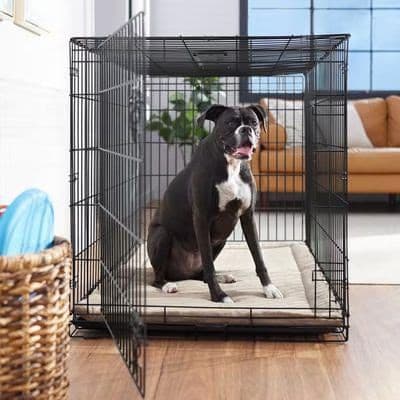
A correctly fitted crate can be one layer of management. Compare the internal dimensions, divider, door placement, wire spacing, and setup requirements of the Frisco Heavy Duty Fold & Carry X-Large crate with the dog's measured size and comfort. A crate must never be used as punishment or as the only answer to distress.
Petful may earn a commission when you click through to Chewy, at no extra cost to you.
Early socialization and exposure
Cane Corso socialization is not an attempt to make a puppy greet everyone. It is a planned process that helps the dog experience people, animals, surfaces, sounds, handling, vehicles, places, and quiet observation at an intensity the dog can handle.

The planned photograph shows an adolescent Cane Corso calmly observing people and dogs from a safe distance. Distance is a training tool. The puppy can notice, take food, check in with the handler, and leave without being pushed into contact.
Quality matters more than a checklist
A useful exposure has three features:
- Choice: The dog can move away, decline touch, or observe without being trapped.
- Manageable intensity: The dog can respond, eat if normally food-motivated, and recover.
- Positive or neutral outcome: Nothing frightening or painful is forced in the name of socialization.
Flooding a worried puppy in a crowded store, dog park, or party can rehearse fear rather than build confidence. Avoid chaotic greetings, unknown dogs, and situations where the puppy cannot retreat. Follow veterinary advice about disease risk while still using safe exposure methods.
Build a varied but calm plan
Rotate brief sessions across low-traffic sidewalks, parked cars, household sounds, different surfaces, grooming tools, cooperative handling, calm visitors, veterinary-style examination practice, and quiet observation. End while the dog is coping rather than after signs escalate.
Watch for freezing, leaning away, closed mouth, hard stare, tucked posture, frantic scanning, refusal of usual food, barking, lunging, hiding, or inability to settle. One sign is not a diagnosis. It is information that may mean the session needs more distance, less duration, or a different setup.
Adolescence is not graduation
Social learning continues as size, confidence, hormones, and environment change. Skills that worked in a quiet puppy class may weaken near unfamiliar dogs, visitors, or territorial boundaries. Reduce difficulty, restore distance, and reinforce the known behavior rather than punishing uncertainty.
The Cane Corso puppy guide covers buying, adoption, breeder, scam and puppy-preparation questions. Ask how puppies were raised and matched, but do not assume a seller's “family raised” phrase proves careful socialization.
Reward-based training and handling
Cane Corso training should teach clear skills while protecting trust and safety. Reward-based methods use food, toys, access, distance, and everyday opportunities to reinforce desired behavior. Management prevents the dog from repeatedly practicing a response that training has not yet replaced. When food rewards fit the dog's diet, the Blue Buffalo Nudges Grillers Steak Natural Dog Treats are one treat option to compare by ingredients, calories, and reward size. For toy rewards, the KONG Classic Dog Toy in Large is one supervised option to compare with the dog's size and chewing style.
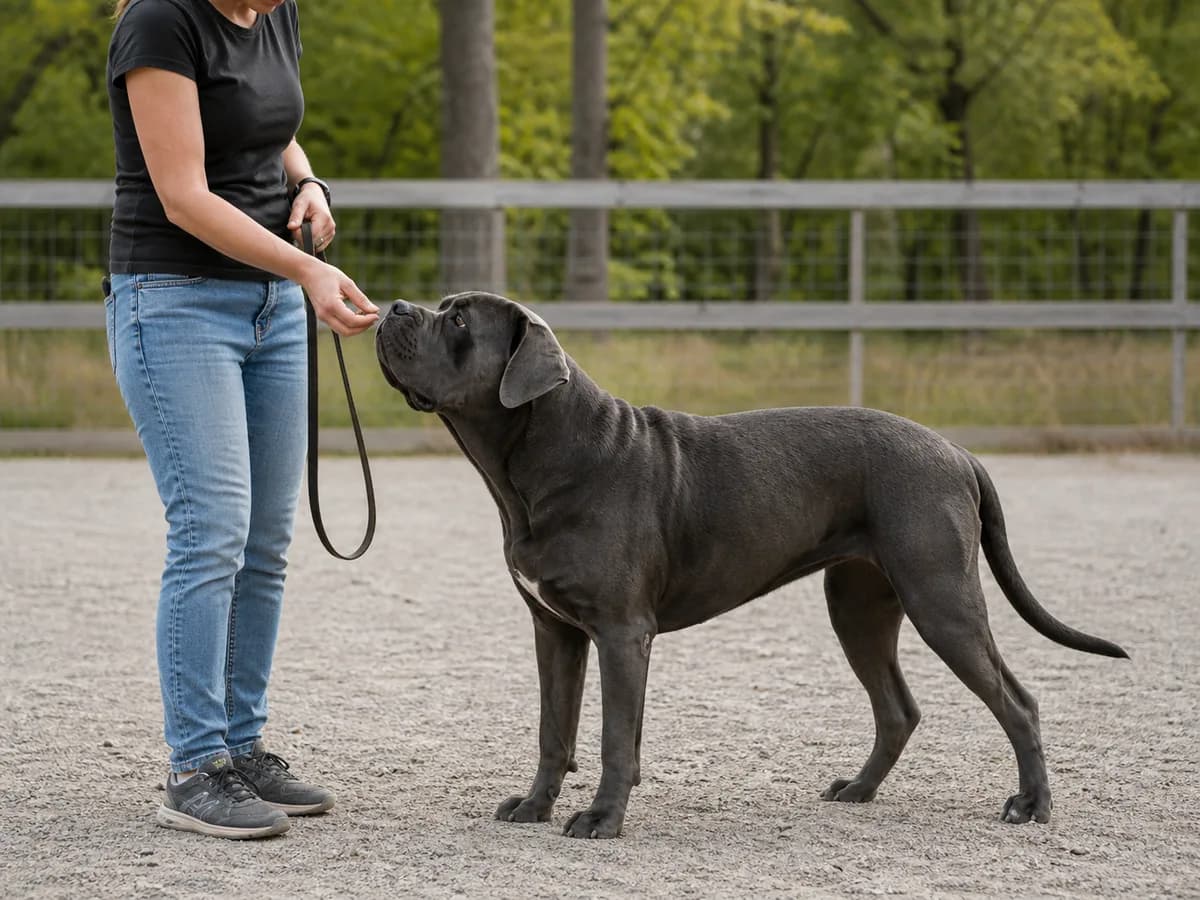
The planned image shows a loose-leash exercise between an adult handler and Cane Corso. The dog is not being dragged into position. The handler rewards attention and slack in the leash in a low-distraction setting before adding difficulty.
Start with functional skills
Prioritize behaviors that make daily life safer:
- Name response, hand target, recall, and moving away with the handler.
- Loose-leash walking and waiting at doors, gates, curbs, and vehicles.
- Mat settle, crate entry, separation behind a barrier, and calm release.
- Leave it, drop through an exchange, and interruption of fixating behavior.
- Cooperative handling for ears, paws, mouth, grooming, veterinary care, and equipment.
- Comfortable basket-muzzle training taught before an emergency.
Train in short sessions. Change one difficulty at a time, such as distance, duration, distraction, or location. A cue is not “known” merely because the dog performed it in the kitchen.
Equipment does not train the dog
A harness must fit the individual dog's chest and movement without rubbing, restricting the shoulders, or allowing escape. The PetSafe Easy Walk harness can be compared by exact measurements, adjustment points, condition, and the dog's response. The listed Medium/Large label must not be assumed to fit an adult Cane Corso.

Petful may earn a commission when you click through to Chewy, at no extra cost to you.
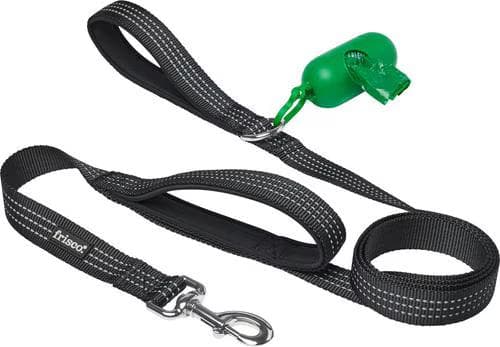
A leash with a second handle may offer another controlled grip at close range. Compare the length, material, hardware, hand comfort, and intended use of the Frisco six-foot traffic leash with dual padded handles. Do not wrap any leash around a hand, attach it to an unsecured waist, or rely on equipment that the handler cannot safely manage.
Petful may earn a commission when you click through to Chewy, at no extra cost to you.
Handling should be cooperative
Break procedures into small steps: approach, brief touch, reward, release, and pause. Teach a chin rest or station behavior. Stop before the dog needs to struggle. If a necessary procedure cannot be done safely, contact the veterinary team or a qualified trainer rather than escalating restraint at home.
Pain can reduce tolerance. A new growl, avoidance, snapping response, handling sensitivity, or change in sleep and movement deserves veterinary consideration, especially when it appears suddenly. Petful's Cane Corso health and lifespan guide explains that clinical boundary.
Choose professional help carefully
Ask a trainer to explain methods, credentials, continuing education, safety controls, and how progress is measured. Observe whether the professional listens to the dog's body language, protects distance, and teaches the owner. Avoid anyone who guarantees an outcome, dismisses fear or pain, provokes aggression for display, or refuses to describe what happens when a dog gets it wrong.
For aggression, a bite history, severe guarding, or escalating reactivity, use qualified behavior help and veterinary input. The plan should include immediate risk reduction, not only an obedience exercise.
Cane Corsos with children, visitors and pets
Are Cane Corsos good family dogs? Some individual Cane Corsos live successfully in prepared families, but breed alone cannot answer the question. A Cane Corso with kids still requires adult supervision, secure separation, child education, and a plan that never makes the child responsible for controlling the dog.

The planned home scene shows the dog settled on a mat while adults talk nearby, with no child contact staged. That setup models the goal: calm, controlled coexistence instead of a photograph that asks a child to hug, climb on, or restrain a powerful dog.
Rules for children and dogs
Adults should prevent children from:
- Approaching a dog who is eating, sleeping, chewing, hiding, injured, or caring for puppies.
- Hugging, riding, cornering, teasing, chasing, or taking an item by force.
- Opening gates, doors, crates, or barriers without adult direction.
- Leading the dog in a situation where the child cannot maintain control.
- Interrupting growling or other warning signals through punishment.
“Supervision” means an attentive adult is close enough to intervene and understands the plan. If attention must shift, separate the dog and child with secure layers. A crate, gate, room, and leash are tools only when the dog has been conditioned to them and the setup cannot be defeated.
Visitor routines start before the bell
Place the dog behind a secure barrier before opening the door. Tell visitors not to reach over the barrier, stare, crowd, or insist on greeting. A dog who remains worried or highly aroused does not need to participate in the visit.
Practice the routine when no visitor is present: door sound, movement to the station, reward, barrier closure, and calm release after the entry area is quiet. Do not improvise with an excited dog at an open doorway.
Other pets require individual assessment
Introductions should be gradual, controlled, and reversible. Use distance, parallel movement where appropriate, separate resources, and secure rest areas. Do not leave dogs together based on one friendly meeting, and do not assume early tolerance will remain unchanged through social maturity.
Cats and smaller animals need escape routes and management that does not depend on the Cane Corso choosing restraint. Prey interest, play style, guarding, health, size difference, and the other animal's behavior all affect risk.
A consistent meal routine can reduce household confusion when several adults share care. The Petlibro Granary WiFi feeder may help log and schedule portions, but feed animals separately when needed and supervise access. Technology does not resolve guarding or ensure that the correct pet ate.
Is a Cane Corso right for a first-time owner?
A Cane Corso first-time owner is taking on a high-consequence learning curve. Prior dog ownership is not the only qualification, but the household must honestly assess skill, physical handling, time, housing, local rules, insurance, visitor patterns, children, other animals, transport, professional support, and emergency planning.
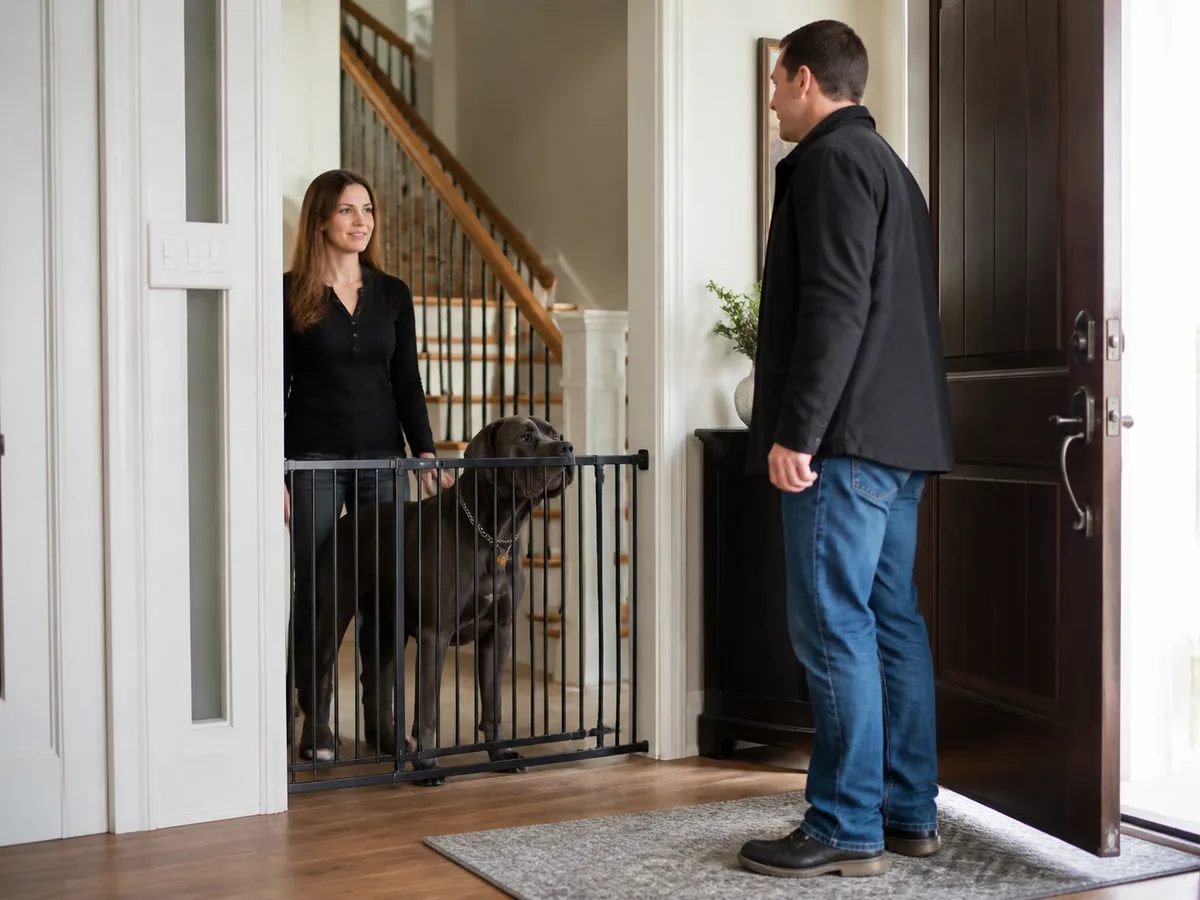
The planned image shows a secure entry with the dog behind a gate while a visitor arrives. This is management doing useful work before training is tested. A first-time owner needs systems that remain safe on a rushed day, not only when every person follows verbal instructions perfectly. For a configurable visitor barrier, compare the Frisco Steel 8-Panel Configurable Dog Gate and Playpen by height, anchoring, spacing, room layout, and the dog's ability to push or climb.
Run a normal-week audit
Map seven real days and include:
- Who handles morning, evening, and unexpected outings.
- How the dog is separated during deliveries, repairs, parties, and child visits.
- Where training happens and what qualified help is available locally.
- How exercise changes in heat, rain, illness, work travel, or injury.
- Whether the vehicle, home, crate, gates, and equipment fit a large adult dog.
- What happens if the primary handler becomes unavailable.
The Cane Corso size, weight and growth guide helps plan measured equipment fit without turning a weight estimate into a promise. A dog too strong for the available handler is a management problem even when the dog is friendly.
Identify your stop signs
Pause the acquisition decision when housing rules are unclear, no adult can safely handle the dog, household members disagree about training, barriers are insecure, or there is no qualified behavior support within reach. Also pause when the seller minimizes guardian traits or promises a puppy will naturally know friend from threat.
A Frisco X-Large wire crate can be evaluated as one quiet-rest and management option, but measure the adult dog and room, condition crate comfort gradually, and build a backup barrier plan. No crate should hold a distressed dog for excessive periods.
Physical control needs a backup
Check the fit and security of a PetSafe Easy Walk harness in a low-distraction area before depending on it outdoors. Pair equipment with trained movement, distance, and handler awareness. A front attachment or marketing claim does not make lunging safe.
Inspect a Frisco dual-handle traffic leash before each use for worn stitching, damaged hardware, or chewing. The close handle may be useful in planned transitions, but constant tight restraint can add tension and cannot replace a safe route or distance.
Choosing a puppy with temperament in mind
The dedicated Cane Corso puppies guide owns breeder evaluation, adoption, price context, records, contracts, and scam avoidance. This temperament page adds one boundary: no puppy test, photograph, breeder adjective, or brief meeting can guarantee the adult personality.
Ask how the litter was raised, which people and environments the puppies experienced, how recovery from novelty was observed, and how the seller matches puppies to households. Meet the mother when appropriate and review dog-specific records, but avoid drawing a lifetime conclusion from one adult or one visit.
Ask for examples, not labels
Replace “Are they good family dogs?” with questions such as:
- What did the puppy do after a new sound or surface, and how quickly did the puppy recover?
- How does the puppy respond to gentle handling and interruption?
- Which environments, people, dogs, and household routines have been introduced?
- What support is available if behavior changes during adolescence?
- What observations led to this household match?
Responsible answers include uncertainty. Walk away from guarantees of aggression, protection, perfect safety, or a specific adult temperament. A high price, rare color, large parent, or dramatic video does not improve behavioral evidence.
What to verify before you decide
- Review dog-specific behavior across contexts, health history, known social experience, training methods and recovery from stress. Ask for records and professional guidance when concerns exist. Appearance is not documentary proof of ancestry, confidence or safety, and no breed label guarantees one response.
Before committing, speak with every adult in the home and write down the visitor, child, pet, gate, transport, training, veterinary, and emergency routines. Confirm local housing and insurance restrictions yourself. Do not rely on a seller's assurance that rules do not apply.
Define success realistically
Success may mean the dog can notice a visitor and remain safely separated, pass another dog at a workable distance, accept veterinary handling through conditioning, or settle during ordinary household activity. It does not require the dog to enjoy every stranger, dog, place, or event.
Track progress by reliability, distance, recovery, and the amount of management needed. If risk is rising, reduce exposure and get help rather than waiting for a more serious incident.
Is this the right dog for your household?
- Prepared owners may value the breed's close bond, watchfulness and trainability
- Structured routines can turn guardian-breed planning into clear daily actions
- Reward-based practice and secure management can support predictable household routines
- Size, strength, territorial behavior and individual variation can make mistakes high consequence
- Socialization, training, supervision and secure management are ongoing commitments
- Children, visitors, pets, housing, physical control and professional support all affect household fit
The right answer can be “not now.” Choosing a dog whose needs and consequences fit the household is more responsible than acquiring a Cane Corso for appearance, status, intimidation, or an imagined protection role.
Cane Corso Temperament, Training and Family Suitability FAQs
Whether a Cane Corso is more aggressive than a pitbull cannot be answered with a reliable breed ranking. Behavior depends on the individual dog, genetics, early experience, health, training, management and context. Because either type can be powerful, owners should focus on observed behavior, safe handling and qualified support. Never arrange confrontations or use online fight comparisons.
A well-selected and responsibly managed Cane Corso can live successfully with a family, but the breed is not an automatic fit for every household. Adults must provide training, secure management, structured socialization and active supervision around children and visitors. Evaluate the individual dog and the adults' experience, schedule and willingness to manage a powerful guardian.
The downsides of a Cane Corso can include adult strength, guardian behavior, substantial training and management needs, housing or insurance restrictions and the cost of large-dog care. Individual dogs vary, but these responsibilities cannot be ignored. The breed is a poor fit when adults cannot provide secure containment, consistent reward-based training, controlled introductions and daily physical and mental activity.
Risk depends on the individual dog, handler, environment and management, not a label alone. A Cane Corso's size and strength can raise the consequences of poor control, so careful selection, secure containment, socialization and skilled training matter. Prospective owners should also check local housing and insurance rules before committing and seek help early for concerning behavior.
Cane Corsos do not unpredictably turn on owners as a breed trait, but any dog can bite or show aggression under particular conditions. Pain, fear, guarding, conflict and learned behavior can contribute. Take warning signals seriously, avoid punishment that escalates fear and use secure management while seeking veterinary and qualified behavior support when safety is in question.
A Cane Corso is usually a demanding choice for a first-time owner because mistakes are harder to manage in a large, powerful guardian. A highly prepared beginner with strong professional support may succeed, but that should not be assumed. Be honest about handling experience, time, secure housing, training access and the ability to manage visitors and other animals.
Many Cane Corsos have guardian tendencies, but protection should not be treated as a guaranteed feature or encouraged through intimidation. The safest goal is a stable dog that follows cues and can be managed around ordinary visitors and public situations. Focus on socialization, obedience, secure boundaries and professional guidance rather than informal protection training.
Begin controlled, positive exposure early and continue throughout adulthood. Pair new people, places, surfaces and calm dogs with rewards while keeping enough distance for the puppy to remain comfortable. Teach foundation skills with reward-based methods, manage doors and visitors carefully, and seek a qualified trainer before fear, guarding or reactivity becomes an established pattern.
Sources

Coreen Saito is a pet writer and longtime shelter volunteer with more than a decade in animal rescue. She covers cat behavior, breed care, and the small, ordinary science of sharing a life with companion animals, with a particular focus on honest takes about the products and decisions that actually matter. At home in Arizona, she's outranked by Mac (a dog with the loudest opinion in the house), Rebel (a cat who governs by quiet authority), and Meri (an orange tabby who runs the late shift and the laundry basket). She writes about all three, plus the rescues that keep coming through her life, at LifeWithMinty.com.
Sign up for expert-backed reviews and safety alerts all in one place.