Cane Corso Health Issues and Lifespan
Cane Corsos can face inherited and acquired health risks. Learn what screening can show, what owners can monitor and when to call a veterinarian when the individual dog changes.

BVMS, MRCVS
Petful is reader supported. As an affiliate of platforms like Amazon and Chewy, we may earn a commission when you buy through links on this page. There is no extra cost to you.
Cane Corso health issues deserve a practical, evidence-aware plan rather than a frightening list. Hip and elbow disease, cardiac concerns, eye or eyelid problems, neurologic disease, skin disease, and other acquired illnesses may affect individual dogs, but a breed tendency is not a diagnosis or a prediction for one Cane Corso.
This veterinary-authored guide explains which records can be verified, how owners can monitor body condition and function, and which changes should prompt veterinary care. It cannot diagnose a dog. If your Cane Corso is struggling to breathe, collapses, has a swollen abdomen with unproductive retching, experiences a seizure, cannot stand, or has a painful eye, seek urgent veterinary help now.

Sign up for expert-backed reviews and safety alerts all in one place.
Cane Corso Health Issues and Lifespan at a glance
A practical evaluation starts with the individual dog. Cane Corso health problems can be influenced by genetics, age, body condition, environment, infectious disease, injury, and chance. Individual dogs can vary, so use documented screening and veterinary findings rather than assuming that a breed label explains a symptom.
- 1Verify health screening records instead of accepting a verbal claim
- 2Keep weight, appetite, mobility, eye, breathing and behavior notes for the individual dog
- 3Treat screening as risk information, not a guarantee
- 4Seek veterinary care promptly for a new or worsening change and urgent care for emergency signs
- 5Breed tendencies describe populations, not every individual dog. Records, direct observation and professional findings answer different questions, and the household routine determines what will be practical.
When to call a veterinarian
Contact your veterinarian promptly when a Cane Corso develops a new limp, reluctance to rise, persistent eye redness or discharge, repeated vomiting or diarrhea, appetite loss, marked thirst, unusual fatigue, coughing, fainting, a new lump, unexplained weight change, or a meaningful behavior change. Timing depends on severity, duration, age, medical history, and whether several signs occur together.
Use emergency care for breathing difficulty; blue, gray, or very pale gums; collapse; repeated unproductive retching with a distended abdomen; uncontrolled bleeding; suspected poisoning; severe trauma; continuous seizure activity; repeated seizures without recovery; sudden inability to use a limb; or severe eye pain or injury. Call the clinic while traveling if possible so the team can prepare and tell you what not to give at home.
Do not wait for a breed explanation
A symptom that resembles a reported breed concern may have another cause. Do not start a supplement, use leftover medication, restrict water, force exercise, or postpone care while trying to identify a condition online. Bring the dog's medication list, recent diet and activity changes, symptom timing, and any safe video of the episode to the appointment.
Cane Corso health at a glance
Cane Corso health issues and Cane Corso health problems are population-level prompts for screening and monitoring, not a diagnosis for one dog. Use the dog's identity, age, family history, current function, body condition, symptoms, examination and test results to decide what matters now. Breed prevalence, documented screening, preventive care, urgent warning signs and veterinary assessment belong in separate evidence lanes.
The most useful framework separates routine prevention, verified screening, changes that need a prompt appointment, and emergencies. These separate categories keep careful distinctions from being mistaken for a diagnosis.
| Decision level | Evidence to use | Practical action |
|---|---|---|
| Routine prevention | Veterinary examination, vaccination and parasite plan, dental care, diet, activity and body-condition trend | Follow the individual care plan and keep dated records |
| Breeding-screening context | Original result, dog identity, registry entry, laboratory or specialist report, and test date | Verify results and ask what each test can and cannot predict |
| Prompt clinical review | New or worsening eye, mobility, appetite, breathing, weight, skin or behavior change | Contact the veterinarian and describe timing, severity and associated signs |
| Emergency | Collapse, breathing distress, repeated unproductive retching, severe trauma, uncontrolled bleeding, prolonged seizure or severe eye pain | Seek urgent veterinary care rather than monitoring at home |
The Cane Corso Association of America health guidance is the breed-specific starting point for current screening and health information. The OFA CHIC program explains how breed-specific screening results can be recorded and made available. Requirements and recommendations can change, so check current pages rather than relying on an old screenshot.

 Sponsored
Have a health question about your pet?
Talk to a licensed vet at Dutch over video or message, including nights and weekends.
Use code Pets60
Plans start at $12/month · covers up to 5 pets
- Licensed vets in most states
- Rx for 150+ conditions
- 4.7 on Trustpilot
A health list is not a forecast
A condition appearing on a breed page means it deserves informed attention, not that every Cane Corso will develop it. Conversely, a normal puppy examination or a clear screening result cannot promise lifelong health. Screening addresses defined questions at a particular time; it does not test for every inherited or acquired condition.
Petful's Cane Corso breed profile covers the broader history, appearance, care, and household picture. This page stays focused on health decisions and lifespan context.
Owners considering DNA-based information can review the scope and limitations of the Embark Breed & Health Dog DNA Test Kit. A consumer DNA panel is not a veterinary diagnosis and does not replace the parent-club screening protocol, physical examination, or specialist testing.

Petful may earn a commission when you click through to Chewy, at no extra cost to you.
Health screening and breeder records
Cane Corso health testing should be discussed before a puppy deposit, but the phrase “health tested” is too vague by itself. Ask for the registered names or identifiers of both parents, the specific tests performed, dates, result documents, and the registry where applicable. Then verify the records independently.

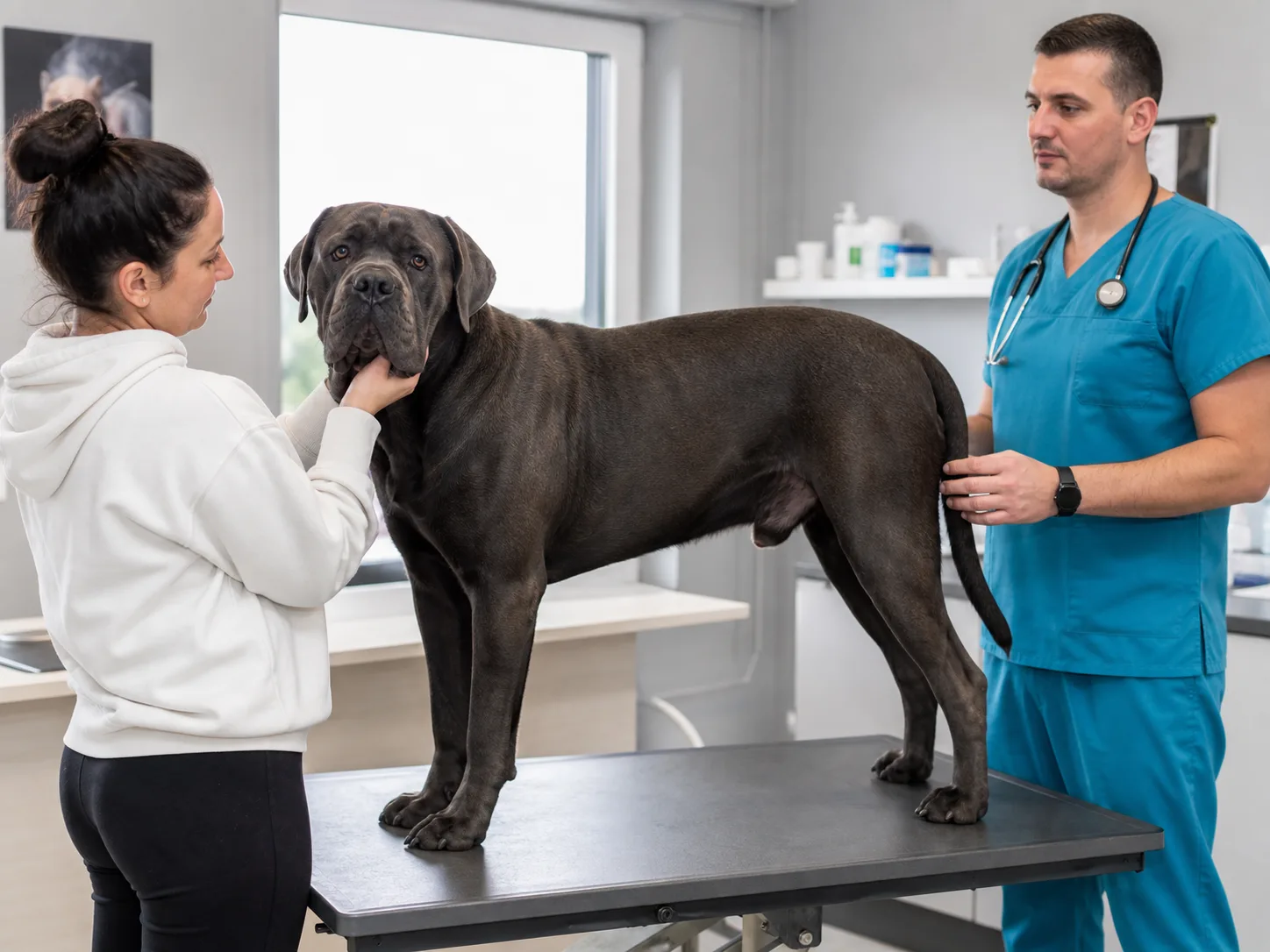
The planned image shows a veterinarian and owner reviewing records with private details obscured. That is the right mental model: match every result to the correct dog and test rather than judging the quality of a breeding program from a website badge or photograph.
Use an evidence ladder
Rank the evidence before making a buying decision:
- Strongest for the stated screening claim: A result in an independent registry or an original report that matches the dog's permanent identity, registered name, test, and date.
- Useful supporting evidence: A veterinary or specialist document whose issuing practice can be confirmed and whose scope is clear.
- Context only: A pedigree, breeder explanation, family history, or prior litter information that is specific and can be checked.
- Not proof: Appearance, muscularity, color, price, awards, social-media popularity, a generic “vet checked” statement, or a cropped certificate with no matching identity.
The OFA CHIC program describes CHIC as a way to identify dogs that completed the breed's recommended tests and made results public. A CHIC number does not mean every result was normal, and it is not a lifetime guarantee. Open the individual record and read the actual results.
Questions to ask about testing
Use the current Cane Corso Association of America health page to frame the conversation, then ask:
- Which current parent-club screening recommendations were completed for the sire and dam?
- Where can each result be independently verified?
- Were any results preliminary, and are final age-appropriate results available?
- What health information is known about close relatives and prior litters?
- What does the contract require if a veterinary concern appears after purchase?
- Will the seller give you time for an independent veterinary examination?
No responsible answer can remove all uncertainty. The point is to replace an unsupported promise with records, limits, and a plan for the puppy as an individual. The Cane Corso puppy guide covers safe buying, breeder questions, adoption, and scam avoidance in more depth.
DNA results need clinical context
A result from the Embark Breed & Health Dog DNA Test Kit may add information about variants included in that product's current panel. It cannot clear conditions that require imaging, an examination, or another laboratory method, and it cannot tell you that a symptomatic dog is safe to monitor without veterinary care.
Hip, elbow and mobility concerns
Cane Corso hip dysplasia is an important screening and clinical topic, but a dog cannot be diagnosed from gait videos, posture, breed, or a parent's result. Hip and elbow structure, arthritis, soft-tissue injury, neurologic disease, paw pain, body condition, age, and activity can all affect movement.

The planned photograph shows a mature Cane Corso walking comfortably on level ground. A calm walk can help an owner notice symmetry, stride, head movement, reluctance, and change from baseline, but observation does not replace an orthopedic and neurologic examination.
Changes worth recording
Contact a veterinarian about persistent or recurring:
- Limping, stiffness, hopping with both rear legs, or uneven wear on nails.
- Difficulty rising, climbing stairs, jumping, lying down, or settling comfortably.
- Reduced willingness to walk, play, turn, or be handled.
- Muscle loss, repeated slipping, toe dragging, swelling, or pain.
- A sudden gait change after exercise, a fall, collision, or rough play.
Do not “test” pain by repeatedly flexing a joint or forcing activity. Limit unsafe movement, follow the clinic's transport advice, and note when the change began. Sudden inability to bear weight, major trauma, severe pain, or neurologic loss of function warrants urgent assessment.
Management follows a diagnosis
The plan may involve weight management, modified activity, rehabilitation, medication, environmental changes, surgery, or another approach depending on the diagnosis and the dog. A supportive sleep surface can improve comfort for some dogs, but it cannot treat an undiagnosed disorder.
Compare the dimensions, entry height, cleaning needs, and support of the FurHaven NAP Ultra Plush Orthopedic Deluxe jumbo bed with your Cane Corso's measured sleeping posture and mobility. Keep beds away from slippery travel paths and monitor whether the dog can get on and off without struggling.

A plush orthopedic foam mattress that cushions aging joints and pressure points, giving a stiff or trembling senior dog warm, supportive rest.
Petful may earn a commission when you click through to Chewy, at no extra cost to you.
Eye, heart and other breed concerns
Cane Corso eye problems can range from surface irritation and injury to eyelid or internal-eye disease. Redness, squinting, cloudiness, swelling, rubbing, a suddenly prominent third eyelid, unequal pupils, discharge, or apparent vision change deserves veterinary advice. Severe pain, trauma, sudden vision loss, or an eye that looks enlarged or displaced is urgent.
Cane Corso heart problems also cannot be identified by breed or one symptom. Coughing, reduced exercise tolerance, rapid or labored breathing, weakness, fainting, abdominal enlargement, and restlessness can have cardiac and noncardiac causes. Breathing distress or collapse requires emergency care.
Seizures and neurologic changes
Keep the dog away from stairs and hazards during a seizure, do not put your hands near the mouth, time the episode, and seek veterinary direction. Continuous seizure activity, repeated seizures without normal recovery, a first seizure with concerning recovery, toxin exposure, or serious injury calls for urgent or emergency evaluation.
Other neurologic changes include circling, marked disorientation, head tilt, weakness, loss of coordination, dragging feet, and sudden behavior change. Record safe video only if doing so does not delay care.
Skin, ears and everyday illness still matter
Breed-focused screening does not make ordinary acquired disease disappear. Persistent itching, hair loss, sores, odor, ear pain, repeated digestive upset, urinary changes, dental pain, or a new lump deserves appropriate assessment. Parasite exposure, infection, allergy, endocrine disease, diet, trauma, and other causes may need to be considered.
Keep a brief symptom record with dates, photographs when useful, medications, diet changes, and response to prior treatment. Do not reuse an old prescription simply because a new problem looks similar.
Weight, exercise and preventive care
A Cane Corso healthy weight is not the largest number the scale can show. The American Veterinary Medical Association healthy-weight guidance recommends working with a veterinarian on weight, nutrition, and activity. A hands-on body-condition assessment adds information that weight alone cannot provide.
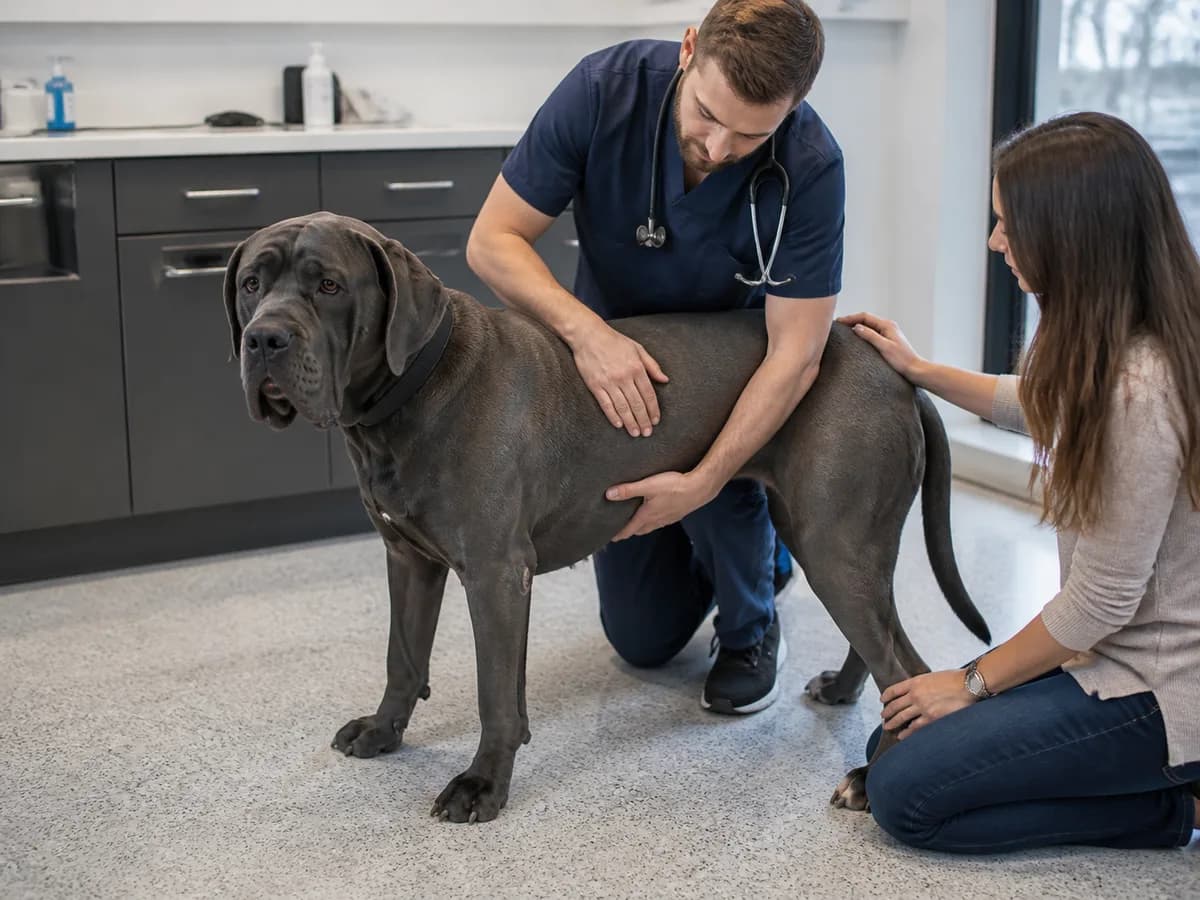
The planned image shows a veterinarian assessing body condition from the side and above. Owners can watch the waist, abdominal contour, rib coverage, and change over time, but a thick coat, muscular frame, deep chest, age, and disease can complicate visual judgment.
 Sponsored
Vet care that's always there
Unlimited video calls and messaging with licensed vets for less than a typical vet visit. One membership covers up to five pets.
Use code Pets60
Plans start at $12/month · covers up to 5 pets
- Licensed vets in most states
- Rx for 150+ conditions
- 4.7 on Trustpilot
Build a preventive record
Keep these items in one accessible file:
- Veterinary examination and preventive-care dates.
- Vaccination and parasite-control plan for the dog's risks and location.
- Current foods, treats, portions, supplements, and medication list.
- Dated weight and body-condition observations on the same scale when possible.
- Dental, skin, ear, eye, appetite, thirst, stool, urine, mobility, sleep, and behavior changes.
- Screening results, imaging reports, laboratory results, and specialist notes.
Measure meals rather than estimating by eye, count treats and chews in the daily total, and reassess intake after changes in growth, activity, health, medication, or neuter status. Do not impose rapid weight loss or a homemade therapeutic diet without veterinary guidance.
Easy water access matters during daily care. The Petlibro Stainless Steel 101-ounce fountain is one option to compare for capacity, cleaning, filter replacement, cord safety, bowl height, and whether the individual dog will use it. A fountain cannot diagnose or correct abnormal thirst or dehydration.
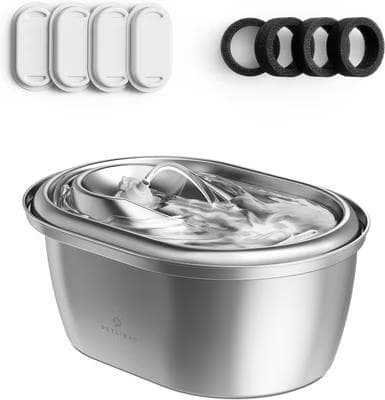
304 food-grade stainless steel pet water fountain, 101 oz. The circulating, filtered water encourages cats to drink more, which supports urinary tract and kidney health.
Petful may earn a commission when you click through to Chewy, at no extra cost to you.
Exercise should fit the dog in front of you
The right activity plan accounts for age, conditioning, weather, footing, body condition, veterinary restrictions, and prior response. Build duration and difficulty gradually. Stop and seek advice for lameness, unusual fatigue, coughing, breathing change, collapse, pain, or delayed recovery.
Owners sometimes consider joint supplements. The Nutramax Cosequin chewable joint supplement should be discussed with a veterinarian who knows the dog's diagnosis, diet, medications, and health history. A supplement does not replace indicated imaging, pain control, rehabilitation, weight management, or surgery.

The number-one veterinarian-recommended joint supplement brand. Glucosamine, chondroitin, and MSM support cartilage and cushion the joints, easing the stiffness and hind-end weakness that can leave an older or arthritic dog trembling.
Petful may earn a commission when you click through to Chewy, at no extra cost to you.
Healthy growth and body condition
Cane Corso size belongs on the dedicated Cane Corso size, weight and growth guide, which explains official height context, proportional weight, puppy trends, and measurement. This health page uses size only to support body-condition and clinical decisions.
A growing puppy needs an age-appropriate diet and regular veterinary monitoring, not a race toward a dramatic weight. Record the puppy's trend, appetite, stool, movement, diet, treats, and body condition. Ask before changing calories or adding minerals and supplements, especially during rapid growth.
Use the dog's own baseline
For adults and seniors, a meaningful change from the dog's established weight, muscle, appetite, or activity may matter even when the current number fits an online range. Confirm surprising scale readings and discuss sustained change, especially when paired with increased thirst, vomiting, diarrhea, pain, coughing, breathing change, or fatigue.
The AVMA healthy-weight resource is useful general guidance. Your veterinarian can connect it to the Cane Corso's examination, life stage, diet, activity, and medical history.
Cane Corso lifespan and healthy aging
People asking how long do Cane Corsos live need a range with source and population context, not a promise for one dog. A Cane Corso lifespan estimate cannot account for every inherited risk, acquired illness, injury, body condition, environment or veterinary-care decision.
Cane Corso lifespan estimates are population-level planning tools, not individual promises. The current AKC Cane Corso profile provides a breed lifespan range, while a particular dog's outcome depends on genetics, health, preventive care, environment, injury, and chance.
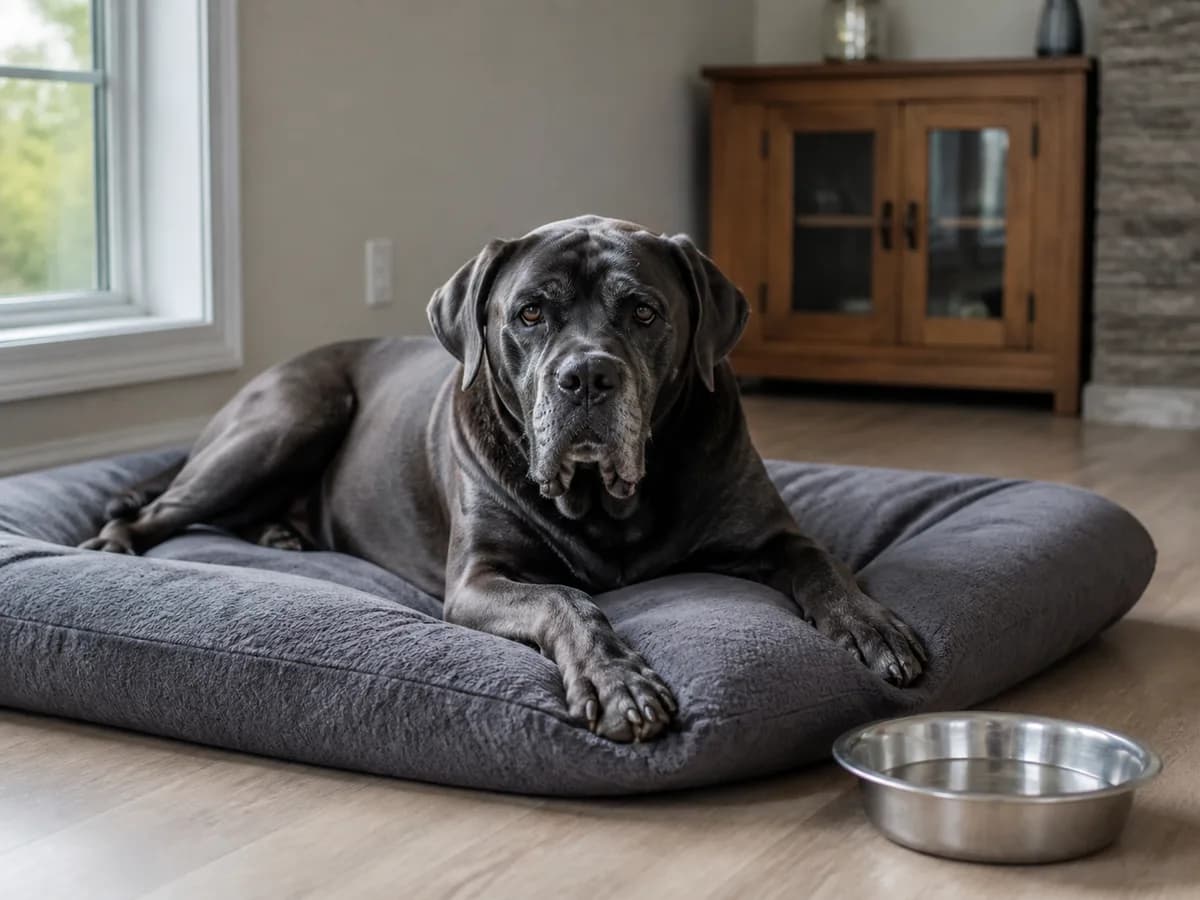
The planned photograph shows a senior Cane Corso on a supportive bed near accessible water. Healthy aging is not the absence of every diagnosis. It is also comfort, mobility, appetite, hydration, sleep, elimination, social engagement, and the ability to enjoy familiar activities.
Adjust care as function changes
Senior-care conversations may include:
- Examination frequency and individualized laboratory or imaging recommendations.
- Weight, body condition, muscle loss, dental health, vision, hearing, and mobility.
- Pain signs, sleep changes, house-soiling, confusion, anxiety, and social withdrawal.
- Safer footing, ramps, accessible water, comfortable rest, temperature control, and transport.
- A written quality-of-life plan and clear thresholds for calling the clinic.
A bed may help a dog settle, but fit and access matter more than an “orthopedic” label alone. Recheck whether the FurHaven jumbo bed gives the dog enough room to lie in a preferred posture and whether its height remains manageable as mobility changes.
Hydration observations need context
Refresh water regularly, clean bowls or fountains, and learn the dog's normal drinking pattern. A Petlibro stainless-steel fountain may suit some households, but a sudden rise or fall in drinking is a health observation, not a shopping problem. Measure intake only if the veterinary team asks and do not restrict access without explicit instruction.
What to verify before you decide
- Ask for dog-specific screening records and match each result to identity, test and date. Read the actual registry entry rather than treating a badge as a guarantee. Appearance is not documentary proof of ancestry or health. A veterinary examination and professional guidance are needed when an individual dog has symptoms.
Before acquiring a puppy or adult, identify the veterinary practice you expect to use, local emergency options, transport, insurance or savings strategy, secure housing, and daily care plan. Read contracts carefully and ask who pays for an independent examination or follow-up testing.
A simple pre-decision file
Save copies of:
- Verified parent screening results and the current parent-club recommendations used.
- The puppy or dog's veterinary record, medication and preventive-care history.
- Seller or rescue contract, return terms, microchip details, and identification.
- Your first-exam appointment, emergency contact, budget, and transport plan.
- Questions that remain unanswered and the person responsible for answering them.
If a seller resists independent verification, rushes payment, substitutes a different dog, or promises that a line is completely free of health problems, step back. Better documentation cannot eliminate risk, but poor documentation should not be replaced with confidence.
Is this the right dog for your household?
- A prepared household can build health decisions around records, preventive care and measured body condition
- Prompt veterinary attention can address meaningful changes before home assumptions harden
- A strong owner-veterinarian relationship can adapt activity, nutrition and environment as the dog ages
- Large-dog imaging, medication, mobility support and emergencies can be expensive and logistically demanding
- Screening lowers uncertainty for defined concerns but cannot guarantee one dog's future
- Transport, safe handling, financial reserves, time and veterinary access require advance planning
Health readiness is only one part of fit. The Cane Corso temperament, training and family suitability guide covers guardian traits, socialization, handling, and household management. Decide based on the whole dog and your real resources, not on an imposing appearance.
Prepare before a problem happens
Practice calm car entry, cooperative handling, scale use, muzzle conditioning with reward-based instruction, and safe confinement before they are medically necessary. Keep a current medication list and know how you would move a large painful dog without risking injury to the dog or people.
If a veterinarian recommends a joint product after evaluating the dog, compare that plan with the exact formulation and serving information for Nutramax Cosequin chewable tablets. Do not combine supplements or assume a product is appropriate because another Cane Corso takes it.
Cane Corso Health Issues and Lifespan FAQs
The leading cause of death in Cane Corsos cannot be named responsibly without a defined population and reliable mortality dataset. The breed can face several important health concerns, but a population statistic cannot predict an individual dog. Focus on verifiable family health history, recommended screening, healthy body condition, preventive care and prompt veterinary evaluation when normal behavior or physical condition changes.
Early signs can be subtle and may include reduced appetite, lower energy, vomiting, diarrhea, coughing, breathing changes, limping, altered thirst, restlessness or behavior that is unusual for that dog. These signs have many possible causes. Contact a veterinarian for guidance, especially when a change is sudden, persistent, worsening or accompanied by pain, collapse or breathing difficulty.
The life expectancy of a Cane Corso varies by source and population, so published ranges should be used only for broad planning rather than as a prediction. The individual dog's genetics, body condition, preventive care, environment and medical history all matter. Plan financially for lifelong veterinary care and discuss age-related changes with the veterinarian who knows the dog.
Important concerns discussed for the breed include hip and elbow problems, certain eye conditions, heart disease and gastric dilatation-volvulus, among others. A list does not mean an individual dog will develop them. Verify parent screening where applicable, keep routine veterinary care current and seek prompt help for pain, collapse, abdominal swelling or breathing changes.
Ask for verifiable results that follow current breed-club recommendations, commonly including orthopedic, cardiac and eye evaluations where applicable. Confirm the dog identities and results in the issuing database rather than accepting screenshots alone. DNA testing can add useful information but does not replace every clinical evaluation, and a veterinarian can help interpret unfamiliar results.
Hip dysplasia is an important concern in large breeds, including Cane Corsos, but risk is not a diagnosis. Parent screening can inform breeding decisions without guaranteeing a puppy's outcome. Support healthy growth and body condition, use age-appropriate exercise and ask a veterinarian about limping, stiffness, difficulty rising or reduced willingness to exercise.
Cane Corsos can be affected by several eye and eyelid conditions, and the significance varies by the individual dog. Breeder eye evaluations can help document parent status, but owners should still watch for redness, discharge, squinting, cloudiness, rubbing or vision changes. Eye pain can be urgent, so contact a veterinarian promptly rather than treating it at home.
Heart disease can occur in Cane Corsos, but only a veterinary examination and appropriate testing can identify the condition in an individual dog. Ask breeders for verifiable cardiac screening where recommended. Seek prompt veterinary care for collapse, fainting, unusual exercise intolerance, persistent coughing or breathing difficulty, and do not use a normal-looking appearance as proof of heart health.
Sources
BVMS, MRCVS
Dr. Pippa Elliott, BVMS, MRCVS, is a veterinarian with nearly 30 years of experience in companion animal practice. Dr. Elliott earned her Bachelor of Veterinary Medicine and Surgery from the University of Glasgow. She was also designated a Member of the Royal College of Veterinary Surgeons. Married with 2 grown-up kids, Dr. Elliott has a naughty Puggle named Poggle, 3 cats and a bearded dragon.
Sign up for expert-backed reviews and safety alerts all in one place.