Serval Cat: Facts, Price, Legality, and What Owning One Is Really Like
A serval cat is a wild African cat, not a domestic breed. Get serval cat facts, size, lifespan, price, and legality by state, plus the honest risks and safer exotic-looking alternatives.

Petful is reader supported. As an affiliate of platforms like Amazon and Chewy, we may earn a commission when you buy through links on this page. There is no extra cost to you.
Thinking about a serval cat as a pet? Here is the short version: a serval cat (Leptailurus serval) is a wild African cat, not a domestic breed, and keeping one is legal only in some US states, usually with permits. This guide covers serval cat facts, size, lifespan, price, and legality, plus what living with one is really like.


Sign up for expert-backed reviews and safety alerts all in one place.
Serval cat quick facts
- 1A serval is a wild African cat (Leptailurus serval), 17 to 24 inches at the shoulder and 15 to 40 pounds, with the longest legs of any cat relative to its body.
- 2Legality is decided state by state: some states ban pet servals, others require permits or registration, and city or county rules can add more.
- 3Expect roughly $3,000 to $10,000 to buy a serval cat, plus a secure enclosure, a raw-prey diet, exotic-vet care, and liability insurance, since pet insurers do not cover servals.
- 4Sanctuaries advise against servals as pets. A later-generation Savannah, Bengal, Egyptian Mau, or Ocicat gives you the exotic look without the wild-animal risk.
A serval cat is a wild cat about the size of a medium dog, built for hunting in tall grass. These quick facts come from the San Diego Zoo, Big Cat Rescue, Wikipedia, and the IUCN Red List.
| Fact | Serval | Source |
|---|---|---|
| Scientific name | Leptailurus serval | IUCN Red List |
| What it is | A wild cat in the family Felidae, not a domestic breed | San Diego Zoo |
| Shoulder height | 17 to 24 inches | San Diego Zoo |
| Weight | About 15 to 40 pounds, with females lighter | San Diego Zoo |
| Lifespan | About 10 years in the wild; up to about 20 in captivity | Wikipedia |
| Native range | Sub-Saharan Africa, with a small isolated population in Morocco | Big Cat Rescue |
| Conservation status | Least Concern overall; the North African population is more threatened | IUCN Red List, San Diego Zoo |
| Vertical leap | More than 9 feet straight up | San Diego Zoo |
| Hunting success | About half of attempts in a Ngorongoro Crater study | Wikipedia |
| Gestation and litter | About 70 to 79 days; 1 to 5 kittens | San Diego Zoo |
What is a serval cat?
The serval (Leptailurus serval) is a medium-sized wild cat native to the grasslands and wetlands of sub-Saharan Africa. It is built for hunting in tall grass, with the longest legs and largest ears relative to body size of any cat, a golden coat marked with bold black spots and bars, and a short, banded tail. Adults stand 17 to 24 inches at the shoulder and weigh about 15 to 40 pounds, which makes a serval cat look far larger and leggier than it actually is.
Servals are solitary, territorial, and most active at dawn and dusk. They are also highly vocal, communicating with sharp chirps, hisses, growls, and a loud, high-pitched call that carries across long distances. None of this changes in captivity. A serval raised in a living room is still a wild African predator, which is why the rest of this guide focuses on what ownership actually demands rather than how the kittens look on social media.
People search for it as a serval, an African serval, a serval cat, or a serval house cat. All of those describe the same wild species, not a breed of domestic cat. It is also often confused with the caracal, a separate wild cat with tufted ears, and both are regulated as wild animals where servals are restricted, including Texas and Florida.
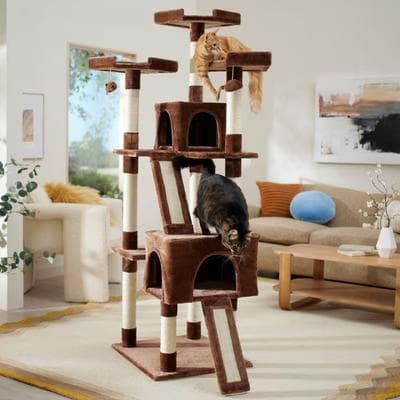
Servals leap 9 feet. A tall 72-inch tree is the legal, safe way to give a big, active domestic cat that vertical life.
Petful may earn a commission when you click through to Chewy, at no extra cost to you.
Serval cat size, coat, and temperament
A serval is built for tall grass. It has a small head on a long neck, very long legs, and huge, rounded ears set close together, which can rotate up to 180 degrees to pinpoint prey by sound, according to Wikipedia's serval entry. Here is what to expect from a full-grown serval cat.
- Size: 17 to 24 inches at the shoulder and about 15 to 40 pounds, roughly two to four times the weight of the 8 to 10 pound domestic cat. Next to a human, a serval's shoulder sits at about knee height.
- Coat: tawny gold with bold black spots and stripes, and a banded tail with a black tip about 12 inches long.
- Colors: the spotted gold coat is typical. All-black (melanistic) servals exist but are rare, and a black serval cat has the same needs and risks as any other.
- Ears, eyes, and legs: large ears for hunting by sound, and long legs that give a serval the height to see over tall grass and the spring to pounce.
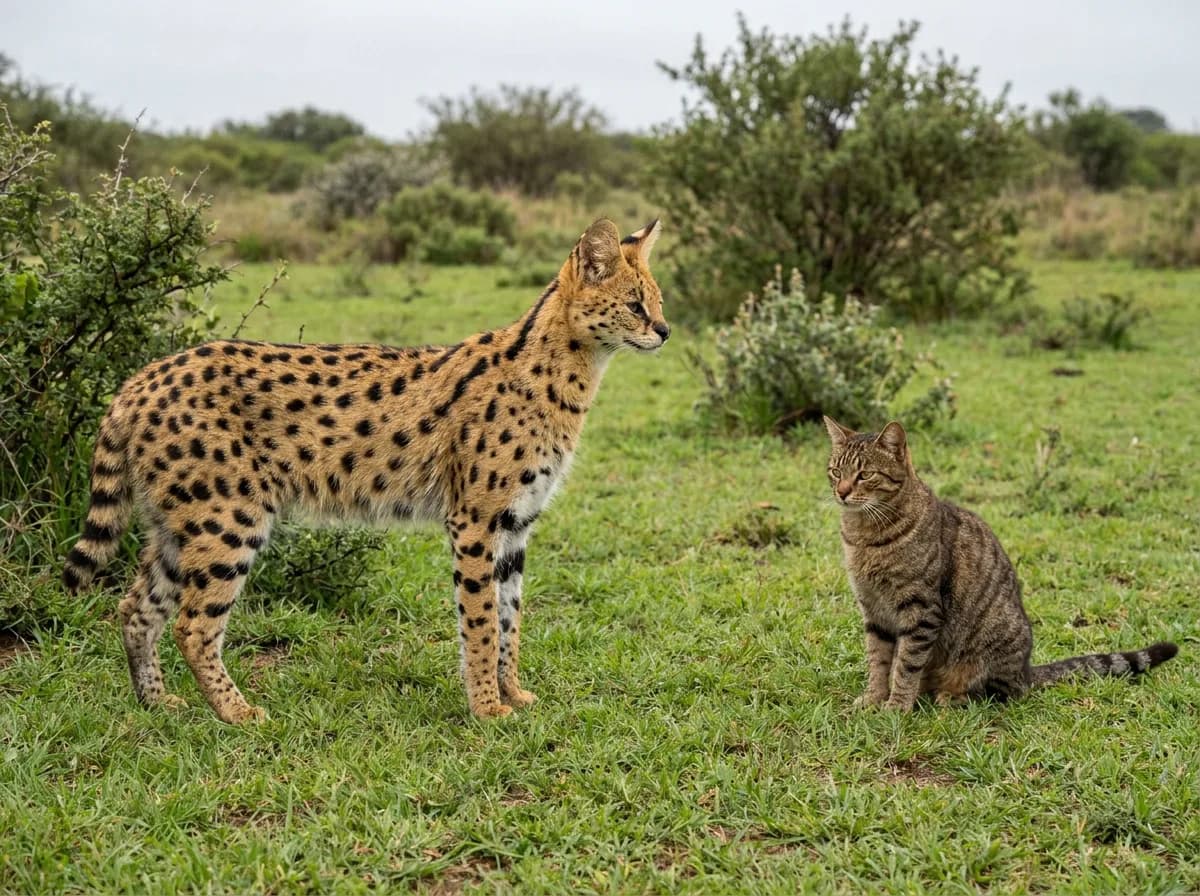
Temperament matters more than looks. Wild servals are solitary, spray urine to mark home ranges of roughly 10 to 32 square kilometers, and are active around dawn, dusk, and midnight. A hand-raised serval kitten can seem affectionate, but the personality that comes with adulthood is a territorial, strong, predatory one. That is why sanctuaries such as Carolina Tiger Rescue say servals do not make good pets.

Servals are obligate carnivores. For a house cat, a meat-forward pate plus freeze-dried raw meals is the closest practical diet match.
Petful may earn a commission when you click through to Chewy, at no extra cost to you.
Where do servals live? Habitat and range
Servals live across sub-Saharan Africa, in savannas, grasslands, and wetlands with tall cover, usually near streams or rivers. They are absent from true rainforests and arid deserts, and a small isolated population survives in Morocco, according to Big Cat Rescue. On Mount Kilimanjaro they have been recorded as high as 3,800 meters, per Wikipedia.
The species is rated Least Concern by the IUCN Red List, so it is not endangered overall, though the North African population is more threatened. The biggest wild threats are loss of wetlands and grasslands, persecution by herders who blame servals for livestock losses, and a skin trade that still occurs in a few countries.
What eats serval cats?
Adult servals are preyed on by hyenas and African wild dogs. A threatened serval hides in cover first, and if a predator gets close it flees in long leaps with its tail raised. One serval was seen climbing a tree more than 9 meters (30 feet) high to escape dogs, according to Wikipedia. Servals have few natural enemies, but humans and habitat loss are the larger problem.
What do serval cats eat?
Servals are obligate carnivores. In the wild they eat mostly rodents, an estimated 80 to 97 percent of the diet, plus birds, reptiles, frogs, fish, and insects. Replicating that diet in captivity is both expensive and nutritionally precise.
How servals hunt: a 50 percent success rate
A serval finds prey by sound, can stay motionless for up to 15 minutes, then pounces with all four feet off the ground, reaching up to 13 feet (4 meters) in the air, and strikes with its front paws. In a study in Tanzania's Ngorongoro Crater, servals succeeded in about half of their attempts, and one mother had a 62 percent success rate, according to Wikipedia. Big Cat Rescue puts the success rate at roughly 50 percent too.
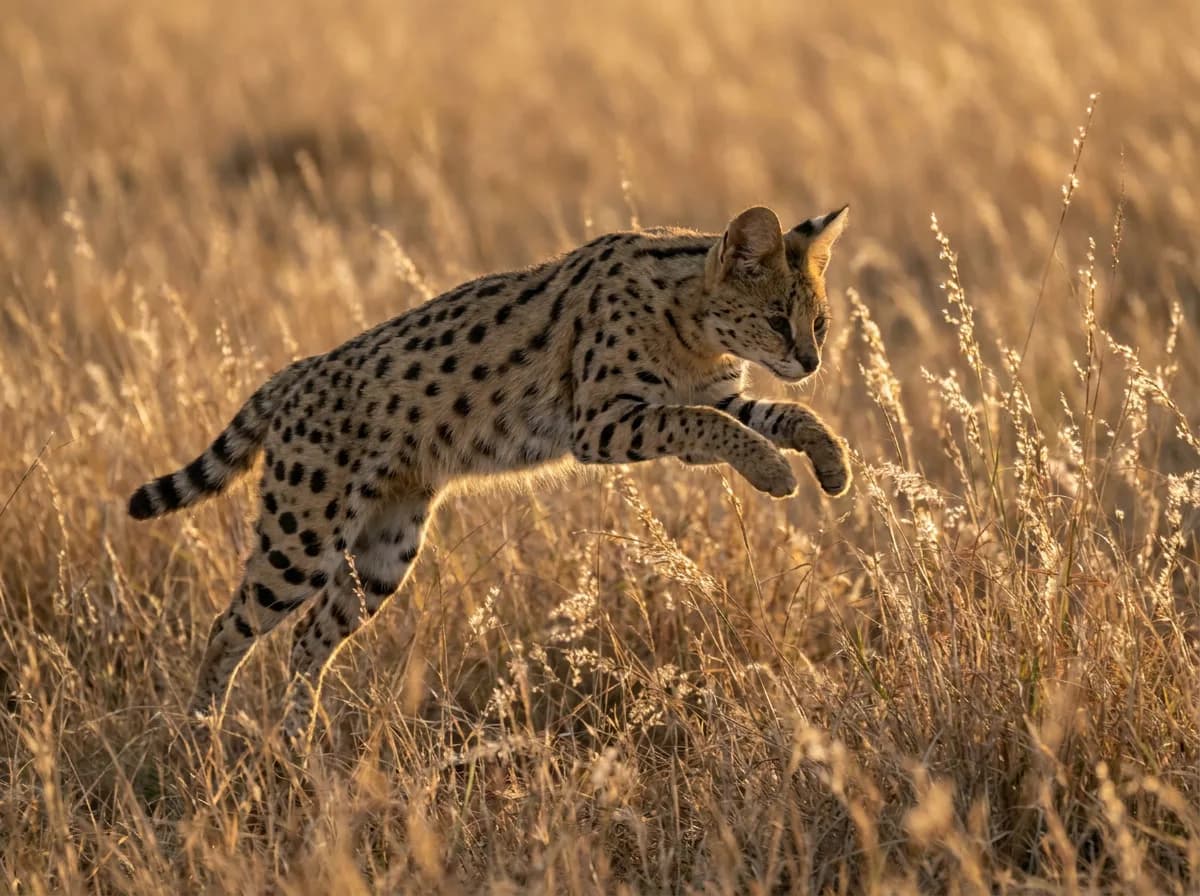
How high can a serval cat jump? The standing jump height is more than 9 feet straight up, per the San Diego Zoo, and per Wikipedia a single leap can cover up to about 11 feet 10 inches of horizontal distance. Inside a house, that means no shelf, counter, or ceiling fan is out of reach, and anything small and quick looks like prey.
A typical pet-serval diet is built from the following, because kibble and canned cat food alone can contribute to nutritional bone disease in captive wild cats.
- Whole prey such as rabbits, quail, and chicks.
- Ground raw meat with bone, plus organ meats.
- Taurine supplementation and careful calcium balancing.
Expect $3,000 to $6,000 per year just for food, and plan for a chest freezer dedicated to prey.
If you share a home with a domestic cat instead, the useful takeaway is a meat-forward diet and daily hunt-style play, not a serval diet.
Serval reproduction and kittens
Serval kittens are born after a pregnancy of about 70 to 79 days, in litters of one to five, usually two or three, according to the San Diego Zoo and Big Cat Rescue. A newborn weighs about 9 ounces and is blind. Here is how a serval cat kitten develops, per Wikipedia.
- 9 to 13 days: the eyes open.
- About 1 month: weaning begins.
- About 6 months: kittens start hunting on their own, once their permanent canines come in.
- About 12 months: they leave their mother in the wild, and both sexes reach sexual maturity at roughly 1 to 2 years.
For a buyer, the point is the timeline. The small, playful kitten in a social media clip is a few months old, and the full adult size and strength arrive within a year or two.
How long do serval cats live?
Servals live about 10 years in the wild and up to about 20 years in captivity, per Wikipedia. That is roughly 50 percent longer than a domestic cat, which averages 13 to 17 years. That longevity is both a selling point and a warning: a serval purchased for a 25-year-old owner will still be alive when the owner is 45, and serval needs do not shrink with the owner's life circumstances. In captivity, lifespan depends heavily on diet quality, access to a vet who knows exotic cats, and a safe enclosure. That is a long commitment: a serval brought home today could still be alive in 2046. Zoo and sanctuary servals reach 19 to 20 years, while a serval fed an inadequate diet can develop nutritional bone disease far earlier.
Can you legally own a serval cat in the US?
Are serval cats legal in the US? It depends on the state: servals are fully banned in some states, allowed with a permit or registration in others, and lightly regulated in only a few, so always check state and local law first. There is no federal ban on private serval ownership, so legality is decided by states, counties, and cities.
Even where a state allows it, you usually need a permit and an approved enclosure. Born Free USA keeps a state-by-state summary of private exotic-animal possession rules, last updated June 2022. It shows that outright bans, partial bans, and license or permit regimes all exist, and it lists only a sampling of animals per state. Sources disagree on the exact picture for servals, so this guide names the rules we could check against statutes and agency pages.
| Rule type | Example states | What it means for a serval | Primary source |
|---|---|---|---|
| Banned or restricted for private pet keeping | California, Connecticut | California restricts all wild Felidae species without a state permit, and permits are for limited purposes rather than pet keeping. Connecticut has seized pet servals as illegal. | California Code of Regulations Title 14, section 671; Connecticut DEEP |
| Permit or registration required | Texas | Texas lists the serval as a dangerous wild animal that must be registered with the local animal registration agency. | Texas Health and Safety Code section 822.101 |
| Experience-gated permit, not a pet route | Florida | Florida lists the serval as Class II captive wildlife. A Class II permit requires documented experience (1,000 hours, or an exam plus 500 hours), a bar most pet buyers cannot meet. | Florida Administrative Code 68A-6.002 and 68A-6.004 |
| Varies by state, county, and city | All other states | Some states ban, some permit, and some leave it to counties and cities, so a local ban can apply even where state law is silent. | Your state wildlife agency and city or county code |
The sources behind the table:
- California Code of Regulations Title 14 section 671
- Texas Health and Safety Code chapter 822
- Florida Administrative Code 68A-6.002
- NBC Connecticut's report on the state's 2016 serval seizure
For states not listed, such as Ohio, Illinois, New York, Tennessee, and Arizona, we did not verify the rules for this guide, so check with the state agency before you assume anything.
- Before you buy, reserve, or transport a serval, get written confirmation from your state wildlife agency and your city or county. State rules change every legislative session, and a seller's word is not a permit.


A strong hunting drive needs an outlet. A puzzle feeder turns meals into a stalk-and-solve game for an active domestic cat.
Petful may earn a commission when you click through to Chewy, at no extra cost to you.
How much does a serval cat cost?
A serval costs roughly $3,000 to $10,000 to buy and about $5,000 to $10,000 or more per year to keep, so lifetime cost can exceed $100,000. A serval cat typically costs $3,000 to $10,000 to buy, though asking prices reach $20,000 for sought-after lines, according to A-Z Animals' July 2024 price guide.
The kitten is the smallest part of the bill. A secure enclosure, a raw-prey diet, exotic-vet care, permits, and liability insurance push the real yearly budget to roughly $5,000 to $10,000 or more, and the lifetime cost can exceed $100,000.
Here's the realistic 2026 breakdown:
| Expense | Typical cost (USD) | Notes |
|---|---|---|
| Serval kitten purchase | $3,000 to $10,000 | Asking prices reach $20,000; varies by breeder, bloodline, and region |
| State and local permits | Often $200 or more per year | Plus application fees and inspections; varies by state |
| Secure enclosure | $5,000 to $25,000 | A-Z Animals lists $2,000 to $6,000 for the cage plus $2,500 to $10,000 for roofing; custom builds cost more |
| Raw or whole-prey diet | $3,000 to $6,000 per year | Rabbits, quail, chicks, and taurine supplementation |
| Exotic-vet care | $1,500 to $4,000 per year | Few vets treat servals; house calls are common |
| Liability insurance | $1,000 to $14,000 per year | Pet insurers do not cover servals, so this is separate liability coverage |
| Home-damage repairs | Variable | Torn upholstery, marked walls, broken doors |
Put plainly: a serval is less a pet purchase and more a private-menagerie commitment.
Serval cats for sale: where people actually get them
Searching for a serval cat for sale turns up breeder sites, classified listings, and social media posts. Here is how legitimate sourcing actually works, and why the sanctuaries that take in surrendered servals ask you not to start there.
How a legal purchase works
- Start with your state, county, and city rules. If servals are banned where you live, stop there.
- Look for a breeder who holds the required state permits and, for exotic animals, a federal license under the Animal Welfare Act (9 CFR Part 2 sets the licensing rules). Ask to see both and confirm them with the agency.
- Expect a waitlist, a deposit, and a written contract, and expect the seller to ask about your enclosure and permits.
- Buy only a captive-bred animal with health records. Moving a serval across state lines usually takes permits from both the sending and receiving states.
- Treat these as red flags: no license to show, payment only by gift card or wire, a price far below the $3,000 low end, and no way to see the animals or the facility.
Searches like serval cat for sale near me, or for sale in Florida or Texas, run into the same fact: your own state decides whether you can take one home, and Texas illustrates the permit route in the legality section above.
Adopting or rescuing a serval
Accredited sanctuaries such as Carolina Tiger Rescue accept surrendered servals, but they generally do not adopt them out to private homes. The sanctuary route is a donation or sponsorship, not a pickup. If you want a serval cat rescue story with a happy ending, the happy ending usually means the animal never ended up in a home to begin with.

Cheap, effective chase-and-pounce play for any high-energy cat, from a Savannah to a shelter tabby.
Petful may earn a commission when you click through to Chewy, at no extra cost to you.
Are serval cats dangerous?
Servals are not aggressive by default, but they are not domestic cats. A grown serval weighs up to 40 pounds, can leap more than 9 feet straight up, and kills prey much of its own size. That same strength and prey drive is what makes them dangerous in human homes.
Can a serval cat kill a human?
A healthy adult is far larger than anything a serval hunts in the wild, so a fatal attack on an adult is extremely unlikely, and there is no verified record of a pet serval killing an adult in the United States. The real risk is serious injury, not death. A serval bite can reach bone, and the claws cause deep lacerations, with children, infants, and elderly or disabled adults facing the highest danger because a 35-pound cat in predatory or defensive mode can overpower them. The documented incidents below follow that pattern: hospital visits, not fatalities.
Incidents are documented. In 2018, a serval at the Potawatomi Zoo in South Bend, Indiana bit a toddler who had been placed within reach of the enclosure. The child required hospital treatment. Private-home attacks are reported less consistently because many go unreported or are resolved quietly by rehoming the animal to a sanctuary.

A longtime serval owner (we'll call her Lolo) shared her lived experience in the comments of this article. Her serval marked the house constantly, struck her "HARD" when she tried to correct him, and, after her family brought home a newborn, attacked the baby, leaving tooth marks on her temple near the eye. The family surrendered the cat to a sanctuary. This is not the extreme edge of serval ownership. It is a common arc. Petful’s separate guide to cats and babies separates the myths from the real precautions.
Children, elderly family members, and other household pets are at the highest risk. Even a well-socialized serval retains full predator drive, especially at dusk and dawn. The rough play that's cute in a 5-pound kitten becomes genuinely dangerous at 35 pounds.
Are serval cats friendly, and can they live with a dog?
A hand-raised serval can be affectionate with its own people, but friendliness does not switch off the hunting instinct. A serval cat with a dog, a small cat, a rabbit, or a bird is a risk to the other animal, and even a larger dog can be hurt by a strong, fast predator. There is no safe way to promise they will get along, so keep them physically separated.
Serval cat vs Savannah cat vs domestic cat
Savannah cats are a serval hybrid, bred specifically to look exotic while being legally and practically manageable. Here is how the three compare at a glance:
| Trait | Serval Cat | Savannah Cat (F1–F5) | Domestic Cat |
|---|---|---|---|
| Origin | Wild African species (Leptailurus serval) | Serval × domestic hybrid (1986–present) | Domesticated 9,000+ years |
| Adult weight | 15–40 lbs | 12–25 lbs (F1), 8–15 lbs (F4+) | 8–10 lbs |
| Lifespan | Up to about 20 years | 17–20 years | 13–17 years |
| Legal in US | Banned or permit-only in many states | F4+ legal in most states | Legal everywhere |
| Typical purchase cost | $3,000 to $10,000 | $1,000 to $20,000 | $0 to $300 |
| Safe around children | Not recommended | Generally safe (F4+) | Safe |
| Exotic appearance | Yes, fully wild | Yes (F1–F3 strong) | No |
Savannah generations matter. An F1 Savannah has a serval as a parent, an F2 has a serval grandparent, and each later generation (F3, F4, F5) carries less serval, which is why the later generations are easier to live with and to keep legally. Our guides to F1 Savannah generations and whether Savannah cats are legal cover the details, and the Savannah cat breed guide covers size and price. People searching for a serval house cat mix are almost always describing a Savannah, the serval and domestic house cat hybrid. A Bengal descends from the Asian leopard cat rather than the serval; see our Bengal cat guide and its F1 to F5 generations.
For most people who want the exotic aesthetic, an F4-or-later Savannah, a Bengal, or an Ocicat delivers the spots, the size, and the personality without the wild-animal headache.

Housing and enclosure requirements
A serval cannot live as a house cat. Minimum housing is a 400-square-foot outdoor enclosure, at least 10 feet tall, fully covered on top (servals clear 9-foot vertical jumps from a standstill), with concrete or buried-wire footing to prevent digging out, and a double-door airlock entry to prevent escape when you pass through.
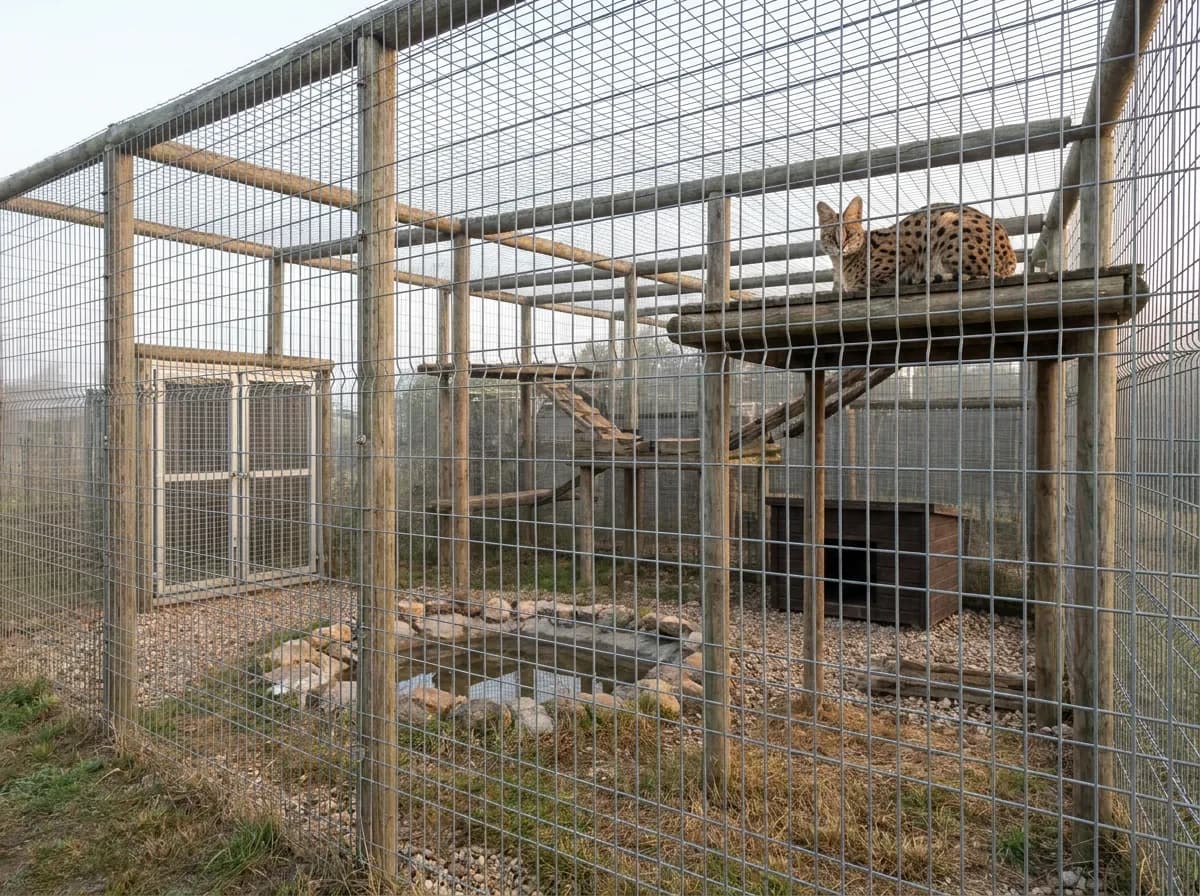
Required features inside: a heated shelter, climbing platforms, a shallow pool, shaded areas, and daily enrichment. Indoor-only housing fails, because servals mark walls and break doors trying to get out. Care also means finding a vet, and few treat servals, as our guide on why exotic pets are so hard to treat explains. If your HOA or local zoning restricts an enclosure of this size, serval ownership is effectively impossible.

Why experts say servals shouldn't be pets
Can serval cats be pets? Legally, sometimes, in a few places. Practically, almost never well: leading sanctuaries advise against it, and the serval cat as a pet story usually ends in surrender.
- Servals have not gone through anything like the thousands of years of selective breeding that produced the house cat. A domestic serval or serval house cat is a marketing phrase, not a biological category.
Leading US cat sanctuaries are on the record opposing the practice of keeping a serval cat as a pet, including Carolina Tiger Rescue, The Wildcat Sanctuary, and Big Cat Rescue.
Their shared argument comes down to four points:
- Servals are solitary, territorial, and nocturnal, which is the opposite of what a family home needs.
- Scent-marking is lifelong and cannot be trained out. Expect urine on walls and furniture permanently.
- Hunting drive never dims. Small pets, children, and anything that moves quickly can trigger a chase.
- When ownership fails (and most attempts do), sanctuaries absorb the cost, and many sanctuaries are now at capacity.
The IUCN Red List rates the serval Least Concern overall, with wild populations threatened mainly by wetland and grassland loss, persecution, and a skin trade that still occurs in a few countries. Buying a captive-bred serval does not protect wild servals, and the IFAW serval profile is a good overview of the species' conservation picture.
Better alternatives if you love exotic-looking cats
If the serval's wild look is the real draw, the practical and legal answer is a later-generation Savannah cat, a domestic hybrid that keeps the long-legged, big-eared, spotted appearance without the wild-animal care needs or permits. The boldest, most serval-like option is the F1 Savannah cat, though it carries its own restrictions, so confirm which Savannah generations are legal in your state before you commit. These options are legal, affordable, safer around children, and available through regulated breeders or breed rescues.
- Savannah cat (F4+ generation): A serval hybrid bred down enough to be legal in most US states. Looks exotic, acts mostly like a large domestic cat.
- Bengal cat: Descended from the Asian leopard cat. Rosetted coat, high intelligence, conversational personality. See our guide to bonding with a Bengal cat. They're demanding but rewarding.
- Egyptian Mau: The only naturally spotted domestic breed. Lean, athletic, and the fastest domestic cat on record (clocked at 30 mph). There is more on this in Petful’s guide to Egyptian Mau colors.
- Ocicat: Spotted, wild-looking, and fully domestic with zero wild ancestry. See our 5 things to know about Ocicats.
Whichever spotted cat you pick, give it vertical space and an outlet for its hunting drive. A 72-inch cat tree and a feather wand cover climbing and chase play, WebVet's guide to cat trees for large cats explains what to look for, and its catio guide covers a safer outdoor space.
Before bringing any new cat home (exotic, hybrid, or otherwise), it's worth reading up on why exotic pets are so hard to treat and doing your homework before you buy so you avoid the surprises that push so many owners toward rehoming.
Whatever cat ends up in your home (domestic, hybrid, or exotic), MyPetID.ai gives them a free QR-coded digital pet ID, AI-driven health tracking, and a central vault for vet records. Sign up in 60 seconds and keep every record in one place for the life of your cat.
Create a free pet IDFrequently Asked Questions
Hand-raised servals can bond with one or two primary humans, but they rarely generalize that bond to strangers, children, or other pets. The bond also does not override predator drive, which is why even bonded servals can strike during rough play.
US sanctuaries like Carolina Tiger Rescue, The Wildcat Sanctuary, and Big Cat Rescue accept surrendered servals but generally do not adopt them out to private homes. If you want to help, sponsor a serval at a sanctuary. Do not take one home.
No. The serval is a wild species, and the thousands of years of selective breeding that produced the house cat have never happened with servals. Hand-raising a kitten can make it tolerant of one or two familiar people, but it does not remove the scent-marking, the hunting drive, or the strength that make a serval unsafe and impractical as a household pet.
Yes. Melanistic, or all-black, servals do exist, though they are rare and turn up mostly in the cooler highland regions of East Africa. A black serval is the same species as a spotted one, with the same wild behavior, the same care needs, and the same legal restrictions, so the unusual coat changes nothing about whether it belongs in a home.
Servals are loud and expressive. They chirp, hiss, growl, purr, and let out a piercing, far-carrying call used to signal across distance. Owners often describe the noise as startling and impossible to muffle, which is one more reason servals struggle in apartments and ordinary neighborhoods.
Not safely. A serval's prey drive covers small dogs, cats, rabbits, and birds, and even a bonded serval can strike a household pet. Keep them physically separated at all times.
References
- IUCN Red List: Leptailurus serval species profile (population status, biology).
- Born Free USA: State Laws, Private Possession of Exotic Animals (legality overview).
- Carolina Tiger Rescue: Servals: Why They Don't Make Good Pets.
- International Fund for Animal Welfare: Serval cats conservation profile.
- The Wildcat Sanctuary: The Truth About Servals as Pets (sanctuary intake and rehoming data).
- San Diego Zoo: Serval species profile (size, diet, leap, gestation).
- Big Cat Rescue: Serval Facts (range, hunting, litter size).
- California Code of Regulations, Title 14, section 671 (restricted live animals).
- Texas Health and Safety Code chapter 822 (dangerous wild animals).
- Florida Administrative Code 68A-6.002 (captive wildlife listing).
- A-Z Animals: Serval cat prices (July 2024 purchase and ownership cost ranges).
Drawn to the serval look but want a cat built for home life? Read our complete Savannah cat breed guide, covering the serval hybrid that delivers the wild appearance in a domestic companion.

Carol Bryant is the founder FidoseofReality.com and SmartDogCopy.com. A pet product expert, Carol is the Past President of the Dog Writers Association of America (DWAA) and winner of Best Dog Blog. A dog lover of the highest order is how Gayle King introduced Carol when she appeared with her Cocker Spaniel on Oprah Radio’s Gayle King Show to dish dogs. She helps pet, animal, and lifestyle brands achieve copywriting and content marketing success using well-trained words that work and is well-known in the pet industry.
Sign up for expert-backed reviews and safety alerts all in one place.