Top Entry Litter Box: What to Know and Which to Buy
Compare four top-entry litter boxes by opening size, usable interior and cleaning access. Learn which cats may need a low-entry alternative and how to introduce a new box without removing the familiar one.
Petful is reader supported. As an affiliate of platforms like Amazon and Chewy, we may earn a commission when you buy through links on this page. There is no extra cost to you.
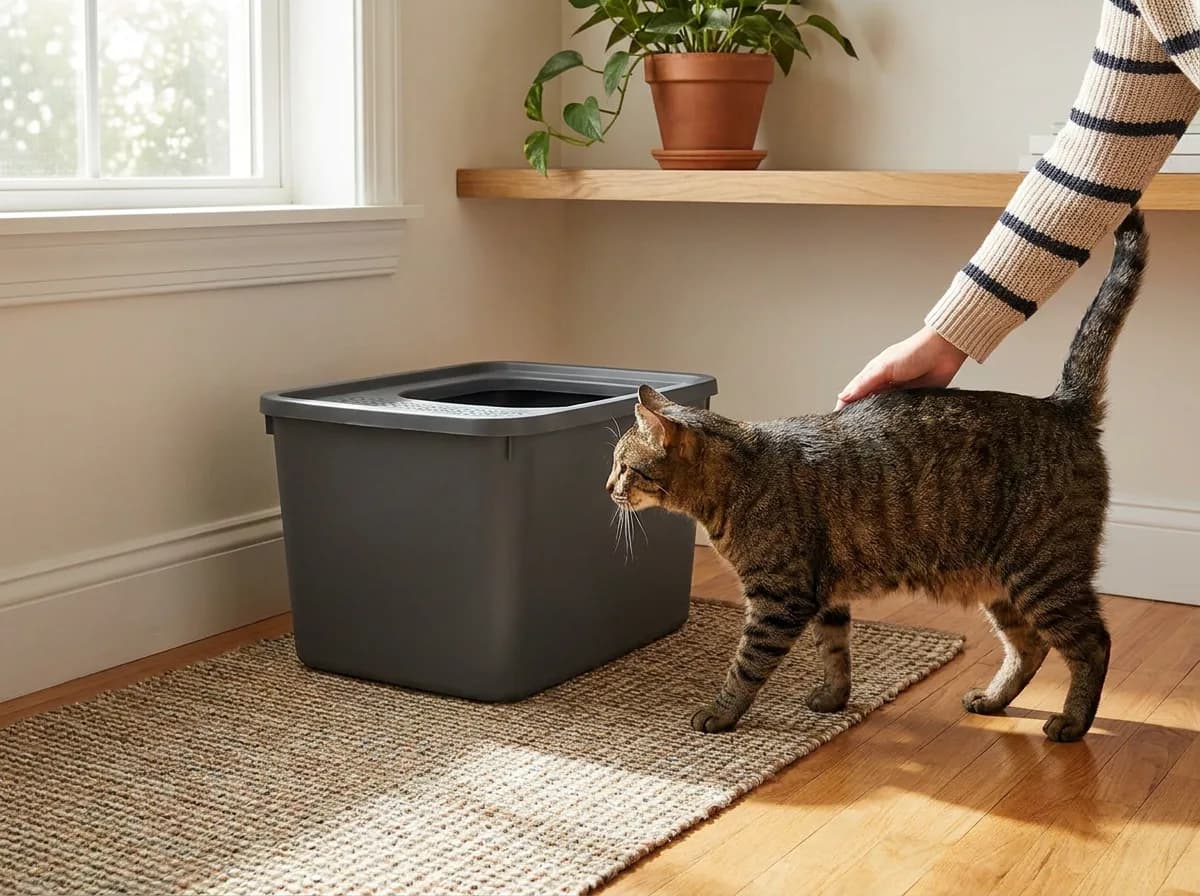
A top entry litter box has a lid with an opening that a cat climbs through to reach the litter. Its high walls can help contain kicked litter, while a textured or perforated lid may catch some granules on the way out. The tradeoff is access: your cat must comfortably enter, turn inside and climb back out.
Choose by the cat’s needs before considering appearance. Entry-opening size, usable interior space and the box’s exterior footprint answer three different questions. The four picks below offer different combinations of size, access and cleaning features, including one that can also be configured for front entry.

Sign up for expert-backed reviews and safety alerts all in one place.
Top entry litter boxes compared
The best top entry litter box is one your cat can use willingly and comfortably, and that you can clean every day. A compact design may suit the room but feel restrictive inside. A larger model may provide more room while still having an entrance that does not work for a particular cat.
| Your priority | Pick | Check before choosing |
|---|---|---|
| Compact square footprint | Modkat Cat Litter Box, White | Entry width, interior fit and ongoing liner replacement |
| More room and configurable access | Modkat Cat Litter Box, X-Large, White | Larger footprint and whether the selected entry configuration is accessible |
| Rounded design with a grooved lid | IRIS Top Entry Cat Litter Box, White, Large | Exact Large model, interior dimensions and published lid limit |
| A straightforward grated-lid design | Petmate Top Entry Litter Pan | Opening size, turning room and access for cleaning |
- 1The best top entry litter box fits the individual cat's body, mobility and preferences.
- 2Compare the entry opening, usable interior and exterior footprint separately.
- 3A top entry litter box may reduce scattered litter, but it does not eliminate tracking or daily cleaning.
- 4Keep a familiar, accessible box available while introducing a new design.
| Product choice | Access and maintenance | Main limitation |
|---|---|---|
| Modkat Original, White | Top entry; swivel lid and reusable liner | Compact footprint means fit needs careful checking; liners require replacement |
| Modkat XL, White | Configurable top or front entry; model-specific liners | Larger footprint; front entry is not automatically low entry |
| IRIS Large, White | Grooved lid, included scoop and no required liner | Listed 20-pound lid limit does not establish comfortable interior fit |
| Petmate Top Entry Litter Pan | Hinged textured lid with grates and a scoop hook | Opening must fit the cat; design is not a dog-proof guarantee |
For a compact footprint: Modkat Cat Litter Box, White
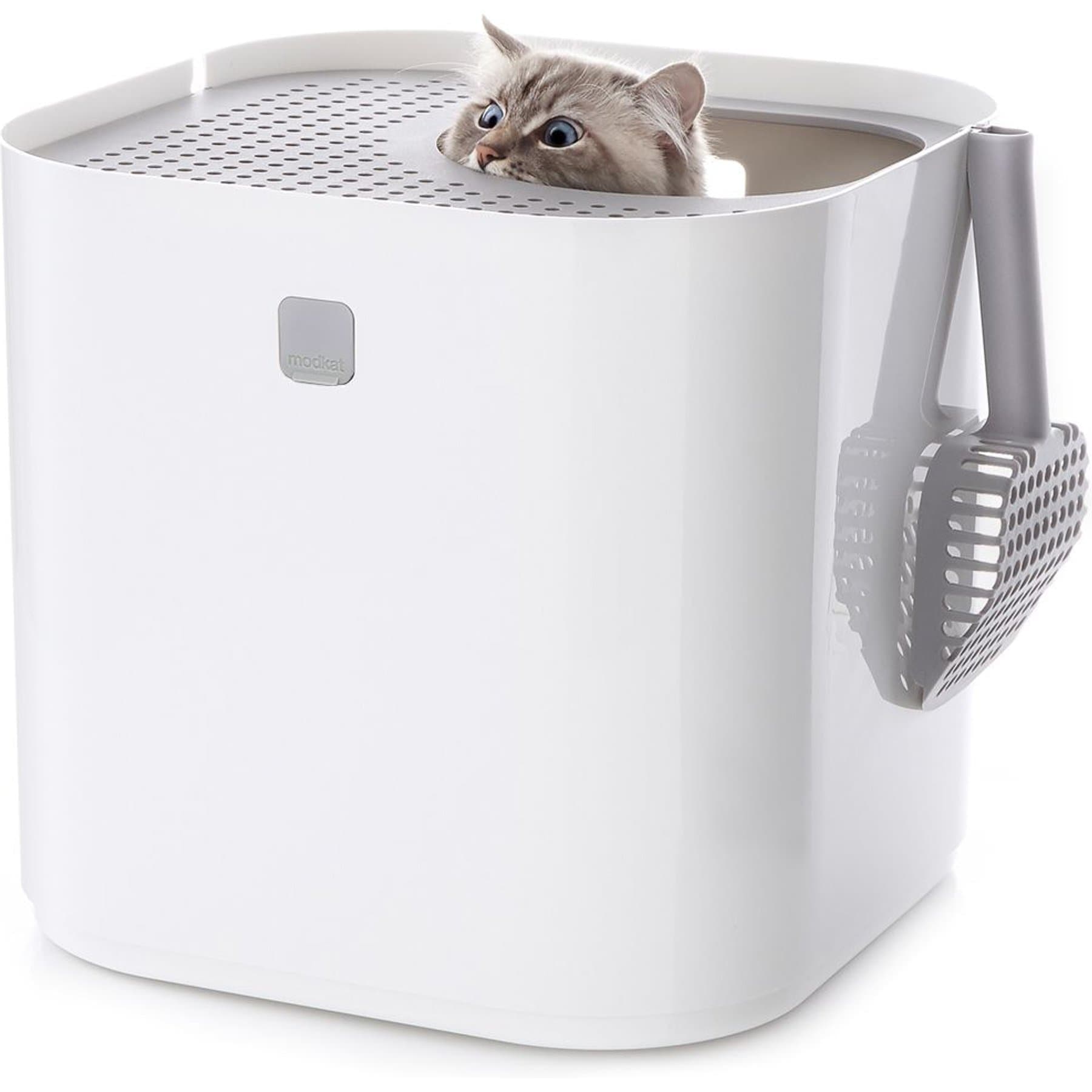
Compact square footprint. Smaller interior and entry than XL; recurring liner replacement.
Petful may earn a commission when you click through to Chewy, at no extra cost to you.
The original Modkat Cat Litter Box has a square exterior measuring 16 by 16 by 15 inches and a published entry width of 9.5 inches. Modkat recommends this model for cats up to 12 pounds. That recommendation is a starting point, not proof that every cat below that weight will fit comfortably. Modkat specifications
Its swivel lid and included scoop provide access for routine cleaning, while the reusable liner is part of the maintenance system. Consider liner care and replacement alongside the initial purchase.
- Useful for: a cat that fits the original model and a room where a compact square footprint matters.
- Main tradeoff: less room than the XL and a continuing need for compatible liners.
The sleek, minimalist shape should be a secondary benefit after checking your cat’s access and turning space.
For more room and entry options: Modkat Cat Litter Box, X-Large, White
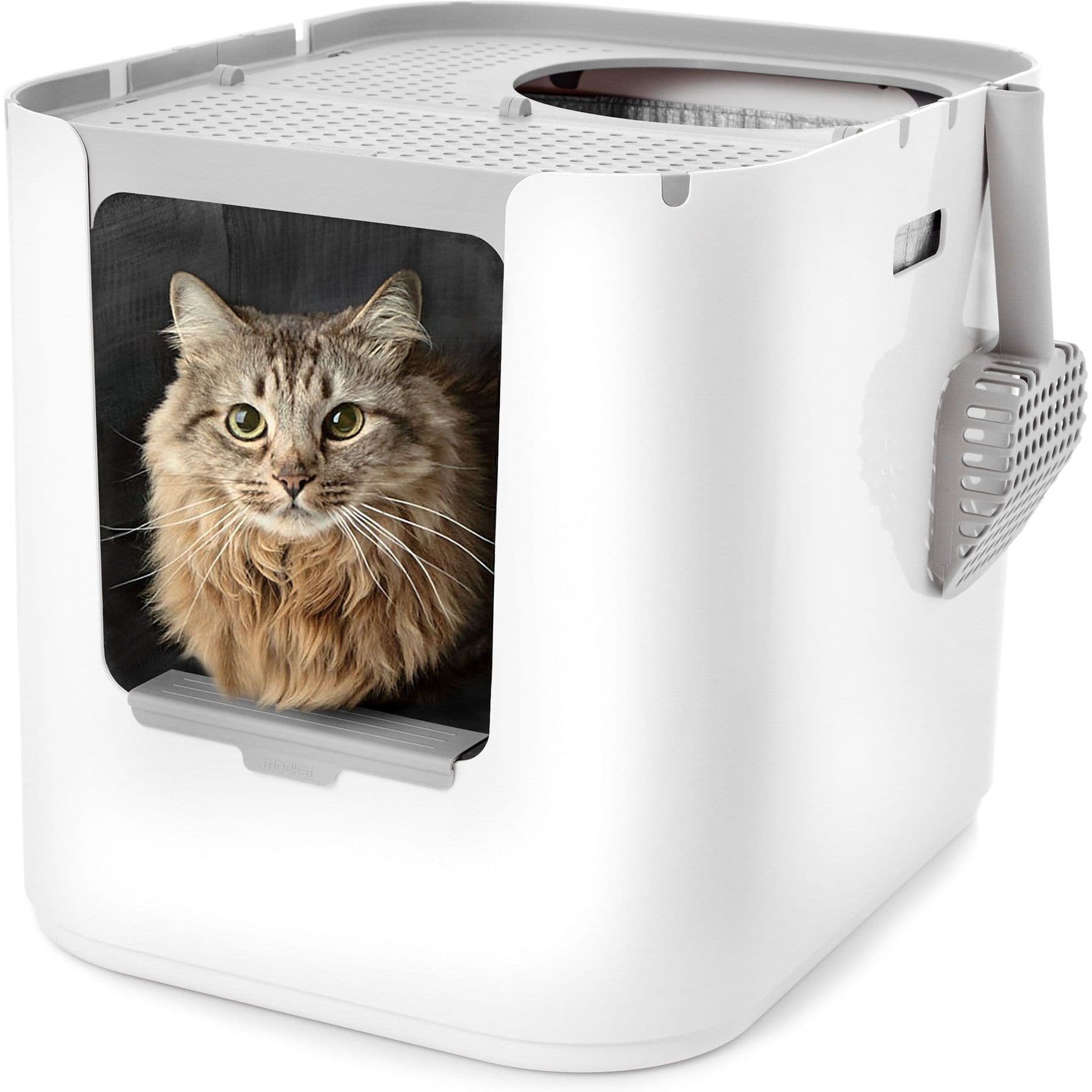
More room and configurable entry. Larger footprint and higher cost; front-entry mode still requires individual access assessment.
Petful may earn a commission when you click through to Chewy, at no extra cost to you.
The Modkat XL measures 21 by 16.5 by 17 inches externally and can be configured for top or front entry. It is a distinct model, not merely a different color of the original. The selected package includes a scoop and type-C and type-D liners for its configurations. Modkat model comparison
The option to change entry style is useful when assessing preference. However, a front opening still needs an individual access check; do not assume it provides the same low threshold as an open tray.
- Useful for: a household that has space for the larger footprint and wants configurable access.
- Main tradeoff: more room required in the home, plus model-specific liner care.
Follow the manufacturer’s configuration instructions rather than improvising a different opening.
For a grooved lid and included scoop: IRIS Top Entry Cat Litter Box, White, Large
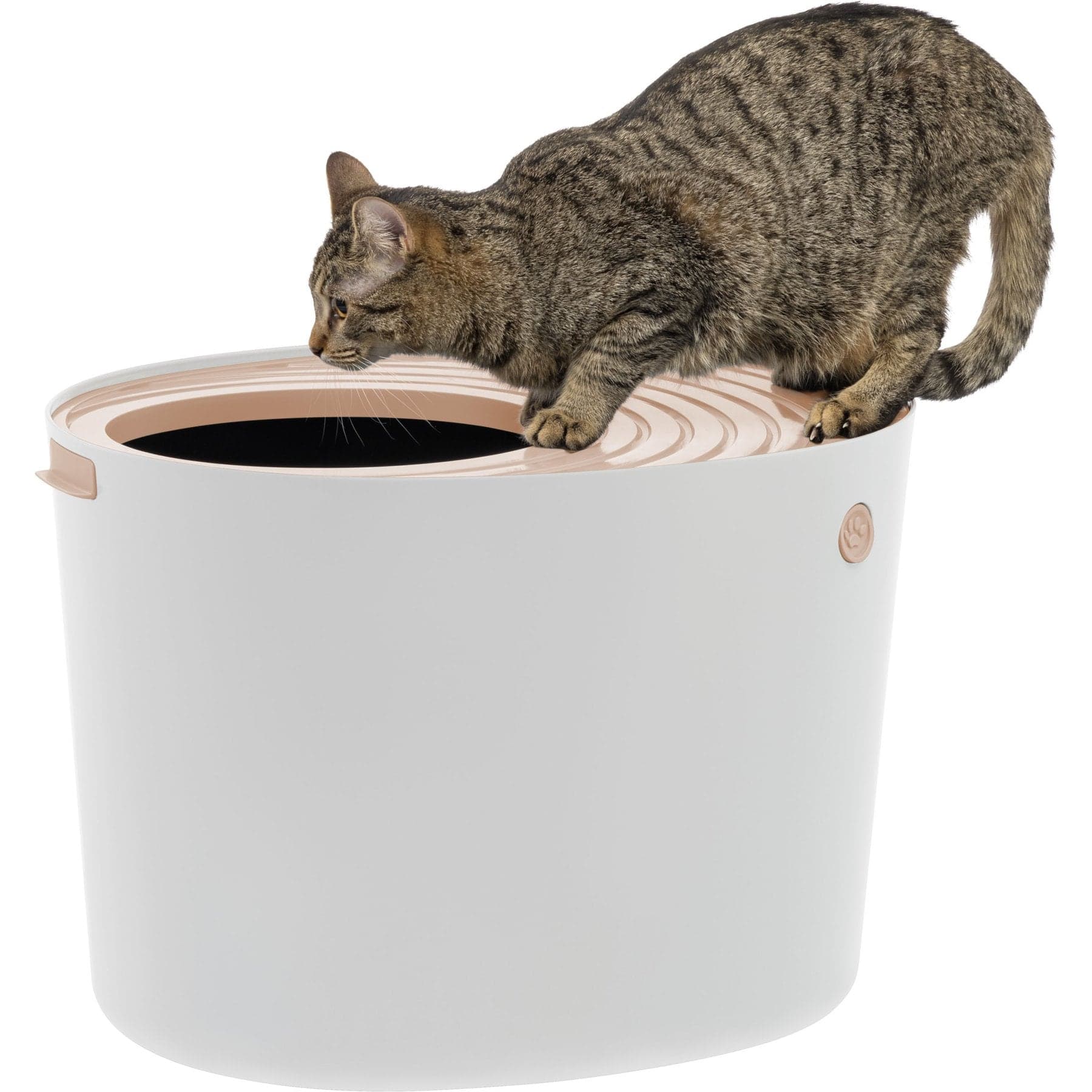
Grooved lid and included scoop. Approximate interior dimensions are 20 x 15.5 x 14 inches; the lid weight limit is 20 lb.
Petful may earn a commission when you click through to Chewy, at no extra cost to you.
The IRIS Large top-entry box in White has a rounded body, a grooved lid and an included scoop. The selected listing gives approximate inside dimensions of 20 by 15.5 by 14 inches and a 20-pound lid weight limit. A liner is not required.
The lid grooves are intended to retain some litter as the cat exits. They do not guarantee that every granule stays on the lid, and the weight limit does not establish that every cat under 20 pounds will have enough room.
- Useful for: someone seeking a rounded box with straightforward scooping access and no required liner.
- Main tradeoff: both the opening and the cat’s movements need checking.
Match the exact Large model. IRIS offers different sizes and shapes, including products whose “open top” description refers to an uncovered tray rather than top entry. IRIS product information
For a grated lid: Petmate Top Entry Litter Pan
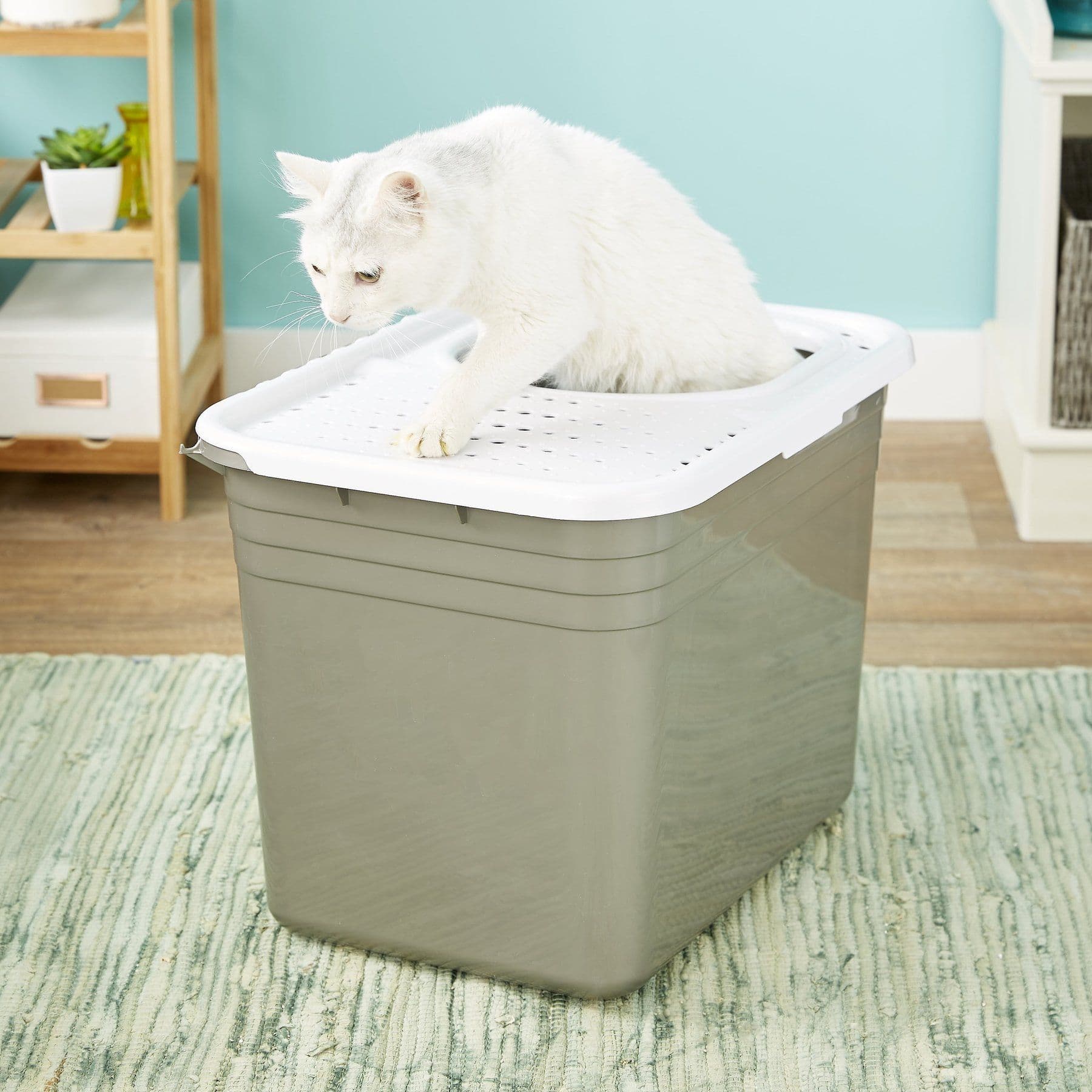
Simple grated-lid design. The opening must fit your cat; this design is not guaranteed to keep dogs out.
Petful may earn a commission when you click through to Chewy, at no extra cost to you.
The Petmate Top Entry Litter Pan combines high walls with a hinged, textured lid. Grates allow some litter collected on top to fall back into the pan, and a built-in hook provides a place for a scoop. Its published opening measures 8.75 by 9.75 inches. Petmate specifications
The opening deserves attention before the overall dimensions. A cat must pass through comfortably and have enough room below to turn and position itself.
- Useful for: someone who prefers a simple high-sided pan with a hinged lid.
- Main tradeoff: the fixed top opening may not suit every cat.
Although this layout may make litter less accessible to some dogs, it is not a reliable dog-proof barrier.
Compare the exact model behind the photograph
Round, oval, square and corner-friendly shapes affect how a box fits the room. Colors such as white, black or gray do not establish its dimensions. When reading reviews, check whether the reviewer used the same size and design, especially for brands with several versions.
“Hop-in” and “jump-in” are descriptions of the access style, not evidence that a cat will enjoy using it. Give more weight to relevant measurements and cleaning details than to a rating without information about the cat or model involved.
Is top entry right for your cat?
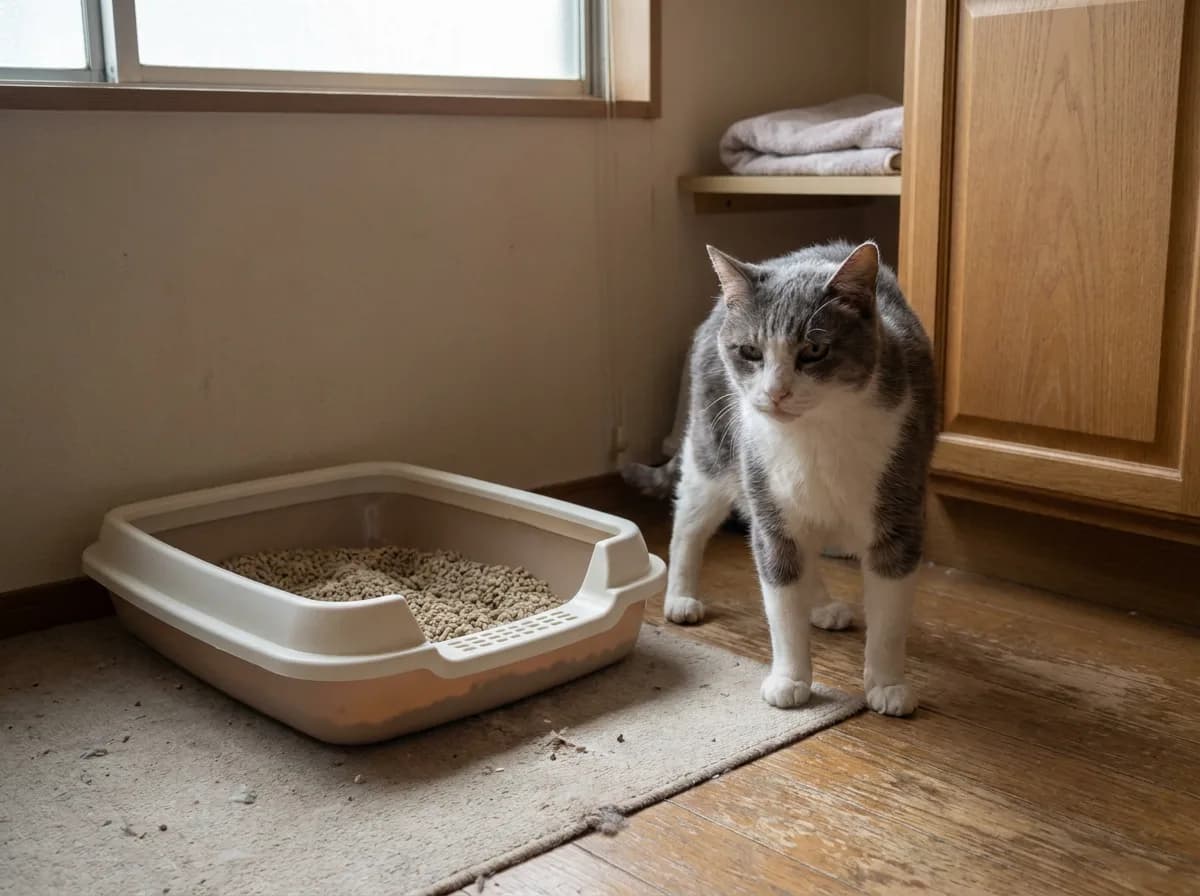
Distinguish top entry from an open-top tray
An open-top litter box is usually an uncovered tray that the cat steps into over a side. A top-entry box is covered, with an opening in the lid. The names sound similar, but the movements required are different.
A conventional hooded box generally has a front or side doorway beneath its cover. That can avoid the climb through a top opening, although the threshold may still be high. A front-entry, top-exit configuration adds another distinction: check which route the cat can actually use in the assembled setup.
Compare access rather than assuming any covered design is better:
- Uncovered tray: no roof above the cat, with entry over the sides or a lowered threshold.
- Hooded front-entry box: an entrance through the front, with a cover above.
- Top-entry box: entry and exit through the lid.
- Convertible box: different configurations, each with its own access requirements.
A litter box does not need a top to function. If you are looking for the best open-top option, begin with a roomy uncovered tray and an entrance your cat can manage. Adding a cover should solve a household need without making toileting harder.
Assess mobility before buying
Top-entry litter boxes are conditional choices for cats that can comfortably negotiate the climb in both directions. They are not a universal upgrade from a regular tray. A cat being able to jump onto a sofa does not tell you how comfortably it can descend through an opening, turn inside and climb out after toileting.
For kittens, older cats and cats with mobility difficulties, accessible entry deserves particular attention. Cornell recommends low sides for these groups. A small kitten should not have to negotiate a tall lid as its only route to a toilet. Cornell access guidance
Use an ordinary low-entry tray when the top-entry movement looks difficult. Watch for the practical problems you can observe:
- Hesitation at the lid or repeated attempts to climb.
- An awkward landing inside the box.
- Difficulty turning beneath the opening.
- Scrambling or slipping during exit.
- Avoidance after initially investigating the box.
These observations tell you that the setup needs reconsideration; they do not identify a medical diagnosis. If mobility changes or toileting discomfort are new, discuss them with your veterinarian rather than treating them as a training issue.
Let preference count as much as physical ability
Cats do not all prefer top entry. Some readily use a covered enclosure; others favor an uncovered box with a clear view around them. Cornell notes that most cats prefer an uncovered box, but individual behavior still matters. Cornell box-preference guidance
A cat may fit through an opening yet dislike using the space beneath it. That is a reason to offer another suitable option, not a reason to keep narrowing the cat’s choices until it complies.
Before switching, identify your actual goal:
- Less litter kicked over the edge.
- A different footprint for the room.
- A lid that collects some tracked granules.
- A more enclosed appearance.
- Reduced access for another household animal.
Then consider whether a roomy high-sided tray, a different location or a litter mat could address the same problem with easier access. The top-entry format should earn its place through suitability, not appearance alone.
Compare benefits with the work they introduce
High walls may contain digging better than a shallow tray, but the lid adds a step to scooping and washing. A compact footprint can help in a small room, while the necessary clearance above the lid may rule out the space beneath a shelf.
When comparing IRIS with Modkat, or top entry with a regular hooded box, ask about daily use rather than searching for a universally superior brand. The original Modkat’s liner system and the IRIS Large model’s liner-optional interior create different maintenance routines.
A useful suitability check includes all four conditions:
- The cat has accessible entry and comfortable exit.
- The interior permits normal turning and positioning.
- The household can provide daily cleaning.
- A familiar accessible alternative remains available during introduction.
The material does not remove these requirements. A stainless steel or other metal top-entry litter box still needs a suitable opening, stable lid and adequate interior. Stainless steel alone cannot make a difficult climb comfortable, and a plastic box is not unsuitable merely because another material is available.
Consider every cat in a shared household
A box that works for one agile adult may not work for a smaller kitten or an older companion. Avoid choosing one top-entry design for multiple cats solely because it is described as extra large.
Assess each cat’s access independently. In a mixed-age household, keeping low-entry options may be more useful than replacing every box with matching covered models. Also consider whether another cat can wait near the single opening and make approaching or leaving uncomfortable.
The best arrangement is the one that gives each cat a usable toilet. Matching colors and identical boxes are optional.
Measure the opening and usable interior
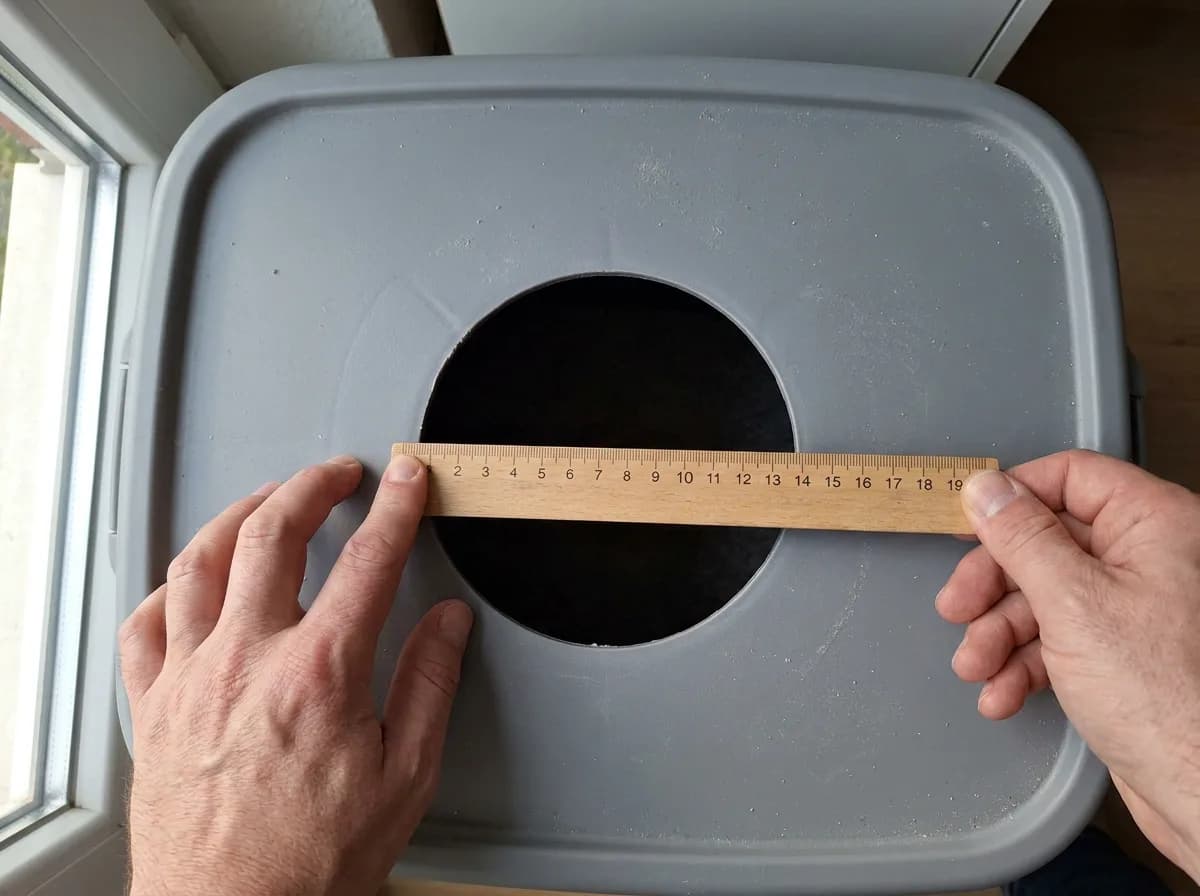
Take three different sets of measurements
Entry width, usable interior dimensions and exterior footprint are not substitutes for one another. A large outer shell can have a relatively narrow opening, while a broad opening says little about the floor space below.
Measure the cat’s current comfortable box as a practical comparison. Then examine the proposed replacement at each point in the route: getting onto the lid, passing through the opening, positioning inside and leaving.
Record these dimensions separately:
- Entry opening: the narrowest usable width and, for an oval or rectangular opening, the other opening dimension.
- Interior: usable floor length and width, plus space above the intended litter level.
- Exterior: the floor space occupied by the assembled box.
- Access clearance: room above and beside the box for the cat and for removing the lid.
Do not measure only the widest point of a tapered opening. Likewise, do not assume the widest part of a rounded shell represents its usable floor. Internal curves, liners and molded features may reduce room where the cat actually stands.
Use the model-specific numbers correctly
The measurements below describe different features. They should not be combined into a single “size” score.
| Selected model | Published exterior dimensions | Published entry information | Interior or fit information |
|---|---|---|---|
| Modkat Original | 16 × 16 × 15 inches | 9.5-inch entry width | Manufacturer recommends cats up to 12 pounds; assess individual fit |
| Modkat XL | 21 × 16.5 × 17 inches | Configurable top or front entry | Larger design; check the chosen configuration and liner |
| IRIS Large, White | 16.14 × 20.47 × 14.56 inches, as listed by the manufacturer | Check the opening on the exact Large model | Selected listing gives approximate interior dimensions of 20 × 15.5 × 14 inches and a 20-pound lid limit |
| Petmate Top Entry, model 22062 | 20.29 × 15.07 × 15.20 inches | 8.75 × 9.75-inch opening | Confirm usable turning room rather than treating exterior dimensions as interior space |
The manufacturer references are Modkat Original, Modkat’s model comparison, IRIS Large and Petmate Top Entry. The IRIS interior measurement and lid limit are specific to the selected listing.
A lid load rating describes the lid, not the cat’s comfort inside. Similarly, a manufacturer’s recommended cat weight does not replace body measurements. Two cats of the same weight may have different lengths, builds and ease of movement.
Compare usable floor space with the cat
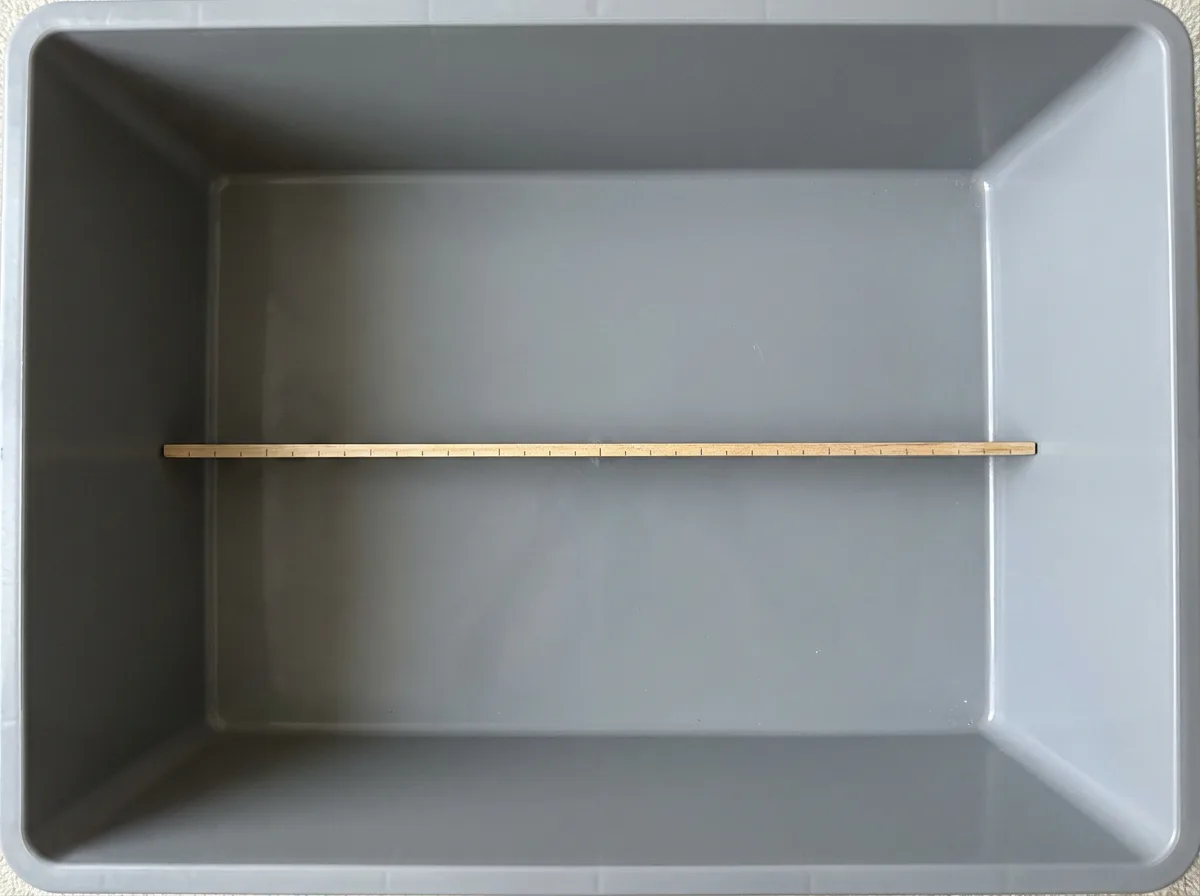
Cat Friendly Homes recommends a litter box approximately one and a half times the cat’s length from nose to tail base, with room to enter, turn, scratch and eliminate. That is a useful reason to check actual space rather than relying on “large” or “jumbo” in a product name. FelineVMA sizing guidance
For example, multiplying a 16-inch nose-to-tail-base measurement by 1.5 gives 24 inches. That calculation can reveal that a seemingly large box deserves closer scrutiny. Compare the guideline with usable space, not a longer exterior measurement that includes the rim or shell.
The opening and floor can fail separately:
- A cat may have enough floor space but struggle through the entrance.
- A cat may pass through easily but lack room to turn.
- A cat may turn comfortably but have too little headroom above the litter.
- A cat may fit inside yet struggle with the climb out.
For large cats, including Maine Coons, breed name alone does not select a suitable box. Measure the individual cat and compare its current comfortable setup. An XL label or a product photograph with a smaller cat cannot establish that fit.
If the biggest top-entry box you are considering still appears restrictive, choose a different access format. There is no requirement to solve a large-cat problem within the top-entry category.
- Choose accessible entry before appearance. A large interior does not compensate for an opening or climb that is difficult for a cat with mobility limitations.
Leave space above the lid and around the approach
A top-entry box needs vertical clearance for the cat, not merely enough height to slide the container beneath furniture. Measure the intended location with the lid in place and consider the cat’s movement above it.
You also need room to open or remove the lid for daily care. If cleaning requires dragging a filled box from beneath a shelf, the location may be more inconvenient than its tidy appearance suggests.
Check the proposed spot before purchasing:
- Mark the exterior footprint on the floor.
- Check nearby doors and drawers in their open positions.
- Leave a clear approach and landing area.
- Confirm that the lid can be opened or removed.
- Make sure the filled box can be moved for washing when necessary.
A corner may be convenient for you but should not trap the cat’s approach between furniture. Avoid a placement that makes the only exit route pass through a busy doorway or beside another animal’s resting place.
Keep size variants separate
When comparing IRIS Medium with Large, use the dimensions for each exact model. Do not transfer the Large model’s interior measurements or lid limit to a smaller box. The same caution applies to listings described as small, premium, square or rounded.
A photograph in orange, black-and-gray or white may show a different size or generation of the product. Confirm the name, dimensions and included parts before treating a color choice as the only difference.
For a narrow space, compare the floor footprint first, but then return to the cat’s usable interior. A box that fits a narrow gap is only useful if it also fits the cat and permits normal entry, exit and cleaning.
Introduce the box without removing the old option
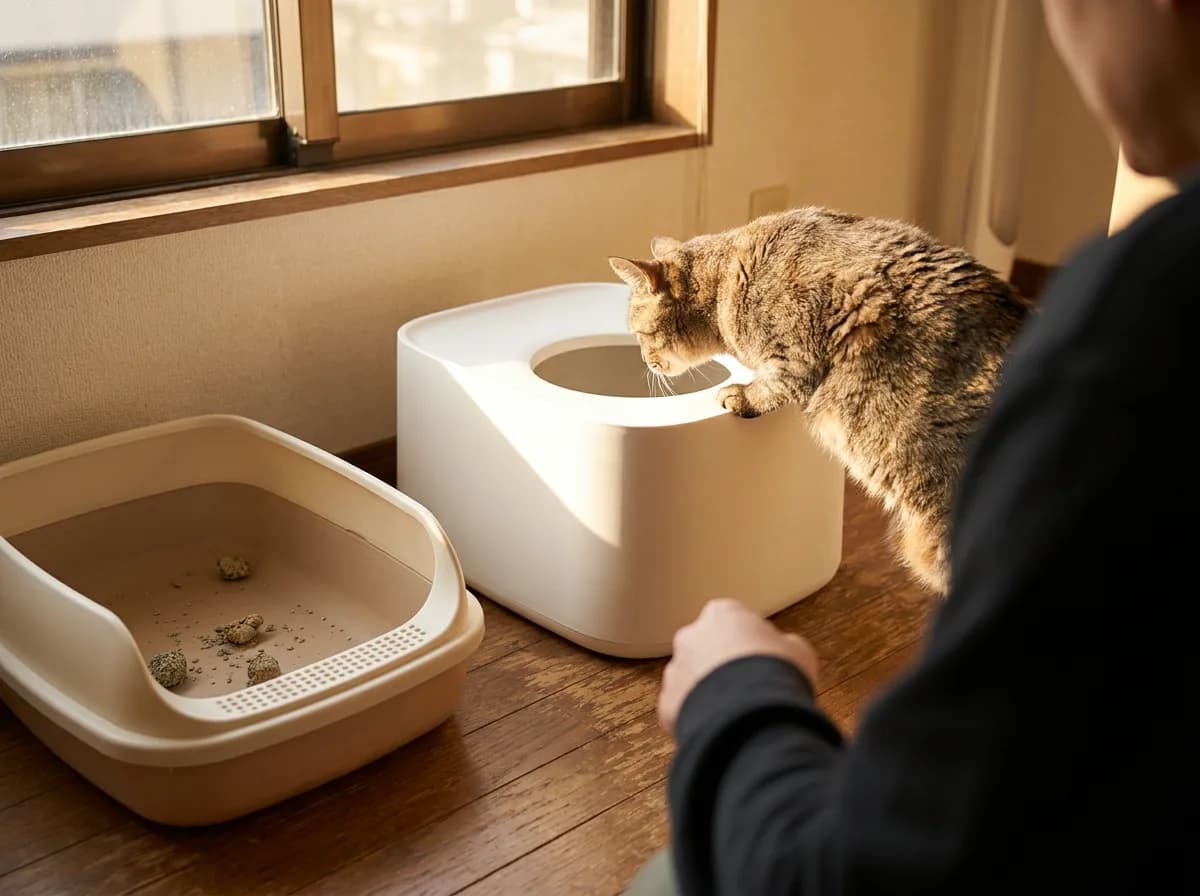
Make the change reversible
Some cats investigate a top-entry box readily; others do not immediately understand or accept the route. Do not assume a cat knows how to use it simply because it recognizes litter. The unfamiliar lid, enclosure and climbing movement are separate parts of the change.
Keep the familiar accessible box in service while introducing the new one. This gives you a way to observe preference without making the new product the cat’s only toilet. A transition succeeds when the cat uses the new arrangement comfortably, not when it has no alternative.
Prepare the new box with as few simultaneous changes as possible:
- Assemble it exactly as directed and check lid stability.
- Use familiar litter if compatible with the box.
- Place it in a suitable accessible location.
- Keep the established box clean and available.
- Allow the cat to approach and investigate voluntarily.
Avoid changing the box, litter texture and location all at once unless there is a necessary reason. If the cat rejects the new arrangement, fewer changes make it easier to identify what may be different.
Observe the whole visit
Seeing the cat stand on the lid does not establish that it can use the box comfortably. Watch the complete sequence when possible, without hovering close enough to discourage it.
Useful observations include:
- Whether the cat approaches without repeated hesitation.
- How it places its feet on the lid.
- Whether it passes through the opening smoothly.
- Whether it can turn and position itself inside.
- How it climbs out and lands afterward.
A quick hop into the box followed by an immediate exit may simply be investigation. Give more weight to repeated comfortable use than to one promising moment. There is no universal number of days after which every cat should have accepted a different toilet.
Do not place or hold the cat inside to demonstrate the route. That does not show voluntary acceptance and may make it harder to judge whether the cat would choose the box.
Use convertible features as intended
A convertible box can let you assess another access configuration without buying a completely separate enclosure. The Modkat XL provides top- and front-entry options, but each setup still needs to be assembled according to its instructions.
If your cat prefers front entry, that is useful information. You do not have to progress toward top entry as though it were the final stage of training. The appropriate configuration is the one the cat uses comfortably and that you can maintain.
Removing a lid also does not automatically produce a low-entry box. The remaining walls may still be tall. Check the resulting entrance before treating a lid-off arrangement as an accessible alternative for a kitten or a cat with limited mobility.
Treat refusal as information
When a cat will not use a top-entry litter box, reconsider the fit, route and location before labeling it stubborn. The problem may be an awkward opening, restricted interior, unstable lid, unfamiliar litter or the presence of another animal near the approach.
Make one relevant adjustment at a time while retaining the familiar box. If the new design continues to be avoided, a different type of box may be the better purchase. A product does not become suitable simply because you have already bought it.
Our guide to a cat refusing to use the litter box explains other possibilities. Sudden changes in toileting, apparent pain or difficulty passing urine require veterinary attention; they should not be managed as a box-training challenge.
Keep an accessible alternative available
If you need an additional temporary toilet while resolving the setup, a suitably sized disposable litter box may be an option. Check its entry height and stability rather than assuming disposable means easy access.
Manage tracking and clean the box
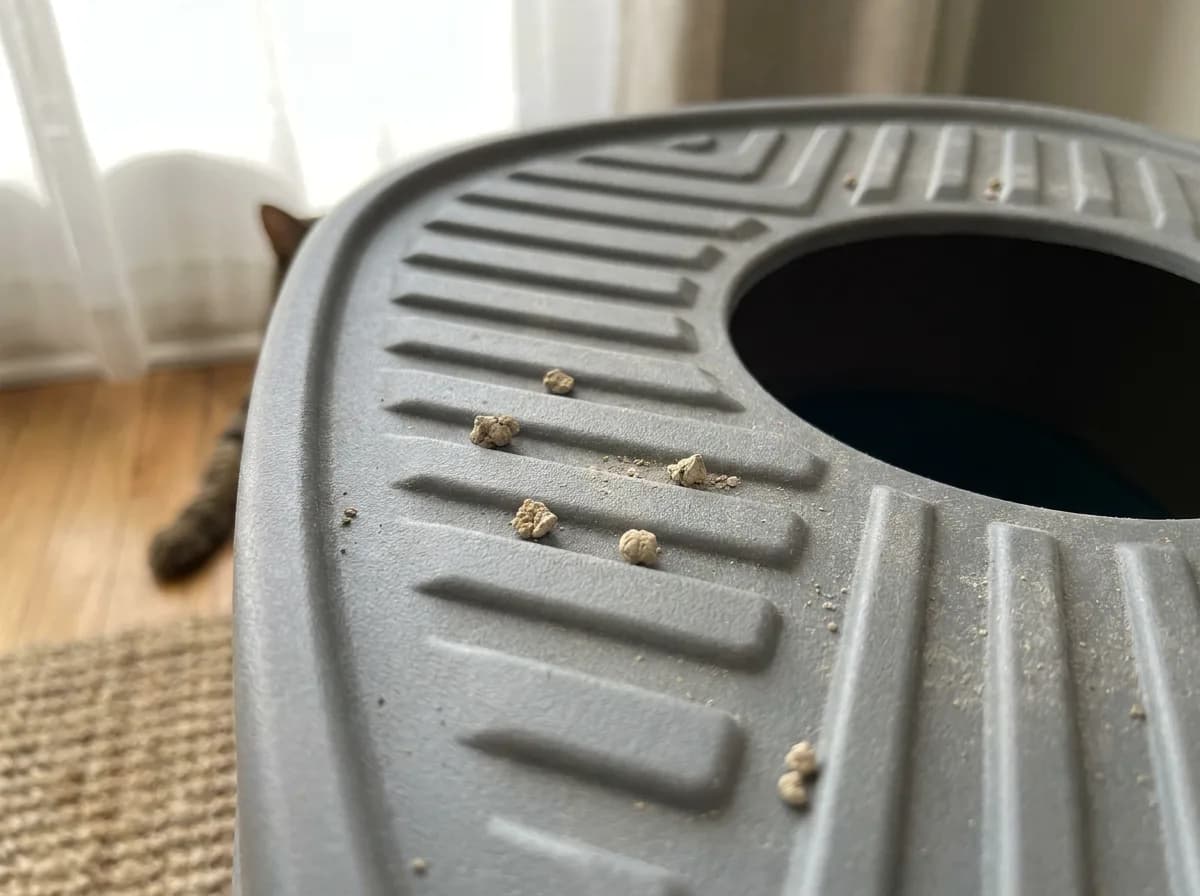
Expect reduced scatter, not a litter-free floor
A top-entry lid can create an extra surface for loose granules to contact as the cat leaves. Grooves may retain some litter, while grates can allow some granules to fall back into the pan. The result depends on the lid design, litter and how the cat exits.
A cat that jumps clear of much of the lid may carry litter directly to the floor. Granules can also remain between toes or on the coat. High walls address litter kicked sideways, which is a different source of mess from litter carried out after toileting.
Evaluate the mess you actually have:
- Litter thrown over an edge during digging.
- Granules carried on paws.
- Litter collected on the lid.
- Spills during scooping or changing litter.
- Scattered material around the landing area.
That distinction helps you decide whether the design is addressing the problem. A textured lid that collects granules still needs cleaning. A mat may help protect the surrounding floor, but place it so it does not make the approach unstable.
Match liners to the exact box and configuration
Top-entry litter box liners are not interchangeable simply because their packaging says “large.” A liner must fit the floor, walls and attachment points without pulling loose or reducing usable space.
The original Modkat and Modkat XL use different arrangements. The selected XL package includes type-C and type-D liners for its configurations. Check the manufacturer’s instructions before buying replacements, particularly if you change how the box is assembled.
For the selected IRIS Large model, a liner is not required. If considering an optional liner for an IRIS or Petmate box, confirm suitability with the exact model rather than assuming a generic bag will stay in place.
Inspect liner fit
Inspect a fitted liner for practical problems:
- Loose material that bunches beneath the cat.
- Edges pulled away from their intended position.
- Tears or worn areas.
- Waste or moisture beneath the liner.
- Interference with the lid or entry opening.
A reusable liner needs its own cleaning and replacement routine. It should make maintenance manageable without becoming a reason to overlook the underlying box.
Separate sifting from the top-entry design
A top-entry litter box is not necessarily a sifting box. The opening in its lid describes access; it does not describe a waste-separation mechanism beneath the litter.
Likewise, grates in a lid are intended to deal with granules collected on top. They do not sift clumps from the main litter bed. Adding a generic sifting liner may alter fit or fail to work with the box’s shape.
If sifting is important to you, check for an explicitly compatible system and its litter requirements. Otherwise, plan to scoop the selected box normally. Do not buy accessories on the assumption that every tray, liner and lid can be combined.
Make daily access easy enough to maintain
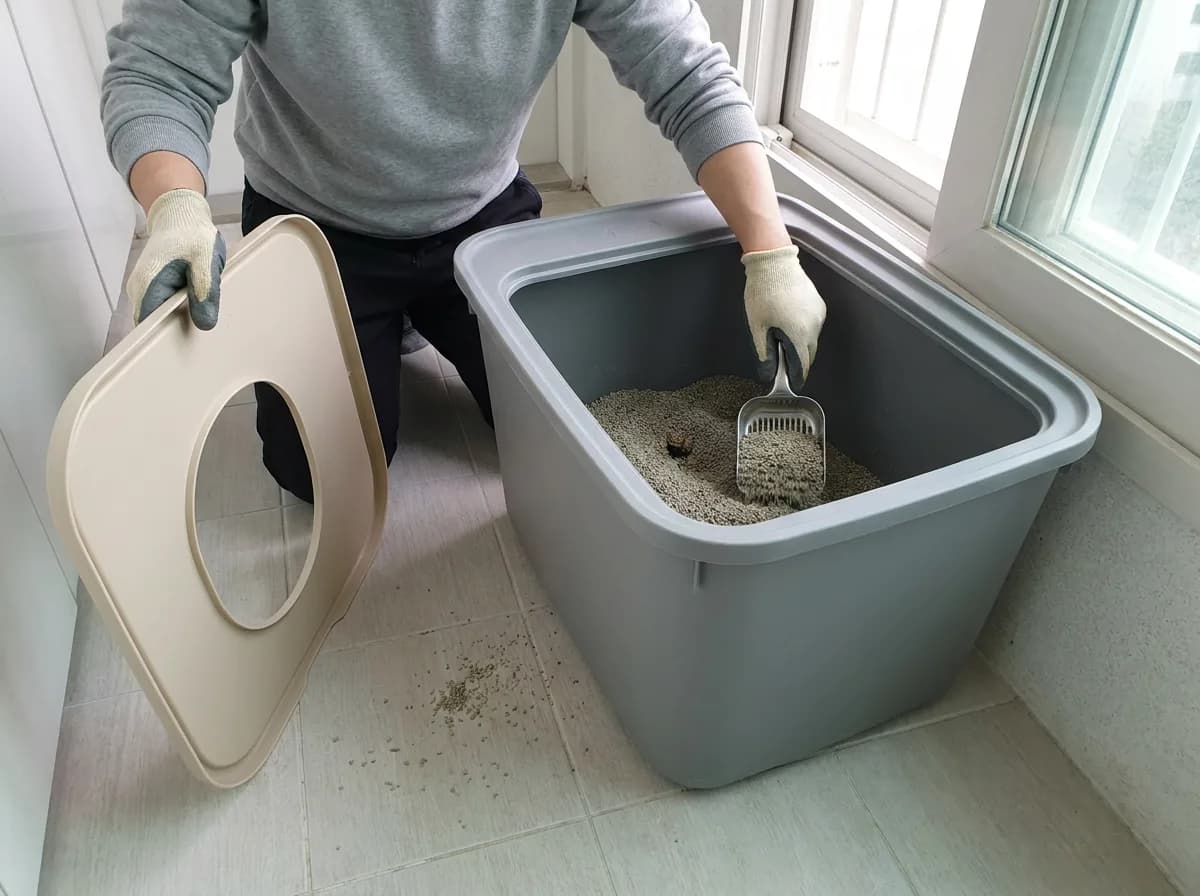
Before settling on a location, rehearse the cleaning task with the empty box. Open the lid, reach the far corners and check where you will set the lid if it detaches. A box that fits the room but makes daily scooping awkward may be the wrong shape or location.
Cat Friendly Homes advises removing waste at least daily and washing the box regularly. Follow the box and liner manufacturers’ care instructions for the materials you choose. FelineVMA maintenance guidance
A practical routine is to:
- Open or remove the lid without scattering collected litter.
- Scoop waste from the full litter area, including corners.
- Inspect the liner or interior walls for soiling and damage.
- Clean granules from the lid and surrounding floor.
- Refit the lid securely before the cat uses the box again.
For washing, empty the box and clean all relevant surfaces, including the underside of the lid and any removable parts. Rinse and dry according to the care instructions before reassembling. Do not assume a large plastic box or its liner is dishwasher-safe.
The effort involved can differ substantially between a swivel lid, a hinged lid and a fully removable cover. Choose the mechanism you can comfortably handle when the box is in its actual location.
Keep litter depth and odor control separate from the lid
How much litter to add depends on the litter and box instructions. Follow any marked fill guidance and maintain the intended depth as waste is removed. A deeper pile is not automatically better, particularly when it reduces the space between the litter surface and lid.
Do not overfill a top-entry box to shorten the climb out. That changes the usable interior and may interfere with the intended setup. If the depth of the box is difficult for the cat, choose an easier-access design.
A cover may keep the contents out of sight, but it does not make accumulated waste disappear. If the box smells, check the litter, liner, lid and surrounding floor rather than relying on an enclosed appearance as evidence of cleanliness.
Provide enough boxes in useful locations
The usual rule is one litter box per cat, plus one extra. Place them in separate accessible locations rather than assuming several boxes clustered together provide the same choices. AAHA/AAFP guidance emphasizes convenient access and quiet locations. AAHA/AAFP litter-box guidance
In a household with multiple cats, the largest top-entry box does not replace that need. One cat may prefer the covered design while another uses a low-entry tray elsewhere.
Keep assessing the arrangement as your cat’s needs change. A box that was comfortable several years ago may become less convenient if mobility or body size changes. Continuing to offer an accessible option lets the household adapt without making toileting depend on a particular product.
Questions readers ask
For cats that can comfortably climb in, turn inside and climb back out, yes. They are a conditional choice, not a universal upgrade. Cornell recommends low sides for kittens, older cats and cats with mobility difficulties, so those groups usually do better with an accessible tray. Watch for hesitation at the lid, awkward landings or scrambling exits, and keep a familiar low-entry box available.
Not automatically. Recognizing litter does not mean the cat understands the lid, the enclosure and the climb. Keep the familiar box in service, assemble the new one exactly as directed, use the same litter if the box allows it, and let the cat investigate on its own. Watch the whole visit rather than one hop onto the lid, and never place or hold the cat inside to show it the route.
Cat Friendly Homes recommends a box about one and a half times the cat’s length from nose to tail base, so a 16-inch cat points to roughly 24 inches of usable floor. Measure the entry opening, the usable interior and the exterior footprint separately; they do not substitute for one another. As reference points, the original Modkat has a 9.5-inch entry and is recommended for cats up to 12 pounds, and the Petmate opening is 8.75 by 9.75 inches.
They reduce litter kicked over the sides, and a grooved or grated lid catches some granules on the way out. They do not stop litter carried on paws or in the coat, and a cat that jumps clear of the lid takes it straight to the floor. Expect less scatter, not a litter-free room, keep a mat at the landing area and plan on cleaning the lid as part of daily scooping.
Change one thing at a time: same litter, a quiet accessible spot, the old box still available, and no forcing. Give it repeated comfortable use rather than a deadline. If the cat still refuses, treat that as information about fit, opening or location; a convertible model such as the Modkat XL can be set to front entry instead. Sudden toileting changes or signs of discomfort need a veterinarian, not more training.

Arden Moore is a Dallas-based award-winning pet writer, podcast host and master certified pet first aid/CPR instructor. She has written more than two dozen dog and cat books, hosts the Oh Behave Show (the longest-running weekly pet podcast) and the Four Legged Life Show. She teams up with her Pet Safety Dog Kona and Pet Safety Cat Casey to teach veterinarian-approved pet first aid classes to pet professionals and pet parents all over the world in person and interactively via ZOOM. Arden’s main websites: ardenmoore.com; petfirstaid4u.com; fourleggedlife.com Arden’s Socials: Facebook: facebook.com/ardenmoore YouTube: @ardenmoore352 TikTok: @ardenmoorepets Instagram: @ardenknowspets
Sign up for expert-backed reviews and safety alerts all in one place.