Best Automatic Dog Feeders of 2026: Top Picks for Every Size Dog
Finding the best automatic dog feeder means matching hopper size, portion accuracy, and power backup to your dog. We compare five top picks across smart, programmable, and wet-food feeders, with guidance on small versus large breeds.
Petful is reader supported. As an affiliate of platforms like Amazon and Chewy, we may earn a commission when you buy through links on this page. There is no extra cost to you.
Choosing the best automatic dog feeder comes down to matching hopper size, portion accuracy, and power backup to your dog, and after weeks of comparing programmable, smart, and gravity models side by side, we have narrowed the crowded market down to five picks that actually hold up in a real home. Whether you run a nine-hour shift, travel for a weekend, or simply want your Labrador to stop inhaling breakfast in eight seconds flat, the right feeder turns a stressful part of your day into something you never have to think about again.
The catch that trips up most first-time buyers is size. A gadget built to portion a quarter cup for a cat will jam or run dry on a 70-pound retriever, and a 6-liter hopper is overkill for a Chihuahua who eats a third of a cup twice a day. Below we break down which feeder fits which dog, why wet-food feeders are a different animal entirely, and what vets actually think about handing mealtime to a machine.
- 1The best automatic dog feeder for most homes is the Petlibro Granary Wi-Fi with Camera, which pairs precise portioning with an app and a live video feed.
- 2Match hopper capacity to your dog's size: small breeds do fine with a 2 to 4 liter hopper, while large breeds eating 3 to 4 cups a day need 5 to 6 liters or more.
- 3Dry-food feeders and wet-food feeders are built differently: only sealed, ice-pack models like the Casfuy F13 keep raw or canned food safe for hours.

Sign up for expert-backed reviews and safety alerts all in one place.
At a Glance
Here is how our five picks compare on the specs that matter most before we get into the detailed reviews. Prices are approximate and shift with sales, so check the current listing before you buy.
- Petlibro Granary Wi-Fi with Camera: Best Overall
- PetSafe Smart Feed 2nd Gen: Most Reliable
- Casfuy F13 6-Meal Feeder: Best Wet/Fresh
- PATPET Timed 4L: Best Budget
- Arf Pets: Best Long Absences
| Feeder | Best For | Approx. Price |
|---|---|---|
| Petlibro Granary Wi-Fi with Camera | Best overall and smart features | $120 |
| PetSafe Smart Feed 2nd Gen | Reliable app control | $100 |
| Casfuy F13 6-Meal Feeder | Wet and fresh food | $80 |
| PATPET Timed 4L | Budget large hopper | $60 |
| Arf Pets Automatic Dog & Cat Feeder | Long absences | $60 |
The Best Automatic Dog Feeders of 2026
We evaluated each feeder on portion accuracy, hopper capacity, jam resistance, power backup, app stability, and how easy it is to clean. Here are the five that earned a spot, ordered by overall value.
1. Petlibro Granary Wi-Fi with Camera: Best Overall
Petful may earn a commission when you click through to Chewy, at no extra cost to you.
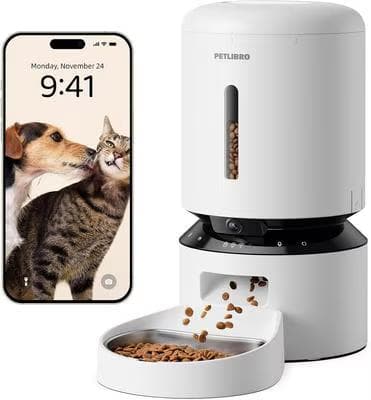
The Petlibro Granary Wi-Fi with Camera is the feeder we would put in most homes without hesitation. It combines a 5-liter hopper (roughly 20 cups of dry food), a stainless steel food bowl that lifts out for washing, and a genuinely useful 1080p camera with night vision so you can watch your dog eat from your phone. That camera is not a gimmick: for anyone who has come home to an untouched bowl and wondered whether their dog skipped a meal, being able to check in on the live feed is real peace of mind.
Portioning is where the Granary shines. You can schedule up to 10 meals a day in increments of roughly one tablespoon (one-tenth of a cup), which gives you the granularity to feed a small dog four tiny meals or a large dog two big ones. The desiccant bag in the lid keeps kibble fresh, and the twin-power design runs off the wall adapter with three D batteries as backup so a blackout will not skip a meal. The app is stable, supports multiple feeders on one account, and lets you record a 10-second voice clip that plays at mealtime so your dog comes running.
The one honest limitation: the 5-liter hopper is generous for small and medium dogs but a two-large-meal-a-day giant breed will empty it in about a week, so plan on refilling more often. For nearly everyone else, this is the best automatic dog feeder we recommend and the one most likely to still be earning its keep two years from now.
- Precise 1-tablespoon portioning
- live camera with night vision
- twin power with battery backup
- dishwasher-safe stainless bowl
- Camera needs decent Wi-Fi
- 5-liter hopper refills weekly for giant breeds
2. PetSafe Smart Feed 2nd Gen: Most Reliable App Control
Petful may earn a commission when you click through to Chewy, at no extra cost to you.
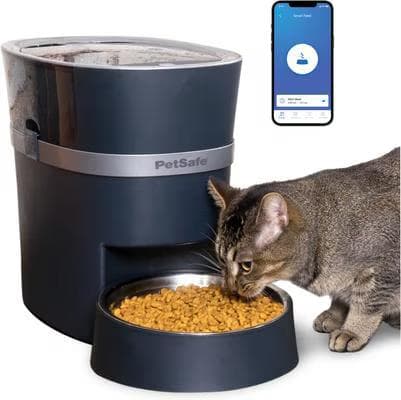
PetSafe is a name most dog owners already trust, and the Smart Feed 2nd Gen is the feeder we reach for when app reliability matters more than a camera. The second-generation revision fixed the connectivity complaints that dogged the original: pairing is quicker, the feeder reconnects on its own after a router reboot, and the app pushes a notification the moment a meal dispenses or if a jam is detected. That last feature is underrated. Knowing your dog was actually fed, not just that a meal was scheduled, is exactly the reassurance a smart feeder should provide.
The 24-cup hopper is one of the larger capacities in this roundup, which makes it a strong pick for medium and large dogs. It portions from one-eighth of a cup up to four cups per meal across up to 12 meals a day, and the slow-feed mode dispenses a single meal gradually over about 15 minutes to help fast eaters pace themselves. Both the hopper and the bowl are dishwasher safe, and the conveyor-style dispensing mechanism handles odd-shaped kibble better than the rotating-auger designs that tend to jam.
It runs on the included adapter with a 4 D-cell battery backup. The trade-off versus the Petlibro is no camera and a slightly higher price for what you get, but if you want the single most dependable app experience in this group, the Smart Feed 2nd Gen earns it.
- Rock-solid app and reconnection
- large 24-cup hopper
- jam and empty alerts
- dishwasher-safe parts
- No camera
- conveyor tray needs occasional wiping
3. Casfuy F13 6-Meal Feeder: Best for Wet and Fresh Food
Petful may earn a commission when you click through to Chewy, at no extra cost to you.
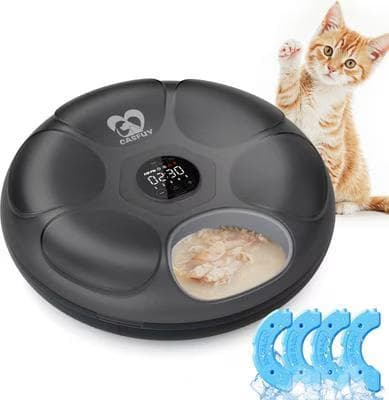
Almost every feeder in this category handles dry kibble only, which leaves owners of dogs on canned, raw, or fresh diets out in the cold. The Casfuy F13 solves that. It uses a rotating tray of six sealed compartments and two ice packs tucked underneath to keep wet food cool and safe for hours, so you can portion out breakfast and lunch before you leave and trust that the second meal has not spoiled by the time it opens.
Each of the six compartments holds up to about 240 milliliters, enough for a substantial wet meal, and the lid rotates to expose one compartment at each scheduled time. You can set up to six meals across a 24-hour window, which comfortably covers a full workday plus an overnight if you are away. The whole tray lifts out and is dishwasher safe on the top rack, and because there is no auger or hopper, there is nothing to jam.
The honest caveats are the ones inherent to wet-food feeders everywhere: the ice packs keep food safe for a window measured in hours, not days, so this is a same-day solution and not a way to leave a dog for a long weekend on canned food. It also runs on battery only (three C-cells), so there is no wall-power option. For fresh and wet diets, though, it is the standout, and it doubles neatly for cats on the same food.
- Keeps wet and raw food cool
- no jam-prone auger
- dishwasher-safe tray
- works for cats too
- Battery only
- cooling lasts hours not days
- dry-food owners will not need it
4. PATPET Timed 4L: Best Budget Large Hopper
Petful may earn a commission when you click through to Chewy, at no extra cost to you.
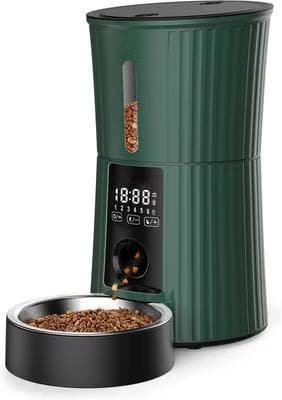
If you want a big, dependable dry-food feeder without paying for Wi-Fi and cameras you will never use, the PATPET Timed 4L is the value pick. It skips the app entirely in favor of buttons on the unit, which for a lot of owners is a feature rather than a compromise: there is no account to set up, no firmware to update, and nothing to go wrong when your internet drops. You program up to four meals a day directly on the feeder, portion from one to twelve servings per meal, and a recordable 10-second voice message calls your dog over.
The 4-liter hopper strikes a smart middle ground, holding enough kibble for a medium or large dog for several days without dominating your kitchen counter. The infrared anti-jam design keeps the dispensing port clear, and the removable stainless bowl and hopper wash easily. Power comes from the wall adapter with a 3 D-cell battery backup, so a short outage will not cost your dog a meal.
What you give up at this price is remote control. If you are stuck late at work, there is no app to trigger an extra feeding from across town, and there is no camera. But for a reliable, set-it-and-forget-it dry feeder that handles a bigger dog on a budget, the PATPET is hard to beat.
- Large 4-liter hopper for the money
- no app dependency
- anti-jam port
- battery backup
- No remote or camera
- on-unit programming only
5. Arf Pets Automatic Dog & Cat Feeder: Best for Long Absences
Petful may earn a commission when you click through to Chewy, at no extra cost to you.
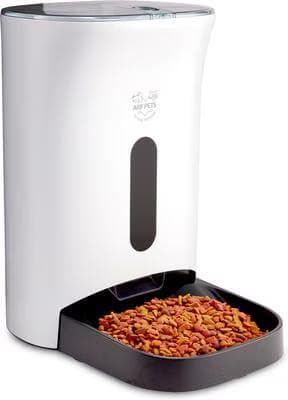
For the owner who occasionally has to be away overnight or across a full weekend, the Arf Pets Automatic Dog & Cat Feeder is built for extended coverage. Its 7-liter hopper is the largest in this roundup, holding around 28 cups of dry food, which is enough to feed even a big dog for the better part of a week if you had to. Paired with up to four scheduled meals a day and a portion range from one to thirty-nine servings per meal, it gives you the runway to leave a pet sitter with less to do.
The design leans practical over flashy. A secure twist-lock lid keeps determined dogs out of the hopper, the infrared sensor prevents overflow if food backs up, and a desiccant compartment keeps the large volume of kibble from going stale. It runs on the wall adapter with a battery backup, and the removable bowl and hopper are simple to rinse and dry. A recordable voice message plays before each meal.
The reason we rank it just behind the others for everyday use is that it is a straightforward timed feeder without app or camera features, so day to day it does less than the Petlibro or PetSafe. But when the priority is holding a lot of food and running dependably through a long absence, the Arf Pets's oversized hopper makes it the pick.
- Largest 7-liter hopper
- secure twist-lock lid
- anti-overflow sensor
- great for weekend coverage
- No app or camera
- large footprint on the counter
Small Breed vs Large Breed: Hopper Size and Portioning
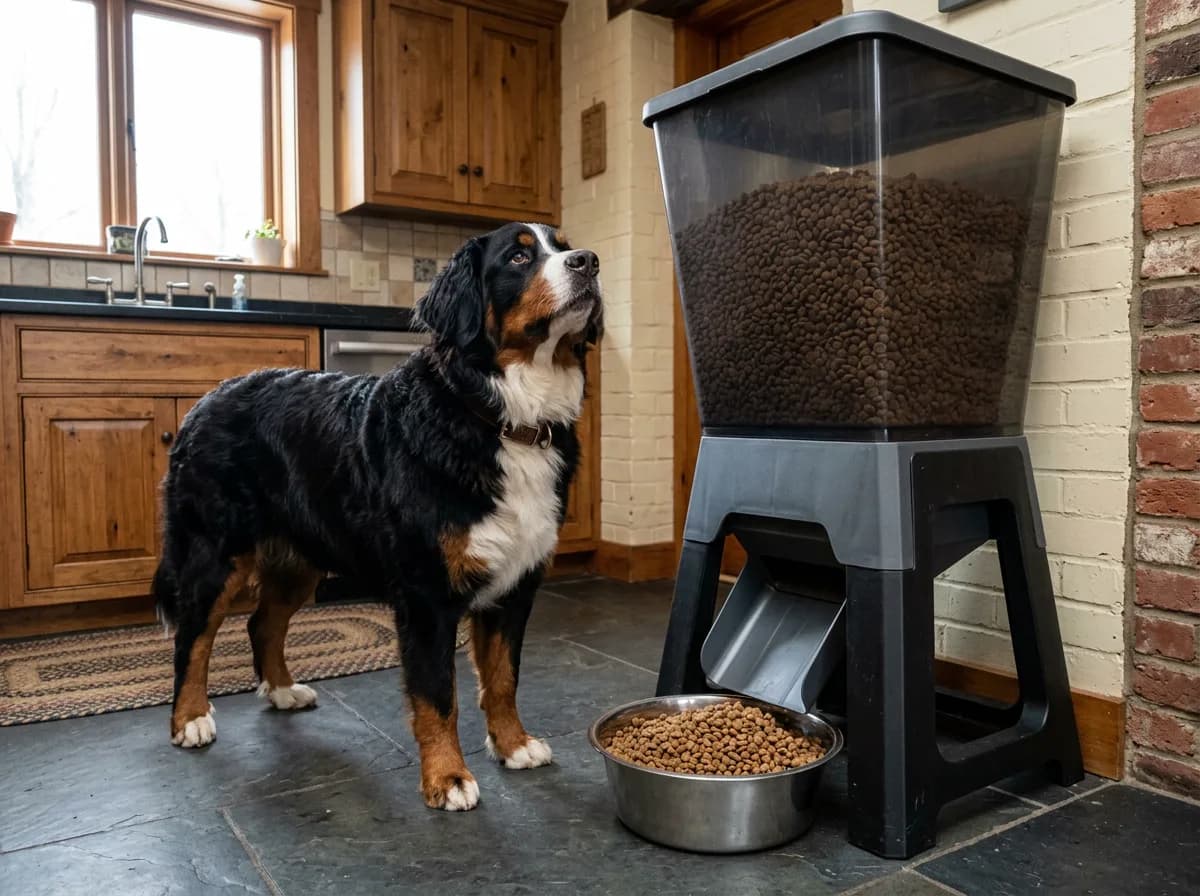
The single biggest mistake dog owners make when buying an automatic feeder is ignoring the enormous range of dog sizes. Cats are all roughly the same size, so a cat feeder can be one-size-fits-all. Dogs span from a 4-pound Chihuahua to a 120-pound Great Dane, and a feeder that is perfect for one is useless for the other. This is why so many "pet feeders" are dual-marketed for cats and dogs at the same time: the compact models genuinely do suit both a cat and a small dog, but they fall apart at scale.
Start with how much your dog actually eats. A small breed eating half a cup to a cup a day is well served by a 2 to 4 liter hopper, which will hold several days of food and portion cleanly at small serving sizes. The thing to watch on the small end is portion granularity: many feeders dispense in whole "servings" of roughly one-tenth of a cup, and if the smallest setting is bigger than what your little dog should eat, the feeder is wrong for you. Look for models that portion in tablespoon-level increments, like the Petlibro.
Large and giant breeds are the opposite problem. A dog eating 3 to 4 cups of kibble a day, split into two meals, needs a feeder that can both dispense a large portion at once and hold enough between refills to be worth the counter space. For these dogs, look at 5 to 7 liter hoppers and confirm the maximum portion per meal is high enough (the PetSafe and Arf Pets both dispense multiple cups per meal). A feeder that tops out at one cup per meal will not feed a Great Dane, no matter how big the hopper is.
- 1Small breeds eating 0.5 to 1 cup a day suit a 2 to 4 liter hopper with tablespoon-level portioning
- 2Large and giant breeds eating 3 to 4 cups a day need a 5 to 7 liter hopper that dispenses multiple cups per meal
- 3Bigger, odd-shaped kibble bridges narrow augers, so favor conveyor or wide anti-jam ports for big dogs
The mechanism matters more at scale, too. Large-breed kibble pieces are bigger and more likely to bridge or jam a narrow auger, so conveyor-style and wide-port anti-jam designs (again, the PetSafe and PATPET) are the safer bet for big dogs. If you have a fast eater of any size, pair the feeder with a strategy for slowing them down, which we cover in the section on choosing below and in our guide to why your dog eats too fast.
Gravity vs Programmable vs Smart Feeders
Not every automatic feeder is the same category of device, and understanding the three tiers saves you from buying the wrong tool. The gap between a $20 gravity feeder and a $120 smart feeder is not just price, it is what the machine can actually do.
- 1Gravity feeders are cheap and unbreakable but give zero portion control, a real risk for dogs that overeat
- 2Programmable feeders add a timer and portioning motor with no app required, the right fit for most dogs
- 3Smart feeders layer Wi-Fi on top for remote control, jam and empty alerts, and feeding history logs
Gravity feeders are the simplest: a reservoir of kibble feeds a bowl by gravity, refilling the bowl automatically as your dog eats down the pile. There is no timer, no motor, and nothing to break or lose power. The upside is dead reliability and a low price. The downside is total lack of portion control. A gravity feeder keeps food available at all times, which is fine for a disciplined dog who self-regulates but a disaster for the many dogs who will simply eat until the reservoir is empty. For a large breed prone to overeating or bloat, free-feeding from gravity is a real risk. See the callout below on when a gravity feeder makes sense for a big dog.
Programmable feeders add a timer and a portioning motor. You set the meals and the sizes, and the feeder dispenses exactly that much at exactly those times, whether you are home or not. This is the sweet spot for most dogs: real portion control, real scheduling, and no smartphone required. The PATPET and Arf Pets in our roundup are programmable feeders. They do everything a healthy feeding routine needs and nothing more.
Smart feeders are programmable feeders with Wi-Fi added, which unlocks remote control from an app, push notifications when a meal dispenses or a jam occurs, feeding history logs, and sometimes a camera. The value here is not the novelty, it is the confirmation: you get told that your dog was actually fed, and you can trigger an extra meal or adjust the schedule from anywhere. The Petlibro and PetSafe are smart feeders. If you travel, work unpredictable hours, or just want the reassurance, the app is worth the premium. If your schedule is steady and your Wi-Fi is not, a programmable feeder will serve you just as well for less money.
- A gravity feeder can work for a large, calm dog who reliably self-regulates and eats only when hungry, especially as a backup water-style food station. But because it offers no portion control and keeps food out constantly, it is a poor choice for any dog that overeats, any dog managing weight, and any breed prone to bloat. If you are not certain your dog paces themselves, choose a programmable feeder instead.
Automatic Feeders for Wet Dog Food
Most automatic feeders are dry-food only, and there is a good reason for it: wet, canned, and raw food spoils. Leave a scoop of pate sitting out in a standard hopper for six hours and you have a food-safety problem, not a meal. If your dog eats wet or fresh food, you need a feeder specifically engineered for it, and the design is fundamentally different from a kibble dispenser.
Wet-food feeders, like the Casfuy F13 in our roundup, use a rotating tray of individual sealed compartments rather than a single hopper. Each compartment stays closed until its scheduled time, and the better models add ice packs or a small cooling element underneath to keep the food safe until it opens. This is what lets you portion out a wet breakfast and a wet lunch in the morning and trust that the second meal has not turned by the time your dog eats it.
The critical thing to understand is the time window. Ice-pack cooling buys you hours, not days. A wet-food feeder is the right tool for covering a workday or a single overnight, but it is not a way to leave a dog on canned food for a long weekend. For extended absences with a wet-fed dog, you still need a person to check in. Cleaning is also non-negotiable with wet food: the tray must be washed after every use, because residue in a compartment is a bacterial risk in a way that dry kibble dust simply is not.
- Ice-pack cooling keeps food safe for hours, not days, so a wet-food feeder covers a workday or a single overnight but never a long weekend on canned food. Wash the tray after every meal to prevent bacterial buildup.
One practical note: because they are compartment-based and portion by the meal, wet-food feeders are naturally forgiving on size. The same F13 that feeds a medium dog its canned dinner works just as well for a cat, which is why this category in particular is so heavily dual-marketed. If you feed a mixed diet, a compartment feeder for the wet meals plus a programmable dry feeder for the kibble meals is a common and effective combination.
App, Camera and Voice Features
The software layer is what separates a smart feeder from a basic timer, and it is worth understanding what these features actually buy you before you pay for them.
- 1The app is the core feature: set the schedule remotely, trigger a manual meal, and get confirmation that food actually dispensed
- 2A camera reassures anxious owners but is overkill if portion control is your only goal
- 3A recordable voice clip trains dogs to come running and eases nervous eaters onto the machine
The app is the core of a smart feeder. A good one lets you set and adjust the feeding schedule from your phone, trigger a manual meal on demand, review a history log of when meals actually dispensed, and receive push notifications. That notification is the real value: instead of hoping the 6 p.m. meal happened, you get told it did, and you get alerted if the feeder jammed or ran empty. App quality varies a lot between brands, and it is the single most common source of one-star reviews, so it is worth weighting heavily. In our testing, the PetSafe app was the most dependable at reconnecting after a network hiccup, and the Petlibro app was the most feature-rich.
The camera, found on the Petlibro Granary, adds a live 1080p video feed with night vision so you can watch your dog eat. For anxious owners, dogs with medical feeding schedules, or anyone who has come home to a full bowl and worried, it is genuinely reassuring to confirm your dog is eating normally. It does require solid Wi-Fi to stream cleanly, and it is the feature most likely to be overkill if your only goal is portion control.
The voice recording feature, which several feeders include, lets you record a short clip that plays before each meal. Dogs learn the sound fast and come running, which turns the feeder into a positive event rather than a mysterious machine that occasionally makes noise. It is a small touch, but it helps nervous dogs adjust to being fed by a device instead of by hand.
Power and Battery Backup (why it matters)
This is the feature owners overlook until the day it costs their dog a meal. An automatic feeder is only as reliable as its power source, and the ones that run on wall power alone have a single point of failure: unplug it, trip a breaker, or lose power in a storm while you are away, and the feeder goes dark and your dog does not eat.
The gold standard is twin power: a wall adapter for everyday use plus a battery backup that takes over automatically if the outlet loses power. Every top pick in this roundup except the battery-only Casfuy offers this, and it is the configuration we recommend for anyone who leaves a dog alone regularly. The batteries are not powering the feeder day to day, so they last a long time, but they are there the moment they are needed.
Battery-only feeders, like the Casfuy F13, are perfectly fine for their intended use because you are refilling and resetting them every day anyway, so a dead battery reveals itself the same day rather than during a week-long absence. The trap to avoid is a wall-only feeder with no battery backup at all. Those exist at the very bottom of the price range, and they are a false economy: the entire point of an automatic feeder is that it works when you are not there to fix it, and a power blip defeats exactly that purpose. Always check the specs for battery backup before you buy, and when you set up a new feeder, load the backup batteries the same day so you are covered from meal one.
How to Choose
With the categories clear, here is how to actually pick the best automatic dog feeder for your specific dog. Work through these in order.
- Portion accuracy for your dog's size. This is the first filter. Confirm the smallest portion setting is small enough for a little dog and the largest is big enough for a large one. A feeder whose minimum serving overfeeds your Chihuahua, or whose maximum underfeeds your retriever, is the wrong feeder regardless of any other feature.
- Anti-jam mechanism. The most common failure mode for dry feeders is a jam, where kibble bridges the dispensing port and the scheduled meal never drops. Conveyor-style dispensing (PetSafe) and wide infrared-monitored ports (PATPET, Arf Pets) resist this far better than a narrow rotating auger, especially with large or oddly shaped kibble. If the feeder is for a big dog, prioritize a jam-resistant design.
- Cleaning. A feeder you dread cleaning is a feeder that stays dirty, and dirty feeders grow bacteria and mold. Look for a removable, dishwasher-safe bowl and hopper. Wet-food trays must be washed after every meal; dry hoppers should be emptied and wiped weekly, and fully washed and dried monthly to prevent oil buildup from the kibble.
- Power backup. As covered above, insist on battery backup unless the feeder is a daily-reset wet-food model.
- Once a week, unplug the feeder, empty the hopper completely, and wipe out any kibble dust and oil residue with a dry cloth. Wash the removable bowl and, if detachable, the hopper in warm soapy water or the dishwasher, then dry them fully before refilling. Dry kibble oils go rancid over time, so a bone-dry hopper matters. For wet-food feeders, wash the tray after every single use. This ten-minute weekly habit is the difference between a feeder that lasts years and one that clogs and smells within months.
Do Vets Recommend Automatic Dog Feeders? Are They Safe?
Automatic feeders are widely used and, when chosen and managed well, veterinarians generally view them as safe and often helpful. The value they see is consistency: dogs on a fixed schedule with controlled portions tend to maintain healthier weights and steadier digestion than dogs who are free-fed or fed erratically. For a working owner, a programmable feeder that delivers the right amount at the right time is a genuine tool for weight management and routine, which are two things vets care a great deal about.
The safety caveats vets raise are practical rather than alarming. First, an automatic feeder does not replace human observation. A machine will happily dispense meals to a dog who has stopped eating, is vomiting, or is ill, and a skipped or refused meal is often the first sign something is wrong. This is exactly why the camera and app-notification features are useful: they help you notice a problem you would otherwise miss. Second, portion control still requires you to get the math right. The feeder dispenses what you tell it to, so if you set the portions too high, it will reliably overfeed your dog into obesity. Third, feeders are not a substitute for care during long absences. A feeder handles food, but a dog left alone still needs water, exercise, bathroom breaks, and companionship, so a multi-day trip needs a sitter, not just a full hopper.
The other safety point is the food itself. Keep dry food dry and fresh, wash the equipment on schedule, and never load a standard hopper with wet or raw food that will spoil. Used within its design, an automatic feeder is a safe and vet-friendly part of a healthy routine. If your dog inhales meals so fast they choke or gulp air, an automatic feeder alone will not fix that; pair it with a slow feeder dog bowl or use the feeder's slow-dispense mode. And if you also have a cat, the same logic and many of the same models apply, which we cover in our guide to the best automatic cat feeders.
Frequently Asked Questions
In our testing the PetSafe Smart Feed 2nd Gen was the most reliable, thanks to a conveyor dispensing mechanism that resists jams, a large 24-cup hopper, an app that reconnects on its own after a network drop, and battery backup. The Petlibro Granary is a close second and adds a camera. Reliability comes down to jam-resistant dispensing plus battery backup, so prioritize both.
Generally yes, when used well. Vets value the consistent schedule and controlled portions that help with weight management and digestion. The caveats are that a feeder does not replace watching your dog for signs of illness, that you must set portions correctly to avoid overfeeding, and that a feeder is not a substitute for a sitter during multi-day absences.
For most owners, yes. If you work long hours, travel, or want to control portions and mealtimes precisely, an automatic feeder removes a daily stressor and helps keep your dog at a healthy weight. If you are always home and your dog self-regulates, the benefit is smaller, though scheduled portioning still helps with weight management.
The Petlibro Granary Wi-Fi with Camera is our pick for the best smart feeder. It combines tablespoon-level portioning, a stable app with feeding history and alerts, twin power with battery backup, and a 1080p night-vision camera so you can watch your dog eat. The PetSafe Smart Feed 2nd Gen is the best choice if you want the most dependable app but do not need a camera.
The main downsides are mechanical jams on dry-food models, reliance on power (which is why battery backup matters), app or Wi-Fi issues on smart models, the risk of overfeeding if portions are set wrong, and the fact that a feeder cannot tell if your dog is unwell. Wet-food feeders add spoilage risk if the cooling window is exceeded. Regular cleaning and correct setup prevent most problems.
Yes, when chosen and managed properly. Use a dry-food feeder only for dry food, use a cooled compartment feeder for wet food and stay within its time window, keep the equipment clean, set correct portions, and pair with human check-ins so a refused meal or illness gets noticed. Under those conditions vets consider them a safe part of a feeding routine.
Benefits include consistent meal timing even when you are out, precise portion control that supports healthy weight, the ability to split food into more frequent smaller meals for dogs prone to bloat or gulping, reduced early-morning begging, and on smart models remote feeding plus confirmation that your dog was actually fed.
Weekly, unplug the feeder, empty the hopper, and wipe out kibble dust and oil residue. Wash the removable bowl and hopper in warm soapy water or the dishwasher, then dry them fully before refilling, since kibble oils go rancid in a damp hopper. Wet-food trays must be washed after every use because food residue is a bacterial risk. A full deep clean of dry feeders monthly keeps them running for years.
The 95 percent rule is an FDA and AAFCO labeling standard. If a dog food is named for an ingredient, such as "Beef for Dogs," that named ingredient must make up at least 95 percent of the product by weight, not counting added water. Lower thresholds apply to other naming formats: the 25 percent or "dinner" rule covers names like "Beef Dinner," and the 3 percent "with" rule covers "with beef." It is a quick way to read how much of a headline ingredient is actually in the food.
The most dangerous common household food for dogs is anything sweetened with xylitol, an artificial sweetener in sugar-free gum, candy, and some peanut butters, because even small amounts can cause a rapid, life-threatening drop in blood sugar. Other foods to never feed include grapes and raisins, chocolate, onions, and garlic. If your dog eats any of these, contact your veterinarian or an animal poison control line immediately.
No. An automatic feeder handles meals, but a dog left alone still needs fresh water, exercise, bathroom breaks, and companionship, and cannot be observed for illness by a machine. A feeder is great for covering a workday or a single overnight, but any multi-day absence requires a pet sitter or boarding, not just a full hopper.

Coreen Saito is a pet writer and longtime shelter volunteer with more than a decade in animal rescue. She covers cat behavior, breed care, and the small, ordinary science of sharing a life with companion animals, with a particular focus on honest takes about the products and decisions that actually matter. At home in Arizona, she's outranked by Mac (a dog with the loudest opinion in the house), Rebel (a cat who governs by quiet authority), and Meri (an orange tabby who runs the late shift and the laundry basket). She writes about all three, plus the rescues that keep coming through her life, at LifeWithMinty.com.
Sign up for expert-backed reviews and safety alerts all in one place.