The Best Slow Feeder Dog Bowl for Every Fast Eater in 2026
Fast eating can cause gulping, vomiting, and even raise bloat risk in deep-chested breeds. We compared slow feeder dog bowls across budgets, materials, and muzzle shapes to find the best picks for every dog, including flat-faced breeds.
Petful is reader supported. As an affiliate of platforms like Amazon and Chewy, we may earn a commission when you buy through links on this page. There is no extra cost to you.
The best slow feeder dog bowl turns a ten-second inhale into a five-minute meal, and after comparing ridged, mazed, and spiral bowls across a range of dogs and muzzle shapes, we have clear favorites for every budget, breed, and snout depth. If your dog wolfs down dinner and then coughs, gulps, or brings some of it back up on the floor, a slow feeder is the cheapest, lowest-effort fix worth trying first.
Fast eating is not just a mealtime annoyance. Gulping air alongside food can trigger regurgitation, and in large, deep-chested breeds, eating too quickly is one of several discussed risk factors for bloat (gastric dilatation-volvulus), a genuine emergency. A slow feeder will not cure a medical problem on its own, but it is a simple tool that may help reduce gulping while adding a little mental work to the bowl. Below are our picks, followed by everything you need to choose the right one for your dog.
- 1A slow feeder bowl uses raised ridges or a maze to make your dog work for each bite, stretching a fast meal from seconds into several minutes.
- 2Our best overall pick is the Outward Hound Fun Feeder Slo Bowl for its proven maze design, grippy base, and dishwasher-safe build at around $15.
- 3Slow feeders may help reduce gulping, vomiting, and mealtime air-swallowing, but they are one strategy among several and do not replace veterinary care for a dog with digestive or bloat concerns.

Sign up for expert-backed reviews and safety alerts all in one place.
At a Glance
- Outward Hound Fun Feeder Slo Bowl: Best Overall
- Frisco Bone-Shaped Ridges Slow Feed Bowl: Best Budget
- PawsPik Raised Ceramic Slow Feeder: Best Ceramic
- Durapet Slow-Feed Bowl: Best Stainless
- JW Pet Skid Stop: Best Value
| Bowl | Best For | Material | Approx Price |
|---|---|---|---|
| Outward Hound Fun Feeder Slo Bowl | Best overall | Food-safe plastic | $15 |
| Frisco Bone-Shaped Ridges Slow Feed Bowl | Best budget | Melamine/plastic | $10 |
| PawsPik Raised Ceramic Slow Feeder | Flat-faced dogs and elevated feeding | Ceramic | $30 |
| Durapet Slow-Feed Bowl | Best stainless steel | Stainless steel | $20 |
| JW Pet Skid Stop Slow Feeder | Best value maze | Food-safe plastic | $12 |
The Best Slow Feeder Dog Bowls, Reviewed
We looked at maze difficulty, how stable each bowl stayed on hard floors, how easy it was to clean, and whether the design suited different muzzle lengths. Here are the five that earned a spot, with a note on who each one is really for.
Outward Hound Fun Feeder Slo Bowl (Best Overall)
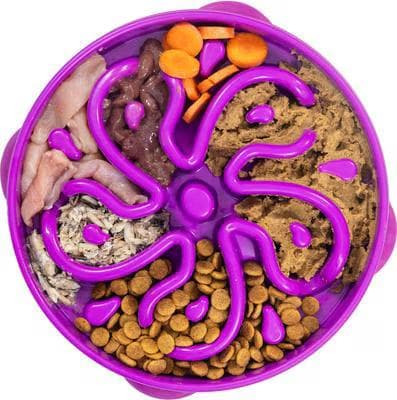
A maze-pattern slow-feeder bowl that makes fast eaters work for each bite, reducing the gulping and swallowed air that trigger regurgitation and vomiting. Holds up to 4 cups.
Petful may earn a commission when you click through to Chewy, at no extra cost to you.
The Outward Hound Fun Feeder is the bowl most people picture when they hear "slow feeder," and it earns that reputation. The raised, curvy ridges create a shallow maze that pushes kibble into channels your dog has to nose and lick around, and in our testing it reliably stretched a 15-second meal into three to five minutes for a medium dog on dry food. It comes in multiple sizes and several maze patterns (mini, regular, large), so you can dial the difficulty up or down to match how food-motivated your dog is.
What sets it apart from cheaper copies is the grippy foot ring on the base, which kept the bowl from sliding or flipping even when a determined Lab shoved it around the kitchen. It is made from food-safe plastic, holds up to four cups depending on size, and it is top-rack dishwasher safe, which matters more than you would think (see our cleaning section below). The one caveat: the tighter maze patterns can frustrate flat-faced dogs, so brachycephalic owners should size up to a wider channel or look at our ceramic pick.
Best for: Most dogs, especially medium and large fast eaters who need a proven, adjustable maze. Keep in mind: Plastic can scratch over years of heavy chewers; supervise dogs who try to eat the bowl.
Frisco Bone-Shaped Ridges Slow Feed Bowl (Best Budget)
Petful may earn a commission when you click through to Chewy, at no extra cost to you.
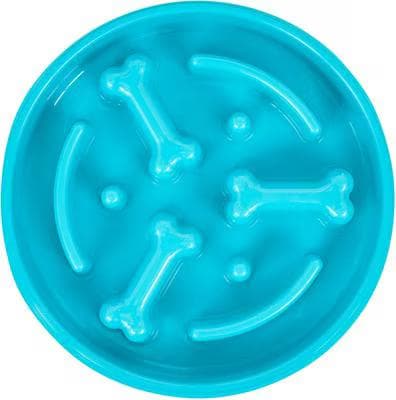
If you want to try a slow feeder without overthinking it, the Frisco bone-shaped bowl is the easiest yes. As Chewy's house brand, it usually lands around $10, and the raised bone-pattern ridges do the core job well: they break up a flat sheet of kibble into pockets so your dog cannot scoop a mouthful in one pass. The difficulty is gentler than the Outward Hound maze, which is actually a plus for beginners, seniors, and dogs who get discouraged by a hard puzzle and give up.
It is a lightweight bowl, so on slick floors it can travel a bit when an enthusiastic eater goes to work, and the ridge pattern is a touch easier to game than a true spiral. But for the price, it is a genuinely effective on-ramp to slower eating, and it is dishwasher safe. We would steer heavy gulpers or strong, food-obsessed dogs toward a more aggressive maze, but for the average dog who eats a little too fast, this is the value winner.
Best for: Budget-conscious owners and dogs new to slow feeding. Keep in mind: Lighter build slides on hard floors; consider a rubber mat underneath.
PawsPik Raised Ceramic Slow Feeder (Best for Flat-Faced Dogs and Elevated Feeding)
Petful may earn a commission when you click through to Chewy, at no extra cost to you.
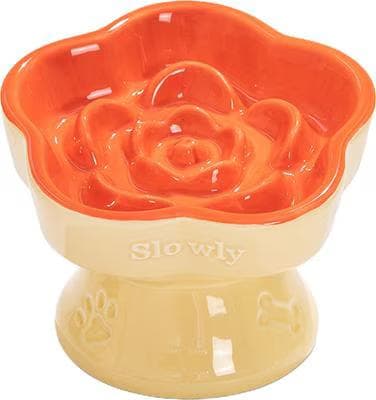
Most slow feeders are deep plastic bowls, which is exactly the wrong shape for a Pug, Bulldog, Boston Terrier, or any short-muzzled dog that cannot reach into narrow channels. The PawsPik raised ceramic feeder solves that with a shallower, wider maze set into a heavier ceramic body, and an elevated profile that can be gentler on the neck for some dogs. The wide, rounded ridges give a flat-faced dog something its short snout can actually work around, so it slows the meal without leaving half the food stranded and the dog frustrated.
Ceramic brings two more advantages: it is heavy enough that it stays put without a grip ring, and the glazed, non-porous surface resists the scratches and odor buildup that plague old plastic bowls. It is also simply nicer to look at on a kitchen floor. The trade-offs are real, though. Ceramic can chip or crack if dropped on tile, and at around $30 it is the priciest pick here. For a flat-faced dog, or an owner who wants a bowl that lasts and looks good, it is worth it.
Best for: Brachycephalic (flat-faced) breeds and owners who want elevated, hygienic feeding. Keep in mind: Can chip if dropped; heaviest and most expensive option.
Durapet Slow-Feed Stainless Steel Bowl (Best Stainless Steel)
Petful may earn a commission when you click through to Chewy, at no extra cost to you.
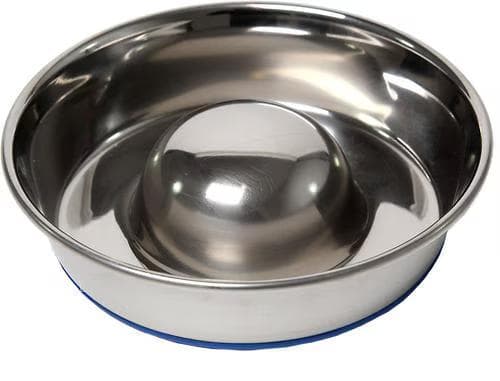
For owners who distrust plastic (chew damage, scratches that harbor bacteria, or "plastic chin" contact irritation), the Durapet slow-feed bowl delivers the maze-style slowdown in stainless steel. A raised center column and inner ridges create the obstacle course, while the stainless interior is the most hygienic surface of any material here: non-porous, does not hold odor, and stands up to years of daily use and dishwashing without degrading. Durapet's signature bonded rubber base ring is genuinely excellent, keeping the bowl planted on tile and hardwood better than almost anything else in this roundup.
Stainless does have limits as a slow-feeder material. The molded shapes cannot be as intricate as plastic or ceramic, so the maze is a bit less aggressive, and it is the wrong choice if your dog needs the hardest possible puzzle. It is also not microwave safe (irrelevant for kibble, worth noting for warmed food). But for durability, hygiene, and stability, this is the bowl that will still be in service in five years.
Best for: Owners prioritizing hygiene and longevity, and dogs with plastic sensitivities. Keep in mind: Milder maze than plastic mazes; not for extreme gulpers who need max difficulty.
JW Pet Skid Stop Slow Feeder (Best Value Maze)
Petful may earn a commission when you click through to Chewy, at no extra cost to you.
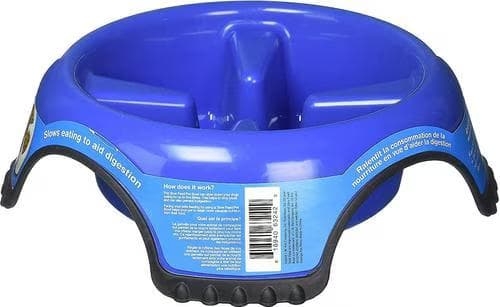
The JW Pet Skid Stop sits between the Frisco and the Outward Hound: a true spiral-and-ridge maze with real difficulty, usually around $12. The swirl pattern is tighter than the Frisco's bones, so it slows a determined eater more effectively, and it comes in several sizes and colors. In testing it did a solid job of turning a fast medium dog's meal into a genuine four-minute effort, and it worked with both dry kibble and (with a little more mess) wet food or a soaked topper.
Its base grip is decent but not class-leading, so on very slick floors a strong dog can still nudge it around; a feeding mat solves that. The plastic quality is good for the price but not premium, and like all tight mazes it is not ideal for flat-faced dogs. For a shopper who wants Outward Hound-style difficulty at a lower price and does not mind a slightly less refined bowl, the JW Pet Skid Stop is the value maze to beat.
Best for: Value shoppers who still want a challenging maze. Keep in mind: Grip and finish are good-not-great; not for brachycephalic dogs.
Why Fast Eating Is a Problem
It is easy to see a dog inhale dinner as harmless enthusiasm, but eating too fast carries real risks worth taking seriously. When a dog gulps food, it also swallows a lot of air. That swallowed air, combined with a stomach filling faster than it can signal fullness, leads to the most common short-term problems: gagging, coughing at the bowl, and regurgitation, where a dog brings food back up minutes after eating, often undigested and in a tube shape. Many owners assume their dog is sick when the real culprit is simply speed.
Fast eating can also blunt the "I am full" signal. It takes time for the stomach to tell the brain it has had enough, so a dog that empties the bowl in seconds may still feel hungry and beg, or gain weight over time from overeating. Slowing the meal gives satiety signals a chance to catch up.
The most serious concern is bloat, formally gastric dilatation-volvulus, or GDV. This is a life-threatening emergency in which the stomach fills with gas and can twist on itself, cutting off blood supply. It is most associated with large, deep-chested breeds such as Great Danes, Standard Poodles, Weimaraners, German Shepherds, and Boxers. It is important to be accurate here: eating quickly is considered one of several possible risk factors for bloat, not a proven direct cause, and the research is still evolving. A slow feeder is not a guaranteed shield against GDV. What we can say is that slowing a fast, air-gulping eater is a reasonable, low-cost precaution, and it is one many veterinarians suggest as part of a broader plan. For a deeper look at fast eating and bloat risk, see our guide on what to do when your dog eats too fast.
- If a large or deep-chested dog shows a swollen, hard belly, unproductive retching (trying to vomit with nothing coming up), drooling, restlessness, or collapse, treat it as an emergency and get to a vet immediately. GDV can be fatal within hours.
How Slow Feeder Bowls Work
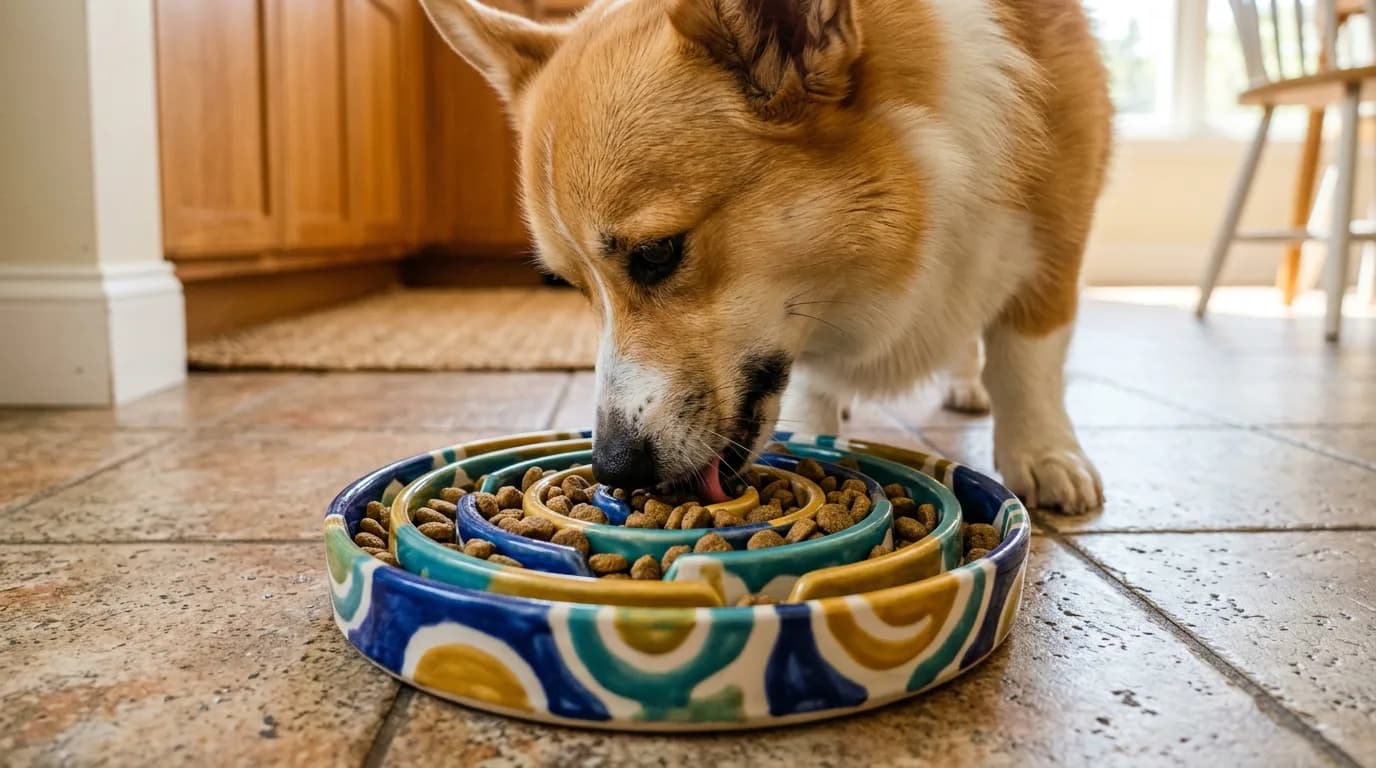
A slow feeder works by putting obstacles between your dog and the food. Instead of an open bowl your dog can scoop in one mouthful, a slow feeder is molded with raised ridges, walls, spirals, or a maze that divides the surface into small pockets and channels. Your dog has to nose, lick, and work its tongue around each barrier to get the kibble out, which physically prevents big, fast gulps and stretches the meal from seconds into minutes.
There is a mental component too. Navigating the maze turns eating into a light foraging puzzle, giving your dog a small dose of problem-solving and enrichment at every meal. That is part of why some owners notice a calmer, more satisfied dog after switching, beyond just the slower pace.
Choosing the right difficulty level
Different patterns create different difficulty levels. Gentle ridge or bone patterns (like the Frisco) offer a mild slowdown that suits beginners and seniors. Tighter spirals and true mazes (like the Outward Hound and JW Pet Skid Stop) are more challenging and better for strong, food-obsessed gulpers. The right amount of difficulty is the one that meaningfully slows your dog without frustrating it into giving up. If your dog quits and walks away hungry, the maze is too hard; ease off to a simpler pattern or a wider channel.
Slow feeders work with dry kibble, and most work with wet or soaked food too, though wet food is messier to clean out of tight grooves. You can also increase difficulty for free by wetting kibble so it sticks in the channels, or freezing wet food or a topper into the maze for a longer-lasting challenge.
Choosing a Material: Silicone vs Stainless Steel vs Plastic vs Ceramic
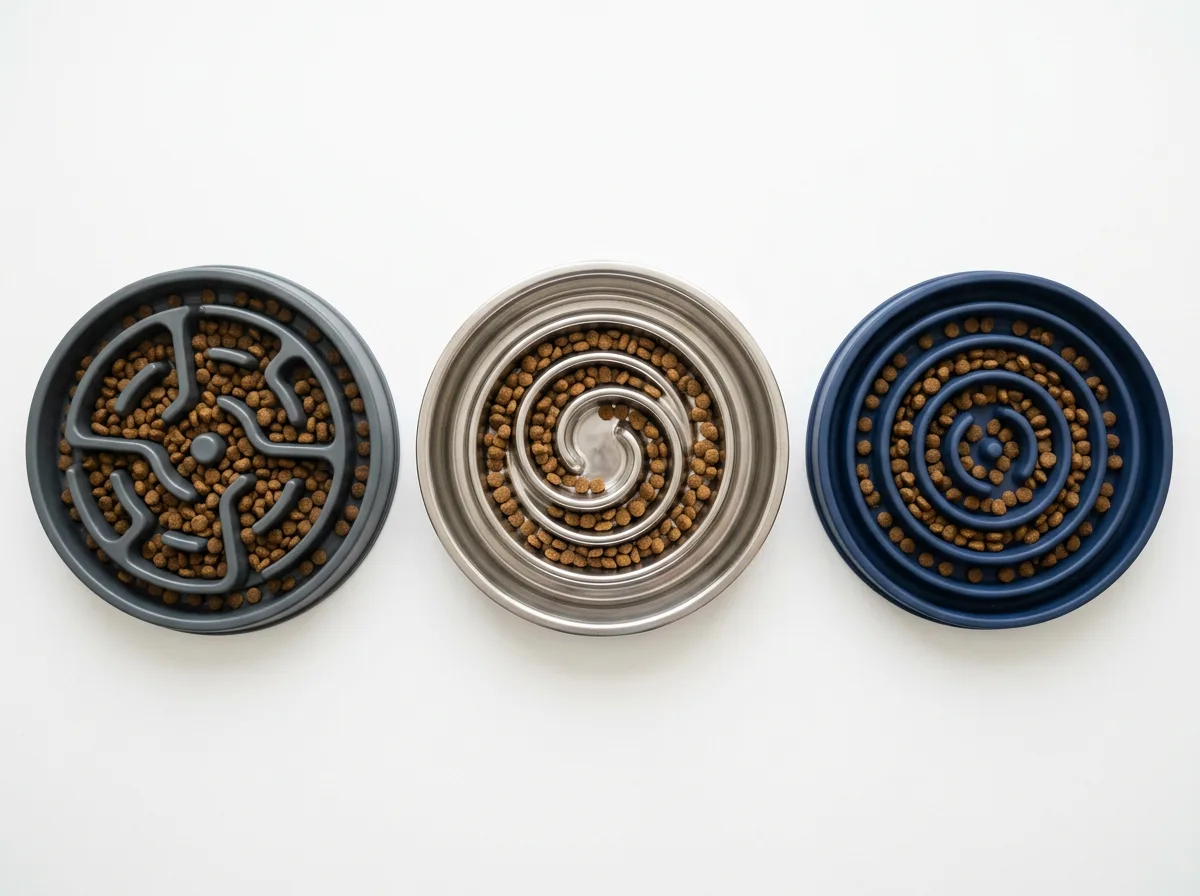
The material of a slow feeder affects durability, hygiene, stability, and price. Here is how the four common options compare.
- Plastic (food-safe): The most common and most affordable, and the material that allows the most intricate mazes, which is why the hardest-difficulty bowls are usually plastic. The downsides: cheaper plastic can scratch over time, and scratches can harbor bacteria and odor; some dogs chew plastic bowls; and a small number of dogs develop contact irritation on the chin ("plastic chin"). Buy food-safe, BPA-free plastic, replace it when it gets deeply scratched, and supervise chewers.
- Stainless steel: The most hygienic surface. It is non-porous, does not hold odor or bacteria, does not scratch meaningfully, and lasts for years of daily washing. It is a great pick for dogs with plastic sensitivities. The trade-off is that molded steel mazes cannot be as intricate as plastic, so the slowdown is a bit milder. Look for a bonded rubber base for stability.
- Ceramic: Heavy, stable, hygienic (glazed ceramic is non-porous), and the nicest looking. Its weight keeps it planted without a grip ring, and the wider, shallower shapes often suit flat-faced dogs. The catch: it can chip or crack if dropped, and it costs the most. A chipped ceramic bowl should be retired, since a chip can expose porous material or a sharp edge.
- Silicone: Less common as the whole bowl, but silicone slow-feeder inserts and mats exist and are flexible, easy to clean, and travel-friendly. Quality varies, and floppy silicone can be nudged around by a strong dog, so many are designed to drop into a firmer outer bowl. A good option for travel or as a low-cost insert.
- Want the hardest maze? Choose plastic. Want the most hygienic and longest-lasting? Choose stainless steel. Flat-faced dog or want it to look nice and stay put? Choose ceramic. Traveling? A silicone insert or mat packs flat.
Difficulty and Size by Breed and Snout Depth
The right slow feeder is not just about brand, it is about matching the bowl to your dog's mouth and eating style. Two variables matter most: size and maze difficulty.
- Size and capacity. The bowl needs to comfortably hold your dog's full meal with the maze in place, since the ridges take up volume. A too-small bowl overflows and defeats the purpose, while a cavernous bowl for a tiny dog just means unreachable food. Most bowls come in mini, regular, and large; match the capacity to your dog's portion, not just its body size. Toy breeds and puppies need shallow channels their small mouths and short tongues can reach.
- Snout depth and length. This is the variable most people overlook. A long-nosed dog (a Collie, a Greyhound, a Doberman) can reach into deep, narrow channels easily, so it can handle the most aggressive mazes. A dog with a shorter or wider muzzle needs shallower, wider channels. And a flat-faced dog needs a bowl practically designed for it (more on that next).
- Eating style. Match difficulty to how hard your dog gulps. A mild ridge bowl is plenty for a dog that is only a little fast; a committed inhaler needs a tight spiral. Start moderate and adjust. If your dog defeats the maze in under two minutes, go harder; if it gives up frustrated, go easier. The goal is a meal that takes several minutes, not one that turns dinner into a battle.
A quick word on puppies: slow feeders are fine for puppies eating kibble, but choose an age-appropriate, shallow, easy pattern so a young dog does not get discouraged, and always match the portion to the puppy's feeding chart.
Flat-Faced (Brachycephalic) Dogs: What to Look For
Flat-faced, or brachycephalic, breeds (Pugs, French Bulldogs, English Bulldogs, Boston Terriers, Boxers, Pekingese, Shih Tzus) are a special case, and most standard slow feeders are actively wrong for them. Their short muzzles and pushed-in faces cannot reach into the deep, narrow channels that a long-nosed dog navigates with ease. Put a Frenchie in front of a tight-maze plastic bowl and you often get a frustrated dog that gives up with food still stranded in the grooves, which is the opposite of what you want.
For these dogs, look for shallow, wide channels and rounded, spaced-out ridges rather than a deep, tight maze. The bowl should let a short snout and tongue actually work the food out. Elevated or raised designs can also help, since they bring the food up toward the dog and can make it easier to eat in a more comfortable posture. This is exactly why our ceramic pick, the PawsPik, is our brachycephalic recommendation: its wide, shallow, rounded maze is reachable, and its raised profile suits a flat-faced dog's mechanics.
It also matters that flat-faced breeds are among those that can struggle with breathing during effortful eating, so a bowl that is too hard, forcing prolonged, frantic work, is counterproductive. The goal for these dogs is a gentle, reachable slowdown, not a maximum-difficulty puzzle. When in doubt, size up the channel width and keep the difficulty moderate.
Cleaning and Hygiene
A slow feeder has far more surface area, grooves, and hidden corners than a plain bowl, which means food residue, saliva, and moisture collect in places you cannot see. Left uncleaned, those grooves grow a biofilm (a slimy bacterial layer) that is exactly what you do not want your dog eating from every day. Slow feeders need more diligent cleaning than a flat bowl, not less.
Wash the bowl after wet-food meals every time, and at least daily-to-every-few-days for dry kibble, sooner if you see any film. Most plastic, stainless, and ceramic slow feeders are top-rack dishwasher safe, which is the easiest way to get into the grooves; check the label. For handwashing, a bottle brush or an old toothbrush gets into the tight channels a sponge misses. Rinse thoroughly, and let the bowl dry fully before refilling, since trapped moisture accelerates bacterial growth.
- Retire and replace any bowl with deep scratches (plastic) or chips (ceramic). Damaged surfaces trap bacteria you cannot scrub out and can develop sharp edges. A cheap bowl replaced yearly is cheaper than a vet visit.
Are Slow Feeder Bowls Safe? When Not to Use One
For most dogs, slow feeder bowls are safe and beneficial, but they are not right for every dog or every situation, and it is worth knowing the exceptions.
Skip or rethink a slow feeder if your dog gets so frustrated it stops eating entirely or loses meaningful weight. Some anxious dogs find the puzzle stressful rather than enriching; if your dog is not eating enough, the bowl is doing harm, and you should switch to an easier pattern or a different method. Dogs with certain dental problems, mouth pain, or missing teeth may struggle to work a maze comfortably. Very young puppies, senior dogs, and dogs recovering from illness or surgery may need the simplest possible pattern or none at all while they recover.
Supervise dogs that chew their bowls. A determined chewer can break off and swallow pieces of plastic, which is a choking and obstruction hazard; for these dogs, stainless steel or ceramic is safer. And choose a quality, food-safe, BPA-free bowl from a reputable maker rather than the cheapest unbranded option, since material quality matters for a thing your dog mouths daily.
- Stop if your dog gets frustrated and loses weight, has dental pain or missing teeth, or is recovering from illness or surgery. A slow feeder is a tool for gulping, not a treatment for a medical problem.
Most importantly, remember what a slow feeder is and is not. It is a helpful tool to slow gulping and add enrichment. It is not a treatment for a medical problem. If your dog is vomiting repeatedly, losing weight, showing signs of pain, or you are worried about bloat risk in a deep-chested breed, a slow feeder is not a substitute for a conversation with your veterinarian.
Alternatives: Puzzle Feeders, Snuffle Mats, Muffin Tins
A slow feeder bowl is the simplest tool, but it is not the only way to slow a fast eater or add mealtime enrichment. Several alternatives work well, alone or in rotation.
- Puzzle feeders and food-dispensing toys make your dog manipulate a toy (slide, flip, roll, or nudge) to release kibble a little at a time. They slow eating and deliver more mental work than a bowl, which is great for high-energy or bored dogs. They take more setup and cleaning, and difficulty varies widely.
- Snuffle mats are fabric mats with dense fingers of fleece you scatter kibble into, so your dog has to sniff and forage to find each piece. They lean heavily on enrichment and tap into a dog's natural foraging instinct, and they are gentle enough for flat-faced dogs. The catch: they must be washed regularly and are not ideal for wet food.
- The muffin-tin trick is the free DIY option: spread your dog's kibble across the cups of a muffin tin so it can only get a few pieces at a time. It is a fine way to test whether slowing meals helps before you buy anything, though it is bulky and less durable than a purpose-built bowl.
Hand-feeding, portioning, and food puzzles you rotate all help too. Many owners land on a slow feeder bowl as the everyday default and keep a snuffle mat or puzzle toy for variety and rainy-day enrichment. If your bigger goal is managing the whole feeding routine, an automatic feeder can portion meals on a schedule; see our roundup of the best automatic dog feeders. And if you are weighing bowl materials more broadly, our guide to the best stainless steel dog bowls goes deeper on hygiene and durability.
Lick mats are another slow-down option, especially for wet food; see our picks for the best lick mats for dogs.
Frequently Asked Questions
Many veterinarians do suggest slow feeder bowls for dogs that eat too fast, gulp air, or regurgitate meals, and as one reasonable precaution for large, deep-chested breeds at higher bloat risk. They are seen as a simple, low-cost tool rather than a medical treatment, so a vet will typically recommend one as part of a broader plan, not as a cure. If your dog has ongoing digestive problems or you are worried about bloat, talk to your vet about whether a slow feeder fits alongside other steps.
Yes, for most dogs they work well. By forcing your dog to eat around ridges or a maze, a slow feeder physically prevents big fast gulps and typically stretches a meal from seconds into several minutes. The effect is most noticeable in enthusiastic, food-motivated eaters. The key is matching the maze difficulty to your dog: too easy and a determined dog games it quickly, too hard and the dog may give up.
For most dogs, yes. Slowing the meal can reduce gulping, air-swallowing, and the regurgitation that follows fast eating, and the maze adds light mental enrichment at every meal. They are not right for every dog, though: some anxious dogs find them stressful, dogs with dental pain may struggle, and chewers need a chew-safe material. They are a helpful tool, not a substitute for veterinary care when a dog has a real medical issue.
A slow feeder bowl with a ridge or maze design is the standard fix, and our best overall pick is the Outward Hound Fun Feeder Slo Bowl for its adjustable difficulty and grippy base. For flat-faced dogs, choose a shallow, wide-channel bowl like a raised ceramic feeder. For hygiene and durability, a stainless steel slow feeder is excellent. Match the size and maze difficulty to your dog's mouth and how hard it gulps.
The main downsides are harder cleaning (more grooves trap food and bacteria, so they need diligent washing), the risk of frustrating an anxious dog or one with dental pain, and poor fit for flat-faced breeds unless you choose a shallow, wide design. Cheap plastic can scratch and harbor bacteria, and chewers can break off and swallow pieces. Choosing the right material and difficulty avoids most of these problems.
They are safe for most dogs, but avoid or rethink one if your dog gets so frustrated it stops eating or loses weight, if it has dental problems or mouth pain that make working a maze difficult, or if it is a heavy chewer that might swallow plastic pieces (choose stainless or ceramic instead). Very young puppies, seniors, and dogs recovering from illness may need the simplest pattern or none at all. A slow feeder is not a treatment for vomiting, weight loss, or bloat risk, so see your vet if those are concerns.

Coreen Saito is a pet writer and longtime shelter volunteer with more than a decade in animal rescue. She covers cat behavior, breed care, and the small, ordinary science of sharing a life with companion animals, with a particular focus on honest takes about the products and decisions that actually matter. At home in Arizona, she's outranked by Mac (a dog with the loudest opinion in the house), Rebel (a cat who governs by quiet authority), and Meri (an orange tabby who runs the late shift and the laundry basket). She writes about all three, plus the rescues that keep coming through her life, at LifeWithMinty.com.
Sign up for expert-backed reviews and safety alerts all in one place.