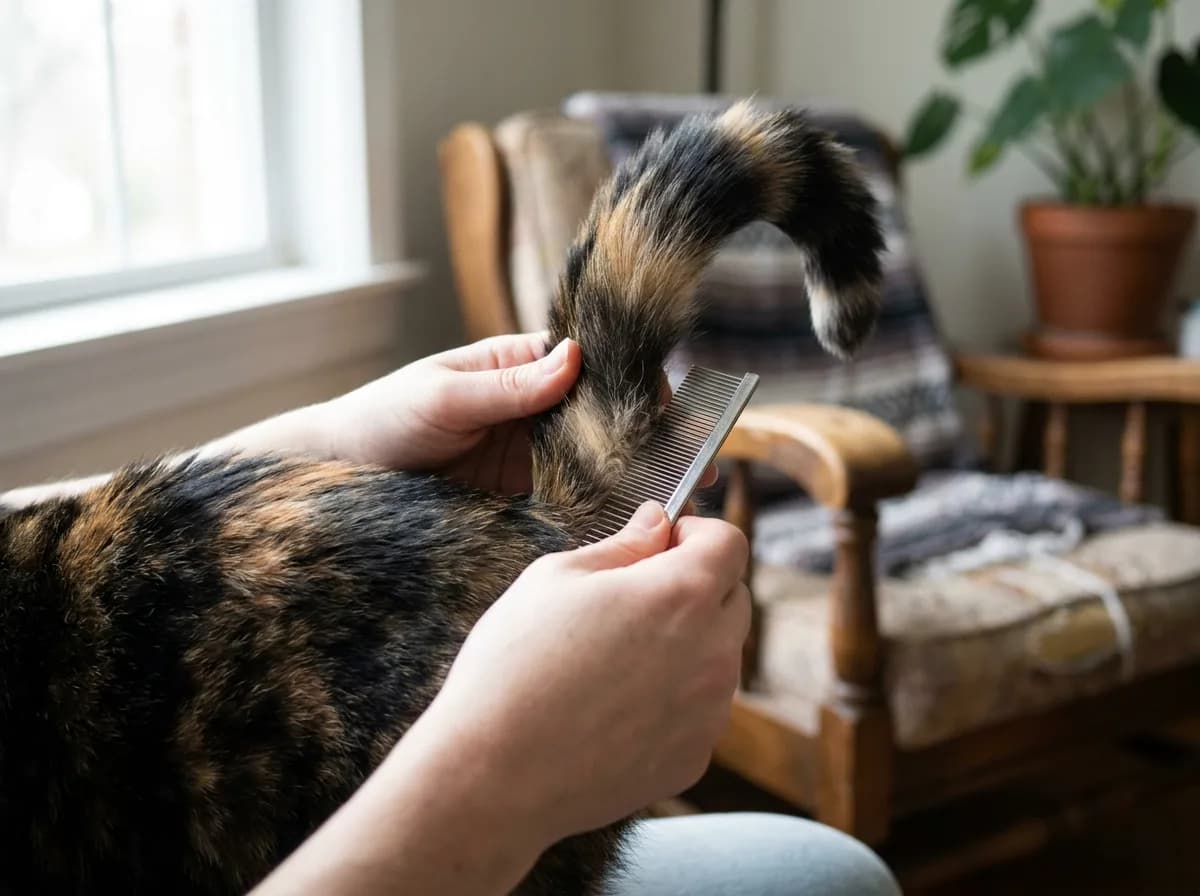
How Often Should I Feed My Cat? A Vet-Informed Feeding Guide
Wondering how often to feed a cat? Most healthy adult cats do best on two measured meals a day, about 10 to 12 hours apart, while kittens and seniors need different schedules. Here is how much to feed by life stage, weight, and food type.
Petful is reader supported. As an affiliate of platforms like Amazon and Chewy, we may earn a commission when you buy through links on this page. There is no extra cost to you.
If you have ever stood over the food bowl at 6 a.m. wondering how often should I feed my cat, here is the short answer: most healthy adult cats do best on two measured meals a day, spaced roughly 10 to 12 hours apart. That simple rhythm covers the majority of cats, but the right schedule shifts with life stage, weight, health, and whether you feed wet food, dry food, or a mix of both.
This guide walks through how often to feed a cat by age, how much food a cat actually needs, the wet-versus-dry question, why scheduled feeding usually beats leaving food out all day, and the warning signs that you are over- or underfeeding. Feeding is one of those everyday routines where small habits add up: get the portions and timing right and you make weight control, litter-box regularity, and long-term health a lot easier. Because your cat's ideal amount depends on their food's calorie density and their target weight, treat every number here as a starting range and confirm the specifics with your veterinarian.
- 1Most adult cats do well on two measured meals a day, about 10 to 12 hours apart
- 2Portion size depends on your food's calories-per-cup and your cat's healthy target weight, not a one-size-fits-all cup measurement
- 3Scheduled meals beat free-feeding for weight control, and your vet is the final word on how much your specific cat should eat

Sign up for expert-backed reviews and safety alerts all in one place.
How Often to Feed a Cat by Life Stage
Cats are not one animal at every age. A growing kitten burns through energy at a rate an older cat never will, so meal frequency should track with life stage. The AAHA/AAFP feline life-stage guidelines group cats into kitten, young adult, mature adult, and senior phases, and each phase has different feeding rhythms. Here is a practical breakdown.
Kittens (under 6 months)
Kittens grow fast and have tiny stomachs, so they need calorie-dense food delivered in small, frequent servings. Most kittens under six months do best on three to four meals a day. Very young kittens who have just been weaned may start at four or more small meals and taper down as they grow. Kittens should eat a diet formulated for growth (look for an AAFCO statement for "growth" or "all life stages" on the label), because adult maintenance food does not supply the extra protein, fat, and minerals a developing kitten needs. Cornell Feline Health Center notes that proper early nutrition sets the foundation for a cat's lifelong health, so this is not a stage to improvise.
Junior cats (6 to 12 months)
As kittens approach their first birthday, growth slows and you can begin consolidating meals. Most junior cats settle comfortably into two to three meals a day. This is also the window where many owners transition from kitten food to adult food, usually around the 12-month mark for most breeds (large breeds like Maine Coons can stay on growth food longer). Make any diet transition gradually over 7 to 10 days to avoid an upset stomach.
Adult cats (1 to 7 years)
For the typical healthy adult cat, two meals a day is the sweet spot: one in the morning and one in the evening, roughly 10 to 12 hours apart. This mirrors a cat's natural preference for eating several small-to-moderate meals rather than one large one, while still giving you the portion control that free-feeding lacks. VCA Animal Hospitals supports twice-daily scheduled feeding for most adult cats as a sound default. If your cat is highly active, pregnant, or nursing, or if your vet has flagged a specific condition, that number may change.
Senior cats (7 years and older)
Older cats often benefit from two to three smaller meals a day. Aging can bring dental issues, reduced appetite, or medical conditions (kidney disease, hyperthyroidism, diabetes) that change how much and how often a cat should eat. Some seniors lose weight and need calories spread across more frequent meals; others gain weight as they slow down and need tighter portion control. Because senior nutrition is so individual, this is the life stage where a veterinary check-in matters most before you set a routine.
How Much Should You Feed a Cat?
This is the question that trips up most owners, and it is where the internet's tidy "give your cat X cups" answers fall apart. The honest answer: the right amount depends on your cat's calorie needs and the calorie density of the specific food you buy. Two dry foods can differ by hundreds of calories per cup, so a portion that is correct for one brand can be far too much or too little for another.
Daily calorie needs are driven by a cat's healthy target weight, age, activity level, and whether they are spayed or neutered. As a rough planning range, many indoor adult cats need somewhere in the neighborhood of 180 to 280 calories per day, but leaner or very active cats may need more and cats on a weight-loss plan need less. Use the numbers below as a starting range only, then refine using your food label and your vet's guidance.
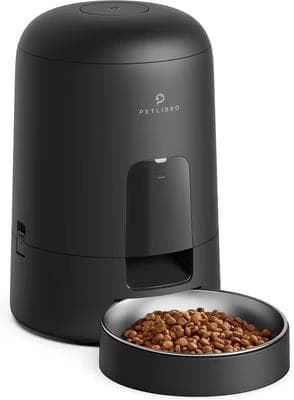
- Petlibro Granary Wi-Fi Camera: Best Camera
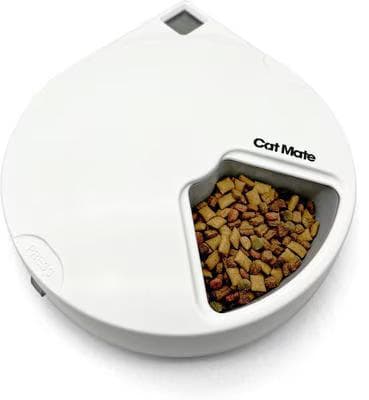
- Cat Mate C500 5-Meal: Best for Wet Food
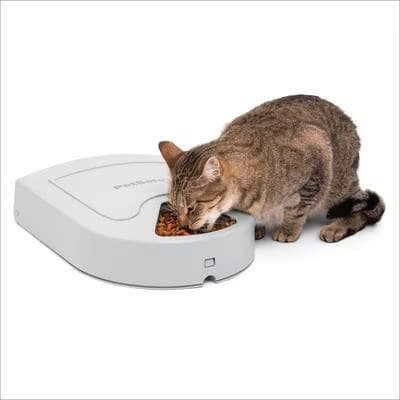
- PetSafe Eatwell 5-Meal: Best Multi-Meal
- Petlibro Air: Best Budget
| Cat Weight | Approx Daily Calories | Rough Portion Guidance |
|---|---|---|
| 5 lb (lean/small adult) | 150 to 200 kcal | Divide across 2 meals; use label kcal/cup to convert |
| 8 to 10 lb (typical adult) | 200 to 280 kcal | Divide across 2 meals; most common adult range |
| 12 to 15 lb (large or over-target) | 250 to 350 kcal | Often a weight-management target, not maintenance; ask your vet |
| Kitten (growing) | Higher per pound than adults | Spread across 3 to 4 meals on a growth-formula food |
| Senior (7+) | Varies widely with health | 2 to 3 smaller meals; individualize with your vet |
How to turn calories into a real portion (the kcal-per-cup math)
Every complete cat food lists a calorie content statement, usually as kilocalories (kcal) per cup for dry food or kcal per can for wet. That number is your conversion key. The math is simple:
Daily portion = your cat's daily calorie target divided by the food's kcal per cup (or per can).
- 1Find the kcal-per-cup or kcal-per-can number on your food label
- 2Divide your cat's daily calorie target by that number for the daily amount
- 3Split that amount across the day's scheduled meals
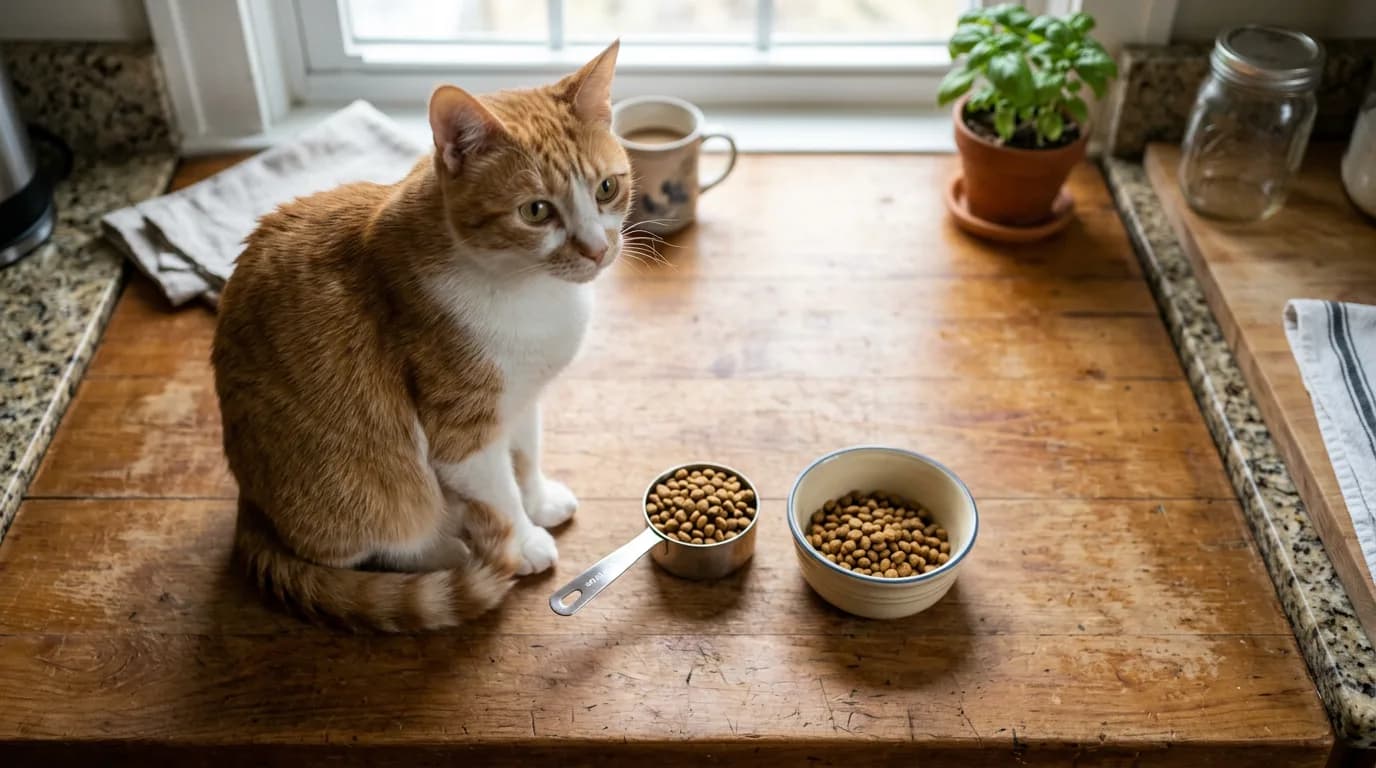
For example, if your vet sets a target of 240 calories a day and your dry food provides 400 kcal per cup, your cat needs about 0.6 cups per day, or roughly 0.3 cups per meal across two meals. Swap in a richer food at 500 kcal per cup and the same cat needs less: about 0.48 cups a day. That is exactly why you should never copy a neighbor's "half a cup twice a day" without checking your own label. Measure with an actual measuring cup, not a coffee mug or a guess, because eyeballing is one of the most common causes of slow weight gain in indoor cats.
If your food's bag also prints a feeding chart, use it as a cross-check rather than gospel: those charts are generous by design and often assume an intact, active cat. When in doubt, start at the lower end of the range, weigh your cat monthly, and adjust.
Wet Food vs Dry Food vs Combination Feeding
How often and how much you feed also interacts with what you feed. Each format has trade-offs.
Dry food (kibble) is convenient, shelf-stable, and easy to portion and to use in automatic feeders and food puzzles. Its downsides are lower moisture content and higher calorie density, which makes overfeeding easier if you free-feed. Cats evolved as desert animals with a low thirst drive, so a diet that is all dry food puts more of the hydration burden on the water bowl.
Wet food (canned or pouch) brings a big hydration advantage (it is roughly 70 to 80 percent water) and tends to be more filling per calorie, which can help with weight control and urinary health. The trade-offs are cost, spoilage once opened, and the fact that it cannot sit out all day. Wet food is best served in scheduled meals and refrigerated between servings.
- Look for a complete-and-balanced AAFCO statement for your cat's life stage, and switch foods gradually over 7 to 10 days to avoid stomach upset.
Combination feeding blends the two: a measured wet meal plus a measured portion of dry, or wet in the morning and dry in the evening. Many owners land here because it captures the hydration and satiety benefits of wet food alongside the convenience of dry. The key discipline with any combination plan is to count the calories from both so the totals still add up to your cat's daily target. It is easy to feed a "full" portion of each and accidentally double your cat's intake.
Whatever format you choose, look for a complete-and-balanced AAFCO statement on the label for your cat's life stage, and make any switch gradually. If your cat has a medical condition, defer to your veterinarian, who may prescribe a therapeutic diet that overrides these general preferences.
Free-Feeding vs Scheduled Feeding
Free-feeding means leaving food (almost always dry) available around the clock so the cat grazes at will. Scheduled feeding (also called meal feeding or portion feeding) means offering measured amounts at set times and picking the bowl up in between. For most cats, scheduled feeding wins, and here is why.
Free-feeding makes portion control nearly impossible. You cannot easily tell how much a cat ate, when, or whether one cat in a multi-cat home is hogging the bowl. Constant access is strongly associated with steady weight gain, and feline obesity is one of the most common preventable health problems veterinarians see. Scheduled meals let you measure exactly what goes in, spot appetite changes early (a cat who suddenly skips a meal is easier to notice), and manage multi-cat households where one cat needs a different diet.
- 1Measured meals keep portions and calories under control
- 2A skipped meal is easy to notice early
- 3Works in multi-cat homes where one cat needs a different diet
Scheduled feeding also fits a cat's biology. Cats are natural small-meal hunters, and set mealtimes satisfy that pattern while keeping you in control of the totals. There are narrow exceptions: some kittens, some underweight or recovering cats, or cats on veterinary advice may do better with more constant access. But as a default for a healthy adult, two measured meals on a schedule is the approach most veterinary sources recommend for weight and health management.
The one honest challenge with scheduled feeding is logistics: work, travel, and early-morning wake-up calls from a hungry cat. That is exactly the gap an automatic feeder is built to close.
Using an Automatic Feeder to Keep the Schedule
An automatic feeder is the simplest way to hold a consistent two-meal rhythm even when your own schedule is anything but consistent. Programmable feeders dispense a pre-set portion at set times, which does two things at once: it protects your cat's calorie total from "just one more scoop" drift, and it keeps mealtimes steady whether you are asleep, at work, or traveling for a night. For a cat who yowls for a 5 a.m. breakfast, moving that first meal to a machine can also save your sanity.

Petful may earn a commission when you click through to Chewy, at no extra cost to you.
For dry food, a hopper-style timed feeder handles multiple meals a day and portions each one for you. If you feed wet food or a combination plan, a chilled or ice-pack wet-food feeder keeps canned meals fresh on a schedule, so wet food no longer has to mean being home at exactly the right hour. Either way, the feeder enforces the portion discipline that makes scheduled feeding work.
Petful may earn a commission when you click through to Chewy, at no extra cost to you.
Petful may earn a commission when you click through to Chewy, at no extra cost to you.
If you are weighing your options, our guide to the best automatic cat feeders breaks down timed hopper feeders, gravity feeders, and app-connected models by how well they hold a portion and a schedule. For canned and combination feeders, see our roundup of the best automatic wet food cat feeders.
Petful may earn a commission when you click through to Chewy, at no extra cost to you.
- When you set up an automatic feeder, calculate the per-meal portion from your food's calories-per-cup first, then program that exact amount into each scheduled meal. A feeder only helps with weight control if the portion you load is the right size to begin with.
Signs You're Overfeeding or Underfeeding
The scale tells part of the story, but the most useful everyday tool is the body condition score (BCS), a hands-on 9-point (or 5-point) system that veterinarians and the WSAVA body-condition tools use to judge whether a cat is at a healthy weight. You can do a rough version at home.
Signs you may be overfeeding:
- You cannot easily feel the ribs under a light layer of fat.
- The waist has disappeared when you look down from above; the body looks oval or round.
- A pronounced belly pad that sways when the cat walks (beyond the normal primordial pouch).
- Steady weight gain month over month, or a food bowl that empties faster than the schedule.
Signs you may be underfeeding:
- Ribs, spine, and hip bones are sharply visible or feel prominent with almost no cover.
- A very tucked, gaunt abdomen and obvious loss of muscle over the shoulders and back.
- Persistent food-seeking, low energy, or a dull coat.
Aim for the middle: ribs you can feel with a light press (like the back of your hand), a visible waist behind the ribs when viewed from above, and a level topline. If your cat is drifting off target in either direction, adjust the portion by a small amount (often 10 percent), hold it for a few weeks, and re-check. Do not crash-diet a cat: rapid weight loss in cats, especially overweight ones, can trigger a serious liver condition called hepatic lipidosis. Any real weight-loss plan should be built with your vet.
When to Call Your Vet
General feeding guidance covers healthy cats, but feeding is also one of the first places health problems show up. Because this is your cat's wellbeing, treat the ranges in this article as a starting point and let your veterinarian set the final plan, especially if anything below applies.
- Contact your veterinarian if your cat refuses food for more than 24 hours, is vomiting or has diarrhea, is losing or gaining weight without a change in feeding, is suddenly ravenous or unusually thirsty, or is straining or unable to keep food down. A cat who stops eating entirely is an urgent concern, since even a day or two without food can lead to serious liver problems, particularly in overweight cats.
Also loop in your vet before making big feeding decisions: choosing a diet for a kitten or senior, setting a weight-loss plan, managing a diagnosed condition (kidney disease, diabetes, hyperthyroidism, urinary issues), or transitioning between food types. Your veterinarian can set an accurate calorie target, recommend a therapeutic diet if needed, and calculate the exact portion for your cat's food and body condition. Cornell Feline Health Center and VCA Animal Hospitals both emphasize that individualized, vet-guided nutrition is the safest path, and this guide is meant to support that conversation, not replace it.
Frequently Asked Questions
Adjusting Portions for Weight, Activity, and Treats
The feeding ranges above are a starting point, not a fixed rule, because two cats of the same weight can have very different calorie needs. An active young cat that plays hard burns more than a sedentary senior, and an indoor-only cat generally needs fewer calories than one with outdoor access. Use your cat’s body condition, not just the scale, to fine-tune: if you cannot easily feel the ribs, cut back gradually, and if the ribs and spine feel sharp, feed a little more and check with your vet.
Treats are the most common hidden source of weight gain. A good habit is the 10 percent rule: treats, dental chews, and table scraps together should make up no more than about 10 percent of your cat’s daily calories, and you should subtract those calories from meals rather than adding them on top. A few extra treats a day may sound harmless, but for a small animal they add up quickly.
Finally, revisit portions whenever your cat’s life changes. Spaying or neutering, a move to indoor-only living, a new health condition, or simply getting older all shift calorie needs, so treat your feeding amount as something to review a few times a year rather than set once and forget.
The 3-3-3 rule is an adjustment timeline for a newly adopted cat, not a feeding schedule. It describes roughly 3 days for the cat to decompress and feel safe, 3 weeks to start settling into your home and routine, and 3 months to feel fully at home and bonded. During the first few days especially, keep feeding calm and consistent (a quiet space, a predictable mealtime, and the food they were already eating) to reduce stress while they adjust.
For most adult cats, one full cup of dry food a day is likely too much. Many indoor adult cats need only about half a cup or less per day, depending on the food's calories-per-cup and the cat's target weight. Because dry foods vary widely in calorie density, check your bag's kcal-per-cup and divide your cat's daily calorie target by that number rather than defaulting to a cup. Confirm the right amount with your vet.
Two meals a day is the better default for most cats because it fits their preference for smaller, more frequent meals and helps with weight control. Some healthy adult cats can do fine on one larger meal, but once-a-day feeding leaves a long stretch without food and can worsen begging or overeating. Kittens, seniors, and cats with health conditions generally should not be fed only once a day. Ask your vet before settling on a single daily meal.
Feed to your cat's daily calorie target, not a fixed cup amount. Many indoor adult cats need roughly 180 to 280 calories a day, but the exact number depends on target weight, age, and activity. Find your food's calories-per-cup (or per can) on the label, divide the daily target by that figure to get the total portion, then split it across two meals. Your veterinarian can set the precise target for your cat.
A cups chart can only ever be a rough starting point, because two dry foods can differ by hundreds of calories per cup. As a rough guide, many adult cats land somewhere around one-third to one-half cup of dry food per day total, split into two meals, but the accurate portion comes from dividing your cat's daily calorie target by your specific food's kcal-per-cup. Use the feeding chart above as a range, measure with a real measuring cup, and confirm with your vet.
Yes. For most healthy adult cats, two measured meals a day, spaced about 10 to 12 hours apart, is the recommended default and is plenty. Kittens need more frequent meals (3 to 4 a day), and some seniors or cats with medical needs do better with 2 to 3 smaller meals, but two meals a day works well for the typical adult cat.
Some cats self-regulate and stop when full, but many do not, especially with free access to tasty, calorie-dense dry food. Boredom, habit, and highly palatable food can all drive a cat to eat past the point of need, which is why free-feeding is linked to weight gain. Do not rely on your cat to self-limit. Offer measured portions on a schedule and let the bowl, not the cat's appetite, set the amount.

Coreen Saito is a pet writer and longtime shelter volunteer with more than a decade in animal rescue. She covers cat behavior, breed care, and the small, ordinary science of sharing a life with companion animals, with a particular focus on honest takes about the products and decisions that actually matter. At home in Arizona, she's outranked by Mac (a dog with the loudest opinion in the house), Rebel (a cat who governs by quiet authority), and Meri (an orange tabby who runs the late shift and the laundry basket). She writes about all three, plus the rescues that keep coming through her life, at LifeWithMinty.com.
Sign up for expert-backed reviews and safety alerts all in one place.