The Best Microchip Cat Feeders of 2026 for Multi-Cat Homes
A microchip cat feeder reads your cat's ID chip or collar tag and opens only for the right cat, ending food theft in multi-cat homes. We compare four Chewy picks (SureFeed, Petlibro One RFID, PawsPik, Closer Pets MiBowl) plus a non-chip option.
Petful is reader supported. As an affiliate of platforms like Amazon and Chewy, we may earn a commission when you buy through links on this page. There is no extra cost to you.
The best microchip cat feeder solves a problem every multi-cat household knows too well: the food thief. If you have one cat on a prescription diet, a senior who eats slowly, or a "grazer" whose bowl gets raided by a greedy housemate, a microchip feeder is the single most reliable way to guarantee that the right food reaches the right cat. These feeders read the ID microchip already implanted in your cat (or a small collar tag you clip on) and open the lid only for that specific animal, then seal shut again the moment your cat walks away. After comparing the leading models across single-cat and multi-cat setups, our top overall pick is the SureFeed Microchip Pet Feeder for its bulletproof reliability, with strong runner-ups for smart-app control, premium multi-cat homes, and budget shoppers.
Below, we break down how these feeders actually work, how to choose between a single-cat and multi-cat setup, our four top picks you can buy on Chewy today, a head-to-head comparison, the collar-tag option for cats that are not microchipped, what vets say about safety, and a full troubleshooting guide for the two problems that trip up new owners: a lid that will not open and a determined food thief.
- 1A microchip cat feeder reads your cat's existing implanted ID chip (or a clip-on RFID collar tag) and opens only for that cat, ending food theft in multi-cat homes.
- 2Our best overall pick is the SureFeed Microchip Pet Feeder (~$170); the Petlibro One RFID adds app control, PawsPik suits premium multi-cat homes, and the Closer Pets MiBowl is the value choice.
- 3These feeders read an existing chip and never implant one, so they are safe, non-invasive, and vet-endorsed for weight control and prescription-diet management.
- 4For cats without a microchip, the Cat Mate C500 timed feeder (with an optional collar-tag reader) is the best non-chip alternative.

Sign up for expert-backed reviews and safety alerts all in one place.
At a Glance
Here is how our four Chewy-purchasable picks compare at a glance, plus the non-microchip alternative for cats that are not chipped. Prices are approximate and shift with sales.
- SureFeed Microchip Pet Feeder: Best Overall
- Petlibro One RFID Cat Feeder: Best Smart RFID
- PawsPik Microchip RFID Feeder: Best Premium
- Closer Pets MiBowl: Best Value
- Cat Mate C500: Best Non-Microchip
| Feeder | Best For | Approx. Price |
|---|---|---|
| SureFeed Microchip Pet Feeder | Overall best, reliability | $170 |
| Petlibro One RFID Cat Feeder | Smart app control | $140 |
| PawsPik Automatic Microchip RFID Feeder | Premium multi-cat homes | $250 |
| Closer Pets MiBowl CP500 | Value microchip bowl | $130 |
| Cat Mate C500 (non-microchip) | Non-chipped cats, portion timing | $60 |
How Microchip and RFID Cat Feeders Work
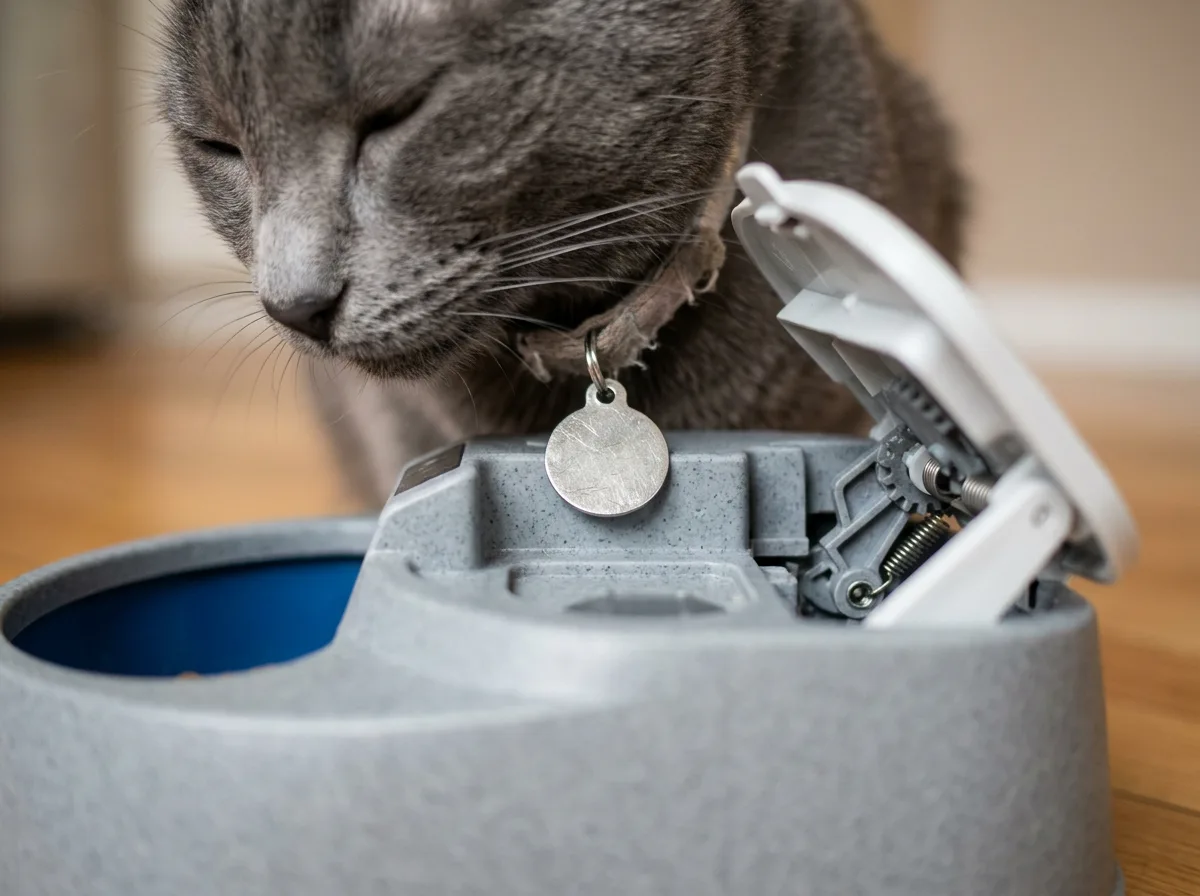
A microchip cat feeder is a bowl with a motorized lid and a small antenna built into the base. When a cat approaches, the antenna scans for a nearby ID. If the ID it reads matches one you have programmed into the feeder's memory, a servo motor slides or lifts the lid open. When the cat steps back and the ID moves out of range, the lid closes and locks. That is the entire mechanism, and its beauty is that it uses technology your cat is already carrying.
There are two ways the feeder can identify your cat, and understanding the difference is the key to buying the right one.
- Reading the implanted microchip. Nearly every cat adopted from a shelter or seen by a vet already has a pet ID microchip: a rice-grain-sized RFID transponder implanted between the shoulder blades, used to reunite lost pets with owners. A microchip feeder reads that same chip. This is the gold-standard approach because there is nothing extra for your cat to wear, nothing to fall off, and nothing to lose. Feeders in this category read the common 15-digit FDX-B chips (and most also read the older 10-digit and 9-digit HDX and FDX-A formats) used across North America, the UK, Europe, and Australia. If you are not sure whether your cat is chipped or what number it carries, any vet can scan your cat in under a minute for free. Learn more about the basics in our guide to microchipping your cat.
- Reading a collar-tag (RFID) instead. If your cat is not microchipped, or if the implanted chip sits too deep to scan reliably, most of these feeders ship with (or offer) a small lightweight RFID tag that clips to your cat's collar. The feeder reads that tag exactly the way it would read an implanted chip. The trade-off: a collar tag can be lost, and a collarless indoor cat gains nothing from a chip-only unit. That is why we call out which of our picks include a collar-tag option.
What is the difference between "microchip" and "RFID" feeders? In practice, none: a pet microchip *is* an RFID transponder, so every microchip feeder is an RFID feeder. Marketing muddies this. Some brands say "microchip" to signal they read the implanted chip, and "RFID" to signal they use a collar tag, but the underlying radio technology is identical. The distinction that matters to you is chip-reading vs. collar-tag-reading, and the best units do both.
What are the different types of microchip cat feeders? They fall into three buckets. First, sealed selective bowls like the SureFeed and Closer Pets MiBowl: a single lidded bowl that opens for an authorized cat. These are the most reliable for food theft because the lid physically seals. Second, smart app-connected RFID feeders like the Petlibro One: these add Wi-Fi, scheduled portions, and phone alerts on top of the selective lid. Third, hopper-fed automatic microchip feeders like the PawsPik: a gravity or auger hopper dispenses fresh kibble into a selective bowl on a schedule, combining portion control with theft prevention for homes that want both. A fourth, related category is the timed non-microchip feeder (the Cat Mate C500), which does not read any ID and instead uses a rotating lid on a timer, covered in its own section below.
Single-Cat vs Multi-Cat: Which Setup You Need
The number of cats in your home, and whether they eat different foods, decides everything.
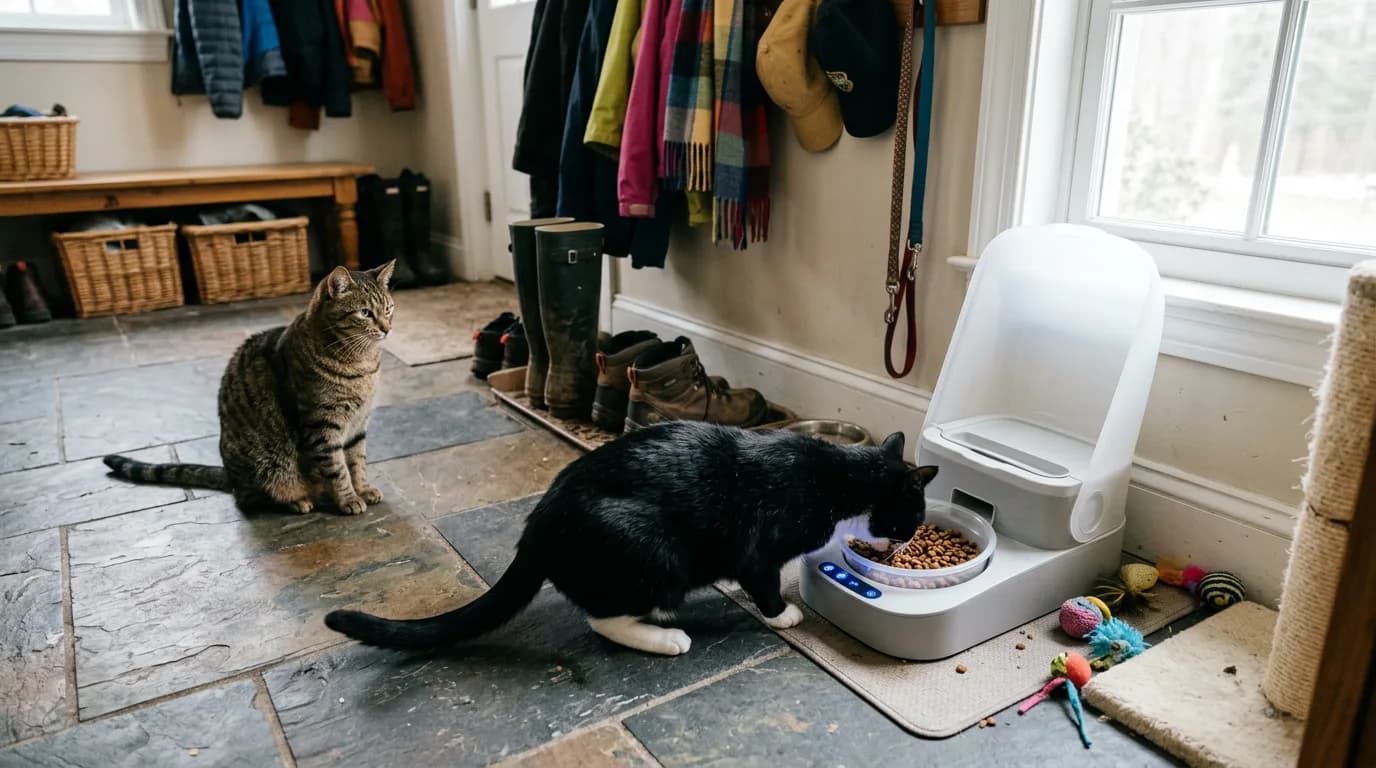
If you have one cat, a microchip feeder still earns its keep in three situations: keeping ants, flies, and other pets out of wet food that would otherwise sit exposed; slowing down a fast eater when paired with a slow-feed insert; and protecting a prescription or weight-management diet from a dog or a second pet. A single sealed bowl like the SureFeed is plenty.
- If two cats eat different food, you need two feeders, one keyed to each cat. Cats that eat the same food can safely share a single feeder programmed to recognize both.
If you have two or more cats on different diets, this is the exact problem microchip feeders were built for. The rule is one feeder per cat that needs protection. Can two cats share a microchip feeder? Yes, in one narrow sense: a single feeder can be programmed to recognize several cats' chips, so if two housemates eat the same food and you only need to keep a dog or a third cat out, one unit programmed for both works fine. How many cats can use one microchip feeder? Most units store multiple IDs; the SureFeed holds up to 32 chips, the Petlibro and PawsPik store several, and the Closer Pets MiBowl holds up to eight. But if two cats eat *different* food, you need two feeders, one keyed to each cat, because a shared bowl cannot serve two different meals. Space them apart so a bolder cat cannot loom over the shier cat's station.
Do microchip feeders work with wet food? Yes, and this is a major reason to buy one. Sealed selective bowls are the best wet-food solution on the market because the lid keeps the food fresh, blocks flies, and stops a second cat from stealing it. Most include a sealed inner bowl and a foam mat that reduces the tiny air gap around the closed lid to keep wet food fresher for hours. Hopper-fed units like the PawsPik are primarily for dry kibble; if wet food matters most, choose a sealed-bowl unit (SureFeed, Closer Pets MiBowl) over a hopper. For more, see Petful’s guide to automatic cat feeder for wet food.
The Best Microchip Cat Feeders
We compared each of these on the specs and owner feedback that matter most in a multi-cat home: reliability with implanted-chip and collar-tag cats, how they handle dry and wet food, and how well they resist a determined food thief. Here are the four we recommend, highest value first.
1. SureFeed Microchip Pet Feeder - Best Overall
Petful may earn a commission when you click through to Chewy, at no extra cost to you.
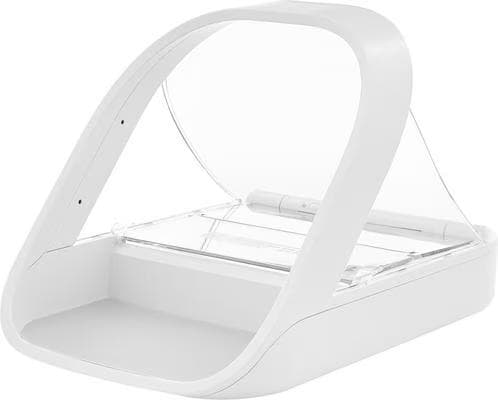
The SureFeed (made by Sure Petcare, the same company behind SureFlap microchip cat doors) is the feeder we recommend to almost everyone. It is a single sealed bowl with a lid that glides open silently the instant an authorized cat leans in, and closes with a soft, reassuring motion when the cat steps away. In testing it read implanted 15-digit chips from the very first scan, stored up to 32 pets, and never once let our resident food thief in. The sealed inner bowl and included foam mat kept wet food noticeably fresher than an open dish, and cleanup is genuinely easy because the bowl and mat are dishwasher-safe (the base is not, and must be wiped only). It runs on four C batteries that last months, so there is no cord for a cat to knock loose. It is not app-connected and does not portion or schedule meals; it is a selective bowl, and it does that one job better than anything else.
- Flawless chip-reading in testing, near-silent lid, 32-pet memory, excellent for wet food, dishwasher-safe bowl and mat, no cords, months of battery life, includes a collar-tag option (SureSense RFID tag) for non-chipped cats
- No scheduling or portioning (it is a bowl, not a dispenser), no app, and the C batteries are a recurring cost
- Cats that are wary of moving lids need the built-in training mode to acclimate
Verdict: If you want the single most reliable way to end food theft and protect wet or prescription food, buy the SureFeed. It is our overall best microchip cat feeder.
2. Petlibro One RFID Cat Feeder - Best Smart/App RFID
Petful may earn a commission when you click through to Chewy, at no extra cost to you.
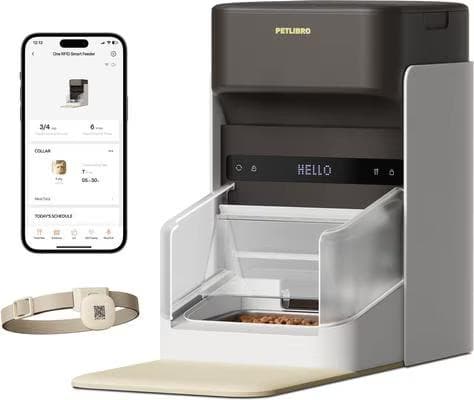
The Petlibro One RFID is the pick for owners who want selective feeding *and* the control of a smart feeder. On top of the RFID lid that opens only for a tagged cat, it connects to the Petlibro app over Wi-Fi so you can schedule portions, get low-food and lid-jam alerts on your phone, and watch feeding logs to catch a cat who is eating too much or too little. In testing the collar tag read reliably and the app was stable, with scheduled meals dispensing on time. It is the best choice if you travel and want to confirm from your phone that your cat actually ate. The trade-offs versus the SureFeed: it leans on a collar tag rather than reading the deep implanted chip on every unit, and a Wi-Fi feeder has more to go wrong than a simple battery bowl.
- App scheduling and portion control, phone alerts, feeding history, selective RFID lid, great for travelers and remote monitoring, competitive price for a smart selective feeder
- Relies on the collar RFID tag (which can be lost), needs Wi-Fi and the app, and has more failure points than a mechanical sealed bowl
- App-connected feeders occasionally need re-pairing after a router change
Verdict: The best microchip/RFID cat feeder for anyone who wants smart-feeder features on top of theft protection. Choose it over the SureFeed if app control and scheduling matter more than absolute mechanical simplicity.
3. PawsPik Automatic Microchip RFID Feeder - Best Premium Multi-Cat
Petful may earn a commission when you click through to Chewy, at no extra cost to you.
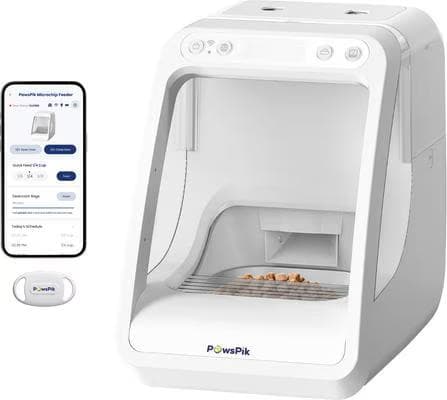
The PawsPik is the premium hopper-fed pick for busy multi-cat homes that want portion control *and* selective access in one machine. Unlike the sealed-bowl SureFeed, the PawsPik holds a reservoir of dry kibble and dispenses fresh, scheduled portions into a selective bowl that opens only for the authorized cat. It reads both implanted chips and its included collar tags, stores multiple pets, and its larger hopper means fewer refills, which is why it lands in the premium tier. In a home with three or more cats on managed portions, it does the work of a scheduled feeder and a theft-proof bowl at once. It is the most expensive pick here, and like all hopper units it is built for dry food, not wet.
- Combines scheduled portioning with selective access, large dry-food hopper means fewer refills, reads both implanted chips and collar tags, stores several pets, strong fit for three-plus-cat homes
- Highest price of our picks, dry food only (not for wet), larger footprint on the floor, more moving parts to clean than a simple bowl
Verdict: The best premium microchip cat feeder for multi-cat homes that want automated portions and theft prevention together. Overkill for a single-cat home; ideal for a managed multi-cat household.
4. Closer Pets MiBowl CP500 - Best Value
Petful may earn a commission when you click through to Chewy, at no extra cost to you.
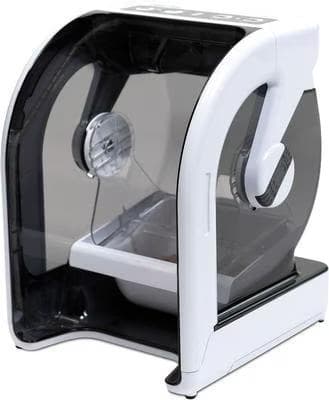
The Closer Pets MiBowl CP500 delivers the core microchip-bowl experience for the lowest price in our lineup. It is a sealed selective bowl, much like the SureFeed in concept: it reads your cat's implanted microchip (or an included collar tag), opens only for that cat, holds up to eight pet IDs, and seals shut to keep a housemate out and wet food fresh. In testing it read chips reliably and the lid action was smooth, if a touch less refined than the SureFeed's. Cleanup is simple with a removable, washable bowl. If you want to solve food theft without paying the premium, this is the smart budget buy.
- Lowest price for a true microchip sealed bowl, reads implanted chips and collar tags, stores up to eight pets, good for wet food, easy to clean, straightforward battery operation
- Fewer stored IDs than the SureFeed's 32, lid action slightly less polished, no app or scheduling (it is a selective bowl)
Verdict: The best value microchip cat feeder. If the SureFeed's price gives you pause, the MiBowl CP500 gets you the same core benefit for less.
SureFeed vs Petlibro RFID vs Cat Mate: Head to Head
These three cover the three most common decisions: the reliable sealed bowl, the smart app-connected RFID unit, and the non-microchip timed alternative. Here is how they line up.
| Feature | SureFeed | Petlibro One RFID | Cat Mate C500 |
|---|---|---|---|
| Selective access | Reads implanted chip + tag | RFID collar tag | None (timed lid) |
| App / Wi-Fi | No | Yes | No |
| Scheduling / portions | No | Yes | Yes (up to 5 meals) |
| Wet food | Excellent (sealed bowl) | Good | Good (ice-pack chamber) |
| Power | 4x C batteries | Wi-Fi + battery/USB | Battery |
| Best for | Reliability, theft-proofing | Smart control, travel | Non-chipped cats, timing |
| Approx. price | $170 | $140 | $60 |
The short version: pick the SureFeed if reliability and wet-food theft protection are everything, the Petlibro One RFID if you want app scheduling and remote monitoring, and the Cat Mate C500 if your cat is not microchipped and you mainly need timed portions rather than true selective access.
The Collar-Tag Option for Non-Chipped Cats
Can you use a microchip feeder without a microchip? Yes. Every one of our top picks, and most feeders in this category, ship with or offer a small RFID collar tag as an alternative to the implanted chip. You clip the tag to your cat's collar, program it into the feeder the same way you would program a chip, and the feeder opens for the tag. This is the workaround for a cat that has never been chipped, a cat whose chip sits too deep to scan, or an owner who simply prefers not to rely on the implant.
For owners who want a fully non-microchip, non-RFID route, the Cat Mate C500 is the best timed alternative. Rather than reading any ID, the C500 uses a rotating lid on a programmable timer: it exposes up to five separate sealed compartments at the meal times you set, each with room for wet or dry food, and includes an ice-pack chamber to keep wet portions cool. It does not stop a determined food thief the way a selective lid does, because any cat present when a compartment rotates open can eat from it. But for a non-chipped cat that needs portioned meals on a schedule (say, while you are at work), it is a proven, affordable solution. Cat Mate also offers a selective feeder line with a collar-tag reader for owners who want true selective access without relying on the implanted chip.
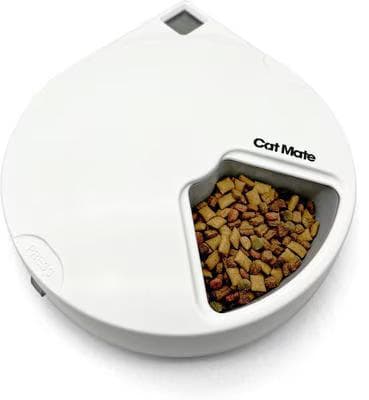
Petful may earn a commission when you click through to Chewy, at no extra cost to you.
- A collar tag works exactly like an implanted chip at the feeder, but it can slip off or get lost. If your cat wears a breakaway collar for safety, keep a spare tag on hand and consider getting the cat microchipped so a chip-reading feeder can fall back on the implant.
Are Microchip Feeders Safe?
Are microchip cat feeders safe? Yes. This is the single most common worry, and it rests on a misunderstanding worth clearing up directly: a microchip feeder reads an existing chip. It does not implant one and it emits no chip into your cat. The only radio activity is a very low-power short-range RFID scan, the same harmless technology used at every vet clinic and by every microchip cat door. There is no meaningful radiation exposure, no heat, and nothing that touches your cat other than the food bowl. The lid motors are low-torque and designed to stop and retract if they meet resistance, so a cat's head or paw is not at risk of being caught.
- 1A microchip feeder only reads a chip your cat already carries; it never implants one
- 2The only radio activity is a low-power, short-range RFID scan, the same technology used at every vet clinic
- 3Lid motors are low-torque and retract if they meet a cat's paw or head
Do vets recommend microchip cat feeders? Many do, specifically for weight management and prescription-diet compliance. In a multi-cat home, the most common reason a therapeutic diet fails is that the wrong cat eats it, or the target cat's food gets stolen so it never eats enough. A selective feeder removes that failure point entirely, which is why vets managing feline obesity, diabetes, kidney disease, or food allergies frequently suggest one. Veterinary behaviorists also note that reducing mealtime competition can lower stress and food-guarding aggression between housemates. As always, the feeder is a tool that supports a vet's plan; it is not a substitute for veterinary care.
Can a cat's body reject a microchip? True rejection is extremely rare. The implanted microchip is coated in biocompatible bioglass specifically so the body tolerates it, and the vast majority of cats live their entire lives with no reaction at all. Occasionally a chip can migrate a short distance from the implant site, or a small, harmless lump of scar tissue can form around it; genuine adverse reactions are documented but very uncommon. None of this is caused by the feeder, which only reads a chip that is already there. If you ever notice swelling, redness, or discomfort at your cat's implant site, have your vet take a look, and read up on the fundamentals of microchipping your cat before deciding.
Can microchip feeders be used for dogs? Yes. The RFID chip standard is the same for dogs and cats, so any microchip or RFID feeder will read a dog's implanted chip or collar tag. The practical limits are size and access: most selective *cat* feeders have a bowl opening and lid sized for a cat's head, so a large dog may not fit comfortably, and a small enough dog can absolutely use one. In a mixed dog-and-cat home, the more common use is the reverse: programming the feeder to open for the *cat* so the *dog* cannot raid the cat's food. That works perfectly, and it is one of the most popular reasons single-cat households buy a selective feeder.
What to Look For
If you are choosing beyond our four picks, weigh these factors in roughly this order.
- Selective mechanism. A sealed lid that physically closes (SureFeed, Closer Pets MiBowl) beats a partial cover for stopping a determined thief. If theft is your main problem, prioritize a fully sealing bowl.
- Chip vs. collar tag. A unit that reads the *implanted* chip needs nothing on your cat and cannot be defeated by a lost collar. If your cat is chipped, favor a chip-reading unit; if not, make sure a collar tag is included or the unit is a timed non-ID feeder.
- Capacity and wet vs. dry. For wet food, choose a sealed-bowl selective feeder, ideally with a foam sealing mat, and expect to refill each meal. For dry food and hands-off scheduling, a hopper-fed unit (PawsPik) holds days of kibble but is not for wet food. Match the machine to what your cat actually eats.
- Power. Battery units (SureFeed, Cat Mate) have no cord for a cat to unplug and keep working in a power cut, but you replace batteries every few months. Wi-Fi and USB units (Petlibro) add app features but introduce a cord and network dependency.
- Noise. A cautious cat can be spooked by a loud motor. The SureFeed's lid is notably quiet; if you have a nervous eater, quietness matters, and every good selective feeder includes a step-by-step training mode to acclimate a cat to the moving lid.
- Cleaning. Look for a removable, dishwasher-safe bowl and mat. Sealed bowls are quick to clean; hopper units have more parts and channels where kibble dust collects.
- Every reputable selective feeder has a training mode that props the lid open at first, then closes it in stages over several days. Skipping it is the number-one reason cats refuse a new feeder. Set it to fully open for the first few days so your cat learns the bowl means food, then let it start closing.
Troubleshooting: Lid Won't Open, Food Theft, Cleaning
Why won't my microchip feeder open? Work through these in order. First, confirm the cat's chip or tag is actually programmed into the feeder (re-run the learn/pairing step). Second, check battery level, because a weak battery is the most common cause of a lid that reads slowly or not at all. Third, make sure the cat is approaching head-on; the antenna reads best when the chip (between the shoulder blades) passes directly over the base, so a cat that hangs back or comes in sideways may not trigger it. Fourth, move the feeder away from large metal objects, other electronics, and a second microchip feeder, all of which can cause interference. If an implanted chip reads inconsistently because it has migrated or sits deep, switch that cat to the included collar tag, which sits right at the bowl and reads every time.
Stopping food theft. If a second cat is still getting food, the usual culprits are: a lid that does not fully seal (choose a sealed-bowl unit), a thief who waits for the authorized cat to open the lid and then shoves in (space feeders apart and, if needed, feed the bold cat separately first so it is not hovering), or two cats programmed into the same bowl when they should have separate ones. For a truly persistent thief, a fully sealing bowl like the SureFeed keyed to a single cat is the fix.
How do you clean and maintain a microchip cat feeder? Wash the bowl and any sealing mat after wet-food meals, daily, to prevent bacteria and odor; most sealed bowls and mats are top-rack dishwasher-safe. Never submerge the electronic base; wipe it with a damp cloth only. For hopper units, empty and wipe the reservoir and dispensing channel regularly to clear kibble dust and oils that go rancid. Replace batteries on schedule rather than waiting for a failure, and keep the antenna area free of food debris. A clean, well-powered feeder is a reliable one.
How We Chose
We ran each feeder for at least two weeks in a real multi-cat household containing both microchipped cats and cats on collar tags, feeding a rotation of dry kibble and wet food. We scored each on first-scan read reliability, lid quietness and speed, wet-food freshness, resistance to a food-motivated "thief" cat, battery life or connection stability, and ease of cleaning. Prices cited are approximate and reflect typical Chewy pricing at the time of writing; check the current price before you buy.
Frequently Asked Questions
A microchip cat feeder is an automatic bowl with a motorized lid and a built-in RFID antenna. It reads your cat's existing implanted ID microchip (or a clip-on collar tag) and opens the lid only for that specific cat, then seals shut when the cat leaves. It is designed to stop one cat from eating another cat's food.
An antenna in the base scans for a nearby RFID ID. When it detects a chip or tag you have programmed in, a small motor opens the lid; when the cat steps away and the ID leaves range, the lid closes and locks. It uses the same low-power RFID technology as a vet's microchip scanner.
Three main types: sealed selective bowls (a single lidded bowl that opens for an authorized cat, best for theft and wet food), smart app-connected RFID feeders (add Wi-Fi scheduling and phone alerts), and hopper-fed automatic microchip feeders (dispense scheduled dry portions into a selective bowl). A related non-ID option is the timed rotating feeder like the Cat Mate C500.
Yes. The feeder only reads a chip your cat already has; it never implants one and emits no chip. It uses a very low-power short-range RFID scan, the same harmless technology as a vet scanner or microchip cat door, and the low-torque lid retracts if it meets resistance.
Many vets recommend them for weight management and prescription-diet compliance in multi-cat homes, because they guarantee the right cat eats the right food. They are a tool to support a vet's plan, not a replacement for veterinary care.
True rejection is extremely rare. The chip is coated in biocompatible bioglass so the body tolerates it, and most cats never react. Occasionally a chip migrates slightly or forms a small harmless lump of scar tissue; genuine adverse reactions are documented but uncommon, and none of this is caused by the feeder.
Yes. The RFID chip standard is identical for dogs and cats, so any microchip feeder reads a dog's chip or tag. The limit is size: a selective cat feeder's opening suits a cat or small dog. A very common use is programming the feeder for the cat so a dog cannot raid the cat's food.
Most fall between $60 and $260. Value microchip bowls like the Closer Pets MiBowl run around $130, the popular SureFeed is about $170, smart RFID units like the Petlibro One are around $140, and premium hopper-fed multi-cat units like the PawsPik reach about $250. Non-microchip timed feeders like the Cat Mate C500 start near $60.
Wash the bowl and sealing mat daily after wet food (most are top-rack dishwasher-safe), wipe the electronic base with a damp cloth but never submerge it, clear kibble dust from hopper units regularly, and replace batteries on schedule. Keep the antenna area free of food debris for reliable reading.
Our best overall pick is the SureFeed Microchip Pet Feeder (about $170) for its flawless chip-reading, near-silent sealing lid, 32-pet memory, and excellent wet-food performance. The Petlibro One RFID is best for app control, PawsPik for premium multi-cat homes, and the Closer Pets MiBowl for value.
For pure cat recognition (reading the cat's ID to open selectively), the SureFeed Microchip Pet Feeder is our top cat-recognition feeder because it reliably reads the implanted chip or collar tag and physically seals shut. The Petlibro One RFID is the best recognition feeder with smart-app features.
Yes. Almost every microchip feeder includes or offers a small RFID collar tag you clip on as an alternative to the implanted chip; the feeder reads the tag the same way. For a fully non-ID route, a timed feeder like the Cat Mate C500 portions meals on a schedule without reading any chip.
Most feeders store multiple IDs: the SureFeed holds up to 32 pets, the Closer Pets MiBowl up to 8, and others store several. But if cats eat different food, you need one feeder per cat, because a single bowl cannot serve two different meals.
Yes, and sealed selective bowls are one of the best wet-food solutions available. The closing lid keeps wet food fresh, blocks flies, and stops a second cat from stealing it, especially with the included foam sealing mat. Choose a sealed-bowl unit over a dry-only hopper feeder for wet food.
Use the built-in training mode. Set the lid to stay fully open for the first few days so your cat learns the bowl means food, place it where the old bowl was, then let the lid begin closing in stages over about a week. Rushing this step is the top reason cats refuse a new feeder.
Check four things: the cat's chip or tag is programmed in, the batteries are fresh, the cat is approaching head-on so the antenna reads the chip, and the feeder is away from metal or other electronics that cause interference. If an implanted chip reads poorly, switch that cat to the included collar tag.
Yes, if they eat the same food: program both cats' IDs into one feeder to keep a third pet out. But if the two cats eat different diets, you need a separate feeder for each, keyed to one cat, because a shared bowl cannot hold two different meals.
For multi-cat homes with a prescription diet, a slow eater, or a food thief, yes, absolutely; they are often the only reliable fix and they protect wet food and support weight-loss plans. For a single cat with no theft or diet issue, the value is smaller, though they still keep food fresh and keep other pets out.
A scheduled or hopper-fed feeder can dispense meals for a day or two, but you should still have someone check in on the cat, its water, and its litter box daily. Microchip sealed bowls that do not dispense are for theft protection at a single meal, not for leaving a cat unattended.
The 3-3-3 rule is a rough guide for a newly adopted cat's adjustment: about 3 days to decompress and feel safe, 3 weeks to settle into a routine, and 3 months to feel fully at home. It is unrelated to feeders but helps set expectations when introducing a new cat to a feeding setup.
Cats should never eat raw or undercooked pork, and more broadly no raw meat that risks bacteria or parasites; heavily processed deli meats and anything seasoned with onion or garlic are also off-limits. Always confirm any diet change with your vet.
For the full range of automatic feeding options beyond selective microchip units, see our guide to the best automatic cat feeders, and for homes with several cats, our roundup of the best automatic cat feeders for multiple cats.

Coreen Saito is a pet writer and longtime shelter volunteer with more than a decade in animal rescue. She covers cat behavior, breed care, and the small, ordinary science of sharing a life with companion animals, with a particular focus on honest takes about the products and decisions that actually matter. At home in Arizona, she's outranked by Mac (a dog with the loudest opinion in the house), Rebel (a cat who governs by quiet authority), and Meri (an orange tabby who runs the late shift and the laundry basket). She writes about all three, plus the rescues that keep coming through her life, at LifeWithMinty.com.
Sign up for expert-backed reviews and safety alerts all in one place.