The Best Automatic Cat Feeder for Multiple Cats: Top Picks
Multi-cat homes face two feeding problems: cats stealing each other's food, and feeding several cats at once. We break down which feeder design solves each, then name five Chewy picks from microchip gatekeepers to dual-hopper units.
Petful is reader supported. As an affiliate of platforms like Amazon and Chewy, we may earn a commission when you buy through links on this page. There is no extra cost to you.
Choosing an automatic cat feeder for multiple cats is a different problem than picking one for a single pet, because you are not just automating a schedule, you are refereeing a household. In a one-cat home the feeder only has to dispense the right amount at the right time. In a multi-cat home it also has to stop the fast eater from clearing the slow eater's bowl, keep the cat on a prescription diet from raiding the healthy one's food, and often serve two or three cats within the same few minutes without turning breakfast into a scrum. That second layer of jobs is what separates the feeders that actually work in a shared home from the ones that just look convenient in the product photos.
The good news is that every one of those problems has a proven hardware answer, and none of them is expensive by pet-gear standards. Below we break the multi-cat feeding challenge into its two real components, explain which feeder design solves each one, and name five specific models you can buy on Chewy today, from a microchip gatekeeper that ends food theft to a dual-hopper unit that feeds two cats at once for around fifty dollars. We will also cover portion control per cat, how long you can safely leave a multi-cat household running on feeders, and what veterinarians actually say about automated feeding when resource guarding is in play.
- 1Multi-cat homes face two distinct problems: food-stealing between cats and simultaneous feeding of several cats.
- 2Microchip or RFID feeders (like the SureFeed) solve theft and diet control by opening only for the assigned cat; multi-bowl or dual-hopper feeders (like the Oneisall PFD-002) solve simultaneous feeding.
- 3Match the feeder design to your actual problem first, then compare price, water access, and backup power before you buy.

Sign up for expert-backed reviews and safety alerts all in one place.
At a Glance
- SureFeed Microchip Pet Feeder: Best Microchip
- Petlibro One RFID Cat Feeder: Best Smart RFID
- Oneisall Two-Bowl Dual-Hopper PFD-002: Best Dual-Hopper
- Vacqueen Smart 3-Cat Feeder: Best 3-Cat
- Cat Mate C500: Best Timed
| Feeder | Best For | Approx. Price |
|---|---|---|
| SureFeed Microchip Pet Feeder | Stopping food theft and protecting a prescription or weight-loss diet | $170 |
| Petlibro One RFID Cat Feeder | Budget microchip-style diet control for one target cat | $140 |
| Oneisall Two-Bowl Dual-Hopper PFD-002 | Feeding two cats at once from a single scheduled unit | $50 |
| Vacqueen Smart 3-Cat Feeder | Portioning for three cats from one app-controlled feeder | $70 |
| Cat Mate C500 | Fresh wet or dry food in five portioned, timed trays | $46 |
The Two Problems Every Multi-Cat Home Has to Solve
Before you compare any specific products, it helps to name the problem you are actually trying to fix, because the two most common multi-cat feeding headaches call for completely different hardware.
Problem one is food-stealing and diet control. In almost every multi-cat home there is a fast eater and a slow eater, or a cat who is supposed to be on a specific diet while the others are not. Maybe one cat is overweight and on a measured weight-loss ration, one is on a prescription renal or urinary food that would be actively bad for the others to eat, or one is a senior who needs to graze slowly while a younger cat inhales everything in sight. A standard open-bowl automatic feeder does nothing to stop the thief. It just dispenses food into a bowl that the wrong cat can reach. The answer here is a selective feeder, one that physically opens only for the cat it is assigned to.
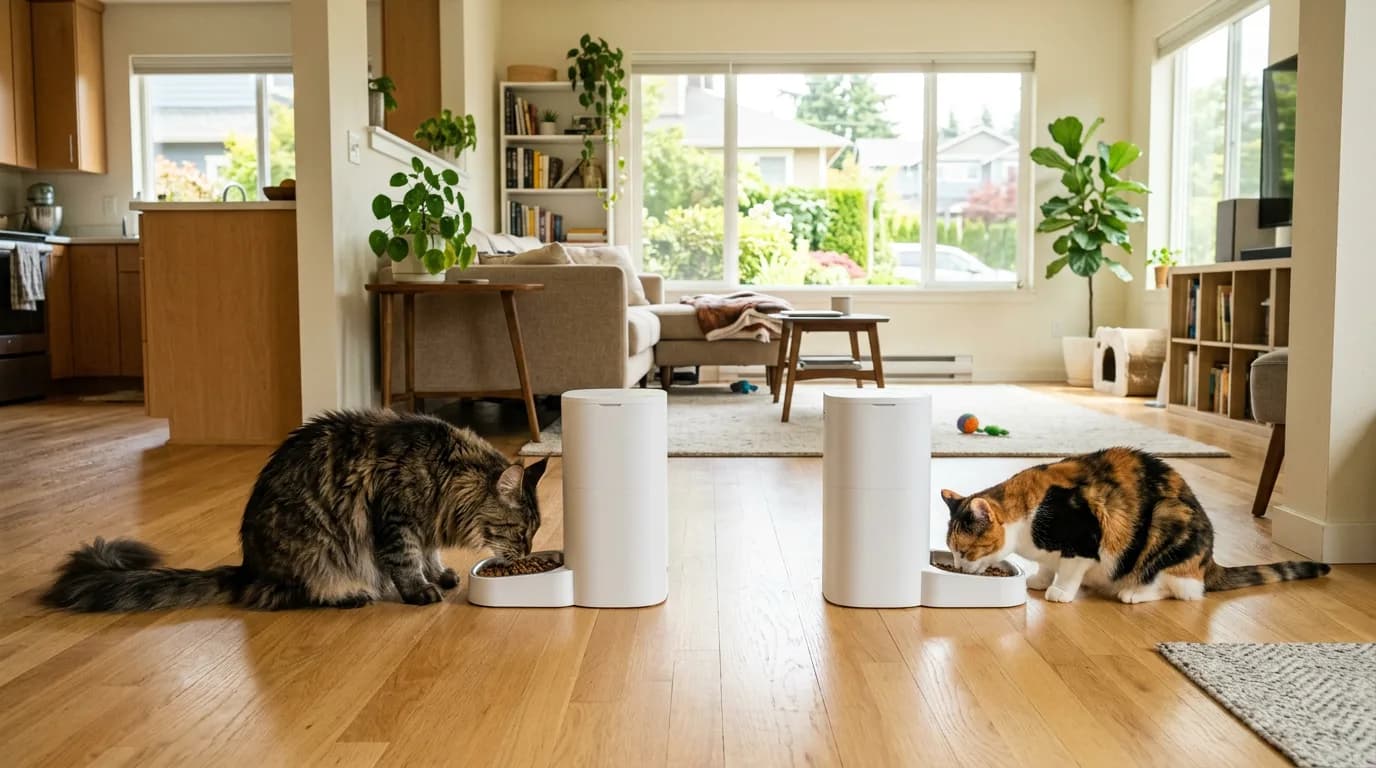
Problem two is simultaneous feeding. This is the logistics problem. You have two or three cats who all expect to eat at the same time, and you want them fed on schedule whether or not you are standing there. The cats are not necessarily stealing from each other, they just all need a bowl at once. The answer here is either a multi-bowl or dual-hopper feeder that fills two or more separate stations from one scheduled unit, or simply one feeder per cat placed in separate spots.
- 1Problem one is food theft or diet control, solved only by a selective microchip or RFID feeder that opens for one cat
- 2Problem two is simultaneous feeding, solved by a dual-hopper or multi-bowl unit or one feeder per cat
- 3Most homes mix both, so fix the louder problem first
Most homes have some mix of both problems, which is exactly why the "best" feeder is not a single product. A two-cat home where nobody steals just needs simultaneous feeding, so a dual-hopper unit is perfect and cheap. A home with a diabetic cat and a food-obsessed housemate needs a microchip gatekeeper first, and simultaneous feeding is secondary. Diagnose which problem is louder in your house, and the shortlist gets short fast.
Microchip and RFID Feeders: Stop One Cat Eating Another's Food
If the core problem in your home is theft, a prescription diet, or one cat who simply must not eat the other's food, a microchip or RFID feeder is the only category that genuinely solves it. Everything else is a workaround.
Here is how it works. The feeder holds a bowl under a motorized lid. When a cat approaches, a sensor reads either the cat's existing implanted microchip or a small RFID tag clipped to the collar. If the ID matches a cat the feeder has been programmed to recognize, the lid slides open and stays open while that cat eats. When the cat walks away, the lid closes. A cat whose ID is not on the list walks up, gets nothing, and learns within a day or two that this particular bowl is not theirs. Because most cats are already microchipped for identification, the chip-reading models often need no extra hardware on the cat at all.
This design does three jobs a normal feeder cannot. It protects a prescription or weight-management diet, so the renal cat's food stays with the renal cat and the dieting cat cannot binge on the other's portion. It stops resource-guarding flashpoints by removing the shared-bowl confrontation entirely, since each cat learns to go to their own station. And it keeps wet food fresh and covered between meals, because the lid seals the bowl instead of leaving it open to the air and to flies.
- 1Protects a prescription or weight-management diet so the right cat keeps its food
- 2Removes the shared-bowl confrontation that sparks resource guarding
- 3Seals wet food between meals to keep it fresh and fly-free
The tradeoff is that microchip feeders are generally single-cat stations by design. One feeder guards one bowl for one authorized cat (some read multiple chips, but they still open the same single bowl). So in a home where two or three cats each need protection, you typically buy one selective feeder per cat that needs its own gated bowl. That is more expensive up front, but it is the only approach that truly works when the stakes are a medical diet.
For the full rundown on this category, including battery life, chip compatibility, and multi-pet programming, see our dedicated guide to the best microchip cat feeders. If you are weighing selective feeders against the broader field of scheduled dispensers, our main automatic cat feeders roundup covers every type in one place.
Multi-Bowl and Dual-Hopper Feeders: Feed Two or Three Cats at Once
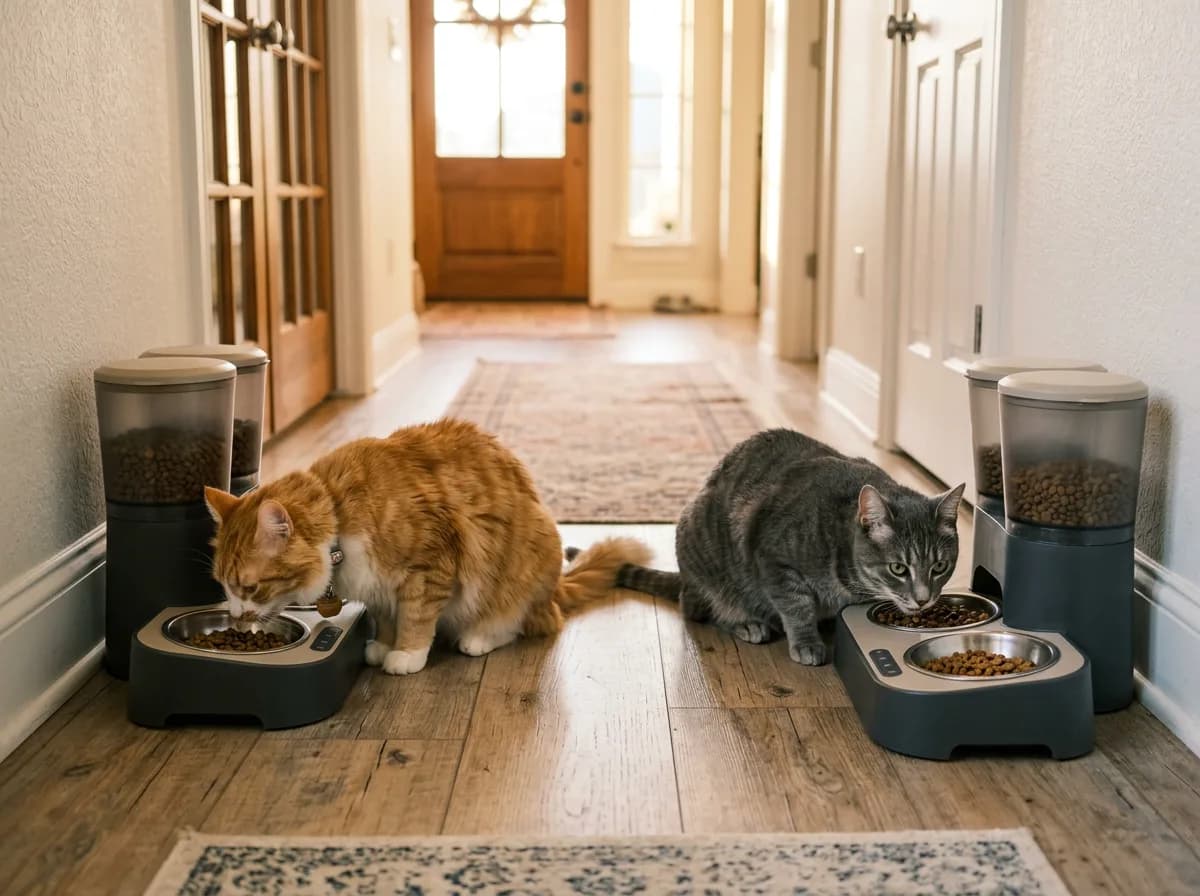
If your cats are not stealing from each other and you just need everyone fed on schedule, you do not need the expense or complexity of microchip gating. You need a feeder that can serve more than one bowl at a time.
There are two mechanical approaches. A dual-hopper feeder holds two separate reservoirs of kibble and drops food into two separate bowls, usually placed a short distance apart via a splitter chute or two attached trays. You program one schedule and both cats get their portions at the same moment. A multi-tray rotating feeder instead loads several sealed compartments onto a turntable and rotates a fresh tray into position at each scheduled time, which is how you serve wet food safely to more than one cat without it spoiling in an open dish for hours.
- A dual-hopper feeder drops kibble into two bowls on one schedule, best for dry food. A multi-tray rotating feeder turns sealed compartments into place at each meal, the safe way to serve wet food to more than one cat.
The advantages here are cost and simplicity. A good dual-hopper unit runs around fifty dollars, a fraction of a single microchip feeder, and one unit handles two cats. The limitation is that these feeders do not know which cat is eating from which bowl. If you have a thief, a dual-hopper feeder will happily let them clean out both bowls. So this category is the right answer when your cats respect their own stations, or when you place the two bowls far enough apart (different rooms, even) that the timing and geography keep them separate.
For three cats, you have two clean options. Use a dedicated three-station or high-capacity multi-portion feeder built for that count, or run one simpler feeder per cat. We will name a specific three-cat model in the picks below, but the "one feeder per cat" route is worth keeping in mind, because three modest single feeders often cost about the same as one fancy three-cat unit and give you redundancy: if one jams, only one cat misses a meal.
Our Top Picks
Every pick below is purchasable on Chewy and chosen to solve a specific slice of the multi-cat problem. Match the pick to your household's louder problem rather than buying the most expensive unit by default.
SureFeed Microchip Pet Feeder
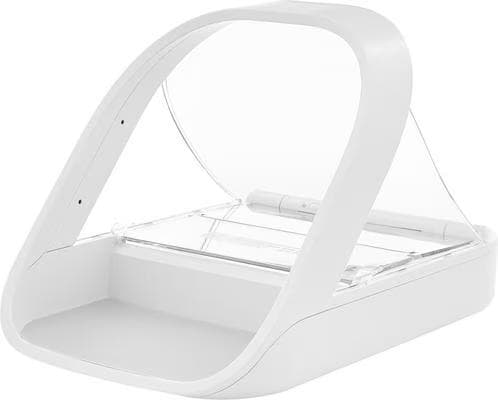
Best for: stopping food theft and protecting a strict diet. The SureFeed is the reference-standard selective feeder and the one most veterinary teams point to first. It reads your cat's existing implanted microchip (or an included RFID collar tag) and opens the sealed lid only for that cat. Program it to a single authorized pet and the food inside is genuinely off-limits to every other cat in the house. The sealed lid also keeps wet food fresh and shuts out flies between visits. At around $170 it is the priciest pick here, but if you are managing a prescription renal diet, a diabetic cat's measured meals, or a weight-loss plan that a housemate keeps sabotaging, it is the only design that reliably delivers. In a three-cat home you would buy one per cat that needs a protected bowl.
Petful may earn a commission when you click through to Chewy, at no extra cost to you.
Petlibro One RFID Cat Feeder
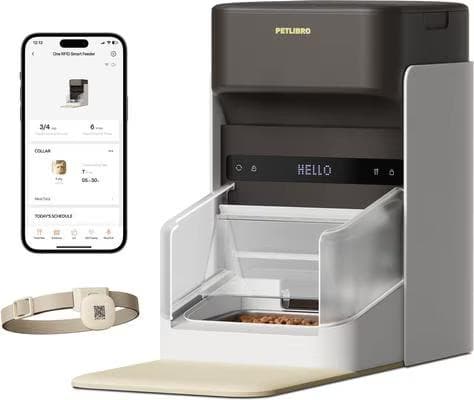
Best for: budget-friendly diet control for one target cat. The Petlibro One brings selective feeding down to around $140 by pairing the unit with RFID collar tags rather than relying solely on an implanted chip read. Assign the tag to the cat whose food needs protecting and the lid opens only for that cat. It hits most of the same jobs as the SureFeed at a lower entry price, which makes it a strong choice when you have exactly one cat who needs gated meals and you would rather not spend for the top-tier unit. The tradeoff versus a chip-only reader is that the protected cat has to keep wearing the tag, so it suits cats who tolerate a collar.
Petful may earn a commission when you click through to Chewy, at no extra cost to you.
Oneisall Two-Bowl Dual-Hopper PFD-002
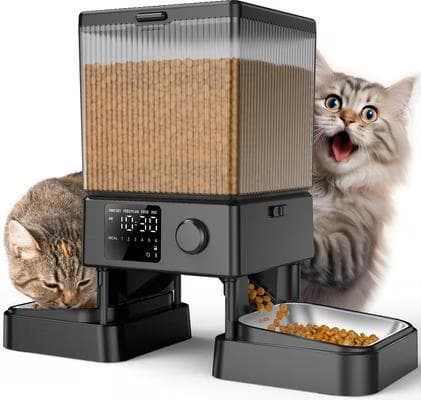
Best for: feeding two cats at once, cheaply. This is the value champion of the simultaneous-feeding category. The Oneisall PFD-002 holds two separate hoppers and drops kibble into two separate bowls on the same programmed schedule, so both cats eat at the same time from one tidy unit for around $50. There is no cat recognition here, so it is built for the household where the two cats respect their own bowls (or where you split the two stations far enough apart to keep the peace). For a straightforward two-cat home with no thief, this does exactly what you need for a fraction of a microchip feeder's price.
Petful may earn a commission when you click through to Chewy, at no extra cost to you.
Vacqueen Smart 3-Cat Feeder
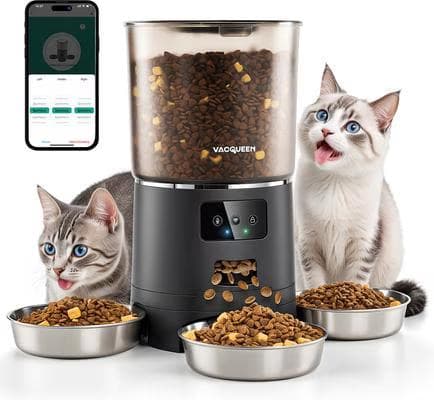
Best for: three cats from one app-controlled unit. When you specifically need to feed three cats and want to keep it to a single feeder, the Vacqueen Smart 3-Cat Feeder is built for that count, dispensing scheduled dry-food portions across the household at around $70. App control lets you set and adjust each feeding time from your phone and drop a manual meal remotely if plans change. As with all multi-station dispensers, it feeds on schedule but does not identify which cat is eating, so it is the right pick for three cats who get along at mealtime rather than a home with a determined food thief. If any one of the three is on a protected diet, pair this with a microchip feeder for that cat and let the Vacqueen handle the other two.
Petful may earn a commission when you click through to Chewy, at no extra cost to you.
Cat Mate C500
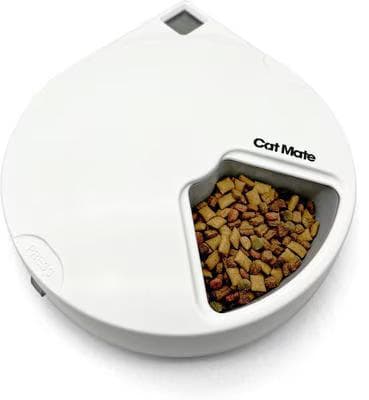
Best for: portioned wet or dry food in timed trays. The Cat Mate C500 uses five sealed compartments on a rotating tray, advancing a fresh portion into position at each scheduled time. That rotating-tray design is what makes it genuinely useful for wet food, because each portion stays covered until its moment instead of drying out in an open bowl. At around $46 it is an affordable way to serve measured meals, and in a multi-cat home two or three C500 units (one per cat, in separate spots) give each cat their own timed trays, including the wet-food meals that other feeder types handle poorly. Ice packs in the base slot help keep wet food cool for the earlier trays.
Petful may earn a commission when you click through to Chewy, at no extra cost to you.
How to Choose: Microchip vs Multi-Bowl vs One-Feeder-Per-Cat
With the picks on the table, the decision comes down to three questions asked in order.
- First, does a cat steal or need a protected diet? If yes, you need microchip or RFID gating (SureFeed or Petlibro One) for that cat, full stop. No amount of scheduling on an open-bowl feeder solves a theft problem. Buy one selective feeder per protected cat.
- Second, if there is no theft, how many cats eat at once? For two peaceful cats, a dual-hopper unit (Oneisall PFD-002) is the cheapest clean answer. For three, either a dedicated three-cat feeder (Vacqueen) or three simple single feeders.
- Third, do you feed wet food? If wet food is on the menu, a rotating sealed-tray feeder (Cat Mate C500) keeps it fresh in a way that hopper-and-bowl designs cannot, so lean that way for any cat eating wet meals. There is more on this in Petful’s guide to automatic cat feeder for wet food.
- You do not have to solve the whole household with one product. The most common winning setup in a real multi-cat home is one microchip feeder for the cat with the special diet plus a cheaper dual-hopper or per-cat feeder for the rest. Solve the highest-stakes problem (a medical diet) with the right tool, and handle the ordinary cats with the affordable one.
Portion Control for Each Cat in a Shared Home
Automating the schedule is only half the battle. In a multi-cat home the other half is making sure each cat gets the right amount, because a single wrong portion size, repeated twice a day, is how cats quietly gain or lose weight.
Start from each cat's actual daily calorie target, which depends on weight, age, activity, and whether they are spayed or neutered. Your veterinarian can give you a specific number, and it is worth asking rather than guessing, because the difference between a maintenance ration and a weight-loss ration can be significant. Divide that daily amount across the number of meals your feeder serves, and program each feeder or each hopper to that cat's number rather than to a single shared setting. This is exactly where per-cat hardware pays off: a dual-hopper or per-cat feeder lets you dial in a different portion for each cat, which a single shared bowl never could.
- 1Start from each cat's vet-set daily calorie target rather than a shared guess
- 2Divide that total across the day's meals and program each hopper to that cat's number
- 3Per-cat or dual-hopper hardware lets every cat get a different portion
For the cat on a weight-loss plan or a prescription diet, a microchip feeder is what makes the portion actually stick, because it stops the other cats from topping the dieting cat up with stolen food or leaving their own leftovers for the wrong cat to finish. Portion control and theft prevention are really the same problem viewed from two angles, which is why the medical-diet cat almost always ends up on selective hardware. For a deeper walk-through of how often and how much to feed, including kitten versus adult versus senior schedules, see our guide on how often to feed a cat.
One practical note: weigh the food, at least at first. Automatic feeders portion by volume or by rough scoop count, and volume can drift as kibble settles or as you switch brands with different densities. Weighing a few portions on a cheap kitchen scale tells you what your feeder's "one portion" actually delivers, so the number you programmed matches the grams your cat receives.
How Long Can You Leave Multiple Cats With a Feeder?
This is the question that sends most people shopping for a feeder in the first place, so let us answer it directly for each length of trip, and then cover the things that matter more than the feeder itself.
Can I leave my cat alone for 2 days with an automatic feeder? For a healthy adult cat with no medical needs, a two-day (one-night) absence is the most defensible solo window, and a reliable automatic feeder plus ample fresh water covers the food side well. Two days is short enough that a single litter box stays usable and a hopper feeder will not run dry. Most vets consider a healthy adult cat fine for roughly 24 to 48 hours alone with food, water, and clean litter in place.
Can I leave my cat alone for 3 days with an automatic feeder? Three days is pushing past what most veterinarians recommend for a cat left completely alone, even with a working feeder. The feeder can handle the food, but three days is long enough that water can get fouled or run low, litter boxes overflow, and, most importantly, no one is checking whether your cats are actually okay. If you must be gone three days, the feeder should be paired with a person, a neighbor, sitter, or friend who drops in at least once to refresh water, scoop litter, and lay eyes on every cat.
- 1Two days: fine for a healthy adult cat with a feeder, ample water, and clean litter
- 2Three days: only if a person drops in to refresh water, scoop litter, and check each cat
- 3Four-plus days: needs a daily in-person check or a sitter, not just a feeder
Can I leave my cat alone for 4 days with an automatic feeder? Four days alone is not something we would recommend for any cat, feeder or not. A feeder solves the calorie problem, but it does nothing about a blocked cat, a vomiting cat, a water bowl a cat knocked over on day one, or a cat who got shut in a closet. At four days you need a real in-person check at least daily, which in practice means a pet sitter or boarding, not a feeder standing in for supervision. The feeder is a tool, not a substitute for a human.
The through-line for every one of these windows is the same: the feeder is the easy part. What actually determines how long your multi-cat home can run unattended is water, litter, backup power, and a human check-in.
- Water. Cats drink more than people expect, and multiple cats drain a bowl fast. Provide more water than you think you need, ideally across two or more stations or a pet water fountain, so one spill or one fouled bowl does not leave everyone dry.
- Backup power. Any feeder you rely on for an absence must have working battery backup, and you should confirm the batteries are fresh before you leave. A feeder that only runs on the wall outlet will stop feeding the moment the power blips. Check that your chosen model keeps its schedule on batteries, not just its clock.
- Redundancy. In a multi-cat home, one feeder per cat (or a spare) means a single jam does not starve anyone. This is the quiet argument for the cheaper per-cat approach over one expensive do-everything unit.
- Litter. Feeders do not scoop. Two days is the practical ceiling for a single box per cat before it becomes a reason a cat stops using it, which is its own problem.
Set against all that, the honest answer is that automatic feeders make short absences genuinely easy and safe, but they do not extend how long a cat can be truly alone. Beyond about two days, plan on a human.
Do Vets Recommend Automatic Feeders for Multi-Cat Homes?
Broadly, yes, with one important caveat. Veterinarians generally view automatic feeders as a helpful tool for consistency, portion control, and weight management, and they are especially useful in multi-cat homes for enforcing a prescription or weight-loss diet that would be impossible to protect with open bowls. The ability of a microchip feeder to guarantee that the renal cat eats only renal food, and the dieting cat cannot binge, is something many vets actively appreciate, because diet compliance is one of the hardest things for owners to maintain by hand.
The caveat is food guarding and resource-related stress. In some multi-cat homes, introducing feeders (especially noisy dispensers or a single shared feeding zone) can flare up resource guarding, where one cat blocks or intimidates the others around the feeder. The fix is straightforward and it is where the selective and per-cat designs shine: give each cat their own feeding station, ideally in separate locations with sight lines that let a cat eat without feeling cornered. When each cat has its own gated or separated bowl, the competition that drives guarding largely disappears. If you already see hissing, blocking, or a cat who refuses to eat when another is near, spread the stations out and lean toward microchip feeders that remove the shared-bowl confrontation entirely.
So the veterinary verdict is a qualified endorsement: automatic feeders are recommended for multi-cat homes, particularly for medical diets and portion control, provided you set them up to reduce competition rather than concentrate it. Design the layout for peace, and the feeders become one of the more useful pieces of gear a multi-cat household can own.
Frequently Asked Questions
Yes, but the right type depends on your problem. If cats steal from each other or one is on a special diet, you need a microchip or RFID feeder that opens only for the assigned cat. If the cats simply need feeding at the same time with no theft, a dual-hopper or multi-bowl feeder, or one feeder per cat, works well and costs far less.
Yes. Dedicated three-cat feeders like the Vacqueen Smart 3-Cat Feeder are built to portion dry food for three cats from one app-controlled unit. Alternatively, run three simple single feeders (one per cat), which often costs about the same and gives you redundancy if one jams. If any of the three is on a protected diet, pair a microchip feeder for that cat with a shared feeder for the other two.
Yes, and two cats is the sweet spot for a dual-hopper feeder like the Oneisall PFD-002, which fills two separate bowls on the same schedule for around $50. If one of the two steals or needs a diet protected, use a microchip feeder for that cat instead of, or in addition to, the shared unit.
Use a dual-hopper feeder that drops food into two bowls simultaneously, or place two single feeders a short distance apart set to the same schedule. Separating the two stations by a few feet, or into different rooms, reduces mealtime competition and keeps a faster eater from crowding the slower one.
Give each cat its own feeding station, portioned to that cat's calorie needs, and separate the stations enough to prevent competition. For any cat on a medical or weight-loss diet, use a microchip feeder so the diet cannot be sabotaged. For the rest, a dual-hopper or per-cat feeder on a consistent schedule keeps everyone fed evenly.
Either a dedicated three-cat feeder or three individual feeders placed in separate spots. Portion each to the individual cat, and if one cat needs a protected diet, gate that cat's food with a microchip feeder while the other two share or use their own scheduled feeders. Spreading stations out is the key to keeping three cats calm at mealtime.
For a healthy adult cat, yes. Two days (one night) is the most defensible solo window with a reliable feeder, plenty of fresh water across multiple stations, and clean litter. Confirm the feeder's battery backup is fresh before you go.
Three days pushes past what most vets recommend for a cat left entirely alone. The feeder handles food, but water can foul or run low, litter overflows, and no one is checking on your cats. If you are gone three days, arrange for a person to drop in at least once to refresh water, scoop litter, and check every cat.
Not recommended for any cat. A feeder solves calories but nothing else, a spilled water bowl, a sick cat, or a cat shut in a room. Four days requires at least daily in-person checks, which means a pet sitter or boarding rather than relying on a feeder.
Generally yes, especially for consistency, portion control, and protecting prescription or weight-loss diets in multi-cat homes. The main caveat is resource guarding: set up separate feeding stations, and use microchip feeders where needed, so the feeders reduce competition between cats rather than concentrate it.
The 3-3-3 rule is a guideline for helping a newly adopted cat adjust: roughly 3 days to decompress and feel safe, 3 weeks to settle into a routine and start showing personality, and 3 months to feel fully at home. It is an adjustment timeline, not a feeding schedule, but it matters for multi-cat feeding because a brand-new cat may need its own quiet, separated feeding station during those first weeks to eat without stress from the resident cats.

Coreen Saito is a pet writer and longtime shelter volunteer with more than a decade in animal rescue. She covers cat behavior, breed care, and the small, ordinary science of sharing a life with companion animals, with a particular focus on honest takes about the products and decisions that actually matter. At home in Arizona, she's outranked by Mac (a dog with the loudest opinion in the house), Rebel (a cat who governs by quiet authority), and Meri (an orange tabby who runs the late shift and the laundry basket). She writes about all three, plus the rescues that keep coming through her life, at LifeWithMinty.com.
Sign up for expert-backed reviews and safety alerts all in one place.