The Best Automatic Cat Feeder for Wet Food: Top Picks for 2026
Wet cat food spoils in hours, so a real wet-food feeder must keep it cold and sealed until mealtime. We compare five Chewy-stocked automatic cat feeders, from a thermoelectric model to a budget ice-pack tray, plus how long you can leave your cat.
Petful is reader supported. As an affiliate of platforms like Amazon and Chewy, we may earn a commission when you buy through links on this page. There is no extra cost to you.
An automatic cat feeder for wet food solves the one problem that most timed feeders quietly ignore: canned and pouch food spoils fast, and leaving it in an open bowl for hours is a food-safety risk, not a convenience. Dry-kibble dispensers have been around for years, but wet-food feeders are a different machine entirely. They have to keep pate or chunks-in-gravy cold, sealed, and portioned until the exact minute your cat is meant to eat, whether that is your normal 6 a.m. wake-up or hour 60 of a long weekend away. This guide walks through how these feeders actually keep food fresh, how long wet food can safely sit out, how many meals different designs hold, and which five Chewy-stocked models earn their place, from a premium thermoelectric fridge-on-a-plate down to a genuinely affordable ice-pack tray.
- 1Wet food spoils in about 2 to 4 hours at room temperature, so a true wet-food feeder must actively cool the food or keep it sealed with ice packs until each meal.
- 2Thermoelectric feeders (like the Petlibro Polar) keep food cold for roughly 3 days without ice; ice-pack feeders (Casfuy, PetSafe, Cat Mate) are cheaper but limited by how long the pack stays frozen.
- 3Match the feeder to your trip: single or two-meal cooling covers a workday, five to six sealed compartments plus a fresh ice pack can cover 2 to 3 days, but no feeder replaces a sitter for longer absences.

Sign up for expert-backed reviews and safety alerts all in one place.
At a Glance
Here is how the five picks compare before we get into the detail. "Cooling type" is the single most important spec: it decides how long the food stays safe, which in turn decides how long you can leave your cat.
- Petlibro Polar Wet Food Feeder: Best Cooling
- Casfuy F13 6-Meal Ice-Pack Feeder: Best 6-Meal
- PetSafe 5-Meal (Eatwell): Best 5-Meal
- Cat Mate C500: Best Value
- Cat Mate C3000: Best Hybrid
| Feeder | Cooling Type | Meals / Freshness |
|---|---|---|
| Petlibro Polar Wet Food Feeder | Thermoelectric (active) | ~3 days cold, app-controlled |
| Casfuy F13 6-Meal Feeder | Ice pack | 6 compartments, ~1-2 days |
| PetSafe 5-Meal (Eatwell) | Ice pack | 5 meals, workday to ~1 day |
| Cat Mate C500 | Ice pack | 5 meals, budget, ~1 day |
| Cat Mate C3000 | Ice pack (hybrid) | Dry + wet, up to 3 meals wet |
How Wet-Food Feeders Keep Food Fresh: Ice Packs vs Thermoelectric Cooling
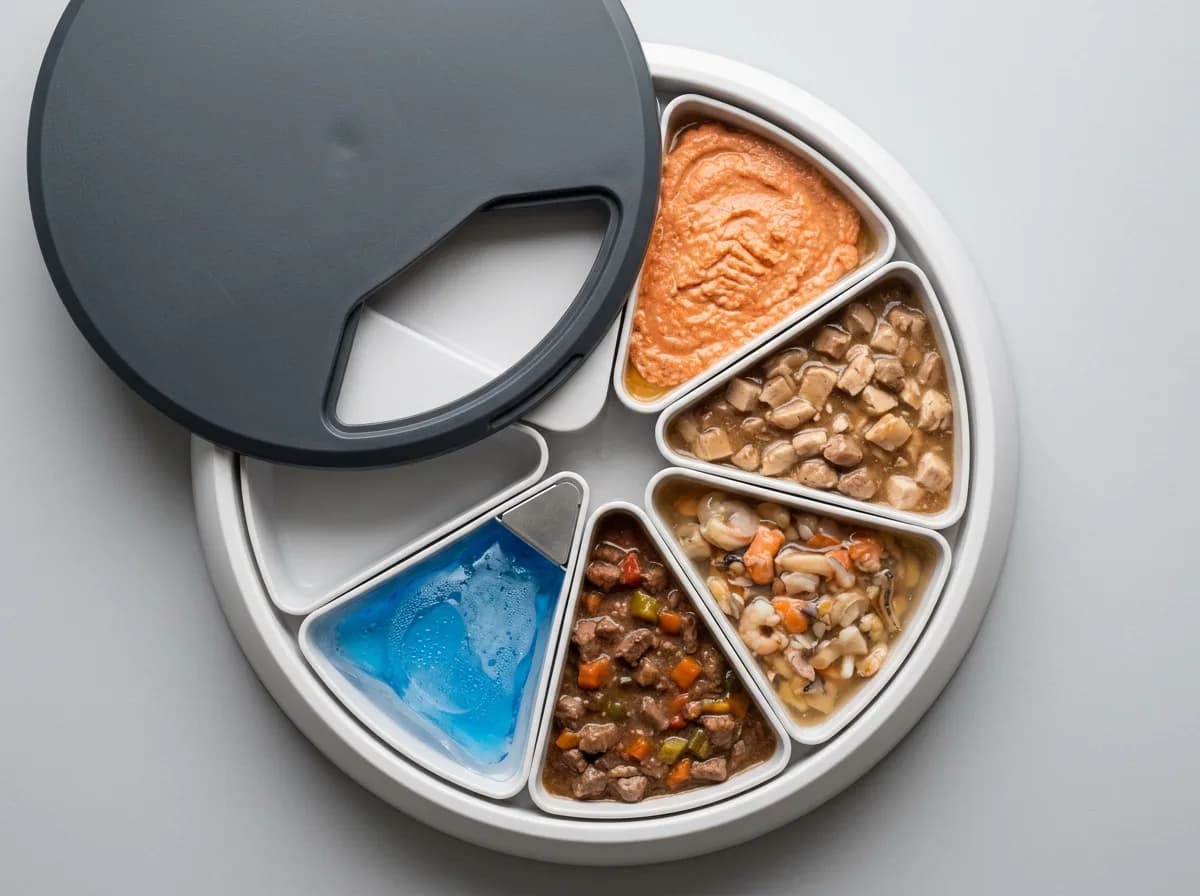
Every wet-food feeder is really answering one question: how do we stop canned food from spoiling before the cat eats it? There are two engineering answers, and the difference between them drives price, run time, and how long you can safely be gone.
Ice-pack (passive) cooling is the older, simpler, cheaper approach. You freeze a gel pack, drop it into a base tray, and set portioned food in sealed or covered compartments on top. The pack chills the food from below for as long as it stays frozen, which in a typical room is somewhere between several hours and a day or so depending on ambient temperature, how many packs the unit holds, and whether the lid seals each portion separately. Cat Mate, PetSafe, and Casfuy all use variations of this. It works, it needs no electricity for cooling, and it is forgiving of power cuts. Its ceiling is physics: once the pack thaws, the cooling stops.
Thermoelectric (active) cooling uses a Peltier element, the same solid-state technology in a plug-in cooler box, to actively pull heat out of the food chamber and hold a set temperature continuously. As long as it has power, it keeps cooling, which is why the Petlibro Polar can advertise roughly three days of freshness rather than the several-hours window of an ice pack. The trade-offs are cost (these units run over twice the price of a basic ice-pack tray) and power dependence: it needs to stay plugged in, and a long outage removes the advantage. For most people the wall-power requirement is a non-issue, and the continuous cold is exactly what makes a genuine multi-day wet-food absence possible.
- 1Ice-pack cooling is cheap and survives power cuts, but stops the moment the pack thaws
- 2Thermoelectric cooling holds a set temperature for days as long as it stays plugged in
- 3The trade-off is cost and power dependence versus a longer safe-absence window
A quick rule of thumb: if your goal is "cover me while I am at work" or "one overnight," an ice-pack feeder is plenty and saves you money. If your goal is "keep wet food genuinely fresh for a two-to-three-day trip," the active-cooling design is the one built for that job.
The Food-Safety Window: How Long Wet Cat Food Can Sit Out
This is the fact everything else hangs on. Opened wet cat food should not sit out at room temperature for more than about 2 to 4 hours. Most manufacturers and veterinary sources put the safe window near two hours in a warm room and stretch it toward four in a cool one. After that, bacteria multiply to levels that can cause vomiting, diarrhea, or worse, and the food dries out and turns unappetizing besides. This is the same food-safety logic you would apply to a plate of meat left on your own counter, and it is exactly why a plain dry-kibble timer cannot be repurposed for wet food.
Cooling changes the math. Refrigerator temperatures (below about 40 degrees Fahrenheit) slow bacterial growth dramatically, which is why a cooled feeder can hold food for a day or more instead of a couple of hours. An ice pack that keeps a sealed compartment cold buys you the difference between a two-hour window and most of a day. Continuous thermoelectric cooling buys you days. The feeder is not making the food last forever; it is holding it in the safe zone until the lid opens, at which point your standard 2-to-4-hour clock starts ticking for the portion that just became "served."
- Cold-from-the-fridge food is less aromatic and some cats eat less of it. If your cat is fussy, pick a feeder whose meal opens shortly before your cat normally eats so the portion has a few minutes to lose its chill and release its smell, rather than sitting cold for hours.
Two practical implications follow from the safety window. First, timing matters more than capacity: a feeder that opens a fresh, still-cold portion right before mealtime is safer than one that exposes several portions early. Second, the sealing quality of each compartment is a real spec, not marketing. A feeder that keeps each meal individually covered until its moment protects the later meals far better than one open tray under a single lid.
Ambient temperature is the hidden variable most buyers forget. The 2-to-4-hour window and the "one day on an ice pack" estimates all assume a normal indoor room, roughly 68 to 72 degrees Fahrenheit. A sunroom in July, a kitchen next to a warm oven, or a home where you turn the air conditioning off while you travel will shorten every one of those numbers. If your feeder will sit somewhere warm, size down your expectations: treat a one-day ice-pack claim as a workday claim, and lean toward thermoelectric cooling for anything longer. The reverse is also true, a cool basement or a home kept at 65 degrees will stretch an ice pack's useful life, but plan for the warm case, not the ideal one, because the cost of guessing wrong is a spoiled meal your cat may still eat.
It is also worth separating "safe" from "appetizing." Food can still be technically within the safety window and yet be refused because it has crusted over, warmed to room temperature, or lost the aroma that draws a cat to the bowl. Cats are famously scent-driven eaters, and a portion that has been exposed even for an hour smells noticeably less enticing than one just uncovered. That is another argument for a feeder that opens each meal fresh and cold on schedule rather than pre-exposing several portions: you are protecting palatability as much as safety.
Single-Meal vs Multi-Meal Designs and How Long You Can Leave a Cat
Wet-food feeders split into two shapes, and the shape decides how long they can stand in for you.
Single or two-meal feeders hold one or two covered wells over an ice pack or cooling base. They are designed for the daily scenario: you leave for work, the feeder pops the lid on a fresh portion at lunchtime, and you are home by evening. Simple, cheap, easy to clean. Not built for multi-day absence.
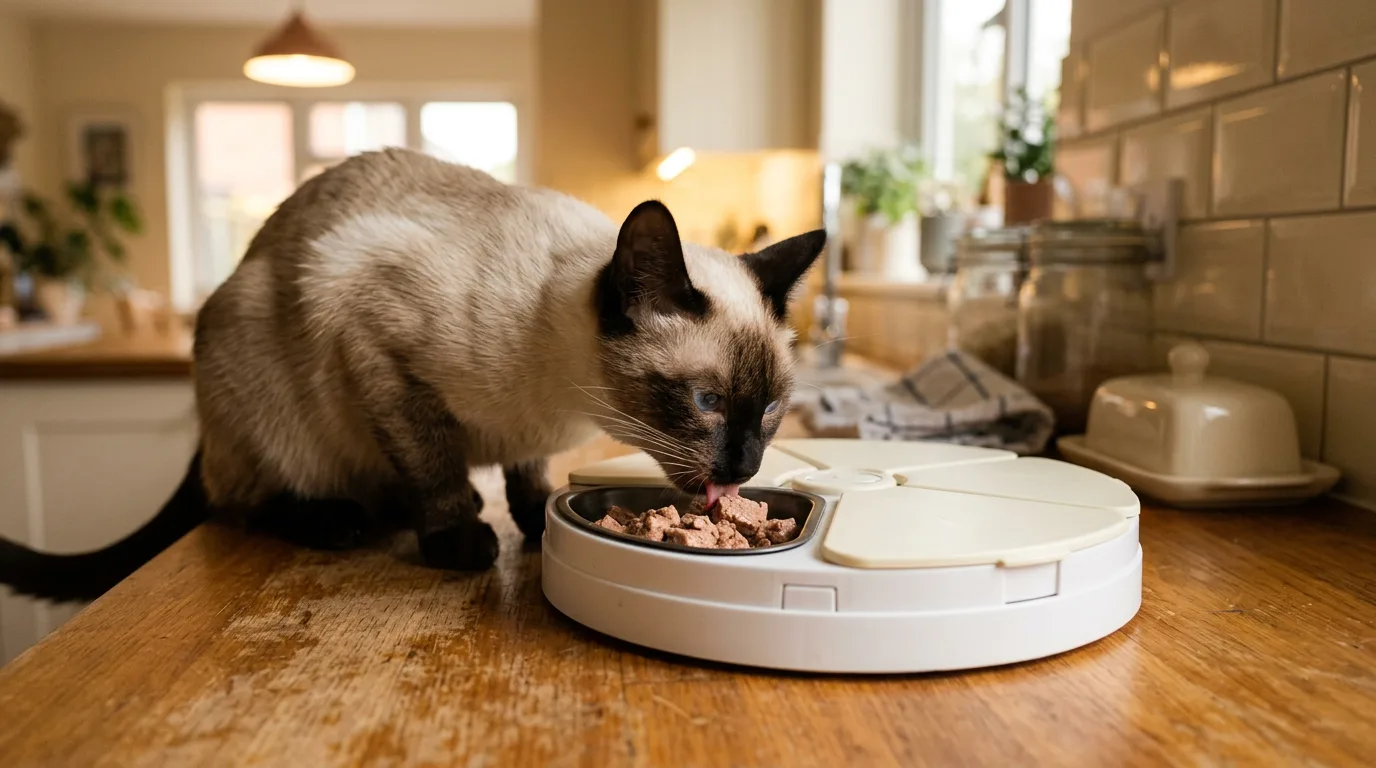
Multi-meal feeders rotate a carousel or open a sequence of five or six compartments on a schedule, each sealed until its turn. This is the design that can cover a genuine absence. A five- or six-compartment ice-pack unit can plausibly cover two meals a day for a couple of days if the pack holds; a thermoelectric unit can hold food fresh across a long weekend. The Petlibro Polar, Casfuy F13, PetSafe 5-Meal, and Cat Mate C500 are all multi-meal designs; the C3000 is a hybrid that adds a large dry hopper alongside a few wet wells.
- 1Single or two-meal feeders cover a workday or one overnight
- 2Multi-meal carousels of five or six compartments can cover a night or two if the ice pack holds
- 3A thermoelectric multi-meal unit is the one built for a multi-day trip
How long you can actually leave a cat is really two questions layered together: can the feeder keep food safe that long, and is it responsible to leave the cat unattended that long? A feeder can technically dispense fresh, cold meals for two or three days. Cats also need constant fresh water, a clean litter box, and eyes on them in case of illness or a stuck paw. The feeder solves food; it does not solve the rest. For anything beyond a night or two, most vets and shelters recommend a drop-in visitor even if the feeder is doing the feeding.
There is also the question of how your particular cat behaves around a feeder, which no spec sheet captures. Some cats learn to pry lids, tip units over, or camp beside the feeder and eat every portion the instant it opens rather than pacing themselves across the day, which defeats the point of scheduled meals and can leave a two-day plan empty by the end of day one. A determined food-motivated cat may need a heavier or wall-adjacent unit, and a fast eater benefits from smaller, more frequent portions rather than two big ones. If you have more than one cat, remember that a single open feeder feeds whichever cat gets there first, so multi-cat homes with different diets often need either separate feeders in separate rooms or microchip-gated bowls, which is a different product category altogether. Test any new feeder for a normal day or two while you are home before you rely on it for a trip, so you learn your cat's habits before the stakes are high.
Our Top Picks
These are ordered by overall value and capability, premium first. Every one is stocked on Chewy. Match the pick to your longest realistic absence and your budget.
1. Petlibro Polar Wet Food Feeder (~$130)
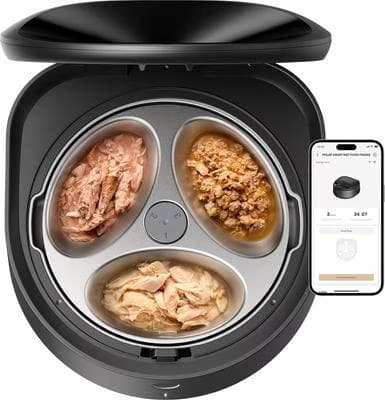
The Polar is the pick if you take real trips and feed wet food. It uses thermoelectric cooling to actively hold the food chamber cold, which is what lets it advertise roughly three days of freshness rather than the several-hours ceiling of an ice-pack tray. It is app-controlled, so you set the schedule and portion sizes from your phone and can adjust remotely if plans change. That combination, continuous cold plus remote scheduling, is exactly what a multi-day wet-food absence needs, and it is the reason this sits at the top despite being the most expensive option here.
Petful may earn a commission when you click through to Chewy, at no extra cost to you.
What you are paying for is the cooling technology and the run time it unlocks. It needs to stay plugged in, so pick a spot near an outlet, and a prolonged power outage would erase its main advantage (the same caveat applies to any active-cooling appliance). For a cat parent who travels for two to three days at a stretch and refuses to switch to dry, this is the most capable feeder on the list.
2. Casfuy F13 6-Meal Ice-Pack Feeder (~$80)
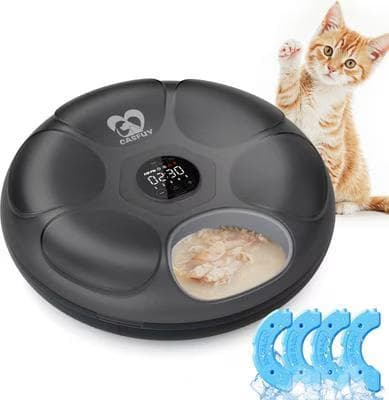
The Casfuy F13 is the strongest ice-pack option here and the best middle-ground pick. Its six sealed compartments over an ice pack give it the most meals of any passive-cooling unit on this list, which makes it the natural choice for someone who wants more than a workday of coverage without stepping up to thermoelectric pricing. Six portions means you can schedule two or three meals a day across a night or two, with each compartment kept individually covered until its rotation opens it, which protects the later meals better than a single open tray would.
Petful may earn a commission when you click through to Chewy, at no extra cost to you.
Its ceiling is the ice pack. In a cool room the pack holds the compartments cold well into a second day; in a warm one you should treat it as a solid one-to-two-day tool rather than a three-day one. At around $80 it lands between the budget trays and the premium Polar, and for most weekend-away scenarios it is the value sweet spot.
3. PetSafe 5-Meal (Eatwell) (~$60)
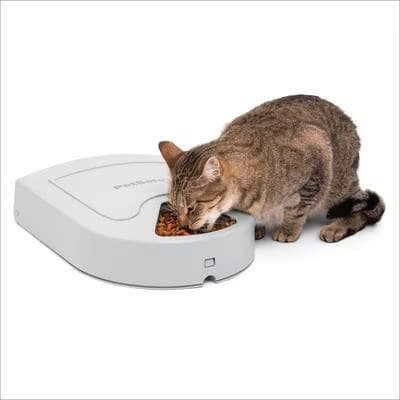
PetSafe's five-meal feeder (sold as the Eatwell) is the reliable, widely available workhorse. Five covered compartments rotate on a programmed schedule over an ice-pack base, and the brand's long track record in pet electronics means parts, support, and replacement trays are easy to find. It is a proven design for covering a workday with a lunchtime wet meal, or stretching to roughly a day of coverage with the ice pack in place.
Petful may earn a commission when you click through to Chewy, at no extra cost to you.
Five compartments is a touch fewer than the Casfuy's six, so it is slightly less suited to a full two-day, multi-meal-a-day plan, but for the common "feed my cat lunch while I am out" and single-overnight cases it does the job at a friendly price. If you value a well-established brand and simple, dishwasher-friendly parts over squeezing out the maximum meal count, this is the safe choice.
4. Cat Mate C500 (~$46)
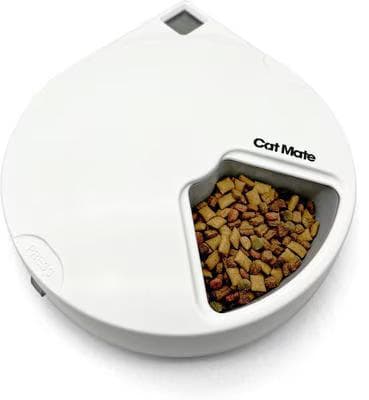
The C500 is the budget pick, and it is a genuinely good one. It gives you five meals over an ice pack in a compact, quiet, battery-powered unit for well under fifty dollars, which makes it the easiest way to try wet-food automation without a big outlay. Battery power (rather than a wall plug) is a real plus for placement flexibility and means a power cut does not stop the schedule, though the cooling is still only as good as the frozen pack.
Petful may earn a commission when you click through to Chewy, at no extra cost to you.
At this price you are not getting an app or active cooling, and five ice-pack compartments cap it at roughly a day of safe coverage. But for the daily routine, the occasional overnight, or a first-time buyer testing whether their cat takes to a feeder at all, the C500 delivers the core function, timed and cooled wet meals, at the lowest cost on this list.
5. Cat Mate C3000 (Dry + Wet Hybrid)
The C3000 is the odd one out, and useful for a specific household: it is a hybrid that pairs a large dry-food hopper with a few wet-food-capable wells over an ice pack. That makes it the pick for a multi-cat or mixed-feeding home where one bowl needs a steady supply of kibble and another needs a couple of timed wet portions, all from one appliance.
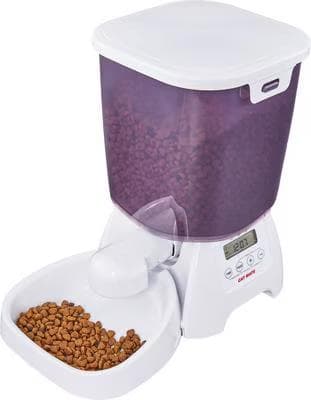
Petful may earn a commission when you click through to Chewy, at no extra cost to you.
Treat its wet-food side as a bonus rather than its main event: the wells and ice pack cover a small number of wet meals (think a couple, not a week), while the dry hopper carries the bulk-feeding load. If your problem is "I need reliable dry feeding plus a little wet on a timer," the C3000 consolidates two machines into one. If wet food is your whole reason for buying, one of the dedicated feeders above will serve you better.
Petlibro Polar vs Cat Mate C500 vs PetSafe: Head to Head
The clearest way to choose is to line up the premium, budget, and brand-name picks against each other on the specs that actually decide the buy.
| Spec | Petlibro Polar | Cat Mate C500 |
|---|---|---|
| Cooling | Thermoelectric (active, ~3 days) | Ice pack (~1 day) |
| Meals / capacity | App-scheduled, continuous cold | 5 compartments |
| Price tier | Premium (~$130) | Budget (~$46) |
| Best for | 2-3 day trips, wet-food-only cats | Daily use and first-timers on a budget |
Read it this way. The Polar wins on run time and remote control and is the only one here truly built for multi-day trips, at a premium price. The C500 wins on price and simplicity and is the right call for daily feeding or a cautious first purchase. The PetSafe 5-Meal sits between them as the trusted-brand middle option: five ice-pack meals, a proven design, easy support, and a mid-range price that suits people who want reliability over either extreme. If your longest absence is a workday, buy on price. If it is a long weekend, buy on cooling.
Cleaning and Maintenance
A wet-food feeder that is not kept clean becomes a health risk, so cleaning ease deserves weight in your decision. Wet food leaves residue that dries hard and grows bacteria, so plan to wash the food trays and any removable lids after every cycle, not once a week. Look for feeders whose trays, wells, and inner lids detach and are dishwasher-safe; that single feature turns a chore into a rinse. The motor base and any electronics never go in water; wipe those with a damp cloth only.
Ice packs need their own attention: rinse and dry them between uses so they do not carry residue back into the next cold cycle, and keep a spare frozen so you are never waiting on a single pack. For thermoelectric units, keep the cooling vents clear of food debris and dust so the Peltier element can shed heat efficiently. Whatever the model, run a full disassembly-and-wash before the first use and after any multi-day trip, and replace worn silicone seals when they stop sealing, because a compartment that no longer closes tightly loses the food-safety protection you bought the feeder for.
What to Look For
If you are choosing beyond this list, weigh these five factors in roughly this order of importance.
- Cooling type and run time. This is the top spec because it sets the safe-absence ceiling. Ice pack for daily and overnight use; thermoelectric for multi-day trips. Everything else is secondary to whether the food stays safe.
- Capacity (number of meals). More compartments means more meals before the feeder runs dry, but only if the cooling lasts that long. Five to six sealed compartments is the practical sweet spot for a weekend; a hybrid dry hopper helps only if you also feed kibble.
- Power source: battery vs plug. Battery units keep running through a power cut and place anywhere, which suits ice-pack feeders. Thermoelectric feeders must stay plugged in, since the cooling is the whole point. Decide which failure mode you would rather avoid.
- App and scheduling. App control lets you set portions and times precisely and adjust remotely mid-trip, genuinely useful when travel plans slip. It is a premium feature, not a necessity; a good mechanical timer covers most routines.
- Budget and sealing quality. Price tracks cooling technology closely, so set your budget by your longest realistic absence, not by feature envy. And do not skimp on how well each compartment seals: individual covered wells protect later meals far better than one open tray, and that sealing is what actually keeps the food safe.
- It is tempting to buy the cheapest feeder that handles a normal workday, but the feeder you regret is the one that cannot cover the trip you actually take. Size the cooling and meal count to the longest absence you realistically leave your cat for, then use it for the everyday cases too.
For more on picking a feeder of any type, see our full guide to the best automatic cat feeders, and to get the schedule itself right, read how often to feed a cat. One more note on food type: wet food supports hydration and suits many cats' preferences, while dry food is simpler to automate and store, so many households run a mix, and a hybrid feeder like the C3000 exists precisely for that split.
Frequently Asked Questions
How to Transition Your Cat to an Automatic Wet Food Feeder
Most cats accept an automatic wet food feeder within a few days, but a calm, staged introduction prevents the stress that can put a suspicious cat off the whole idea. Start by placing the feeder, unplugged and with the lid open, in your cat’s normal eating spot for a day or two so it becomes a familiar object rather than a strange new machine. Let your cat sniff and investigate it on their own terms, and reward any curiosity with a treat nearby.
Next, run the feeder through a full cycle while you are home and your cat is watching. The tray rotation and any beep or motor sound is the part cats notice most, so let them hear it a few times with no pressure to eat. Put a small amount of a food they already love in the first open compartment so the first automated meal is a clearly positive experience. If your cat hesitates, hand-feed a bite from the tray so they connect the feeder with their normal food.
Once your cat is eating comfortably from the open tray, begin using the timer for one meal a day while you are still around to supervise. Keep their other meals on the old routine at first, then shift more meals to the feeder over a week or two as your cat gains confidence. Cats are creatures of habit, so change the schedule gradually rather than all at once.
- 1Let your cat investigate the feeder unplugged for a day or two first
- 2Run a full cycle while you are home so the sound becomes familiar
- 3Start with one timed meal a day, then shift more over a week or two
A few practical points make the transition stick. Clean the tray after every wet meal, because a cat that finds crusted old food will learn to distrust the feeder. If you use ice packs, chill them fully so the food stays appealing rather than lukewarm. And always leave a bowl of fresh water nearby, ideally a fountain, since wet food does not replace a cat’s need to drink. With a patient introduction, most cats treat the feeder as just another reliable part of their day.
Yes, but only feeders specifically built for it. Standard dry-kibble dispensers cannot keep wet food safe. Wet-food feeders use ice packs or thermoelectric cooling to hold canned or pouch food in the safe temperature zone and keep each portion sealed until its scheduled meal, which a plain timer feeder does not do.
Use a cooled, multi-compartment wet-food feeder. Portion the meals into its sealed wells, add a frozen ice pack (or plug in a thermoelectric model), and program the schedule so each fresh, cold portion opens right before your cat normally eats. Always leave plenty of fresh water alongside it.
For multi-day trips, the Petlibro Polar leads because its thermoelectric cooling keeps food fresh for about three days and it is app-controlled. For a weekend on a budget, the Casfuy F13 (six ice-pack compartments) is the value pick, and the Cat Mate C500 is the best low-cost daily option.
A multi-meal cooled feeder can safely dispense fresh wet meals across two days, especially a thermoelectric model or a six-compartment ice-pack unit with a well-frozen pack. But food is only part of it: your cat also needs constant fresh water, a clean litter box, and someone to check on them, so a drop-in visit is still wise even over two days.
The 3-3-3 rule describes how long a newly adopted cat takes to adjust: about 3 days to decompress, 3 weeks to settle into a routine, and 3 months to feel fully at home. For feeding, it is a reminder to keep meals consistent and predictable during that adjustment, which is exactly where a reliable automatic feeder on a fixed schedule can help a new cat feel secure.
Yes, provided it is a dedicated wet-food model with cooling. Feeders using ice packs or thermoelectric cooling keep canned food safe and portioned; ordinary dry-food dispensers cannot, because wet food spoils within a couple of hours at room temperature without refrigeration.
For a short vacation of a day or two, a cooled multi-meal wet-food feeder handles the meals: load the sealed compartments, add a fresh ice pack or use a plug-in thermoelectric feeder, and set the schedule. For anything longer, pair the feeder with a pet sitter who can refresh food and water, since no feeder covers an extended absence on its own.
Many vets support automatic feeders for keeping mealtimes consistent, controlling portions to manage weight, and slowing fast eaters. The main cautions are to keep the feeder scrupulously clean, ensure it never becomes the reason a cat is left unmonitored too long, and for wet food, to use a properly cooled model so meals stay safe.
Three days pushes the limit. A thermoelectric feeder can keep wet food fresh that long, but leaving a cat unattended for three days is risky regardless of the feeder, because water can spill, litter fills, and illness or injury can go unnoticed. Most vets and shelters recommend a daily or every-other-day visitor for any absence of two to three days or more, with the feeder handling the meals in between.

Coreen Saito is a pet writer and longtime shelter volunteer with more than a decade in animal rescue. She covers cat behavior, breed care, and the small, ordinary science of sharing a life with companion animals, with a particular focus on honest takes about the products and decisions that actually matter. At home in Arizona, she's outranked by Mac (a dog with the loudest opinion in the house), Rebel (a cat who governs by quiet authority), and Meri (an orange tabby who runs the late shift and the laundry basket). She writes about all three, plus the rescues that keep coming through her life, at LifeWithMinty.com.
Sign up for expert-backed reviews and safety alerts all in one place.