Savannah Cat: Size, Price, Generations and Full Breed Guide
A complete savannah cat guide covering generations (F1 to F5), real price ranges, size, temperament, legality by state, health, and care, plus an honest look at whether this serval hybrid is right for your home.
Petful is reader supported. As an affiliate of platforms like Amazon and Chewy, we may earn a commission when you buy through links on this page. There is no extra cost to you.
The savannah cat is a hybrid breed created by crossing a wild African serval with a domestic cat, and according to The International Cat Association (TICA) the very first one was born on April 7, 1986. That single litter launched the tallest, most striking domestic cat most people have ever seen: a lean, long-legged animal that can stand up to 17 inches at the shoulder, weigh 11 to 20 pounds, and live 12 to 15 years. If you have ever spotted a cat that looks like a miniature cheetah strolling on a leash, you were almost certainly looking at one of these.
This guide pulls together everything a prospective owner needs in one place: the generation system (F1 through F5 and beyond), real price ranges, the patchwork of state laws, temperament, daily care, health, and an honest look at whether this wild-looking cat actually belongs in your living room.
- 1Savannahs are a serval x domestic cat hybrid first bred in 1986, recognized by TICA for championship competition in 2012
- 2Generation matters more than any other single factor: an F1 is roughly 50% serval, an F2 about 25%, and percentages fall from there
- 3Expect 11 to 20 pounds, up to 17 inches tall, and a 12 to 15 year lifespan
- 4Legality is set state by state and even city by city, so verify your local law before you buy

Sign up for expert-backed reviews and safety alerts all in one place.
What Is a Savannah Cat?
A savannah cat is a domestic hybrid: the descendant of a serval, a medium-sized wild cat native to the African savanna, crossed with a domestic cat. The breed's scientific shorthand is *Felis catus x Leptailurus serval*, which captures both halves of its parentage.
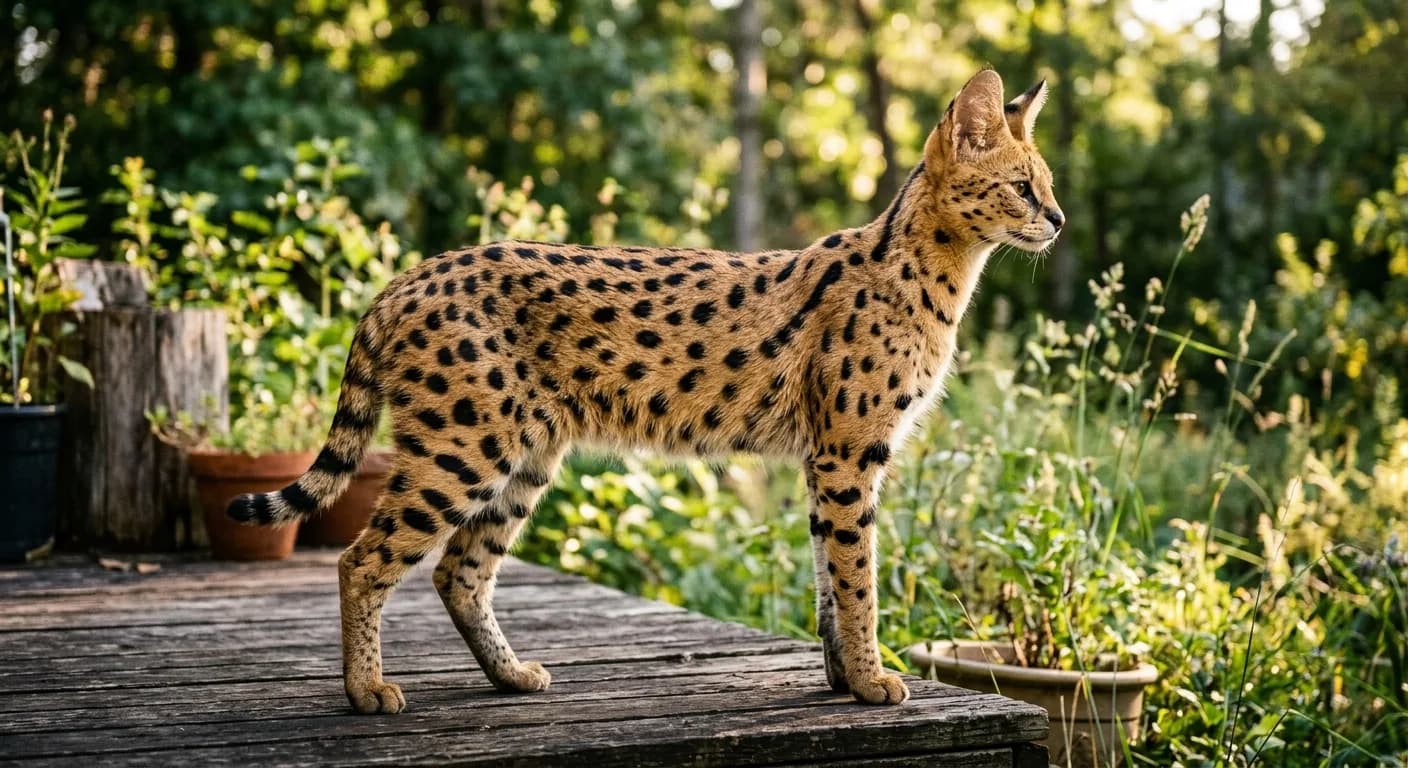
The look is unmistakable. Savannahs are built tall and lean rather than stocky. They carry long, slender necks, slightly triangular heads, very large ears set high and upright, and legs that run noticeably longer than an ordinary housecat's. The coat is short and patterned with bold dark spots over a base of golden brown, silver, black, or black smoke. The overall impression is a small cheetah, which is exactly the effect breeders set out to achieve.
It is worth being clear about what a savannah is and is not. It is a recognized domestic breed, not a wild animal you keep as a novelty. At the same time, the earliest generations carry a high percentage of serval genes and behave accordingly, which is why generation is the first thing any serious buyer should understand. The serval parent is a true wild cat, and anyone romanced by the savannah's looks should first read a clear-eyed account of what owning a serval actually involves before deciding how much wild blood they want in the house.
- Servals roam the grasslands and savannas of sub-Saharan Africa, and the breed was named for that landscape. The first kitten produced from a serval and a domestic cat was literally named Savannah, and the name stuck for the whole breed.
A Short History of the Breed
The breed's origin is well documented. In 1986, a serval owned by one breeder mated with a domestic cat belonging to another, and a single hybrid kitten named Savannah was born on April 7 of that year. Breeders saw the potential in a cat that combined a wild silhouette with a companionable temperament, and through the late 1980s and 1990s they worked to establish a consistent type.
TICA accepted the savannah for registration in 2001 and granted it full championship status in 2012, which is the milestone most often cited as the breed's formal arrival. Today the savannah is one of the most recognizable and sought-after hybrid breeds in the world, though it remains far less common than established breeds like the Maine Coon or the Siamese that helped build its foundation lines.
Savannah Cat Generations Explained
Nothing about this breed matters more than the generation label, written as an "F number." It tells you how many generations removed a given cat is from its wild serval ancestor, and it predicts size, temperament, price, and even whether the cat is legal where you live.
| Generation | Approx. Serval Percentage | What to Expect |
|---|---|---|
| F1 | About 50% | Largest and most wild in behavior; serval parent. Often heavily restricted by law. |
| F2 | About 25% | Still large and athletic with strong serval traits; one serval grandparent. |
| F3 | About 12.5% | More manageable; many owners find this the sweet spot for a wild look with domestic temperament. |
| F4 and F5 | Roughly 6% or less | Considered Stud Book Tradition (SBT) once both parents are savannahs for several generations; the most house-friendly tier. |
A few points the table cannot capture:
Never Scoop Again® with the Whisker Litter-Robot, the smart self-cleaning automatic litter box. Monitor visits and track weights for better overall care in the Whisker® app. Multi-cat friendly.
Petful may earn a commission when you click through to Whisker, at no extra cost to you.
The percentages are approximate, not exact. Genetics do not split cleanly, so two F2 cats from different lines can differ noticeably in size and drive. The F number is a reliable guide, not a guarantee.
Males are often sterile in early generations. F1 through roughly F4 males are frequently infertile, which is why breeding programs lean on fertile females and serval studs to produce each new F1. This biology is part of why early-generation cats command such high prices.
Later does not mean boring. Even an F5 savannah keeps the long legs, big ears, spotted coat, and high energy that define the breed. You are choosing a calmer, more predictable companion, not a different-looking cat.
For most first-time owners, an F3 or later strikes the best balance of dramatic looks and livable behavior. If you are specifically drawn to the biggest, wildest end of the spectrum, our dedicated guide to the F1 savannah cat covers the realities of that tier in depth.
- A reputable breeder will state the exact generation and provide TICA registration paperwork. If a seller is vague about the F number or cannot produce registration, treat that as a serious red flag, both for the cat's authenticity and for your legal protection.
How Big Do Savannah Cats Get?
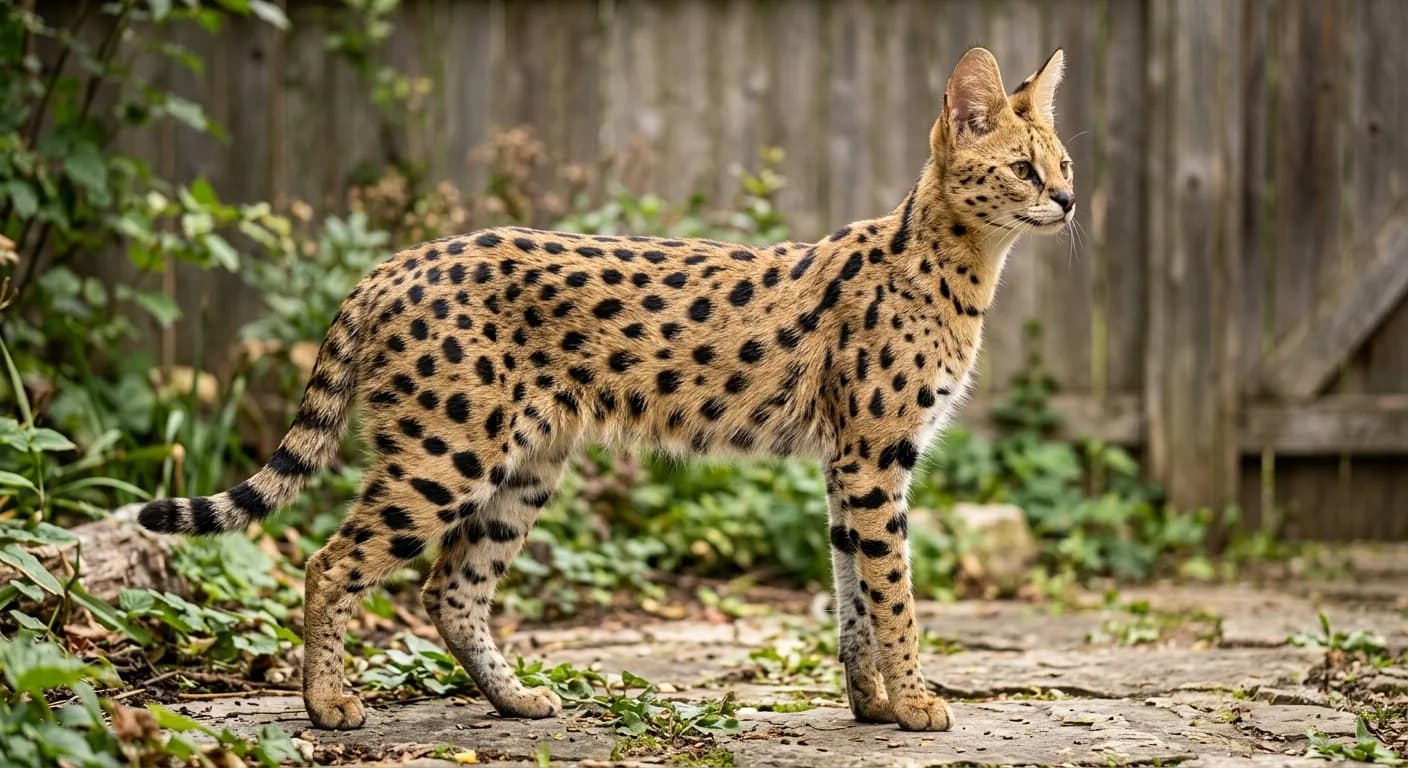
Savannahs are routinely called the tallest domestic cat breed, and the reputation is earned. Their height comes from those long legs and upright posture rather than from bulk. A tall savannah can stand around 16 to 17 inches at the shoulder, and the breed has held a Guinness World Record for tallest domestic cat.
In terms of weight, most savannahs fall between 11 and 20 pounds, with the heaviest figures belonging to large F1 and F2 males. Because they are lean and elongated, they often look even bigger than the scale suggests. Later-generation cats tend toward the lower end of that range and are closer in mass to a large ordinary housecat, just stretched taller.
Savannah vs Maine Coon: which is bigger?
This is one of the most common comparisons, and the answer depends on how you measure. The Maine Coon is generally the heavier and more massive breed, with large males reaching well over 15 pounds of dense, muscular body. The savannah usually wins on height and leg length, standing taller even when it weighs less. So a Maine Coon is typically bigger by weight and bulk, while a savannah is typically taller and leaner.
Temperament and Personality
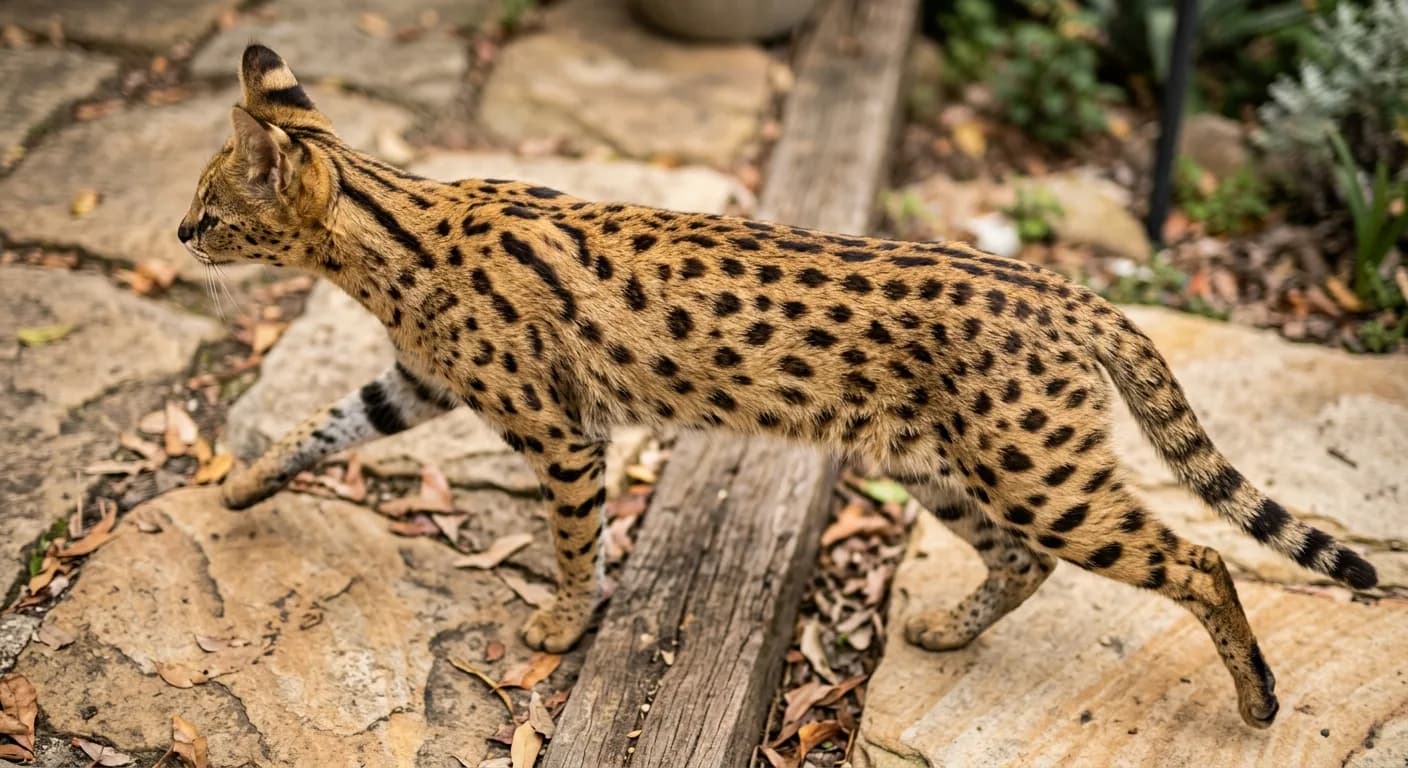
If you take one thing from this section, make it this: savannahs are intensely active, intelligent, and interactive cats that are often described as dog-like. They bond hard with their people, follow them from room to room, and are not content to sleep on a windowsill all day.
Common traits owners report include:
Athleticism. Savannahs jump extraordinarily well, easily clearing counters, refrigerators, and the tops of door frames. Vertical space is not optional with this breed.
Water fascination. Many savannahs love water and will paw at faucets, join you at the sink, or splash in a tub. This trait traces back to the serval, a wetland hunter.
Trainability. They take readily to leash-and-harness walks, learn to fetch, and can pick up cues like a clever dog. Mental stimulation is as important to them as physical exercise.
Vocal and social behavior. Expect chirps, trills, and the occasional loud demand for attention. They do not do well left alone for long stretches and often pair better with another active pet than with a quiet household.
- A bored savannah is a destructive savannah. Without daily play, climbing outlets, and interaction, these cats open cabinets, knock items off shelves, and find their own (expensive) entertainment. Be honest about your time and energy before committing.
The breed's high-octane personality and exotic appearance invite frequent comparison to the Bengal, the other famous wild-look hybrid. If you are weighing the two, our full Bengal cat guide breaks down how their temperaments and care needs diverge, and our roundup of Bengal cat mixes covers the wider family of spotted hybrids you might encounter while shopping.
How Much Does a Savannah Cat Cost?
Price is driven almost entirely by generation, and the spread is enormous. As a working framework:
- Later generations (F4, F5 and SBT): often in the low thousands, frequently around 1,000 to 5,000 dollars depending on quality, breeder, and pet versus show potential.
- Mid generations (F2, F3): commonly several thousand dollars, often in the 4,000 to 10,000 dollar range.
- F1 savannahs: the priciest tier by far, regularly running from roughly 12,000 dollars up to 20,000 dollars or more for top examples.
Those F1 figures are why the savannah turns up in lists of the world's most expensive cats and why search engines fill with questions like "what cat is worth 20,000 dollars." An exceptional F1 savannah is a genuine answer to that question.

63-inch multi-level cat tree with scratch posts, hammock, plush perches, and dangling toys. Vertical territory is non-negotiable for high-energy climbing breeds like the Bengal.
Petful may earn a commission when you click through to Chewy, at no extra cost to you.
- Budget well beyond the sticker. A savannah needs a tall, sturdy cat tree or climbing wall, an enclosed catio or harness for safe outdoor time, premium food, and the same lifelong veterinary care as any cat. Early-generation cats may also require a specialized or exotics-experienced veterinarian, which costs more than a standard clinic visit.
Whatever generation you choose, buy only from a TICA-registered breeder who health-tests their lines and will show you the kitten's parents and paperwork. The bargain "savannah" advertised for a few hundred dollars on a classifieds site is almost never the real thing. For a deeper breakdown of what drives the numbers and how to budget realistically, see our dedicated guide to savannah cat price.
A Savannah is a high-value, often regulated cat, so a free MyPetID profile is worth keeping, storing generation paperwork, microchip number, and proof of ownership in one place, with a scannable QR ID that helps recover a cat people may mistake for a wild serval.
Is a Savannah Cat Legal Where You Live?
This is the question that trips up the most buyers, and there is no single national answer. In the United States, the legality of owning a savannah is decided by a patchwork of state, county, and city laws, and the rules very often hinge on the generation.
The general pattern works like this:
- Many jurisdictions that regulate savannahs restrict or ban only the earliest generations (typically F1 through F3 or F4), treating them more like the serval, while allowing later-generation cats that are several steps removed from the wild parent.
- Some places require a permit or license for certain generations rather than an outright ban.
- A smaller number of states and cities restrict the breed regardless of generation.
Because these rules change and are enforced locally, the only safe approach is to confirm the current law for your specific state and municipality before you commit to a kitten. A breeder may know the broad strokes, but the legal responsibility lands on the owner. Our guide to whether savannah cats are legal walks through how the generation-based rules typically work and what questions to ask your local animal control office.
- Lawmakers regulate exotic and hybrid animals based on how close they are to a wild species. Since an F1 is about half serval and a later-generation cat is overwhelmingly domestic, statutes commonly draw the legal line at a specific F number rather than banning the whole breed.
Are Savannah Cats Dangerous?
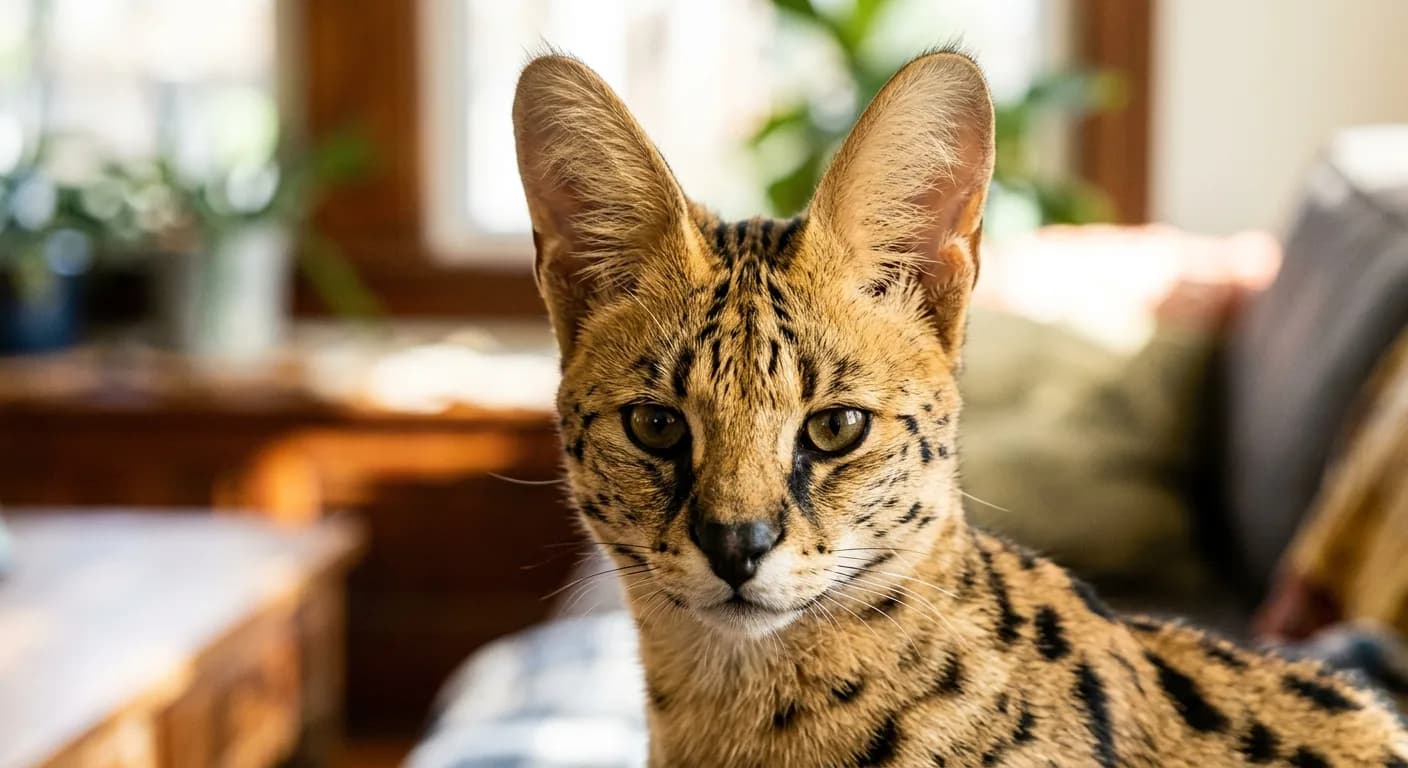
For a later-generation savannah living as a family pet, "dangerous" is the wrong word. These are domestic cats with big personalities, not predators. They can be mouthy in play and powerful enough to knock things over, but a well-socialized F4 or F5 savannah is no more a safety threat than any large, energetic housecat.
The nuance, again, is generation. An F1 or F2 carries more serval instinct, more strength, and more intensity, and it demands an experienced owner who can meet its needs and manage its environment. That is a question of suitability and commitment, not viciousness. Problems arise when people acquire a high-generation hybrid on impulse, underestimate its drive, and cannot provide the space, stimulation, and structure it requires.
We cover the realistic risks, the behavior myths, and the owner-experience question in detail in our piece on whether savannah cats are dangerous.
Caring for a Savannah Cat
The good news is that, coat and grooming aside, much of savannah care echoes responsible care for any active cat. The energy level is what sets the work apart.

108-oz stainless steel pet fountain with quiet pump and water-level window. Bengals are notoriously water-obsessed; a flowing fountain encourages hydration and pulls them away from sinks and toilets.
Petful may earn a commission when you click through to Chewy, at no extra cost to you.
Grooming
The short, dense coat is low maintenance. A weekly brushing removes loose hair and keeps the spots glossy, and savannahs are generally tidy self-groomers. Round out the routine with regular nail trims and dental care, since dental disease is a common feline issue across all breeds.
Diet and nutrition
Feed a high-quality, protein-forward cat food that meets AAFCO standards for the cat's life stage. Savannahs do well on premium commercial diets, and there is no need for an exotic or raw-only regimen unless your veterinarian specifically recommends one. Introduce any food change gradually to avoid digestive upset, keep fresh water available at all times, and watch portions, because even an athletic cat can gain unhealthy weight if it is fed free-choice and under-exercised.
Exercise and enrichment
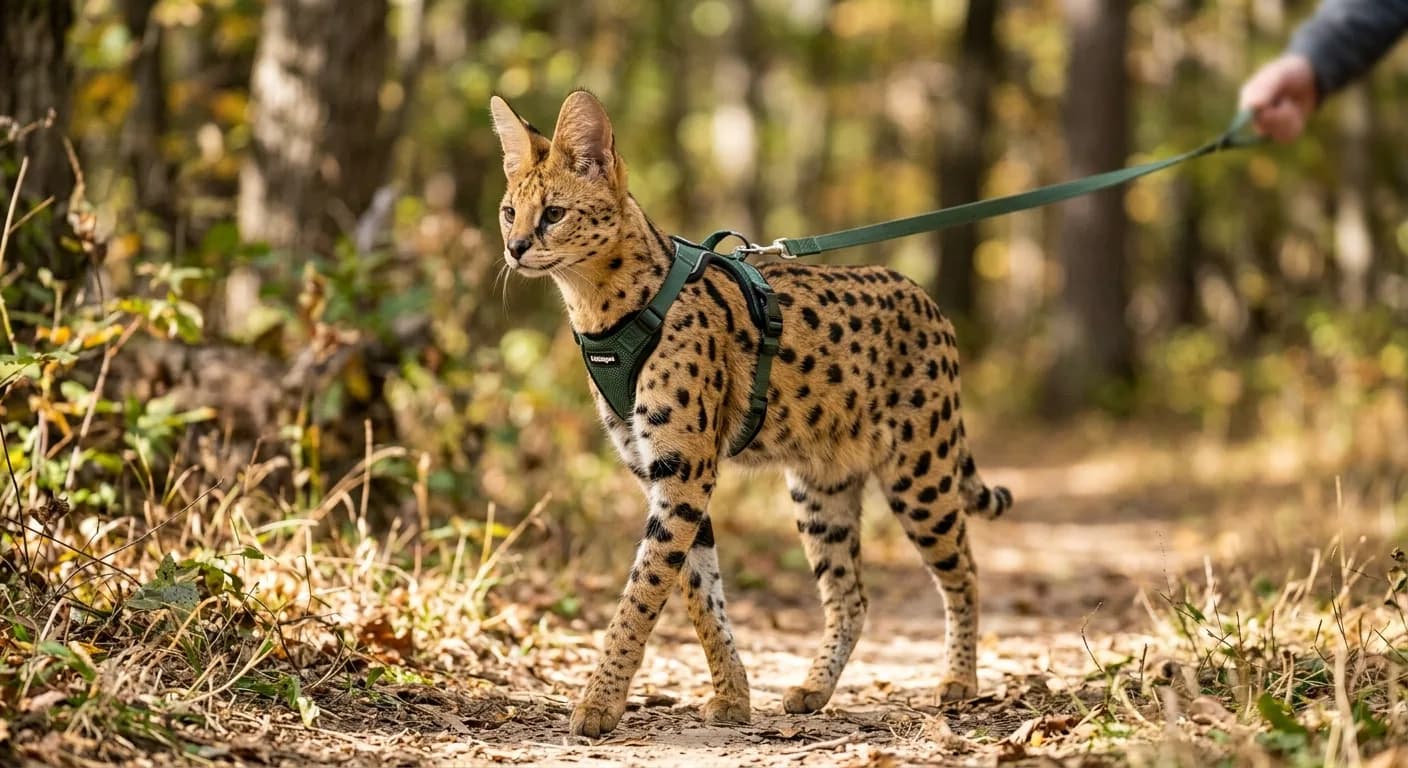
This is where the breed earns its reputation. Plan for daily interactive play, puzzle feeders, and serious vertical territory. Tall cat trees, wall-mounted shelves, and sturdy perches let a savannah climb and survey the way it instinctively wants to. Many owners leash-train their cats or build a secure catio so the cat can experience the outdoors without the risks of free-roaming.
- Because savannahs train so readily, channel that intelligence: teach fetch, practice harness walks, rotate puzzle toys, and use clicker training. A savannah with a job to do is a calmer, happier, less destructive housemate.
Living environment and other pets
Savannahs thrive in homes that can match their energy and tolerate a busy, curious cat that gets into everything. They often do best with another active animal for company and tend to be poor fits for people who want a placid lap cat or who are away from home for long hours. Their jumping ability also means breakables, balconies, and screens need a second look before a savannah moves in.
Savannah Cat Health and Lifespan
Savannahs are generally a robust breed, and the typical lifespan is 12 to 15 years, with some individuals reported to live into their late teens or beyond when they receive consistent preventive care.
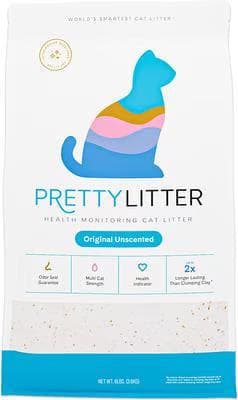
Color-changing crystal litter that flags pH shifts in your cat's urine, an early warning sign of UTIs, kidney issues, and more.
Petful may earn a commission when you click through to Chewy, at no extra cost to you.
A handful of health conditions are worth knowing about and discussing with a breeder, since responsible programs test their breeding cats:
Pyruvate kinase deficiency (PK deficiency): an inherited condition affecting red blood cells, for which a genetic test exists.
Progressive retinal atrophy (PRA): an inherited degenerative eye disease that can lead to vision loss, also identifiable through genetic testing.
Hypertrophic cardiomyopathy (HCM): the most common form of heart disease in cats generally, worth monitoring across the breed.
Routine feline concerns: dental disease and obesity, both of which are largely manageable through good preventive care, diet, and exercise.
- Because PK deficiency and PRA both have DNA tests, an ethical breeder can show you the results for a kitten's parents. Reviewing that paperwork before purchase is one of the simplest ways to stack the odds in favor of a long, healthy life.
Establishing care with a veterinarian who is comfortable with the breed, especially for early-generation cats, keeps vaccinations, parasite prevention, and wellness checks on track from kittenhood forward.
Is a Savannah Cat Right for You?
A savannah rewards the right owner like few other cats. If you want an athletic, affectionate, endlessly engaging companion that walks on a leash, plays in water, and turns heads on sight, and you can provide the space, time, enrichment, and budget it demands, a later-generation savannah can be a spectacular pet.
It is the wrong cat for someone seeking a quiet, independent, low-maintenance animal, for a household that is empty most of the day, or for anyone unwilling to verify local law and buy responsibly. And the higher up the generation ladder you climb, the more those demands intensify, until at the F1 level you are essentially caring for an animal with one foot still in the wild.
Choose your generation honestly, buy from a registered and health-testing breeder, confirm your local laws, and prepare your home for a cat that will genuinely change the energy of your household.
Prices range widely by generation. Later-generation cats (F4, F5, SBT) often run from about 1,000 to 5,000 dollars, mid generations (F2, F3) commonly fall in the 4,000 to 10,000 dollar range, and F1 savannahs frequently cost 12,000 to 20,000 dollars or more, which places them among the most expensive cats in the world.
It depends on your state, county, and city, and often on the generation. Many areas restrict only the earliest generations (such as F1 through F3 or F4) or require a permit, while allowing later-generation cats. A few places restrict the breed regardless of generation. Always confirm your local law before buying.
Yes, for the right owner. Later-generation savannahs are affectionate, playful, dog-like companions that bond closely with their families. They need lots of exercise, vertical space, and interaction, so they suit active households better than quiet ones, and they are generally not ideal for people seeking a calm lap cat.
They are considered the tallest domestic cat breed, standing up to about 16 to 17 inches at the shoulder, and they typically weigh 11 to 20 pounds. Their long legs and lean build make them look even larger than their weight suggests, with F1 and F2 males reaching the high end of the range.
A well-socialized later-generation savannah is not dangerous; it is simply a large, energetic, intelligent housecat. Early generations (F1 and F2) carry more serval instinct and strength and need an experienced owner, but the concern is suitability and commitment rather than aggression.
The typical Savannah cat lifespan is 12 to 15 years, and some individuals live into their late teens or beyond with good preventive veterinary care, a quality diet, and regular exercise.
It depends on the measure. The Maine Coon is usually heavier and more muscular by body mass, while the Savannah is usually taller and leaner thanks to its long legs. So a Maine Coon tends to win on weight and bulk, and a Savannah tends to win on height.
The 3-3-3 rule is a general guideline for any newly adopted cat: roughly three days to decompress in a quiet space, three weeks to learn the household routine, and three months to feel fully settled. Given how active and sensitive savannahs are, a calm, patient introduction following this pattern helps them adjust.

Coreen Saito is a pet writer and longtime shelter volunteer with more than a decade in animal rescue. She covers cat behavior, breed care, and the small, ordinary science of sharing a life with companion animals, with a particular focus on honest takes about the products and decisions that actually matter. At home in Arizona, she's outranked by Mac (a dog with the loudest opinion in the house), Rebel (a cat who governs by quiet authority), and Meri (an orange tabby who runs the late shift and the laundry basket). She writes about all three, plus the rescues that keep coming through her life, at LifeWithMinty.com.
Sign up for expert-backed reviews and safety alerts all in one place.