F1 Savannah Cat: Generations F1 to F5 Explained
An F1 Savannah cat is a first-generation serval cross, about 50% wild. This guide explains the F1 to F5 generation ladder: serval percentage, size, temperament, fertility, price, and legality, so you know exactly what you are buying.
Petful is reader supported. As an affiliate of platforms like Amazon and Chewy, we may earn a commission when you buy through links on this page. There is no extra cost to you.
An F1 Savannah cat is the first-generation offspring of an African serval and a domestic cat, which makes it roughly 50% serval, according to The International Cat Association (TICA), the registry that recognizes the breed. That single "F" number, short for "filial," is the most important spec in the Savannah world: it tells you how many generations a cat sits away from its wild ancestor, and it drives everything from size and temperament to price and whether the cat is even legal where you live. This guide walks the full ladder, F1 through F5 and beyond, so you can tell exactly what you are looking at.
- 1"F" stands for "filial" and counts generations from the African serval, the wild parent of the breed
- 2An F1 Savannah is about 50% serval, an F2 roughly 25%, an F3 around 12.5%, with the wild percentage halving (on average) each generation
- 3F1 cats are the largest and most serval-like in look; F4 and F5 cats resemble a tall spotted housecat
- 4"SBT" (Stud Book Tradition) Savannahs are F4 and later, four or more generations removed from the serval and considered fully domestic
- 5Generation drives legality: many U.S. states restrict or ban early-generation (F1 to F3) cats while allowing later ones

Sign up for expert-backed reviews and safety alerts all in one place.
What is an F1 Savannah cat?
An F1 Savannah cat is a direct serval-to-domestic-cat cross. One parent is a purebred African serval (*Leptailurus serval*, a medium-sized wild cat native to sub-Saharan Africa) and the other is a domestic cat, so the kitten inherits half of its genes from each side. That 50-50 split is why the F1 is the most "wild-looking" and physically dramatic generation of the entire breed. For more, see Petful’s guide to are Savannah cats dangerous.
The Savannah itself was developed in the 1980s. The first documented kitten, named "Savannah," was born in 1986, and TICA accepted the breed into its new-breed program in 2001 before granting full championship status to later generations in May 2012. So while the breed is now formally recognized, an F1 is only one step removed from a non-domestic animal, and that matters for how it looks, behaves, and is regulated.

Compare coverage choices for your pet, then request a quote directly on Lemonade.
- Check a price for your pet
- Review available coverage choices
- See the terms before you decide
Eligibility, waiting periods, limits and exclusions apply.
Petful may earn a commission when you click through to Lemonade, at no extra cost to you.
- When a breeder lists a kitten as F1, F2, F3 and so on, the number tells you how many generations separate that cat from its serval ancestor. A lower number means more serval influence in size, look, and temperament. It is the single most useful spec when comparing Savannahs.
How much serval is in an F1 Savannah?
An F1 Savannah is approximately 50% serval. Because each generation crosses back to a domestic (or lower-percentage Savannah) cat, the serval contribution roughly halves at each step down the ladder. Wikipedia, citing breed registry data, puts the standard figures at 50% for F1 and at least 12.5% for F3, with F2 cats ranging from about 25% up to around 37.5% depending on whether the F1 mother was bred back to a serval or to a domestic male.
Those percentages are averages, not guarantees. Genetics are a roll of the dice, so two F2 littermates can look and act noticeably different from each other. Still, the generation label is the best single predictor you have before meeting the cat.
Never Scoop Again® with the Whisker Litter-Robot, the smart self-cleaning automatic litter box. Monitor visits and track weights for better overall care in the Whisker® app. Multi-cat friendly.
Petful may earn a commission when you click through to Whisker, at no extra cost to you.
| Generation | Approx. Serval Percentage | Typical Look | Males Fertile? |
|---|---|---|---|
| F1 | About 50% | Largest, most serval-like (tall, very big ears) | No, typically sterile |
| F2 | About 25% (up to ~37.5%) | Large, still strongly exotic | Usually no |
| F3 | About 12.5% | Exotic but more housecat-sized | Usually no |
| F4 (SBT) | About 6% | Looks like a tall spotted housecat | Often fertile |
| F5 (SBT) | About 3% | Domestic spotted cat | Usually fertile |
Use that table as a quick reference, then read on for how each generation actually feels to live with.
What is the difference between F1 and F2 Savannah cats?
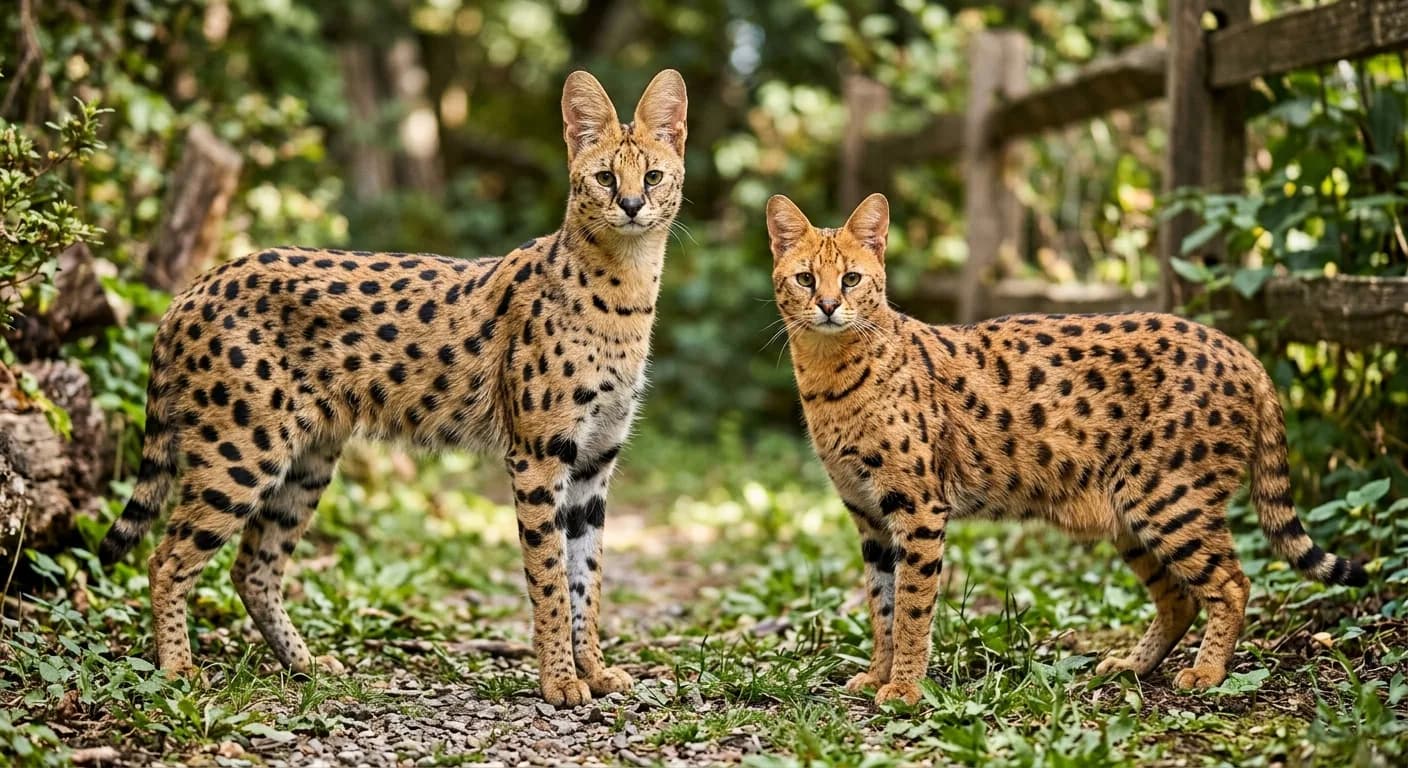
The jump from F1 to F2 is the single biggest step on the ladder, because it is where the serval percentage roughly halves from 50% to around 25%. In practice that shows up in three ways: size, temperament, and price.
Size
F1 cats are the giants of the breed. Breed-size references commonly list F1 males at roughly 17 to 25 pounds, standing about 16 to 18 inches at the shoulder, with females a bit smaller at around 13 to 19 pounds. Their long legs, long necks, and oversized ears give them a leggy, almost cheetah-like silhouette. F2 cats overlap on weight (some males still hit the mid-20s) but tend to be slightly shorter at the shoulder and a touch more compact.
Temperament
F1 Savannahs are the most intense generation. They are highly active, intensely curious, deeply bonded to one or two people, and often standoffish with strangers. They are not "mean" or dangerous to people, but they are a lot of cat: they climb everything, they need vertical space, and they can be a real threat to small pets like rodents, birds, and fish because their prey drive is strong. F2 cats keep much of that exotic energy but are generally a step calmer and warm up to family more readily. Many F2 owners describe a dog-like, follow-you-around loyalty.
Price
F1 cats sit at the top of the price ladder, frequently quoted in the $10,000 to $20,000+ range, while F2 cats commonly land around $4,000 to $12,000. By F3 and later, prices typically fall into the low-thousands. You are paying for rarity and difficulty: producing F1s requires keeping a serval, a demanding and tightly regulated undertaking.
- If you want the dramatic wild look but a more manageable, family-friendly cat, an F3 is often the sweet spot, exotic enough to turn heads, domestic enough to settle in. Reserve F1 and F2 cats for experienced exotic-pet owners with the time, space, and budget they demand.
Why are early-generation males sterile?
Here is a quirk of Savannah genetics that surprises many first-time buyers: early-generation males are usually sterile, while females are fertile from the F1 generation onward. This is why breeding programs always pair an early-generation female (F1, F2, F3) with a fertile domestic or later-generation male, then breed forward toward fertility.
Male fertility typically returns around the F4 to F5 generation, though some breeders have reported a resurgence of sterility problems even at F5 and F6 in certain lines. The upshot for a pet owner is simple: if you are buying an F1, F2, or F3, the male you bring home will almost certainly be unable to reproduce, which has no effect on him as a companion.
What does SBT (Stud Book Tradition) mean?
"SBT" stands for Stud Book Tradition, and it is TICA's label for a Savannah that is at least four generations (F4 and later) removed from the serval, with only Savannah-to-Savannah breeding in the three prior generations. An SBT cat is considered a fully domestic, "purebred" Savannah, and it is the only category eligible for TICA championship competition, a status the registry granted in May 2012. For more, see Petful’s guide to the Caracat.
In plain terms: an F1 is half-wild and not a show cat; an SBT (F4, F5, F6 and beyond) is a registered domestic breed that happens to carry a striking spotted coat. When a listing says "SBT," it is telling you the cat is several generations into domestic territory.

63-inch multi-level cat tree with scratch posts, hammock, plush perches, and dangling toys. Vertical territory is non-negotiable for high-energy climbing breeds like the Bengal.
Petful may earn a commission when you click through to Chewy, at no extra cost to you.
- You will often see codes like "F5 SBT." The number is the generation from the serval; "SBT" confirms it is four or more generations removed and bred only to other Savannahs. "A," "B," and "C" codes you may also see refer to how many Savannah-only generations sit behind the cat.
An F1 is the generation most likely to face permits, so a free MyPetID profile is handy for storing generation documentation, microchip number, and proof of ownership in one place you can pull up whenever you need it.
What does an F1 Savannah look like compared to later generations?
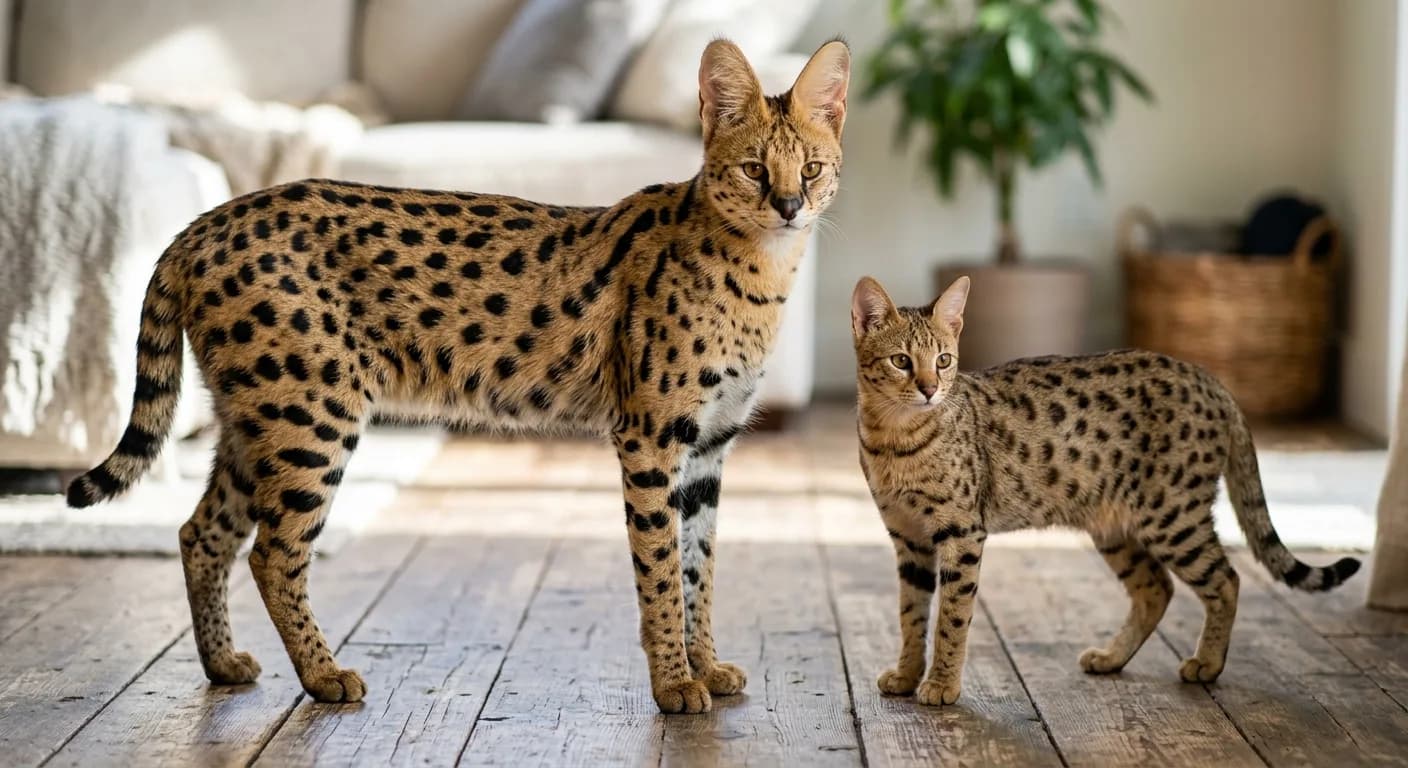
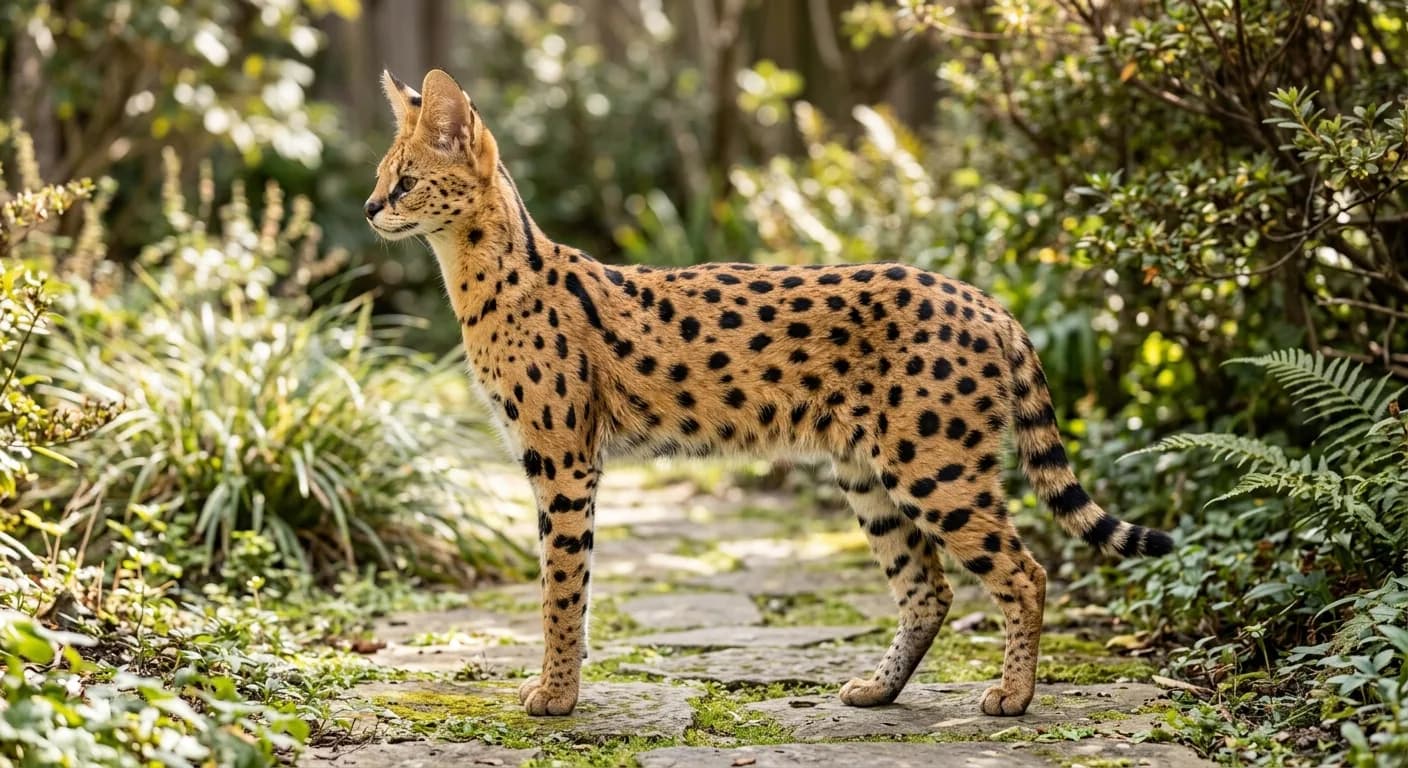
This is where the generation ladder is most visible to the eye. An F1 is the tallest and most serval-like: long legs, a long neck, a small head relative to the body, very large upright ears (sometimes with the serval's pale "ocelli" spots on the backs), and bold, dark, well-defined spotting on a warm golden coat. Stand one next to a normal cat and the difference is obvious.
As you move down the ladder, the serval features soften. By F4 and F5, you are looking at what most people would describe as a tall, athletic, spotted housecat: still exotic and eye-catching, but clearly domestic in proportion. The ears shrink relative to F1, the legs look less stilt-like, and the overall frame reads "big domestic cat" rather than "small wild cat."
To learn more about the wild parent behind all of this, see our guide on the risks of owning a serval cat, the species every Savannah ultimately descends from. For the full breed picture across all generations, our complete Savannah cat breed guide covers care, history, and personality in depth.
Can you own an F1 Savannah cat?
Sometimes, but it depends heavily on where you live. In the United States, Savannah-cat legality is set at the state (and sometimes city or county) level, and it is almost always tied to the generation. Many jurisdictions treat early-generation cats (commonly F1 through F3, sometimes defined by percentage of wild blood) as exotic or hybrid animals subject to permits or outright bans, while later SBT generations are regulated like ordinary domestic cats.
Editorial breed references note that F1 Savannahs are restricted or banned in well over a dozen U.S. states, with some jurisdictions (the often-cited examples include Hawaii, Georgia, and others) prohibiting them entirely, while plenty of states allow later generations freely. Laws change, and the exact cut-off generation varies by state, so the only safe move is to confirm the current rule with your own state and local authorities before you buy.
- Savannah legality is set locally and changes over time. An F1 that is legal in one state may be banned in the next one over, and a city ordinance can be stricter than the state. Confirm the current rules with your state wildlife or agriculture agency and your local animal-control office before committing.
For a deeper breakdown of where these cats stand legally, read our explainer on whether Savannah cats are legal, which covers how generation affects the rules.

108-oz stainless steel pet fountain with quiet pump and water-level window. Bengals are notoriously water-obsessed; a flowing fountain encourages hydration and pulls them away from sinks and toilets.
Petful may earn a commission when you click through to Chewy, at no extra cost to you.
Is an F1 Savannah the right cat for you?
An F1 is a spectacular animal, but it is genuinely demanding, and it is not the cat for most households. Before you fall for the look, weigh what you are taking on.
The case for an F1
- The most dramatic, serval-like appearance in the breed
- Enormous size and presence; a true conversation piece
- Intensely bonded, dog-like devotion to its person
- Exceptional intelligence and athleticism
The case against (or for choosing a later generation)
- Very high purchase price and demanding care needs
- Strong prey drive that endangers small household pets
- May be illegal or permit-only where you live
- Needs serious vertical space, enrichment, and an experienced owner
- An F1 Savannah is best suited to experienced exotic-cat owners who can meet its space, enrichment, legal, and financial demands. If this is your first unusual cat, a later-generation (F4 to F5 SBT) Savannah delivers the look with far fewer complications.
If budget is the sticking point, our guide to how much a Savannah cat costs breaks down pricing by generation so you can see exactly where an F1 sits relative to an F3 or F5.
The bottom line
The "F" number is the key that unlocks everything about a Savannah cat. An F1 is about 50% serval, the largest and wildest-looking generation, expensive, and tightly regulated. Each step down (F2 around 25%, F3 around 12.5%, then the SBT generations F4 and F5) trades some of that wild drama for a calmer, more domestic, and more affordable cat. Decide how much "wild" you actually want to live with, confirm what is legal where you are, and buy from a registered, ethical breeder who can show you the pedigree.
An F1 Savannah cat is the first-generation offspring of an African serval bred to a domestic cat, making it about 50% serval. It is the largest and most serval-like generation of the breed.
An F1 is about 50% serval, while an F2 is roughly 25% (up to about 37.5% in some lines). F1 cats are larger, wilder, and more expensive; F2 cats are generally calmer, slightly smaller, and more family-friendly.
An F1 Savannah is approximately 50% serval, because it has one purebred serval parent and one domestic cat parent. The serval percentage then roughly halves with each later generation.
It depends on where you live. U.S. legality is set by state and local law and is usually tied to generation, with many places restricting or banning F1 to F3 cats while allowing later SBT generations. Always confirm your state and local rules first.
SBT stands for Stud Book Tradition. It describes a Savannah that is at least four generations (F4 and later) removed from the serval and bred only to other Savannahs, making it a fully domestic, registry-recognized cat.
F1 Savannahs are not considered dangerous to people, but they keep a strong prey drive and can pose a risk to small pets such as rodents, birds, and fish. They need experienced owners and plenty of enrichment.

Coreen Saito is a pet writer and longtime shelter volunteer with more than a decade in animal rescue. She covers cat behavior, breed care, and the small, ordinary science of sharing a life with companion animals, with a particular focus on honest takes about the products and decisions that actually matter. At home in Arizona, she's outranked by Mac (a dog with the loudest opinion in the house), Rebel (a cat who governs by quiet authority), and Meri (an orange tabby who runs the late shift and the laundry basket). She writes about all three, plus the rescues that keep coming through her life, at LifeWithMinty.com.
Sign up for expert-backed reviews and safety alerts all in one place.