Are Savannah Cats Legal? Ownership Laws by State (2026)
Are savannah cats legal where you live? In most states later generations are fine, but F1-F3 cats are often restricted or banned. Here is how generation and state law decide Savannah cat ownership, and how to verify the rules before you buy.
Petful is reader supported. As an affiliate of platforms like Amazon and Chewy, we may earn a commission when you buy through links on this page. There is no extra cost to you.
So, are savannah cats legal where you live? In most of the United States the answer is yes, but the real answer hinges on one detail almost no buyer thinks about first: the cat's generation. The International Cat Association (TICA), which recognized the Savannah as a championship breed in 2012, classifies these cats by how many generations removed they are from their wild ancestor, the African serval. That single number, F1 through F5 and beyond, is what most state wildlife and agriculture agencies use to decide whether your cat counts as a legal domestic pet or a regulated exotic.
- 1Savannah cat legality usually depends on GENERATION, not the breed itself.
- 2Early generations (F1 to F3) are most likely to be restricted or banned because they carry the most serval ancestry.
- 3Later generations (F4, F5, and SBT) are legal in the large majority of states.
- 4A handful of states ban Savannah cats outright, and cities or counties can add their own rules on top of state law.
- 5Always confirm with your state wildlife or agriculture department before you buy, because penalties can include confiscation.
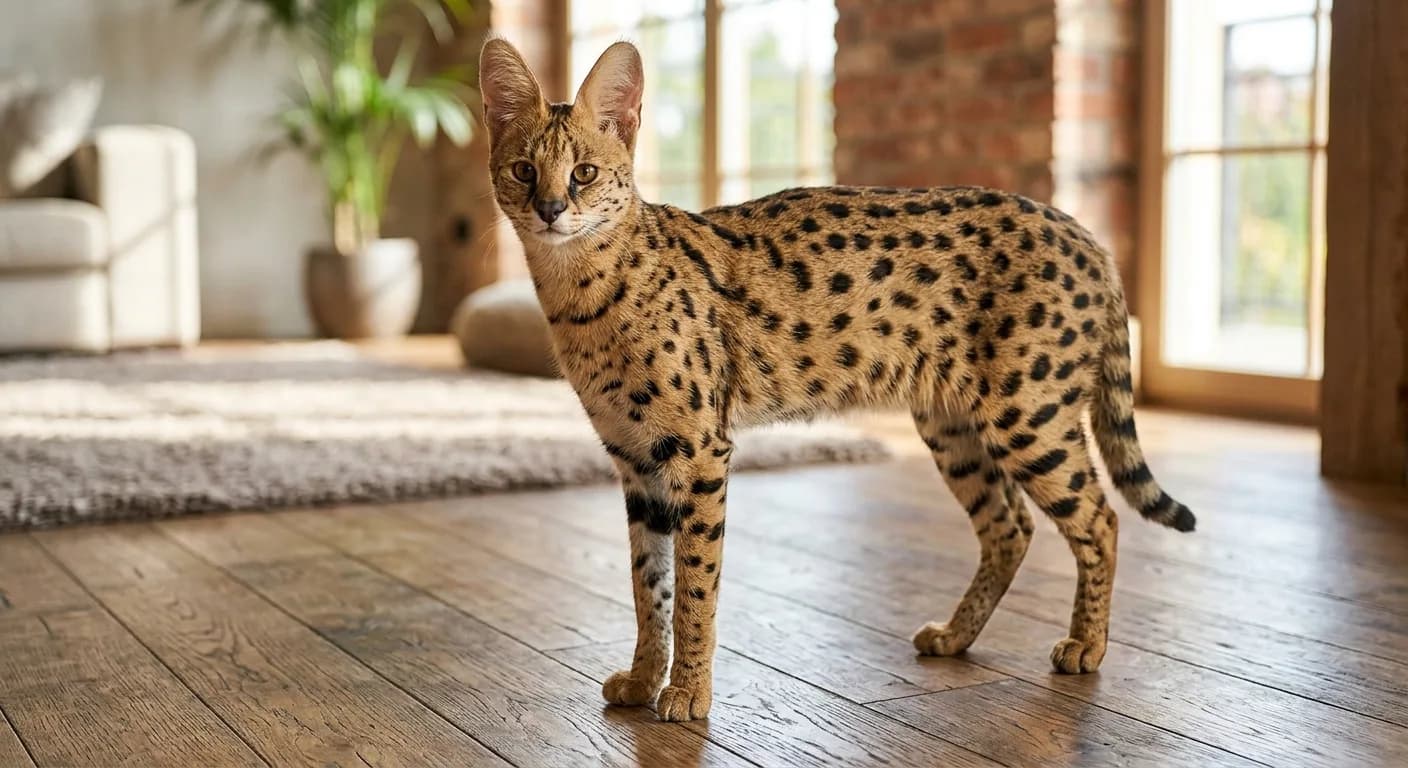
The Savannah is a tall, lean, spotted cat that looks strikingly like a small wild serval, and that resemblance is exactly why lawmakers treat it differently from a typical house cat. This guide explains how generation drives the law, which states ban or restrict ownership, how to verify the rules for your address, and the licensing questions buyers ask most. Because pet ownership laws are a legal matter that changes over time, treat everything here as a starting point and confirm current statutes with the official agency in your state.

Sign up for expert-backed reviews and safety alerts all in one place.
Why generation decides whether a Savannah cat is legal
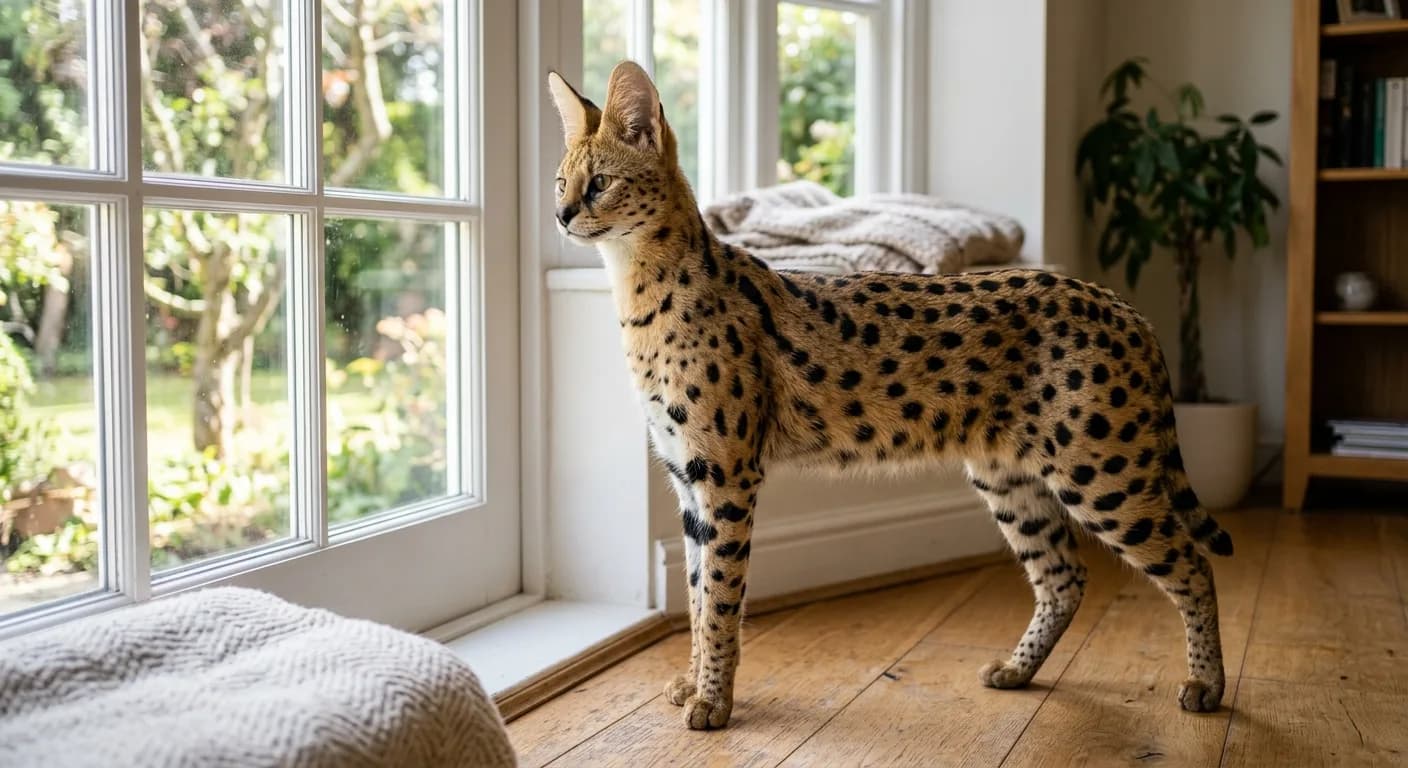
A Savannah cat is a hybrid created by crossing a domestic cat with an African serval, a medium-sized wild cat native to sub-Saharan Africa. Breeders label each cat with a filial number that records how far it sits from that serval ancestor.
Never Scoop Again® with the Whisker Litter-Robot, the smart self-cleaning automatic litter box. Monitor visits and track weights for better overall care in the Whisker® app. Multi-cat friendly.
Petful may earn a commission when you click through to Whisker, at no extra cost to you.
- F1 Savannah cats have one serval parent and are roughly half serval by ancestry. They are the largest, most wild-influenced, and the most heavily regulated.
- F2 cats have a serval grandparent, F3 a serval great-grandparent, and so on. With each generation the serval percentage drops and the cat behaves more like a conventional domestic pet.
- F4, F5, and SBT (Stud Book Tradition, meaning at least three generations of Savannah-to-Savannah breeding) are considered fully domestic by most authorities and are the generations sold to the typical pet owner.
Many states write their wild-animal and hybrid statutes around this exact ladder. A law might ban "hybrids of the first three generations" while permitting F4 and later, or it might require a permit for any cat with serval ancestry within a certain number of generations. That is why the same breed can be perfectly legal in one state and a prohibited exotic next door.
- An F1 cat is one generation from a wild serval; an F5 cat is five generations removed. The higher the number, the more domestic the cat and the more likely it is to be legal where you live.
To go deeper on the breed's temperament, size, and care needs across all generations, see our complete Savannah cat breed guide, which covers what daily life with one of these high-energy cats actually looks like.
Are Savannah cats legal in the US at the federal level?
There is no single federal law that bans private ownership of Savannah cats as pets across the country. The USDA, through its Animal and Plant Health Inspection Service (APHIS), regulates the commercial breeding, sale, and exhibition of certain animals, and once a serval hybrid is bred down to a domestic line it is generally treated as a domestic cat rather than a regulated wild animal. The Captive Wildlife Safety Act and the federal Lacey Act focus on big cats and on trafficking across state lines, not on owning a later-generation Savannah at home.
In practice this means legality is decided at the state and local level, not in Washington. So when someone asks whether Savannah cats are legal in the US, the honest answer is that it depends entirely on your state, and sometimes your city or county, rather than on any nationwide rule.
- Owning a purebred African serval is far more restricted than owning a Savannah, and rescue organizations frequently warn that servals do not make good pets. Because the Savannah descends from the serval, lawmakers often lump early generations in with the wild parent. If you are weighing the wild side of this lineage, read why a serval is a poor pet choice in our guide on the [risks of owning a serval cat](https://www.petful.com/cat-breeds/should-i-get-serval-cat-risks/).
What states are Savannah cats illegal in?
A small group of states prohibit Savannah cat ownership regardless of generation, and several more allow only later generations or require a permit. State wildlife and agriculture agencies are the authority here, and the lists below reflect the patterns those agencies have published. Because statutes are amended and because cities can be stricter than the state, verify your specific address before buying.

Compare coverage choices for your pet, then request a quote directly on Lemonade.
- Check a price for your pet
- Review available coverage choices
- See the terms before you decide
Eligibility, waiting periods, limits and exclusions apply.
Petful may earn a commission when you click through to Lemonade, at no extra cost to you.
| Restriction level | Typical rule | Example states (verify locally) |
|---|---|---|
| Outright ban | No Savannah cats of any generation | Georgia, Hawaii, Nebraska, Rhode Island |
| Later generations only | F4 or F5 and later permitted, early generations restricted | Alaska, Colorado, Iowa, Massachusetts, New Hampshire, New York, Vermont |
| Permit required | Ownership allowed only with a state permit | Delaware |
| Weight or local limits | State allows it but adds conditions | Maryland (under 30 lbs), Texas (varies by county) |
| Generally legal, all generations | No state-level Savannah restriction | California, Florida, Idaho, Illinois, Ohio, Pennsylvania, Michigan, and most others |
A few important notes on that table. Hawaii is the strictest jurisdiction in the country for non-native animals and effectively prohibits Savannah cats. Georgia, Nebraska, and Rhode Island are commonly cited as full-ban states under their broader exotic or hybrid animal rules. States such as New York allow only very late generations (often F5 and later) at the state level, while New York City layers on its own prohibition. Colorado and several New England states commonly permit F4 and later but restrict the earliest generations.

63-inch multi-level cat tree with scratch posts, hammock, plush perches, and dangling toys. Vertical territory is non-negotiable for high-energy climbing breeds like the Bengal.
Petful may earn a commission when you click through to Chewy, at no extra cost to you.
- A Savannah cat can be legal statewide yet banned in your city. Seattle, Denver, New York City, and several Texas counties are well-known examples where local rules differ from the state. Always check both your state agency and your city or county animal-control ordinance.
Because rules vary by state and generation, a free MyPetID profile keeps your Savannah's generation paperwork, registration, and vet records on your phone, ready the moment anyone asks.
Are F1 Savannah cats legal?
F1 Savannah cats are the hardest generation to own legally. Because an F1 is roughly half serval and the largest, most wild-influenced of the line, it is the generation most often swept into a state's exotic or wild-animal statute. Even in states that permit Savannahs broadly, an F1 may require a permit, may be capped by weight, or may be prohibited while F4 and F5 cats are fine.
States that allow later generations but restrict the early ones, such as those permitting F4 and later, are specifically targeting F1 through F3 cats. So a buyer set on an F1 has a much shorter list of legal states than a buyer who is happy with an F5 or SBT companion. If your heart is set on the most serval-like look, read our dedicated F1 Savannah cat guide before committing, because the legal, financial, and care demands of an F1 are in a different league from later generations.
- If you own a restricted generation in a state or city that prohibits it, animal-control authorities can confiscate the cat, and you may face fines. This is not a paperwork technicality. Confirm both state and local law for the exact generation you intend to buy, and keep your breeder's generation documentation.
Do you need a license for a Savannah cat?
For most pet owners buying a later-generation cat, no special license is required, because F4, F5, and SBT Savannahs are treated as ordinary domestic cats in the large majority of states. You would simply follow the same licensing, vaccination, and registration rules your municipality applies to any house cat.
The picture changes for early generations and for restrictive states. Where a permit is required, it is typically issued by the state wildlife or natural-resources agency (sometimes the department of agriculture), and the process can involve an application, a fee, enclosure or care standards, and proof of the cat's generation. A handful of states require this kind of permit specifically for hybrids within a certain number of generations of a wild ancestor.

108-oz stainless steel pet fountain with quiet pump and water-level window. Bengals are notoriously water-obsessed; a flowing fountain encourages hydration and pulls them away from sinks and toilets.
Petful may earn a commission when you click through to Chewy, at no extra cost to you.
- Search for your state's Department of Fish and Wildlife, Department of Natural Resources, or Department of Agriculture, plus the phrase "hybrid cat" or "Savannah cat." Those agencies, not a breeder's website, are the authoritative source for whether you need a license and for which generations.
How to verify Savannah cat laws for your address
Because the rules turn on both generation and geography, a five-minute check before you buy can save you from heartbreak later. Work through these steps in order.
1. Pin down the exact generation you intend to buy (F1 through F5 or SBT). The breeder should document this in writing.
2. Check your state agency. Look up your state wildlife or agriculture department's rules on exotic, wild, or hybrid animals, and note any generation cutoffs.
3. Check your city and county. Municipal animal-control ordinances can ban a cat the state allows. Call your local animal-control office if the ordinance is unclear.
4. Confirm in writing. Where possible, get the rule in writing from the agency, and keep your breeder's generation paperwork together with it.
5. Re-check before you move. A cat legal at your current address may be restricted at your next one. Verify before relocating across state or city lines.
- Reputable Savannah breeders refuse to sell restricted generations into states or cities where they are illegal, and they document each kitten's generation. A seller who waves away your legality questions is a seller to walk away from.
What this means before you bring one home
Savannah cats are legal for most Americans who want a later-generation pet, and prohibited or tightly restricted for those set on an early-generation, more serval-like cat. The breed's beauty comes from its wild ancestry, and that same ancestry is exactly what the law scrutinizes. Decide on your generation first, verify your state and local rules second, and only then choose a breeder. For a full picture of the temperament, lifespan, and daily care that come with this remarkable cat, our Savannah cat breed guide walks through everything ownership involves.
There is no nationwide federal ban on owning a Savannah cat as a pet. Legality is set at the state and local level, so the answer depends on your state, your city or county, and the cat's generation. Most later-generation Savannahs are legal across most of the country.
Several states are commonly cited as banning Savannah cats outright, including Georgia, Hawaii, Nebraska, and Rhode Island. Others, such as Alaska, Colorado, Massachusetts, New Hampshire, New York, and Vermont, allow only later generations or require a permit. Verify the current rule with your state wildlife or agriculture agency, since statutes change.
F1 Savannah cats, which are about half serval, are the most heavily restricted generation. They are banned or permit-only in many states even where later generations are freely allowed. If you want an F1, your list of legal states is much shorter, so confirm both state and local law first.
For later generations (F4, F5, and SBT) in most states, no special license is needed because the cat is treated as a domestic pet. Early generations and restrictive states may require a permit from the state wildlife or agriculture department, which can involve an application, a fee, and proof of generation.
States restrict Savannah cats because they descend from the African serval, a wild cat. Lawmakers worry about public safety, the welfare of the animal, and the risk to native wildlife, so they regulate early generations as exotic or wild animals while generally permitting more domesticated later generations.
Price varies dramatically by generation. Early generations like F1 can run many thousands of dollars, while later generations are less expensive, though still a premium breed. The legal and care demands rise sharply with earlier generations, so factor those in alongside the purchase price.

Coreen Saito is a pet writer and longtime shelter volunteer with more than a decade in animal rescue. She covers cat behavior, breed care, and the small, ordinary science of sharing a life with companion animals, with a particular focus on honest takes about the products and decisions that actually matter. At home in Arizona, she's outranked by Mac (a dog with the loudest opinion in the house), Rebel (a cat who governs by quiet authority), and Meri (an orange tabby who runs the late shift and the laundry basket). She writes about all three, plus the rescues that keep coming through her life, at LifeWithMinty.com.
Sign up for expert-backed reviews and safety alerts all in one place.