Are Savannah Cats Dangerous? Temperament, Bite Risk, and Safety
Are Savannah cats dangerous? The breed is not considered dangerous to humans, but a strong prey drive makes it a real threat to small pets. Here is the temperament, bite-risk, legality, and child-safety breakdown by generation.
Petful is reader supported. As an affiliate of platforms like Amazon and Chewy, we may earn a commission when you buy through links on this page. There is no extra cost to you.
Are savannah cats dangerous? For the people who share a home with one, the honest answer is no: the breed is generally not considered dangerous to humans, and there are no verified reports of a Savannah cat killing a person. The International Cat Association (TICA), which recognized the Savannah as a championship breed in 2012, describes the cat as confident, curious, and social rather than aggressive. The nuance that gets lost in the scary headlines is generation. An F1 Savannah is roughly 50 percent African serval, can stand close to 17 inches at the shoulder, and behaves very differently from an F5 that is several greats-removed from its wild ancestor and lives like an ordinary house cat.
- 1Savannah cats are not considered dangerous to humans, and no verified human fatality exists
- 2The real risk is to small pets (rodents, birds, fish), driven by a strong inherited prey drive, not aggression toward people
- 3Generation matters enormously: F1 to F2 cats are larger, more reactive, and harder to handle than F4 to F5 cats that act like normal domestic cats
- 4The bigger practical issues for most owners are legality, escape-artist energy, and the cost of meeting the cat's needs, not bite risk
This guide walks through what the temperament data actually shows, where genuine risk lives, how the generations differ, whether a Savannah is safe around children, and how the breed compares to its wild serval parent. The Savannah cat is the domestic side of a wild lineage, so understanding that lineage is the key to understanding the cat.

Sign up for expert-backed reviews and safety alerts all in one place.
Are Savannah Cats Dangerous to Humans?
The breed-club and veterinary consensus is consistent: Savannah cats are not dangerous to humans in the way the word "dangerous" usually implies. They do not stalk people, they are not predisposed to attack, and the breed has no documented record of killing or seriously maiming an owner. Pet writers and breed associations alike note that there are no reports of a Savannah significantly injuring a human, which is a striking thing to be able to say about a cat that carries wild ancestry.

Compare coverage choices for your pet, then request a quote directly on Lemonade.
- Check a price for your pet
- Review available coverage choices
- See the terms before you decide
Eligibility, waiting periods, limits and exclusions apply.
Petful may earn a commission when you click through to Lemonade, at no extra cost to you.
What a Savannah can do is bite or scratch the same way any cat can, and because the cat is athletic and powerful, a play bite or a fear reaction from a large early-generation cat lands harder than it would from a six-pound tabby. That is a handling and socialization issue, not evidence of an inherently vicious animal. Cats of any breed bite when frightened, cornered, or over-stimulated, and a confident, well-socialized Savannah is no more likely to do so than a typical housecat.
- A Savannah cat is a cross between an African serval and a domestic cat. Even an F1 is a domestic hybrid, not a captive wild animal, and later generations are genetically mostly domestic cat. That distinction is why most Savannahs can be seen by a regular veterinarian rather than an exotics specialist.
It is worth naming the comparison that breeders themselves make: with an early-generation Savannah, the humans are usually the bigger danger to the cat than the other way around. These are sensitive, intelligent animals that startle easily, and rough handling or a chaotic household stresses them far more than they stress the people in it.
Never Scoop Again® with the Whisker Litter-Robot, the smart self-cleaning automatic litter box. Monitor visits and track weights for better overall care in the Whisker® app. Multi-cat friendly.
Petful may earn a commission when you click through to Whisker, at no extra cost to you.
Do Savannah Cats Attack Humans?
Unprovoked attacks on humans are not a documented feature of the breed. When a Savannah lashes out, it is almost always a reaction: pain, fear, being grabbed, being startled, or being pushed past its tolerance during play. This is true of cats generally, and it is especially worth respecting in the larger F1 and F2 cats, where a defensive swat carries more force.
The temperament most owners describe is closer to a dog than to a skittish wildcat. Savannahs follow their people from room to room, learn to walk on a harness, play fetch, and greet visitors with curiosity. TICA's breed description leans on words like loyal, adventurous, and devoted. None of that is the profile of an animal looking to attack the household.
- Most "aggression" complaints about Savannahs trace back to boredom. A bored, under-exercised Savannah redirects its hunting energy into your ankles. Tall cat trees, daily interactive play, food puzzles, and even leash walks drain the tank and keep the cat from turning play into a problem.
Is a Savannah Cat Aggressive?
The Savannah Cat Association states plainly that the breed is not aggressive or destructive by nature. The traits people misread as aggression are usually the breed's hallmark intensity: stalking and pouncing on moving objects, rough-looking play that lacks real bite, and relentless energy. That is prey-simulation behavior, not hostility.
Where genuine reactivity shows up is in the earliest generations and in poorly socialized individuals. An F1 or F2 cat that was not handled gently and often as a kitten can be wary, flighty, and quick to defend itself. By F4 and F5, that edge has largely bred out, and the cats are typically as even-tempered as any active domestic breed. Socialization in the first weeks of life is the single biggest predictor of adult temperament, which is why reputable breeders matter so much for this breed.
The Real Danger: Small Pets and Prey Drive
Here is the honest risk, and the one the friendly headlines under-sell. The serious danger a Savannah cat poses is to small animals, not to people. The breed inherited a powerful prey drive from the serval, a wild African cat that is one of the most successful small-game hunters of any feline, and a Savannah will treat a hamster, gerbil, parakeet, fish, or even a small rabbit as something to hunt.
- A high prey drive means a Savannah cat can injure or kill rodents, birds, reptiles, and fish, sometimes through a tank or cage. If you keep pocket pets or birds, a Savannah is a poor fit. House the small animals in a separate, securely closed room the cat cannot access, and never assume a closed door or a cage is enough.
This is also why nearly every breed source recommends keeping Savannahs indoors or in a secured outdoor enclosure ("catio") with a roof. Outdoors, that same prey drive turns the cat into a threat to local wildlife and exposes the cat itself to traffic, theft, and disease. The risk runs both directions: the cat is a danger to small creatures, and the outdoors is a danger to the cat.
| Who or What | Risk Level | Why |
|---|---|---|
| Adult humans | Very low | No verified fatalities; bites and scratches are fear or play reactions, not predation |
| Children | Low to moderate | Not predatory toward kids, but a large, fast cat plus rough toddler handling can mean accidental scratches |
| Other cats and dogs | Low if introduced young | Often coexist well; early-generation cats may bully smaller or timid pets |
| Rodents, birds, fish, reptiles | High | Strong prey drive; a Savannah will hunt pocket pets, often fatally |
A Savannah's high prey drive makes an escape a real risk, so a free MyPetID profile with a scannable QR ID helps a finder confirm it is a registered pet and reach you fast, while keeping vet records in one place.
Is a Savannah Cat Safe Around Children?
For most families, a well-socialized Savannah of a later generation can be safe around children, and many owners report the cats are playful and patient companions for kids. There are no documented reports of a Savannah cat seriously injuring a child. The breed is not predatory toward children, and it does not view them as prey.

63-inch multi-level cat tree with scratch posts, hammock, plush perches, and dangling toys. Vertical territory is non-negotiable for high-energy climbing breeds like the Bengal.
Petful may earn a commission when you click through to Chewy, at no extra cost to you.
That said, "safe" depends on supervision and on the cat's generation. A large F1 or F2 cat combined with a young toddler who pulls tails and grabs fistfuls of fur is a recipe for an accidental scratch, simply because the cat is big, strong, and fast. The same caution applies to any large, high-energy pet. Teach children to interact gently, give the cat an escape route and a high perch it can retreat to, and supervise play between young kids and any cat. With those basics in place, the danger to children is low.
- This is not a one-size answer. A multi-greats-removed F5 Savannah in a home with school-age children is a very different proposition from an F1 in a home with a toddler. If you have very young kids, favor a later-generation cat and meet the specific kitten before committing.
Savannah Cat vs Serval: Why People Confuse the Two
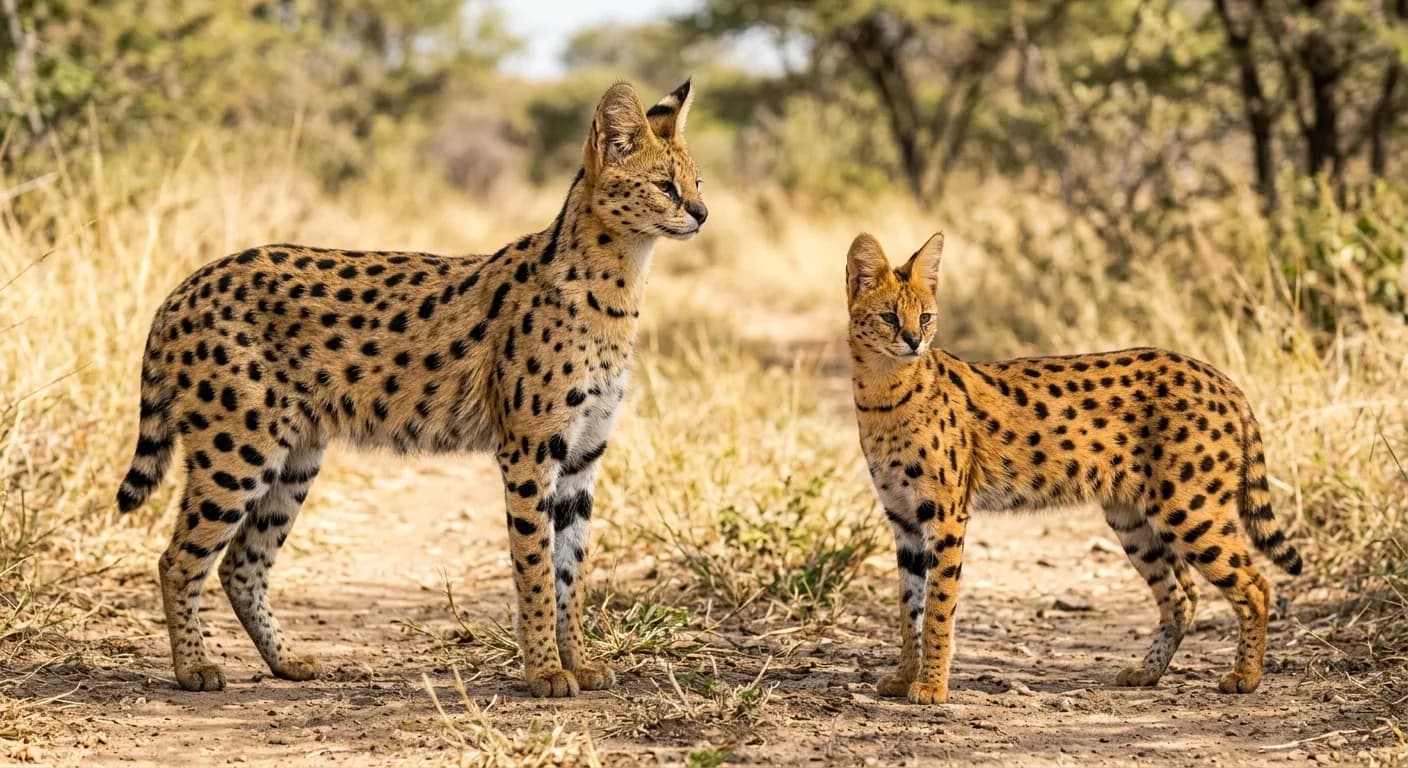
A lot of the fear around the question "are savannah cats dangerous" comes from confusing the Savannah with its wild parent, the serval. They are not the same animal, and the difference is enormous. The serval is the wild African cat at the top of the family tree; the Savannah is the domestic hybrid descended from it. If you are weighing the wild parent specifically, our guide to the real risks of keeping a serval cat lays out why a true serval is a wild animal with needs a Savannah simply does not have.
| Trait | African Serval | Savannah Cat (later generation) |
|---|---|---|
| Status | Wild, non-domesticated animal | Domestic hybrid breed |
| Height | About 21-24 inches at the shoulder | Roughly 10-17 inches depending on generation |
| Weight | About 20-40 pounds | About 10-25 pounds (heaviest in F1) |
| Veterinary care | Needs an exotics vet competent with wildcats | Can usually see a regular small-animal vet |
| Suitable home | Specialized permits, large enclosures, expert keepers | A committed, active domestic home with enrichment |
The practical takeaway: a serval is a wild cat that demands exotic-animal expertise, special permits, and large custom enclosures, while a Savannah, especially from F3 onward, lives as a (very energetic) house cat. The further a Savannah sits from its serval ancestor, the more it behaves like the domestic cat it mostly is. For the full breed picture, see Petful's complete Savannah cat breed guide.

108-oz stainless steel pet fountain with quiet pump and water-level window. Bengals are notoriously water-obsessed; a flowing fountain encourages hydration and pulls them away from sinks and toilets.
Petful may earn a commission when you click through to Chewy, at no extra cost to you.
Generation by Generation: How Much "Wild" Is Left?
"Savannah cat" covers a wide spectrum, and danger questions only make sense once you fix the generation. The filial number (F1, F2, F3, and so on) counts how many generations removed the cat is from its serval ancestor. Lower numbers mean more serval influence, larger size, and a more reactive temperament; higher numbers mean a cat that is mostly domestic in both genetics and behavior.
| Generation | Approx. Serval Influence | Typical Temperament | Best For |
|---|---|---|---|
| F1 | Around 50% | Largest, most reactive, needs expert handling and the most space | Experienced exotic-leaning owners |
| F2 | Around 25-30% | Big and lively, still intense, more affectionate than F1 | Dedicated, active households |
| F3 | Roughly 10-15% | Energetic but noticeably calmer, more "house cat" | Confident first-time-of-breed owners |
| F4-F5 | Single digits | Acts like a normal active domestic cat | Most families, including those with kids |
This is also why the same breed can be both "illegal exotic" and "fine family pet" depending on which cat you mean. Earlier generations carry the size, strength, and intensity that drive both the legal restrictions and the danger questions; later generations largely shed them.
- F1 and F2 Savannahs are the cats that need expert owners, the most enrichment, and the most space. If you are new to the breed, a later-generation cat is calmer, more widely legal, and far less likely to test your patience or your furniture.
Are Savannah Cats Legal Where You Live?
For many would-be owners, the law is a bigger hurdle than any danger. Because Savannahs descend from a wild species, ownership is regulated unevenly across the United States, and the rules usually hinge on generation. Several states ban the breed outright or restrict the early generations, while others permit only later generations such as F4 and beyond.
Reporting from veterinary and breed sources consistently lists states including Georgia, Hawaii, Nebraska, and Rhode Island as banning Savannah cats, with states such as Iowa and Vermont allowing only F4-and-later generations. Other states (and many individual cities and counties) layer on their own permit requirements, especially for F1 and F2 cats. Because these laws change and local ordinances can be stricter than state law, always confirm the current rules with your own state wildlife agency and your city or county before acquiring a Savannah.
- Exotic-pet laws change, and a city ordinance can ban a cat your state allows. Confirm both your state wildlife agency's current rules and your local ordinance before buying or adopting, because an illegally kept hybrid can be confiscated.
So, Are Savannah Cats Dangerous? The Bottom Line
Pulled together, the picture is clear. To people, a Savannah cat is not dangerous in any meaningful sense: no verified fatalities, no predatory intent, and a temperament most owners compare to a loyal, high-energy dog. To small pets, the breed genuinely is dangerous, because the inherited prey drive is strong and real. The practical challenges that trip up owners are legality, the cat's relentless energy and escape-artist tendencies, and the cost and effort of meeting its needs, far more than any threat to human safety.
If you want a calm, low-maintenance lap cat, a Savannah, especially an early generation, is the wrong choice. If you want an intelligent, interactive, dog-like companion and you can provide enrichment, secure space, and a legal home, the danger question largely answers itself. For a different spotted-but-fully-domestic option with similar energy and a friendlier legal status, compare the Bengal cat breed, which delivers the wild look without the serval ancestry.
Not to humans. The breed is not considered dangerous to people, and there are no verified reports of a Savannah killing a person. The real danger is to small pets like rodents, birds, and fish, because of the cat's strong inherited prey drive.
Unprovoked attacks are not a documented feature of the breed. Like any cat, a Savannah may bite or scratch out of fear, pain, or over-stimulation, and a large early-generation cat hits harder, but they do not view people as prey.
The Savannah Cat Association says the breed is not aggressive by nature. What looks like aggression is usually intense prey-simulation play. Poorly socialized or early-generation (F1 to F2) cats can be more reactive.
A well-socialized later-generation Savannah is generally safe around children, with no documented reports of serious injury to a child. Supervise young kids, teach gentle handling, and favor a later generation if you have toddlers.
Savannahs are loyal and dog-like and may alert to or investigate strangers and unusual sounds, but they are not guard animals and should not be expected to protect you the way a dog might.
Yes, for the right owner. They are safe to live with as long as you provide enrichment, keep them indoors or in a secure catio, separate them from small prey pets, and confirm the breed is legal where you live.
Veterinary and breed sources commonly list Georgia, Hawaii, Nebraska, and Rhode Island as banning the breed, with states such as Iowa and Vermont allowing only F4 and later generations. Laws change and cities can be stricter, so verify locally.
Price drops sharply with each generation. Early F1 cats can run many thousands of dollars, while later generations cost much less. Always price the specific generation you want and budget for enrichment and secure housing on top.
A serval is a wild African cat that needs an exotics vet and special permits. A Savannah is the domestic hybrid descended from it, and later generations live as energetic house cats and usually see a regular veterinarian.

Coreen Saito is a pet writer and longtime shelter volunteer with more than a decade in animal rescue. She covers cat behavior, breed care, and the small, ordinary science of sharing a life with companion animals, with a particular focus on honest takes about the products and decisions that actually matter. At home in Arizona, she's outranked by Mac (a dog with the loudest opinion in the house), Rebel (a cat who governs by quiet authority), and Meri (an orange tabby who runs the late shift and the laundry basket). She writes about all three, plus the rescues that keep coming through her life, at LifeWithMinty.com.
Sign up for expert-backed reviews and safety alerts all in one place.