Manx Cat Tail: The Four Tail Types and Why Back Legs Are Longer
Manx cats come in four tail types, from completely tailless rumpy to full-tailed longy. Here is the genetics behind the Manx cat tail, why the back legs are longer and the breed hops like a rabbit, plus other tailless cat breeds.
Petful is reader supported. As an affiliate of platforms like Amazon and Chewy, we may earn a commission when you buy through links on this page. There is no extra cost to you.
The Manx cat tail is the breed's signature trait, and both the CFA and TICA recognize four distinct tail lengths, from completely tailless to nearly full-length. Most people picture a Manx as a cat with no tail at all, and many are, but the breed actually ranges across a spectrum. The same dominant mutation that erases the tail in some cats leaves a short stub or even a long tail in others, which is why a single Manx litter can hold kittens with four different tails. This guide breaks down each tail type, the genetics behind them, the famous longer back legs and rabbit-like hop, and the welfare issue every owner should understand before bringing one home.
- 1Manx cats come in four tail types: rumpy (no tail), rumpy riser (a tiny knob), stumpy (a short partial tail), and longy (a near-full or full tail).
- 2Taillessness comes from a single dominant gene; two copies are fatal in the womb, so every Manx can produce tailed kittens.
- 3The hind legs are longer than the front legs, which lifts the rump, arches the back, and creates the breed's rabbit-like hopping walk.
- 4A minority of Manx develop Manx Syndrome, a spinal condition tied to the same gene, with risk highest in fully tailless rumpy cats.

Sign up for expert-backed reviews and safety alerts all in one place.
Do Manx Cats Have Tails?
Many Manx cats have no tail at all, but not every Manx is tailless. The breed is defined by tail length rather than by a guaranteed absence of one, so a Manx can be born completely tailless, with a small stub, or with a tail that looks almost normal. The fully tailless look is simply the most famous and the most prized in the show ring.
In practice, the answer depends on which of the four tail types a given cat carries. A "rumpy" Manx is the classic tailless cat you picture, often with nothing but a small dimple where a tail would start. A "stumpy" Manx has a short partial tail, and a "longy" Manx has a half-length to full-length tail. All of them are true Manx, and all of them carry the same gene. So if you meet a tailless cat at a shelter, it may well be a Manx, but a Manx with a visible tail is not a contradiction. It is just a different point on the same genetic spectrum. The breed's solid, cobby body actually traces back to British shorthaired stock, and the Manx shares that rounded, sturdy build with the British Shorthair.
- A Manx is genetically a Manx whether it has no tail, a stub, or a full tail. Tail length varies kitten to kitten even within one litter, so a tail does not disqualify a cat from being a true Manx.
The Four Manx Cat Tail Types
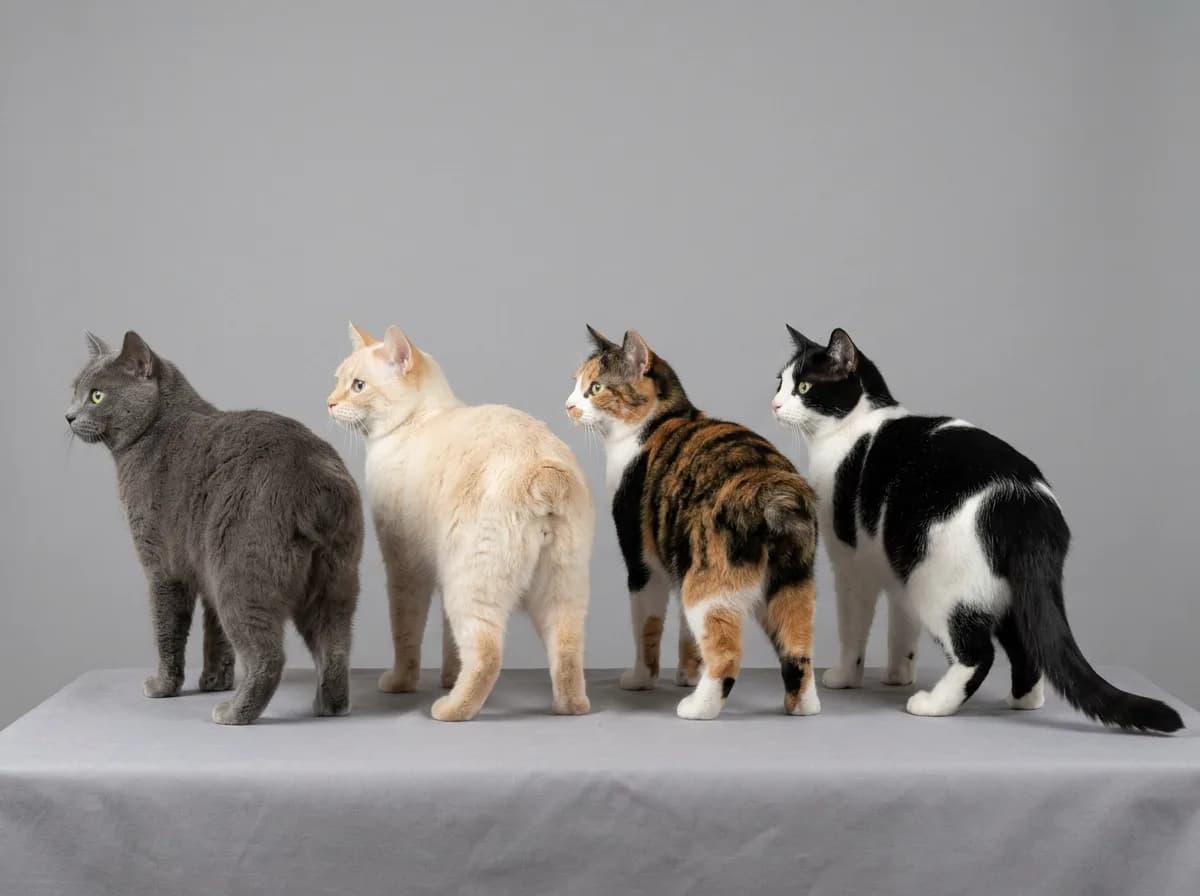
The Cat Fanciers' Association (CFA) and The International Cat Association (TICA) classify the Manx cat tail into four recognized types, based on how many tail (caudal) vertebrae remain at the end of the spine. Breeders use these terms constantly, and knowing them helps you understand what you are looking at when you meet a Manx.
The rumpy is the only type with no tail vertebrae beyond the base of the spine, often marked by a small hollow or dimple. The rumpy riser adds a tiny knob of one or two fused vertebrae that can rise under your fingers when the cat is happy. The stumpy carries a short, often kinked partial tail of roughly two to six vertebrae. The longy has a half-length to full-length tail that can look nearly normal. Importantly, CFA show standards recognize only the rumpy and rumpy riser for the show ring, while stumpy and longy cats are common and completely healthy as pets and in random-bred populations.

Never Scoop Again® with the Whisker Litter-Robot, the smart self-cleaning automatic litter box. Monitor visits and track weights for better overall care in the Whisker® app. Multi-cat friendly.
Petful may earn a commission when you click through to Whisker, at no extra cost to you.
| Tail Type | What It Looks Like | Tail Vertebrae | Show or Pet |
|---|---|---|---|
| Rumpy | No tail at all, usually a small dimple at the base of the spine | None beyond the spine base | Show standard (CFA, TICA) |
| Rumpy riser | A small knob that may rise when the cat is petted or happy | One or two fused vertebrae | Show standard (CFA, TICA) |
| Stumpy | A short, often movable or kinked partial tail | Roughly two to six vertebrae | Common as a pet |
| Longy | A half-length to nearly full-length tail | Near-normal count | Common as a pet and in random-bred cats |
- Gently run a finger down the cat's lower back toward the rump. On a rumpy riser you will feel a small rise of bone or cartilage that a true rumpy does not have. Many risers lift this knob when they are content, almost like a tail that never finished growing.
The Genetics: Why a Manx Can Have Tailed Kittens
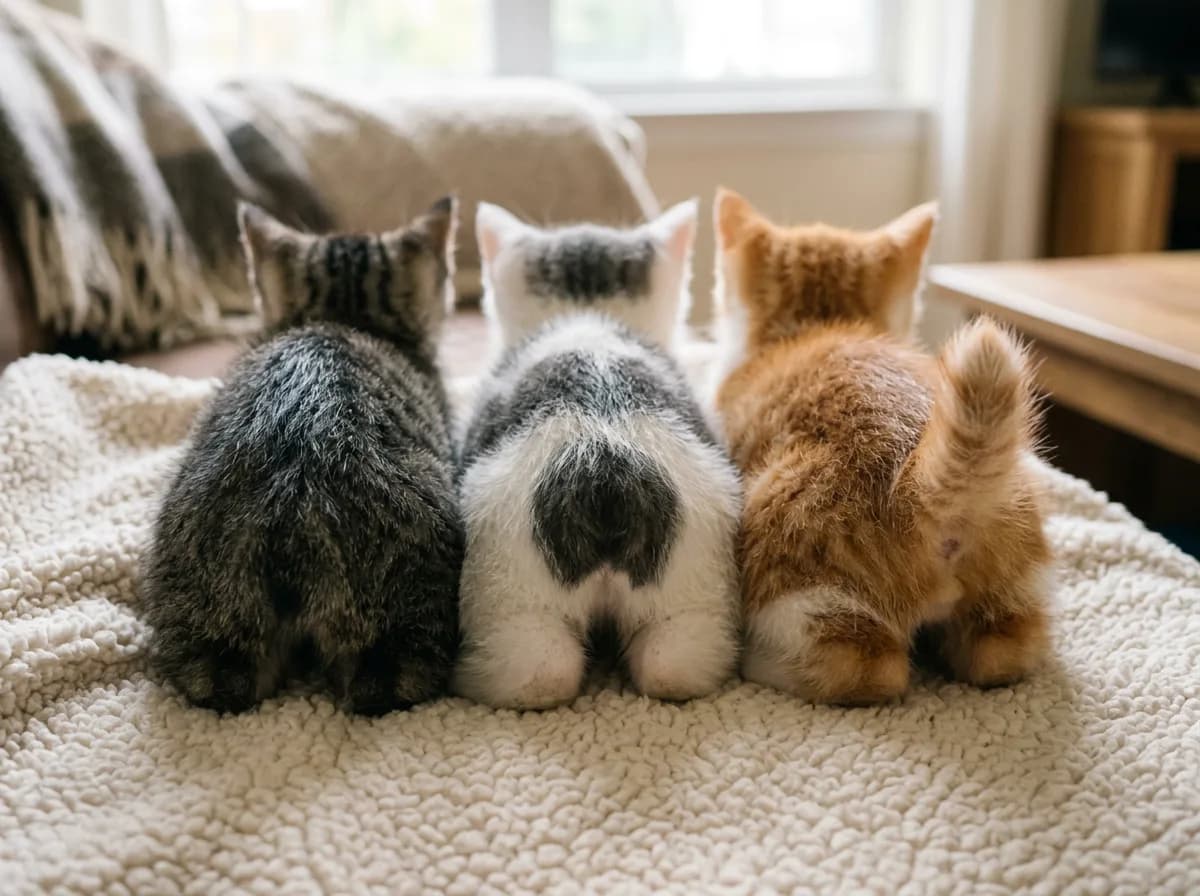
Taillessness in the Manx comes from a single dominant gene, usually written as M, often called the Manx gene. Because it is dominant, a cat needs only one copy to show the trait, so a Manx carries one Manx allele paired with one normal allele (written Mm). This is why the tail trait passes down so reliably from a tailless parent, and why the gene is described as highly penetrant. The Manx is one of several cat breeds built around a single dramatic mutation, much like the folded ears of the Scottish Fold or the wavy coat of the Selkirk Rex.
Here is the critical part that surprises many new owners: two copies of the gene (MM) are lethal early in pregnancy. An embryo that inherits the Manx gene from both parents typically does not survive, which is reabsorbed long before birth. Because the homozygous combination is fatal, no living Manx is MM. Every Manx is Mm, which means every Manx still carries one normal tail allele to pass on. Breed two Manx together and the kittens land on a spectrum: some completely tailless, some with stubs, some with full tails, and a portion lost to the lethal pairing. That is exactly why tail length scatters randomly through a litter, why Manx litters can run smaller, and why responsible breeders never pair two fully tailless rumpy cats.
- Pairing two tailless (rumpy) Manx stacks the odds of the lethal double gene and raises the risk of spinal defects in surviving kittens. Reputable breeders deliberately cross a rumpy with a stumpy or tailed Manx to keep litters healthier. This is a core reason a true Manx should only come from an experienced, ethical breeder.
So can a Manx have tailed kittens? Yes, and routinely. Because every Manx carries a normal tail allele, tailed offspring are a normal, expected outcome, not a sign that a parent was not "really" a Manx. A long-tailed (longy) Manx can even carry and pass the gene while looking like an ordinary cat.
Why the Back Legs Are Longer (and Why a Manx Hops)
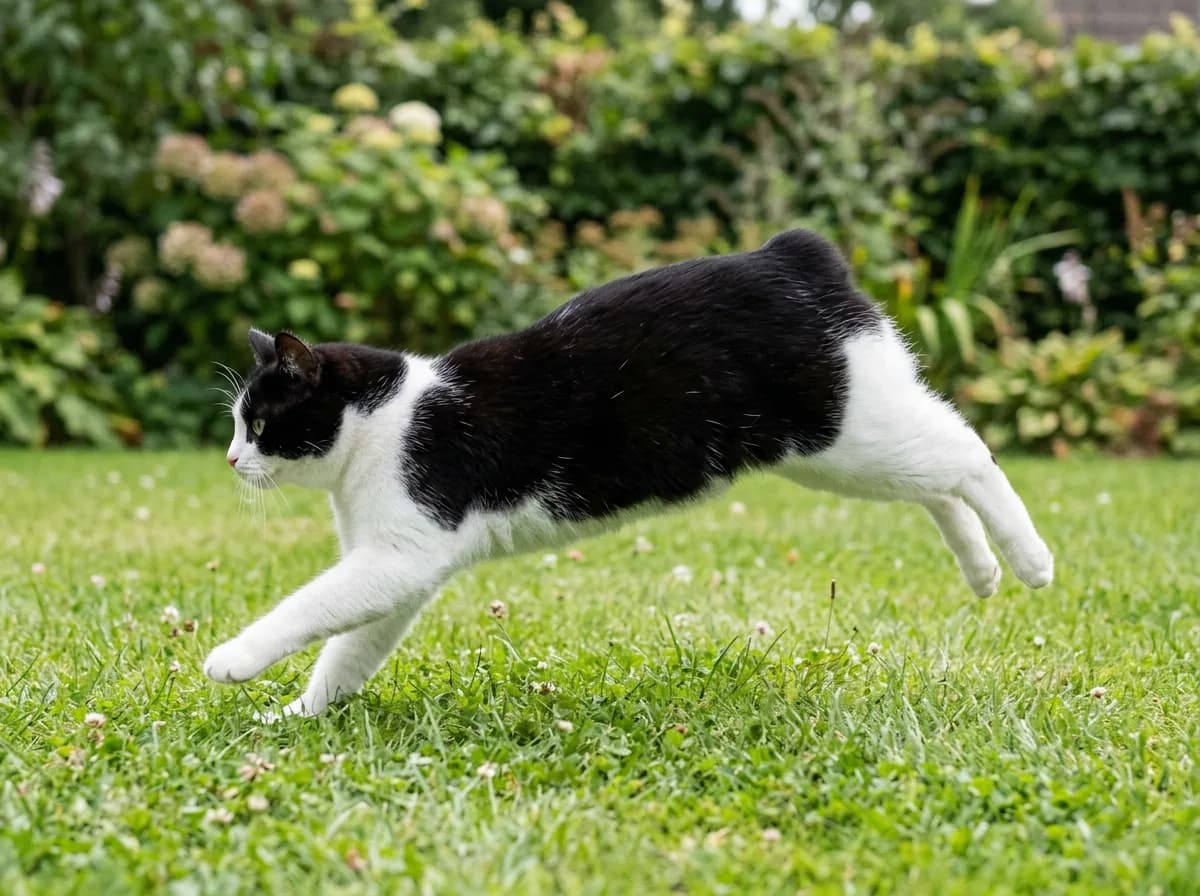
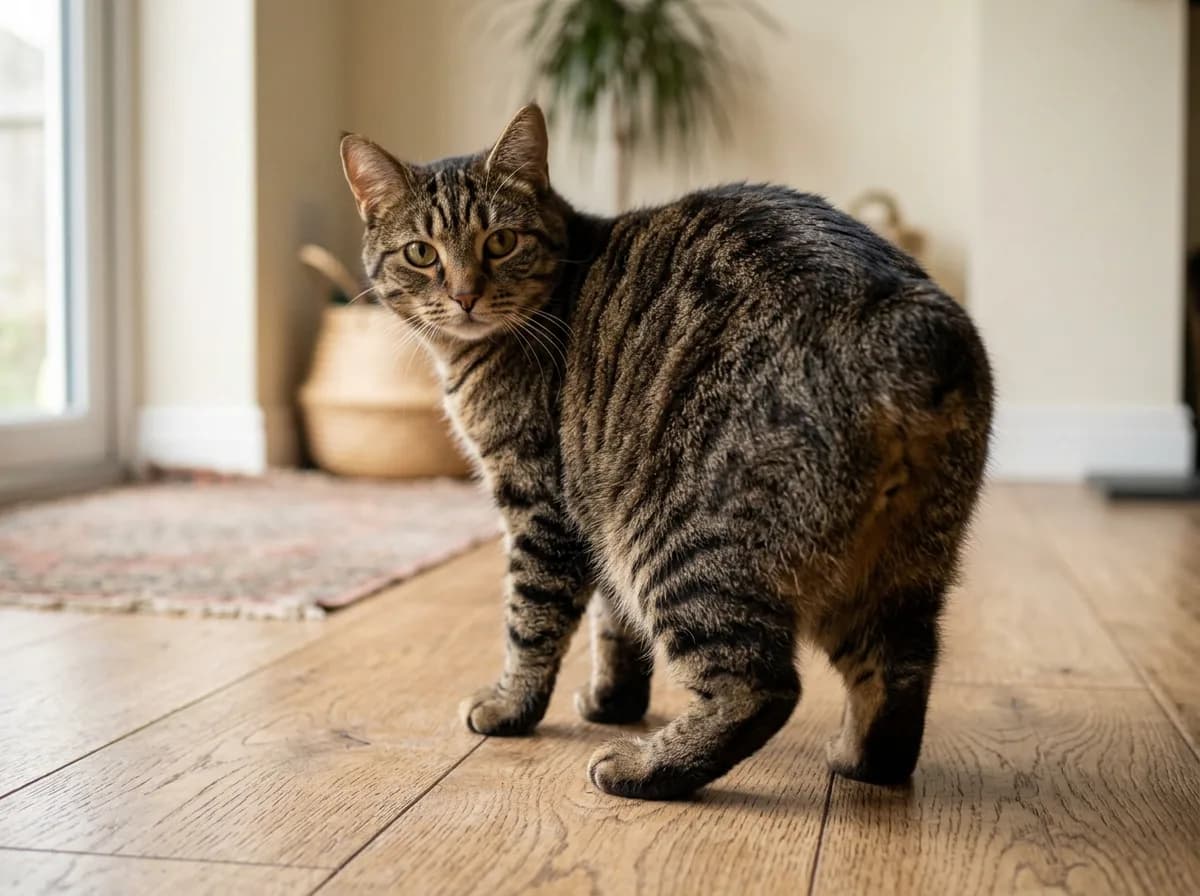
One of the most searched questions about this breed is why a Manx cat's back legs are longer than its front legs, and it is one of the most distinctive things about the animal in motion. The hind legs of a Manx are noticeably longer than the forelegs. That single proportion drives the breed's whole silhouette and its famous gait.
Because the rear legs are taller, the rump sits higher than the shoulders. The spine then sweeps up in a continuous curve from the shoulders to the hindquarters, producing the rounded, arched topline that breeders prize and that gives the Manx its compact, "humped" look. Combine the longer back legs, the raised rump, and the missing tail, and you get a walk that genuinely resembles a rabbit's hop, with the powerful hindquarters pushing the cat forward in a bounding motion rather than a smooth feline glide. This rabbit-like hop is real and is part of why the old "cabbit" folklore (the myth that a Manx is a cat-rabbit hybrid) took hold. To be clear, that hybrid story is pure legend and is genetically impossible. A cat and a rabbit cannot interbreed. The resemblance is a coincidence of anatomy, nothing more.
- The Manx hopping gait and missing tail inspired centuries of "cat-rabbit hybrid" folklore. It is a charming story and nothing else. Cats and rabbits are different species and cannot produce offspring together. The hop comes entirely from the longer hind legs and arched back.
This same anatomy is why the Manx page you are reading already ranks for searches about cats with back legs longer than the front. It is a genuine breed signature, not a defect, and a healthy Manx uses those strong rear legs to jump remarkably well. The trait also appears, to a lesser degree, in the long-haired version of the breed, the Cymric, since it is the same cat under a longer coat.
Manx Cat With a Long Tail: The Longy Explained
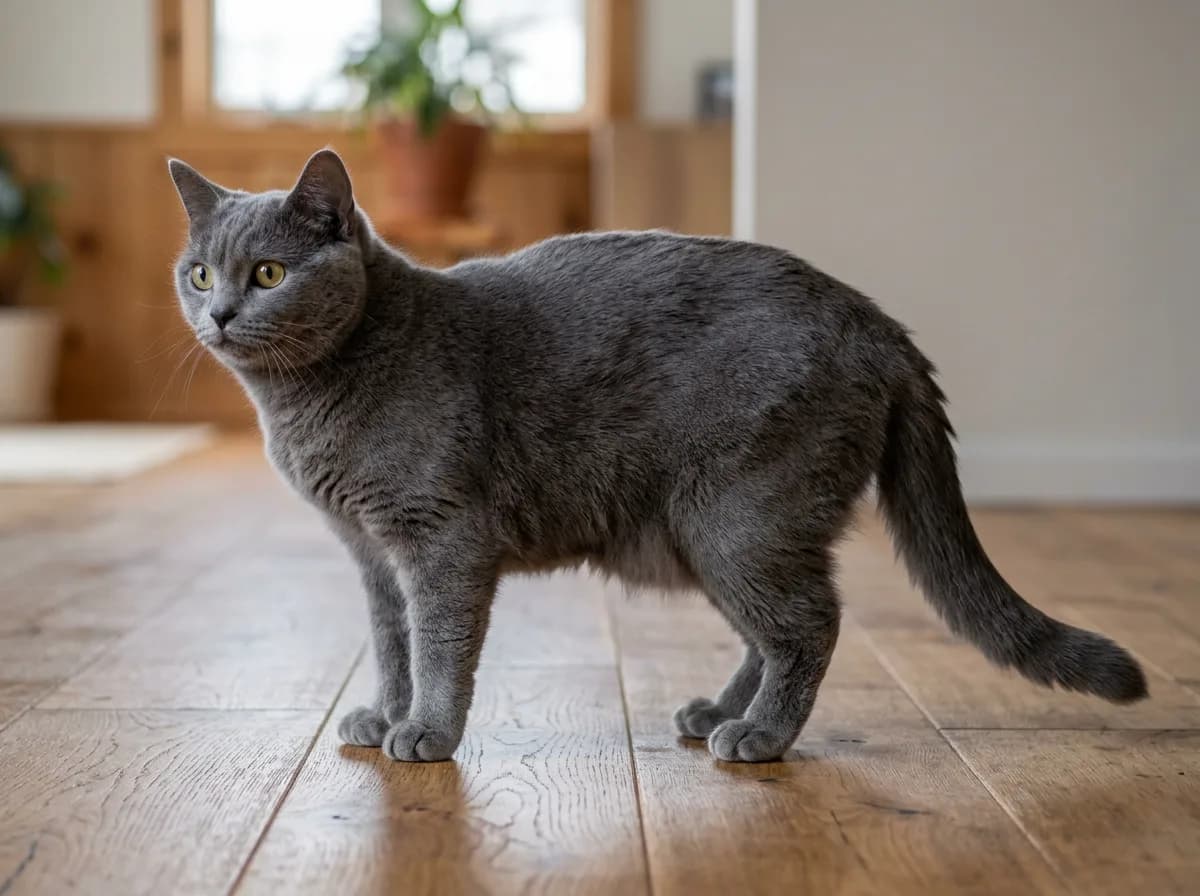
A Manx cat with a long tail is called a "longy" (sometimes spelled longie), and it is far more common than most people expect, especially among pet and random-bred Manx. A longy has a half-length to full-length tail that can look completely ordinary, which is why these cats are sometimes mistaken for non-Manx mixes.
What makes a longy a true Manx is the gene, not the look. A longy still carries the dominant Manx allele and can produce rumpy, riser, stumpy, or longy kittens of its own. Breeders actually value tailed and stumpy Manx as breeding stock precisely because crossing them with rumpy cats avoids the lethal double gene and produces healthier litters. So a long tail on a Manx is not a flaw or a mislabel. It is the breed working exactly as its genetics dictate, and a black Manx with a long tail (a frequently searched combination) is simply a longy that happens to be black.

63-inch multi-level cat tree with scratch posts, hammock, plush perches, and dangling toys. Vertical territory is non-negotiable for high-energy climbing breeds like the Bengal.
Petful may earn a commission when you click through to Chewy, at no extra cost to you.
- If your kitten came from a Manx litter but has a full tail, it is most likely a healthy longy carrying the Manx gene. Tailed Manx are real, common, and often the safest to breed. Ask the breeder which tail types were in the litter to understand your cat's genetics.
A Safety Note: Manx Syndrome
The same gene that shortens the Manx cat tail can, in a minority of cats, shorten the spine too much and cause a serious condition called Manx Syndrome (medically, sacrocaudal dysgenesis). It is a spina-bifida-like malformation of the lower spine and spinal cord, and it is the breed's defining welfare issue, so it deserves a clear, honest mention here even though the full medical detail lives on a dedicated guide.
Signs usually appear by four to six months of age and can include hind-limb weakness, an exaggerated hopping gait, fecal or urinary incontinence, constipation or megacolon, and recurrent urinary tract infections. One often-cited study found signs in around 30 percent of the Manx examined, with nearly all of the affected cats being rumpies (the fully tailless type that carries the most extreme version of the trait); severe cases are less common, and the exact figure varies by source. Risk is highest in rumpy cats and in rumpy-to-rumpy breeding, which is the main reason ethical breeders avoid that pairing, screen their lines, and place kittens at four months or older once they can confirm a kitten shows no signs. Mild cases can live full, happy lives with veterinary management, while severe cases carry a poor prognosis. If you are choosing a Manx, this is the single most important health topic to discuss with your breeder, and a detailed Manx Syndrome guide on Petful covers diagnosis, treatment, and prognosis in depth.
- If a young Manx shows hind-leg weakness, struggles to control its bladder or bowels, or strains in the litter box, see a veterinarian promptly. These can be signs of Manx Syndrome. Risk is highest in fully tailless rumpy cats, and early veterinary care makes a real difference to quality of life.
For a source-based side-by-side guide, see Japanese Bobtail vs Manx for tail genetics, body standards, health context, and ancestry evidence.
Other Tailless and Short-Tailed Cat Breeds
The Manx is the most famous tailless cat, but it is not the only one. Several other breeds carry short, bobbed, or absent tails, each from its own separate genetics, so a stub-tailed cat is not automatically a Manx. Just as the Sphynx is instantly recognizable for its hairless coat, these breeds are defined by their tails. Here is how the best-known tailless and bobtail breeds compare.
American Bobtail
The American Bobtail is a sturdy, medium-to-large North American breed with a short, expressive tail that is usually about one-third the length of a normal cat's tail. Its bobbed tail comes from a different dominant mutation than the Manx gene, and unlike the rumpy Manx it virtually always has at least a visible stub. American Bobtails are known for a relaxed, dog-like temperament that Manx owners will find familiar, and they are the closest mainstream parallel to the Manx among short-tailed breeds.
Japanese Bobtail
The Japanese Bobtail is an ancient breed celebrated in Japanese art and folklore, and the model for the waving "lucky cat" figurine. Its signature pom-pom tail comes from a recessive gene (the opposite inheritance pattern from the Manx), so the trait behaves very differently in breeding, and a Japanese Bobtail always has at least some kinked or curled tail rather than none.

108-oz stainless steel pet fountain with quiet pump and water-level window. Bengals are notoriously water-obsessed; a flowing fountain encourages hydration and pulls them away from sinks and toilets.
Petful may earn a commission when you click through to Chewy, at no extra cost to you.
Kurilian Bobtail
Native to the Kuril Islands between Russia and Japan, the Kurilian Bobtail is a robust, wild-looking breed with a short, fluffy pom tail made of a few kinked vertebrae. It developed naturally on its remote islands, much as the Manx did on the Isle of Man, but from unrelated genetics.
Pixie-bob
The Pixie-bob is an American breed bred to resemble the wild bobcat, complete with a short bobbed tail, tufted ears, and a spotted coat. Its short tail is part of the look, and like the other bobtails its tail genetics are distinct from the Manx mutation. There is more on this in Petful’s guide to Pixie-Bob cat.
Highlander
The Highlander is a newer hybrid breed known for curled ears and a naturally short, bobbed tail. It is a large, athletic, playful cat, and its short tail is a defining feature alongside those distinctive ears. For more, see Petful’s guide to Highlander cat.
Cymric
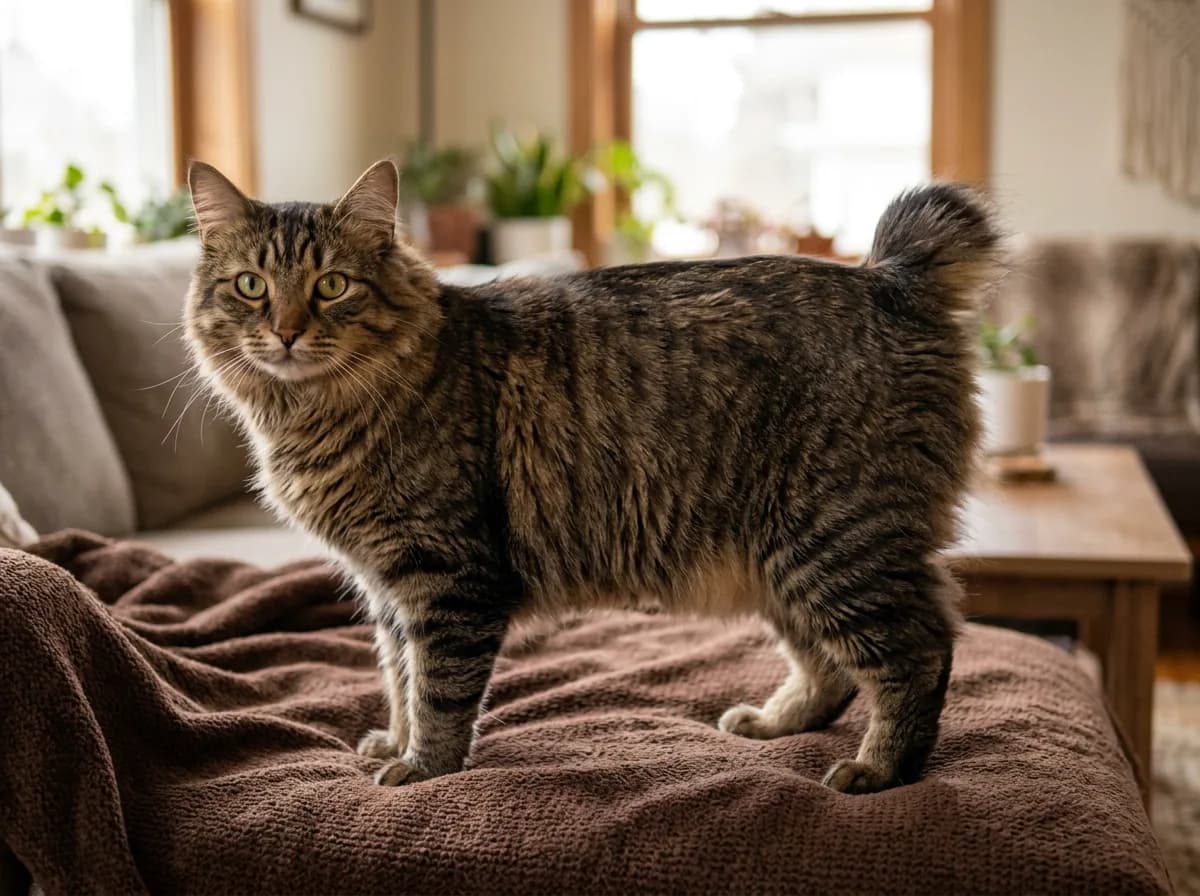
The Cymric is, quite simply, a long-haired Manx. It is the same cat with the same tail types (rumpy, riser, stumpy, longy), the same dominant gene, the same longer back legs, and the same Manx Syndrome risk, just wearing a plush semi-long coat. CFA registers it as the long-haired division of the Manx, while TICA recognizes it under the Cymric name.
| Breed | Tail | Gene Pattern | Origin |
|---|---|---|---|
| Manx | None to full (four types) | Dominant | Isle of Man |
| Cymric | Same as Manx, long-haired | Dominant | Isle of Man |
| American Bobtail | Short stub, about one-third length | Dominant (separate gene) | North America |
| Japanese Bobtail | Short pom or kinked tail | Recessive | Japan |
| Kurilian Bobtail | Short fluffy pom | Natural island mutation | Kuril Islands |
| Pixie-bob | Short bobbed tail | Distinct mutation | United States |
| Highlander | Short bobbed tail, curled ears | Hybrid breed trait | United States |
Caring for a Manx Tail (or Lack of One)
For most Manx, the tail needs no special care, but two practical points are worth knowing. First, fully tailless rumpy cats can have a sensitive lower-back and rump area, so handle that region gently and check it during grooming. Second, stumpy and longy Manx occasionally develop arthritis at the base of a partial tail as they age, which can make that spot tender; if your cat flinches when the tail base is touched, mention it to your veterinarian. Some breeders historically docked partial tails to prevent this, though that practice is increasingly discouraged and restricted.
Beyond the tail itself, a Manx is a generally hardy, muscular cat that benefits from the same good care as any breed: quality nutrition, regular veterinary checkups, and plenty of play to satisfy those powerful, jump-ready hind legs. It is a medium-sized cat rather than a giant, so it does not need the heavy-duty space and gear that a large breed like the Maine Coon demands, but it is every bit as athletic. Whether your Manx is a rumpy or a longy, treat the lower back and tail base as a sensitive zone, and bring any tenderness, flinching, or litter-box trouble to your veterinarian, since the lower spine is exactly where Manx health issues show up.
Frequently Asked Questions
Some do and some do not. Manx cats come in four tail types: rumpy (no tail), rumpy riser (a tiny knob), stumpy (a short partial tail), and longy (a near-full or full tail). The fully tailless rumpy is the most famous, but tailed Manx are common, especially as pets.
Taillessness comes from a single dominant mutation called the Manx gene. It shortens or eliminates the tail vertebrae. The trait arose naturally centuries ago in the isolated cat population on the Isle of Man and passes down reliably because only one copy of the gene is needed to show it.
Yes. A Manx with a long tail is called a longy, and it is common, particularly in pet and random-bred Manx. A longy still carries the Manx gene and can produce tailless kittens, so a full tail does not mean the cat is not a true Manx. A black Manx with a long tail is simply a black longy.
Rumpy (completely tailless, often with a dimple), rumpy riser (a small knob of one or two vertebrae that can rise when the cat is happy), stumpy (a short partial tail of roughly two to six vertebrae), and longy (a half-length to full-length tail). CFA shows only rumpy and rumpy riser, while stumpy and longy are common pets.
It is a defining feature of the breed. The longer hind legs raise the rump above the shoulders, create a continuous arch along the back, and produce the breed's rabbit-like hopping walk. It is normal Manx anatomy, not an injury or defect, and it helps the cat jump powerfully.
Besides the Manx and its long-haired version the Cymric, short-tailed and bobtail breeds include the American Bobtail, Japanese Bobtail, Kurilian Bobtail, Pixie-bob, and Highlander. Each gets its short tail from its own separate genetics, so a stub-tailed cat is not automatically a Manx.
The tailless ones are born that way; the tail length is set genetically before birth, not docked. Within a single litter, kittens can be born rumpy, riser, stumpy, or longy because every Manx carries both the Manx gene and a normal tail allele.
Yes. Pairing two rumpy (fully tailless) Manx greatly raises the risk of the lethal double gene, which is fatal to embryos in the womb, and increases the chance of spinal defects in surviving kittens. Responsible breeders cross a rumpy with a stumpy or tailed Manx instead and place kittens at four months or older once they can confirm no signs of Manx Syndrome.

Coreen Saito is a pet writer and longtime shelter volunteer with more than a decade in animal rescue. She covers cat behavior, breed care, and the small, ordinary science of sharing a life with companion animals, with a particular focus on honest takes about the products and decisions that actually matter. At home in Arizona, she's outranked by Mac (a dog with the loudest opinion in the house), Rebel (a cat who governs by quiet authority), and Meri (an orange tabby who runs the late shift and the laundry basket). She writes about all three, plus the rescues that keep coming through her life, at LifeWithMinty.com.
Sign up for expert-backed reviews and safety alerts all in one place.