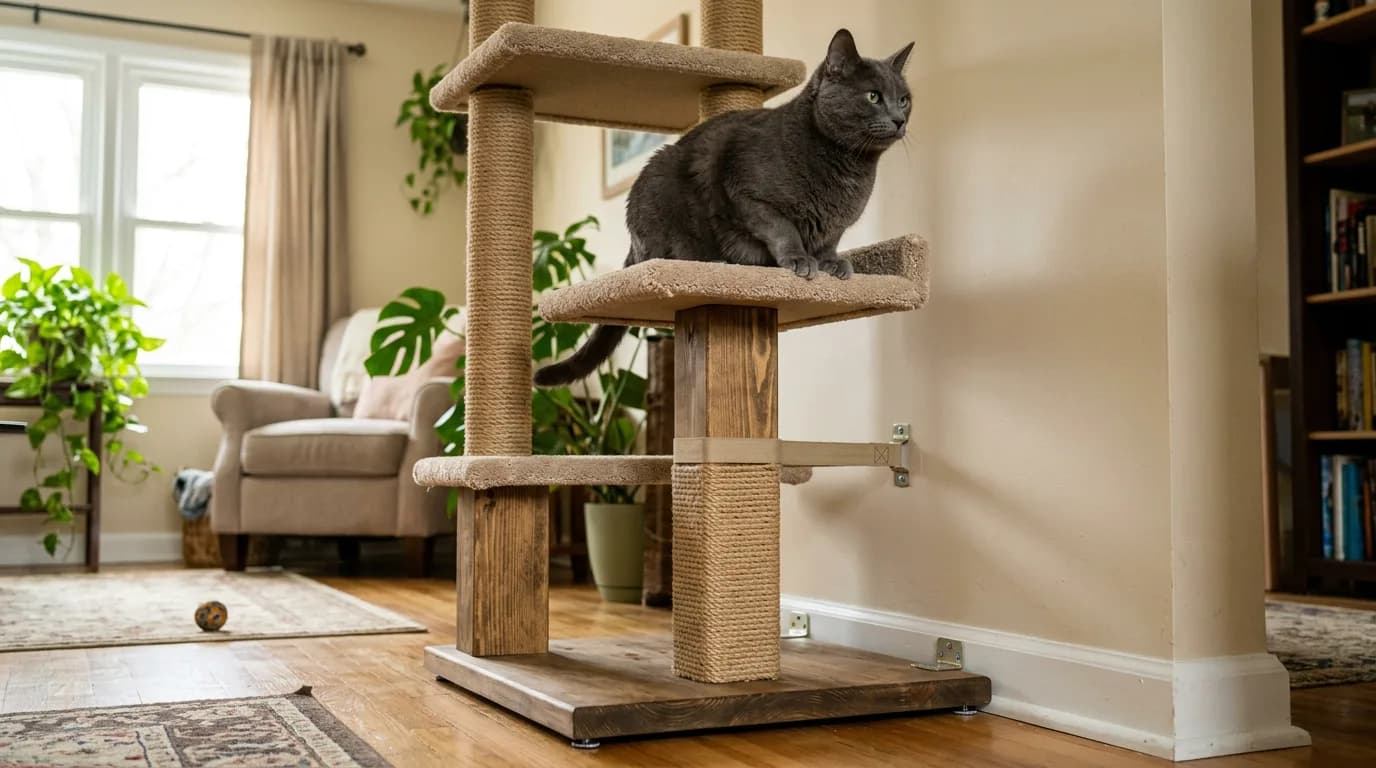
Cat Trees and Scratching Posts Compared
Choose between a cat tree, scratching post, floor scratcher, or mounted board by matching each piece to your cat's habits, usable room space, and the function your current setup is missing.
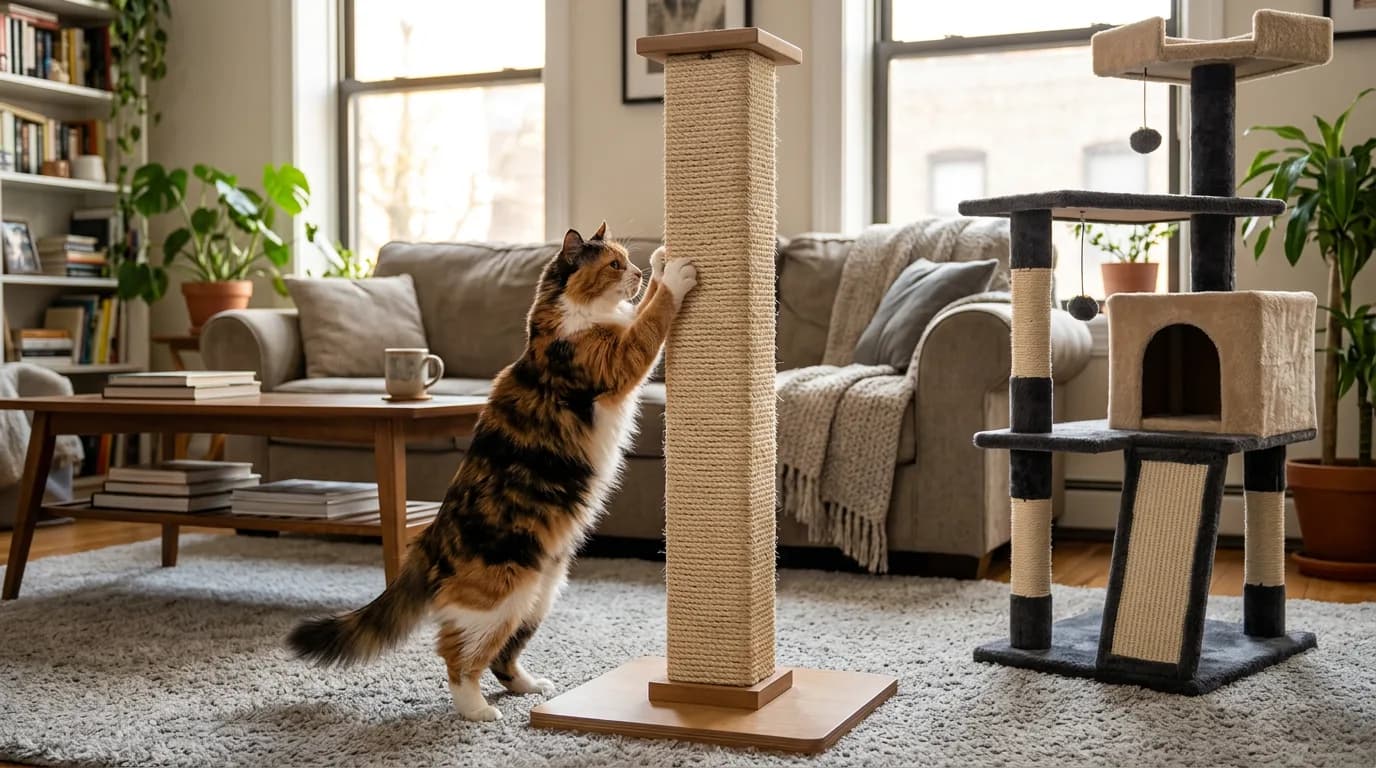
Separate pieces can provide climbing, resting and scratching options.
Petful is reader supported. As an affiliate of platforms like Amazon and Chewy, we may earn a commission when you buy through links on this page. There is no extra cost to you.
Cat trees and scratching posts solve overlapping problems, but they do different jobs. A tree can add climbing routes and elevated resting places. A separate post, board, or floor scratcher can provide a scratching surface in the position your cat already uses.
Start with the missing function. If your cat has a favorite perch but scratches the sofa upright, a well-placed post may be the useful addition. If scratching is covered but your cat keeps seeking a higher resting spot, compare trees. The right setup gives your cat usable choices without filling the room with furniture that duplicates an existing favorite.

Sign up for expert-backed reviews and safety alerts all in one place.
Cat Tree, Scratching Post, or Both?
A cat tree, sometimes listed as a cat scratch tower, combines some mix of platforms, beds, enclosed spaces, and scratching supports. A scratching post concentrates on an upright scratching surface. Neither category promises that every part will suit every cat. A tall tree may have short wrapped supports, while a simple post may offer a longer uninterrupted stretch.
- 1Choose climbing access, scratching surface, and resting space separately, then see which piece combines the functions your cat needs.
- 2A cat tree does not automatically replace a full-height scratching post or a floor scratcher.
- 3Add the missing function before buying another version of something your cat already uses.
Think about the entire setup rather than a single purchase. An elevated bed your cat can reach comfortably might already supply resting space. A quiet hideaway elsewhere might provide retreat space. You can then spend your budget on the scratching format that is missing.
| Furniture format | Main useful function | What to check | Possible missing function |
|---|---|---|---|
| Cat tree | Climbing access and resting space | Reachable platforms, usable beds, uninterrupted scratching areas | A full-stretch scratching surface |
| Scratching post | Upright scratching surface | Usable height, attachment, base stability | Elevated resting or retreat space |
| Floor pad | Horizontal scratching surface | Enough usable area and resistance to sliding | Climbing access |
| Mounted board | Scratching surface at an installed height | Approved mounting method and clear approach | Resting space |
| Separate pieces | Different functions in different locations | Whether each piece solves an observed need | A convenient route between resources |
The useful comparison is not how many features a listing names. It is whether your cat can use those features. A cubby too small to enter comfortably does not add practical retreat space. A bed positioned beyond a difficult jump does not add an accessible resting place.
- Keep a favorite existing scratcher if it still works.
- Identify the activity the current arrangement does not support.
- Check whether one new piece can supply that activity where it is needed.
- Leave enough floor space for your cat to approach and leave it.
A dedicated upright post makes sense at this point if the missing function is a long scratching surface, rather than another place to sleep.
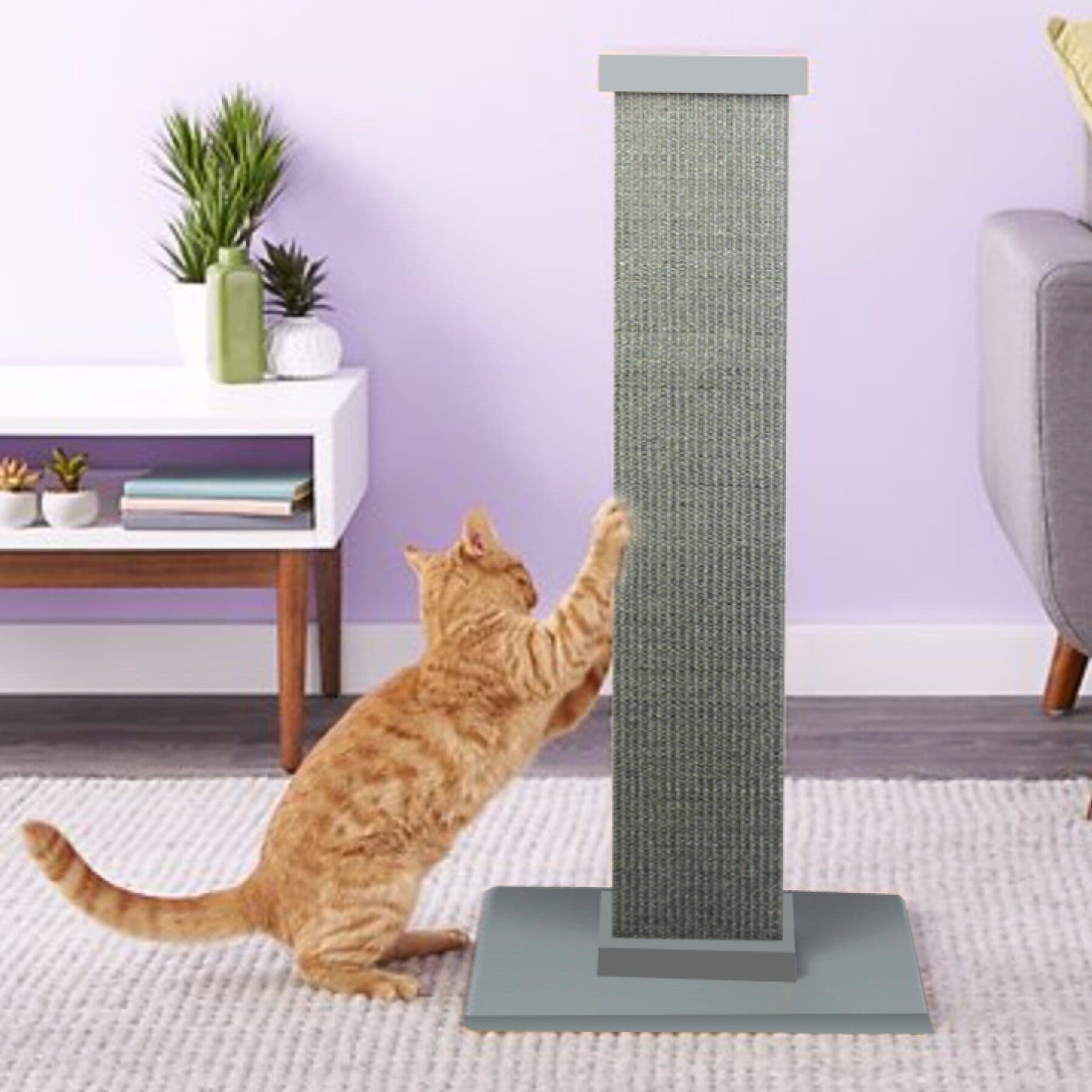
A 32-inch woven-sisal scratching post with a 16-inch square base. Compare its height with your cat’s full scratching stretch.
Petful may earn a commission when you click through to Chewy, at no extra cost to you.
A separate scratcher also lets you change one part of the arrangement without replacing a whole tree. That can help when a cat likes the tree's bed but ignores its scratching supports. Conversely, a post cannot substitute for climbing access simply because it is tall.
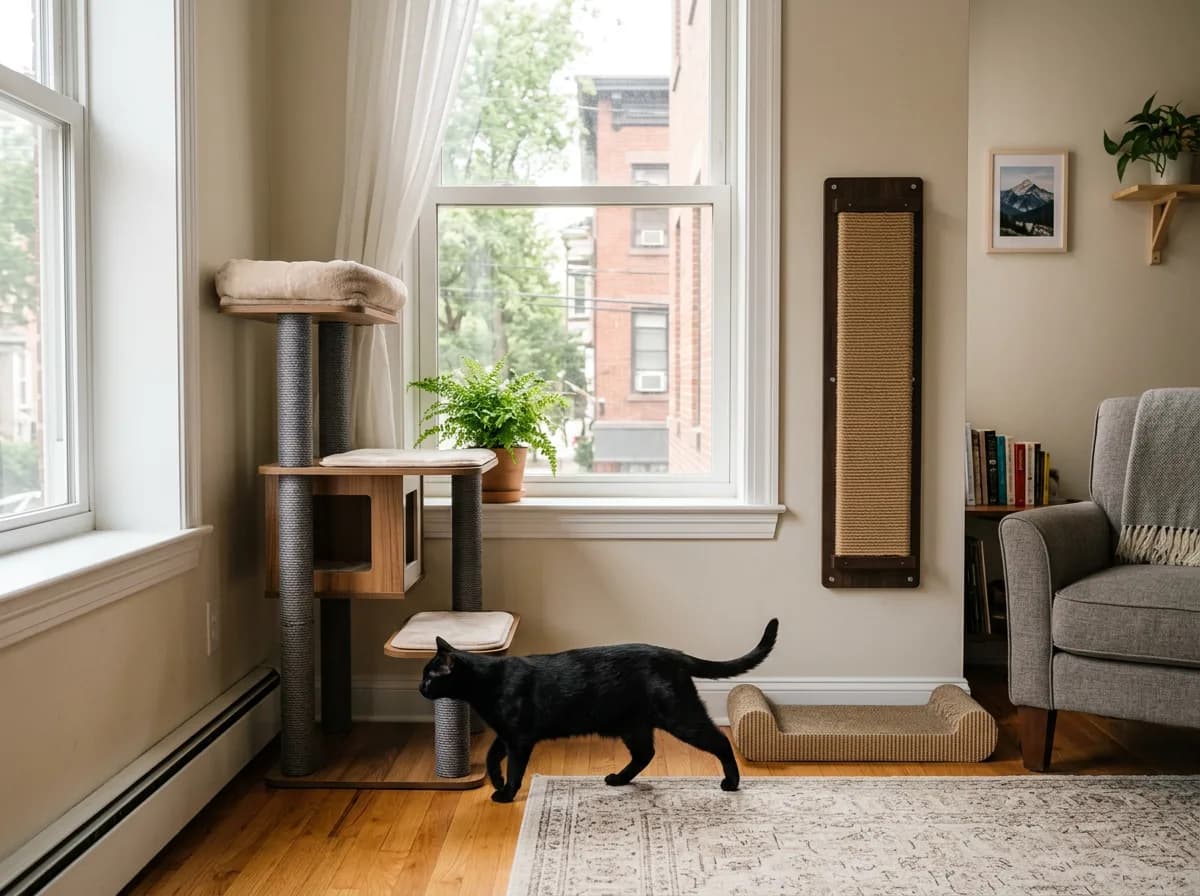
Start With How Your Cat Scratches, Climbs, and Rests
Watch a few ordinary scratching sessions before choosing. Note where the front paws land, whether your cat stands up or stays over a flat surface, and whether the surface moves. Also notice where your cat chooses to rest when the room is quiet. These observations give you more useful starting information than a product described as suitable for every cat.
Do scratching posts help cats? They give cats an appropriate place to perform natural scratching and stretching when the surface, position, and location suit them. Simply owning a post does not ensure it will replace the sofa. An ignored post may be poorly placed, unstable during use, or different from the angle or texture the cat seeks.
| Surface example | Useful observation | What the observation cannot prove |
|---|---|---|
| Sisal surface | Whether the cat returns to that particular woven or wrapped surface | That all sisal products will work equally well |
| Jute surface | Whether the cat uses the wrapped post comfortably | That jute and sisal are interchangeable |
| Cardboard surface | Whether the cat scratches while standing over it | That cardboard alone explains the preference |
| Any surface | Repeated voluntary use and individual preference | A universal preference shared by other cats |
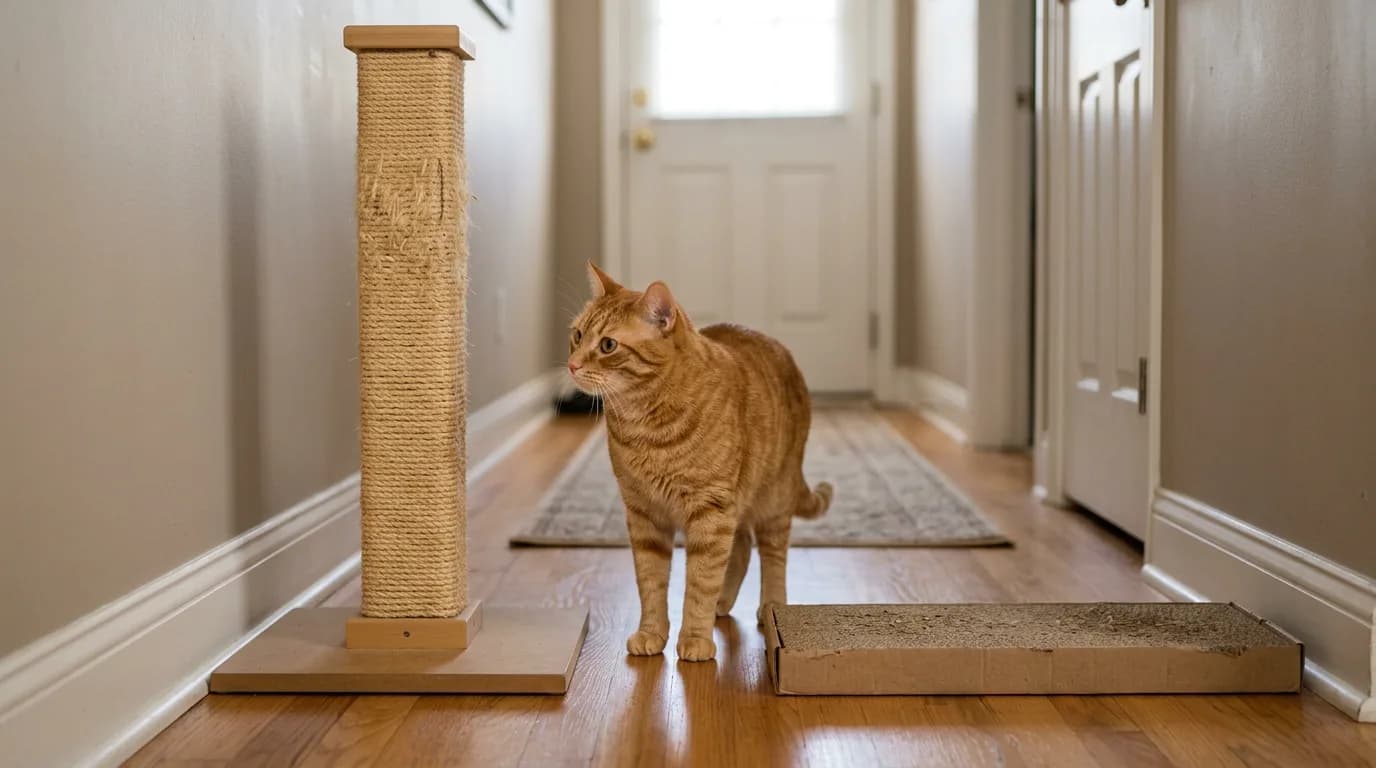
A horizontal cardboard lounge is one option when the scratching happens at floor level. Compare that stance with the upright posture your cat uses on a post before deciding which format belongs in the room.
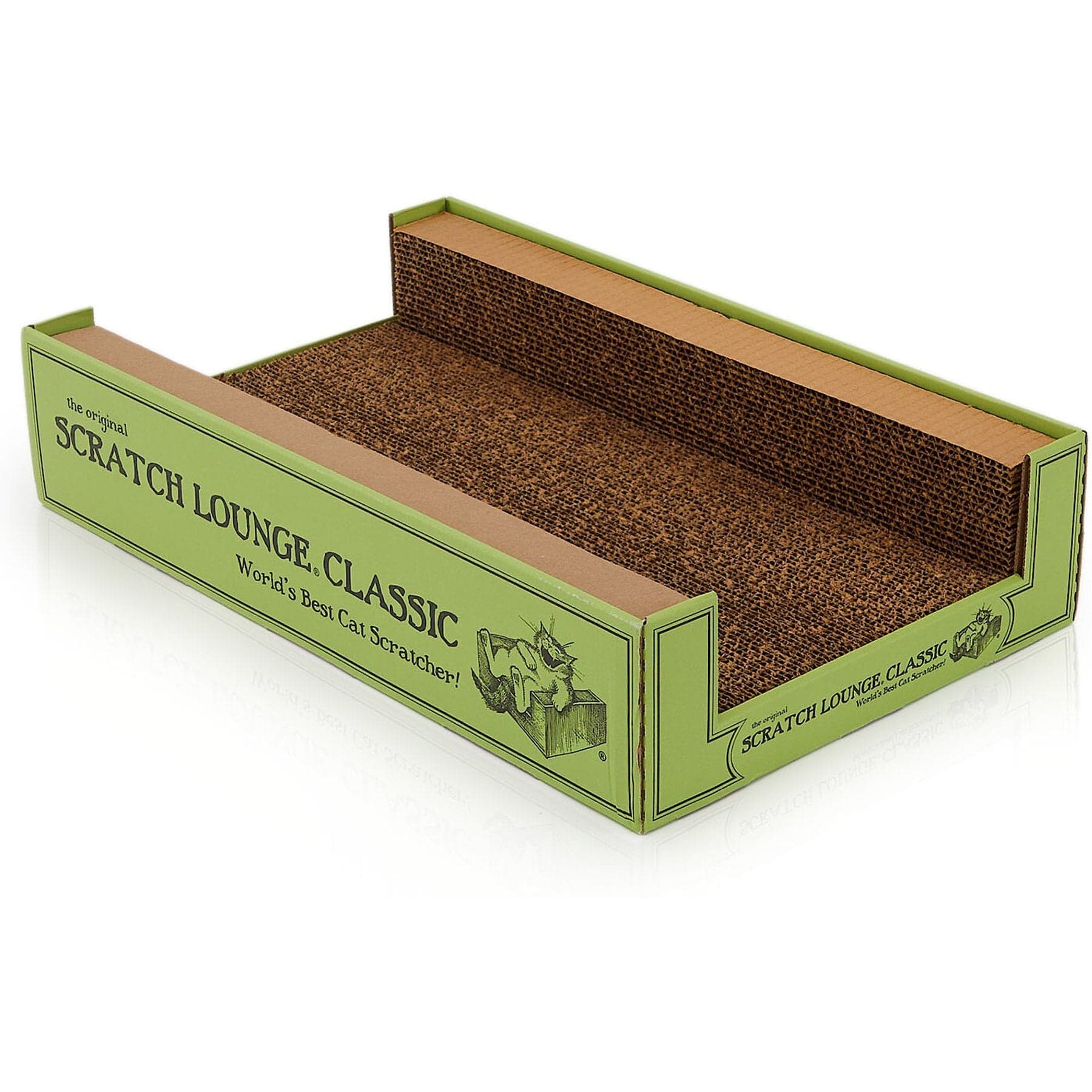
A horizontal cardboard lounge with reversible pads and available floor refills. An option for cats that scratch while standing on a flat surface.
Petful may earn a commission when you click through to Chewy, at no extra cost to you.
Choose a scratching material
For material choice, separate the surface from the shape beneath it. A sisal board and a sisal post may invite different stances, even though both are labeled sisal. Woven fabric and rope wrapping also differ in construction. Our scratching post materials comparison explains those distinctions, visible wear, and replacement choices so you can narrow a material change without guessing from a broad product label.
Choose scratching orientation
Scratching orientation deserves its own check. A cat reaching up a sofa arm may need an upright option close to that spot. A cat scratching a rug may find a floor scratcher easier to approach. If you are choosing between those positions, compare vertical and horizontal cat scratchers. Keep the location and material similar where possible so the new angle is the main change.
Check Usable Space, Scratching Height, and Stability
Measure the space your cat can actually use, not just the furniture's advertised height. On a tree, a shelf can interrupt an otherwise tall scratching support. On a post, the base and top cap may occupy part of the overall measurement. Compare the continuous scratching area with your cat's observed reach rather than assuming that the tallest listing provides the best stretch.
For a mounted board, usable scratching height also depends on the approved installation position. For a floor pad, usable length and width matter more than overall height. These measurements describe different tasks, so comparing their height numbers alone tells you very little about which one fills the gap.
The floor footprint is only the beginning of the room check. A tree squeezed between furniture may technically fit while leaving an awkward approach. Include the space your cat uses to step back, turn, jump down, and pass another cat. Doors, drawers, and everyday walking routes still need to work.
| Check | What to look at | How it affects the choice |
|---|---|---|
| Usable height | Uninterrupted scratching area within reach | Distinguishes a tall product from a useful stretching surface |
| Base footprint | The support area resting on the floor | Helps compare floor fit and room for placement |
| Clear approach | Space in front of the scratching surface | Lets the cat choose a natural stance |
| Landing space | Open area beside platforms and exits | Keeps access practical when the room is furnished |
| Stability | Movement, loose connections, and required attachments | Identifies assembly or support problems before use |
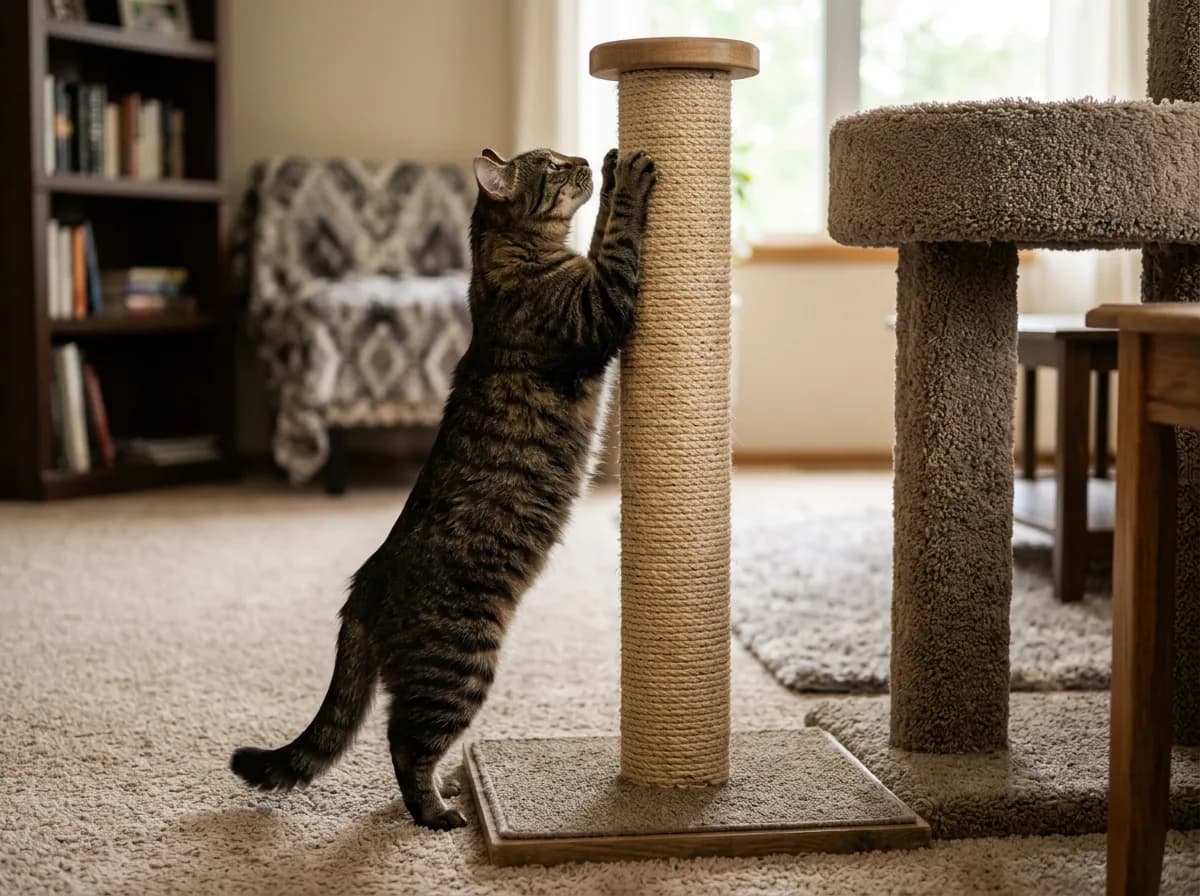
For a big cat, check the room needed to use a scratcher as well as its listed base dimensions. Mark those dimensions on the floor, then picture the approach, not just the square or rectangle. Then compare the actual platform dimensions with the space your cat occupies when resting. Overall height does not tell you whether a bed is large enough.
Check the structure before use
- Read the exact model's assembly and attachment instructions.
- Check that the intended floor and wall position suit those instructions.
- Inspect connections and the base after assembly.
- Recheck any movement that develops during use.
For a loose, damaged, or newly assembled tree, use our cat tree safety guide to work through the condition and installation decision. A new scratching surface cannot repair a damaged supporting structure. Likewise, placing a tree near a wall is not a substitute for a required attachment. Resolve the actual support problem before treating the furniture as ready for normal use.
Match the Setup to Your Household
The most useful setup depends on the room and the cats sharing it. Two households with the same floor area can need different furniture if one cat likes elevated beds and another stays on the floor. Start with access and usable surfaces, then compare appearance and extras.
| Household | Start with this comparison | Avoid assuming |
|---|---|---|
| Apartment space | Footprint plus approach and landing space | A tall, narrow tree automatically saves usable room |
| Large cat | Platform dimensions, usable scratching height, exact model guidance | Overall tree height proves body-size fit |
| Multiple cats | Separate approaches, exits, and alternative resting spots | Several beds guarantee comfortable sharing |
| Kitten fit | Reachable scratching areas and manageable routes | A small cat can use every part of a large tree |
| Nonclimbing setup | Stable floor scratching and accessible resting space | Every cat needs elevated furniture |
Apartments and small rooms
A small apartment may benefit from one well-used tree, or from a compact scratcher beside an existing resting spot. Compare the space the cat occupies while using it with the furniture's footprint. A narrow unit can still need a wide landing area.
A mounted scratching board offers another way to place a surface without a freestanding base. A wall-mounted climbing system is a different purchase with different installation needs. Do not treat those categories as interchangeable. Compare cat-tree features and formats when deciding between freestanding, multi-level, and wall-based arrangements.
A board can add a scratching station without adding another tree. A model designed for either floor use or wall mounting lets you choose between those supported positions, provided the installation matches its instructions.
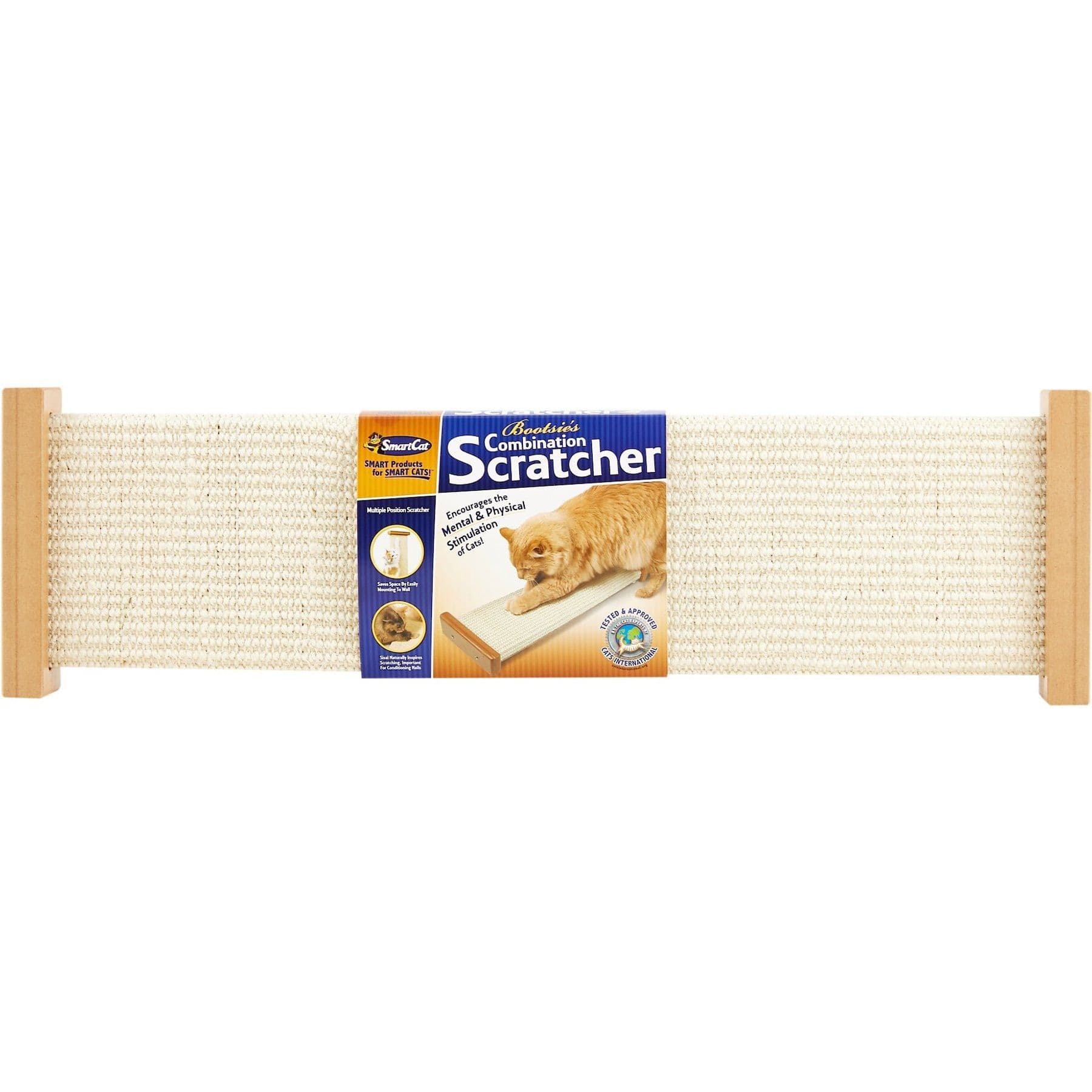
A woven-sisal board for floor or securely mounted wall use. A way to try another scratching angle without a full cat tree.
Petful may earn a commission when you click through to Chewy, at no extra cost to you.
Large cats and shared homes
For a large cat, check usable platform and bed measurements as well as the manufacturer's exact model guidance. A tall scratching post can still have an unsuitable base or insufficient space around it. Product photos alone do not establish capacity.
In a multi-cat home, check shared access: watch whether one cat waits for another to leave a perch or blocks a narrow route. Several platforms on one tree can still share a single approach. Another resting spot or scratcher in a different location may make the arrangement more usable than a larger version of the same bottleneck.
Check the occupied arrangement as well as the empty tree:
- A cat stretched across one shelf may change the route to the next.
- A shared approach can become a bottleneck even when beds are empty.
- Another resting spot elsewhere may improve access without replacing the tree.
Kittens and cats that stay low
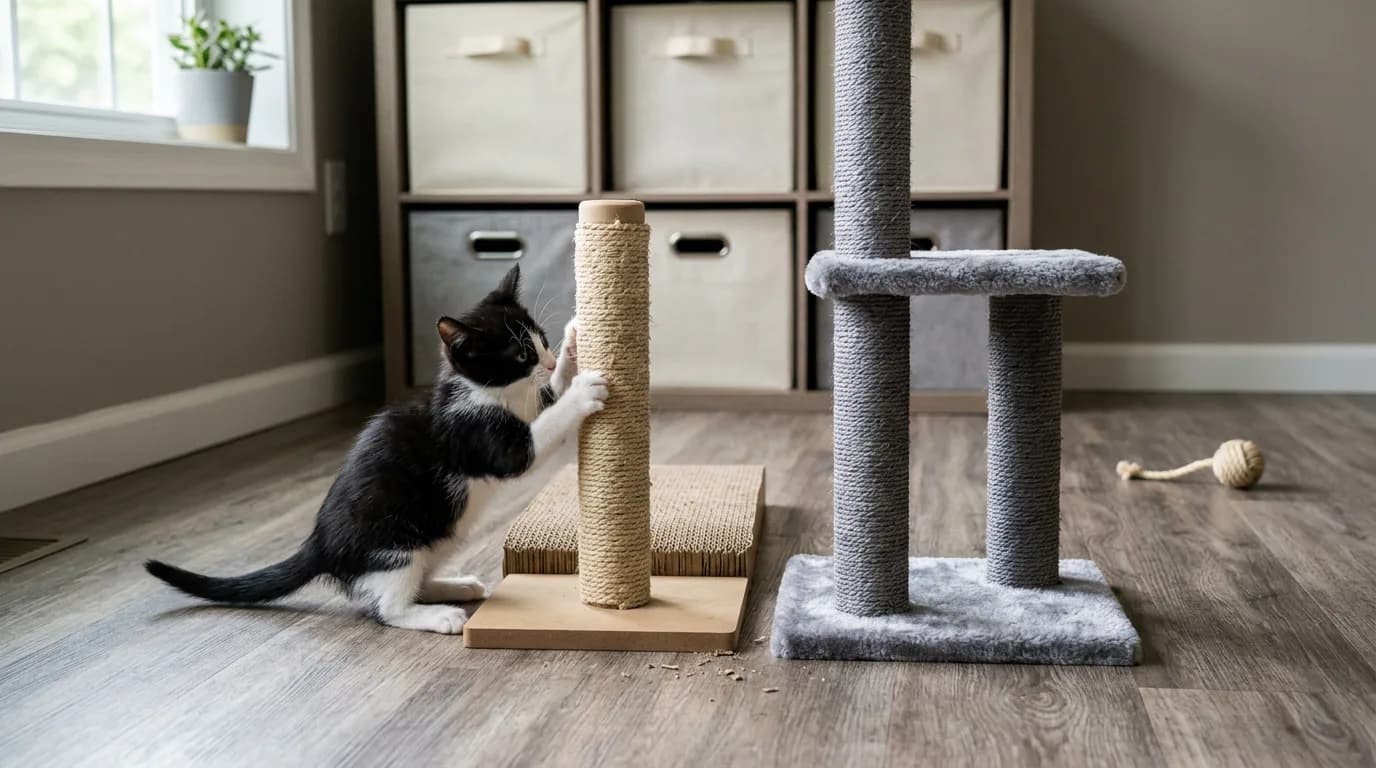
For kittens, start with reachable surfaces and an arrangement you can adjust as their size and use change. A kitten-specific label does not replace checking the actual route and scratching area. Our guide to kitten scratching posts and first cat trees compares those first purchases in detail, including when a simple scratcher makes more sense than a complex climbing setup.
For a cat that does not climb, a standalone post and floor pad can supply scratching choices alongside an accessible resting place. Use the formats your cat actually chooses. A tree is optional when its elevated features do not solve a current need. If a cat's willingness or ability to climb changes unexpectedly, treat that as a separate issue rather than assuming a taller or newer tree is the answer.
Where to Put Each Piece
Begin with the places your cat already scratches, rests, or passes regularly. Putting a new scratcher near an existing scratching spot makes the alternative available at the moment it is needed. A post hidden in an unused room may be easy to overlook, even when its surface is otherwise suitable.
Think about the furniture as a small route through the room. Your cat needs to reach the scratching face, step away, and get to nearby resting areas without squeezing behind objects. For a tree, check both the upward route and the landing space below.
- Put the scratching surface within a clear approach from the usual route.
- Keep doors and moving furniture from striking the piece.
- Leave an exit from enclosed or tucked-away resting areas.
- Check nearby cords, blinds, and other objects before choosing a climbing spot.
- Follow the model's location and attachment instructions rather than relying on a convenient corner.
For example, a post can fit beside a sofa yet face the wrong way for the cat's usual approach. Turning it within its approved setup may make the scratching face easier to reach. A floor pad under a side table might stay out of your way but leave too little headroom for the cat's natural stance.
A window-side tree can provide a place to look outside, but the whole location still needs checking. Consider direct heat, access to window coverings, and whether people regularly need that space. The appealing view does not make every spot beside a window suitable.
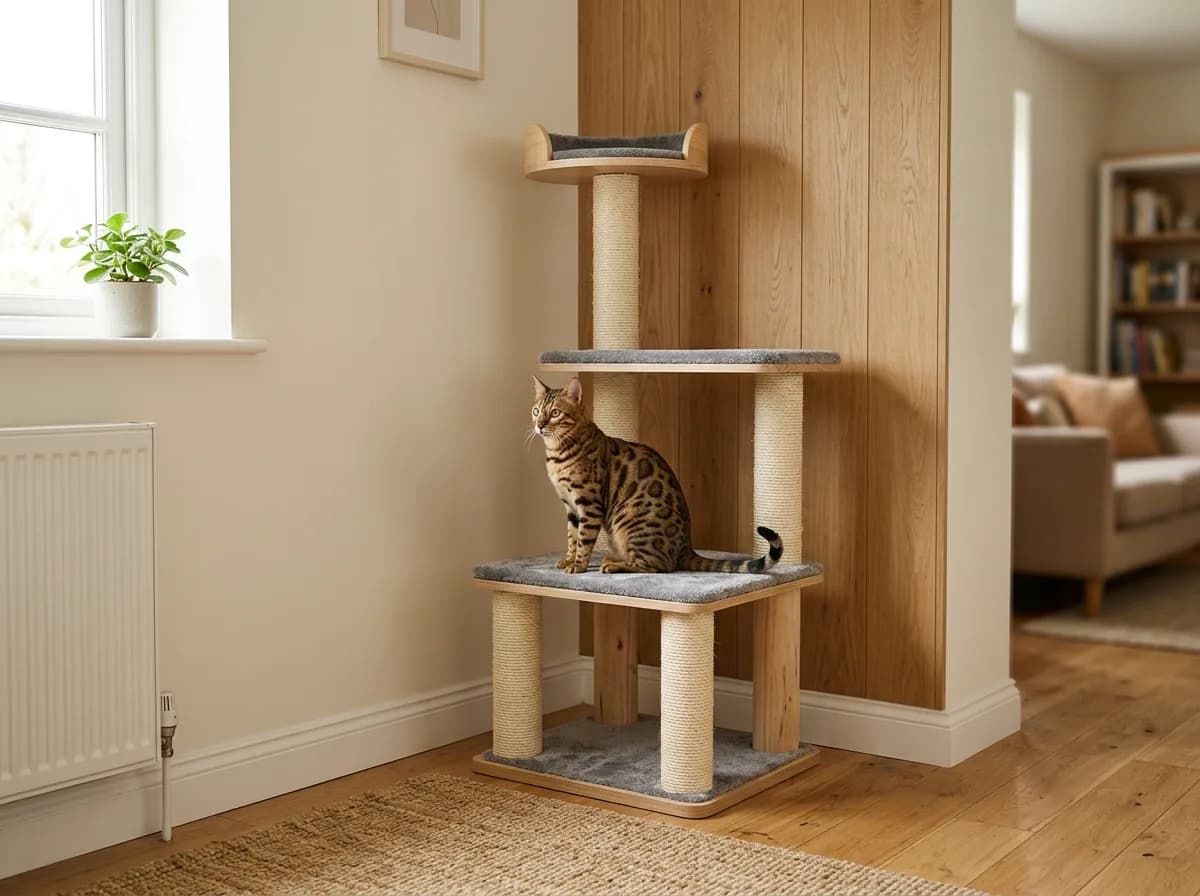
A multi-level tree is one way to combine climbing and resting in the chosen area. Before buying, check how its individual levels would work in that position, including whether nearby furniture would obstruct a platform or create an awkward exit.

63-inch multi-level cat tree with scratch posts, hammock, plush perches, and dangling toys. Vertical territory is non-negotiable for high-energy climbing breeds like the Bengal.
Petful may earn a commission when you click through to Chewy, at no extra cost to you.
Separate pieces give you flexibility. The tree might work best in a shared living area while the scratching post belongs beside the sofa arm your cat targets. A floor pad can serve another room without requiring a second climbing structure. There is no need to arrange everything as a matching furniture set.
If a scratcher is being used reliably, avoid moving it solely to make the room look tidier. When a move is necessary, keep the same surface and orientation initially. Changing the object, angle, and room together makes it harder to understand why your cat stops using it.
Compare Products for Each Part of the Setup
What is the best cat scratching post? It is the one that provides a usable scratching area in a stable format at a location your cat will approach. That may be a tall woven-sisal post for one cat and a floor-level scratcher for another. Compare these examples by the job they perform, rather than treating four different formats as a ranked list.
SmartCat The Ultimate 32-in Sisal Cat Scratching Post, Gray
The SmartCat Ultimate scratching post is a 32-inch woven-sisal post with a 16-inch square base. It is a straightforward comparison for a cat that reaches up to scratch and does not need another bed or climbing platform.
Compare its scratching area with your cat's stretch and check the base footprint in the intended spot. The height does not establish a fit for every large cat, and it does not add elevated resting space. Its role is a dedicated upright scratching station.
Scratch Lounge The Original Scratch Lounge Cat Toy with Catnip
The Scratch Lounge Original supplies a horizontal cardboard scratching option. Its reversible pads offer a different stance and texture from an upright post. The manufacturer also offers floor and side refills, which is useful when comparing the initial purchase with future surface replacement.
This format is worth considering when your cat scratches while standing over a flat surface. It does not provide climbing access, and its lounge shape does not guarantee that your cat will rest in it. Check the usable interior space rather than assuming the outside dimensions describe the scratching area.
SmartCat Bootsie's Combination Scratcher
SmartCat Bootsie's Combination Scratcher uses woven sisal on a board. It is designed for floor use or wall mounting, giving you a different furniture format from the freestanding Ultimate post.
Its useful distinction is the ability to place a sisal surface in either of those supported positions. Follow the mounting instructions for wall use. Propping a board against furniture is not the same installation. Check that the selected position leaves the cat enough room to approach and scratch.
Yaheetech Multi-Level 63-in Plush Cat Tree, Dark Gray
The Yaheetech Multi-Level 63-inch cat tree is the tree example here for readers comparing a climbing arrangement with separate scratchers. Its listed overall height is 63 inches. That measurement does not describe an uninterrupted scratching surface or establish the size of its individual platforms.
Before choosing it, compare the exact listing and assembly guidance with your cat's size, the available floor area, and the routes between levels. A larger overall structure is useful only when the cat can reach and use its parts. Keep a separate scratcher if the tree does not meet the scratching need.
For a ranked buying guide focused specifically on trees, see our best cat towers comparison. Here, the buying decision is which function to add. You may need only one of these formats, or a combination that supplies genuinely different places to scratch, climb, and rest.
Introduce the Setup and Adjust What Your Cat Ignores
Make the new piece easy to investigate without forcing contact. Leave a clear approach and let your cat choose when to come near it. You can reward voluntary interaction, but do not hold the cat's paws against the surface or make scratching a handling exercise.
Keep a familiar, usable scratcher available while introducing another option. Removing the old one immediately creates a different problem: the cat loses an established place before showing whether the replacement works.
- Place the new piece near a relevant existing activity.
- Check that it stays steady in its intended installation.
- Watch for voluntary scratching, climbing, or resting.
- Note which part is used and which part is ignored.
- Change one feature, such as location, before replacing the entire setup.
A cat using a tree's bed but ignoring its supports is giving you specific information. The resting function works; the scratching function may still need a separate solution. Likewise, a floor pad used frequently is useful even if the matching upright post receives little attention.
There is no fixed acceptance timetable that proves a product is wrong. Look for a pattern across ordinary opportunities to use it. If a change helps, keep that feature stable before making another adjustment.
For ongoing furniture scratching, our scratching-post placement and redirection tips cover the wider behavior question. Buying more furniture alone does not address every reason a cat returns to a particular spot. Start by making an appropriate alternative practical and appealing at that location.
Frequently Asked Questions
Compare usable height and base stability with the individual cat's reach and force during scratching. Check the exact model's guidance rather than choosing by advertised height alone. A large cat also needs room to approach and stretch without a nearby shelf or wall interrupting the movement.
A floor pad or securely mounted board can provide a scratching surface without a freestanding post. Choose a format your cat can approach naturally, then check that it stays in place during use. Neither option adds climbing or elevated resting space, so consider those needs separately.
Scratching is natural, but a new object may not immediately become the preferred place. Scratcher placement and a usable surface help make the choice accessible. Allow voluntary use and reward voluntary use when it occurs; avoid moving the cat's paws through a scratching motion.
Look for the missing function. If the tree already provides a usable scratching surface in the cat's preferred position, a separate post may duplicate it. If its supports are too short, inconvenient, or ignored, a dedicated scratcher can complement the tree's climbing and resting areas.
Start with a stable scratching option that fits the available space, then use observed use to guide additional purchases. You do not need to buy every format at once. Notice whether the cat seeks an upright stretch, a floor surface, or an elevated resting place before adding another piece.
Let existing use guide the starting positions. Put scratching options near relevant scratching activity, with a clear approach, and give a tree enough landing space around its accessible platforms. The pieces can be in different locations if that makes each function easier to use.

Coreen Saito is a pet writer and longtime shelter volunteer with more than a decade in animal rescue. She covers cat behavior, breed care, and the small, ordinary science of sharing a life with companion animals, with a particular focus on honest takes about the products and decisions that actually matter. At home in Arizona, she's outranked by Mac (a dog with the loudest opinion in the house), Rebel (a cat who governs by quiet authority), and Meri (an orange tabby who runs the late shift and the laundry basket). She writes about all three, plus the rescues that keep coming through her life, at LifeWithMinty.com.
Sign up for expert-backed reviews and safety alerts all in one place.