Vertical vs Horizontal Cat Scratchers
Choose an upright, floor, angled, or mounted scratcher by watching your cat's stance, then compare usable space, support, material, and placement without changing every feature at once.
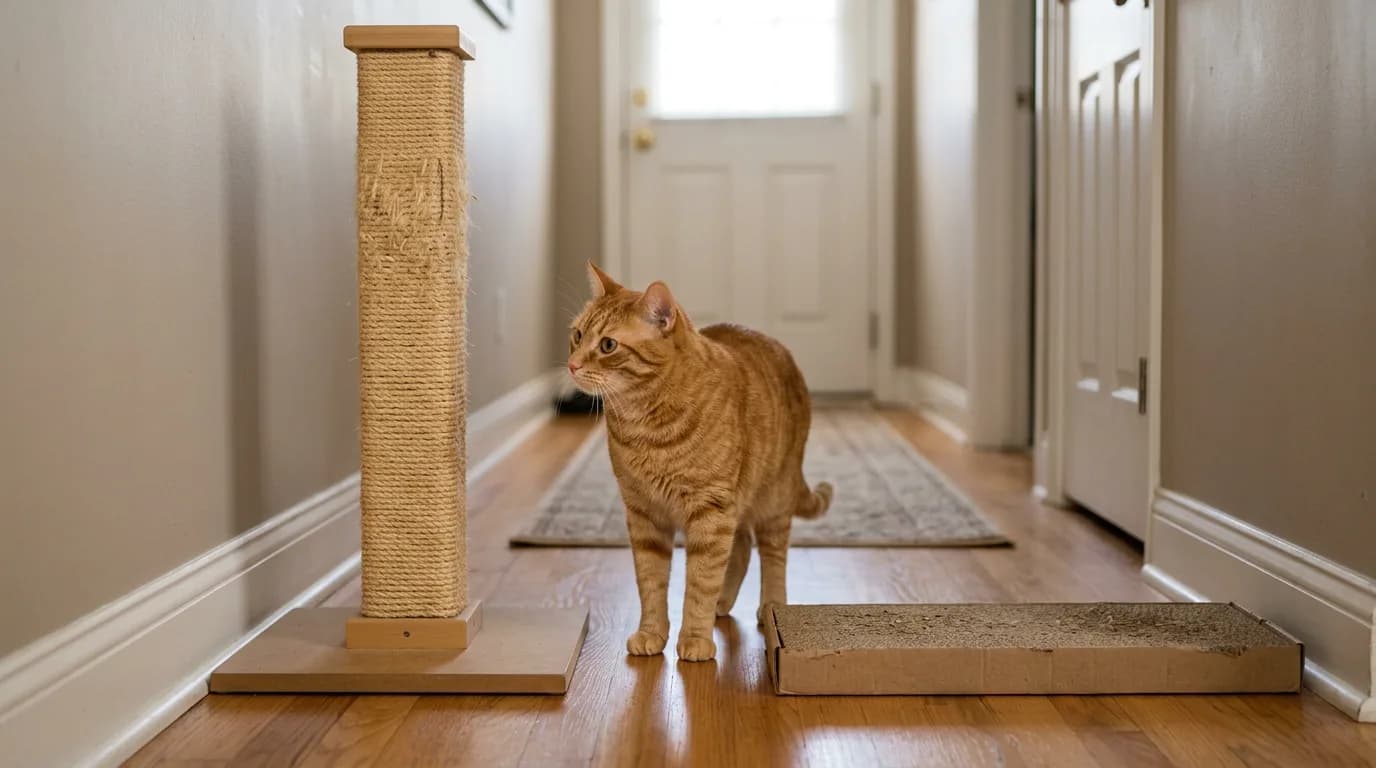
Cats that stretch up and cats that scratch flat surfaces often need different scratcher formats.
Petful is reader supported. As an affiliate of platforms like Amazon and Chewy, we may earn a commission when you buy through links on this page. There is no extra cost to you.
When comparing vertical vs horizontal cat scratchers, start with your cat's scratching stance. A cat reaching up a sofa arm gives you a reason to try an upright surface. A cat stretching over a rug gives you a reason to try a floor scratcher. Some cats use both.
The next checks are fit, support, material, and location. An upright post can be too short, a floor pad can slide, and a good surface can be ignored in the wrong room. Compare the complete scratching setup before deciding that your cat dislikes a particular orientation.

Sign up for expert-backed reviews and safety alerts all in one place.
Vertical, Horizontal, or Angled?
A vertical scratcher lets the cat reach upward while scratching. A horizontal scratcher provides a surface close to the floor, usually with the cat standing over or alongside it. An angled scratcher offers a supported slope. Wall mounting describes how a surface is attached; a wall-mounted board usually provides an upright scratching position.
- 1Start with observed scratching: reaching upward suggests a vertical scratcher, while scratching rugs or floor surfaces suggests a horizontal scratcher.
- 2Some cats use more than one orientation.
- 3Compare fit and support before treating an ignored scratcher as proof of a preference.
Choose the orientation that most closely matches a current scratching target as your starting point. That does not commit you to one type forever. A useful first purchase gives the cat a practical alternative, then lets you observe whether another position would add something.
| Format | Scratching stance | Support to check | Placement consideration |
|---|---|---|---|
| Vertical scratcher | Cat reaches up from the floor | Base stability, attachment, usable height | Clear approach and room for a full stretch |
| Horizontal scratcher | Cat stands over or beside the surface | Sliding resistance and usable standing area | Floor space on an existing route |
| Angled scratcher | Cat works against a supported slope | Purpose-built support at the intended angle | Clear approach at the lower end |
| Wall-mounted scratcher | Cat reaches toward a securely attached face | Correct mounting method and surface | Usable height without blocking the approach |
For an upright starting point, a dedicated post keeps the comparison simple. A 32-inch woven-sisal example such as the SmartCat Ultimate provides one surface and one main scratching position, without adding beds or climbing platforms. Compare its usable face with your cat's actual reach.
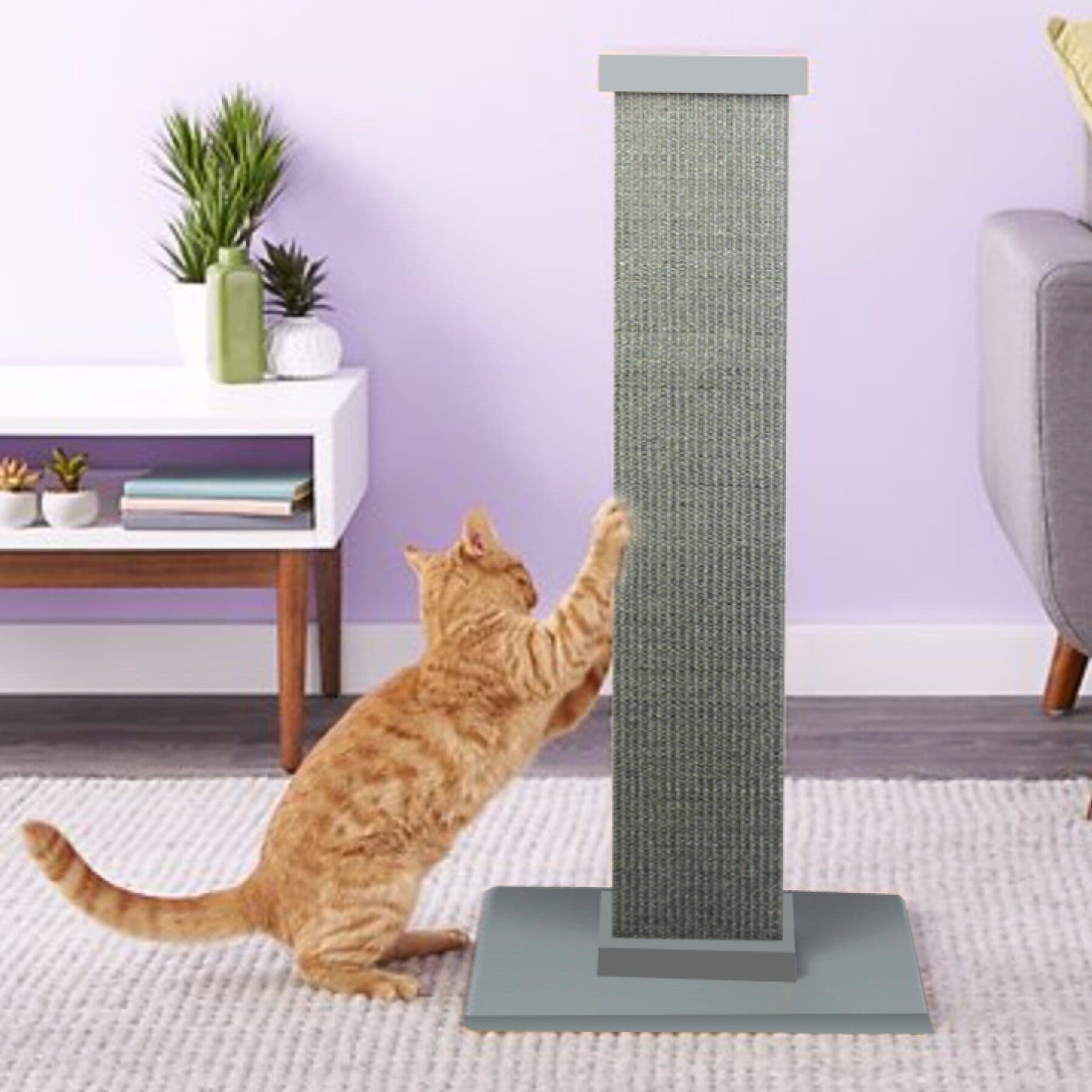
A 32-inch woven-sisal scratching post with a 16-inch square base. Compare its height with your cat’s full scratching stretch.
Petful may earn a commission when you click through to Chewy, at no extra cost to you.
Think about the activity, not the product name. A cardboard lounge may be used for scratching, resting, or both. A tree's wrapped supports may be upright but too interrupted to provide a full stretch. A board may have more than one approved position, while another similar-looking board may support only one.
You also do not need to replace a successful format just because another is popular. Keep an existing scratcher that remains sound and useful. Add a different orientation when your observations identify a missing option, such as persistent floor scratching in a room that has only an upright post.
Read the Clues in Your Cat's Scratching
Watch where the front paws land and how the rest of the body is positioned. The difference between reaching upward and pulling across a flat surface is more informative than simply noting which piece of furniture is damaged. Also watch what happens to the surface during use.
The San Francisco SPCA's scratching-post guidance recommends observing whether the cat reaches up or favors carpets and rugs, then offering an appropriate scratching format. It also emphasizes sturdy upright posts tall enough for a stretch. Use those observations as a starting point, not a guarantee that every post of that type will work.
Record a few concrete details:
- The scratching target and room.
- Whether the cat reaches up, stays low, or uses a slope.
- Where the cat's paws and body fit.
- Whether the surface moves.
- Whether the cat returns to the same spot on later occasions.
A sofa corner may offer several features at once: an upright face, an edge, a familiar texture, and a prominent location. Replacing it with a small pad in another room changes all of those features. If the pad is ignored, that does not isolate the problem to horizontal scratching.
Similarly, scratching near the floor can involve a rug edge, a flat pad, or a low part of an upright object. Watch the action rather than classifying every floor-level event as the same preference. A single brief pawing episode is less useful than a repeated pattern of scratching the same kind of surface.
A smaller upright post can still be a useful comparison when its usable height fits the cat. The TRIXIE Parla is a 24.4-inch jute-wrapped example. Its dimensions and construction differ from a taller woven-sisal post, so compare those features separately rather than attributing every difference to orientation.
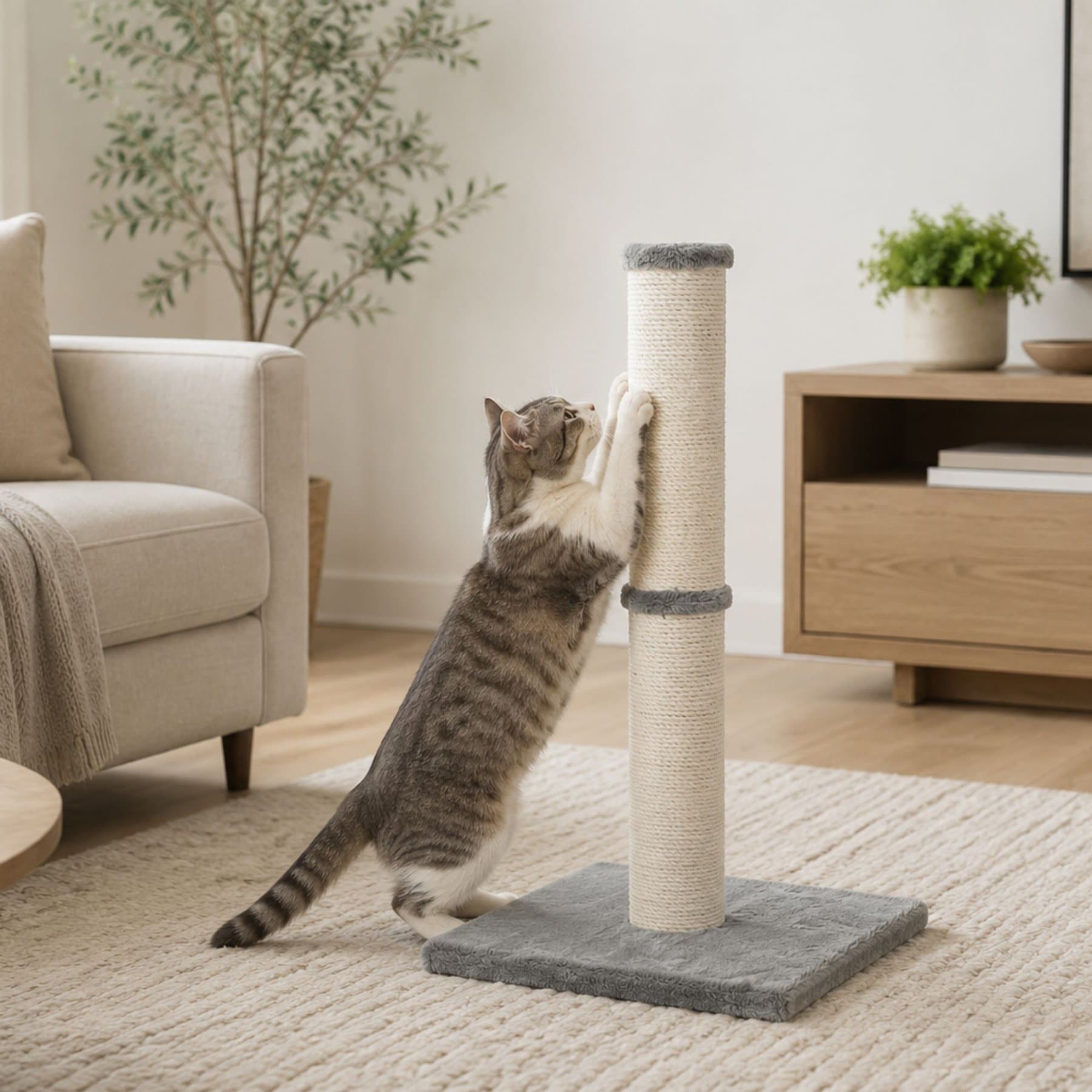
A 24.4-inch jute-wrapped post on a plush-covered base. A simple scratching station when you do not need elevated beds or platforms.
Petful may earn a commission when you click through to Chewy, at no extra cost to you.
For a new cat whose preferences are still unclear, make a stable option available and keep observing. You can offer a second orientation if it answers another pattern you see. There is no need to buy an entire set before learning which surfaces and locations the cat uses.
What Makes a Vertical Scratcher Work
A vertical cat scratching post needs enough uninterrupted scratching surface for the cat's stretch. Overall height is useful shopping information, but caps, shelves, and changes in covering can reduce the usable face. Compare the part the claws can actually reach with the cat's normal posture.
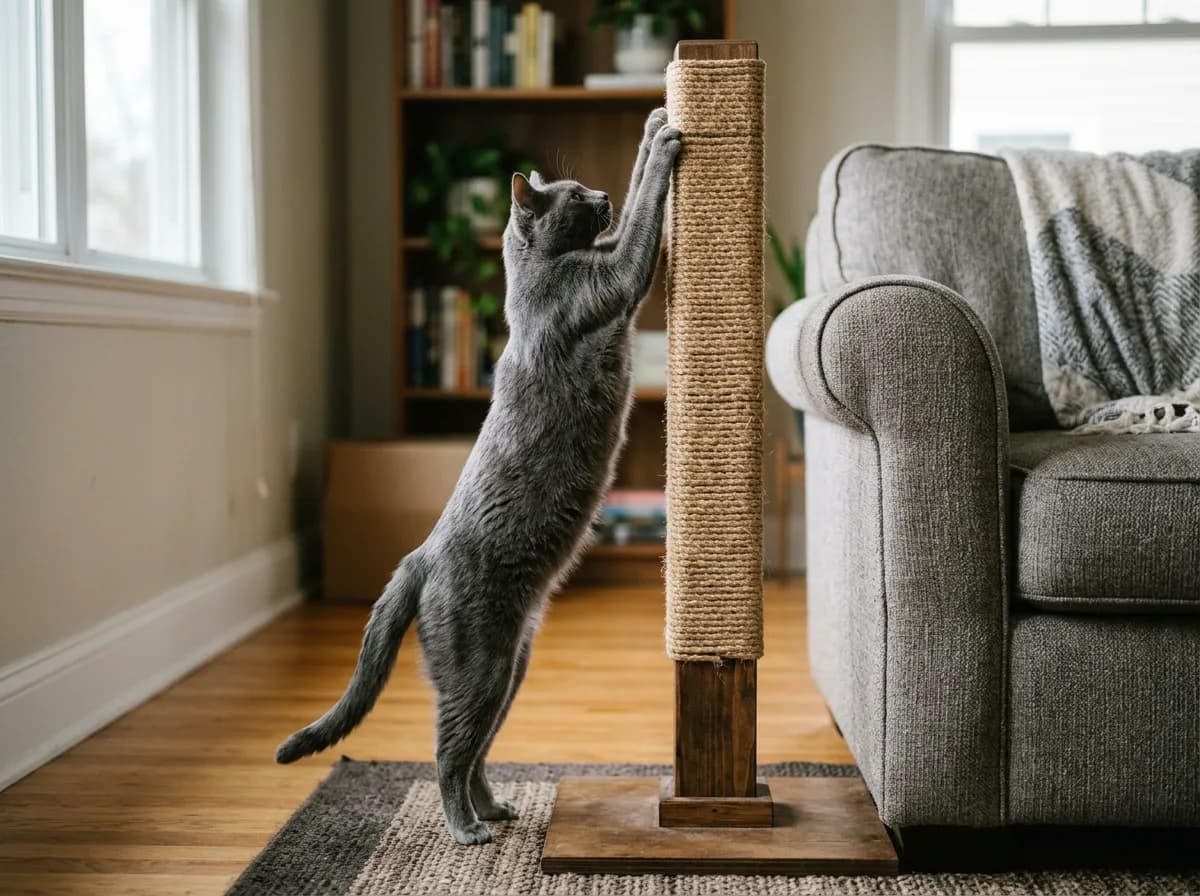
Look at the approach as well as the post. A tall surface behind a chair may leave little room for the cat's body. A post pressed into a narrow gap may be reachable from only one awkward direction. The base should fit the room without crowding the stance you are trying to provide.
- Check the continuous scratching height.
- Leave space in front of the usable face.
- Assemble the post according to its instructions.
- Check base movement and the post-to-base connection.
- Reassess any looseness that develops during use.
A wobbling vertical scratcher creates a different problem from a disliked texture. If the cat approaches, touches it, and withdraws when it moves, inspect the setup before buying another material. Correct loose assembly according to the instructions; a damaged supporting part needs repair or replacement by a suitable method.
Fit the upright surface to the cat
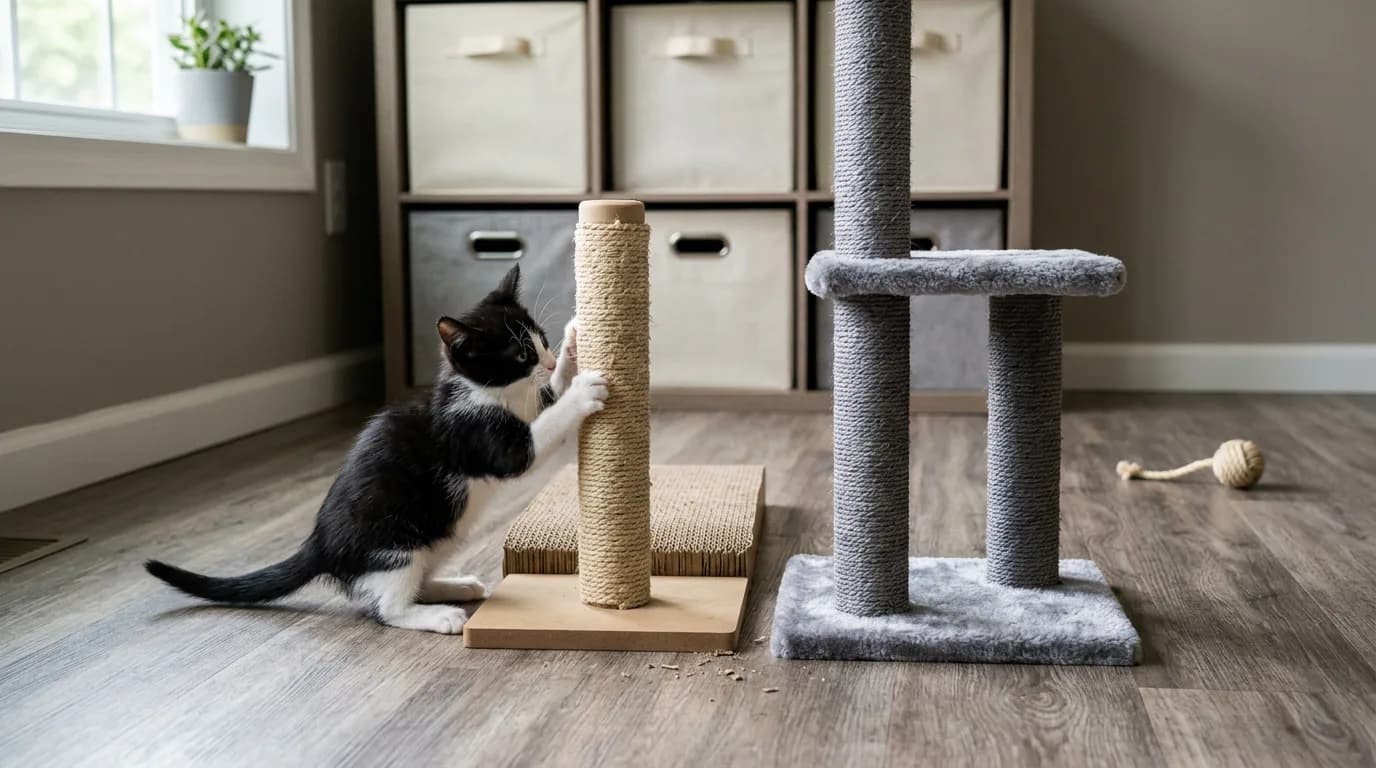
For a large cat, compare usable height and the space needed for the full body stretch. A tall listing does not establish a fit by itself. For a kitten, the scratching surface must be reachable now, while the setup should be reassessed as the kitten grows. There is no single post height that answers both situations for every cat.
A senior cat may continue to enjoy upright scratching, or may choose a lower position. Watch the individual rather than assuming age determines the orientation. A change in how the cat moves or scratches is information to consider separately from the shopping decision; a new post is not automatically the answer.
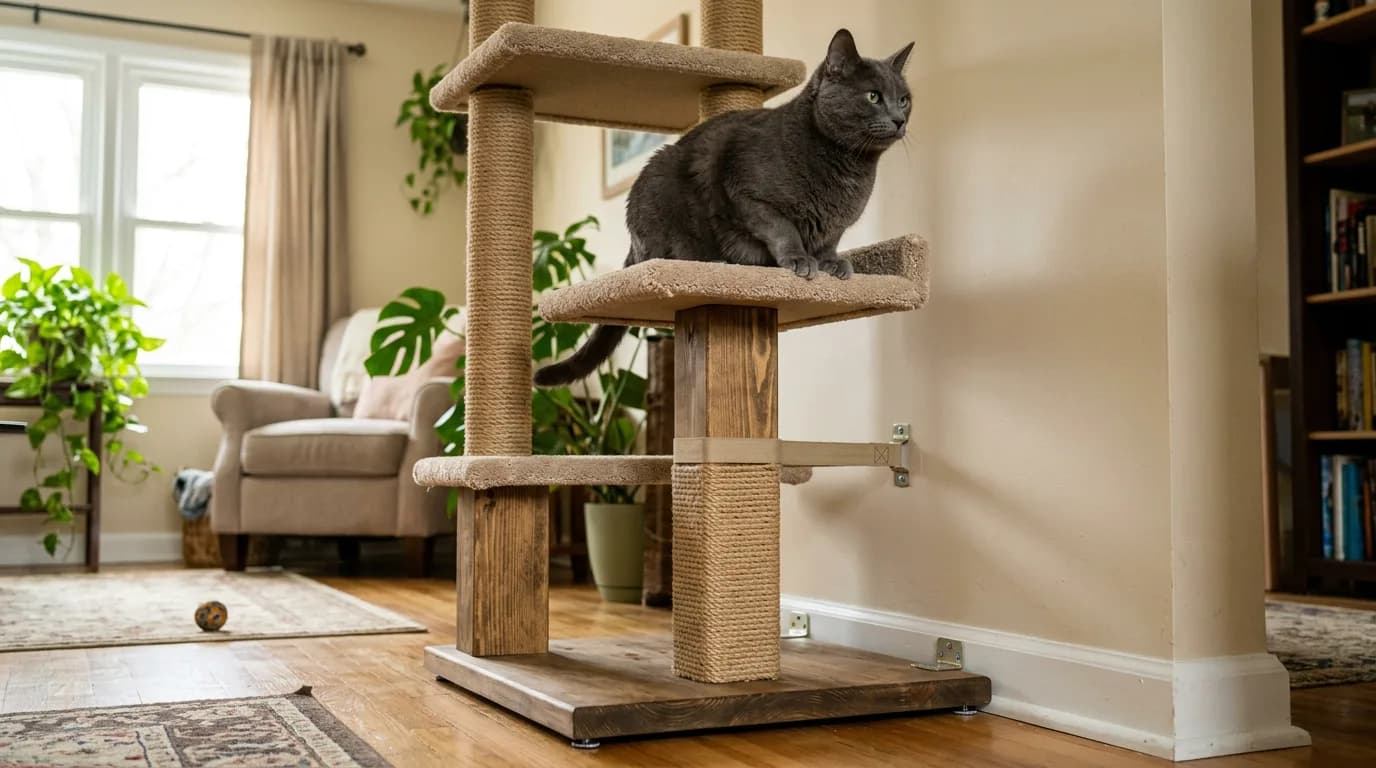
A tree can provide vertical scratching too, but examine each support. Several short wrapped segments do not necessarily equal one long, usable face. If the tree's resting places work well while its supports are ignored, a separate post may supply the missing stretch without replacing the tree.
What Makes a Horizontal Scratcher Work
A horizontal cat scratcher needs usable scratching area and enough room for the cat's stance. Look at where the hind feet rest while the front paws work. A pad can appear generously sized from above yet feel cramped when raised edges, a curved holder, or nearby furniture limit the approach.
Floor scratchers can be cardboard pads, woven boards, mats, or other products designed for that position. A horizontal cat scratching post does not have to be a round post laid on its side. Use the orientation supported by the product rather than repurposing a freestanding upright unit.
The term “floor-to-ceiling cat scratching post” describes an upright structure supported between surfaces, not a horizontal scratcher. Check its installation requirements as a separate format. The presence of “floor” in a product name does not tell you the scratching angle.
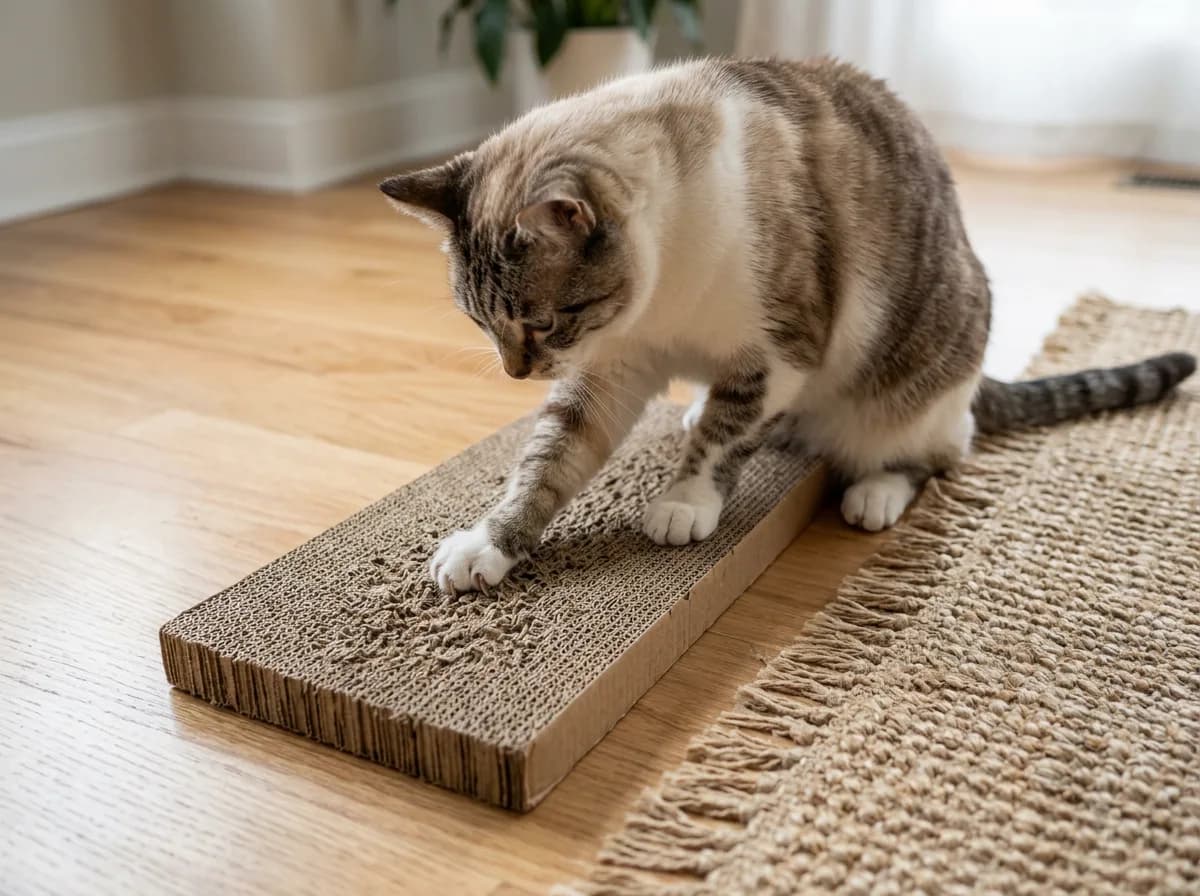
Sliding resistance matters. A sliding pad may be ignored because it moves under the cat, not because the cat dislikes horizontal scratching. Check the intended floor surface, holder, and any manufacturer-supported way to keep it in place. Do not add an improvised attachment that creates loose material or changes the product's intended use.
- Check the usable pad area inside any holder.
- Leave room for the cat to stand and turn.
- Watch whether the pad shifts during scratching.
- Check edges and the condition of the scratching surface.
- Keep the approach free of objects that alter the stance.
A cat scratching mat can suit a floor-level position if it stays in its intended place. A rolled edge, slipping backing, or bunched surface changes how it works. Compare the actual condition during use instead of assuming that a flat-looking product remains flat once the cat starts scratching.
Floor access may suit a cat that chooses to stay low, but it does not establish a medical benefit. For kittens, check the entrance and usable area of a raised-sided lounge. For larger cats, check whether the available standing space supports a natural posture rather than judging by the outside dimensions.
When an Angled or Wall-Mounted Scratcher Fits
An angled scratcher may suit a cat that repeatedly uses a sloped surface or seems comfortable scratching with its front paws raised only partway. Choose a product designed to support its scratching face at that angle. A board leaning against the sofa is not equivalent to a purpose-built ramp.
Check the support behind or beneath the slope and the space at its lower end. The cat needs an approach that works with the intended stance. If the product shifts, folds, or changes angle during use, inspect its assembly and condition before drawing conclusions about preference.
A horizontal cardboard lounge with reversible, replaceable pads offers one practical floor-level comparison. Its format and maintenance options should be considered alongside the texture, especially when comparing it with an upright woven or rope-wrapped post.
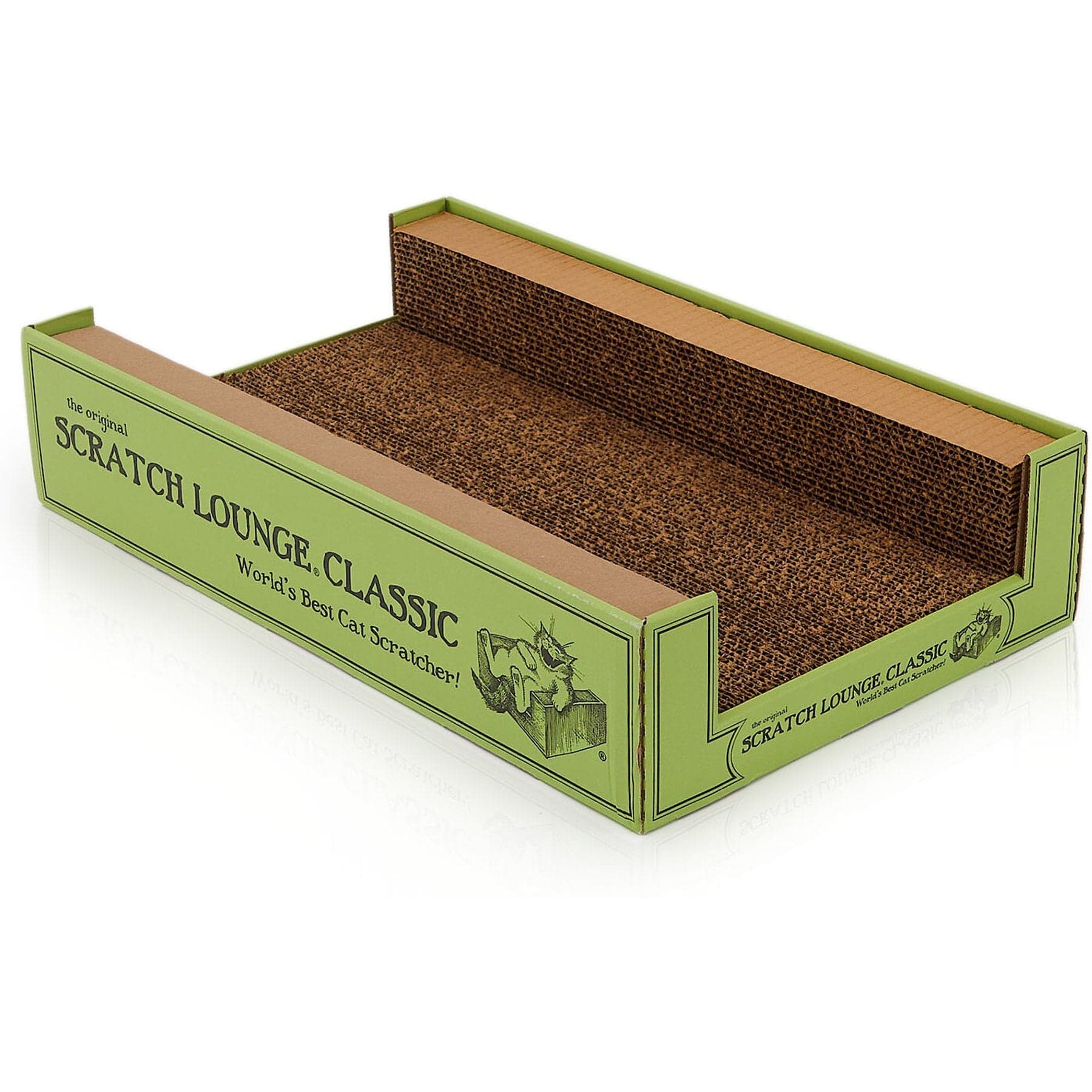
A horizontal cardboard lounge with reversible pads and available floor refills. An option for cats that scratch while standing on a flat surface.
Petful may earn a commission when you click through to Chewy, at no extra cost to you.
Angled and L-shaped formats
A cat scratcher ramp has a sloping scratching area, but its precise supported position depends on the design. An L-shaped cat scratcher may provide both an upright face and a floor section. Read which surfaces are intended for scratching and how the two sections are supported.
Do not assume a ramp intended for scratching is also a suitable access ramp for climbing onto furniture. That is a separate use requiring its own product information. Here, the useful question is whether the supported slope gives your cat a scratching stance it chooses voluntarily.
Wall, corner, and door-frame formats
A wall-mounted cat scratcher can position an upright surface without a freestanding base in front of it. Follow the product's mounting instructions for the actual wall or other specified surface. Check the installed height against the cat's reach and leave enough room to approach.
A wall-corner cat scratcher and a door-frame cat scratcher also need the correct attachment and usable position. A corner location may match an existing target, but a door still needs to move without striking the scratcher or disturbing the cat's access.
- Confirm the product's approved mounting location.
- Use the specified attachment method.
- Check the usable scratching face after installation.
- Keep the approach clear of door swings and furniture.
- Inspect attachments when movement or wear appears.
SmartCat Bootsie's is designed for floor use or wall mounting. Those are the two supported positions relevant to this comparison. Its board shape does not establish a third, freestanding angled mode. If an angled scratcher is the feature you need, compare a product explicitly designed for that use.
Compare Orientation Without Confusing It With Material
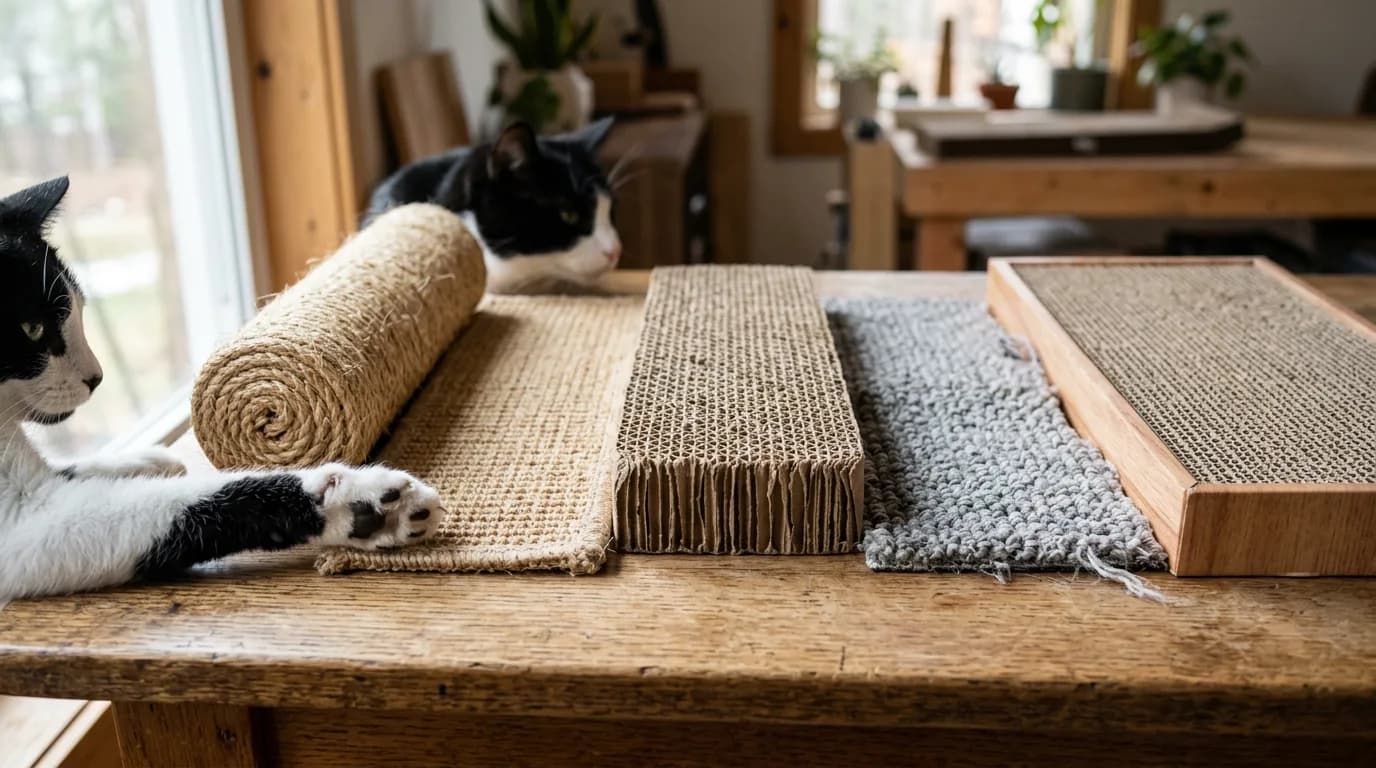
To compare scratching orientation, hold the same material and same location as steady as practical. Otherwise, a switch from an upright sisal post to a flat cardboard pad changes angle, texture, and often size at once. The cat's choice may be useful, but it cannot tell you which change mattered most.
A board approved for floor and wall use offers one way to keep the scratching material consistent. You still need to follow the installation instructions for each position. The floor position and the mounted wall position can differ in surrounding space, so note that difference rather than calling the comparison perfectly controlled.
| Part of the comparison | Hold steady or record | What the result can tell you |
|---|---|---|
| Same material | Use the same stated surface where practical | Reduces a simultaneous texture change |
| Same location | Keep access and nearby activity similar | Reduces a simultaneous room or placement change |
| Scratching orientation | Change only to a supported position | Shows which of those available positions is used |
| Voluntary use | Observe actual scratching without handling the paws | Distinguishes use from simply approaching the object |
| Product condition | Check movement, edges, and attachments | Identifies a fit or maintenance problem |
Bootsie's woven-sisal board is relevant here because its supported floor and wall positions allow this kind of comparison. It can also be chosen simply because one of those positions fits the room. You do not have to perform a formal trial before offering a useful scratching surface.
For example, if your cat already uses a woven floor board, an approved wall position lets you observe upright use without introducing cardboard or rope at the same time. If the board is ignored after mounting, check the height and approach before treating the result as a firm rejection of vertical scratching.
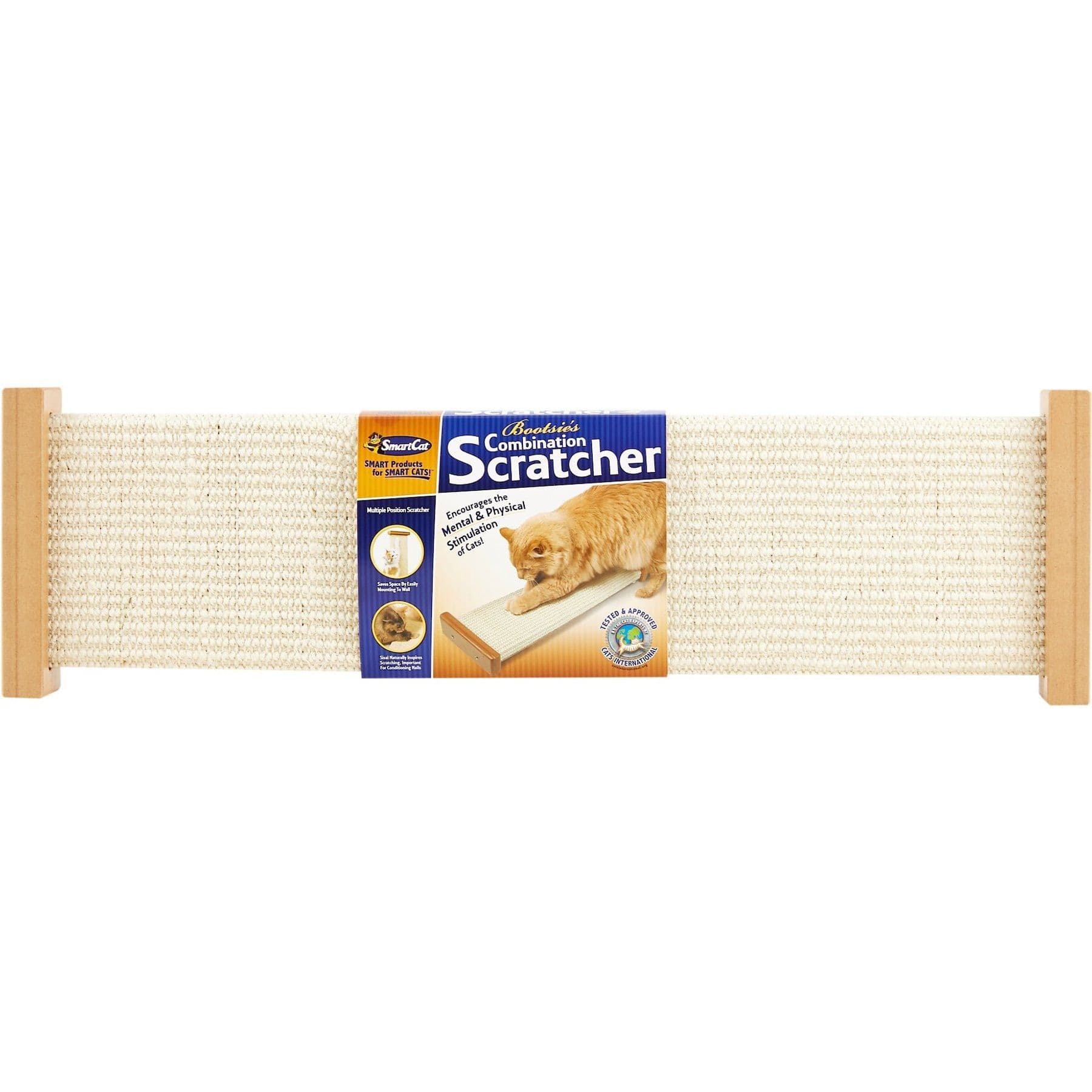
A woven-sisal board for floor or securely mounted wall use. A way to try another scratching angle without a full cat tree.
Petful may earn a commission when you click through to Chewy, at no extra cost to you.
Use the result to choose the next step:
- If the new orientation is used repeatedly, keep it available and note whether the cat still uses the original option. The two can serve different moments or locations.
- If both positions are used, there may be no reason to select a single winner. Keep the arrangement that fits the room and provides useful access.
- If neither position is used, inspect movement, approach, and location before buying another texture.
- If use changes only after moving the scratcher, preserve that location before making the next change.
The packaging illustrates the product's supported positions; it does not prove that a particular installation is secure. Check the actual setup. Likewise, two products both called sisal may use woven fabric and rope wrapping, which are different constructions.
For the best material for your cat, when to replace a scratcher, or how to compare likely maintenance, use our scratching post materials guide. It separates material, visible wear, refill availability, and repair choices. There is no universal longest-lasting winner established by this orientation comparison, and a replacement cat scratching post should preserve the features that already work.
Place Scratchers Where Your Cat Already Wants Them
Start near the current scratching target or another location where your cat naturally spends time. A corner scratcher beside the sofa can offer a nearby alternative to the sofa edge. The same product hidden behind unused furniture may receive little attention.
Match the face of the scratcher to the approach. For a cat scratching post for couch corners, check whether the cat can reach the intended surface from its usual direction. A post can be close to the right spot yet turned or crowded in a way that changes the stance.
- Keep the scratching face accessible.
- Leave enough body space in front of an upright surface.
- Leave standing and turning room around a floor pad.
- Check door swings and moving furniture.
- Avoid placing the alternative where another cat routinely blocks access.
A resting area can also be a useful location to consider. The San Francisco SPCA notes that cats may scratch after waking and recommends placing scratching options in prominent areas. Use your cat's actual routine to decide which room or route deserves an option.
In a multi-cat home, several scratchers gathered in one corner may still share the same approach. Watch whether one cat waits, detours, or avoids that area when another cat is present. A separate location can add useful access without needing a different material or a much larger product.
There is no fixed scratcher quota that fits every household. Before adding another option, identify the gap it would fill:
- A room with repeated scratching but no suitable alternative.
- A preferred stance the current products do not support.
- A location where shared access is difficult.
Those are useful reasons to add a scratcher. An identical set in every room may simply duplicate options the cat already ignores.
Once a scratcher is being used reliably, preserve the successful features when making a necessary move. Keep its material and orientation familiar initially. Moving it to another room while changing the surface gives you fewer clues if the cat stops using it.
Compare Products for Each Orientation
These four products illustrate two upright formats, a horizontal cardboard format, and a board with supported floor or wall use. They are not interchangeable, and they do not establish a universal winner. Match the format to the observed stance, then compare usable size, material, support, and replacement options.
SmartCat The Ultimate 32-in Sisal Cat Scratching Post, Gray
The SmartCat Ultimate is a 32-inch upright post with woven sisal and a 16-inch square base. Compare it when the missing feature is a dedicated vertical scratching face.
Its overall height provides a starting measurement, but the cat's full stretch and the usable face still decide the fit. Check the base footprint in the intended location. It does not add a floor-level scratching position simply because the cat can reach the bottom of the post.
TRIXIE Parla 24.4-in Jute Cat Scratching Post, Platinum Gray
The TRIXIE Parla is a 24.4-inch upright post with a 15.7-inch square base. The manufacturer identifies the scratching wrap as jute; the base is covered in polyester plush.
This is a shorter upright example, not a kitten-specific recommendation or a sisal equivalent. Compare its usable reach with the cat you are buying for. Choosing between it and the Ultimate changes material and dimensions while retaining the general upright orientation.
Scratch Lounge The Original Scratch Lounge Cat Toy with Catnip
The Scratch Lounge Original provides a horizontal cardboard scratching area with reversible pads. The manufacturer offers floor and side refills, giving you a documented replacement route for those surfaces.
Compare the usable interior area with the cat's standing posture. The surrounding lounge shape and the cardboard texture are both part of the choice. A cat that prefers it to an upright post has selected a different overall arrangement, not demonstrated that cardboard always beats sisal.
SmartCat Bootsie's Combination Scratcher
SmartCat Bootsie's Combination Scratcher uses woven sisal on a board designed for floor use or wall mounting. It is relevant when you want a woven surface without choosing a freestanding post.
Select one of its supported positions and follow the relevant instructions. For mounted use, check the installed height and approach. For floor use, observe whether it remains in place during scratching. An improvised incline is not an additional supported orientation.
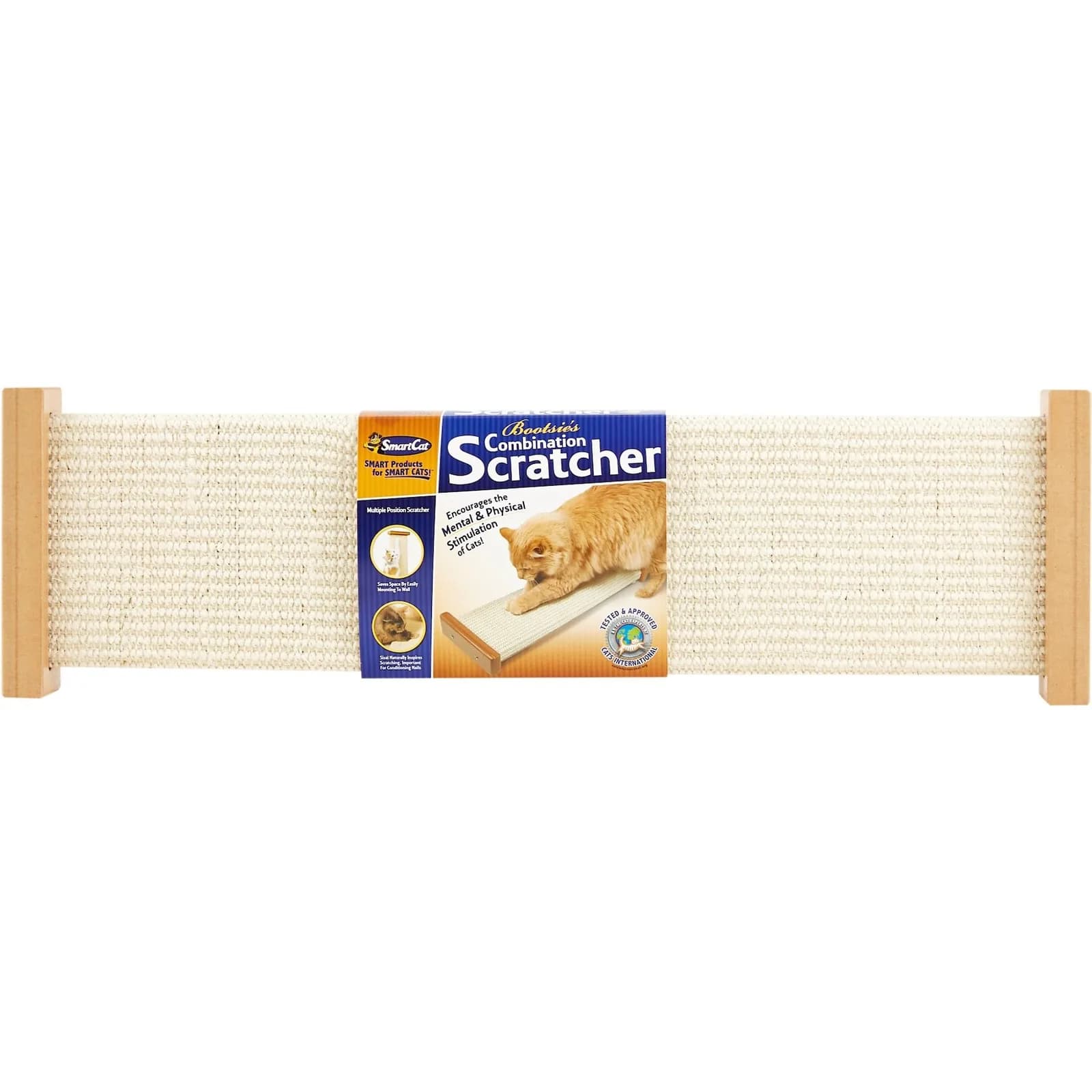
If you are replacing a successful scratcher, compare its useful features with the new listing before ordering. Match the working orientation, then check usable dimensions, surface construction, and the support or mounting method. A smaller footprint may be attractive in the room but reduce the cat's standing space. A taller overall product may still interrupt the scratching face. For a refillable floor scratcher, check the exact refill identity and availability separately from the price of the complete unit. These details make the replacement decision more specific than buying whichever product carries the same broad label.
If Your Cat Ignores the New Scratcher
Do cats know to use a scratching post? Scratching is natural, but a new object does not automatically become the preferred scratching site. Make the surface accessible, allow voluntary investigation, and reward voluntary scratching when it happens. Do not take the cat's paws and move them across the surface.
Before changing the product, identify what might be preventing use. A short upright face, sliding pad, blocked approach, unfamiliar texture, or inconvenient location each suggests a different next adjustment. Buying another version of the same mismatch may leave the problem unchanged.
| What you observe | Check first | Next adjustment |
|---|---|---|
| Upright scratching is cramped | Space for a full stretch | Compare a longer usable face or remove an approach obstruction |
| Sliding pad moves during use | Intended floor setup and holder | Correct the supported setup or choose a suitable stable format |
| Cat cannot reach the face naturally | Clear approach and nearby furniture | Improve access within the product's approved placement |
| Cat investigates but does not scratch | Texture, orientation, and location | Change one feature while keeping the others familiar |
| Familiar scratching continues elsewhere | Location of the alternative | Put a suitable option nearer that activity |
| Movement or damage develops | Assembly, attachments, and component condition | Correct the actual fault before continued use |
Keep a familiar, sound scratcher available during introduction. You can spend time nearby and encourage investigation through ordinary play, without turning the scratching surface into a forced exercise. A cat may approach, sniff, rest beside, or use a different part of the object before scratching it.
If the cat scratches the floor instead, look at the repeated action and setting. A rug edge may suggest a horizontal alternative, while pawing briefly at a floor does not by itself identify a preferred scratcher. Avoid treating every movement as a training failure.
Making a homemade post with carpet or rope changes more than the material if its size or support differs too. Before deciding to build one, identify the feature the current scratcher lacks:
- Is the usable face too short or too narrow?
- Does the existing surface move during scratching?
- Is the texture different from the cat's usual target?
Our materials guide covers bounded repair and construction considerations. A homemade surface still needs appropriate support and attachment; the DIY approach does not remove those checks.
For persistent furniture scratching or questions about scent deterrents, use our scratching-post and redirection guide. There is no fixed training timetable that makes an ignored scratcher a failure. Keep the adjustments specific, and preserve an option once your cat uses it comfortably and it remains in suitable condition.
Frequently Asked Questions
Individual preference varies. Existing scratching targets can suggest a starting point: reaching up favors trying a vertical scratcher, while working over a rug favors trying a horizontal scratcher. Some cats use both. Check material, fit, and location before attributing the choice to orientation alone.
They can be useful when the cat prefers a floor-level stance. Check standing space and sliding resistance, including the usable area inside a holder. A horizontal scratcher that moves or crowds the cat's body may be a poor fit even when the scratching material is appealing.
Start near a current scratching target or another place your cat already uses, with a clear approach to the scratching face. Scratcher placement should leave room for the body as well as the base. Check that doors and nearby furniture do not interrupt that approach.
Consider the rooms used, preferred stances, and shared access rather than a fixed number. Another scratcher is useful when it serves a distinct location or gives a cat access that is otherwise blocked. Several products in one crowded spot may not provide those separate opportunities.
Check usable height, base movement, and scratcher location first, then consider texture and approach. A cat may like upright scratching but dislike one particular setup. Change one relevant feature at a time so the next observation helps identify what works.
Consider an angled scratcher when observed preference suggests a slope would be useful. Choose a product with a supported angle and enough approach space. Do not assume a floor-or-wall board can be leaned against furniture to create an equivalent angled option.

Coreen Saito is a pet writer and longtime shelter volunteer with more than a decade in animal rescue. She covers cat behavior, breed care, and the small, ordinary science of sharing a life with companion animals, with a particular focus on honest takes about the products and decisions that actually matter. At home in Arizona, she's outranked by Mac (a dog with the loudest opinion in the house), Rebel (a cat who governs by quiet authority), and Meri (an orange tabby who runs the late shift and the laundry basket). She writes about all three, plus the rescues that keep coming through her life, at LifeWithMinty.com.
Sign up for expert-backed reviews and safety alerts all in one place.