Cat Trees Compared by Space and Cat Size
Compare cat trees by room size, usable platforms, access routes and household needs, with practical measurements and four product examples to help you choose a suitable layout.
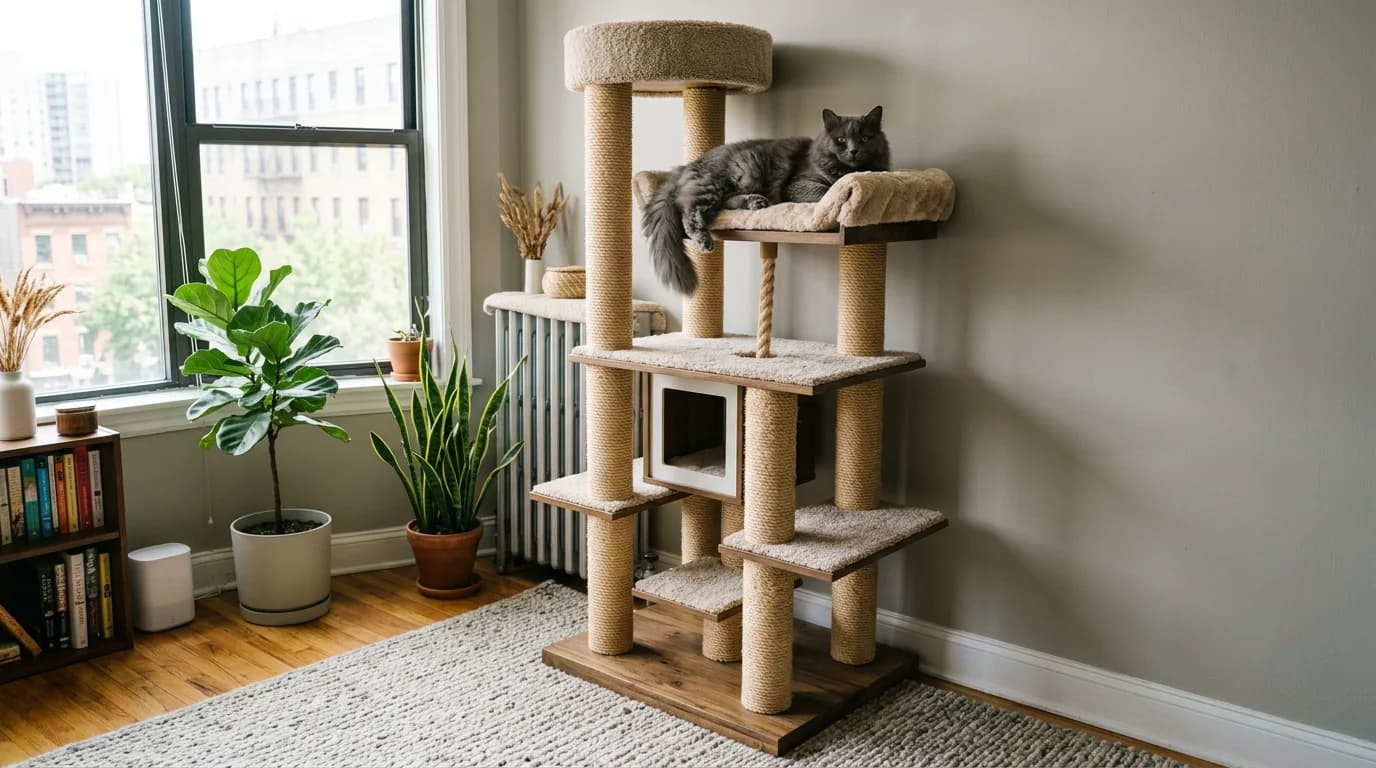
Compare resting space, access routes and room footprint before choosing a tree.
Petful is reader supported. As an affiliate of platforms like Amazon and Chewy, we may earn a commission when you buy through links on this page. There is no extra cost to you.
Cat trees compared by height alone can look remarkably similar while giving a cat very different places to sleep, scratch and move. The useful comparison starts with your room, your cat's resting habits and the route between platforms. A tall tower with a small bed may solve less than a shorter tree with room to turn.
This guide compares furniture formats and the measurements that determine fit. Four exact product examples illustrate how to read a listing. The comparison draws on product information and manufacturer instructions, not hands-on testing or measured load performance.

Sign up for expert-backed reviews and safety alerts all in one place.
Compare Cat-Tree Formats Before Comparing Brands
“Cat tree” and “cat tower” are shopping labels, not standardized classes. Either name can describe a climbing structure with posts, shelves, beds and an indoor cat house. A tower is not automatically taller, stronger or better for an adult cat. Look at the actual arrangement before deciding what the name promises.
Start by choosing the furniture format that meets your household needs. A freestanding tree brings several activities into one floor location. A wall arrangement distributes them across a route. A floor-to-ceiling design uses the room's height but introduces its own installation requirements. None of those formats tells you how much usable space a particular model provides.
- 1Match the furniture format to your room and household needs.
- 2Compare usable space, support and access before total height.
- 3Treat beds, scratching areas and routes as separate features to evaluate.
| Format | What it can provide | Main tradeoff | First check |
|---|---|---|---|
| Freestanding tree | Resting, scratching and climbing in one structure | Base footprint plus space around projecting platforms | Overall outline and installation instructions |
| Wall-mounted shelves or tree system | A climbing route above the floor | Layout depends on the wall and approved mounting method | Mounting requirements and routes up and down |
| Wall-mounted scratcher | Scratching without a broad floor base | Does not necessarily provide a bed or climbing route | Reachable scratching area and attachment instructions |
| Floor-to-ceiling tree | Vertical activity within a limited floor area | Ceiling height, surface and attachment must suit the model | Installation instructions and adjustment range |
| Low tree or perch | A reachable resting place with fewer levels | Less vertical variety | Step spacing and usable bed size |
Compare the structure behind the style
A luxury or mid-century modern cat tree may suit your living room, but its appearance does not establish quality. Open wood platforms need the same platform-fit check as plush ones. A natural-looking finish does not explain what the structural parts are made from, and upholstery can conceal the edges you need to measure.
Furniture-style designs deserve a close look at their intended use:
- Bookshelf cat tree: Separate the shelves intended for cats from storage areas. Books and decorations should not occupy the cat's approach or landing spot.
- Cat tree with a litter box compartment: Check box access, ventilation and cleaning access. A sleeping platform above the compartment does not solve a blocked entrance below.
- Custom or modular cat tree: Confirm that the proposed configuration and connecting parts are supported by the manufacturer. Adding another level can change the route and installation requirements.
- Plastic or collapsible cat tree: Inspect the specified locking, assembly and support arrangements. A folding feature is useful only if the tree can be correctly secured for use.
A multi-level climbing tree can offer variety, but count complete activities rather than accessories. One comfortable bed, an unobstructed scratching post and a workable ascent may be more useful than numerous tiny shelves. A modern tower with a large enclosed house also needs enough open space for a cat to enter, turn and leave.
High-quality cat trees should make their construction, care and assembly requirements understandable. When comparing clearance prices, keep the exact model, included hardware, condition and return terms alongside the discount. A lower price does not make an undersized platform fit. For the broader choice between climbing furniture and a dedicated scratcher, see our cat trees and scratching posts comparison.
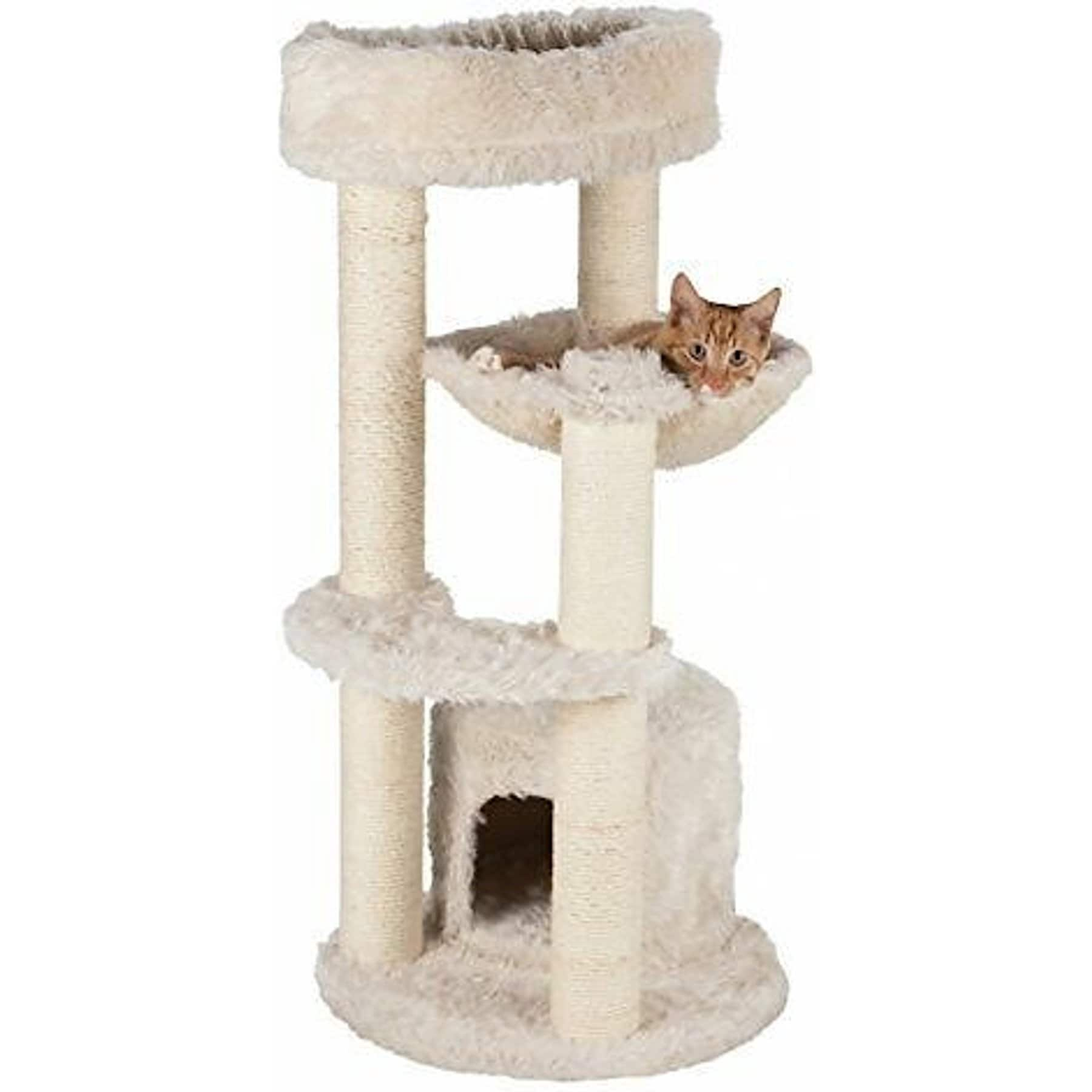
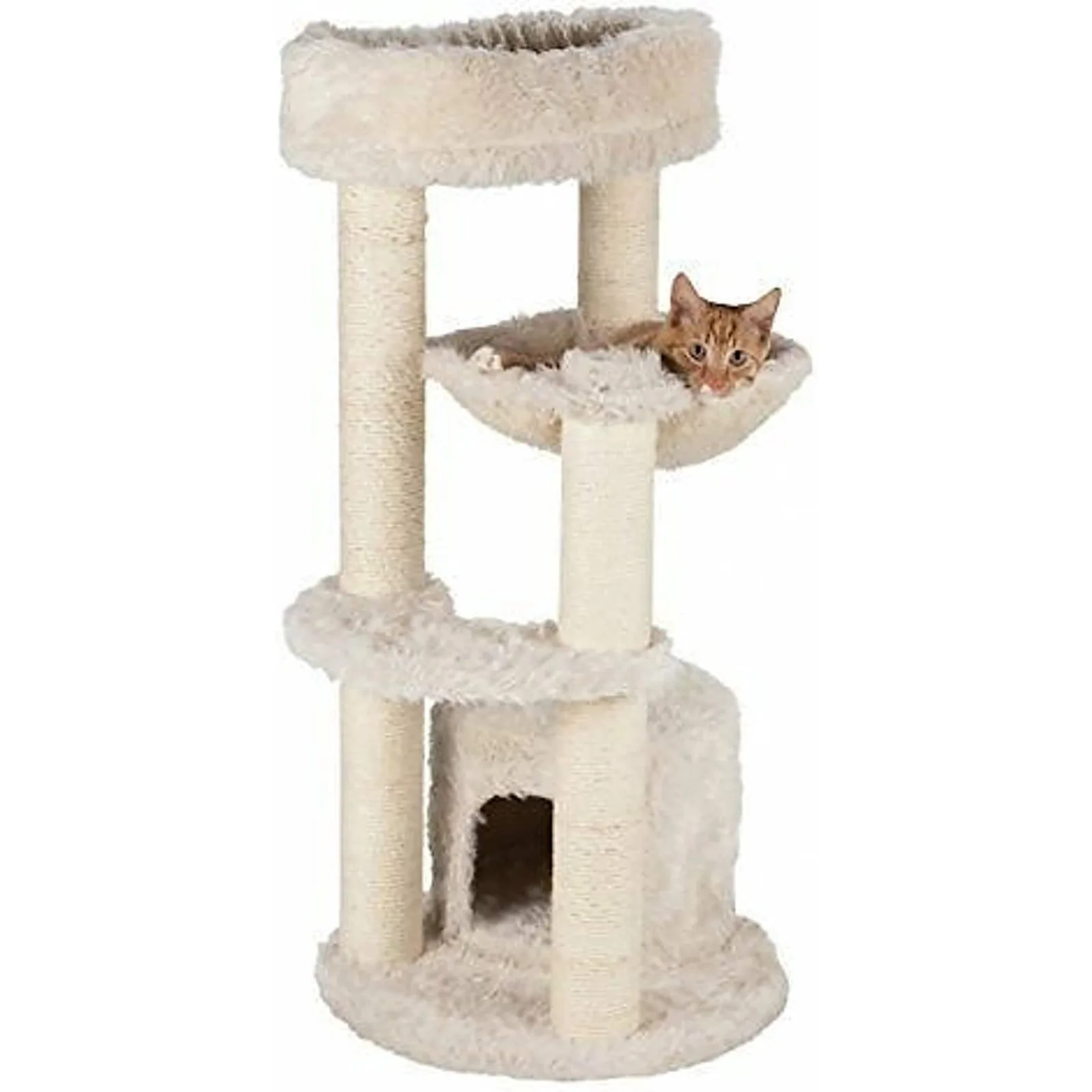
A 38.6-inch compact cat tree with jute-wrapped posts. Compare its climbing route and resting spaces with your cat’s reach and balance.
Petful may earn a commission when you click through to Chewy, at no extra cost to you.
Measure the Space Your Cat Will Actually Use
Record overall dimensions and usable dimensions separately. Overall height, width and depth describe the product's outside envelope. They may include a projecting bed, a curved rim or a toy. Those measurements help you place the tree, but they do not tell you whether your cat can lie comfortably on a platform.
Begin with a resting place your cat already chooses. Measure the space occupied during the sleeping posture you want the new bed to accommodate. A cat curled into a cushion and the same cat stretched along a windowsill need different shapes. Use those observations as a comparison, not a reason to restrain or stretch your cat for a measurement.
Separate the base, the bed and the opening
The base footprint is the floor area occupied by the base itself. The tree's widest point may sit above it. Check both, then leave room for the cat to approach and step or jump off. A base that fits beside a cabinet can still leave an upper bed pressing into the cabinet door.
For a usable platform measurement, look inside raised sides and around posts. A round bed's outside diameter can include a thick rim. A shelf with a post through its center offers less uninterrupted resting area than its full rectangle suggests. Ask for the clear sleeping dimensions if the listing provides only outside measurements.
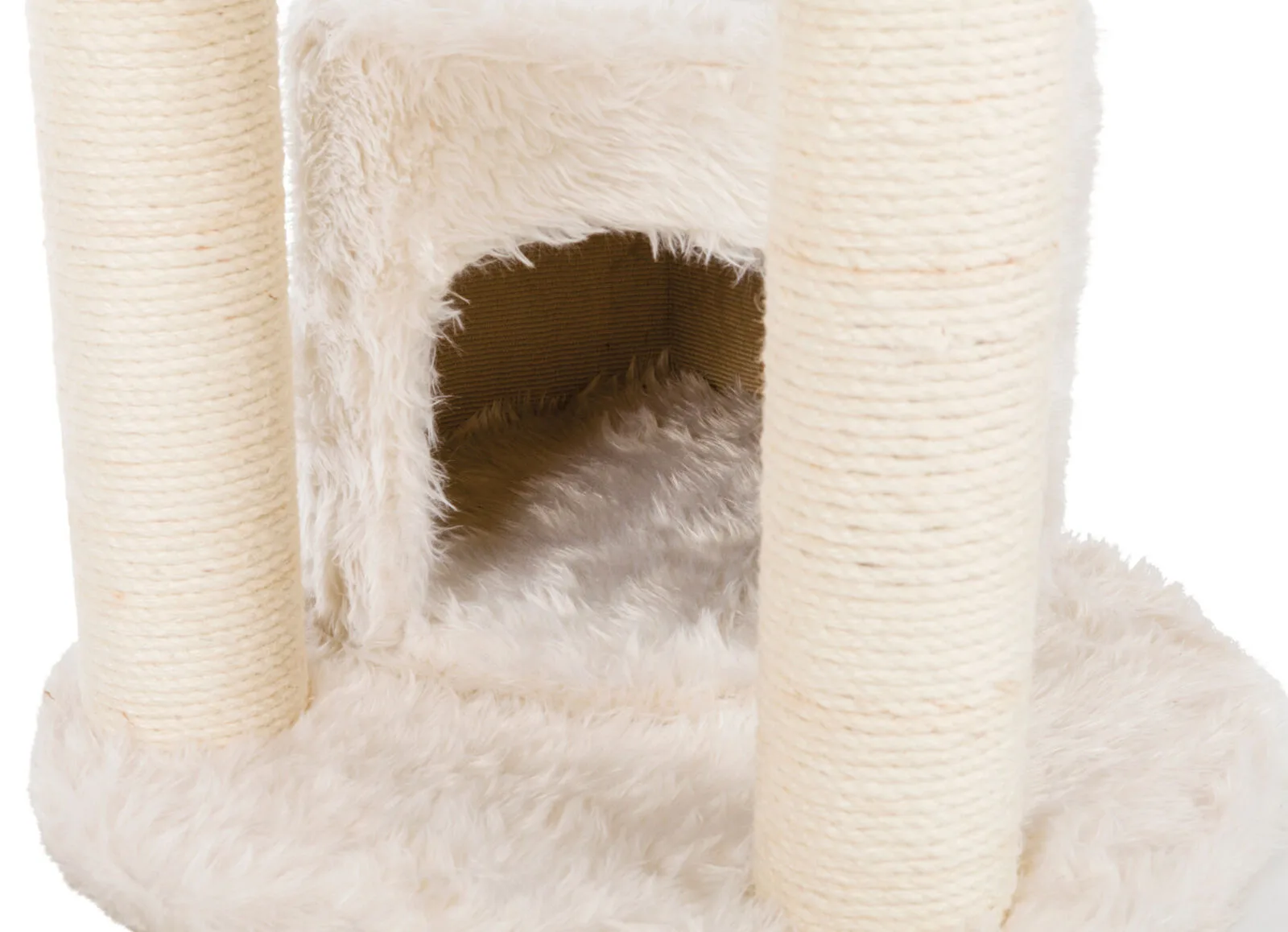
An enclosed opening needs two checks: the entrance and the interior clearance beyond it. The photograph above shows why the visible doorway and the outside condo shape are separate questions. A cat may fit through an opening but lack space to turn comfortably once inside. Inspect any lip at the entrance and the surface immediately outside it, too.
| Measurement to record | Where to measure or what to request | Decision it supports |
|---|---|---|
| Overall dimensions | Widest, deepest and highest assembled points | Room fit and overhead clearance |
| Base footprint | Outer edges of the floor base | Floor area occupied |
| Usable platform | Clear resting area inside rims and around posts | Sleeping and turning space |
| Enclosed opening | Clear entrance height and width | Entry and exit |
| Interior clearance | Clear inside floor area and headroom | Comfortable use of the hide |
| Scratching clearance | Uninterrupted wrapped length and room below it | Space for the cat's scratching posture |
| Landing route | Vertical gaps, horizontal offsets and clear landing surfaces | Ascent, descent and turning |
Trace a complete route
Follow the landing route from the floor to the highest bed, then back down. Do not assume that a level visible behind another platform is easy to reach. A cat may need to move sideways around a post, turn on a small shelf or pass through a narrow opening to continue.
Evaluate each transition with the same questions:
- Is there enough unobstructed space to stand before the next movement?
- Does the next platform project far enough to offer a clear landing?
- Can the cat turn around without entering a bed already occupied by another cat?
- Does the downward route end on open floor rather than behind furniture?
- Will the route still work after the tree is placed against its intended wall?
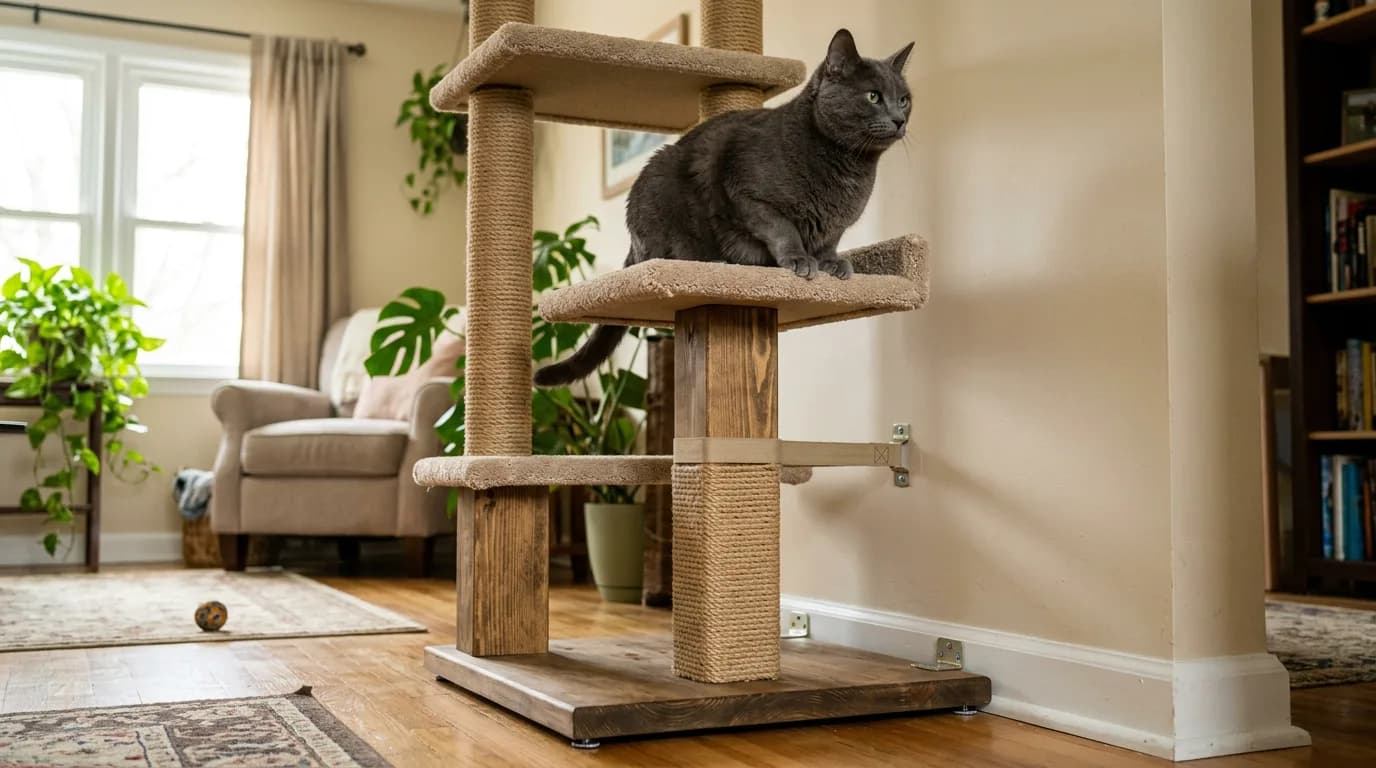
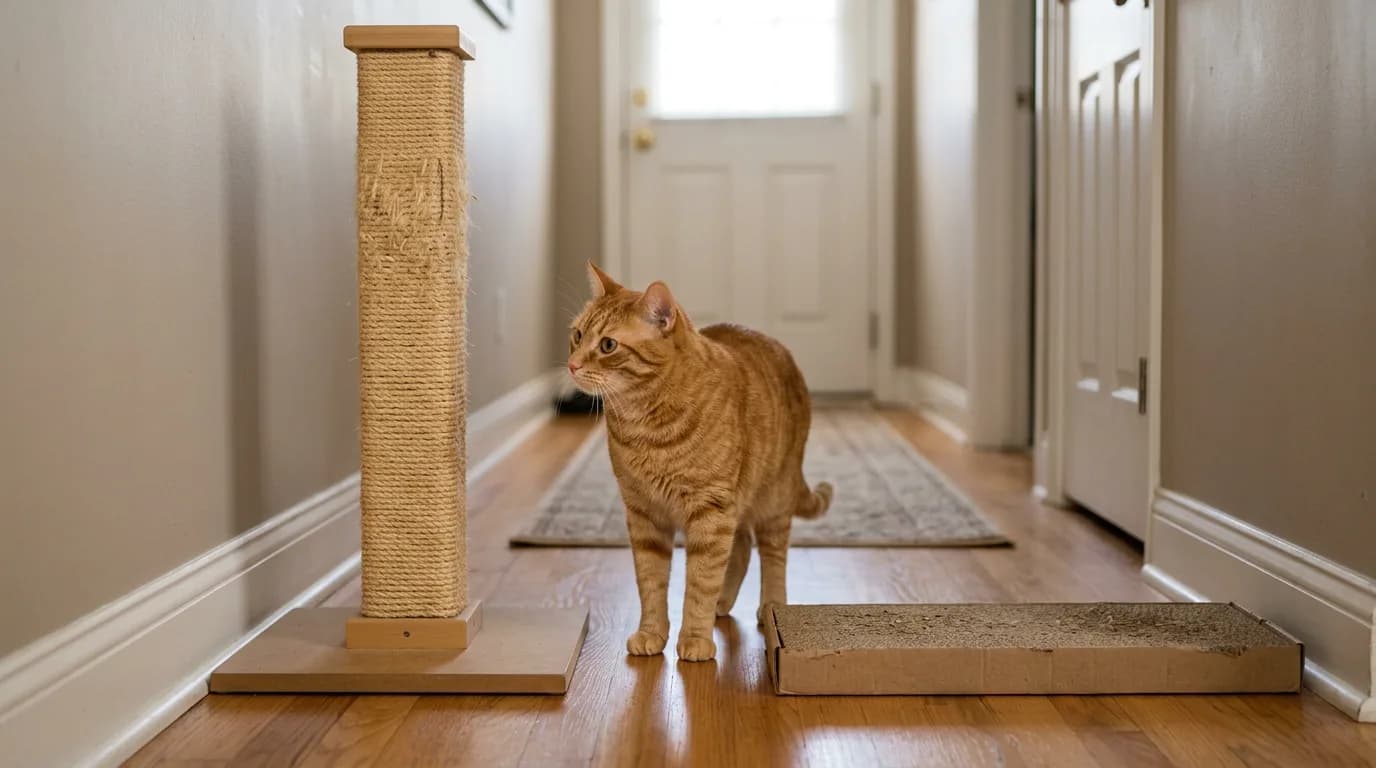
Scratching clearance is another measurement that overall height cannot supply. A tall tree can divide its posts into short sections between shelves. Check for an accessible, uninterrupted scratching area and room for the cat to stand at its base. The San Francisco SPCA's scratching-post guidance emphasizes a sturdy surface that accommodates stretching, alongside the cat's preferences.
When dimensions are missing, send the seller or manufacturer a precise question: “What are the clear dimensions inside the top bed, excluding the rim?” is more useful than “Is this big enough?” Keep unanswered measurements marked as unknown while comparing alternatives. Product photographs can identify what to ask about, but perspective does not provide a reliable ruler.
Compare two finalists on the same basis
Put the two listings beside the same worksheet rather than comparing whichever measurements each seller emphasizes. If one provides an outside bed diameter and the other provides an inside sleeping diameter, those figures are not equivalent. Ask for matching usable dimensions before deciding that the larger number represents more resting room.
Keep shape in the comparison as well. A long rectangular shelf and a round bed can have similar overall width while accommodating different sleeping positions. The same applies to condo entrances: the widest part of an arched opening does not describe its full clear passage. Record the narrow points that affect access, then check the interior separately.
Use the worksheet to make the remaining uncertainty specific:
- If the platform size is known but support information is missing, ask about the manufacturer limit.
- If support information is clear but the bed dimensions are missing, ask for its usable sleeping area.
- If both are known but the route is unclear, request a side view or the assembly layout.
That process lets you reject a poor fit for a concrete reason and recognize when a simple follow-up question could resolve the choice. It also prevents a well-photographed but sparsely described tree from appearing more suitable than a less decorative listing with the information you actually need.
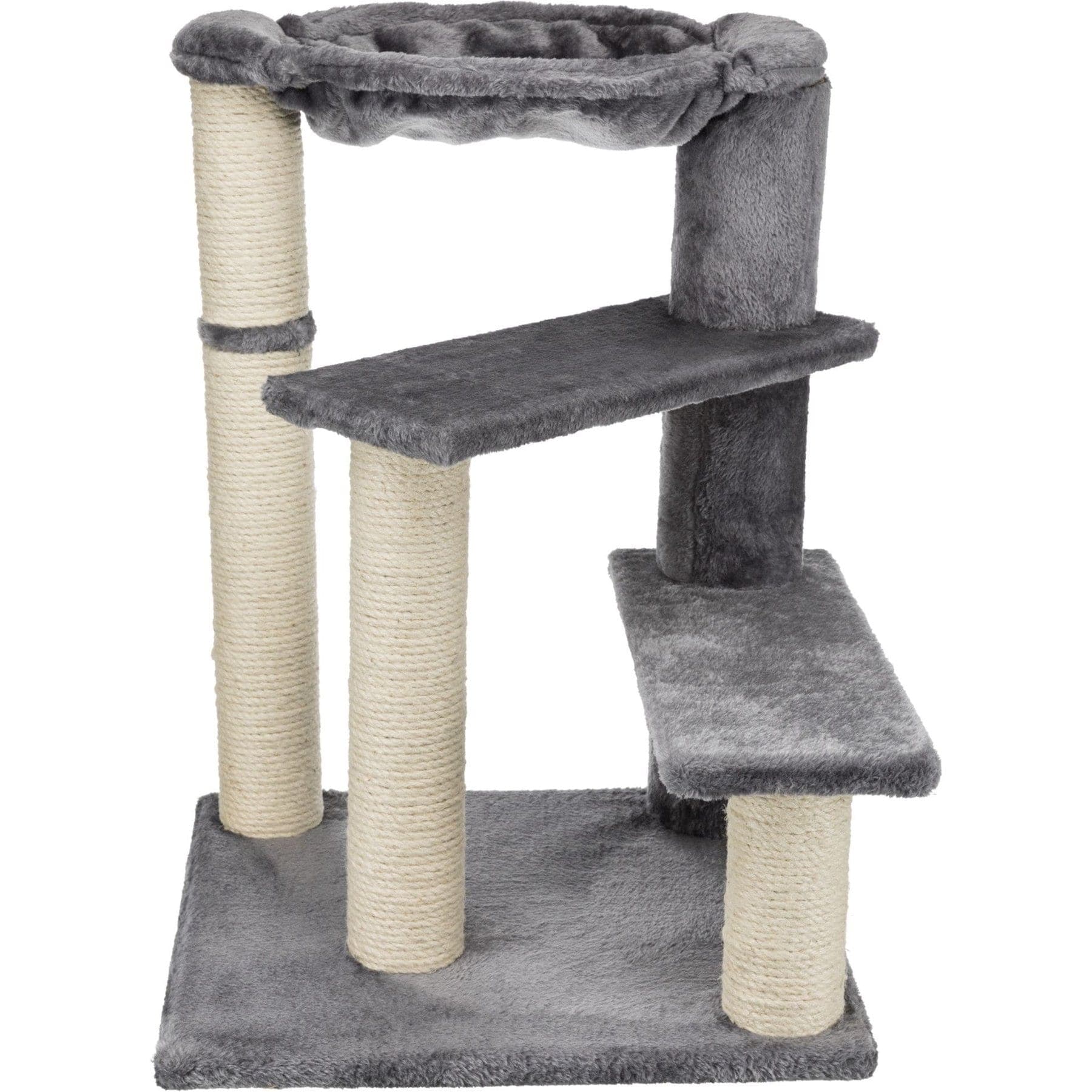
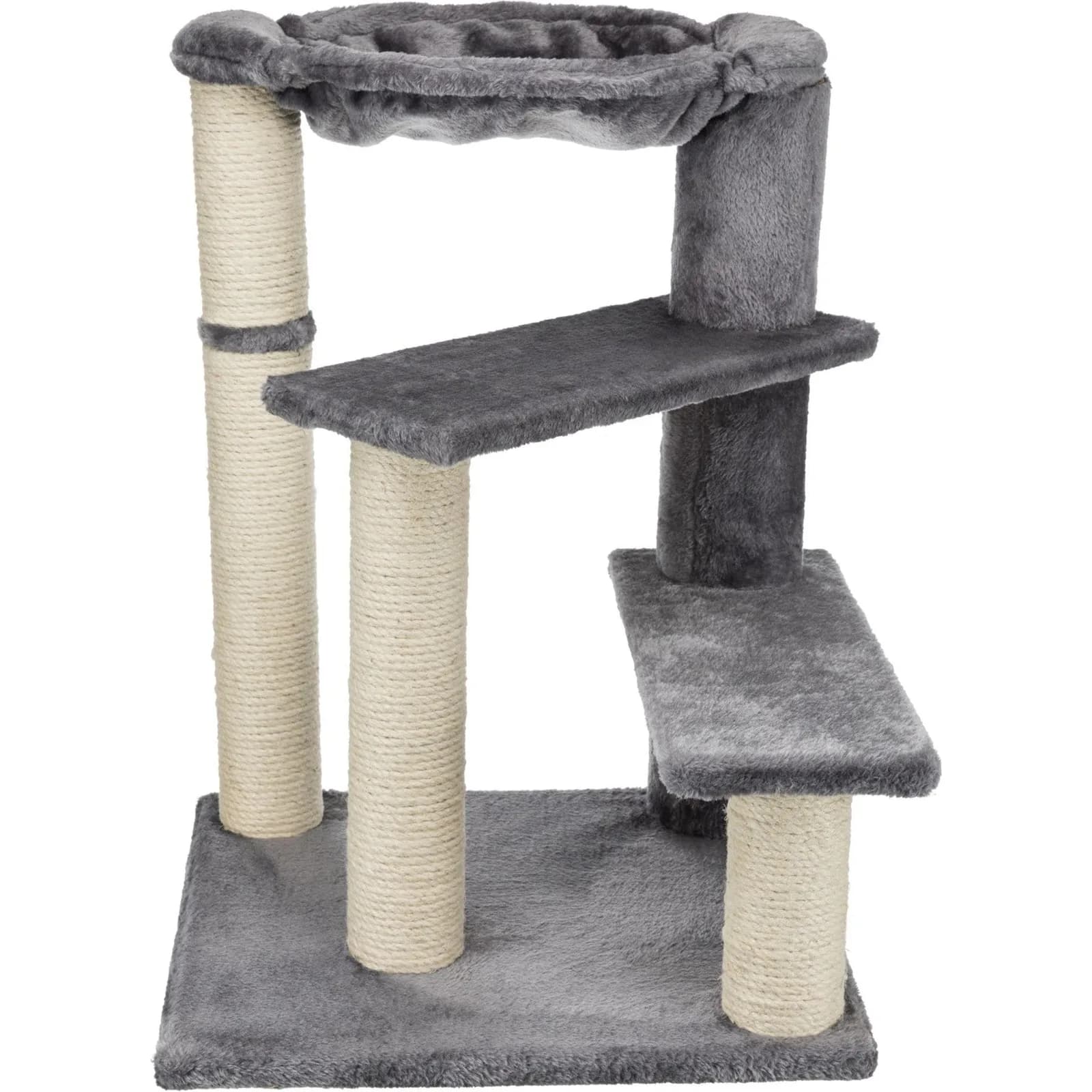
A lower 27.6-inch cat tree with stepped resting places. Check the step distances and bed size for your individual cat.
Petful may earn a commission when you click through to Chewy, at no extra cost to you.
Compact, Corner, and Tall Trees for Small Homes
For a small apartment, compare the area the tree needs during use, not just the space it occupies when empty. A compact base may fit a corner while its first platform blocks the approach. A tall, narrow cat tree can conserve floor area, but only if the climbing route remains accessible once it is positioned.
Map the intended location before choosing the height. Note the opening of nearby doors and drawers, the walking path through the room and the places where your cat normally jumps down. Include cleaning access around the base. A space-saving tree loses some of its value if it must be moved every time you open a cupboard or vacuum.
Make a corner work for the cat
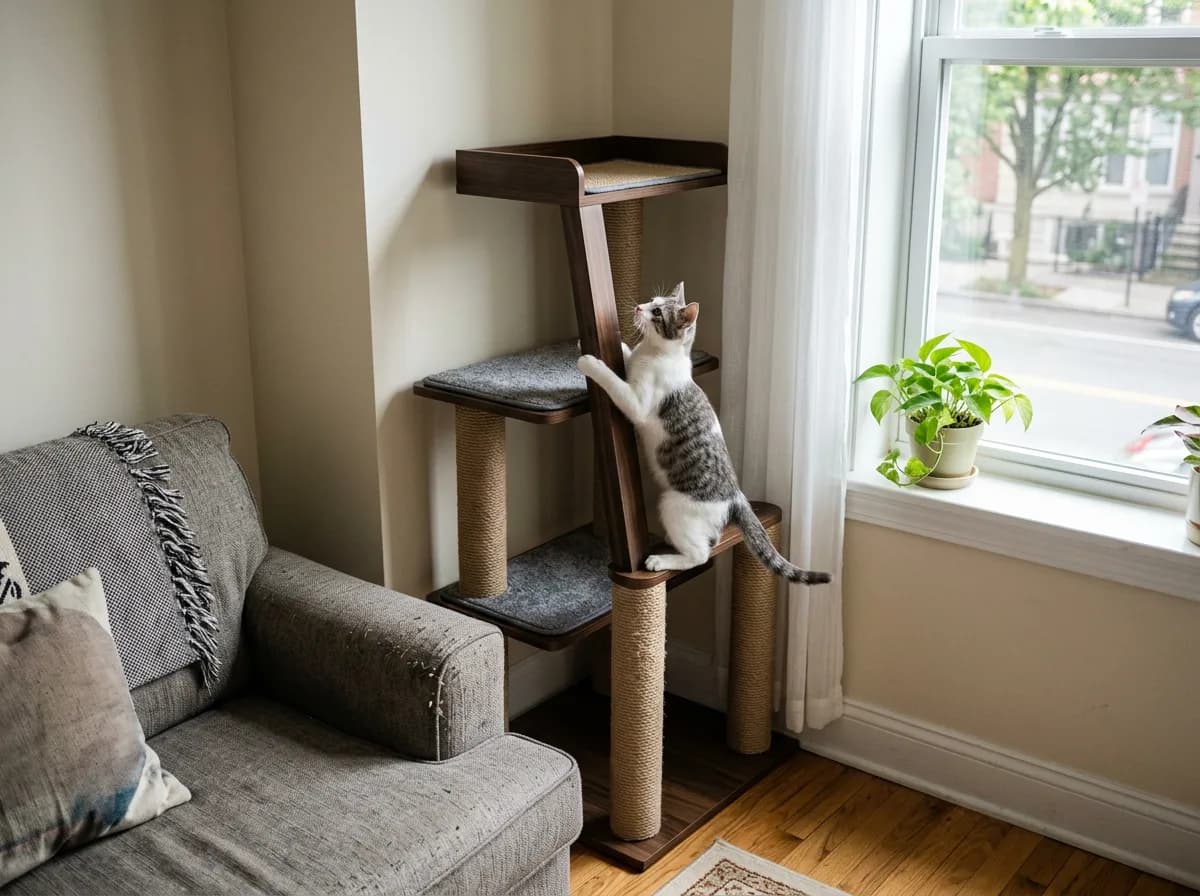
Corner placement can keep a tree outside the household's main walking route. It can also close off two sides of the structure. Compare the orientation of the condo entrance, the first step and any platform that projects toward a wall. A triangular base does not guarantee that the rest of the tree fits neatly into the same triangle.
Before committing to a corner model:
- Check the tree's widest assembled dimensions, including upper beds.
- Identify which sides need a clear approach for climbing or scratching.
- Leave an open exit from the lower hide.
- Confirm that the intended position allows any specified wall attachment.
- Check the view and access from the cat's level, rather than only from standing height.
A minimalist cat tree may offer one generous perch where a busier design supplies several small ones. That can be a sensible trade if your cat mainly wants a viewing station. If your cat uses multiple resting heights, compare the number of genuinely usable destinations rather than assuming a simple design or a crowded design is inherently better.
Choose between a mini perch and vertical furniture
A mini or short tree suits a limited job, such as resting beside a sofa or reaching a low viewing point. It does not have to imitate a full tower. Conversely, a narrow climbing tree can provide more vertical choice, provided its platforms have enough depth for the cat using them.
Think through two possible layouts. One puts a larger all-in-one tree in the only open corner. The other uses a smaller perch near an existing resting area and a separate scratcher where the cat already scratches. Compare the total floor space, the activities each layout supports and the routes left open. The second arrangement is not automatically cheaper or smaller, but it may fit the room better.
Wall shelves are another option when floor space is scarce, though they introduce mounting and layout commitments. For renters or people who rearrange furniture frequently, a freestanding design may be easier to accommodate within the property's rules. Choose the format whose complete installation you can support, rather than treating wall mounting as a universal small-room solution.
Large-Cat Fit: Platforms, Posts, and Support
For a large cat, separate physical fit from structural support. Physical fit concerns the usable platform, enclosed opening and room to turn. Structural support concerns the manufacturer's instructions and limits for the assembled product. A tree can pass one of those checks and still fail the other.
Labels such as giant, massive, extra large, XL or XXL do not establish a standard platform size. A very tall tree may have small beds. A wood cat tree for large cats also needs verified dimensions and support information; the word “wood” alone does not describe the joints, platform attachment or complete structure.
Start with the way your cat uses space
Observe the cat's usual sleeping posture and how it approaches elevated furniture. A long-bodied cat may need more uninterrupted bed length than a cat that curls tightly. A heavy cat needs appropriate documented support, but weight alone does not describe body length, turning room or preferred route.
The same method applies when choosing a cat tree for Bengal cats. Breed wording is less useful than the particular cat's size and behavior. A Bengal that climbs actively and another that mainly uses a broad resting shelf may benefit from different layouts. Do not use a breed label as a substitute for checking the exact model.
Compare these points together:
- Platform dimensions: Use the clear resting area rather than the outer edge of the bed.
- Enclosed opening: Check the entrance, interior floor area and room immediately outside.
- Scratching clearance: Look for a reachable wrapped section that supports the cat's preferred stretch.
- Manufacturer limit: Confirm what the stated limit applies to and which assembly conditions it requires.
- Access: Make sure the platform that fits your cat can actually be reached and left comfortably.
| Question | Useful evidence | What does not answer it |
|---|---|---|
| Can my cat rest comfortably? | Clear platform dimensions matched to the cat's usual posture | Overall tree height |
| Can my cat use the condo? | Enclosed opening plus interior dimensions | A large-looking exterior |
| Does the scratching area fit? | Scratching clearance and accessible footing | Number of wrapped posts |
| Is the intended use supported? | Manufacturer limit for the exact model and component | “Heavy duty,” XL or breed labels alone |
| Can my cat move between levels? | Platform spacing, offsets and clear landing surfaces | Total number of levels |
Read load information precisely
If a listing gives a weight figure, establish whether it refers to one bed, one platform, one cat or the entire structure. Those are different claims. Also check whether the limit assumes wall attachment or another installation step. A statement about one component should not be extended to every perch on the tree.
Where the manufacturer limit is unclear, ask before buying for a larger cat. Do not calculate a capacity from the product's shipping weight, post diameter or a photograph of a cat on the top bed. Those details can inform questions, but they do not replace the missing specification. Customer experiences may reveal fit issues worth investigating; they cannot establish a new load rating.
Support also depends on assembling the exact configuration as instructed. Omitting a brace to open up a larger sleeping area or rearranging parts to create a wider platform changes the product you evaluated. If you need a different layout, choose a supported configuration or a model with the dimensions you need from the outset. For a larger-bodied cat, prioritize a spacious destination and a clear route over the most imposing silhouette. That approach keeps the shopping decision concrete without treating body size as a reason to assume that all climbing furniture is unsuitable.
Multiple Cats Need More Than Extra Levels
A tree with several beds does not necessarily offer several independent resting places. Two beds may share one narrow approach. A condo can sit directly beneath the only route upward. Before buying for multiple cats, trace what happens when every appealing destination is occupied.
Shared access is the key difference between a multi-cat decision and a large-cat decision. A broad platform may fit one large cat beautifully while offering no separate route for another cat to pass. Conversely, several well-separated platforms can still be too small for the cats expected to use them.
Check capacity language with the same care used for a large cat. “Multi-cat” describes intended use only to the extent explained by the manufacturer. Confirm any limit for individual components and the overall arrangement. Never assume that several cats' combined weights are supported simply because the listing shows several beds.
Count destinations and escape routes
Start with the resting locations your cats already choose. Do they routinely sleep together, use nearby separate spots or settle in different rooms? Do not buy one shared hammock on the assumption that cats who tolerate each other will want the same bed.
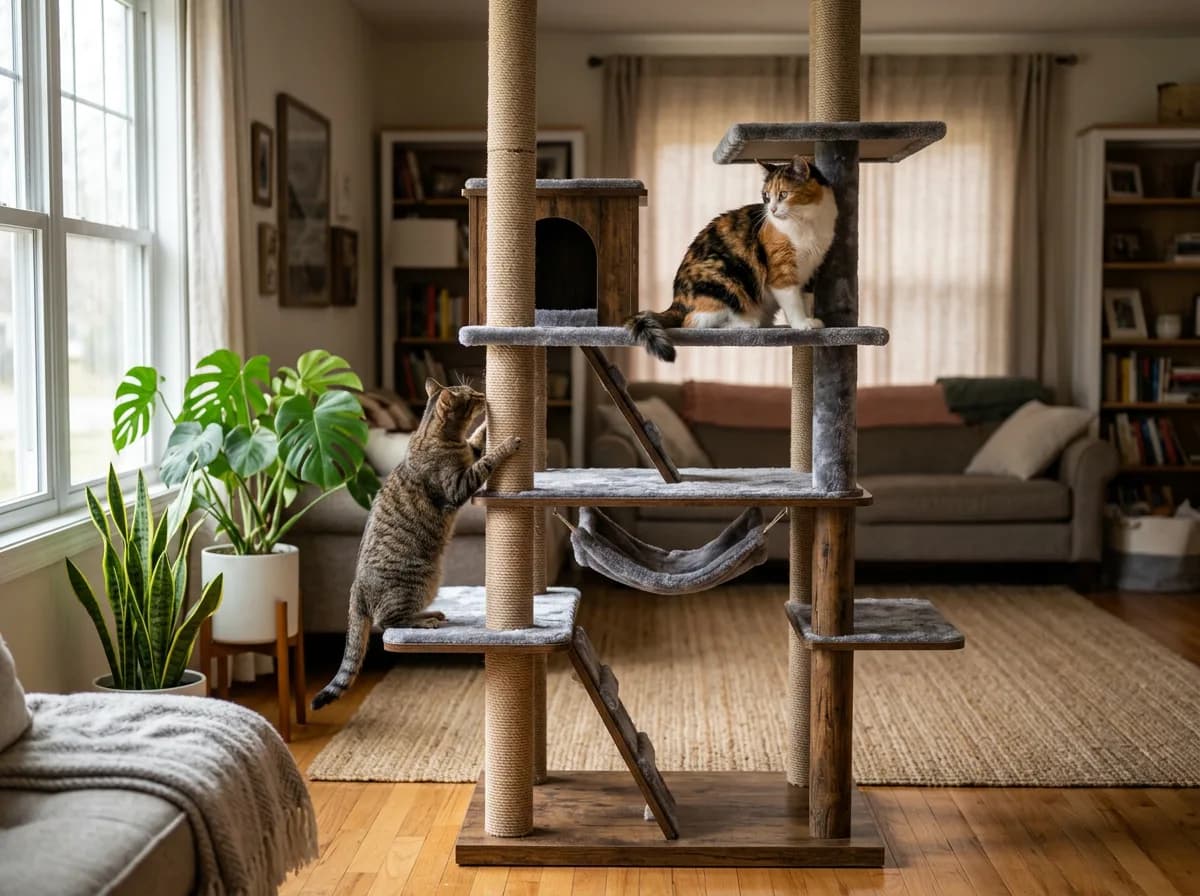
Use the product photographs to identify separate levels and then examine the escape routes between them. The useful question is whether one cat can leave without needing another to move. A decorative opening that leads to the same small platform does not necessarily create a second route.
For each likely resting place, check:
- The clear bed or platform dimensions for its intended occupant.
- The path from the floor to that destination.
- The path back down when a neighboring bed is occupied.
- Whether a cat in the lower condo can leave independently.
- Whether another resting station elsewhere would avoid concentrating access in one place.
The photo illustrates cats occupying different levels, but occupancy alone cannot establish that a tree suits every pair. Your room layout matters as well. Placing the tree tightly between furniture may remove an exit that was available in the listing photographs. Evaluate the installed arrangement, not just the freestanding studio view.
Compare one large structure with separate stations
A single multi-level tree can work as a shared activity area when its routes and destinations suit the cats. Two smaller stations can offer more choice of location. The comparison is about useful access, rather than a rule that every cat needs an identical tree or that one large tower always saves space.
Consider a household where one cat prefers a sunny perch and another rests near people. A single elaborate tree in the sunny room may not serve both preferences. Separate resting stations could meet those needs while reducing competition for the same location. In another household, cats may already choose neighboring shelves, making a structure with separated beds worth considering.
Watch how the cats use the finished setup. If one waits below while another occupies the only intermediate shelf, the next improvement may be an alternative resting location or a clearer route. Adding height above the same bottleneck does not solve that specific problem.

63-inch multi-level cat tree with scratch posts, hammock, plush perches, and dangling toys. Vertical territory is non-negotiable for high-energy climbing breeds like the Bengal.
Petful may earn a commission when you click through to Chewy, at no extra cost to you.
Low Trees, Steps, and Reachable Resting Places
A short cat tree can provide a useful destination without a long climbing sequence. Compare it by the ease of reaching the bed, the resting space it provides and the route back to the floor. Low overall height alone does not tell you whether the first step is reachable or the last transition is awkward.
For cats that choose lower furniture, look closely at the distance and offset between platforms. Staggered steps can create intermediate landings, but each landing needs enough usable space for the cat to stand and turn. A small shelf directly beneath a large overhanging bed may be less accessible than the front view suggests.
Inspect descent as carefully as ascent
The TRIXIE Baza Senior photograph shows an arrangement of staggered platforms below a top resting bed. It is a useful layout to examine when comparing accessible steps and landing space. It does not establish the distance between those platforms or suitability for an individual cat.
Review the route in both directions:
- Locate the first landing above the floor.
- Check the usable area on each intermediate platform.
- Identify where the cat must change direction.
- Look for headroom beneath an overhanging bed.
- Confirm that the final descent reaches clear floor space.
Compare those transitions with movements your cat already makes comfortably around the home. Avoid assuming that an age label supplies the missing measurements. “Senior” and “Junior” are product names or descriptions, not individualized assessments of reach or ability.
A lower setup can also be useful beside an existing resting area, but consider the two pieces together. A sofa is only a dependable intermediate destination if it will stay in the intended position and the gap works for the cat. Moving the tree or furniture later changes that route and calls for another check.
Leave room for a kitten's changing needs
A cat tree for kittens should be judged by today's usable routes as well as the space it will provide as the cat grows. A tiny hide can be inviting initially but quickly become less useful. A tall structure purchased for eventual adult use may need a different introduction than a low first perch.
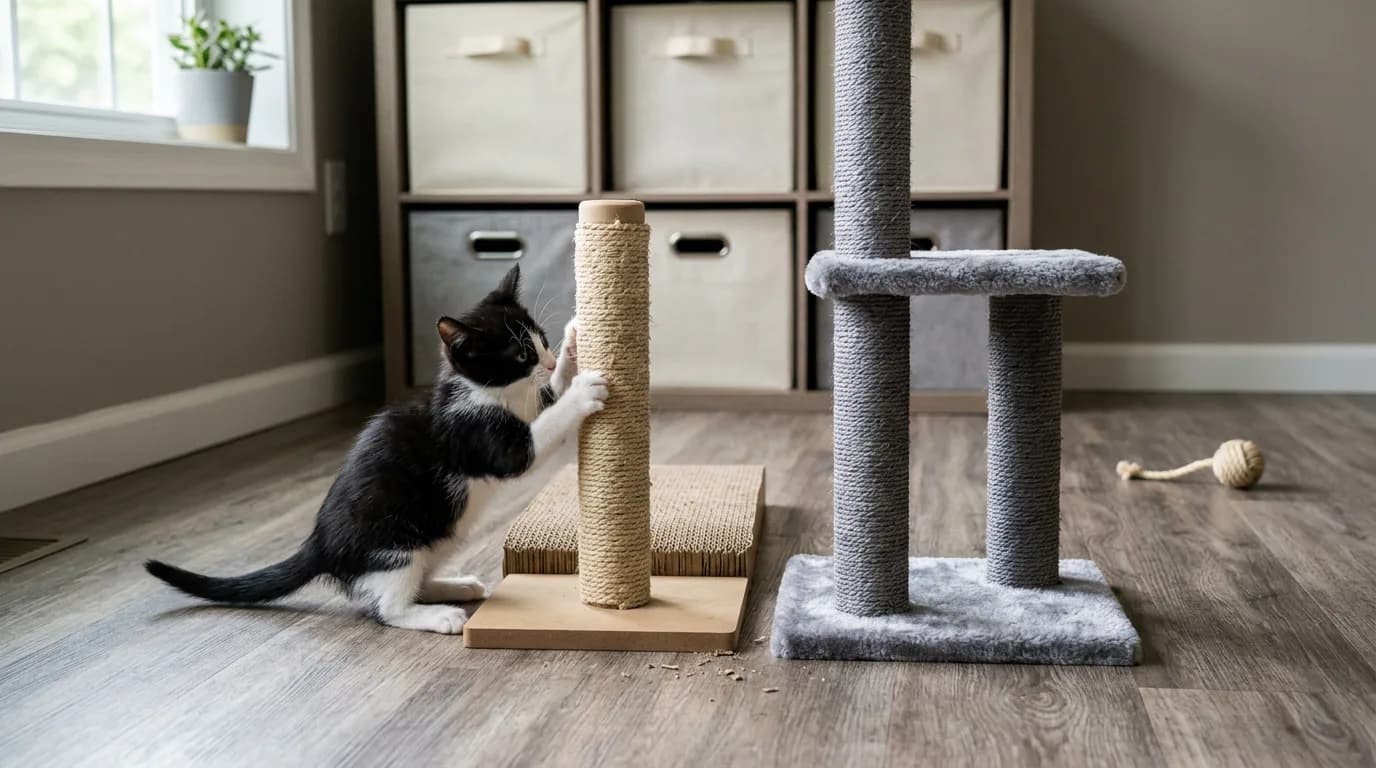
Our guide to kitten scratching posts and first cat trees covers that first-furniture decision in more detail. Use it to compare a manageable initial setup, scratching access and the transition toward larger furniture. Here, keep the comparison focused on platform size, reachable steps and a clear descent, rather than treating maximum height as a measure of future value.
Freestanding, Wall-Mounted, and Floor-to-Ceiling Designs
Choose the installation method before falling in love with the silhouette. Freestanding, wall-mounted and floor-to-ceiling designs make different demands on the room. Compare the mounting surface, required hardware, installation instructions and maintenance access as part of the purchase, not as problems to solve after the box arrives.
A freestanding tree has its own floor base, but that description does not mean every model is intended to stand without an attachment. Follow the exact product's instructions, including any specified wall connection. The base also needs a suitable location where the tree can be assembled and used as intended.
Plan a wall route as a complete arrangement
A wall-mounted cat tree can free floor space by placing beds and steps above it. Each component still needs the mounting method specified for that product and surface. Do not assume that hardware included for one wall construction is suitable for another.
Lay out the entire route before installing the first shelf. Include an accessible starting point, room to turn, resting destinations and a clear route back down. A series of attractive platforms is not necessarily a complete climbing route. Consider how you will remove covers, inspect attachments and clean above or below each component.
Door-hanging cat trees introduce another moving surface. Check the specified door type, dimensions and attachment arrangement. Consider how the door is used by people and whether the product requires it to remain in a particular position. An over-door design should not be treated as interchangeable with hardware mounted into a wall.
Check a tension design against the room
For a floor-to-ceiling cat tree, compare the exact adjustment range with the actual floor-to-ceiling distance where it will stand. Then check the surfaces and attachment method the manufacturer allows. A ceiling that falls within the height range does not by itself establish that the installation is suitable.
Read how the tension or other securing mechanism is set and maintained. If the instructions require additional attachment, retain it. Do not improvise an extension or substitute a different contact surface simply to make the tree reach. Installation details are part of the product's design.
| Design | Room or mounting surface check | Route check | Maintenance access |
|---|---|---|---|
| Freestanding | Suitable floor position and any specified attachment | Approach and landing space around the base | Room to inspect joints and remove washable parts |
| Wall-mounted | Approved mounting surface and hardware | Clear route between shelves and back to the floor | Reach every attachment and removable component |
| Floor-to-ceiling | Approved surfaces, height range and securing method | Access to intermediate levels and a clear descent | Access required by installation instructions |
| Door-hanging | Compatible door and specified attachment | Door position must preserve the usable route | Inspect attachment points without relying on improvised support |
Include permission and future access
For rented homes, establish what installation is permitted before choosing a wall system. For any home, consider nearby doors, windows and furniture that may be moved. A route that depends on a particular cabinet can change when the room is rearranged.
Keep the instructions and hardware information after assembly. They make it easier to identify a component during maintenance or reassemble the same model after moving. If a product's instructions do not explain the mounting surface or arrangement you intend to use, resolve that question with the manufacturer before installation. This is a fit decision with a concrete answer, not a reason to reject every mounted design.
Petful may earn a commission when you click through to Chewy, at no extra cost to you.
Compare Scratching Areas, Beds, Hammocks, and Hiding Spaces
Break the feature list into activities. Cat tree beds provide resting space. Shelves can act as destinations, intermediate landings or both. Posts provide scratching opportunities only where the surface and access suit the cat. A hide is useful only if its entrance, interior and location work together.
This distinction helps you avoid buying features your cat is unlikely to use. A plush cat tree may appeal to a cat that seeks soft resting surfaces, while another cat regularly chooses an uncovered shelf. Observe those habits, then compare the actual bed and platform construction rather than assuming one covering suits every cat.
Compare resting surfaces by shape
Look at how a bed supports the cat's preferred posture. A raised rim reduces the flat interior area but may offer a place to lean. An open shelf provides a different shape and edge. A suspended hammock is another option, but its visible diameter does not necessarily equal a flat sleeping surface.
Check resting components individually:
- Is the bed's inside length and width available?
- Does the rim leave enough room for the cat's usual position?
- Can the cat enter without an awkward turn?
- Does a hammock have a stated component limit?
- Can the cover or cushion be removed according to its care instructions?
- Is a replacement compatible with the exact model?
Compare cat tree shelves as part of the route, too. A shelf used to reach a higher bed must remain available as a landing. Filling it with another cushion may reduce clearance beneath the platform above. Adding accessories can change the usable space even when the main structure stays the same.
An enclosed hide adds another choice of resting place. Check whether its doorway faces the room, a wall or a busy passage once the tree is installed. In a shared household, also consider whether another cat can sit directly outside the exit. The feature is the same in the product list, but its usefulness depends on placement and access.
Separate scratching texture from upholstery
A real-carpet cat tree and a tree covered in soft plush may feel quite different. Neither description tells you whether the cat has a sufficiently long, accessible scratching surface. Identify which components are intended for scratching and which are primarily coverings for beds or platforms.
Cats can have preferences for both texture and scratching position. International Cat Care's guidance on scratching furniture and carpets supports observing those preferences and providing suitable alternatives. Our scratching-post materials comparison explains the material decision separately, while vertical versus horizontal scratchers addresses orientation.
For a tree, apply that information to the available surface. A wrapped post behind a condo may be difficult to approach. Several short wrapped sections may not provide the continuous space your cat uses for a stretch. A good bed does not automatically make the same tree a complete scratching solution.
Compare Cleaning, Replacement Parts, and Long-Term Cost
Compare maintenance while the product information is still in front of you. List the components likely to collect hair, the surfaces the cat will scratch and the parts you must remove to reach them. A tree with fewer accessories may be easier to maintain, but a more elaborate model can also be practical when its components are accessible.
Care instructions apply to specific materials and parts. A washable cushion does not make the whole tree washable. Similarly, a removable bed does not establish that its cover can go in a washing machine. Check the instructions for the cushion, cover, frame and fixed upholstery separately.
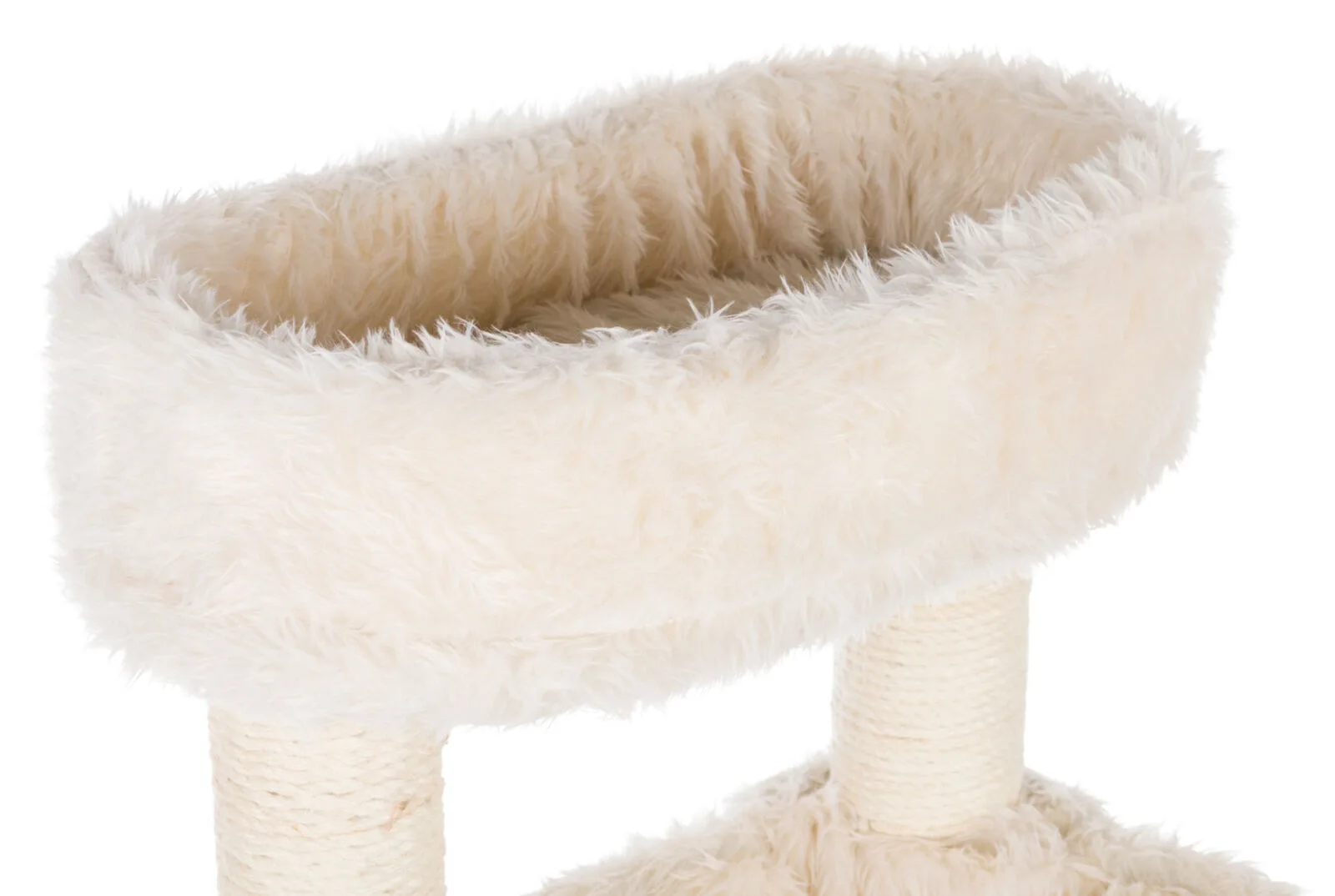
Identify what actually comes off
The installed bed in the photograph is a useful example of a removable component that still looks integrated into the tree. TRIXIE's Baza Junior product information identifies a removable top bed that can also be used separately and gives hand-washing care for the reversible cushion.
That is a component-specific benefit. It does not establish a washing method for every upholstered surface, nor does it show the bed being removed. Before choosing a model for easy cleaning, check how the part detaches and how it is reattached correctly afterward.
For your shortlist, record:
- Which cushions, covers or beds can be removed.
- The cleaning method allowed for each removable part.
- How to clean fixed coverings and structural surfaces.
- Whether the instructions require drying before reassembly.
- Which fasteners or connections need attention after reassembly.
- Whether you can reach every area with the tree in its planned location.
Before removing a component for cleaning, identify its attachment in the instructions and keep the matching hardware together. Reassemble it in the specified position once the required drying is complete. Check the connection before returning the tree to use. A clean cover that is loosely refitted or obstructs a nearby step can change the usable route even though the underlying structure has not changed.
Check replacement compatibility before counting on it
Cat tree replacement parts can extend the usefulness of a design when the manufacturer supports the replacement. Ask for the exact part reference, compatible model and fitting instructions. Similar-looking posts, beds and screws are not automatically interchangeable.
The Baza Junior assembly instructions identify the tree's components and hardware. That information helps identify a scratching component when asking about replacement. A parts list does not, by itself, establish that every component is currently sold separately. Confirm availability and compatibility before treating replacement as a financial advantage.
For a potential replacement post, the questions extend beyond its length. The connection, thread or fastener arrangement and position within the structure also matter. For a replacement bed, verify its attachment and intended model. Avoid making the fit work with unapproved modifications to a structural component.
Compare total useful cost
Include delivery, required installation supplies, care effort and any confirmed replacement costs when comparing prices. A higher purchase price may be reasonable for a removable bed you will actually clean or a supported replacement component you can obtain. It is not automatically worthwhile because a listing uses “premium” or “durable.”
A discounted or used tree needs an additional inspection of condition and completeness. Obtain the model information and instructions, then check for missing hardware or altered parts before planning to use it. Cleaning cannot correct a damaged structural component, and tightening cannot restore a part that needs replacement.
If you need to know how to clean a used cat tree or how to secure a cat tree, our cat-tree safety guide covers those decisions in more detail. Use it alongside the exact manufacturer's care and assembly instructions. For this comparison, the important buying question is whether the tree can be maintained, inspected and correctly assembled in the home where it will be used.
Use Four Product Examples to Read a Listing
These four examples show how to separate a documented height and named feature from a dimension or capacity you still need to check. They illustrate different layouts; they are not a ranking of products tested under the same conditions.
Use the exact model and selected variant when comparing specifications. Another size, color listing or similarly named tree may use different photographs or details. Keep the product identity attached to your notes so a dimension from one configuration does not accidentally become a claim about another.
| Exact example | Documented height | What the example helps compare | Check before buying |
|---|---|---|---|
| TRIXIE Baza Junior 38.6-in Plush Cat Scratching Post | 38.6 inches | Condo, hammock, wrapped posts and removable top bed | Usable dimensions, route spacing and manufacturer limit |
| TRIXIE Baza Senior 27.6-in Cat Scratching Post, Gray | 27.6 inches | Staggered platforms below a resting bed | Platform dimensions, step distances and manufacturer limit |
| Yaheetech Multi-Level 63-in Plush Cat Tree, Dark Gray | 63 inches | A taller multi-level format | Usable beds, openings, installation requirements and manufacturer limit |
| Frisco 72-in Faux Fur Cat Tree & Condo, Brown | 72 inches | A tall tree-and-condo format | Footprint, usable dimensions, routes and manufacturer limit |
TRIXIE Baza Junior 38.6-in Plush Cat Scratching Post
The TRIXIE Baza Junior combines several kinds of resting space. TRIXIE identifies jute-wrapped posts, a plush-lined condo with an insert, a hammock and a top platform with a removable bed. The selected product is the cream-colored example shown in this guide.
Use it to compare enclosed, suspended and open resting options within one structure. Then measure the features separately. The condo's exterior is not its usable interior, the hammock is not a flat platform, and the overall height does not tell you the spacing between destinations. The “Junior” name should not replace an individual kitten-fit check.
TRIXIE Baza Senior 27.6-in Cat Scratching Post, Gray
The gray TRIXIE Baza Senior provides a lower-height comparison with staggered platforms leading toward its top bed. The photograph makes the arrangement visible; it does not supply platform measurements or certify suitability for a cat with particular mobility needs.
Ask for the clear landing areas and the distances between them. Compare those details with your cat's current movements and resting preferences. A lower tree can be a useful option without being the automatic choice for every older cat. The relevant benefit is the layout your cat can use, rather than the age-related product name.
Yaheetech Multi-Level 63-in Plush Cat Tree, Dark Gray
The Yaheetech Multi-Level 63-in Plush Cat Tree in Dark Gray is the taller multi-level example in this comparison. Its listed height gives you a starting point for room planning, while the multi-level arrangement prompts closer questions about routes and resting destinations.
Check the usable dimensions of the beds and openings, then trace the path between them. If considering it for multiple cats, assess shared access rather than equating several levels with a confirmed capacity. If considering it for a Bengal or another active cat, assess the actual cat's size and movements. The product name does not establish a breed-specific recommendation.
Frisco 72-in Faux Fur Cat Tree & Condo, Brown
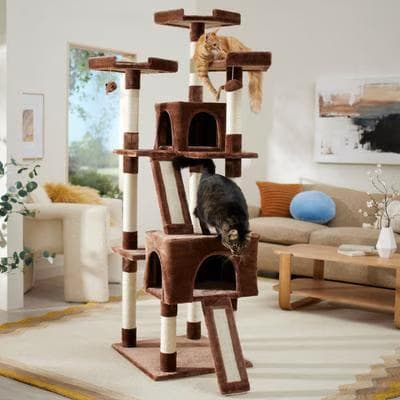
The Frisco 72-in Faux Fur Cat Tree & Condo in Brown shows why a tall tree still needs a ground-level fit check. Compare the base footprint, projecting components and landing routes before deciding where a 72-inch structure belongs.
Next, examine the condo entrance and usable resting areas. The height difference between this model and the others does not establish greater sleeping space, load capacity or suitability for multiple cats. Confirm the manufacturer limit and installation requirements for this exact brown variant, just as you would for a shorter model.
For ranked recommendations, including the best cat trees for multiple cats and comparisons of companies, use our best cat towers guide. First narrow your requirements here: usable bed size, room footprint, route layout, maintenance and installation. A ranked recommendation becomes more useful when you can explain which of those requirements it needs to meet, rather than choosing a brand before defining the fit.
Choose a Location and Introduce the Tree
Choose a location your cat has a reason to visit. Compare existing resting places, preferred views, scratching locations and the rooms where the cat spends time. An unused corner may be convenient for people but offer little of what attracted the cat to its current spot.
Then check the installed route from the cat's perspective. Leave a clear approach to the first platform and landing space at the base. Make sure a condo opening does not face directly into furniture. If the tree is near a window, confirm that the available resting view and the surrounding household setup remain practical once the whole structure is in place.
Make the intended activities easy to find
A tree can serve more than one purpose, but its location may favor some activities over others. A resting perch beside a frequently used sofa may become a place to spend time near people. A scratching surface needs a location where the cat can readily approach it. An enclosed hide should remain accessible even when the room is busy.
Check the location with a short walkthrough:
- Open nearby doors, drawers and cupboards through their normal range.
- Confirm that people can pass without stepping into the landing area.
- Look at the approach to the scratching surface from the floor.
- Check the route down from the highest resting place.
- Make sure cleaning and required attachment checks remain possible.
- Keep window-covering cords and other loose items out of the climbing route.
If several cats will use the area, repeat the walkthrough with an occupied platform in mind. A route that works while the tree is empty may become a narrow shared passage once a cat settles on a lower shelf. Preserve access to other resting places while you learn how the new tree is used.
Let use develop voluntarily
After correct assembly, allow the cat to inspect the tree at its own pace. Start with accessible lower areas. You can place a familiar removable blanket where it does not interfere with the intended bed or attachment, or use a treat to invite exploration. Avoid placing the cat high on the structure and expecting it to work out the route down.
Encourage voluntary exploration:
- Reward investigation and scratching. The San Francisco SPCA recommends encouraging appropriate scratching rather than punishing the behavior.
- Keep introduction gentle. Interest in a new object can begin with sniffing, sitting nearby or using only one part.
Observe which component the cat chooses. If the lower bed is popular and the upper perch is ignored, inspect the transition between them before assuming the cat needs more encouragement. If the entire structure is ignored, reassess location, approach and the activities it offers. Change one relevant factor at a time so the cat's response is easier to interpret.
A useful final comparison is between the listing you liked and the setup your cat actually uses. Keep successful resting and scratching options available while making adjustments. The aim is a comfortable, accessible part of the home, with a route and maintenance routine you can continue to support.
Frequently Asked Questions
Start with observed resting habits rather than a universal favorite. Look for a usable route to the type of resting place your cat already chooses, whether an open shelf, cushioned bed or enclosed hide. Platform fit and scratching texture matter more than the tree's marketing label.
There is no fixed number that fits every home. Consider the rooms used and whether another tree would add a useful resting station or scratching location. One suitable tree may serve a small home well; another station may be useful when the cat regularly spends time elsewhere.
Choose a location the cat already has a reason to visit, with a clear approach and adequate landing space. Check scratcher placement separately from the view offered by the top bed. In a multi-cat home, consider shared access so one occupant does not block the only route.
A suitable tree can provide resting space, climbing access and a scratching surface in one location. Its value comes from those usable functions. A cat that prefers a low perch and a separate scratcher may be well served by that arrangement without needing a tall, elaborate tower.
Choose by usable platform dimensions, interior space, access and the manufacturer limit for the exact model. Overall height and XL labels do not establish fit. Compare the clear bed area with your cat's usual resting posture and confirm that the support information applies to the intended use.
They offer different tradeoffs. Wall systems can conserve floor space, but their mounting requirements and complete route must suit the room. A freestanding tree may be easier to position or relocate. Either option needs a clear route, suitable support and access for cleaning and inspection.

Coreen Saito is a pet writer and longtime shelter volunteer with more than a decade in animal rescue. She covers cat behavior, breed care, and the small, ordinary science of sharing a life with companion animals, with a particular focus on honest takes about the products and decisions that actually matter. At home in Arizona, she's outranked by Mac (a dog with the loudest opinion in the house), Rebel (a cat who governs by quiet authority), and Meri (an orange tabby who runs the late shift and the laundry basket). She writes about all three, plus the rescues that keep coming through her life, at LifeWithMinty.com.
Sign up for expert-backed reviews and safety alerts all in one place.