Best Cat Puzzle Toys: 4 Picks From Easy to Expert
The best cat puzzle toys ranked from beginner to advanced, plus how to introduce a puzzle, level up difficulty, and keep food-contact toys clean for safer daily enrichment.
Petful is reader supported. As an affiliate of platforms like Amazon and Chewy, we may earn a commission when you buy through links on this page. There is no extra cost to you.
The best cat puzzle toys make your cat work for food the way nature intended: pawing, nosing, and problem-solving instead of gulping from a bowl. The trick is matching the puzzle to your individual cat, because a board that delights a seasoned forager will stump and frustrate a first-timer. This guide ranks four picks that span the full difficulty ladder, from a true beginner puzzle to an expert-level treat board, and shows you exactly how to introduce a puzzle and level up from there.
One honest note on methodology: we did not hands-on test these four toys. Our verdicts are expert analysis of manufacturer descriptions, puzzle mechanisms, care instructions, and aggregated verified-owner reviews on Chewy. Beginner, intermediate, and advanced are Petful's editorial progression unless a manufacturer explicitly labels a level, and nothing here implies physical testing.
- 1The best overall cat puzzle toy is the Catit Play Treat Puzzle ($30.99), a multi-station board placed at the advanced end of Petful's progression.
- 2Our four picks cover an editorial beginner-to-advanced ladder, so you can start with visible, easy rewards and add harder mechanisms only after your cat succeeds.
- 3For meal-time slow feeding rather than treat snacks, choose the Catit Senses 2.0 Food Tree.

Sign up for expert-backed reviews and safety alerts all in one place.
Our Top Picks for the Best Cat Puzzle Toys
What are the best puzzle toys for cats? The honest answer depends on your cat's experience level, which is why this list is built as a progression rather than a single winner. In Petful's framework, the Catstages Buggin' Out is the easy entry point, the Outward Hound Rainy Day and Catit Senses 2.0 Food Tree occupy the middle, and the Catit Play Treat Puzzle is the most complex board in this slate. Prices and the editorial difficulty placement are compared below.
Puzzles for cats work best when the first setup is easy enough to solve and later sessions add one new mechanism at a time. The four specific picks below form a beginner-to-advanced difficulty progression rather than four interchangeable boards. That structure helps a first-time cat build confidence and gives an experienced forager a real next step instead of another product at the same level.
| Pick | Price | Difficulty | Best For |
|---|---|---|---|
| Catit Play Treat Puzzle | $30.99 | Advanced | Experienced foragers ready for an expert challenge |
| Catit Senses 2.0 Food Tree | $28.99 | Intermediate | Slow-feeding full dry-food meals |
| Outward Hound Rainy Day Puzzle & Play | Check price | Intermediate | Cats stepping up from beginner boards |
| Catstages Buggin' Out Interactive Puzzle & Play | Check price | Beginner | First-time puzzle cats and kittens |
Best Treat Puzzle Overall: Catit Play Treat Puzzle
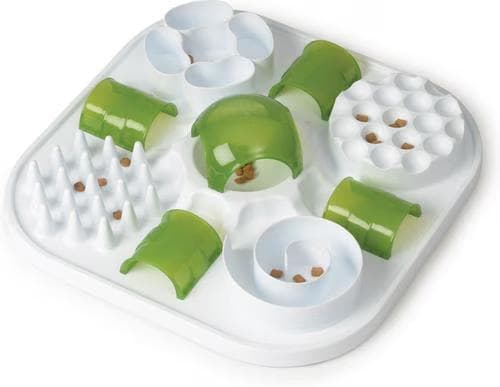
The Catit Play Treat Puzzle ($30.99, rated 4.4 stars) is a multi-station board that combines several foraging challenges on one base: channels to swipe treats along, cups to fish them out of, and obstacles that force a slower, more deliberate paw. That variety is exactly what an experienced cat needs, because a single-mechanism puzzle gets decoded quickly while a multi-station board keeps rotating the problem.
- Benefits: several puzzle mechanisms in one footprint, genuinely challenging for smart cats, strong owner-rating consensus at 4.4 stars
- Drawbacks: too hard as a first puzzle, and the treat channels are hand-wash only, so cleaning effort scales with use
Owner reviews consistently describe cats staying engaged far longer than with single-well boards, and the recurring complaint theme is scattered kibble and cleaning effort rather than breakage.
Petful may earn a commission when you click through to Chewy, at no extra cost to you.
Best Puzzle Feeder for Meals: Catit Senses 2.0 Food Tree
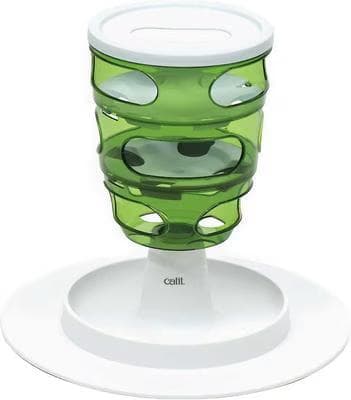
The Catit Senses 2.0 Food Tree ($28.99, rated 4.1 stars) is the meal-time specialist on this list. Instead of dispensing a few treats, the tower holds a full portion of dry food that your cat fishes down through side openings, tier by tier, turning an ordinary dinner into a 20-minute foraging session and a built-in slow feeder for cats that gulp.
- Benefits: handles complete dry-food meals rather than snacks, slows fast eaters, and disassembles for washing; verify current care instructions before using a dishwasher
- Drawbacks: dry kibble only, and enthusiastic cats will flick some pieces onto the floor
If your goal is daily enrichment at every meal rather than an occasional treat game, this is the pick to start with.
Petful may earn a commission when you click through to Chewy, at no extra cost to you.
Best Beginner Puzzle: Catstages Buggin' Out Interactive Puzzle & Play
The Catstages Buggin' Out Interactive Puzzle & Play is the beginner puzzle we recommend for cats that have never worked for food. Its shallow, open wells and simple swiveling leaf covers let a novice cat see and smell the payoff immediately, so the first session can end in success rather than frustration. A difficult first attempt may make a cautious cat reluctant to try again, which is why visible rewards matter more than maximum complexity at this stage.
- Benefits: easiest mechanisms on this list, low sides suit kittens and seniors, quick wins build foraging confidence
- Drawbacks: experienced cats solve it in under a minute, so plan to level up
Best Intermediate Puzzle: Outward Hound Rainy Day Puzzle & Play
The Outward Hound Rainy Day Puzzle & Play is the natural second rung in Petful's editorial ladder. It mixes sliding pieces and hidden compartments that demand more deliberate pawing than an open-well beginner board without approaching the multi-station variety of the Catit Play. It is the type of mechanism change to try after a cat solves visible, shallow rewards confidently.
- Benefits: sliding covers introduce a new mechanic, and the compact board stores easily
- Drawbacks: hand-wash only, and determined cats may flip the whole board rather than solve it
Best Treat Puzzles and Treat-Dispensing Toys
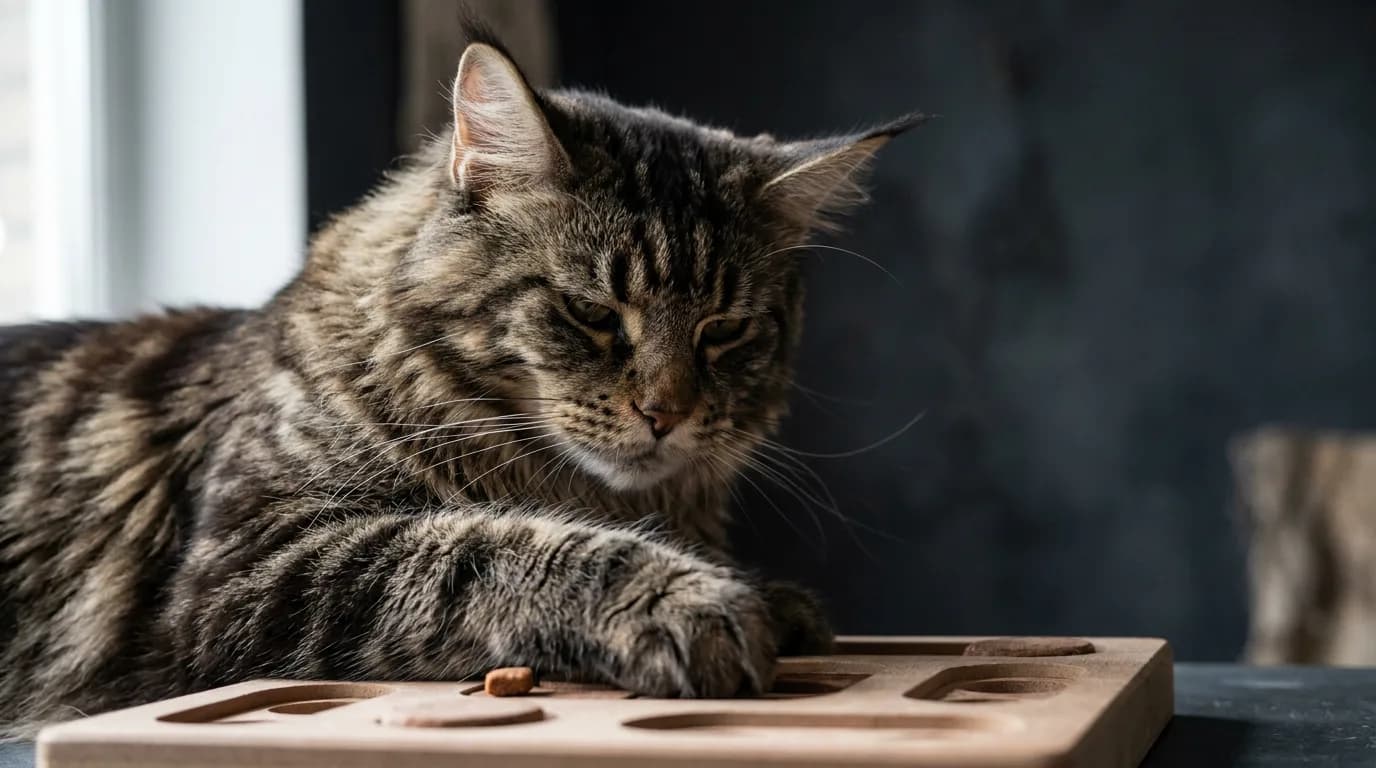
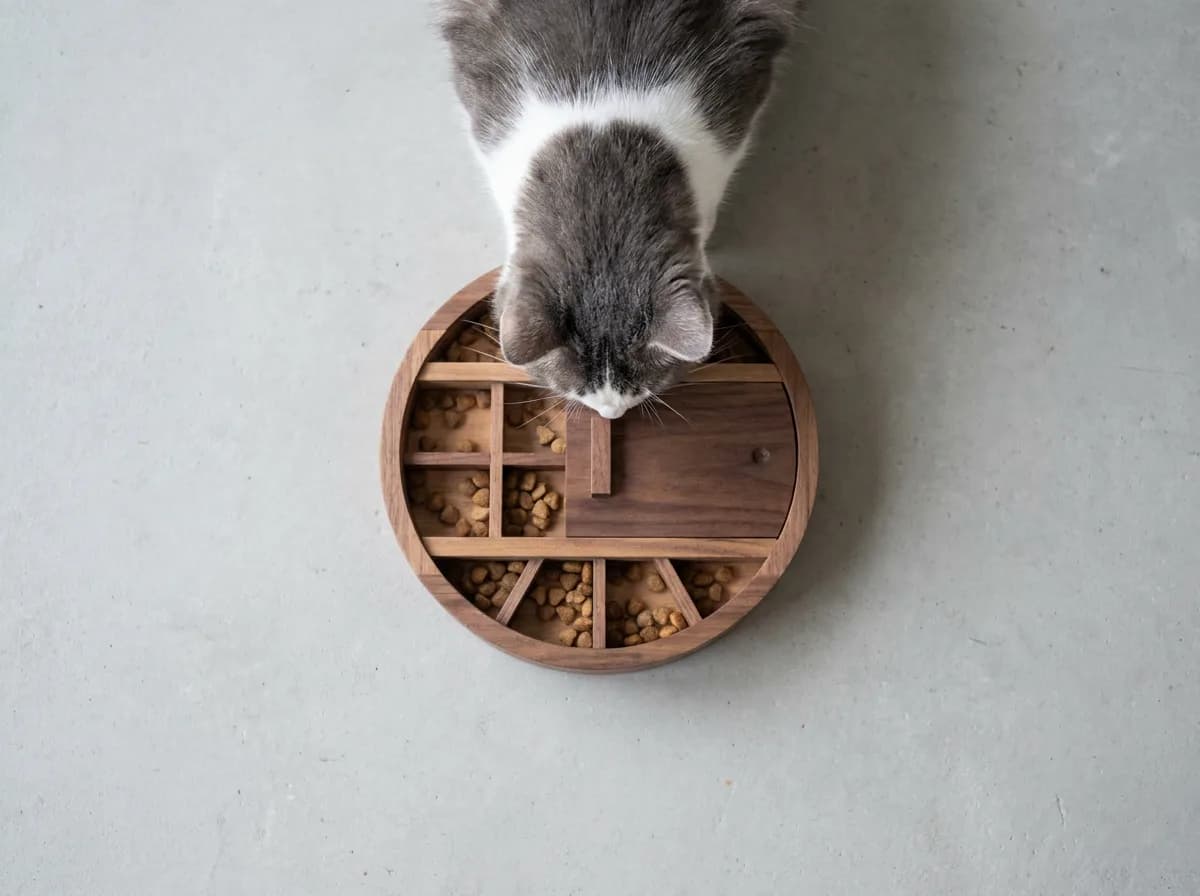
Treat puzzles are the snack-session side of the category: short, high-motivation games loaded with a few high-value treats rather than a full meal. Before buying one, look for an in-use photo like the one above, because watching a cat working the treat puzzle tells you more about the paw-dexterity challenge than any product render. Shallow open wells suit beginners; covered compartments, sliding pieces, and narrow channels for pawing treats out belong to the intermediate and advanced rungs.
Cat treat puzzle toys and cat treat dispenser toys are best for small, measured rewards rather than unlimited calories. Start with visible treats and one active mechanism, then cover more wells or add sliders after the cat succeeds. If the cat paws once and leaves, the puzzle may be too difficult or the reward too weak; if every piece disappears instantly, increase the challenge gradually instead of jumping to an expert board.
Food-contact puzzle hygiene
Because treat boards are food-contact surfaces, hygiene is not optional. Treat residue and saliva collect in the channels, and soft or lickable treats accelerate the buildup.
Food-contact hygiene means cleaning a cat puzzle toy as often as the food format requires: after every wet or soft-food session, and after every few dry uses at minimum. Check the current care label, separate removable pieces, scrub grooves and corners, and dry every surface before refilling. This cleaning schedule belongs beside the introduce-and-level-up guidance because a puzzle used daily is feeding equipment as well as enrichment.
- Treat channels collect residue and saliva, and damp buildup can grow mold. Wash after every few uses at minimum, and after every session if you use soft or lickable treats. Most treat boards are hand-wash only, so check the care label, scrub the channels with a bottle brush, and dry completely before refilling.
Puzzle Feeders for Meal-Time Enrichment
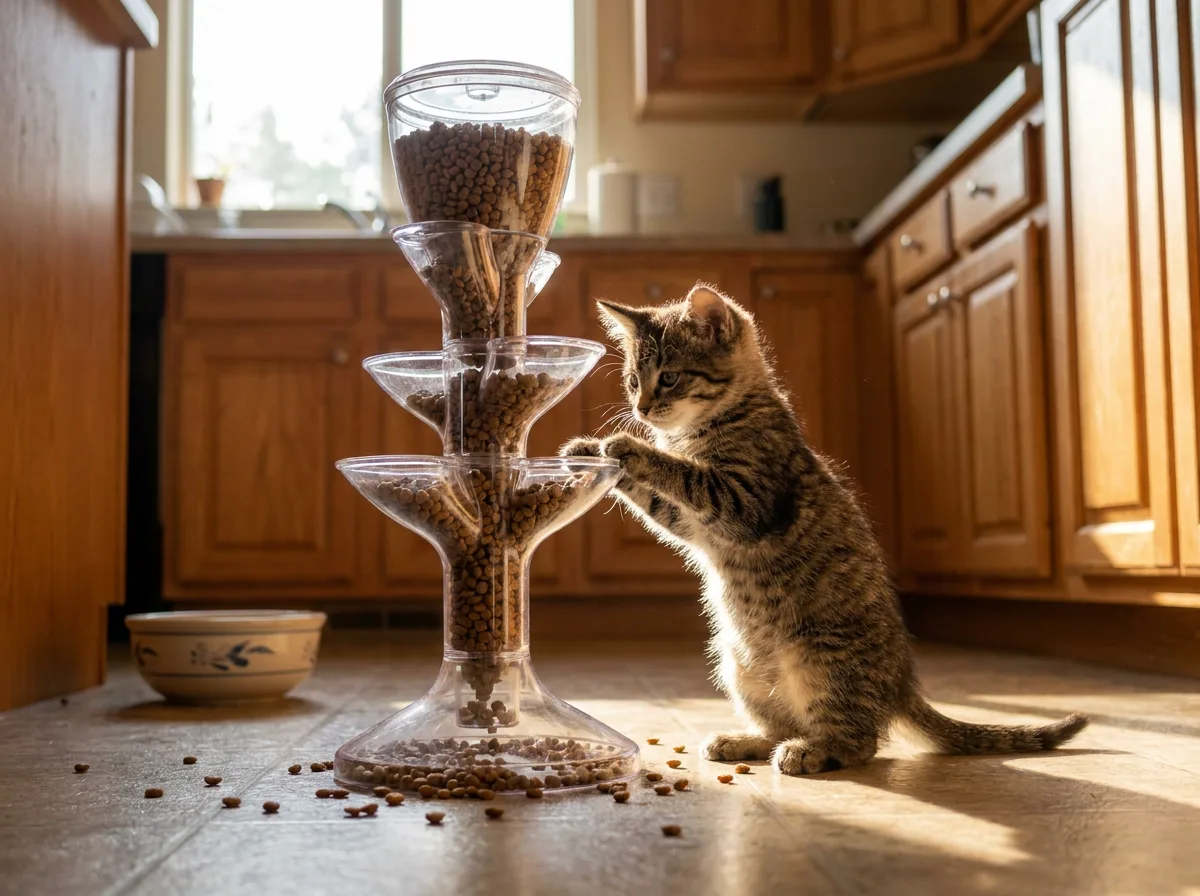
A cat puzzle feeder differs from a treat puzzle in one practical way: capacity. Food puzzles for cats built for meals, like the Food Tree, hold a full dry-food portion and dispense it slowly, so the puzzle replaces the bowl instead of supplementing it. That makes them the best daily-use option, since your cat forages at every meal without extra treat calories.
The best puzzle feeder for cats is therefore the one that fits the full meal format, portion size, cleaning routine, and current skill level. Dry-food trees can extend a meal vertically, flat boards can work with wet food, and either format should let the cat access the complete planned ration without prolonged distress or another cat taking over the station.
Wet-food households need a different shape. A tower can't handle pate, so for a cat puzzle feeder wet food setup, use a flat silicone puzzle mat or a shallow multi-well board, spread the wet food thinly, and wash it after every single meal.
More Enrichment Beyond Puzzles
Puzzles exercise the brain, but a complete enrichment routine also needs toys that move. A battery-free track such as the Catstages Tower of Tracks covers independent batting without pretending to be another puzzle pick. Our roundup of the best interactive cat toys compares the broader categories and makes the commercial ownership clear.
For cat enrichment toys, stimulating cat toys, and other toys for stimulation, use that interactive guide rather than expecting a food puzzle to own every enrichment job. It covers movement, safe solo play, rotation, and indoor-cat stimulation; this page stays with food-work difficulty, meal compatibility, and cleaning. The distinction helps a reader choose a complementary toy instead of another puzzle that repeats the same task.
DIY cat enrichment ideas can also begin with a box, paper packing material, or a supervised food search, but they belong to the broader enrichment system rather than this ranked product slate. Use free materials only when they are clean, stable, and easy to inspect, and retire anything that becomes wet, torn, or small enough to swallow.
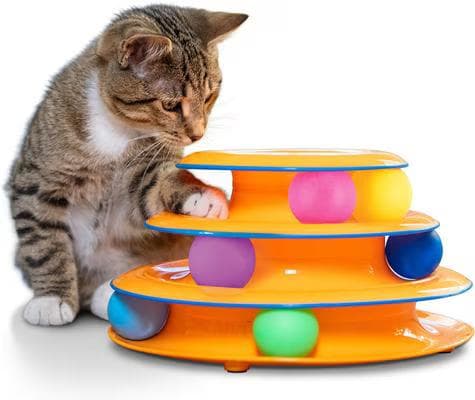
Petful may earn a commission when you click through to Chewy, at no extra cost to you.
Prefer motorized play? Interactive cat toys
Motorized mice, feather spinners, and hide-and-seek prey toys cover the stalk-and-chase side of the hunt that a stationary board cannot. The Potaroma 3-in-1 butterfly toy is one current physical-prey alternative for cats that need movement rather than food work. It is a contextual alternative, not a replacement card for either named puzzle pick whose exact offer is unavailable.
Shoppers comparing interactive toys for cats may also search for automatic cat toys, moving cat toys, electronic cat toys, motion-activated cat toys, or the best interactive cat toys. Those are movement-product decisions, so the linked interactive roundup owns the recommendations. A puzzle remains the better fit when the desired action is foraging or problem-solving for food rather than chasing powered motion.
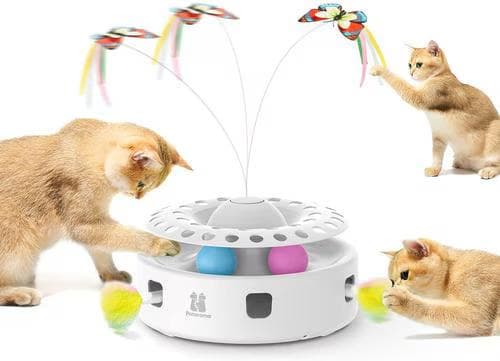
Petful may earn a commission when you click through to Chewy, at no extra cost to you.
Puzzle Difficulty: How to Challenge a Smart Cat
Smart cat toys are puzzles pitched one rung above what your cat has already mastered. Cats do not arrive good at puzzles; they learn mechanisms through success and repetition. The levels below are Petful's editorial progression for these four products, not a universal manufacturer scale:
Products marketed as a Nina Ottosson cat puzzle may use their own level system, so compare the actual lids, sliders, wells, and food access rather than assuming two brands' numbers mean the same thing. “Cat intelligence toys” and “cat toys for smart cats” are useful shopping labels only when the mechanisms suit the individual cat's current experience.
- Level 1, beginner: Catstages Buggin' Out, with open wells and simple covers for first-time foragers
- Level 2 to 3, intermediate: Outward Hound Rainy Day for sliding-piece mechanics, and the Senses 2.0 Food Tree for meal-time foraging
- Level 4, advanced: Catit Play Treat Puzzle, where multiple stations force your cat to switch strategies mid-session
Use behavior rather than a calendar to know when to climb. If your cat empties the current puzzle without pausing or clearly loses interest, introduce one harder mechanism. If your cat walks away with food still inside, make the reward easier to see or drop back a rung. Cats at the top of the ladder can rotate two familiar boards or change reward placement instead of moving up on a fixed schedule.
How to introduce a puzzle toy to a first-time cat
To introduce a puzzle toy to a cat that has never used one, begin with the easiest visible reward and let the cat watch you place it. Keep the first session short, avoid moving the cat's paw by force, and make the first success possible within a minute or two. If the cat walks away frustrated, uncover the reward or simplify the mechanism; frustration is a signal to lower difficulty, not proof that the cat is not smart.
Use concrete level-up criteria. Move from beginner to intermediate only after the cat approaches willingly and clears the easy setup without help on several occasions. Increase one variable at a time: hide a treat more deeply, close one lid, add one moving piece, or spread food across more stations. If the cat solves the whole puzzle in under a minute, add a small challenge; if engagement drops, return to the last successful level.
DIY Cat Puzzles vs Store-Bought
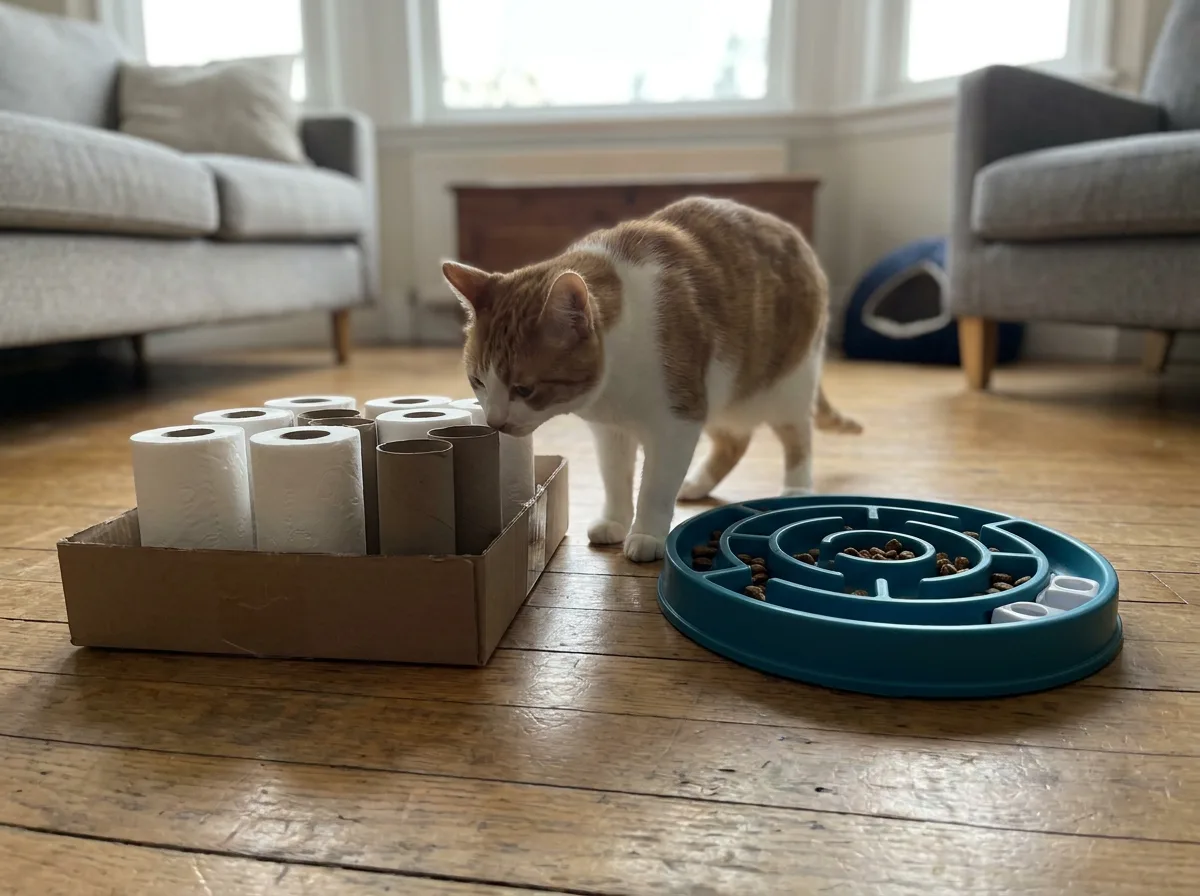
DIY cat toys have a legitimate place on the difficulty ladder: the bottom rung. A DIY cat puzzle feeder made from a clean egg carton with kibble dropped in the cups can teach the same core lesson as the Buggin' Out, that food comes from effort. Homemade cat toys are a low-cost way to find out whether your cat enjoys foraging before you spend money, but they require supervision.
Where DIY loses is everything after that first lesson:
- Durability: cardboard shreds within sessions, while a plastic board survives years of daily pawing
- Hygiene: you cannot wash an egg carton, so food-contact cardboard becomes a residue trap that has to be thrown out and rebuilt
- Progression: DIY difficulty plateaus fast, and there is no clean path to intermediate mechanics like sliders and covered compartments
Avoid staples, exposed tape, string, sharp cut edges, and plastic rings or caps that can detach. Discard cardboard as soon as it becomes damp, heavily chewed, or ragged, and never use a food-contact DIY puzzle that cannot be cleaned or replaced after residue builds up. Our verdict: start with a supervised egg-carton test if you like, then move to a washable beginner board once your cat takes to it.
A toilet-roll puzzle is another short-lived test: cut smooth kibble-sized openings in a clean cardboard tube, fold the ends without staples or tape, and supervise the first use. DIY egg-box and toilet-roll puzzles are cheap and adjustable, but store-bought durability and washable food-contact surfaces make more sense for repeated meals. Replace homemade cardboard freely rather than trying to reinforce wet or shredded material.
Why Puzzle Play Taps the Foraging Instinct
Are puzzle toys good for cats? They can help many cats by turning food into work that engages the foraging instinct instead of handing every bite over in seconds. A solvable puzzle adds mental stimulation, may slow eating, and creates a tangible reward, but food still counts toward the daily ration. It is not a weight-loss treatment or a fix for every behavior problem. For the full research discussion, see our guide to the benefits of food puzzles for cats, and for broader context, see how interactive toys help your cat.
Beyond Puzzles: The Best Cat Toys Overall
If you're building a toy box from scratch, puzzles are one category of several your cat needs. Wands deliver interactive prey play, kickers and crinkle balls handle solo sessions, and tunnels cover ambush instincts. For the full tour of every category and which cats each one suits, start with our pillar guide to the best cat toys overall, then come back here when it's time to pick the foraging piece.
That pillar owns recommended, best-rated, and top-rated cat toys across categories; this page does not treat a puzzle rating as an overall toy ranking. Use the broader comparison when the choice is still wand versus tunnel versus track versus puzzle, then return here only after food work is the selected category.
What About Laser Toys?
Lasers sit at the opposite pole from puzzles: pure chase with no food payoff and no catch. They're excellent cardio when used correctly, but they need session rules that puzzles never require, including always ending on a catchable toy. Our guide to the best cat laser toys ranks the safest automatic and handheld units and explains the frustration research behind those rules.
That laser guide also owns laser pointer syndrome in cats, whether laser pointers give cats anxiety, whether laser pointers are dangerous, and how to compare the best or rechargeable laser pointer for cats. Those questions require beam classification, eye safety, fixation, and session evidence that would distract from puzzle difficulty and food hygiene here.
Cat Puzzle Toy FAQs
Make the first session an easy win. Start on the easiest setting or the simplest puzzle you own, and load it with high-value treats first, something your cat loves more than kibble, so the motivation outweighs the novelty. Let your cat watch you drop the treats in, then step back. If your cat stalls, nudge a treat partway out of a well so the first success comes fast. Keep early sessions short, and only add difficulty once your cat empties the puzzle confidently.
Wash after every few uses for dry treats and kibble, and after every single session for wet food or soft, lickable treats. Saliva and food residue build up in channels and wells, and damp residue can grow mold. Check the care label first: some feeders, like the Catit Food Tree, disassemble and have dishwasher-safe parts, while most flat treat boards are hand-wash only and need a bottle brush for the channels. Dry everything completely before the next fill.

Coreen Saito is a pet writer and longtime shelter volunteer with more than a decade in animal rescue. She covers cat behavior, breed care, and the small, ordinary science of sharing a life with companion animals, with a particular focus on honest takes about the products and decisions that actually matter. At home in Arizona, she's outranked by Mac (a dog with the loudest opinion in the house), Rebel (a cat who governs by quiet authority), and Meri (an orange tabby who runs the late shift and the laundry basket). She writes about all three, plus the rescues that keep coming through her life, at LifeWithMinty.com.
Sign up for expert-backed reviews and safety alerts all in one place.