The Best Cat Toys of 2026: 6 Picks Our Experts Rated
We ranked the 6 best cat toys of 2026 by play style, safety, and budget tier, from an $8.79 ball track to a 72-inch cat tree, plus wand, kitten, catnip, tunnel, laser, and puzzle toy advice for bored indoor cats.
Petful is reader supported. As an affiliate of platforms like Amazon and Chewy, we may earn a commission when you buy through links on this page. There is no extra cost to you.
The best cat toys are the ones that match your cat's hunting style, not the ones at the top of a bestseller list. A ground stalker who ambushes ankles needs a different toy than an aerial hunter who leaps for birds at the window, and a $9 catnip toy can outperform a $90 gadget if it fits the cat. We ranked 6 top rated cat toys from Chewy, from an $8.79 ball track to a 72-inch cat tree, and matched each one to a play style, an age range, and a budget tier.
*Petful earns a commission on purchases made through the Chewy links in this article. We did not test these toys hands-on; our verdicts are expert analysis of materials, safety design, and verified-owner review patterns, explained in full in [how we chose](#how-we-chose-these-cat-toys).*
- 1The Catstages Tower of Tracks ($8.79) is our best overall cat toy: a three-tier ball track that works for solo play, kittens, and seniors alike
- 2Match the toy to your cat's play style first: ground stalkers want tunnels and mice, aerial hunters want wands, climbers want a tree
- 3Rotation beats any single toy: cycling toys weekly keeps an indoor cat's novelty response alive

Sign up for expert-backed reviews and safety alerts all in one place.
The best cat toys: our top picks
Every pick below earned its spot on play-style fit, safety, durability signals from thousands of verified owner reviews, and price per play-value. Good cat toys do one job well; these six each own a different job.
These six ranked picks include current Chewy pricing, a clear statement of who each toy is for, and an honest drawback rather than a generic list of positives. This guide covers kitten toys, tunnels, and budget tiers in one place, alongside options for adult and senior cats, food puzzles, lasers, solo toys, and climbing furniture from under $10 to nearly $100. That breadth lets you compare categories without pretending every cat needs the same product.
Best overall: Catstages Tower of Tracks
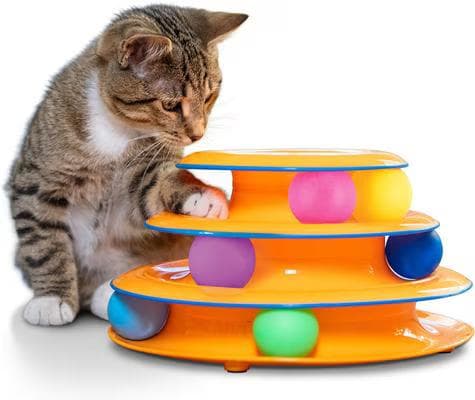
The Catstages Tower of Tracks ($8.79, rated 4.5 out of 5) is the rare toy that works for nearly every cat. Three stacked tracks hold brightly colored balls a cat can bat but never lose, so the game resets itself all day with no human required.
Choose it when you want a low-cost, battery-free toy that can stay on the floor between guided play sessions. It is especially practical for kittens and older cats because the action happens at ground level, but it is less useful for cats that only engage with food or airborne prey. The plastic surface is easy to wipe, and a rug reduces both sliding and ball noise on hard floors.
- Best for: solo play, multi-cat homes, kittens through seniors, ground stalkers and food hunters alike
- Budget tier: under $10
- Drawback: the rattling balls are loud on hard floors, so skip it if the toy will live outside your bedroom door
Compared with the Catit Senses circuit, the Tower of Tracks is more compact and cheaper, though the circuit's expandable track suits homes with more floor space.
Petful may earn a commission when you click through to Chewy, at no extra cost to you.
Best catnip toy: Yeowww! Catnip Banana
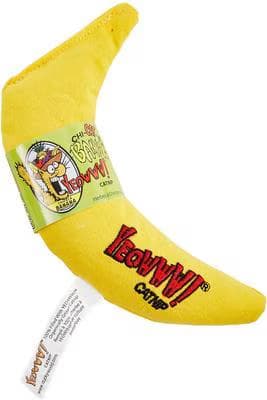
The Yeowww! Catnip Banana ($8.27, rated 4.7) is stuffed entirely with organically grown catnip, no cotton filler, which is why it holds a 4.7 rating across tens of thousands of reviews. The banana shape is big enough for full-body kicker play: cats grab it with front paws and rake it with their back legs, a natural prey-handling move most small toys are too little to trigger.
This is a better fit for a cat that wrestles and bunny-kicks than one that prefers to chase. Because it is a fabric toy, inspect the seams after vigorous sessions and retire it when stuffing, threads, or torn fabric appear. Catnip also fades with exposure, so store the banana in a sealed container between rotations instead of leaving it on the floor all month.
- Best for: solo play, catnip responders, cats who kick and wrestle their prey
- Budget tier: under $10
- Drawback: roughly one in three cats has no catnip response at all, and it does nothing for most kittens under 6 months
Petful may earn a commission when you click through to Chewy, at no extra cost to you.
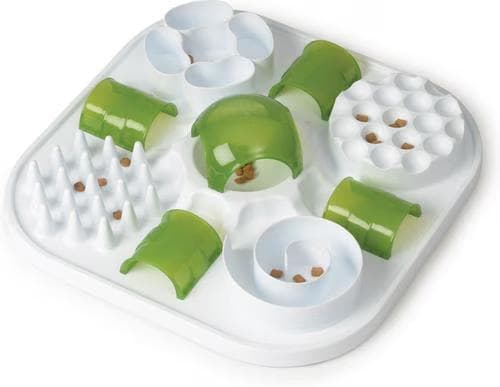
Best puzzle toy: Catit Play Treat Puzzle
The Catit Play Treat Puzzle ($30.99, rated 4.4) turns snack time into a hunt. Cats fish kibble or treats through openings in a raised track, slowing fast eaters and giving food-motivated cats a problem to solve every day.
Pick it for a cat that works harder for food than for movement, and skip it as a first puzzle if your cat gives up easily. Start with treats placed in the most open stations, then use the more difficult channels only after the first pattern feels easy. Count puzzle food toward the daily ration, separate competing cats during use, and wash food-contact grooves often enough that crumbs and saliva do not build up.
- Best for: food hunters, fast eaters, bored indoor cats who ignore chase toys
- Budget tier: $10-40
- Drawback: determined paws can clear it quickly once they learn the pattern, so raise the difficulty by using smaller treats
Petful may earn a commission when you click through to Chewy, at no extra cost to you.
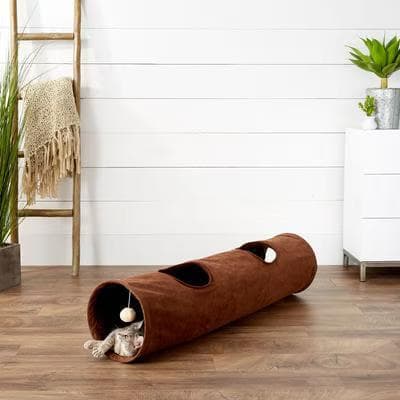
Best tunnel: Frisco 47-in Crinkle Tunnel
The Frisco 47-inch Crinkle Tunnel ($14.99, rated 4.7) is a ground stalker's dream: a long, crinkly hideout with a peephole for ambushing whatever walks past. The crinkle lining rewards every step with sound, and the tunnel folds flat for storage.
The tunnel works best when it becomes part of a game rather than a static tube. Drag a wand past the openings, toss a spring through it, or let two compatible cats use opposite ends for chase play. Measure the open floor area before buying, and consider a quieter fabric tunnel if crinkle noise startles your cat or carries through a small apartment at night.
- Best for: ground stalkers, ambush players, multi-cat chase games, shy cats who want cover
- Budget tier: $10-40
- Drawback: confident, tunnel-loving cats can wear through the crinkle liner in months of heavy use
Petful may earn a commission when you click through to Chewy, at no extra cost to you.
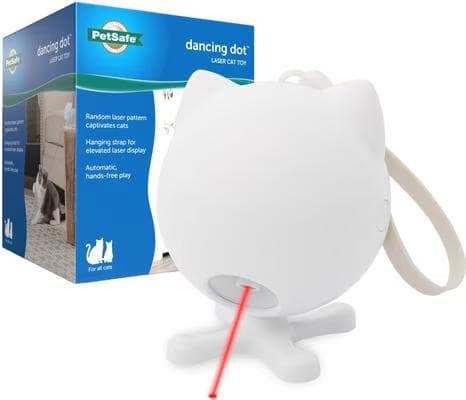
Best laser toy: PetSafe Dancing Dot
The PetSafe Dancing Dot ($23.99, rated 3.8) is an automatic laser that sweeps a random pattern across the floor, then shuts off on a timer so the game does not run all day. Its rating is the lowest of our six picks, and the review pattern explains why: laser play thrills some cats and frustrates others.
An automatic shutoff limits the cycle; it does not make laser play a leave-alone activity. Use the first sessions to see whether your cat can disengage, keep the beam away from eyes and reflective surfaces, and finish by steering the dot onto a physical toy the cat can grab. Skip lasers entirely for cats that continue searching walls, shadows, or reflections after the light is gone.
- Best for: high-energy chasers who get a physical toy to "catch" at the end of each session
- Budget tier: $10-40
- Drawback: a laser dot can never be caught, so always end sessions on a catchable toy; some cats lose interest in the repeating pattern
Petful may earn a commission when you click through to Chewy, at no extra cost to you.
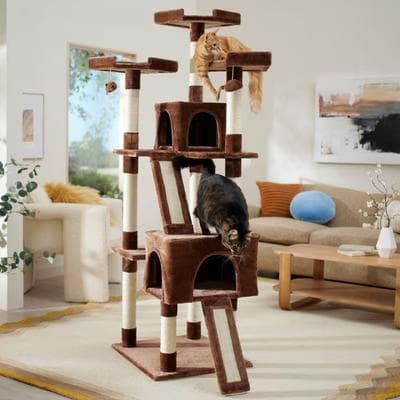
Best splurge: Frisco 72-in Faux Fur Cat Tree
The Frisco 72-inch Faux Fur Cat Tree ($96.59, rated 4.7) is for the climber: the cat who lives on top of your refrigerator. Six feet of perches, two condos, and sisal scratching posts give vertical territory that no floor toy can, which is why a tall tree earns its price in multi-cat homes.
A tree is enrichment furniture rather than a handheld toy, and it earns this slot because some cats value climbing territory more than another object on the floor. It is the least portable pick and the one that demands the most planning: measure the footprint and ceiling clearance, place it where the cat already watches the room, and recheck fasteners as the structure settles. A shorter, lower perch is the better choice for cats with limited mobility.
- Best for: climbers, window watchers, multi-cat households that need vertical territory
- Budget tier: $40+
- Drawback: it needs real floor space and about 30-45 minutes of assembly, and top-heavy trees should sit against a wall
Petful may earn a commission when you click through to Chewy, at no extra cost to you.
Match the toy to your cat
| Pick | Price | Toy type | Best for |
|---|---|---|---|
| Catstages Tower of Tracks | $8.79 | Ball track (solo play) | Best overall; every age and play style |
| Yeowww! Catnip Banana | $8.27 | Catnip kicker | Catnip responders who kick and wrestle |
| Catit Play Treat Puzzle | $30.99 | Treat puzzle | Food hunters and fast eaters |
| Frisco 47-in Crinkle Tunnel | $14.99 | Play tunnel | Ground stalkers and ambush players |
| PetSafe Dancing Dot | $23.99 | Automatic laser | High-energy chasers (end on a catchable toy) |
| Frisco 72-in Faux Fur Cat Tree | $96.59 | Cat tree | Climbers and multi-cat homes |
The table is the shortcut, but the rule behind it is simple. Watch how your cat hunts:
- Ground stalker: crouches, creeps, and ambushes; start with the crinkle tunnel and a mouse-style toy
- Aerial hunter: leaps and swats at height; start with a feather wand, then the Dancing Dot for solo sessions
- Climber: seeks the highest perch in every room; the 72-inch cat tree is the toy that doubles as territory
- Food hunter: motivated by treats over feathers; the Catit Play Treat Puzzle wins every time
How to choose the right cat toy
Start with the job the toy needs to do. A toy for ten minutes of shared exercise can have feathers and string because you are present; a toy that stays out during the workday needs a simpler construction with no cords, loose pieces, or exposed battery compartment. Treat "interactive" and "automatic" as descriptions of how a toy moves, not proof that it is safe without supervision.
Use five filters before buying:
- Play style: choose low, skittering toys for ground stalkers, airborne lures for leapers, tunnels for ambush hunters, and puzzles for food-motivated cats.
- Age and mobility: kittens need oversized, non-shedding toys; active adults can handle faster chase; seniors often prefer ground-level batting, slow wand movement, and easy food work.
- Human involvement: wands deliver the most responsive chase but require a person, while tracks and sturdy puzzles can support safe solo play after you have watched the first sessions.
- Household fit: consider floor space, nighttime noise, storage, and whether one cat will guard a food puzzle from another. Multi-cat homes often need duplicate resources rather than one high-value toy.
- Upkeep and replacement cost: washable food-contact surfaces, replaceable batteries, reinforced seams, and parts you can inspect matter more over a year than a clever feature used twice.
Budget by category instead of assuming a higher price creates more play. Under $10 buys a durable ball track or catnip kicker; the middle tier adds tunnels, puzzles, and small electronics; the highest tier should solve a space or territory problem, as a tall tree does. When you are unsure, test the play style with a cheap version before buying the premium one.
The best first purchase for a new cat is usually a small system, not one "perfect" toy: one wand for shared prey play, one sturdy solo toy, one food-work option, and a tunnel, box, or perch that changes the terrain. That set covers movement, problem-solving, social play, and hiding without asking one product to do everything.
How we chose these cat toys
Honesty first: this is expert analysis, not a hands-on lab test. Petful did not put these six toys in front of a test panel of cats, and we will never imply otherwise. The methodology combines manufacturer specifications, verified-owner durability patterns, play-style fit, budget tiers, and vet-informed safety notes. No manufacturer supplied products or paid for placement; we earn a commission only when you buy through our Chewy links.
What we did instead:
- Compared manufacturer specifications, materials, and safety mechanisms across each toy category
- Analyzed verified-owner review patterns on Chewy for durability complaints and boredom reports, not just star averages
- Weighed each toy against feline-behavior evidence on the hunt-catch-kill-eat play sequence and environmental enrichment, drawing on guidance like the AAFP and ISFM environmental needs guidelines
- Scored every pick on play-style fit, safety, durability signals, and price per play-value within its budget tier
Our limitations are real: no hands-on durability testing, no multi-cat household trial, and prices checked on 2026-08-04 can drift.
- String, ribbon, tinsel, and elastic are the most dangerous cat toys in your house. Swallowed string causes linear foreign body obstruction, a surgical emergency, so string ingestion risk is the first thing to check on any toy. Keep wand toys put away between sessions, treat any toy with strings, feathers, or glued-on small parts as a supervised play toy only, and retire toys once parts loosen.
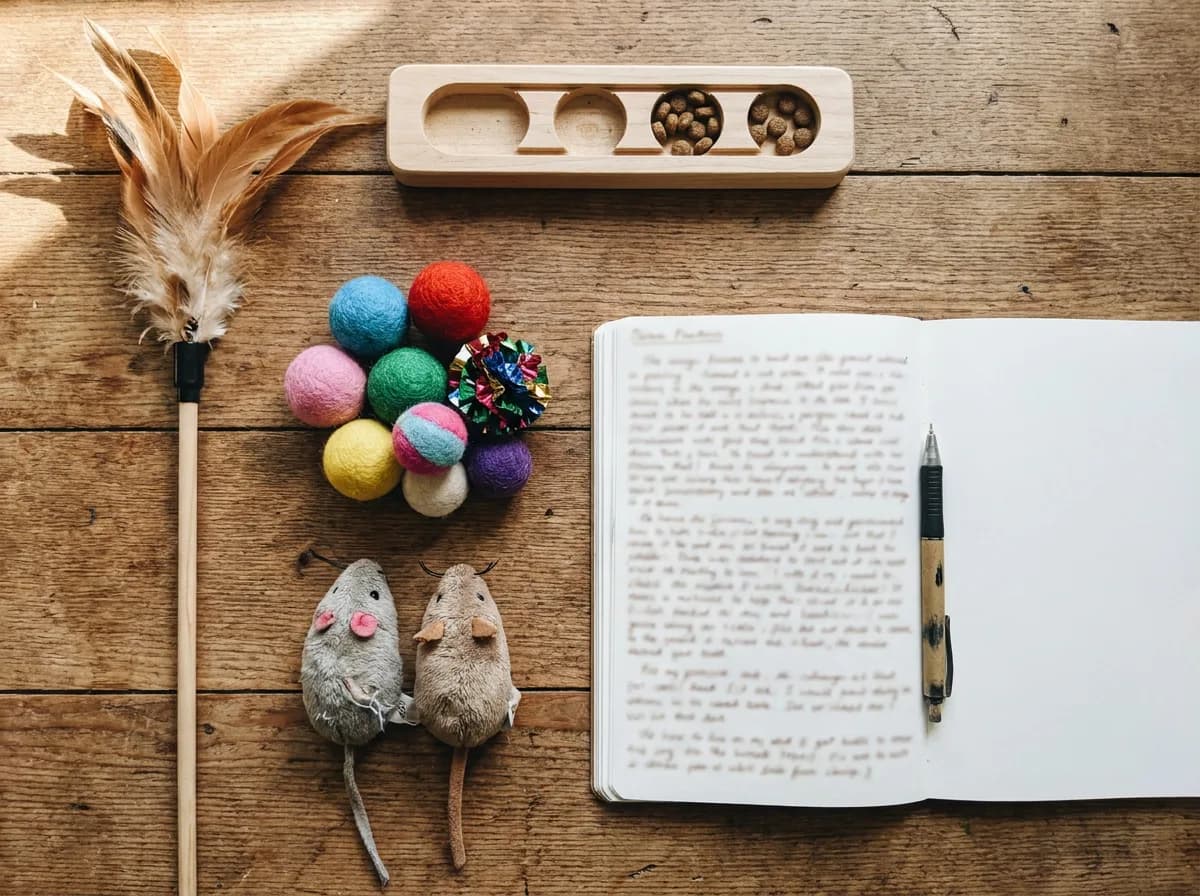
Age matters as much as play style. A senior cat with arthritis still needs to hunt, just lower and slower: a ball track like the Tower of Tracks or a slow-rolled wand keeps an older cat playing without leaps that hurt.
Cat toy safety and when to replace a toy
The higher-risk toy features are long strings, elastic loops, feathers that detach, small glued decorations, exposed wire, and accessible batteries. Those features do not automatically make a toy unusable, but they move it into the supervised-only category. Put wand and string toys away after the session, and never leave a damaged motorized toy where a cat can pry at the battery compartment.
Inspect toys during the weekly rotation. Retire or repair a toy when you find:
- frayed string, stretched elastic, or a loose feather attachment
- torn fabric, exposed stuffing, sharp plastic, or wire showing through
- cracked puzzle surfaces that can trap a claw or hold food residue
- a loose battery door, overheating motor, or new grinding sound
- a tunnel wire pushing through the fabric
- a cat tree that rocks, leans, or has fasteners that no longer tighten securely
Cleaning rules depend on the play surface. Wipe plastic tracks and motor housings with the product turned off; wash food puzzles according to their care instructions after residue collects; and spot-clean fabric toys before they become damp or heavily soiled. Let every food-contact part dry completely before refilling it. Replacement is cheaper than a swallowed part or a toy that has become impossible to clean.
Wand and teaser toys
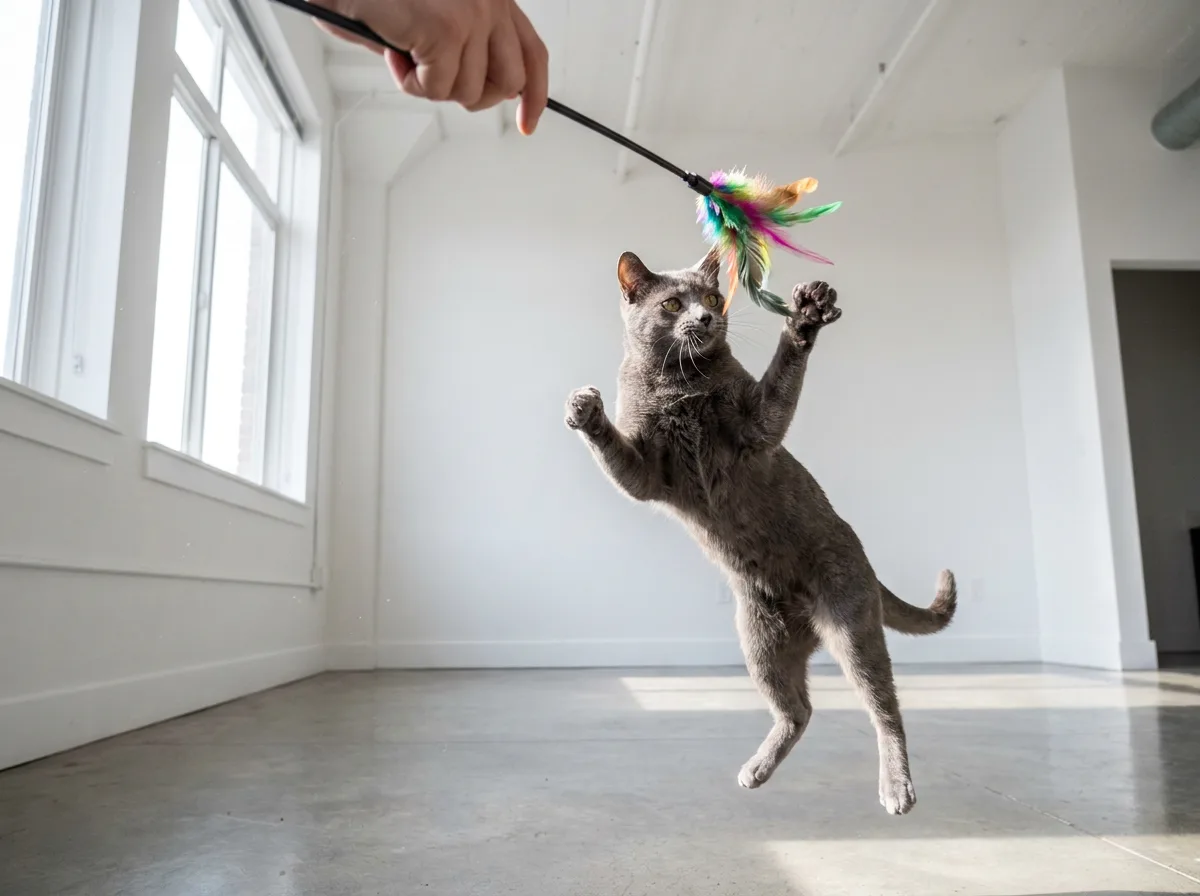
Cat wand toys are the single best tool for interactive play, because you control the prey. A feather wand leap is the full hunt in one motion: stalk, chase, jump, catch. No autonomous toy replicates that, which is why behaviorists reach for wand toys first with bored or overweight cats.
Flying-bird cat toys belong in this human-led category when the lure has feathers or wings on a wand, not a loose motorized piece that can shed parts. Move these flying bird toys in short arcs with pauses and low passes so the cat can stalk as well as leap. The value comes from responsive prey movement and a controlled catch, not from keeping a feather airborne continuously.
How to run a wand session that actually satisfies a cat:
- Move the lure like prey: skitter it away from the cat, pause behind cover, never wave it in their face
- Let your cat catch the lure every few passes; a hunt with no catch is just frustration
- End with a final catch and a few treats to complete the hunt-catch-kill-eat sequence
- Put the wand away afterward; string ingestion is the risk, and scarcity keeps the toy exciting
Two 10-15 minute wand sessions a day is the standard enrichment recommendation for indoor cats. Our full guide to how to play with interactive cat toys covers technique in more depth, including what to do with a cat who just watches the toy.
Best cat toys for bored and indoor cats
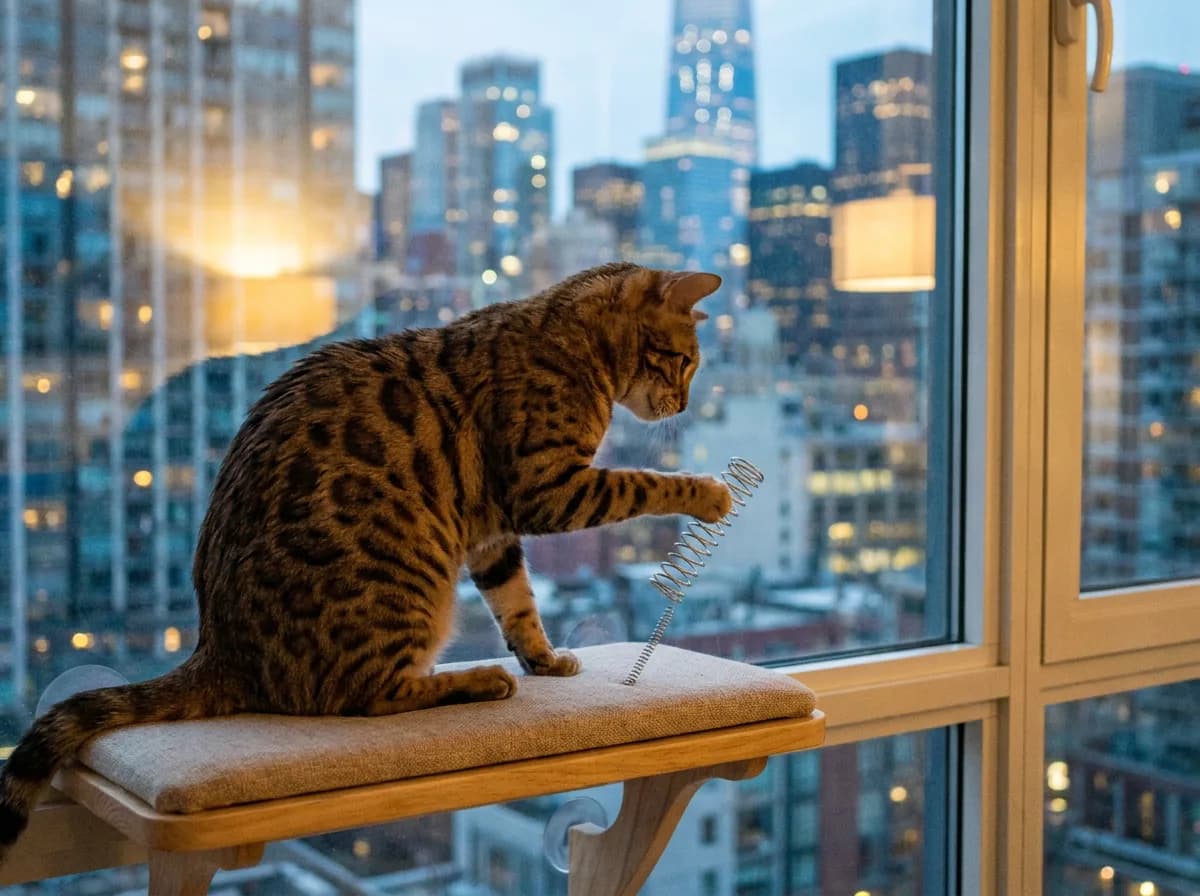
Cat toys for bored cats fail for a predictable reason: the toy never changes. Cats are wired for novelty, and a mouse that has been dead on the rug for three weeks is furniture, not prey. The fix costs nothing.
Toy rotation fights boredom in indoor cats by making a familiar object feel available again after a short absence. Rotation does not require constant buying: it means storing part of the collection, changing which play jobs are represented, and watching whether the cat still chooses each item. Keep a genuine favorite in use when engagement remains high; rotate the objects that have faded into the background.
Run a toy rotation:
- Keep only 4-5 toys out at a time and store the rest in a closed bin
- Swap the active set weekly; the reappearing toys trigger a fresh novelty response
- Store fabric toys in the bin with a pinch of catnip so they come back "recharged"
- Keep one self-play station out permanently, like the Tower of Tracks, for the hours you are away
The best cat toys for indoor cats cover three bases: a solo toy for alone time, an interactive toy for your shared sessions, and territory like the 72-inch cat tree that makes the indoors bigger vertically. Stimulating cat toys for indoor cats do not need batteries; they need to change often and be huntable. If your cat is bored and food-motivated, the Catit Play Treat Puzzle turns every meal into enrichment.
Build a toy rotation that covers the whole hunt
Rotation works best when each active set has different jobs. Keep one human-led chase toy, one safe solo batting toy, one food puzzle, and one terrain-changing option such as a tunnel or box. Swap individual pieces weekly rather than replacing the entire set at once, so the room stays familiar while one or two prey experiences feel new.
Watch use instead of following a rigid calendar. A favorite toy can stay if the cat still initiates play; a ignored toy should disappear for a week or two. Move toys between rooms, put a spring inside a tunnel, or feed one meal through a puzzle before buying another gadget. Those small changes create novelty without adding clutter.
Best kitten toys
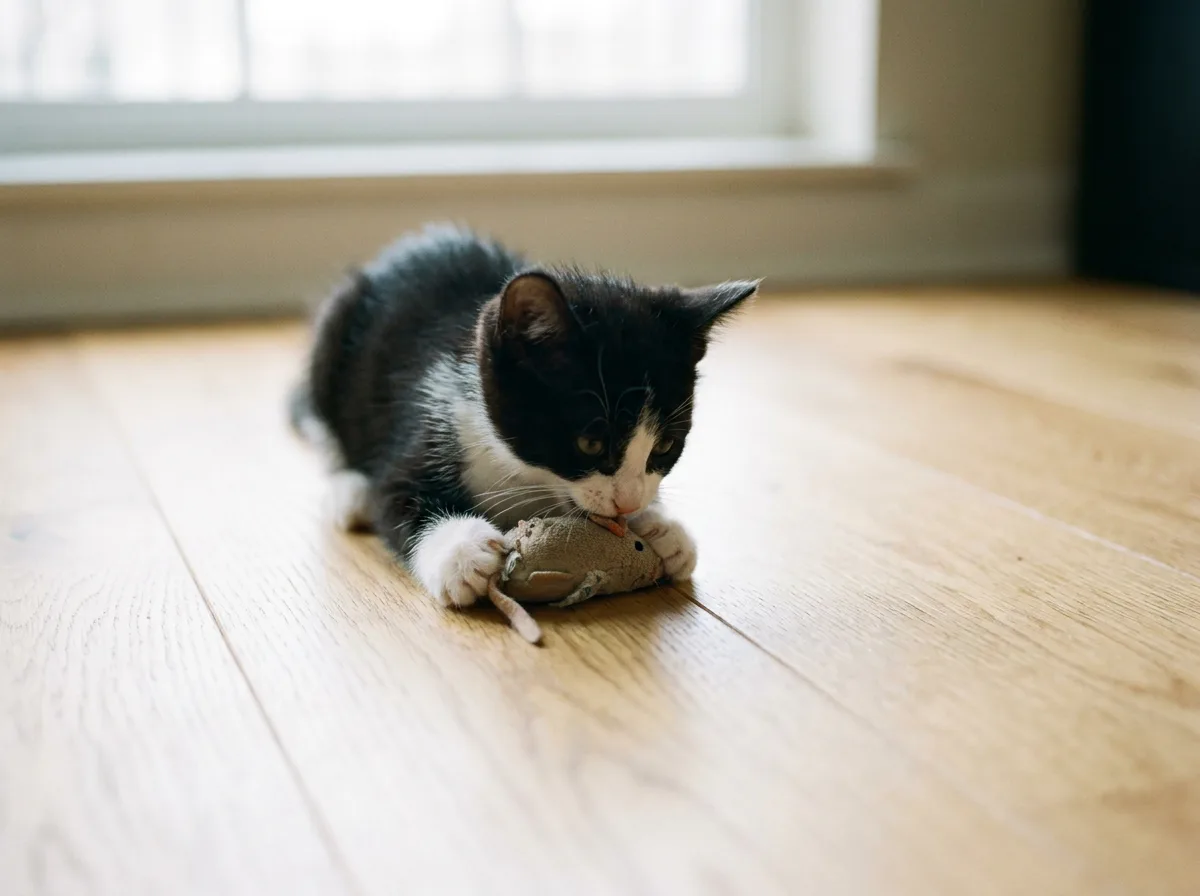
Kitten toys have one non-negotiable requirement: nothing swallowable. Kittens explore with their mouths, so glued-on eyes, bells, feathers that shred, and any toy smaller than a ping-pong ball are a small-parts hazard for a 10-week-old.
The best kitten toys share three traits:
- Soft and oversized: plush toys bigger than the kitten's head invite wrestling and are teething-safe material during the 3-6 month teething window, when cat teething toys save your hands and furniture
- Self-resetting: kittens play in dozens of short bursts a day; the Tower of Tracks is our best-overall pick partly because it is kitten-proof, with no removable parts
- Hands-free: never use fingers or toes as prey; a kitten taught that hands are toys becomes an adult cat that bites
Cat toys for kittens can skip catnip entirely. Most kittens do not respond to catnip until around 6 months to a year, so save the Yeowww! Catnip Banana for the first-birthday gift. A crinkle tunnel, by contrast, is a day-one hit: kittens treat the Frisco tunnel as a racetrack, a den, and an ambush point in the same afternoon.
Adult and senior cat toy needs
Adult cats usually need variety more than extra intensity. Mix short human-led sessions with a toy that can stay out, then rotate both before they become background furniture. For cats carrying extra weight, begin with brief ground-level play and use part of the normal food ration in a puzzle instead of adding treat calories.
Senior cats may play in smaller movements that are easy to miss: a paw reaching from a bed, a slow stalk, or a few focused bats at a track. Put toys on non-slip surfaces, keep puzzle openings easy to reach, and avoid forcing jumps. A sudden loss of interest in favorite toys, especially with hiding, stiffness, appetite change, or litter box changes, deserves a veterinary check rather than a more exciting purchase.
Catnip and solo-play toys
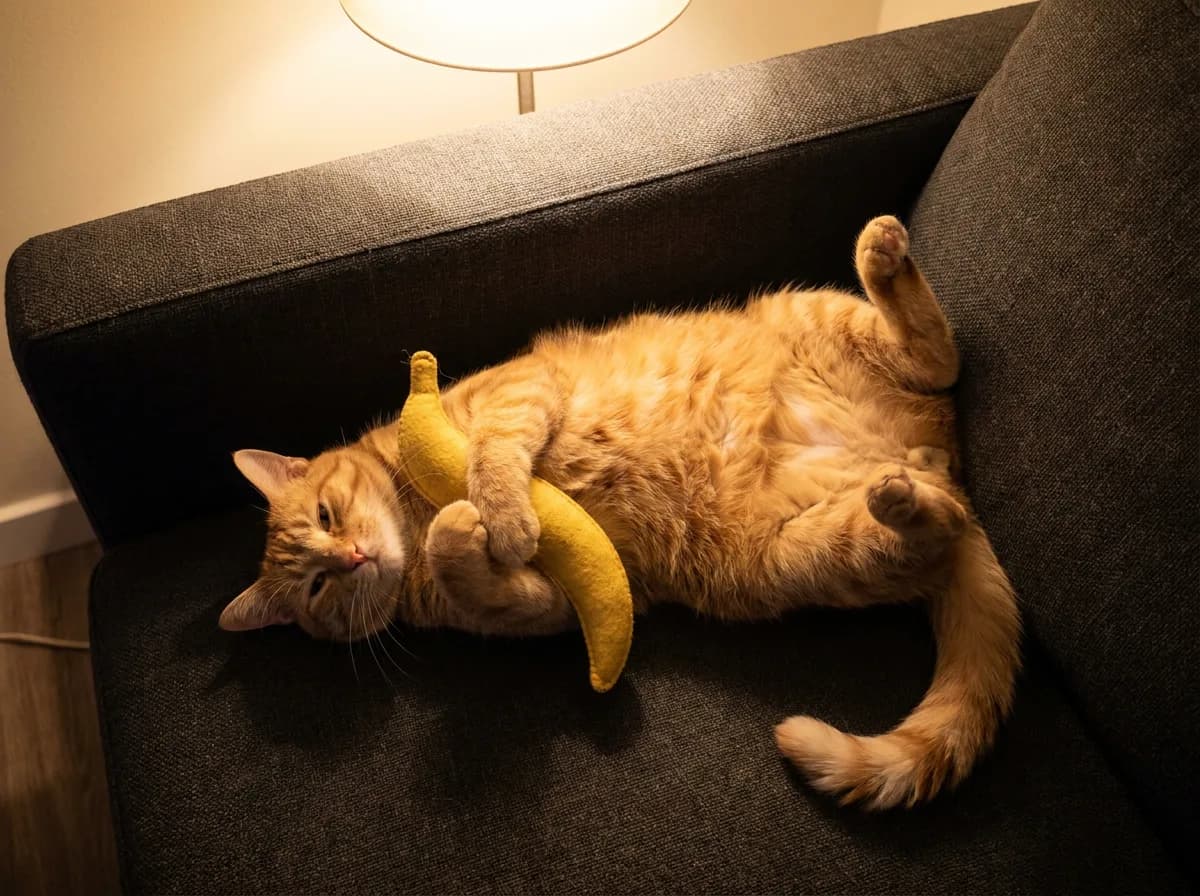
Catnip toys work through nepetalactone, a compound that triggers a euphoric rolling, rubbing, kicking response in roughly two-thirds of adult cats. The response is genetic: research on olfactory enrichment found about one in three cats does not react to catnip, but most of those non-responders do react to silvervine (Bol et al., 2017, BMC Veterinary Research). If the Yeowww! Catnip Banana gets a shrug, try a silvervine toy before deciding your cat hates stuffed toys.
Solo-play toys carry the hours you are not home, and shape decides what a cat does with them:
- Kicker toys: long stuffed cat toys and cat plush toys sized for bunny-kicking; the banana is the archetype
- Cat chew toys: firm, silvervine-stick or rubber-textured toys that satisfy chewing urges safely, useful for cats who gnaw cables
- Ball and track toys: self-resetting batting games like the Tower of Tracks
A ten-minute session with a catnip kicker also makes a great wind-down after wand play: the cat "kills" the prey, then grooms and rests.
Tunnels, springs, and ball toys
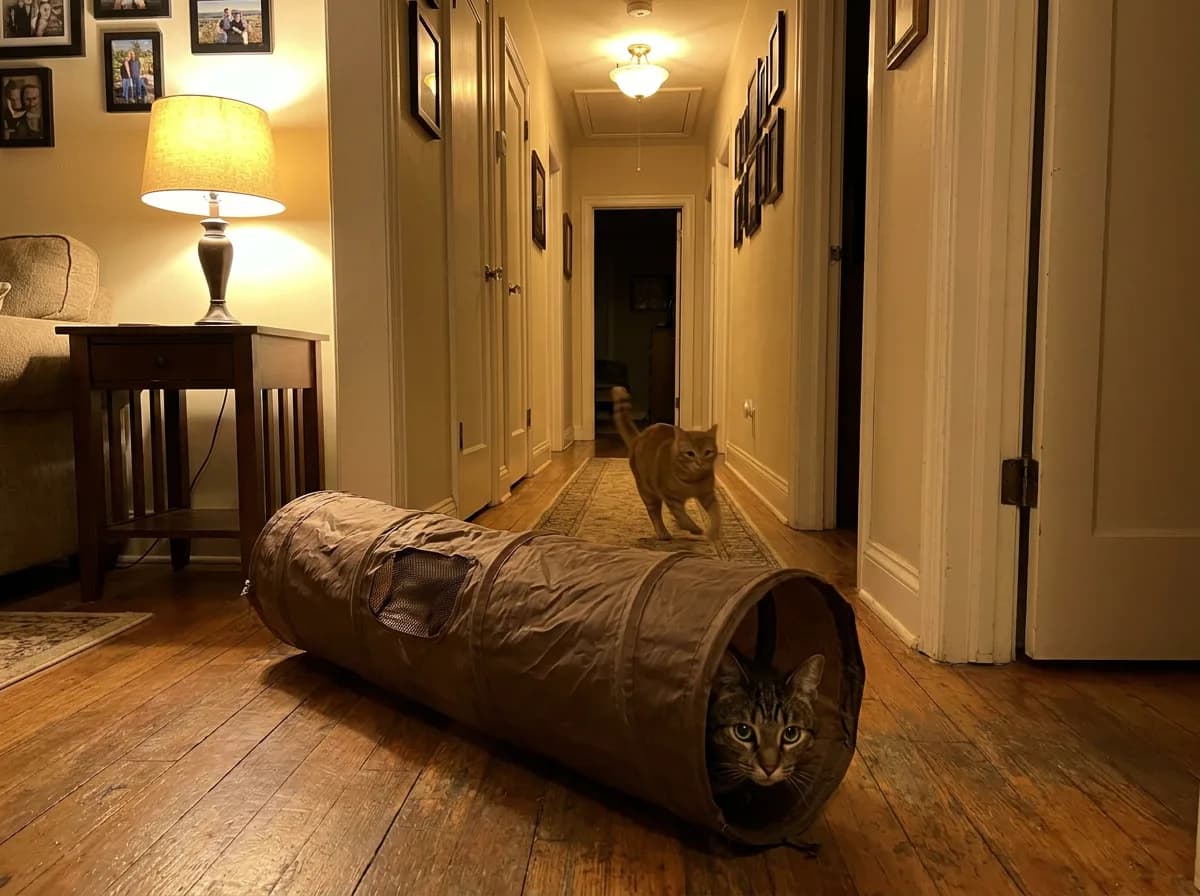
A cat play tunnel is the cheapest way to build hunting terrain into a living room. The tunnel ambush is a core ground-stalker behavior: hide, wait, explode outward at a passing target. The Frisco 47-inch Crinkle Tunnel earns its pick slot because it is long enough for a real hide, crinkly enough to reward movement, and collapsible when guests come over.
Round out the floor game with the two smallest, most losable toy types:
- Cat spring toys: wide plastic coils that bounce unpredictably when batted; cheap, silent, and weirdly addictive for cats who ignore balls
- Cat toys balls: crinkle balls, sisal balls, and ping-pong balls; buy multiples, because half will live under the refrigerator by Friday
Springs and balls are also the best toys to toss into a tunnel: the crinkle amplifies every bounce, and the cat gets a contained chase. For homes with two cats, one tunnel plus a handful of springs reliably produces the chase-and-ambush games cats will not do with a human.
Laser toys for cats
Are laser cat toys good for cats? They can be, with one rule attached. Laser play delivers intense aerobic chase that many indoor cats badly need, and an automatic unit like the PetSafe Dancing Dot runs a session when you cannot. The problem is that a dot can never be caught, so a laser-only routine leaves the hunt permanently unfinished and can frustrate some cats. Always end a laser session by landing the dot on a physical toy or tossing a treat, so the cat completes the catch.
Questions such as “are laser pointers bad for cats,” “do laser pointers give cats anxiety,” and “are laser pointers dangerous” need more than a yes-or-no answer. The risk depends on eye exposure, beam classification, session structure, and the individual cat's response. Repetitive light chasing is sometimes described as laser pointer syndrome in cats, so a cat that keeps hunting reflections after play should stop using lasers and switch to physical prey toys.
For the pick-by-pick comparison of automatic and handheld lasers, safe session length, and what the evidence says about laser frustration and stress, see our dedicated guide to the best cat laser toys.
Interactive and electronic cat toys
Interactive cat toys split into two camps: toys a human drives (wands, teasers) and electronic toys that move on their own, from fluttering butterflies to motion-activated mice. Electronic motion is genuinely useful for solo hours, but review patterns show the same failure mode across brands: cats habituate to repeating patterns, so an electronic toy is a rotation item, not a daily fixture.
We rank the best interactive cat toys, including electronic and app-driven options and which ones survive real cats, in our full best interactive cat toys roundup. For technique with the toys you already own, start with how to play with interactive cat toys.
Puzzle and treat-dispensing toys
Are treat puzzles good for cats? Yes, and the case is stronger than for almost any other toy type. Treat puzzles let a cat forage, which is how wild cats spend a large share of their waking hours. Food puzzles slow fast eaters, add mental work to meals for overweight and bored indoor cats, and give food hunters a job. Start easy so the cat wins early: our pick, the Catit Play Treat Puzzle, lets you control difficulty by treat size.
Cat puzzle toys go much deeper than one pick, from beginner treat balls to multi-stage boards. Our cat puzzle toys roundup compares them by difficulty level and food type.
Best cat toys FAQ
The most stimulating toy for cats is a wand or teaser driven by a human, because it is the only toy type that runs the complete prey-sequence play cycle: stalk, chase, catch, and "kill." No battery-powered toy matches prey that responds to the cat. For solo hours, a treat puzzle is the most stimulating option since foraging engages the brain and the appetite at once. But rotation beats any single toy: even the best toy goes stale if it never leaves the floor, so cycle your toy bin weekly and the whole collection stays stimulating.
Rotate cat toys weekly. Keep 4-5 toys out, store the rest in a closed bin, and swap the sets every week; a weekly rotation is frequent enough to keep triggering your cat's novelty response but long enough for favorites to get real use. Store fabric toys with a pinch of catnip so returning toys smell new, and leave one self-resetting toy, like a ball track, out permanently for solo play.
Yes, in two ways: size and softness. Kitten toys must have no swallowable pieces, since glued-on eyes, bells, and small balls are a small-parts hazard for a mouthy kitten, and they should be made of soft, teething-safe material during the 3-6 month teething window. Skip catnip toys until around 6-12 months, when the catnip response develops. Adult toys can be firmer and smaller, but the supervision rule for string and feather toys applies at every age.
*Prices and ratings pulled from Chewy on August 4, 2026, and may have changed.*

T.J. Banks is the author of several books, including Catsong, which received a Merial Human–Animal Bond Award. A contributing editor to laJoie, T.J. also has received writing awards from the Cat Writers’ Association (most recently a Certificate of Excellence in 2019), as well as from ByLine and The Writing Self. Her work has appeared in numerous anthologies, including Chicken Soup for the Single Parent’s Soul and A Cup of Comfort for Women in Love, and T.J. has worked as a stringer for the Associated Press, as an instructor for the Writer’s Digest School and as a columnist.
Sign up for expert-backed reviews and safety alerts all in one place.