Catalyst Pet Natural Cat Litter Review: Is This Eco-Friendly Soft Wood Litter Worth the Switch?
Thinking about switching to Catalyst Pet Natural Cat Litter? This eco-friendly soft wood litter promises strong odor control, low dust, and less tracking—but does it actually deliver? Here’s an honest review of how it performs in real homes with real cats.

Petful is reader supported. As an affiliate of platforms like Amazon and Chewy, we may earn a commission when you buy through links on this page. There is no extra cost to you.
Cat parents know the drill: you want a litter that actually traps odor, doesn’t coat your floors (and lungs) in dust, forms solid clumps for easy clean-up, and doesn’t feel like you’re hauling a 40-pound sack of concrete up the stairs. Ideally, it should also last long enough that you don’t have to keep buying more with every visit to the store. Is there such a litter? For more, see Petful’s guide to best cat litter for odor control.
When I first came across Catalyst Pet Natural Cat Litter, a lightweight and eco-friendly litter made from upcycled soft wood, I had one big question: could this sustainable cat litter that checks so many boxes also be cost-effective enough to replace what I’m already using? The short answer is yes!
Catalyst Pet is a natural clumping litter that's softer on paws, lower in dust, and easier on the planet. This brand is an alternative to the heavier clumping clay and/or natural options on the market. It’s made from upcycled soft wood and formulated to control odor while still clumping.
In this review, we break down what this sustainable cat litter claims to do, how it's made, and what daily real-world use looks like — and whether switching from your tried-and-true litter to this soft, wood-based formula is worth the effort.
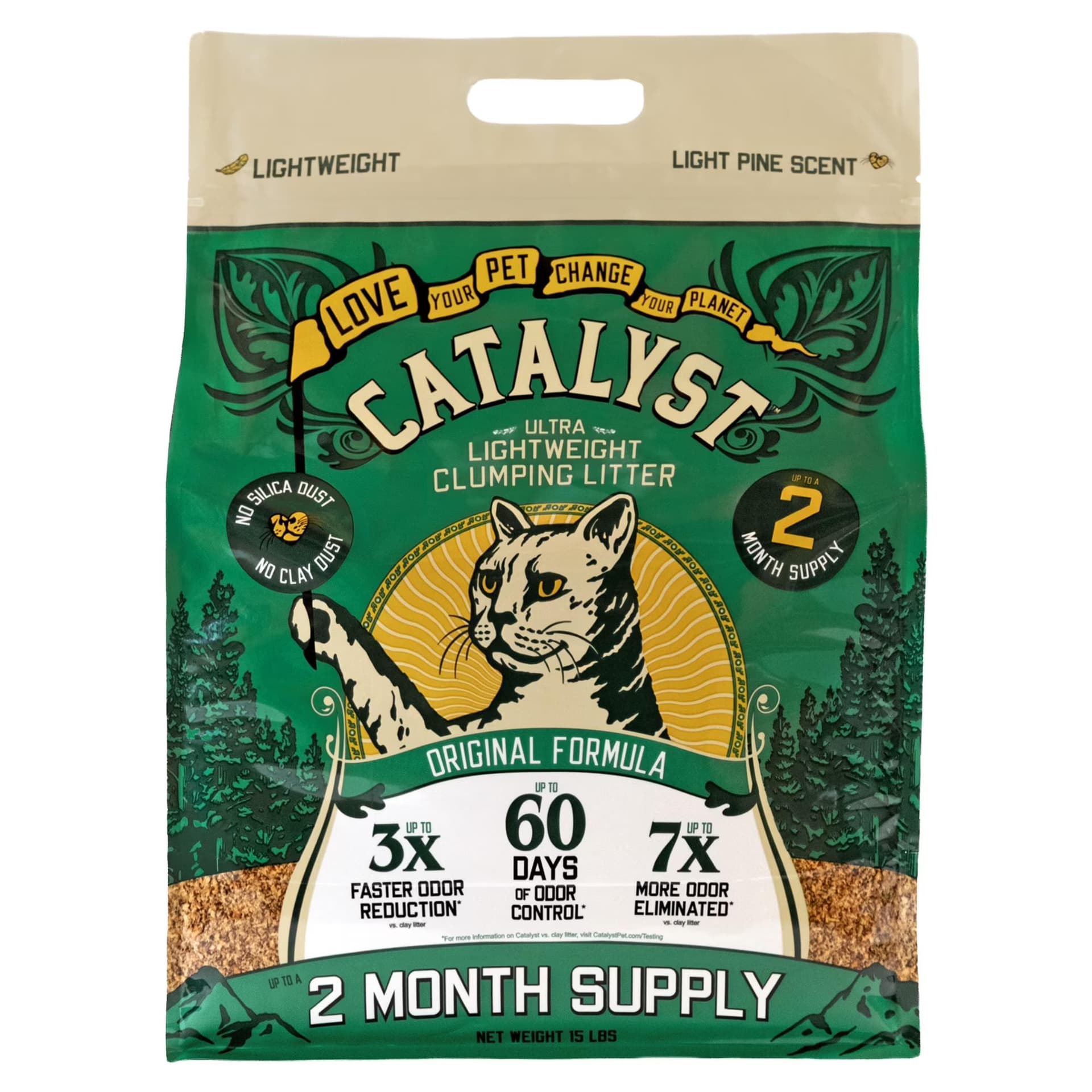
Lightweight softwood clumping cat litter that delivers up to a 2-month supply per 15-lb bag. Up to 7x more odor reduction and 3x faster odor elimination than clay, with up to 95% less airborne dust. No clay, no silica, light pine scent.
Petful may earn a commission when you click through to Walmart, at no extra cost to you.
Petful may earn a commission if you click on our links and make a purchase. This comes at no extra cost to you and helps us continue providing trusted pet product reviews.

Sign up for expert-backed reviews and safety alerts all in one place.
What Catalyst Pet Is About
Most cat litter innovation tends to improve in one area but still falls short in another. For example, eco-friendly litter aims to solve the environmental problem, but it frequently introduces a different one: performance or price.
Catalyst Pet is different. The brand focuses on creating an affordable lightweight litter that delivers strong odor control, reliable clumping, and low dust while also being made from sustainable materials. In other words, the goal is to offer cat parents an eco-friendly option that performs like traditional litter without the usual tradeoffs in effectiveness or affordability.
Instead of using bentonite clay (the strip-mined, earth-littered material we currently use), Catalyst is made from upcycled soft wood fiber, which means less landfill waste and a smaller environmental footprint. Catalyst Pet says it’s significantly lighter than clay, low-dust, and strong enough to clump for easy scooping. Accurate? Keep reading.
Catalyst Pet litter is available in several formulas, depending on where you purchase it. For this review, I tested Original, one of two formulas (they also offer Unscented) sold at Walmart and shown in my photos. This formula is sold as Multi-Cat through the Catalyst Pet website and other retailers. *If you purchase through the Catalyst Pet website, Chewy, or other retailers, you will see additional options such as Healthy Cat and Wood Pellets.
Cat litter lives or dies by how well it performs. Ingredient lists and sustainability claims sound great on paper, but what really matters is odor control, clumping ability, dust levels, and overall ease of use. So we put Catalyst Pet to the test to see how it performs in real-world conditions.
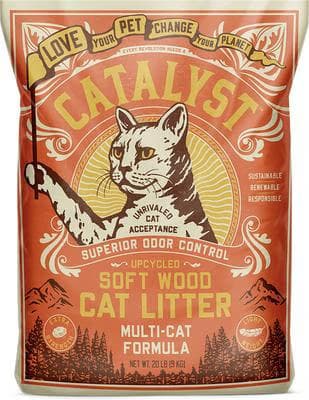
Upcycled soft-wood cat litter with superior odor control, very low dust, and a simple natural composition (no clay, no synthetic fragrance) - a gentler box for cats that nibble at their litter.
Petful may earn a commission when you click through to Chewy, at no extra cost to you.
How It’s Supposed to Work
Clay clumps because bentonite expands dramatically when wet. Wood works differently.
The fine wood fibers in this natural clumping cat litter absorb moisture and bind together due to the addition of guar gum, which is the clumping agent.
How We Tested It: What Happened in Our Basement Experiment
We have three cats. Two are large, and one is small and extremely dramatic about anything new.
Before testing Catalyst, we were using World’s Best Cat Litter (unscented, because scented litters often seem to magnify odors rather than control them). It worked well, and we were fans. However, it is quite heavy, which makes hauling it home from the store less convenient. And occasionally the smell from our cats’ more… enthusiastic bathroom moments would linger a bit longer than we liked. Petful’s guide to are automatic litter boxes safe has the full breakdown.
Our main litter box lives in the basement. It’s ventilated, but not so ventilated that you don’t notice when something has happened down there.
For this test, I completely emptied a traditional litter box and filled it with Catalyst rather than mixing it with our existing litter. It’s important to note that vets, experts, and brands strongly recommend transitioning litters gradually to give cats time to adjust. Cats are extremely sensitive to changes in their litter box environment, and for many of them, the litter box is truly sacred territory. In fact, Catalyst notes that most cases of cats rejecting a new litter occur because the transition happens too quickly.
To play it safe, I also kept a backup litter box in another room with our original litter in case anyone decided to stage a protest. Over the course of a week, here’s what happened: I refreshed and topped off the litter twice.
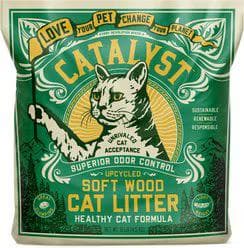
Natural softwood clumping cat litter that absorbs ammonia at the source. Lighter than clay, lung-friendly, and biodegradable.
Petful may earn a commission when you click through to Chewy, at no extra cost to you.
- I paid attention to dust, smell, clumps, tracking, and cat behavior.
- I walked around in socks. (Important detail. You’ll find out why in a bit.)

First Impressions: It’s Uniquely Light with a Pleasant Odor
When I picked up the bag, the first thing I thought was that it felt half-empty. It’s just so light. The litter looks and feels like finely shredded wood. Soft, almost like mulch that’s been processed down.
When I poured, there was virtually no visible dust. The smell? Earthy. Not perfumed. Not artificial. Just woodsy.
What Happened Over the Week
So what did the cats think? How did this litter perform when it’s used as intended?
Odor Control: This Is Where Catalyst Pet Shines
This was the biggest difference. Our standard clay litter usually gives you a subtle heads-up when a cat has done their business via an odor. With Catalyst, it really didn’t. The earthy wood smell didn’t overpower anything, either, so it didn't mask any other smell. Catalyst litter neutralizes the smell you don’t want. Wood is much better at absorbing your cat’s “stuff” than clay!
Even on heavier-use days (three cats means overlapping schedules), it held up better than our previous litter.
So I’m going to say it again because it’s so important: odor control was the standout feature. That alone would honestly make me switch.
Clumping: Different From Clay, But Effective When Given Time
Catalyst does clump, but it behaves differently from traditional clay litter.
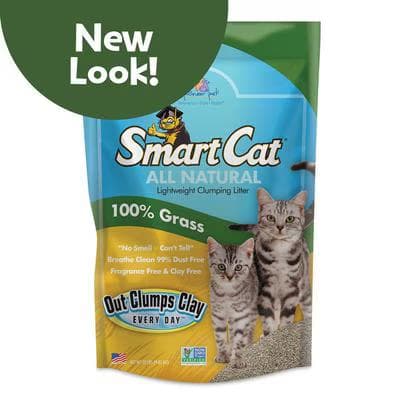
Unscented grass-based clumping litter for cats, with a lightweight clay-free formula.
Petful may earn a commission when you click through to Chewy, at no extra cost to you.
Instead of forming one heavy, brick-like mass, urine usually forms smaller, clustered clumps. That’s because the wood fibers first absorb moisture and odor before binding together, a process that takes a few minutes.
Once the litter has time to absorb the liquid, the clumps become more cohesive and easier to scoop.
Because of this absorption step, the Catalyst works best in a traditional litter box rather than an automatic one. Many automatic boxes begin their cleaning cycle shortly after a cat leaves, which may not give wood-based litter enough time to fully form a clump.
To better understand how the litter performed, I allowed clumps to sit for several minutes before scooping. With that extra time, they held together much more solidly and were easy to remove.
So while the clumping behavior differs from clay, it still performs well once the litter has time to do what wood litter does best: absorb moisture and lock in odor.
Dust & Tracking
I didn’t see clouds of dust when pouring or dusty paw prints on the basement floor.
For households sensitive to dust—human or feline—this is a meaningful accolade. My usual clay litter would sometimes form a thin layer, which signals it’s time to replace or replenish the litter and vacuum the area.
And because there wasn’t much dust with Catalyst litter, there wasn't much tracking. But the pieces that did escape were noticeable because of their shape.
If you stepped on one in socks, it would cling to them. Not painfully, but in that “why is there something in my sock?” way. That said, a good litter mat will fix most of that, but it does mean this is not a clean-free system. (But then again, what is?)
Get Your Cat Started on Catalyst Pet Natural Cat Litter
What My Three Cats Thought of Catalyst Pet
Day 1: Suspicious. (Which is normal, because again, the litter box is sacred territory)
Day 2: Still suspicious. They continued using the backup box.
Day 3: Acceptance. After the sus vibes dissipated, they went about their business as usual. No accidents. No dramatic avoidance. Just a short adjustment period, which is common when switching textures.
What I Loved and What I Didn’t
After a full week of living with it (and letting three cats render their verdict), here’s the honest breakdown of where Catalyst impressed me, and where it’s not quite perfect.
Pros and Cons
Pros
- Noticeably lightweight compared to traditional clay
- Strong odor control, especially in a multi-cat home
- Low visible dust
- Made from upcycled soft wood fiber rather than mined clay
- Affordable, with the cost under $10 per month per cat.
- Resealable, self-standing bag for easy pouring and storage
- Cats adjusted within a few days
Cons
- Clumps aren’t as dense as heavy clay
- Wood fibers can stick to socks if tracked

What to Know Before You Buy
If odor is your biggest issue and you have one or more cats, the Original formula makes sense. Unscented works well if anyone in your home has respiratory sensitivities.
Discover the Catalyst Pet Natural Cat Litter DifferenceFAQs
Catalyst does not universally recommend flushing in all plumbing systems. While wood-based litters are often marketed as more septic-friendly than clay, flushing any litter depends on your town’s rules and plumbing infrastructure. When in doubt, stick to disposing of it in the trash.
It really depends on your cat. Texture and smell will be your biggest hurdles. Wood-fiber litter feels lighter and softer underpaw than dense clay, and some cats notice immediately. In my experience, there was a two-day period of skepticism before things normalized. But again, proper transition is the key to success.
Most wood-based litters are considered safe once kittens are reliably using the litter box and no longer ingesting litter out of curiosity. Very young kittens can sometimes chew or taste litter, so it’s always wise to check with your veterinarian about the safest option for your cat.
In my personal test, Catalyst litter functioned in an automatic PetSnowy litter box, and the clumps were stable enough for the sifting cycle to remove waste. However, Catalyst does not officially recommend using its litter in automatic litter boxes.Because the litter is made from wood, it needs a few minutes to absorb moisture and fully form clumps, and many automatic boxes begin cleaning too quickly. For best performance, Catalyst recommends using its clumping formulas in a traditional litter box and allowing the litter time to fully clump before scooping.
Final Verdict
Switching litter is not a small household change. Cats are creatures of habit, and litter box peace is sacred. But if you’re looking for something that performs well as you move away from clay, Catalyst Pet is worth trying. I don’t see any gimmicks here. It’s lighter, which is great if you are buying directly from a store and don’t want to lug a heavy bag. It smells cleaner, which everyone in the household will benefit from. (It doesn’t just mask the funk either.)
For pet parents who care about performance and sustainability, this eco-friendly, wood-based option really is worth trying. Just make sure to follow the transition instructions on the back of the bag and on the Catalyst Pet website.
A Final Word (Disclaimer)
At Petful, our review integrity is paramount; we never exchange special treatment in our reviews for monetary or material rewards.
Nonetheless, when our readers click through to online merchants (including Chewy or Amazon), we receive a referral commission. This supports the running of our free blog, and we appreciate your backing.
For additional information, kindly refer to our Disclaimer and Discourse Section.

Ysolt Usigan is lifestyle writer and editor with over a decade of experience creating share-worthy content for various audiences. Her feature articles, product roundups and reviews, and news articles have appeared in media sites including Woman’s Day, BestProducts.com, Biography.com, Yahoo, MSN, CBS News, Huffington Post—just to name a few. A working mom to two human daughters and three cat babies, her editorial expertise in shopping, parenting, pets, and home is rooted in her everyday life. Her passion revolves around hunting for the best products and services, and sharing them with the masses, so others don't have to waste time and money.
Sign up for expert-backed reviews and safety alerts all in one place.