The Benefits of Interactive Cat Toys for Mental Stimulation and Health
Interactive cat toys deliver mental stimulation, healthy weight management, and calmer behavior. Learn how long play sessions should run and how to match a toy to your cat's hunting play style.

Petful is reader supported. As an affiliate of platforms like Amazon and Chewy, we may earn a commission when you buy through links on this page. There is no extra cost to you.
The benefits of interactive cat toys go far beyond filling an afternoon. Used well, they provide mental stimulation, support healthy activity and weight management, and give indoor cats an outlet for hunting behaviors that might otherwise show up as frustration or restless habits.
Research on feline enrichment shows why food work and responsive play can help, but no toy is a cure-all. This guide separates the supported benefits from overpromises, explains how long play sessions should run, and shows how hunting style changes the kind of engagement a cat receives.

Sign up for expert-backed reviews and safety alerts all in one place.
A Healthy Mind: Mental Benefits of Interactive Cat Toys
What are the benefits of interactive cat toys? They give indoor cats the hunting challenge their brains are wired for, and the research-backed payoffs show up in body condition, behavior, and mood:
- Mental stimulation benefits: Instead of grazing from a bowl, your cat works for meals and rewards, engaging problem-solving skills every day.
- Healthy weight management: Toys that encourage movement and foraging can support a calorie-controlled weight plan when food rewards are counted in the daily ration.
- A hunting outlet: Stalking, pouncing, and batting satisfy prey drive that otherwise has nowhere to go indoors.
- Boredom and stress relief: Most behaviorists agree that many feline behavior problems stem from boredom, frustration, and stress; structured play relieves all three.
- Stronger bonding: Wand and teaser play is shared time, and cats that play with their people interact more overall.
A research-based cat toy plan is not a special product label or a promise that one gadget improves health. It is a routine built around environmental enrichment, voluntary movement, the feline prey sequence, and measured food rewards. Used within a calorie plan, interactive play can support activity for cats at risk of feline obesity; it remains one part of cat health, not a replacement for nutrition or veterinary care.
The concrete mental and physical benefits of interactive play are connected: problem-solving provides mental stimulation, movement supports activity and weight management, a catch or food payoff completes the hunting task, and predictable shared sessions can strengthen routine and bonding. The result depends on voluntary engagement, appropriate difficulty, safe materials, and food portions counted within the normal daily ration.
Interactive cat toys deliver mental stimulation, healthy weight management, and calmer behavior by giving indoor cats a daily outlet for their natural hunting sequence: stalk, chase, pounce, catch.
A study in the Journal of Feline Medicine and Surgery traced food puzzles back to enrichment programs for zoo and laboratory animals, then documented feline cases where puzzles were used alongside changes in feeding and behavior management. Several individual cats in those case reports lost between 6.4% and 20% of body weight after foraging toys replaced free-feeding; those are examples, not an expected result for every cat.
As cat behaviorist Carole Wilbourn showed in her groundbreaking work with felines since the 1970s, cats are not so different from us: they need challenges to stay mentally sharp, and a cat with daily problems to solve is a more confident, more social cat.
Why Mental Stimulation Matters for Indoor Cats
Are cats OK with doing nothing all day? Not really. A cat may look content sleeping 16 hours, but an indoor cat with no hunting outlet is often understimulated rather than relaxed, and chronic boredom shows up as overgrooming, night-time yowling, counter surfing, and weight gain.
Outdoor cats fill their waking hours with patrol, stalking, and dozens of small hunts. Indoor cats live longer, safer lives, but they inherit the same wiring with none of the workload. Interactive cat toys are how you give that workload back:
- An indoor hunting outlet: Puzzles and teasers recreate the search-and-capture loop a hunt provides.
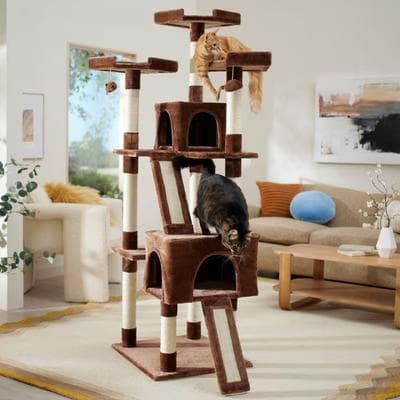
- Territory enrichment: Vertical space plus rotating toys makes the same square footage feel bigger and more interesting. A tall perch such as the Frisco 72-inch cat tree gives your cat a lookout post that turns floor-level toy play into full three-dimensional territory.
- Routine: Predictable daily play sessions give an indoor cat something to anticipate, which behaviorists consider enrichment in itself.
If you are building out a dedicated space, our guide to setting up an indoor cat play area shows how to arrange toys, perches, and scratchers so they actually get used.
Cat toys for mental stimulation should ask for a small, achievable action: stalk, paw, search, climb, or manipulate food. “Cat mental stimulation toys” and “mentally stimulating cat toys” are shopping phrases, but the benefit comes from the work, not the wording on the package. Rotate mental stimulation toys for cats and pair them with perches, hiding places, and predictable social play. Cats left alone for long stretches may also benefit from the broader routine in our guide to whether cats get lonely.
Toys to keep cats stimulated should change the task without constantly adding products. Move a familiar track to another room, place kibble in a different puzzle station, vary a wand's speed and hiding places, or alternate ground and aerial movement. These small changes preserve novelty while keeping the challenge recognizable enough for the cat to succeed.
Petful may earn a commission when you click through to Chewy, at no extra cost to you.
How Interactive Cat Toys Like Food Puzzles Benefit Your Cat
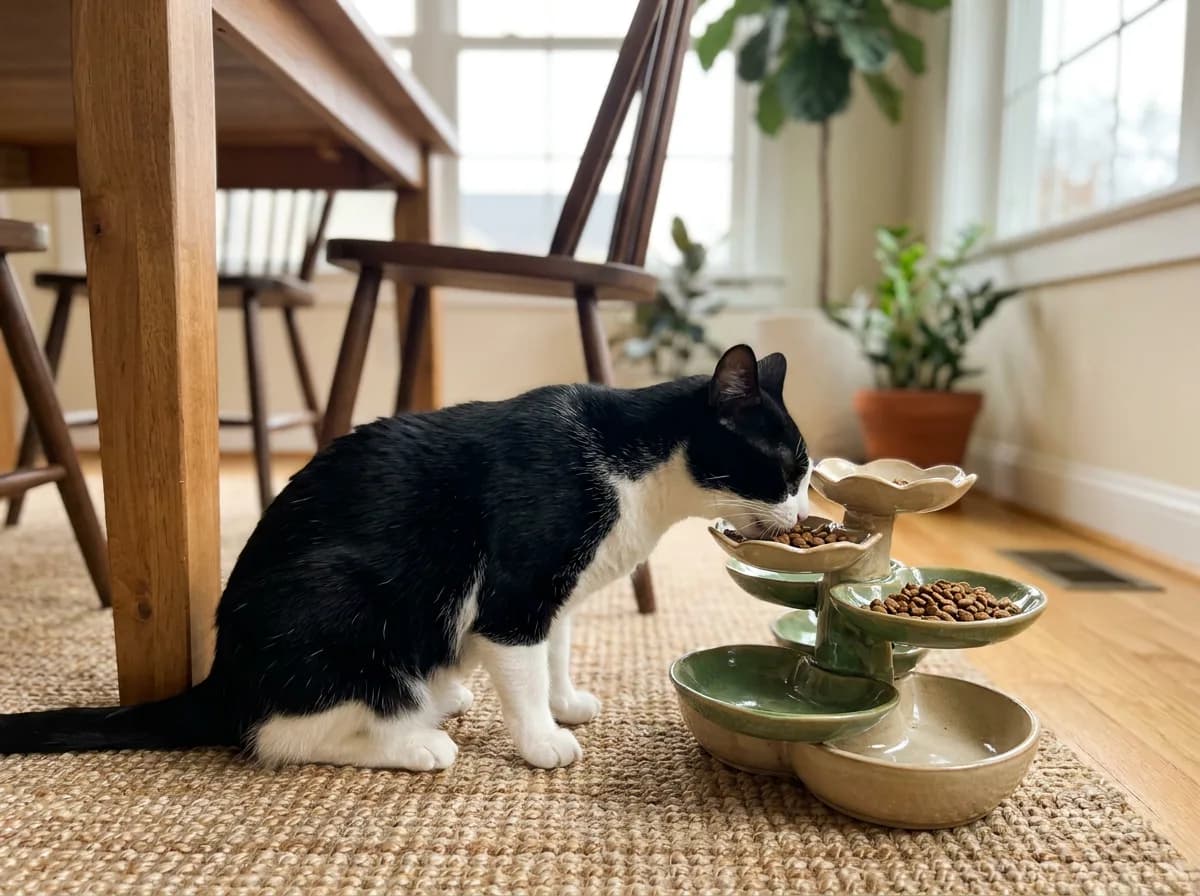
Food puzzles, also called foraging toys, are the most studied category of interactive cat toys, and they generally fall into two groups:
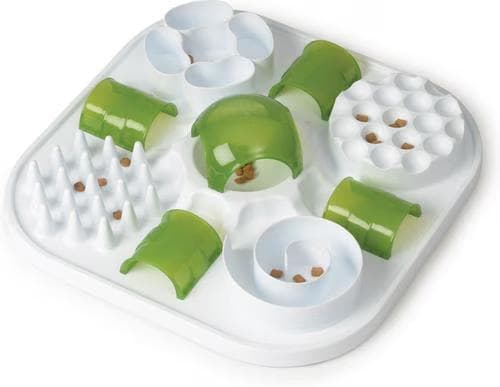
- Stationary puzzles: Mazes, slow-feeder bowls, and grooved boards that work for kibble or wet food. The Catit Play Treat Puzzle is a classic groove-and-compartment board for beginners.
- Rolling or mobile puzzles: Foraging cups, eggs, and treat balls with holes your cat coaxes kibble out of.
Petful may earn a commission when you click through to Chewy, at no extra cost to you.
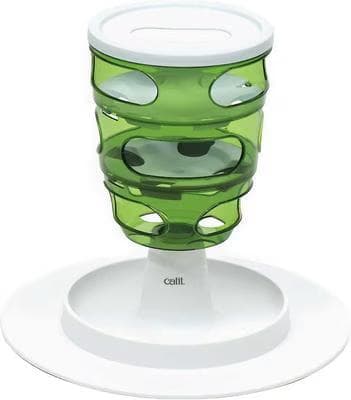
Start easy and level up. A cat who has always eaten from a bowl needs a puzzle they can win on day one, or they quit. Vertical designs such as the Catit Senses Food Tree add difficulty gradually as your cat learns to fish kibble down through the tiers.
Petful may earn a commission when you click through to Chewy, at no extra cost to you.
Not all cats are drawn to the same puzzle. One published case chronicled a 7-year-old cat who preferred stationary food puzzles while a younger, more energetic housemate favored rolling ones, which is exactly the play-style matching covered above. For the full case for foraging, see our deeper guide to the benefits of food puzzles for cats.
Cat intelligence toys and brain stimulating cat toys are shopping terms for this same food-work category, but the right difficulty matters more than the label. If you are choosing a product rather than studying the benefit, our cat puzzle toy comparison ranks options by Petful's beginner-to-advanced progression and food compatibility.
Addressing Behavior Issues with Interactive Cat Toys
The majority of cats in the JFMS study had behavior issues before food puzzles were introduced:
- Separation anxiety: Pacing, agitation, and distress when their human prepared to leave. Learn more about feline separation anxiety.
- Inappropriate urination: Spraying and litter box avoidance, in some cases tied to chronic feline idiopathic cystitis or Pandora syndrome.
- Multi-cat household conflict: Fighting over meals and resources.
- Fear-based and redirected aggression toward other cats in the home.
Some cats in the published cases improved after food puzzles were introduced as part of a broader management plan. One withdrawn, obese female began playing with her humans, took an interest in the foraging toys the household kittens used, and eventually foraged alongside them. Case reports can show what is possible, but they do not prove a toy will resolve the same behavior in another household.
Play can also redirect ordinary stalking and ambush energy toward an appropriate target. If counter pouncing is part of the problem, combine scheduled play with the environmental changes in our guide to keeping cats off counters; punishment does not supply the missing outlet. Sudden or escalating behavior still requires a health and household assessment.
When reduced play needs more than enrichment
When toy-resistant behavior signals a bigger health or behavior problem, the important clue is change: a cat that previously played but now avoids jumping, hides, guards a body part, changes appetite, or has litter box trouble may be painful or ill. Persistent fear, aggression, or multi-cat conflict also needs more than enrichment. Pause the toy experiment and seek veterinary or qualified behavior help instead of escalating motion or difficulty.
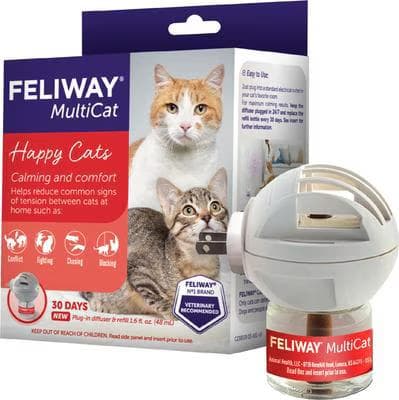
Are there cat toys that can help reduce stress? Predictable wand sessions, food work, and safe hiding or ambush play can give some cats a controllable outlet, and toys for cats with anxiety may support a broader enrichment plan. They do not treat pain, illness, severe fear, or multi-cat conflict by themselves. A calming pheromone diffuser such as Feliway MultiCat may be a veterinarian-guided adjunct, but it is not a substitute for diagnosing the cause.
Petful may earn a commission when you click through to Chewy, at no extra cost to you.
- If your cat suddenly stops playing, hides, or shows litter box changes, do not assume a toy will fix it. Sudden toy resistance can signal pain, dental disease, or illness, and those cats need a veterinary exam before an enrichment plan.
How Long Should I Let My Cat Play With an Interactive Toy?
How long should you let your cat play with an interactive toy? Aim for 10 to 15 minute play sessions, one to two times a day, and stop while your cat is still interested. Cats are sprint hunters, not endurance athletes: short daily play sessions that end with a “catch” satisfy the hunting sequence far better than one long marathon that ends in fatigue or frustration.
This is concrete session-length and daily frequency guidance, not a rigid quota. A kitten may prefer several shorter bursts, a healthy adult may use the full 10 to 15 minutes, and a senior may need gentler five-minute sessions. Watch breathing, movement quality, willingness to re-engage, and recovery; those observations matter more than forcing every cat to finish the clock.
- Run two 10 to 15 minute play sessions daily, ideally morning and evening, twice a day matching your cat's natural dawn-and-dusk activity peaks. End every session by letting your cat catch the toy, then offer a small meal or treat to complete the hunt-catch-eat cycle.
A few signs to calibrate by:
- Panting, flopping, or walking away means the session ran long; stop sooner next time.
- Immediate re-engagement after a pause means your cat wanted more; add a second or third short session rather than extending one.
- Senior or overweight cats do better with gentler 5 to 10 minute sessions built around ground-level toys.
- Solo toys (puzzles, track toys) can stay out longer, but rotate them weekly so novelty does not wear off.
Why Interactive Play Keeps Cats Engaged
What makes a cat toy engaging for a cat? Movement that changes like prey, a catch or food payoff, and a challenge matched to the cat's current skill all matter. Do cats need toys? Indoor cats need ways to stalk, chase, pounce, forage, and manipulate their environment; toys are one practical way to provide that work safely.
The play-style-to-toy-type matching framework below covers three hunting styles: ground stalkers, pouncers, and aerial hunters. It changes the benefit a cat receives because the same object can invite a low crawl, a sudden ambush, or repeated jumping. Matching movement and session length to the observed style makes enrichment more specific than a generic claim that every interactive toy stimulates every cat.
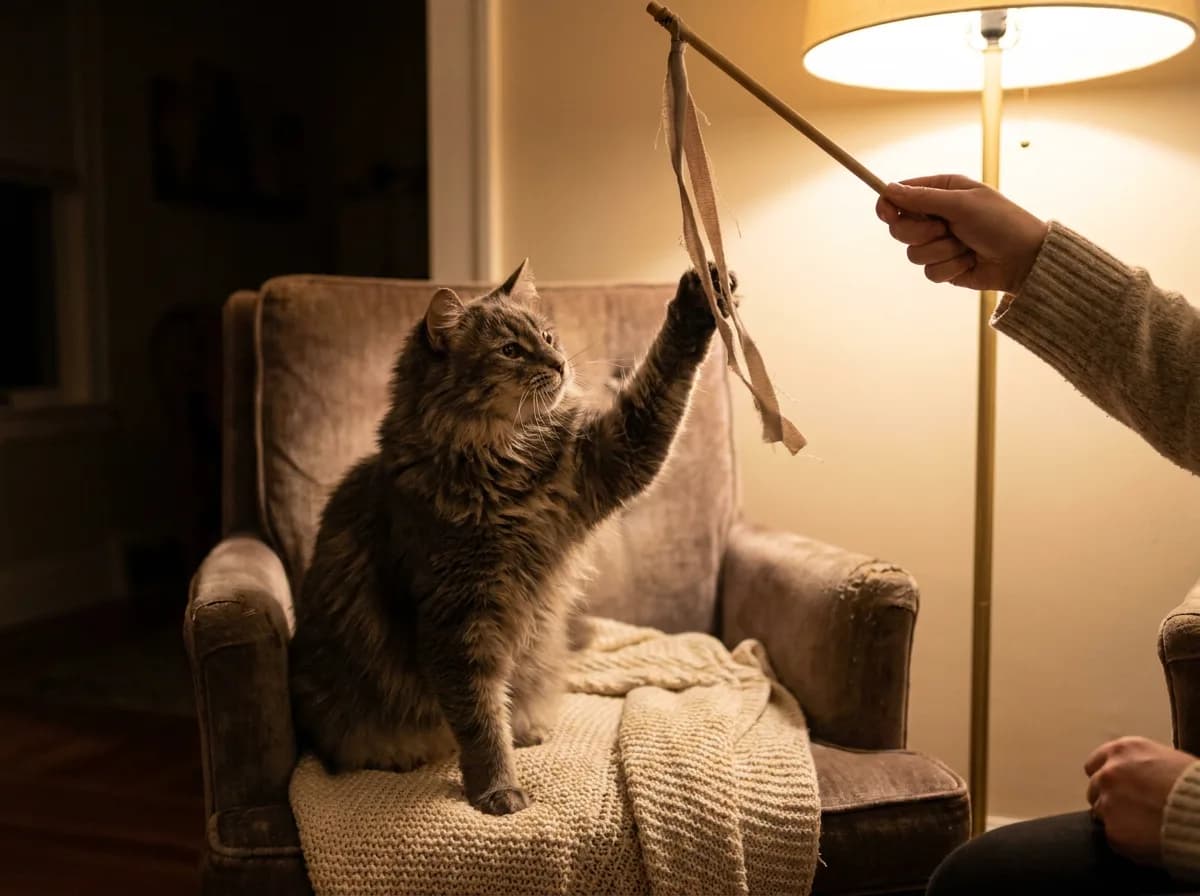
How do interactive cat toys compare in terms of engagement? Human-led toys can react instantly to the cat, food puzzles renew motivation at meals, and automatic toys can start short activity bursts without a person moving the lure. None will keep your cat entertained for hours without interruption. Cats usually engage in short bouts, so rotation and variety matter more than continuous motion.
What should you know about interactive cat toys before matching one to a cat? How different hunting styles change the enrichment a cat receives is more important than whether the package says smart or automatic. A ground stalker needs low movement and cover, a pouncer needs stops and hiding places, and an aerial hunter needs controlled flight.
Watch your cat during free play. A ground stalker hugs the floor, creeping low and pouncing on anything that skitters like a mouse. A pouncer loves ambush: hiding behind furniture and exploding onto toys that pause and dart. An aerial hunter leaps and swats at anything that flies like a bird or insect. Match the toy to the style:
- Ground stalkers engage best with mice-style toys, rolling track toys such as the Catstages Tower of Tracks, and puzzles worked at floor level; run 10 to 15 minute low-and-slow sessions.
- Pouncers want toys that stop, hide, and dart: wand toys dragged around corners and motorized balls, in two or three short 5 to 10 minute bursts.
- Aerial hunters need flight: feather wands, teaser toys swooped overhead, and anything that flutters; 10 minute sessions with real leaps tire them quickly.
| Play style | How to spot it | Best interactive toy types | Session length |
|---|---|---|---|
| Ground stalker | Creeps low, pounces on floor-level movement | Mouse toys, rolling track toys, floor puzzles | 10-15 minutes, 1-2x daily |
| Pouncer | Ambushes from cover, loves stop-and-dart motion | Wand toys around corners, motorized balls, crinkle tunnels | 5-10 minute bursts, 2-3x daily |
| Aerial hunter | Leaps and swats at flying movement | Feather wands, flying teasers, fluttering toys | 10 minutes with jumps, 1-2x daily |
Whatever the style, safety rules stay the same: supervise string and feather toys, retire anything shedding small parts, and skip toys with loose elastic. Our guide to choosing the best cat toys covers the full safety checklist, and this list of dangerous objects for cats flags common household hazards that look like toys to a cat.
Benefits and Limits of Electronic Cat Toys
Electronic and automatic toys can start short movement sessions when you are busy, but they cannot respond to a cat as well as human-led play and they need a closer safety read than a simple track:
- Automatic timer shutoff: Pick toys that cycle off after 10 to 15 minutes so your cat gets novelty bursts instead of learning to ignore constant motion.
- Laser-light rules: Never shine a laser in your cat's eyes, and always end laser play by landing the dot on a physical toy or treat your cat can actually catch; a hunt with no catch builds frustration.
- Solo play safety: Only leave out toys with no strings, cords, or small detachable parts. Wand and string toys are supervised-only.
- Match the motion to the play style: Rolling automatic balls suit ground stalkers and pouncers; fluttering electronic wings suit aerial hunters.
Use electronic motion as one part of a rotation, not an all-day background. "Hands-free" does not mean no supervision: watch the first sessions, inspect the battery door and moving parts, and make sure laser play ends with something physical to catch. For actual product comparisons, the commercial roundup linked below owns automatic and electronic selection.
Homemade toys need the same safety limits. Use clean, food-safe cardboard for simple foraging, make openings too small for a head or limb to become trapped, remove staples, tape loops, string, and loose plastic, and discard the project when it becomes wet or shredded. Laser-light toys require eye protection and a physical catch ending; electronic toys require secure battery compartments and observation before any solo use.
Ready to Choose? Compare the Best Interactive Cat Toys
Which electronic toys work well for your cat, and which interactive cat toy features matter? Start with play style and safe solo use, then compare noise, upkeep, and budget:
- Use the best interactive cat toys roundup for stimulating cat toys for indoor cats, automatic movement, tunnels, tracks, food work, and product fit by cat personality.
- Use the best cat puzzle toys guide for brain challenge, difficulty, and food compatibility.
- Use the dedicated cat laser toy guide for beam safety, automatic versus handheld formats, and session structure.
Frequently Asked Questions (FAQ)
Indoor cats live safer lives, but they still need an indoor hunting outlet. Interactive play adds daily mental stimulation, movement, and predictable opportunities to stalk, chase, catch, or forage. Match the activity to your cat's hunting style, use short sessions, and rotate toys so the environment does not become static.
A predictable play routine, food work, and safe hiding or ambush toys can help some cats channel arousal and boredom. Toys are support, not treatment: sudden behavior change, persistent hiding, litter box changes, aggression, or a cat that stops playing needs veterinary or qualified behavior help rather than a more stimulating product.
References
- Dantas, L.M.S., et al. "Food Puzzles for Cats: Feeding for Physical and Emotional Wellbeing." Journal of Feline Medicine and Surgery. http://jfm.sagepub.com/content/early/2016/04/21/1098612X16643753
- "Interactive Electronic Toys for Cats." Chewy. https://www.chewy.com/b/interactive-electronic-toys-327
- "Interactive Toys for Cats." Petco. https://www.petco.com/shop/en/petcostore/category/cat/cat-toys/interactive-toys

T.J. Banks is the author of several books, including Catsong, which received a Merial Human–Animal Bond Award. A contributing editor to laJoie, T.J. also has received writing awards from the Cat Writers’ Association (most recently a Certificate of Excellence in 2019), as well as from ByLine and The Writing Self. Her work has appeared in numerous anthologies, including Chicken Soup for the Single Parent’s Soul and A Cup of Comfort for Women in Love, and T.J. has worked as a stringer for the Associated Press, as an instructor for the Writer’s Digest School and as a columnist.
Sign up for expert-backed reviews and safety alerts all in one place.