Rottweiler: Temperament, Size, Care and Breed Guide
This practical Rottweiler guide explains temperament, working history, size, exercise, training, grooming, health context and family fit while separating breed tendencies from evidence about an individual dog.

Petful is reader supported. As an affiliate of platforms like Amazon and Chewy, we may earn a commission when you buy through links on this page. There is no extra cost to you.
The Rottweiler is a powerful working dog known for close family bonds, watchfulness, confidence and a willingness to learn. Those broad breed tendencies can make a well-bred, well-socialized Rottweiler a deeply engaged companion, but they also mean that training, management, exercise and responsible adult supervision are everyday responsibilities rather than optional extras.
This Rottweiler breed guide covers history, personality, size, activity, grooming and daily care. It also shows how to compare the individual dog, available records and your real household routine before deciding. A breed label or a black-and-rust appearance can suggest what to investigate, but neither predicts an individual dog's health, behavior, ancestry or fit.

Sign up for expert-backed reviews and safety alerts all in one place.
Rottweiler at a glance
- 1Rottweilers are large, strong working dogs that usually do best with consistent reward-based training, thoughtful socialization, daily physical and mental activity, secure management and involved adult caregivers
- 2Individual dogs vary even when they share a breed, so breed tendencies describe a population rather than a guaranteed outcome
- 3Use records and direct observation to assess health claims, ancestry, age, behavior and current condition instead of relying on appearance or seller wording
- 4Assess the actual dog's behavior in context and build a weekday care plan before making a commitment
The American Kennel Club Rottweiler profile describes a robust working breed with a black coat and clearly defined rust markings. The American Rottweiler Club breed standard is the parent-club reference for proportion, movement, coat, markings and temperament. These sources explain the breed ideal. They do not certify that a particular dog meets it.

| Decision area | What many owners should expect | What to verify for one dog |
|---|---|---|
| Adult presence | A substantial, athletic dog whose strength changes handling, housing and travel decisions | Current measured size, body condition, mobility and equipment fit |
| Temperament | Confidence, watchfulness, engagement with family and capacity for focused work | Behavior across ordinary settings, recovery after surprise and handling history |
| Training | Best results from clear routines, rewards, repetition and calm management | Current skills, triggers, motivation and the caregiver's ability to practice daily |
| Activity | Daily exercise plus purposeful mental work | Age, health, conditioning, weather and the dog's ability to settle afterward |
| Care | Short-coat grooming, measured feeding, dental care, nail care and preventive veterinary visits | Individual diet, weight trend, skin, teeth, nails, medication and veterinary plan |
| Household fit | Strong potential for a prepared home with active adult participation | Local rules, insurance, landlord terms, visitors, children, pets and backup care |
A practical comparison, not a stereotype
Use three evidence levels when evaluating a Rottweiler:

Petful may earn a commission when you click through to Chewy, at no extra cost to you.
- Breed evidence explains the traits, body and working purpose associated with the registered breed.
- Individual evidence includes veterinary records, verified parent information, observed behavior, training history and current body condition.
- Household evidence is your actual schedule, physical ability, experience, housing, budget and management plan.
The strongest decision uses all three. Breed information alone is too general. One calm meeting is too narrow. A promising household plan without suitable dog-specific evidence is incomplete. When the three levels disagree, pause and investigate instead of choosing the most reassuring story.
Rottweiler history and working purpose
Rottweiler history is tied to practical work. The breed developed in Germany as a versatile droving and guarding dog, moving livestock and protecting people and property associated with trade. Later roles included draft work, military and police work, search tasks, obedience, service activities and family companionship. The details of any one modern dog's working ability depend on genetics, development, health, training and opportunity.
That working background helps explain several traits prospective owners notice today:
- Many Rottweilers pay close attention to their people and surroundings.
- They can learn complex routines when training is consistent and worthwhile.
- Physical confidence and persistence can become difficult if boundaries are unclear.
- Boredom, isolation or under-stimulation may show up as destructive, noisy or impulsive behavior.
- A dog bred for purposeful activity still needs to learn how to relax in a modern home.
History should inform the care plan, not become an excuse for behavior. Calling a dog protective does not justify lunging, uncontrolled guarding or unsafe visitor interactions. Calling a dog stubborn may hide unclear cues, inconsistent reinforcement, discomfort, fear or an exercise plan that does not fit the individual.
Rottweiler personality and household fit
Rottweiler personality is often described with words such as confident, loyal, calm and courageous. These are broad tendencies, not guarantees. Puppies from the same litter can differ, and an adult's behavior is shaped by inherited tendencies, early development, learning, health, environment and current context.
The dedicated Petful guide to Rottweiler temperament, training and family fit covers this decision in depth. For a first-pass evaluation, look for behavior that is observable and specific:
- Can the dog disengage from a distraction and return attention to a handler?
- How quickly does the dog recover after a new sound, person or surface?
- Can the dog rest while normal household activity continues?
- What happens during gentle handling of paws, ears, mouth and equipment?
- How does the dog respond when access to a desired item or location is delayed?
- Which situations require distance, barriers, a leash or professional support?
Do not confuse calmness with certainty: A quiet Rottweiler in one meeting may be relaxed, tired, inhibited, unwell or simply unfamiliar with the setting. Ask for observations across time and contexts. If there is a bite, fear, guarding or reactivity history, use qualified professional help and a written management plan rather than relying on a breed label.
Rottweilers and children
A Rottweiler can live successfully with children in some households, but size and strength raise the consequence of ordinary mistakes. Adults should supervise actively, manage space and teach both dog and child predictable rules. Supervision means an adult is close enough to intervene, not merely present somewhere in the house.
Children should not climb on the dog, disturb sleep, take food or toys, crowd a retreat area or handle the leash without a capable adult. Dogs need a quiet place behind a gate or closed door where children cannot follow. Even a friendly dog can knock over a child during play or react when hurt, startled or trapped.
Other dogs, cats and visitors
Compatibility with animals varies. Ask about the individual dog's history, then use controlled introductions and physical separation when nobody can supervise. Do not treat one successful greeting as permanent proof of safety. Resource guarding, chase behavior, play style, sex, maturity, pain and environmental pressure can all change an interaction.

Petful may earn a commission when you click through to Chewy, at no extra cost to you.
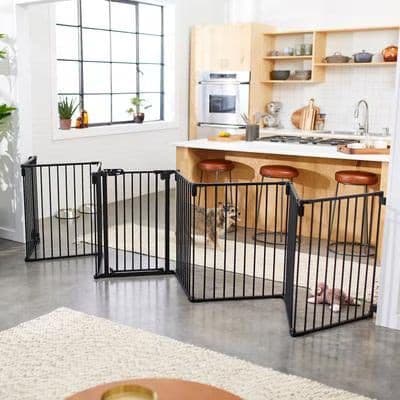
Visitor plans should be decided before the doorbell rings. Useful options include a trained station, leash, closed room, sturdy barrier or structured introduction at a distance. The Frisco Steel 8-Panel Configurable Dog Gate and Playpen is one tracked barrier option to compare for height, panel stability, gaps, room layout and the dog's behavior. A second look at the Frisco configurable gate and playpen can help owners plan zones, but no portable barrier should be assumed escape-proof or used without checking every connection.
Exercise, training and enrichment
Rottweiler exercise should build fitness, skills and the ability to settle. More intensity is not automatically better. Repeated high-impact work, abrupt mileage increases and exercise in heat can be poor choices, particularly for growing, unconditioned, older or medically affected dogs. Ask a veterinarian about restrictions for the individual dog.
For leash work, WebVet's guide to stopping a dog from pulling outlines a reward-based progression without relying on force.
A balanced adult routine may combine:
- Purposeful walks with time to sniff and practice attention.
- Short reward-based training sessions embedded in daily life.
- Controlled play that has a clear start and stop.
- Food searches, scent games or simple problem-solving.
- Strength and conditioning work approved for the dog's health and skill level.
- Planned rest in a quiet area.

Train the skills that make daily life safer
Begin with name response, recall foundations, loose-leash walking, waiting at doors, trading items, settling on a mat, cooperative handling and calm entry and exit from vehicles. Teach skills in easy settings before adding distance, duration and distraction. Reinforce the behavior you want instead of waiting for the dog to make a large mistake.
The PetSafe Easy Walk medium and large harness is one option to compare when fitting equipment for a strong dog. Measure the dog, follow the maker's fitting directions and check skin and movement. No harness replaces leash skills or gives a handler more physical control than they can safely manage.
For meal-based enrichment and schedule consistency, the Petlibro Granary automatic feeder with camera is one tracked option. Compare kibble compatibility, portion accuracy, cleaning, power backup and whether the dog can reach or damage it. The Petlibro automatic feeder can support a routine, but a caregiver still needs to observe appetite, water intake, stool, body condition and behavior around food.
Management is part of training
Management prevents rehearsals while skills are developing. It includes barriers, closed doors, leash use, secure storage, a suitable rest area and predictable handling. A crate can be one management tool when introduced gradually and used for reasonable periods. The Frisco Heavy Duty Fold and Carry X-Large wire crate is one tracked adult-size option to compare by interior dimensions, divider setup, wire spacing, latch design and the dog's ability to rest without distress.
If reviewing the Frisco X-Large wire crate, size it for standing, turning and lying naturally. Remove snag hazards, keep temperature comfortable and do not use confinement as punishment. A dog that panics, injures itself or cannot settle needs a different plan and qualified guidance.
Rottweiler size, body and coat
Rottweilers are substantial, compact working dogs rather than simply heavy dogs. The official sources describe males and females with different typical height ranges, while the overall picture emphasizes strength, balance and efficient movement. Sex, family line, age and individual development affect measured size.
The dedicated Petful Rottweiler size, weight and growth guide owns exact growth and measurement questions. Use that page for age-aware context rather than forcing a puppy to match an internet chart.
Petful may earn a commission when you click through to Chewy, at no extra cost to you.

Healthy condition matters more than a dramatic number
The American Veterinary Medical Association healthy-weight guidance recommends working with a veterinarian to determine a pet's healthy weight. For a Rottweiler, an impressive scale number is not a quality goal. Track weight trend and body condition, and ask the veterinary team to account for frame, muscle, life stage and medical factors.
At home, note whether the waist and abdominal tuck remain visible and whether the ribs can be felt with appropriate covering. Those observations are not a diagnosis. Sudden weight change, reduced stamina, pain, swelling, appetite change or altered movement deserves veterinary assessment.
Coat and color
The Rottweiler has a relatively short, dense coat and defined markings. The exact standard language and accepted colors belong to official registry and parent-club references. Petful's Rottweiler colors and markings guide explains placement and appearance without treating a rare-color sales label as evidence of pedigree or value.
Appearance cannot prove ancestry. A black-and-tan dog may resemble a Rottweiler without being a registered Rottweiler, and a registered dog's records still need to be verified under the correct identity. If ancestry matters, compare registration and pedigree records. A DNA product may provide additional ancestry information, but no consumer result can substitute for health records, observed behavior or a veterinarian's examination.
Grooming, feeding and daily care
Rottweiler care is straightforward in some areas, but the dog's size makes consistency important. A weekly routine should include coat and skin checks, nail and paw care, dental care, ear observation, equipment inspection and a review of weight and mobility.

Grooming the short coat
Brush often enough to remove loose hair and notice skin changes. Bathe when needed with a dog-appropriate product, then dry folds and dense areas thoroughly. Check for redness, odor, swelling, pain, parasites, sores or sudden hair loss. Persistent skin or ear changes need veterinary evaluation rather than repeated product switching.
Nails that remain too long can affect comfort and footing. Introduce paw handling in small rewarded steps. If the dog is fearful or the nail anatomy is unclear, ask a veterinary or qualified grooming professional for help. Teeth also need a veterinarian-guided home plan and regular professional assessment.
Feeding and body condition
Choose a complete diet appropriate for the dog's life stage and veterinary needs, measure portions and include treats in the daily total. Product labels provide a starting range, not a personalized prescription. Adjust from weight trend, body condition, appetite, stool, activity and veterinary advice.
Large dogs can make unsecured food storage and countertop access a real management issue. Keep food, medications, chocolate, xylitol-containing products, grapes, raisins and other hazards inaccessible. If a dog may have eaten something dangerous, contact a veterinarian or animal poison service promptly instead of waiting for breed-specific symptoms.
Rest and home setup
Rottweilers need a comfortable place to lie without being stepped over or cornered. The FurHaven Velvet Waves large orthopedic sofa bed is one tracked option to compare for sleeping dimensions, support, cover washability and ease of entry. Measure the dog in a natural sleeping posture. Recheck the FurHaven large orthopedic bed after setup for sliding, chewing and whether it allows the dog to change positions comfortably.
Place rest areas where the dog can be near household life without controlling a doorway. A bed does not treat joint disease, and the word orthopedic is not a medical guarantee. New stiffness, reluctance to rise, limping or pain requires veterinary attention.
Rottweiler puppies in brief
Rottweiler puppies grow into strong adults, so selection and early care should prioritize stable handling, health evidence and the household's long-term capacity. Do not let urgency about a puppy for sale replace verification of the source, parents, health records, contract and payment recipient.
Petful's guide to Rottweiler puppies, breeders, adoption and buying safely owns the full sourcing process. Before committing, ask for:
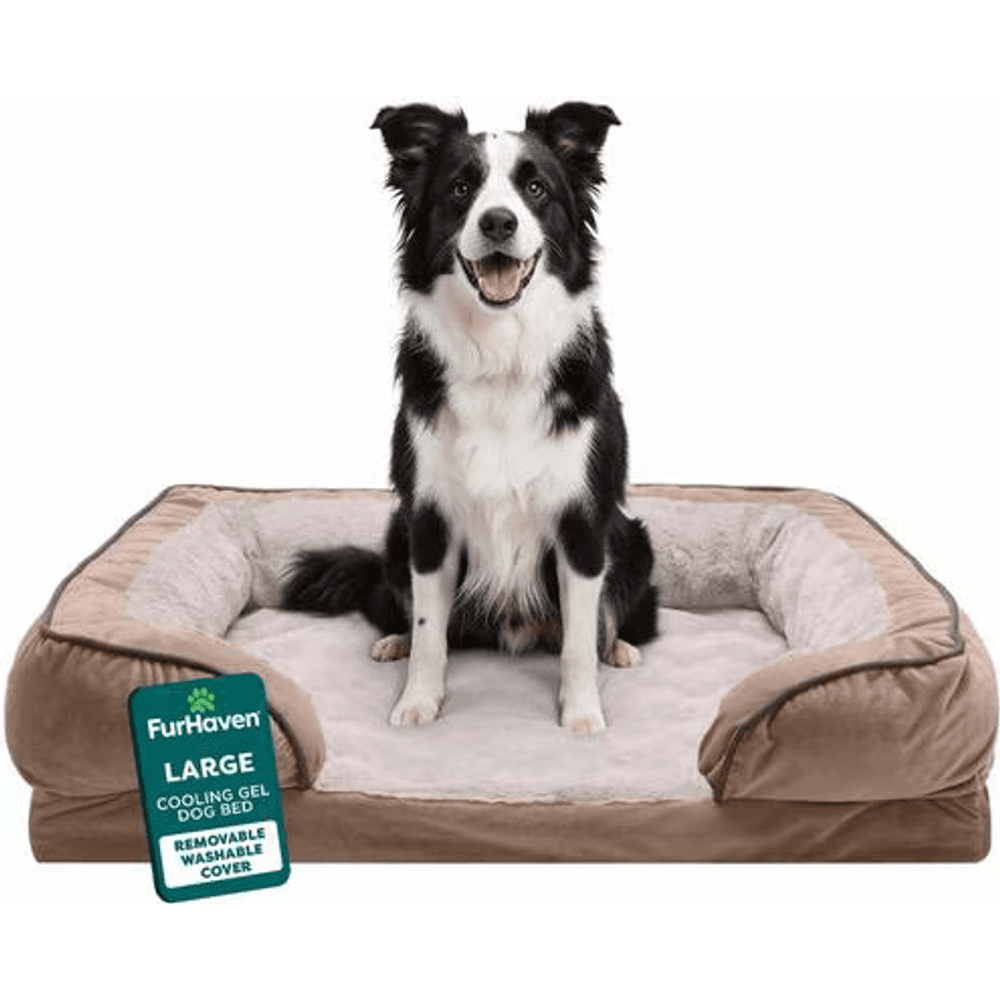
An orthopedic sofa bed with three bolstered sides for dogs who like to rest their head and joints against a cushion. The supportive foam base cradles hips and elbows, a comforting spot for an older or shaky dog to settle.
Petful may earn a commission when you click through to Chewy, at no extra cost to you.
- The source's independently verified identity and location.
- Live access to the specific puppy and, when applicable, the dam.
- Parent identities and relevant original screening reports.
- The puppy's veterinary, microchip and care records.
- A complete written contract before any deposit.
- A realistic plan for transport, veterinary care, training and adult size.
Use Petful's Rottweiler price and lifetime budget guide to connect the acquisition amount with first-year equipment, training, recurring care and a risk reserve. A high price cannot prove health, ancestry or responsible breeding.
Early socialization should create safe, positive exposure without flooding or forced contact. A puppy does not need to greet every person or dog. It needs brief, appropriate experiences paired with choice, recovery and rest, adjusted to veterinary guidance.
Health and lifespan in brief
Rottweiler health issues should be discussed as risks to understand, not diagnoses attached to every dog. Parent screening, family history, the dog's own veterinary record and ongoing examinations answer different questions. No screening program guarantees that a dog will remain disease-free.
The veterinary-authored Petful guide to Rottweiler health issues and lifespan covers screening, mobility, cardiac concerns, cancer awareness, healthy weight and aging. For a puppy search, match every report to the correct parent's registered identity. For an owned dog, keep a dated record of weight, appetite, activity, medication and changes that can help the veterinarian see a trend.
Seek urgent veterinary care for collapse, difficulty breathing, a swollen painful abdomen, repeated unproductive retching, severe weakness, uncontrolled bleeding, repeated seizures or rapid deterioration. This list is not complete. When a dog seems seriously unwell, call a veterinarian or emergency clinic for case-specific guidance.
Size, color and breed labels in brief
Petful separates related appearance questions so each can be answered clearly. The Rottweiler size, weight and growth guide explains measurement and body condition. The Rottweiler colors and markings guide explains the standard appearance and rare-color marketing. The German versus American Rottweiler guide explains why those labels do not create two separate breeds.
Use records for documentary questions, direct observation for behavior and body-condition questions, and professional assessment for health questions. Do not make one kind of evidence perform another kind of job.
What to verify before you decide
The most useful Rottweiler decision separates claims that can be documented from qualities that must be observed. Appearance, seller wording and documented records answer different questions. A broad head, black-and-rust coat or confident first meeting cannot establish pedigree, medical status, age, training history or future behavior. Start with the claim being made, then ask what evidence could actually support it.
- Use documented evidence for identity, pedigree, screening and veterinary history. Use direct observation across relevant settings for current behavior, handling and recovery. Use professional guidance from a veterinarian or qualified behavior professional when health, pain, aggression, fear or safety is in question. No single source answers every part of the decision.
For identity and background claims, request original records that name the dog or parent being discussed. Compare registration numbers, microchip details, dates and veterinary identifiers rather than accepting cropped screenshots or a seller's summary. If the source cannot connect a report to the correct dog, treat the claim as unverified. A clear next step is to pause payment or placement until the record can be independently checked.
For current behavior, observe the individual dog in more than one relevant context when it is safe to do so. A practical comparison includes the dog's response to ordinary movement, handling, food, barriers, visitors and recovery after a mild surprise. Ask what management is already required. If there is a bite, guarding, panic or reactivity history, obtain professional guidance and a written safety plan before deciding whether the household fit is realistic.
Verify health with a clinician
For health, use the dog's veterinary record and an examination by a veterinarian who is accountable to the patient. Parent screening can clarify inherited risk, but it cannot diagnose the puppy in front of you or guarantee a disease-free future. Conversely, a normal-looking dog can still need testing, treatment or follow-up. Record changes in appetite, weight, breathing, movement, stamina, sleep and elimination so a clinician has specific evidence to evaluate.
Finally, test the household rather than only the dog. Write down who handles walks, visitors, feeding, training, veterinary appointments and backup care. Confirm landlord, insurer and local requirements in writing. Price the ordinary routine as well as an emergency reserve. If the plan only works when nothing goes wrong, it is not yet a durable plan for a large, powerful dog.
Use this verification sequence
- Name the exact claim, such as registered ancestry, completed health screening or comfort around children.
- Match it to the right evidence, including records, direct observation or professional assessment.
- Confirm that the evidence belongs to the individual dog or identified parent.
- Note what remains unknown and what management that uncertainty requires.
- Choose a clear next step, which may be another visit, a veterinary review, a professional behavior consultation or walking away.
Is this the right dog for your household?
A Rottweiler can be an excellent companion for a household prepared to guide a large working dog through every life stage. The practical test is not whether the breed is good or bad. It is whether the household can provide safe management, daily involvement, training, health care and backup coverage for this individual dog.

- Many Rottweilers form close, attentive relationships with their people when the household fit and individual behavior align
- The breed can engage deeply in reward-based learning and purposeful activity
- Short-coat grooming is usually manageable with a regular routine
- A prepared household can channel strength and watchfulness into calm daily skills
- Size and power raise the consequence of weak handling or inconsistent management
- Training, social learning and visitor plans require continuing adult effort
- Housing, insurance or local rules may restrict the breed
- Food, veterinary care, equipment, training and emergency planning can be substantial costs
Write a seven-day care plan before deciding. Include morning and evening exercise, midday needs, training, feeding, grooming, visitor management, time alone, veterinary access and backup care. Then test that plan against overtime, illness, travel and an adolescent dog who needs more support than expected.
The plan should name the responsible adults. A child cannot carry primary responsibility for a powerful dog. If no adult can safely hold the leash, manage a doorway or implement a behavior plan, the current match is not safe regardless of affection or intent.
Rottweiler FAQs
A Rottweiler can be a good dog to have when a prepared household can provide consistent reward-based training, daily activity, secure management, veterinary care and involved adult supervision. Review verified records, observe the individual dog across relevant settings and compare those findings with the household's real routine. The clear next step is to write a seven-day care and safety plan, then decide whether the adults can sustain it throughout the dog's life. Breed reputation alone cannot establish fit.
A Rottweiler can be a good family dog in some homes, but family fit depends on the individual dog's behavior and history, the adults' handling skill, children's conduct, other animals, space and management. Review verified records and observe interactions instead of treating the breed label as a safety guarantee. The clear next step is to plan adult supervision, barriers, calm training and a dog-only rest area before the dog joins ordinary family activity.
It is not accurate to say police no longer use Rottweilers everywhere. Working-dog choices vary by agency, location, task, available breeding programs, training systems and individual candidates, and some organizations favor other breeds for particular operational needs. Verified records from a specific agency or program are more reliable than a sweeping claim. The clear next step is to check the named organization's current information rather than using police selection to judge one pet dog's trainability.
The most important thing to know about rottweiler ownership is that strength changes the margin for error. A practical comparison must consider breed tendencies, the individual dog and the ordinary household routine. The household needs to teach and maintain calm handling, doorway, leash, visitor and rest skills throughout the dog's life. Observe individual behavior across relevant settings, confirm the adults can manage the dog safely and build a durable plan before deciding.
What evidence should you verify for rottweiler ownership depends on the claim being evaluated. Use documented evidence for registration, pedigree, parent screening, veterinary history and microchip identity. Use direct observation for individual behavior, handling and current body condition. Seek professional guidance for health, pain or behavior concerns. Appearance and seller wording cannot prove ancestry, health, age or temperament, so match every statement to the source capable of supporting it.
The next step after learning about rottweiler is to test household fit against the individual behavior and records of the dog being considered. Build a realistic weekly care and management plan, confirm local housing and insurance rules, and identify responsible adults and backup care. Then use the dedicated Petful guides for puppies, temperament, health, growth, colors, price and regional labels to resolve the specific decision still open before making a commitment.
Sources

Kristine Lacoste has been researching dog and cat breeds for nearly a decade and has observed the animals up close at dog shows in both the United States and the United Kingdom. She is the author of the book One Unforgettable Journey, which was named as a finalist for a Maxwell Award from the Dog Writers Association of America, and was host of a weekly pet news segment on the National K-9 Academy Radio Show. In addition, she was the New Orleans coordinator for Dogs on Deployment, a nonprofit that helps military members and their pets, for 3 years. Kristine has researched and written about pet behaviors and care for many years. She holds a bachelor’s degree in psychology, another bachelor’s degree in English and a Master of Business Administration degree.
Sign up for expert-backed reviews and safety alerts all in one place.