Irish Doodle: Temperament, Size, and Care Guide
Understand the Irish Doodle's Setter and Poodle ancestry, variable adult traits, and everyday care. Use a practical household routine to assess activity, training, companionship, and coat maintenance.

BVMS, MRCVS

Petful is reader supported. As an affiliate of platforms like Amazon and Chewy, we may earn a commission when you buy through links on this page. There is no extra cost to you.
An Irish Doodle is a dog with Irish Setter and Poodle ancestry. The appeal is easy to understand: an expressive face, an often shaggy coat, and the possibility of an affectionate, active companion. The important word is possibility. This cross has no single breed standard that guarantees adult size, coat, personality, or health.
Decide whether your household can meet the needs of the individual dog rather than buying a promise attached to the name. Daily activity, comfortable handling, training, companionship, and coat maintenance all belong in that decision.

Sign up for expert-backed reviews and safety alerts all in one place.
What Is an Irish Doodle?
Irish Doodle describes an Irish Setter–Poodle cross or a later-generation dog from that ancestry. “Irish Doodle dog breed” is common shorthand, but it should not imply a uniform population with fixed dimensions and behavior. The AKC describes the Irish Setter as an energetic gundog, while the Poodle also has an athletic working background. A curly coat does not cancel that heritage.
Start with a time-and-space fit test. Identify where sniffing and recall practice will happen, who will provide company during the day, and where the dog can rest without interruption. Include settling practice as a taught skill instead of assuming a tired dog will automatically switch off whenever you need quiet.
If a crate is part of that arrangement, compare the Frisco X-Large wire crate with the dog’s actual standing height and resting length. The dog should be able to stand naturally, turn and lie comfortably. Introduce the space gradually; it is not a solution for distress during absences.

X-Large wire crate only if your dog can stand, turn and rest naturally inside. Introduce gradually; no escape-proof or transport-safety claim.
Petful may earn a commission when you click through to Chewy, at no extra cost to you.
| Everyday decision | A workable answer | A gap to solve before committing |
|---|---|---|
| Sniffing and recall | Safe walking routes and secured practice areas | Relying on an unfenced yard or untrained off-lead exercise |
| Settling practice | A quiet resting spot and short reward-based sessions | Expecting the dog to entertain itself all day |
| Coat care | An agreed home routine and grooming budget | Choosing a long coat without time to comb it |
| Family contact | Supervision and a retreat from excitement | Assuming friendliness prevents jumping or rough play |
| Workdays | A realistic plan for breaks and company | Hoping a puppy will immediately manage long absences |

Read generation labels as family information
F1 usually means a first-generation Irish Setter crossed with a Poodle. F1b generally describes a backcross, often to a Poodle, but ask the breeder to identify the actual parents. F2 commonly describes a cross between two first-generation dogs, while F1bb is often used for another backcross. These labels are a starting point for examining a pedigree, not a complete description of the puppy.
A label does not establish which traits the individual inherited or how they will develop. Do not accept a claim that a particular generation guarantees no shedding, easy training, calmness, or freedom from inherited disease. Ask for parent identities, health screening, and observations of the actual litter rather than relying on a percentage written in an advertisement.
Appearance varies within the cross
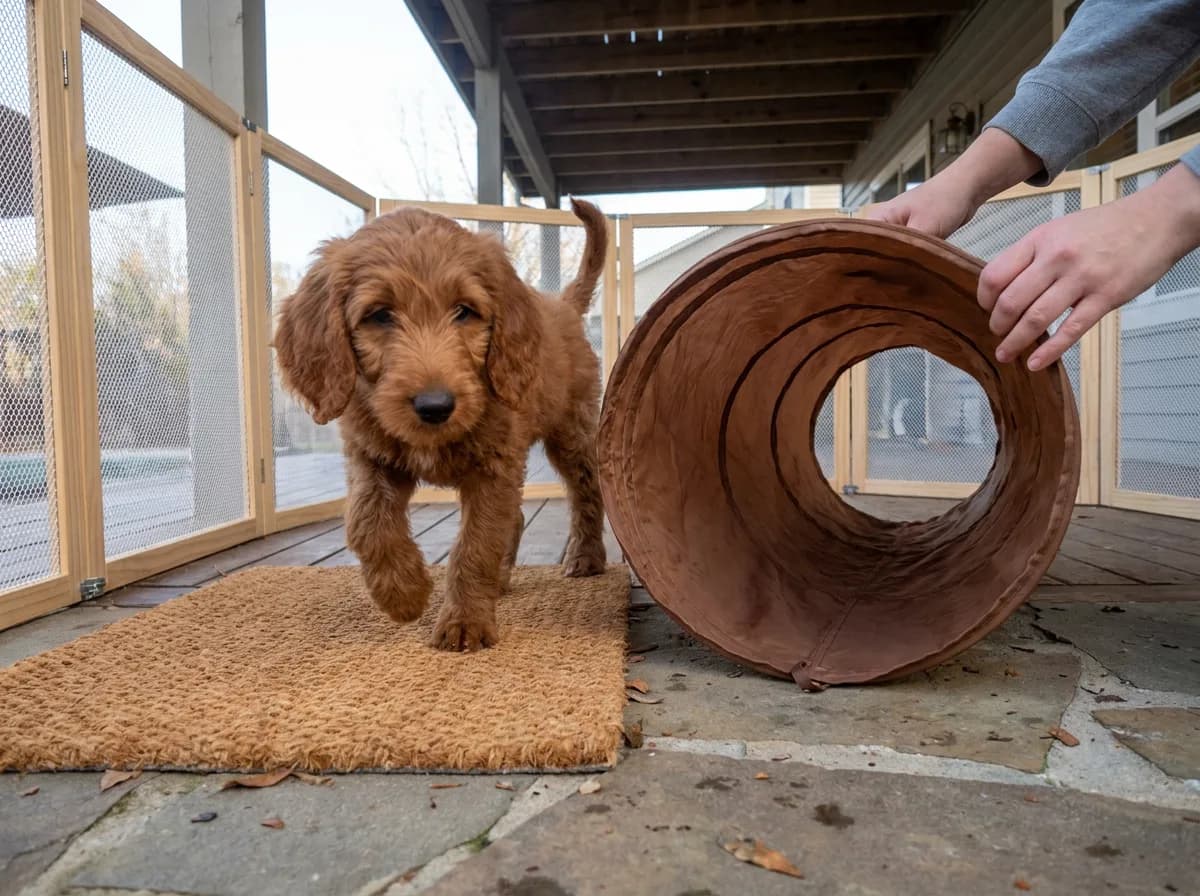
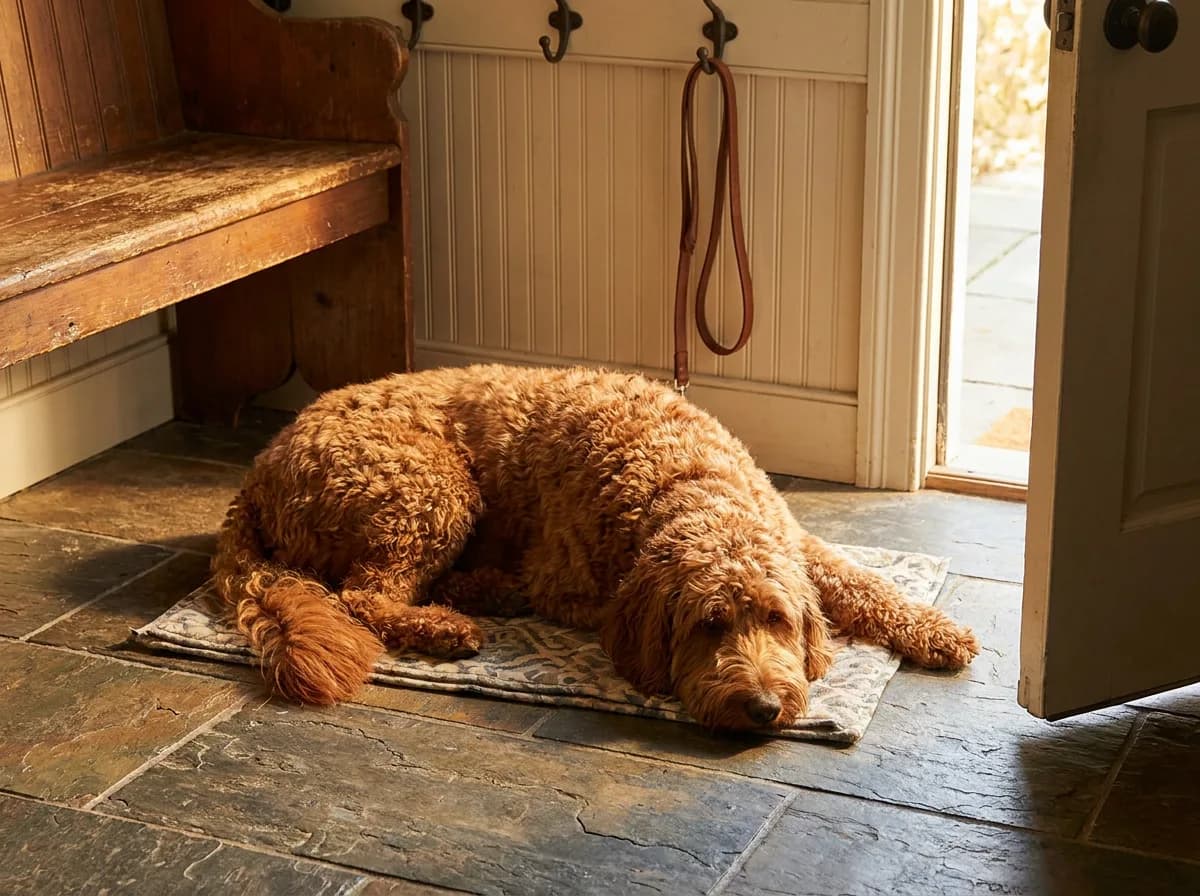
Irish Doodle pictures may show long legs, hanging ears, a bearded face, and coats ranging from loose waves to more pronounced curls. Some dogs look more setter-like than others. A photograph cannot prove parentage, and a puppy's coat is not a reliable preview of every feature of the adult coat.
Red is strongly associated with the Irish Setter, but Irish Doodle listings may also describe apricot, black, chocolate or brown, white, red and white, or black and white dogs. Treat these as descriptions to verify, not separate Irish Doodle breeds. If an advertisement emphasizes merle or another unusual pattern, ask for documented lineage and a clear explanation rather than inferring ancestry from color.
Sporting ancestry needs an outlet
A resting surface should fit the way the dog sleeps. A large FurHaven sofa-style bed may suit some individuals, but compare its usable sleeping area with your dog's measurements. The purpose is a comfortable place to rest; a product name containing “orthopedic” is not a promise to prevent or treat joint disease.

Removable-cover sofa bed. Check usable sleeping space and entry height against your dog’s posture and mobility; no medical or calming outcome promised.
Petful may earn a commission when you click through to Chewy, at no extra cost to you.
The setter contribution makes interest in movement, scents, and exploring a sensible possibility to plan for. It does not guarantee hunting ability, nor does a Poodle parent guarantee effortless obedience. For a companion home, the useful response is a safe routine with opportunities to investigate, learn, play, and recover.
Watch the individual dog's preferences. One may enjoy retrieving a toy; another may prefer a relaxed sniffing walk or a short search game. You do not need to turn every outing into a training test, but you do need a way to keep the dog safe when something more interesting than you appears.
Irish Doodle Temperament and Daily Activity
The practical pros and cons of Irish Doodle temperament depend on your routine: a sociable, playful dog can be an engaging companion, while that enthusiasm needs daily direction and opportunities to settle. An intelligent dog can learn to walk politely, or learn that jumping, stealing objects, and pulling produce exciting results. The daily pattern you reinforce matters more than a general promise of an easy family dog.
- 1Combine sniffing and recall practice with play, learning, and adequate rest.
- 2Teach settling practice in manageable steps rather than relying on exhaustion.
- 3Supervise contact with children and other dogs; enthusiasm is not the same as safe manners.

Build variety into ordinary days
Instead of seeking one universal exercise quota, consider the dog's age, health, fitness, and behavior before and after activity. A puppy, a fit adult, and an older dog need different plans. Ask your veterinarian about appropriate activity when growth, injury, or a medical condition affects the choice.
A practical day can include several different jobs:
- A walk with time to sniff rather than constant marching.
- Short practice of useful cues such as coming when called and waiting at doors.
- A controlled game suited to the dog, with pauses before excitement escalates.
- Food-search or enrichment tasks that do not create frustration.
- Quiet time where the dog can sleep without repeated interruption.
If a day becomes unusually busy, have a backup plan. A trusted walker, a family member, or a change to your own schedule may help. A garden can provide convenience, but simply opening the back door does not tell you whether the dog has had meaningful activity or enough human contact.
Practice recall where mistakes are manageable
Begin in a quiet enclosed area and reward the dog for turning toward you and coming closer. Increase difficulty gradually rather than calling repeatedly when the dog is already absorbed in a distant bird or another dog. Use a suitable lead or long line where needed to prevent an untrained recall becoming a safety problem.
Check the setting before allowing more freedom. Roads, livestock, wildlife, unfamiliar dogs, and gaps in fencing change the decision. Good behavior in the kitchen does not establish that the same cue will work at a busy park. If the dog cannot respond at the current difficulty, reduce it and practice again.
For ordinary walks, the Frisco six-foot traffic leash offers a close-handling option when its fittings and weight suit the dog. This is a different tool from a long line used for distance-recall practice. Check the attachment to fitted walking equipment before going out.
Make rest an observable skill
Reward small moments of calm on a mat or bed while you are nearby. Start when the dog has had an appropriate opportunity to move and toilet, then keep the exercise easy enough to succeed. Gradually add normal household activity without expecting a young dog to remain still through every distraction.
Prepare for time apart
Being comfortable while you sit nearby is different from being comfortable when you leave. Build brief, manageable periods of separation into the routine and increase them according to the dog's response. Arrange help for absences the dog cannot yet manage. Do not assume that a sociable dog will automatically accept a full workday alone once it has had a walk.
A camera can help you observe what happens after you leave, but it does not teach the skill or replace care. Look at the whole picture: whether the dog settles, stays occupied comfortably, or shows persistent pacing, vocalizing, escape attempts, or other distress. Share concerning observations with your veterinarian or a qualified reward-based behavior professional.
A crate is useful only when it is appropriately sized and the dog is comfortable using it. It should not be used to force a distressed dog to endure an absence or to replace toilet opportunities and exercise. Plan a safe area and gradual introduction, and change the arrangement if confinement itself causes difficulty. The important outcome is comfortable, safe time apart, not simply a quiet house when you return.
Use enrichment with supervision
A food toy can give the dog a manageable activity while you sit nearby. A KONG Classic in Large is a candidate only when that size and rubber type suit the individual dog's mouth and chewing behavior. Follow the maker's guidance, inspect for damage, and supervise initial use.

Six-foot leash for supervised everyday walks when the clip and weight suit your dog. Not a long line for distance recall.
Petful may earn a commission when you click through to Chewy, at no extra cost to you.
Count edible fillings in the overall feeding plan and start with an easy task. A toy that is too difficult may produce frustration rather than useful engagement. Put it away if the dog damages it, guards it from household members, or cannot use it safely, and get appropriate professional advice about the behavior.
Teach household manners and toileting
Reward-based training gives everyone a clear way to respond to the same behavior. The American Veterinary Society of Animal Behavior recommends reward-based methods. Agree on simple household rules so the puppy is not invited to jump by one person and punished for it by another.
For potty training, provide frequent opportunities appropriate to the puppy's age and routine, reward toileting in the chosen place, and supervise indoors. Watch for patterns after waking, eating, playing, and drinking. Accidents are information about management and learning, not a reason for punishment after the event.
Introduce other dogs thoughtfully
Irish Doodle temperament with other dogs cannot be predicted from the cross name. Consider each dog's social experience, play style, and ability to disengage. Arrange calm introductions with space to move away, and use barriers or separate areas when close contact would be overwhelming.
Do not insist that a hesitant dog join a lively game. Watch whether both dogs choose to return after a pause, rather than assuming chasing and wrestling are welcome because neither has growled. Feed separately if needed and provide individual resting places. A friendly reputation does not remove the need for observation.
Irish Doodle Size and Everyday Care
Adult size depends on the actual parents and subsequent breeding, especially the Poodle variety. “Standard Irish Doodle” usually points to Standard Poodle ancestry, but it is not a standardized height or weight category for the cross. Ask for measured adult dimensions from both parents and, where available, previous adult offspring from the same pairing.

Adult Irish Doodle Size
A Standard-parent Irish Doodle can become a substantial dog, so plan beyond the puppy's current appearance. For orientation, the AKC lists Irish Setters at about 60 pounds for females and 70 for males, and Standard Poodles at 40–50 pounds for females and 60–70 for males. These are parent-breed figures, not guaranteed limits for their offspring. AKC breed weight chart
Those parent weights span roughly 18–32 kilograms. Height also varies: the Irish Setter profile lists approximately 25–27 inches, while the Standard Poodle category begins above 15 inches at the shoulder. Do not average these figures into a supposedly exact Irish Doodle size chart. A full-grown black Irish Doodle does not have a separate size range merely because of its color.
Track the individual rather than a formula
Record weight with the unit, date, and scale used. Measure height from level ground to the withers while the dog stands naturally, and ask your veterinary team to assess body condition. A monthly size chart divided into male and female targets would imply more certainty than the evidence supports for this varied cross.

Large rubber toy for supervised enrichment if sizing and chewing style suit. Follow the current size guide, inspect regularly and retire when damaged.
Petful may earn a commission when you click through to Chewy, at no extra cost to you.
For smaller-parent pairings, our Mini Irish Doodle guide explains the limits of mini, petite, toy, and similar labels. Use the parent's records and the individual puppy's progress for practical planning. Choosing a smaller label does not guarantee a less active dog or a particular adult weight.
Irish Doodle Lifespan and Preventive Care
There is no well-established lifespan dataset here that allows a precise prediction for Irish Doodles. Parent-breed estimates provide context, not an inherited timetable: the AKC lists 12–15 years for Irish Setters and 10–18 for Poodles. There is no supported basis in these sources for separate Irish Doodle male and female lifespan promises. Irish Setter profile, Poodle profile
Mixed ancestry does not eliminate health problems. Ask about health screening appropriate to both parent breeds and the Poodle variety, then review the actual results with your veterinarian. The Poodle Club of America distinguishes recommended screening for Standard, Miniature, and Toy Poodles; a generic DNA panel is not the same as every relevant clinical examination.
Keep routine care practical
Build preventive care around the dog, its history, and your location. Discuss vaccination, parasite prevention, nutrition, dental care, and any inherited health concerns with your veterinary team. Keep records from the breeder or rescue so new care is coordinated with what has already been done.
At home, use ordinary handling to notice changes without trying to diagnose them yourself:
- Check for new tangles, sore skin, or changes beneath the coat.
- Notice ear discomfort, odor, or repeated scratching and seek advice rather than treating blindly.
- Introduce gentle mouth and paw handling in short, rewarded sessions.
- Track changes in appetite, activity, toileting, or weight.
- Recheck collars and harnesses as the dog grows and after coat changes.
A harness marked Small should not be assumed to fit a Standard-parent adult. Follow the exact manufacturer's measurement instructions and choose a model that fits securely without restricting movement. The same principle applies to crates: the dog needs appropriate standing, turning, and resting clearance, not a size chosen from the word “Doodle.”
Is an Irish Doodle Right for Your Household?
The useful pros and cons are practical tradeoffs. Sociability may make shared activities rewarding, but can also mean you need a plan for time alone. Enthusiasm can support play and learning, while making greeting manners and child supervision especially important. A full coat can be attractive and still create substantial maintenance.

Who Is an Irish Doodle a Good Fit For?
An Irish Doodle can be a good fit for someone who enjoys an active companion, can teach everyday manners patiently, and accepts uncertainty in coat and adult traits. It may be a poor fit when the household needs a reliably low-maintenance dog, cannot arrange daytime care, or expects young children to manage a boisterous adolescent without help.
Evaluate the actual dog and your actual week. An experienced foster carer's description of how an adult behaves during visitors, walks, grooming, and quiet evenings may be more useful than a broad breed label. A puppy requires willingness to work through development without knowing every adult trait in advance.
Protect children and the dog from overwhelming contact
Set up greetings that do not involve running, crowding, or a child holding an excited dog by its collar. An adult should supervise and step in early when contact becomes too energetic. Give the dog a retreat where eating and sleeping are respected.
Teach children to invite interaction and allow the dog to move away. Do not describe tolerance as a reason to permit hugging, climbing, or taking objects from the dog's mouth. If size, jumping, or uncertainty makes a situation difficult to manage, use distance and barriers while you build skills with qualified help.
Test the routine on paper
Before choosing a puppy, walk through a typical workday, a rainy weekend, and a day when you are unwell. Identify who provides exercise, grooming, toilet breaks, and companionship in each situation. This makes hidden assumptions visible while you can still change the plan.
If you are considering another Poodle cross, use our Irish Doodle vs. Goldendoodle comparison to compare parentage, coat uncertainty, and household demands. Neither name guarantees the calmer or easier dog. An individual match and a sustainable routine matter more than a ranking of crossbreeds.
Finding a Puppy and Planning Coat Care
Choose a source that can explain the pairing, identify the parents, show relevant health records, and discuss the puppy's early experiences. Ask how the puppy responds to brushing, gentle restraint, unfamiliar sounds, and short periods away from littermates. Specific observations are more informative than describing every puppy as perfect for families.
For prices, breeder checks, adoption routes, and first-year planning, see our Irish Doodle puppy guide. A purchase price is only part of the commitment. Regular grooming, training support, routine veterinary care, and backup daytime care can matter more to the ongoing budget than a starter bag of supplies.
Choose a coat routine you can maintain
Ask a groomer to assess the dog's actual texture and demonstrate how to check through to the skin without pulling. Friction areas such as behind the ears, under the harness, and where the legs meet the body can need particular attention. A smooth surface does not prove the coat is free of tangles underneath.
A short practical cut and a longer teddy-bear style can require different home routines. Our Irish Doodle haircut guide explains how to agree on length, face shape, and maintenance with the groomer. Style names alone are not precise instructions, so describe what you can comfortably brush and comb between visits.
Separate shedding from allergies
Some Irish Doodles shed more visibly than others, and neither generation nor curl guarantees a non-shedding coat. A lower-shedding dog can still trigger a person's allergies. The AAAAI explains that no dog breed is truly hypoallergenic; allergy or asthma concerns belong in a discussion with an allergist before committing to the dog.
Do not use a brief visit as proof that living together will be symptom-free. Likewise, do not buy a puppy on the assumption that a haircut or shampoo can remove the problem. Make the household decision with realistic information about both the dog's care and the person's needs.
Irish Doodle Questions
Barking varies by individual and situation. Alert barking, excitement, frustration, and difficulty being alone need different responses. Observe what happens before the noise, address the underlying need, and use reinforced quiet behavior in manageable situations. A crossbreed label cannot predict the volume or frequency in your home. Persistent distress calls for qualified help rather than simply trying to suppress the sound.
They can require substantial coat care time and daily activity, especially if you keep a long coat or raise a lively puppy. Include grooming appointments, home combing, training, company, and rest in your plan. A shorter haircut can simplify some maintenance, but it does not remove the need for regular care or make the dog suitable for an otherwise incompatible schedule.
The foundation pairing is an Irish Setter and a Poodle parent. Later-generation Irish Doodles may come from crosses or backcrosses within that ancestry, so ask for the actual parent identities rather than relying only on an F label. Their appearance alone cannot establish the pairing or predict temperament, adult size, or health.
No. F1b generally describes a backcross, often to a Poodle, rather than a guarantee about the individual coat. Ask which dogs were paired and examine the actual coat as it develops. A curlier appearance does not prove that loose hair will be absent or that grooming will be easy. Lower visible shedding also does not mean allergy-free, so a household with allergy concerns needs a separate discussion with an allergist.
Use the same toilet area and offer frequent opportunities after waking, meals and play. Go with the puppy so you can reward the result promptly, then supervise indoors between trips. Keep the schedule consistent across caregivers and adjust it when accidents show the puppy cannot manage the interval. Intelligence does not replace this routine, and punishment after an accident does not teach where to go.
BVMS, MRCVS
Dr. Pippa Elliott, BVMS, MRCVS, is a veterinarian with nearly 30 years of experience in companion animal practice. Dr. Elliott earned her Bachelor of Veterinary Medicine and Surgery from the University of Glasgow. She was also designated a Member of the Royal College of Veterinary Surgeons. Married with 2 grown-up kids, Dr. Elliott has a naughty Puggle named Poggle, 3 cats and a bearded dragon.
Sign up for expert-backed reviews and safety alerts all in one place.